The Calcium Connection: Explaining Motor Neuron Vulnerability in ALS


Highlights
- Calcium dysregulation plays a key role in ALS, acting on the cellular, synaptic, and network levels to drive disease progression.
- Calcium dysregulation is linked to metabolic dysfunction, ER stress, and aberrant neuron-glia interactions.
- Understanding the role of calcium dysregulation in ALS can elucidate the causes of the selective vulnerability of classes of motor neurons in ALS
- Targeting calcium dysregulation can lead to the development of new therapeutic interventions.
Abstract
1. Introduction
1.1. ALS Etiology
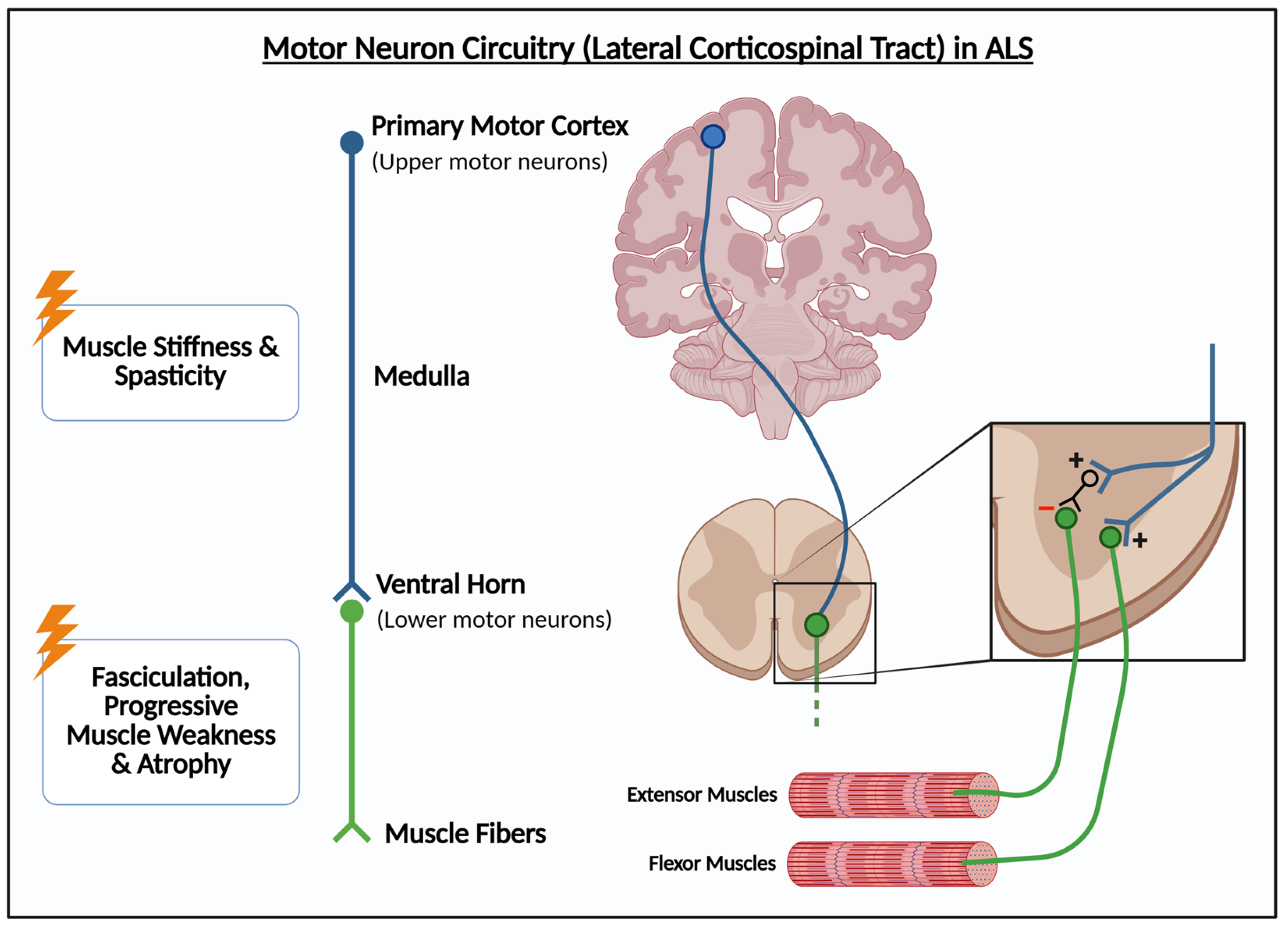
1.2. ALS Symptomology
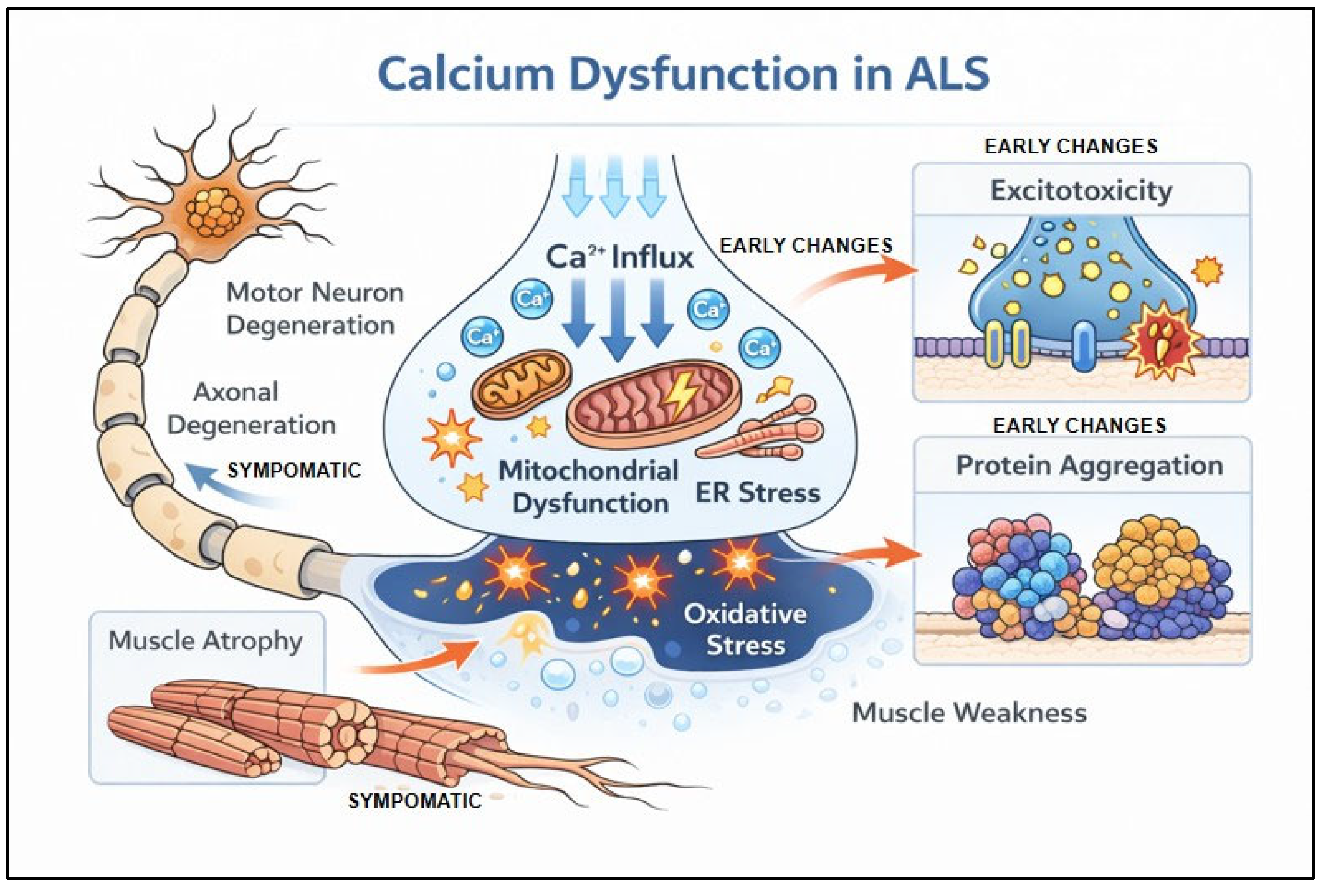
2. Calcium-Driven Hyperexcitability and Excitotoxicity
3. Calcium-Driven Hyperexcitability as a Neuroprotective Mechanism
4. Calcium, Metabolic Function, and Endoplasmic Reticulum Stress
5. Calcium and Toxic Protein Aggregation in ALS
6. Calcium Dysregulation in Glial Cells in ALS
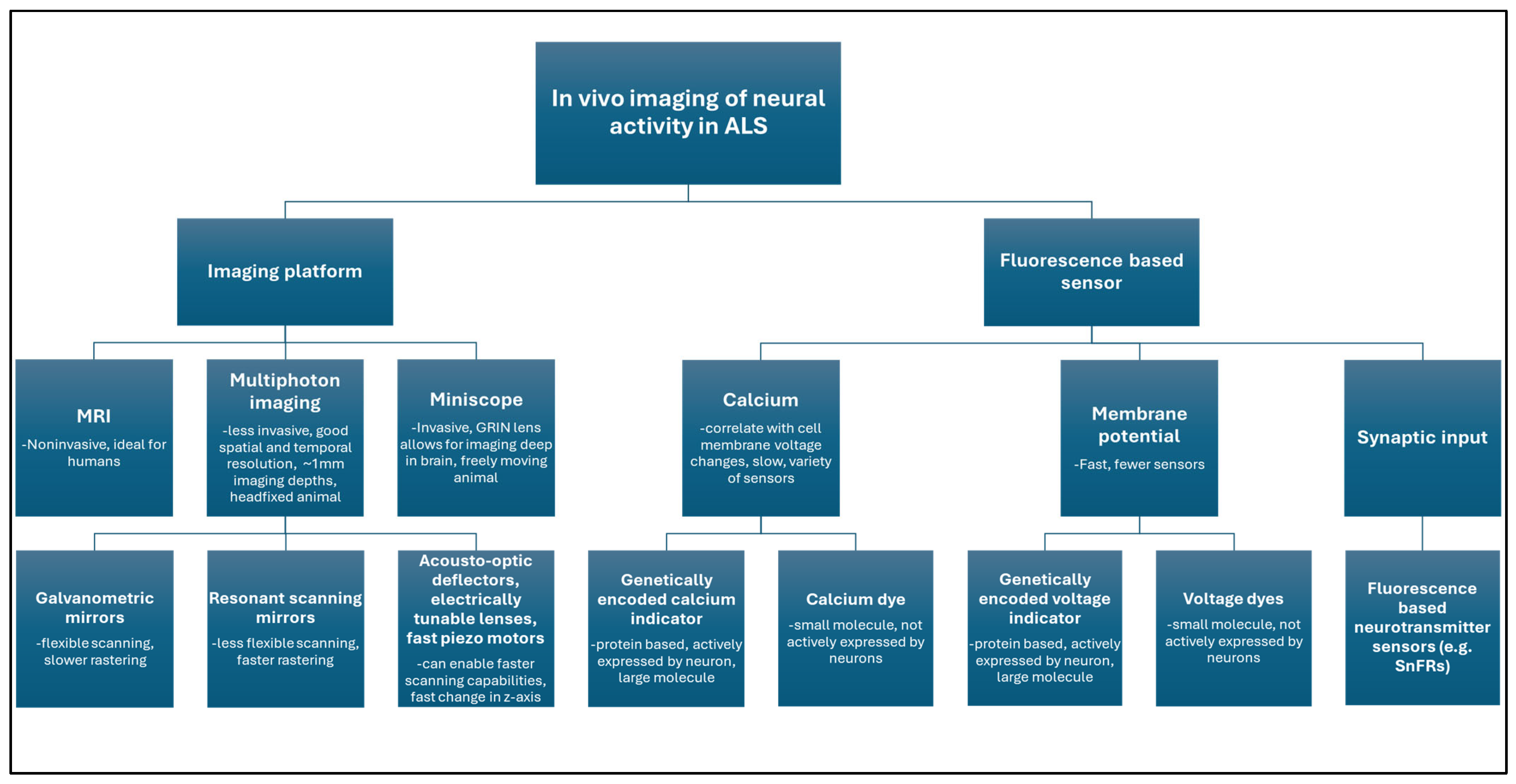
7. Tools for Analyzing Calcium in Motor Neurons
7.1. In Vivo Imaging Platforms
7.2. Fluorescence-Based Constructs
7.3. Imaging Calcium in Human Patients
8. Conclusions
Author Contributions
Funding
Institutional Review Board Statement
Data Availability Statement
Acknowledgments
Conflicts of Interest
References
- Arnold, F.J.; Putka, A.F.; Raychaudhuri, U.; Hsu, S.; Bedlack, R.S.; Bennett, C.L.; La Spada, A.R. Revisiting Glutamate Excitotoxicity in Amyotrophic Lateral Sclerosis and Age-Related Neurodegeneration. Int. J. Mol. Sci. 2024, 25, 5587. [Google Scholar] [CrossRef] [Scilit] [PubMed]
- Brotman, R.G.; Moreno-Escobar, M.C.; Joseph, J.; Munakomi, S.; Pawar, G. Amyotrophic Lateral Sclerosis. In StatPearls; StatPearls Publishing: Treasure Island, FL, USA, 2025. [Google Scholar]
- Talbott, E.O.; Malek, A.M.; Lacomis, D. The Epidemiology of Amyotrophic Lateral Sclerosis. Handb. Clin. Neurol. 2016, 138, 225–238. [Google Scholar] [CrossRef] [Scilit] [PubMed]
- Ingre, C.; Roos, P.M.; Piehl, F.; Kamel, F.; Fang, F. Risk Factors for Amyotrophic Lateral Sclerosis. Clin. Epidemiol. 2015, 7, 181–193. [Google Scholar] [CrossRef] [Scilit]
- Arnold, W.D.; Castoro, R.; Saxena, S. Innovations In Physical Medicine and Rehabilitation: Advances in the Diagnosis, Treatment, and Care of Amyotrophic Lateral Sclerosis. Mo. Med. 2025, 122, 199–205. [Google Scholar]
- Lee, J.W.; Kang, S.-W.; Choi, W.A. Clinical Course of Amyotrophic Lateral Sclerosis According to Initial Symptoms: An Analysis of 500 Cases. Yonsei Med. J. 2021, 62, 338–343. [Google Scholar] [CrossRef] [Scilit]
- Chen, L.; Chen, G.; Zhang, M.; Zhang, X. Modeling Sporadic Juvenile ALS in iPSC-Derived Motor Neurons Explores the Pathogenesis of FUSR503fs Mutation. Front. Cell. Neurosci. 2024, 18, 1364164. [Google Scholar] [CrossRef] [Scilit] [PubMed]
- Quinn, C.; Elman, L. Amyotrophic Lateral Sclerosis and Other Motor Neuron Diseases. Contin. Lifelong Learn. Neurol. 2020, 26, 1323–1347. [Google Scholar] [CrossRef] [Scilit]
- Morgan, S.; Orrell, R.W. Pathogenesis of Amyotrophic Lateral Sclerosis. Br. Med. Bull. 2016, 119, 87–98. [Google Scholar] [CrossRef] [Scilit]
- Rowland, L.P.; Shneider, N.A. Amyotrophic Lateral Sclerosis. N. Engl. J. Med. 2001, 344, 1688–1700. [Google Scholar] [CrossRef] [Scilit]
- Brown, R.H.; Al-Chalabi, A. Amyotrophic Lateral Sclerosis. N. Engl. J. Med. 2017, 377, 162–172. [Google Scholar] [CrossRef] [Scilit]
- Vanderhaeghe, S.; Prerad, J.; Tharkeshwar, A.K.; Goethals, E.; Vints, K.; Beckers, J.; Scheveneels, W.; Debroux, E.; Princen, K.; Van Damme, P.; et al. A Pathogenic Mutation in the ALS/FTD Gene VCP Induces Mitochondrial Hypermetabolism by Modulating the Permeability Transition Pore. Acta Neuropathol. Commun. 2024, 12, 161. [Google Scholar] [CrossRef] [Scilit]
- Grad, L.I.; Rouleau, G.A.; Ravits, J.; Cashman, N.R. Clinical Spectrum of Amyotrophic Lateral Sclerosis (ALS). Cold Spring Harb. Perspect. Med. 2017, 7, a024117. [Google Scholar] [CrossRef] [Scilit]
- Leal, S.S.; Gomes, C.M. Calcium Dysregulation Links ALS Defective Proteins and Motor Neuron Selective Vulnerability. Front. Cell. Neurosci. 2015, 9, 225. [Google Scholar] [CrossRef] [Scilit]
- Bond, S.; Saxena, S.; Sierra-Delgado, J.A. Microglia in ALS: Insights into Mechanisms and Therapeutic Potential. Cells 2025, 14, 421. [Google Scholar] [CrossRef] [Scilit] [PubMed]
- Chia, R.; Chiò, A.; Traynor, B.J. Novel Genes Associated with Amyotrophic Lateral Sclerosis: Diagnostic and Clinical Implications. Lancet Neurol. 2018, 17, 94–102. [Google Scholar] [CrossRef] [Scilit] [PubMed]
- Renton, A.E.; Chiò, A.; Traynor, B.J. State of Play in Amyotrophic Lateral Sclerosis Genetics. Nat. Neurosci. 2014, 17, 17–23. [Google Scholar] [CrossRef] [Scilit]
- Nijs, M.; Van Damme, P. The Genetics of Amyotrophic Lateral Sclerosis. Curr. Opin. Neurol. 2024, 37, 560–569. [Google Scholar] [CrossRef] [Scilit]
- Goutman, S.A.; Hardiman, O.; Al-Chalabi, A.; Chió, A.; Savelieff, M.G.; Kiernan, M.C.; Feldman, E.L. Emerging Insights into the Complex Genetics and Pathophysiology of Amyotrophic Lateral Sclerosis. Lancet Neurol. 2022, 21, 465–479. [Google Scholar] [CrossRef] [Scilit] [PubMed]
- Bagyinszky, E.; Hulme, J.; An, S.S.A. Studies of Genetic and Proteomic Risk Factors of Amyotrophic Lateral Sclerosis Inspire Biomarker Development and Gene Therapy. Cells 2023, 12, 1948. [Google Scholar] [CrossRef] [Scilit]
- Kim, G.; Gautier, O.; Tassoni-Tsuchida, E.; Ma, X.R.; Gitler, A.D. ALS Genetics: Gains, Losses, and Implications for Future Therapies. Neuron 2020, 108, 822–842. [Google Scholar] [CrossRef] [Scilit]
- Chiò, A.; Traynor, B.J.; Lombardo, F.; Fimognari, M.; Calvo, A.; Ghiglione, P.; Mutani, R.; Restagno, G. Prevalence of SOD1 Mutations in the Italian ALS Population. Neurology 2008, 70, 533–537. [Google Scholar] [CrossRef] [Scilit]
- Neumann, M.; Sampathu, D.M.; Kwong, L.K.; Truax, A.C.; Micsenyi, M.C.; Chou, T.T.; Bruce, J.; Schuck, T.; Grossman, M.; Clark, C.M.; et al. Ubiquitinated TDP-43 in Frontotemporal Lobar Degeneration and Amyotrophic Lateral Sclerosis. Science 2006, 314, 130–133. [Google Scholar] [CrossRef] [Scilit]
- Kabashi, E.; Bercier, V.; Lissouba, A.; Liao, M.; Brustein, E.; Rouleau, G.A.; Drapeau, P. FUS and TARDBP but Not SOD1 Interact in Genetic Models of Amyotrophic Lateral Sclerosis. PLoS Genet. 2011, 7, e1002214. [Google Scholar] [CrossRef] [Scilit] [PubMed]
- Johnson, J.O.; Mandrioli, J.; Benatar, M.; Abramzon, Y.; Van Deerlin, V.M.; Trojanowski, J.Q.; Gibbs, J.R.; Brunetti, M.; Gronka, S.; Wuu, J.; et al. Exome Sequencing Reveals VCP Mutations as a Cause of Familial ALS. Neuron 2010, 68, 857–864. [Google Scholar] [CrossRef] [Scilit] [PubMed]
- Pilotto, F.; Smeele, P.H.; Scheidegger, O.; Diab, R.; Schobesberger, M.; Sierra-Delgado, J.A.; Saxena, S. Kaempferol Enhances ER-Mitochondria Coupling and Protects Motor Neurons from Mitochondrial Dysfunction and ER Stress in C9ORF72-ALS. Acta Neuropathol. Commun. 2025, 13, 21. [Google Scholar] [CrossRef] [Scilit]
- Masrori, P.; Van Damme, P. Amyotrophic Lateral Sclerosis: A Clinical Review. Eur. J. Neurol. 2020, 27, 1918–1929. [Google Scholar] [CrossRef] [Scilit] [PubMed]
- DeJesus-Hernandez, M.; Mackenzie, I.R.; Boeve, B.F.; Boxer, A.L.; Baker, M.; Rutherford, N.J.; Nicholson, A.M.; Finch, N.A.; Flynn, H.; Adamson, J.; et al. Expanded GGGGCC Hexanucleotide Repeat in Noncoding Region of C9ORF72 Causes Chromosome 9p-Linked FTD and ALS. Neuron 2011, 72, 245–256. [Google Scholar] [CrossRef] [Scilit]
- Renton, A.E.; Majounie, E.; Waite, A.; Simón-Sánchez, J.; Rollinson, S.; Gibbs, J.R.; Schymick, J.C.; Laaksovirta, H.; van Swieten, J.C.; Myllykangas, L.; et al. A Hexanucleotide Repeat Expansion in C9ORF72 Is the Cause of Chromosome 9p21-Linked ALS-FTD. Neuron 2011, 72, 257–268. [Google Scholar] [CrossRef] [Scilit]
- Jiang, L.; Zhang, T.; Lu, K.; Qi, S. The Progress in C9orf72 Research: ALS/FTD Pathogenesis, Functions and Structure. Small GTPases 13 2022, 13, 56–76. [Google Scholar] [CrossRef] [Scilit]
- Smeyers, J.; Banchi, E.-G.; Latouche, M. C9ORF72: What It Is, What It Does, and Why It Matters. Front. Cell. Neurosci. 2021, 15, 661447. [Google Scholar] [CrossRef] [Scilit]
- Bozzoni, V.; Pansarasa, O.; Diamanti, L.; Nosari, G.; Cereda, C.; Ceroni, M. Amyotrophic Lateral Sclerosis and Environmental Factors. Funct. Neurol. 2016, 31, 7–19. [Google Scholar] [CrossRef] [Scilit]
- Morahan, J.M.; Yu, B.; Trent, R.J.; Pamphlett, R. Genetic Susceptibility to Environmental Toxicants in ALS. Am. J. Med. Genet. Part B Neuropsychiatr. Genet. Off. Publ. Int. Soc. Psychiatr. Genet. 2007, 144B, 885–890. [Google Scholar] [CrossRef] [Scilit] [PubMed]
- Verma, A. Clinical Manifestation and Management of Amyotrophic Lateral Sclerosis. In Amyotrophic Lateral Sclerosis; Araki, T., Ed.; Exon Publications: Brisbane, Australia, 2021; ISBN 978-0-6450017-7-8. [Google Scholar]
- de Carvalho, M.; Swash, M.; Pinto, S. Diaphragmatic Neurophysiology and Respiratory Markers in ALS. Front. Neurol. 2019, 10, 143. [Google Scholar] [CrossRef] [Scilit]
- Abramzon, Y.A.; Fratta, P.; Traynor, B.J.; Chia, R. The Overlapping Genetics of Amyotrophic Lateral Sclerosis and Frontotemporal Dementia. Front. Neurosci. 2020, 14, 42. [Google Scholar] [CrossRef] [Scilit]
- Burrell, J.R.; Kiernan, M.C.; Vucic, S.; Hodges, J.R. Motor Neuron Dysfunction in Frontotemporal Dementia. Brain J. Neurol. 2011, 134, 2582–2594. [Google Scholar] [CrossRef] [Scilit] [PubMed]
- Hur, S.K.; Hunter, M.; Dominique, M.A.; Farag, M.; Cotton-Samuel, D.; Khan, T.; Trojanowski, J.Q.; Spiller, K.J.; Lee, V.M.-Y. Slow Motor Neurons Resist Pathological TDP-43 and Mediate Motor Recovery in the rNLS8 Model of Amyotrophic Lateral Sclerosis. Acta Neuropathol. Commun. 2022, 10, 75. [Google Scholar] [CrossRef] [Scilit]
- Ovsepian, S.V.; O’Leary, V.B.; Martinez, S. Selective Vulnerability of Motor Neuron Types and Functional Groups to Degeneration in Amyotrophic Lateral Sclerosis: Review of the Neurobiological Mechanisms and Functional Correlates. Brain Struct. Funct. 2024, 229, 1–14. [Google Scholar] [CrossRef] [Scilit]
- Díaz-García, C.M.; Meyer, D.J.; Nathwani, N.; Rahman, M.; Martínez-François, J.R.; Yellen, G. The Distinct Roles of Calcium in Rapid Control of Neuronal Glycolysis and the Tricarboxylic Acid Cycle. eLife 2021, 10, e64821. [Google Scholar] [CrossRef] [Scilit] [PubMed]
- Südhof, T.C. Calcium Control of Neurotransmitter Release. Cold Spring Harb. Perspect. Biol. 2012, 4, a011353. [Google Scholar] [CrossRef] [Scilit]
- Gleichmann, M.; Mattson, M.P. Neuronal Calcium Homeostasis and Dysregulation. Antioxid. Redox Signal. 2011, 14, 1261–1273. [Google Scholar] [CrossRef] [Scilit]
- Brini, M.; Calì, T.; Ottolini, D.; Carafoli, E. Neuronal Calcium Signaling: Function and Dysfunction. Cell. Mol. Life Sci. CMLS 2014, 71, 2787–2814. [Google Scholar] [CrossRef] [Scilit] [PubMed]
- Zündorf, G.; Reiser, G. Calcium Dysregulation and Homeostasis of Neural Calcium in the Molecular Mechanisms of Neurodegenerative Diseases Provide Multiple Targets for Neuroprotection. Antioxid. Redox Signal. 2011, 14, 1275–1288. [Google Scholar] [CrossRef] [Scilit]
- Matuz-Mares, D.; González-Andrade, M.; Araiza-Villanueva, M.G.; Vilchis-Landeros, M.M.; Vázquez-Meza, H. Mitochondrial Calcium: Effects of Its Imbalance in Disease. Antioxidants 2022, 11, 801. [Google Scholar] [CrossRef] [Scilit]
- Dafinca, R.; Barbagallo, P.; Farrimond, L.; Candalija, A.; Scaber, J.; Ababneh, N.A.; Sathyaprakash, C.; Vowles, J.; Cowley, S.A.; Talbot, K. Impairment of Mitochondrial Calcium Buffering Links Mutations in C9ORF72 and TARDBP in iPS-Derived Motor Neurons from Patients with ALS/FTD. Stem Cell Rep. 2020, 14, 892–908. [Google Scholar] [CrossRef] [Scilit] [PubMed]
- Bursch, F.; Kalmbach, N.; Naujock, M.; Staege, S.; Eggenschwiler, R.; Abo-Rady, M.; Japtok, J.; Guo, W.; Hensel, N.; Reinhardt, P.; et al. Altered Calcium Dynamics and Glutamate Receptor Properties in iPSC-Derived Motor Neurons from ALS Patients with C9orf72, FUS, SOD1 or TDP43 Mutations. Hum. Mol. Genet. 2019, 28, 2835–2850. [Google Scholar] [CrossRef] [Scilit]
- Selvaraj, B.T.; Livesey, M.R.; Zhao, C.; Gregory, J.M.; James, O.T.; Cleary, E.M.; Chouhan, A.K.; Gane, A.B.; Perkins, E.M.; Dando, O.; et al. C9ORF72 Repeat Expansion Causes Vulnerability of Motor Neurons to Ca2+-Permeable AMPA Receptor-Mediated Excitotoxicity. Nat. Commun. 2018, 9, 347. [Google Scholar] [CrossRef] [Scilit] [PubMed]
- Kawahara, Y.; Ito, K.; Sun, H.; Aizawa, H.; Kanazawa, I.; Kwak, S. Glutamate Receptors: RNA Editing and Death of Motor Neurons. Nature 2004, 427, 801. [Google Scholar] [CrossRef] [Scilit]
- Takuma, H.; Kwak, S.; Yoshizawa, T.; Kanazawa, I. Reduction of GluR2 RNA Editing, a Molecular Change That Increases Calcium Influx through AMPA Receptors, Selective in the Spinal Ventral Gray of Patients with Amyotrophic Lateral Sclerosis. Ann. Neurol. 1999, 46, 806–815. [Google Scholar] [CrossRef] [Scilit]
- Guo, C.; Ma, Y.-Y. Calcium Permeable-AMPA Receptors and Excitotoxicity in Neurological Disorders. Front. Neural Circuits 2021, 15, 711564. [Google Scholar] [CrossRef] [Scilit]
- Hideyama, T.; Yamashita, T.; Suzuki, T.; Tsuji, S.; Higuchi, M.; Seeburg, P.H.; Takahashi, R.; Misawa, H.; Kwak, S. Induced Loss of ADAR2 Engenders Slow Death of Motor Neurons from Q/R Site-Unedited GluR2. J. Neurosci. 2010, 30, 11917–11925. [Google Scholar] [CrossRef] [Scilit]
- Huber, N.; Hoffmann, D.; Giniatullina, R.; Rostalski, H.; Leskelä, S.; Takalo, M.; Natunen, T.; Solje, E.; Remes, A.M.; Giniatullin, R.; et al. C9orf72 Hexanucleotide Repeat Expansion Leads to Altered Neuronal and Dendritic Spine Morphology and Synaptic Dysfunction. Neurobiol. Dis. 2022, 162, 105584. [Google Scholar] [CrossRef] [Scilit]
- Chikuchi, R.; Kato, Y.; Tomatsu, A.; Nishisaki, S.; Kawakami, Y.; Yoshimura, T.; Li, J.; Iguchi, Y.; Onodera, K.; Hashimoto, R.; et al. The TDP-43I383V Heterozygous Mutation Results in Increased TDP-43 Expression and Altered Neuronal Activity in ALS Patient-Derived iPSC Motor Neurons. Neurosci. Res. 2026, 222, 105003. [Google Scholar] [CrossRef] [Scilit]
- Grosskreutz, J.; Van Den Bosch, L.; Keller, B.U. Calcium Dysregulation in Amyotrophic Lateral Sclerosis. Cell Calcium 2010, 47, 165–174. [Google Scholar] [CrossRef] [Scilit]
- Vanselow, B.K.; Keller, B.U. Calcium Dynamics and Buffering in Oculomotor Neurones from Mouse That Are Particularly Resistant during Amyotrophic Lateral Sclerosis (ALS)-Related Motoneurone Disease. J. Physiol. 2000, 525, 433–445. [Google Scholar] [CrossRef] [Scilit] [PubMed]
- Palecek, J.; Lips, M.B.; Keller, B.U. Calcium Dynamics and Buffering in Motoneurones of the Mouse Spinal Cord. J. Physiol. 1999, 520, 485–502. [Google Scholar] [CrossRef] [Scilit] [PubMed]
- Amalyan, S.; Tamboli, S.; Lazarevich, I.; Topolnik, D.; Bouman, L.H.; Topolnik, L. Enhanced Motor Cortex Output and Disinhibition in Asymptomatic Female Mice with C9orf72 Genetic Expansion. Cell Rep. 2022, 40, 111043. [Google Scholar] [CrossRef] [Scilit]
- Jaiswal, M.K. Calcium, Mitochondria, and the Pathogenesis of ALS: The Good, the Bad, and the Ugly. Front. Cell. Neurosci. 2013, 7, 199. [Google Scholar] [CrossRef] [Scilit]
- Alexianu, M.E.; Ho, B.-K.; Mohamed, A.H.; La Bella, V.; Smith, R.G.; Appel, S.H. The Role of Calcium-Binding Proteins in Selective Motoneuron Vulnerability in Amyotrophic Lateral Sclerosis. Ann. Neurol. 1994, 36, 846–858. [Google Scholar] [CrossRef] [Scilit]
- Sun, D.; Amiri, M.; Meng, Q.; Unnithan, R.R.; French, C. Calcium Signalling in Neurological Disorders, with Insights from Miniature Fluorescence Microscopy. Cells 2024, 14, 4. [Google Scholar] [CrossRef] [Scilit] [PubMed]
- Tran, L.T.; Gentil, B.J.; Sullivan, K.E.; Durham, H.D. The Voltage-Gated Calcium Channel Blocker Lomerizine Is Neuroprotective in Motor Neurons Expressing Mutant SOD1, but Not TDP-43. J. Neurochem. 2014, 130, 455–466. [Google Scholar] [CrossRef] [Scilit]
- Patten, S.A.; Aggad, D.; Martinez, J.; Tremblay, E.; Petrillo, J.; Armstrong, G.A.; La Fontaine, A.; Maios, C.; Liao, M.; Ciura, S.; et al. Neuroleptics as Therapeutic Compounds Stabilizing Neuromuscular Transmission in Amyotrophic Lateral Sclerosis. JCI Insight 2017, 2, e97152. [Google Scholar] [CrossRef] [Scilit]
- Pozzi, S.; Thammisetty, S.S.; Julien, J.-P. Chronic Administration of Pimozide Fails to Attenuate Motor and Pathological Deficits in Two Mouse Models of Amyotrophic Lateral Sclerosis. Neurother. J. Am. Soc. Exp. Neurother. 2018, 15, 715–727. [Google Scholar] [CrossRef] [Scilit] [PubMed]
- Shum, C.; Hedges, E.C.; Allison, J.; Lee, Y.; Arias, N.; Cocks, G.; Chandran, S.; Ruepp, M.-D.; Shaw, C.E.; Nishimura, A.L. Mutations in FUS Lead to Synaptic Dysregulation in ALS-iPSC Derived Neurons. Stem Cell Rep. 2024, 19, 187–195. [Google Scholar] [CrossRef] [Scilit] [PubMed]
- Meszlényi, V.; Patai, R.; Polgár, T.F.; Nógrádi, B.; Körmöczy, L.; Kristóf, R.; Spisák, K.; Tripolszki, K.; Széll, M.; Obál, I.; et al. Passive Transfer of Sera from ALS Patients with Identified Mutations Evokes an Increased Synaptic Vesicle Number and Elevation of Calcium Levels in Motor Axon Terminals, Similar to Sera from Sporadic Patients. Int. J. Mol. Sci. 2020, 21, 5566. [Google Scholar] [CrossRef] [Scilit] [PubMed]
- Foerster, B.R.; Callaghan, B.C.; Petrou, M.; Edden, R.a.E.; Chenevert, T.L.; Feldman, E.L. Decreased Motor Cortex γ-Aminobutyric Acid in Amyotrophic Lateral Sclerosis. Neurology 2012, 78, 1596–1600. [Google Scholar] [CrossRef] [Scilit] [PubMed]
- Weerasekera, A.; Peeters, R.; Sima, D.; Dresselaers, T.; Sunaert, S.; De Vocht, J.; Claeys, K.; Van Huffel, S.; Van Damme, P.; Himmelreich, U. Motor Cortex Metabolite Alterations in Amyotrophic Lateral Sclerosis Assessed in Vivo Using Edited and Non-Edited Magnetic Resonance Spectroscopy. Brain Res. 2019, 1718, 22–31. [Google Scholar] [CrossRef] [Scilit]
- Hinchcliffe, M.; Smith, A. Riluzole: Real-World Evidence Supports Significant Extension of Median Survival Times in Patients with Amyotrophic Lateral Sclerosis. Degener. Neurol. Neuromuscul. Dis. 2017, 7, 61–70. [Google Scholar] [CrossRef] [Scilit] [PubMed]
- Leroy, F.; Lamotte d’Incamps, B.; Imhoff-Manuel, R.D.; Zytnicki, D. Early Intrinsic Hyperexcitability Does Not Contribute to Motoneuron Degeneration in Amyotrophic Lateral Sclerosis. eLife 2014, 3, e04046. [Google Scholar] [CrossRef] [Scilit]
- Venugopal, S.; Hsiao, C.-F.; Sonoda, T.; Wiedau-Pazos, M.; Chandler, S.H. Homeostatic Dysregulation in Membrane Properties of Masticatory Motoneurons Compared with Oculomotor Neurons in a Mouse Model for Amyotrophic Lateral Sclerosis. J. Neurosci. 2015, 35, 707–720. [Google Scholar] [CrossRef] [Scilit]
- Michalak, M. Calreticulin: Endoplasmic Reticulum Ca2+ Gatekeeper. J. Cell. Mol. Med. 2023, 28, e17839. [Google Scholar] [CrossRef] [Scilit]
- Clark, R.M.; Blizzard, C.A.; Young, K.M.; King, A.E.; Dickson, T.C. Calretinin and Neuropeptide Y Interneurons Are Differentially Altered in the Motor Cortex of the SOD1G93A Mouse Model of ALS. Sci. Rep. 2017, 7, 44461. [Google Scholar] [CrossRef] [Scilit] [PubMed]
- Petri, S.; Krampfl, K.; Hashemi, F.; Grothe, C.; Hori, A.; Dengler, R.; Bufler, J. Distribution of GABAA Receptor mRNA in the Motor Cortex of ALS Patients. J. Neuropathol. Exp. Neurol. 2003, 62, 1041–1051. [Google Scholar] [CrossRef] [Scilit] [PubMed]
- Mazurie, Z.; Branchereau, P.; Cattaert, D.; Henkous, N.; Savona-Baron, C.; Vouimba, R.-M. Acute Stress Differently Modulates Interneurons Excitability and Synaptic Plasticity in the Primary Motor Cortex of Wild-Type and SOD1G93A Mouse Model of ALS. J. Physiol. 2024, 602, 4987–5015. [Google Scholar] [CrossRef] [Scilit]
- Montañana-Rosell, R.; Selvan, R.; Hernández-Varas, P.; Kaminski, J.M.; Sidhu, S.K.; Ahlmark, D.B.; Kiehn, O.; Allodi, I. Spinal Inhibitory Neurons Degenerate before Motor Neurons and Excitatory Neurons in a Mouse Model of ALS. Sci. Adv. 2024, 10, eadk3229. [Google Scholar] [CrossRef] [Scilit]
- Nijssen, J.; Comley, L.H.; Hedlund, E. Motor Neuron Vulnerability and Resistance in Amyotrophic Lateral Sclerosis. Acta Neuropathol. 2017, 133, 863–885. [Google Scholar] [CrossRef] [Scilit]
- Schweingruber, C.; Hedlund, E. The Cell Autonomous and Non-Cell Autonomous Aspects of Neuronal Vulnerability and Resilience in Amyotrophic Lateral Sclerosis. Biology 2022, 11, 1191. [Google Scholar] [CrossRef] [Scilit]
- De Marco, G.; Lomartire, A.; Manera, U.; Canosa, A.; Grassano, M.; Casale, F.; Fuda, G.; Salamone, P.; Rinaudo, M.T.; Colombatto, S.; et al. Effects of Intracellular Calcium Accumulation on Proteins Encoded by the Major Genes Underlying Amyotrophic Lateral Sclerosis. Sci. Rep. 2022, 12, 395. [Google Scholar] [CrossRef] [Scilit] [PubMed]
- Park, J.H.; Chung, C.G.; Park, S.S.; Lee, D.; Kim, K.M.; Jeong, Y.; Kim, E.S.; Cho, J.H.; Jeon, Y.-M.; Shen, C.-K.J.; et al. Cytosolic Calcium Regulates Cytoplasmic Accumulation of TDP-43 through Calpain-A and Importin A3. eLife 2020, 9, e60132. [Google Scholar] [CrossRef] [Scilit]
- Waldherr, S.M.; Eck, R.J.; Hincks, J.C.; Currey, H.N.; Goldberg, M.; McMillan, P.J.; Saxton, A.D.; Hulsey-Vincent, H.J.; Latimer, C.S.; Kraemer, B.C.; et al. Calcineurin Depletion Coincides with Phosphorylated TDP-43 Deposition in a Mouse Model of ALS/FTLD-TDP. Acta Neuropathol. Commun. 2026, 14, 33. [Google Scholar] [CrossRef] [Scilit]
- Chen, L.; Song, M.; Yao, C. Calcineurin in Development and Disease. Genes Dis. 2022, 9, 915–927. [Google Scholar] [CrossRef] [Scilit] [PubMed]
- Liachko, N.F.; Saxton, A.D.; McMillan, P.J.; Strovas, T.J.; Currey, H.N.; Taylor, L.M.; Wheeler, J.M.; Oblak, A.L.; Ghetti, B.; Montine, T.J.; et al. The Phosphatase Calcineurin Regulates Pathological TDP-43 Phosphorylation. Acta Neuropathol. 2016, 132, 545–561. [Google Scholar] [CrossRef] [Scilit]
- Armstrong, G.A.B.; Drapeau, P. Calcium Channel Agonists Protect against Neuromuscular Dysfunction in a Genetic Model of TDP-43 Mutation in ALS. J. Neurosci. 2013, 33, 1741–1752. [Google Scholar] [CrossRef] [Scilit]
- Saxena, S.; Roselli, F.; Singh, K.; Leptien, K.; Julien, J.-P.; Gros-Louis, F.; Caroni, P. Neuroprotection through Excitability and mTOR Required in ALS Motoneurons to Delay Disease and Extend Survival. Neuron 2013, 80, 80–96. [Google Scholar] [CrossRef] [Scilit] [PubMed]
- Wate, R.; Ito, H.; Zhang, J.H.; Ohnishi, S.; Nakano, S.; Kusaka, H. Expression of an Endoplasmic Reticulum-Resident Chaperone, Glucose-Regulated Stress Protein 78, in the Spinal Cord of a Mouse Model of Amyotrophic Lateral Sclerosis. Acta Neuropathol. 2005, 110, 557–562. [Google Scholar] [CrossRef] [Scilit]
- Kikuchi, H.; Almer, G.; Yamashita, S.; Guégan, C.; Nagai, M.; Xu, Z.; Sosunov, A.A.; McKhann, G.M.; Przedborski, S. Spinal Cord Endoplasmic Reticulum Stress Associated with a Microsomal Accumulation of Mutant Superoxide Dismutase-1 in an ALS Model. Proc. Natl. Acad. Sci. USA 2006, 103, 6025–6030. [Google Scholar] [CrossRef] [Scilit] [PubMed]
- Zhao, C.; Liao, Y.; Rahaman, A.; Kumar, V. Towards Understanding the Relationship Between ER Stress and Unfolded Protein Response in Amyotrophic Lateral Sclerosis. Front. Aging Neurosci. 2022, 14, 892518. [Google Scholar] [CrossRef] [Scilit] [PubMed]
- Bernard-Marissal, N.; Moumen, A.; Sunyach, C.; Pellegrino, C.; Dudley, K.; Henderson, C.E.; Raoul, C.; Pettmann, B. Reduced Calreticulin Levels Link Endoplasmic Reticulum Stress and Fas-Triggered Cell Death in Motoneurons Vulnerable to ALS. J. Neurosci. 2012, 32, 4901–4912. [Google Scholar] [CrossRef] [Scilit]
- Saxena, S.; Cabuy, E.; Caroni, P. A Role for Motoneuron Subtype-Selective ER Stress in Disease Manifestations of FALS Mice. Nat. Neurosci. 2009, 12, 627–636. [Google Scholar] [CrossRef] [Scilit]
- Tadic, V.; Prell, T.; Lautenschlaeger, J.; Grosskreutz, J. The ER Mitochondria Calcium Cycle and ER Stress Response as Therapeutic Targets in Amyotrophic Lateral Sclerosis. Front. Cell. Neurosci. 2014, 8, 147. [Google Scholar] [CrossRef] [Scilit]
- De Lorenzo, F.; Lüningschrör, P.; Nam, J.; Beckett, L.; Pilotto, F.; Galli, E.; Lindholm, P.; Rüdt von Collenberg, C.; Mungwa, S.T.; Jablonka, S.; et al. CDNF Rescues Motor Neurons in Models of Amyotrophic Lateral Sclerosis by Targeting Endoplasmic Reticulum Stress. Brain 2023, 146, 3783–3799. [Google Scholar] [CrossRef] [Scilit]
- Moss, K.R.; Saxena, S. Schwann Cells in Neuromuscular Disorders: A Spotlight on Amyotrophic Lateral Sclerosis. Cells 2025, 14, 47. [Google Scholar] [CrossRef] [Scilit] [PubMed]
- Verma, M.; Wills, Z.; Chu, C.T. Excitatory Dendritic Mitochondrial Calcium Toxicity: Implications for Parkinson’s and Other Neurodegenerative Diseases. Front. Neurosci. 2018, 12, 523. [Google Scholar] [CrossRef] [Scilit]
- Lautenschläger, J.; Prell, T.; Ruhmer, J.; Weidemann, L.; Witte, O.W.; Grosskreutz, J. Overexpression of Human Mutated G93A SOD1 Changes Dynamics of the ER Mitochondria Calcium Cycle Specifically in Mouse Embryonic Motor Neurons. Exp. Neurol. 2013, 247, 91–100. [Google Scholar] [CrossRef] [Scilit]
- Taylor, C.W.; Tovey, S.C. IP3 Receptors: Toward Understanding Their Activation. Cold Spring Harb. Perspect. Biol. 2010, 2, a004010. [Google Scholar] [CrossRef] [Scilit]
- Wuytack, F.; Raeymaekers, L.; Missiaen, L. Molecular Physiology of the SERCA and SPCA Pumps. Cell Calcium 2002, 32, 279–305. [Google Scholar] [CrossRef] [Scilit]
- Gunter, T.E.; Sheu, S.-S. Characteristics and Possible Functions of Mitochondrial Ca2+ Transport Mechanisms. Biochim. Biophys. Acta BBA—Bioenerg. 2009, 1787, 1291–1308. [Google Scholar] [CrossRef] [Scilit] [PubMed]
- Pivovarova, N.B.; Andrews, S.B. Calcium-Dependent Mitochondrial Function and Dysfunction in Neurons. FEBS J. 2010, 277, 3622–3636. [Google Scholar] [CrossRef] [Scilit]
- Pilotto, F.; Toth, T.D.; Bond, S.; Schmitz, A.; Diab, R.; Tenlep, S.Y.N.; Mooney, B.; Erni, S.; Schobesberger, M.; Scheidegger, O.; et al. Engineered GM1 Intersects Between Mitochondrial and Synaptic Pathways to Ameliorate ALS Pathology. Adv. Sci. 2026, e14128. [Google Scholar] [CrossRef] [Scilit] [PubMed]
- Jaiswal, M.K.; Zech, W.-D.; Goos, M.; Leutbecher, C.; Ferri, A.; Zippelius, A.; Carrì, M.T.; Nau, R.; Keller, B.U. Impairment of Mitochondrial Calcium Handling in a mtSOD1 Cell Culture Model of Motoneuron Disease. BMC Neurosci. 2009, 10, 64. [Google Scholar] [CrossRef] [Scilit]
- Božič, J.; Motaln, H.; Janež, A.P.; Markič, L.; Tripathi, P.; Yamoah, A.; Aronica, E.; Lee, Y.-B.; Heilig, R.; Fischer, R.; et al. Interactome Screening of C9orf72 Dipeptide Repeats Reveals VCP Sequestration and Functional Impairment by polyGA. Brain 2022, 145, 684–699. [Google Scholar] [CrossRef] [Scilit]
- Pilotto, F.; Schmitz, A.; Maharjan, N.; Diab, R.; Odriozola, A.; Tripathi, P.; Yamoah, A.; Scheidegger, O.; Oestmann, A.; Dennys, C.N.; et al. PolyGA Targets the ER Stress-Adaptive Response by Impairing GRP75 Function at the MAM in C9ORF72-ALS/FTD. Acta Neuropathol. 2022, 144, 939–966. [Google Scholar] [CrossRef] [Scilit]
- Raoul, C.; Estévez, A.G.; Nishimune, H.; Cleveland, D.W.; deLapeyrière, O.; Henderson, C.E.; Haase, G.; Pettmann, B. Motoneuron Death Triggered by a Specific Pathway Downstream of Fas: Potentiation by ALS-Linked SOD1 Mutations. Neuron 2002, 35, 1067–1083. [Google Scholar] [CrossRef] [Scilit] [PubMed]
- Kawamata, H.; Manfredi, G. Mitochondrial Dysfunction and Intracellular Calcium Dysregulation in ALS. Mech. Ageing Dev. 2010, 131, 517–526. [Google Scholar] [CrossRef] [Scilit]
- Gupta, R.; Santiago, E.; Verma, A.; Rao, R. Calcium Dysregulation in Amyotrophic Lateral Sclerosis. Physiology 2025, 40, 0749. [Google Scholar] [CrossRef] [Scilit]
- Ruegsegger, C.; Maharjan, N.; Goswami, A.; Filézac de L’Etang, A.; Weis, J.; Troost, D.; Heller, M.; Gut, H.; Saxena, S. Aberrant Association of Misfolded SOD1 with Na+/K+ATPase-α3 Impairs Its Activity and Contributes to Motor Neuron Vulnerability in ALS. Acta Neuropathol. 2016, 131, 427–451. [Google Scholar] [CrossRef] [Scilit]
- Nahm, M.; Lim, S.M.; Kim, Y.-E.; Park, J.; Noh, M.-Y.; Lee, S.; Roh, J.E.; Hwang, S.-M.; Park, C.-K.; Kim, Y.H.; et al. ANXA11 Mutations in ALS Cause Dysregulation of Calcium Homeostasis and Stress Granule Dynamics. Sci. Transl. Med. 2020, 12, eaax3993. [Google Scholar] [CrossRef] [Scilit]
- Xie, M.; Pallegar, P.N.; Parusel, S.; Nguyen, A.T.; Wu, L.-J. Regulation of Cortical Hyperexcitability in Amyotrophic Lateral Sclerosis: Focusing on Glial Mechanisms. Mol. Neurodegener. 2023, 18, 75. [Google Scholar] [CrossRef] [Scilit]
- Isbrandt, D. A Mechanistic Link between Glia and Neuronal Excitability in Acute Neuroinflammation. J. Physiol. 2017, 595, 603–604. [Google Scholar] [CrossRef] [Scilit]
- Pascual, O.; Ben Achour, S.; Rostaing, P.; Triller, A.; Bessis, A. Microglia Activation Triggers Astrocyte-Mediated Modulation of Excitatory Neurotransmission. Proc. Natl. Acad. Sci. USA 2012, 109, E197–E205. [Google Scholar] [CrossRef] [Scilit]
- Chen, T.; Lennon, V.A.; Liu, Y.U.; Bosco, D.B.; Li, Y.; Yi, M.-H.; Zhu, J.; Wei, S.; Wu, L.-J. Astrocyte-Microglia Interaction Drives Evolving Neuromyelitis Optica Lesion. J. Clin. Investig. 2020, 130, 4025–4038. [Google Scholar] [CrossRef] [Scilit] [PubMed]
- Cocozza, G.; di Castro, M.A.; Carbonari, L.; Grimaldi, A.; Antonangeli, F.; Garofalo, S.; Porzia, A.; Madonna, M.; Mainiero, F.; Santoni, A.; et al. Ca2+-Activated K+ Channels Modulate Microglia Affecting Motor Neuron Survival in hSOD1G93A Mice. Brain. Behav. Immun. 2018, 73, 584–595. [Google Scholar] [CrossRef] [Scilit]
- Cocozza, G.; Garofalo, S.; Morotti, M.; Chece, G.; Grimaldi, A.; Lecce, M.; Scavizzi, F.; Menghini, R.; Casagrande, V.; Federici, M.; et al. The Feeding Behaviour of Amyotrophic Lateral Sclerosis Mouse Models Is Modulated by the Ca2+-activated KCa3.1 Channels. Br. J. Pharmacol. 2021, 178, 4891–4906. [Google Scholar] [CrossRef] [Scilit]
- Kerk, S.Y.; Bai, Y.; Smith, J.; Lalgudi, P.; Hunt, C.; Kuno, J.; Nuara, J.; Yang, T.; Lanza, K.; Chan, N.; et al. Homozygous ALS-Linked FUS P525L Mutations Cell- Autonomously Perturb Transcriptome Profile and Chemoreceptor Signaling in Human iPSC Microglia. Stem Cell Rep. 2022, 17, 678–692. [Google Scholar] [CrossRef] [Scilit]
- Poon, H.F.; Hensley, K.; Thongboonkerd, V.; Merchant, M.L.; Lynn, B.C.; Pierce, W.M.; Klein, J.B.; Calabrese, V.; Butterfield, D.A. Redox Proteomics Analysis of Oxidatively Modified Proteins in G93A-SOD1 Transgenic Mice—A Model of Familial Amyotrophic Lateral Sclerosis. Free Radic. Biol. Med. 2005, 39, 453–462. [Google Scholar] [CrossRef] [Scilit]
- Cassina, P.; Cassina, A.; Pehar, M.; Castellanos, R.; Gandelman, M.; de León, A.; Robinson, K.M.; Mason, R.P.; Beckman, J.S.; Barbeito, L.; et al. Mitochondrial Dysfunction in SOD1G93A-Bearing Astrocytes Promotes Motor Neuron Degeneration: Prevention by Mitochondrial-Targeted Antioxidants. J. Neurosci. 2008, 28, 4115–4122. [Google Scholar] [CrossRef] [Scilit]
- Kawamata, H.; Ng, S.K.; Diaz, N.; Burstein, S.; Morel, L.; Osgood, A.; Sider, B.; Higashimori, H.; Haydon, P.G.; Manfredi, G.; et al. Abnormal Intracellular Calcium Signaling and SNARE-Dependent Exocytosis Contributes to SOD1G93A Astrocyte-Mediated Toxicity in Amyotrophic Lateral Sclerosis. J. Neurosci. Off. J. Soc. Neurosci. 2014, 34, 2331–2348. [Google Scholar] [CrossRef] [Scilit] [PubMed]
- Milošević, M.; Bataveljić, D.; Nikolić, L.; Bijelić, D.; Andjus, P. The Effect of Amyotrophic Lateral Sclerosis-Linked Exogenous SOD1-G93A on Electrophysiological Properties and Intracellular Calcium in Cultured Rat Astrocytes. Amyotroph. Lateral Scler. Front. Degener. 2016, 17, 443–451. [Google Scholar] [CrossRef] [Scilit] [PubMed]
- Norante, R.P.; Peggion, C.; Rossi, D.; Martorana, F.; De Mario, A.; Lia, A.; Massimino, M.L.; Bertoli, A. ALS-Associated SOD1(G93A) Decreases SERCA Pump Levels and Increases Store-Operated Ca2+ Entry in Primary Spinal Cord Astrocytes from a Transgenic Mouse Model. Int. J. Mol. Sci. 2019, 20, 5151. [Google Scholar] [CrossRef] [Scilit] [PubMed]
- Velebit, J.; Horvat, A.; Smolič, T.; Prpar Mihevc, S.; Rogelj, B.; Zorec, R.; Vardjan, N. Astrocytes with TDP-43 Inclusions Exhibit Reduced Noradrenergic cAMP and Ca2+ Signaling and Dysregulated Cell Metabolism. Sci. Rep. 2020, 10, 6003. [Google Scholar] [CrossRef] [Scilit]
- Fritz, E.; Izaurieta, P.; Weiss, A.; Mir, F.R.; Rojas, P.; Gonzalez, D.; Rojas, F.; Brown, R.H.; Madrid, R.; van Zundert, B. Mutant SOD1-Expressing Astrocytes Release Toxic Factors That Trigger Motoneuron Death by Inducing Hyperexcitability. J. Neurophysiol. 2013, 109, 2803–2814. [Google Scholar] [CrossRef] [Scilit]
- Gunes, Z.I.; Kan, V.W.Y.; Ye, X.; Liebscher, S. Exciting Complexity: The Role of Motor Circuit Elements in ALS Pathophysiology. Front. Neurosci. 2020, 14, 573. [Google Scholar] [CrossRef] [Scilit] [PubMed]
- Martorana, F.; Brambilla, L.; Valori, C.F.; Bergamaschi, C.; Roncoroni, C.; Aronica, E.; Volterra, A.; Bezzi, P.; Rossi, D. The BH4 Domain of Bcl-X(L) Rescues Astrocyte Degeneration in Amyotrophic Lateral Sclerosis by Modulating Intracellular Calcium Signals. Hum. Mol. Genet. 2012, 21, 826–840. [Google Scholar] [CrossRef] [Scilit]
- McCauley, M.E.; Baloh, R.H. Inflammation in ALS/FTD Pathogenesis. Acta Neuropathol. 2019, 137, 715–730. [Google Scholar] [CrossRef] [Scilit]
- Jong Huat, T.; Camats-Perna, J.; Newcombe, E.A.; Onraet, T.; Campbell, D.; Sucic, J.T.; Martini, A.; Forner, S.; Mirzaei, M.; Poon, W.; et al. The Impact of Astrocytic NF-κB on Healthy and Alzheimer’s Disease Brains. Sci. Rep. 2024, 14, 14305. [Google Scholar] [CrossRef] [Scilit]
- Lee, H.-K.; Barbarosie, M.; Kameyama, K.; Bear, M.F.; Huganir, R.L. Regulation of Distinct AMPA Receptor Phosphorylation Sites during Bidirectional Synaptic Plasticity. Nature 2000, 405, 955–959. [Google Scholar] [CrossRef] [Scilit]
- Douthwaite, C.; Tietje, C.; Ye, X.; Liebscher, S. Probing Cerebellar Circuit Dysfunction in Rodent Models of Spinocerebellar Ataxia by Means of in Vivo Two-Photon Calcium Imaging. STAR Protoc. 2024, 5, 102911. [Google Scholar] [CrossRef] [Scilit]
- Croci, D.; Zomer, A.; Kowal, J.; Joyce, J.A. Cranial Imaging Window Implantation Technique for Longitudinal Multimodal Imaging of the Brain Environment in Live Mice. STAR Protoc. 2023, 4, 102197. [Google Scholar] [CrossRef] [Scilit]
- Denk, W.; Delaney, K.R.; Gelperin, A.; Kleinfeld, D.; Strowbridge, B.W.; Tank, D.W.; Yuste, R. Anatomical and Functional Imaging of Neurons Using 2-Photon Laser Scanning Microscopy. J. Neurosci. Methods 1994, 54, 151–162. [Google Scholar] [CrossRef] [Scilit]
- Svoboda, K.; Denk, W.; Kleinfeld, D.; Tank, D.W. In Vivo Dendritic Calcium Dynamics in Neocortical Pyramidal Neurons. Nature 1997, 385, 161–165. [Google Scholar] [CrossRef] [Scilit] [PubMed]
- Rodríguez, C.; Liang, Y.; Lu, R.; Ji, N. Three-Photon Fluorescence Microscopy with an Axially Elongated Bessel Focus. Opt. Lett. 2018, 43, 1914–1917. [Google Scholar] [CrossRef] [Scilit] [PubMed]
- Xiao, Y.; Deng, P.; Zhao, Y.; Yang, S.; Li, B. Three-Photon Excited Fluorescence Imaging in Neuroscience: From Principles to Applications. Front. Neurosci. 2023, 17, 1085682. [Google Scholar] [CrossRef] [Scilit] [PubMed]
- Chen, B.; Huang, X.; Gou, D.; Zeng, J.; Chen, G.; Pang, M.; Hu, Y.; Zhao, Z.; Zhang, Y.; Zhou, Z.; et al. Rapid Volumetric Imaging with Bessel-Beam Three-Photon Microscopy. Biomed. Opt. Express 2018, 9, 1992–2000. [Google Scholar] [CrossRef] [Scilit]
- Aharoni, D.; Khakh, B.S.; Silva, A.J.; Golshani, P. All the Light That We Can See: A New Era in Miniaturized Microscopy. Nat. Methods 2019, 16, 11–13. [Google Scholar] [CrossRef] [Scilit]
- Guo, C.; Blair, G.J.; Sehgal, M.; Sangiuliano Jimka, F.N.; Bellafard, A.; Silva, A.J.; Golshani, P.; Basso, M.A.; Blair, H.T.; Aharoni, D. Miniscope-LFOV: A Large-Field-of-View, Single-Cell-Resolution, Miniature Microscope for Wired and Wire-Free Imaging of Neural Dynamics in Freely Behaving Animals. Sci. Adv. 2023, 9, eadg3918. [Google Scholar] [CrossRef] [Scilit]
- Werner, C.T.; Williams, C.J.; Fermelia, M.R.; Lin, D.-T.; Li, Y. Circuit Mechanisms of Neurodegenerative Diseases: A New Frontier with Miniature Fluorescence Microscopy. Front. Neurosci. 2019, 13, 494308. [Google Scholar] [CrossRef] [Scilit]
- Liang, B.; Thapa, R.; Zhang, G.; Moffitt, C.; Zhang, Y.; Zhang, L.; Johnston, A.; Ruby, H.P.; Barbera, G.; Wong, P.C.; et al. Aberrant Neural Activity in Prefrontal Pyramidal Neurons Lacking TDP-43 Precedes Neuron Loss. Prog. Neurobiol. 2022, 215, 102297. [Google Scholar] [CrossRef] [Scilit] [PubMed]
- Qian, L.; Liu, Y.; Chen, Y.; Wu, J. High-Throughput Two-Photon Volumetric Brain Imaging in Freely Moving Mice. Nat. Commun. 2025, 17, 206. [Google Scholar] [CrossRef] [Scilit]
- Zhou, A.; Engelmann, S.A.; Mihelic, S.A.; Tomar, A.; Hassan, A.M.; Dunn, A.K. Evaluation of Resonant Scanning as a High-Speed Imaging Technique for Two-Photon Imaging of Cortical Vasculature. Biomed. Opt. Express 2022, 13, 1374–1385. [Google Scholar] [CrossRef] [Scilit]
- Akondi, V.; Kowalski, B.; Burns, S.A.; Dubra, A. Dynamic Distortion in Resonant Galvanometric Optical Scanners. Optica 2020, 7, 1506–1513. [Google Scholar] [CrossRef] [Scilit]
- Grewe, B.F.; Voigt, F.F.; van ’t Hoff, M.; Helmchen, F. Fast Two-Layer Two-Photon Imaging of Neuronal Cell Populations Using an Electrically Tunable Lens. Biomed. Opt. Express 2011, 2, 2035–2046. [Google Scholar] [CrossRef] [Scilit] [PubMed]
- Sakaki, K.D.R.; Coleman, P.; Toth, T.D.; Guerrier, C.; Haas, K. Automating Event-Detection of Brain Neuron Synaptic Activity and Action Potential Firing in Vivo Using a Random-Access Multiphoton Laser Scanning Microscope for Real-Time Analysis. In Proceedings of the 2018 40th Annual International Conference of the IEEE Engineering in Medicine and Biology Society (EMBC), Honolulu, HI, USA, 18–21 July 2018; pp. 1–7. [Google Scholar]
- Sakaki, K.D.R.; Podgorski, K.; Dellazizzo Toth, T.A.; Coleman, P.; Haas, K. Comprehensive Imaging of Sensory-Evoked Activity of Entire Neurons Within the Awake Developing Brain Using Ultrafast AOD-Based Random-Access Two-Photon Microscopy. Front. Neural Circuits 2020, 14, 33. [Google Scholar] [CrossRef] [Scilit]
- Chen, T.-W.; Wardill, T.J.; Sun, Y.; Pulver, S.R.; Renninger, S.L.; Baohan, A.; Schreiter, E.R.; Kerr, R.A.; Orger, M.B.; Jayaraman, V.; et al. Ultrasensitive Fluorescent Proteins for Imaging Neuronal Activity. Nature 2013, 499, 295–300. [Google Scholar] [CrossRef] [Scilit]
- Nakai, J.; Ohkura, M.; Imoto, K. A High Signal-to-Noise Ca2+ Probe Composed of a Single Green Fluorescent Protein. Nat. Biotechnol. 2001, 19, 137–141. [Google Scholar] [CrossRef] [Scilit]
- Zhang, Y.; Rózsa, M.; Liang, Y.; Bushey, D.; Wei, Z.; Zheng, J.; Reep, D.; Broussard, G.J.; Tsang, A.; Tsegaye, G.; et al. Fast and Sensitive GCaMP Calcium Indicators for Imaging Neural Populations. Nature 2023, 615, 884–891. [Google Scholar] [CrossRef] [Scilit]
- Dana, H.; Sun, Y.; Mohar, B.; Hulse, B.K.; Kerlin, A.M.; Hasseman, J.P.; Tsegaye, G.; Tsang, A.; Wong, A.; Patel, R.; et al. High-Performance Calcium Sensors for Imaging Activity in Neuronal Populations and Microcompartments. Nat. Methods 2019, 16, 649–657. [Google Scholar] [CrossRef] [Scilit] [PubMed]
- Katona, G.; Szalay, G.; Maák, P.; Kaszás, A.; Veress, M.; Hillier, D.; Chiovini, B.; Vizi, E.S.; Roska, B.; Rózsa, B. Fast Two-Photon in Vivo Imaging with Three-Dimensional Random-Access Scanning in Large Tissue Volumes. Nat. Methods 2012, 9, 201–208. [Google Scholar] [CrossRef] [Scilit]
- Sun, W.; McConnell, E.; Pare, J.-F.; Xu, Q.; Chen, M.; Peng, W.; Lovatt, D.; Han, X.; Smith, Y.; Nedergaard, M. Glutamate-Dependent Neuroglial Calcium Signaling Differs Between Young and Adult Brain. Science 2013, 339, 197–200. [Google Scholar] [CrossRef] [Scilit] [PubMed]
- Guerrier, C.; Dellazizzo Toth, T.; Galtier, N.; Haas, K. An Algorithm Based on a Cable-Nernst Planck Model Predicting Synaptic Activity throughout the Dendritic Arbor with Micron Specificity. Neuroinformatics 2023, 21, 207–220. [Google Scholar] [CrossRef] [Scilit]
- Coleman, P.; Hogg, P.W.; Toth, T.D.; Haas, K. PyNeuroTrace—Python Code for Neural Activity Time Series. J. Open Source Softw. 2024, 9, 6877. [Google Scholar] [CrossRef] [Scilit]
- Xie, M.; Liang, Y.; Miller, A.S.; Pallegar, P.N.; Umpierre, A.D.; Wang, N.; Zhang, S.; Nagaraj, N.K.; Fogarty, Z.C.; Ghayal, N.B.; et al. Rod-Shaped Microglia Interact with Neuronal Dendrites to Attenuate Cortical Excitability during TDP-43-Related Neurodegeneration. Immunity 2025, 58, 3113–3129.e8. [Google Scholar] [CrossRef] [Scilit]
- Asakawa, K.; Handa, H.; Kawakami, K. Dysregulated TDP-43 Proteostasis Perturbs Excitability of Spinal Motor Neurons during Brainstem-Mediated Fictive Locomotion in Zebrafish. Dev. Growth Differ. 2023, 65, 446–452. [Google Scholar] [CrossRef] [Scilit] [PubMed]
- Marvin, J.S.; Borghuis, B.G.; Tian, L.; Cichon, J.; Harnett, M.T.; Akerboom, J.; Gordus, A.; Renninger, S.L.; Chen, T.-W.; Bargmann, C.I.; et al. An Optimized Fluorescent Probe for Visualizing Glutamate Neurotransmission. Nat. Methods 2013, 10, 162–170. [Google Scholar] [CrossRef] [Scilit] [PubMed]
- Marvin, J.S.; Scholl, B.; Wilson, D.E.; Podgorski, K.; Kazemipour, A.; Müller, J.A.; Schoch, S.; Quiroz, F.J.U.; Rebola, N.; Bao, H.; et al. Stability, Affinity, and Chromatic Variants of the Glutamate Sensor iGluSnFR. Nat. Methods 2018, 15, 936–939, Erratum in Nat. Methods 2019, 16, 351. https://doi.org/10.1038/s41592-019-0363-5. [Google Scholar] [CrossRef] [Scilit]
- Aggarwal, A.; Liu, R.; Chen, Y.; Ralowicz, A.J.; Bergerson, S.J.; Tomaska, F.; Mohar, B.; Hanson, T.L.; Hasseman, J.P.; Reep, D.; et al. Glutamate Indicators with Improved Activation Kinetics and Localization for Imaging Synaptic Transmission. Nat. Methods 2023, 20, 925–934. [Google Scholar] [CrossRef] [Scilit] [PubMed]
- Gonzalez, K.C.; Losonczy, A.; Negrean, A. Dendritic Excitability and Synaptic Plasticity In Vitro and In Vivo. Neuroscience 2022, 489, 165–175. [Google Scholar] [CrossRef] [Scilit]
- Lavzin, M.; Rapoport, S.; Polsky, A.; Garion, L.; Schiller, J. Nonlinear Dendritic Processing Determines Angular Tuning of Barrel Cortex Neurons In Vivo. Nature 2012, 490, 397–401. [Google Scholar] [CrossRef] [Scilit]
- Fomin, V.; Richard, P.; Hoque, M.; Li, C.; Gu, Z.; Fissore-O’Leary, M.; Tian, B.; Prives, C.; Manley, J.L. The C9ORF72 Gene, Implicated in Amyotrophic Lateral Sclerosis and Frontotemporal Dementia, Encodes a Protein That Functions in Control of Endothelin and Glutamate Signaling. Mol. Cell. Biol. 2018, 38, e00155-18. [Google Scholar] [CrossRef] [Scilit]
- Deisseroth, K. Optogenetics. Nat. Methods 2011, 8, 26–29. [Google Scholar] [CrossRef] [Scilit]
- Emiliani, V.; Entcheva, E.; Hedrich, R.; Hegemann, P.; Konrad, K.R.; Lüscher, C.; Mahn, M.; Pan, Z.-H.; Sims, R.R.; Vierock, J.; et al. Optogenetics for Light Control of Biological Systems. Nat. Rev. Methods Primer 2022, 2, 55. [Google Scholar] [CrossRef] [Scilit]
- Asakawa, K.; Handa, H.; Kawakami, K. Optogenetic Modulation of TDP-43 Oligomerization Accelerates ALS-Related Pathologies in the Spinal Motor Neurons. Nat. Commun. 2020, 11, 1004. [Google Scholar] [CrossRef] [Scilit]
- Bryson, J.B.; Kourgiantaki, A.; Jiang, D.; Demosthenous, A.; Greensmith, L. An Optogenetic Cell Therapy to Restore Control of Target Muscles in an Aggressive Mouse Model of Amyotrophic Lateral Sclerosis. eLife 2024, 12, RP88250. [Google Scholar] [CrossRef] [Scilit] [PubMed]
- Northall, A.; Doehler, J.; Weber, M.; Vielhaber, S.; Schreiber, S.; Kuehn, E. Layer-Specific Vulnerability Is a Mechanism of Topographic Map Aging. Neurobiol. Aging 2023, 128, 17–32. [Google Scholar] [CrossRef] [Scilit] [PubMed]
- Northall, A.; Doehler, J.; Weber, M.; Tellez, I.; Petri, S.; Prudlo, J.; Vielhaber, S.; Schreiber, S.; Kuehn, E. Multimodal Layer Modelling Reveals in Vivo Pathology in Amyotrophic Lateral Sclerosis. Brain 2024, 147, 1087–1099. [Google Scholar] [CrossRef] [Scilit] [PubMed]
- Ghaderi, S.; Mohammadi, S.; Fatehi, F. Calcium Accumulation or Iron Deposition: Delving into the Temporal Sequence of Amyotrophic Lateral Sclerosis Pathophysiology in the Primary Motor Cortex. Ibrain 2024, 10, 375–377. [Google Scholar] [CrossRef] [Scilit]



| Gene | % Accounting for fALS | % Accounting for sALS | Protein Function | Pathogenic Function in ALS |
|---|---|---|---|---|
| SOD1 | 12 | 1 | antioxidant/superoxide metabolism | toxic protein aggregation, calcium dysregulation, ER stress, metabolic dysfunction, microglia and astrocyte dysfunction |
| TARDBP | 4 | 1 | transcription regulation | toxic protein aggregation, calcium dysregulation, aberrant synapses, ER stress, astrocyte dysfunction |
| FUS | 4 | 1 | transcription regulation | linked to TARDBP dysfunction, calcium dysregulation, aberrant synapses, microglia dysfunction, astrocyte dysfunction |
| VCP | 1–2 | 1 | autophagosome function | linked to TARDBP dysfunction, metabolic dysfunction |
| C9ORF72 | 30–50 | 7–10 | autophagy, membrane trafficking, immune response | toxic protein aggregation, calcium dysregulation, ER stress, metabolic dysfunction, aberrant synapses, microglia, and astrocyte dysfunction |
| Motor Neuron Subtype | Size | Muscle Fiber Type and Metabolism | Muscle Fiber Innervated No. | Vulnerability in ALS | Firing Ability and Contraction | Calcium Handling Properties |
|---|---|---|---|---|---|---|
| Fast-twitch, fast-fatigable (FF) | Large | Glycolytic muscle fibers: MHC type IIb (MYH4), sometimes combined with MHC type IIx (MYH1) | 300–2000 | Most vulnerable, degenerate early | Low excitability, fast firing, the strongest contractions, and are rapidly fatigued | Lowest ability to buffer calcium |
| Fast-twitch, fatigue-resistant (FR) | Large | Mixed glycolytic and oxidative energy metabolism: MHC type IIa (MYH2) | Several hundreds | Less vulnerable, degenerate later | Low excitability, fast firing, strong contractions, and less fatigability | Low calcium buffering ability |
| Slow-twitch, fatigue resistant (S) | Small | Mostly oxidative metabolism: MHC type I (MYH7) | Less than 200 | Least vulnerable, degenerate last | Slower firing velocity, relatively weak contractions, resistant to fatigue during prolonged stimulation | Highest calcium buffering ability |
| Source of Hyperexcitability | Effects |
|---|---|
| AMPA receptor dysregulation | More AMPA receptors, more AMPA receptors trafficked to synapse, higher GluA1 expression, higher permeability to calcium, higher AMPA signal amplitude |
| NMDA receptor dysregulation | Increased expression of extrasynaptic NMDA receptors, increased vulnerability to cell death pathway activation |
| Depolarized resting membrane potential | Increased vulnerability to hyperexcitability in response to synaptic input, increased vulnerability to excitotoxicity |
| Aberrant synapse formation, structure, and function | Increased excitatory synapse number, increased synaptic vesicle release, and increased vulnerability to hyperexcitability |
| Reduction in calcium-binding protein levels | Less calcium buffering ability, increased vulnerability to hyperexcitability |
| GABA receptor dysfunction | Less calcium buffering ability, increased vulnerability |
| Finding | Effect |
|---|---|
| S-type but not F-type motor neurons are hyperexcitable | S-type motor neurons resistant to degeneration in ALS; F-type neurons are vulnerable and degenerate first |
| Trigeminal motor neurons show altered firing thresholds but not oculomotor neurons | Trigeminal motor neurons are vulnerable to degeneration, and oculomotor neurons are resistant |
| Interneurons are less excitable and have an altered dendritic structure | Interneurons degenerate in early disease stages |
| Elevated neural calcium levels drive activation of calcium-dependent proteins and proteases | Prevention and reduction in the expression of toxic proteins |
| Model | Advantages | Limitations |
|---|---|---|
| in vitro human cell models | Human-specific context, avoids species-specific protein differences, can generate precision-targeted therapies for individual patients, high-throughput capacity, tightly controlled environment | Simplified model in a dish compared to a living organism, loss of some complex interactions between different cells and system-system interactions, morphological differences for cultured cells vs. in vivo, particularly for neurons, where structure is strongly shaped by synaptic input |
| In vivo rodent models | Allow for studying disease in a living organism context, captures complex interactions between different organs and systems, enables long-term longitudinal studies, can utilize behavioral analysis, can assess treatment effects and potential side-effects in a living organism | Species differences in protein expression, a lab-generated rodent model of a disease may not totally reflect the real human disease, and often have a lower throughput capacity |
| Cell Type | Target | Therapeutic Mechanism |
|---|---|---|
| Motor neurons | Calcium channels | Use agonists in early stages to activate compensatory mechanisms and channel-blocking drugs in later stages to prevent calcium excitotoxicity |
| Calcium-binding proteins | Upregulate calcium-binding proteins like parvalbumin and calbindin to prevent calcium excitotoxicity | |
| AMPA receptors | Modulate the permeability of AMPA receptors through targeting the editing of the GluA2 subunit via ADAR2 | |
| Calcineurin | Upregulate calcineurin activity, reduce toxic phosphorylated TDP-43 accumulation | |
| ER and mitochondria | Target abnormal calcium management to restore function | |
| Interneurons | Calcium channels | Use calcium channel agonists to stimulate increased firing and prevent early-stage degeneration |
| ER and mitochondria | Target abnormal calcium management to restore function | |
| Glial cells | Calcium-activated potassium channels | Inhibit the channel to rescue normal microglia function |
| Calcium channels | inhibit channels, prevent elevated calcium levels, and glial malfunction |
Disclaimer/Publisher’s Note: The statements, opinions and data contained in all publications are solely those of the individual author(s) and contributor(s) and not of MDPI and/or the editor(s). MDPI and/or the editor(s) disclaim responsibility for any injury to people or property resulting from any ideas, methods, instructions or products referred to in the content. |
© 2026 by the authors. Licensee MDPI, Basel, Switzerland. This article is an open access article distributed under the terms and conditions of the Creative Commons Attribution (CC BY) license.
Share and Cite
Dellazizzo Toth, T.; Bond, S.; Saxena, S. The Calcium Connection: Explaining Motor Neuron Vulnerability in ALS. Cells 2026, 15, 322. https://doi.org/10.3390/cells15040322
Dellazizzo Toth T, Bond S, Saxena S. The Calcium Connection: Explaining Motor Neuron Vulnerability in ALS. Cells. 2026; 15(4):322. https://doi.org/10.3390/cells15040322
Chicago/Turabian StyleDellazizzo Toth, Tristan, Silvano Bond, and Smita Saxena. 2026. "The Calcium Connection: Explaining Motor Neuron Vulnerability in ALS" Cells 15, no. 4: 322. https://doi.org/10.3390/cells15040322
APA StyleDellazizzo Toth, T., Bond, S., & Saxena, S. (2026). The Calcium Connection: Explaining Motor Neuron Vulnerability in ALS. Cells, 15(4), 322. https://doi.org/10.3390/cells15040322