

Review

Peculiar Cat with Many Lives: PUMA in Viral Infections

by
Zbigniew Wyżewski
1,*,
Justyna Stępkowska
2,
Pola Pruchniak
3,
Adrianna Niedzielska
3,
Karolina Paulina Gregorczyk-Zboroch
3 and
Matylda Barbara Mielcarska
3
1
Institute of Biological Sciences, Cardinal Stefan Wyszynski University in Warsaw, Dewajtis 5, 01-815 Warsaw, Poland
2
Institute of Family Sciences, Cardinal Stefan Wyszynski University in Warsaw, Dewajtis 5, 01-815 Warsaw, Poland
3
Division of Immunology, Department of Preclinical Sciences, Institute of Veterinary Medicine, Warsaw University of Life Sciences—SGGW, Ciszewskiego 8, 02-786 Warsaw, Poland
*
Author to whom correspondence should be addressed.
Cells 2026, 15(3), 278; https://doi.org/10.3390/cells15030278
Submission received: 12 December 2025 / Revised: 20 January 2026 / Accepted: 27 January 2026 / Published: 1 February 2026

Abstract

Apoptosis is a natural mechanism that shapes morphogenesis and helps maintain tissue homeostasis in healthy organisms. It is also extensively studied in the context of pathologies such as cancer and viral infections. The course of the latter strictly depends on host cell viability; therefore, regulators of apoptosis may play essential roles in distinct viral infections as well as virus-dependent diseases. The p53-upregulated modulator of apoptosis (PUMA), a pro-apoptotic member of the B-cell lymphoma 2 (Bcl-2) family, directly disrupts mitochondrial integrity, thereby promoting the intrinsic apoptotic pathway. PUMA-mediated cell death act as a double-edged sword that may either facilitate viral infection and its consequences or counteract them, depending on the infectious agent and the complex context of pathogen–host interactions. Accordingly, various viruses have evolved strategies to modulate host cell viability to their advantage by targeting PUMA—either by suppressing transcription of the PUMA gene, binding and inactivating the PUMA protein, or, conversely, inducing its production. In this work, we describe the role of PUMA in infections caused by distinct viruses and in associated diseases, viral strategies for modulating PUMA-related signaling pathways, and potential therapeutic implications.

1. Introduction

Apoptosis is a type I programmed cell death (PCD I) mechanism that does not trigger inflammation and is crucial in maintaining organismal homeostasis [1]. It is essential for proper embryonic development, cellular turnover within tissues, and the proper functioning of the immune system. Moreover, apoptosis contributes to host defense mechanisms by eliminating damaged or pathogen-infected cells [2]. Apart from PCD I, additional forms of PCD have been described, including autophagy, necroptosis, pyroptosis, PANoptosis, ferroptosis, and cuproptosis [3,4,5,6,7,8,9,10,11,12,13].
Apoptosis proceeds according to a strictly defined sequence of events and is accompanied by characteristic morphological changes in the cell [14,15]. The molecular mechanism of PCD I is highly complex, involving numerous proteins and signaling molecules that govern both the initiation and execution of the process. Two major apoptotic pathways are distinguished: extrinsic and intrinsic [16]. An illustration of the key components of both the extrinsic and intrinsic apoptotic pathways is provided in Figure 1 of Wyżewski et al. [17].
The extrinsic apoptotic pathway is triggered by the activation of death receptors of the tumor necrosis factor receptor superfamily, such as tumor necrosis factor (TNF) receptor 1 (TNFR-1) and Fas [18,19], upon binding of their respective ligands. Ligand-induced receptor trimerization enables recruitment of adaptor proteins, including Fas-associated death domain (FADD) and TNF receptor-associated death domain (TRADD) [20], leading to activation of initiator caspases, primarily caspase-8 or caspase-10, within the death-inducing signaling complex (DISC)) [21]. This signaling cascade culminates in the activation of effector caspases, mainly caspase-3 and caspase-7, executing apoptosis [22,23,24,25,26]. The intrinsic (mitochondrial) apoptotic pathway is activated by intracellular stress signals, including DNA damage, hypoxia, viral infections, reactive oxygen species (ROS), and nutrient or cytokine deprivation. These stimuli trigger mitochondrial dysfunction, characterized by increased outer membrane permeability and a loss of membrane potential, ultimately leading to apoptosis [27]. Regulation of this pathway is mediated primarily by the B-cell lymphoma 2 (Bcl-2) protein family, whose activity is tightly controlled by the tumor suppressor p53 [28]. Upon stress, p53 promotes activation and oligomerization of the pro-apoptotic proteins, Bcl-2-associated X protein (Bax) and Bcl-2 homologous antagonist/killer (Bak), at the mitochondrial outer membrane (MOM), resulting in MOM permeabilization (MOMP) [29]. MOMP leads to the release of mitochondrial apoptogenic factors, such as cytochrome c, which activates the caspase cascade via apoptosome formation, as well as caspase-independent effectors including apoptosis-inducing factor (AIF) [29,30,31,32].
The key transcription factor that integrates the response to DNA damage with cell cycle control mechanisms and participates in both apoptotic pathways is p53 [33]. Under physiological conditions, the level of p53 remains low due to strict regulation by its negative regulators [34,35]. Upon exposure to intrinsic or extrinsic stress, such as DNA damage, hypoxia, nutrient deprivation, or oncogenic signals, ubiquitination of p53 is inhibited, leading to a rapid increase in its intracellular concentration. Accumulated p53 is subsequently activated and stabilized by various post-translational modifications [36,37,38,39]. Stabilized nuclear p53 binds to target DNA and regulates the transcription of multiple genes, thereby initiating signaling cascades that result in cell cycle arrest, DNA repair, or apoptosis [40,41,42,43,44].
The p53-upregulated modulator of apoptosis (PUMA) is a key mediator of the cytoplasmic pro-apoptotic functions of p53. As a BH3-only member of the Bcl-2 family, PUMA contains a BH3 domain that facilitates interaction with other family members [45,46]. Importantly, among all BH3-only proteins, only PUMA has been shown to release p53 from its inhibitory complex by directly binding B-cell lymphoma-extra large (Bcl-xL) protein [47]. While cytoplasmic p53 can be sequestered and inactivated by Bcl-xL [47,48], nuclear p53 induces the transcription of multiple pro-apoptotic genes, including PUMA itself [45,49]. Once expressed, PUMA strongly binds to and neutralizes anti-apoptotic members of the Bcl-2 family [50]. Moreover, upon release from Bcl-xL, cytoplasmic p53 can directly activate Bax or Bak, thereby initiating MOMP or apoptosis [43].
Apoptosis is one of the key mechanisms limiting viral replication in infected host cells. However, since viable cells are required for genome replication and progeny virion production, viruses have developed mechanisms to prevent host cell death effectively [51,52]. Viral proteins can both inhibit and induce the apoptotic process. Most often, however, viruses block or delay apoptosis, ensuring sufficient time for genome replication and assembly of progeny virions. Such regulation may occur during lytic and latent infections: by preventing premature cell death, which allows increased virion production [51], or by supporting cell survival during host cell transformation [53].
Viruses modulate apoptosis by interfering with both the extrinsic and intrinsic pathways. DNA viruses encode inhibitors that can block the extrinsic apoptotic pathway by suppressing the activity of cellular FLICE-like inhibitory protein (c-FLIP), which binds to FADD, or by neutralizing death ligands that promote caspase-8 activation [27]. In contrast, viral proteins capable of inhibiting the intrinsic pathway act by mimicking the function of host anti-apoptotic proteins or by neutralizing pro-apoptotic members of the Bcl-2 family, including Bax [54].
Some viruses adopt the opposite strategy and actively induce apoptosis. In this way, they exploit apoptotic bodies as “transmission vehicles”, facilitating the release and spread of progeny virions while avoiding recognition by the host immune system [51,55]. A notable example of a virus that induces apoptosis is the Zika virus (ZIKV), which directly impacts the intrinsic apoptotic pathway by modulating the recruitment and activation of Bax [56].
On the whole, both forms of apoptosis modulation, its inhibition and induction, can adversely affect the host organism. Inhibition of apoptosis promotes viral replication and hinders the clearance of infection, whereas induction of apoptosis may result in tissue and organ damage due to excessive cell death [57].
This article aims to provide a comprehensive overview of the role of PUMA as a critical regulator of apoptosis in the context of viral infection. By highlighting the molecular mechanisms of PUMA activity and its ability to shape host–virus interactions, this review seeks to clarify the nature of PUMA’s contribution to infection outcomes and to assess its potential relevance as a therapeutic target.
While several review articles have addressed the role of PUMA in apoptosis and cancer or have broadly described apoptotic molecular pathways during viral infections, a focused synthesis of PUMA-centered mechanisms in this context is still lacking. Notably, the existing virological review literature typically presents PUMA as one of many BH3-only proteins or Bcl-2 family members, rather than providing a dedicated and comprehensive analysis specifically concentrated on this molecule. In this work, we provide a comparative overview of the distinct effects exerted on PUMA by a broad spectrum of viral infections, which either promote or suppress the PUMA-mediated apoptotic cascade. By linking these processes to pathogen-driven pathologies and antiviral therapeutic strategies, our review offers a novel perspective on PUMA as a central regulatory hub in virus–host interactions.

2. Literature Search and Selection Criteria

Literature for this narrative review was retrieved primarily from the PubMed, Scopus, and Web of Science databases. Searches were conducted up to September 2024, with an emphasis on studies published within the last 5–15 years. Combinations of the keywords “PUMA” and “viral infection”, “virus”, or “apoptosis” were used, together with either the full or abbreviated names of individual viruses discussed in this work. Original research articles and relevant review papers published in English were considered. Priority was given to studies providing mechanistic insights into PUMA regulation or function during viral infection. Additional references were identified through manual screening of cited literature.

3. Molecular Biology of PUMA

As previously described, PUMA is a member of the Bcl-2 protein family and belongs to the BH3-only subgroup. It contains a characteristic BH3 domain that enables interaction with other members of the Bcl-2 family [45,46]. The PUMA gene encodes four isoforms: α, β, γ, and δ, of which only PUMA-α and PUMA-β possess the BH3 domain [45]. The PUMA protein consists of 193 amino acids and comprises two functional domains. The BH3 domain is amphipathic and adopts an α-helical structure, while the hydrophobic segment localized in the C-terminal region directs PUMA to mitochondria, functioning as a mitochondrial localization signal (MLS) [58,59].
PUMA expression is generally maintained at low levels but can be induced either in a p53-dependent manner (in response to stress) or independently of p53 through other transcription factors, such as p73 and E2F1 in response to DNA damage [60,61], or through forkhead box O3 (FOXO3a) in response to cytokine or growth factor deprivation [62]. Since PUMA can bind to and inactivate all anti-apoptotic members of the Bcl-2 family, its activity must be tightly regulated [63].
p53 plays a crucial role in regulating the expression of PUMA. Transcriptional activation of PUMA requires the direct binding of nuclear p53 to specific sequences within its promoter. Studies have shown that only the binding of p53 to the PUMA promoter enables the initiation of transcriptional processes, such as the recruitment of transcriptional coactivators (e.g., p300) and chromatin modifications, including histone H4 acetylation. The results obtained by the researchers highlight the direct, specific, and indispensable role of p53-binding sites in the regulation of PUMA transcription [64].
PUMA expression can also be regulated in a p53-independent manner through the activity of other transcription factors. It has been demonstrated that p73 can induce PUMA transcription, thereby activating the apoptotic pathway involving Bax translocation to the mitochondria [61]. Similarly, the transcription factor FOXO3a can directly interact with the PUMA promoter, regulating its expression in response to cytokine or growth factor deprivation [62]. Another important regulator of PUMA is the transcription factor E2F1, which increases PUMA levels within the cell, contributing to apoptosis induction [65].
The p53-PUMA pathway is subject to complex regulation involving additional proteins that modulate its activity. It has been shown that the transcriptional repressor Slug antagonizes p53-dependent apoptosis by repressing PUMA expression in hematopoietic progenitor cells [66]. Another regulatory mechanism involves the interaction of PUMA with p23, a small chaperone protein with anti-apoptotic function. Prolonged endoplasmic reticulum (ER) stress induces caspase-dependent cleavage of p23, which abolishes its interaction with PUMA. As a result, PUMA becomes more available for binding to Bax, thereby facilitating the initiation of apoptosis [67].
It has been demonstrated that PUMA can directly mediate the activation of the pro-apoptotic proteins Bax and Bak [68]. The first one is stabilized by its α1 helix, which controls the engagement of the α9 helix within the dimerization pocket. PUMA transiently binds to the α1 helix of Bax, relieving its autoinhibition. This interaction induces conformational changes in Bax, exposing its N- and C-terminal ends. As a result, the C-terminal transmembrane domain becomes available for insertion into the MOM. PUMA remains associated with the N-terminally exposed Bax, thereby promoting its homo-oligomerization within the MOM. In contrast, Bak, an integral mitochondrial membrane protein, constitutively exposes its α1 helix and requires the presence of proteins such as PUMA to trigger homo-oligomerization. This process relies on the interaction between the BH3 domain of one protein and the canonical dimerization pocket of another, as evidenced by the fact that mutations within the BH1 or BH3 domains abolish the oligomerization capacity of Bax and Bak [68].
Activation of Bax/Bak may also occur indirectly, when BH3-only proteins such as PUMA bind to and neutralize anti-apoptotic members of the Bcl-2 family, including Bcl-xL. This inhibition occurs through the interaction of the amphipathic α-helix of the PUMA BH3 domain with the hydrophobic groove formed by the BH1–3 domains of anti-apoptotic proteins. This results in the inactivation of anti-apoptotic proteins and the release of pro-apoptotic Bax/Bak, enabling their activation and the induction of apoptosis [69].
The interaction between PUMA and Bcl-xL involves conserved amino acid residues within the BH3 domain and Bcl-2 family proteins. Notably, tryptophan 71 (Trp71) in PUMA is unique among BH3 domains and engages in a specific π-stacking interaction with histidine 113 (His113) in Bcl-xL. This interaction induces partial unfolding of the α2 and α3 helices in Bcl-xL, thereby abolishing its ability to bind p53. Importantly, studies have shown that substituting Trp71 with alanine prevented the release of p53 from the Bcl-xL complex [70].
Studies have shown that PUMA undergoes active proteasome-dependent degradation [63]. In particular, PUMA is subject to post-translational regulation through phosphorylation. It has been demonstrated that PUMA is phosphorylated at multiple sites, with serine 10 (Ser10) identified as the primary phosphorylation site. Researchers concluded that phosphorylation at Ser10 promotes PUMA degradation, thereby limiting its pro-apoptotic potential and supporting cell survival. These findings indicate that phosphorylation at Ser10 plays a critical role in determining the rate of PUMA turnover, as a non-phosphorylatable PUMA mutant is degraded more slowly than the wild-type protein [63].

4. PUMA in Viral Infections

Viral infections may exert either pro-apoptotic or pro-survival effects on the cell [71,72,73,74,75,76,77,78,79,80,81,82,83,84,85,86,87,88,89,90,91,92,93,94,95,96,97,98,99]. Consequently, virus–host interactions can markedly elevate intracellular PUMA levels or, conversely, diminish the expression of its gene and/or inhibit the activity of the protein [98,100,101,102,103,104,105]. Figure 1 illustrates how distinct viral pathogen–Epstein–Barr virus (EBV), Herpes simplex virus type 1 (HSV-1), Hepatitis B virus (HBV), Human immunodeficiency virus type 1 (HIV-1), Measles virus (MeV), ZIKV, and Dengue virus (DENV)–affect PUMA, while Table 1 summarizes the corresponding data.

4.1. PUMA in EBV Infections

EBV, a representative of the Orthoherpesviridae family [106], is an infectious agent highly prevalent among humans. The majority of people have been exposed to this pathogen, resulting in a high percentage of carriers—up to 95% [107]. The virus may infect epithelial cells as well as immune cells, such as T and B lymphocytes and natural killer (NK) cells. Different expression patterns of several viral products, including proteins and non-coding RNAs, enable EBV to establish distinct latency programs in infected cells. These phenomena are responsible for long-term pathogen persistence and often contribute to oncogenesis, leading to the development of malignant diseases such as Burkitt’s lymphoma (BL), Hodgkin’s lymphoma T-cell lymphoma, T/NK-cell lymphoma, nasopharyngeal carcinoma (NPC), or gastric carcinoma (GC). The genome of EBV is a linear double-stranded DNA (dsDNA) molecule, containing 90 open reading frames (ORFs), and housed within an icosahedral nucleocapsid. This structure is separated from the external environment by a tegument and a lipid envelope, the latter studded with glycoproteins [100].
EBV may affect host cell viability through a diverse set of factors, including both viral proteins and non-coding RNAs. The first category of pathogen-derived products includes the BamHI fragment H rightward-facing (BHRF1) molecule. Meanwhile, the non-coding RNAs comprise EBV-encoded small RNAs (EBERs) and microRNAs (miRNAs), such as BamHI A rightward transcripts (miR-BARTs) and miR-BHRF1s. Both BHRF1 and miR-BART5 have been found to counteract apoptosis by targeting PUMA [100].
Fitzsimmons et al. [101] delved into the molecular mechanisms responsible for the survival of EBV-infected BL cells, a phenomenon that is a key process in cancer pathogenesis. The team compared BL clones carrying the pathogen with those that had lost the virus. The BL cells were subjected to 48 h stimulation with ionomycin to trigger the intrinsic, mitochondria-dependent apoptotic pathway, and treated with the pan-caspase inhibitor Q-VD.OPh to block terminal caspase activation, thereby restricting apoptosis to early stages and enabling their detailed analysis. The cells were subsequently analyzed by Western blot, and among the 17 proteins examined, Bcl-2-interacting mediator of cell death (Bim) and PUMA showed significantly higher levels in EBV-loss cells compared to EBV-positive clones. Importantly, silencing of Bim and PUMA by small hairpin RNA (shRNA) in BL cells did not alter apoptosis levels, as this knockdown overlapped with the effect of the viral Latency I products, including EBNA1, EBERs, and BART microRNAs [101].
Choy et al. [108] previously demonstrated that the non-coding RNA miR-BART5 contributes to the downregulation of PUMA. Sequence complementarity analysis, combined with a luciferase reporter assay, identified a miR-BART5 target site within the 3′ untranslated region (3′ UTR) of the PUMA gene. Alignment of miR-BART5 and the predicted target sequence in the 3′ UTR revealed perfect complementarity over the 7-nucleotide seed region. Despite five mismatches in the central region of the alignment, the base-pairing in the seed region appeared sufficient to mediate miR-BART5-dependent repression of the target gene. It is worth noting that the complementary sequence in the 3′ UTR of PUMA is highly conserved, as demonstrated in primates (chimpanzee and rhesus monkey) and mouse. To further validate the role of miR-BART5 in suppressing PUMA-dependent apoptosis, the team assessed its abundance in EBV-positive C666-1 cells, an NPC-derived epithelial line, alongside the EBV-negative NPC line HK1. Another tested sample was HK1, which became EBV-positive (HK1/EBV) after acquiring the virus from Akata-1 cells during co-incubation. The panel of models was completed with the GC-derived AGS cell line, which, upon EBV infection, gave rise to AGS-BX1. All EBV-positive systems, namely C666-1, HK1/EBV, and AGS-BX1, were found to produce miR-BART5, in contrast to EBV-negative HK1. These findings link elevated miR-BART5 levels to NPC and GC phenotypes [108].
Follow-up experiments were aimed at assessing the influence of miR-BART5 on PUMA. EBV presence and expression of miR-BART5 correlated with reduced PUMA levels. In HK1/EBV cells, the abundance of PUMA—specifically the α and β apoptotic isoforms—was decreased by approximately 2–2.5-fold compared with HK1. PUMA β levels were markedly diminished in C666-1 cells in relation to NP69, a non-tumorigenic epithelial line. Treatment with an anti-miR-BART5 oligonucleotide in C666-1 and AGS-BX1 cells led to a marked increase in PUMA. Conversely, transfection of EBV-negative cell lines HeLa and HK1 with pre-miR-BART5 downregulated the β-isoform of this protein. The research was not limited to cell lines; instead, it also included tissue samples collected from patients with NPC. Several of these samples exhibited moderately or severely reduced PUMA levels compared with non-tumorigenic tissues. Previous analyses also reported elevated miR-BART5 levels in NPC samples. Together, these observations suggest a possible association between miR-BART5 presence and diminished PUMA levels in undifferentiated NPC tissues, consistent with the functional effects observed in cell line models [108].
Furthermore, reduced PUMA levels in C666-1, AGS/BX1, and HK1/EBV cells modulated their response to doxorubicin treatment relative to the corresponding EBV-negative lines (NP69, AGS, and HK1, respectively). The deficiency of this pro-apoptotic protein markedly decreased cleavage of poly(ADP-ribose) polymerase (PARP), a molecular hallmark of apoptosis. Terminal deoxynucleotidyl transferase dUTP nick end labeling (TUNEL) assay revealed that inhibition of miR-BART5 induced apoptosis in C666-1 cells [108].
Fitzsimmons et al. [101] also demonstrated the influence of miR-BART5 on PUMA levels in human embryonic kidney 293 (HEK293) cells. Similarly to the effects observed by Choy et al. [108] in NPC and GC lines, transfection of HEK293 cells with a lentiviral vector encoding miR-BART5 decreased PUMA levels, as shown by immunoblotting. However, the effect of miR-BART5 on this apoptotic protein is context-dependent: in EBV-loss BL clones, miR-BART5 alone did not alter PUMA abundance. Only reinfection with EBV resulted in decreased PUMA levels, indicating a cooperative effect of distinct viral products, including EBNA1, EBERs, and miR-BARTs, impending the apoptosis activation [101].
The follow-up study by Fitzsimmons et al. [102] identified PUMA, together with other pro-apoptotic Bcl-2 family members (Bim, BH3 interacting domain death agonist (Bid), and Bak), as targets of the BHRF1 protein. This conclusion was supported by experiments in human BL and murine Eµ-Myc lymphoma-derived cell lines, both representing c-Myc-dependent lymphomas, with BL as an example. Wp-restricted BL cells, characterized by BHRF1 expression, showed increased resistance to apoptotic stimuli (ionomycin or anti-IgM) compared with Latency I BL cells, which lack BHRF1. The combination of site-specific mutagenesis and gene knockout approaches allowed identification of amino acid residues in BHRF1 essential for binding its targets. Phenylalanine residue at position 72 (Phe72) was shown to be critical for interaction with PUMA. These results indicate that in c-Myc-driven aggressive lymphomas, BHRF1 protects cells through synergistic suppression of multiple pro-apoptotic proteins [102].
Taken together, research to date shows that targeting PUMA affects cell viability in various cellular, tissue, and pharmacological contexts and contributes to viral persistence as well as to the pathogenesis of EBV-associated diseases. The pathogen may interfere with PUMA at multiple levels—by repressing its gene transcription or, post-translationally, by inhibiting the protein through direct sequestration by a viral anti-apoptotic factor.

4.2. PUMA in HSV-1 Infections

HSV-1, a pathogen belonging to the Orthoherpesviridae family [109], is characterized by its ability to establish persistent infections in host cells, particularly neurons. The latent state of the virus facilitates its spread within the population. Epidemiological studies indicate that, in 2016, asymptomatic infections were present in 67% of the global population below 50 years of age, corresponding to approximately 3.7 billion individuals [110,111,112]. The host immune system usually keeps the pathogen under control, preventing clinical manifestations or restricting them to mild, non-life-threatening symptoms [110]. However, in some cases, the infection can lead to the development of severe diseases, including herpes simplex encephalitis (HSE), herpes simplex keratitis and neonatal herpes [110,112]. HSV-1 is a DNA virus, with the virion composed of linear dsDNA, icosahedral capsid, tegument, and lipid envelope decorated with glycoproteins [113].
Despite its tendency to establish latency, HSV-1 is also capable of inducing apoptosis. The dual nature of HSV-1 infection, encompassing both latent and lytic replication cycles, underlies a wide spectrum of clinical manifestations, with the most severe outcomes linked to the pro-apoptotic activity of the virus. Several viral products with anti-apoptotic functions have been identified, including infected cell proteins (ICP)4, 22, and 27, the latency-associated transcript (LAT), the unique short (US)3 kinase, as well as glycoproteins gD and gJ. HSV-1 can prevent host cell death via nuclear factor κB (NF-κB)-dependent signaling, which stimulates the production of a set of prosurvival molecules such as FLIP, cellular inhibitor of apoptosis protein 2, and survivin. The viability of HSV-infected cells is further supported by anti-apoptotic members of the Bcl-2 family [114]. However, in certain cases, viral infection can culminate in apoptosis of immune system cells, including monocytes, T lymphocytes, and dendritic cells [114,115,116,117,118,119]. Additionally, neuronal cell death has been observed following HSV-1 infection, both in rat hippocampal cultures and in brain tissues from patients diagnosed with HSE. Given its contribution to the pathogenesis of HSV-induced neural disorders, the mechanisms underlying HSV-dependent neuronal apoptosis warrants further investigation [119].
Pappaianni et al. [114] studied the molecular events underlying mitochondria-dependent apoptosis in HSV-1-infected cells, including monocytes, fibroblasts, and colon carcinoma-derived cells. Their research identified PUMA as the key protein mediating the switch of intracellular signaling toward Bax/Bak-driven MOMP. Firstly, the team used human U937 monocytes to examine the role of Bax and Bak in virus-mediated apoptosis under NF-κB pathway suppression. After transfection with a vector encoding the NF-κB inhibitor IκBα and infection with HSV-1, Bax- and/or Bak-deficient cells exhibited resistance to apoptosis, whereas their counterparts producing these proteins succumbed to PCD I. These findings demonstrated that viral infection, in the absence of NF-κB-dependent protection, can trigger the cascade of molecular events involving Bcl-2 family apoptotic regulators, ultimately leading to MOMP. The role of Bax and Bak in HSV-1-driven PCD I was further confirmed in a different experimental model. Mouse embryonic fibroblasts (MEFs) immortalized via SV40 T antigen (TAg) underwent apoptosis following viral infection, whereas knockout of the Bax and Bak rendered the cells insensitive to HSV-1-mediated apoptotic stimulation. The necessity of Bax and Bak for HSV-1-induced PCD I was also demonstrated in mouse factor-dependent monocytes (FDMs) and the human colon cancer cell line HCT116. These findings prompted a systematic search for the molecular sensor responsible for initiating the signaling cascade that culminates in the death of infected cells. Different gene knockouts in TAg+ MEFs, as well as in 3T9 MEFs, allowed the exclusion of a set of candidate BH3-only proteins, including Bid, Bcl-associated death promoter (Bad), Bik, Bim, and Noxa. In contrast, deletion of PUMA conferred resistance to apoptosis in 3T9 MEFs, FDMs, and HCT116, highlighting its critical role as the molecular mediator of HSV-1-driven, mitochondria-dependent PCD I. Similarly, partial silencing of PUMA with shRNA conferred protection in both 3T9 and TAg+ MEFs. Further analyses in MEF models allowed reconstruction of an intriguing sequence of molecular events in the trail of HSV-1 infection, with up-regulation of PUMA gene transcription following, but not preceding MOMP. The increase in PUMA mRNA was determined by the accessibility of Bax and Bak—cells lacking these proteins did not exhibit altered levels of PUMA transcript. Interestingly, the amount of PUMA protein continued to rise as infection progressed, even in the absence of Bax and Bak. It suggests that the pathogen may promote apoptosis by affecting PUMA at posttrancriptional level, while transcriptional upregulation occurs downstream of MOMP and is dispensable for initiating cell death. Interestingly, knockout of the genes encoding p53, p73, and p65 NFκB excluded the involvement of these proteins in HSV-1-induced apoptosis. This raised the question of the exact mechanism underlying PUMA upregulation and highlighted the need for a precise reconstruction of the intracellular signaling events leading to the death of HSV-1-infected cells [114].
PUMA has also been shown to contribute to the resolution of the immune response following effective clearance of HSV-1. In this context, antigen-specific T lymphocytes were found to undergo apoptosis via the mitochondria-dependent pathway, as part of a phenomenon aligning the host defense with the organism’s needs. Fischer et al. [120] used mouse mutants lacking genes encoding various members of the Bcl-2 family, including PUMA, Bim, Noxa, Bid, and Bad, to identify the factors responsible for the depletion of CD8+ T cells. After 2–4 weeks of HSV-1 infection, the absence of either PUMA or Bim affected the number of these lymphocytes in the spleen, which remained substantially higher than in wild-type animals. These results were corroborated by in vitro experiments. CD8+ T lymphocytes isolated from the mouse spleen, under conditions of viral infection and cytokine deprivation, displayed lower levels of apoptosis when lacking PUMA or Bim. This finding suggests an association between the reduction in prosurvival cytokines, the pro-apoptotic activities of these Bcl-2 family members, and the depletion of the aforementioned immune cells during the resolution phase of the antiviral response [120].

4.3. PUMA in HBV Infections

HBV is a small, enveloped DNA virus that belongs to the Hepadnaviridae [121]. Worldwide, HBV infection impacts more than 250 million individuals and results in over one million fatalities annually due to progressive liver disease and hepatocellular carcinoma (HCC) [122]. The pathogen may spread through contact with infected blood or bodily fluids. In regions of high endemicity, vertical transmission from mother to child represents the predominant route of infection, whereas horizontal transmission in adulthood occurs less frequently. While most infections in adults resolve independently, infections acquired at birth or in early childhood frequently lead to chronic conditions [121]. HBV genome consists of a partially double-stranded, relaxed circular DNA (rcDNA) that is approximately 3.2 kb long and encodes four overlapping ORFs: S, C, P, and X, which encode the viral surface protein (HBs), the core protein (HBc) and the secreted e antigen (HBe), the polymerase, and the X protein (HBx). The infectious virion, known as the Dane particle, consists of an icosahedral nucleocapsid wrapped in a lipid envelope that holds the hepatitis B surface antigen (HBsAg). HBV produces large quantities of non-infectious subviral particles composed solely of HBsAg, serving as decoys that modulate immune recognition [122].
HBV specifically targets the liver, infecting hepatocytes through the interaction between the preS1 domain of its large HBs (L-HBs) and the host receptor sodium taurocholate cotransporting polypeptide (NTCP) [121]. The initial viral attachment occurs through low-affinity binding to heparan sulfate proteoglycans, such as glypican-5, which enables a subsequent high-affinity interaction with NTCP [122]. Upon receptor-mediated endocytosis, the nucleocapsid is released into the cytoplasm and transported to the nucleus, where the rcDNA is repaired to form covalently closed circular DNA (cccDNA). This episomal minichromosome serves as the transcriptional template for all viral RNAs and ensures long-term persistence within infected hepatocytes [121].
During chronic infection, HBV DNA can integrate into the host genome (iDNA), along with cccDNA. Although iDNA cannot support complete replication, it retains the Sp1, Sp2, and X promoters, which drive the expression of HBs and HBx. These integration events create chimeric viral-host transcripts that can modify host gene expression and contribute to oncogenic transformation. Therefore, persistent transcription from iDNA serves as a reservoir for viral antigens and represents a considerable obstacle to achieving a functional cure [122].
Clinically, HBV infection ranges from acute, self-limiting hepatitis to chronic liver disease and HCC [121,123,124,125,126,127,128,129,130,131,132,133,134,135,136,137]. Fulminant hepatitis occurs in about 1–2% of acute infections, primarily driven by an excessive immune response that causes hepatocyte apoptosis and leads to multiorgan failure [138]. Chronic hepatitis B is characterized by continuous HBsAg expression and can progress to fibrosis, cirrhosis, and ultimately HCC. Various mechanisms facilitate the development of HCC in individuals infected with HBV, including ongoing inflammation, oxidative stress, and the integration of viral DNA into the host genome. This integration disrupts host gene regulation and leads to genomic instability [121]. Among the viral proteins, HBx functions as a multifunctional regulator that modifies host signaling pathways, interferes with DNA repair, and reprograms apoptotic responses [139].
HBV is generally considered a non-cytopathic virus, with hepatocellular damage mainly resulting from immune-mediated apoptosis and the cytotoxic effects of viral proteins [121]. The multifunctional HBx protein serves as the principal viral regulator of apoptosis, exhibiting both anti-apoptotic and pro-apoptotic effects depending on its level and the cellular context [139]. The pro-survival properties of HBx may be linked to its potential influence on PUMA. HBx can directly bind to and inactivate p53, and—since p53 can promote PUMA expression—this inactivation is likely to reduce transcription of the gene, thereby suppressing apoptosis during the early stages of infection [103,138,140]. Moreover, at low expression levels, HBx activates NF-κB signaling, leading to the upregulation of anti-apoptotic proteins, including A20 and Bcl-xL, which are direct inhibitors of p53 and promote cell survival and viral persistence [139,141]. In contrast, high levels of HBx expression suppress NF-κB activity and enhance p53-dependent apoptosis, ultimately leading to mitochondrial dysfunction and cytochrome c release [139].
As mentioned earlier, HBV infection may lead to the development of virus-associated liver malignancy, HCC. Pro-apoptotic proteins generally perform anti-oncogenic functions by promoting the death of transformed cells; however, the role of PUMA in HCC pathogenesis appears ambiguous. Ahn et al. [109] reported increased PUMA levels in HBV/hepatitis C virus (HCV)-associated HCC tissues (mainly HBV) in 10 of 20 patients, compared with non-tumor tissues from the same individuals, whereas in the remaining cases, PUMA levels did not differ between matched samples. According to the authors, these results may suggest that PUMA contributes to HCC progression, possibly by exerting survival pressure on transformed cells, thereby favoring the selection of the ones with the greatest resistance [104].
Peng et al. [103] performed a comparative analysis of human HCC and paired non-tumor tissue samples to examine the synthesis and intracellular distribution of the PUMA protein by immunohistochemistry, with the integrated optical density (IOD) used as a quantitative measure. The study encompassed 80 HBV-positive patients, 26 of whom exhibited recurrence-related factors, such as bile duct tumor thrombus (BDTT), portal vein tumor thrombus (PVTT), and multiple satellite lesions. The sample composed in this way enabled the researchers to determine the association between PUMA expression levels and the risk of disease relapse. Contrary to Ahn et al. [104], this study showed either the increase in levels of PUMA in transformed hepatocytes, or the drop of this protein, dependent on the case, highlighting the heterogeneity of PUMA expression across studies. Elevated PUMA levels in HCC tissues (compared with non-tumor samples from the same individuals) were linked to lower tumor-node-metastasis (TNM) stages, and were also associated with the absence of factors related to disease recurrence. Moreover, further analyses suggested that PUMA influenced the prognosis of HBV-positive HCC patients, as its elevated levels in tumor tissues were correlated with disease-free survival (DFS) and overall survival (OS). The association between PUMA levels in HCC tissues and disease outcomes and the molecular mechanisms regulating PUMA expression await further investigation [103].

4.4. PUMA in HIV-1 Infections

HIV-1, a member of the Retroviridae family [142], is the causative agent of acquired immunodeficiency syndrome (AIDS) [143,144,145]. AIDS remains a significant global public health concern, having caused approximately 44.1 million deaths to date. The transmission of HIV-1, resulting from exposure to infected blood or genital secretions, or from an infected mother to her child during pregnancy, labor, delivery, or breastfeeding, continues to occur in every country around the world. It was estimated that by the end of 2024, 40.8 million individuals were infected, with 65% of this population residing in the WHO African Region. In 2024, roughly 630,000 people died from HIV-related causes, while an estimated 1.3 million individuals were newly diagnosed with the virus [146].
The HIV-1 genome consists of two copies of a single-stranded, positive-sense RNA (ssRNA+) molecule, each about 9.8 to 10.0 kilobases in length. Within the virus particle, the RNA is protected by a conical capsid that houses essential viral enzymes, including reverse transcriptase and integrase. The structure of the virus features a lipid envelope that is derived from the host cell, along with viral proteins and the RNA genome. This host-derived lipid envelope is crucial for the assembly and function of the virus, as it incorporates viral glycoproteins and forms the outer layer of the virus particle [147,148,149].
The hallmark of AIDS progression is the progressive depletion of CD4+ T lymphocytes, which weakens the immune system and predisposes patients to immunodeficiencies, autoimmune phenomena, and tumors [150,151,152,153,154,155]. HIV-1 infection is characterized by the activity of envelope glycoproteins (gp120/gp41, envelope glycoprotein complex; Env), which mediate viral entry through interactions with CD4 and chemokine receptors, typically CCR5 and CXCR4 [156,157]. In addition to productive infection, HIV establishes long-lived latent reservoirs in memory CD4+ T cells. These reservoirs pose a significant challenge to eradicating the virus [158]. Additionally, HIV-1 can also infect dendritic cells, serving as a vector to transmit the virus to memory CD4+ T cells [159].
Depending on the tropism, HIV strains can be classified as either non-syncytium-inducing (NSI; CCR5-tropic) or syncytium-inducing (SI; CXCR4-tropic) [160,161]. The shift from NSI to SI viruses is associated with advanced disease progression and poor prognosis, as SI variants exhibit enhanced cytopathic activity and readily induce the formation of multinucleated cells (syncytia) [162,163]. While syncytia are frequently observed in vitro in peripheral blood mononuclear cell (PCBM) cultures and T-cell lines, their detection in vivo has mainly been limited to the central nervous system (CNS). Infected microglia and macrophages form multinucleated giant cells, a neuropathological hallmark of HIV-associated dementia [163,164,165].
The cytopathic effect of syncytia is closely linked to activation of apoptosis. Env-CD4 interactions trigger a sequence of intracellular events involving NF-κB activation, mechanistic target of rapamycin (mTOR) signaling, and phosphorylation of p53 at serine 15 and serine 46. This results in aberrant cell cycle entry mediated by cyclin B1 and activation of mitochondrial pathways of PCD I. Although NF-κB is classically regarded as an anti-apoptotic transcription factor [166,167], in this context it enables mitotic progression and acts upstream of p53 activation. Additional viral proteins, including Tat, Rev, Nef, Vif, Vpr and Vpu, may cooperate with Env in stimulating pro-apoptotic cascades [168,169,170].
Central to this process is the activation of PUMA, as both transcriptional profiling and functional studies identified PUMA as one of the principal effectors of HIV-1-induced apoptosis [171]. Env-driven syncytia exhibit a defined signaling cascade, in which NF-κB activation and phosphorylation of its inhibitor IκB (Ser32/36) precede aberrant cyclin B1/cyclin-dependent kinase 1 (Cdk1) activity and the sequential phosphorylation of p53 on Ser15 and Ser46. This ordered activation, confirmed in both in vitro syncytia and lymph node biopsies from HIV-1 carriers, culminates in the robust transcription of PUMA driven by p53. Transcriptional profiling using microarray and macroarray approaches consistently identified PUMA, together with Bax and PIG8, as among the most strongly upregulated p53 target genes during syncytia formation, with a ≥2-fold induction validated by quantitative RT-PCR and immunoblotting [171].
Functionally, PUMA induction correlates with conformational activation of Bax and Bak, MOMP, cytochrome c release, and caspase activation. Antisense anti-PUMA oligonucleotides abolish Bax/Bak activation, prevent cytochrome c release, and block chromatin condensation, underscoring its essential role in the execution of apoptosis [171]. RNA interference experiments revealed a functional hierarchy between Bak and Bax, in which Bak activation is required for Bax conformational change, but not vice versa, positioning PUMA as the upstream trigger of this cascade. While p53-dependent transcription is a major driver of PUMA expression, alternative p53-independent pathways also contribute. For example, gp120 variants induced PUMA expression and apoptosis in p53-deficient U937 cells, and transfection with wild-type p53 accelerated gp120-mediated PUMA induction, indicating that p53-dependent and -independent routes can cooperate to amplify apoptosis [171].
Clinical studies further highlight the importance of PUMA in HIV-1 infection. Elevated PUMA expression was observed in lymph nodes and circulating CD4+ T lymphocytes from untreated HIV-1-infected patients, with particularly high expression in CD4+ T cells and CD14+ monocytes [171]. Importantly, PUMA levels showed a positive correlation with viral titers, with the strongest induction observed in patients with high viral loads (>20,000 copies/mL). Immunoblotting confirmed elevated PUMA protein in CD4+ cells, while longitudinal analyses demonstrated that antiretroviral therapy restored PUMA expression to baseline levels. This decline was paralleled by a recovery of CD4+ T-cell homeostasis and a reduction in the spontaneous apoptosis of circulating lymphocytes. Collectively, these findings establish PUMA as a central mediator of CD4+ T-cell depletion in AIDS, suggesting its potential as a biomarker for disease progression and therapeutic efficacy [171].

4.5. PUMA in MeV Infections

MeV is a member of the Paramyxoviridae family [172]. Although an effective vaccine for the prevention of infection has been licensed for decades, it has not stopped the spread of the pathogen, and measles, a MeV-driven disease, remains a global health problem [173]. The limited coverage of vaccination enables the virus to disseminate, infecting approximately 9,000,000 people worldwide in 2022, mainly children under 5 years old, with an exceptionally high mortality: the number of reported deaths exceeded 135,000 [174]. The effective spread of MeV occurs via the respiratory tract, through both droplet and airborne transmission. In the host lungs, MeV infects immune cells, including dendritic cells, which act as vehicles to transport the virus to the local lymph nodes and subsequently to its secondary targets, the T lymphocytes. Next, MeV replicates in the host immune cells and undergoes further dissemination, colonizing various epithelial and submucosal tissues, including those of the oral cavity, upper respiratory tract, and skin [175]. MeV is an RNA virus, with the virion consisting of nonsegmented negative-sense ssRNA (ssRNA-) arranged with nucleoprotein (N) into a helical ribonucleocapsid that is associated with phosphoprotein (P) and the viral polymerase (L), and surrounded by matrix protein and a lipid envelope adorned with glycoproteins [85,174,176].
MeV has been shown to possess both pro-apoptotic and anti-apoptotic activities, depending on the infected cell type and stage of infection. It induces apoptosis in immune cells, particularly PBMCs, in a caspase-dependent manner. Its ability to induce cell death makes it a promising candidate for use as an oncolytic agent in anticancer therapy. The activity of the N protein has been linked to both oxidative stress and caspase-3 activation during MeV infection, implicating that it contributes to the pro-apoptotic properties of the virus. On the other hand, the viral P protein displays the opposite activity. It has been found to increase the transcription of two anti-apoptotic cellular genes in HeLa cells, resulting in a substantial rise in mRNA levels encoding both Bcl-2 and Bcl-xL proteins, and a decrease in the percentage of apoptotic cells [85].
Moreover, another pro-survival mechanism employed by MeV to manipulate host cell viability has been linked to changes in PUMA level. Cruz et al. [177] investigated the V protein-dependent mechanisms by which MeV disrupts the host’s antiviral response pathways. Co-precipitation assays revealed the affinity of the viral V protein to two members of the p53 family. The MeV V protein was found to bind to the DNA-binding domains (DBDs) of the p53 and p73 factors. These findings prompted the authors to hypothesize that the V protein may influence the viability of infected cells. To verify this assumption, they used the 2fTGH fibrosarcoma cell line transduced with lentiviral vectors engineered to express the MeV V protein. Treatment with doxycycline was employed to induce apoptosis. As expected, the presence of the V protein counteracted this apoptotic stimulus, substantially reducing the percentage of apoptotic cells, as measured by propidium iodide staining and flow cytometric analysis of fragmented DNA, and confirmed by PARP cleavage. Further investigations revealed significant changes in the transcription of two genes, each encoding a cellular pro-apoptotic factor, in the presence of ectopically produced MeV protein, compared to non-transduced controls. Both Bax and PUMA mRNAs were significantly reduced in MeV V-positive cells, with PUMA transcript levels decreasing by more than twofold. Western blot analysis of PUMA protein levels in doxycycline-treated human 293T cells demonstrated that the presence of MeV V is associated with reduced PUMA synthesis. Assessment of p53- and p73-dependent luciferase reporter activity indicated that MeV V protein selectively inhibits p73-mediated transcription, while p53 activity remains unaffected. The V protein-deficient mutant ultimately displayed markedly greater cytopathicity toward 2fTGH and Vero cells than the full-genome strain, suggesting a link between virus-induced cytopathic effects and the viability of infected cells, which was associated with PUMA levels. The above-mentioned results suggest that counteracting apoptosis may be part of the pathogen’s strategy for efficient replication. By rescuing cells from p73/PUMA-mediated PCD I, MeV may preserve the natural environment required for its replicative cycle [177]. According to the scientific literature, the V protein may interfere with the host antiviral response in paramyxoviruses, as demonstrated not only for MeV but also for simian virus 5 (SV5). By disrupting interferon (IFN) signaling and promoting cell survival, the V protein fosters the development of infection. It would be worth investigating whether PUMA levels are altered during SV5 infection. The influence of MeV on PUMA levels in different cellular contexts and at distinct stages of systemic infection also warrants thorough examination [177,178,179].

4.6. PUMA in IAV Infections

Influenza A virus (IAV), a pathogen belonging to the Orthomyxoviridae family [180], is capable of infecting a broad spectrum of hosts, including dogs, horses, pigs, seals, minks, ferrets, bats, and birds. Apart from animals, it also poses a threat to humans as a widespread agent of seasonal respiratory infections, which are difficult to prevent due to the extremely high genetic variability of the virus [17]. The manifestations of IAV-induced disease may be limited to benign symptoms such as cough and fever, however, more severe outcomes can also occur, including acute respiratory distress syndrome (ARDS) and neurological complications such as encephalitis and encephalopathy [17,99,181,182]. The genetic heterogeneity of strains within the IAV species results from the segmentation of its genome, a feature that facilitates RNA reassortment and the emergence of new viral variants, thereby necessitating systematic annual vaccination to maintain immune preparedness [183,184,185]. The ssRNA- genome of IAV is contained within an icosahedral capsid and surrounded by an envelope studded with two glycoproteins, hemagglutinin and neuraminidase, the combination of which determines the strain identity [17].
The progression of pathogen-host interactions at both cellular and systemic levels has been associated with the survival of infected mast cells (mastocytes) [105]. They are important components of the innate arm of the immune system, with the ability to modulate the activation of the adaptive branch by influencing T-lymphocyte stimulation [186]. Mastocytes produce a variety of immunomodulatory compounds and accumulate them in specialized intracellular granules. These substances include proteases [187,188,189,190,191,192,193,194], proteoglycans [191], and bioactive amines, the latter represented primarily by histamine [195,196,197,198,199,200,201]. By releasing this mediator, mast cells may contribute to the development of asthma. Mastocytes are well known to participate in allergic reactions and autoimmune-driven inflammatory responses [186,202]. On the other hand, they may exert a favorable impact on host condition, participating in processes such as detoxification, neuroprotection, tissue renewal, and, importantly, recruitment and/or activation of immune cells. By engaging these immune components or acting directly, mastocytes can achieve a potent antimicrobial effect. Cytokine-driven recruitment of NK cells, natural killer T (NKT) cells, and cytotoxic T (Tc) cells, together with the secretion of lipid-envelope-disrupting cathelicidins, constitute mast cell-mediated mechanisms directed at viral pathogen elimination [186]. However, mastocyte-induced inflammation may also promote viral pathogenesis. In the course of IAV infection, mast cells can intensively release histamine, tryptase, and a set of immunoregulatory proteins, including interleukin (IL)-6, IL-18, TNF-α, IFN-γ, and monocyte chemoattractant protein-1/C-C motif chemokine ligand 2 (MCP-1/CCL2) [105,203,204]. By mediating a strong inflammatory response through their secretory activity, mastocytes shape the pathogenesis of IAV-driven disease, contributing to hyperinflammation and subsequent lung injury [105,203]. Research by Liu et al. [105] suggests a role for PUMA protein in mast cell apoptosis. The team examined three IAV strains, each representing a distinct viral subtype: H1N1 (A/WSN/33), H5N1 (A/Chicken/Henan/1/04), and H7N2 (A/Chicken/Hebei/2/02). P815, a mastocytoma cell line originating from a mouse, underwent apoptosis in response to each of the above-mentioned pathogens. Noticeably, the levels of the pro-apoptotic Bcl-2 family proteins PUMA and Bim were consistently increased in IAV-infected cells, as demonstrated by Western blot analysis. This result was in keeping with the observed caspase-9 cleavage, indicating the intrinsic apoptotic pathway as the predominant mechanism of mastocyte death. Further analyses revealed the role of PCD I in promoting IAV replication and virus-driven inflammation. Exposure of IAV-infected P815 cells to a pan-caspase inhibitor (Z-VAD-fmk) or a caspase-9 inhibitor (Z-LEHD-fmk) diminished viral titers and reduced the secretion of four pro-inflammatory cytokines: IL-6, IL-18, TNF-α, and MCP-1/CCL2 [105].
In general, programmed cell death during viral infection may act as a double-edged sword, either impairing or promoting viral spread. IAV exemplifies the latter scenario, exploiting apoptosis to facilitate propagation. The rapid kinetics of IAV replication allow the production of progeny virions to occur before apoptosis is completed, thus rendering the virus largely independent of prolonging host cell viability. Moreover, apoptotic signaling in mastocytes is tightly coupled to their pro-inflammatory response during IAV infection, indicating a potential role for PUMA in amplifying cytokine release and the resulting pathology [105].

4.7. PUMA in Flaviviral Infections

Flaviviruses are enveloped ssRNA+ viruses of the Flaviviridae family, which includes major human pathogens such as DENV and ZIKV. Their genome, approximately 10.7–11 kb in length, encodes a single open reading frame flanked by 5′ and 3′ untranslated regions. They produce three structural proteins: capsid (C), premembrane/membrane (prM/M), and envelope (E), and seven non-structural proteins (NS1–NS5) [205,206].
DENV circulates as four antigenically distinct serotypes (DENV-1 to DENV-4) and causes about 390 million infections annually, of which 100 million are symptomatic [207]. Clinical manifestations can range from mild dengue fever to severe cases like dengue hemorrhagic fever and dengue shock syndrome. ZIKV, first identified in 1947, became a major global threat after the outbreaks in the Americas during 2015–2016, which were associated with congenital Zika syndrome and Guillain–Barré syndrome [205]. While approximately 80% of infections remain asymptomatic, severe neurological and developmental outcomes are characteristic of prenatal infection [206].
Both DENV and ZIKV exhibit broad cellular tropism. DENV targets hepatocytes, dendritic cells, endothelial cells, and monocytes, with the liver being a crucial site for viral replication and disease impact [207]. In hepatocytes, infection triggers ER stress, activates the unfolded protein response (UPR), and leads to apoptosis, as seen in fatal dengue cases [207].
ZIKV demonstrates strong neurotropism, targeting neural progenitor cells (NePCs) and astrocytes, and can also infect placental trophoblasts. Interactions between the virus and receptors such as Axl, Tyro3, and TIM1 facilitate viral entry. These interactions promote the endocytosis of the E protein-receptor complex [205]. Once the complex is internalized, the acidic environment within the cell induces conformational changes in the E protein, which allows for fusion and the release of the viral genome [206]. This finding indicates that the virus can establish prolonged latency-like states [205].
DENV infection leads to systemic vascular leakage and liver dysfunction, which is associated with widespread apoptosis and metabolic failure in liver cells. The viral NS proteins, along with the accumulation of misfolded prM and E proteins in the ER, create cellular stress and disrupt cytokine regulation. This, in turn, exacerbates inflammatory damage [207].
In contrast, ZIKV pathogenesis primarily focuses on the damage to neural and reproductive tissues. Infection of developing fetal brain tissue leads to neuronal apoptosis, cortical thinning, and microcephaly [205,208]. In adult models, ZIKV has been detected in testes and ocular tissues, associated with infertility and uveitis [205]. On a molecular level, ZIKV induces pathology through ER stress, mitochondrial dysfunction, and the inhibition of interferon signaling. The non-structural proteins NS1, NS4B, and NS5 primarily mediate these effects [205,206].
Both ZIKV and DENV exploit ER stress pathways and the intrinsic mitochondrial death machinery to regulate host apoptosis. In DENV-infected hepatocytes, the dissociation of glucose-regulated protein 78 (GRP78) from ER sensors inositol-requiring enzyme 1 (IRE1), PKR-like ER kinase (PERK), and activating transcription factor 6 (ATF6) can trigger the activation of the UPR. Thepparit et al. [207] used DENV serotype 2 (DENV-2) to infect HepG2 cells and analyze ER-stress markers induced by the virus. This viral challenge resulted in the splicing of X-box binding protein 1 (XBP1), the phosphorylation of translation initiation factor 2 alpha (eIF2α), and the transcriptional induction of C/EBP homologous protein (CHOP), Noxa, and PUMA. Semi-quantitative and real-time RT-PCR confirmed a robust upregulation of all three genes, with PUMA transcripts increasing earlier than those of Noxa. Further analyses showed a concurrent decrease in mitochondrial membrane potential. As shown by Western blot and enzyme-linked immunosorbent assay (ELISA), DENV-2 exposure led to the activation of caspases-4, -7, -8, and -9, thereby linking ER stress to both the intrinsic and extrinsic apoptotic pathways. The coordinated upregulation of PUMA and Noxa emphasizes their role as essential BH3-only effectors that connect ER stress to mitochondria-mediated cell death [207].
In neuronal cells, ZIKV triggers a comparable apoptotic response. In a recent study by Krishnamoorthy et al. [209], two recombinant ZIKV strains, MR766 and PRVABC59, were examined for their effects on ER stress markers and the viability of SH-SY5Y neuroblastoma cells differentiated into neuron-like cells. Infection increased the cleavage of PARP, caspase-3, and the levels of pro-apoptotic BH3-only proteins, such as PUMA and Bim, and down-regulated anti-apoptotic Bcl-2 family members. ZIKV activated all three branches of the UPR: PERK, IRE1α, and ATF6. It culminated in the phosphorylation of eIF2α and the expression of gene encoding CHOP. Excessive ER stress resulted in mitochondrial permeabilization, the release of cytochrome c, and activation of caspase-9. Pharmacological inhibition of ER stress or supplementation with palmitoleate markedly reduced PUMA level, caspase activation, and viral replication, confirming that PUMA-mediated apoptosis contributes to the cytopathic effects of ZIKV [209].
Similarly, Li et al. [208] identified an additional mechanism by which ZIKV infection promotes PUMA expression. Using immunoprecipitation-coupled mass spectrometry, and confirming these findings with immunoprecipitation-based approaches, including co-immunoprecipitation and glutathione S-transferase (GST) pull-down assays, the authors demonstrated that the viral NS5 protein interacts with the cellular factor p53. A deeper insight into the molecular mechanism underlying this interplay revealed that the viral NS5 protein binds the C-terminal region of its target through its methyltransferase domain. The interaction between NS5 and p53 enhanced the stability of the latter molecule. Studies on human neural progenitor cells (hNePCs) demonstrated the apoptotic effect of ZIKV infection and enabled the researchers to explore the molecular basis of ZIKV-induced PCD I, a process that contributes to viral pathogenesis by impairing neurogenesis and promoting neonatal microcephaly. As shown by Western blot analysis, the viral challenge resulted in PARP proteolysis, a hallmark of apoptosis. Further investigation using quantitative RT-PCR (RT-qPCR) demonstrated an increase in the transcription of several p53-dependent genes, including those encoding Noxa, p21, and PUMA. The positive effect of ZIKV on PUMA mRNA levels was subsequently confirmed in another cell line, HEK293T. Ectopic presence of NS5, and to a smaller degree, NS2A, increased PUMA transcript abundance. Finally, transfection of hNePCs with an NS5-encoding vector produced a comparable outcome [208].
Collectively, these findings identify PUMA as a central mediator of apoptosis in both DENV and ZIKV infections, integrating ER stress, UPR activation, and mitochondrial dysfunction into a unified cell-death pathway. In ZIKV-infected cells, a complementary p53-dependent mechanism driving PUMA transcription has also been demonstrated. The regulation of mitochondria-mediated apoptosis by viral factors and host metabolic signals, therefore, emerges as a promising therapeutic axis for mitigating flavivirus-induced tissue damage.

5. PUMA as a Prospective Therapeutic Target and Biomarker in Viral Infections

As a potent pro-apoptotic regulator, PUMA may determine cell viability and, indirectly, influence viral replication and the overall course of pathogenesis. This Bcl-2 family member has been shown to affect the efficiency of IAV propagation as well as host immune responses, including cytokine storms that contribute to IAV-mediated inflammation [105]. By modulating ER stress-dependent and/or p53-mediated intrinsic apoptosis pathways, PUMA may also play a role in the detrimental effects of ZIKV and DENV infections, such as liver damage and neural disorders [207,208,209]. Therefore, targeting PUMA may represent a promising strategy for mitigating these virus-induced pathologies. Inhibiting this protein may alter cell fate and, consequently, the trajectory of the pathological processes, potentially reducing viral propagation, inflammation, and organ-specific disease symptoms. One compound with demonstrated PUMA-targeting potential is Component 8 (CTZ-8). Feng et al. [210] investigated this molecule in the context of radiotherapy-associated side effects. Inactivation of PUMA mitigated apoptosis in human umbilical vein endothelial cells (HUVECs) exposed to ionizing radiation, and these in vitro observations were confirmed in a mouse model. Administration of CTZ-8 increased the post-irradiation survival of the animals. Although CTZ-8 was developed as a radioprotective agent [210], its mechanism of action suggests broader therapeutic potential in conditions where excessive apoptosis contributes to tissue damage, including viral infections and their associated pathologies.
Another apoptosis modulator with emerging therapeutic relevance is palmitoleate, a monounsaturated fatty acid. Krishnamoorthy et al. [209] demonstrated its neuroprotective effect during ZIKV infection and virus-induced ER stress. As mentioned above, treatment of ZIKV-infected neuron-like SH-SY5Y cells with palmitoleate exerted an anti-apoptotic effect, including a substantial reduction in PUMA levels. This phenomenon resulted from the alleviation of ER stress and the consequent attenuation of the PERK–eIF2α–ATF4–CHOP signaling cascade. A 72 h exposure to 200 µM of this fatty acid markedly decreased the amount of PUMA protein, an effect accompanied by a concurrent reduction in PARP cleavage. Finally, shifting intracellular signaling toward a pro-survival outcome reduced the viral titer not only in SH-SY5Y cells but also in fetal cortical neurons isolated from hSTAT2KI mice [209].
Taken together, these findings indicate that both direct and indirect targeting of PUMA may offer a promising therapeutic avenue to protect infected hosts from pathogens, restraining apoptosis-dependent viral replication and mitigating the detrimental consequences of excessive cell death.
A body of research highlights the role of PUMA in HIV-induced apoptosis of host immune cells and provides grounds to consider indirect, p53-dependent PUMA targeting for preventing virus-driven immunosuppression. Pharmacological studies offer significant evidence that upstream signaling events tightly regulate PUMA activation during HIV-1 infection. Inhibiting NF-κB with the peptide SN50 or with an IκB super-repressor prevents cyclin B1 accumulation, karyogamy, phosphorylation of p53, and subsequent PUMA upregulation in Env-driven syncytia. Similarly, blocking Cdk1 with roscovitine or inhibiting mTOR with rapamycin disrupts the sequential phosphorylation of p53 at Ser15 and Ser46 [211], thereby suppressing its transcriptional activity and the downstream induction of PUMA. Most notably, the p53 inhibitor cyclic pifithrin-α abolishes approximately 85% of the transcriptional changes elicited by Env, including the strong upregulation of PUMA, and prevents syncytial apoptosis. These findings demonstrate that the NF-κB–Cdk1/mTOR–p53 signaling axis is indispensable for PUMA expression in HIV-1 infection, and that pharmacological interference at multiple levels of this cascade can effectively block mitochondrial apoptosis of CD4+ T cells [171].
Considering PUMA solely as an antiviral target does not exhaust the potential medical applications stemming from our understanding of this protein. It may also be considered a prognostic indicator in HBV-related oncogenesis—specifically, HCC. As mentioned above, elevated PUMA levels have been associated with lower TNM stages, the absence of recurrence-related factors, and improved DFS and OS, all of which point toward a more favorable prognosis. Thus, monitoring PUMA levels appears to be a promising approach for estimating clinical parameters that predict patient outcomes [103].
Although PUMA appears to be a promising direct or indirect target for antiviral therapies, treatment strategies must consider several limitations and potential risks. These include the possibility of excessive apoptosis inhibition in non-infected cells, challenges in precisely modulating PUMA levels or activity in specific tissues or cell types, and potential side effects from long-term interference with cellular signaling pathways, including p53-dependent cascades and ER stress responses.

Therapeutic Translation: Current Developments

Efforts to translate PUMA modulation into therapies are still at an early stage. Direct PUMA inhibitors, such as CTZ-8, and indirect modulators like palmitoleate, have demonstrated efficacy in preclinical models but have not yet entered clinical trials. Currently, no PUMA-targeting compounds are registered in clinical trials for viral infections, highlighting a critical gap between mechanistic insights and therapeutic translation.

6. Conclusions

The viability of host cells is tightly regulated by both extrinsic and intracellular signals that integrate into a vast, densely interwoven network spanning entire tissues, organs, and systems. Control of cell fate subordinates individual cells to the interests of the multicellular organism, enabling proper and directed morphogenesis. Apoptosis is a key process that ensures the maintenance of organismal health. It allows the host to eliminate old, damaged, malfunctioning, or transformed cells for the benefit of the whole body. It also plays an important—though often ambiguous—role in the context of viral infections.
Virus–host cell interactions may modulate the signaling cascades that constitute both the extrinsic and intrinsic pathways of PCD I. The latter arm centers on mitochondrial integrity, the loss of which represents the key event in this process. The fate of the cell depends on the subtle interplay of pro- and anti-apoptotic factors, including members of the Bcl-2 family. Among them is PUMA, an anti-survival factor of particular importance. Its contribution to mitochondria-dependent apoptosis may shape, influence, and determine virus–host interactions, the propagation of the infectious agent, and the course of pathogen-related diseases. Such involvement has been reported for EBV, HSV-1, HBV, HIV-1, MeV, IAV, ZIKV, and DENV. PUMA-supported apoptosis may facilitate certain viral infections and exacerbate their outcomes. It is partially responsible for immunosuppression in the context of HSV-1 and HIV-1 infection, where it contributes to the depletion of CD8+ and CD4+ lymphocytes, respectively. During IAV challenge, it promotes mastocyte apoptosis as well as inflammation, thereby triggering a cytokine-mediated response. Research has revealed additional effects of PUMA activity that are detrimental for hosts infected with two ssRNA viruses: this pro-apoptotic member of the Bcl-2 family may enhance the replication efficiency of IAV and HIV, as reflected by substantially higher viral titers. PUMA is also detrimental in flaviviral infections: its activity in DENV-positive hepatocytes and ZIKV-infected neural cells can lead to liver damage and neural pathologies, respectively, the latter including serious disorders such as neurodegeneration and microcephaly. The role of PUMA in promoting viral infections makes it a component of pathogens’ strategies to manipulate host intracellular signaling, tailoring it to the viruses’ needs. HSV-1, HIV-1, DENV, and ZIKV have been found to induce the production of this protein, either via p53-dependent or p53-independent pathways.
On the other hand, the high apoptotic potential of the host cell may serve as a circumstance preventing certain viral infections and pathogen-associated diseases, and in this context, PUMA functions as an anti-viral agent. Consequently, some viruses target it and—contrary to the aforementioned infectious agents—diminish its level or activity. MeV encodes the V protein, a product capable of binding p73, a transcriptional activator of the PUMA gene. In this way, the pathogen decreases PUMA levels, which appears to sustain host cell viability and thus preserve the environment for viral replication. Next, the anti-apoptotic abilities of EBV are responsible for the latency (permissiveness) of infection and contribute to the development of EBV-associated diseases. PUMA down-regulation is part of this process: research has shown that two viral products, the BHRF1 protein and the miR-BART5 transcript, suppress PUMA via direct inactivation and transcriptional repression, respectively.
Changes in PUMA levels have also been observed in HBV/HCV (mainly HBV)-related and HBV-associated HCC. Depending on the patient, the disease resulted in elevated, decreased, or unmodified PUMA levels. The role of this protein in HCC development, however, remains equivocal. One report suggests that PUMA may drive HCC progression by imposing survival pressure on transformed cells and favoring the selection of those with the greatest resistance to apoptosis. Meanwhile, another study associates elevated PUMA levels with better survival prognosis, lower TNM stages, and the absence of factors linked to disease recurrence. The influence of HBV alone on PUMA levels has not been determined yet; however, some information exists regarding its ambiguous effect on p53 signaling. HBV’s HBx protein can dysregulate p53 either indirectly, by modulating NF-κB activity, or directly, by binding to and inhibiting the p53 molecule. The ambiguity of this influence suggests a potentially equivocal effect of the virus on PUMA, as reflected in HCC studies.
The indispensable role of PUMA in viral infections has inspired scientists to explore the therapeutic implications of understanding its intracellular signaling. Direct or indirect targeting of PUMA could reshape both the fate of the cell and the course of infection, thereby affecting disease outcomes. Whether the infectious agent upregulates or suppresses PUMA determines the potential antiviral strategy: pathogens inducing PUMA-dependent apoptosis may be countered by inhibiting PUMA or modulating its upstream regulators. Moreover, for viruses that antagonize PUMA, strategies aimed at restoring pro-apoptotic signaling could be explored in the future. Additionally, PUMA may also be considered a potential marker in HBV-associated HCC.
Despite the undeniable significance of PUMA within the apoptotic molecular network in the context of viral infections, several important questions remain unanswered. Current knowledge gaps arise primarily from the lack of comprehensive in vivo data, particularly from clinical studies, as most available evidence is derived from in vitro systems or animal models. The strong context dependency of virus–PUMA interactions also requires further investigation. Mechanisms underlying divergent effects of viral infection on PUMA expression or activity, such as those depending on the stage of infection or the abundance of viral proteins, as observed for HBV, remain incompletely understood. Moreover, the development of safe and selective PUMA modulators represents a major challenge, as compounds such as CTZ-8 and palmitoleate have not yet been translated into clinically approved therapies. Finally, the potential utility of PUMA as a biomarker warrants prospective validation in well-designed clinical studies.

Author Contributions

Z.W.: writing—original draft preparation, investigation, and artwork; J.S.: investigation; P.P.: writing—original draft preparation and investigation; A.N.: writing—original draft preparation and investigation; K.P.G.-Z.: investigation and artwork; M.B.M.: investigation and review. All authors have read and agreed to the published version of the manuscript.

Funding

This article was developed within the framework of the project funded in whole or in part by the National Science Centre 2023/07/X/NZ6/01069. For the purpose of Open Access, the author has applied a CC-BY public copyright license to any Author Accepted Manuscript (AAM) version arising from this submission.

Data Availability Statement

No new data were created or analyzed in this study.

Acknowledgments

During the preparation of this manuscript, the authors used the publicly available web version of ChatGPT (OpenAI, San Francisco, CA, USA; https://chat.openai.com; accessed on 9 December 2025), powered by the GPT-5 mini model, for the purposes of enhancing the clarity and coherence of the English language in this article.

Conflicts of Interest

The authors declare no conflicts of interest.

Abbreviations

The following abbreviations are used in this manuscript:
3′ UTR3′ untranslated region
AIFapoptosis-inducing factor
AIDSacquired immunodeficiency syndrome
ARDSacute respiratory distress syndrome
Apaf-1apoptotic protease-activating factor 1
ATF6activating transcription factor 6
BakBcl-2 homologous antagonist/killer
BadBcl-2-associated death promoter
BaxBcl-2-associated X protein
Bcl-2B-cell lymphoma 2
Bcl-xLB-cell lymphoma-extra large
BDTTbile duct tumor thrombus
BH3Bcl-2 homology 3 domain
BHRF1BamHI fragment H rightward-facing protein
BidBH3 interacting domain death agonist
BimBcl-2-interacting mediator of cell death
BLBurkitt’s lymphoma
cccDNAcovalently closed circular DNA
Cdk1cyclin-dependent kinase 1
cFLIPcellular FLICE-like inhibitory protein
CHOPC/EBP homologous protein
CNScentral nervous system
CTZ-8Component 8
DBDDNA-binding domain
DFSdisease-free survival
DISCdeath-inducing signaling complex
DENVDengue virus
dsDNAdouble-stranded DNA
EBERsEBV-encoded small RNAs
EBVEpstein–Barr virus
ELISAenzyme-linked immunosorbent assay
Envenvelope glycoprotein complex (gp120/gp41)
eIF2αeukaryotic translation initiation factor 2 alpha
ERendoplasmic reticulum
FADDFas-associated death domain
FDMsfactor-dependent monocytes
FOXO3aforkhead box O3
GCgastric carcinoma
GRP78glucose-regulated protein 78
GSTglutathione S-transferase
HBchepatitis B core antigen
HBehepatitis B e antigen
HBshepatitis B surface protein
HBsAghepatitis B surface antigen
HBVHepatitis B virus
HBxhepatitis B x protein
HCChepatocellular carcinoma
HCVHepatitis C virus
HEK293human embryonic kidney 293 cells
HIV-1human immunodeficiency virus type 1
hNePCshuman neural progenitor cells
HSEherpes simplex encephalitis
HSV-1Herpes simplex virus type 1
HUVECshuman umbilical vein endothelial cells
IAVinfluenza A virus
ICPinfected cell protein
iDNAintegrated viral DNA
IFNinterferon
ILinterleukin
IODintegrated optical density
IκBinhibitor of NF-κB
IRE1inositol-requiring enzyme 1
LATlatency-associated transcript
L-HBslarge HBs
MCP-1/CCL2monocyte chemoattractant protein-1/C-C motif chemokine ligand 2
MEFsmouse embryonic fibroblasts
MeVMeasles virus
miR-BARTsBamHI A rightward transcripts microRNAs
miRNAsmicroRNAs
MLSmitochondrial localization signal
MOMmitochondrial outer membrane
MOMPmitochondrial outer membrane permeabilization
mTORmechanistic target of rapamycin
NF-κBnuclear factor κB
NKT cellsnatural killer T cells
NK cellsnatural killer cells
NPCnasopharyngeal carcinoma
NePCsneural progenitor cells
NTCPsodium taurocholate cotransporting polypeptide
NSnon-structural protein
NSInon-syncytium-inducing
ORFsopen reading frames
OSoverall survival
PARPpoly(ADP-ribose) polymerase
PCBMperipheral blood mononuclear cell
PCD Iprogrammed cell death type I
PERKPKR-like ER kinase
prM/Mpremembrane/membrane protein
PUMAp53-upregulated modulator of apoptosis
PVTTportal vein tumor thrombus
rcDNArelaxed circular DNA
ROSreactive oxygen species
RT-PCRreverse transcription polymerase chain reaction
RT-qPCRquantitative RT PCR
shRNAsmall hairpin RNA
SIsyncytium-inducing
ssRNA+single-stranded, positive-sense RNA
ssRNA−single-stranded, negative-sense RNA
TAgT antigen
Tccytotoxic T cells
TNFtumor necrosis factor
TNFR-1TNF receptor 1
TNMtumor-node-metastasis
TRADDTNF receptor-associated death domain
TUNELterminal deoxynucleotidyl transferase dUTP nick end labeling
UPRunfolded protein response
USunique short kinase
XBP1X-box binding protein 1
ZIKVZika virus

References

  1. Szondy, Z.; Sarang, Z.; Kiss, B.; Garabuczi, É.; Köröskényi, K. Anti-Inflammatory Mechanisms Triggered by Apoptotic Cells during Their Clearance. Front. Immunol. 2017, 8, 909. [Google Scholar] [CrossRef]
  2. Norbury, C.J.; Hickson, I.D. Cellular Responses to DNA Damage. Annu. Rev. Pharmacol. Toxicol. 2001, 41, 367–401. [Google Scholar] [CrossRef]
  3. Bedoui, S.; Herold, M.J.; Strasser, A. Emerging Connectivity of Programmed Cell Death Pathways and Its Physiological Implications. Nat. Rev. Mol. Cell Biol. 2020, 21, 678–695. [Google Scholar] [CrossRef]
  4. Zhu, M.; Liu, D.; Liu, G.; Zhang, M.; Pan, F. Caspase-Linked Programmed Cell Death in Prostate Cancer: From Apoptosis, Necroptosis, and Pyroptosis to PANoptosis. Biomolecules 2023, 13, 1715. [Google Scholar] [CrossRef]
  5. Snyder, A.G.; Oberst, A. The Antisocial Network: Cross Talk between Cell Death Programs in Host Defense. Annu. Rev. Immunol. 2021, 39, 77–101. [Google Scholar] [CrossRef] [PubMed]
  6. Lee, E.; Song, C.H.; Bae, S.J.; Ha, K.T.; Karki, R. Regulated Cell Death Pathways and Their Roles in Homeostasis, Infection, Inflammation, and Tumorigenesis. Exp. Mol. Med. 2023, 55, 1632–1643. [Google Scholar] [CrossRef] [PubMed]
  7. Nguyen, L.N.; Kanneganti, T.D. PANoptosis in Viral Infection: The Missing Puzzle Piece in the Cell Death Field. J. Mol. Biol. 2022, 434, 167249. [Google Scholar] [CrossRef]
  8. Ketelut-Carneiro, N.; Fitzgerald, K.A. Apoptosis, Pyroptosis, and Necroptosis—Oh My! The Many Ways a Cell Can Die. J. Mol. Biol. 2022, 434, 167378. [Google Scholar] [CrossRef]
  9. Liu, Y.; He, Y.; Lei, S. The Important Role of Cuproptosis and Cuproptosis-Related Genes in the Development of Thyroid Carcinoma Revealed by Transcriptomic Analysis and Experiments. Braz. J. Otorhinolaryngol. 2025, 91, 101560. [Google Scholar] [CrossRef] [PubMed]
  10. Cui, G.; Liu, J.; Wang, C.; Gu, R.; Wang, M.; Sun, Z.; Wei, F. Comprehensive Analysis of the Prognostic Signature and Tumor Microenvironment Infiltration Characteristics of Cuproptosis-Related LncRNAs for Patients with Colon Adenocarcinoma. Front. Oncol. 2022, 12, 1007918. [Google Scholar] [CrossRef]
  11. Xiao, Y.; Wang, Z.; Xin, Y.; Wang, X.; Dong, Z. Characteristics of Two Different Immune Infiltrating Pyroptosis Subtypes in Ischemic Stroke. Heliyon 2024, 10, e36349. [Google Scholar] [CrossRef]
  12. Shen, S.; Shao, Y.; Li, C. Different Types of Cell Death and Their Shift in Shaping Disease. Cell Death Discov. 2023, 9, 284. [Google Scholar] [CrossRef]
  13. Liu, J.; Hong, M.; Li, Y.; Chen, D.; Wu, Y.; Hu, Y. Programmed Cell Death Tunes Tumor Immunity. Front. Immunol. 2022, 13, 847345. [Google Scholar] [CrossRef]
  14. Kerr, J.F.R.; Wyllie, A.H.; Currie, A.R. Apoptosis: A Basic Biological Phenomenon with Wide-Ranging Implications in Tissue Kinetics. Br. J. Cancer 1972, 26, 239. [Google Scholar] [CrossRef] [PubMed]
  15. Atkin-Smith, G.K.; Poon, I.K.H. Disassembly of the Dying: Mechanisms and Functions. Trends Cell Biol. 2017, 27, 151–162. [Google Scholar] [CrossRef] [PubMed]
  16. Mustafa, M.; Ahmad, R.; Tantry, I.Q.; Ahmad, W.; Siddiqui, S.; Alam, M.; Abbas, K.; Moinuddin; Hassan, M.I.; Habib, S.; et al. Apoptosis: A Comprehensive Overview of Signaling Pathways, Morphological Changes, and Physiological Significance and Therapeutic Implications. Cells 2024, 13, 1838. [Google Scholar] [CrossRef]
  17. Wyżewski, Z.; Gregorczyk-Zboroch, K.P.; Mielcarska, M.B.; Świtlik, W.; Niedzielska, A. Bid Protein: A Participant in the Apoptotic Network with Roles in Viral Infections. Int. J. Mol. Sci. 2025, 26, 2385. [Google Scholar] [CrossRef] [PubMed]
  18. Green, D.R. The Death Receptor Pathway of Apoptosis. Cold Spring Harb. Perspect. Biol. 2022, 14, a041053. [Google Scholar] [CrossRef]
  19. Walczak, H. Death Receptor-Ligand Systems in Cancer, Cell Death, and Inflammation. Cold Spring Harb. Perspect. Biol. 2013, 5, a008698. [Google Scholar] [CrossRef]
  20. Devin, A.; Lin, Y.; Liu, Z.G. The Role of the Death-Domain Kinase RIP in Tumour-Necrosis-Factor-Induced Activation of Mitogen-Activated Protein Kinases. EMBO Rep. 2003, 4, 623–627. [Google Scholar] [CrossRef]
  21. Kischkel, F.C.; Hellbardt, S.; Behrmann, I.; Germer, M.; Pawlita, M.; Krammer, P.H.; Peter, M.E. Cytotoxicity-Dependent APO-1 (Fas/CD95)-Associated Proteins Form a Death-Inducing Signaling Complex (DISC) with the Receptor. EMBO J. 1995, 14, 5579–5588. [Google Scholar] [CrossRef] [PubMed]
  22. Kim, J.W.; Choi, E.J.; Joe, C.O. Activation of Death-Inducing Signaling Complex (DISC) by pro-Apoptotic C-Terminal Fragment of RIP. Oncogene 2000, 19, 4491–4499. [Google Scholar] [CrossRef] [PubMed]
  23. Yang, J.K. Death Effecter Domain for the Assembly of Death-Inducing Signaling Complex. Apoptosis 2015, 20, 235–239. [Google Scholar] [CrossRef]
  24. Arnhold, J. Mechanisms of Cell Death. In Cell and Tissue Destruction; Academic Press: Cambridge, MA, USA, 2020; pp. 135–153. [Google Scholar] [CrossRef]
  25. Hyun, H.P.; Lo, Y.C.; Lin, S.C.; Wang, L.; Jin, K.Y.; Wu, H. The Death Domain Superfamily in Intracellular Signaling of Apoptosis and Inflammation. Annu. Rev. Immunol. 2007, 25, 561–586. [Google Scholar] [CrossRef]
  26. Kantari, C.; Lafont, E.; Walczak, H. Death Receptor-Induced Apoptotic and Nonapoptotic Signaling. In Pathobiology of Human Disease: A Dynamic Encyclopedia of Disease Mechanisms; Academic Press: Cambridge, MA, USA, 2014; pp. 131–144. [Google Scholar] [CrossRef]
  27. Elmore, S. Apoptosis: A Review of Programmed Cell Death. Toxicol. Pathol. 2007, 35, 495. [Google Scholar] [CrossRef]
  28. Cory, S.; Adams, J.M. The Bcl2 Family: Regulators of the Cellular Life-or-Death Switch. Nat. Rev. Cancer 2002, 2, 647–656. [Google Scholar] [CrossRef]
  29. Saelens, X.; Festjens, N.; Vande Walle, L.; Van Gurp, M.; Van Loo, G.; Vandenabeele, P. Toxic Proteins Released from Mitochondria in Cell Death. Oncogene 2004, 23, 2861–2874. [Google Scholar] [CrossRef]
  30. Li, P.; Nijhawan, D.; Budihardjo, I.; Srinivasula, S.M.; Ahmad, M.; Alnemri, E.S.; Wang, X. Cytochrome c and DATP-Dependent Formation of Apaf-1/Caspase-9 Complex Initiates an Apoptotic Protease Cascade. Cell 1997, 91, 479–489. [Google Scholar] [CrossRef] [PubMed]
  31. Zou, H.; Henzel, W.J.; Liu, X.; Lutschg, A.; Wang, X. Apaf-1, a Human Protein Homologous to C. Elegans CED-4, Participates in Cytochrome c-Dependent Activation of Caspase-3. Cell 1997, 90, 405–413. [Google Scholar] [CrossRef]
  32. Sever, A.I.M.; Reid Alderson, T.; Rennella, E.; Aramini, J.M.; Liu, Z.H.; Harkness, R.W.; Kay, L.E. Activation of Caspase-9 on the Apoptosome as Studied by Methyl-TROSY NMR. Proc. Natl. Acad. Sci. USA 2023, 120, e2310944120. [Google Scholar] [CrossRef]
  33. Vousden, K.H. P53: Death Star. Cell 2000, 103, 691–694. [Google Scholar] [CrossRef] [PubMed]
  34. Bieging, K.T.; Mello, S.S.; Attardi, L.D. Unravelling Mechanisms of P53-Mediated Tumour Suppression. Nat. Rev. Cancer 2014, 14, 359–370. [Google Scholar] [CrossRef]
  35. Lakin, N.D.; Jackson, S.P. Regulation of P53 in Response to DNA Damage. Oncogene 1999, 18, 7644–7655. [Google Scholar] [CrossRef]
  36. Chen, L.; Liu, S.; Tao, Y. Regulating Tumor Suppressor Genes: Post-Translational Modifications. Signal Transduct. Target. Ther. 2020, 5, 90. [Google Scholar] [CrossRef] [PubMed]
  37. DeHart, C.J.; Chahal, J.S.; Flint, S.J.; Perlman, D.H. Extensive Post-Translational Modification of Active and Inactivated Forms of Endogenous P53. Mol. Cell. Proteom. 2014, 13, 1–17. [Google Scholar] [CrossRef]
  38. Gu, B.; Zhu, W.G. Surf the Post-Translational Modification Network of P53 Regulation. Int. J. Biol. Sci. 2012, 8, 672. [Google Scholar] [CrossRef]
  39. Kruse, J.P.; Gu, W. SnapShot: P53 Posttranslational Modifications. Cell 2008, 133, 930.e1. [Google Scholar] [CrossRef]
  40. Ma, M.; Hua, S.; Min, X.; Wang, L.; Li, J.; Wu, P.; Liang, H.; Zhang, B.; Chen, X.; Xiang, S. P53 Positively Regulates the Proliferation of Hepatic Progenitor Cells Promoted by Laminin-521. Signal Transduct. Target. Ther. 2022, 7, 290. [Google Scholar] [CrossRef]
  41. Vaddavalli, P.L.; Schumacher, B. The P53 Network: Cellular and Systemic DNA Damage Responses in Cancer and Aging. Trends Genet. 2022, 38, 598–612. [Google Scholar] [CrossRef]
  42. Aubrey, B.J.; Kelly, G.L.; Janic, A.; Herold, M.J.; Strasser, A. How Does P53 Induce Apoptosis and How Does This Relate to P53-Mediated Tumour Suppression? Cell Death Differ. 2018, 25, 104–113. [Google Scholar] [CrossRef] [PubMed]
  43. Chipuk, J.E.; Kuwana, T.; Bouchier-Hayes, L.; Droin, N.M.; Newmeyer, D.D.; Schuler, M.; Green, D.R. Direct Activation of Bax by P53 Mediates Mitochondrial Membrane Permeabilization and Apoptosis. Science 2004, 303, 1010–1014. [Google Scholar] [CrossRef]
  44. Mihara, M.; Erster, S.; Zaika, A.; Petrenko, O.; Chittenden, T.; Pancoska, P.; Moll, U.M. P53 Has a Direct Apoptogenic Role at the Mitochondria. Mol. Cell 2003, 11, 577–590. [Google Scholar] [CrossRef]
  45. Nakano, K.; Vousden, K.H. PUMA, a Novel Proapoptotic Gene, Is Induced by P53. Mol. Cell 2001, 7, 683–694. [Google Scholar] [CrossRef] [PubMed]
  46. Yu, J.; Zhang, L.; Hwang, P.M.; Kinzler, K.W.; Vogelstein, B. PUMA Induces the Rapid Apoptosis of Colorectal Cancer Cells. Mol. Cell 2001, 7, 673–682. [Google Scholar] [CrossRef] [PubMed]
  47. Chipuk, J.E.; Bouchier-Hayes, L.; Kuwana, T.; Newmeyer, D.D.; Green, D.R. PUMA Couples the Nuclear and Cytoplasmic Proapoptotic Function of P53. Science 2005, 309, 1732–1735. [Google Scholar] [CrossRef] [PubMed]
  48. Green, D.R.; Kroemer, G. Cytoplasmic Functions of the Tumour Suppressor P53. Nature 2009, 458, 1127–1130. [Google Scholar] [CrossRef]
  49. Jeffers, J.R.; Parganas, E.; Lee, Y.; Yang, C.; Wang, J.L.; Brennan, J.; MacLean, K.H.; Han, J.; Chittenden, T.; Ihle, J.N.; et al. Puma Is an Essential Mediator of P53-Dependent and -Independent Apoptotic Pathways. Cancer Cell 2003, 4, 321–328. [Google Scholar] [CrossRef]
  50. Chen, L.; Willis, S.N.; Wei, A.; Smith, B.J.; Fletcher, J.I.; Hinds, M.G.; Colman, P.M.; Day, C.L.; Adams, J.M.; Huang, D.C.S. Differential Targeting of Prosurvival Bcl-2 Proteins by Their BH3-Only Ligands Allows Complementary Apoptotic Function. Mol. Cell 2005, 17, 393–403. [Google Scholar] [CrossRef]
  51. Thomson, B.J. Viruses and Apoptosis. Int. J. Exp. Pathol. 2001, 82, 65–76. [Google Scholar] [CrossRef]
  52. Nainu, F.; Shiratsuchi, A.; Nakanishi, Y. Induction of Apoptosis and Subsequent Phagocytosis of Virus-Infected Cells As an Antiviral Mechanism. Front. Immunol. 2017, 8, 1220. [Google Scholar] [CrossRef]
  53. Lin, S.; Zhang, Y.J. Interference of Apoptosis by Hepatitis B Virus. Viruses 2017, 9, 230. [Google Scholar] [CrossRef]
  54. Tsujimoto, Y. Role of Bcl-2 Family Proteins in Apoptosis: Apoptosomes or Mitochondria? Genes Cells 1998, 3, 697–707. [Google Scholar] [CrossRef] [PubMed]
  55. Finlay, B.B.; McFadden, G. Anti-Immunology: Evasion of the Host Immune System by Bacterial and Viral Pathogens. Cell 2006, 124, 767–782. [Google Scholar] [CrossRef] [PubMed]
  56. Han, X.; Wang, J.; Yang, Y.; Qu, S.; Wan, F.; Zhang, Z.; Wang, R.; Li, G.; Cong, H. Zika Virus Infection Induced Apoptosis by Modulating the Recruitment and Activation of Pro-Apoptotic Protein Bax. J. Virol. 2021, 95, 17. [Google Scholar] [CrossRef] [PubMed]
  57. Chen, W.; Huang, C.; Shi, Y.; Li, N.; Wang, E.; Hu, R.; Li, G.; Yang, F.; Zhuang, Y.; Liu, P.; et al. Investigation of the Crosstalk between GRP78/PERK/ATF-4 Signaling Pathway and Renal Apoptosis Induced by Nephropathogenic Infectious Bronchitis Virus Infection. J. Virol. 2022, 96, 12. [Google Scholar] [CrossRef]
  58. Han, C.W.; Lee, H.N.; Jeong, M.S.; Park, S.Y.; Jang, S.B. Structural Basis of the P53 DNA Binding Domain and PUMA Complex. Biochem. Biophys. Res. Commun. 2021, 548, 39–46. [Google Scholar] [CrossRef]
  59. Yu, J.; Wang, Z.; Kinzler, K.W.; Vogelstein, B.; Zhang, L. PUMA Mediates the Apoptotic Response to P53 in Colorectal Cancer Cells. Proc. Natl. Acad. Sci. USA 2003, 100, 1931–1936. [Google Scholar] [CrossRef]
  60. Urist, M.; Tanaka, T.; Poyurovsky, M.V.; Prives, C. P73 Induction after DNA Damage Is Regulated by Checkpoint Kinases Chk1 and Chk2. Genes Dev. 2004, 18, 3041–3054. [Google Scholar] [CrossRef]
  61. Melino, G.; Bernassola, F.; Ranalli, M.; Yee, K.; Zong, W.X.; Corazzari, M.; Knight, R.A.; Green, D.R.; Thompson, C.; Vousden, K.H. P73 Induces Apoptosis via PUMA Transactivation and Bax Mitochondrial Translocation. J. Biol. Chem. 2004, 279, 8076–8083. [Google Scholar] [CrossRef]
  62. You, H.; Pellegrini, M.; Tsuchihara, K.; Yamamoto, K.; Hacker, G.; Erlacher, M.; Villunger, A.; Mak, T.W. FOXO3a-Dependent Regulation of Puma in Response to Cytokine/Growth Factor Withdrawal. J. Exp. Med. 2006, 203, 1657–1663. [Google Scholar] [CrossRef]
  63. Fricker, M.; O’Prey, J.; Tolkovsky, A.M.; Ryan, K.M. Phosphorylation of Puma Modulates Its Apoptotic Function by Regulating Protein Stability. Cell Death Dis. 2010, 1, e59. [Google Scholar] [CrossRef]
  64. Wang, P.; Yu, J.; Zhang, L. The Nuclear Function of P53 Is Required for PUMA-Mediated Apoptosis Induced by DNA Damage. Proc. Natl. Acad. Sci. USA 2007, 104, 4054–4059. [Google Scholar] [CrossRef]
  65. Hershko, T.; Ginsberg, D. Up-Regulation of Bcl-2 Homology 3 (BH3)-Only Proteins by E2F1 Mediates Apoptosis. J. Biol. Chem. 2004, 279, 8627–8634. [Google Scholar] [CrossRef]
  66. Wu, W.S.; Heinrichs, S.; Xu, D.; Garrison, S.P.; Zambetti, G.P.; Adams, J.M.; Look, A.T. Slug Antagonizes P53-Mediated Apoptosis of Hematopoietic Progenitors by Repressing Puma. Cell 2005, 123, 641–653. [Google Scholar] [CrossRef] [PubMed]
  67. Rao, R.V.; Niazi, K.; Mollahan, P.; Mao, X.; Crippen, D.; Poksay, K.S.; Chen, S.; Bredesen, D.E. Coupling Endoplasmic Reticulum Stress to the Cell-Death Program: A Novel HSP90-Independent Role for the Small Chaperone Protein P23. Cell Death Differ. 2006, 13, 415–425. [Google Scholar] [CrossRef] [PubMed]
  68. Kim, H.; Tu, H.C.; Ren, D.; Takeuchi, O.; Jeffers, J.R.; Zambetti, G.P.; Hsieh, J.J.D.; Cheng, E.H.Y. Stepwise Activation of BAX and BAK by TBID, BIM, and PUMA Initiates Mitochondrial Apoptosis. Mol. Cell 2009, 36, 487–499. [Google Scholar] [CrossRef] [PubMed]
  69. Willis, S.N.; Fletcher, J.I.; Kaufmann, T.; Van Delft, M.F.; Chen, L.; Czabotar, P.E.; Ierino, H.; Lee, E.F.; Fairlie, W.D.; Bouillet, P.; et al. Apoptosis Initiated When BH3 Ligands Engage Multiple Bcl-2 Homologs, Not Bax or Bak. Science 2007, 315, 856–859. [Google Scholar] [CrossRef]
  70. Follis, A.V.; Chipuk, J.E.; Fisher, J.C.; Yun, M.K.; Grace, C.R.; Nourse, A.; Baran, K.; Ou, L.; Min, L.; White, S.W.; et al. PUMA Binding Induces Partial Unfolding within BCL-XL to Disrupt P53 Binding and Promote Apoptosis. Nat. Chem. Biol. 2013, 9, 163–168. [Google Scholar] [CrossRef]
  71. Niu, X.; Nong, S.; Gong, J.; Zhang, X.; Tang, H.; Zhou, T.; Li, W. Hepatitis B Virus DNA Polymerase Displays an Anti-Apoptotic Effect by Interacting with Elongation Factor-1 Alpha-2 in Hepatoma Cells. J. Microbiol. Biotechnol. 2021, 31, 16–24. [Google Scholar] [CrossRef]
  72. Marino-Merlo, F.; Klett, A.; Papaianni, E.; Drago, S.F.A.; Macchi, B.; Rincón, M.G.; Andreola, F.; Serafino, A.; Grelli, S.; Mastino, A.; et al. Caspase-8 Is Required for HSV-1-Induced Apoptosis and Promotes Effective Viral Particle Release via Autophagy Inhibition. Cell Death Differ. 2023, 30, 885–896. [Google Scholar] [CrossRef]
  73. Khodamoradi, S.; Khodaei, F.; Mohammadian, T.; Ferdousi, A.; Rafiee, F. Oxidative Stress, Inflammation, and Apoptosis in Alzheimer’s Disease Associated with HSV-1 and CMV Coinfection. Virol. J. 2025, 22, 169. [Google Scholar] [CrossRef]
  74. Zhou, Q.; Shi, D.; Tang, Y.D.; Zhang, L.; Hu, B.; Zheng, C.; Huang, L.; Weng, C. Pseudorabies Virus GM and Its Homologous Proteins in Herpesviruses Induce Mitochondria-Related Apoptosis Involved in Viral Pathogenicity. PLoS Pathog. 2024, 20, e1012146. [Google Scholar] [CrossRef]
  75. Li, X.; Hu, W.; Shen, J.; Li, M.; Gong, W. Targeting Proteasome Enhances Anticancer Activity of Oncolytic HSV-1 in Colorectal Cancer. Virology 2023, 578, 13–21. [Google Scholar] [CrossRef]
  76. Weniger, M.A.; Küppers, R. Molecular Biology of Hodgkin Lymphoma. Leukemia 2021, 35, 968–981. [Google Scholar] [CrossRef] [PubMed]
  77. Ghabeshi, S.; Najafi, A.; Zamani, B.; Soltani, M.; Arero, A.G.; Izadi, S.; Piroozmand, A. Evaluation of Molecular Apoptosis Signaling Pathways and Its Correlation with EBV Viral Load in SLE Patients Using Systems Biology Approach. Hum. Antibodies 2022, 30, 37–46. [Google Scholar] [CrossRef]
  78. Mund, R.; Whitehurst, C.B. Ubiquitin-Mediated Effects on Oncogenesis during EBV and KSHV Infection. Viruses 2024, 16, 1523. [Google Scholar] [CrossRef] [PubMed]
  79. Ji, H.; Yang, T.; Li, C.; Zhu, Y.; Zheng, Z.; Zhang, J.; Liu, Y.; Gao, Y.; Wu, H.; Jiang, J.; et al. EBV-Encoded MiRNAs BHRF1-1 and BART2-5p Aggravate Post- Transplant Lymphoproliferative Disorder via LZTS2-PI3K-AKT Axis. Biochem. Pharmacol. 2023, 214, 115676. [Google Scholar] [CrossRef]
  80. Suraweera, C.D.; Hinds, M.G.; Kvansakul, M. Crystal Structures of Epstein-Barr Virus Bcl-2 Homolog BHRF1 Bound to Bid and Puma BH3 Motif Peptides. Viruses 2022, 14, 2222. [Google Scholar] [CrossRef] [PubMed]
  81. Jalilian, S.; Bastani, M.N. From Virus to Cancer: Epstein-Barr Virus MiRNA Connection in Burkitt’s Lymphoma. Infect. Agents Cancer 2024, 19, 54. [Google Scholar] [CrossRef]
  82. Yanagi, Y.; Watanabe, T.; Hara, Y.; Sato, Y.; Kimura, H.; Murata, T. EBV Exploits RNA M6A Modification to Promote Cell Survival and Progeny Virus Production During Lytic Cycle. Front. Microbiol. 2022, 13, 870816. [Google Scholar] [CrossRef]
  83. Zaremba, A.A.; Zaremba, P.Y.; Platonov, M.O. De Novo Designed EBAI as a Potential Inhibitor of the Viral Protein BHRF1. Research in Silico. J. Biomol. Struct. Dyn. 2023, 41, 3680–3685. [Google Scholar] [CrossRef] [PubMed]
  84. Da, D.; Qi, Y.; Dang, C.; Xue, L.; Huang, X.; Wang, X.; Li, H. EBV-MiR-BART5-3p Promotes the Proliferation of Burkitt Lymphoma Cells via Glycolytic Pathway. Ann. Hematol. 2025, 104, 5731. [Google Scholar] [CrossRef] [PubMed]
  85. Bhattacharjee, S.; Jaiswal, R.K.; Yadava, P.K. Measles Virus Phosphoprotein Inhibits Apoptosis and Enhances Clonogenic and Migratory Properties in HeLa Cells. J. Biosci. 2019, 44, 10. [Google Scholar] [CrossRef] [PubMed]
  86. Polonio, C.M.; Peron, J.P.S. Zikv Infection and Mirna Network in Pathogenesis and Immune Response. Viruses 2021, 13, 1992. [Google Scholar] [CrossRef]
  87. Wang, Y.; Song, D.; Li, Y.; Qin, L.; Wan, Q.; Hu, H.; Wu, M.; Feng, Y.; Schang, L.; Weiss, R.; et al. Erp57 Facilitates ZIKV-Induced DNA Damage via NS2B/NS3 Complex Formation. Emerg. Microbes Infect. 2024, 13, 2417864. [Google Scholar] [CrossRef]
  88. Pan, Y.; Cheng, A.; Wang, M.; Yin, Z.; Jia, R. The Dual Regulation of Apoptosis by Flavivirus. Front. Microbiol. 2021, 12, 654494. [Google Scholar] [CrossRef]
  89. Zhang, S.; Li, N.; Wu, S.; Xie, T.; Chen, Q.; Wu, J.; Zeng, S.; Zhu, L.; Bai, S.; Zha, H.; et al. C-FLIP Facilitates ZIKV Infection by Mediating Caspase-8/3-Dependent Apoptosis. PLoS Pathog. 2024, 20, 1012408. [Google Scholar] [CrossRef]
  90. Turpin, J.; El Safadi, D.; Lebeau, G.; Krejbich, M.; Chatelain, C.; Desprès, P.; Viranaïcken, W.; Krejbich-Trotot, P. Apoptosis during ZIKA Virus Infection: Too Soon or Too Late? Int. J. Mol. Sci. 2022, 23, 1287. [Google Scholar] [CrossRef]
  91. Leowattana, W.; Leowattana, T. Dengue Hemorrhagic Fever and the Liver. World J. Hepatol. 2021, 13, 1968–1976. [Google Scholar] [CrossRef]
  92. Melo, K.; dos Santos, C.R.; Franco, E.C.S.; Martins Filho, A.J.; Casseb, S.M.M.; da Costa Vasconcelos, P.F. Exploring the Interplay between MiRNAs, Apoptosis and Viral Load, in Dengue Virus Infection. Virology 2024, 596, 110095. [Google Scholar] [CrossRef]
  93. Freppel, W.; Barragan Torres, V.A.; Uyar, O.; Anton, A.; Nouhi, Z.; Broquière, M.; Mazeaud, C.; Sow, A.A.; Léveillé, A.; Gilbert, C.; et al. Dengue Virus and Zika Virus Alter Endoplasmic Reticulum-Mitochondria Contact Sites to Regulate Respiration and Apoptosis. iScience 2025, 28, 111599. [Google Scholar] [CrossRef]
  94. Lucena-Neto, F.D.; Falcão, L.F.M.; da Silva Moraes, E.C.; David, J.P.F.; de Souza Vieira-Junior, A.; Silva, C.C.; de Sousa, J.R.; Duarte, M.I.S.; da Costa Vasconcelos, P.F.; Quaresma, J.A.S. Dengue Fever Ophthalmic Manifestations: A Review and Update. Rev. Med. Virol. 2023, 33, 2422. [Google Scholar] [CrossRef]
  95. Jabea Ekabe, C.; Asaba Clinton, N.; Agyei, E.K.; Kehbila, J. Role of Apoptosis in HIV Pathogenesis. Adv. Virol. 2022, 2022, 8148119. [Google Scholar] [CrossRef]
  96. Yang, H.; Cheung, P.H.H.; Wu, L. SAMHD1 Enhances HIV-1-Induced Apoptosis in Monocytic Cells via the Mitochondrial Pathway. mBio 2025, 16, 22. [Google Scholar] [CrossRef]
  97. Chéret, A. Acute HIV-1 Infection: Paradigm and Singularity. Viruses 2025, 17, 366. [Google Scholar] [CrossRef]
  98. Gregorczyk, K.; Szulc-Dąbrowska, L.; Wyżewski, Z.; Struzik, J.; Niemiałtowski, M. Changes in the Mitochondrial Network during Ectromelia Virus Infection of Permissive L929 Cells. Acta Biochim. Pol. 2014, 61, 171–177. [Google Scholar] [CrossRef]
  99. Wyżewski, Z.; Świtlik, W.; Mielcarska, M.B.; Gregorczyk-Zboroch, K.P. The Role of Bcl-XL Protein in Viral Infections. Int. J. Mol. Sci. 2021, 22, 1956. [Google Scholar] [CrossRef] [PubMed]
  100. Wyżewski, Z.; Mielcarska, M.B.; Gregorczyk-Zboroch, K.P.; Myszka, A. Virus-Mediated Inhibition of Apoptosis in the Context of EBV-Associated Diseases: Molecular Mechanisms and Therapeutic Perspectives. Int. J. Mol. Sci. 2022, 23, 7265. [Google Scholar] [CrossRef] [PubMed]
  101. Fitzsimmons, L.; Boyce, A.J.; Wei, W.; Chang, C.; Croom-Carter, D.; Tierney, R.J.; Herold, M.J.; Bell, A.I.; Strasser, A.; Kelly, G.L.; et al. Coordinated Repression of BIM and PUMA by Epstein-Barr Virus Latent Genes Maintains the Survival of Burkitt Lymphoma Cells. Cell Death Differ. 2018, 25, 241–254. [Google Scholar] [CrossRef] [PubMed]
  102. Fitzsimmons, L.; Cartlidge, R.; Chang, C.; Sejic, N.; Galbraith, L.C.A.; Suraweera, C.D.; Croom-Carter, D.; Dewson, G.; Tierney, R.J.; Bell, A.I.; et al. EBV BCL-2 Homologue BHRF1 Drives Chemoresistance and Lymphomagenesis by Inhibiting Multiple Cellular pro-Apoptotic Proteins. Cell Death Differ. 2020, 27, 1554–1568. [Google Scholar] [CrossRef]
  103. Peng, S.-L.; Yao, D.-B.; Zhao, Y.; Xu, F.; Jia, C.-J.; Xu, Y.-Q.; Dai, C.-L. Prognostic Value of PUMA Expression in Patients with HBV-Related Hepatocellular Carcinoma. Eur. Rev. Med. Pharmacol. Sci. 2015, 19, 38–44. [Google Scholar] [PubMed]
  104. Ahn, C.H.; Jeong, E.G.; Kim, S.S.; Lee, J.W.; Lee, S.H.; Kim, S.H.; Kim, M.S.; Yoo, N.J.; Lee, S.H. Expressional and Mutational Analysis of Pro-Apoptotic Bcl-2 Member PUMA in Hepatocellular Carcinomas. Dig. Dis. Sci. 2008, 53, 1395–1399. [Google Scholar] [CrossRef]
  105. Liu, B.; Meng, D.; Wei, T.; Zhang, S.; Hu, Y.; Wang, M. Apoptosis and Pro-Inflammatory Cytokine Response of Mast Cells Induced by Influenza A Viruses. PLoS ONE 2014, 9, e100109. [Google Scholar] [CrossRef]
  106. Taxonomy Browser. Available online: https://www.ncbi.nlm.nih.gov/Taxonomy/Browser/wwwtax.cgi?id=10376 (accessed on 9 December 2025).
  107. He, H.P.; Luo, M.; Cao, Y.L.; Lin, Y.X.; Zhang, H.; Zhang, X.; Ou, J.Y.; Yu, B.; Chen, X.; Xu, M.; et al. Structure of Epstein-Barr Virus Tegument Protein Complex BBRF2-BSRF1 Reveals Its Potential Role in Viral Envelopment. Nat. Commun. 2020, 11, 5405. [Google Scholar] [CrossRef]
  108. Choy, E.Y.W.; Siu, K.L.; Kok, K.H.; Lung, R.W.M.; Tsang, C.M.; To, K.F.; Kwong, D.L.W.; Tsao, S.W.; Jin, D.Y. An Epstein-Barr Virus–Encoded MicroRNA Targets PUMA to Promote Host Cell Survival. J. Exp. Med. 2008, 205, 2551. [Google Scholar] [CrossRef]
  109. Taxonomy Browser (Human Alphaherpesvirus 1). Available online: https://www.ncbi.nlm.nih.gov/Taxonomy/Browser/wwwtax.cgi?command=show&mode=node&id=10298&lvl= (accessed on 9 December 2025).
  110. Zhu, S.; Viejo-Borbolla, A. Pathogenesis and Virulence of Herpes Simplex Virus. Virulence 2021, 12, 2670–2702. [Google Scholar] [CrossRef] [PubMed]
  111. James, C.; Harfouche, M.; Welton, N.J.; Turner, K.M.E.; Abu-Raddad, L.J.; Gottlieb, S.L.; Looker, K.J. Herpes Simplex Virus: Global Infection Prevalence and Incidence Estimates, 2016. Bull. World Health Organ. 2020, 98, 315. [Google Scholar] [CrossRef] [PubMed]
  112. Su, D.; Han, L.; Shi, C.; Li, Y.; Qian, S.; Feng, Z.; Yu, L. An Updated Review of HSV-1 Infection-Associated Diseases and Treatment, Vaccine Development, and Vector Therapy Application. Virulence 2024, 15, 2425744. [Google Scholar] [CrossRef] [PubMed]
  113. Smith, S.; Reuven, N.; Mohni, K.N.; Schumacher, A.J.; Weller, S.K. Structure of the Herpes Simplex Virus 1 Genome: Manipulation of Nicks and Gaps Can Abrogate Infectivity and Alter the Cellular DNA Damage Response. J. Virol. 2014, 88, 10146. [Google Scholar] [CrossRef]
  114. Papaianni, E.; El Maadidi, S.; Schejtman, A.; Neumann, S.; Maurer, U.; Marino-Merlo, F.; Mastino, A.; Borner, C. Phylogenetically Distant Viruses Use the Same BH3-Only Protein Puma to Trigger Bax/Bak-Dependent Apoptosis of Infected Mouse and Human Cells. PLoS ONE 2015, 10, e0126645. [Google Scholar] [CrossRef]
  115. Mastino, A.; Sciortino, M.T.; Medici, M.A.; Perri, D.; Ammendolia, M.G.; Grelli, S.; Amici, C.; Pernice, A.; Guglielmino, S. Herpes Simplex Virus 2 Causes Apoptotic Infection in Monocytoid Cells. Cell Death Differ. 1997, 4, 629–638. [Google Scholar] [CrossRef]
  116. Ito, M.; Watanabe, M.; Kamiya, H.; Sakurai, M. Herpes Simplex Virus Type 1 Induces Apoptosis in Peripheral Blood T Lymphocytes. J. Infect. Dis. 1997, 175, 1220–1224. [Google Scholar] [CrossRef] [PubMed]
  117. Bosnjak, L.; Miranda-Saksena, M.; Koelle, D.M.; Boadle, R.A.; Jones, C.A.; Cunningham, A.L. Herpes Simplex Virus Infection of Human Dendritic Cells Induces Apoptosis and Allows Cross-Presentation via Uninfected Dendritic Cells. J. Immunol. 2005, 174, 2220–2227. [Google Scholar] [CrossRef] [PubMed]
  118. Kather, A.; Raftery, M.J.; Devi-Rao, G.; Lippmann, J.; Giese, T.; Sandri-Goldin, R.M.; Schönrich, G. Herpes Simplex Virus Type 1 (HSV-1)-Induced Apoptosis in Human Dendritic Cells as a Result of Downregulation of Cellular FLICE-Inhibitory Protein and Reduced Expression of HSV-1 Antiapoptotic Latency-Associated Transcript Sequences. J. Virol. 2009, 84, 1034. [Google Scholar] [CrossRef]
  119. Perkins, D.; Gyure, K.A.; Pereira, E.F.R.; Aurelian, L. Herpes Simplex Virus Type 1-Induced Encephalitis Has an Apoptotic Component Associated with Activation of c-Jun N-Terminal Kinase. J. Neurovirol. 2003, 9, 101–111. [Google Scholar] [CrossRef]
  120. Fischer, S.F.; Belz, G.T.; Strasser, A. BH3-Only Protein Puma Contributes to Death of Antigen-Specific T Cells during Shutdown of an Immune Response to Acute Viral Infection. Proc. Natl. Acad. Sci. USA 2008, 105, 3035–3040. [Google Scholar] [CrossRef]
  121. Liu, J.; Yuan, T.; Xue, L.; Liang, H. Pathogenesis, Prevention, and Therapeutic Advances in Hepatitis B, C, and D. Virol. J. 2025, 22, 274. [Google Scholar] [CrossRef]
  122. Harris, J.M.; Lok, J.; Wand, N.; Magri, A.; Tsukuda, S.; Wu, Y.; Ng, E.; Jennings, D.; Elshenawy, B.; Balfe, P.; et al. Episomal and Integrated Hepatitis B Transcriptome Mapping Uncovers Heterogeneity with the Potential for Drug-Resistance. Nat. Commun. 2025, 16, 8515. [Google Scholar] [CrossRef]
  123. Ringelhan, M.; Schuehle, S.; van de Klundert, M.; Kotsiliti, E.; Plissonnier, M.L.; Faure-Dupuy, S.; Riedl, T.; Lange, S.; Wisskirchen, K.; Thiele, F.; et al. HBV-Related HCC Development in Mice Is STAT3 Dependent and Indicates an Oncogenic Effect of HBx. JHEP Rep. 2024, 6, 101128. [Google Scholar] [CrossRef]
  124. Khan, M.N.; Mao, B.; Hu, J.; Shi, M.; Wang, S.; Rehman, A.U.; Li, X. Tumor-Associated Macrophages and CD8+ T Cells: Dual Players in the Pathogenesis of HBV-Related HCC. Front. Immunol. 2024, 15, 1472430. [Google Scholar] [CrossRef] [PubMed]
  125. Wang, L.; Cao, J.; Liu, Z.; Wu, S.; Liu, Y.; Liang, R.; Zhu, R.; Wang, W.; Li, J.; Sun, Y. Enhanced Interactions within Microenvironment Accelerates Dismal Prognosis in HBV-Related HCC after TACE. Hepatol. Commun. 2024, 8, e0548. [Google Scholar] [CrossRef] [PubMed]
  126. Ye, Y.; Zhang, Y.; Tang, Y.; Liu, M.; Xie, S.; Liu, Y. Clinical Features of HBV-Related HCC in Long-Term NAs-Treated Versus Untreated Patients. J. Cell. Mol. Med. 2025, 29, 70717. [Google Scholar] [CrossRef]
  127. Zhang, T.; Huang, C.J.; Chen, H.T.; Huang, Y.H.; Pan, M.H.; Lee, M.H.; Viard, M.; Hildesheim, A.; Pfeiffer, R.M.; Carrington, M.; et al. HLA-DQB1*03:01 and Risk of Hepatitis B Virus-Related Hepatocellular Carcinoma. Hepatology 2025, 83, 374–386. [Google Scholar] [CrossRef]
  128. You, M.; Gao, Y.; Fu, J.; Xie, R.; Zhu, Z.; Hong, Z.; Meng, L.; Du, S.; Liu, J.; Wang, F.S.; et al. Epigenetic Regulation of HBV-Specific Tumor-Infiltrating T Cells in HBV-Related HCC. Hepatology 2023, 78, 943–958. [Google Scholar] [CrossRef]
  129. Li, P.; Wang, Y.; Yu, J.; Yu, J.; Tao, Q.; Zhang, J.; Lau, W.Y.; Zhou, W.; Huang, G. Tenofovir vs Entecavir Among Patients with HBV-Related HCC After Resection. JAMA Netw. Open 2023, 6, 40353. [Google Scholar] [CrossRef]
  130. Zhao, Z.; Zhu, Y.; Ni, X.; Lin, J.; Li, H.; Zheng, L.; Zhang, C.; Qi, X.; Huo, H.; Lou, X.; et al. Serum GGT/ALT Ratio Predicts Vascular Invasion in HBV-Related HCC. Cancer Cell Int. 2021, 21, 517. [Google Scholar] [CrossRef] [PubMed]
  131. Zhou, M.; Xia, Y.; Wang, S. IL35 Modulates HBV-Related HCC Progression via IL6-STAT3 Signaling. Sci. Rep. 2025, 15, 6293. [Google Scholar] [CrossRef]
  132. Lee, S.Y.; Nah, B.K.Y.; Leo, J.; Koh, J.H.; Huang, D.Q. Optimizing Care of HBV Infection and HBV-Related HCC. Clin. Liver Dis. 2024, 23, e0169. [Google Scholar] [CrossRef]
  133. Wan, T.; Lei, Z.; Tu, B.; Wang, T.; Wang, J.; Huang, F. NEDD4 Induces K48-Linked Degradative Ubiquitination of Hepatitis B Virus X Protein and Inhibits HBV-Associated HCC Progression. Front. Oncol. 2021, 11, 625169. [Google Scholar] [CrossRef]
  134. Jannuzzi, A.T.; Sari, G.; Arslan-Eseryel, S.; Zeybel, M.; Yilmaz, Y.; Dayangac, M.; Yigit, B.; Arga, K.Y.; Boonstra, A.; Eren, F.; et al. HBV Infection Drives PSMB5-Dependent Proteasomal Activation in Humanized Mice and HBV-Associated HCC. Viruses 2025, 17, 1454. [Google Scholar] [CrossRef] [PubMed]
  135. Ataman, E.; Harputluoglu, M.; Carr, B.I.; Gozukara, H.; Ince, V.; Yilmaz, S. HBV Viral Load and Tumor and Non-Tumor Factors in Patients with HBV-Associated HCC. Hepatol. Forum 2024, 5, 73–76. [Google Scholar] [CrossRef] [PubMed]
  136. Zhang, J.; Zheng, B.; Zhou, X.; Zheng, T.; Wang, H.; Wang, Y.; Zhang, W. Increased BST-2 Expression by HBV Infection Promotes HBV-Associated HCC Tumorigenesis. J. Gastrointest. Oncol. 2021, 12, 694–710. [Google Scholar] [CrossRef]
  137. Sajid, M.; Liu, L.; Sun, C. The Dynamic Role of NK Cells in Liver Cancers: Role in HCC and HBV Associated HCC and Its Therapeutic Implications. Front. Immunol. 2022, 13, 887186. [Google Scholar] [CrossRef] [PubMed]
  138. Jose-Abrego, A.; Roman, S.; Laguna-Meraz, S.; Panduro, A. Host and HBV Interactions and Their Potential Impact on Clinical Outcomes. Pathogens 2023, 12, 1146. [Google Scholar] [CrossRef] [PubMed]
  139. Clippinger, A.J.; Gearhart, T.L.; Bouchard, M.J. Hepatitis B Virus X Protein Modulates Apoptosis in Primary Rat Hepatocytes by Regulating Both NF-KappaB and the Mitochondrial Permeability Transition Pore. J. Virol. 2009, 83, 4718–4731. [Google Scholar] [CrossRef]
  140. Yu, J.; Zhang, L. PUMA, a Potent Killer with or without P53. Oncogene 2008, 27, S71–S83. [Google Scholar] [CrossRef]
  141. Liu, J.; Yang, S.; Wang, Z.; Chen, X.; Zhang, Z. Ubiquitin Ligase A20 Regulates P53 Protein in Human Colon Epithelial Cells. J. Biomed. Sci. 2013, 20, 74. [Google Scholar] [CrossRef]
  142. Taxonomy Browser (Human Immunodeficiency Virus 1). Available online: https://www.ncbi.nlm.nih.gov/Taxonomy/Browser/wwwtax.cgi?command=show&mode=node&id=11676&lvl= (accessed on 9 December 2025).
  143. Belawati, Y.R.; Febrinasari, R.P.; Widyaningsih, V.; Probandari, A. From Health to AIDS: Exploring the Quality of Life among Men Who Have Sex with Men along the HIV Spectrum in a Mid-Sized City in Indonesia. AIDS Care 2025. ahead of print. [Google Scholar] [CrossRef]
  144. Orser, L.; O’Byrne, P.; Holmes, D. AIDS Cases in Ottawa: A Review of Simultaneous HIV and AIDS Diagnoses. Public Health Nurs. 2022, 39, 909–916. [Google Scholar] [CrossRef]
  145. Nugraheni, R.; Murti, B.; Irawanto, M.E.; Sulaiman, E.S.; Pamungkasari, E.P. The Social Capital Effect on HIV/AIDS Preventive Efforts: A Meta-Analysis. J. Med. Life 2022, 15, 1212. [Google Scholar] [CrossRef]
  146. Global HIV & AIDS Statistics—Fact Sheet|UNAIDS. Available online: https://www.unaids.org/en/resources/fact-sheet (accessed on 9 December 2025).
  147. Leung, K.; Kim, J.O.; Ganesh, L.; Kabat, J.; Schwartz, O.; Nabel, G.J. HIV-1 Assembly: Viral Glycoproteins Segregate Quantally to Lipid Rafts That Associate Individually with HIV-1 Capsids and Virions. Cell Host Microbe 2008, 3, 285–292. [Google Scholar] [CrossRef]
  148. Levintov, L.; Vashisth, H. Structural and Computational Studies of HIV-1 RNA. RNA Biol. 2023, 21, 167. [Google Scholar] [CrossRef] [PubMed]
  149. Sundquist, W.I.; Kräusslich, H.G. HIV-1 Assembly, Budding, and Maturation. Cold Spring Harb. Perspect. Med. 2012, 2, a006924. [Google Scholar] [CrossRef]
  150. Badley, A.D.; Pilon, A.A.; Landay, A.; Lynch, D.H. Mechanisms of HIV-Associated Lymphocyte Apoptosis. Blood 2000, 96, 2951–2964. [Google Scholar] [CrossRef]
  151. Février, M.; Dorgham, K.; Rebollo, A. CD4+ T Cell Depletion in Human Immunodeficiency Virus (HIV) Infection: Role of Apoptosis. Viruses 2011, 3, 586–612. [Google Scholar] [CrossRef] [PubMed]
  152. Gougeon, M.L. Apoptosis as an HIV Strategy to Escape Immune Attack. Nat. Rev. Immunol. 2003, 3, 392–404. [Google Scholar] [CrossRef]
  153. Le Hingrat, Q.; Sereti, I.; Landay, A.L.; Pandrea, I.; Apetrei, C. The Hitchhiker Guide to CD4+ T-Cell Depletion in Lentiviral Infection. A Critical Review of the Dynamics of the CD4+ T Cells in SIV and HIV Infection. Front. Immunol. 2021, 12, 695674. [Google Scholar] [CrossRef] [PubMed]
  154. Okoye, A.A.; Picker, L.J. CD4(+) T-Cell Depletion in HIV Infection: Mechanisms of Immunological Failure. Immunol. Rev. 2013, 254, 54–64. [Google Scholar] [CrossRef]
  155. Vijayan, K.V.; Karthigeyan, K.P.; Tripathi, S.P.; Hanna, L.E. Pathophysiology of CD4+ T-Cell Depletion in HIV-1 and HIV-2 Infections. Front. Immunol. 2017, 8, 580. [Google Scholar] [CrossRef]
  156. Blanco, J.; Barretina, J.; Ferri, K.F.; Jacotot, E.; Gutiérrez, A.; Armand-Ugón, M.; Cabrera, C.; Kroemer, G.; Clotet, B.; Esté, J.A. Cell-Surface-Expressed HIV-1 Envelope Induces the Death of CD4 T Cells during GP41-Mediated Hemifusion-like Events. Virology 2003, 305, 318–329. [Google Scholar] [CrossRef]
  157. Ferri, K.F.; Jacotot, E.; Blanco, J.; Esté, J.A.; Zamzami, N.; Susin, S.A.; Xie, Z.; Brothers, G.; Reed, J.C.; Penninger, J.M.; et al. Apoptosis Control in Syncytia Induced by the HIV Type 1-Envelope Glycoprotein Complex: Role of Mitochondria and Caspases. J. Exp. Med. 2000, 192, 1081–1092. [Google Scholar] [CrossRef]
  158. Siliciano, R.F.; Greene, W.C. HIV Latency. Cold Spring Harb. Perspect. Med. 2011, 1, A007096. [Google Scholar] [CrossRef]
  159. Reyes-Rodriguez, A.L.; Reuter, M.A.; McDonald, D. Dendritic Cells Enhance HIV Infection of Memory CD4(+) T Cells in Human Lymphoid Tissues. AIDS Res. Hum. Retroviruses 2016, 32, 203–210. [Google Scholar] [CrossRef]
  160. Bon, I.; Clò, A.; Borderi, M.; Colangeli, V.; Calza, L.; Morini, S.; Miserocchi, A.; Cricca, M.; Gibellini, D.; Re, M.C. Prevalence of R5 Strains in Multi-Treated HIV Subjects and Impact of New Regimens Including Maraviroc in a Selected Group of Patients with CCR5-Tropic HIV-1 Infection. Int. J. Infect. Dis. 2013, 17, e875–e882. [Google Scholar] [CrossRef] [PubMed]
  161. Goetz, M.B.; Leduc, R.; Kostman, J.R.; Labriola, A.M.; Lie, Y.; Weidler, J.; Coakley, E.; Bates, M.; Luskin-Hawk, R. Relationship between HIV Coreceptor Tropism and Disease Progression in Persons with Untreated Chronic HIV Infection. J. Acquir. Immune Defic. Syndr. 2009, 50, 259–266. [Google Scholar] [CrossRef] [PubMed]
  162. Schuitemaker, H.; Koot, M.; Kootstra, N.A.; Dercksen, M.W.; de Goede, R.E.; van Steenwijk, R.P.; Lange, J.M.; Schattenkerk, J.K.; Miedema, F.; Tersmette, M. Biological Phenotype of Human Immunodeficiency Virus Type 1 Clones at Different Stages of Infection: Progression of Disease Is Associated with a Shift from Monocytotropic to T-Cell-Tropic Virus Population. J. Virol. 1992, 66, 1354–1360. [Google Scholar] [CrossRef]
  163. van ’t Wout, A.B.; Blaak, H.; Ran, L.J.; Brouwer, M.; Kuiken, C.; Schuitemaker, H. Evolution of Syncytium-Inducing and Non-Syncytium-Inducing Biological Virus Clones in Relation to Replication Kinetics during the Course of Human Immunodeficiency Virus Type 1 Infection. J. Virol. 1998, 72, 5099–5107. [Google Scholar] [CrossRef]
  164. Mattson, M.P.; Haughey, N.J.; Nath, A. Cell Death in HIV Dementia. Cell Death Differ. 2005, 12, 893–904. [Google Scholar] [CrossRef] [PubMed]
  165. Shieh, J.T.C.; Martín, J.; Baltuch, G.; Malim, M.H.; González-Scarano, F. Determinants of Syncytium Formation in Microglia by Human Immunodeficiency Virus Type 1: Role of the V1/V2 Domains. J. Virol. 2000, 74, 693–701. [Google Scholar] [CrossRef] [PubMed]
  166. Senftleben, U.; Schlottmann, S.; Buback, F.; Stahl, B.; Meierhenrich, R.; Walther, P.; Georgieff, M. Prolonged Classical NF-KappaB Activation Prevents Autophagy upon E. Coli Stimulation in Vitro: A Potential Resolving Mechanism of Inflammation. Mediat. Inflamm. 2008, 2008, 725854. [Google Scholar] [CrossRef]
  167. Verzella, D.; Pescatore, A.; Capece, D.; Vecchiotti, D.; Ursini, M.V.; Franzoso, G.; Alesse, E.; Zazzeroni, F. Life, Death, and Autophagy in Cancer: NF-ΚB Turns up Everywhere. Cell Death Dis. 2020, 11, 210. [Google Scholar] [CrossRef] [PubMed]
  168. Ahr, B.; Robert-Hebmann, V.; Devaux, C.; Biard-Piechaczyk, M. Apoptosis of Uninfected Cells Induced by HIV Envelope Glycoproteins. Retrovirology 2004, 1, 12. [Google Scholar] [CrossRef]
  169. Li, L.; Li, H.S.; Pauza, C.D.; Bukrinsky, M.; Zhao, R.Y. Roles of HIV-1 Auxiliary Proteins in Viral Pathogenesis and Host-Pathogen Interactions. Cell Res. 2005, 15, 923–934. [Google Scholar] [CrossRef] [PubMed]
  170. Nardacci, R.; Perfettini, J.L.; Grieco, L.; Thieffry, D.; Kroemer, G.; Piacentini, M. Syncytial Apoptosis Signaling Network Induced by the HIV-1 Envelope Glycoprotein Complex: An Overview. Cell Death Dis. 2015, 6, e1846. [Google Scholar] [CrossRef]
  171. Perfettini, J.L.; Roumier, T.; Castedo, M.; Larochette, N.; Boya, P.; Raynal, B.; Lazar, V.; Ciccosanti, F.; Nardacci, R.; Penninger, J.; et al. NF-KappaB and P53 Are the Dominant Apoptosis-Inducing Transcription Factors Elicited by the HIV-1 Envelope. J. Exp. Med. 2004, 199, 629–640. [Google Scholar] [CrossRef]
  172. Taxonomy Browser. Available online: https://www.ncbi.nlm.nih.gov/Taxonomy/Browser/wwwtax.cgi?searchTerm=measles+virus&searchMode=complete+name&lock=1&unlock=1&command=search (accessed on 9 December 2025).
  173. Misin, A.; Antonello, R.M.; Di Bella, S.; Campisciano, G.; Zanotta, N.; Giacobbe, D.R.; Comar, M.; Luzzati, R. Measles: An Overview of a Re-Emerging Disease in Children and Immunocompromised Patients. Microorganisms 2020, 8, 276. [Google Scholar] [CrossRef]
  174. Wang, D.; Yang, G.; Liu, B. Structure of the Measles Virus Ternary Polymerase Complex. Nat. Commun. 2025, 16, 3819. [Google Scholar] [CrossRef]
  175. Naim, H.Y. Measles Virus. Hum. Vaccines Immunother. 2015, 11, 21–26. [Google Scholar] [CrossRef]
  176. Guryanov, S.G.; Liljeroos, L.; Kasaragod, P.; Kajander, T.; Butcher, S.J. Crystal Structure of the Measles Virus Nucleoprotein Core in Complex with an N-Terminal Region of Phosphoprotein. J. Virol. 2015, 90, 2849–2857. [Google Scholar] [CrossRef] [PubMed]
  177. Cruz, C.D.; Palosaari, H.; Parisien, J.-P.; Devaux, P.; Cattaneo, R.; Ouchi, T.; Horvath, C.M. Measles Virus V Protein Inhibits P53 Family Member P73. J. Virol. 2006, 80, 5644. [Google Scholar] [CrossRef]
  178. Wansley, E.K.; Parks, G.D. Naturally Occurring Substitutions in the P/V Gene Convert the Noncytopathic Paramyxovirus Simian Virus 5 into a Virus That Induces Alpha/Beta Interferon Synthesis and Cell Death. J. Virol. 2002, 76, 10109–10121. [Google Scholar] [CrossRef]
  179. Wansley, E.K.; Grayson, J.M.; Parks, G.D. Apoptosis Induction and Interferon Signaling but Not IFN-β Promoter Induction by an SV5 P/V Mutant Are Rescued by Coinfection with Wild-Type SV5. Virology 2003, 316, 41–54. [Google Scholar] [CrossRef][Green Version]
  180. Taxonomy Browser (Influenza A Virus). Available online: https://www.ncbi.nlm.nih.gov/Taxonomy/Browser/wwwtax.cgi?command=show&mode=node&id=11320&lvl= (accessed on 9 December 2025).
  181. Reddy, M.K.; Ca, J.; Kandi, V.; Murthy, P.M.; Harikrishna, G.V.; Reddy, S.; Gr, M.; Sam, K.; Challa, S.T. Exploring the Correlation Between Influenza A Virus (H3N2) Infections and Neurological Manifestations: A Scoping Review. Cureus 2023, 15, e36936. [Google Scholar] [CrossRef]
  182. Nolan, K.E.; Baer, L.A.; Karekar, P.; Nelson, A.M.; Stanford, K.I.; Doolittle, L.M.; Rosas, L.E.; Hickman-Davis, J.M.; Singh, H.; Davis, I.C. Metabolic Shifts Modulate Lung Injury Caused by Infection with H1N1 Influenza A Virus. Virology 2021, 559, 111. [Google Scholar] [CrossRef]
  183. Beans, C. Researchers Getting Closer to a “Universal” Flu Vaccine. Proc. Natl. Acad. Sci. USA 2022, 119, e2123477119. [Google Scholar] [CrossRef]
  184. de Fougerolles, T.R.; Baïssas, T.; Perquier, G.; Vitoux, O.; Crépey, P.; Bartelt-Hofer, J.; Bricout, H.; Petitjean, A. Public Health and Economic Benefits of Seasonal Influenza Vaccination in Risk Groups in France, Italy, Spain and the UK: State of Play and Perspectives. BMC Public Health 2024, 24, 1222. [Google Scholar] [CrossRef] [PubMed]
  185. Grohskopf, L.A.; Ferdinands, J.M.; Blanton, L.H.; Broder, K.R.; Loehr, J. Prevention and Control of Seasonal Influenza with Vaccines: Recommendations of the Advisory Committee on Immunization Practices-United States, 2024–2025 Influenza Season. MMWR Recomm. Rep. 2024, 73, 1–25. [Google Scholar] [CrossRef] [PubMed]
  186. Katsoulis-Dimitriou, K.; Kotrba, J.; Voss, M.; Dudeck, J.; Dudeck, A. Mast Cell Functions Linking Innate Sensing to Adaptive Immunity. Cells 2020, 9, 2538. [Google Scholar] [CrossRef] [PubMed]
  187. Ribatti, D. Mast Cell Proteases and Metastasis. Pathol. Res. Pract. 2025, 266, 155801. [Google Scholar] [CrossRef]
  188. Atiakshin, D.; Morozov, S.; Dlin, V.; Kostin, A.; Volodkin, A.; Ignatyuk, M.; Kuzovleva, G.; Baiko, S.; Chekmareva, I.; Chesnokova, S.; et al. Renal Mast Cell-Specific Proteases in the Pathogenesis of Tubulointerstitial Fibrosis. J. Histochem. Cytochem. 2024, 72, 495–515. [Google Scholar] [CrossRef]
  189. Berlin, F.; Mogren, S.; Tutzauer, J.; Andersson, C.K. Mast Cell Proteases Tryptase and Chymase Induce Migratory and Morphological Alterations in Bronchial Epithelial Cells. Int. J. Mol. Sci. 2021, 22, 5250. [Google Scholar] [CrossRef]
  190. Caughey, G.H. Update on Mast Cell Proteases as Drug Targets. Immunol. Allergy Clin. N. Am. 2023, 43, 777–787. [Google Scholar] [CrossRef]
  191. Hellman, L.; Akula, S.; Fu, Z.; Wernersson, S. Mast Cell and Basophil Granule Proteases—In Vivo Targets and Function. Front. Immunol. 2022, 13, 918305. [Google Scholar] [CrossRef] [PubMed]
  192. Willows, S.D.; Vliagoftis, H.; Sim, V.L.; Kulka, M. PrP Is Cleaved from the Surface of Mast Cells by ADAM10 and Proteases Released during Degranulation. J. Leukoc. Biol. 2024, 116, 838–853. [Google Scholar] [CrossRef]
  193. Wang, Y.-N.; Zhang, Y.-F.; Peng, X.-F.; Ge, H.-H.; Wang, G.; Ding, H.; Li, Y.; Li, S.; Zhang, L.-Y.; Zhang, J.-T.; et al. Mast Cell-Derived Proteases Induce Endothelial Permeability and Vascular Damage in Severe Fever with Thrombocytopenia Syndrome. Microbiol. Spectr. 2022, 10, e0129422. [Google Scholar] [CrossRef] [PubMed]
  194. Ramu, S.; Akbarshahi, H.; Mogren, S.; Berlin, F.; Cerps, S.; Menzel, M.; Hvidtfeldt, M.; Porsbjerg, C.; Uller, L.; Andersson, C.K. Direct Effects of Mast Cell Proteases, Tryptase and Chymase, on Bronchial Epithelial Integrity Proteins and Anti-Viral Responses. BMC Immunol. 2021, 22, 35. [Google Scholar] [CrossRef] [PubMed]
  195. Vitte, J.; Vibhushan, S.; Bratti, M.; Montero-Hernandez, J.E.; Blank, U. Allergy, Anaphylaxis, and Nonallergic Hypersensitivity: IgE, Mast Cells, and Beyond. Med. Princ. Pract. 2022, 31, 501–515. [Google Scholar] [CrossRef]
  196. Conesa, M.P.B.; Blixt, F.W.; Peesh, P.; Khan, R.; Korf, J.; Lee, J.; Jagadeesan, G.; Andersohn, A.; Das, T.K.; Tan, C.; et al. Stabilizing Histamine Release in Gut Mast Cells Mitigates Peripheral and Central Inflammation after Stroke. J. Neuroinflammation 2023, 20, 230. [Google Scholar] [CrossRef]
  197. Kolkhir, P.; Giménez-Arnau, A.M.; Kulthanan, K.; Peter, J.; Metz, M.; Maurer, M. Urticaria. Nat. Rev. Dis. Primers 2022, 8, 61. [Google Scholar] [CrossRef]
  198. Kakavas, S.; Karayiannis, D.; Mastora, Z. The Complex Interplay between Immunonutrition, Mast Cells, and Histamine Signaling in COVID-19. Nutrients 2021, 13, 3458. [Google Scholar] [CrossRef]
  199. Zhao, X.; Younis, S.; Shi, H.; Hu, S.; Zia, A.; Wong, H.H.; Elliott, E.E.; Chang, T.; Bloom, M.S.; Zhang, W.; et al. RNA-Seq Characterization of Histamine-Releasing Mast Cells as Potential Therapeutic Target of Osteoarthritis. Clin. Immunol. 2022, 244, 109117. [Google Scholar] [CrossRef]
  200. Pham, L.; Baiocchi, L.; Kennedy, L.; Sato, K.; Meadows, V.; Meng, F.; Huang, C.K.; Kundu, D.; Zhou, T.; Chen, L.; et al. The Interplay between Mast Cells, Pineal Gland, and Circadian Rhythm: Links between Histamine, Melatonin, and Inflammatory Mediators. J. Pineal Res. 2021, 70, 12699. [Google Scholar] [CrossRef]
  201. Asero, R. Mechanisms of Histamine Release from Mast Cells beyond the High Affinity IgE Receptor in Severe Chronic Spontaneous Urticaria. Immunol. Lett. 2024, 265, 1–4. [Google Scholar] [CrossRef]
  202. Gilfillan, A.M.; Austin, S.J.; Metcalfe, D.D. Mast Cell Biology: Introduction and Overview. Adv. Exp. Med. Biol. 2011, 716, 2–12. [Google Scholar] [CrossRef]
  203. Hu, Y.; Jin, Y.; Han, D.; Zhang, G.; Cao, S.; Xie, J.; Xue, J.; Li, Y.; Meng, D.; Fan, X.; et al. Mast Cell-Induced Lung Injury in Mice Infected with H5N1 Influenza Virus. J. Virol. 2012, 86, 3347–3356. [Google Scholar] [CrossRef]
  204. Murphy-Schafer, A.R.; Paust, S. Divergent Mast Cell Responses Modulate Antiviral Immunity During Influenza Virus Infection. Front. Cell. Infect. Microbiol. 2021, 11, 580679. [Google Scholar] [CrossRef]
  205. Bhat, E.A.; Ali, T.; Sajjad, N.; Kumar, R.; Bron, P. Insights into the Structure, Functional Perspective, and Pathogenesis of ZIKV: An Updated Review. Biomed. Pharmacother. 2023, 165, 115175. [Google Scholar] [CrossRef]
  206. Feng, Y. Recent Advances in the Study of Zika Virus Structure, Drug Targets, and Inhibitors. Front. Pharmacol. 2024, 15, 1418516. [Google Scholar] [CrossRef] [PubMed]
  207. Thepparit, C.; Khakpoor, A.; Khongwichit, S.; Wikan, N.; Fongsaran, C.; Chingsuwanrote, P.; Panraksa, P.; Smith, D.R. Dengue 2 Infection of HepG2 Liver Cells Results in Endoplasmic Reticulum Stress and Induction of Multiple Pathways of Cell Death. BMC Res. Notes 2013, 6, 372. [Google Scholar] [CrossRef] [PubMed]
  208. Li, P.; Jiang, H.; Peng, H.; Zeng, W.; Zhong, Y.; He, M.; Xie, L.; Chen, J.; Guo, D.; Wu, J.; et al. Non-Structural Protein 5 of Zika Virus Interacts with P53 in Human Neural Progenitor Cells and Induces P53-Mediated Apoptosis. Virol. Sin. 2021, 36, 1411–1420. [Google Scholar] [CrossRef] [PubMed]
  209. Krishnamoorthy, C.; Delaney, A.; Shukla, D.; Hahka, T.; Anderson-Berry, A.; Natarajan, S.K. Palmitoleate Protects against Zika Virus Infection-Induced Endoplasmic Reticulum Stress and Apoptosis in Neurons. bioRxiv 2025. bioRxiv:2025.01.22.634157. [Google Scholar] [CrossRef]
  210. Feng, T.; Liu, J.; Zhou, N.; Wang, L.; Liu, X.; Zhang, S.; Wang, S.; Chen, H. CLZ-8, a Potent Small-Molecular Compound, Protects Radiation-Induced Damages Both in Vitro and in Vivo. Environ. Toxicol. Pharmacol. 2018, 61, 44–51. [Google Scholar] [CrossRef] [PubMed]
  211. Castedo, M.; Ferri, K.E.; Blanco, J.; Roumier, T.; Larochette, N.; Barretina, J.; Amendola, A.; Nardacci, R.; Métivier, D.; Este, J.A.; et al. Human Immunodeficiency Virus 1 Envelope Glycoprotein Complex-Induced Apoptosis Involves Mammalian Target of Rapamycin/FKBP12-Rapamycin-Associated Protein-Mediated P53 Phosphorylation. J. Exp. Med. 2001, 194, 1097–1110. [Google Scholar] [CrossRef] [PubMed]
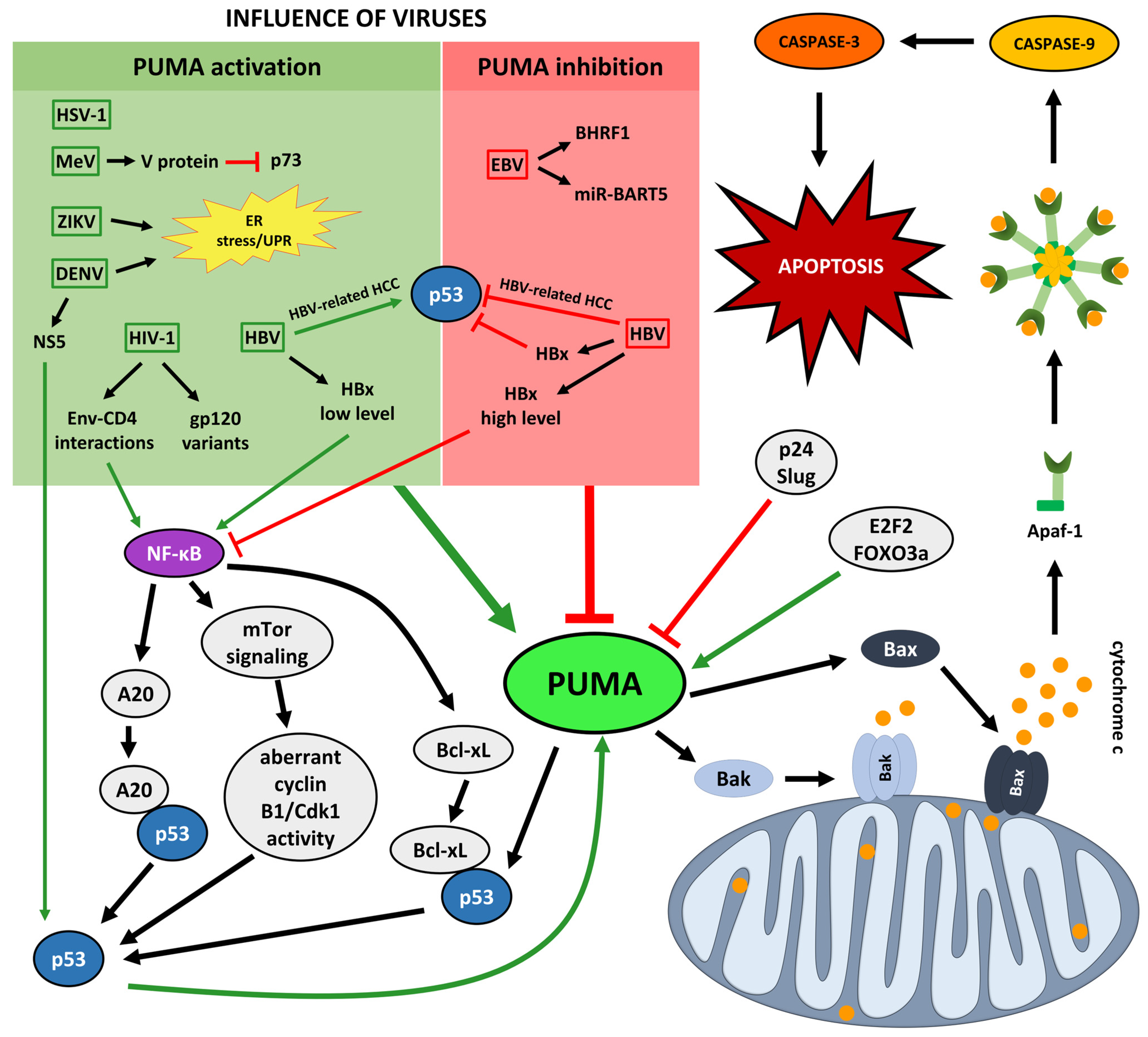
Figure 1. The effect of viral infections on PUMA protein. Arrow colors indicate the type of influence on PUMA: green—increase in its intracellular level; red—decrease in its level or inhibition of its function. Abbreviations: EBV—Epstein–Barr virus; HSV-1—herpes simplex virus type 1; HBV—hepatitis B virus; HIV-1—human immunodeficiency virus type 1; MeV—measles virus; ZIKV—Zika virus; DENV—dengue virus; PUMA—p53-upregulated modulator of apoptosis; Bax—Bcl-2-associated X protein; Bak—Bcl-2 homologous antagonist/killer; Apaf-1—apoptotic protease-activating factor 1; mTOR—mechanistic target of rapamycin; Cdk1—cyclin-dependent kinase 1; FOXO3a—forkhead box O3a; BHRF1—viral Bcl-2 homolog encoded by EBV; miR-BART5—microRNA BamHI A rightward transcript; ER—endoplasmic reticulum; UPR—unfolded protein response; NS5—non-structural protein 5; NF-κB—nuclear factor κB; Env—envelope glycoprotein; CD4—cluster of differentiation 4; gp120—glycoprotein 120; HCC—hepatocellular carcinoma; HBx—HBV X protein.
Cells 15 00278 g001
Table 1. The influence of viral infections on PUMA.
VirusViral Factor(s)MechanismApoptotic Profile
EBVmiR-BART5Direct targeting of PUMA mRNA (3′ UTR binding)Anti-apoptotic
BHRF1Direct sequestration of PUMA (protein binding)Anti-apoptotic
HSV-1Not clearly identifiedIndirect promotion of PUMA protein accumulation independent of p53/p73/NF-κBPro-apoptotic
HBVHBxDirect binding and inactivation of p53, leading to reduced PUMA transcriptionAnti-apoptotic
NF-κB signaling activation, leading to inhibition of p53-dependent PUMA induction (low HBx levels) Anti-apoptotic
NF-κB activity suppression, leading to enhancement of p53-dependent PUMA induction (high HBx levels) Pro-apoptotic
HIV-1EnvNF-κB-dependent p53-mediated stimulation of PUMA transcriptionPro-apoptotic
p53-independent PUMA inductionPro-apoptotic
MeVV proteinInhibition of p73-mediated PUMA transcriptionAnti-apoptotic
ZIKVNot definedER stress/UPR activationPro-apoptotic
DENVNot definedER stress/UPR activationPro-apoptotic
NS5Stabilization of p53 and p53-dependent PUMA inductionPro-apoptotic
Abbreviations: EBV—Epstein–Barr virus; BHRF1—BamHI fragment H rightward-facing 1; HSV-1—Herpes simplex virus type 1; HBV—Hepatitis B virus; HBx—Hepatitis B virus X protein; NF-κB—nuclear factor kappa B; HIV-1—Human immunodeficiency virus type 1; Env—Envelope glycoprotein complex of HIV-1 (gp120/gp41); MeV—Measles virus; ZIKV—Zika virus; DENV—Dengue virus; NS5—non-structural protein 5; PUMA—p53-upregulated modulator of apoptosis; ER—endoplasmic reticulum; UPR—unfolded protein response; 3′ UTR—3′ untranslated region.
Disclaimer/Publisher’s Note: The statements, opinions and data contained in all publications are solely those of the individual author(s) and contributor(s) and not of MDPI and/or the editor(s). MDPI and/or the editor(s) disclaim responsibility for any injury to people or property resulting from any ideas, methods, instructions or products referred to in the content.