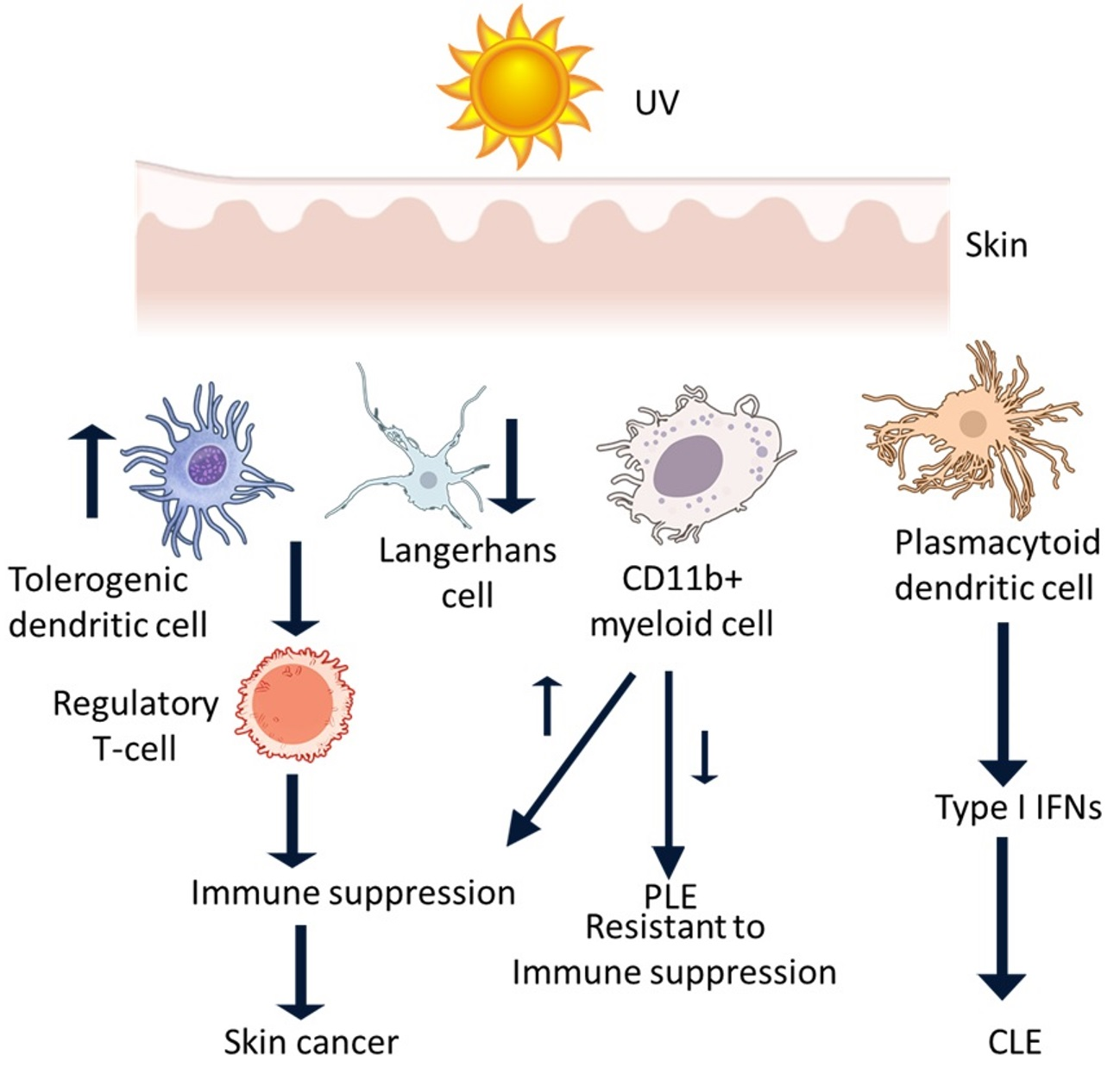
Ultraviolet Radiation-Induced Tolerogenic Dendritic Cells in Skin: Insights and Mechanisms

Abstract
1. Introduction
2. Various Cutaneous Immune Cells Implicated in UV-Induced Immune Suppression
2.1. Langerhans Cells
2.2. Conventional Dendritic Cells (cDCs)
2.3. CD11b+ Myeloid Cells
3. Mechanisms for UV-Induced Regulation of DC Activity
3.1. Inactivation of DCs
3.2. Tolerogenic DCs
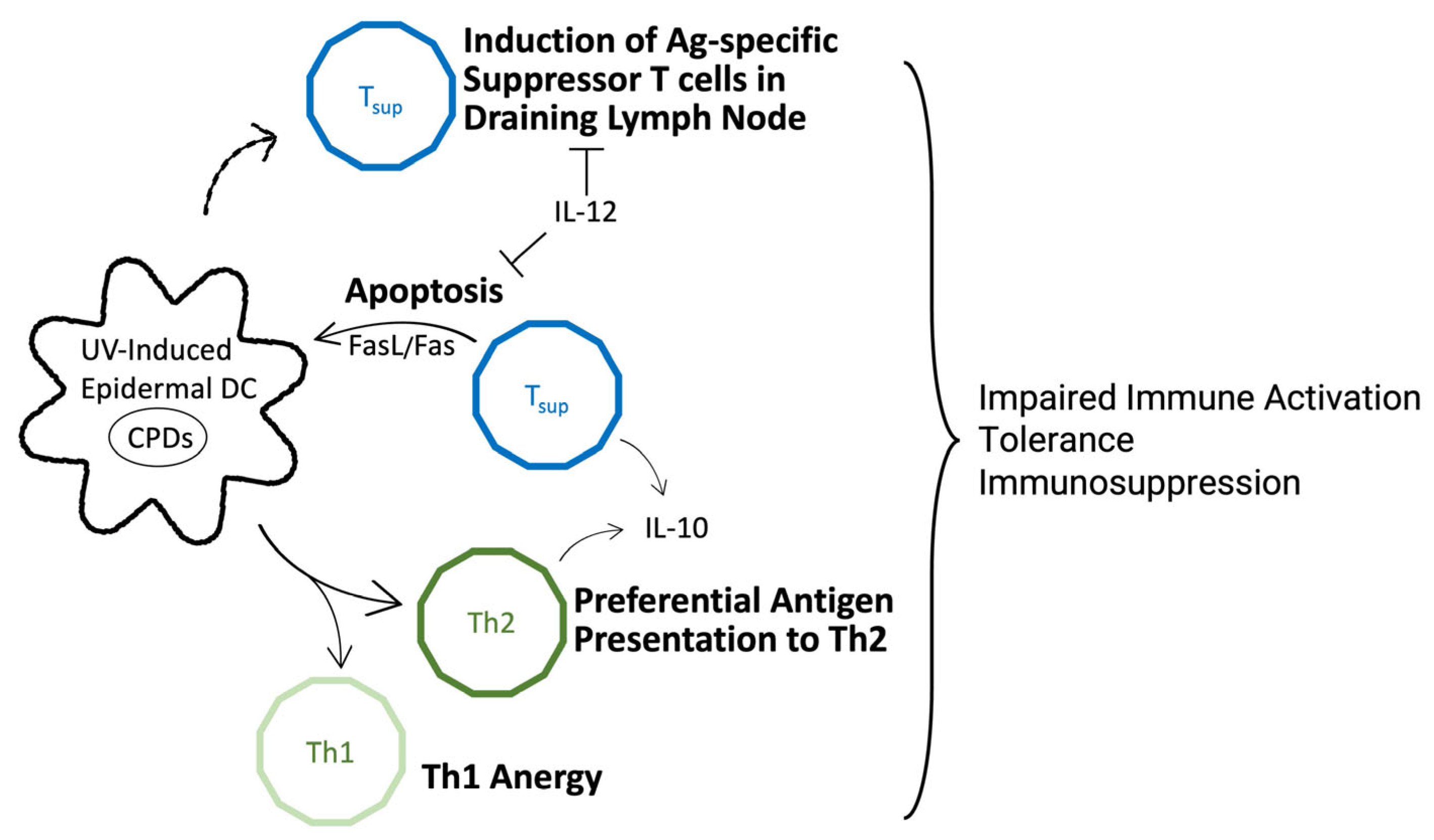
3.3. DCs and the Development of T Lymphocyte Populations in the Context of UV-Induced Immune Suppression
3.3.1. CD4+ Treg Cells
3.3.2. CD4+ T Helper Cells
4. The Role of DCs in UV-Induced Skin Diseases
4.1. Cutaneous Lupus Erythematous (CLE)
4.2. Polymorphic Light Eruption (PLE)
4.3. Skin Cancer
5. Conclusions
6. Perspective
Author Contributions
Funding
Data Availability Statement
Conflicts of Interest
Abbreviations
| APC | Antigen-presenting cell |
| BDCA | Blood DC antigen |
| Bid | BH3-interacting death domain protein |
| cDC | Conventional dendritic cell |
| CPD | Cyclobutene pyrimidine dimer |
| CHS | Contact hypersensitivity |
| CLE | Cutaneous lupus erythematous |
| DC | Dendritic cell |
| DNFB | 2,4-dinitrofluorobenzene |
| IFN | Interferon |
| IL | Interleukin |
| LC | Langerhans cell |
| MHC | Major histocompatibility complex |
| pDC | Plasmacytoid dendritic cell |
| Th1 | T helper 1 |
| Th2 | T helper 2 |
| Th17 | T helper 17 |
| Treg | Regulatory T cell |
| UV | Ultraviolet |
| UVB | Ultraviolet B |
References
- Koulu, L.; Jansen, C.T.; Viander, M. Effect of UVA and UVB irradiation on human epidermal Langerhans cell membrane markers defined by ATPase activity and monoclonal antibodies (OKT 6 and anti-Ia). Photodermatology 1985, 2, 339–346. [Google Scholar] [PubMed]
- Obata, M.; Tagami, H. Alteration in Murine Epidermal Langerhans Cell Population by Various UV Irradiations: Quantitative and Morphologic Studies on the Effects of Various Wavelengths of Monochromatic Radiation on Ia-Bearing Cells. J. Investig. Dermatol. 1985, 84, 139–145. [Google Scholar] [CrossRef] [PubMed]
- Langerhans, P. Über die Nerven der menschlichen Haut. Arch. Pathol. Anat. Physiol. Klin. Med. 1868, 44, 325–337. [Google Scholar] [CrossRef]
- Stingl, G.; Katz, S.I.; Shevach, E.M.; Rosenthal, A.S.; Green, I. Analogous functions of macrophages and Langerhans cells in the initiation in the immune response. J. Investig. Dermatol. 1978, 71, 59–64. [Google Scholar] [CrossRef]
- Stingl, G.; Katz, S.I.; Clement, L.; Green, I.; Shevach, E.M. Immunologic functions of Ia-bearing epidermal Langerhans cells. J. Immunol. 1978, 121, 2005–2013. [Google Scholar] [CrossRef]
- Rowden, G.; Phillips, T.M.; Delovitch, T.L. Expression of ia antigens by murine keratinizing epithelial langerhans cells. Immunogenetics 1978, 7, 465–478. [Google Scholar] [CrossRef]
- Stingl, G.; Katz, S.I.; Shevach, E.M.; Wolff-Schreiner, E.; Green, I. Detection of Ia antigens on Langerhans cells in guinea pig skin. J. Immunol. 1978, 120, 570–578. [Google Scholar] [CrossRef]
- Toews, G.B.; Bergstresser, P.R.; Streilein, J.W. Epidermal Langerhans cell density determines whether contact hypersensitivity or unresponsiveness follows skin painting with DNFB. J. Immunol. 1980, 124, 445–453. [Google Scholar] [CrossRef]
- Cruz, P.D., Jr.; Tigelaar, R.E.; Bergstresser, P.R. Langerhans cells that migrate to skin after intravenous infusion regulate the induction of contact hypersensitivity. J. Immunol. 1990, 144, 2486–2492. [Google Scholar] [CrossRef]
- Noonan, F.P.; Bucana, C.; Sauder, D.N.; De Fabo, E.C. Mechanism of systemic immune suppression by UV irradiation in vivo. II. The UV effects on number and morphology of epidermal Langerhans cells and the UV-induced suppression of contact hypersensitivity have different wavelength dependencies. J. Immunol. 1984, 132, 2408–2416. [Google Scholar] [CrossRef]
- Orita, M. Effects of ultraviolet irradiation on surface marker expression by epidermal immunocompetent cells and contact sensitization to dinitrofluorobenzene in mice. Br. J. Dermatol. 1987, 117, 721–733. [Google Scholar] [CrossRef] [PubMed]
- Aberer, W.; Schuler, G.; Stingl, G.; Hönigsmann, H.; Wolff, K. Ultraviolet Light Depletes Surface Markers of Langerhans Cells. J. Investig. Dermatol. 1981, 76, 202–210. [Google Scholar] [CrossRef] [PubMed]
- Zhou, L.; Jiang, A.; Veenstra, J.; Ozog, D.M.; Mi, Q.S. The Roles of Skin Langerhans Cells in Immune Tolerance and Cancer Immunity. Vaccines 2022, 10, 1380. [Google Scholar] [CrossRef]
- Nakagawa, S.; Koomen, C.W.; Bos, J.D.; Teunissen, M.B.M. Differential Modulation of Human Epidermal Langerhans Cell Maturation by Ultraviolet B Radiation. J. Immunol. 1999, 163, 5192–5200. [Google Scholar] [CrossRef]
- Ginhoux, F.; Collin, M.P.; Bogunovic, M.; Abel, M.; Leboeuf, M.; Helft, J.; Ochando, J.; Kissenpfennig, A.; Malissen, B.; Grisotto, M.; et al. Blood-derived dermal langerin+ dendritic cells survey the skin in the steady state. J. Exp. Med. 2007, 204, 3133–3146. [Google Scholar] [CrossRef]
- Bursch, L.S.; Wang, L.; Igyarto, B.; Kissenpfennig, A.; Malissen, B.; Kaplan, D.H.; Hogquist, K.A. Identification of a novel population of Langerin+ dendritic cells. J. Exp. Med. 2007, 204, 3147–3156. [Google Scholar] [CrossRef]
- Poulin, L.F.; Henri, S.; de Bovis, B.; Devilard, E.; Kissenpfennig, A.; Malissen, B. The dermis contains langerin+ dendritic cells that develop and function independently of epidermal Langerhans cells. J. Exp. Med. 2007, 204, 3119–3131. [Google Scholar] [CrossRef]
- Wang, L.; Jameson, S.C.; Hogquist, K.A. Epidermal Langerhans Cells Are Not Required for UV-Induced Immunosuppression. J. Immunol. 2009, 183, 5548–5553. [Google Scholar] [CrossRef]
- Schwarz, A.; Noordegraaf, M.; Maeda, A.; Torii, K.; Clausen, B.E.; Schwarz, T. Langerhans Cells Are Required for UVR-Induced Immunosuppression. J. Investig. Dermatol. 2010, 130, 1419–1427. [Google Scholar] [CrossRef]
- Kashem, S.W.; Haniffa, M.; Kaplan, D.H. Antigen-Presenting Cells in the Skin. Annu. Rev. Immunol. 2017, 35, 469–499. [Google Scholar] [CrossRef]
- Ng, R.L.X.; Bisley, J.L.; Gorman, S.; Norval, M.; Hart, P.H. Ultraviolet Irradiation of Mice Reduces the Competency of Bone Marrow-Derived CD11c+ Cells via an Indomethacin-Inhibitable Pathway. J. Immunol. 2010, 185, 7207–7215. [Google Scholar] [CrossRef] [PubMed]
- Ng, R.L.X.; Scott, N.M.; Strickland, D.H.; Gorman, S.; Grimbaldeston, M.A.; Norval, M.; Waithman, J.; Hart, P.H. Altered Immunity and Dendritic Cell Activity in the Periphery of Mice after Long-Term Engraftment with Bone Marrow from Ultraviolet-Irradiated Mice. J. Immunol. 2013, 190, 5471–5484. [Google Scholar] [CrossRef] [PubMed]
- Ng, R.L.; Scott, N.M.; Bisley, J.L.; Lambert, M.J.; Gorman, S.; Norval, M.; Hart, P.H. Characterization of regulatory dendritic cells differentiated from the bone marrow of UV-irradiated mice. Immunology 2013, 140, 399–412. [Google Scholar] [CrossRef] [PubMed]
- Scott, N.M.; Ng, R.L.; Gorman, S.; Norval, M.; Waithman, J.; Hart, P.H. Prostaglandin E2 imprints a long-lasting effect on dendritic cell progenitors in the bone marrow. J. Leukoc. Biol. 2014, 95, 225–232. [Google Scholar] [CrossRef] [PubMed]
- Schmitt, D.A.; Owen-Schaub, L.; Ullrich, S.E. Effect of IL-12 on immune suppression and suppressor cell induction by ultraviolet radiation. J. Immunol. 1995, 154, 5114–5120. [Google Scholar] [CrossRef]
- Schwarz, A.; Grabbe, S.; Aragane, Y.; Sandkuhl, K.; Riemann, H.; Luger, T.A.; Kubin, M.; Trinchieri, G.; Schwarz, T. Interleukin-12 prevents ultraviolet B-induced local immunosuppression and overcomes UVB-induced tolerance. J. Investig. Dermatol. 1996, 106, 1187–1191. [Google Scholar] [CrossRef]
- Schwarz, A.; Grabbe, S.; Grosse-Heitmeyer, K.; Roters, B.; Riemann, H.; Luger, T.A.; Trinchieri, G.; Schwarz, T. Ultraviolet Light-Induced Immune Tolerance Is Mediated via the Fas/Fas-Ligand System. J. Immunol. 1998, 160, 4262–4270. [Google Scholar] [CrossRef]
- Thatcher, T.H.; Luzina, I.; Fishelevich, R.; Tomai, M.A.; Miller, R.L.; Gaspari, A.A. Topical Imiquimod Treatment Prevents UV-Light Induced Loss of Contact Hypersensitivity and Immune Tolerance. J. Investig. Dermatol. 2006, 126, 821–831. [Google Scholar] [CrossRef]
- Crispin, M.K.; Fuentes-Duculan, J.; Gulati, N.; Johnson-Huang, L.M.; Lentini, T.; Sullivan-Whalen, M.; Gilleaudeau, P.; Cueto, I.; Suárez-Fariñas, M.; Lowes, M.A.; et al. Gene profiling of narrow-band UVB-induced skin injury defines cellular and molecular innate immune responses. J. Investig. Dermatol. 2013, 133, 692–701. [Google Scholar] [CrossRef]
- Chu, C.-C.; Ali, N.; Karagiannis, P.; Di Meglio, P.; Skowera, A.; Napolitano, L.; Barinaga, G.; Grys, K.; Sharif-Paghaleh, E.; Karagiannis, S.N.; et al. Resident CD141 (BDCA3)+ dendritic cells in human skin produce IL-10 and induce regulatory T cells that suppress skin inflammation. J. Exp. Med. 2012, 209, 935–945. [Google Scholar] [CrossRef]
- Cooper, K.D.; Oberhelman, L.; Hamilton, T.A.; Baadsgaard, O.; Terhune, M.; LeVee, G.; Anderson, T.; Koren, H. UV exposure reduces immunization rates and promotes tolerance to epicutaneous antigens in humans: Relationship to dose, CD1a-DR+ epidermal macrophage induction, and Langerhans cell depletion. Proc. Natl. Acad. Sci. USA 1992, 89, 8497–8501. [Google Scholar] [CrossRef] [PubMed]
- Kang, K.; Hammerberg, C.; Meunier, L.; Cooper, K.D. CD11b+ macrophages that infiltrate human epidermis after in vivo ultraviolet exposure potently produce IL-10 and represent the major secretory source of epidermal IL-10 protein. J. Immunol. 1994, 153, 5256–5264. [Google Scholar] [CrossRef] [PubMed]
- Yoshida, Y.; Kang, K.; Berger, M.; Chen, G.; Gilliam, A.C.; Moser, A.; Wu, L.; Hammerberg, C.; Cooper, K.D. Monocyte Induction of IL-10 and Down-Regulation of IL-12 by iC3b Deposited in Ultraviolet-Exposed Human Skin. J. Immunol. 1998, 161, 5873–5879. [Google Scholar] [CrossRef] [PubMed]
- Hammerberg, C.; Duraiswamy, N.; Cooper, K.D. Reversal of immunosuppression inducible through ultraviolet-exposed skin by in vivo anti-CD11b treatment. J. Immunol. 1996, 157, 5254–5261. [Google Scholar] [CrossRef]
- Hammerberg, C.; Katiyar, S.K.; Carroll, M.C.; Cooper, K.D. Activated Complement Component 3 (C3) Is Required for Ultraviolet Induction of Immunosuppression and Antigenic Tolerance. J. Exp. Med. 1998, 187, 1133–1138. [Google Scholar] [CrossRef]
- Vink, A.A.; Strickland, F.M.; Bucana, C.; Cox, P.A.; Roza, L.; Yarosh, D.B.; Kripke, M.L. Localization of DNA damage and its role in altered antigen-presenting cell function in ultraviolet-irradiated mice. J. Exp. Med. 1996, 183, 1491–1500. [Google Scholar] [CrossRef]
- Vink, A.A.; Moodycliffe, A.M.; Shreedhar, V.; Ullrich, S.E.; Roza, L.; Yarosh, D.B.; Kripke, M.L. The inhibition of antigen-presenting activity of dendritic cells resulting from UV irradiation of murine skin is restored by in vitro photorepair of cyclobutane pyrimidine dimers. Proc. Natl. Acad. Sci. USA 1997, 94, 5255–5260. [Google Scholar] [CrossRef]
- Sun, L.; Ding, F.; Zhou, L.; Wang, J.; Li, M.; Zhou, P.; Li, J.; Ding, C.; Wang, H.; Xu, Y. Apoptosis of Dendritic Cells and Autoimmune Disease. Front. Biosci. 2024, 29, 157. [Google Scholar] [CrossRef]
- Pradhan, S.; Kim, H.K.; Thrash, C.J.; Cox, M.A.; Mantena, S.K.; Wu, J.-H.; Athar, M.; Katiyar, S.K.; Elmets, C.A.; Timares, L. A Critical Role for the Proapoptotic Protein Bid in Ultraviolet-Induced Immune Suppression and Cutaneous Apoptosis. J. Immunol. 2008, 181, 3077–3088. [Google Scholar] [CrossRef]
- Rosenblum, M.D.; Olasz, E.; Woodliff, J.E.; Johnson, B.D.; Konkol, M.C.; Gerber, K.A.; Orentas, R.J.; Sandford, G.; Truitt, R.L. CD200 is a novel p53-target gene involved in apoptosis-associated immune tolerance. Blood 2004, 103, 2691–2698. [Google Scholar] [CrossRef]
- Wright, G.J.; Cherwinski, H.; Foster-Cuevas, M.; Brooke, G.; Puklavec, M.J.; Bigler, M.; Song, Y.; Jenmalm, M.; Gorman, D.; McClanahan, T.; et al. Characterization of the CD200 receptor family in mice and humans and their interactions with CD200. J. Immunol. 2003, 171, 3034–3046. [Google Scholar] [CrossRef] [PubMed]
- Wright, G.J.; Puklavec, M.J.; Willis, A.C.; Hoek, R.M.; Sedgwick, J.D.; Brown, M.H.; Barclay, A.N. Lymphoid/neuronal cell surface OX2 glycoprotein recognizes a novel receptor on macrophages implicated in the control of their function. Immunity 2000, 13, 233–242. [Google Scholar] [CrossRef] [PubMed]
- Maldonado, R.A.; von Andrian, U.H. How tolerogenic dendritic cells induce regulatory T cells. Adv. Immunol. 2010, 108, 111–165. [Google Scholar] [PubMed]
- Wu, L.; Liu, Y.J. Development of dendritic-cell lineages. Immunity 2007, 26, 741–750. [Google Scholar] [CrossRef]
- Elmets, C.A.; Bergstresser, P.R.; Tigelaar, R.E.; Wood, P.J.; Streilein, J.W. Analysis of the mechanism of unresponsiveness produced by haptens painted on skin exposed to low dose ultraviolet radiation. J. Exp. Med. 1983, 158, 781–794. [Google Scholar] [CrossRef]
- Yagi, H.; Tokura, Y.; Wakita, H.; Furukawa, F.; Takigawa, M. TCRV beta 7+ Th2 cells mediate UVB-induced suppression of murine contact photosensitivity by releasing IL-10. J. Immunol. 1996, 156, 1824–1831. [Google Scholar] [CrossRef]
- Schwarz, A.; Maeda, A.; Wild, M.K.; Kernebeck, K.; Gross, N.; Aragane, Y.; Beissert, S.; Vestweber, D.; Schwarz, T. Ultraviolet Radiation-Induced Regulatory T Cells Not Only Inhibit the Induction but Can Suppress the Effector Phase of Contact Hypersensitivity. J. Immunol. 2004, 172, 1036–1043. [Google Scholar] [CrossRef]
- Freeman, G.J.; Borriello, F.; Hodes, R.J.; Reiser, H.; Hathcock, K.S.; Laszlo, G.; McKnight, A.J.; Kim, J.; Du, L.; Lombard, D.B.; et al. Uncovering of functional alternative CTLA-4 counter-receptor in B7-deficient mice. Science 1993, 262, 907–909. [Google Scholar] [CrossRef]
- Schwarz, A.; Beissert, S.; Grosse-Heitmeyer, K.; Gunzer, M.; Bluestone, J.A.; Grabbe, S.; Schwarz, T. Evidence for Functional Relevance of CTLA-4 in Ultraviolet-Radiation-Induced Tolerance. J. Immunol. 2000, 165, 1824–1831. [Google Scholar] [CrossRef]
- Schwarz, T. Mechanisms of UV-induced immunosuppression. Keio J. Med. 2005, 54, 165–171. [Google Scholar] [CrossRef]
- Schwarz, A.; Stander, S.; Berneburg, M.; Bohm, M.; Kulms, D.; van Steeg, H.; Grosse-Heitmeyer, K.; Krutmann, J.; Schwarz, T. Interleukin-12 suppresses ultraviolet radiation-induced apoptosis by inducing DNA repair. Nat. Cell Biol. 2002, 4, 26–31. [Google Scholar] [CrossRef] [PubMed]
- Meeran, S.M.; Mantena, S.K.; Meleth, S.; Elmets, C.A.; Katiyar, S.K. Interleukin-12-deficient mice are at greater risk of UV radiation-induced skin tumors and malignant transformation of papillomas to carcinomas. Mol. Cancer Ther. 2006, 5, 825–832. [Google Scholar] [CrossRef] [PubMed]
- Mosmann, T.R.; Coffman, R.L. TH1 and TH2 Cells: Different Patterns of Lymphokine Secretion Lead to Different Functional Properties. Annu. Rev. Immunol. 1989, 7, 145–173. [Google Scholar] [CrossRef] [PubMed]
- Weaver, C.T.; Hatton, R.D.; Mangan, P.R.; Harrington, L.E. IL-17 Family Cytokines and the Expanding Diversity of Effector T Cell Lineages. Annu. Rev. Immunol. 2007, 25, 821–852. [Google Scholar] [CrossRef]
- Berger, A. Th1 and Th2 responses: What are they? BMJ 2000, 321, 424. [Google Scholar] [CrossRef]
- Simon, J.C.; Mosmann, T.; Edelbaum, D.; Schopf, E.; Bergstresser, P.R.; Cruz, P.D., Jr. In vivo evidence that ultraviolet B-induced suppression of allergic contact sensitivity is associated with functional inactivation of Th1 cells. Photodermatol. Photoimmunol. Photomed. 1994, 10, 206–211. [Google Scholar]
- Araneo, B.A.; Dowell, T.; Moon, H.B.; Daynes, R.A. Regulation of murine lymphokine production in vivo. Ultraviolet radiation exposure depresses IL-2 and enhances IL-4 production by T cells through an IL-1-dependent mechanism. J. Immunol. 1989, 143, 1737–1744. [Google Scholar] [CrossRef]
- Simon, J.C.; Cruz, P.D., Jr.; Bergstresser, P.R.; Tigelaar, R.E. Low dose ultraviolet B-irradiated Langerhans cells preferentially activate CD4+ cells of the T helper 2 subset. J. Immunol. 1990, 145, 2087–2091. [Google Scholar] [CrossRef]
- Brown, E.L.; Rivas, J.M.; Ullrich, S.E.; Young, C.R.; Norris, S.J.; Kripke, M.L. Modulation of immunity to Borrelia burgdorferi by ultraviolet irradiation: Differential effect on Th1 and Th2 immune responses. Eur. J. Immunol. 1995, 25, 3017–3022. [Google Scholar] [CrossRef]
- Simon, J.C.; Tigelaar, R.E.; Bergstresser, P.R.; Edelbaum, D.; Cruz, P.D., Jr. Ultraviolet B radiation converts Langerhans cells from immunogenic to tolerogenic antigen-presenting cells. Induction of specific clonal anergy in CD4+ T helper 1 cells. J. Immunol. 1991, 146, 485–491. [Google Scholar] [CrossRef]
- Veldhoen, M. Interleukin 17 is a chief orchestrator of immunity. Nat. Immunol. 2017, 18, 612–621. [Google Scholar] [CrossRef] [PubMed]
- Kolls, J.K.; Linden, A. Interleukin-17 family members and inflammation. Immunity 2004, 21, 467–476. [Google Scholar] [CrossRef] [PubMed]
- Peiser, M. Role of Th17 Cells in Skin Inflammation of Allergic Contact Dermatitis. J. Immunol. Res. 2013, 2013, 261037. [Google Scholar] [CrossRef]
- He, D.; Wu, L.; Kim, H.K.; Li, H.; Elmets, C.A.; Xu, H. CD8+ IL-17-Producing T Cells Are Important in Effector Functions for the Elicitation of Contact Hypersensitivity Responses. J. Immunol. 2006, 177, 6852–6858. [Google Scholar] [CrossRef]
- He, D.; Wu, L.; Kim, H.K.; Li, H.; Elmets, C.A.; Xu, H. IL-17 and IFN-{gamma} Mediate the Elicitation of Contact Hypersensitivity Responses by Different Mechanisms and Both Are Required for Optimal Responses. J. Immunol. 2009, 183, 1463–1470. [Google Scholar] [CrossRef]
- MacLeod, A.S.; Rudolph, R.; Corriden, R.; Ye, I.; Garijo, O.; Havran, W.L. Skin-Resident T Cells Sense Ultraviolet Radiation–Induced Injury and Contribute to DNA Repair. J. Immunol. 2014, 192, 5695–5702. [Google Scholar] [CrossRef]
- Li, H.; Prasad, R.; Katiyar, S.K.; Yusuf, N.; Elmets, C.A.; Xu, H. Interleukin-17 Mediated Inflammatory Responses Are Required for Ultraviolet Radiation-Induced Immune Suppression. Photochem. Photobiol. 2015, 91, 235–241. [Google Scholar] [CrossRef]
- Crowson, A.N.; Magro, C. The cutaneous pathology of lupus erythematosus: A review. J. Cutan. Pathol. 2001, 28, 1–23. [Google Scholar] [CrossRef]
- Oh, E.H.; Kim, E.J.; Ro, Y.S.; Ko, J.Y. Ten-year retrospective clinicohistological study of cutaneous lupus erythematosus in Korea. J. Dermatol. 2018, 45, 436–443. [Google Scholar] [CrossRef]
- Jarukitsopa, S.; Hoganson, D.D.; Crowson, C.S.; Sokumbi, O.; Davis, M.D.; Michet, C.J., Jr.; Matteson, E.L.; Maradit Kremers, H.; Chowdhary, V.R. Epidemiology of systemic lupus erythematosus and cutaneous lupus erythematosus in a predominantly white population in the United States. Arthritis Care Res. 2015, 67, 817–828. [Google Scholar] [CrossRef]
- Patel, J.; Borucki, R.; Werth, V.P. An Update on the Pathogenesis of Cutaneous Lupus Erythematosus and Its Role in Clinical Practice. Curr. Rheumatol. Rep. 2020, 22, 69. [Google Scholar] [CrossRef] [PubMed]
- Yin, Q.; Xu, X.; Lin, Y.; Lv, J.; Zhao, L.; He, R. Ultraviolet B irradiation induces skin accumulation of plasmacytoid dendritic cells: A possible role for chemerin. Autoimmunity 2014, 47, 185–192. [Google Scholar] [CrossRef] [PubMed]
- Fitzgerald-Bocarsly, P.; Dai, J.; Singh, S. Plasmacytoid dendritic cells and type I IFN: 50 years of convergent history. Cytokine Growth Factor Rev. 2008, 19, 3–19. [Google Scholar] [CrossRef]
- Vermi, W.; Lonardi, S.; Morassi, M.; Rossini, C.; Tardanico, R.; Venturini, M.; Sala, R.; Tincani, A.; Poliani, P.L.; Calzavara-Pinton, P.G.; et al. Cutaneous distribution of plasmacytoid dendritic cells in lupus erythematosus. Selective tropism at the site of epithelial apoptotic damage. Immunobiology 2009, 214, 877–886. [Google Scholar] [CrossRef]
- Means, T.K.; Latz, E.; Hayashi, F.; Murali, M.R.; Golenbock, D.T.; Luster, A.D. Human lupus autoantibody-DNA complexes activate DCs through cooperation of CD32 and TLR9. J. Clin. Investig. 2005, 115, 407–417. [Google Scholar] [CrossRef]
- Eloranta, M.L.; Lovgren, T.; Finke, D.; Mathsson, L.; Ronnelid, J.; Kastner, B.; Alm, G.V.; Ronnblom, L. Regulation of the interferon-alpha production induced by RNA-containing immune complexes in plasmacytoid dendritic cells. Arthritis Rheum. 2009, 60, 2418–2427. [Google Scholar] [CrossRef]
- Saadeh, D.; Kurban, M.; Abbas, O. Update on the role of plasmacytoid dendritic cells in inflammatory/autoimmune skin diseases. Exp. Dermatol. 2016, 25, 415–421. [Google Scholar] [CrossRef]
- Bave, U.; Alm, G.V.; Ronnblom, L. The combination of apoptotic U937 cells and lupus IgG is a potent IFN-alpha inducer. J. Immunol. 2000, 165, 3519–3526. [Google Scholar] [CrossRef]
- Lovgren, T.; Eloranta, M.L.; Bave, U.; Alm, G.V.; Ronnblom, L. Induction of interferon-alpha production in plasmacytoid dendritic cells by immune complexes containing nucleic acid released by necrotic or late apoptotic cells and lupus IgG. Arthritis Rheum. 2004, 50, 1861–1872. [Google Scholar] [CrossRef]
- Chaichian, Y.; Wallace, D.J.; Weisman, M.H. A promising approach to targeting type 1 IFN in systemic lupus erythematosus. J. Clin. Investig. 2019, 129, 958–961. [Google Scholar] [CrossRef]
- Furie, R.; Werth, V.P.; Merola, J.F.; Stevenson, L.; Reynolds, T.L.; Naik, H.; Wang, W.; Christmann, R.; Gardet, A.; Pellerin, A.; et al. Monoclonal antibody targeting BDCA2 ameliorates skin lesions in systemic lupus erythematosus. J. Clin. Investig. 2019, 129, 1359–1371. [Google Scholar] [CrossRef] [PubMed]
- Werth, V.P.; Barbey, C.; Franchimont, N. Anti-BDCA2 Antibody for Cutaneous Lupus Erythematosus. N. Engl. J. Med. 2022, 387, 1528–1529. [Google Scholar] [CrossRef] [PubMed]
- Werth, V.P.; Furie, R.A.; Romero-Diaz, J.; Navarra, S.; Kalunian, K.; van Vollenhoven, R.F.; Nyberg, F.; Kaffenberger, B.H.; Sheikh, S.Z.; Radunovic, G.; et al. Trial of Anti-BDCA2 Antibody Litifilimab for Cutaneous Lupus Erythematosus. N. Engl. J. Med. 2022, 387, 321–331. [Google Scholar] [CrossRef] [PubMed]
- Biermann, M.H.; Veissi, S.; Maueroder, C.; Chaurio, R.; Berens, C.; Herrmann, M.; Munoz, L.E. The role of dead cell clearance in the etiology and pathogenesis of systemic lupus erythematosus: Dendritic cells as potential targets. Expert Rev. Clin. Immunol. 2014, 10, 1151–1164. [Google Scholar] [CrossRef] [PubMed]
- Gruber-Wackernagel, A.; Byrne, S.N.; Wolf, P. Polymorphous Light Eruption: Clinic Aspects and Pathogenesis. Dermatol. Clin. 2014, 32, 315–334. [Google Scholar] [CrossRef]
- Burfield, L.; Rutter, K.J.; Thompson, B.; Marjanovic, E.J.; Neale, R.E.; Rhodes, L.E. Systematic review of the prevalence and incidence of the photodermatoses with meta-analysis of the prevalence of polymorphic light eruption. J. Eur. Acad. Dermatol. Venereol. 2023, 37, 511–520. [Google Scholar] [CrossRef]
- Morison, W.L.; Stern, R.S. Polymorphous light eruption: A common reaction uncommonly recognized. Acta Derm. Venereol. 1982, 62, 237–240. [Google Scholar] [CrossRef]
- Honigsmann, H. Polymorphous light eruption. Photodermatol. Photoimmunol. Photomed. 2008, 24, 155–161. [Google Scholar] [CrossRef]
- Lembo, S.; Raimondo, A. Polymorphic Light Eruption: What’s New in Pathogenesis and Management. Front. Med. 2018, 5, 252. [Google Scholar] [CrossRef]
- Kolgen, W.; van Weelden, H.; Den Hengst, S.; Guikers, K.L.H.; Kiekens, R.C.M.; Knol, E.F.; Bruijnzeel-Koomen, C.A.F.M.; van Vloten, W.A.; de Gruijl, F.R. CD11b+ Cells and Ultraviolet-B-Resistant CD1a+ Cells in Skin of Patients with Polymorphous Light Eruption. J. Investig. Dermatol. 1999, 113, 4–10. [Google Scholar] [CrossRef]
- Kölgen, W.; van Meurs, M.; Jongsma, M.; van Weelden, H.; Bruijnzeel-Koomen, C.A.F.M.; Knol, E.F.; van Vloten, W.A.; Laman, J.; de Grui, F.R. Differential expression of cytokines in uv-b–exposed skin of patients with polymorphous light eruption: Correlation with langerhans cell migration and immunosuppression. Arch. Dermatol. 2004, 140, 295–302. [Google Scholar] [CrossRef] [PubMed]
- Schornagel, I.J.; Sigurdsson, V.; Nijhuis, E.H.J.; Bruijnzeel-Koomen, C.A.F.M.; Knol, E.F. Decreased Neutrophil Skin Infiltration After UVB Exposure in Patients with Polymorphous Light Eruption. J. Investig. Dermatol. 2004, 123, 202–206. [Google Scholar] [CrossRef] [PubMed]
- Kripke, M.L. Antigenicity of murine skin tumors induced by ultraviolet light. J. Natl. Cancer Inst. 1974, 53, 1333–1336. [Google Scholar] [CrossRef] [PubMed]
- Kripke, M.L.; Fisher, M.S. Immunologic parameters of ultraviolet carcinogenesis. J. Natl. Cancer Inst. 1976, 57, 211–215. [Google Scholar] [CrossRef]
- Alcalay, J.; Kripke, M.L. Antigen-presenting activity of draining lymph node cells from mice painted with a contact allergen during ultraviolet carcinogenesis. J. Immunol. 1991, 146, 1717–1721. [Google Scholar] [CrossRef]
- Lewis, J.M.; Bürgler, C.D.; Freudzon, M.; Golubets, K.; Gibson, J.F.; Filler, R.B.; Girardi, M. Langerhans Cells Facilitate UVB-induced Epidermal Carcinogenesis. J. Investig. Dermatol. 2015, 135, 2824–2833. [Google Scholar] [CrossRef]


| Identification Method | Special Considerations | |
|---|---|---|
| LCs |
| |
| cDCs |
|
|
| CD11b+ |
|
|
Disclaimer/Publisher’s Note: The statements, opinions and data contained in all publications are solely those of the individual author(s) and contributor(s) and not of MDPI and/or the editor(s). MDPI and/or the editor(s) disclaim responsibility for any injury to people or property resulting from any ideas, methods, instructions or products referred to in the content. |
© 2025 by the authors. Licensee MDPI, Basel, Switzerland. This article is an open access article distributed under the terms and conditions of the Creative Commons Attribution (CC BY) license (https://creativecommons.org/licenses/by/4.0/).
Share and Cite
Ghajar-Rahimi, G.; Yusuf, N.; Xu, H. Ultraviolet Radiation-Induced Tolerogenic Dendritic Cells in Skin: Insights and Mechanisms. Cells 2025, 14, 308. https://doi.org/10.3390/cells14040308
Ghajar-Rahimi G, Yusuf N, Xu H. Ultraviolet Radiation-Induced Tolerogenic Dendritic Cells in Skin: Insights and Mechanisms. Cells. 2025; 14(4):308. https://doi.org/10.3390/cells14040308
Chicago/Turabian StyleGhajar-Rahimi, Gelare, Nabiha Yusuf, and Hui Xu. 2025. "Ultraviolet Radiation-Induced Tolerogenic Dendritic Cells in Skin: Insights and Mechanisms" Cells 14, no. 4: 308. https://doi.org/10.3390/cells14040308
APA StyleGhajar-Rahimi, G., Yusuf, N., & Xu, H. (2025). Ultraviolet Radiation-Induced Tolerogenic Dendritic Cells in Skin: Insights and Mechanisms. Cells, 14(4), 308. https://doi.org/10.3390/cells14040308