

Cellular Interactions of Cardiac Repair After Myocardial Infarction

 ,
,  , , , and
Highlights
- Myocardial infarction (MI) triggers a cascade of cellular and molecular events, including rapid infiltration of inflammatory cells to remove necrotic tissue.
- Various cell populations, particularly leukocytes and fibroblasts, play crucial roles in tissue remodeling and scar formation.
- While scar formation is vital for structural stabilization, it also leads to increased myocardial stiffness and impaired contractile function.
- Understanding the cellular dynamics and inflammatory signaling in MI healing can inform therapeutic strategies to enhance recovery outcomes.
Abstract
1. Introduction
2. Initiation of the MI Inflammatory Response

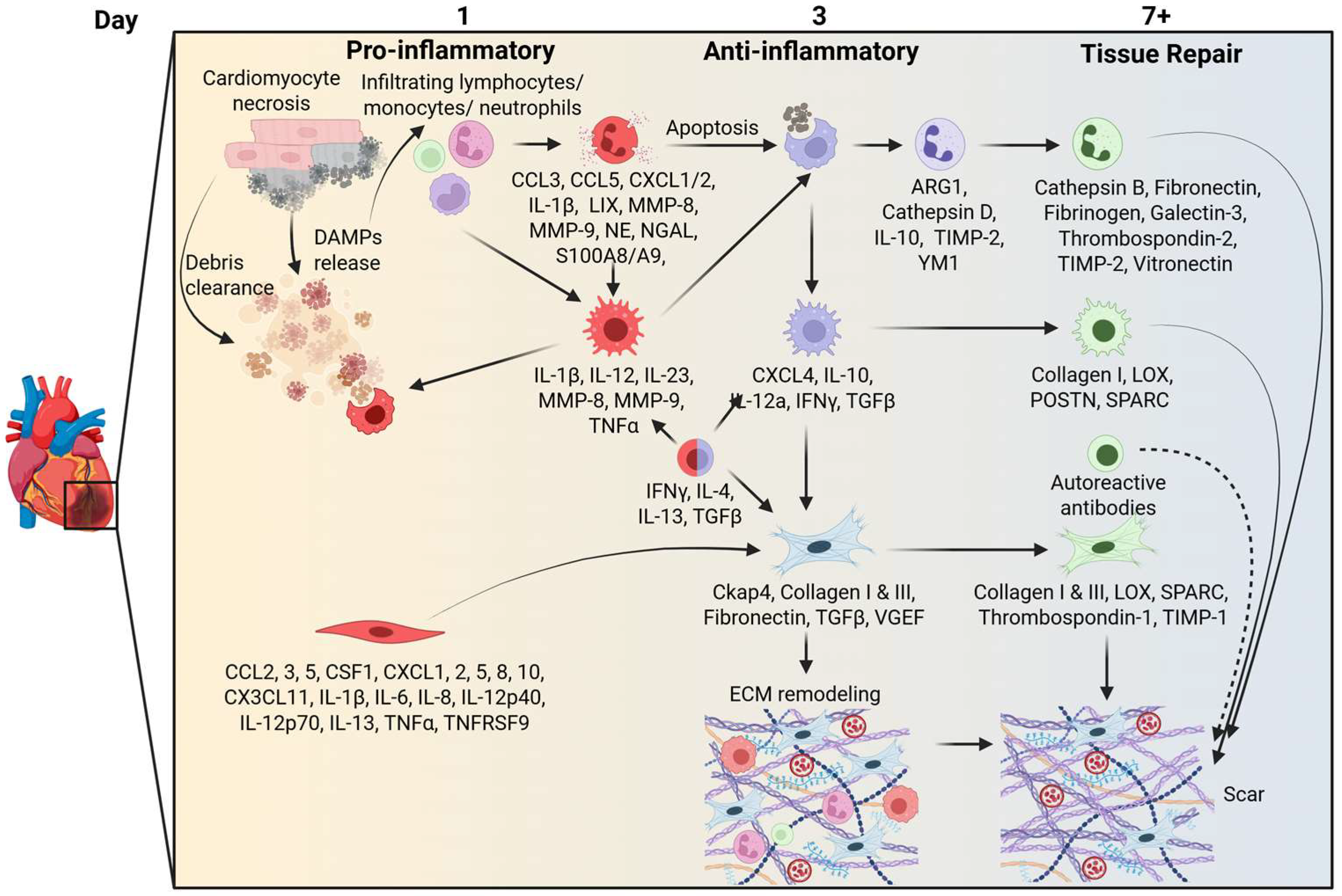
| MI Days | Cell | Key Activities | Markers/Signals |
|---|---|---|---|
| 0–1 | Cardiomyocytes | Necrosis | DAMPs |
| Macrophages, Lymphocytes, Neutrophils | Infiltration, Pro-inflammation cytokine & chemokine release, ECM degradation & debris clearance | Cxcl1/2/8, IL-1β, MMP-8, MMP-9 | |
| 1–3 | Macrophages, Lymphocytes, Neutrophils | Peak infiltration, Pro-inflammation | Il-6, Tnf-α, Tgf-β, Csf-1 |
| Fibroblasts | Amplified breakdown of ECM | ||
| 3–5 | Macrophages, Lymphocytes, Neutrophils | Transition to anti-inflammatory phenotype, Resolution of inflammation, Phagocytosis of apoptotic cells | Arg1, IL-10, Lgals3, Tgf-β, Vegf |
| Fibroblasts (proliferative), | ECM deposition, Stimulation of Angiogenesis | Fn, Lgals1, Lgals3, Smad | |
| Endothelial cells (angiogenesis) | Revascularization of the infarct region | Smad, Vegf | |
| 5–7 | Fibroblasts (scar-forming) | Scar formation, ECM maturation, anti-Angiogenesis | Col I, Col III, Sparc, Lgals1, Lgals3, Lox, TIMPs |
| Lymphocytes, Macrophages, Neutrophils | Reparative phenotype, anti-angiogenic Signaling | Tsp-1 | |
| Endothelial cells | Anti-angiogenic signaling | TIMPs | |
| 7+ | Fibroblasts, Macrophages | Scar maturation, Suppression of remaining inflammation, Maintenance of new homeostasis; Stabilization of neovasculature | Crosslinked ECM (collagens), Tsp-1 |
3. Extracellular Matrix Dynamics
4. Cellular Interactions
| Interaction | Signaling Mechanisms | Outcome |
|---|---|---|
| Neutrophil–Macrophage [13,31,43,99] | Apoptosis signals; IL-10; MMP-12; JAK/STAT | Macrophage polarization to reparative phenotype; Apoptotic neutrophil phagocytosis |
| Macrophage–Fibroblast [67,100,101] | Tgf-β and Pdgf | Fibroblast activation and ECM production |
| Macrophage–Endothelial Cell [102,103,104] | Vegf, latent Tgf-β (via MT1-MMP), MMP-2 | Angiogenesis in the infarct zone; promote endothelial-to-mesenchymal transition and matrix remodeling that link angiogenesis to scar formation |
| Endothelial–Fibroblast [16,23,105] | Vegf, Fgf2, Tgf-β, Tsp-1 | Angiogenesis and tissue remodeling |
| Lymphocyte–Macrophage [36] | Ifn-γ, IL-13 | Cytokine modulation of resolution & Remodeling |
| Lymphocyte–Fibroblast [36,74,75,76] | Ccl11, IL-4, Tgf-β, MMP-2, MMP-3, MMP-9 | Downregulate macrophage recruitment; ECM production and turnover |
5. Therapeutic Implications
6. Knowledge Gaps and Future Directions
7. Conclusions
Author Contributions
Funding
Institutional Review Board Statement
Informed Consent Statement
Data Availability Statement
Acknowledgments
Conflicts of Interest
Abbreviations
| Arg | Arginase |
| CD | Cluster differentiation |
| Csf | Colony-stimulating factor |
| Ccl | CC Chemokine ligand |
| Col | Collagen |
| Cxcl | CXC chemokine ligand |
| DAMPs | Damage-associated molecular patterns |
| ECM | Extracellular matrix |
| Fgf | Fibroblast growth factor |
| Fn | Fibronectin |
| Lgals | Galectin |
| Hmgb1 | High-Mobility Group Box 1 |
| Ifn | Interferon |
| IL | Interleukin |
| Ip | Interferon-gamma inducible protein |
| Lox | Lysyl oxidase |
| MCP | Monocyte chemotactic protein |
| M1 | Pro-inflammatory |
| M2 | Anti-inflammatory |
| MI | Myocardial infarction |
| MMP | Matrix metalloproteinase |
| Smad | Small mother against decapentaplegic |
| Sparc | Secreted protein acidic and rich in cysteine |
| Tgfβ | Transforming growth factor beta |
| TIMP | Tissue inhibitor of metalloproteinase |
| Tnfα | Tumor necrosis factor alpha |
| Tsp | Thrombospondin |
| Vegf | Vascular endothelial growth factor |
References
- Chalise, U.; Becirovic-Agic, M.; Lindsey, M.L. The cardiac wound healing response to myocardial infarction. WIREs Mech. Dis. 2023, 15, e1584. [Google Scholar] [CrossRef]
- Lindsey, M.L.; Becirovic-Agic, M. Skin wound healing as a mirror to cardiac wound healing. Exp. Physiol. 2023, 108, 1003–1010. [Google Scholar] [CrossRef]
- Frangogiannis, N.G. Pathophysiology of Myocardial Infarction. Compr. Physiol. 2015, 5, 1841–1875. [Google Scholar] [CrossRef]
- Talman, V.; Ruskoaho, H. Cardiac fibrosis in myocardial infarction-from repair and remodeling to regeneration. Cell Tissue Res. 2016, 365, 563–581. [Google Scholar] [CrossRef]
- Grilo, G.A.; Cakir, S.N.; Shaver, P.R.; Iyer, R.P.; Whitehead, K.; McClung, J.M.; Vahdati, A.; de Castro Brás, L.E. Collagen matricryptin promotes cardiac function by mediating scar formation. Life Sci. 2023, 321, 121598. [Google Scholar] [CrossRef]
- Lindsey, M.L.; de Castro Bras, L.E.; DeLeon-Pennell, K.Y.; Frangogiannis, N.G.; Halade, G.V.; O’Meara, C.C.; Spinale, F.G.; Kassiri, Z.; Kirk, J.A.; Kleinbongard, P.; et al. Reperfused vs. nonreperfused myocardial infarction: When to use which model. Am. J. Physiol. Heart Circ. Physiol. 2021, 321, H208–H213. [Google Scholar] [CrossRef]
- Lindsey, M.L.; Brunt, K.R.; Kirk, J.A.; Kleinbongard, P.; Calvert, J.W.; de Castro Bras, L.E.; DeLeon-Pennell, K.Y.; Del Re, D.P.; Frangogiannis, N.G.; Frantz, S.; et al. Guidelines for in vivo mouse models of myocardial infarction. Am. J. Physiol. Heart Circ. Physiol. 2021, 321, H1056–H1073. [Google Scholar] [CrossRef] [PubMed]
- Frangogiannis, N.G. Inflammation in cardiac injury, repair and regeneration. Curr. Opin. Cardiol. 2015, 30, 240–245. [Google Scholar] [CrossRef] [PubMed]
- Prabhu, S.D.; Frangogiannis, N.G. The Biological Basis for Cardiac Repair After Myocardial Infarction: From Inflammation to Fibrosis. Circ. Res. 2016, 119, 91–112. [Google Scholar] [CrossRef]
- Hilgendorf, I.; Frantz, S.; Frangogiannis, N.G. Repair of the Infarcted Heart: Cellular Effectors, Molecular Mechanisms and Therapeutic Opportunities. Circ. Res. 2024, 134, 1718–1751. [Google Scholar] [CrossRef] [PubMed]
- Ma, Y.; Yabluchanskiy, A.; Iyer, R.P.; Cannon, P.L.; Flynn, E.R.; Jung, M.; Henry, J.; Cates, C.A.; Deleon-Pennell, K.Y.; Lindsey, M.L. Temporal neutrophil polarization following myocardial infarction. Cardiovasc. Res. 2016, 110, 51–61. [Google Scholar] [CrossRef]
- Date, S.; Bhatt, L.K. Targeting high-mobility-group-box-1-mediated inflammation: A promising therapeutic approach for myocardial infarction. Inflammopharmacology 2025, 33, 767–784. [Google Scholar] [CrossRef]
- Frodermann, V.; Nahrendorf, M. Neutrophil-macrophage cross-talk in acute myocardial infarction. Eur. Heart J. 2017, 38, 198–200. [Google Scholar] [CrossRef]
- Marchini, T.; Mitre, L.S.; Wolf, D. Inflammatory Cell Recruitment in Cardiovascular Disease. Front. Cell Dev. Biol. 2021, 9, 635527. [Google Scholar] [CrossRef]
- Chen, B.; Frangogiannis, N.G. Chemokines in Myocardial Infarction. J. Cardiovasc. Transl. Res. 2021, 14, 35–52. [Google Scholar] [CrossRef]
- Nielsen, S.H.; Mouton, A.J.; DeLeon-Pennell, K.Y.; Genovese, F.; Karsdal, M.; Lindsey, M.L. Understanding cardiac extracellular matrix remodeling to develop biomarkers of myocardial infarction outcomes. Matrix Biol. 2019, 75–76, 43–57. [Google Scholar] [CrossRef]
- Frangogiannis, N.G. Regulation of the inflammatory response in cardiac repair. Circ. Res. 2012, 110, 159–173. [Google Scholar] [CrossRef]
- Daseke, M.J., 2nd; Valerio, F.M.; Kalusche, W.J.; Ma, Y.; DeLeon-Pennell, K.Y.; Lindsey, M.L. Neutrophil proteome shifts over the myocardial infarction time continuum. Basic Res. Cardiol. 2019, 114, 37. [Google Scholar] [CrossRef]
- Chiao, Y.A.; Zamilpa, R.; Lopez, E.F.; Dai, Q.; Escobar, G.P.; Hakala, K.; Weintraub, S.T.; Lindsey, M.L. In vivo matrix metalloproteinase-7 substrates identified in the left ventricle post-myocardial infarction using proteomics. J. Proteome Res. 2010, 9, 2649–2657. [Google Scholar] [CrossRef]
- DeLeon-Pennell, K.Y.; Meschiari, C.A.; Jung, M.; Lindsey, M.L. Matrix Metalloproteinases in Myocardial Infarction and Heart Failure. Prog. Mol. Biol. Transl. Sci. 2017, 147, 75–100. [Google Scholar]
- Chalise, U.; Becirovic-Agic, M.; Daseke, M.J., 2nd; Konfrst, S.R.; Rodriguez-Paar, J.R.; Feng, D.; Salomon, J.D.; Anderson, D.R.; Cook, L.M.; Lindsey, M.L. S100A9 is a functional effector of infarct wall thinning after myocardial infarction. Am. J. Physiol. Heart Circ. Physiol. 2022, 322, H145–H155. [Google Scholar] [CrossRef]
- Huang, S.; Frangogiannis, N.G. Anti-inflammatory therapies in myocardial infarction: Failures, hopes and challenges. Br. J. Pharmacol. 2018, 175, 1377–1400. [Google Scholar] [CrossRef]
- Mouton, A.J.; Ma, Y.; Rivera Gonzalez, O.J.; Daseke, M.J., 2nd; Flynn, E.R.; Freeman, T.C.; Garrett, M.R.; DeLeon-Pennell, K.Y.; Lindsey, M.L. Fibroblast polarization over the myocardial infarction time continuum shifts roles from inflammation to angiogenesis. Basic Res. Cardiol. 2019, 114, 6. [Google Scholar] [CrossRef] [PubMed]
- Daseke, M.J., 2nd; Tenkorang, M.A.A.; Chalise, U.; Konfrst, S.R.; Lindsey, M.L. Cardiac fibroblast activation during myocardial infarction wound healing: Fibroblast polarization after MI. Matrix Biol. 2020, 91–92, 109–116. [Google Scholar] [CrossRef] [PubMed]
- Sager, H.B.; Hulsmans, M.; Lavine, K.J.; Moreira, M.B.; Heidt, T.; Courties, G.; Sun, Y.; Iwamoto, Y.; Tricot, B.; Khan, O.F.; et al. Proliferation and Recruitment Contribute to Myocardial Macrophage Expansion in Chronic Heart Failure. Circ. Res. 2016, 119, 853–864. [Google Scholar] [CrossRef] [PubMed]
- Totoń-Żurańska, J.; Mikolajczyk, T.P.; Saju, B.; Guzik, T.J. Vascular remodelling in cardiovascular diseases: Hypertension, oxidation, and inflammation. Clin. Sci. 2024, 138, 817–850. [Google Scholar] [CrossRef]
- Kain, V.; Grilo, G.A.; Upadhyay, G.; Nadler, J.L.; Serhan, C.N.; Halade, G.V. Macrophage-specific lipoxygenase deletion amplify cardiac repair activating Treg cells in chronic heart failure. J. Leukoc. Biol. 2024, 116, 864–875. [Google Scholar] [CrossRef]
- Krishnan, V.; Booker, D.; Cunningham, G.; Jadapalli, J.K.; Kain, V.; Pullen, A.B.; Halade, G.V. Pretreatment of carprofen impaired initiation of inflammatory- and overlapping resolution response and promoted cardiorenal syndrome in heart failure. Life Sci. 2019, 218, 224–232. [Google Scholar] [CrossRef]
- Francis Stuart, S.D.; De Jesus, N.M.; Lindsey, M.L.; Ripplinger, C.M. The crossroads of inflammation, fibrosis, and arrhythmia following myocardial infarction. J. Mol. Cell. Cardiol. 2016, 91, 114–122. [Google Scholar] [CrossRef]
- LeGal, Y.M.; Morrissey, L.L. Methylprednisolone interventions in myocardial infarction: A controversial subject. Can. J. Cardiol. 1990, 6, 405–410. [Google Scholar]
- Horckmans, M.; Ring, L.; Duchene, J.; Santovito, D.; Schloss, M.J.; Drechsler, M.; Weber, C.; Soehnlein, O.; Steffens, S. Neutrophils orchestrate post-myocardial infarction healing by polarizing macrophages towards a reparative phenotype. Eur. Heart J. 2017, 38, 187–197. [Google Scholar] [CrossRef]
- Kain, V.; Prabhu, S.D.; Halade, G.V. Inflammation revisited: Inflammation versus resolution of inflammation following myocardial infarction. Basic Res. Cardiol. 2014, 109, 444. [Google Scholar] [CrossRef]
- Rao, A.; Gupta, A.; Kain, V.; Halade, G.V. Extrinsic and intrinsic modulators of inflammation-resolution signaling in heart failure. Am. J. Physiol. Heart Circ. Physiol. 2023, 325, H433–H448. [Google Scholar] [CrossRef]
- Kain, V.; Halade, G.V. Role of neutrophils in ischemic heart failure. Pharmacol. Ther. 2020, 205, 107424. [Google Scholar] [CrossRef]
- Ma, Y. Role of Neutrophils in Cardiac Injury and Repair Following Myocardial Infarction. Cells 2021, 10, 1676. [Google Scholar] [CrossRef]
- Zaidi, Y.; Aguilar, E.G.; Troncoso, M.; Ilatovskaya, D.V.; DeLeon-Pennell, K.Y. Immune regulation of cardiac fibrosis post myocardial infarction. Cell. Signal. 2021, 77, 109837. [Google Scholar] [CrossRef] [PubMed]
- Zhang, S.; Bories, G.; Lantz, C.; Emmons, R.; Becker, A.; Liu, E.; Abecassis, M.M.; Yvan-Charvet, L.; Thorp, E.B. Immunometabolism of Phagocytes and Relationships to Cardiac Repair. Front. Cardiovasc. Med. 2019, 6, 42. [Google Scholar] [CrossRef] [PubMed]
- Jannesar, K.; Soraya, H. MPO and its role in cancer, cardiovascular and neurological disorders: An update. Biochem. Biophys. Res. Commun. 2025, 755, 151578. [Google Scholar] [CrossRef]
- Morrissey, S.M.; Kirkland, L.G.; Phillips, T.K.; Levit, R.D.; Hopke, A.; Jensen, B.C. Multifaceted roles of neutrophils in cardiac disease. J. Leukoc. Biol. 2025, 117, qiaf017. [Google Scholar] [CrossRef]
- Bonaventura, A.; Montecucco, F.; Dallegri, F.; Carbone, F.; Lüscher, T.F.; Camici, G.G.; Liberale, L. Novel findings in neutrophil biology and their impact on cardiovascular disease. Cardiovasc. Res. 2019, 115, 1266–1285. [Google Scholar] [CrossRef] [PubMed]
- Kostin, S.; Krizanic, F.; Kelesidis, T.; Pagonas, N. The role of NETosis in heart failure. Heart Fail. Rev. 2024, 29, 1097–1106. [Google Scholar] [CrossRef]
- Huertas-Nieto, S.; Moraga-Yébenes, A.; Zamora-Pérez, L.; Moreno, G.; Maneiro-Melón, N.; Sarnago-Cebada, F.; Kadir, B.F.; Medina, A.; García-Martín, R.M.; Lizasoain, I.; et al. Characterization of Neutrophil Extracellular Traps in Acute Myocardial Infarction: A Translational Study. J. Cardiovasc. Transl. Res. 2025, 18, 1325–1335. [Google Scholar] [CrossRef] [PubMed]
- Chalise, U.; Daseke, M.J., 2nd; Kalusche, W.J.; Konfrst, S.R.; Rodriguez-Paar, J.R.; Flynn, E.R.; Cook, L.M.; Becirovic-Agic, M.; Lindsey, M.L. Macrophages secrete murinoglobulin-1 and galectin-3 to regulate neutrophil degranulation after myocardial infarction. Mol. Omics 2022, 18, 186–195. [Google Scholar] [CrossRef] [PubMed]
- Christia, P.; Frangogiannis, N.G. Targeting inflammatory pathways in myocardial infarction. Eur. J. Clin. Investig. 2013, 43, 986–995. [Google Scholar] [CrossRef]
- Mouton, A.J.; Rivera, O.J.; Lindsey, M.L. Myocardial infarction remodeling that progresses to heart failure: A signaling misunderstanding. Am. J. Physiol. Heart Circ. Physiol. 2018, 315, H71–H79. [Google Scholar] [CrossRef]
- Frantz, S.; Hundertmark, M.J.; Schulz-Menger, J.; Bengel, F.M.; Bauersachs, J. Left ventricular remodelling post-myocardial infarction: Pathophysiology, imaging, and novel therapies. Eur. Heart J. 2022, 43, 2549–2561. [Google Scholar] [CrossRef]
- Calvieri, C.; Riva, A.; Sturla, F.; Dominici, L.; Conia, L.; Gaudio, C.; Miraldi, F.; Secchi, F.; Galea, N. Left Ventricular Adverse Remodeling in Ischemic Heart Disease: Emerging Cardiac Magnetic Resonance Imaging Biomarkers. J. Clin. Med. 2023, 12, 334. [Google Scholar] [CrossRef]
- Kain, V.; Halade, G.V. Big eater macrophages dominate inflammation resolution following myocardial infarction. J. Mol. Cell. Cardiol. 2015, 87, 225–227. [Google Scholar] [CrossRef] [PubMed]
- Tourki, B.; Halade, G. Leukocyte diversity in resolving and nonresolving mechanisms of cardiac remodeling. FASEB J. 2017, 31, 4226–4239. [Google Scholar] [CrossRef]
- Halade, G.V.; Tourki, B. Specialized Pro-resolving Mediators Directs Cardiac Healing and Repair with Activation of Inflammation and Resolution Program in Heart Failure. Adv. Exp. Med. Biol. 2019, 1161, 45–64. [Google Scholar]
- Venugopal, H.; Hanna, A.; Humeres, C.; Frangogiannis, N.G. Properties and Functions of Fibroblasts and Myofibroblasts in Myocardial Infarction. Cells 2022, 11, 1386. [Google Scholar] [CrossRef]
- Saadat, S.; Noureddini, M.; Mahjoubin-Tehran, M.; Nazemi, S.; Shojaie, L.; Aschner, M.; Maleki, B.; Abbasi-Kolli, M.; Rajabi Moghadam, H.; Alani, B.; et al. Pivotal Role of TGF-β/Smad Signaling in Cardiac Fibrosis: Non-coding RNAs as Effectual Players. Front. Cardiovasc. Med. 2020, 7, 588347. [Google Scholar] [CrossRef]
- Fu, X.; Khalil, H.; Kanisicak, O.; Boyer, J.G.; Vagnozzi, R.J.; Maliken, B.D.; Sargent, M.A.; Prasad, V.; Valiente-Alandi, I.; Blaxall, B.C.; et al. Specialized fibroblast differentiated states underlie scar formation in the infarcted mouse heart. J. Clin. Investig. 2018, 128, 2127–2143. [Google Scholar] [CrossRef]
- Wu, X.; Reboll, M.R.; Korf-Klingebiel, M.; Wollert, K.C. Angiogenesis after acute myocardial infarction. Cardiovasc. Res. 2021, 117, 1257–1273. [Google Scholar] [CrossRef]
- Frangogiannis, N.G. Fibroblast-Extracellular Matrix Interactions in Tissue Fibrosis. Curr. Pathobiol. Rep. 2016, 4, 11–18. [Google Scholar] [CrossRef] [PubMed]
- Ma, Y.; de Castro Bras, L.E.; Toba, H.; Iyer, R.P.; Hall, M.E.; Winniford, M.D.; Lange, R.A.; Tyagi, S.C.; Lindsey, M.L. Myofibroblasts and the extracellular matrix network in post-myocardial infarction cardiac remodeling. Pflug. Arch. 2014, 466, 1113–1127. [Google Scholar] [CrossRef] [PubMed]
- Toba, H.; Takai, S. Exploring the roles of SPARC as a proinflammatory factor and its potential as a novel therapeutic target against cardiovascular disease. Am. J. Physiol. Heart Circ. Physiol. 2024, 327, H1174–H1186. [Google Scholar] [CrossRef] [PubMed]
- Tenkorang, M.A.A.; Chalise, U.; Daseke Ii, M.J.; Konfrst, S.R.; Lindsey, M.L. Understanding the mechanisms that determine extracellular matrix remodeling in the infarcted myocardium. Biochem. Soc. Trans. 2019, 47, 1679–1687. [Google Scholar] [CrossRef]
- Daskalopoulos, E.P.; Hermans, K.C.; Blankesteijn, W.M. Cardiac (myo)fibroblast: Novel strategies for its targeting following myocardial infarction. Curr. Pharm. Des. 2014, 20, 1987–2002. [Google Scholar] [CrossRef]
- Frangogiannis, N.G. Matricellular proteins in cardiac adaptation and disease. Physiol. Rev. 2012, 92, 635–688. [Google Scholar] [CrossRef]
- Ciortan, L.; Macarie, R.D.; Barbu, E.; Naie, M.L.; Mihaila, A.C.; Serbanescu, M.; Butoi, E. Cross-Talk Between Neutrophils and Macrophages Post-Myocardial Infarction: From Inflammatory Drivers to Therapeutic Targets. Int. J. Mol. Sci. 2025, 26, 10575. [Google Scholar] [CrossRef]
- Schloss, M.J.; Horckmans, M.; Nitz, K.; Duchene, J.; Drechsler, M.; Bidzhekov, K.; Scheiermann, C.; Weber, C.; Soehnlein, O.; Steffens, S. The time-of-day of myocardial infarction onset affects healing through oscillations in cardiac neutrophil recruitment. EMBO Mol. Med. 2016, 8, 937–948. [Google Scholar] [CrossRef]
- Glinton, K.E.; Ma, W.; Lantz, C.; Grigoryeva, L.S.; DeBerge, M.; Liu, X.; Febbraio, M.; Kahn, M.; Oliver, G.; Thorp, E.B. Macrophage-produced VEGFC is induced by efferocytosis to ameliorate cardiac injury and inflammation. J. Clin. Investig. 2022, 132, e140685. [Google Scholar] [CrossRef] [PubMed]
- DeBerge, M.; Zhang, S.; Glinton, K.; Grigoryeva, L.; Hussein, I.; Vorovich, E.; Ho, K.; Luo, X.; Thorp, E.B. Efferocytosis and Outside-In Signaling by Cardiac Phagocytes. Links to Repair, Cellular Programming, and Intercellular Crosstalk in Heart. Front. Immunol. 2017, 8, 1428. [Google Scholar] [CrossRef]
- Thorp, E.B. Cardiac macrophages and emerging roles for their metabolism after myocardial infarction. J. Clin. Investig. 2023, 133, e171953. [Google Scholar] [CrossRef] [PubMed]
- Ma, Y.; Kemp, S.S.; Yang, X.; Wu, M.H.; Yuan, S.Y. Cellular mechanisms underlying the impairment of macrophage efferocytosis. Immunol. Lett. 2023, 254, 41–53. [Google Scholar] [CrossRef]
- Ma, Y.; Mouton, A.J.; Lindsey, M.L. Cardiac macrophage biology in the steady-state heart, the aging heart, and following myocardial infarction. Transl. Res. 2018, 191, 15–28. [Google Scholar] [CrossRef] [PubMed]
- Mouton, A.J.; DeLeon-Pennell, K.Y.; Rivera Gonzalez, O.J.; Flynn, E.R.; Freeman, T.C.; Saucerman, J.J.; Garrett, M.R.; Ma, Y.; Harmancey, R.; Lindsey, M.L. Mapping macrophage polarization over the myocardial infarction time continuum. Basic Res. Cardiol. 2018, 113, 26. [Google Scholar] [CrossRef]
- Jung, M.; Ma, Y.; Iyer, R.P.; DeLeon-Pennell, K.Y.; Yabluchanskiy, A.; Garrett, M.R.; Lindsey, M.L. IL-10 improves cardiac remodeling after myocardial infarction by stimulating M2 macrophage polarization and fibroblast activation. Basic Res. Cardiol. 2017, 112, 33. [Google Scholar] [CrossRef]
- Francisco, J.; Del Re, D.P. Inflammation in Myocardial Ischemia/Reperfusion Injury: Underlying Mechanisms and Therapeutic Potential. Antioxidants 2023, 12, 1944. [Google Scholar] [CrossRef]
- Kanuri, B.; Sreejit, G.; Biswas, P.; Murphy, A.J.; Nagareddy, P.R. Macrophage heterogeneity in myocardial infarction: Evolution and implications for diverse therapeutic approaches. iScience 2024, 27, 110274. [Google Scholar] [CrossRef] [PubMed]
- Talman, V.; Kivelä, R. Cardiomyocyte-Endothelial Cell Interactions in Cardiac Remodeling and Regeneration. Front. Cardiovasc. Med. 2018, 5, 101. [Google Scholar] [CrossRef] [PubMed]
- Ahmad, W.; Dutta, S.; He, X.; Chen, S.; Saleem, M.Z.; Wang, Y.; Liang, J. In Vivo Targeted Reprogramming of Cardiac Fibroblasts for Heart Regeneration: Advances and Therapeutic Potential. Bioengineering 2025, 12, 940. [Google Scholar] [CrossRef]
- Ilatovskaya, D.V.; Pitts, C.; Clayton, J.; Domondon, M.; Troncoso, M.; Pippin, S.; DeLeon-Pennell, K.Y. CD8(+) T-cells negatively regulate inflammation post-myocardial infarction. Am. J. Physiol. Heart Circ. Physiol. 2019, 317, H581–H596. [Google Scholar] [CrossRef]
- Bradshaw, A.D.; DeLeon-Pennell, K.Y. T-cell regulation of fibroblasts and cardiac fibrosis. Matrix Biol. 2020, 91–92, 167–175. [Google Scholar] [CrossRef]
- Learmonth, M.; Corker, A.; Dasgupta, S.; DeLeon-Pennell, K.Y. Regulation of cardiac fibroblasts by lymphocytes after a myocardial infarction: Playing in the major league. Am. J. Physiol. Heart Circ. Physiol. 2023, 325, H553–H561. [Google Scholar] [CrossRef]
- Ma, Y.; Yang, X.; Villalba, N.; Chatterjee, V.; Reynolds, A.; Spence, S.; Wu, M.H.; Yuan, S.Y. Circulating lymphocyte trafficking to the bone marrow contributes to lymphopenia in myocardial infarction. Am. J. Physiol. Heart Circ. Physiol. 2022, 322, H622–H635. [Google Scholar] [CrossRef]
- Hofmann, U.; Beyersdorf, N.; Weirather, J.; Podolskaya, A.; Bauersachs, J.; Ertl, G.; Kerkau, T.; Frantz, S. Activation of CD4+ T lymphocytes improves wound healing and survival after experimental myocardial infarction in mice. Circulation 2012, 125, 1652–1663. [Google Scholar] [CrossRef]
- Zaidi, Y.; Corker, A.; Vasileva, V.Y.; Oviedo, K.; Graham, C.; Wilson, K.; Martino, J.; Troncoso, M.; Broughton, P.; Ilatovskaya, D.V.; et al. Chronic Porphyromonas gingivalis lipopolysaccharide induces adverse myocardial infarction wound healing through activation of CD8(+) T cells. Am. J. Physiol. Heart Circ. Physiol. 2021, 321, H948–H962. [Google Scholar] [CrossRef]
- Houssari, M.; Dumesnil, A.; Tardif, V.; Kivelä, R.; Pizzinat, N.; Boukhalfa, I.; Godefroy, D.; Schapman, D.; Hemanthakumar, K.A.; Bizou, M.; et al. Lymphatic and Immune Cell Cross-Talk Regulates Cardiac Recovery After Experimental Myocardial Infarction. Arterioscler. Thromb. Vasc. Biol. 2020, 40, 1722–1737. [Google Scholar] [CrossRef] [PubMed]
- Goodchild, T.T.; Robinson, K.A.; Pang, W.; Tondato, F.; Cui, J.; Arrington, J.; Godwin, L.; Ungs, M.; Carlesso, N.; Weich, N.; et al. Bone marrow-derived B cells preserve ventricular function after acute myocardial infarction. JACC Cardiovasc. Interv. 2009, 2, 1005–1016. [Google Scholar] [CrossRef] [PubMed]
- Störch, H.; Zimmermann, B.; Resch, B.; Tykocinski, L.O.; Moradi, B.; Horn, P.; Kaya, Z.; Blank, N.; Rehart, S.; Thomsen, M.; et al. Activated human B cells induce inflammatory fibroblasts with cartilage-destructive properties and become functionally suppressed in return. Ann. Rheum. Dis. 2016, 75, 924–932. [Google Scholar] [CrossRef]
- Düngen, H.D.; Dordevic, A.; Felix, S.B.; Pieske, B.; Voors, A.A.; McMurray, J.J.V.; Butler, J. β(1)-Adrenoreceptor Autoantibodies in Heart Failure: Physiology and Therapeutic Implications. Circ. Heart Fail. 2020, 13, e006155. [Google Scholar] [CrossRef]
- Leuschner, F.; Li, J.; Göser, S.; Reinhardt, L.; Ottl, R.; Bride, P.; Zehelein, J.; Pfitzer, G.; Remppis, A.; Giannitsis, E.; et al. Absence of auto-antibodies against cardiac troponin I predicts improvement of left ventricular function after acute myocardial infarction. Eur. Heart J. 2008, 29, 1949–1955. [Google Scholar] [CrossRef]
- O’Donohoe, T.J.; Ketheesan, N.; Schrale, R.G. Anti-troponin antibodies following myocardial infarction. J. Cardiol. 2017, 69, 38–45. [Google Scholar] [CrossRef]
- Reusswig, F.; Dille, M.; Krüger, E.; Ortscheid, J.; Feige, T.; Gorressen, S.; Fischer, J.W.; Elvers, M. Platelets modulate cardiac remodeling via the collagen receptor GPVI after acute myocardial infarction. Front. Immunol. 2023, 14, 1275788. [Google Scholar] [CrossRef]
- Schanze, N.; Hamad, M.A.; Nührenberg, T.G.; Bode, C.; Duerschmied, D. Platelets in Myocardial Ischemia/Reperfusion Injury. Hamostaseologie 2023, 43, 110–121. [Google Scholar] [CrossRef]
- Rienks, M.; Papageorgiou, A.P.; Frangogiannis, N.G.; Heymans, S. Myocardial extracellular matrix: An ever-changing and diverse entity. Circ. Res. 2014, 114, 872–888. [Google Scholar] [CrossRef] [PubMed]
- Lindsey, M.L.; Iyer, R.P.; Jung, M.; DeLeon-Pennell, K.Y.; Ma, Y. Matrix metalloproteinases as input and output signals for post-myocardial infarction remodeling. J. Mol. Cell. Cardiol. 2016, 91, 134–140. [Google Scholar] [CrossRef]
- Mouton, A.J.; Rivera Gonzalez, O.J.; Kaminski, A.R.; Moore, E.T.; Lindsey, M.L. Matrix metalloproteinase-12 as an endogenous resolution promoting factor following myocardial infarction. Pharmacol. Res. 2018, 137, 252–258. [Google Scholar] [CrossRef] [PubMed]
- Becirovic-Agic, M.; Chalise, U.; Daseke, M.J., 2nd; Konfrst, S.; Salomon, J.D.; Mishra, P.K.; Lindsey, M.L. Infarct in the Heart: What’s MMP-9 Got to Do with It? Biomolecules 2021, 11, 491. [Google Scholar] [CrossRef] [PubMed]
- Zamilpa, R.; Lindsey, M.L. Extracellular matrix turnover and signaling during cardiac remodeling following MI: Causes and consequences. J. Mol. Cell. Cardiol. 2010, 48, 558–563. [Google Scholar] [CrossRef]
- Lindsey, M.L.; Jung, M.; Yabluchanskiy, A.; Cannon, P.L.; Iyer, R.P.; Flynn, E.R.; DeLeon-Pennell, K.Y.; Valerio, F.M.; Harrison, C.L.; Ripplinger, C.M.; et al. Exogenous CXCL4 infusion inhibits macrophage phagocytosis by limiting CD36 signalling to enhance post-myocardial infarction cardiac dilation and mortality. Cardiovasc. Res. 2019, 115, 395–408. [Google Scholar] [CrossRef] [PubMed]
- Gardner, R.T.; Ripplinger, C.M.; Myles, R.C.; Habecker, B.A. Molecular Mechanisms of Sympathetic Remodeling and Arrhythmias. Circ. Arrhythm. Electrophysiol. 2016, 9, e001359. [Google Scholar] [CrossRef] [PubMed]
- Humeres, C.; Frangogiannis, N.G. Fibroblasts in the Infarcted, Remodeling, and Failing Heart. JACC Basic Transl. Sci. 2019, 4, 449–467. [Google Scholar] [CrossRef]
- Witherel, C.E.; Abebayehu, D.; Barker, T.H.; Spiller, K.L. Macrophage and Fibroblast Interactions in Biomaterial-Mediated Fibrosis. Adv. Healthc. Mater. 2019, 8, e1801451. [Google Scholar] [CrossRef]
- Li, R.; Frangogiannis, N.G. Chemokines in cardiac fibrosis. Curr. Opin. Physiol. 2021, 19, 80–91. [Google Scholar] [CrossRef]
- Jadapalli, J.K.; Halade, G.V. Unified nexus of macrophages and maresins in cardiac reparative mechanisms. FASEB J. 2018, 32, 5227–5237. [Google Scholar] [CrossRef]
- Yang, Q.; Ji, H.; Modarresi Chahardehi, A. JAK/STAT pathway in myocardial infarction: Crossroads of immune signaling and cardiac remodeling. Mol. Immunol. 2025, 186, 206–217. [Google Scholar] [CrossRef]
- Ma, Y.; Iyer, R.P.; Jung, M.; Czubryt, M.P.; Lindsey, M.L. Cardiac Fibroblast Activation Post-Myocardial Infarction: Current Knowledge Gaps. Trends Pharmacol. Sci. 2017, 38, 448–458. [Google Scholar] [CrossRef]
- Ragazzini, S.; Scocozza, F.; Bernava, G.; Auricchio, F.; Colombo, G.I.; Barbuto, M.; Conti, M.; Pesce, M.; Garoffolo, G. Mechanosensor YAP cooperates with TGF-β1 signaling to promote myofibroblast activation and matrix stiffening in a 3D model of human cardiac fibrosis. Acta Biomater. 2022, 152, 300–312. [Google Scholar] [CrossRef] [PubMed]
- Ferraro, B.; Leoni, G.; Hinkel, R.; Ormanns, S.; Paulin, N.; Ortega-Gomez, A.; Viola, J.R.; de Jong, R.; Bongiovanni, D.; Bozoglu, T.; et al. Pro-Angiogenic Macrophage Phenotype to Promote Myocardial Repair. J. Am. Coll. Cardiol. 2019, 73, 2990–3002. [Google Scholar] [CrossRef] [PubMed]
- Cochain, C.; Channon, K.M.; Silvestre, J.S. Angiogenesis in the infarcted myocardium. Antioxid. Redox Signal. 2013, 18, 1100–1113. [Google Scholar] [CrossRef]
- Alonso-Herranz, L.; Sahún-Español, Á.; Paredes, A.; Gonzalo, P.; Gkontra, P.; Núñez, V.; Clemente, C.; Cedenilla, M.; Villalba-Orero, M.; Inserte, J.; et al. Macrophages promote endothelial-to-mesenchymal transition via MT1-MMP/TGFβ1 after myocardial infarction. eLife 2020, 9, e57920. [Google Scholar] [CrossRef]
- Garoffolo, G.; Casaburo, M.; Amadeo, F.; Salvi, M.; Bernava, G.; Piacentini, L.; Chimenti, I.; Zaccagnini, G.; Milcovich, G.; Zuccolo, E.; et al. Reduction of Cardiac Fibrosis by Interference With YAP-Dependent Transactivation. Circ. Res. 2022, 131, 239–257. [Google Scholar] [CrossRef]
- Chalise, U.; Becirovic-Agic, M.; Konfrst, S.R.; Rodriguez-Paar, J.R.; Cook, L.M.; Lindsey, M.L. MMP-12 polarizes neutrophil signalome towards an apoptotic signature. J. Proteom. 2022, 264, 104636. [Google Scholar] [CrossRef] [PubMed]
- Hume, R.D.; Deshmukh, T.; Doan, T.; Shim, W.J.; Kanagalingam, S.; Tallapragada, V.; Rashid, F.; Marcuello, M.; Blessing, D.; Selvakumar, D.; et al. PDGF-AB Reduces Myofibroblast Differentiation Without Increasing Proliferation After Myocardial Infarction. JACC Basic Transl. Sci. 2023, 8, 658–674. [Google Scholar] [CrossRef]
- Rodero, M.P.; Khosrotehrani, K. Skin wound healing modulation by macrophages. Int. J. Clin. Exp. Pathol. 2010, 3, 643–653. [Google Scholar]
- Guan, J.; Del Re, D.P. Cell type specificity of Hippo-YAP signaling in cardiac development and disease. J. Mol. Cell. Cardiol. 2025, 207, 51–63. [Google Scholar] [CrossRef]
- Chimenti, I.; Pagano, F.; Cozzolino, C.; Icolaro, F.; Floris, E.; Picchio, V. The Role of Cardiac Fibroblast Heterogeneity in Myocardial Fibrosis and Its Novel Therapeutic Potential. Int. J. Mol. Sci. 2025, 26, 5882. [Google Scholar] [CrossRef]
- Abbate, A.; Van Tassell, B.W.; Biondi-Zoccai, G.G. Blocking interleukin-1 as a novel therapeutic strategy for secondary prevention of cardiovascular events. BioDrugs 2012, 26, 217–233. [Google Scholar] [CrossRef] [PubMed]
- DeLeon-Pennell, K.Y.; Lindsey, M.L. Somewhere over the sex differences rainbow of myocardial infarction remodeling: Hormones, chromosomes, inflammasome, oh my. Expert. Rev. Proteom. 2019, 16, 933–940. [Google Scholar] [CrossRef]
- Halade, G.V.; Kain, V.; Dillion, C.; Beasley, M.; Dudenbostel, T.; Oparil, S.; Limdi, N.A. Race-based and sex-based differences in bioactive lipid mediators after myocardial infarction. ESC Heart Fail. 2020, 7, 1700–1710. [Google Scholar] [CrossRef] [PubMed]
- Shivam, P.; Ball, D.; Cooley, A.; Osi, I.; Rayford, K.J.; Gonzalez, S.B.; Edwards, A.D.; McIntosh, A.R.; Devaughn, J.; Pugh-Brown, J.P.; et al. Regulatory roles of PIWI-interacting RNAs in cardiovascular disease. Am. J. Physiol. Heart Circ. Physiol. 2025, 328, H991–H1004. [Google Scholar] [CrossRef]
- Abbas, M.; Gaye, A. Emerging roles of noncoding RNAs in cardiovascular pathophysiology. Am. J. Physiol. Heart Circ. Physiol. 2025, 328, H603–H621. [Google Scholar] [CrossRef]
- Davis, S.K.; Xu, R.; Gebreab, S.Y.; Riestra, P.; Gaye, A.; Khan, R.J.; Wilson, J.G.; Bidulescu, A. Association of ADIPOQ gene with type 2 diabetes and related phenotypes in African American men and women: The Jackson Heart Study. BMC Genet. 2015, 16, 147. [Google Scholar] [CrossRef]
- Yang, X.; Chatterjee, V.; Ma, Y.; Zheng, E.; Yuan, S.Y. Protein Palmitoylation in Leukocyte Signaling and Function. Front. Cell Dev. Biol. 2020, 8, 600368. [Google Scholar] [CrossRef]
- Ambreen, S.; McCarthy, A.; Hidalgo, A.; Adrover, J.M. Heart of the matter: Neutrophils, cancer, and cardiovascular disease. J. Exp. Med. 2025, 222, e20242402. [Google Scholar] [CrossRef]
- Dobaczewski, M.; Bujak, M.; Li, N.; Gonzalez-Quesada, C.; Mendoza, L.H.; Wang, X.F.; Frangogiannis, N.G. Smad3 signaling critically regulates fibroblast phenotype and function in healing myocardial infarction. Circ. Res. 2010, 107, 418–428. [Google Scholar] [CrossRef] [PubMed]
- Pullen, A.B.; Kain, V.; Serhan, C.N.; Halade, G.V. Molecular and Cellular Differences in Cardiac Repair of Male and Female Mice. J. Am. Heart Assoc. 2020, 9, e015672. [Google Scholar] [CrossRef]
- Seegers, L.M. Sex differences in coronary artery disease. Naunyn Schmiedebergs Arch. Pharmacol. 2025. [Google Scholar] [CrossRef] [PubMed]
- Abbas, M.; Martin, P.; Lindsey, M.L.; Bennett, E.S.; Brown, T.L.; Nzerue, C.; Williams, C.R.; Gaye, A. Intersecting transcriptomic landscapes of hypertension and kidney function in African American women. Am. J. Physiol. Renal Physiol. 2025, 329, F59–F70. [Google Scholar] [CrossRef] [PubMed]
- Vargas, J.D.; Abbas, M.; Goodney, G.; Le, H.; Hinton, A.O.; Gaye, A. Regulatory Roles of Long Noncoding RNAs in Arterial Stiffness and Hypertension. Hypertension 2025, 82, 1195–1207. [Google Scholar] [CrossRef] [PubMed]

| Identified Gap | Description | Proposed Research Questions |
|---|---|---|
| Neutrophil heterogeneity [18,118] | Temporal, spatial, and physiological diversity of neutrophil subpopulations | How do distinct neutrophil subsets regulate each phase of response? |
| Macrophage-fibroblast signaling [100] | Specific paracrine pathways for scar Optimization | What molecular signals determine the ECM traits of an optimal scar? |
| Antifibrotic therapy timing [1] | Risks of anti-inflammatory/pro-fibrotic intervention at various phases | When is the ideal window for anti-fibrotic modulation? |
| Regenerative approaches [119] | Limited cardiomyocyte regeneration after MI | How can cell therapy be guided by endogenous repair cues? |
| Sex differences [112,113,120,121] | Impact of sex on immune response and scar outcomes | What are the cellular/molecular bases for sex differences in MI response? |
Disclaimer/Publisher’s Note: The statements, opinions and data contained in all publications are solely those of the individual author(s) and contributor(s) and not of MDPI and/or the editor(s). MDPI and/or the editor(s) disclaim responsibility for any injury to people or property resulting from any ideas, methods, instructions or products referred to in the content. |
© 2025 by the authors. Licensee MDPI, Basel, Switzerland. This article is an open access article distributed under the terms and conditions of the Creative Commons Attribution (CC BY) license (https://creativecommons.org/licenses/by/4.0/).
Share and Cite
Lindsey, M.L.; Oliver, A.F.; Gaye, A.; Nde, P.N.; DeLeon-Pennell, K.Y.; González, G.E. Cellular Interactions of Cardiac Repair After Myocardial Infarction. Cells 2025, 14, 1903. https://doi.org/10.3390/cells14231903
Lindsey ML, Oliver AF, Gaye A, Nde PN, DeLeon-Pennell KY, González GE. Cellular Interactions of Cardiac Repair After Myocardial Infarction. Cells. 2025; 14(23):1903. https://doi.org/10.3390/cells14231903
Chicago/Turabian StyleLindsey, Merry L., Ashton F. Oliver, Amadou Gaye, Pius N. Nde, Kristine Y. DeLeon-Pennell, and Germán E. González. 2025. "Cellular Interactions of Cardiac Repair After Myocardial Infarction" Cells 14, no. 23: 1903. https://doi.org/10.3390/cells14231903
APA StyleLindsey, M. L., Oliver, A. F., Gaye, A., Nde, P. N., DeLeon-Pennell, K. Y., & González, G. E. (2025). Cellular Interactions of Cardiac Repair After Myocardial Infarction. Cells, 14(23), 1903. https://doi.org/10.3390/cells14231903