1. Introduction
Amidst increasingly stringent environmental protection regulations, plant protection operations must reduce pesticide input and off-target risks while ensuring efficacy. This shift promotes the development of spray operations toward green, ecological, and efficient practices [
1]. The environmental impact caused by the improper use of pesticides has become a major issue of public concern [
2]. Deposition quantity and spatial uniformity are key indicators of application quality, directly correlating with pesticide utilization efficiency and pest control effectiveness [
3]. Achieving these goals relies not only on rational application strategies but also on the controllability of the spray process itself. Key operating conditions, such as nozzle structure, nozzle type, and working pressure can significantly alter atomization states and droplet characteristics [
4]. Furthermore, the transport, penetration, and adhesion processes of droplets under the influence of airflow further affect effective deposition and potential drift risks [
5]. Therefore, rapid characterization and diagnosis of droplet states at the operational level [
6] are essential foundations for supporting spray parameter optimization and system performance evaluation.
Currently, methods for the evaluation and measurement of agricultural spray droplet deposition can generally be categorized into mechanical sampling methods and optical measurement methods. Mechanical sampling is most commonly performed using artificial targets such as water-sensitive paper [
7,
8] and filter paper [
9,
10]. This approach has the advantages of simple structure, low cost, and ease of operation, but its measurement process typically relies on post-spray recovery and offline analysis, making it difficult to capture transient changes during the spraying process [
11,
12]. Existing studies indicate that while water-sensitive paper, serving as an artificial receptor for spray quality evaluation, exhibits a quantifiable statistical relationship between its coverage rate and spray deposition distribution—providing reference value for evaluating indicators such as spray coverage [
13]—it has limitations in quantitatively characterizing deposition amount and particle size information. Results are easily susceptible to factors such as droplet spreading, overlapping, and target response characteristics [
14]. To improve offline analysis efficiency, researchers have developed portable scanning and image recognition tools for the rapid reading of water-sensitive paper deposition, but this essentially remains an offline “sampling–recovery–post-processing” path, making it difficult to achieve immediate feedback during operation or online parameter adjustment [
15]. Furthermore, for off-target deposition and drift risk assessment, paper-based samplers such as filter paper are also widely used for deposition monitoring in off-target areas, but these similarly require subsequent extraction and laboratory quantitative analysis, and are significantly affected by sampling layout and environmental disturbances [
16]. The liquid immersion method [
17] is a widely used mechanical technique for measuring droplet size and distribution under controlled laboratory conditions. In this method, spray droplets are collected on silicone oil-coated Petri dishes [
18], which are then photographed and analyzed to calculate spray parameters. Previous studies indicate that this approach provides results consistent with other measurement systems, although further optimization may be necessary. In field trials, spray tracers are often used as substitutes for pesticides to assess spray deposition patterns. Representative tracers include metal ions, food dyes (Allura Red, Tartrazine, and Ponceau), fluorescent agents (BSF), and dyes (Rhodamine) [
19]. Collectors are typically fixed on leaves at different heights within the canopy to collect droplets. After processing, information on deposited droplets is obtained, including deposition analysis, deposition size distribution, coverage, and deposition density, thereby acquiring the drift and deposition distribution patterns of droplets under real application scenarios [
20].
With the popularization of high-speed cameras and optical imaging hardware, along with advancements in digital image processing and machine learning methods, imaging-based spray droplet detection and characterization are increasingly demonstrating advantages in terms of cost, portability, and real-time performance, becoming a viable path for engineering deployment of droplet monitoring [
21]. Laser Diffraction [
22] is a mature application in spray particle size measurement and has established a corresponding standardized framework (e.g., ISO 13320), making it suitable for the characterization and comparison of droplet size distributions under laboratory conditions [
23,
24]. Phase Doppler Particle Analysis (PDPA) [
25] enables the simultaneous measurement of droplet size and velocity at a single point, serving as a critical means for obtaining joint size-velocity distributions [
26]. High-speed Shadow Imaging (HSI) typically utilizes a backlight arrangement for image acquisition [
27] and has been employed for characterizing standard nozzle droplets and validating comparative methods [
28]. While HSI is a powerful and versatile low-cost tool, not all droplets appear in sharp focus during the actual imaging process; out-of-focus droplets appear larger than their actual size, leading to an overestimation of the droplet size distribution [
29]. Other imaging techniques, such as Particle/Droplet Image Analysis (PDIA), have also been widely applied in measuring droplet distribution and spray parameters [
30]. However, these high-precision systems generally impose strict requirements on optical path stability, installation position, and the testing environment, with equipment size and cost further limiting their flexible deployment in agricultural spraying fields.
Addressing the droplet detection needs in agricultural spraying, this study proposes a droplet detection method based on the principle of laser imaging. This study established an optical model of the interaction between the laser and droplets, analyzed the relationship between droplet image features and spray flow rate under different imaging parameters, and validated the feasibility and applicability of the method through experiments. This method utilizes non-contact imaging, allowing for the acquisition of characterization information without interfering with the droplet motion process. Water was used as the spray liquid in bench experiments. No dyes or tracers were added, and the experiments were conducted under controlled laboratory conditions. This system demonstrates engineering potential in terms of compact size and controllable cost, offering a scalable technical means for spray system performance evaluation and parameter optimization.
3. Materials and Methods
3.1. Test System Setup, Arrangement, and Operating Conditions
In this study, the Ai-Thinker BW21-CBV-Kit (Shenzhen Ai-Thinker Technology, Shenzhen, China) was selected as the imaging acquisition unit, using an SD (TF) (SanDisk, Milpitas, CA, USA) card for data storage. The light source selected was a red line laser module HBX65010L (90°) (HBX, Shenzhen, China). For spray generation, eight Lechler TR80 series hollow cone nozzles (nozzle sizes 005–05, 80° spray angle, Lechler GmbH, Metzingen, Germany) were tested at a pressure of 0.4 MPa. These fine-droplet nozzles are designed to produce an optimized droplet spectrum with high coverage.
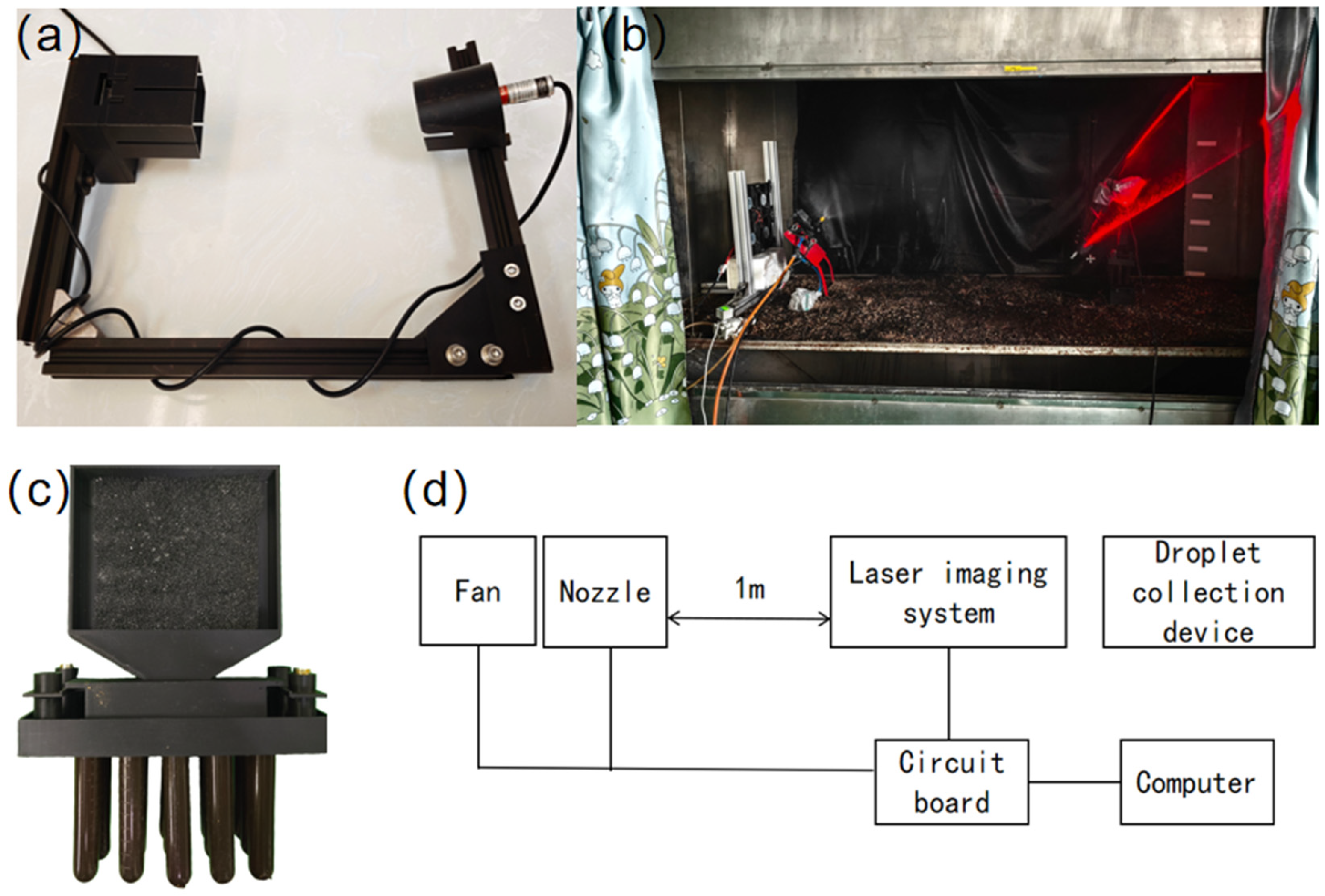
A housing was designed for the camera module, and a waterproof cover was installed over the lens. A fixation structure was designed for the laser module, integrated with a light shield to prevent direct laser light from entering the camera’s field of view. The camera and laser components were rigidly connected as shown in
Figure 3a to form an integrated laser imaging unit.
Indoor spray tests were conducted on a custom-built spray test bench. A fan, pressure controller, pressure gauge, solenoid valve, and nozzle assembly were arranged sequentially on the left side of the test bench. The nozzle was installed as shown in
Figure 3b, with its spray angle set at approximately 45° to the horizontal. The laser imaging system was positioned 100 cm to the right of the nozzle, with the connecting rod between the camera and laser inclined at an angle of 20° to the vertical. Before the start of the experiment, blackout curtains were drawn to ensure there was no interference from external light sources within the test bench.
To obtain the actual spray flow rate, a flow measurement device was arranged near the laser imaging system. The gravimetric method was employed to calculate the actual spray mass passing through the laser plane for each spray event, which was used to establish a mapping relationship with image features subsequently. The droplet mass collection device, shown in
Figure 3c, was employed to collect droplets traveling in the horizontal direction. The droplet flow rate passing through the laser plane was subsequently determined using the gravimetric method.
Lechler TR80 series nozzles were selected, comprising eight specifications with nozzle sizes of 005, 0067, 01, 015, 02, 03, 04, and 05, respectively. This series consists of fine-droplet hollow cone nozzles with a spray angle of 80°. The experimental spray pressure was set to 0.4 MPa, and the spray distance was set to 1 m. A bench fan was used to provide airflow, and the wind speed measured at the fan outlet was 7 m/s. The environmental temperature and relative humidity were 26 °C and 60%, respectively. These experimental conditions were kept consistent throughout the experiment.
3.2. System Control Procedure
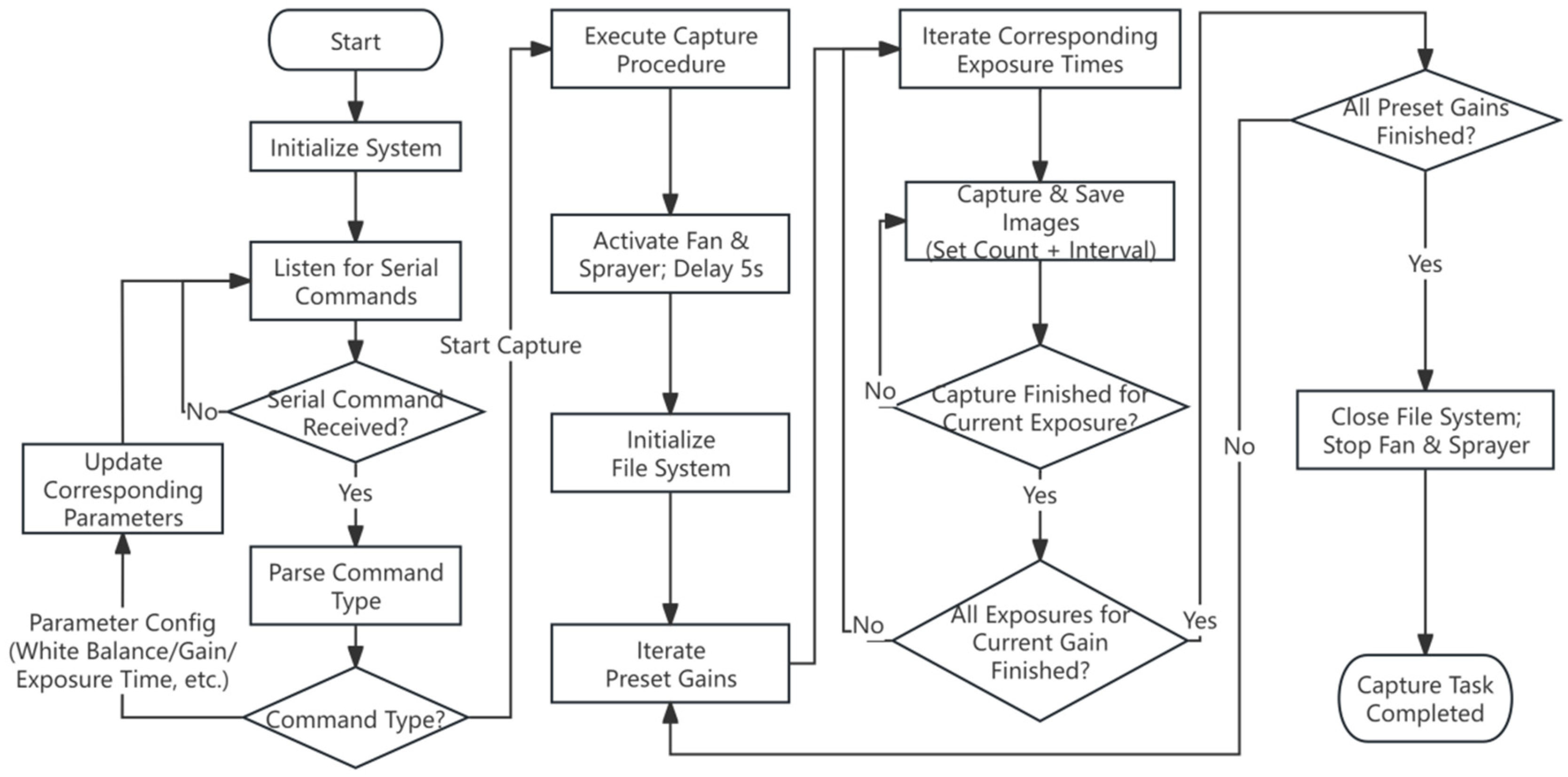
The control program was developed using the Arduino integrated development environment (Arduino IDE, version 2.3.4; Arduino SA, Lugano, Switzerland). The workflow of the laser imaging control system in this study is illustrated in
Figure 4. Upon system power-up, hardware and file system initializations are completed, followed by entering a serial command listening state. Upon receiving a first command, the system parses its type: If a parameter configuration command (e.g., white balance, gain, exposure time) is executed, the system updates the corresponding parameters and returns to the listening state. If the command is “START”, the system initiates the image acquisition task sequence.
Upon initiation of the acquisition task, the system activates the fan and spray device, followed by a 5 s delay to stabilize the spray status. Subsequently, a data storage directory is created, and file naming conventions are initialized. During the acquisition process, the camera cycles through exposure parameters according to a preset exposure time sequence. Under each exposure setting, image acquisition and storage to the SD card are completed based on the specified number of shots and fixed time intervals. Upon completion of acquisition for all exposure settings, the file system is closed, and the fan and spray device are stopped in sequence, concluding the current acquisition task.
After each task, the system is powered off, and the SD (TF) card is removed. Image data are exported to a computer, and the SD card is reformatted. Subsequently, the card is reinserted, the nozzle is replaced, and the system is restarted to initiate the next acquisition cycle for different nozzle specifications.
Based on preliminary experimental analysis, gain is appropriately increased for intensity compensation while exposure time is reduced, achieving optimal droplet visibility with minimal motion blur. The default gain and exposure time combinations in the program are listed in
Table 1.
3.3. Image Processing
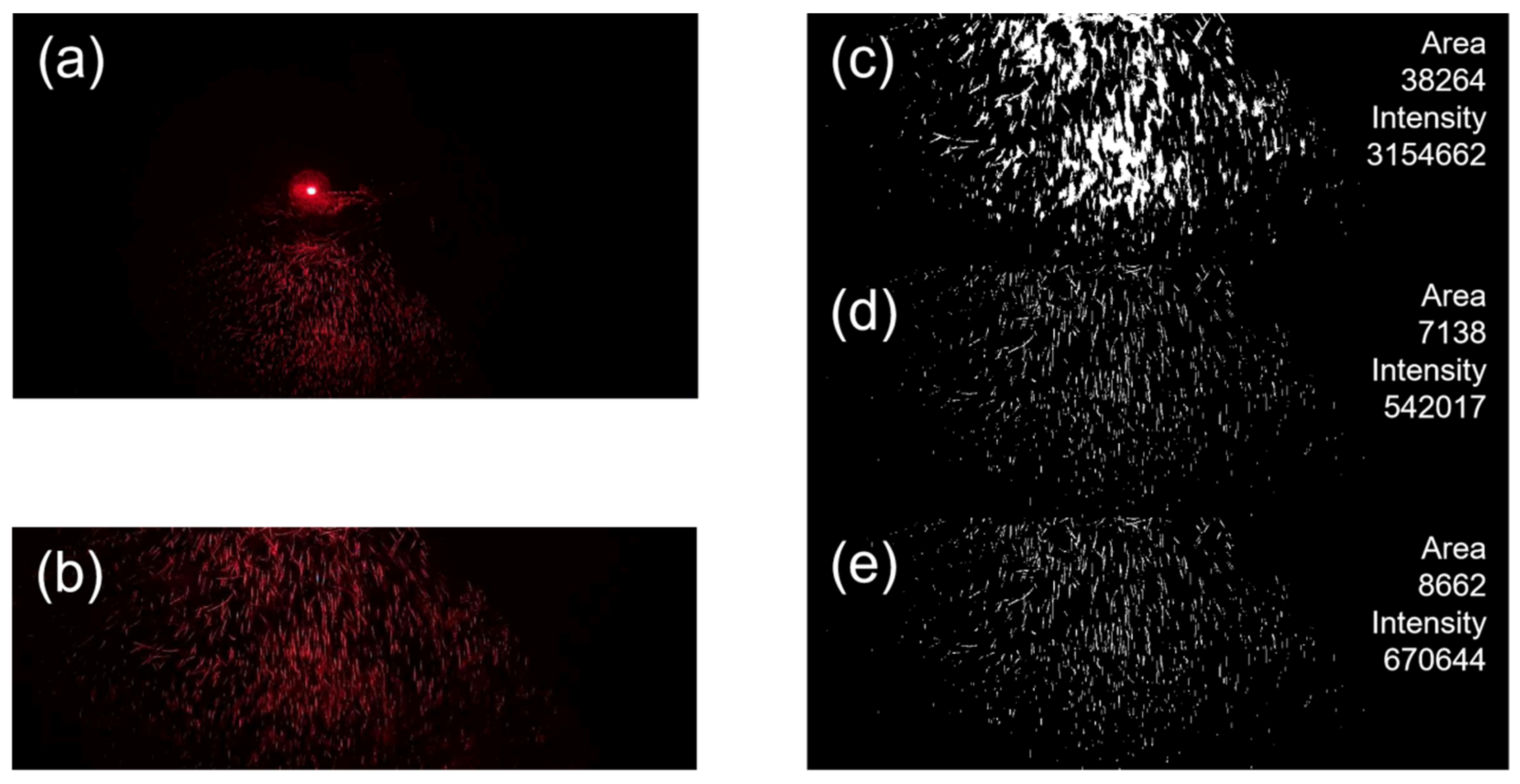
Image processing was implemented using PyCharm 2024 (JetBrains s.r.o., Prague, Czech Republic) with Python 3.12, utilizing libraries including OpenCV and NumPy. This study performed fixed-region cropping on the original images (
Figure 5a) to mitigate the impact of direct light from the laser aperture and its high-intensity regions on feature extraction. The upper section containing the laser source was removed, retaining only the lower field of view for droplet characterization, as shown in
Figure 5b. The cropped images were categorized and archived according to the gain and exposure time settings used during acquisition to ensure data traceability. For images within the same parameter group, the R, G and B channels were extracted separately and subjected to threshold segmentation, as shown in
Figure 5c–e. Based on this, the total area (
A) and total intensity (
I) of pixels exceeding the threshold were calculated as statistical features representing the droplet scattering intensity.
To minimize the impact of single-frame fluctuations on statistical results, n = 15 consecutive image frames were captured for each nozzle under each set of imaging parameters. The choice of n = 15 was based on preliminary experiments, in which we tested n = 1, 5, 15, and 30 frames. Results showed that n = 1 and n = 5 exhibited significant frame-to-frame variability due to the transient nature of the spray. Increasing n to 30 improved stability only marginally, while substantially increasing data storage requirements and processing time. Thus, n = 15 was selected as the optimal compromise between statistical stability and experimental efficiency. The mean values of the features were then calculated to serve as the representative values for the corresponding operating condition.
The average pixel area of the images for each nozzle during spraying was calculated as:
where
Si is the area of pixels above the threshold in the
i-th frame.
The average image intensity for each nozzle during spraying was calculated as:
where
Ij is the accumulated intensity (sum of grayscale values) of pixels above the threshold in the
j-th frame.
3.4. Data Processing
For different combinations of imaging parameters, the average pixel area () and average intensity () features of the RGB channels were extracted, respectively. Using the actual flow rate measured by the gravimetric method as the reference standard, a linear regression model was constructed. The goodness of fit and linear correlation of the model were quantitatively evaluated by calculating the regression coefficients and coefficients of determination (R2) for each channel under different parameters.
3.5. Droplet Size and Velocity Measurement
An OXFORD LASERS IMAGING SYSTEMS (Oxford Lasers Ltd., Didcot, UK) particle size analyzer was employed as auxiliary measurement equipment to measure the droplet characteristics of each nozzle under the same pressure conditions. During the measurement phase, the laser imaging system was removed from the measurement position, and the particle size analyzer was positioned at the original location of the laser imaging system, ensuring that the measurement distance and spray geometry remained consistent. Prior to measurement, instrument calibration and parameter configuration were completed. The horizontal direction pointing from the nozzle toward the laser imaging system was defined as the reference axis for the velocity direction, and the direction of the velocity vector output by the instrument was expressed as an angle relative to this reference axis.
These auxiliary results help interpret imaging phenomena but are not the validation standard for the proposed flow-rate method. The primary validation remains the gravimetric method, as stated in
Section 3.4.
4. Results
4.1. Results of Image Acquisition
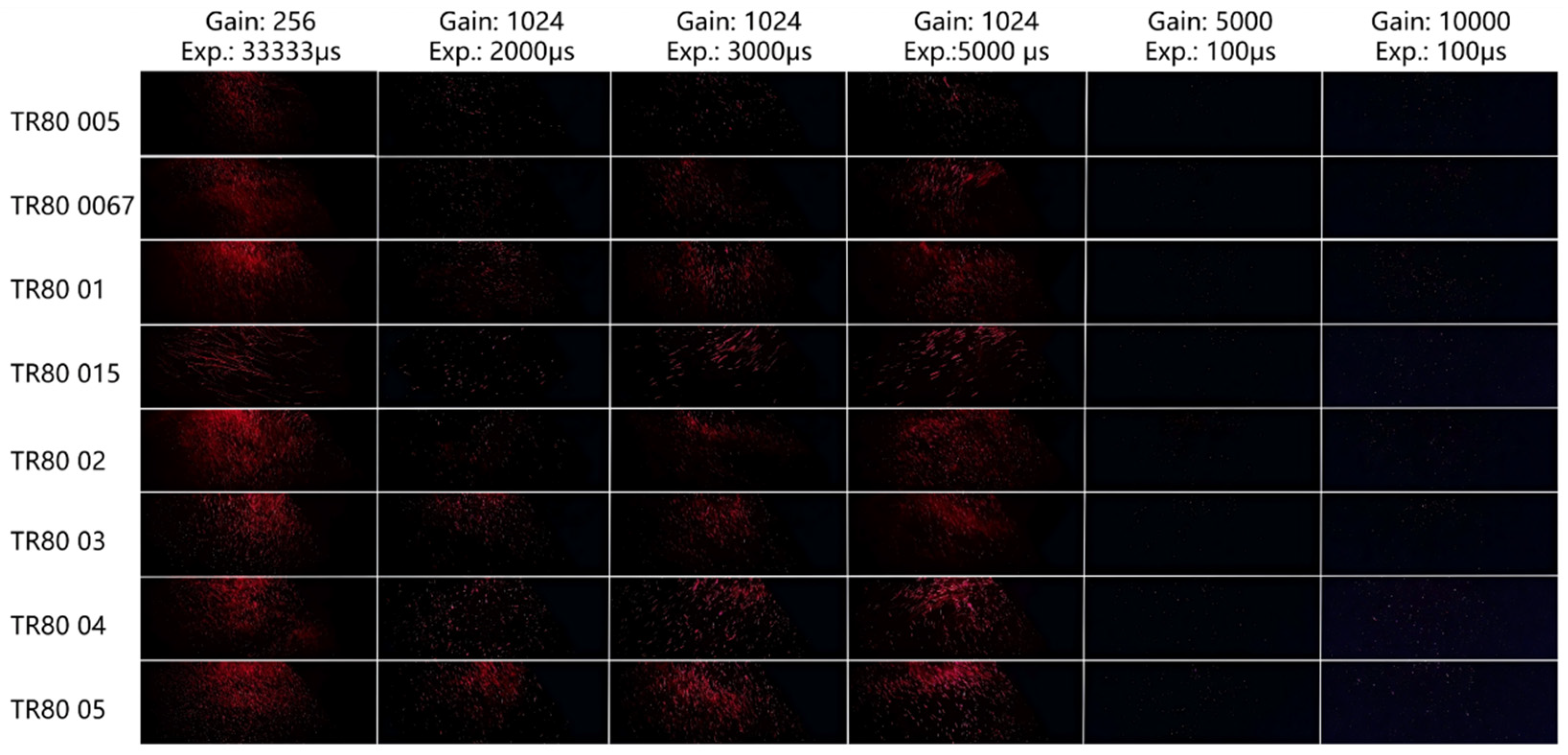
The cropped images are presented in
Figure 6. Exposure time directly influenced image intensity and motion blur. Longer exposure times yielded brighter images; however, due to droplet movement during the exposure period, substantial motion blur manifested as streaks. Conversely, shorter exposure times resulted in reduced overall intensity, minimized the appearance of motion blur, and captured discrete droplets with a scattered, dot-like morphology. Under identical imaging parameter conditions, as the nozzle specification increased from 005 to 05, the total area of the binarized bright pixel clusters exhibited an increasing trend.
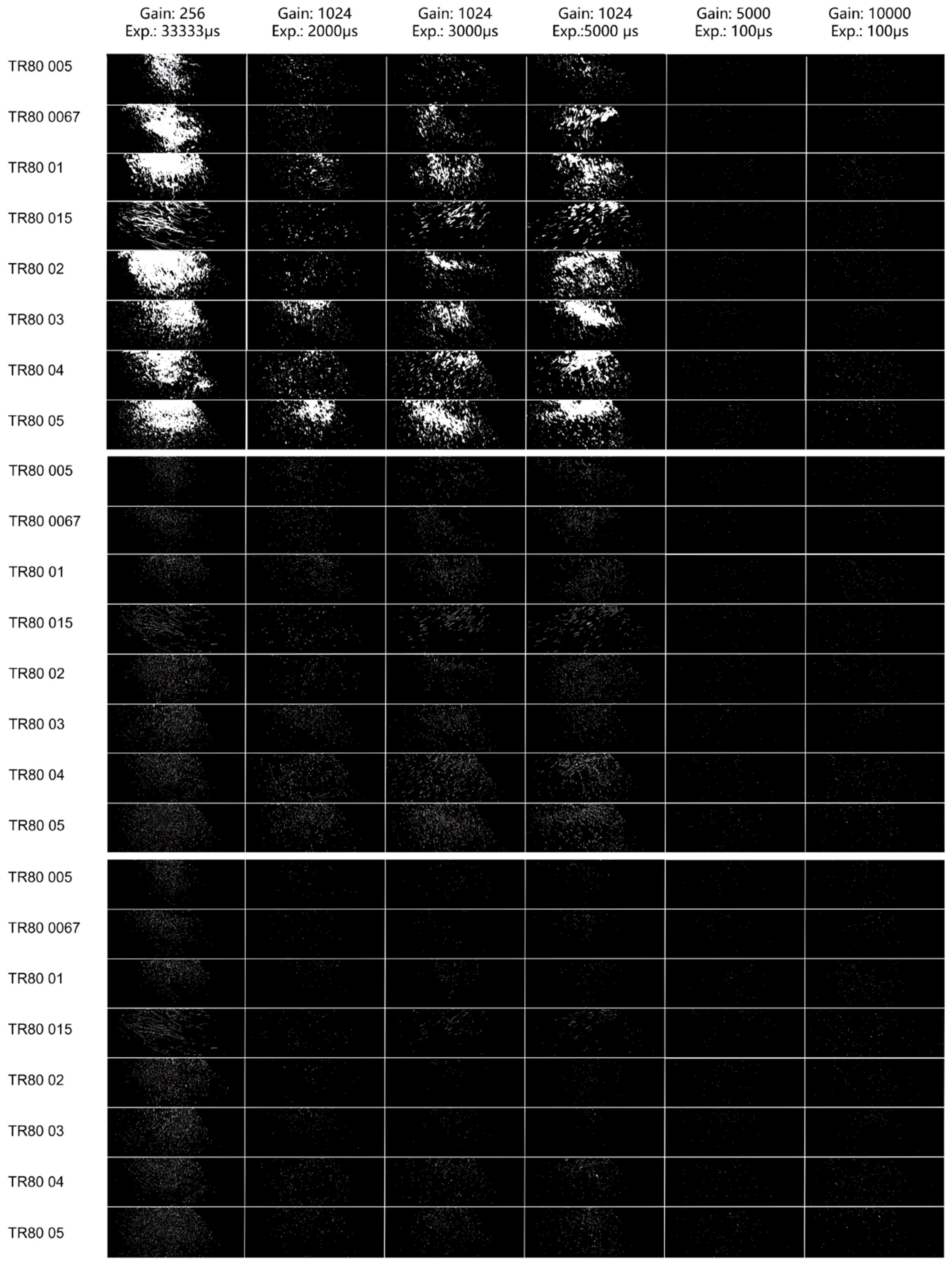
The R, G, and B color channels were independently extracted from the cropped images and subjected to individual threshold segmentation.
Figure 7 illustrates the results, displaying binarized outputs of the red, green, and blue channels from top to bottom. The red channel exhibited extensive contiguous high-intensity regions. Conversely, droplet signatures in the green and blue channels adopted discrete punctate distributions characterized by superior boundary definition. Based on visual inspection of the binarized images (
Figure 7), these channels exhibited sharper boundary definition and better separation between individual droplet signals compared to the red channel, more closely resembling the expected spatial dispersion of droplets. Therefore, the green and blue channels were selected as more suitable inputs for subsequent quantitative analysis.
4.2. Data Processing Results
Linear regression results between image features and flow rates are presented in
Table 2. Overall, imaging parameters significantly influenced the goodness of fit across channels. At a gain of 256 and exposure time of 33,333 μs,
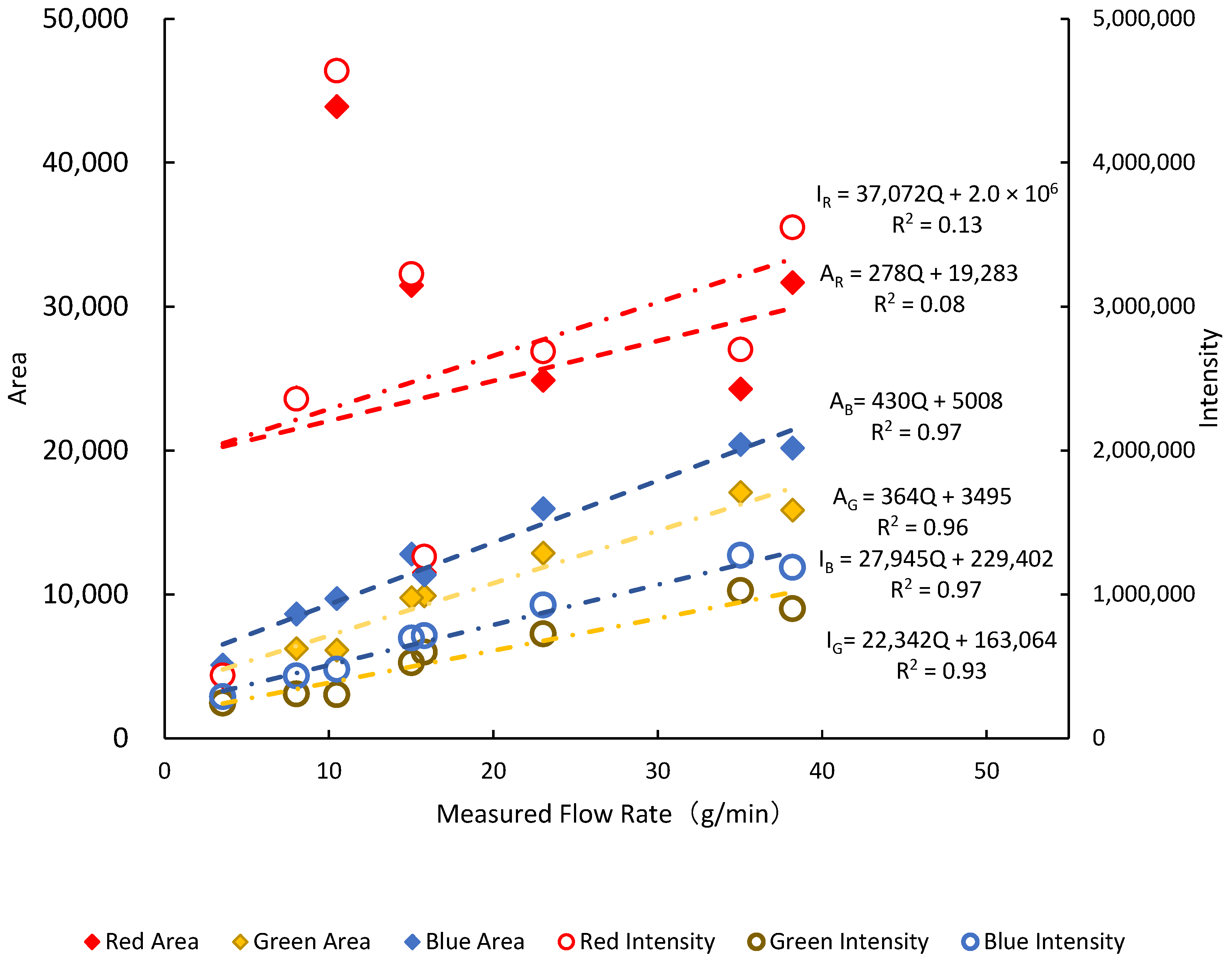
R2 values for the red channel’s area and intensity were 0.08 and 0.13, respectively, indicating no valid fit. Conversely, the green and blue channels exhibited high goodness of fit (green area: 0.96, green intensity: 0.93; blue area and intensity: 0.97). These results demonstrated that scattering features from green/blue channels could stably characterize flow rate variations.
When the exposure time was reduced to 2000–5000 μs (gain 1024), fitting results improved:
At 2000 μs, all channels achieved R2 = 0.75–0.82;
At 3000 μs, red and green channels reached R2 = 0.88–0.90; blue showed 0.86 (area) and 0.90 (intensity);
At 5000 μs, green and blue maintained high levels (0.87–0.90); red declined slightly (0.77–0.83);
With 100 μs exposure and increasing gain (5000 → 10,000), all channels retained high R2 (0.76–0.78 → 0.84–0.88).
In summary, under appropriate exposure-gain combinations, RGB features established stable linear relationships with flow rate. Conditions at 3000–5000 μs (gain 1024) and 100 μs (high gain) proved most robust as documented by R2 values, enabling subsequent flow modeling based on image features.
The regression results at gain 256/exposure time 33,333 μs are illustrated in
Figure 8. The scatter plots, overlaid with linear regression lines and equations, depict trends of area and intensity features versus flow rate across channels.
It is evident that the data points for the green and blue channels were concentrated along the fitting lines with a clear trend, indicating that the features of these two channels varied consistently with the flow rate under these parameter conditions. In contrast, the scatter points for the red channel were more dispersed, with points deviating from the fitting trend, leading to insufficient representativeness of the fitting line.
Figure 8 further visually demonstrates the differences in fitting stability among the different channels under these imaging parameters, providing a graphical basis for the subsequent discussion on imaging parameters and channel selection.
4.3. Particle Size Analyzer Results
The droplet characteristics of each nozzle were measured using the particle size analyzer under identical pressure conditions, and the results are presented in
Table 3.
Overall, as the nozzle specification increased from 005 to 05, the volume median diameter (Dv50) exhibited a gradually increasing trend, rising from 128 μm to 223 μm. The droplet velocities were generally distributed within the range of 0.60–0.76 m/s, with relatively limited differences among different nozzles. Regarding directional characteristics, with the direct right defined as the 0° reference, the dominant direction of each nozzle was generally close to the horizontal direction, though certain deviations and dispersion differences existed.
It is worth noting that the Dv50 of the 015 nozzle was 161 μm, similar to that of the 02 nozzle (156 μm). However, its average velocity was 0.61 m/s (relatively low among the nozzles), and its dominant direction was −20° with a directional dispersion reaching ±72°, which was significantly higher than that of most nozzles (typically ±35° to ±40°). This result aligned with the phenomenon observed in laser imaging, where the 015 nozzle was more prone to exhibiting streak-like trajectories and poor distribution uniformity within the observation cross-section. This indicated that its spray direction fluctuated more significantly, resulting in a more dispersed appearance of droplet trajectories under the same imaging parameters.
For small-sized nozzles (005–03), the Dv50 was mainly distributed between 128 and 187 μm, with the dominant direction concentrated near 0° (0–7°) and directional dispersion mostly ranging from ±35° to ±40°, showing good overall directional consistency. For large-sized nozzles (04 and 05), the Dv50 increased to 203–223 μm, and the dominant direction exhibited a downward-right deflection (−15° to −17°). Specifically, the directional dispersion for the 04 nozzle was ±60°, while for the 05 nozzle it was ±40°, indicating that differences in directional stability were observed across various nozzle sizes.
Based on these observations, future experiments should consider optimizing exposure settings specifically for nozzles with large directional dispersion to minimize motion blur artifacts. Additionally, increasing the number of repeated measurements for such nozzles may help improve feature stability and regression robustness.
5. Discussion
5.1. Trailing Phenomenon
In the spray experiments, droplet images under longer exposure conditions were prone to the trailing phenomenon shown in
Figure 9, which significantly impacted the accuracy of feature extraction and subsequent regression fitting. This trailing effect originates from motion blur caused by the displacement of droplets during the exposure time. When the exposure time is long, the scattered bright spots of droplets within the laser sheet accumulate integrally along the direction of motion, elongating from point-like responses to streak-like trajectories. This results in an overall overestimation of cumulative features such as area and intensity, thereby leading to an overestimation of spray intensity (or flow rate). As seen in
Figure 9, continuous high-intensity regions were more pronounced in the red channel results, indicating that under this exposure condition, the red channel was more susceptible to the superposition of laser background response and motion blur effects, with more prominent streak overlapping. In contrast, the green and blue channels were still dominated by discrete bright spots and short streaks, and their spatial distribution more closely matched the actual state of droplets in the observed cross-section. For real-world applications, this sensitivity to imaging parameters implies that the method would require site-specific calibration and stable lighting conditions (e.g., using light shields or operating at night) to maintain accuracy. Additionally, nozzles with highly dispersed spray patterns may need customized exposure settings to avoid motion blur artifacts.
The impact of motion blur on feature extraction is not only related to the imaging channel but also varies with the motion characteristics of the nozzle droplets. As shown in
Table 2, the 015 nozzle had the lowest average droplet velocity (0.61 m/s) and the largest directional dispersion (−20° ± 72°), indicating that the motion direction of its droplets fluctuated more significantly within the observation cross-section. Under the long-exposure conditions corresponding to
Figure 8 (Gain 256, Exposure Time 33,333 μs), the characteristic of “large directional dispersion” of this nozzle is superimposed with the long exposure condition. This facilitated the formation of longer streak trajectories and exacerbated the overlap between streaks, causing an abnormal elevation in area and intensity statistics. In
Figure 8, obvious outliers appeared in both the area and intensity curves of the red channel; their statistical values were significantly larger, deviating from the overall variation trend within the same flow rate interval, thereby directly weakening the stability of the red channel regression fitting. Combining this with the results in
Table 2, it can be inferred that this outlier was consistent with the phenomenon of enhanced streak superposition and feature overestimation of the 015 nozzle under long-exposure conditions.
Conversely, an excessively short exposure time causes the droplet scattering signal to approach the background noise level, reducing the image signal-to-noise ratio (SNR). In this case, if the gain is merely increased to compensate for intensity, the background noise is also synchronously amplified, causing feature statistics to become more sensitive to threshold settings, increasing fluctuations, and even leading to missed detections or instability. Therefore, exposure time and gain need to be set synergistically. The primary objective is to ensure that the droplet scattering signal remains identifiable. Under this premise, priority should be given to shortening the exposure time to suppress motion blur, while using moderate gain to compensate for intensity. Simultaneously, multi-frame acquisition and averaging processing should be adopted to reduce the impact of transient spray fluctuations and droplet randomness on single-frame statistics, thereby improving the stability and repeatability of the feature–flow rate fitting relationship.
5.2. Advantages of the Method
The laser imaging droplet intensity detection method proposed in this paper centers on using a line laser to generate a light sheet and a camera to capture scattering images of droplets. It enables the characterization of droplet status without contacting the droplets and without the need to dye the spray liquid or add tracers. This avoids the physical disturbances to the spray process caused by traditional sampling methods—such as collectors (e.g., water-sensitive paper or filter paper) that alter local airflow and droplet trajectories when inserted into the spray—as well as the latency associated with offline post-processing. The system hardware configuration is relatively concise (camera + line laser + fixation structure + control program), and the device is highly compact, making it convenient for conducting rapid comparative tests of multiple nozzles and parameters on a spray test bench.
A stable linear relationship with the flow rate can be established by using the low rate obtained via the gravimetric method as a control metric and processing images through fixed-region cropping, RGB channel separation and threshold segmentation. Experimental results demonstrated that under a suitable exposure–gain combination, the goodness of fit for the Green/Blue channel features and flow rate was high (R2 > 0.9), effectively distinguishing the variations in spray intensity across different nozzle specifications. Furthermore, the system employs SD card writing for data acquisition, ensuring a clear workflow and good repeatability. This facilitates subsequent unified data export, offline processing, and result verification, providing a possible engineering means for spray parameter optimization and system performance evaluation.
5.3. Disadvantages of the Method
The quantitative results of this method are relatively sensitive to imaging parameters and the optical environment.
First, the settings of exposure time and gain directly affect the trailing effect, signal-to-noise ratio (SNR), and the stability of feature statistics. Long exposure conditions are prone to motion blur, leading to overestimated area and intensity features, whereas short exposure may result in insufficient effective scattering signals and increased feature fluctuation. Therefore, parameter screening and optimization are required for specific operating conditions.
Second, since the light source is a red line laser, the red channel is more susceptible to the superposition of background scattering, residual direct light, or high-intensity regions. Under certain parameters, the fitting quality deteriorates significantly, indicating differences in sensitivity to noise and stray light among different channels. At the same time, the system relies heavily on the consistency of light shielding, installation angles, and the relative position between the camera and laser; geometric deviations or changes in external lighting may introduce additional errors.
Third, the current features are primarily statistical such as “area” and “intensity”, which essentially reflect the correlation between droplet scattering intensity within the observation cross-section and flow rate. It is difficult to directly provide finer-grained droplet dynamic information such as particle size spectra or velocity spectra. When the droplet density is too high (causing overlap and saturation of bright spots) or when the droplet distribution is extremely non-uniform, the linear relationship may weaken.
Finally, processing parameters such as image thresholds are still somewhat empirical. When crossing nozzle types or environmental conditions (e.g., different background reflections, spray concentrations, or airflow conditions), recalibration or adaptive strategies may be required. It should be noted that the present study was conducted exclusively under controlled laboratory conditions on a spray test bench. Therefore, robustness under complex canopy airflow, ambient light variations, and real field environments have not been tested and requires further verification and enhancement.
6. Conclusions
This study proposes a droplet intensity characterization method based on line-laser imaging to address the demand for droplet status detection in agricultural spray processes. This method is designed for the rapid comparison and quantitative analysis of spray intensity variations among different nozzles under test bench conditions. By using a line laser to form a stable light sheet and capturing scattering images as droplets pass through it, an association was established between image statistical features and the flow rate measured by the gravimetric method. This achieved non-contact measurement and characterization of the spray status without contacting droplets or adding dyes/tracers to the liquid.
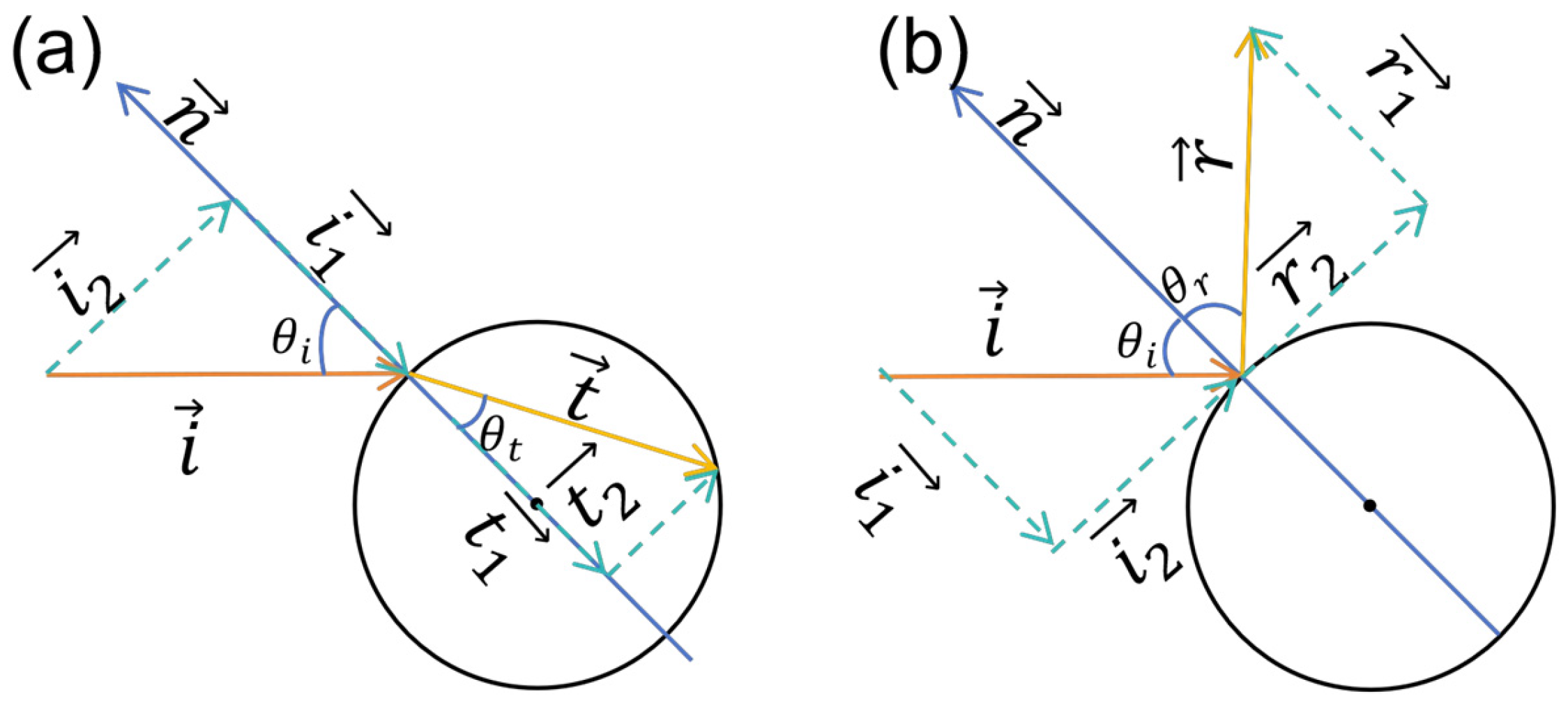
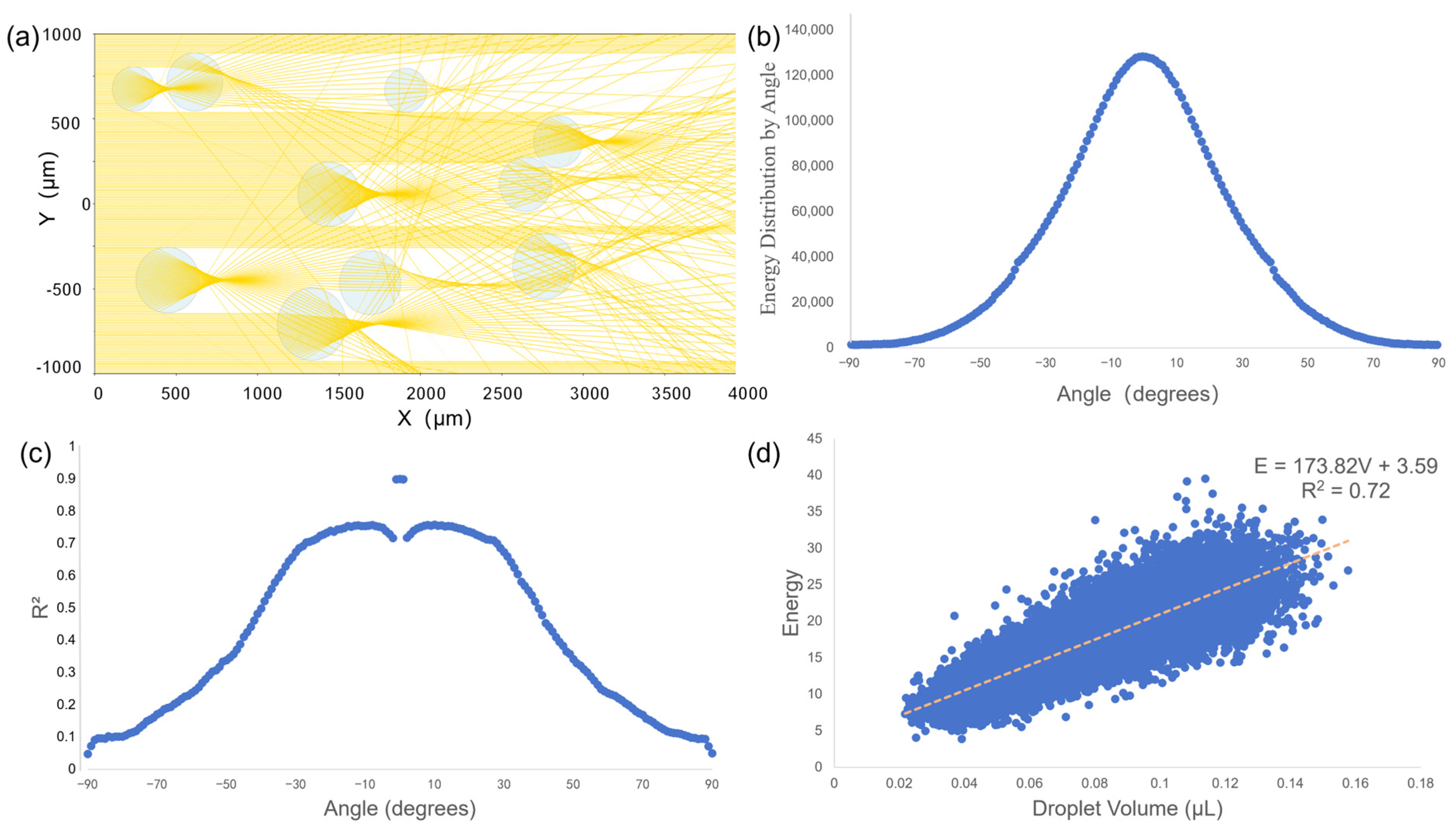
In terms of theoretical analysis, droplets were idealized as spherical particles, and a two-dimensional ray-tracing model was constructed to simulate the refraction, reflection, and energy distribution processes of a parallel laser beam at the droplet interface. Correlation between received energy and total droplet volume within different deflection angle intervals was obtained through repeated simulations. Within the observation angle range of 0–25°, the energy signal maintains high consistency with droplet volume (R2 generally greater than 0.7). Combined with imaging geometric distortion factors, the angle between the camera optical axis and the laser plane was determined to be 25°, providing a quantitative basis for the system structural layout and subsequent experiments.
In terms of system implementation and experimental verification, a laser imaging droplet detection system consisting of a camera, line laser module, and supporting control and data acquisition software was constructed. Comparative tests with multiple nozzles and multiple imaging parameter combinations were conducted on a spray test bench. For the acquired images, processing workflows including fixed-region cropping, RGB channel separation, and threshold segmentation were adopted to extract the pixel area and accumulated intensity of scattered bright zones as characterization features. These were then subjected to linear regression analysis against the flow rate obtained by the gravimetric method. The results indicated that imaging parameters had a significant impact on feature stability: under long exposure conditions, the red channel was susceptible to background response and the superposition of trailing effects, leading to a marked decline in regression performance. In contrast, under suitable exposure–gain combinations, the green/blue channels can stably characterize spray intensity variations. Their area and intensity features exhibited a strong linear relationship with the measured flow rate, with coefficients of determination reaching above 0.9, verifying the feasibility of this method for comparative analysis of spray status under the experimental program investigated.
In summary, this study demonstrates that in-flight droplet flow rate can be estimated from image features—a concept that shifts the focus from deposition measurement to spray flow rate assessment in the airborne phase. The proposed method provides a new technical pathway for spray characterization and system optimization. The laser imaging droplet intensity detection method proposed in this study features a relatively compact structure and is easy to integrate, offering a practical laboratory tool for rapid comparative assessment of spray flow characteristics (e.g., across different nozzle types or newly developed nozzles). Future work will focus on improving robustness under complex airflow and canopy environments. Key areas include suppressing trailing effects and background scattering, enabling adaptive imaging parameters, enhancing feature extraction stability, and conducting calibration under a wider range of operating conditions to further improve engineering applicability.
The proposed method is not limited to the specific nozzles or test bench conditions used in this study. Other researchers can adopt this approach by replicating the hardware configuration (camera + line laser) and following the calibration procedure described in
Section 3 to establish their own feature-flow rate relationships for different nozzle types, spray pressures, or application scenarios (e.g., tractor booms or aircraft spray systems). With appropriate adaptation—such as weatherproofing, vibration resistance, and real-time processing—the method could potentially be integrated into field-deployable monitoring systems for on-site spray assessment. Future work may also explore correlations with high-speed video recordings to further validate droplet dynamics under field conditions.



 ,
,