Article

Soil Texture Mediates the Short-Term Response of Particulate and Mineral-Associated Organic Carbon to Straw Return in the Loess Plateau


1
College of Natural Resources and Environment, Northwest A&F University, Yangling 712100, China
2
Key Laboratory of Plant Nutrition and the Agro-Environment in Northwest China, Ministry of Agriculture, Yangling 712100, China
3
State Key Laboratory of Soil and Water Conservation and Desertification Control, College of Soil and Water Conservation Science and Engineering (Institute of Soil and Water Conservation), Northwest A&F University, Yangling 712100, China
*
Authors to whom correspondence should be addressed.
Agronomy 2026, 16(6), 647; https://doi.org/10.3390/agronomy16060647
Submission received: 2 February 2026 / Revised: 8 March 2026 / Accepted: 16 March 2026 / Published: 19 March 2026
(This article belongs to the Section Soil and Plant Nutrition)

Abstract

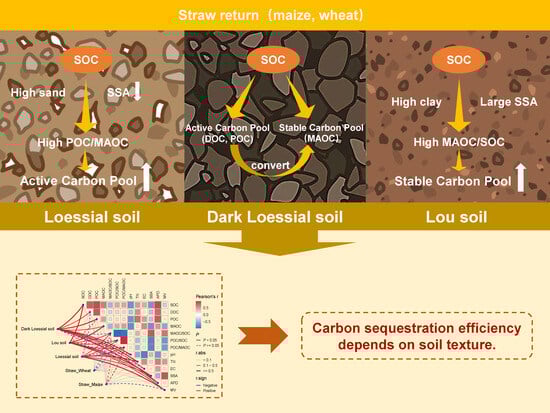
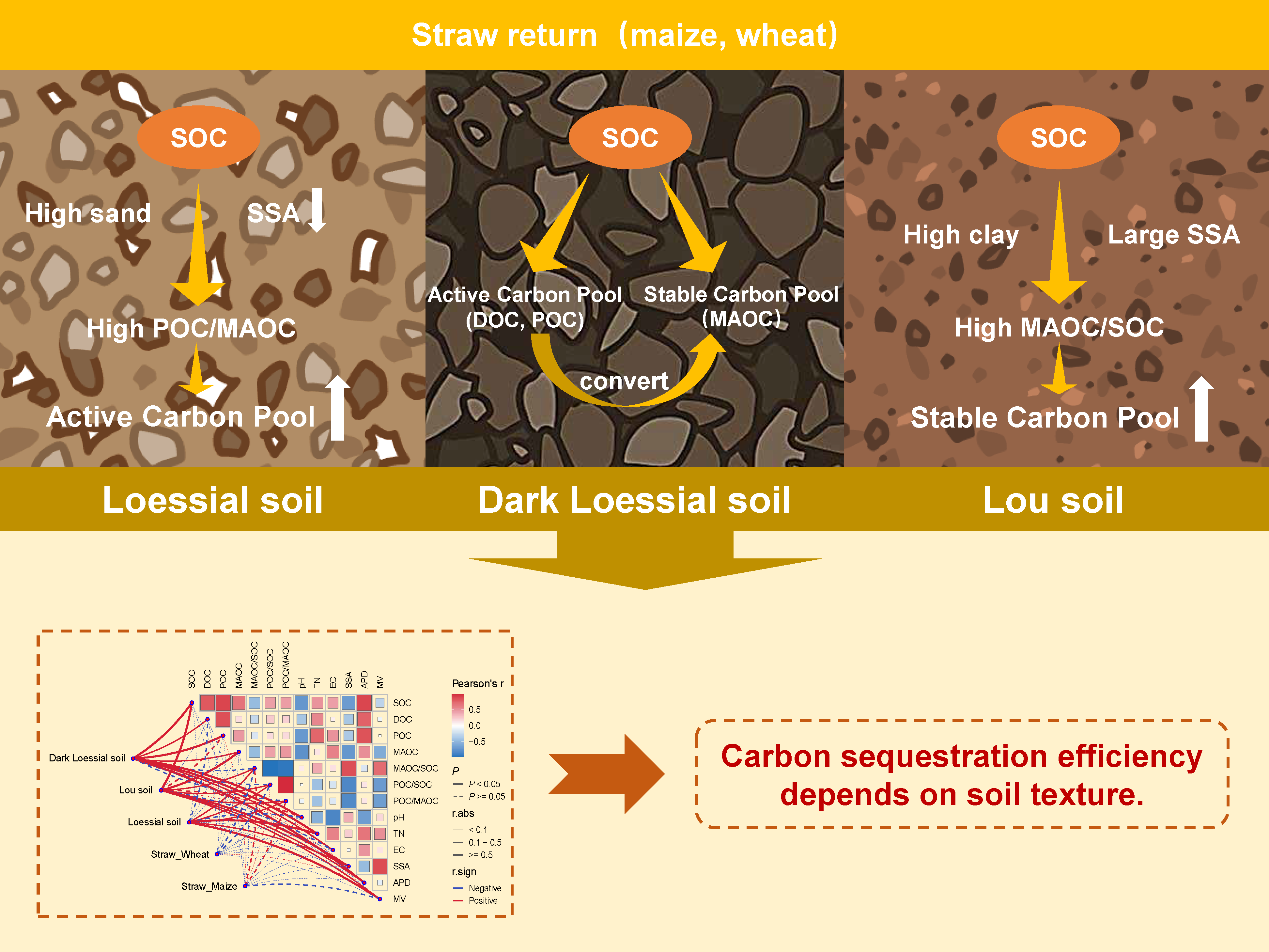
In the fragile Loess Plateau ecosystem, straw return is a key measure to improve its low soil organic matter. However, the short-term carbon retention efficacy of straw return, which depends on the initial balance between carbon mineralization and sequestration, remains unclear across different soil textures. This study investigated the short-term impacts of straw return on organic carbon fractions in three soils with varying textures via laboratory incubation. Results showed that while straw return universally increased active organic carbon pools, its accumulation in the mineral-associated organic carbon (MAOC) pool was texture-dependent. Straw incorporation, especially maize straw, effectively promoted MAOC formation in clayey soils (Phaeozems and Anthrosols) with large specific surface areas. Conversely, in Arenosols, carbon was retained in active pools, limiting long-term retention potential. The mechanism involves a combined regulation by soil physicochemical properties, where clay content and specific surface area are fundamental physical drivers for MAOC accumulation, synergistically influenced by chemical factors like pH and electrical conductivity through processes such as cation bridging. These findings provide critical scientific evidence for developing texture-specific straw return management strategies for the Loess Plateau.

Graphical Abstract

1. Introduction

Soil is the largest organic carbon reservoir in terrestrial ecosystems, storing approximately three times more carbon than the atmosphere. Agricultural soils, owing to their extensive area and frequent management interventions (e.g., tillage, fertilization), exert a substantial influence on the global carbon balance. Enhancing soil carbon sequestration in such agricultural systems is therefore recognized as a cost-effective strategy to mitigate climate change while safeguarding food security [1,2,3]. However, an estimated one-third of global soils are degraded to some degree, particularly in ecologically fragile regions [4]. A representative example is the Loess Plateau in China, which serves as a vital zone for dryland farming and commercial grain production. Due to its unique parent material and long-term unsustainable cultivation, soils in this region suffer from multiple ecological constraints, including extremely low organic matter content, poor aggregate stability, structural degradation, and severe erosion [5,6,7]. Identifying effective agronomic practices to rapidly increase soil organic carbon (SOC) content and improve soil quality in the Loess Plateau is therefore of critical importance.
Among various agronomic practices, straw incorporation is widely recognized as a core technique for replenishing exogenous soil organic carbon and enhancing soil fertility by directly returning substantial biomass carbon to farmland [5,8]. Long-term field trials have shown that sustained straw application increases topsoil organic carbon content, improves aggregate structure, and enhances nutrient availability [9,10,11]. However, the carbon sequestration effect of straw incorporation is not a simple linear function of input quantity [12,13]. Upon incorporation, straw carbon is rapidly decomposed by microorganisms, which alters the turnover of native SOC and partitions the newly added carbon into fractions with distinct dynamic characteristics: a portion is rapidly mineralized and lost as CO2, while the remainder is allocated to physiochemically distinct pools [14,15,16]. Consequently, the actual carbon sequestration efficiency of straw incorporation depends not merely on the total amount applied, but ultimately on how much carbon is retained in long-term carbon pools. Currently, the distribution patterns and dynamic changes in fresh carbon among different functional carbon pools, and particularly the regulation of these processes by soil properties, remain key to understanding the underlying mechanisms of carbon sequestration for the short-term effects observed within weeks to months after straw incorporation.
To accurately track carbon pathways and stability in soil, the scientific community has widely adopted physical fractionation-based approaches to categorize SOC into functional pools, moving beyond total carbon measurements. Among these, the framework dividing SOC into particulate organic carbon (POC) and mineral-associated organic carbon (MAOC) has become a mainstream method for studying carbon stabilization mechanisms [17]. POC consists largely of partially decomposed plant residues with relatively rapid turnover (years to decades); it responds sensitively to management and serves as a key energy source for microorganisms [1]. In contrast, MAOC is composed mainly of microbial metabolites that are strongly adsorbed to mineral surfaces such as clay and silt, with turnover times extending to centuries or even millennia, thereby representing a longer-cycling carbon pool. Soil clay and silt content is recognized as a key property governing the distribution of carbon between these pools [18,19]. Extensive research confirms that clay-rich soils, due to their high specific surface area and abundance of reactive sites, more effectively transform microbially processed organic matter into stable MAOC through physicochemical protection [20,21]. However, existing studies often treat soil texture as a static background variable rather than a dynamic regulator in carbon transformation processes. Divergent patterns of soil organic carbon stocks across the Loess Plateau are closely tied to soil texture. Clay-rich soils stabilize carbon through physicochemical protection, in contrast to sandy soils, where high decomposition rates and poor aggregate stability limit carbon accumulation [22,23]. While existing research has primarily focused on spatial patterns of carbon stocks or total SOC responses, it has paid limited attention to how soil texture governs the allocation dynamics and transformation rates of external carbon inputs (e.g., crop residues) among distinct carbon pools.
Soil carbon dynamics in farmland result from the coupled effects of management practices (e.g., straw incorporation) and inherent soil properties (e.g., texture) [19,24]. Translating this understanding into precise management, however, requires addressing two research gaps. First, most straw incorporation studies are based on long-term field trials that reflect cumulative “net effects” over years. While valuable for assessing sequestration potential, such trials obscure the critical carbon transformations occurring during the initial weeks to months after straw addition [24]. This limits our ability to address the fundamental question of how carbon is sequestered in the early stages, thereby hindering a mechanistic understanding of soil carbon stabilization processes. Second, studies comparing carbon sequestration across soil textures often attribute differences broadly to “physical protection” without directly quantifying carbon pathways. Several questions therefore remain unresolved: Are the short-term effects of straw incorporation consistent across the texture gradient of the Loess Plateau, or do they result in distinct allocation patterns? In coarse-textured soils, does the lack of mineral protection cause straw-derived carbon to remain predominantly in the rapidly cycling POC pool? Answering these questions is essential for developing texture-specific management strategies.
Therefore, this study selected soils with representative texture gradients from the Loess Plateau. Through short-term controlled incubation experiments combined with physical fractionation techniques, it aimed to address the following core scientific questions: (1) How do the short-term dynamics of dissolved organic carbon (DOC), POC, and MAOC differ among soils of varying textures following straw return? (2) How does soil texture regulate the distribution patterns and turnover rates of soil carbon components after straw incorporation? Based on this framework, we propose the following hypothesis: Finer-textured soils, owing to their greater physicochemical protection capacity, more effectively promote the conversion of straw-derived POC into the stable MAOC pool compared with coarser-textured soils. This would be reflected in a faster increase in the MAOC pool and a lower POC/MAOC ratio, thereby reducing the overall carbon turnover rate and enhancing short-term carbon sequestration efficiency. By characterizing the short-term interactions between straw incorporation and soil texture from the perspective of carbon fraction dynamics, this study aims to provide a scientific basis for developing site-specific strategies to improve soil fertility and carbon retention across diverse soil types in the Loess Plateau.

2. Materials and Methods

2.1. Study Area and Experimental Design

2.1.1. Study Area

The study was conducted in Shaanxi Province, China. Three representative sites were selected along a natural geographical and soil texture gradient from north to south: Ansai District in Yan’an City on the Northern Loess Plateau, Chunhua County in Xianyang City at the northern transition zone of the Guanzhong Plain, and Yangling District in Xianyang City within the central Guanzhong Plain. Ansai District (36°30′ N 109°10′ E) has a temperate semi-arid continental monsoon climate, with a mean annual temperature of 8.5–9.0 °C and annual precipitation of 450–550 mm. The soil was classified as Arenosols according to the World Reference Base for Soil Resources (WRB) [25]. Chunhua County (34°43′ N 108°18′ E) experiences a warm temperate semi-humid continental monsoon climate, with an average annual temperature of 9.6–10.5 °C and annual precipitation of 580–650 mm. The soil was classified as Phaeozems according to the WRB. Yangling District (34°14′ N 108°00′ E) is characterized by a warm temperate semi-humid continental monsoon climate, with an average annual temperature of 12.5–13.5 °C and mean annual precipitation of 600–660 mm. The soil was classified as Anthrosols in the WRB.

2.1.2. Experimental Design

A controlled incubation experiment was conducted under constant temperature conditions. Three soil types were used in the experiment: Phaeozems (BC), Anthrosols (LC), and Arenosols (YC). Soil samples were air-dried, sieved through a 2 mm sieve to remove plant residues and debris, and then stored for subsequent analysis. The basic physicochemical properties of the soils are summarized in Table 1.
Wheat and maize straw samples were collected from Yangling District. The materials were oven-dried, finely ground, and passed through a 2 mm sieve prior to use. The C/N ratios of the wheat and maize straw were 44.95 and 35.28, respectively.
In this experiment, soils were amended with straw at a rate of 1.5% (w/w), alongside a control treatment without straw. This addition rate falls within the typical range (1–2%) for short-term incubation studies and was selected to effectively elucidate the effects of initial straw decomposition on soil physicochemical properties and soil organic carbon fractions [26,27]. Nine treatments were established: (1) Phaeozems (BC); (2) Phaeozems + 1.5% wheat straw (BW); (3) Phaeozems + 1.5% maize straw (BM); (4) Arenosols (YC); (5) Arenosols + 1.5% wheat straw (YW); (6) Arenosols + 1.5% maize straw (YM); (7) Anthrosols (LC); (8) Anthrosols + 1.5% wheat straw (LW); (9) Anthrosols + 1.5% maize straw (LM). The specific treatments are as described in Table 2. Each treatment was replicated three times, resulting in a total of 27 pots. Each pot contained 3 kg of soil, which was thoroughly mixed with 45 g of straw. The soil moisture content was maintained at 70% of field capacity, and pots were incubated at 25 °C for 120 days in a temperature-controlled chamber. During incubation, the pots were aerated daily, weighed weekly, and their soil moisture content was adjusted as needed to maintain a constant level.

2.2. Analysis of Basic Soil Properties and Organic Carbon Fractions

Basic soil physicochemical properties were analyzed as follows: soil organic matter (SOM) was determined by the heated potassium dichromate oxidation method; pH was measured potentiometrically in a 1:2.5 soil: water suspension (PHS-3C, Shanghai INESA Scientific Instrument Co., Ltd., Shanghai, China); electrical conductivity (EC) was determined in a 1:5 soil: water extract; total nitrogen (TN) was analyzed using an elemental analyzer (AA3, FOSS GmbH, Hamburg, Germany); and soil porosity, average pore diameter, and specific surface area were measured by nitrogen adsorption (BET method, Micromeritics ASAP 2460, Micromeritics Instrument Corporation, Norcross, GA, USA).
Dissolved organic carbon (DOC): A 10.00 g aliquot of air-dried soil (<2 mm) was mixed with 50 mL of distilled water (1:5 w/v) and shaken (ZWY-211C, Shanghai Zhicheng Analytical Instrument Manufacturing Co., Ltd., Shanghai, China) continuously for 1 h at 25 °C. The suspension was filtered through a 0.45 μm membrane filter, and the DOC concentration in the filtrate was determined.
Particulate and Mineral-Associated Organic Carbon (POC and MAOC): A 25.00 g sample of air-dried soil (<2 mm) was dispersed in 100 mL of sodium hexametaphosphate solution (5 g L−1) by shaking for 18 h. The dispersed suspension was passed through a 53 μm sieve. The material retained on the sieve (>53 μm) was rinsed thoroughly with deionized water, oven-dried at 60 °C, weighed, ground to pass a 0.25 mm sieve, and analyzed for organic carbon by the heated potassium dichromate oxidation method to obtain the POC content. The fraction passing through the 53 μm sieve (<53 μm) contains MAOC. The MAOC content was calculated as the difference between SOC and POC. This subtraction method inevitably introduces measurement errors from both SOC and POC determinations. To minimize these uncertainties, all analyses were performed in triplicate, and strict quality control was maintained throughout the fractionation and oxidation procedures.

2.3. Statistical Analysis

Data were compiled and managed in Microsoft Excel 2019. All statistical analyses were conducted with SPSS software (version 27.0), while graphical presentations were created with the aid of Origin 2021. The correlation heatmap was analyzed and visualized using OmicStudio.

3. Results

3.1. Basic Physical and Chemical Properties of Soil

After the 120-day incubation period, significant alterations in soil physicochemical properties were observed. These changes showed distinct patterns dependent on soil type and straw treatment (Table 3).
Following the incubation period, soil chemical properties exhibited distinct changes across treatments (Table 3). Regarding pH, all treatments in the Phaeozems showed a significant decrease (p < 0.05). For instance, the BC treatment had a pH reduction from 8.09 to 7.71, indicating that incubation alone decreased soil alkalinity. In contrast, the LW in Anthrosols resulted in a significant soil pH increase from 8.32 to 8.46. In Arenosols, the YC treatment also displayed a notable soil pH decrease, whereas both straw amendments (YW, YM) led to slight pH elevations. This indicates that straw addition helped buffer soil pH fluctuations and contributed to greater soil pH stability in Arenosols.
Total nitrogen (TN) content exhibited variable responses across soil types following incubation. In Phaeozems, TN decreased under all treatments, with the BM showing a decline from 1.30 to 1.15 g kg−1. In contrast, TN remained relatively stable in both Anthrosols and Arenosols throughout the incubation period, with no pronounced differences observed among treatments or between initial and final measurements.
Electrical conductivity (EC) showed the most distinct changes among the measured properties, with responses differing markedly by soil type. In Phaeozems, EC increased significantly (p < 0.01) in all treatments after incubation. The BC exhibited a pronounced rise from 131.27 to 504 μS cm−1, representing an increase of more than 284%. Conversely, in Anthrosols, EC decreased significantly in both straw treatments (LW, LM), whereas an increase was observed in the LC. Changes in EC within the YC were minor and showed no consistent trend across treatments.
Soil pore characteristics responded significantly to the incubation process. Soil specific surface area (SSA) generally increased after incubation. With the exception of a slight decrease in the YM treatment, SSA increased significantly (p < 0.05) in all treatments of both Phaeozems and Anthrosols. For instance, the BC in Phaeozems rose from 15.00 to 17.30 m2 g−1.
Average pore diameter exhibited a general decreasing trend, with most treatments showing a significant reduction (Table 3, p < 0.05). Changes in soil mesopore volume varied by soil type: it generally increased in Phaeozems and Anthrosols. For example, the BM treatment in Phaeozems had an increase from 0.0313 to 0.0348 cm3 g−1. In contrast, in Arenosols, mesopore volume declined slightly in the YC treatment from 0.0228 to 0.0227 cm3 g−1, while both straw treatments (YW, YM) effectively maintained levels close to the original.

3.2. Effects of Straw Incorporation and Soil Texture on SOC and DOC

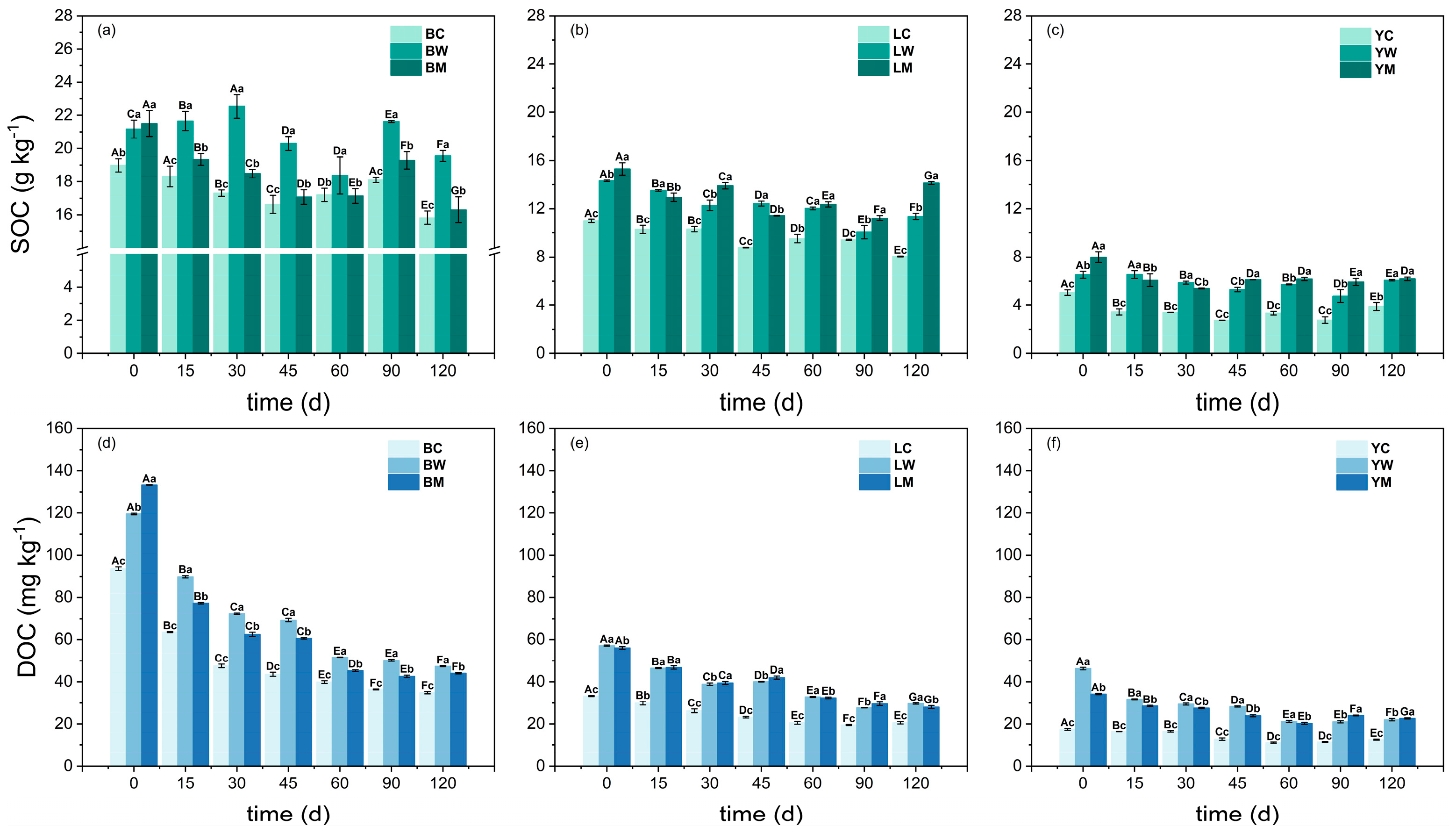
The dynamics of organic carbon content varied significantly among the three soil types. Soil type, straw incorporation treatment, and incubation duration all exerted highly significant effects on SOC content (Table 4, p < 0.001). By the end of the incubation period (120 days), SOC content in all control treatments (BC, LC, YC) had decreased significantly compared to initial levels (0 days, p < 0.05, Figure 1a–c), indicating net mineralization and depletion of the native soil organic carbon pool in the absence of fresh organic inputs. Straw incorporation effectively counteracted this depletion, leading to increased SOC levels in most amended treatments. Across the three soils, the overall SOC and DOC contents generally followed the order: Phaeozems > Anthrosols > Arenosols.
In Phaeozems, the SOC content in the BC declined consistently from an initial 18.98 to 15.83 g kg−1 (Figure 1a). In contrast, SOC levels under both BW and BM were significantly higher than the control at most sampling points during incubation (p < 0.05). Notably, the BM treatment peaked at 22.54 g kg−1 by 30 days, indicating enhanced short-term carbon retention in this treatment.
In Anthrosols, SOC content in the LC treatment declined from 10.98 to 8.05 g kg−1 after 120 days of incubation. The LM treatment showed a distinct pattern: following a mid-incubation decline, SOC rebounded sharply to 14.12 g kg−1 by the end of the incubation period, significantly exceeding all other treatments at that time (p < 0.05). This highlights the strong potential of maize straw to promote carbon accumulation in this soil type. Throughout the incubation, the LW treatment consistently maintained higher SOC levels than the control.
In Arenosols, SOC content showed the most pronounced dynamics. The YC treatment experienced a sharp decline of over 50% within the 45 days. Although some recovery occurred toward the end of the incubation period, SOC remained significantly lower than the initial value. Both straw treatments (YW and YM) effectively alleviated the decline in SOC, maintaining levels significantly above the control throughout the incubation (p < 0.05). Notably, the YM treatment achieved the highest SOC content (6.19 g kg−1) after 120 days of incubation, suggesting that maize straw contributes to maintain SOC content in the nutrient-poor Arenosols.
During incubation, DOC content showed marked temporal dynamics, with distinct response patterns depending on soil type and straw amendment (Figure 1d–f). Overall, DOC levels declined significantly over time in all treatments (p < 0.05). Notably, straw addition consistently elevated DOC concentrations throughout the incubation period across all three soil types (p < 0.05).
In Phaeozems, DOC content was the highest among all soil types, with straw amendments significantly enhancing DOC levels. At the start of incubation (0 days), the BM treatment showed the highest DOC content (133.33 mg kg−1), followed by the BW treatment (119.53 mg kg−1); both were significantly greater than the BC treatment (93.64 mg kg−1). After 120 days of incubation, DOC content declined substantially in all treatments, yet remained significantly higher in the BW (47.34 mg kg−1) and BM (44.01 mg kg−1) treatments compared to the control (34.88 mg kg−1).
In Anthrosols, straw addition consistently resulted in higher DOC concentrations. At the start of the incubation, DOC levels in the LW and LM treatments (57.16 and 56.06 mg kg−1) were significantly higher than in the control (LC, 33.31 mg kg−1). After 120 days, DOC in the LW treatment (29.67 mg kg−1) remained significantly elevated compared to both the LC and LM treatments.
In Arenosols, DOC content was the lowest in absolute terms among the three soils, yet it showed the strongest relative response to straw addition. At the onset of incubation, DOC in the YW (46.21 mg kg−1) was 2.6 times and 1.3 times higher than in the YC and YM treatments, respectively. Throughout the incubation period, DOC levels in both straw treatments (YW, YM) remained significantly higher than in the YC treatment (p < 0.05). This indicates that straw incorporation plays a significant role in sustaining the active carbon pool even in this relatively nutrient-poor soil.
Overall, straw incorporation markedly increased both SOC and DOC pools, though its effects were soil-specific and time-dependent. In the more fertile Phaeozems and Anthrosols, maize straw was more effective in maintaining elevated SOC levels. In contrast, in the relatively nutrient-poor Arenosols, straw addition primarily functioned to mitigate the rapid loss of native SOC.

3.3. Effects of Straw Returning to Fields and Soil Texture on POC and MAOC Content

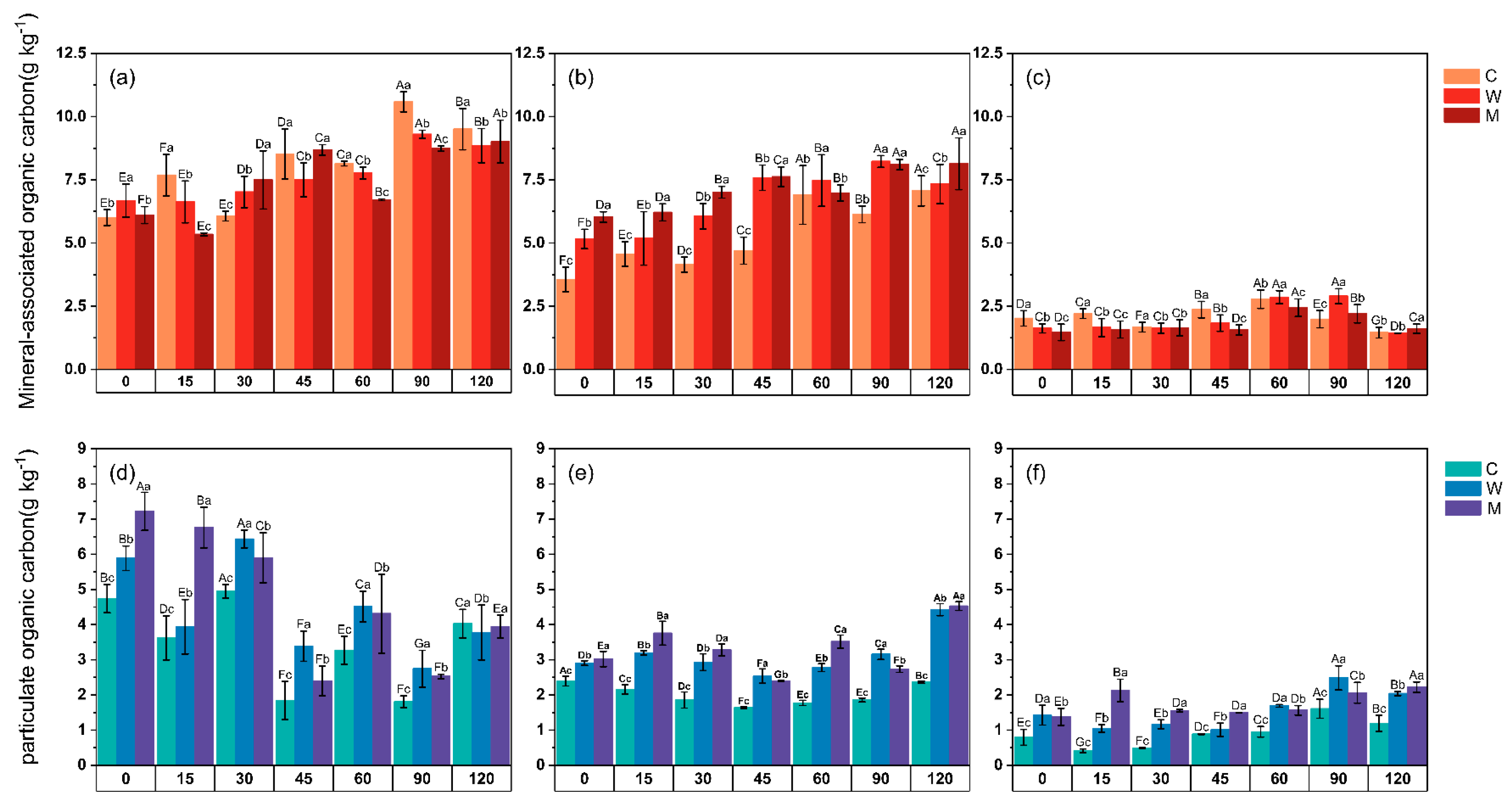
Straw incorporation differentially influenced the accumulation of soil organic carbon fractions, with the effects varying by soil type and straw source (Figure 2). Straw incorporation consistently and significantly increased the POC pool across treatments (p < 0.05), whereas its effect on the MAOC pool was more variable, showing strong dependence on soil type (p < 0.001) and distinct temporal dynamics. In terms of absolute content, both POC and MAOC followed the same order across soils: Phaeozems > Anthrosols > Arenosols.
In Phaeozems, the enhancement of POC by straw incorporation was most evident during the early incubation phase (Figure 2d). By 45 days, the BW and BM treatments had increased POC content by 50.8% and 31.1%, respectively, compared to the BC treatment. MAOC increased significantly in all treatments during the mid-to-late incubation period (Figure 2a). However, by the end of the 120-day incubation, MAOC levels in the straw treatments (BW: 8.85 g kg−1; BM: 9.01 g kg−1) did not differ significantly from the control (BC: 9.50 g kg−1).
In Anthrosols, the LM treatment showed a stronger promotion of MAOC accumulation (Figure 2b). After 120 days of incubation, the MAOC content in the LM treatment reached 8.13 g kg−1, which was significantly higher than in both the control and wheat straw treatments (p < 0.05). Meanwhile, straw incorporation significantly increased POC levels (Figure 2e); by the end of the incubation, POC contents in the LM and LW treatments were approximately 88% higher than in the control. These results indicate that maize straw contributed to greater accumulation of both POC and MAOC in Anthrosols compared to wheat straw.
In Arenosols, straw addition led to the most pronounced increase in POC (Figure 2f). After 120 days of incubation, POC content in the YW and YM treatments reached 2.04 and 2.22 g kg−1, representing increases of 71.4% and 86.6%, respectively, compared to the control (p < 0.05). In contrast, MAOC content remained consistently low throughout the incubation in all treatments (Figure 2c; range: 1.43–2.90 g kg−1), with no significant differences observed. These results suggest that in the sand-rich Arenosols, straw-derived carbon was primarily retained in the POC pool, with limited accumulation in the MAOC fraction.

3.4. Joint Regulation of Carbon Fraction Proportions and Turnover by Straw Incorporation and Soil Texture

Analysis of the mineral-associated with total organic carbon ratio (MAOC/SOC) and particulate to total organic carbon ratio (POC/SOC) over the 120-day incubation revealed that straw incorporation significantly altered the composition of soil organic carbon pools across the three soil types (Table 5, Table 6 and Table 7). Overall, Anthrosols demonstrated the highest proportion of mineral-associated carbon, maintaining an MAOC/SOC ratio above 0.82 throughout most of the incubation while exhibiting the lowest POC/SOC ratio. Phaeozems ranked second in stability, whereas Arenosols was dominated by active carbon components, showing a significantly higher POC/SOC ratio than the other two soils under all treatments.
In Anthrosols, the carbon pool remained highly stable, with the MAOC/SOC ratio peaking at 0.96 during the mid-incubation period (45–90 days). Straw incorporation partially modified this pattern. By the end of the 120-day incubation, the MAOC/SOC ratio in the LW treatment (0.74) was significantly lower than in both the LC and LM treatments, while its corresponding POC/SOC ratio (0.26) was significantly elevated. This suggests that wheat straw addition promotes a shift in carbon toward more active pools in Anthrosols. The POC/MAOC ratio strongly supports this observation: the LC treatment maintained a very low POC/MAOC ratio (0.05–0.23) throughout the incubation, reaching its minimum during the mid-term (45–90 days). In contrast, the LW treatment reached a ratio of 0.35 by 120 days, which was significantly higher than both the control (0.23) and the maize straw treatment (LM, 0.19).
In Phaeozems, the MAOC/SOC ratio remained relatively high and increased during the mid-to-late incubation periods (45–90 days). The MAOC/SOC ratio under straw amendments did not differ significantly from the BC treatment at most sampling points; however, the BM treatment showed the highest value (0.78) at 30 days. The POC/SOC ratio generally declined over time across all treatments. The POC/MAOC ratio decreased initially before rising later in the incubation. During the mid-incubation period (30–90 days), the BM treatment maintained a relatively low POC/MAOC ratio, indicating greater carbon retention in mineral-associated forms. By the end of the 120-day incubation, however, no significant differences in this ratio were detected among treatments.
In Arenosols, straw incorporation drove the most pronounced changes in carbon-pool composition. The YM treatment resulted in the highest POC/SOC ratio (0.45) and the lowest MAOC/SOC ratio (0.55) after 120 days, demonstrating that maize straw redirected carbon toward the labile pool and resulted in a lower MAOC/SOC ratio. This was further evidenced by a 73% rise in the POC/MAOC ratio (from 0.48 to 0.83) under the YM treatment, which was significantly greater than in other treatments (p < 0.05). These findings show that maize straw not only enhanced the active carbon pool but also fundamentally altered the carbon-pool equilibrium toward a more labile and rapidly cycling regime.
Meanwhile, to better understand the temporal patterns of mineral-associated carbon accumulation, we fitted a GaussAmp function to the MAOC/SOC data for each treatment (Table 8). The goodness of fit (R2) ranged from 0.32 to 0.62 across treatments. Model fits were stronger for Anthrosols (R2 = 0.58–0.60) and for Arenosols under straw addition (R2 = 0.55–0.62), but weaker for Phaeozems (R2 = 0.32–0.38) and the YC treatment control (R2 = 0.37). The lower R2 values in Phaeozems likely reflect greater temporal variability in MAOC/SOC dynamics under these treatments, consistent with the more fluctuating carbon allocation patterns observed in this soil type.
Anthrosols had the highest baseline MAOC/SOC ( y 0 = 0.80–0.84), while LW treatment triggered an early peak (52.93 days) that declined sharply, with MAOC/SOC dropping to 0.74 by day 120 and POC/MAOC rising to 0.35 (Table 5). LM treatment produced a later (86.7 days) and broader peak, with MAOC/SOC remaining elevated throughout.
Phaeozems showed intermediate baselines ( y 0 = 0.73–0.74). Peak responses occurred at 78–90 days. The BM treatment had a slightly earlier peak (84.28 days) and lower POC/MAOC during mid-incubation (Table 6), but treatment differences diminished by day 120.
Arenosols had the lowest baselines ( y 0 = 0.59–0.69). The YM treatment gave the largest amplitude (A = 0.20), yet POC/MAOC still rose from 0.48 to 0.83 by day 120 (Table 7), indicating carbon remained largely in labile forms despite increased MAOC.
Values are presented as mean ± standard error (n = 3). The GaussAmp function y = y 0 + A e ( x x c ) 2 2 w 2 was fitted to MAOC/SOC data over 120 days of incubation. MAOC was calculated as the difference between SOC and POC. Baseline ( y 0 ) represents the estimated background MAOC/SOC; amplitude (A) represents the maximum increase in MAOC/SOC above baseline; peak time ( x c ) indicates the day at which the maximum response occurred; width ( w ) reflects the duration of the response. R2 indicates the goodness of fit.

3.5. Regulation of Soil Organic Carbon Components by Straw Incorporation and Soil Texture

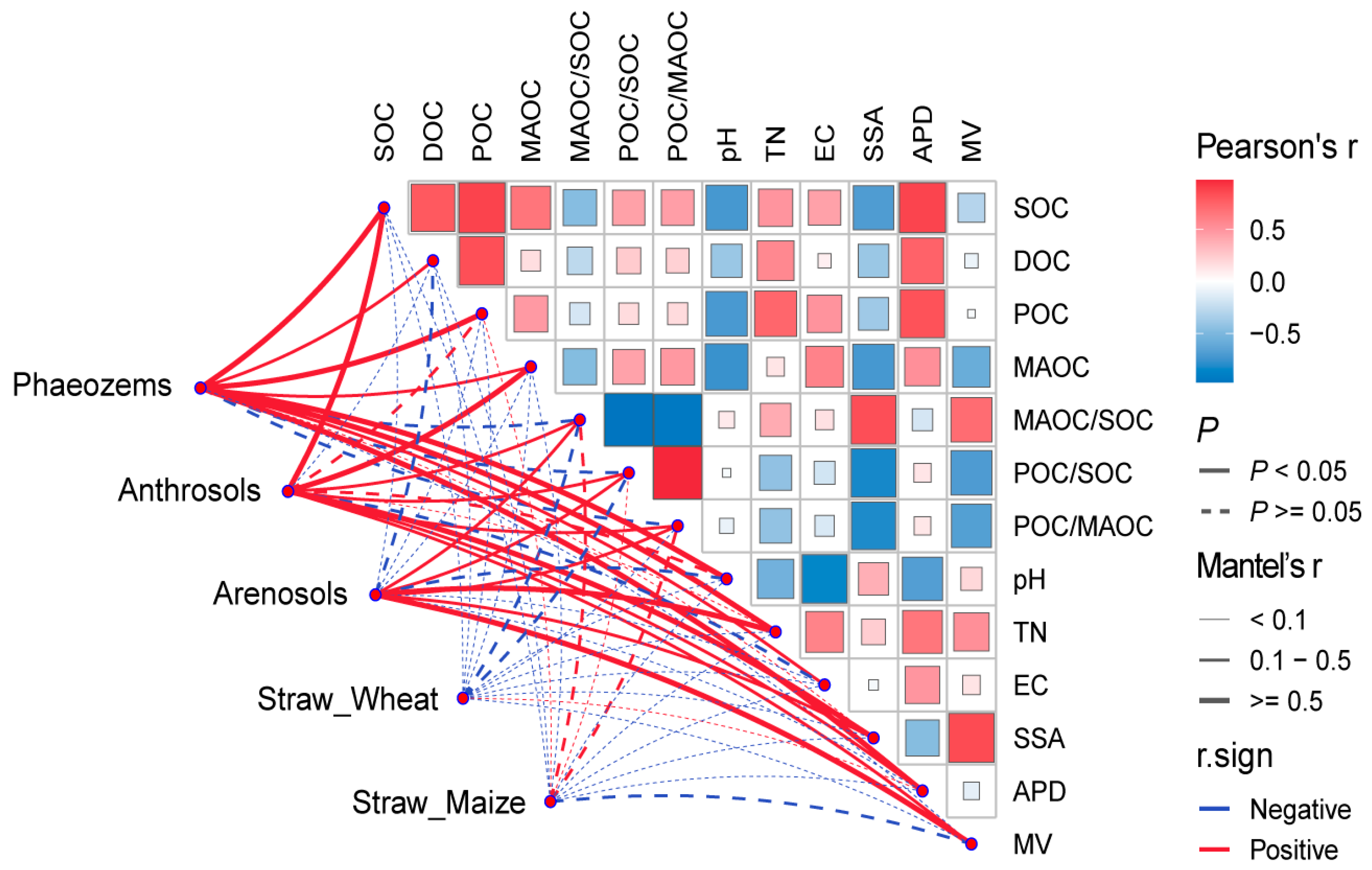
To identify the dominant factors controlling SOC stability, this study analyzed the relationships between SOC components and key physicochemical properties under varying soil textures and straw amendments. Mantel test results indicated that soil texture was the primary driver influencing organic carbon fractions (Figure 3). In Anthrosols and Phaeozems, physicochemical properties and SOC fractions showed significant positive correlations (Mantel’s r = 0.59 and 0.58, respectively; p < 0.001), whereas no such significant correlations were observed under wheat or maize straw amendments. This underscores the decisive role of inherent soil properties in shaping system-level interactions.
Correlation analysis further revealed distinct SOC accumulation and turnover pathways across different soil textures. In Anthrosols, physical properties dominated SOC dynamics, evidenced by a strong positive correlation between SSA and the MAOC/SOC ratio (r = 0.84, p < 0.001), and between the MAOC/SOC ratio and MV (r = 0.70). This suggests that in Anthrosols, physical properties are closely associated with the accumulation of mineral-associated carbon.
Conversely, in Phaeozems, SOC dynamics were primarily coupled with labile carbon and physical structure. SOC content correlated strongly with POC (r = 0.88, p < 0.001). Both POC and SOC were closely linked to TN and APD (r = 0.73–0.88), indicating that under this texture, straw-derived carbon is more readily channeled into the active carbon pool.
In Arenosols, carbon retention was limited by weak mineral protection, resulting in low stability and no consistent associations with most physicochemical properties. SOC showed no significant correlations with any carbon fraction; its dynamics were mainly tied to TN (r = 0.71, p < 0.001) and mesopore volume (r = 0.66, p < 0.001). This suggests that in the absence of strong mineral protection, straw carbon primarily serves as a nutrient source and physical substrate. Although straw incorporation significantly increased POC content (by up to 86.6%), the increase in POC was not accompanied by a corresponding increase in MAOC. Consequently, the carbon pool in this soil remained dominated by labile components and exhibited the lowest MAOC/SOC ratio.

4. Discussion

4.1. Driving Role of Straw Incorporation in Soil Carbon Cycling

The observed increases in DOC and POC following straw addition indicate that straw incorporation enhanced the turnover rate of the labile carbon pool. During the initial incubation phase (0–15 days), the contents of DOC and POC increased significantly in all soils following straw addition. For example, DOC in the BW treatment reached 119.53 mg kg−1 in the early stage, substantially higher than the control, while the POC/SOC ratio in Anthrosols was also markedly elevated under straw treatment. This confirms that straw, as a readily available organic carbon source, rapidly replenishes the labile carbon pool, supplying ample energy for microorganisms and thereby stimulating microbial activity. This acceleration promotes the cycling and transformation between native soil carbon and newly added carbon [28,29,30], a conclusion similarly supported by Gmach and Jiang et al. [31,32]. However, this stimulatory effect was transient, as DOC content declined consistently throughout the incubation, reflecting the rapid depletion and transformation characteristic of the labile carbon pool [33,34].
Straw addition also redirected the flow and distribution of carbon among different organic carbon fractions. Throughout the incubation, DOC content decreased across all treatments, whereas POC and MAOC exhibited distinct dynamics depending on soil type. For instance, Phaeozems showed the highest absolute MAOC and POC contents, indicating greater carbon retention in these fractions. Anthrosols displayed notable potential for MAOC accumulation, with both control and straw-amended treatments showing significant increases in MAOC during the late incubation phase (90–120 days). Fitted parameters further revealed that under wheat straw, the MAOC/SOC peak occurred early ( x c = 52.93 days) and was short lived, while under maize straw, the peak was delayed ( x c = 86.68 days) and more sustained. In contrast, Arenosols contained the lowest MAOC and POC levels, suggesting a limited capacity for long-term carbon storage. These patterns align with the “microbial carbon pump” framework [35], wherein microbial metabolites derived from straw carbon (e.g., residues, secretions) serve as precursors that bind to soil minerals, shifting carbon from labile pools (DOC, POC) toward the MAOC pool. The V-shaped trajectory of the POC/MAOC ratio, with an initial decline followed by a later rise, reflects this early carbon transfer and subsequent return toward baseline conditions.
Nevertheless, the extent to which straw incorporation promotes MAOC accumulation is strongly soil-dependent and often delayed. As noted by Woolf and Lehmann [36], straw primarily stimulates the fast-cycle carbon pool in the short term, while effective transfer of exogenous carbon into slower-cycling pools is constrained by soil properties. Our results support this view: although labile carbon pools fluctuated considerably, MAOC content and the MAOC/SOC ratio responded more slowly and heterogeneously to straw addition. In fine-textured soils with high specific surface area, straw effectively promoted MAOC accumulation. Conversely, in coarse-textured Arenosols, straw-derived carbon was primarily retained in labile pools, with limited accumulation in the MAOC fraction.
In summary, straw incorporation is a key agricultural practice for driving soil carbon turnover. Its efficacy depends not merely on carbon input, but on how it regulates carbon cycling through enhanced microbial activity and altered transformation pathways. Ultimately, however, the retention of added carbon is governed by the soil’s inherent capacity to protect it. This implies that future management should focus on improving soil quality (such as enhancing structure and aggregate formation) as a foundation for increasing the carbon-sequestration efficiency of straw, thereby integrating short-term carbon dynamics with long-term carbon retention.

4.2. The Role of Soil Texture in Shaping Carbon Retention Patterns

This study compared the composition of carbon pools across three distinct soil textures, revealing that physical protection is a key mechanism regulating carbon retention, with its effectiveness largely governed by clay mineral content. Anthrosols exhibited the highest MAOC/SOC ratio and the lowest POC/MAOC ratio, reflecting greater carbon retention in mineral-associated forms. GaussAmp fitting of MAOC/SOC dynamics confirmed this pattern, with Anthrosols showing the highest baseline values (0.80–0.84) among the three soils (Table 8). This can be attributed to its abundant clay minerals, which provide a high specific surface area for adsorption and aggregation, effectively encapsulating organic carbon and slowing microbial decomposition [19,37,38]. In contrast, the Arenosols (sand > 70%) have low clay content and limited protective sites [39], resulting in a higher proportion of carbon residing in the readily decomposable POC pool and a significantly elevated POC/MAOC ratio (0.16–0.83) compared to other soils. The fitted baseline values for Arenosols were correspondingly low (0.59–0.69), consistent with their limited mineral surface area. Chemical properties also appeared to influence carbon retention pattern. In Phaeozems and Anthrosols, MAOC accumulation coincided with specific chemical changes. In these alkaline soils (pH > 8), the pronounced EC increase in Anthrosols, especially the 284 percent rise in BC treatment (Table 3), points to base cation (e.g., Ca2+) release during straw decomposition. Elevated Ca2+ availability would be expected to promote cation bridging [40,41], a mechanism that can facilitate organo–mineral associations. The limited MAOC accumulation in Arenosols, despite similar straw inputs, likely reflects insufficient clay surfaces for such Ca-bridged complexes to form, rather than a lack of cations. Changes in soil pH may further modulate organic–mineral interactions by influencing organic matter solubility and functional-group ionization [42]. In fine-textured soils such as Anthrosols and Phaeozems, these chemical conditions may promote organo–mineral binding, contributing to greater carbon retention [43]. In coarse-textured Arenosols, similar chemical processes may occur, but carbon retention remains limited due to the scarcity of mineral binding sites. Thus, MAOC accumulation appears to be shaped by interactions between physical and chemical properties that collectively govern carbon retention.
Through the mechanisms described above, soil texture influences the composition and dynamics of soil carbon pools. This texture-dependent pattern is clearly reflected in the POC/MAOC ratio. The Anthrosols showed the lowest POC/MAOC ratio with the least variability, Phaeozems exhibited an intermediate value, while Arenosols displayed the highest ratio and the greatest variation. Correlation analysis (Figure 3) supports this interpretation, with SSA and mesopore volume in Anthrosols showing strong correlations with MAOC/SOC (r = 0.84 and 0.70). In Arenosols, by contrast, no such associations were found. Fine-textured soils not only possess a greater capacity for carbon retention but also demonstrate a stronger ability to retain exogenous carbon inputs, such as straw, thereby promoting its accumulation in the MAOC pool. In contrast, sandy soils are constrained by inherent physicochemical limitations, resulting in low MAOC/SOC ratios, a weak capacity to retain added carbon, and consequently faster carbon cycling. The direct reason for this difference lies in the abundant clay minerals of fine-textured soils, which provide a substantial specific surface area and numerous reactive sites, a perspective supported by studies such as Salonen et al. [44] and de Lima et al. [45]. It is worth noting that maintaining soil moisture at 70% of field capacity does not ensure equivalent water-filled pore space across textures. Coarse-textured soils drain more rapidly and remain better aerated than fine-textured ones under the same moisture regime [46,47]. Such differences in aeration and water distribution can influence microbial activity and organic matter decomposition [48,49], and may partly explain the texture-dependent patterns in MAOC accumulation observed here. Thus, while our approach standardized moisture content, the inherent pore architecture of each soil likely shaped the microbial environment and subsequent carbon dynamics. This study further observed that Anthrosols and Phaeozems maintained or even increased their mesopore volume after incubation, which may facilitate the formation of protective micro-environments. In contrast, mesopore volume decreased sharply in the control treatment of Arenosols, revealing its structural vulnerability. As demonstrated by Yang et al. [50], fragile pore structures not only reduce physical protection but may also accelerate the aerobic microbial mineralization of organic carbon due to excessive aeration. Thus, soil texture indirectly determines whether organic carbon persists in a physical environment conducive to long-term preservation by influencing structural stability.
In summary, soil texture regulates both the availability of “physical protective spaces” and the density of “chemical binding sites,” thereby governing the size and composition of the soil organic carbon pool, particularly the MAOC fraction.

4.3. Synergistic Regulation of Soil Organic Carbon by Straw and Texture in the Loess Plateau

The findings of this study demonstrate that on the Loess Plateau, the carbon retention effect of straw incorporation is not an independent process but exhibits a profound coupling with soil texture. This interaction is not a simple additive relationship; rather, soil texture acts as the foundational factor that fundamentally regulates the transformation pathways and efficiency of exogenous straw carbon, leading to distinct retention patterns.
In soils with inherently high clay content and specific surface area, straw addition (especially maize straw) created positive synergistic effects. Data showed that the LM treatment in Anthrosols achieved the highest absolute MAOC content (8.13 g kg−1) and a high MAOC/SOC ratio (0.93) by the end of incubation (Figure 2b, Table 5). This indicates that the strong physicochemical retention capacity of such soils is effectively activated by straw input, with straw carbon efficiently directed into the MAOC pool [43]. Therefore, straw return represents a highly promising long-term carbon sequestration strategy for fine-textured soils on the Loess Plateau.
In contrast, in coarse-textured soils, straw carbon flowed primarily into the active carbon pool. This was reflected in a significant increase in the POC/SOC ratio (from 0.32 to 0.45 in the YM treatment) and a sharp rise in the POC/MAOC ratio (from 0.48 to 0.83, Table 7). These results suggest that in nutrient-poor sandy soils, the core benefit of straw return lies in rapidly enhancing and maintaining soil fertility by stimulating biological activity and nutrient cycling through an expanded active carbon pool [51], while its long-term accumulation in the MAOC pool remains limited.
Soils of intermediate texture, such as Phaeozems, exhibited a balanced carbon retention pattern, where straw incorporation drove active microbial turnover. This was evidenced by a significant expansion of the POC and DOC pools in the early incubation phase (0–45 days), accompanied by a synchronous increase in the MAOC pool (e.g., the BM treatment increased from 6.10 to 9.01 g kg−1). This represents a synergistic pathway that rapidly builds soil fertility (via increased POC) while also promoting mineral-associated carbon accumulation through chemical regulation (e.g., decreased pH, increased EC). This model effectively balances short-term fertility maintenance with longer-term carbon retention, delivering multiple ecological benefits.

5. Conclusions

This study demonstrates that the carbon sequestration effect of straw incorporation on the Loess Plateau is highly soil texture-dependent. Although straw incorporation rapidly increased the size of soil labile carbon pools (DOC and POC) in the short term, MAOC accumulation was primarily governed by soil texture. In fine-textured soils with high clay content and specific surface area, straw effectively promoted MAOC accumulation. In contrast, in coarse-textured sandy soils, added carbon remained predominantly in the active pools, limiting long-term carbon retention. Clay content and specific surface area served as key physical determinants of MAOC accumulation, while chemical factors such as pH and electrical conductivity exerted synergistic effects, likely through mechanisms such as cation bridging under the alkaline conditions (pH > 8) characteristic of these soils. Consequently, future management should adopt precision strategies: soils with high carbon retention capacity (e.g., Anthrosols and Phaeozems) should be managed for long-term carbon storage, while in nutrient-poor soils (e.g., Arenosols), the focus should shift to short-term fertility enhancement via straw-mediated nutrient cycling. Integrated practices, including the use of soil conditioners and optimized nutrient management, may help compensate for inherent soil limitations, thereby improving the overall efficiency and stability of the soil carbon cycle across the region. While this study clarifies organic carbon transformation pathways based on laboratory evidence, its conclusions warrant field validation. Future research would be valuable to complement these findings with microbial community data, which would provide a more mechanistic understanding of the processes involved.

Author Contributions

Q.W.: conceptualization, data curation, investigation, writing—original draft. Y.S.: data curation, investigation. S.F.: formal analysis, software. X.L.: formal analysis, investigation. Y.Z.: resources, methodology. L.W.: software, visualization. C.X.: resources, validation. F.H.: resources, supervision. W.D.: funding acquisition, project administration, supervision. J.L.: funding acquisition, methodology, supervision, writing—original draft, writing—review and editing. All authors have read and agreed to the published version of the manuscript.

Funding

This work was supported by the National Natural Science Foundation of China (42107332), the Key Research and Development Program of Shaanxi Province, China (2024NC-ZDCYL-02-14), and the Agricultural Key-scientific and Core-technological Project of Shaanxi Province (2025NYGG011).

Data Availability Statement

The original contributions presented in this study are included in the article. Further inquiries can be directed to the corresponding author.

Acknowledgments

We sincerely thank all the members of the team for their enthusiastic help and the availability of laboratory conditions.

Conflicts of Interest

The authors declare no conflicts of interest.

References

  1. Zhu, C.; Zhong, W.; Han, C.; Deng, H.; Jiang, Y. Driving Factors of Soil Organic Carbon Sequestration under Straw Returning across China’s Uplands. J. Environ. Manag. 2023, 335, 117590. [Google Scholar] [CrossRef]
  2. Xin, J.; Yan, L.; Cai, H. Response of Soil Organic Carbon to Straw Return in Farmland Soil in China: A Meta-Analysis. J. Environ. Manag. 2024, 359, 121051. [Google Scholar] [CrossRef]
  3. Zhang, J.; Zhang, F.; Yang, L. Continuous Straw Returning Enhances the Carbon Sequestration Potential of Soil Aggregates by Altering the Quality and Stability of Organic Carbon. J. Environ. Manag. 2024, 358, 120903. [Google Scholar] [CrossRef]
  4. Zhen, L.; Wei, Y.-J.; Xiao, Y. Comprehensive Analysis of Ecological Restoration Technologies in Typical Ecologically Vulnerable Regions around the World. Sustainability 2021, 13, 13290. [Google Scholar] [CrossRef]
  5. Sun, L.; Wang, R.; Li, J.; Wang, Q.; Lyu, W.; Wang, X.; Cheng, K.; Mao, H.; Zhang, X. Reasonable Fertilization Improves the Conservation Tillage Benefit for Soil Water Use and Yield of Rain-Fed Winter Wheat: A Case Study from the Loess Plateau, China. Field Crops Res. 2019, 242, 107589. [Google Scholar] [CrossRef]
  6. Yin, Y.; Yuan, Y.; Zhang, X.; Huhe; Cheng, Y.; Borjigin, S. Comparison of the Responses of Soil Fungal Community to Straw, Inorganic Fertilizer, and Compost in a Farmland in the Loess Plateau. Microbiol. Spectr. 2022, 10, e0223021. [Google Scholar] [CrossRef]
  7. Zeng, J.; Li, X.; Song, R.; Xie, H.; Li, X.; Liu, W.; Liu, H.; Du, Y.; Xu, M.; Ren, C.; et al. Mechanisms of Litter Input Changes on Soil Organic Carbon Dynamics: A Microbial Carbon Use Efficiency-Based Perspective. Sci. Total Environ. 2024, 949, 175092. [Google Scholar] [CrossRef] [PubMed]
  8. Zhang, M.; Cheng, G.; Feng, H.; Sun, B.; Zhao, Y.; Chen, H.; Chen, J.; Dyck, M.; Wang, X.; Zhang, J.; et al. Effects of Straw and Biochar Amendments on Aggregate Stability, Soil Organic Carbon, and Enzyme Activities in the Loess Plateau, China. Environ. Sci. Pollut. Res. 2017, 24, 10108–10120. [Google Scholar] [CrossRef] [PubMed]
  9. Wang, X.; Jia, Z.; Liang, L.; Zhao, Y.; Yang, B.; Ding, R.; Wang, J.; Nie, J. Changes in Soil Characteristics and Maize Yield under Straw Returning System in Dryland Farming. Field Crops Res. 2018, 218, 11–17. [Google Scholar] [CrossRef]
  10. Guan, X.-K.; Wei, L.; Turner, N.C.; Ma, S.-C.; Yang, M.-D.; Wang, T.-C. Improved Straw Management Practices Promote in Situ Straw Decomposition and Nutrient Release, and Increase Crop Production. J. Clean. Prod. 2020, 250, 119514. [Google Scholar] [CrossRef]
  11. Liu, J.; Qiu, H.; He, S.; Tian, G. Long-Term Mulched Drip Irrigation Facilitates Soil Organic Carbon Stabilization and the Dominance of Microbial Stochastic Assembly Processes. Agric. Water Manag. 2024, 302, 109008. [Google Scholar] [CrossRef]
  12. Wang, X.; He, C.; Liu, B.; Zhao, X.; Liu, Y.; Wang, Q.; Zhang, H. Effects of Residue Returning on Soil Organic Carbon Storage and Sequestration Rate in China’s Croplands: A Meta-Analysis. Agronomy 2020, 10, 691. [Google Scholar] [CrossRef]
  13. Jensen, J.L.; Eriksen, J.; Thomsen, I.K.; Munkholm, L.J.; Christensen, B.T. Cereal Straw Incorporation and Ryegrass Cover Crops: The Path to Equilibrium in Soil Carbon Storage Is Short. Eur. J. Soil Sci. 2022, 73, e13173. [Google Scholar] [CrossRef]
  14. Kirkby, C.A.; Richardson, A.E.; Wade, L.J.; Batten, G.D.; Blanchard, C.; Kirkegaard, J.A. Carbon-Nutrient Stoichiometry to Increase Soil Carbon Sequestration. Soil Biol. Biochem. 2013, 60, 77–86. [Google Scholar] [CrossRef]
  15. An, T.; Schaeffer, S.; Zhuang, J.; Radosevich, M.; Li, S.; Li, H.; Pei, J.; Wang, J. Dynamics and Distribution of 13C-Labeled Straw Carbon by Microorganisms as Affected by Soil Fertility Levels in the Black Soil Region of Northeast China. Biol. Fertil. Soils 2015, 51, 605–613. [Google Scholar] [CrossRef]
  16. Zhou, R.; Chen, W.; Gunina, A.; Kumar, A.; Wang, M.; Kuzyakov, Y.; Tian, J. Carbon Sequestration through Straw Amendment: Multi-Pool Dynamics within Soil Organic Carbon. Geoderma 2025, 461, 117471. [Google Scholar] [CrossRef]
  17. Wang, X.; Wang, L.; Ren, J.; Wang, L.; Tao, Y.; Zhang, Y. Nitrogen Availability Regulates the Effects of Straw Incorporation on Soil Organic Carbon Functional Pools. Soil Biol. Biochem. 2026, 212, 110017. [Google Scholar] [CrossRef]
  18. Sokol, N.W.; Whalen, E.D.; Jilling, A.; Kallenbach, C.; Pett-Ridge, J.; Georgiou, K. Global Distribution, Formation and Fate of Mineral-Associated Soil Organic Matter under a Changing Climate: A Trait-Based Perspective. Funct. Ecol. 2022, 36, 1411–1429. [Google Scholar] [CrossRef]
  19. Mao, H.-R.; Cotrufo, M.F.; Hart, S.C.; Sullivan, B.W.; Zhu, X.; Zhang, J.; Liang, C.; Zhu, M. Dual Role of Silt and Clay in the Formation and Accrual of Stabilized Soil Organic Carbon. Soil Biol. Biochem. 2024, 192, 109390. [Google Scholar] [CrossRef]
  20. Franzluebbers, A.J.; Arshad, M.A. Particulate Organic Carbon Content and Potential Mineralization as Affected by Tillage and Texture. Soil Sci. Soc. Am. J. 1997, 61, 1382–1386. [Google Scholar] [CrossRef]
  21. García, G.V.; Wyngaard, N.; Reussi Calvo, N.I.; San Martino, S.; Covacevich, F.; Studdert, G.A. Soil Survey Reveals a Positive Relationship between Aggregate Stability and Anaerobically Mineralizable Nitrogen. Ecol. Indic. 2020, 117, 106640. [Google Scholar] [CrossRef]
  22. Jia, X.-X.; Yang, Y.; Zhang, C.-C.; Shao, M.-A.; Huang, L.-M. A State-Space Analysis of Soil Organic Carbon in China’s Loess Plateau. Land Degrad. Dev. 2017, 28, 983–993. [Google Scholar] [CrossRef]
  23. Zhu, Y.; Dong, M.; Wang, X.; Chen, D.; Zhang, Y.; Liu, X.; Yang, K.; Luo, H. Spatiotemporal Distribution Characteristics of Soil Organic Carbon and Its Influencing Factors in the Loess Plateau. Agronomy 2025, 15, 2260. [Google Scholar] [CrossRef]
  24. Fan, T.; Zhang, Y.; Hu, K.; Xu, S.; Zhang, A.; Xue, S.; Han, J.; Wang, X. Changes in Soil Organic Carbon and Microbial Community in Saline Soil Following Different Forms of Straw Incorporation. Eur. J. Soil Sci. 2024, 75, e13457. [Google Scholar] [CrossRef]
  25. Food and Agriculture Organization of the United Nations. World Reference Base for Soil Resources 2014: International Soil Classification System for Naming Soils and Creating Legends for Soil Maps; FAO, Ed.; World Soil Resources Reports; FAO: Rome, Italy, 2014; ISBN 978-92-5-108369-7. [Google Scholar]
  26. Jiang, C.; Yu, W. Maize Production and Field CO2 Emission under Different Straw Return Rates in Northeast China. Plant Soil Environ. 2019, 65, 198–204. [Google Scholar] [CrossRef]
  27. Hu, L.; Li, S.; Li, K.; Huang, H.; Wan, W.; Huang, Q.; Li, Q.; Li, Y.; Deng, H.; He, T. Effects of Two Types of Straw Biochar on the Mineralization of Soil Organic Carbon in Farmland. Sustainability 2020, 12, 10586. [Google Scholar] [CrossRef]
  28. Bingeman, C.W.; Varner, J.E.; Martin, W.P. The Effect of the Addition of Organic Materials on the Decomposition of an Organic Soil. Soil Sci. Soc. Am. J. 1953, 17, 34–38. [Google Scholar] [CrossRef]
  29. Jin, Z.; Shah, T.; Zhang, L.; Liu, H.; Peng, S.; Nie, L. Effect of Straw Returning on Soil Organic Carbon in Rice–Wheat Rotation System: A Review. Food Energy Secur. 2020, 9, e200. [Google Scholar] [CrossRef]
  30. Zhang, X.; Chang, F.; Zhang, H.; Wang, X.; Li, H.; Song, J.; Kan, Z.; Du, Z.; Zhou, J.; Chen, J.; et al. Divergent Responses of Particulate and Mineral-Associated Organic Carbon with Soil Depth under Straw Interlayer in Saline-Alkali Soil. Agric. Ecosyst. Environ. 2024, 371, 109073. [Google Scholar] [CrossRef]
  31. Jiang, N.; Bah, H.; Zhou, M.; Xu, P.; Zhang, B.; Zhu, B. Effects of Straw and Biochar Amendment on Hydrological Fluxes of Dissolved Organic Carbon in a Subtropical Montane Agricultural Landscape. Environ. Pollut. 2022, 296, 118751. [Google Scholar] [CrossRef]
  32. Gmach, M.R.; Kaiser, K.; Cherubin, M.R.; Cerri, C.E.P.; Lisboa, I.P.; Vasconcelos, A.L.S.; Siqueira-Neto, M. Soil Dissolved Organic Carbon Responses to Sugarcane Straw Removal. Soil Use Manag. 2021, 37, 126–137. [Google Scholar] [CrossRef]
  33. Bonner, M.T.L.; Castro, D.; Schneider, A.N.; Sundström, G.; Hurry, V.; Street, N.R.; Näsholm, T. Why Does Nitrogen Addition to Forest Soils Inhibit Decomposition? Soil Biol. Biochem. 2019, 137, 107570. [Google Scholar] [CrossRef]
  34. Minuț, M.; Diaconu, M.; Roșca, M.; Cozma, P.; Bulgariu, L.; Gavrilescu, M. Screening of Azotobacter, Bacillus and Pseudomonas Species as Plant Growth-Promoting Bacteria. Processes 2022, 11, 80. [Google Scholar] [CrossRef]
  35. Liang, C. Soil Microbial Carbon Pump: Mechanism and Appraisal. Soil Ecol. Lett. 2020, 2, 241–254. [Google Scholar] [CrossRef]
  36. Woolf, D.; Lehmann, J. Microbial Models with Minimal Mineral Protection Can Explain Long-Term Soil Organic Carbon Persistence. Sci. Rep. 2019, 9, 6522. [Google Scholar] [CrossRef]
  37. Heckman, K.; Hicks Pries, C.E.; Lawrence, C.R.; Rasmussen, C.; Crow, S.E.; Hoyt, A.M.; von Fromm, S.F.; Shi, Z.; Stoner, S.; McGrath, C.; et al. Beyond Bulk: Density Fractions Explain Heterogeneity in Global Soil Carbon Abundance and Persistence. Glob. Change Biol. 2022, 28, 1178–1196. [Google Scholar] [CrossRef] [PubMed]
  38. Ning, Y.; Chen, Z.; Xu, R.; Yang, Y.; Wang, S.; Zhou, D. Bio-Regulatory Mechanisms of Straw Incorporation in Haplic Phaeozem Region: Soil Ecosystem Responses Driven by Multi-Factor Interactions. Agriculture 2025, 15, 2195. [Google Scholar] [CrossRef]
  39. Benbi, D.K.; Toor, A.S.; Kumar, S. Management of Organic Amendments in Rice-Wheat Cropping System Determines the Pool Where Carbon Is Sequestered. Plant Soil 2012, 360, 145–162. [Google Scholar] [CrossRef]
  40. Chen, L.; Sun, S.; Yao, B.; Peng, Y.; Gao, C.; Qin, T.; Zhou, Y.; Sun, C.; Quan, W. Effects of Straw Return and Straw Biochar on Soil Properties and Crop Growth: A Review. Front. Plant Sci. 2022, 13, 986763. [Google Scholar] [CrossRef]
  41. Pan, F.F.; Pan, S.; Tang, J.; Chen, B.H. Continuous Biogas Slurry Substitution of Chemical Fertilizer with Wheat/Maize Straw Return Alters Surface and Subsoil Physicochemical and Aggregate Properties Differently. Eurasian Soil Sci. 2024, 57, 1369–1380. [Google Scholar] [CrossRef]
  42. Bai, T.; Ran, C.; Ma, Q.; Miao, Y.; Li, S.; Lan, H.; Li, X.; Chen, Q.; Zhang, Q.; Shao, X. The Application of Straw Return with Nitrogen Fertilizer Increases Rice Yield in Saline–Sodic Soils by Regulating Rice Organ Ion Concentrations and Soil Leaching Parameters. Agronomy 2024, 14, 2807. [Google Scholar] [CrossRef]
  43. He, W.; Wang, H.; Ye, W.; Tian, Y.; Hu, G.; Lou, Y.; Pan, H.; Yang, Q.; Zhuge, Y. Distinct Stabilization Characteristics of Organic Carbon in Coastal Salt-Affected Soils with Different Salinity under Straw Return Management. Land Degrad. Dev. 2022, 33, 2246–2257. [Google Scholar] [CrossRef]
  44. Salonen, A.-R.; de Goede, R.; Creamer, R.; Heinonsalo, J.; Soinne, H. Soil Organic Carbon Fractions and Storage Potential in Finnish Arable Soils. Eur. J. Soil Sci. 2024, 75, e13527. [Google Scholar] [CrossRef]
  45. de Lima, R.P.; Tormena, C.A.; Menillo, R.B.; La Scala Júnior, N.; da Silva, A.R.; Souza, Z.M.; Cerri, C.E.P.; Cherubin, M.R. Correlation of Total Organic C, Particulate and Mineral-Associated C Fractions with Strength Indicators in Oxisols. Soil Sci. Soc. Am. J. 2025, 89, e70141. [Google Scholar] [CrossRef]
  46. Razzaghi, F.; Obour, P.B.; Arthur, E. Does Biochar Improve Soil Water Retention? A Systematic Review and Meta-Analysis. Geoderma 2020, 361, 114055. [Google Scholar] [CrossRef]
  47. Deveci, H.; Önler, B.; Erdem, T. Modeling the Effect of Soil Type Change on Irrigation Water Requirements of Sunflower and Wheat Using CROPWAT 8.0. Water 2025, 17, 1437. [Google Scholar] [CrossRef]
  48. Gholami, L.; Karimi, N.; Kavian, A. Soil and Water Conservation Using Biochar and Various Soil Moisture in Laboratory Conditions. Catena 2019, 182, 104151. [Google Scholar] [CrossRef]
  49. Gutierrez, M.M.; Liu, S.C.; Dip, S.A.; Hettiarachchi, G.M.; Derby, M.M.; Hansen, R.R. Impact of Soil Texture on Biosurfactant-Mediated Soil Wetting and Water Retention. Agric. Environ. Lett. 2025, 10, e70043. [Google Scholar] [CrossRef]
  50. Yang, J.H.; Liu, H.Q.; Zhang, J.P.; Rahma, A.E.; Lei, T.W. Lab Simulation of Soil Erosion on Cultivated Soil Slopes with Wheat Straw Incorporation. Catena 2022, 210, 105865. [Google Scholar] [CrossRef]
  51. Tian, J.; Dungait, J.A.J.; Hou, R.; Deng, Y.; Hartley, I.P.; Yang, Y.; Kuzyakov, Y.; Zhang, F.; Cotrufo, M.F.; Zhou, J. Microbially Mediated Mechanisms Underlie Soil Carbon Accrual by Conservation Agriculture under Decade-Long Warming. Nat. Commun. 2024, 15, 377. [Google Scholar] [CrossRef] [PubMed]
Figure 1. Dynamic changes in soil organic carbon and dissolved organic carbon under different straw incorporation treatments. (ac) Temporal changes in SOC content across three soil types: Phaeozems, Anthrosols, and Arenosols. (df) Corresponding temporal changes in DOC content in the same soils. Treatments: C (control, no straw), W (wheat straw addition), M (maize straw addition). Error bars represent mean ± standard deviation (n = 3). Different uppercase letters indicate significant differences for the same treatment at different incubation times, and different lowercase letters indicate significant differences among different treatments at the same incubation time (p < 0.05).
Agronomy 16 00647 g001
Figure 2. Temporal dynamics of mineral-associated and particulate organic carbon under straw incorporation. (ac) Changes in mineral-associated organic carbon content in Phaeozems, Anthrosols, and Arenosols. (df) Changes in particulate organic carbon content in the corresponding soils. Treatments: C (control), W (wheat straw), M (maize straw). Error bars indicate mean ± SD (n = 3). MAOC was calculated as the difference between SOC and POC. Different uppercase letters indicate significant differences for the same treatment at different incubation times, and different lowercase letters indicate significant differences among different treatments at the same incubation time (p < 0.05).
Agronomy 16 00647 g002
Figure 3. The left panel presents a mantel-based association network depicting the interrelationships among measured indicators across three soil textures (Phaeozems, Anthrosols, Arenosols) and two straw amendment treatments (Wheat, Maize). The right panel shows the overall Pearson correlation coefficient matrix between soil carbon components, carbon pool ratios, and physicochemical properties for all samples combined. The color gradient denotes the strength and direction of correlations (red: positive; blue: negative). Abbreviations: APD, Average pore diameter; MV, Mesopore volume. MAOC was calculated as the difference between SOC and POC. The size of the squares indicates the level of significance.
Agronomy 16 00647 g003
Table 1. Basic Physical and Chemical Properties of the Experimental Soils.
Soil TypesPhaeozemsAnthrosolsArenosols
pH8.09 ± 0.028.34 ± 0.018.46 ± 0.01
Soil organic carbon (g·kg−1)18.98 ± 0.4010.98 ± 0.145.05 ± 0.23
Total Nitrogen (g·kg−1)1.30 ± 0.010.80 ± 0.010.31 ± 0.01
Electrical Conductivity (μS·cm−1)131.27 ± 2.15107.87 ± 3.53106.21 ± 5.12
Soil Machinery Components (%)Sand (0.05–2 mm %)45.90 ± 3.1549.08 ± 1.2173.55 ± 0.06
Silt (0.002–0.05 mm %)39.65 ± 2.1134.10 ± 1.3719.49 ± 0.34
Clay (<0.002 mm %)14.45 ± 2.5416.82 ± 0.436.96 ± 0.55
Table 2. Basic Experimental treatments and codes.
Soil TypesTreatment CodeStraw AmendmentIncubation Period
PhaeozemsBCNo straw0, 15, 30, 45, 60, 90, 120
BWWheat straw0, 15, 30, 45, 60, 90, 120
BMMaize straw0, 15, 30, 45, 60, 90, 120
ArenosolsYCNo straw0, 15, 30, 45, 60, 90, 120
YWWheat straw0, 15, 30, 45, 60, 90, 120
YMMaize straw0, 15, 30, 45, 60, 90, 120
AnthrosolsLCNo straw0, 15, 30, 45, 60, 90, 120
LWWheat straw0, 15, 30, 45, 60, 90, 120
LMMaize straw0, 15, 30, 45, 60, 90, 120
Table 3. Soil Physical and Chemical Properties Before and After Incubation.
Soil TypesIncubation Period
(Day)
pHTN
(g kg−1)
EC
(μS cm−1)
Specific Surface Area
(m2 g−1)
Average Pore Diameter
(nm)
Mesoporous Volume
(cm3 g−1)
BC08.09 ± 0.021.30 ± 0.01131.27 ± 2.1515.0013.600.0313
1207.71 ± 0.121.20 ± 0.04504 ± 21.1217.3012.770.0326
BW07.96 ± 0.081.35 ± 0.02183.4 ± 5.3213.6514.290.0317
1207.75 ± 0.221.32 ± 0.05358.4 ± 7.1116.2312.710.0320
BM07.88 ± 0.021.30 ± 0.07214.2 ± 5.6315.2113.270.0313
1207.58 ± 0.111.15 ± 0.10412.3 ± 9.4517.1413.630.0348
LC08.34 ± 0.010.80 ± 0.01107.87 ± 3.5325.8311.380.0436
1208.15 ± 0.050.72 ± 0.03198.8 ± 3.4126.4411.270.0441
LW08.32 ± 0.310.81 ± 0.01127.96 ± 7.8524.8311.200.0410
1208.46 ± 0.010.76 ± 0.17107.66 ± 4.2225.5910.900.0435
LM08.24 ± 0.010.85 ± 0.01149.8 ± 3.0123.9011.200.0401
1208.43 ± 0.040.80 ± 0.01132.86 ± 4.1525.7911.020.0443
YC08.46 ± 0.010.31 ± 0.01106.21 ± 5.1212.5612.620.0228
1208.05 ± 0.210.28 ± 0.17137.76 ± 8.8213.0911.510.0227
YW08.13 ± 0.020.32 ± 0.03117.81 ± 1.5311.9611.470.0197
1208.23 ± 0.010.33 ± 0.0297.02 ± 5.6812.4911.150.0205
YM08.02 ± 0.140.34 ± 0.01143.5 ± 1.7512.2012.230.0211
1208.23 ± 0.220.33 ± 0.01116.13 ± 4.1111.0311.470.0215
Table 4. Three-way analysis of variance (ANOVA) of SOC.
Source of VariationdfMean SquareF ValueSignificance
Soil Types (S)21385.7211259.743***
Straw Treatment (T)2218.447198.588***
Incubation Period (D)652.17647.436***
S × T453.71348.823***
S × D128.6357.85***
T × D123.1462.86**
S × T × D241.7791.617*
Residual1261.1
* Significant at p < 0.05 ** Significant at p < 0.01 *** Significant at p < 0.001.
Table 5. Effect of Straw Incorporation on the Proportion of SOC Components in Anthrosols.
Soil TypesTreatmentPeriod
(Days)
MAOC/SOC
(%)
POC/SOC
(%)
POC/MAOC
(%)
AnthrosolsLC00.88 ± 0.030.12 ± 0.030.14 ± 0.01
150.93 ± 0.020.07 ± 0.020.08 ± 0.02
300.92 ± 0.010.08 ± 0.010.08 ± 0.01
450.96 ± 0.010.04 ± 0.010.05 ± 0.00
600.95 ± 0.010.06 ± 0.010.06 ± 0.03
900.95 ± 0.020.05 ± 0.020.05 ± 0.02
1200.82 ± 0.020.18 ± 0.010.23 ± 0.02
LW00.83 ± 0.040.17 ± 0.010.21 ± 0.04
150.91 ± 0.010.09 ± 0.010.10 ± 0.02
300.91 ± 0.020.09 ± 0.020.10 ± 0.02
450.92 ± 0.020.08 ± 0.020.09 ± 0.00
600.92 ± 0.030.08 ± 0.030.09 ± 0.03
900.92 ± 0.020.08 ± 0.020.08 ± 0.02
1200.74 ± 0.020.26 ± 0.010.35 ± 0.02
LM00.82 ± 0.030.18 ± 0.030.21 ± 0.03
150.86 ± 0.030.14 ± 0.010.16 ± 0.03
300.92 ± 0.010.08 ± 0.010.09 ± 0.02
450.93 ± 0.020.07 ± 0.020.07 ± 0.02
600.91 ± 0.020.09 ± 0.020.10 ± 0.02
900.94 ± 0.010.06 ± 0.010.07 ± 0.01
1200.93 ± 0.000.17 ± 0.000.19 ± 0.04
Table 6. Effect of Straw Incorporation on the Proportion of SOC Components in Phaeozems.
Soil TypesTreatmentPeriod
(Days)
MAOC/SOC
(%)
POC/SOC
(%)
POC/MAOC
(%)
PhaeozemsBC00.75 ± 0.030.25 ± 0.030.33 ± 0.03
150.80 ± 0.040.20 ± 0.040.25 ± 0.04
300.71 ± 0.060.29 ± 0.060.40 ± 0.06
450.89 ± 0.020.11 ± 0.020.12 ± 0.02
600.81 ± 0.000.19 ± 0.000.23 ± 0.00
900.90 ± 0.020.10 ± 0.020.11 ± 0.02
1200.75 ± 0.060.25 ± 0.060.34 ± 0.06
BW00.73 ± 0.000.27 ± 0.000.38 ± 0.00
150.77 ± 0.010.23 ± 0.010.29 ± 0.09
300.65 ± 0.040.35 ± 0.040.53 ± 0.11
450.80 ± 0.020.20 ± 0.020.25 ± 0.02
600.74 ± 0.040.26 ± 0.040.36 ± 0.04
900.86 ± 0.010.14 ± 0.010.17 ± 0.01
1200.75 ± 0.020.25 ± 0.020.33 ± 0.02
BM00.66 ± 0.030.34 ± 0.030.52 ± 0.03
150.69 ± 0.040.31 ± 0.040.45 ± 0.04
300.78 ± 0.040.22 ± 0.040.28 ± 0.01
450.88 ± 0.010.12 ± 0.010.13 ± 0.01
600.77 ± 0.010.23 ± 0.010.31 ± 0.01
900.88 ± 0.020.12 ± 0.020.13 ± 0.02
1200.80 ± 0.030.20 ± 0.030.25 ± 0.10
Table 7. Effect of Straw Incorporation on the Proportion of SOC Components in Arenosols.
Soil TypesTreatmentPeriod
(Days)
MAOC/SOC
(%)
POC/SOC
(%)
POC/MAOC
(%)
ArenosolsYC00.64 ± 0.040.36 ± 0.040.56 ± 0.04
150.68 ± 0.060.32 ± 0.060.48 ± 0.02
300.86 ± 0.020.14 ± 0.020.16 ± 0.02
450.75 ± 0.020.25 ± 0.020.34 ± 0.02
600.77 ± 0.040.23 ± 0.040.30 ± 0.04
900.73 ± 0.020.27 ± 0.020.37 ± 0.02
1200.72 ± 0.010.28 ± 0.010.38 ± 0.08
YW00.62 ± 0.020.38 ± 0.020.61 ± 0.02
150.64 ± 0.020.36 ± 0.020.57 ± 0.02
300.71 ± 0.030.29 ± 0.030.41 ± 0.05
450.74 ± 0.030.26 ± 0.030.36 ± 0.03
600.75 ± 0.040.25 ± 0.040.34 ± 0.01
900.70 ± 0.020.30 ± 0.020.44 ± 0.02
1200.66 ± 0.030.34 ± 0.030.52 ± 0.01
YM00.68 ± 0.040.32 ± 0.040.48 ± 0.04
150.63 ± 0.020.37 ± 0.020.59 ± 0.01
300.69 ± 0.030.31 ± 0.030.45 ± 0.01
450.75 ± 0.020.25 ± 0.020.33 ± 0.02
600.77 ± 0.020.23 ± 0.020.29 ± 0.08
900.75 ± 0.020.25 ± 0.020.33 ± 0.16
1200.55 ± 0.000.45 ± 0.000.83 ± 0.04
Table 8. GaussAmp fitting parameters for MAOC/SOC dynamics across treatments.
Treatment Baseline   ( y 0 ) Peak   Time   ( x c , Days) Width   ( w , Days)Amplitude (A)R2
BC0.74 ± 0.0378.53 ± 6.4830.46 ± 6.850.15 ± 0.030.33
BW0.73 ± 0.0090.36 ± 7.4217.33 ± 4.430.13 ± 0.030.32
BM0.74 ± 0.0384.28 ± 9.1530.72 ± 9.450.13 ± 0.040.38
LC0.84 ± 0.0353.46 ± 4.8236.33 ± 5.130.12 ± 0.010.60
LW0.80 ± 0.0452.93 ± 5.1835.38 ± 5.430.14 ± 0.020.58
LM0.82 ± 0.0386.68 ± 8.1350.82 ± 9.150.12 ± 0.010.58
YC0.69 ± 0.0462.90 ± 7.0425.85 ± 6.860.09 ± 0.020.37
YW0.65 ± 0.0256.64 ± 5.0823.41 ± 4.460.11 ± 0.020.55
YM0.59 ± 0.0462.23 ± 3.8928.98 ± 3.830.20 ± 0.020.62
Disclaimer/Publisher’s Note: The statements, opinions and data contained in all publications are solely those of the individual author(s) and contributor(s) and not of MDPI and/or the editor(s). MDPI and/or the editor(s) disclaim responsibility for any injury to people or property resulting from any ideas, methods, instructions or products referred to in the content.