Article

An Edge-Enhanced and Feature-Fused Terahertz Image Denoising Network for Wheat Impurity Detection

1
Key Laboratory of Grain Information Processing and Control, Ministry of Education, Henan University of Technology, Zhengzhou 450001, China
2
Henan Provincial Key Laboratory of Grain Photoelectric Detection and Control, Henan University of Technology, Zhengzhou 450001, China
3
College of Information Science and Engineering, Henan University of Technology, Zhengzhou 450001, China
4
School of Artificial Intelligence and Big Data, Henan University of Technology, Zhengzhou 450001, China
*
Author to whom correspondence should be addressed.
Agronomy 2026, 16(5), 527; https://doi.org/10.3390/agronomy16050527
Submission received: 21 December 2025 / Revised: 11 February 2026 / Accepted: 13 February 2026 / Published: 28 February 2026
(This article belongs to the Section Precision and Digital Agriculture)

Abstract

During the harvesting and storage of wheat, various impurities are often mixed in, which adversely affect the processing quality and food safety of wheat. Therefore, developing an efficient and accurate impurity detection method is of great importance. Terahertz (THz) imaging technology can acquire time-domain spectral transmission images of wheat impurities, providing more features and facilitating detection. However, due to the limitations of THz imaging system hardware and environmental factors, the acquired THz images are often contaminated with noise, resulting in blurred details and indistinct edges, which severely hinder the accurate identification of impurities. To improve the quality of THz images of wheat impurities, this study proposes an Edge-Enhanced and Feature-Fused Image Denoising Network (EEFDNet). The proposed network employs a dual-branch architecture: a denoising branch utilizing dilated convolutions to strengthen feature representation, and an edge enhancement branch designed to emphasize impurity contour information. The outputs of the two branches are integrated through a feature fusion module to effectively remove noise while preserving and enhancing structural details. Experimental results on a self-established THz image dataset of wheat impurities demonstrate that EEFDNet exhibits superior performance, with the PSNR (Peak Signal-to-Noise Ratio) and SSIM (Structural Similarity Index) reaching 32.59 dB and 0.9180, respectively, outperforming several mainstream denoising models. Moreover, the proposed method exhibits strong robustness under high-noise conditions. This study provides an effective image preprocessing approach for wheat impurity detection and establishes a solid foundation for subsequent high-precision impurity identification.

1. Introduction

Food security is a major strategic issue closely related to national stability and public well-being. As one of the world’s staple food crops, the quality of wheat directly determines the quality of derived food products and the health and safety of consumers [1]. During the processes of harvesting and storage, wheat is often contaminated with impurities such as stones, soil clods, and husks. These impurities not only significantly reduce the purity and processing quality of wheat, ultimately affecting the final product quality, but may also cause wear, blockage, or even failure of processing equipment, posing potential safety risks to production. At present, the mainstream methods for detecting wheat impurities include manual inspection, machine vision detection [2], and X-ray inspection [3], each of which has inherent limitations. Manual inspection is inefficient, labor-intensive, and lacks sensitivity to small impurities. Machine vision methods struggle to distinguish impurities with color or texture characteristics similar to those of wheat grains. Although X-ray detection provides strong penetration capability, its ionizing radiation may pose potential hazards to both operators and samples. With the rapid development of information technology and intelligent equipment, the concept of smart agriculture has been continuously advanced, and machine vision and deep learning have been widely applied in various agricultural activities, such as intelligent detection of weeds in farmland [4], assessment of pest and disease severity using deep learning [5], and quantification of pathogen infection levels in agricultural products using machine learning [6]. In this context, the development of efficient, non-contact detection technologies for intelligent grain sorting and quality evaluation has become an important research direction in the fields of agricultural engineering and food safety. Therefore, developing a rapid, accurate, and non-destructive detection technology for wheat impurities is of great significance for ensuring the quality of raw grains, improving processing efficiency, and advancing intelligent grain-sorting equipment.
Terahertz (THz) technology has emerged in recent years as a rapidly developing non-destructive testing technique. THz waves occupy the frequency range of 0.1–10 THz, positioned between the microwave and infrared regions of the electromagnetic spectrum [7]. Benefiting from their combined advantages of strong penetrability and high spatial resolution, THz waves can effectively identify various organic substances and demonstrate excellent penetration performance in non-polar materials. With the continuous advancement of key components such as THz sources and detectors, the penetration depth, spatial resolution, and imaging speed of THz systems have been substantially enhanced. These technological developments have facilitated the broad application of THz spectral imaging in fields including agricultural product inspection [8], security screening [9], and biomedical diagnostics [10]. However, due to the limitations of current THz imaging hardware and the relatively long wavelength of THz radiation, the captured THz images are often degraded by noise interference and blurred contour features. These image quality issues not only degrade image clarity but also compromise the accuracy and reliability of subsequent detection and analysis.
At present, there are two primary approaches to improving the resolution of THz images. The first involves directly enhancing the performance of the THz imaging hardware, thereby improving the overall image quality. The second approach focuses on algorithmic optimization, aiming to enhance image quality through post-processing techniques such as noise reduction, detail enhancement, and contrast adjustment applied to the acquired THz images. Image denoising, as a crucial research topic in the field of image processing, aims to improve image quality, preserve structural details, and optimize visual perception, thereby providing higher-quality input data for subsequent image analysis, object recognition, and other computer vision applications.
THz image denoising methods can be broadly classified into traditional approaches and deep learning-based approaches. Traditional denoising methods are primarily grounded in signal and image processing theories, where noise removal is achieved by modeling either the statistical properties of noise or the structural characteristics of images. Common traditional methods include spatial-domain filtering [11,12] and transform-domain filtering [13,14]. Although these approaches achieve reasonable results in suppressing Gaussian, impulse, and stripe noise, their effectiveness declines under complex noise conditions, and they often cause the loss of fine image details. In contrast, deep learning-based denoising methods have emerged as the dominant paradigm in recent years due to their outstanding performance. Convolutional Neural Network (CNN) [15], through end-to-end learning, can automatically learn the mapping between noisy and clean images, thereby significantly improving denoising performance. Among them, DnCNN [16] (Denoising Convolutional Neural Network) employs a residual learning framework to effectively suppress Gaussian noise and achieves excellent performance on multiple public datasets. FFDNet [17] (Fast and Flexible Denoising Convolutional Neural Network) further enhances denoising flexibility and adaptability by introducing an adjustable noise level map. In addition, Generative Adversarial Network (GAN) based methods [18,19] utilize adversarial training between the generator and discriminator to learn effective image representations from noisy data, producing high-quality and visually realistic denoised images. These methods can perform denoising even with limited clean reference images, thus reducing the dependency on high-quality labeled data and showing great potential for practical applications. To further overcome the limitations of conventional CNNs, Transformer-based denoising algorithms [20,21] have been widely adopted. By leveraging attention mechanisms to model global dependencies within images, these methods can effectively capture long-range contextual information and demonstrate stronger capability in handling complex noise patterns.
Image denoising research has gradually shifted from traditional methods to deep learning–based approaches, driven by advances in self-supervised learning, multi-task learning, and computational architectures, which have significantly improved denoising performance and generalization ability in various application scenarios. However, in the field of THz image denoising, existing methods mostly focus on noise suppression and overall image quality improvement, with insufficient attention paid to preserving target edge information [22,23]. For THz images in agricultural detection tasks, the contour and boundary features of impurities are crucial for accurate identification. Traditional denoising methods often neglect effective enhancement of edge features, easily leading to edge blurring and loss of structural details, thus affecting subsequent detection performance. The THz image denoising method proposed in this study improves the applicability and reliability of the denoising results in practical applications such as target detection and segmentation, thereby distinguishing it from existing THz image denoising methods.
The goal of this study is to improve the quality of THz images of wheat impurities that are severely affected by noise interference and blurred edge features. Specifically, this study develops a deep learning-based THz image denoising method that can effectively suppress noise while preserving and enhancing impurity edge information, thereby providing reliable and high-quality input data for the accurate detection of wheat impurity.
The main contributions of this study are summarized as follows:
  • A dual-branch denoising network (EEFDNet) is constructed to address the noise and edge blurring problems in images acquired by THz systems.
  • The network effectively fuses the outputs of the denoising branch and the edge enhancement branch through a feature fusion module, suppressing noise while preserving the contour structures and fine details of wheat impurities.
  • Multiple comparative experiments are conducted on a self-established THz image dataset to further verify the effectiveness and robustness of the proposed method, in which both PSNR and SSIM achieve superior performance.

2. Experiment and Data

2.1. Sample Preparation

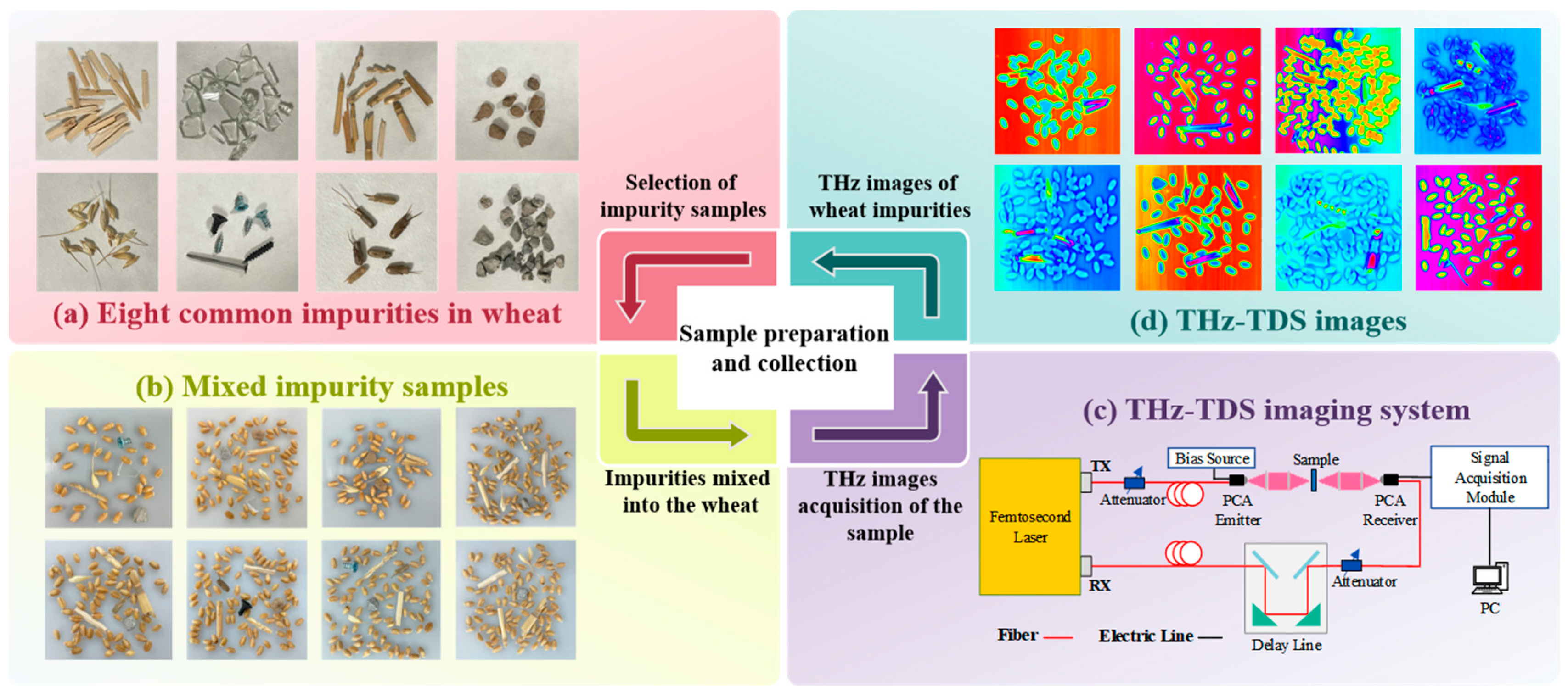
The selection and collection of wheat impurity samples have a decisive impact on the accuracy and reliability of subsequent experimental results. To ensure that the experimental data realistically reflect the actual conditions of wheat during harvesting and transportation, this study selected common impurities encountered in these processes in accordance with the National Standards of the People’s Republic of China. During the sample preparation stage, various types of impurities were systematically collected and categorized as either organic or inorganic. Eight common wheat impurities were selected, including wheat husk, wheat straw, wooden chips, foreign grains, stones, clods, glass fragments, and screws, as shown in Figure 1a. To ensure the representativeness of the sample types and the reliability of experimental results, special attention was paid to the morphology and size of the impurities during collection, aiming to closely simulate the conditions that may occur during actual harvesting and transportation. After collection, the impurity samples were cleaned and dried to remove surface contaminants and moisture, ensuring that the samples would not be affected by external factors during THz imaging.
Prior to image acquisition, in order to realistically simulate the natural mixing of impurities in wheat during harvesting, transportation, and other practical processes, the pre-categorized impurities were randomly mixed with normal wheat grains. As shown in Figure 1b, different types of impurities are irregularly distributed in wheat grains, exhibiting differences in spatial location and orientation. This random mixing strategy can effectively simulate the distribution characteristics of wheat impurities in real-world scenarios. This approach fully accounts for the disorderly and random distribution of impurities in real-world scenarios, ensuring that the constructed experimental samples accurately reflect the natural state of wheat and its impurities under practical conditions. Consequently, it provides more representative and generalizable training data for subsequent experiments and model development.

2.2. Experimental Equipment and Data Collection

In this study, THz image data of wheat impurities were acquired using the THz Three-Dimensional Tomography Imaging System (QT-TO1000) from Qingdao Quenda Terahertz Technology Co., Ltd., Qingdao, China, as illustrated in Figure 1c. The system is equipped with a femtosecond laser source with a central wavelength of 1550 nm, and an output pulse width of less than 100 fs. It offers a frequency bandwidth of 0.1–3 THz, a spectral resolution of 8 GHz, an imaging speed of 60 pixels/s, and a scanning area of 100 mm × 100 mm. The imaging system supports both transmission and reflection modes. In transmission mode, THz waves penetrate the sample, providing images with higher contrast and clearer structural information, making it an ideal choice for wheat impurity detection. Although reflection mode can be used for material identification and differentiation, the rough surfaces of wheat grains and impurities cause diffuse reflection, which can lead to THz signal attenuation. Therefore, transmission mode was selected for experimental data acquisition in this study.
During image acquisition, the samples were placed on the two-dimensional translation stage integrated with the imaging system, and the imaging area was adjusted to ensure that all samples were within the field of view. The scanning step size in both X and Y directions was set to 0.2 mm, with a system scanning frequency of 30 Hz and a scan time of 90 ps. Figure 1d shows wheat impurity images acquired in transmission mode using a terahertz time-domain spectroscopy (THz-TDS) imaging system under different impurity placement methods and various time-domain ranges.

2.3. THz Image Dataset of Wheat Impurities

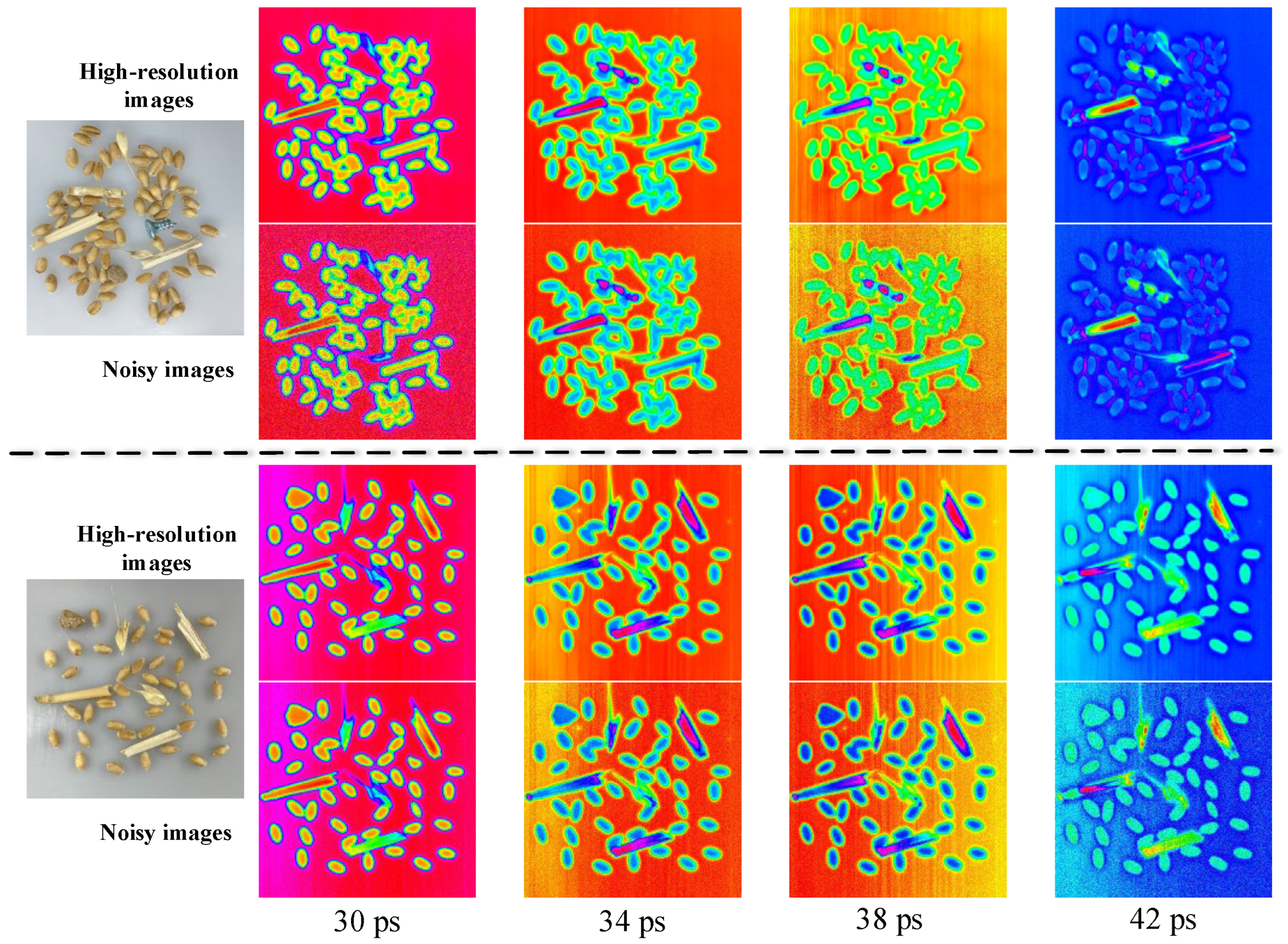
To simulate the noise introduced by hardware limitations and environmental interference during actual THz time-domain spectroscopy (THz-TDS) imaging, different levels of Gaussian noise were randomly added to the acquired high-resolution THz images. This procedure was designed to replicate the complex scenarios in which noise intensity dynamically varies in practical applications. Using this approach, a paired training dataset was constructed, where each sample consists of a high-quality clean image and its corresponding noisy counterpart, forming image pairs that map clean and noisy images. Figure 2 shows a subset of sample pairs from the dataset, allowing for a visual comparison of the effects of different noise levels on image quality. To ensure the diversity and representativeness of the experimental samples, a total of 1504 original THz images were collected. After adding noise at different intensity levels, a strictly paired training dataset of 1504 image pairs was established, providing sufficient data support for the subsequent training and validation of the denoising network.

3. Model and Method

3.1. THz Image Denoising Model

Traditional single-branch denoising networks possess advantages such as simple architecture, ease of understanding, and stable performance, and they perform well in conventional image processing tasks. However, when applied to complex THz image denoising tasks, the single-branch network architecture struggles to simultaneously capture both local detail features and global structural information, thereby limiting its ability to effectively suppress complex noise. To overcome these limitations, this study proposes an Edge-Enhanced and Feature-Fusion THz Image Denoising Network (EEFDNet). By employing a dual-branch architecture, EEFDNet achieves collaborative optimization for preserving local details while extracting global features.
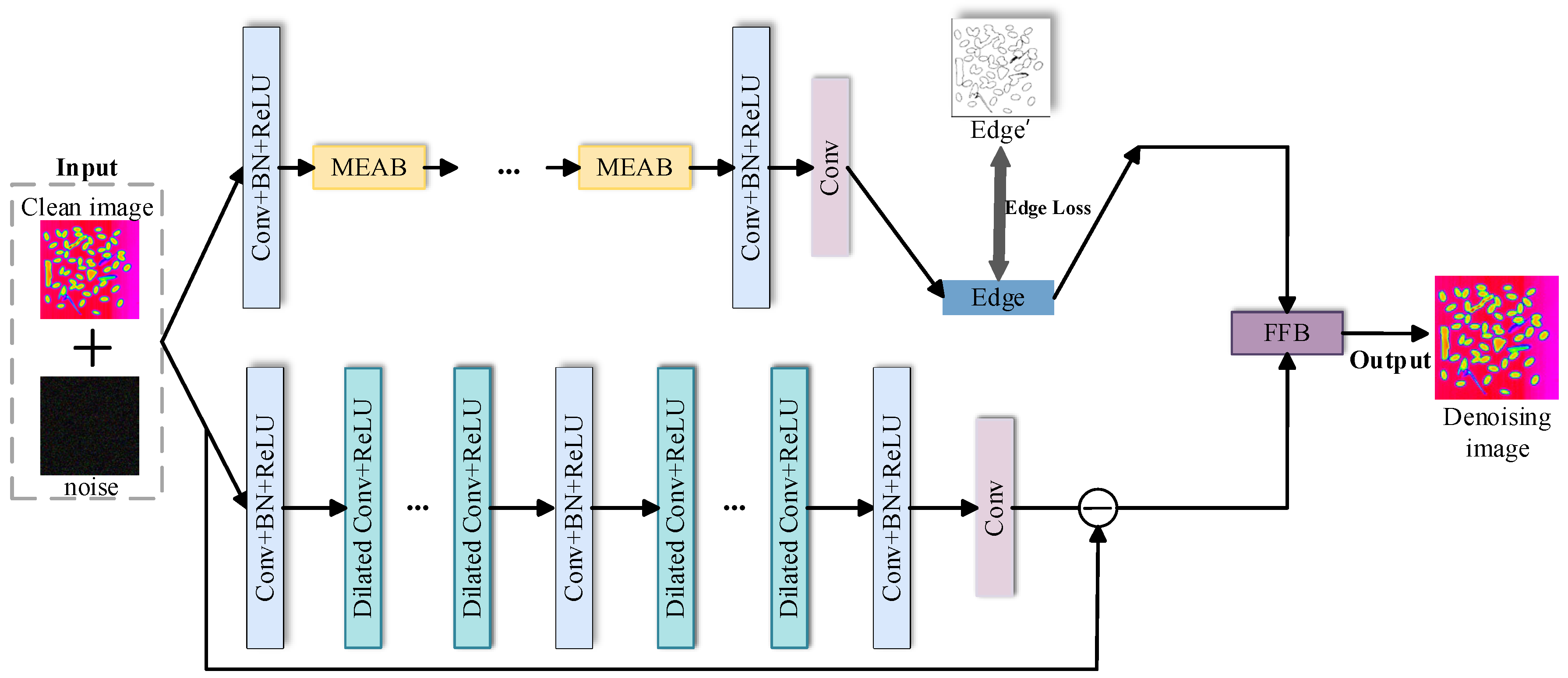
EEFDNet adopts a dual-branch structural framework, which mainly consists of a denoising branch and a multi-scale edge enhancement branch, as illustrated in Figure 3. In the denoising branch, initial feature extraction is performed through standard convolutional layers, followed by a series of dilated convolutions and ReLU activation functions [24] to enhance feature representation and improve the model’s nonlinear fitting capability. The dilated convolution expands the receptive field by inserting zeros into the convolution kernel, allowing the network to capture a broader contextual range without increasing computational cost. This property is particularly beneficial for removing noise while preserving fine image details. Moreover, this branch enables multi-scale feature learning, effectively avoiding information loss caused by a limited receptive field. In the multi-scale edge enhancement branch, a Multi-Scale Edge Enhancement Attention Block (MEAB) [25] is introduced. After the noisy THz image is input into the network, it first passes through a conventional convolutional layer for basic feature extraction. Subsequently, five MEAB modules are employed to strengthen the edge information of the image, enhancing structural features across multiple scales. Finally, the outputs from the two branches are integrated through a Feature Fusion Block (FFB), which merges the denoised image features with the edge-enhanced features. This ensures that the final output not only preserves fine edge details but also effectively removes image noise, resulting in a denoising THz image.

3.1.1. THz Image Denoising Branch

Traditional convolutional neural network expands the receptive field by stacking multiple convolutional layers. However, as the network depth increases, the computational cost and memory requirements also rise sharply. Moreover, traditional convolutions often rely on enlarging the kernel size or increasing the number of layers to extend the receptive field. This approach not only leads to a significant increase in the number of parameters but also easily causes the loss of contextual information. When the image contains complex backgrounds or large-scale noise, the network may fail to effectively capture global information. To address this issue, dilated convolution has been proposed.
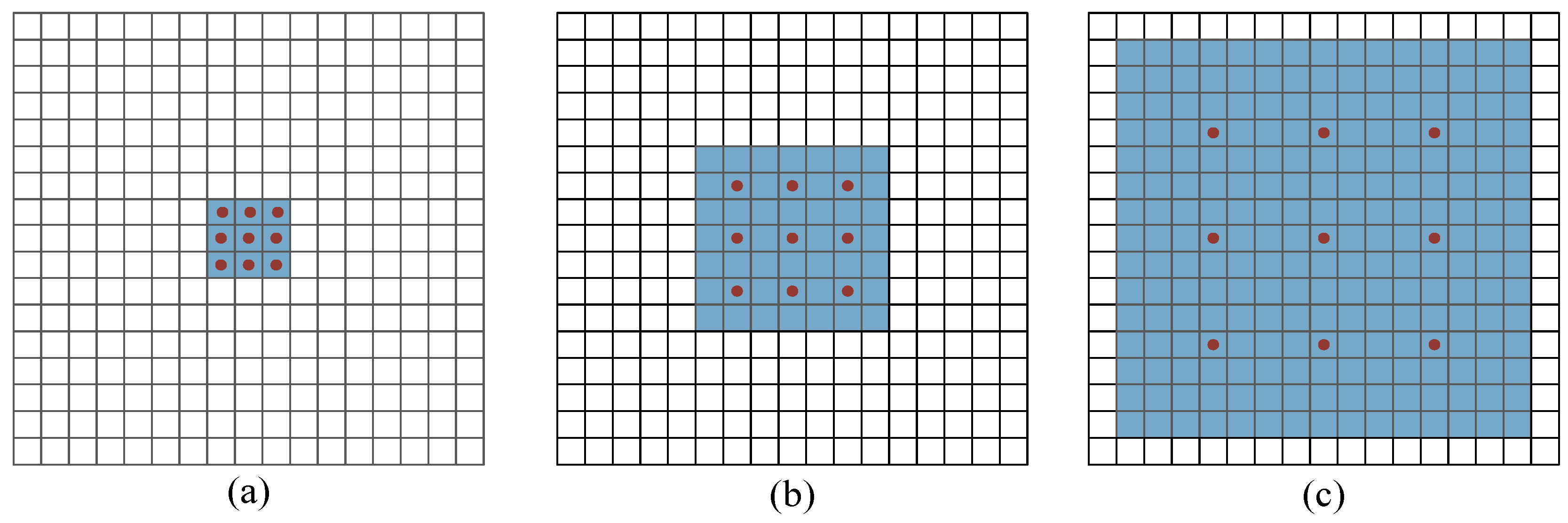
Dilated convolution [26] is a commonly used convolution operation in deep learning. By introducing a dilation rate, it enables the receptive field to expand exponentially without reducing resolution or coverage. As shown in Figure 4, a standard 3 × 3 convolution kernel can achieve an effect equivalent to 5 × 5 or 7 × 7 convolutions by adjusting the dilation rate. Assuming the kernel size of the dilated convolution is k and the dilation rate is d , the equivalent kernel size in spatial dimensions, denoted as k , can be calculated as follows:
k = k + ( k 1 ) × ( d 1 )
Let the receptive field of the layer i be RFi, and the equivalent kernel size be  k i . Then, the recursive relationship of the receptive field for the next layer is:
R F i + 1 = R F i + ( k i 1 ) × S i
where Si represents the product of the strides of the layer i and all preceding layers, that is:
S i = j = 1 i s t r i d e j = S i 1 × s t r i d e i
It can be seen that the stride of the layer i + 1 does not affect the receptive field of the layer i + 1, and the receptive field is independent of padding.
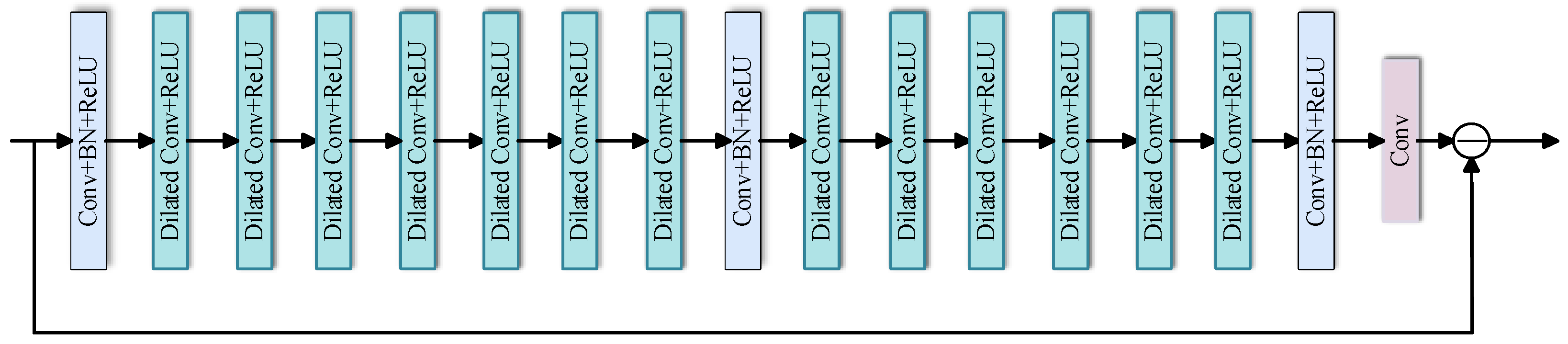
The denoising branch of EEFDNet is similar to the lower network branch of BRDNet [27], also incorporating dilated convolutions. This branch consists of 17 convolutional layers, where layers 1, 9, and 16 adopt the Conv + BN + ReLU structure, as shown in Figure 5. The remaining layers employ a combination of dilated convolution with a dilation rate of 2 and ReLU, which allows the network to capture broader contextual information while reducing computational cost, thereby enhancing denoising capability. The final layer employs a standard 3 × 3 convolution. By integrating a residual structure, the branch output is derived by subtracting the predicted noise from the original input, yielding a clean, noise-free image.

3.1.2. THz Image Edge Enhancement Branch

In this study, edge information from the original THz images is extracted as guidance to provide a reference for the network’s edge enhancement branch. Combined with an edge loss function, this approach helps the network capture important edge features. To obtain clear edge information from wheat impurity THz images, traditional edge detection algorithms are employed to extract the edges of both wheat grains and impurities from high-quality THz images.
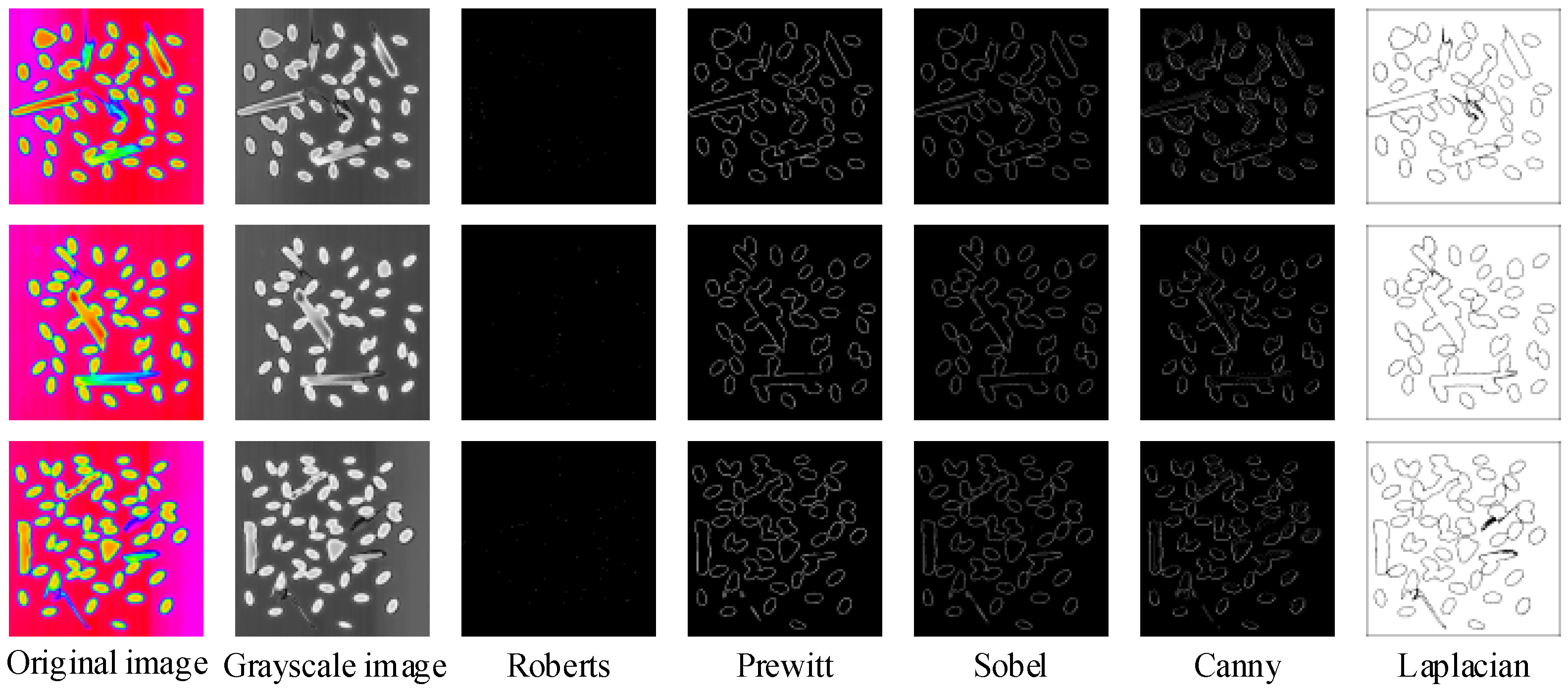
Edge extraction aims to identify regions in an image where the intensity changes sharply, which correspond to the edges. Edges typically contain essential information about object contours, structures, and textures, making them one of the key features for image understanding and analysis. In image enhancement and segmentation tasks, accurately extracting and preserving edge information can significantly improve the model’s ability to capture image details and structural features. Common edge detection algorithms include the Sobel, Prewitt, Laplacian, Roberts, and Canny operators, which detect edges effectively by computing gradients or second-order derivatives. Table 1 explains the principles of these edge detection algorithms and compares their advantages and disadvantages.
The five aforementioned edge detection algorithms were applied to extract edges from the THz images of wheat impurities. As shown in Figure 6, the edge detection performance varies among the methods. The Laplacian operator achieved the best edge extraction results, clearly outlining the contours of both wheat and impurities while preserving the fine details of the edges. In comparison, the Canny algorithm performed well in noise suppression and edge localization, but some fine details were lost. The Prewitt and Sobel operators effectively captured the main contours, though the edges appeared slightly blurred. The Roberts operator yielded the poorest edge extraction performance. Therefore, the Laplacian operator demonstrated the best performance in terms of detail preservation and contour clarity, making it most suitable for edge extraction of wheat impurities in THz images. Accordingly, in this study, the THz edge images of wheat impurities extracted using the Laplacian operator are employed as references for the edge enhancement branch.
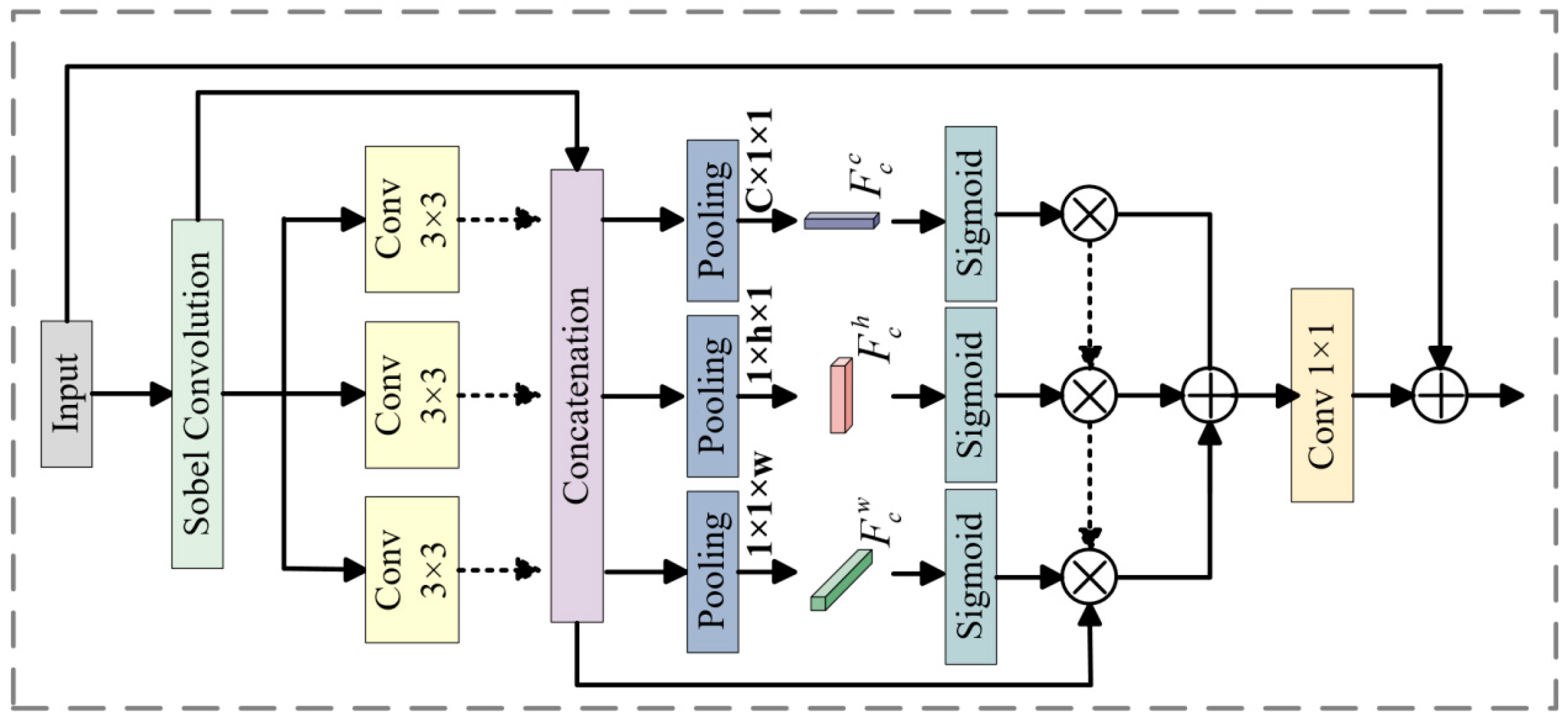
The edge feature enhancement branch of the wheat impurity THz image denoising network primarily consists of convolutional layers and the MEAB. MEAB performs feature fusion using dilated convolutions with different dilation rates and a multi-dimensional attention mechanism, effectively capturing the structural information of THz images while preventing the adverse effects of excessive smoothing, as illustrated in Figure 7. MEAB enhances edges at multiple scales of the THz image, expanding the receptive field and simultaneously suppressing noise interference through targeted edge enhancement. The Sobel operator is employed to extract edge contour information from the THz image, serving as the basis for edge enhancement. Edge enhancement information, denoted as ε F i n , is obtained by learning positional information along horizontal, vertical, and diagonal directions. Three parallel 3 × 3 dilated convolutions generate three new feature sets, f d = 1 3 × 3 ( F i n ) , f d = 3 3 × 3 ( F i n ) , and f d = 5 3 × 3 ( F i n ) . The network learns the mapping relationship between the noisy image and its corresponding clear edges, directly reconstructing accurate edges from the noisy input. The edge-enhanced features are then concatenated to obtain F c , improving the model’s perception of fine structures such as edges and textures.
F c = ε F i n , f d = 1 3 × 3 ( F i n ) , f d = 3 3 × 3 ( F i n ) , f d = 5 3 × 3 ( F i n )
F i n represents the input, and , denotes the concatenation operation of the feature maps.
Figure 7. Structure of the MEAB. Reprinted with permission from Ref. [25]. Copyright 2024, Society for Imaging Informatics in Medicine.
Agronomy 16 00527 g007
Subsequently, the multi-dimensional attention guidance mechanism processes each group of features and applies average pooling along the channel, height, and width axes to obtain three sets of contextual information. The Sigmoid activation function is then applied to each set of contextual information, generating spatial attention maps ranging from 0 to 1, denoted as F c c , F c h , and F c w . These maps are multiplied with F c and then summed, followed by a 1 × 1 convolution for fusion. This approach fully leverages contextual information across all dimensions, further enhancing the model’s perceptual capability and feature representation.
F c c = σ ( a v g p o o l ( F c ) ) F c
F c h = σ ( a v g p o o l ( F c ) ) F c
F c w = σ ( a v g p o o l ( F c ) ) F c
F o u t = F i n + f 1 × 1 ( F c c + F c h + F c w )
σ represents the Sigmoid activation function, and F o u t denotes the final output.
After passing through five MEABs, the output is further processed by Conv + BN + ReLU and a 3 × 3 convolution layer to ensure that the resulting feature maps are consistent with those from the denoising branch. During this process, the extracted edge features are guided by the edge loss function L e d g e to focus the network’s attention on the target edge regions, producing edge features that are more accurate and clear.
L e d g e = I e d g e I e d g e 1
I e d g e represents the predicted image edges, and I e d g e denotes the clear edges detected from the clean image.

3.1.3. Feature Fusion Module

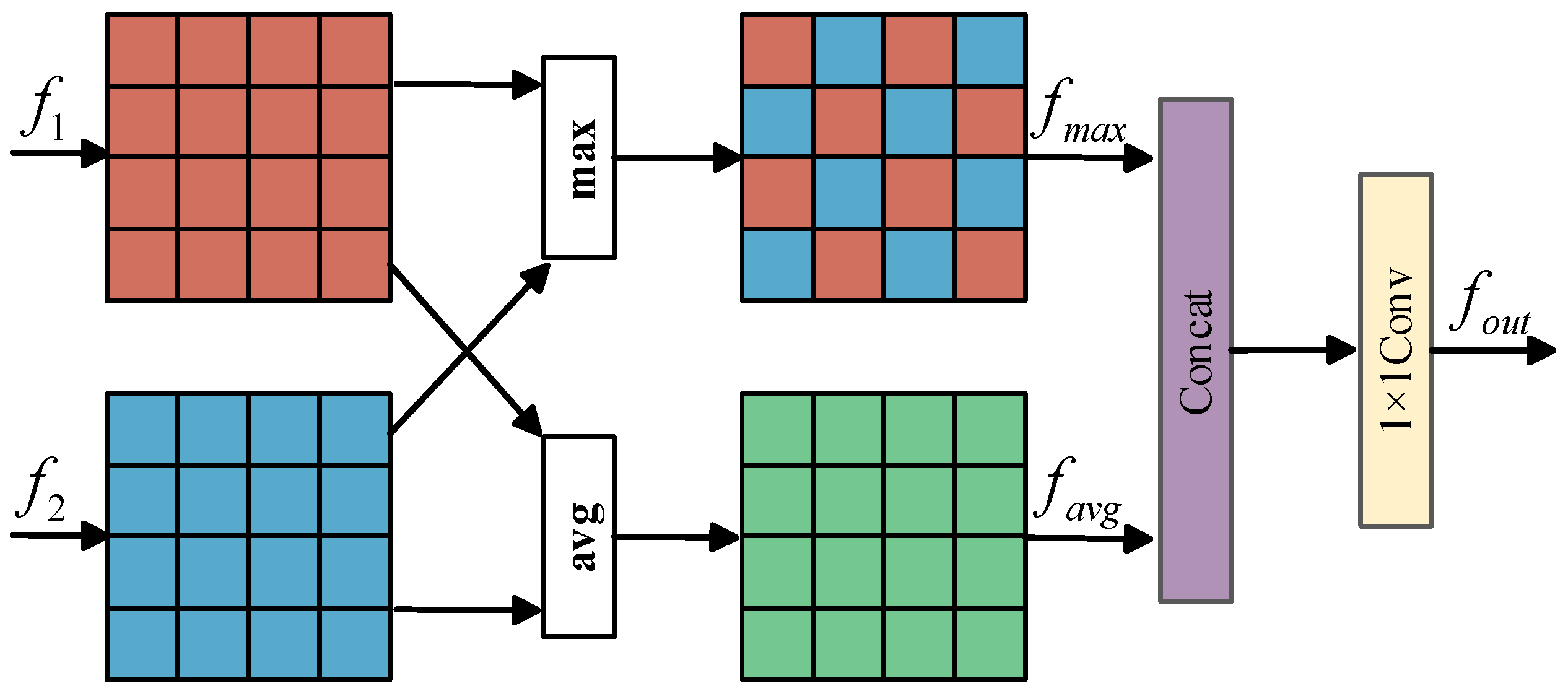
The image features output from the denoising branch and the edge feature enhancement branch are fed into the Feature Fusion Block (FFB) to obtain the fused image features from different branches. The specific structure of the FFB is shown in Figure 8. This module first performs max pooling and average pooling on the input denoised and edge-enhanced images to extract multi-scale information and highlight key image features.
f m a x = m a x ( f 1 , f 2 )
f a v g = f 1 + f 2 2
f 1 and f 2 represent the denoised image and the edge-enhanced image, respectively. Max pooling effectively preserves the prominent features in the image, making edge regions more distinct, while average pooling retains the global information of the image. The combination of the two not only preserves the overall structural information but also highlights the edge feature information. Subsequently, the two pooled features are concatenated along the channel dimension to fuse the key information extracted by different pooling operations. A 1 × 1 convolution is then applied to reduce the channel dimensionality, achieving feature fusion and enhancing the model’s ability to selectively focus on important information.
f c o n c a t = C o n c a t ( f m a x , f a v g )
f o u t = C o n v ( f c o n c a t )
Figure 8. Structure diagram of the FFB module.
Agronomy 16 00527 g008
The fusion strategy of this module combines max pooling and average pooling in an integrated manner, effectively suppressing image noise while significantly enhancing key edge information such as texture and contours. As a result, the denoised image maintains overall structural integrity while exhibiting clearer and sharper details.

3.2. Evaluation Metrics

In the fields of image processing and computer vision, evaluating image quality is a crucial step for assessing algorithm performance and optimizing model effectiveness. Accurately and objectively measuring the differences between reconstructed images and the original images is essential for improving the robustness of algorithms and their practical applicability. However, due to the subjective and multi-dimensional nature of image quality, a single evaluation metric is often insufficient to comprehensively reflect both the visual quality and the fidelity of information. Therefore, selecting appropriate image quality metrics to fully assess the reconstruction quality and perceptual differences has become a key issue in image processing research.
Mean Squared Error (MSE) [33] is a commonly used loss function and evaluation metric that measures the difference between predicted and true values. It calculates the average of the squared errors, reflecting the accuracy of the model’s predictions. A smaller MSE indicates that the predicted results are closer to the true values.
M S E = 1 M N i = 1 M j = 1 N [ I ( i , j ) K ( i , j ) ] 2
Here, M and N represent the width and height of the image, respectively, while I ( i , j ) and K ( i , j ) denote the pixel values of the original image and the enhanced image at position ( i , j ) .
Peak Signal-to-Noise Ratio (PSNR) [34] is one of the most commonly used objective metrics for image quality assessment, measuring the difference between the enhanced image and the original image. It is based on the pixel-wise error of the image and reflects the amount of noise in the reconstructed image. A higher PSNR value indicates better reconstructed image quality.
P S N R = 10 log 10 ( M A X I 2 M S E )
M A X I represents the maximum pixel value of the image.
Structural Similarity Index (SSIM) [35] is an image quality assessment metric based on the human visual system. It evaluates the similarity between the reconstructed image and the original image by comparing their luminance, contrast, and structural information. The SSIM value ranges from 0 to 1, with values closer to 1 indicating higher similarity. Unlike PSNR, SSIM aligns more closely with human visual perception and can effectively reflect differences in contrast, luminance, and structural information, showing superior performance in assessing distortions such as blur and noise.
S S I M ( x , y ) = ( 2 μ x μ y + C 1 ) ( 2 σ x y + C 2 ) ( μ x 2 + μ y 2 + C 1 ) ( σ x 2 + σ y 2 + C 2 )
x and y represent patches from the original and enhanced images, respectively, while C 1 and C 2 are constants.
μ x and μ y are the means of x and y , representing the luminance information:
μ x = 1 N i = 1 N x i
σ x and σ y are the variances of x and y , representing the contrast information:
σ x 2 = 1 N 1 i = 1 N ( x i μ x ) 2
σ x y is the covariance of x and y , representing the structural information:
σ x y = 1 N 1 i = 1 N ( x i μ x ) ( y i μ y )
In image enhancement tasks, PSNR and SSIM are typically used in combination to obtain a more comprehensive assessment of image quality. PSNR provides an intuitive measure of pixel-wise errors, while SSIM evaluates image quality from the perspective of human visual perception. Combining the two metrics allows for a more comprehensive assessment of the differences between the reconstructed and original images, providing a reliable reference for image processing algorithms and model optimization.

3.3. Training and Testing Procedure

In this study, the constructed dataset was randomly split into training and testing sets at a ratio of 7:3, allowing effective evaluation of the model’s generalization ability and network performance. The hardware configuration used for model training and validation included an Intel(R) Core(TM) i5-13400F processor (2.50 GHz), 16 GB of RAM, and an NVIDIA GeForce RTX 3060 GPU. The operating system was Windows 11, with the software environment comprising Python 3.8 and PyTorch 2.0.1, and GPU-accelerated computations were performed using the CUDA 11.6 framework.
The network training process is as follows: First, the noisy THz images are used as the input data for the network. The input data is then processed through EEFDNet, which leverages the edge contour information extracted from the original THz images to assist the network in generating enhanced edge information, producing denoised and edge-enhanced THz images. To further optimize network performance, this study also designs ablation experiments to investigate the impact of the number and placement of MEAB and FFB modules on the network’s performance, thereby determining the optimal configuration to improve the model’s denoising capability and edge enhancement effectiveness.
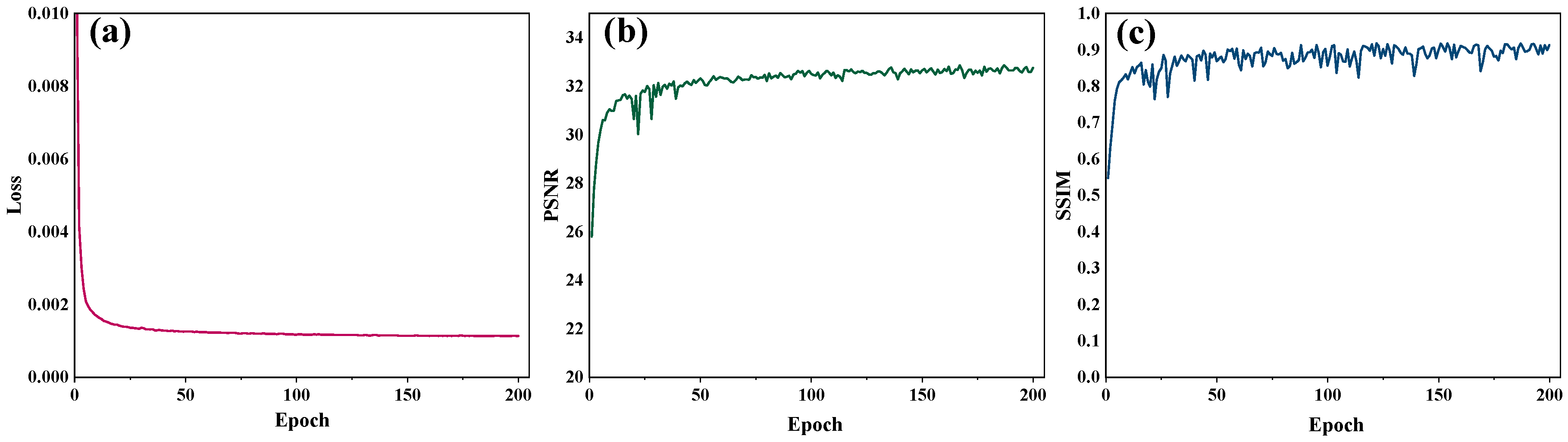
To evaluate the overall performance of EEFDNet, this study analyzed the changes in the model’s loss function. Figure 9a presents the loss curve of EEFDNet, showing a rapid decrease during the first 20 epochs, followed by a stable convergence phase, eventually stabilizing at a low value. This ensures both training efficiency and model generalization capability. Meanwhile, the PSNR and SSIM trends shown in Figure 9b,c indicate effective improvement in image quality. The PSNR curve exhibits a steady upward trend, reaching 32.59 dB, demonstrating continuous enhancement in pixel-level fidelity. In contrast, the SSIM curve shows slight fluctuations within its overall increasing trend, reflecting EEFDNet’s varying sensitivity to different THz images in optimizing perceptual quality and structural fidelity. Nevertheless, the SSIM ultimately reaches 0.9180, indicating that the model achieves excellent overall structural reconstruction capability.

4. Experimental Results and Analysis

4.1. Models Comparison

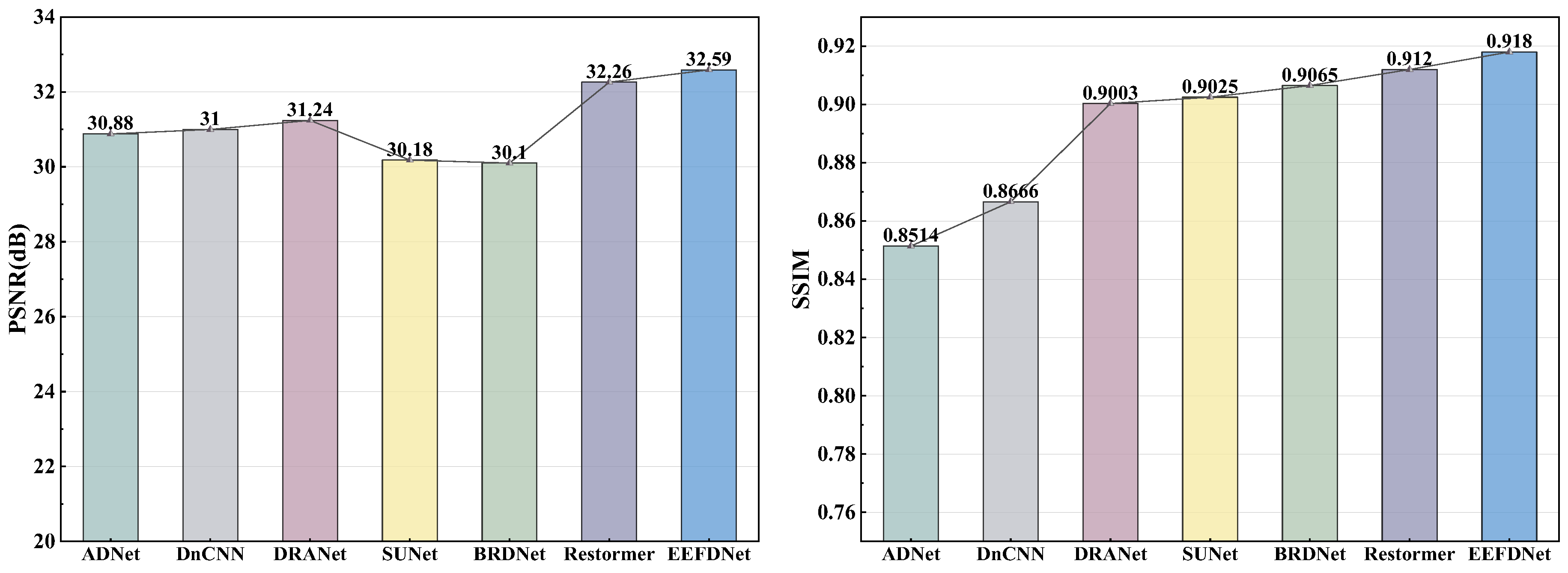
In this section, the original THz images are first corrupted with varying levels of Gaussian noise and then input into the EEFDNet model for denoising and edge feature enhancement. To comprehensively evaluate the denoising performance of the proposed model, six mainstream denoising networks, ADNet [36], DnCNN, DRANet [37], SUNet [38], BRDNet, and Restormer [39], are used as comparative models. The denoising results of each model are quantitatively analyzed using two image quality metrics, PSNR and SSIM. The results are presented in Table 2.
The results show that compared with other models, the proposed EEFDNet achieved the best performance, with a PSNR of 32.59 dB and an SSIM of 0.9180. Compared with ADNet, DnCNN, DRANet, SUNet, BRDNet, and Restormer, the PSNR increased by 1.71 dB, 1.59 dB, 1.35 dB, 2.41 dB, 2.49 dB, and 0.33 dB, respectively, while the SSIM increased by 0.0666, 0.0514, 0.0177, 0.0155, 0.0115, and 0.006, respectively. These results indicate that THz images processed by EEFDNet not only effectively remove noise but also preserve most of the image details. Among the six commonly used denoising models, Restormer, as an image denoising network based on Transformer, demonstrates excellent noise removal capability and achieves the best performance among all comparison models. Its PSNR is 32.26 dB, and the SSIM is 0.9120. However, EEFDNet still outperforms Restormer on both metrics, indicating that the edge enhancement and feature fusion strategy proposed in this study is more effective in preserving the fine structural details of THz images while suppressing noise. ADNet and DnCNN showed relatively poor denoising performance. Although SUNet and BRDNet have SSIM values second only to Restormer, their PSNR values are relatively low, indicating that while they maintain structural information well, their noise suppression capability is weaker. DRANet exhibited the best overall denoising performance among the five comparison networks, with notable PSNR improvements over the other four networks. However, compared with EEFDNet, DRANet still shows a gap in denoising accuracy and structural preservation. Figure 10 presents a comparison of PSNR and SSIM among all models, providing a more intuitive visualization of the denoising performance and further highlighting the superior performance of the EEFDNet network.
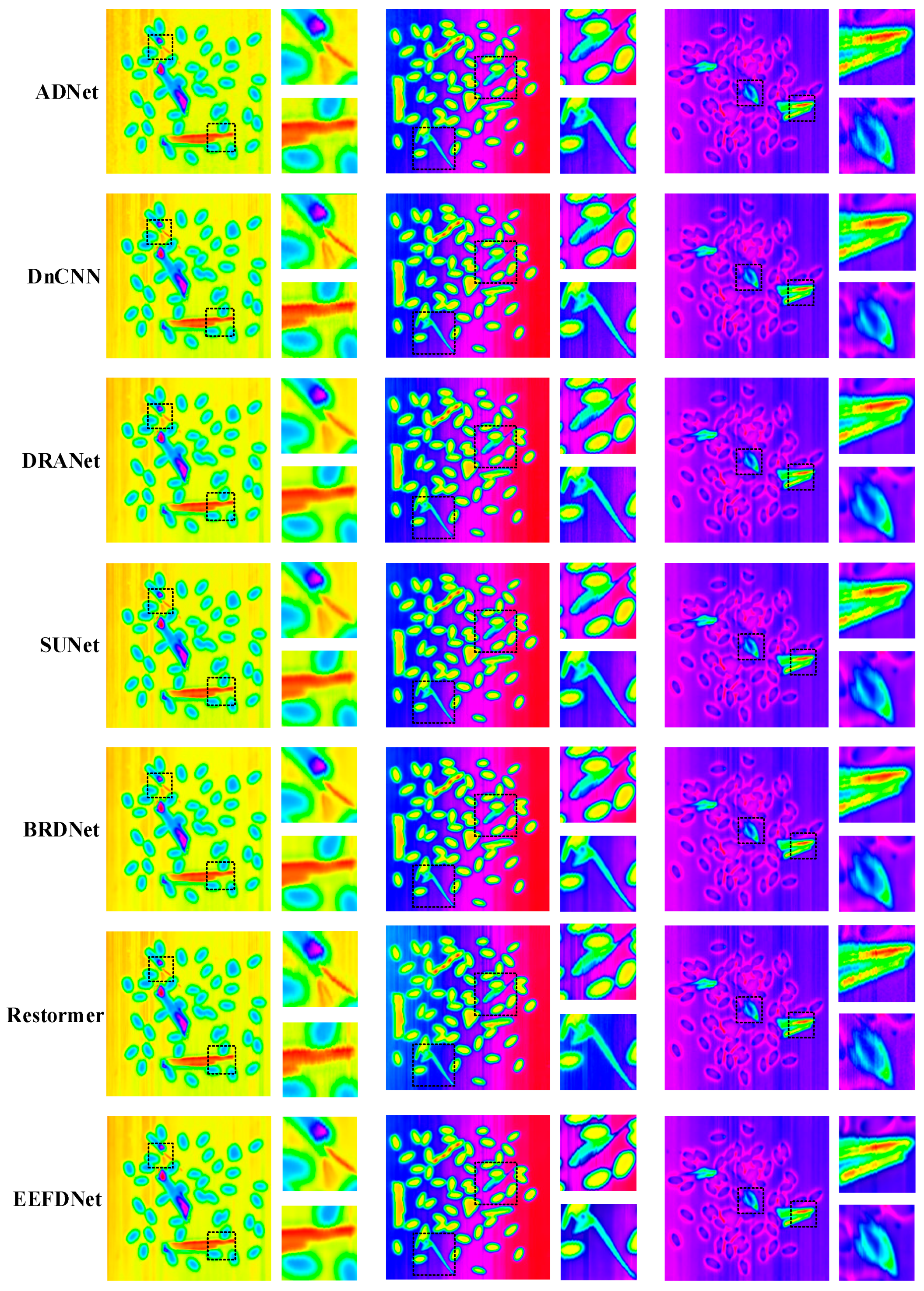
To more intuitively compare the denoising performance of each model, the denoised images generated by different networks were visually compared. Typical images from the dataset were selected as examples, and key regions were zoomed in to highlight differences in noise suppression and detail preservation among the models. As shown in Figure 11, ADNet, DnCNN, DRANet, SUNet, BRDNet, Restormer, and EEFDNet all demonstrate some denoising capability on THz images, but differences exist in denoising level and detail retention. ADNet and DnCNN still exhibit residual noise, with blurred wheat impurity edges, indicating suboptimal overall denoising performance. The comparison of the enlarged regions indicates that DRANet, SUNet, and BRDNet exhibit certain advantages in noise suppression; however, excessive smoothing occurs during the denoising process, leading to the attenuation of some edge information of wheat impurities and resulting in less clear local details of both wheat and impurities. Although Restormer achieves relatively good overall image quality, the locally magnified views of the denoised THz images show that the edge details of impurities remain relatively blurred, and a certain level of noise interference is still present. In contrast, the enlarged local images produced by EEFDNet show that, by adopting an edge feature enhancement mechanism and incorporating edge information into the network training, EEFDNet is able to preserve more high-frequency detail information while effectively removing noise. This leads to clearer contours and richer structural details, thereby demonstrating superior overall denoising performance.
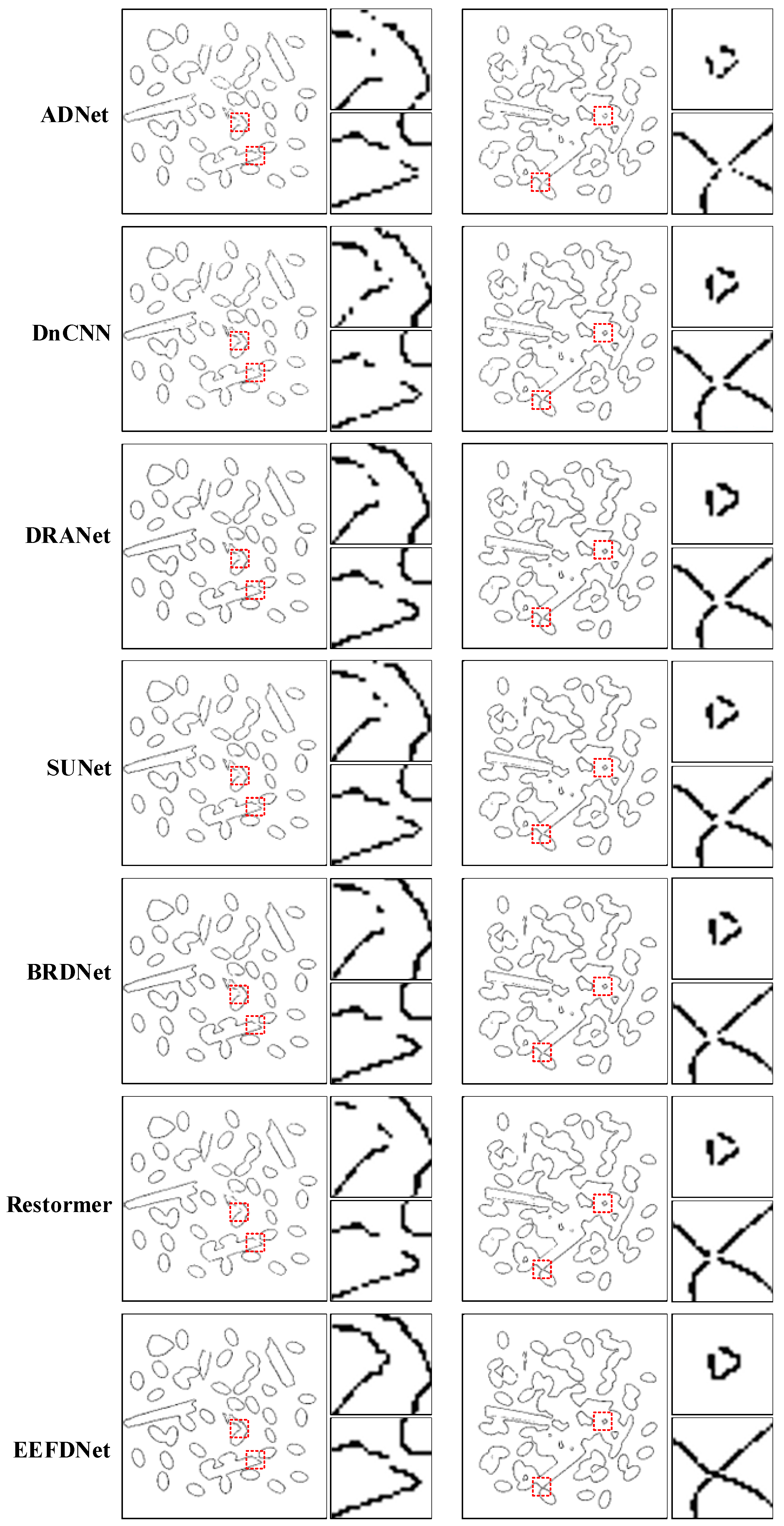
To verify the capability of EEFDNet in preserving and enhancing edge information after denoising, the Laplacian edge extraction algorithm was applied to the denoised images produced by each network. Figure 12 shows the edge extraction results and magnified views of some images. Comparative analysis shows that the edge outputs of ADNet and DnCNN still contain considerable noise, and the edge contours are relatively incomplete, indicating that although these methods can achieve a certain level of denoising, residual noise significantly interferes with the integrity of edge information. In contrast, DRANet, SUNet, and BRDNet have better overall denoising performance, with significantly reduced residue noise and relatively complete edge structures of wheat and impurities; however, edge discontinuities are still observed in some target areas. Although the Restormer achieves relatively high PSNR and SSIM values after image denoising, observation of the edge extraction results of the denoised THz images reveals that it still has limitations in preserving and enhancing the edge contours of wheat and impurities. The edge extraction results of EEFDNet have the least residual noise, clearer, more continuous, and more complete edge details. Moreover, some edge information that is difficult to capture by other methods is effectively enhanced, resulting in more refined contour details, which further demonstrates the advantage of EEFDNet in edge preservation and enhancement.

4.2. Ablation Study

In this study, an image denoising network based on edge enhancement and feature fusion was constructed to improve the quality of the original THz images. The network incorporates the FFB module to effectively fuse image edge features. In addition, the feature enhancement branch of EEFDNet mainly consists of five MEAB modules, achieving optimal denoising performance while keeping the network’s computational cost manageable. To further investigate the impact of the number of FFB and MEAB modules on the denoising network’s performance, corresponding ablation experiments were designed to systematically evaluate the contribution of each module to the denoising effect. Table 3 presents the results of the ablation experiments, where “-“ indicates that the module was not used in the model, and “√” indicates that the module was used.
The ablation experiment results shown in Table 3 indicate that the number of MEAB modules has a significant impact on the denoising performance of the network. As the number of MEAB modules increases, the SSIM gradually improves; however, the PSNR reaches its peak only when the number of MEAB modules is 5. When the number of MEAB modules is 10, SSIM attains its highest value, but the addition of a large number of MEAB modules increases the model complexity and training cost. Therefore, considering all factors, using 5 MEAB modules ensures a lightweight network while achieving optimal denoising performance. In addition, when the FFB module is not included in the network, PSNR and SSIM decrease by 1.18 dB and 0.032, respectively, demonstrating the critical role of FFB in the EEFDNet architecture.
Considering that the THz imaging system may produce different levels of system noise under varying acquisition conditions, changes in noise levels can affect the denoising capability of the model. For this reason, in this experiment, Gaussian noise of different levels (5 dB, 15 dB, 25 dB, and 40 dB) was added to the original wheat impurity THz images to comprehensively evaluate the model’s robustness and overall denoising performance. As shown in Table 4, EEFDNet achieved optimal denoising performance for all noise levels. Notably, under the high noise level of 40 dB, EEFDNet outperformed ADNet, DnCNN, DRANet, SUNet, BRDNet, and Restormer, with PSNR improvements of 0.05 dB, 2.37 dB, 2.78 dB, 2.93 dB, 2.23 dB, and 1.28 dB, respectively, and SSIM improvements of 0.0598, 0.1072, 0.1354, 0.0743, 0.0525, and 0.0213, respectively. Therefore, EEFDNet maintains excellent denoising performance and outstanding structural information recovery even for high-noise-level THz images.

5. Discussion

This study proposes a terahertz image denoising and edge feature enhancement network, termed EEFDNet. The network adopts a dual-branch architecture combined with a feature fusion module, enabling effective noise suppression while significantly preserving and enhancing the edge structure information of wheat and its impurities. Existing THz image denoising methods predominantly focus on noise removal and often suffer from excessive smoothing during the denoising process, which weakens or even loses target edge features and overlooks the critical role of edge information in detection tasks. In impurity detection scenarios, however, the integrity of edge contours directly affects the accuracy of subsequent identification and classification. Targeting wheat impurity detection, EEFDNet explicitly enhances impurity edge contours during denoising, facilitating more precise impurity identification. In addition, some studies employ self-supervised denoising algorithms, which typically rely on extensive prior data. When prior conditions are insufficient or noise levels are high, the denoising performance of such methods tends to be limited. To comprehensively evaluate the performance of EEFDNet, comparative experiments were conducted against several mainstream denoising models, including ADNet, DnCNN, DRANet, SUNet, and BRDNet. The experimental results demonstrate that EEFDNet achieves superior performance in both noise suppression and structure preservation. Moreover, although the Transformer-based Restormer exhibits strong denoising capability on natural images, its performance on THz images remains suboptimal. This is primarily attributed to its architectural design, which is tailored for real-scene image denoising and not fully adapted to the noise characteristics and structural properties inherent to THz imaging. The model’s performance under varying noise levels was also validated: at 5 dB, 15 dB, 25 dB, and 40 dB, EEFDNet consistently achieved optimal denoising results, proving its robustness. This characteristic is particularly significant in practical scenarios with dynamically changing noise levels, ensuring reliable THz image preprocessing of wheat impurities under various real-world conditions and providing a solid foundation for subsequent wheat impurity identification.
Although EEFDNet demonstrates excellent denoising and edge enhancement performance across multiple experiments, certain limitations remain. First, while most existing studies assume that THz image noise approximates Gaussian noise, the actual imaging process introduces more complex mixed noise due to system hardware and environmental interference. This study relies on artificially added Gaussian noise for training data, which can effectively simulate system noise but still differs from the more complex mixed noise present in real THz imaging systems. In addition, the inherent noise of the THz time-domain spectroscopy imaging system itself remains a key factor affecting image quality, and the current system’s signal-to-noise ratio and spatial resolution need improvement, which limits the quality ceiling of the original THz images. Finally, this study is based on a supervised learning paradigm that requires large amounts of paired clean and noisy images for model training. In practical scenarios, however, obtaining absolutely clear reference images is challenging, which restricts the model’s generalization ability under real and complex conditions.
To address the above issues, future research could focus on the following aspects:
First, constructing more realistic noise models. By analyzing various types of noise in THz imaging systems, mathematical models of compound noise can be established to improve the authenticity of training data. Second, optimizing the hardware performance of THz imaging systems. While the method proposed in this study enhances image quality algorithmically, further improvements can be achieved by optimizing the hardware. This includes enhancing imaging resolution and reducing noise interference by improving THz light source design, using more stable THz wave generators to minimize environmental noise, and optimizing detector sensitivity to more effectively capture THz signals and improve image signal-to-noise ratio. Third, developing weakly supervised or unsupervised learning models. By breaking through the limitations of traditional supervised learning, models that adaptively train on unpaired data can be explored, reducing reliance on ideal training datasets and further enhancing the model’s generalization ability in practical application scenarios.


6. Conclusions

This study addresses the problems of poor detail and severe noise in raw THz images caused by hardware system limitations and environmental interference during acquisition. By leveraging deep learning network architectures, we propose a THz image de-noising network, EEFDNet. The key innovation of this study lies in proposing a dual-branch network architecture. By constructing a noise suppression branch and an edge feature enhancement branch separately, and using a feature fusion module to effectively fuse the outputs of the two branches, noise suppression can be achieved while better preserving the contour structure and detailed information of wheat impurities. Experimental results demonstrate that EEFDNet significantly improves the quality of THz images and outperforms several mainstream denoising networks in terms of PSNR and SSIM. By providing high-quality THz images with enhanced edge information, EEFDNet establishes a solid foundation for automating wheat impurities detection and contributes to advancing the application of THz technology in precision agriculture and intelligent grain processing systems.

Author Contributions

Conceptualization, M.J. and Y.J.; methodology, M.J., X.L. and Y.J.; data curation, M.J.; formal analysis, M.J. and X.L.; investigation, Y.J. and H.G.; validation, X.L.; writing—original draft preparation, M.J. and Y.J.; writing—review and editing, X.L. and H.G.; supervision, Y.J.; project administration, H.G.; funding acquisition, H.G. All authors have read and agreed to the published version of the manuscript.

Funding

This work was supported by the National Natural Science Foundation of China (No. 62271191), Key Science and Technology Program of Henan Province (No. 242102211082), the Open Fund Project of Key Laboratory of Grain Information Processing and Control, Ministry of Education, Henan University of Technology (No. KFJJ2023018), and the Innovative Funds Plan of Henan University of Technology (No. 2021ZKCJ04).

Data Availability Statement

The data presented in this study are available on request from the corresponding author due to the data are not publicly available due to privacy restrictions.

Acknowledgments

During the preparation of this manuscript, the authors used ChatGPT (OpenAI, San Francisco, CA, USA, GPT-5) for the purposes of language polishing and grammatical checking. The authors have reviewed and edited the output and take full responsibility for the content of this publication.

Conflicts of Interest

The authors declare no conflicts of interest.

References

  1. Jiang, H.; Zhang, S.; Yang, Z.; Zhao, L.; Zhou, Y.; Zhou, D. Quality classification of stored wheat based on evidence reasoning rule and stacking ensemble learning. Comput. Electron. Agric. 2023, 214, 108339. [Google Scholar] [CrossRef]
  2. Qi, Z.; Ling, W.; Xindong, N.; Faming, W.; Du, C.; Shumao, W. Research on wheat broken rate and impurity rate detection method based on DeepLab-EDA model and system construction. Comput. Electron. Agric. 2024, 226, 109375. [Google Scholar] [CrossRef]
  3. Li, P.; Zhu, C. Ro-YOLOv5: One new detector for impurity in wheat based on circular smooth label. Crop Prot. 2024, 184, 106806. [Google Scholar] [CrossRef]
  4. Gomroki, M.; Benaragama, D.; Henry, C.J.; Badreldin, N.; Gulden, R. CWRepViT-Net: An encoder–decoder deep learning framework with RepViT blocks for crop–weed semantic segmentation in soybean fields through their life journey. Smart Agric. Technol. 2025, 12, 101472. [Google Scholar] [CrossRef]
  5. Esgario, J.G.M.; Krohling, R.A.; Ventura, J.A. Deep learning for classification and severity estimation of coffee leaf biotic stress. Comput. Electron. Agric. 2020, 169, 105162. [Google Scholar] [CrossRef]
  6. Martinez, A.; Di Sarno, V.; Maddaloni, P.; Rocco, A.; Paturzo, M.; Ruocco, M.; Paparo, D. Chestnut quality classification by THz time-domain hyperspectral imaging combined with unsupervised learning analysis. Food Control 2025, 168, 110878. [Google Scholar] [CrossRef]
  7. Koch, M.; Mittleman, D.M.; Ornik, J.; Castro-Camus, E. Terahertz time-domain spectroscopy. Nat. Rev. Methods Primers 2023, 3, 48. [Google Scholar] [CrossRef]
  8. Yu, J.; Pu, H.; Sun, D.W. Fast real-time monitor of rice grains infested with Sitophilus oryzae based on terahertz imaging combined with machine learning. Food Control 2025, 176, 111290. [Google Scholar] [CrossRef]
  9. Strąg, M.; Świderski, W. Non-destructive inspection of military-designated composite materials with the use of terahertz imaging. Compos. Struct. 2023, 306, 116588. [Google Scholar] [CrossRef]
  10. Roh, Y.; Kim, K.; Lee, G.; Lee, J.; Kim, T.; Shin, B.; Kang, D.M.; Kim, Y.K.; Seo, M. Metasurface-enhanced terahertz imaging for glioblastoma in orthotopic xenograft mouse model combined with neural network decision making. Biosens. Bioelectron. 2025, 287, 117715. [Google Scholar] [CrossRef]
  11. Takeda, H.; Farsiu, S.; Milanfar, P. Kernel regression for image processing and reconstruction. IEEE Trans. Image Process. 2007, 16, 349–366. [Google Scholar] [CrossRef]
  12. Bouboulis, P.; Slavakis, K.; Theodoridis, S. Adaptive kernel-based image denoising employing semi-parametric regularization. IEEE Trans. Image Process. 2010, 19, 1465–1479. [Google Scholar] [CrossRef]
  13. Zhang, L.; Bao, P.; Wu, X. Multiscale LMMSE-based image denoising with optimal wavelet selection. IEEE Trans. Circuits Syst. Video Technol. 2005, 15, 469–481. [Google Scholar] [CrossRef]
  14. Da Silva, R.D.; Minetto, R.; Schwartz, W.R.; Pedrini, H. Adaptive edge-preserving image denoising using wavelet transforms. Pattern Anal. Appl. 2013, 16, 567–580. [Google Scholar] [CrossRef]
  15. Cong, S.; Zhou, Y. A review of convolutional neural network architectures and their optimizations. Artif. Intell. Rev. 2023, 56, 1905–1969. [Google Scholar] [CrossRef]
  16. Zhang, K.; Zuo, W.; Chen, Y.; Meng, D.; Zhang, L. Beyond a Gaussian denoiser: Residual learning of deep CNN for image denoising. IEEE Trans. Image Process. 2017, 26, 3142–3155. [Google Scholar] [CrossRef]
  17. Zhang, K.; Zuo, W.; Zhang, L. FFDNet: Toward a fast and flexible solution for CNN-based image denoising. IEEE Trans. Image Process. 2018, 27, 4608–4622. [Google Scholar] [CrossRef]
  18. Chen, J.; Chen, J.; Chao, H.; Yang, M. Image blind denoising with generative adversarial network based noise modeling. In Proceedings of the IEEE Conference on Computer Vision and Pattern Recognition (CVPR), Salt Lake City, UT, USA, 18–23 June 2018; pp. 3155–3164. [Google Scholar]
  19. Yang, Q.; Yan, P.; Zhang, Y.; Yu, H.; Shi, Y.; Mou, X.; Kalra, M.K.; Zhang, Y.; Sun, L.; Wang, G. Low-dose CT image denoising using a generative adversarial network with Wasserstein distance and perceptual loss. IEEE Trans. Med. Imaging 2018, 37, 1348–1357. [Google Scholar] [CrossRef] [PubMed]
  20. Tian, C.; Zheng, M.; Zuo, W.; Zhang, S.; Zhang, Y.; Lin, C.-W. A cross transformer for image denoising. Inf. Fusion 2024, 102, 102043. [Google Scholar] [CrossRef]
  21. Yu, Y.; Li, W.; Bai, L.; Duan, J.; Zhang, X. UTDM: A universal transformer-based diffusion model for multi-weather-degraded images restoration. Vis. Comput. 2025, 41, 4269–4285. [Google Scholar] [CrossRef]
  22. Li, X.; Li, X.; Gu, Y.; Qian, X.; Sun, J.; Dong, B.; Zheng, X. Data-efficient self-supervised 3D-CNN for real-time terahertz image denoising and enhancement. Opt. Laser Technol. 2026, 196, 114656. [Google Scholar] [CrossRef]
  23. Jung, S.-H.; Yeo, W.-H.; Maeng, I.; Ji, Y.; Oh, S.J.; Ryu, H.-C. Self-supervised deep learning for efficient denoising of terahertz images measured with a THz-TDS system. Expert Syst. Appl. 2025, 271, 126595. [Google Scholar] [CrossRef]
  24. Glorot, X.; Bordes, A.; Bengio, Y. Deep sparse rectifier neural networks. In Proceedings of the Fourteenth International Conference on Artificial Intelligence and Statistics (AISTATS), Fort Lauderdale, FL, USA, 11–13 April 2011; pp. 315–323. [Google Scholar]
  25. Zhang, J.; Ye, L.; Gong, W.; Chen, M.; Liu, G.; Cheng, Y. A novel network for low-dose CT denoising based on dual-branch structure and multi-scale residual attention. J. Imaging Inform. Med. 2025, 38, 1245–1264. [Google Scholar] [CrossRef]
  26. Yu, F.; Koltun, V. Multi-scale context aggregation by dilated convolutions. arXiv 2015, arXiv:1511.07122. [Google Scholar]
  27. Tian, C.; Xu, Y.; Zuo, W. Image denoising using deep CNN with batch renormalization. Neural Netw. 2020, 121, 461–473. [Google Scholar] [CrossRef] [PubMed]
  28. Sobel, I.; Feldman, G. A 3 × 3 Isotropic Gradient Operator for Image Processing; Stanford Artificial Intelligence Project: Stanford, CA, USA, 1968. [Google Scholar]
  29. Prewitt, J.M.S. Object enhancement and extraction. In Picture Processing and Psychopictorics; Lipkin, B.S., Rosenfeld, A., Eds.; Academic Press: New York, NY, USA, 1970; pp. 15–19. [Google Scholar]
  30. Sorkine, O.; Cohen-Or, D.; Lipman, Y.; Alexa, M.; Rössl, C.; Seidel, H.-P. Laplacian surface editing. In Proceedings of the Eurographics/ACM SIGGRAPH Symposium on Geometry Processing, Nice, France, 8–10 July 2004; pp. 175–184. [Google Scholar]
  31. Roberts, L.G. Machine Perception of Three-Dimensional Solids. Ph.D. Thesis, Massachusetts Institute of Technology, Cambridge, MA, USA, 1965. [Google Scholar]
  32. Canny, J. A computational approach to edge detection. IEEE Trans. Pattern Anal. Mach. Intell. 1986, 8, 679–698. [Google Scholar] [CrossRef] [PubMed]
  33. Marmolin, H. Subjective MSE measures. IEEE Trans. Syst. Man Cybern. 1986, 16, 486–489. [Google Scholar] [CrossRef]
  34. Sheikh, H.R.; Sabir, M.F.; Bovik, A.C. A statistical evaluation of recent full reference image quality assessment algorithms. IEEE Trans. Image Process. 2006, 15, 3440–3451. [Google Scholar] [CrossRef]
  35. Wang, Z.; Bovik, A.C.; Sheikh, H.R.; Simoncelli, E.P. Image quality assessment: From error visibility to structural similarity. IEEE Trans. Image Process. 2004, 13, 600–612. [Google Scholar] [CrossRef]
  36. Tian, C.; Xu, Y.; Li, Z.; Zuo, W.; Fei, L.; Liu, H. Attention-guided CNN for image denoising. Neural Netw. 2020, 124, 117–129. [Google Scholar] [CrossRef]
  37. Wu, W.; Liu, S.; Xia, Y.; Zhang, Y. Dual residual attention network for image denoising. Pattern Recognit. 2024, 149, 110291. [Google Scholar] [CrossRef]
  38. Fan, C.M.; Liu, T.J.; Liu, K.H. SUNet: Swin Transformer UNet for image denoising. In Proceedings of the IEEE International Symposium on Circuits and Systems (ISCAS), Austin, TX, USA, 27 May–1 June 2022; pp. 2333–2337. [Google Scholar]
  39. Zamir, S.W.; Arora, A.; Khan, S.; Hayat, M.; Khan, F.S.; Yang, M.-H. Restormer: Efficient Transformer for High-Resolution Image Restoration. In Proceedings of the IEEE/CVF Conference on Computer Vision and Pattern Recognition, New Orleans, LA, USA, 18–24 June 2022; pp. 5728–5739. [Google Scholar]
Figure 1. Schematic diagram of the THz image acquisition process for wheat impurities.
Agronomy 16 00527 g001
Figure 2. Paired THz training images with varying levels of added noise.
Agronomy 16 00527 g002
Figure 3. Network architecture of EEFDNet.
Agronomy 16 00527 g003
Figure 4. (a) Convolution kernels with different dilation rates. (a) Dilation rate = 1, (b) Dilation rate = 2, (c) Dilation rate = 3.
Agronomy 16 00527 g004
Figure 5. Architecture of the denoising branch in EEFDNet.
Agronomy 16 00527 g005
Figure 6. Comparison of edge extraction results from THz images using different edge detection algorithms.
Agronomy 16 00527 g006
Figure 9. Training process of EEFDNet. (a) Loss, (b) PSNR, (c) SSIM.
Agronomy 16 00527 g009
Figure 10. Comparison of PSNR and SSIM results among different denoising networks.
Agronomy 16 00527 g010
Figure 11. Comparison of denoising results of wheat impurity THz images using different algorithms.
Agronomy 16 00527 g011
Figure 12. Comparison of edge results of THz images after denoising using different algorithms.
Agronomy 16 00527 g012
Table 1. Performance comparison of various edge detection algorithms.
AlgorithmPrincipleAdvantagesDisadvantages
Sobel [28]Edge detection by computing horizontal and vertical gradientsSimple computation, fast speedSensitive to noise, edge localization is coarse
Prewitt [29]Gradient-based computation with equally weighted differential kernelsSimple to compute, easy to implementLow edge localization accuracy, sensitive to noise
Laplacian [30]Second-order derivative to detect regions with sharp intensity changesFast edge detectionSensitive to noise, edges are relatively coarse
Roberts [31]Edge detection by computing gradients along diagonal directionsSimple algorithm, fast computation, precise edge localizationSensitive to noise, not suitable for horizontal or vertical edges
Canny [32]Gradient computation + non-maximum suppression + double-threshold connectivitySimple algorithm, fast computation, precise edge localizationComplex parameter selection, relatively high computational complexity
Table 2. Comparison of results for different denoising networks.
ModelADNetDnCNNDRANetSUNetBRDNetRestormerEEFDNet
PSNR (dB)30.8831.0031.2430.1830.1032.2632.59
SSIM0.85140.86660.90030.90250.90650.91200.9180
Bold values indicate the best performance.
Table 3. Comparison of the Effects of FFB and MEAB on Network Performance.
FFBMEAB × 1MEAB × 3MEAB × 5MEAB × 7MEAB × 10PSNR (dB)SSIM
----31.730.8676
----31.850.8908
----32.590.9180
----32.520.9198
----32.560.9208
-----31.410.9148
Table 4. Comparison of Denoising Results of Different Networks under Various Noise Levels.
Model5 dB15 dB25 dB40 dB
PSNR/dBSSIMPSNR/dBSSIMPSNR/dBSSIMPSNR/dBSSIM
ADNet30.690.757927.880.662823.450.532220.800.4312
DnCNN30.700.859128.490.759122.090.529818.480.3838
DRANet31.000.895228.980.801624.670.598618.070.3556
SUNet29.890.892227.650.802321.870.604317.920.4167
BRDNet29.800.899027.530.825722.460.630618.620.4385
Restormer31.190.903028.400.846624.280.604719.570.4697
EEFDNet32.240.907630.390.890924.710.696620.850.4910
Bold values indicate the best performance.
Disclaimer/Publisher’s Note: The statements, opinions and data contained in all publications are solely those of the individual author(s) and contributor(s) and not of MDPI and/or the editor(s). MDPI and/or the editor(s) disclaim responsibility for any injury to people or property resulting from any ideas, methods, instructions or products referred to in the content.