Article

Fertilization Effects of Recycled Phosphorus with CaAl-LDH Under Controlled Conditions

1
Nanjing Institute of Environmental Sciences, Ministry of Ecology and Environment, Nanjing 210042, China
2
Key Laboratory of Soil Environmental Management and Pollution Control, Ministry of Ecology and Environment, Nanjing 210042, China
3
Key Laboratory of Agro-Forestry Environmental Processes and Ecological Regulation of Hainan Province, School of Environmental Science and Engineering, Hainan University, Haikou 570228, China
4
Jiangsu Longchang Chemical Co., Ltd., Nantong 226500, China
5
College of Horticulture, Nanjing Agricultural University, Nanjing 210095, China
6
State Key Laboratory of Soil and Sustainable Agriculture, Institute of Soil Science, Chinese Academy of Sciences, Nanjing 211135, China
7
University of Chinese Academy of Sciences, Beijing 100049, China
*
Authors to whom correspondence should be addressed.
Agronomy 2026, 16(3), 385; https://doi.org/10.3390/agronomy16030385

Submission received: 24 December 2025 / Revised: 21 January 2026 / Accepted: 30 January 2026 / Published: 5 February 2026
(This article belongs to the Section Soil and Plant Nutrition)

Abstract

To mitigate the exhausting of phosphate rock (PR) reserves and the widespread water eutrophication due partially to excessive phosphorus (P), efficient adsorbents are valuable. Calcium (Ca) and aluminum (Al) containing layered double hydroxides (CaAl-LDHs) showed high P adsorption capacity and potential as slow-release P fertilizers, which merits further investigation. Two P proportions (5% and 10%) of P-adsorbed CaAl-LDHs (P-LDHs) were prepared, and its effects on various soil P contents and oilseed rape (Brassica napus L.) growth were evaluated. The main components of 5%P-LDH were P-intercalated CaAl-LDH and brushite, while 10%P-LDH mainly consisted of brushite. The proportions of P were extracted from 10%P-LDH and increased in the order of 4.9% (deionized water) < 48.9% (Olsen method) < 63.5% (Bray method) < 67.4% (citric acid), which suggested that 10%P-LDH could be citrate-soluble P fertilizer. 10%P-LDH showed similar effects on soil available P with single superphosphate (SSP). Both 5%- and 10%P-LDHs showed comparable improvement with SSP on aboveground dry weight of oilseed in the red soil, while being inapparent in the Fluvo-aquic soil. The CaAl-LDH appeared capable of providing Ca for rape growth in the low initial P concentration red soil, which showed the highest dry weight when combined with SSP. The recycled P-LDHs, especially 10%P-LDH, could supply P in a comparable manner with SSP for oilseed rape P uptake. Based on trials conducted under controlled conditions, our study suggested a promising production route of commercial P fertilizer alternatives via water P removal by CaAl-LDH. Further validations with realistic wastewater P removal by CaAl-LDH and via field scale growth trials are still needed before wide application of the alternative P fertilizer production procedure reported in the present study.

1. Introduction

Although phosphorus (P) is an essential and indispensable nutrient element for living organisms, excessive P leads to eutrophication and deterioration of water bodies. The water pollution source of P mainly consists of point and non-point sources. Different from non-point sources of P such as farmland cultivation, livestock, and rural domestic wastes, which are relatively random and dispersive [1], the industrial point source was identified as more feasible and economic in pollution control [2]. Moreover, the finite and non-renewable global phosphate rock reverses are under-exhausted for fertilization and food production to meet the demand for food caused by the rising population [3]. As a result, P removal and recycle techniques from wastewater have received considerable attention for both water P pollution control and sustainable P management [4,5]. Techniques commonly used for phosphorus recovery from wastewater include physical (i.e., membrane filtration, adsorption), chemical (precipitation, adsorption), and biological (microbial uptake) methods [6]. Due mainly to fast removal speed, high removal efficiency, relatively low cost, and ease of operation, adsorption received much attention for its promising application in wastewater phosphorus removal and recycling [7,8].
Layered double hydroxides (LDHs), as a class of two-dimensional sandwich structural anionic clay, mainly consists of positively charged metal oxide layers and intercalated anions [9,10]. The typical formula of LDHs is [ X a 2 + 1−n · Y b 3 + n·(OH)2]n+·[(Zm−)n/m] a H2O, with X a 2 + and Y b 3 + denoting divalent (e.g., Ca2+, Mg2+, Fe2+, Mn2+, and Ni2+) and trivalent cations (Al3+ and Fe3+), respectively; Zm− represents intercalated anions (e.g., Cl, N O 3 , H2 P O 4 , C O 3 2 , S O 4 2 , HPO 4 2 , and PO 4 3 ) [11]. Besides a wide perspective in photo/electrocatalysis, electrochemical energy storage, magnetic materials, and other fields, LDHs showed potential in pollutant adsorption [12]. Not only gaseous pollutants (e.g., SO2, NOx, VOCs, CO2) [13], heavy metals (e.g., Cd2+, Ni2+, Cr6+, Sb5+) [14,15,16], and organic pollutants (tetracycline, Congo red) [17,18], but inorganic anions (phosphate) were also reported to be adsorbed and removed by LDHs [19]. Several reviews have systematically summarized the application of LDH-based adsorbents for wastewater phosphate removal [9,10,20]. As summarized, phosphate removal effectiveness by LDHs with many types of divalent and trivalent metal combinations (e.g., MgAl, ZnAl, ZnFe, CaAl, CaMgAl) with various molar ratios (such as 2:1, 2:3, 3:1 and 4:1) and interlayer anions (Cl, NO 3 , CO 3 2 , SO 4 2 ) were studied [10,20].
The reuse of P-loaded LDHs (P-LDHs) after removal as P fertilizer substitution is critical for the alleviation of exhausted PR reserves and sustainable P management. Although it was believed that P-LDHs could be promising P fertilizers, many studies were focused on the effects of P-loaded MgAl-LDHs and ZnAl-LDHs on plant growth in soils [21,22,23]. Notably, Ca-type LDHs generally showed remarkable and higher P adsorption capacity than Mg-type LDHs [9]. Zeng et al. [24] reported that the phosphate adsorption capacity of CaAl-NO3-LDH reached 237 mg g−1, which meant a P content of 23.7% that was slightly higher than the P contents (19.6%~22.7% as P, and 45%~52% as P2O5) of commercial soluble P fertilizer triple superphosphate (TSP). Our previous study also synthesized CaAl-Cl-LDH with a relatively high P adsorption capacity of 182.5 mg g−1 [25]. Until now, there were few studies on the effects of P-loaded CaAl-LDHs (CaAl-P-LDH) on plant growth. Composites of CaAl-LDH and biochar were synthesized, and after adsorbing P their performance on growth of Pisum sativum L., Elymus dahuricus, and cannabis pea were evaluated via hydroponic trials [26,27]. The authors found that plant growth was significantly promoted by the addition of P-loaded composites of CaAl-LDH and biochar. Mixtures of CaAl- and MgAl-LDHs prepared with concrete powder were evaluated on P removal, and then the resulting product was demonstrated to be better than TSP in enhancing mung bean growth via pot trials with calcareous soil [28]. To now, there was no report on the performance of solely CaAl-P-LDH on oilseed rape growth in soils; moreover, knowledge of its P release mechanisms and behaviours under various soil properties contribute to the systematic evaluation of a closed P loop via P recovery from wastewater as alternative P fertilizers.
As one of the main oil crops worldwide, oilseed rape (Brassica napus L.) is sensitive to P supply and has a higher demand for P than cereal crops [29]. To evaluate the effects of CaAl-P-LDH on different soil P pools, growth, and P uptake of oilseed rape, two soil types differed in soil pH and nutrient levels were included in the present study. We hypothesized that CaAl-P-LDH could improve soil available P and supply P for oilseed rape but in a slower manner than soluble P fertilizers, as CaAl-P-LDH is relatively stable, while non-alkaline soil pH and low soil available P could enhance the performance of CaAl-P-LDH.

2. Materials and Methods

2.1. Synthesis of Cl-LDH and P-LDHs

Reagents used in this study were of analytical grade and purchased from Nanjing Chemical Reagent Co., Ltd. (Nanjing, China). Solutions were prepared using deionized water (N5 MΩ) as solvent. The CaAl-Cl-LDH was synthesized in a previous study with method modified on the basis of a traditional co-precipitation method [25,30], which contains two main steps: (i) high-speed stirring for nucleation and (ii) a separate drying and ageing process. In detail, Ca(OH)2 powder (22.0 g) and NaAlO2 solution (1 mol L−1, 75.0 mL) were added simultaneously to a 1 L beaker, which already contained 600 mL 10 wt% HCl. The mixture pH was adjusted to 6–7 by drop-wise addition of 1 mol L−1 HCl or 1 mol L−1 NaOH. The mixture was stirred at 150 rpm for 1 h at room temperature and then collected by filtration and rinsed thoroughly with deionized water. The final precipitate was oven-dried (Shanghai CIMO Medical Instrument Manufacturing Co., Ltd., Shanghai, China) at 60 °C before being ground and sieved (<0.15 mm) into powder for further use.
Our previous study showed that the maximum adsorption capacity of CaAl-Cl-LDH could reach ~180 mg g−1 with 1800 mg L−1 phosphate solutions [25]. In the present study, to synthesize CaAl-P-LDHs with P contents of 5% and 10%, synthetic solutions with much higher P concentrations than real wastewater were applied. Amounts of 500 mg L−1 and 2000 mg L−1 phosphate solutions were prepared by NaH2PO4 to synthesize CaAl-P-LDHs with P contents of 5% and 10%, thereafter termed as 5%P-LDH and 10%P-LDH, respectively. Briefly, CaAl-Cl-LDH (termed as CaAl-LDH thereafter) powders were mixed with 500 mg L−1 and 2000 mg L−1 phosphate solutions at a ratio of 5 g L−1 in 5 L beakers, respectively. The suspensions were stirred at 250 rpm for 24 h at room temperature and then collected by suction filtration and rinsed thoroughly with deionized water. The resulting precipitates were dried and ground (<0.15 mm) for further analyses.

2.2. Extraction of P from 10%P-LDH

The availability of P in 10%P-LDH was evaluated by different P extraction methods. An amount of 2.00 g of a 10%P-LDH sample (<0.15 mm) was extracted with 40 mL 0.5 mol L−1 NaHCO3 (pH 8.5) for 30 min under 150 rpm and stirring at 25 °C; the P in the extractants, after filtration with P-free Whatman No. 42 filter paper, was measured by ICP-AES (IRIS Advantage, Thermo Jarrell Ash/Baird, Franklin, MA, USA) as Olsen-P [31]. An amount of 20 mL mixture solutions of 0.03 mol L−1 NH4F and 0.025 mol L−1 HCl were used to extract P of 2.00 g 10%P-LDH sample (<0.15 mm) under 150 rpm, shaking for 5 min at 25 °C. The extracted P was determined as Bray-P [32]. More 10%P-LDH samples (<0.15 mm, 2.00 g) were extracted by 20 mL 10 mmol L−1 citric acid under 200 rpm stirring for 30 min at 25 °C [33]. The resulting P was denoted as citric-P. 2.00 g 10%P-LDH (<0.15 mm) and was also extracted by 20 mL deionized water (DIW-P). All extractions were conducted in triplicates.

2.3. Pot Trials

Greenhouse pot experiments with oilseed rape (Brassica napus L.) were carried out with red soil and Fluvo-aquic soil, respectively. The red soil and Fluvo-aquic soil samples were collected from arable lands near the Ecological Experimental Station of Red Soil in Liujiazhan, Yingtan, China (28°15′ N, 116°55′ E), and the Fengqiu State Key Agroecological experimental station in Henan Province, China (35°00′ N, 114°24′ E), respectively. Bulk soil samples were air dried, sieved (<5 mm), and mixed thoroughly; 1.5 kg soil were filled into plastic pots (15 cm diameter, 17 cm height). Some basic soil properties are shown in Table 1. The initial soil pH of the red soil was 4.8. In this study, we included both acidic and alkaline soils for more comprehensive evaluation of the performance of P-LDHs under different soil pH values. However, preliminary trials indicated that the seedlings of oilseed rape were unable to grow in the red soil. We speculated that the quite low soil pH (4.8) may inhibit the growth of oilseed rape seedlings based on the symptoms. Thus, the red soil was limed with CaCO3 (5 g kg−1 soil) to pH 7.0 before fertilization treatments. Therefore, this study examined the effects of P-LDHs on soil P contents and rape growth and P uptake under neutral and alkaline soil pH. The five treatments of this study were as follows: (1) control treatment, no P fertilization, termed as No-P; (2) single superphosphate, SSP; (3) SSP and Cl-LDH, SSP+LDH; (4) 5% P-LDH, and (5) 10% P-LDH. For treatments (2) and (3), the P dosage (P2O5) was 0.15 g kg−1 soil, and for treatments (4) and (5), different amounts of 5%- or 10%P-LDH were applied to reach the same P dosages. The application amounts of 5%- and 10%P-LDHs were calculated via dividing P dosages per pot by 5% and 10%, respectively. For all five treatments, both N (urea) and K (potassium sulfate) fertilizers were basally applied and mixed with soil uniformly at a rate of 0.15 (N) g kg−1 soil and 0.15 (K2O) g kg−1 soil. Micro-nutrients were added with half-strength Arnon’s micro-nutrient solution [34]. All treatments were triplicated in a randomized block design.
Ten pregerminated oilseed rape (Brassica napus L.) seedlings were transplanted in each pot and thinned to three seedlings after one week. The soil moisture was kept at approximately 70% field capacity by daily weighing and watering with deionized water. Aboveground tissues were harvested after 3 months and then oven-dried, weighed, and grounded. Plant samples were digested and analyzed for total P by ICP-AES [35]. Soil samples were collected after harvesting and then air-dried and grounded for soil available P and total P analyses. The soil available P was evaluated with the Olsen method as above. The total concentrations of P, Fe, Al, and Ca were also measured by ICP-AES after digestion with HClO4-H2SO4 [36]. The soil available potassium (K) and total K concentrations were extracted with the sodium tetraphenylboron method and hot nitric acid method, respectively, both determined by flame photometer [35]. The soil pH was measured with a METTLER TOLEDO pH meter (Model SG78, METTLER TOLEDO, Zurich, Switzerland) in a 1:2.5 (w/v) soil/deionized water suspension [35].

2.4. Analyses and Statistics

The morphology of the CaAl-LDH and two P-loaded LDHs were examined by Hitachi S4800 (Hitachi High-Tech Corporation, Tokyo, Japan) field emission scanning electron microscopy equipped with an energy dispersive spectrometer (SEM-EDS). Brunauer–Emmett–Teller (BET) specific surface area was recorded via ASAP 2020 M + C (Micromeritics, Norcross, GA, USA) with N2 adsorption. The structural patterns of three LDHs were measured by powder X-ray diffraction (PXRD) on a Phillips X’ PERT X-ray Diffractometer (Philips Analytical, Almelo, The Netherlands) using Cu Kα radiation at a scanning speed of 2° min−1 (2θ, 5–90°). The XRD patterns were analyzed with powder data files (ICDD-JCPDS).
The rape uptake of P (mg pot−1) was calculated by Equation (1). To evaluate the P use efficiency of SSP and other P fertilizations, the apparent fertilizer P use efficiency (AFPUE) was calculated with Equation (2). AFPU denoted the apparent fertilizer P uptake, which was calculated by Equation (3).
P uptake (mg pot−1) = P content (mg g−1) × dry weight (g pot−1)
AFPUE (%) = 100 × (AFPU (mg pot−1)/total P applied per pot (mg pot−1))
AFPU (mg pot−1) = P uptake (fertilized treatment) − P uptake (control treatment)
Statistics and plotting were performed with RStudio version 4.4.2 [37]. Assumptions of homogeneity of variance and normality were tested via Levene’s and Shapiro–Wilk tests, respectively [38]. With verified assumptions, one-way ANOVA was performed to compare means of various P fertilization treatments for each soil type. The multiple comparison was performed via post hoc test with the Tukey HSD method. With violated assumptions, the non-parametric Friedman’s test was applied [39]. Correlations between aboveground dry weight of oilseed rape and other parameters were performed with rcorr function in “Hmisc” R package 4.4.2. Statistical significance was accepted with p < 0.05 (N = 3).

3. Results and Discussion

3.1. Main Components of Cl- and P-LDHs

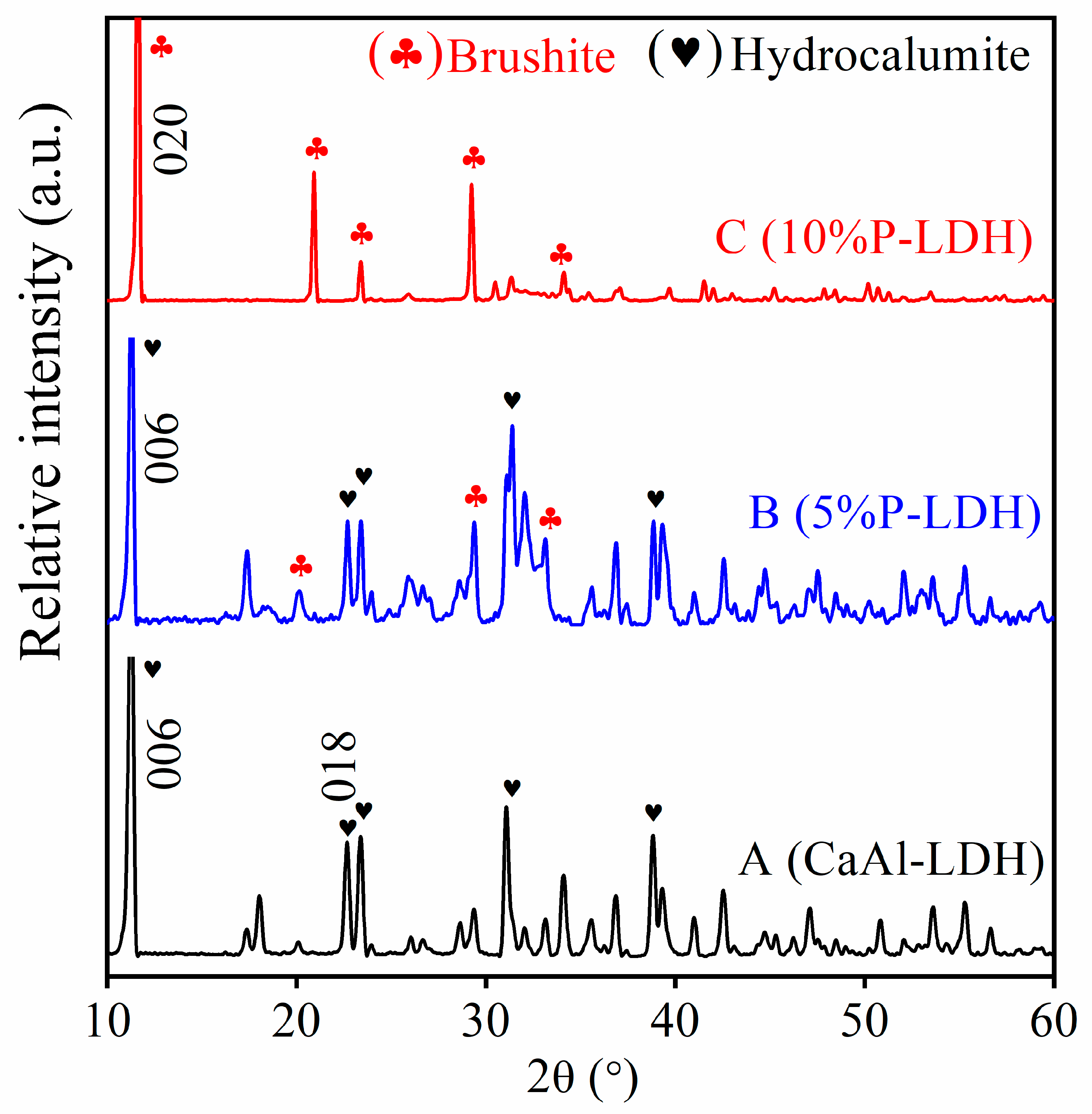
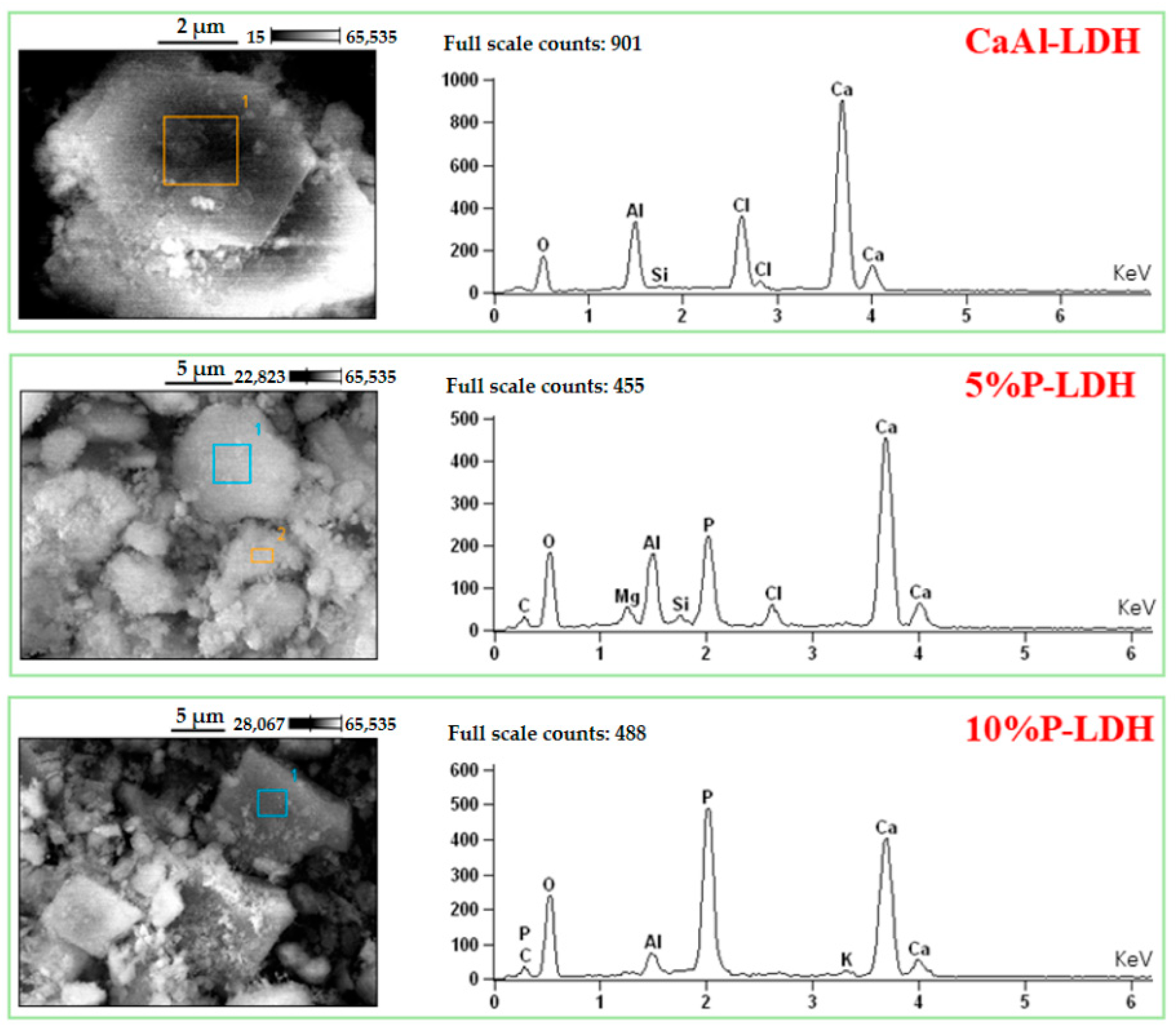
The XRD patterns of LDHs showed that typical reflections of hydrocalumite (Ca2Al(OH)6Cl·2H2O) diminished gradually from CaAl-LDH to 5% P-LDH (Figure 1). Meanwhile, characteristic diffraction peaks of brushite (CaHPO4·2H2O) became apparent from 5%P-LDH to 10%P-LDH. For 5%P-LDH, typical reflections of hydrocalumite and brushite co-existed. However, typical reflections of hydrocalumite almost disappeared in 10%P-LDH. The results indicated that 5%P-LDH was a mixture of hydrocalumite and brushite, while 10%P-LDH mainly consisted of brushite. Figure 2 shows the planar rhombohedral structure of CaAl-LDH. The main components of CaAl-LDH were Ca, Al, Cl, and O, which were in agreement with the formula of hydrocalumite Ca2Al(OH)6Cl·2H2O. From CaAl-LDH to 5%P-LDH in Figure 2, the counts of P increased while Cl decreased, which indicated anion exchange of interlayer Cl by phosphate. Moreover, from 5%P-LDH to 10%P-LDH, the counts of P increased almost twice, while Al declined sharply and Cl disappeared, which indicated the dissolution of the LDH structure and supported the formation of brushite. BET results indicated that the surface areas of CaAl-LDH, 5%P-LDH, and 10%P-LDH were 52.25, 12.21, and 41.94 m2 g−1, respectively.
It has been reported that the adsorption mechanisms of phosphate by CaAl-LDH mainly consisted of anion exchange and dissolution–precipitation [25]. In the present study, 500 mg L−1 and 2000 mg L−1 phosphate solutions with pH ~ 4 were used to prepare 5%P-LDH and 10%P-LDH, respectively. The diminished typical reflections of hydrocalumite of XRD patterns from CaAl-LDH via 5%P-LDH to 10%P-LDH indicated that more CaAl-LDH powders could be dissolved under increased phosphate concentrations. The released Ca2+ could be reacted with high concentrations of phosphate and form brushite precipitates, which was confirmed as enhanced typical reflections of brushite from CaAl-LDH via 5%P-LDH to 10%P-LDH. The XRD pattern of 10%P-LDH showed no obvious typical reflections of hydrocalumite, while Xu et al. [40] reported that there were still sharp typical reflections of hydrocalumite after 40 h of CaAl-LDH adsorption of 155 mg L−1 phosphate solutions. Based on our previous results, the adsorption process of phosphorus by CaAl-LDH reached equilibrium within 10 h [25]; thus, the 24 h reaction duration in the present study could be enough for maximum adsorption. The pH of 2000 mg L−1 NaH2PO4 solutions is ~4, which may dissolve much of the added CaAl-LDH with a dosage of 5 g L−1 under continuous stirring. With initial phosphate solution pH of 5, there were also no apparent typical reflections of hydrocalumite existing after 40 h adsorption by CaAl-LDH [40]. Similar results were reported by Qian et al. [41], who noted that no typical reflections of hydrocalumite were found under CaAl-LDH adsorption of K2HPO4 solutions (280~870 mg L−1, pH 5.0) after 24 h, while hydrocalumite peaks of the diffractogram under CaAl-LDH adsorption of K2HPO4 solutions (870 mg L−1, pH 9.0) remained after 24 h. Typical reflections of brushite rather than hydroxyapatite were dominant in P-LDH after phosphate adsorption by CaAl-LDH which was also reported [42]. The authors owed the precipitation of brushite to high Ca concentrations and appropriate pH (6). The present study synthesized the 10%P-LDH with a dosage of 5 g L−1 which was higher than 1 g L−1 in the studies by Xu et al. [40] and Qian et al. [41], while there were hydroxyapatite precipitates for the latter two studies. In the present study, with a high dosage of LDH adsorbent, more Ca2+ could be released and precipitated with large amounts of phosphates as brushite under the initial solution of pH ~ 4.

3.2. Evaluation of Available Phosphorus of 10%P-LDHs

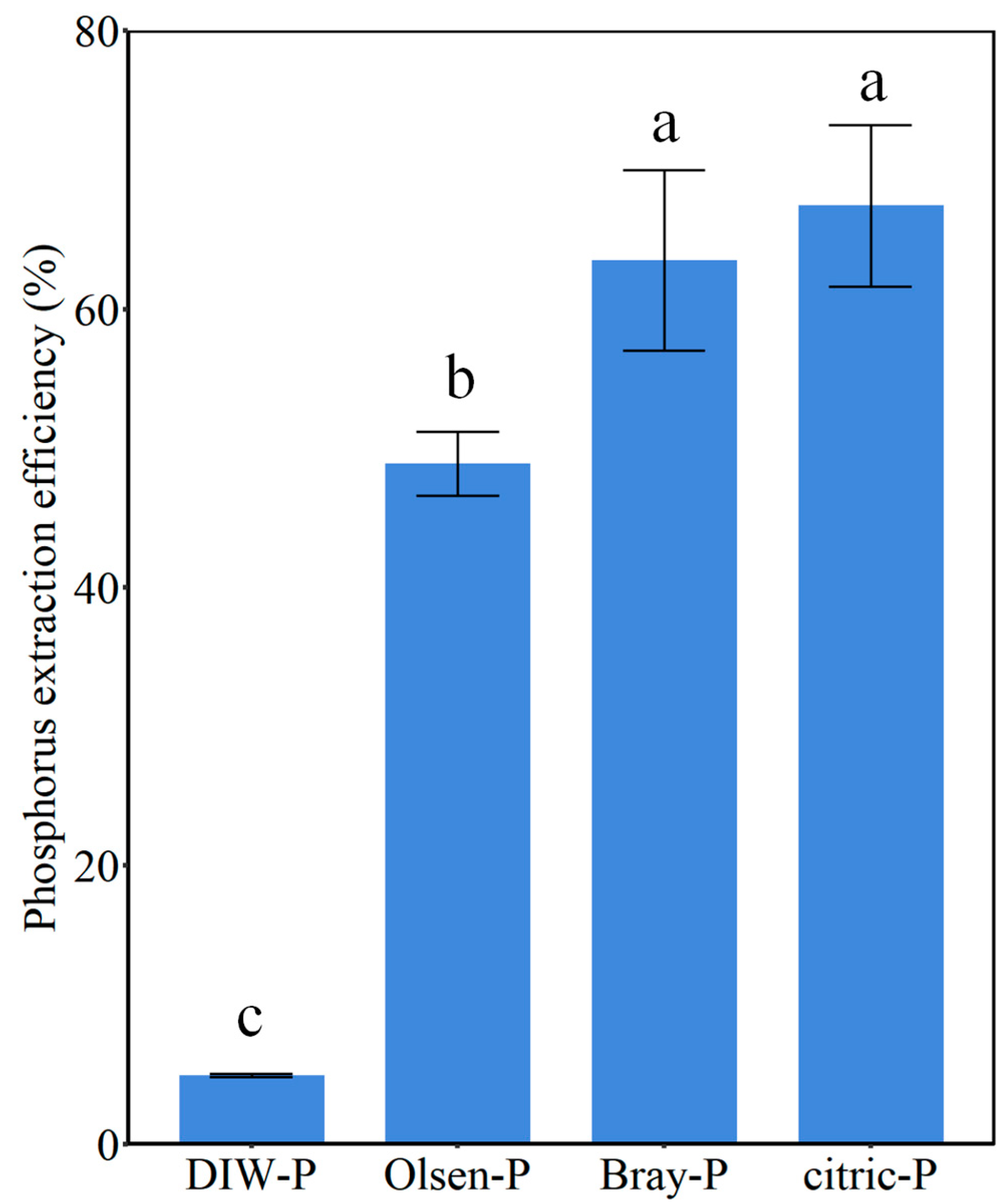
Four extractants differing in extractabilities were used to evaluate the bioavailability of P in 10%P-LDH. The phosphorus extraction efficiencies of 10%P-LDH increased in the order of DIW-P (4.9%) < Olsen-P (48.9%) < Bray-P (63.5%) < citric-P (67.4%) (Figure 3). It was reported that two of the commonly used phosphorus fertilizers, i.e., TSP and SSP, which are both fully acidulated, contained citrate-soluble phosphorus of 84.1% and 79.7%, respectively [43]. For comparison, the above study included two non-reactive phosphate rocks, one reactive phosphate rock, and their partially acidulated products, which contained citric-P of 10.1% to 43.0%. In the present study, the citric-P of 10%P-LDH was 67.4%, which indicated that 10%P-LDH contained much more citric-P than reactive phosphate rocks and its partially acidulated products. Thus, 10%P-LDH could be similar to citrate-soluble phosphate fertilizers in phosphorus release under acidic conditions. This was understandable, as the main component of 10%P-LDH was brushite based on XRD characterization, and brushite has been demonstrated to be as effective as commercial chemical phosphorus fertilizers [44]. Since acidic extractants showed better extraction efficiencies, the potential application of 10%P-LDH as phosphate fertilizer could be more reasonable for acidic soils. Previous study has shown that the diffusion of MgAl-P-LDH-derived P was faster in slightly acidic soil (pH = 6.2) than neutral soil (pH ~7.7) [21].

3.3. Effects of LDHs Application on Various Soil P Concentrations

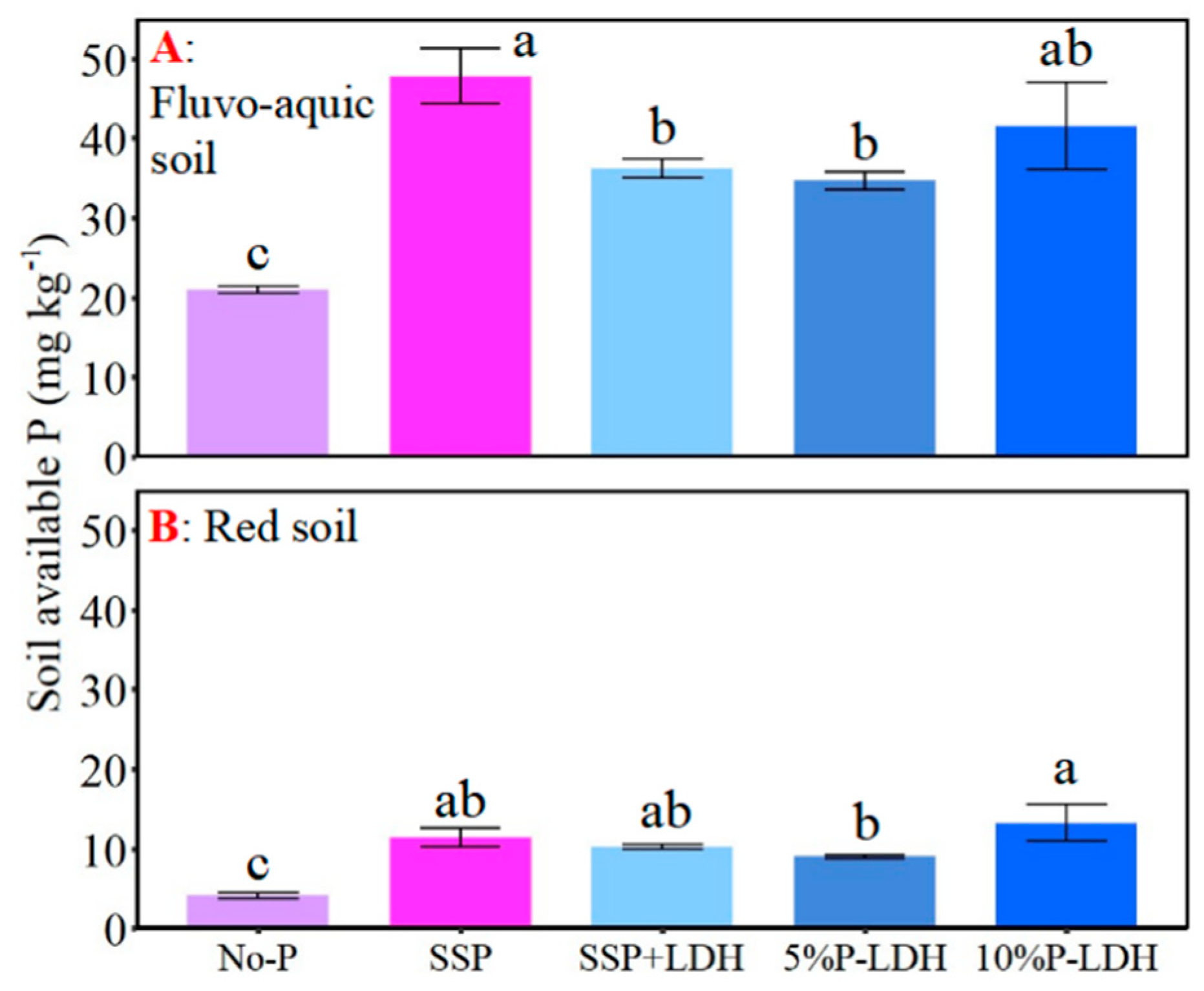
In both soils, P fertilizations led to significantly higher soil available P than No-P (Figure 4). Without P fertilization, the soil available P concentrations were 20.9 ± 0.45 mg kg−1 and 4.10 ± 0.41 mg kg−1 for the Fluvo-aquic soil and the red soil, respectively. The average soil available P concentrations for four P fertilization treatments were 40.0 ± 6.09 mg kg−1 and 11.0 ± 1.97 mg kg−1 in the Fluvo-aquic soil and the red soil, respectively. In the Fluvo-aquic soil, the SSP (47.8 ± 3.50 mg kg−1) fertilization had the highest soil available P, which was significantly higher than that of the SSP+LDH (36.2 ± 1.16 mg kg−1) and 5%P-LDH (34.6 ± 1.07 mg kg−1) treatments. There were insignificant differences of soil available P between additions of SSP and 10%P-LDH (41.6 ± 5.47 mg kg−1). In the red soil, the application of 10%P-LDH (13.2 ± 2.24 mg kg−1) led to significant enhancement of soil available P compared to No-P and 5%P-LDH (8.98 ± 0.27 mg kg−1), while showing no significant differences with the SSP (11.4 ± 1.16 mg kg−1) and SSP+LDH (10.2 ± 0.30 mg kg−1) (Figure 4). In both moderate (Fluvo-aquic soil) and low (red soil) initial P concentration soils, 10%P-LDH showed comparable effects with SSP on soil available P concentrations. Intriguingly, the addition of SSP led to insignificantly higher soil available P concentrations compared to SSP+LDH and 5%P-LDH in the Fluvo-aquic soil while with apparent variations in the red soil. In contrary, SSP application showed significant accrual of soil available P concentrations than SPP+LDH and 5%P-LDH in the Fluvo-aquic soil, while comparable soil available P concentrations were seen in the red soil.
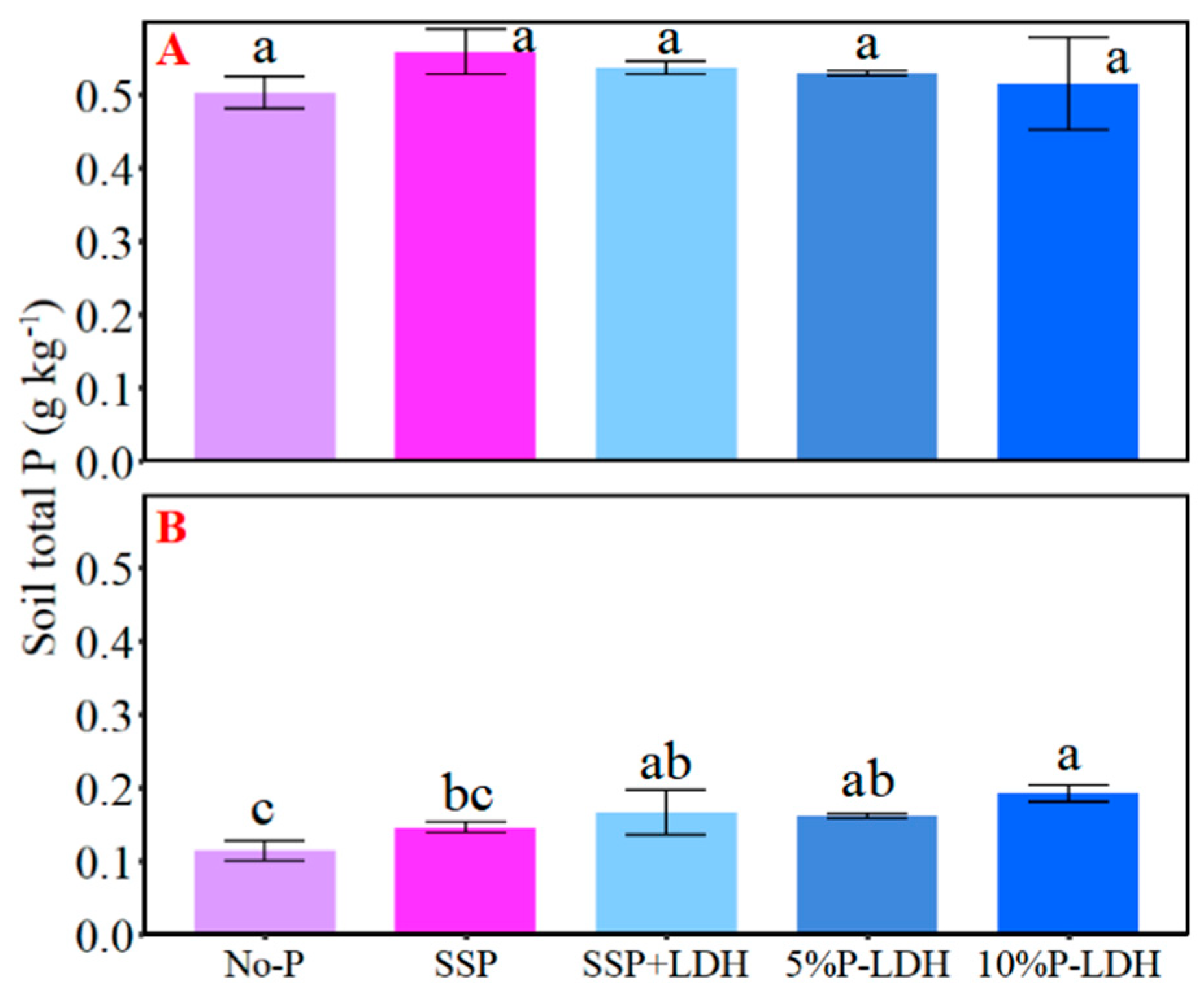
The average soil total P concentrations of the Fluvo-aquic and red soils were 0.53 ± 0.03 mg kg−1 and 0.15 ± 0.03 mg kg−1, respectively (Figure 5). There were insignificant differences in soil total P concentrations between five treatments of the Fluvo-aquic soil. However, the addition of 10%P-LDH (0.19 ± 0.01 mg kg−1) showed apparently higher soil total P concentrations than No-P (0.11 ± 0.01 mg kg−1) and SPP (0.14 ± 0.01 mg kg−1).
The present study showed that the soil available P of the 5%P-LDH treatment was significantly lower than the SSP via 3-month pot trials in the Fluvo-aquic soil. The XRD patterns indicated that P intercalated CaAl-LDH (P-LDH) and brushite co-existed in the 5%P-LDH. Brushite has been confirmed to be as effective as commercial P fertilizers [44]. Our results also demonstrated that there were insignificant differences in soil available P between SSP and 10%P-LDH (brushite was the main component) treatments at both soil types. Thus, the decline of soil available P after 5%P-LDH addition in the Fluvo-aquic soil could mainly be attributed to P-LDH. Typically, the mechanisms of P release from P-LDH included anion exchange of HPO 4 2 by anions with higher affinities such as CO 3 2 [45] and partial dissolution of P-LDH [40]. To our knowledge, there are no reports of the effects of CaAl-P-LDH application on soil P contents yet. A previous study on P intercalated MgAl-LDH (MgAl-P-LDH) reported that after 100 days incubation with soil, only 10–26% of total P of MgAl-P-LDH was released [21]. Everaert et al. [45] suggested that the MgAl-LDH dissolution was improbable under soil with pH of 7.0. Despite Ca type LDHs being more soluble than Mg type LDHs [40], the dissolution of 5%P-LDH could be slow in the Fluvo-aquic soil which was alkaline (pH = 8.6). Moreover, the dissolved P from P-LDH could be re-fixed to soil particles via processes such as precipitation and complexation [46]. In the red soil, the initial soil pH was 4.8, which had been adjusted to around 7.0 via liming with CaCO3 (5 g kg−1 soil) at the beginning of pot trials. The dissolution of 5%P-LDH could be limited, owing to the dissolution of added CaCO3 in the red soil. Jiang et al. [47] suggested that the P release of P-LDH in soils was repressed upon high ionic strength conditions, such as Ca2+ and K+. In this case, the relatively high soil available K of the 5%P-LDH (Figure S1) treatment in both soils was negatively connected with low soil available P with 5%P-LDH addition. Regarding P release of 5%P-LDH via anion exchange, complete P desorption from MgAl-P-LDH was not achieved even in NaHCO3 or NaOH solutions [21]. Therefore, P release from 5%P-LDH via anion exchange was also responsible for lower soil available P compared to SSP. This kind of low solubility and partial exchangeability of 5%P-LDH is a double-edged sword, which makes 5%P-LDH a potential slow-release P fertilizer which needs further demonstration.
All LDH additions obtained mainly comparable effects with SSP on soil total P contents, except for the 10%P-LDH in the red soil which demonstrated significantly higher soil total P than SSP. This implied that even though the soil consisted mainly of brushite, which showed similar effects with SSP on soil available P, 10%P-LDH performed better in soil total P retention or soil P loss reduction than SSP. Rapid dissolution of SSP took place after application into soils, with parts of the dissolved P being taken up by rape plant roots, and the rest could have formed phosphates such as brushite [44], while some parts, especially soluble P, could have leached out of the pots. Therefore, 10%P-LDH could be more suitable for P fertilization in the red soil to control soil P loss compared to highly soluble commercial P fertilizers.

3.4. Effects of LDHs Application on Growth and P Uptake of Oilseed Rape

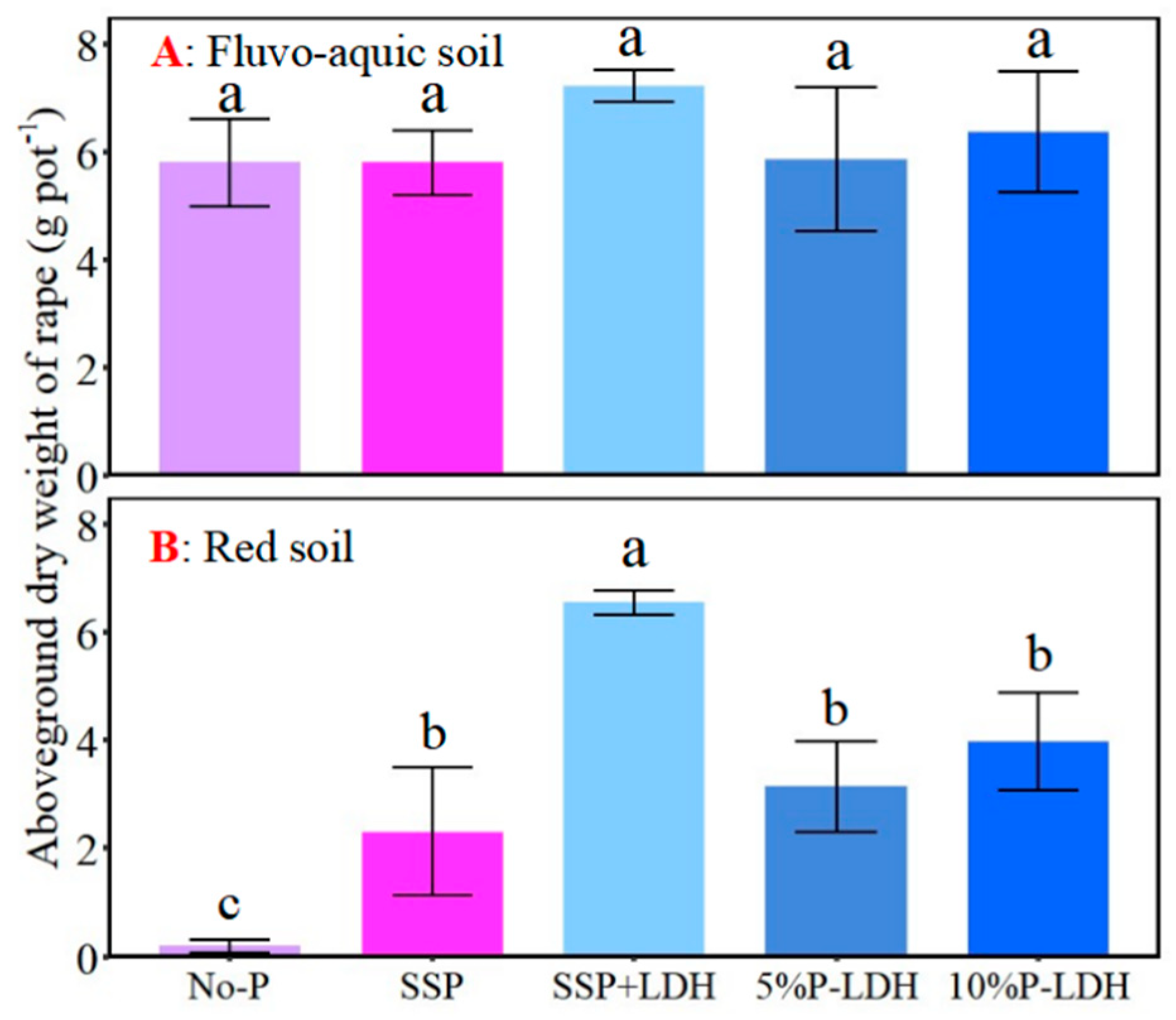
In the Fluvo-aquic soil, among all treatments, there were insignificant differences in aboveground dry weights (DW) of oilseed rape grown for three months (Figure 6). The rape DW grown in Fluvo-aquic soil ranged from 5.01 to 7.57 g pot−1, and the SSP+LDH treatment had the highest DW (7.22 ± 0.29 g pot−1). In the red soil, the SSP + LDH also obtained the highest DW (6.56 ± 0.23 g pot−1), while there were significant differences in DW between SSP+LDH and other treatments in red soil. Without P fertilization (No-P), rape DW (0.20 ± 0.11 g pot−1) was extremely low compared to other treatments. Two P-LDHs treatments showed insignificant variations in DW with SSP, and there was a slight accrual trend from SSP (2.31 ± 1.18 g pot−1) via 5%P-LDH (3.15 ± 0.84 g pot−1) to 10%P-LDH (4.00 ± 0.91 g pot−1).
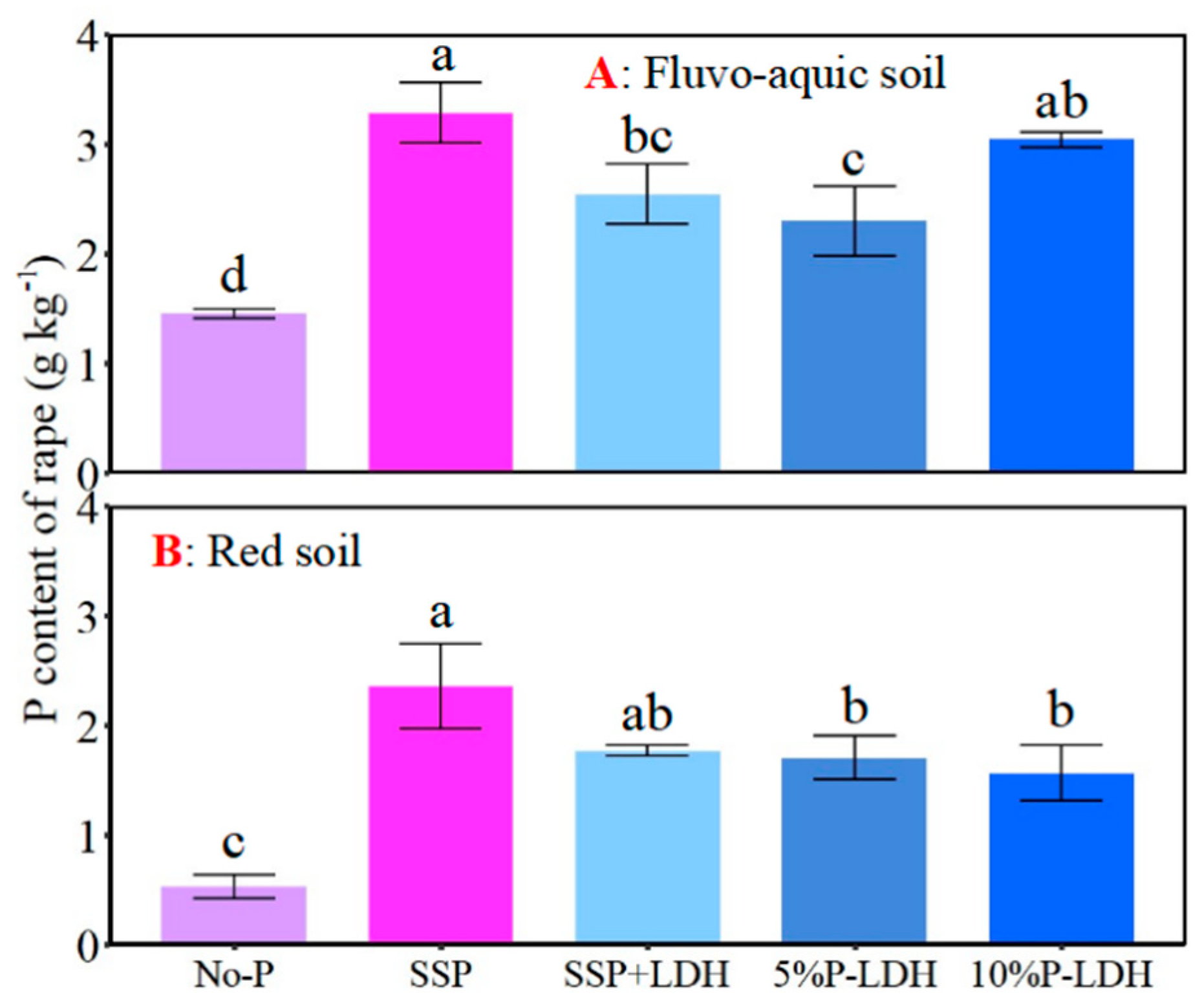
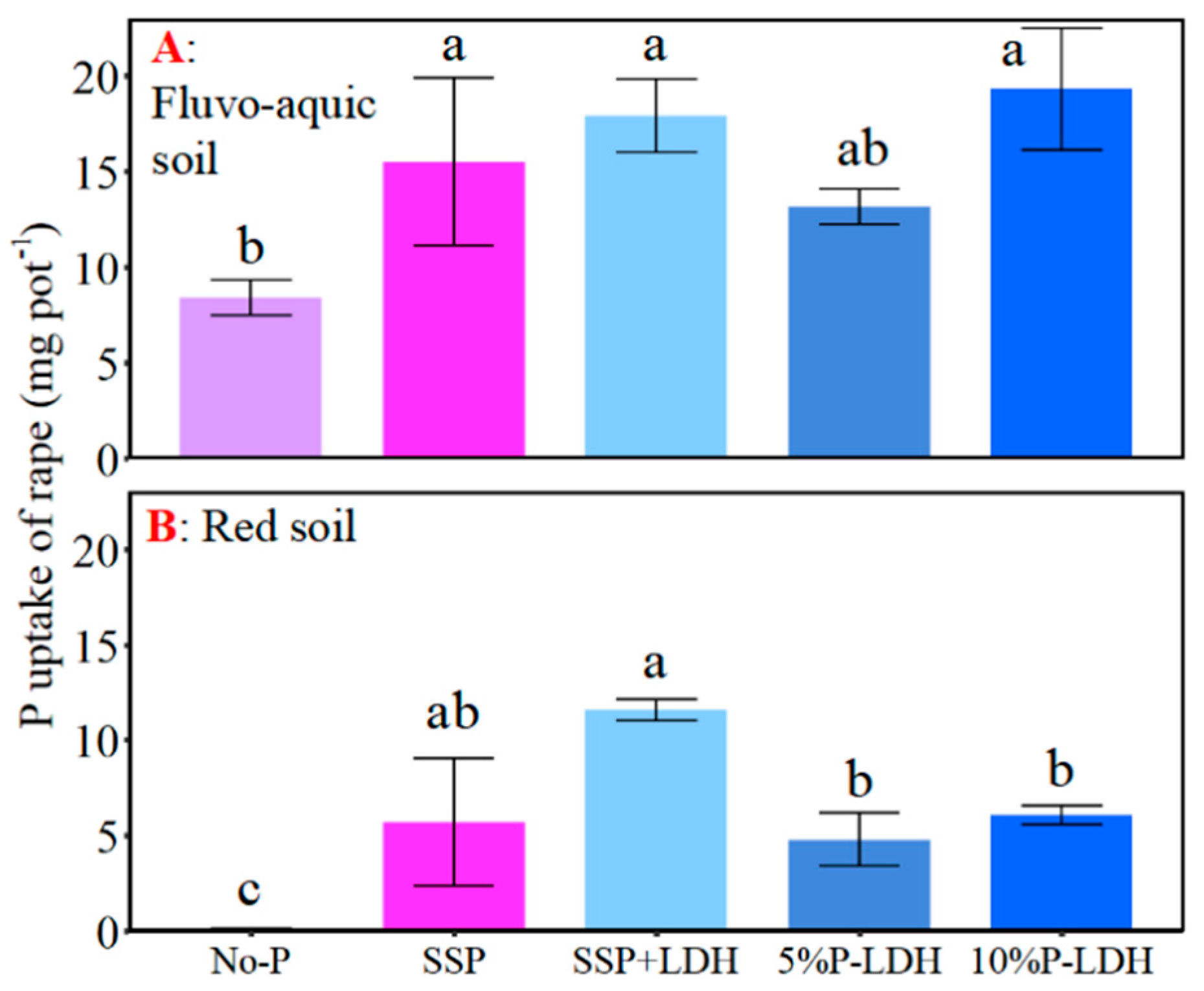
There were significant differences in rape P contents among treatments in both soils (Figure 7). For the Fluvo-aquic soil, SSP demonstrated the highest rape P content (3.28 ± 0.28 g kg−1 DW), being significantly higher than SSP + LDH (2.54 ± 0.27 g kg−1 DW), 5%P-LDH (2.29 ± 0.31 g kg−1 DW), and No-P (1.45 ± 0.04 g kg−1 DW), but insignificantly differed from 10%P-LDH (3.04 ± 0.07 g kg−1 DW). Among three LDH applications, 10%P-LDH had the highest rape P content which was apparently higher than 5%P-LDH. The rape P contents in the red soil showed similar trends with the Fluvo-aquic soil, except for the 10%P-LDH (1.56 ± 0.25 g kg−1 DW) treatment which resulted in lower rape P content than SSP (2.35 ± 0.39 g kg−1 DW). Meanwhile, there were inapparent variations in rape P contents between three LDHs additions in the red soil. Similarly to DW, the addition of SSP + LDH obtained the highest rape P uptake per pot (Figure 8). All P fertilizations had significantly higher P uptake than no P addition. The AFPUE was the highest of 10%P-LDH in the Fluvo-aquic soil and of SSP + LDH in the red soil, respectively (Table 2). At both soils, the 5%P-LDH sample obtained the lowest AFPUE.
Both 5%P-LDH and 10%P-LDH applications resulted in comparable P uptake to SSP in two soils, which indicated that the studied P-LDHs could supply P to a similar extent with SSP for rape growth. Insignificant differences in rape DW among two P-LDHs and SSP treatments in both soils also confirmed this conclusion. The two P-LDH additions both lifted the soil available P from ~4 mg kg−1 to ≥9 mg kg−1, which was higher than the suggested critical Olsen P (5 mg kg−1) that would lead to P deficiency symptoms of rape plants [48]. Liu et al. [28] synthesized concrete-based LDH (CLDH), which mainly consisted of CaAl-LDH and MgAl-LDH, and demonstrated that P-loaded CLDH was more effective in promoting biomass accumulation of mung beans than TSP based on results of 40-day pot trials. Besides P, the authors speculated that Ca and Mg of P-loaded CLDH contributed to promoted growth as well [28]. In our study, the combination of SSP and CaAl-LDH (SSP + LDH) showed high DW of rape especially in the red soil. Since the applied CaAl-LDH contained no P, and the soil available P and total P contents were comparable between SSP and SSP + LDH, we believed that the rape growth-promoting effects of the SSP + LDH treatment were not attributed to P but other factors such as Ca. Our previous study showed that CaAl-LDH mainly consisted of O (57%), Ca (24%), Al (11%), and Cl (7%) elements [25], which indicated that CaAl-LDH addition could bring abundant Ca into soils. Indeed, there was an increase in soil total Ca content in red soils that received both CaAl-LDH and P-LDHs compared to the SSP and No-P treatments (Table S1). Intriguingly, in the red soil the Ca contents of aboveground oilseed rape (Table S2) showed a significant decline in SSP + LDH which contained high soil total Ca and obtained the highest DW. Among all treatments in the red soil, the DW of rape was highly and negatively correlated with rape Ca contents (r = −0.80, p < 0.001) (Table 3). A previous study indicated that the Ca contents of aboveground oilseed rape during the elongation periods was ~ 9 to 12 g kg−1 [49,50], which was relatively lower than that of the No-P, SSP, and 5%P-LDH treatments in the present study. As the red soil contained low levels of nutrients such as P and Ca (Table 1 and Table S1), the rape growth was probably under stress of P and/or Ca deficiencies. The high rape Ca contents of No-P could be due to Ca redistribution from rape root to shoot under Ca-deficient soil conditions [51]. The high DW of the SSP + LDH suggested that CaAl-LDH promoted the growth of rape, which could be attributed to CaAl-LDH-derived Ca for stress alleviation of Ca deficiency. Of note, the above speculation was based on total Ca concentrations, which could be more believable if available Ca concentrations (have no data) showed the same trend. The oilseed rape was harvested during the elongation period in the present study; longer term trials should be performed to evaluate the effects of CaAl-LDH and P-LDHs on the yield and quality of rapeseed before considering the substitution of soluble P fertilizers by P-LDHs and CaAl-LDH as red soil conditioners.

4. Conclusions

Although batch trials indicated that CaAl-LDHs were efficient in P removal, which could be promising wastewater P removal materials and alternative slow-release P fertilizers, the effects of P-loaded CaAl-LDHs on soil P contents and crop growth in soils needs further evaluation. This study is the first to identify the P-loaded CaAl-LDHs application on soil available P and oilseed rape growth and P uptake under various soil P levels. The synthesized CaAl-P-LDHs with two P contents (i.e., 5%- and 10%P-LDH), which contained mainly P-intercalated CaAl-LDH and brushite, and mainly brushite, respectively, were both citrate-soluble P materials with P extraction efficiencies > 63%. Moreover, both 5%- and 10%P-LDH effectively enhanced the soil available P and aboveground biomass of oilseed rape compared to no P addition; specifically, the 10%P-LDH sample showed comparable effects with soluble fertilizer single superphosphate. The fertilization effects of P-LDHs were more apparent in the low initial P red soil, which showed 170% and 1714% increases in averaged soil available P and oil seed rape plant aboveground dry weight compared to no P addition, while there were 82% and 5% increases in the high P Fluvo-aquic soil. Intriguingly, among all treatments, the rape aboveground dry weights in the red soil were highly and negatively correlated with rape Ca contents (r = −0.80), which might be due to redistribution of Ca from root to shoot under Ca deficiency in the red soil. This may explain the prominent rape growth promotion with the combination of a single superphosphate and CaAl-LDH. Indeed, conclusions based on three-month soil pot experiments with oilseed rape growth were limited. Further long-term field trials are needed to examine the CaAl-P-LDH-derived P (removed from realistic wastewater) supply for the whole growth period of oilseed rape and its oil yield. Future studies should also examine the control of soil P loss due to low water solubility of citrate-soluble P-LDHs and their application potential as acidic soil conditioners, which may affect soil properties and interact with soil microorganisms.

Supplementary Materials

The following supporting information can be downloaded at: https://www.mdpi.com/article/10.3390/agronomy16030385/s1, Figure S1: Soil available K (mg kg−1) of oilseed rape grown for three months in two soils (A: Fluvo-aquic soil, and B: Red soil) under five P treatments. No-P, without P fertilization; SSP, single superphosphate; SSP+LDH, single superphosphate combined with CaAl-LDH; 5%P-LDH and 10%P-LDH represented P fertilizations with these two materials. Significant differences between various treatments were labelled with lower-case letters. p < 0.05. N = 3; Table S1: Soil pH and elemental contents (mean ± SD) in two soils under five P treatments. No-P, without P fertilization; SSP, single superphosphate; SSP + LDH, single superphosphate combined with CaAl-LDH; 5%P-LDH and 10%P-LDH represented P fertilizations with these two materials. Significant differences between various treatments were labelled with lower-case letters. p < 0.05. N = 3; Table S2: Elemental contents of aboveground oilseed rape grown in the red soil. No-P, without P fertilization; SSP, single superphosphate; SSP + LDH, single superphosphate combined with CaAl-LDH; 5%P-LDH and 10%P-LDH represented P fertilizations with these two materials. Significant differences between various treatments were labelled with lower-case letters. p < 0.05. N = 3.

Author Contributions

Y.J.: Formal Analysis, Investigation, Writing—Original Draft, Writing—Review and Editing. L.W.: Methodology, Software, Visualization. S.H.: Data Curation, Investigation, Resources. Y.C.: Conceptualization, Funding Acquisition, Validation, Writing—Original Draft. M.L.: Conceptualization, Validation, Resources. F.L.: Funding Acquisition, Writing—Review and Editing. J.Z. (Jianyu Zhang): Methodology, Resources. J.Z. (Jibing Zhang): Funding Acquisition, Project Administration. L.Y.: Writing—Review and Editing. H.W.: Conceptualization, Methodology, Supervision. All authors have read and agreed to the published version of the manuscript.

Funding

This study was funded by the Natural Science Foundation of Jiangsu Province (BK 20240276), the National Natural Science Foundation of China (42207108), the Special Fund of Chinese Central Government for Basic Scientific Research Operations in Commonweal Research Institute (GYZX250104 and GYZX240411), and the Guangdong Basic and Applied Basic Research Foundation (2021A1515010295).

Data Availability Statement

The original contributions presented in this study are included in the article/Supplementary Materials. Further inquiries can be directed to the corresponding authors.

Acknowledgments

We thank Wang and Jiang for their help in pot trials management.

Conflicts of Interest

Author Jianyu Zhang was employed by the company Jiangsu Longchang Chemical Co., Ltd. The remaining authors declare that the research was conducted in the absence of any commercial or financial relationships that could be construed as a potential conflict of interest.

References

  1. Wang, M.; Jiang, T.; Mao, Y.; Wang, F.; Yu, J.; Zhu, C. Current situation of agricultural non-point source pollution and its control. Water Air Soil Pollut. 2023, 234, 471. [Google Scholar] [CrossRef]
  2. Yan, X.; Xia, Y.; Ti, C.; Shan, J.; Wu, Y.; Yan, X. Thirty years of experience in water pollution control in Taihu Lake: A review. Sci. Total Environ. 2024, 914, 169821. [Google Scholar] [CrossRef]
  3. Zou, T.; Zhang, X.; Davidson, E.A. Global trends of cropland phosphorus use and sustainability challenges. Nature 2022, 611, 81–87. [Google Scholar] [CrossRef]
  4. Bao, T.; Damtie, M.M.; Wang, C.Y.; Chen, Z.; Tao, Q.; Wei, W.; Cho, K.; Yuan, P.; Frost, R.L.; Ni, B.J. Comprehensive review of modified clay minerals for phosphate management and future prospects. J. Clean. Prod. 2024, 447, 141425. [Google Scholar] [CrossRef]
  5. Liu, Y.; Wang, S.; Huo, J.; Zhang, X.; Wen, H.; Zhang, D.; Zhao, Y.; Kang, D.; Guo, W.; Ngo, H.H. Adsorption recovery of phosphorus in contaminated water by calcium modified biochar derived from spent coffee grounds. Sci. Total Environ. 2024, 909, 168426. [Google Scholar] [CrossRef]
  6. Lin, H.; Wang, Y.; Dong, Y. A review of methods, influencing factors and mechanisms for phosphorus recovery from sewage and sludge from municipal wastewater treatment plants. J. Environ. Chem. Eng. 2024, 12, 111657. [Google Scholar] [CrossRef]
  7. Loganathan, P.; Vigneswaran, S.; Kandasamy, J.; Bolan, N.S. Removal and Recovery of Phosphate from Water Using Sorption. Crit. Rev. Environ. Sci. Technol. 2014, 44, 847–907. [Google Scholar] [CrossRef]
  8. Wang, S.X.; Huang, Y.X.; Wu, Q.F.; Yao, W.; Lu, Y.Y.; Huang, B.C.; Jin, R.C. A review of the application of iron oxides for phosphorus removal and recovery from wastewater. Crit. Rev. Environ. Sci. Technol. 2023, 54, 405–423. [Google Scholar] [CrossRef]
  9. Gao, D.; Zhang, W.; Dong, H.; Yu, Y.; Liu, W.; Luo, H.; Jing, Z.; Liang, B.; Peng, L.; Wu, B.; et al. Phosphorus removal from water by the layered double hydroxides (LDHs)-based adsorbents: A review for structure, mechanism, and current progress. Environ. Technol. Innov. 2025, 37, 104003. [Google Scholar] [CrossRef]
  10. Pattappan, D.; Kapoor, S.; Islam, S.S.; Lai, Y.T. Layered Double Hydroxides for Regulating Phosphate in Water to Achieve Long-Term Nutritional Management. ACS Omega 2023, 8, 24727–24749. [Google Scholar] [CrossRef] [PubMed]
  11. He, T.; Li, Q.; Lin, T.; Li, J.; Bai, S.; An, S.; Kong, X.; Song, Y.F. Recent progress on highly efficient removal of heavy metals by layered double hydroxides. Chem. Eng. J. 2023, 462, 142041. [Google Scholar] [CrossRef]
  12. Duan, M.; Liu, S.; Jiang, Q.; Guo, X.; Zhang, J.; Xiong, S. Recent progress on preparation and applications of layered double hydroxides. Chin. Chem. Lett. 2022, 33, 4428–4436. [Google Scholar] [CrossRef]
  13. Tan, Y.; Yi, H.; Tang, X.; Yu, Q.; Gao, F.; Liu, J.; Wang, Y.; Zhou, Y.; Kang, D.; Zhao, S. Layered double hydroxides for air pollution control: Applications, mechanisms and trends. J. Clean. Prod. 2024, 436, 140635. [Google Scholar] [CrossRef]
  14. Fu, Y.; Li, Y.; Zhang, J.; Liu, D.; Liu, C.; Ke, Y. Chloride intercalated Ni-Al layered double hydroxide for effective adsorption removal of Sb(Ⅴ). Inorg. Chem. Commun. 2022, 142, 109651. [Google Scholar] [CrossRef]
  15. Gupta, D.; Singh, C.; Koranne, A.; Singh, S.; Azad, U.P.; Singh, A.K.; Singh, S.K. Layered Double Hydroxide: An Economical and Dynamic Choice for Water Remediation with Multiple Functionality. ChemistrySelect 2024, 9, e202303300. [Google Scholar] [CrossRef]
  16. Pasquali, E.A.; Demaman Oro, C.E.; Bernardi, J.L.; Grass, G.B.; Venquiaruto, L.D.; Treichel, H.; Mossi, A.J.; Dallago, R.M. Exploring the adsorptive potential of layered double hydroxides for chromium(VI) remediation. Int. J. Environ. Sci. Technol. 2024, 22, 9627–9636. [Google Scholar] [CrossRef]
  17. Qin, J.; Shi, H.; Lv, Q.; He, M.; Xu, Y.; Chen, M.; Chen, X.; Zhang, J.; Liu, Y.; Yu, J. Enhanced adsorption effect of defect ordering Mg/Al on layered double hydroxides nanosheets with highly efficient removal of Congo red. Mater. Des. 2023, 232, 112084. [Google Scholar] [CrossRef]
  18. Zubair, M.; Manzar, M.S.; El-Qanni, A.; Haroon, H.; Alqahtani, H.A.; Al-Ejji, M.; Mu’azu, N.D.; AlGhamdi, J.M.; Haladu, S.A.; Al-Hashim, D.; et al. Biochar-layered double hydroxide composites for the adsorption of tetracycline from water: Synthesis, process modeling, and mechanism. Environ. Sci. Pollut. Res. 2023, 30, 109162–109180. [Google Scholar] [CrossRef]
  19. Abduarahman, M.A.; Vuksanović, M.M.; Milošević, M.; Egelja, A.; Savić, A.; Veličković, Z.; Marinković, A. Mn-Fe Layered Double Hydroxide Modified Cellulose-Based Membrane for Sustainable Anionic Pollutant Removal. J. Polym. Environ. 2024, 32, 3776–3794. [Google Scholar] [CrossRef]
  20. Gao, S.; Yin, T.; Jia, X.; Chang, F.; Shi, Y.; Liu, H.; Xie, X.; Yang, Q.; Li, C.; Hu, G. Latest Progress and Perspectives in Layered Double Hydroxide-Based Adsorbents for Phosphate Pollution Removal from Wastewater. ChemistrySelect 2025, 10, e01025. [Google Scholar] [CrossRef]
  21. Everaert, M.; Degryse, F.; McLaughlin, M.J.; De Vos, D.; Smolders, E. Agronomic Effectiveness of Granulated and Powdered P-Exchanged Mg-Al LDH Relative to Struvite and MAP. J. Agric. Food Chem. 2017, 65, 6736–6744. [Google Scholar] [CrossRef]
  22. Hatami, H.; Fotovat, A.; Halajnia, A. Availability and Uptake of Phosphorus and Zinc by Maize in the Presence of Phosphate-Containing Zn-Al-LDH in a Calcareous Soil. Eurasian Soil Sci. 2021, 54, 431–440. [Google Scholar] [CrossRef]
  23. Roy, A.S.; de Beer, M.; Pillai, S.K.; Ray, S.S. Application of Layered Double Hydroxides as a Slow-Release Phosphate Source: A Comparison of Hydroponic and Soil Systems. ACS Omega 2023, 8, 15017–15030. [Google Scholar] [CrossRef]
  24. Zeng, Z.; Zheng, J.; Li, X.; Fan, C.; Zeng, R.; Tang, W. Phosphate adsorption by amino acids intercalated calcium aluminum hydrotalcites: Kinetic, isothermal and mechanistic studies. J. Solid State Chem. 2024, 329, 124428. [Google Scholar] [CrossRef]
  25. Jia, Y.; Wang, H.; Zhao, X.; Liu, X.; Wang, Y.; Fan, Q.; Zhou, J. Kinetics, isotherms and multiple mechanisms of the removal for phosphate by Cl-hydrocalumite. Appl. Clay Sci. 2016, 129, 116–121. [Google Scholar] [CrossRef]
  26. Dan, L.; Nan, H.; Zhang, Y.; Sher, F.; Wang, C. Phosphorus recovery from wastewater by Ca-Al layered double hydroxide/biochar as potential agricultural phosphorus for closed-loop phosphorus recycling. Process Saf. Environ. Prot. 2025, 194, 1538–1548. [Google Scholar] [CrossRef]
  27. Zhou, Z.; Luo, D.; Zhang, X.; Wang, C. Sustainable phosphorus recovery from wastewater by layered double hydroxide/biochar composites for potential agricultural application. Ind. Crops Prod. 2025, 224, 120422. [Google Scholar] [CrossRef]
  28. Liu, X.; Zhi, Y.Z.; Tian, Y.; Yuan, Y.; Zhong, H.Y. Phosphate-adsorbed by concrete-based layered double hydroxide: A slow-release phosphate fertilizer. Pol. J. Environ. Stud. 2024, 33, 5191–5198. [Google Scholar] [CrossRef]
  29. Yan, J.; Ren, T.; Wang, K.; Li, H.; Li, X.; Cong, R.; Lu, J. Improved crop yield and phosphorus uptake through the optimization of phosphorus fertilizer rates in an oilseed rape-rice cropping system. Field Crops Res. 2022, 286, 108614. [Google Scholar] [CrossRef]
  30. Lv, L.; He, J.; Wei, M.; Evans, D.G.; Zhou, Z. Treatment of high fluoride concentration water by MgAl-CO3 layered double hydroxides: Kinetic and equilibrium studies. Water Res. 2007, 41, 1534–1542. [Google Scholar] [CrossRef] [PubMed]
  31. Olsen, S.R.; Sommers, L.E. Phosphorus. In Methods of Soil Analysis: Part 2 Chemical and Microbiological Properties; Page, A.L., Ed.; American Society of Agronomy, Soil Science Society of America: Madison, WI, USA, 1982; pp. 403–430. [Google Scholar]
  32. Bray, R.H.; Kurtz, L.T. Determination of total, organic, and available forms of phosphorus in soils. Soil Sci. 1945, 59, 39–45. [Google Scholar] [CrossRef]
  33. Taghipour, M.; Jalali, M. Effect of low-molecular-weight organic acids on kinetics release and fractionation of phosphorus in some calcareous soils of western Iran. Environ. Monit. Assess. 2013, 185, 5471–5482. [Google Scholar] [CrossRef] [PubMed]
  34. Arnon, D.I.; Hoagland, D.R. Crop production in artificial culture solutions and in soils with special reference of factors influencing yields and absorption of inorganic nutrients. Soil Sci. 1940, 50, 463–484. [Google Scholar]
  35. Lu, R.K. Analysis Method of Soil Agricultural Chemistry; China Agricultural Science and Technology Press: Beijing, China, 2000. [Google Scholar]
  36. Bao, S.D. Soil Agriculture Chemical Elements Analysis; China Agriculture Press: Beijing, China, 2000. [Google Scholar]
  37. R Core Team. R: A Language and Environment for Statistical Computing; R Core Team: Vienna, Austria, 2018. [Google Scholar]
  38. Alboukadel, K. rstatix: Pipe-Friendly Framework for Basic Statistical Tests, Online. 2021. Available online: https://rdrr.io/cran/rstatix/ (accessed on 29 January 2026).
  39. Field, A.; Miles, J.; Field, Z. Discovering Statistics Using R; SAFE Publications Ltd.: Thousand Oaks, CA, USA, 2012. [Google Scholar]
  40. Xu, Y.; Dai, Y.; Zhou, J.; Xu, Z.P.; Qian, G.; Lu, G.Q.M. Removal efficiency of arsenate and phosphate from aqueous solution using layered double hydroxide materials: Intercalation vs. precipitation. J. Mater. Chem. 2010, 20, 4684–4691. [Google Scholar] [CrossRef]
  41. Qian, G.; Feng, L.; Zhou, J.Z.; Xu, Y.; Liu, J.; Zhang, J.; Xu, Z.P. Solubility product (Ksp)-controlled removal of chromate and phosphate by hydrocalumite. Chem. Eng. J. 2012, 181, 251–258. [Google Scholar] [CrossRef]
  42. Lundehoj, L.; Jensen, H.C.; Wybrandt, L.; Nielsen, U.G.; Christensen, M.L.; Quist-Jensen, C.A. Layered double hydroxides for phosphorus recovery from acidified and non-acidified dewatered sludge. Water Res. 2019, 153, 208–216. [Google Scholar] [CrossRef]
  43. Santos, W.O.; Mattiello, E.M.; Barreto, M.S.C.; Cantarutti, R.B. Acid Ammonium Citrate as P Extractor for Fertilizers of Varying Solubility. Rev. Bras. Ciência Solo 2019, 43, e0180072. [Google Scholar] [CrossRef]
  44. Coker, H.R.; Yang, R.; Robertson, I.J.; Doria, J.M.; Lewis, K.L.; Howe, J.A. Brushite: A Reclaimed Phosphorus Fertilizer for Agricultural Nutrient Fertilization. J. Soil Sci. Plant Nutr. 2025, 25, 2085–2097. [Google Scholar] [CrossRef]
  45. Everaert, M.; Warrinnier, R.; Baken, S.; Gustafsson, J.-P.; De Vos, D.; Smolders, E. Phosphate-Exchanged Mg–Al Layered Double Hydroxides: A New Slow Release Phosphate Fertilizer. ACS Sustain. Chem. Eng. 2016, 4, 4280–4287. [Google Scholar] [CrossRef]
  46. Everaert, M.; Slenders, K.; Dox, K.; Smolders, S.; De Vos, D.; Smolders, E. The isotopic exchangeability of phosphate in Mg-Al layered double hydroxides. J. Colloid Interface Sci. 2018, 520, 25–32. [Google Scholar] [CrossRef]
  47. Jiang, X.; Zhang, M.; Yan, B.; Hu, J.; Chen, J.; Guan, Y. Roles of Mg-Al layered double hydroxides and solution chemistry on P transport in soil. Chem. Eng. J. 2019, 373, 1111–1119. [Google Scholar] [CrossRef]
  48. Nourgholipour, F.; Mirseyed Hosseini, H.; Tehrani, M.M.; Motesharezadeh, B.; Moshiri, F. Comparison of phosphorus efficiency among spring oilseed rape cultivars in response to phosphorus deficiency. N. Z. J. Crop Hortic. Sci. 2017, 46, 54–71. [Google Scholar] [CrossRef]
  49. Seleiman, M.F.; Santanen, A.; Jaakkola, S.; Ekholm, P.; Hartikainen, H.; Stoddard, F.L.; Mäkelä, P.S.A. Biomass yield and quality of bioenergy crops grown with synthetic and organic fertilizers. Biomass Bioenergy 2013, 59, 477–485. [Google Scholar] [CrossRef]
  50. Zhang, L.; Wang, Y.; Lu, J.W.; Ren, T.; Li, X.K.; Cong, R.H. Effect of potassium application on adsorption of potassium, calcium and magnesium for direct-sowing winter rapeseed. Chin. J. Oil Crop Sci. 2015, 37, 336–343. [Google Scholar]
  51. Maillard, A.; Diquelou, S.; Billard, V.; Laine, P.; Garnica, M.; Prudent, M.; Garcia-Mina, J.M.; Yvin, J.C.; Ourry, A. Leaf mineral nutrient remobilization during leaf senescence and modulation by nutrient deficiency. Front. Plant Sci. 2015, 6, 317. [Google Scholar] [CrossRef]
Figure 1. XRD patterns of LDHs before (A: CaAl-LDH) and after (B: 5%P-LDH and C: 10%P-LDH) phosphorus adsorption. Typical reflections of hydrocalumite are labelled with “♥”, while reflections of brushite are labelled with red “♣”.
Agronomy 16 00385 g001
Figure 2. SEM-EDS results of LDHs before (CaAl-LDH) and after (5%P-LDH and 10%P-LDH) phosphorus adsorption.
Agronomy 16 00385 g002
Figure 3. Phosphorus extraction efficiency (%) of 10%P-LDH by various extractants. DIW-P: P extracted by deionized water; Olsen-P: extracted by 0.5 mol L−1 NaHCO3 (pH = 8.5); Bray-P: extracted by 0.03 mol L−1 NH4F and 0.025 mol L−1 HCl; citric-P: extracted by 0.01 mol L−1 citric acid. Significant differences between various extractants are labelled with lower-case letters. p < 0.05 (N = 3).
Agronomy 16 00385 g003
Figure 4. Soil available P (mg kg−1) of oilseed rape grown for three months in two soils ((A) Fluvo-aquic soil, and (B) Red soil) under five P treatments. No-P, without P fertilization; SSP, single superphosphate; SSP+LDH, single superphosphate combined with CaAl-LDH; 5%P-LDH and 10%P-LDH represented P fertilizations with these two materials. Significant differences between various treatments are labelled with lower-case letters. p < 0.05 (N = 3).
Agronomy 16 00385 g004
Figure 5. Soil total P (g kg−1) of oilseed rape grown for three months in two soils ((A) Fluvo-aquic soil, and (B) Red soil) treated under five P treatments. No-P, without P fertilization; SSP, single superphosphate; SSP+LDH, single superphosphate combined with CaAl-LDH; 5%P-LDH and 10%P-LDH represented P fertilization with these two materials. Significant differences between various treatments are labelled with lower-case letters. p < 0.05 (N = 3).
Agronomy 16 00385 g005
Figure 6. Aboveground dry weight (g pot−1) of oilseed rape grown for three months in two soils ((A) Fluvo-aquic soil, and (B) Red soil) under five P treatments. No-P, without P fertilization; SSP, single superphosphate; SSP + LDH, single superphosphate combined with CaAl-LDH; 5%P-LDH and 10%P-LDH represent P fertilization which was performed with these two materials. Significant differences between various treatments are labelled with lower-case letters. p < 0.05 (N = 3).
Agronomy 16 00385 g006
Figure 7. P content (g kg−1 DW) of oilseed rape grown for three months in two soils ((A) Fluvo-aquic soil, and (B) Red soil) under five P treatments. No-P, without P fertilization; SSP, single superphosphate; SSP + LDH, single superphosphate combined with CaAl-LDH; 5%P-LDH and 10%P-LDH represent P fertilization which was performed with these two materials. Significant differences between various treatments are labelled with lower-case letters. p < 0.05 (N = 3).
Agronomy 16 00385 g007
Figure 8. P uptake (mg pot−1) of oilseed rape grown for three months in two soils ((A) Fluvo-aquic soil, and (B) Red soil) under five P treatments. No-P, without P fertilization; SSP, single superphosphate; SSP + LDH, single superphosphate combined with CaAl-LDH; 5%P-LDH and 10%P-LDH represent P fertilization which was performed with these two materials. Significant differences between various treatments are labelled with lower-case letters. p < 0.05 (N = 3).
Agronomy 16 00385 g008
Table 1. Basic soil properties.
Soil TypespHSand (%)Slit (%)Clay (%)SOM (%)CEC (cmol kg−1)AN (mg kg−1)AP (mg kg−1)TP (g kg−1)AK (mg kg−1)TK (g kg−1)
Fluvo-aquic soil8.69.276.614.21.5210.219427.940087318.32
Red soil4.843.948.27.91.6811.2793.985.311748.30
Notes: SOM, soil organic matter; CEC, cation exchange capacity; AN, available nitrogen; AP, available phosphorus; TP, total phosphorus; AK, available potassium; TK, total potassium.
Table 2. Apparent fertilizer P uptake (AFPU) and apparent fertilizer P use efficiency (AFPUE) for oilseed rape.
Soil TypeTreatmentsAFPU
(mg pot−1)
CIs of AFPUAFPUE (%)CIs of AFPUE (%)
Fluvo-aquic
soil
SSP7.12(−3.21, 17.4)7.25(−3.27, 17.8)
SSP + LDH9.49(5.50, 13.5)9.67(5.60, 13.7)
5%P-LDH4.77(2.65, 6.88)4.85(2.70, 7.01)
10%P-LDH10.91(3.78, 18.0)11.11(3.85, 18.4)
Red soilSSP5.62(−2.67, 13.9)5.72(−2.72, 14.2)
SSP + LDH11.48(10.1, 12.8)11.69(10.3, 13.1)
5%P-LDH4.70(1.28, 8.12)4.78(1.30, 8.27)
10%P-LDH5.99(4.77, 7.22)6.11(4.86, 7.35)
Notes: SSP, single superphosphate; SSP + LDH, single superphosphate combined with CaAl-LDH; 5%P-LDH and 10%P-LDH represent P fertilization which was performed with these two materials. N = 3.
Table 3. Correlation coefficients (r) between rape aboveground dry weight and other parameters.
Coefficients
(r)
Soil pHSoil AlSoil CaSoil FeSoil KSoil PPlant AlPlant CaPlant FePlant KPlant P
Dry weight0.370.190.400.090.190.57 *−0.52−0.80 ***−0.510.090.47
p value0.1880.5100.1590.7590.5200.0340.0540.00060.0640.7500.090
Notes: “*” and “***” represent p < 0.05 and p < 0.001, respectively. N = 15.
Disclaimer/Publisher’s Note: The statements, opinions and data contained in all publications are solely those of the individual author(s) and contributor(s) and not of MDPI and/or the editor(s). MDPI and/or the editor(s) disclaim responsibility for any injury to people or property resulting from any ideas, methods, instructions or products referred to in the content.