Review

Physiological and Molecular Mechanisms of Ethylene in Sculpting Rice Root System Architecture

Jiangsu Key Laboratory of Crop Genetics and Physiology, Jiangsu Key Laboratory of Crop Cultivation and Physiology, Jiangsu Co-Innovation Center for Modern Production Technology of Grain Crops, Yangzhou University, Yangzhou 225009, China
*
Author to whom correspondence should be addressed.
Agronomy 2026, 16(3), 355; https://doi.org/10.3390/agronomy16030355 (registering DOI)
Submission received: 3 December 2025 / Revised: 30 January 2026 / Accepted: 30 January 2026 / Published: 1 February 2026
(This article belongs to the Special Issue Innovative Research on Rice Breeding and Genetics)

Abstract

The root system of rice (Oryza sativa L.) is a central determinant of stress resilience and yield, functioning in resource acquisition, anchorage, and environmental sensing. This review synthesizes recent advances in understanding how the gaseous hormone ethylene acts as a master regulator to sculpt root system architecture by spatiotemporally integrating developmental cues and stress signals. We detail the core molecular machinery of ethylene in rice, encompassing its biosynthesis, perception, and signal transduction pathways. Ethylene modulates root development through intricate crosstalk with auxin, abscisic acid, and jasmonic acid, inhibiting primary root elongation while promoting lateral root initiation, adventitious rooting, root hair development, and aerenchyma formation. The review further dissects the context-dependent role of ethylene signaling in mediating adaptive responses to key abiotic stresses, including drought, hypoxia, salinity, and heavy metal stress. It also examines how ethylene influences root-microbe interactions, shaping the rhizosphere microbiome. Finally, we discuss root trait optimization strategies that leverage the ethylene signaling network, providing a mechanistic foundation for breeding next-generation rice varieties with enhanced stress tolerance and resource-use efficiency.

1. Introduction

Rice (Oryza sativa L.) is a critical global staple crop, underpinning food security for over half of the world’s population [1]. Owing to its profound impact on global food supply, economic development, employment, and regional stability, rice is considered a fundamental strategic commodity [2]. The root system serves as the primary underground organ that drives rice performance. It acquires water and mineral nutrients from the soil, provides mechanical anchorage, transduces stress signals, and recruits beneficial microbes to maximize resource use efficiency [3]. Additionally, roots maintain intimate physiological connections with shoots. Through root-derived signals such as hydraulic cues and abscisic acid (ABA), roots regulate stomatal conductance and water use efficiency [4]. Furthermore, roots influence canopy architecture by modulating leaf angle via gravitropic and mechanosensory responses [5]. Collectively, this root-shoot communication adjusts photosynthetic efficiency and governs whole-plant performance, fine-tuning physiological responses to environmental fluctuations [6]. To sense and adapt to abiotic stresses and biotic challenges (e.g., pathogens and herbivores), plants have evolved sophisticated surveillance and response systems. Phytohormones are central components of these systems. They coordinate growth, development, and stress defense programs [7]. The phytohormone ethylene, a gaseous signaling molecule, mediates communication between roots and shoots in rice. This classic hormone governs diverse processes including seed germination, root growth, organ senescence, abscission, fruit ripening, and defense responses [8].
Recent integrated studies have highlighted the critical role of ethylene in rice root physiology. While ethylene deficiency impairs root development and compromises stress tolerance [9], its overaccumulation is also detrimental [10]. In etiolated rice seedlings, a unique ethylene response is observed, which is characterized by the inhibition of primary root elongation and the promotion of coleoptile and mesocotyl extension. This tissue-specific dual response differs not only from that of the model dicot Arabidopsis but also from other major monocot species such as maize, wheat, and sorghum [11]. Distinct from these species, the ethylene pathway in rice possesses adaptive features that are closely linked to its semi-aquatic habitat and complex root system architecture (RSA). This distinctiveness is manifested in the unique composition and functional specialization of the ethylene receptor family, which allows rice to perceive environmental signals in a species-specific manner [12]; in key regulatory proteins such as MAOHUZI3 (MHZ3) that precisely govern signal-state switching, thereby fine-tuning ethylene-mediated stress adaptation [13]; and in the expression of specific 1-aminocyclopropane-1-carboxylic acid (ACC) synthase (ACS) and ACC oxidase (ACO) isoforms, which dynamically regulate ethylene biosynthesis to coordinate growth and environmental stress responses [14,15]. Moreover, ethylene functions within a dynamic hormonal crosstalk network (involving auxin, ABA, and others), with effects that vary temporally and across cultivars. Several key questions remain unresolved: What spatiotemporal molecular mechanisms underlie the coordination between ethylene and other hormones in fine-tuning rice RSA? How does context-dependent ethylene signaling integrate diverse abiotic stress signals to balance adaptive responses and growth costs? What distinct regulatory logic governs ethylene’s role in mediating both beneficial root-microbe symbiosis and pathogenic defense? This review synthesizes current knowledge on the physiological roles and regulatory mechanisms of ethylene in rice roots, aiming to provide a theoretical framework for future genetic improvement.

Literature Search Strategy

To ensure a comprehensive and unbiased synthesis, a systematic literature search was conducted across major academic databases (e.g., Web of Science, Scopus, PubMed) and specialized plant science sources. The search employed a staged strategy using keyword combinations centered on rice, ethylene, and root biology, followed by sequential screening for relevance, article type, and scholarly impact. The detailed workflow, including databases, keyword combinations, and inclusion criteria, is summarized in Table 1.

2. Ethylene Biosynthesis and Signaling

2.1. Ethylene Biosynthetic Pathway

Ethylene biosynthesis is initiated from methionine (Met) and proceeds through three core enzymatic steps to form ethylene, with the entire pathway sustained by the continuous regeneration of Met via the Yang cycle [8]. The pathway flux is governed by two key regulatory enzymes: ACS, which converts SAM to ACC, and ACO, which oxidizes ACC to ethylene [16]. Specifically S-Adenosyl-L-methionine (SAM) synthase (SAMS) catalyzes the conversion of Met into SAM, consuming ATP in the process; ACS then cleaves SAM, generating ACC and 5′-methylthioadenosine (MTA); finally, ACO oxidizes ACC to produce ethylene, with carbon dioxide and cyanide released as byproducts [17]. Furthermore, ACC undergoes conjugation with malonyl-CoA, a reaction catalyzed by ACC-N-malonyltransferase, to produce the inactive conjugate known as N-malonyl-ACC (MACC). This reaction not only reduces ethylene production, but also serves as a cytosolic storage form of ACC [18]. Ethylene biosynthesis is upregulated during specific developmental stages, such as floral organ senescence and fruit ripening. Similarly, multiple abiotic stresses and elevated levels of indole-3-acetic acid (IAA) can potently stimulate the key enzymes in this pathway [19]. Conversely, ethylene biosynthesis is subject to inhibition under certain conditions. For example, anaerobic conditions and elevated temperatures suppress the activity of ACO, whereas cobalt ions (Co2+) competitively inhibit this enzyme, effectively blocking ethylene production [20,21]. Furthermore, chemical inhibitors like aminoethoxy vinyl glycine (AVG) and aminooxyacetic acid (AOA) effectively suppress ethylene biosynthesis. These compounds act by specifically inhibiting ACS, thereby curtailing the formation of its direct product, the ethylene precursor ACC [19,20]. In rice, the ACS gene family comprises six members (OsACS1–OsACS6), and there are seven putative ACO genes (OsACO1–OsACO7). The expression of these genes is precisely modulated by both developmental and environmental signals [14,15]. In summary, ethylene biosynthesis is a continuous yet tightly regulated process, particularly under stress. This regulation is achieved through the coordinated expression of key enzyme genes and metabolic replenishment via the Yang cycle (Figure 1).

2.2. Ethylene Signaling Pathway

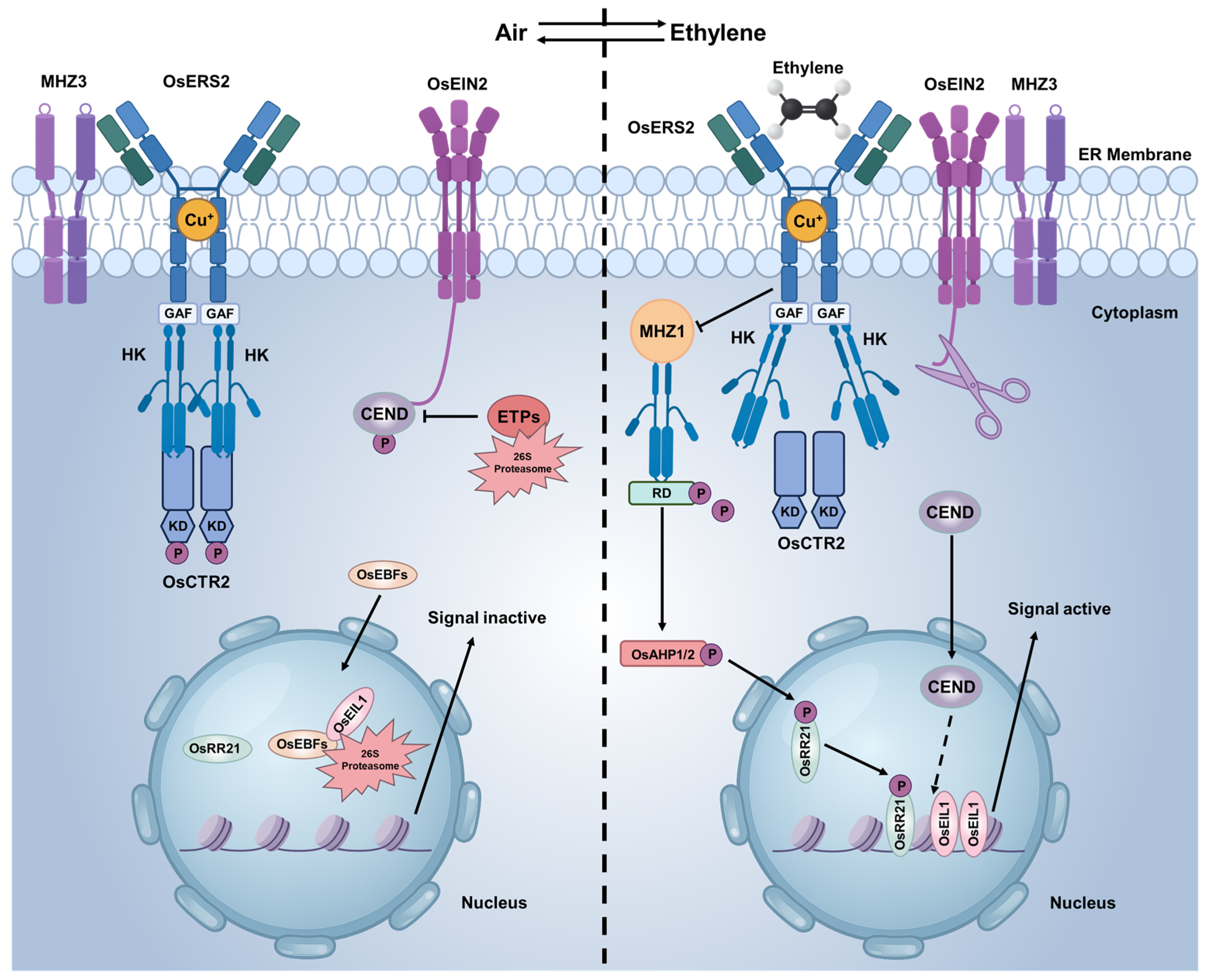
Ethylene signaling in rice involves a canonical pathway from receptor perception to transcriptional reprogramming, alongside auxiliary regulatory branches. Perception initiates at the endoplasmic reticulum membrane, where ethylene binds to its receptors [22]. The five rice ethylene receptors are divided into two subfamilies. Subfamily I includes ETHYLENE RESPONSE SENSOR 1 (OsERS1) and OsERS2, while Subfamily II is composed of ETHYLENE RECEPTOR 2 (OsETR2), OsETR3, and OsETR4 [12]. Each receptor carries a cGMP-specific phosphodiesterases, adenylyl cyclases and FhlA (GAF) domain that binds ethylene and a histidine kinase (HK) domain that relays the signal [23]. In the absence of ethylene, the pathway is held in an inhibitory state. The key regulator MHZ3 interacts with OsERS2, facilitating the phosphorylation and activation of the negative regulator CONSTITUTIVE TRIPLE RESPONSE 2 (OsCTR2) [24]. This active OsCTR2, along with ETHYLENE INSENSITIVE 2 (OsEIN2), suppresses downstream signaling. Ethylene binding triggers a conformational change that releases MHZ3 from OsERS2. This leads to the dephosphorylation and inactivation of OsCTR2. Concurrently, the freed MHZ3 binds to and stabilizes OsEIN2, promoting its dephosphorylation [25]. This activates OsEIN2, culminating in the proteolytic cleavage of its C-terminal end (EIN2-CEND), which then translocates to the nucleus to initiate transcriptional responses [26]. Parallel to this canonical pathway, an OsEIN2-independent phosphorelay branch exists. It is initiated by the autophosphorylation of the histidine kinase MHZ1/OsHK1, with the signal relayed via phosphotransfer proteins OsAHP1/2 to the response regulator OsRR21, fine-tuning specific responses (Figure 2) [27]. The nuclear signaling module centers on ETHYLENE INSENSITIVE 3-LIKE (OsEIL) transcription factors. Among the six OsEIL homologs, OsEIL1 is pivotal in roots, while OsEIL2 plays a major role in coleoptiles [28]. In the absence of ethylene, EIN3 BINDING F-BOX1/2 (OsEBF1/2) proteins target OsEIL transcription factors for degradation by the 26S proteasome [25], thereby suppressing ethylene responses. Upon ethylene activation, MHZ9 contributes to the translational repression of OsEBF1/2 mRNA within P-bodies. This reduction in OsEBF1/2 protein levels stabilizes OsEIL1 and OsEIL2, which in turn activate downstream branches of both ABA and auxin signaling [29]. The significance of this pathway is evident in OsEIN2 overexpressors, which exhibit hypersensitive phenotypes: exaggerated elongation of coleoptiles and mesocotyls coupled with severely stunted and twisted roots [30]. Further downstream, Ethylene Response Factor (ERF) proteins, which contain the AP2/ERF DNA-binding domain, execute adaptive transcriptional programs. A prime example is SUBMERGENCE 1A (SUB1A), an ERF protein that confers flooding tolerance by orchestrating a quiescence strategy [31]. In summary, Figure 2 schematically illustrates the core components of the ethylene signaling.

3. Ethylene Modulation of Root System Development

3.1. Root Primary Growth

A defining phenotypic impact of ethylene on rice is the concentration-dependent inhibition of primary root elongation. Under standard hydroponic conditions, exogenous ethylene (1 µL·L−1) reduces primary root length by approximately 30% in 4-day-old wild-type (Nipponbare) seedlings compared to air controls [32]. In contrast, stress conditions including flooding, salinity stress trigger endogenous ethylene overproduction and are often experimentally simulated with 10 µL·L−1 ethylene treatment; these conditions suppress primary root elongation by more than 60% compared with unstressed seedlings [33,34]. This inhibition results primarily from the direct suppression of post-mitotic cell expansion in the root elongation zone [35]. In addition, ethylene can indirectly reduce the rate of meristematic cell division in the RAM, as evidenced by a lowered mitotic index and delayed cell cycle progression [36]. However, this effect on division is secondary and is considered a consequence of the prior limitation in cell expansion potential, rather than a direct inhibition of cell cycle phases (e.g., G1/S or G2/M transitions) [37]. These responses constitute an acclimation strategy that favors stress tolerance over longitudinal root growth under adverse conditions. Notably, in etiolated seedlings, this root inhibition occurs alongside ethylene-promoted coleoptile and mesocotyl elongation, forming the characteristic ethylene dual response in rice [38]. More critically, ethylene potently stimulates local auxin biosynthesis, notably via the OsEIL1-mediated transcriptional activation of YUC8/REIN7, a key gene in the YUCCA pathway that converts indole-3-pyruvic acid to active IAA [34,39]. Conversely, auxin can reciprocally enhance ethylene biosynthesis by upregulating the expression of ACS, thereby forming a positive feedback loop that amplifies the hormonal signal [19]. The resulting auxin accumulation in the elongation zone, facilitated by altered polar transport, effectively arrests cell elongation. Genetic evidence confirms that this suppression of root elongation is auxin-dependent [40]. In rice, the ethylene-ABA crosstalk regulates primary root elongation in a manner distinct from that in Arabidopsis [37]. Here, ethylene signaling acts upstream to transcriptionally activate the ABA biosynthetic genes MHZ4/MHZ5, elevating ABA levels to inhibit root growth [9,41]. This hierarchy contrasts with the established pathway in Arabidopsis, where ABA promotes ethylene biosynthesis [42]. A tissue-specific reversal of this order occurs in the coleoptile, where the same MHZ4/5-dependent ABA module acts upstream to repress ethylene signaling [41]. This reversal is driven by a molecular switch involving the differential transcriptional regulation of the core ethylene signaling component OsEIN2. Consequently, MHZ4/5-dependent ABA enhances ethylene responses downstream of OsEIN2 in roots, while it suppresses OsEIN2 transcription to act upstream in coleoptiles [9,41]. Furthermore, this regulatory network is enriched by specific feedback and synergistic interactions, such as the feedback regulation of OsEIN2 activity via ABA-modulated phosphorylation [9], and the synergistic interaction between ABA and auxin in regulating stress-induced root swelling [10]. In conclusion, the ethylene-mediated modulation of both cellular proliferation and elongation, integrated with auxin and ABA signaling pathways, underlies the suppression of primary root growth in rice. This sophisticated hormonal interplay constitutes a key physiological regulatory mechanism that coordinates growth and stress responses to environmental changes.

3.2. Root Secondary Growth

Under mechanical stress such as soil compaction, roots trigger local ethylene biosynthesis and activate membrane-localized ethylene receptors (e.g., OsERS1/OsETR2). The resulting signaling cascade inhibits longitudinal cell elongation while promoting radial cell thickening, thereby temporarily enhancing root mechanical strength [43]. Studies have shown that ethylene significantly promotes cell wall thickening in rice roots. This promotion is associated with the upregulation of key genes involved in cell wall assembly, including CELLULOSE SYNTHASE A3, 4, 7, 9 (OsCESA3, 4, 7, 9) and CELLULOSE SYNTHASE-LIKE C1, 2, 7, 9, 10 (OsCSLC1, 2, 7, 9, 10) [44]. The postembryonic root system of rice comprises lateral roots and adventitious roots. Lateral roots, which originate from pericycle cells near the primary root’s phloem pole, are decisive for the root system’s nutrient acquisition capacity. Adjacent endodermal cells also participate in primordium development. Primordium initiation begins with asymmetric divisions of pericycle cells, and the newly formed primordium eventually penetrates the cortex and emerges through the epidermis of the parent root [45]. The formation of lateral roots is coordinated by multiple phytohormones. Notably, auxin and ethylene act antagonistically in regulating lateral root formation, contrasting with their synergistic action in inhibiting root elongation. For example, ACC reduces the local auxin maximum required for initiation by altering the abundance of polar auxin transporters, thus inhibiting lateral root formation [46]. In monocot, adventitious roots constitute the main root system. They originate from non-root tissues and form both during normal development and in response to environmental cues such as flooding or nutrient stress [47]. For instance, OsERF3, an AP2/ERF family transcription factor gene, represses ethylene biosynthesis and collaborates with the WUSCHEL-related homeobox gene WOX11 to promote adventitious root development in rice [48]. Root hairs, which are tubular extensions of epidermal cells, greatly expand the root-soil interface. This expanded surface area enhances water and solute uptake, facilitates microbial interactions, and improves soil anchorage [46]. Ethylene is a well-established promoter of root hair development. Sustained activation of ethylene signaling or external application of ethylene/ACC markedly promotes root hair elongation. Conversely, mutants impaired in ethylene biosynthesis or signaling produce significantly shorter root hairs [49]. This regulation involves genes such as OsERF1, which induces ROOT HAIRLESS (RHL1/4) expression, and is tightly linked to auxin-ethylene crosstalk [46,50]. In summary, ethylene modulates various aspects of rice root development through synergistic or antagonistic interactions with other hormones, ultimately shaping the RSA in response to environmental signals.

4. The Role of Ethylene in Rice Stress Responses

4.1. Drought Stress

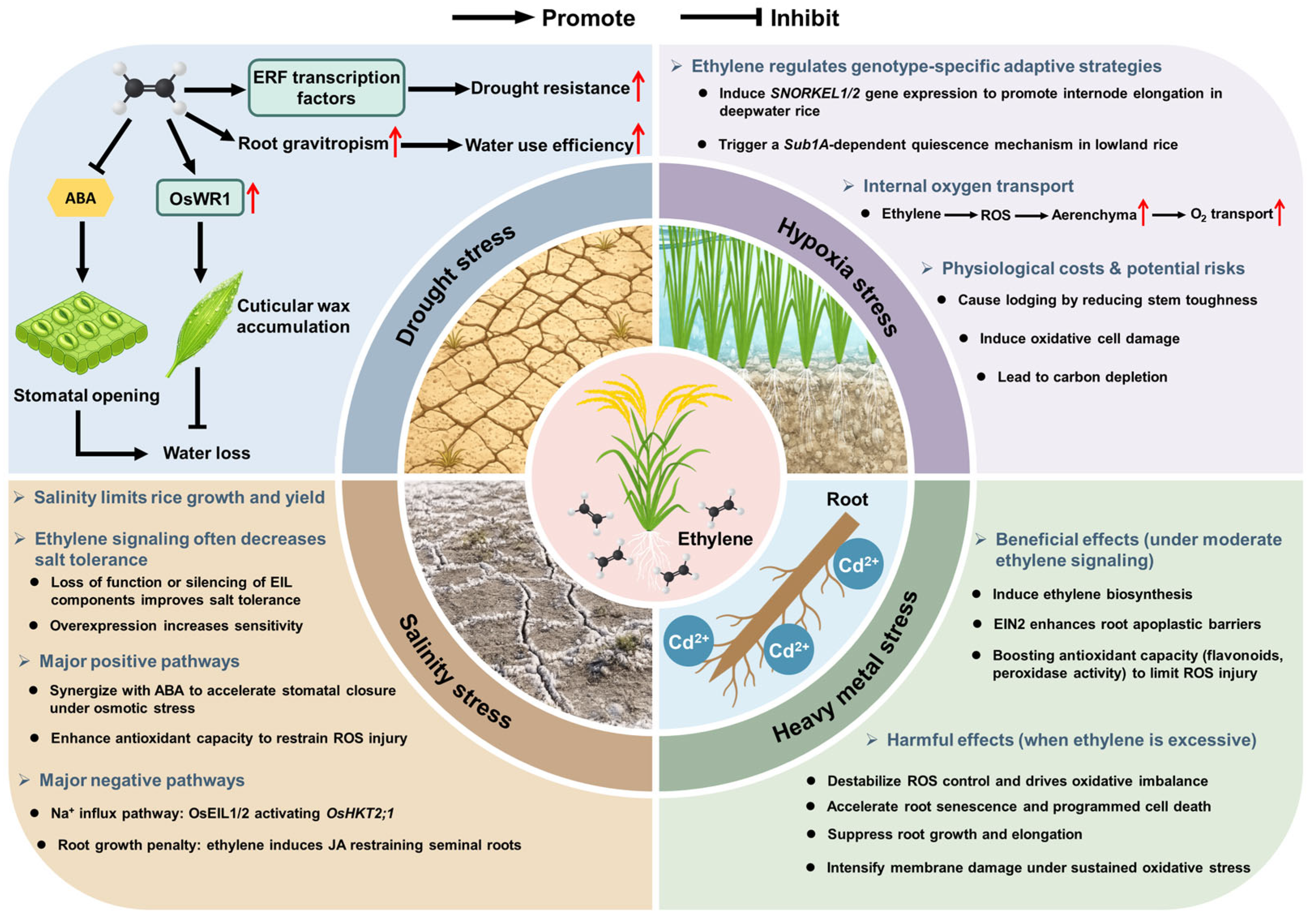
As a core phytohormone, ethylene exhibits a dual role in rice drought responses. In terms of adaptive mechanisms, ethylene signaling activates ERF transcription factors such as OsLG3, which coordinate drought resistance processes [51]. Ethylene promotes root gravitropism, facilitating the formation of a compact and deeply anchored root system that enhances water uptake efficiency [52]. Additionally, ethylene upregulates the wax biosynthesis gene OsWR1, leading to increased cuticular wax accumulation and reduced transpirational water loss [53]. During grain filling, moderate drought downregulates ethylene emission, thereby supporting the filling process [54]. However, excessive ethylene triggers maladaptive responses. It accelerates leaf senescence and abscission, resulting in loss of photosynthetic capacity [55]. Ethylene also antagonizes ABA-mediated stomatal closure, exacerbating water loss under drought conditions [56]. Notably, ethylene spikes during critical reproductive stages impair pollen viability, fertilization, and grain initiation, leading to a 48.5–50.9% increase in spikelet sterility and a significant decline in seed-setting rate [57]. In summary, ethylene’s function in rice drought response and survival is highly dependent on developmental stage, concentration, duration of exposure, and hormonal crosstalk. Deciphering this context-dependent regulatory network remains a central focus for future research.

4.2. Hypoxia Stress

In rice cultivation, cold and frequently flooded environments establish flooding stress as a primary constraint on yield. Prolonged flooding induces hypoxia stress, which increases root porosity, inhibits root initiation, and can trigger root rot, thereby severely compromising root function [58]. Under flooding-induced hypoxia, ethylene serves as the core signal for the adaptive response of rice. Ethylene rapidly accumulates in rice tissues and stabilizes ERF-VII transcription factors through PHYTOGLOBIN 1 (PGB1)-mediated nitric oxide (NO) scavenging and plant cysteine oxidase (PCO) activity inhibition, thereby activating hypoxia-responsive genes [59,60]. Ethylene regulates genotype-specific adaptive strategies. In deepwater rice, it induces SNORKEL1/2 (SK1/SK2) gene expression to promote internode elongation, whereas in lowland rice, it triggers a Sub1A-dependent quiescence mechanism [26]. Furthermore, ethylene stimulates respiratory burst oxidase homolog (RBOH)-dependent reactive oxygen species (ROS) production. This ROS burst facilitates lysigenous aerenchyma formation, thereby enhancing internal oxygen transport capacity [61]. However, these ethylene-driven survival strategies entail significant physiological costs and potential risks, underscoring the dual role of ethylene. First, the rapid elongation growth promoted by ethylene can lead to plant lodging due to reduced stem mechanical strength [62]. Second, an uncontrolled ROS burst triggered by excessive ethylene exceeds the scavenging capacity of the antioxidant system, resulting in membrane lipid peroxidation and irreversible cellular damage [63]. Third, sustained Sub1A expression under excessive ethylene levels inhibits photosynthesis and chlorophyll synthesis, leading to a state of carbon depletion [64]. In summary, ethylene exerts a dual role in the hypoxia response. Spatiotemporally balanced accumulation drives adaptive morphological and physiological changes, whereas excessive ethylene signaling exacerbates stress-induced damage. The final outcome is therefore determined by stress intensity, duration, and rice genotype.

4.3. Salinity Stress

Soil salinization poses a substantial challenge to agricultural sustainability by limiting plant development and reducing crop yields. The phytohormone ethylene plays a central role in the response to salinity stress. Accumulating studies indicate that ethylene signaling generally acts as a negative regulator of salt tolerance in rice. This is supported by genetic studies showing that salt tolerance is enhanced in Oseil1 loss-of-function mutants and OsEIL2-silenced lines, whereas MHZ6/OsEIL1 or OsEIL2 overexpression lines exhibit increased sensitivity [26]. Two core mechanisms underlie this negative regulation. First, OsEIL1/2 transcriptionally activates root OsHKT2;1, promoting Na+ uptake and exacerbating ionic toxicity [28]. Second, ethylene induces jasmonic acid (JA) biosynthesis, which indirectly inhibits seminal root growth and consequently impairs salt tolerance [36]. Notably, rice has evolved adaptive strategies to mitigate this negative impact, such as suppressing ethylene biosynthesis via the OsDOF15-OsACS1 pathway to sustain root growth under salt stress [65]. Nevertheless, ethylene’s function is highly context-dependent, and it can exert positive regulatory effects under specific conditions. For instance, ethylene can act as an early warning signal that synergizes with ABA to rapidly induce stomatal closure, thereby reducing water loss and alleviating salt-induced osmotic stress [66]. Ethylene also activates the antioxidant defense system to scavenge excessive ROS and mitigate oxidative damage [67]. For example, OsARD1-mediated enhancement of ethylene biosynthesis reduces salt sensitivity in rice [68], implying the existence of uncharacterized positive regulatory pathways that depend on specific regulators. In summary, the regulatory effect of ethylene on rice salt stress responses is context-specific, which is jointly shaped by multiple endogenous and exogenous factors. Therefore, unraveling the precise regulatory logic of these context-dependent pathways will lay a solid theoretical foundation for targeted manipulation of ethylene signaling to breed salt-tolerant rice varieties.

4.4. Heavy Metal Stress

Plants require trace amounts of heavy metal ions for growth, metabolism, and development; however, excess accumulation triggers phytotoxicity and cellular damage. Over recent decades, rapid industrialization, urbanization, and agricultural practices such as wastewater irrigation and fertilizer overuse have markedly elevated soil heavy metal concentrations [69]. The rapid induction of ethylene biosynthesis in plant roots upon heavy metal exposure is well-documented [18]. In the initial phase of heavy metal stress, ethylene activates RBOH, evoking a transient ROS burst. This metal-induced perturbation of ROS homeostasis constitutes a central node in ethylene-mediated stress signaling [70]. Cadmium (Cd) is highly phytotoxic owing to its high solubility, efficient uptake by plants, and propensity to accumulate in the food chain [71]. In rice, Cd stress activates the ethylene biosynthesis pathway by upregulating the transcription of key enzymes ACS and ACO [72]. EIN2, a core component of ethylene signaling, positively regulates Cd tolerance: it enhances Casparian strips and suberin lamellae, strengthens apoplastic barriers to inhibit Cd radial transport to shoots, and activates flavonoid biosynthesis and peroxidase activity to scavenge ROS [73]. However, excessive ethylene accumulation can exert detrimental effects under heavy metal stress. It accelerates root cell senescence and necrosis, inhibits root elongation, disrupts ROS homeostasis, and exacerbates oxidative stress damage [74]. This dual role of ethylene, along with its intricate interaction with EIN2 and ROS, constructs a sophisticated regulatory network that lays a crucial molecular foundation for deciphering plant stress response mechanisms to heavy metals and breeding Cd-tolerant crop varieties.
This review summarizes the context-dependent, dual regulatory functions of ethylene in rice under drought, hypoxia, salinity, and heavy metal stress, as outlined in Table 2 and illustrated in Figure 3.

5. Ethylene-Mediated Root and Microbe Interactions

5.1. Rhizobacteria

A diverse array of bacteria inhabiting the plant rhizosphere and internal tissues exhibit plant growth-promoting (PGP) activities. Among these, plant growth-promoting rhizobacteria (PGPR) have garnered significant attention for their roles in modulating rice growth and stress resistance [75,76]. Ethylene plays a central signaling role in mediating rice-PGPR interactions, a key focus of current research. One established mechanism is the ethylene-mediated modulation of root exudation. In Arabidopsis, ethylene signaling fine-tunes the secretion of compounds including phenolic acids, organic acids such as malate and citrate, and specialized metabolites like coumarins [77]. This reshaping of the root exudate profile directly influences microbial recruitment and rhizosphere community assembly [78]. This mechanism of ethylene-modulated exudation is likely conserved in rice, although direct and comprehensive experimental evidence in rice is still emerging. Altered root exudates directly affect PGPR chemotaxis and colonization success [79]. For example, certain PGPR sense specific signal molecules within root exudates to direct their movement toward roots, a process potentially shaped in rice by ethylene-mediated shifts in exudate composition [80]. However, the specific signal molecules and receptor-mediated pathways underlying this phenomenon in rice await further elucidation. Furthermore, many PGPR produce ACC deaminase, an enzyme that hydrolyzes the ethylene precursor ACC to lower ethylene levels in the host plant [81]. The physiological impact of this ACC deaminase activity is highly context-dependent. Under abiotic stress, it mitigates stress-induced ethylene accumulation, thereby alleviating growth inhibition [82]. Conversely, under optimal conditions, it may disrupt ethylene-mediated developmental programs and defense priming [83]. Thus, the net benefit conferred by these PGPR depends on both environmental conditions and the physiological status of the host plant. Ethylene signaling is also integral to PGPR-induced systemic resistance in rice, where it primes JA signaling to enhance immunity [84]. A critical future direction lies in elucidating how the host ethylene signaling network integrates these diverse microbial mechanisms to finely tune rice RSA and stress resilience.

5.2. Rhizosphere Fungi

In the complex interplay between plants and microbes, ethylene plays a fascinating dual role: it acts as both a suppressor of mutualistic symbiosis and an activator of immune defense. A central unresolved question in plant-microbe interactions is how the ethylene signaling system distinguishes between beneficial arbuscular mycorrhizal fungi (AMF) and invading pathogenic fungi to orchestrate these opposing responses. Emerging evidence suggests that this functional specificity is rooted in distinct, context-dependent molecular mechanisms. AMF are ubiquitous soil microorganisms that form mutualistic symbioses with the roots of over 80% of land plants [85]. AMF significantly promote plant growth by enhancing abiotic stress tolerance, improving mineral nutrient and water uptake, and providing protection against soil-borne pathogens [86]. A substantial body of evidence positions ethylene as a negative regulator of AM symbiosis. In rice, ethylene promotes the accumulation of the key symbiosis suppressor SMAX1, thereby significantly inhibiting intraradical hyphal colonization and arbuscule formation by AMF [87]. However, the smax1 loss-of-function mutants exhibit the opposite phenotype. In these mutants, the upregulation of OsACS7 expression leads to increased ACC and ethylene production, which correlates with elevated AMF colonization [88]. This apparent contradiction to the ethylene inhibitor model suggests that smax1 mutant roots may exhibit altered sensitivity to ACC, or that ethylene action is finely balanced and highly context-dependent. Therefore, further studies are needed to explore the compensatory mechanisms underlying this phenomenon [87,88]. In contrast, ethylene is a crucial positive regulator of defense against major rice pathogenic fungi. For instance, ethylene biosynthesis and its byproduct cyanide are essential for mounting a hypersensitive response against Magnaporthe oryzae (causing rice blast), a process dependent on OsACS2 and OsACO7 [15]. Furthermore, upon infection by Rhizoctonia solani, ethylene biosynthesis is rapidly induced and acts synergistically with the JA signaling pathway. This hormone crosstalk activates transcription factors such as OsERF109, which upregulates key phytoalexin biosynthetic genes and promotes cell wall lignification, thereby systemically enhancing disease resistance [89,90]. A novel defense metabolic pathway has been identified, in which the rice immune regulator PICI1 stabilizes Met synthase OsMS1 to boost Met and ethylene biosynthesis, thereby enhancing basal resistance against pathogen [91]. While the roles of ethylene in suppressing AM symbiosis and promoting pathogen defense are becoming clear, a fundamental question remains: what are the precise molecular mechanisms that enable the ethylene signaling system to differentiate between symbiotic and pathogenic microbes, thereby coordinating these diametrically opposed outcomes? Elucidating this discriminatory logic constitutes a critical goal for future research.

6. Challenges and Prospects

This review summarizes ethylene-regulated networks in rice root development, stress adaptation and microbe interactions. Ethylene-mediated hormone crosstalk is most critical for root function, directly shaping RSA that serves as the basis of nutrient uptake and anchorage with strong experimental support. Next, ethylene integrates abiotic stress signals context-dependently, with reliable evidence and high manipulability. In contrast, its regulation of root symbiosis and defense has weaker support and lower manipulability. This review outlines these interactions and establishes a framework for prioritizing ethylene signaling manipulation to improve stress resilience and root function.
Current research on the physiological roles of ethylene in rice roots still faces multiple challenges and requires systematic breakthroughs. First, the signaling networks between ethylene and other molecules remain poorly understood. Most studies have focused on linear interactions between ethylene and a few hormones, such as auxin and ABA. However, roots reside in a complex chemical environment involving multiple hormones (gibberellin, cytokinins, brassinosteroids, JA, strigolactones), ROS, Ca2+, NO, peptide, and secondary metabolites. A key question is how ethylene functions as a central node within this intricate network. The specific protein complexes, spatiotemporal dynamics, and feedback loops that govern this crosstalk lack high-resolution quantitative models, limiting predictive understanding of root stress responses. Second, the cell- and tissue- specificity of ethylene action has not been precisely mapped. Significant differences exist in ethylene biosynthesis capacity, receptor expression levels, and downstream transcription factors among the root tip meristem, elongation zone, cortex, endodermis, root hairs, and aerenchyma. However, most existing mutants or transgenic materials rely on whole plant overexpression or knockout, which obscures region-specific ethylene responses. Third, validating ethylene function under complex field conditions remains inadequate. Most evidence derives from controlled hydroponic or seedling studies, which cannot replicate the multifactorial interactions in field environments. Key obstacles include soil heterogeneity, limitations in non-destructive root phenotyping, interacting abiotic and biotic stresses, and the uncertain efficacy of ethylene-modulating agents in soil. To overcome these constraints, developing integrated approaches that combine advanced microbiomics, in situ root imaging, and artificial intelligence-based modeling represents a critical future direction.
Future studies may prioritize the following three avenues. (i) Ethylene-based strategies for rice root improvement hold significant potential. By systematically deciphering the regulatory principles of ethylene on RSA, anatomical structure and physiological function, synergistic optimization strategies can be formulated. These strategies should consider root traits, soil conditions, and stress adaptability to enhance nutrient uptake efficiency and stress resilience. (ii) Developing elite rice varieties through targeted modification of ethylene signaling pathway genes is a central goal of modern breeding. Technologies such as gene editing, base editing, and promoter editing enable the spatiotemporal and dose-dependent fine-tuning of key nodes in ethylene biosynthesis, perception, and signaling. This precision approach aims to engineer an ideal RSA characterized by deeper rooting, increased lateral root density, and enhanced root hair development. Furthermore, by integrating big-data correlation analyses of transcriptomic, phenotypic, and environmental data, we can identify superior alleles that maintain ethylene homeostasis under stress. This will accelerate the concurrent improvement of root architecture, stress tolerance, and yield. (iii) Developing inducible chemical or microbial tools targeting ethylene signaling will enable dynamic field management. For instance, novel small molecule modulators could be developed to precisely manipulate local ethylene levels during critical growth stages, thereby regulating root growth dynamics and nutrient uptake. Alternatively, synthetic microbial communities could be constructed to modulate ethylene signaling through rhizosphere colonization, fostering plant-microbe coregulated root systems. Pursuing these directions will provide actionable solutions for advancing green and sustainable rice production.

Author Contributions

Conceptualization, H.Z. and N.Z.; data curation, Y.Y., Q.M. and C.W.; formal analysis, Y.Y. and W.J.; investigation, N.Z., X.L., Y.Y. and C.W.; methodology, W.J., Y.Z. and Z.X.; software, Q.M. and W.J.; validation, X.L., C.W. and Z.X.; visualization, N.Z. and Y.Z.; writing—original draft, N.Z. and X.L.; writing—review and editing, H.Z.; supervision, H.Z.; funding acquisition, H.Z.; resources, H.Z.; project administration, H.Z. All authors have read and agreed to the published version of the manuscript.

Funding

This work was supported by the National Natural Science Foundation of China (32572443, 32272197, 32071944), Agronomy Major in the Yangzhou University Funded by Industry- Education Integration Brand Program Construction Project of Jiangsu Province (2023-4-89), and the Priority Academic Program Development of Jiangsu Higher Education Institutions (PAPD).

Data Availability Statement

No new data were created or analyzed in this study.

Conflicts of Interest

The authors declare no conflicts of interest.

References

  1. Zhang, J.; Zhu, Y.; Yu, L.; Yang, M.; Zou, X.; Yin, C.; Lin, Y. Research advances in cadmium uptake, transport and resistance in rice (Oryza sativa L.). Cells 2022, 11, 569. [Google Scholar] [CrossRef]
  2. Bin Rahman, A.N.M.R.; Zhang, J. Trends in rice research: 2030 and beyond. Food Energy Secur. 2023, 12, e390. [Google Scholar] [CrossRef]
  3. Takehisa, H.; Sato, Y.; Igarashi, M.; Abiko, T.; Antonio, B.A.; Kamatsuki, K.; Minami, H.; Namiki, N.; Inukai, Y.; Nakazono, M.; et al. Genome-wide transcriptome dissection of the rice root system: Implications for developmental and physiological functions. Plant J. 2012, 69, 126–140. [Google Scholar] [CrossRef]
  4. Tardieu, F.; Davies, W.J. Integration of hydraulic and chemical signalling in the control of stomatal conductance and water status of droughted plants. Plant Cell Environ. 1993, 16, 341–349. [Google Scholar] [CrossRef]
  5. Liu, L.; Zhao, L.; Liu, Y.; Zhu, Y.; Chen, S.; Yang, L.; Li, X.; Chen, W.; Xu, Z.; Xu, P.; et al. Transcription factor OsWRKY72 controls rice leaf angle by regulating LAZY1-mediated shoot gravitropism. Plant Physiol. 2024, 195, 1586–1600. [Google Scholar] [CrossRef] [PubMed]
  6. Wu, W.; Cheng, S. Root genetic research, an opportunity and challenge to rice improvement. Field Crops Res. 2014, 165, 111–124. [Google Scholar] [CrossRef]
  7. Zhang, Y.; Berman, A.; Shani, E. Plant hormone transport and localization: Signaling molecules on the move. Annu. Rev. Plant Biol. 2023, 74, 453–479. [Google Scholar] [CrossRef] [PubMed]
  8. Yang, S.F.; Hoffman, N.E. Ethylene biosynthesis and its regulation in higher plants. Annu. Rev. Plant Physiol. 1984, 35, 155–189. [Google Scholar] [CrossRef]
  9. Ma, B.; Yin, C.C.; He, S.J.; Lu, X.; Zhang, W.K.; Lu, T.G.; Chen, S.Y.; Zhang, J.S. Ethylene-induced inhibition of root growth requires abscisic acid function in rice (Oryza sativa L.) seedlings. PLoS Genet. 2014, 10, e1004701. [Google Scholar] [CrossRef]
  10. Huang, G.; Kilic, A.; Karady, M.; Zhang, J.; Mehra, P.; Song, X.; Sturrock, C.J.; Zhu, W.; Qin, H.; Hartman, S.; et al. Ethylene inhibits rice root elongation in compacted soil via ABA- and auxin-mediated mechanisms. Proc. Natl. Acad. Sci. USA 2022, 119, e2201072119. [Google Scholar] [CrossRef]
  11. Yang, C.; Lu, X.; Ma, B.; Chen, S.Y.; Zhang, J.S. Ethylene signaling in rice and Arabidopsis: Conserved and diverged aspects. Mol. Plant 2015, 8, 495–505. [Google Scholar] [CrossRef]
  12. Yau, C.P. Differential expression of three genes encoding an ethylene receptor in rice during development, and in response to indole-3-acetic acid and silver ions. J. Exp. Bot. 2004, 55, 547–556. [Google Scholar] [CrossRef]
  13. Khattak, A.A.; Huang, Y.; Afzal, M.; Wang, X. MHZ3: A key regulator of ethylene signaling in rice. aBIOTECH 2025, 6, 133–138. [Google Scholar] [CrossRef]
  14. Zarembinski, T.I.; Theologis, A. Anaerobiosis and plant growth hormones induce two genes encoding 1-aminocyclopropane-1-carboxylate synthase in rice (Oryza sativa L.). Mol. Biol. Cell 1993, 4, 363–373. [Google Scholar] [CrossRef]
  15. Iwai, T.; Miyasaka, A.; Seo, S.; Ohashi, Y. Contribution of ethylene biosynthesis for resistance to blast fungus infection in young rice plants. Plant Physiol. 2006, 142, 1202–1215. [Google Scholar] [CrossRef]
  16. Pattyn, J.; Vaughan-Hirsch, J.; Van de Poel, B. The regulation of ethylene biosynthesis: A complex multilevel control circuitry. New Phytol. 2021, 229, 770–782. [Google Scholar] [CrossRef] [PubMed]
  17. Lin, Z.; Zhong, S.; Grierson, D. Recent advances in ethylene research. J. Exp. Bot. 2009, 60, 3311–3336. [Google Scholar] [CrossRef] [PubMed]
  18. Keunen, E.; Schellingen, K.; Vangronsveld, J.; Cuypers, A. Ethylene and metal stress: Small molecule, big impact. Front. Plant Sci. 2016, 7, 23. [Google Scholar] [CrossRef] [PubMed]
  19. Yu, Y.B.; Yang, S.F. Auxin-induced ethylene production and its inhibition by aminoethyoxyvinylglycine and cobalt ion. Plant Physiol. 1979, 64, 1074–1077. [Google Scholar] [CrossRef]
  20. Ramonell, K.M.; McClure, G.; Musgrave, M.E. Oxygen control of ethylene biosynthesis during seed development in Arabidopsis thaliana (L.) Heynh. Plant Cell Environ. 2002, 25, 793–801. [Google Scholar] [CrossRef]
  21. Biggs, M.S.; Woodson, W.R.; Handa, A.K. Biochemical basis of high-temperature inhibition of ethylene biosynthesis in ripening tomato fruits. Physiol. Plant. 1988, 72, 572–578. [Google Scholar] [CrossRef]
  22. Wang, Q.; Zhang, W.; Yin, Z.; Wen, C.K. Rice CONSTITUTIVE TRIPLE-RESPONSE2 is involved in the ethylene-receptor signalling and regulation of various aspects of rice growth and development. J. Exp. Bot. 2013, 64, 4863–4875. [Google Scholar] [CrossRef]
  23. Wuriyanghan, H.; Zhang, B.; Cao, W.H.; Ma, B.; Lei, G.; Liu, Y.F.; Wei, W.; Wu, H.J.; Chen, L.J.; Chen, H.W.; et al. The ethylene receptor ETR2 delays floral transition and affects starch accumulation in rice. Plant Cell 2009, 21, 1473–1494. [Google Scholar] [CrossRef]
  24. Li, X.K.; Huang, Y.H.; Zhao, R.; Cao, W.Q.; Lu, L.; Han, J.Q.; Zhou, Y.; Zhang, X.; Wu, W.A.; Tao, J.J.; et al. Membrane protein MHZ3 regulates the on-off switch of ethylene signaling in rice. Nat. Commun. 2024, 15, 5987. [Google Scholar] [CrossRef]
  25. Ma, B.; Zhou, Y.; Chen, H.; He, S.J.; Huang, Y.H.; Zhao, H.; Lu, X.; Zhang, W.K.; Pang, J.H.; Chen, S.Y.; et al. Membrane protein MHZ3 stabilizes OsEIN2 in rice by interacting with its Nramp-like domain. Proc. Natl. Acad. Sci. USA 2018, 115, 2520–2525. [Google Scholar] [CrossRef]
  26. Zhao, H.; Yin, C.; Ma, B.; Chen, S.; Zhang, J. Ethylene signaling in rice and Arabidopsis: New regulators and mechanisms. J. Integr. Plant Biol. 2021, 63, 102–125. [Google Scholar] [CrossRef]
  27. Zhao, H.; Duan, K.X.; Ma, B.; Yin, C.C.; Hu, Y.; Tao, J.J.; Huang, Y.H.; Cao, W.Q.; Chen, H.; Yang, C.; et al. Histidine kinase MHZ1/OsHK1 interacts with ethylene receptors to regulate root growth in rice. Nat. Commun. 2020, 11, 518. [Google Scholar] [CrossRef] [PubMed]
  28. Yang, C.; Ma, B.; He, S.J.; Xiong, Q.; Duan, K.X.; Yin, C.C.; Chen, H.; Lu, X.; Chen, S.Y.; Zhang, J.S. MAOHUZI6/ETHYLENE INSENSITIVE3-LIKE1 and ETHYLENE INSENSITIVE3-LIKE2 regulate ethylene response of roots and coleoptiles and negatively affect salt tolerance in rice. Plant Physiol. 2015, 169, 148–165. [Google Scholar] [CrossRef] [PubMed]
  29. Li, X.K.; Yin, C.C.; Tao, J.J.; Chen, S.Y.; Zhao, H.; Zhang, J.S.; Li, X.K.; Yin, C.C.; Tao, J.J.; Chen, S.Y.; et al. Ethylene signaling in rice and Arabidopsis: From the perspective of protein complexes. Plant Horm. 2025, 1, e009. [Google Scholar] [CrossRef]
  30. Ma, B.; He, S.J.; Duan, K.X.; Yin, C.C.; Chen, H.; Yang, C.; Xiong, Q.; Song, Q.X.; Lu, X.; Chen, H.W.; et al. Identification of rice ethylene-response mutants and characterization of MHZ7/OSEIN2 in distinct ethylene response and yield trait regulation. Mol. Plant 2013, 6, 1830–1848. [Google Scholar] [CrossRef]
  31. Xu, K.; Xu, X.; Fukao, T.; Canlas, P.; Maghirang-Rodriguez, R.; Heuer, S.; Ismail, A.M.; Bailey-Serres, J.; Ronald, P.C.; Mackill, D.J. Sub1A is an ethylene-response-factor-like gene that confers submergence tolerance to rice. Nature 2006, 442, 705–708. [Google Scholar] [CrossRef] [PubMed]
  32. Qin, H.; Pandey, B.K.; Li, Y.; Huang, G.; Wang, J.; Quan, R.; Zhou, J.; Zhou, Y.; Miao, Y.; Zhang, D.; et al. Orchestration of ethylene and gibberellin signals determines primary root elongation in rice. Plant Cell 2022, 34, 1273–1288. [Google Scholar] [CrossRef]
  33. Morgan, P.W.; Drew, M.C. Ethylene and plant responses to stress. Physiol. Plant. 1997, 100, 620–630. [Google Scholar] [CrossRef]
  34. Qin, H.; Zhang, Z.; Wang, J.; Chen, X.; Wei, P.; Huang, R. The activation of OsEIL1 on YUC8 transcription and auxin biosynthesis is required for ethylene-inhibited root elongation in rice early seedling development. PLoS Genet. 2017, 13, e1006955. [Google Scholar] [CrossRef]
  35. Yu, S.; Zheng, S.; Ning, J.; Shi, Y.; Guo, D.; Luo, R.; Xiao, G.; Saleem, S.; Ali, A.; Zhou, H.; et al. The rice OsCBL3-OsCIPK31 module regulates root development via abscisic acid and auxin signaling pathways. Crop J. 2025, 13, 694–704. [Google Scholar] [CrossRef]
  36. Zou, X.; Liu, L.; Hu, Z.; Wang, X.; Zhu, Y.; Zhang, J.; Li, X.; Kang, Z.; Lin, Y.; Yin, C. Salt-induced inhibition of rice seminal root growth is mediated by ethylene-jasmonate interaction. J. Exp. Bot. 2021, 72, 5656–5672. [Google Scholar] [CrossRef]
  37. Qin, H.; He, L.; Huang, R. The coordination of ethylene and other hormones in primary root development. Front. Plant Sci. 2019, 10, 874. [Google Scholar] [CrossRef] [PubMed]
  38. Zhou, Y.; Xiong, Q.; Yin, C.; Ma, B.; Chen, S.; Zhang, J. Ethylene biosynthesis, signaling, and crosstalk with other hormones in rice. Small Methods 2020, 4, 1900278. [Google Scholar] [CrossRef]
  39. Mashiguchi, K.; Tanaka, K.; Sakai, T.; Sugawara, S.; Kawaide, H.; Natsume, M.; Hanada, A.; Yaeno, T.; Shirasu, K.; Yao, H.; et al. The main auxin biosynthesis pathway in Arabidopsis. Proc. Natl. Acad. Sci. USA 2011, 108, 18512–18517. [Google Scholar] [CrossRef]
  40. Růžička, K.; Ljung, K.; Vanneste, S.; Podhorská, R.; Beeckman, T.; Friml, J.; Benková, E. Ethylene regulates root growth through effects on auxin biosynthesis and transport-dependent auxin distribution. Plant Cell 2007, 19, 2197–2212. [Google Scholar] [CrossRef]
  41. Yin, C.C.; Ma, B.; Collinge, D.P.; Pogson, B.J.; He, S.J.; Xiong, Q.; Duan, K.X.; Chen, H.; Yang, C.; Lu, X.; et al. Ethylene responses in rice roots and coleoptiles are differentially regulated by a carotenoid isomerase-mediated abscisic acid pathway. Plant Cell 2015, 27, 1061–1081. [Google Scholar] [CrossRef] [PubMed]
  42. Luo, X.; Chen, Z.; Gao, J.; Gong, Z. Abscisic acid inhibits root growth in Arabidopsis through ethylene biosynthesis. Plant J. 2014, 79, 44–55. [Google Scholar] [CrossRef]
  43. Clark, L.J.; Whalley, W.R.; Barraclough, P.B. How do roots penetrate strong soil? Plant Soil 2003, 255, 93–104. [Google Scholar] [CrossRef]
  44. Zhou, Y.; Gao, Y.H.; Zhang, B.C.; Yang, H.L.; Tian, Y.B.; Huang, Y.H.; Yin, C.C.; Tao, J.J.; Wei, W.; Zhang, W.K.; et al. CELLULOSE SYNTHASE-LIKE C proteins modulate cell wall establishment during ethylene-mediated root growth inhibition in rice. Plant Cell 2024, 36, 3751–3769. [Google Scholar] [CrossRef]
  45. Yu, P.; Gutjahr, C.; Li, C.; Hochholdinger, F. Genetic control of lateral root formation in cereals. Trends Plant Sci. 2016, 21, 951–961. [Google Scholar] [CrossRef]
  46. Muday, G.K.; Rahman, A.; Binder, B.M. Auxin and ethylene: Collaborators or competitors? Trends Plant Sci. 2012, 17, 181–195. [Google Scholar] [CrossRef] [PubMed]
  47. Steffens, B.; Rasmussen, A. The physiology of adventitious roots. Plant Physiol. 2016, 170, 603–617. [Google Scholar] [CrossRef]
  48. Zhao, Y.; Cheng, S.; Song, Y.; Huang, Y.; Zhou, S.; Liu, X.; Zhou, D.X. The interaction between rice ERF3 and WOX11 promotes crown root development by regulating gene expression involved in cytokinin signaling. Plant Cell 2015, 27, 2469–2483. [Google Scholar] [CrossRef]
  49. Song, L.; Yu, H.; Dong, J.; Che, X.; Jiao, Y.; Liu, D. The molecular mechanism of ethylene-mediated root hair development induced by phosphate starvation. PLoS Genet. 2016, 12, e1006194. [Google Scholar] [CrossRef] [PubMed]
  50. Moon, S.; Cho, L.H.; Kim, Y.J.; Gho, Y.S.; Jeong, H.Y.; Hong, W.J.; Lee, C.; Park, H.; Jwa, N.S.; Dangol, S.; et al. RSL class II transcription factors guide the nuclear localization of RHL1 to regulate root hair development. Plant Physiol. 2019, 179, 558–568. [Google Scholar] [CrossRef]
  51. Xiong, H.; Yu, J.; Miao, J.; Li, J.; Zhang, H.; Wang, X.; Liu, P.; Zhao, Y.; Jiang, C.; Yin, Z.; et al. Natural variation in OsLG3 increases drought tolerance in rice by inducing ROS scavenging. Plant Physiol. 2018, 178, 451–467. [Google Scholar] [CrossRef] [PubMed]
  52. Kong, X.; Xiong, Y.; Song, X.; Wadey, S.; Yu, S.; Rao, J.; Lale, A.; Lombardi, M.; Fusi, R.; Bhosale, R.; et al. Ethylene regulates auxin-mediated root gravitropic machinery and controls root angle in cereal crops. Plant Physiol. 2024, 195, 1969–1980. [Google Scholar] [CrossRef] [PubMed]
  53. Wang, Y.; Wan, L.; Zhang, L.; Zhang, Z.; Zhang, H.; Quan, R.; Zhou, S.; Huang, R. An ethylene response factor OsWR1 responsive to drought stress transcriptionally activates wax synthesis related genes and increases wax production in rice. Plant Mol. Biol. 2012, 78, 275–288. [Google Scholar] [CrossRef]
  54. Yang, J.C.; Zhang, J.H.; Ye, Y.X.; Wang, Z.Q.; Zhu, Q.S.; Liu, L.J. Involvement of abscisic acid and ethylene in the responses of rice grains to water stress during filling. Plant Cell Environ. 2004, 27, 1055–1064. [Google Scholar] [CrossRef]
  55. Young, T.E.; Meeley, R.B.; Gallie, D.R. ACC synthase expression regulates leaf performance and drought tolerance in maize. Plant J. 2004, 40, 813–825. [Google Scholar] [CrossRef]
  56. Huang, S.; Wang, H.; Liu, S.; Lu, S.; Hua, J.; Zou, B. Ethylene antagonizes ABA and inhibits stomatal closure and chilling tolerance in rice. J. Exp. Bot. 2025, 76, 5011–5024. [Google Scholar] [CrossRef] [PubMed]
  57. Yang, J.C.; Liu, K.; Zhang, S.F.; Wang, X.M.; Wang, Z.Q.; Liu, L.J. Hormones in rice spikelets in responses to water stress during meiosis. Acta Agron. Sin. 2008, 34, 111–118. [Google Scholar] [CrossRef]
  58. Peng, Y.; Zhou, Z.; Tong, R.; Hu, X.; Du, K. Anatomy and ultrastructure adaptations to soil flooding of two full-sib poplar clones differing in flood-tolerance. Flora 2017, 233, 90–98. [Google Scholar] [CrossRef]
  59. Hartman, S.; Liu, Z.; van Veen, H.; Vicente, J.; Reinen, E.; Martopawiro, S.; Zhang, H.; van Dongen, N.; Bosman, F.; Bassel, G.W.; et al. Ethylene-mediated nitric oxide depletion pre-adapts plants to hypoxia stress. Nat. Commun. 2019, 10, 4020. [Google Scholar] [CrossRef]
  60. Weits, D.A.; Giuntoli, B.; Kosmacz, M.; Parlanti, S.; Hubberten, H.M.; Riegler, H.; Hoefgen, R.; Perata, P.; van Dongen, J.T.; Licausi, F. Plant cysteine oxidases control the oxygen-dependent branch of the N-end-rule pathway. Nat. Commun. 2014, 5, 3425. [Google Scholar] [CrossRef]
  61. Yamauchi, T.; Yoshioka, M.; Fukazawa, A.; Mori, H.; Nishizawa, N.K.; Tsutsumi, N.; Yoshioka, H.; Nakazono, M. An NADPH oxidase RBOH functions in rice roots during lysigenous aerenchyma formation under oxygen-deficient conditions. Plant Cell 2017, 29, 775–790. [Google Scholar] [CrossRef]
  62. Vriezen, W.H.; Zhou, Z.; Van Der Straeten, D. Regulation of submergence-induced enhanced shoot elongation in Oryza sativa L. Ann. Bot. 2003, 91, 263–270. [Google Scholar] [CrossRef] [PubMed]
  63. Steffens, B.; Sauter, M. Epidermal cell death in rice is confined to cells with a distinct molecular identity and is mediated by ethylene and H2O2 through an autoamplified signal pathway. Plant Cell 2009, 21, 184–196. [Google Scholar] [CrossRef]
  64. Fukao, T.; Yeung, E.; Bailey-Serres, J. The submergence tolerance regulator SUB1A mediates crosstalk between submergence and drought tolerance in rice. Plant Cell 2011, 23, 412–427. [Google Scholar] [CrossRef] [PubMed]
  65. Qin, H.; Wang, J.; Chen, X.; Wang, F.; Peng, P.; Zhou, Y.; Miao, Y.; Zhang, Y.; Gao, Y.; Qi, Y.; et al. Rice OsDOF15 contributes to ethylene-inhibited primary root elongation under salt stress. New Phytol. 2019, 223, 798–813. [Google Scholar] [CrossRef] [PubMed]
  66. Sackey, O.K.; Feng, N.; Mohammed, Y.Z.; Dzou, C.F.; Zheng, D.; Zhao, L.; Shen, X. A comprehensive review on rice responses and tolerance to salt stress. Front. Plant Sci. 2025, 16, 1561280. [Google Scholar] [CrossRef]
  67. Steffens, B. The role of ethylene and ROS in salinity, heavy metal, and flooding responses in rice. Front. Plant Sci. 2014, 5, 685. [Google Scholar] [CrossRef]
  68. Liang, S.; Xiong, W.; Yin, C.; Xie, X.; Jin, Y.; Zhang, S.; Yang, B.; Ye, G.; Chen, S.; Luan, W. Overexpression of OsARD1 improves submergence, drought, and salt tolerances of seedling through the enhancement of ethylene synthesis in rice. Front. Plant Sci. 2019, 10, 1088. [Google Scholar] [CrossRef]
  69. Angon, P.B.; Islam, M.S.; Kc, S.; Das, A.; Anjum, N.; Poudel, A.; Suchi, S.A. Sources, effects and present perspectives of heavy metals contamination: Soil, plants and human food chain. Heliyon 2024, 10, e28357. [Google Scholar] [CrossRef]
  70. Saini, S.; Kaur, N.; Pati, P.K. Phytohormones: Key players in the modulation of heavy metal stress tolerance in plants. Ecotoxicol. Environ. Saf. 2021, 223, 112578. [Google Scholar] [CrossRef]
  71. Haider, F.U.; Liqun, C.; Coulter, J.A.; Cheema, S.A.; Wu, J.; Zhang, R.; Wenjun, M.; Farooq, M. Cadmium toxicity in plants: Impacts and remediation strategies. Ecotoxicol. Environ. Saf. 2021, 211, 111887. [Google Scholar] [CrossRef]
  72. Chen, H.; Zhang, Q.; Lv, W.; Yu, X.; Zhang, Z. Ethylene positively regulates Cd tolerance via reactive oxygen species scavenging and apoplastic transport barrier formation in rice. Environ. Pollut. 2022, 302, 119063. [Google Scholar] [CrossRef] [PubMed]
  73. Tao, Q.; Liu, J.; Zhang, K.; Yan, M.; Li, M.; Wu, Y.; Wang, C.; Li, B. Ethylene-mediated root endodermal barrier development in impeding Cd radial transport and accumulation in rice (Oryza sativa L.). Plant Physiol. Biochem. 2025, 219, 109313. [Google Scholar] [CrossRef]
  74. Azhar, W.; Khan, A.R.; Salam, A.; Ulhassan, Z.; Qi, J.; Shah, G.; Liu, Y.; Chunyan, Y.; Yang, S.; Gan, Y. Ethylene accelerates copper oxide nanoparticle-induced toxicity at physiological, biochemical, and ultrastructural levels in rice seedlings. Environ. Sci. Pollut. Res. 2023, 30, 26137–26149. [Google Scholar] [CrossRef] [PubMed]
  75. Bal, H.B.; Nayak, L.; Das, S.; Adhya, T.K. Isolation of ACC deaminase producing PGPR from rice rhizosphere and evaluating their plant growth promoting activity under salt stress. Plant Soil 2013, 366, 93–105. [Google Scholar] [CrossRef]
  76. Sodhi, G.K.; Saxena, S. Plant growth promotion and abiotic stress mitigation in rice using endophytic fungi: Advances made in the last decade. Environ. Exp. Bot. 2023, 209, 105312. [Google Scholar] [CrossRef]
  77. Harbort, C.J.; Hashimoto, M.; Inoue, H.; Niu, Y.; Guan, R.; Rombolà, A.D.; Kopriva, S.; Voges, M.J.E.E.E.; Sattely, E.S.; Garrido-Oter, R.; et al. Root-secreted coumarins and the microbiota interact to improve iron nutrition in Arabidopsis. Cell Host Microbe 2020, 28, 825–837.e6. [Google Scholar] [CrossRef]
  78. Halshoy, H.S.; Braim, S.A.; Hama, J.R. Phytohormonal regulation of root exudation: Mechanisms and rhizosphere function. Plant Signal. Behav. 2025, 20, 2587486. [Google Scholar] [CrossRef]
  79. Badri, D.V.; Vivanco, J.M. Regulation and function of root exudates. Plant Cell Environ. 2009, 32, 666–681. [Google Scholar] [CrossRef]
  80. Bais, H.P.; Weir, T.L.; Perry, L.G.; Gilroy, S.; Vivanco, J.M. The role of root exudates in rhizosphere interactions with plants and other organisms. Annu. Rev. Plant Biol. 2006, 57, 233–266. [Google Scholar] [CrossRef]
  81. Dimkpa, C.; Weinand, T.; Asch, F. Plant-rhizobacteria interactions alleviate abiotic stress conditions. Plant Cell Environ. 2009, 32, 1682–1694. [Google Scholar] [CrossRef]
  82. Barnawal, D.; Maji, D.; Bharti, N.; Chanotiya, C.S.; Kalra, A. ACC deaminase-containing bacillus subtilis reduces stress ethylene-induced damage and improves mycorrhizal colonization and rhizobial nodulation in trigonella foenum-graecum under drought stress. J. Plant Growth Regul. 2013, 32, 809–822. [Google Scholar] [CrossRef]
  83. Glick, B.R. Plant growth-promoting bacteria: Mechanisms and applications. Scientifica 2012, 2012, 963401. [Google Scholar] [CrossRef]
  84. Van Wees, S.C.M.; Van der Ent, S.; Pieterse, C.M. Plant immune responses triggered by beneficial microbes. Curr. Opin. Plant Biol. 2008, 11, 443–448. [Google Scholar] [CrossRef] [PubMed]
  85. Wang, B.; Qiu, Y.L. Phylogenetic distribution and evolution of mycorrhizas in land plants. Mycorrhiza 2006, 16, 299–363. [Google Scholar] [CrossRef] [PubMed]
  86. Kalamulla, R.; Karunarathna, S.C.; Tibpromma, S.; Galappaththi, M.C.A.; Suwannarach, N.; Stephenson, S.L.; Asad, S.; Salem, Z.S.; Yapa, N. Arbuscular mycorrhizal fungi in sustainable agriculture. Sustainability 2022, 14, 12250. [Google Scholar] [CrossRef]
  87. Das, D.; Varshney, K.; Ogawa, S.; Torabi, S.; Huettl, R.; Nelson, D.C.; Gutjahr, C. Ethylene promotes SMAX1 accumulation to inhibit arbuscular mycorrhiza symbiosis. Nat. Commun. 2025, 16, 2025. [Google Scholar] [CrossRef]
  88. Carbonnel, S.; Das, D.; Varshney, K.; Kolodziej, M.C.; Villaécija-Aguilar, J.A.; Gutjahr, C. The karrikin signaling regulator SMAX1 controls Lotus japonicus root and root hair development by suppressing ethylene biosynthesis. Proc. Natl. Acad. Sci. USA 2020, 117, 21757–21765. [Google Scholar] [CrossRef]
  89. Helliwell, E.E.; Wang, Q.; Yang, Y. Transgenic rice with inducible ethylene production exhibits broad-spectrum disease resistance to the fungal pathogens Agnaporthe oryzae and Rhizoctonia solani. Plant Biotechnol. J. 2013, 11, 33–42. [Google Scholar] [CrossRef]
  90. Yang, C.; Li, W.; Cao, J.; Meng, F.; Yu, Y.; Huang, J.; Jiang, L.; Liu, M.; Zhang, Z.; Chen, X.; et al. Activation of ethylene signaling pathways enhances disease resistance by regulating ROS and phytoalexin production in rice. Plant J. Cell Mol. Biol. 2017, 89, 338–353. [Google Scholar] [CrossRef]
  91. Zhai, K.; Liang, D.; Li, H.; Jiao, F.; Yan, B.; Liu, J.; Lei, Z.; Huang, L.; Gong, X.; Wang, X.; et al. NLRs guard metabolism to coordinate pattern- and effector-triggered immunity. Nature 2022, 601, 245–251. [Google Scholar] [CrossRef] [PubMed]
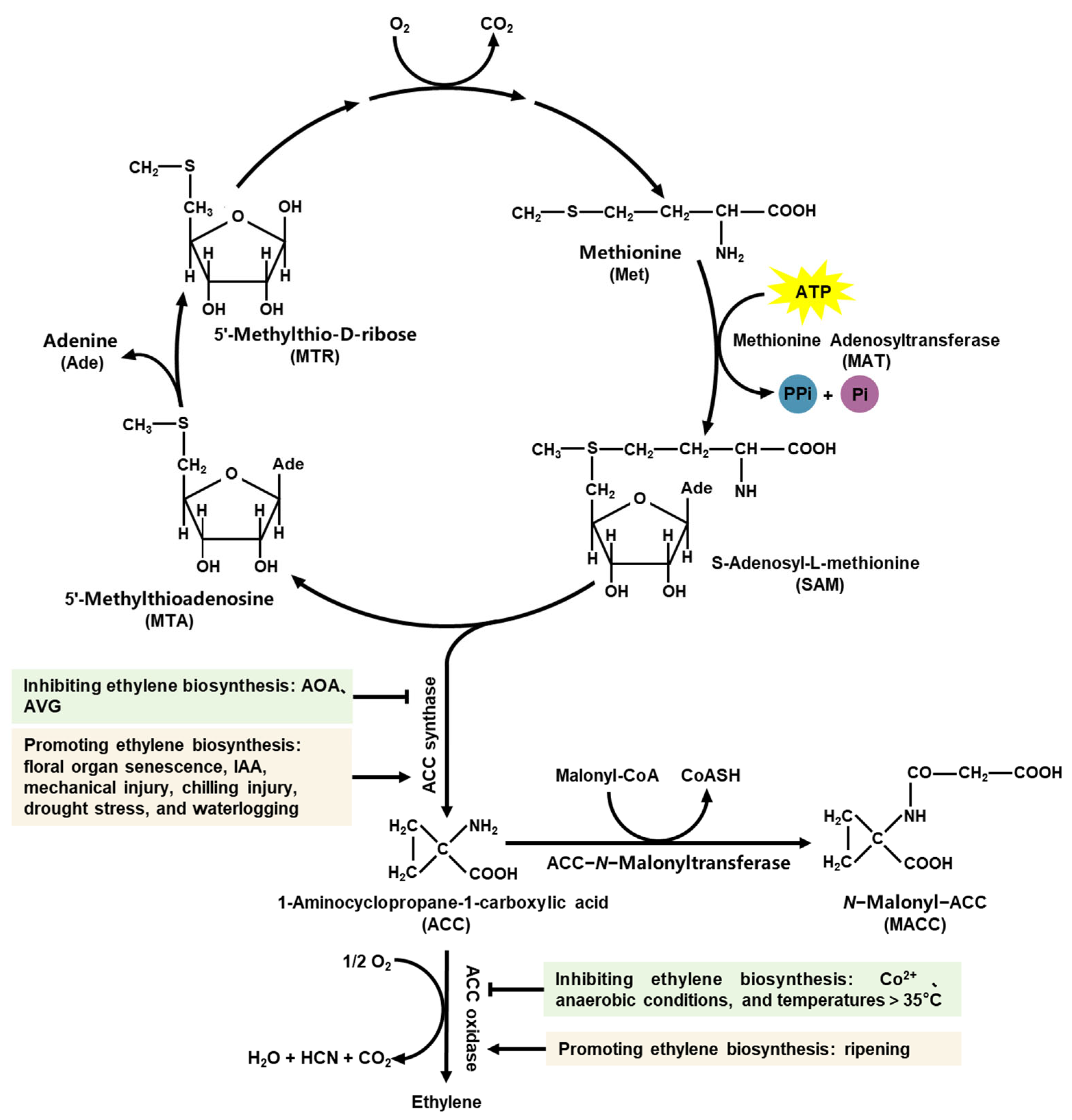
Figure 1. Ethylene biosynthesis pathway and regulatory mechanisms. ACS: ACC synthase; ACO: ACC oxidase; AOA: aminooxyacetic acid; AVG: aminoethoxy vinyl glycine; IAA: indole-3-acetic acid. This figure outlines the central biosynthetic pathway for ethylene in plants. It depicts the key enzymatic steps from Met to ethylene and highlights the chemical and environmental factors that regulate each step. MAT first converts Met into SAM. ACS then converts SAM into ACC. Finally, ACO converts ACC into ethylene. The diagram further annotates the small molecule regulators, environmental cues and physiological processes that control each enzymatic step, providing a comprehensive schematic of the molecular mechanism and regulatory network of ethylene biosynthesis. This schematic was created by the authors based on current literature.
Agronomy 16 00355 g001
Figure 2. Ethylene signaling and molecular mechanisms in rice. This figure depicts the molecular regulatory network of the rice ethylene signaling under two conditions: ethylene absent (left half) and ethylene present (right half). On the left, the pathway is in its repressed state; ethylene receptors cooperate with negative regulators to block downstream signaling. On the right, ethylene binding to its receptors initiates a signaling phosphorelay that activates ethylene-responsive genes within the nucleus. The entire diagram illustrates how the ethylene signaling is finely tuned through covalent modifications (e.g., phosphorylation, ubiquitination) and specific protein complex formation. The figure is adapted from Zhao et al. (2021) [26].
Agronomy 16 00355 g002
Figure 3. Ethylene functions in rice under abiotic stress. The red arrows in the figure indicate an increase or upregulation.
Agronomy 16 00355 g003
Table 1. Systematic literature search and screening workflow.
Search PhasePrimary Databases or SourcesRepresentative Keyword CombinationsKey Screening and Inclusion Criteria
Phase 1: Broad IdentificationWeb of Science, Scopus, PubMed, Google Scholar(Oryza sativa OR rice) AND ethylene AND (root system architecture OR root development)Relevance to core topic; exclusion of non-research articles (e.g., non-peer-reviewed reports).
Phase 2: Targeted ExpansionRiceXPro, Publisher Portals (e.g., ScienceDirect)Core keywords extended with: stress (drought, salinity, hypoxia), root-microbe interactions, ACS/ACO, signaling pathwayPeer-reviewed original research; must include experimental data on ethylene’s role in rice roots.
Phase 3: Final CurationCross-check across all above sourcesCombined use of core and extended keywords1. Central focus on ethylene in rice root biology; 2. Publication period: 1979–2025; 3. Emphasis on influential studies (assessed by citation count as a heuristic).
Table 2. Ethylene-mediated rice responses to abiotic stresses: dual roles and molecular mechanisms.
Stress TypeCore Role of EthyleneKey Molecular MechanismsImpact on Root Architecture and PhysiologyReference
DroughtDual role; beneficial at low levels, harmful when excessive.Positive: Induces drought-responsive TFs (OsLG3); promotes wax synthesis (OsWR1).
Negative: Antagonizes ABA signaling; triggers senescence programs.
Adaptive: 1. Promotes a compact, deeply anchored RSA, improving water uptake; 2. Reduces transpirational water loss; 3. Facilitates grain filling under moderate stress.
Detrimental: 1. Exacerbates water loss; 2. Leads to loss of photosynthetic capacity; 3. Significantly increases spikelet sterility.
[51,52,53,54,55,56,57]
HypoxiaCore adaptive signal; survival trade-offs occur at high levels.Positive: Stabilizes ERF-VII TFs (e.g., SK1/SK2, Sub1A); activates RBOH for aerenchyma.
Negative: Causes ROS overproduction; suppresses photosynthesis.
Adaptive: 1. Forms lysigenous aerenchyma, enhancing internal O2 transport; 2. Promotes internode elongation (escape) or triggers quiescence (endurance).
Detrimental: 1. Causes plant lodging due to reduced stem toughness; 2. Induces oxidative cell damage; 3. Leads to carbon depletion.
[26,59,60,61,62,63,64]
SalinityPrimarily negative; positive modulation occurs in specific pathways.Positive: Synergizes with ABA; activates antioxidants; OsDOF15 suppresses OsACS1.
Negative: OsEIL1/2 upregulate OsHKT2;1 (Na+ uptake); induces JA.
Adaptive: 1. Alleviates osmotic stress; 2. Mitigates oxidative damage; 3. Maintains root growth via suppressed ethylene biosynthesis.
Detrimental: 1. Exacerbates ionic toxicity; 2. Impairs root growth and salt tolerance.
[28,36,65,66,67,68]
Heavy MetalEarly positive, late negative; dose- and time-dependent.Positive: Upregulates ACS/ACO; EIN2 enhances apoplastic barriers (Casparian strip).
Negative: Disrupts ROS homeostasis; promotes cell death.
Adaptive: 1. Strengthens apoplastic barriers, reducing Cd translocation to shoots; 2. Alleviates oxidative damage.
Detrimental: 1. Inhibits root elongation; 2. Exacerbates oxidative stress damage.
[72,73,74]
Disclaimer/Publisher’s Note: The statements, opinions and data contained in all publications are solely those of the individual author(s) and contributor(s) and not of MDPI and/or the editor(s). MDPI and/or the editor(s) disclaim responsibility for any injury to people or property resulting from any ideas, methods, instructions or products referred to in the content.