Simulating Daily Evapotranspiration of Summer Soybean in the North China Plain Using Four Machine Learning Models



Abstract
1. Introduction
2. Materials and Methods
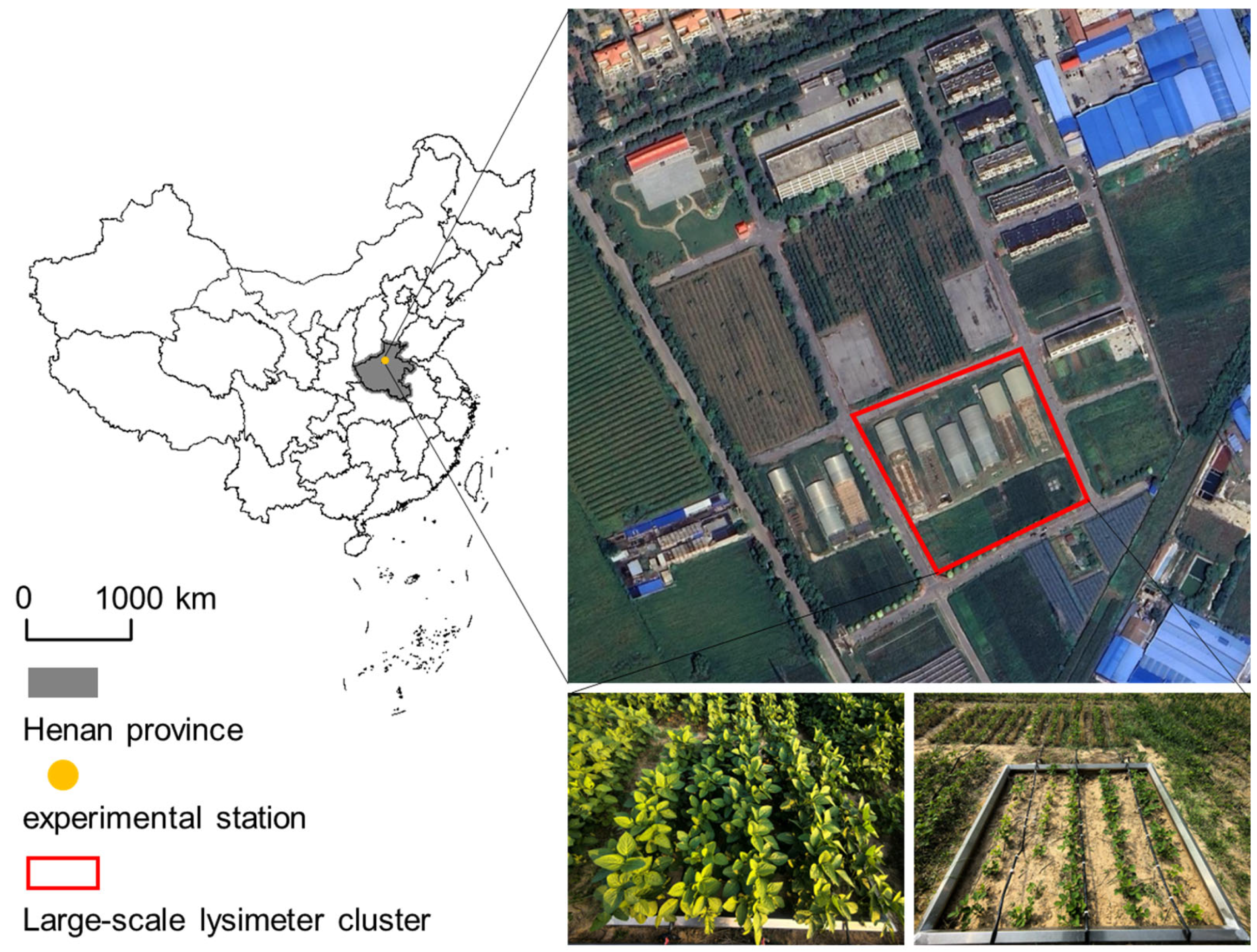
2.1. Experimental Station Overview and Data Collection
2.1.1. Experimental Overview and Meteorological Data
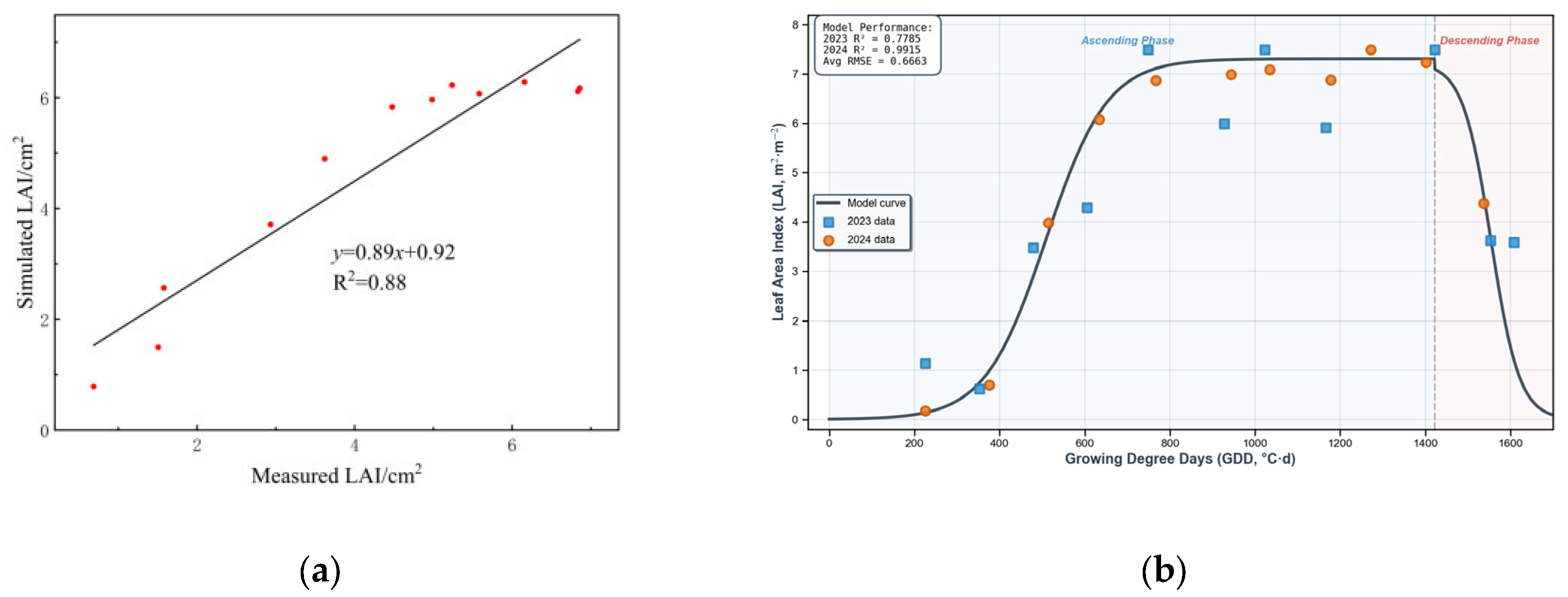
2.1.2. Measurement and Calculation of Leaf Area Index (LAI)
2.2. Machine Learning Models
2.2.1. Random Forest
2.2.2. Support Vector Machine
2.2.3. Gradient Boosting Model
2.2.4. Stacking Ensemble Model
2.3. Optimization Algorithms
2.3.1. Particle Swarm Optimization (PSO) Algorithm
2.3.2. Genetic Algorithm (GA)
2.3.3. Randomized Grid Search (RGS)
2.4. Model Input Parameter Combination Design
2.5. Model Interpretability and Sensitivity Analysis Methods
2.5.1. SHAP Analysis
2.5.2. Global Sensitivity Analysis
2.6. Evaluation Metrics
3. Results
3.1. Dynamic Characteristics of Summer Soybean Evapotranspiration and Its Influencing Factors
3.1.1. Construction and Validation of the Leaf Area Index (LAI) Model
3.1.2. Dynamic Changes and Influencing Factors of Evapotranspiration (ET) in Summer Soybean at Different Growth Stages
3.2. Comparison and Evaluation of Summer Soybean ET Simulation Performance Between the FAO-56 Penman–Monteith (PM) Model and Optimized Machine Learning Models
3.2.1. Performance Analysis of Summer Soybean ET Simulation Using the FAO-56 Penman–Monteith Model
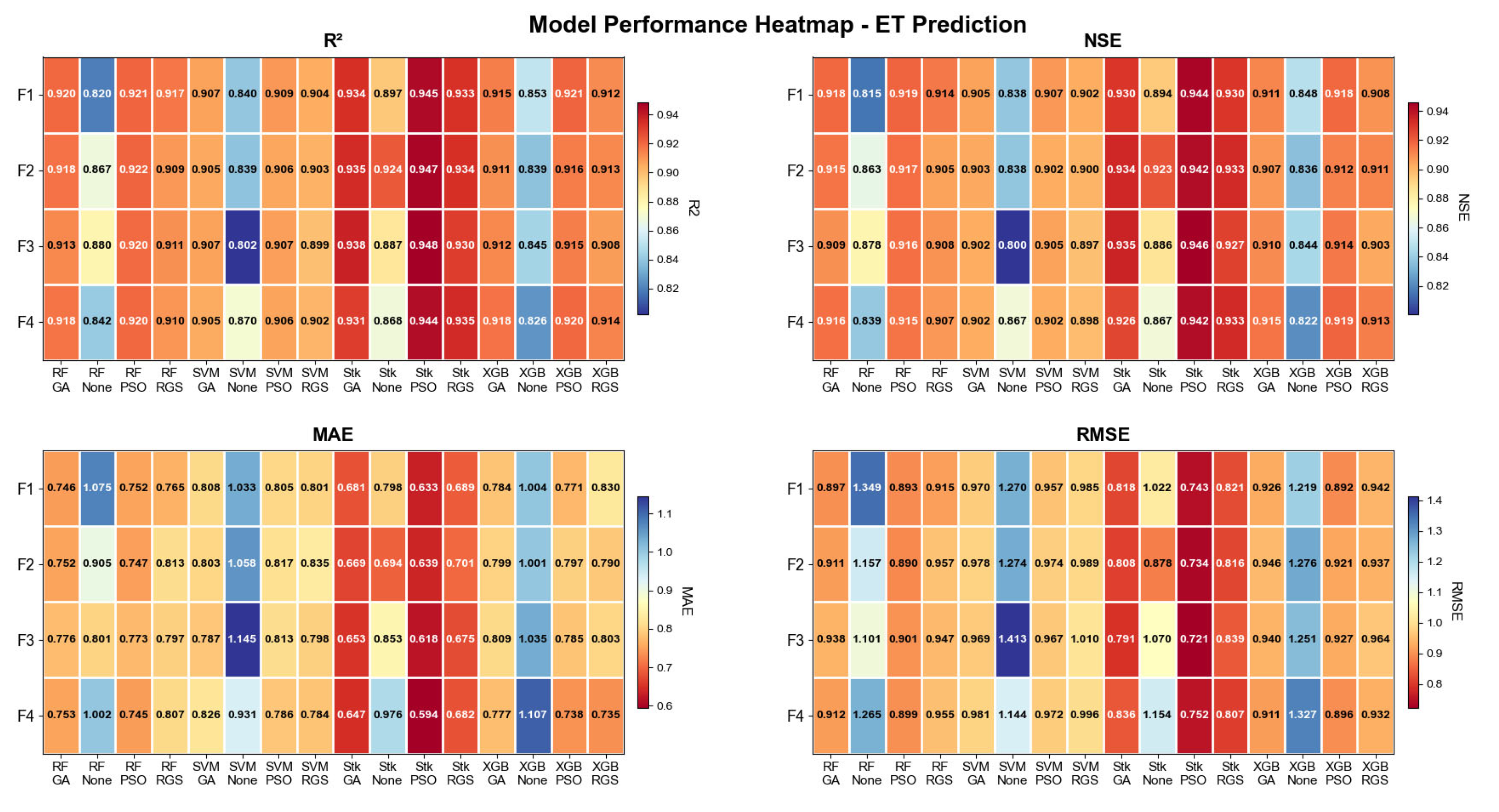
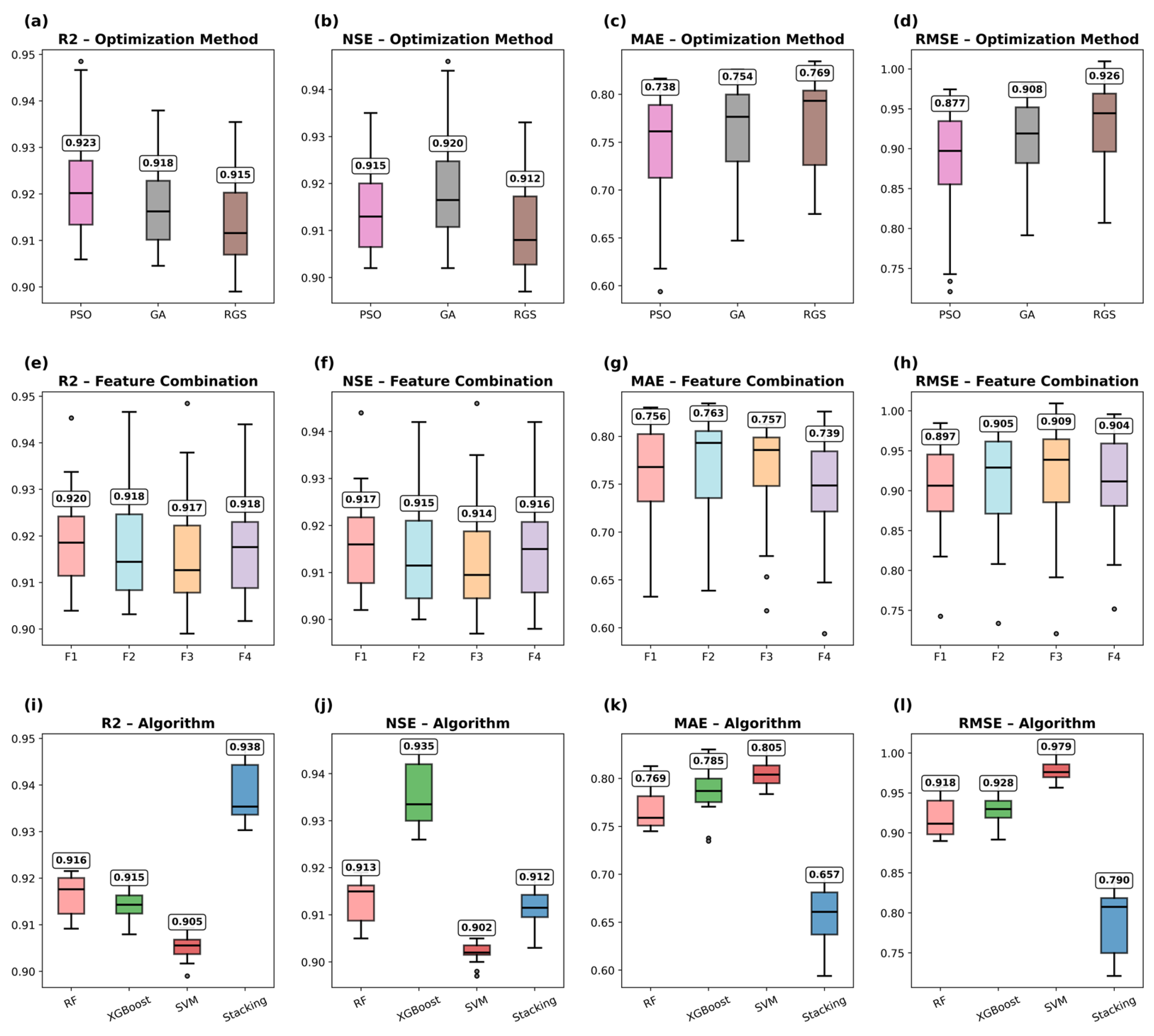
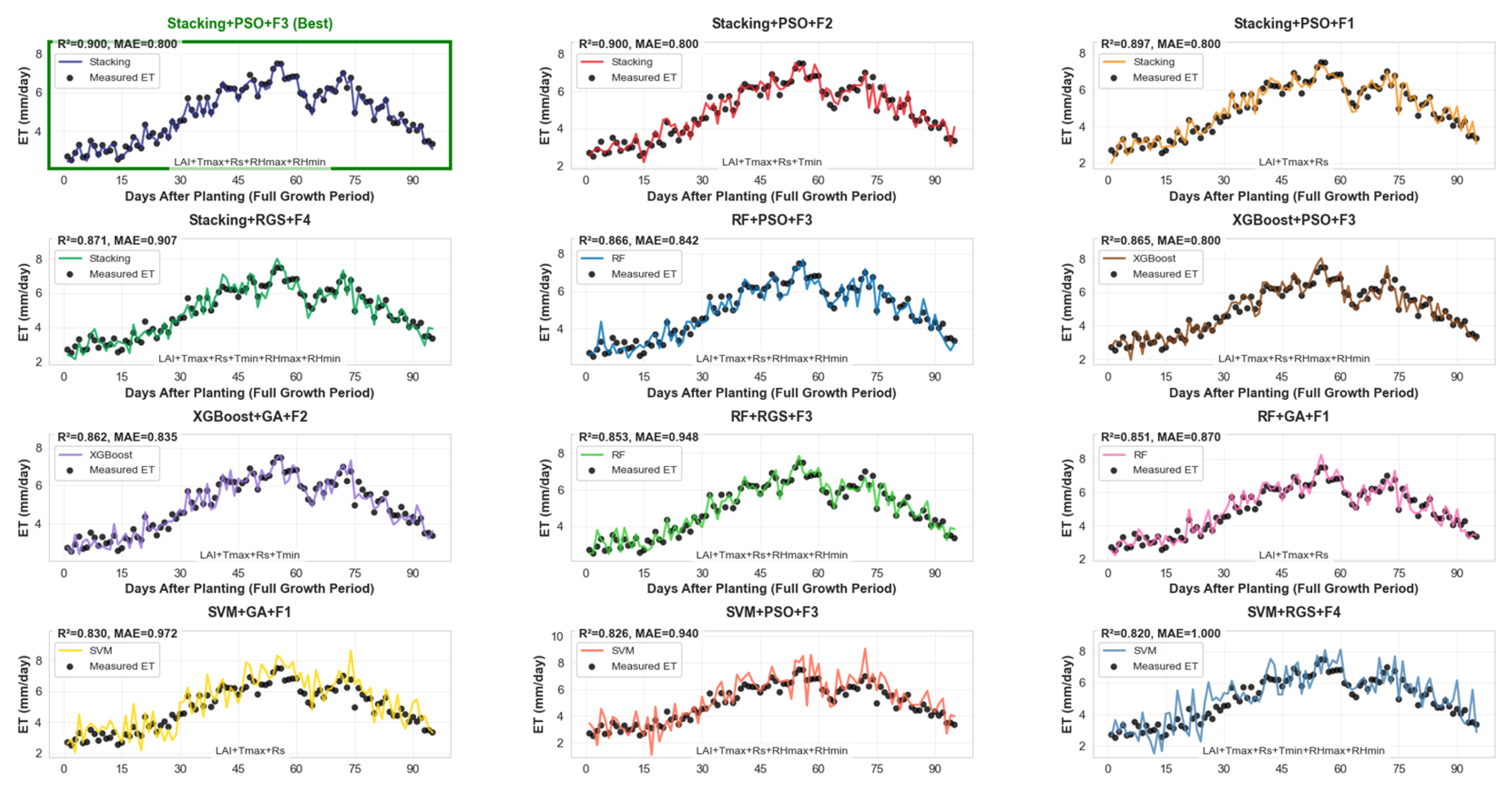
3.2.2. Overall Model Performance and Comparison of Optimization Algorithm Effects
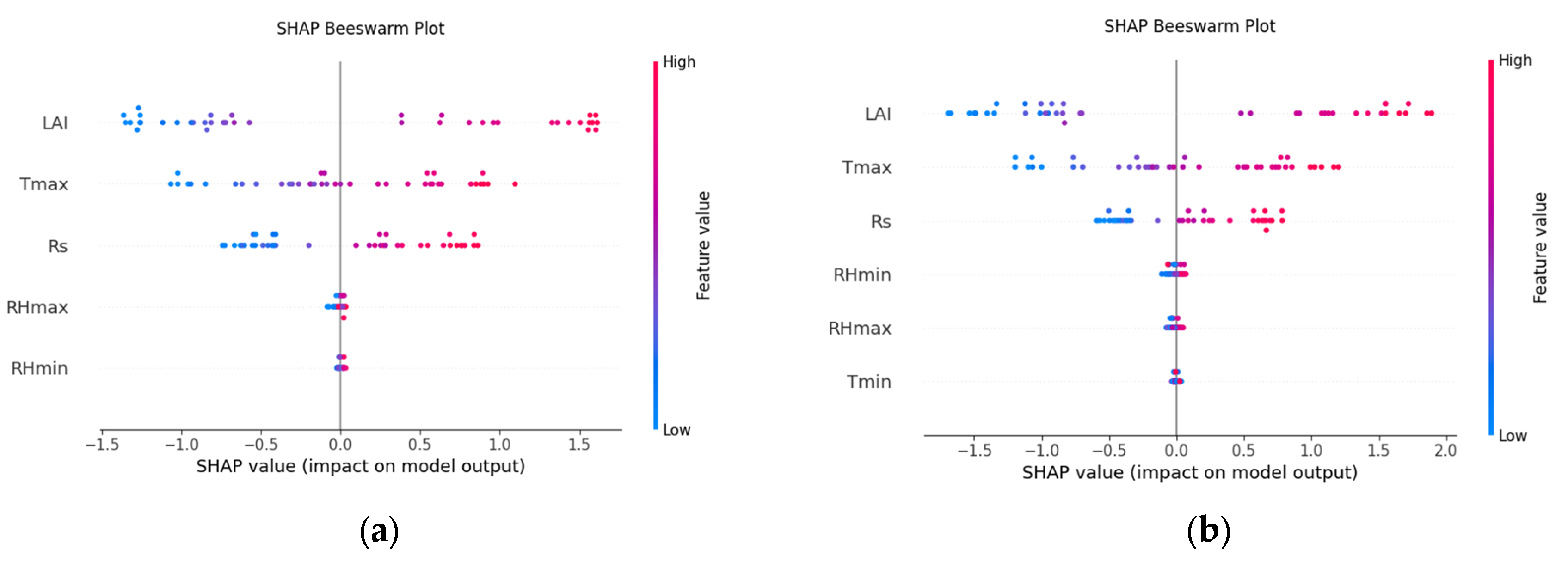
3.2.3. Analysis of Summer Soybean Evapotranspiration Simulation Models Based on SHAP and Global Sensitivity Analysis
- (1)
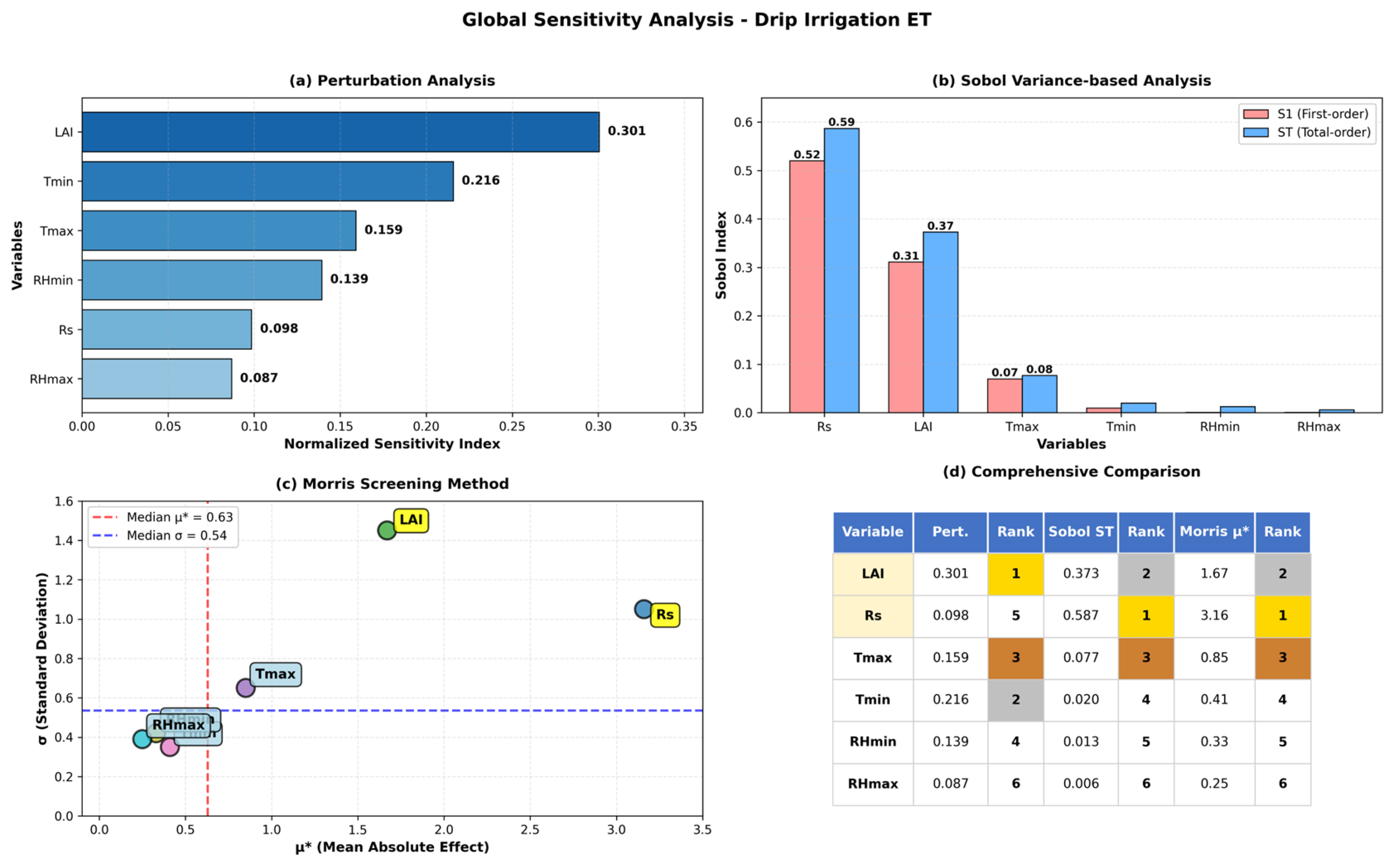
- Results of Perturbation Analysis
- (2)
- Results of Sobol Variance Decomposition
- (3)
- Results of Morris Screening
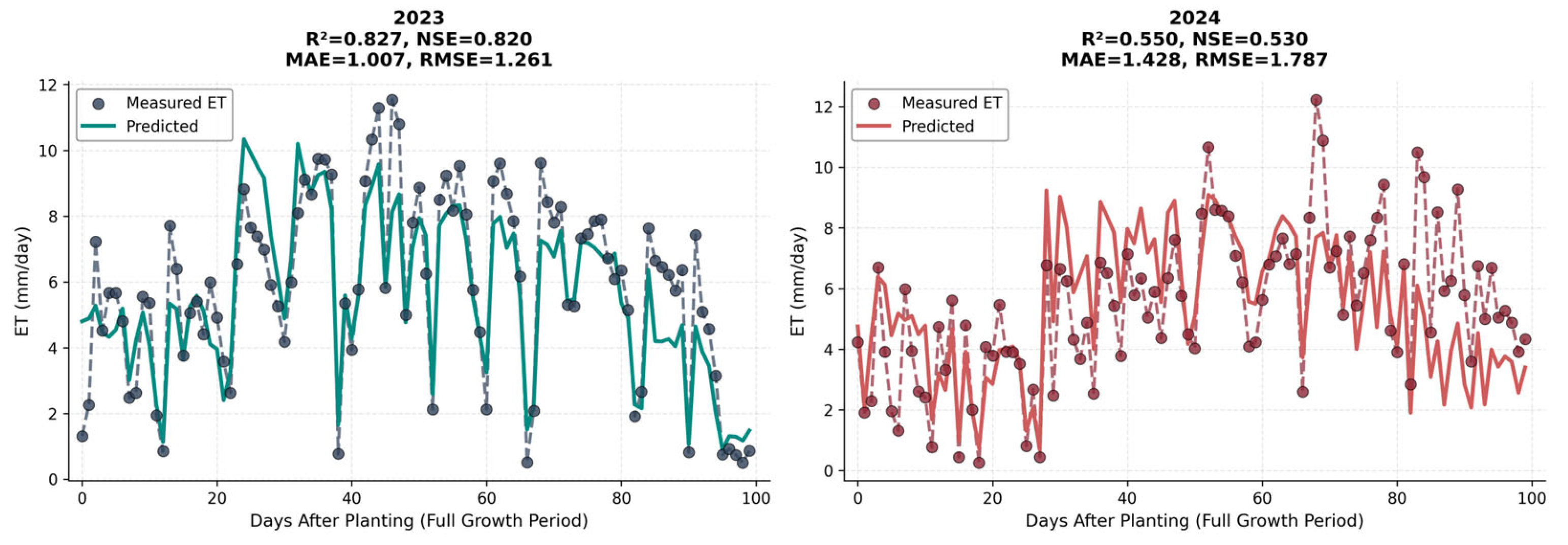
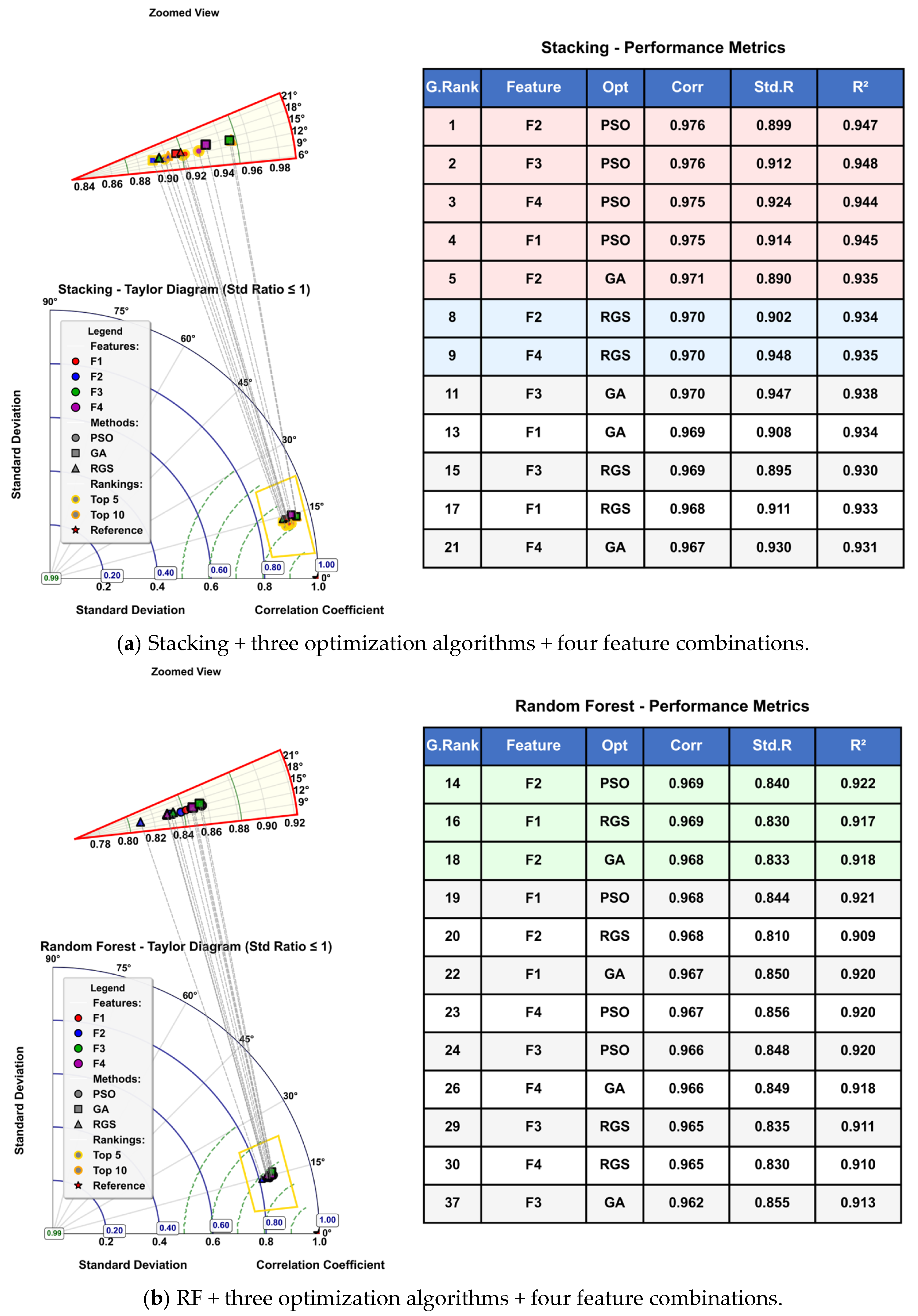
3.2.4. Evaluation of Model Robustness and Generalization Ability
4. Discussion
4.1. Performance Comparison Between Different Machine Learning Models and the Penman–Monteith Model and Analysis of Ensemble Advantages
4.2. Enhancement Effect of Optimization Algorithms on Model Performance
4.3. Core Driving and Regulatory Mechanisms of Summer Soybean Evapotranspiration
4.4. Model Robustness and Cross-Annual Generalization Ability
4.5. Limitations and Future Directions
5. Conclusions
Author Contributions
Funding
Data Availability Statement
Acknowledgments
Conflicts of Interest
References
- Zhang, H.Y. Study on the Formation Mechanism and Avoidance of Soybean Import Dependence Risk in China. Master’s Thesis, Yangzhou University, Yangzhou, China, 2023. [Google Scholar]
- Cai, H.J.; Zhai, L.Q.; Shen, Q.H.; Cao, J.Q. Technical Path for Increasing Soybean Yield under Grain-Soybean Rotation in the Huang Huai Hai Region. Anhui Agric. Sci. Bull. 2025, 31, 16–19. [Google Scholar] [CrossRef]
- Yang, S.; Li, H.; Xu, Y.; Wang, T.; Hu, Y.; Zhao, Y.; Qian, X.; Li, Z.; Sui, P.; Gao, W.; et al. The Yield Performance of Maize-Soybean Intercropping in the North China Plain: From 172 Sites Empirical Investigation. Field Crops Res. 2024, 315, 109467. [Google Scholar] [CrossRef]
- Fan, Y.; Wang, E.; Gong, W.; Xu, L.; Zhao, Z.; He, D.; Yang, F.; Wang, X.; Yong, T.; Liu, J.; et al. Soybean Yield Variations and the Potential of Intercropping to Increase Production in China. Field Crops Res. 2023, 297, 108771. [Google Scholar] [CrossRef]
- Ren, T.H.; Li, Z.Y.; Du, B.; Zhang, X.H.; Xu, Z.; Gao, D.P.; Zheng, B.; Zhao, W.; Li, G.; Ning, T.Y. Improving Photosynthetic Performance and Yield of Summer Soybean by Organic Fertilizer Application and Increasing Plant Density. J. Plant Nutr. Fertil. 2021, 27, 1361–1375. [Google Scholar] [CrossRef]
- Liao, Z.; Ding, X.; Zhang, H.; Zhang, H.; Li, Z.; Zhang, F.; Fan, J. Multi-objective optimization of soil water-nitrogen management practice and seeding rate for sustainable soybean production on the Loess Plateau of China. Agric. Water Manag. 2025, 312, 109414. [Google Scholar] [CrossRef]
- Karbasi, M.; Jamei, M.; Ali, M.; Malik, A.; Yaseen, Z.M. Forecasting Weekly Reference Evapotranspiration Using Auto Encoder Decoder Bidirectional LSTM Model Hybridized with a Boruta-CatBoost Input Optimizer. Comput. Electron. Agric. 2022, 198, 107121. [Google Scholar] [CrossRef]
- Fan, J.L.; Ma, X.; Wu, L.F.; Zhang, F.C.; Yu, X.; Zeng, W.Z. Light Gradient Boosting Machine: An Efficient Soft Computing Model for Estimating Daily Reference Evapotranspiration with Local and External Meteorological Data. Agric. Water Manage 2019, 225, 105758. [Google Scholar] [CrossRef]
- Sanikhani, H.; Kisi, O.; Maroufpoor, E.; Yaseen, Z.M. Temperature-Based Modeling of Reference Evapotranspiration Using Several Artificial Intelligence Models: Application of Different Modeling Scenarios. Theor. Appl. Climatol. 2019, 135, 449–462. [Google Scholar] [CrossRef]
- Wang, L.; Kisi, O.; Zounemat-Kermani, M.; Li, H. Pan Evaporation Modeling Using Six Different Heuristic Computing Methods in Different Climates of China. J. Hydrol. 2017, 544, 407–427. [Google Scholar] [CrossRef]
- Fan, J.L.; Yue, W.J.; Wu, L.F.; Zhang, F.C.; Cai, H.J.; Wang, X.K.; Lu, X.H.; Xiang, Y.Z. Evaluation of SVM, ELM and Four Tree-Based Stacking-ensemble Models for Predicting Daily Reference Evapotranspiration Using Limited Meteorological Data in Different Climates of China. Agric. For. Meteorol. 2018, 263, 225–241. [Google Scholar] [CrossRef]
- Kisi, O. Modeling Reference Evapotranspiration Using Three Different Heuristic Regression Approaches. Agric. Water Manag. 2016, 169, 162–172. [Google Scholar] [CrossRef]
- Chia, M.Y.; Huang, Y.F.; Koo, C.H. Support Vector Machine Enhanced Empirical Reference Evapotranspiration Estimation with Limited Meteorological Parameters. Comput. Electron. Agric. 2020, 175, 105577. [Google Scholar] [CrossRef]
- Yamaç, S.S. Artificial Intelligence Methods Reliably Predict Crop Evapotranspiration with Different Combinations of Meteorological Data for Sugar Beet in a Semiarid Area. Agric. Water Manag. 2021, 254, 106968. [Google Scholar] [CrossRef]
- Saggi, M.K.; Jain, S. Application of Fuzzy-Genetic and Regularization Random Forest (FG-RRF) for Estimating Crop Evapotranspiration (ETc) of Maize and Wheat. Agric. Water Manag. 2020, 229, 105907. [Google Scholar] [CrossRef]
- Zhao, X.; Zhang, L.; Zhu, G.; Chen, C.G.; He, J.; Traore, S.; Singh, V.P. Exploring Interpretable and Non-Interpretable Machine Learning Models for Estimating Winter Wheat Evapotranspiration Using Particle Swarm Optimization with Limited Climatic Data. Comput. Electron. Agric. 2023, 212, 108140. [Google Scholar] [CrossRef]
- Kavzoglu, T.; Teke, A. Advanced Hyperparameter Optimization for Improved Spatial Prediction of Shallow Landslides Using Extreme Gradient Boosting (XGBoost). Bull. Eng. Geol. Environ. 2022, 81, 229. [Google Scholar] [CrossRef]
- Jiang, X.M.; Wang, G.Q.; Wang, Y.T.; Yao, J.P.; Xue, B.L. A Hybrid Framework for Simulating Actual Evapotranspiration in Data-Deficient Areas: A Case Study of the Inner Mongolia Section of the Yellow River Basin. Remote Sens. 2023, 15, 2234. [Google Scholar] [CrossRef]
- Li, T.T. Research on Hyperparameter Optimization Based on Improved Particle Swarm Optimization. Master’s Thesis, Xidian University, Xi’an, China, 2019. [Google Scholar]
- Gong, L.Q. Research and Implementation of Hyperparameter Optimization Methods in Machine Learning. Master’s Thesis, Xidian University, Xi’an, China, 2024. [Google Scholar] [CrossRef]
- Petković, D.; Gocic, M.; Shamshirband, S.; Qasem, S.N.; Trajkovic, S. Particle Swarm Optimization-Based Radial Basis Function Network for Estimation of Reference Evapotranspiration. Theor. Appl. Climatol. 2016, 125, 555–563. [Google Scholar] [CrossRef]
- Wu, Z.J.; Cui, N.B.; Hu, X.T.; Gong, D.Z.; Wang, Y.S.; Feng, Y.; Jiang, S.Z.; Lv, M.; Han, L.; Xing, L.W.; et al. Optimization of Extreme Learning Machine Model with Biological Heuristic Algorithms to Estimate Daily Reference Crop Evapotranspiration in Different Climatic Regions of China. J. Hydrol. 2021, 598, 127028. [Google Scholar] [CrossRef]
- Zhang, Y.; Cui, N.B.; Feng, Y.; Gong, D.Z.; Hu, X.T. Comparison of BP, PSO-BP and Statistical Models for Predicting Daily Global Solar Radiation in Arid Northwest China. Comput. Electron. Agric. 2019, 164, 104905. [Google Scholar] [CrossRef]
- Tang, D.H.; Feng, Y.; Gong, D.Z.; Hao, W.P.; Cui, N.B. Evaluation of Artificial Intelligence Models for Actual Crop Evapotranspiration Modeling in Mulched and Non-Mulched Maize Croplands. Comput. Electron. Agric. 2018, 152, 375–384. [Google Scholar] [CrossRef]
- Mun, H.; Seo, S.; Son, B.; Yun, J. Black-Box Audio Adversarial Attack Using Particle Swarm Optimization. IEEE Access 2022, 10, 21685–21695. [Google Scholar] [CrossRef]
- Xu, Y.H.; Hu, C.H.; Wu, Q.; Jian, S.Q.; Li, Z.C.; Chen, Y.Q.; Zhang, G.D.; Zhang, Z.X.; Wang, S.L. Research on Particle Swarm Optimization in LSTM Neural Networks for Rainfall-Runoff Simulation. J. Hydrol. 2022, 608, 127553. [Google Scholar] [CrossRef]
- Yu, J.Y.; He, Y.; Zhao, Z.F.; Wang, D. Correction Coefficients for Leaf Area Estimation of Crops Using Length-Width Method. Jiangsu Agric. Sci. 2007, 2, 37–39. [Google Scholar] [CrossRef]
- Wang, Q.J.; Liu, Y.H.; Su, L.J. Relative Leaf Area Index of Typical Crops Based on Single Parameter Logistic Model. Trans. Chin. Soc. Agric. Mach. 2020, 51, 210–219. [Google Scholar] [CrossRef]
- Yin, X.Y.; Kropff, M.J.; McLaren, G.; Visperas, R.M. A Nonlinear Model for Crop Development as a Function of Temperature. Agric. For. Meteorol. 1995, 77, 1–16. [Google Scholar] [CrossRef]
- Breiman, L. Random Forests. Mach. Learn. 2001, 45, 5–32. [Google Scholar] [CrossRef]
- Liaw, A.; Wiener, M. Classification and Regression by Random Forest. R News 2002, 2, 18–22. [Google Scholar]
- Feng, Y.; Jia, Y.; Cui, N.B.; Zhao, L.; Li, C.; Gong, D.Z. Calibration of Hargreaves Model for Reference Evapotranspiration Estimation in Sichuan Basin of Southwest China. Agric. Water Manag. 2017, 181, 1–9. [Google Scholar] [CrossRef]
- Biau, G.; Scornet, E. A Random Forest Guided Tour. Test 2016, 25, 197–227. [Google Scholar] [CrossRef]
- Probst, P.; Bischl, B.; Boulesteix, A.L. Tunability: Importance of Hyperparameters of Machine Learning Algorithms. arXiv 2018, arXiv:1802.09596. [Google Scholar] [CrossRef]
- Vapnik, V.N. The Nature of Statistical Learning Theory; Springer: Berlin, Germany, 1995. [Google Scholar] [CrossRef]
- Ferreira, L.B.; da Cunha, F.F.; de Oliveira, R.A.; Filho, E.I.F. Estimation of Reference Evapotranspiration in Brazil with Limited Meteorological Data Using ANN and SVM–A New Approach. J. Hydrol. 2019, 572, 556–570. [Google Scholar] [CrossRef]
- Chen, T.; Guestrin, C. XGBoost: A Scalable Tree Boosting System. In Proceedings of the 22nd ACM SIGKDD International Conference on Knowledge Discovery and Data Mining (KDD), San Francisco, CA, USA, 13–17 August 2016; ACM: New York, NY, USA, 2016; pp. 785–794. [Google Scholar] [CrossRef]
- Bentejac, C.; Csorgo, A.; Martinez-Munoz, G. A Comparative Analysis of Gradient Boosting Algorithms. Artif. Intell. Rev. 2021, 54, 1937–1967. [Google Scholar] [CrossRef]
- Wolpert, D.H. Stacked Generalization. Neural Netw. 1992, 5, 241–259. [Google Scholar] [CrossRef]
- Wu, T.N.; Zhang, W.; Jiao, X.Y.; Guo, W.H.; Hamoud, Y.A. Evaluation of Stacking and Blending Ensemble Learning Methods for Estimating Daily Reference Evapotranspiration. Comput. Electron. Agric. 2021, 184, 106039. [Google Scholar] [CrossRef]
- Liu, A.; Zhao, D.B.; Wei, Y.C.; Xiao, L. Ensemble-Learning Estimation of Reference Crop Evapotranspiration Incorporating Spatiotemporal Features. J. Drain. Irrig. Mach. Eng. 2024, 42, 179–186 + 193. [Google Scholar] [CrossRef]
- Chen, Z.J.; Zhu, Z.C.; Sun, S.J.; Wang, Q.Y.; Su, T.Y.; Fu, Y.J. Estimation of Daily Evapotranspiration and Crop Coefficient of Maize under Mulched Drip Irrigation by Stacking Ensemble Learning Model. Trans. CSAE 2021, 37, 95–104. [Google Scholar] [CrossRef]
- Kennedy, J.; Eberhart, R.C. Particle Swarm Optimization. In Proceedings of the IEEE International Conference on Neural Networks (ICNN), Perth, WA, Australia, 27 November–1 December 1995; IEEE: Piscataway, NJ, USA, 1995; Volume 4, pp. 1942–1948. [Google Scholar] [CrossRef]
- Poli, R.; Kennedy, J.; Blackwell, T. Particle Swarm Optimization. Swarm Intell. 2007, 1, 33–57. [Google Scholar] [CrossRef]
- Gad, A.G. Correction to: Particle Swarm Optimization Algorithm and Its Applications: A Systematic Review. Arch. Comput. Methods Eng. 2023, 30, 2299. [Google Scholar] [CrossRef]
- Zhou, Y.; Zhou, N.R.; Gong, L.H.; Jiang, M.L. Prediction of Photovoltaic Power Output Based on Similar Day Analysis, Genetic Algorithm and Extreme Learning Machine. Energy 2020, 204, 117894. [Google Scholar] [CrossRef]
- Zhang, Z.; Gu, J.; Luo, J. Evaluation of Genetic Algorithm on Grasp Planning Optimization for 3D Object: A Comparison with Simulated Annealing Algorithm. In Proceedings of the 2013 IEEE International Symposium on Industrial Electronics (ISIE), Taipei, Taiwan, 28–31 May 2013; IEEE: Piscataway, NJ, USA, 2013; pp. 1896–1901. [Google Scholar] [CrossRef]
- Bergstra, J.; Bengio, Y. Random Search for Hyper-Parameter Optimization. J. Mach. Learn. Res. 2012, 13, 281–305. [Google Scholar]
- Yang, L.; Shami, A. On Hyperparameter Optimization of Machine Learning Algorithms: Theory and Practice. Neurocomputing 2020, 415, 295–316. [Google Scholar] [CrossRef]
- Geng, J.; Li, H.; Luan, W.; Shi, Y.; Pang, J.; Zhang, W. Estimation of Daily Actual Evapotranspiration of Tea Plantations Using Ensemble Machine Learning Algorithms and Six Available Scenarios of Meteorological Data. Appl. Sci. 2023, 13, 12961. [Google Scholar] [CrossRef]
- Aschale, T.M.; Peres, D.J.; Gullotta, A.; Sciuto, G.; Cancelliere, A. Trend Analysis and Identification of the Meteorological Factors Influencing Reference Evapotranspiration. Water 2023, 15, 470. [Google Scholar] [CrossRef]
- Kuhnt, S.; Kalka, A. Global Sensitivity Analysis for the Interpretation of Machine Learning Algorithms. In Artificial Intelligence, Big Data and Data Science in Statistics; Springer: Berlin/Heidelberg, Germany, 2022; pp. 155–169. Available online: https://link.springer.com/chapter/10.1007/978-3-031-07155-3_6 (accessed on 15 November 2022).
- Allen, R.G. Crop Evapotranspiration: Guidelines for Computing Crop Water Requirements. FAO Irrig. Drain. Pap. 1998, 56, 1–300. [Google Scholar]
- Mossie Aschale, T.; Sciuto, G.; Peres, D.J.; Gullotta, A.; Cancelliere, A. Comparison of Different Methods for Reference Evapotranspiration Estimation in Semi-Arid Climates. Water 2022, 14, 2268. [Google Scholar] [CrossRef]
- Lundberg, S.; Lee, S.I. A Unified Approach to Interpreting Model Predictions. arXiv 2017, arXiv:1705.07874. [Google Scholar] [CrossRef]
- Da Figueiredo Moura Silva, E.H.; Kothari, K.; Pattey, E.; Battisti, R.; Boote, K.J.; Archontoulis, S.V.; Cuadra, S.V.; Faye, B.; Grant, B.; Hoogenboom, G.; et al. Inter-comparison of soybean models for the simulation of evapotranspiration in a humid continental climate. Agric. For. Meteorol. 2025, 365, 110463. [Google Scholar] [CrossRef]
- Wu, L.; Fan, J. Comparison of Neuron-Based, Kernel-Based, Tree-Based and Curve-Based Machine Learning Models for Predicting Daily Reference Evapotranspiration. PLoS ONE 2019, 14, e0217520. [Google Scholar] [CrossRef]
- Fan, J.; Wu, L.; Zheng, J.; Zhang, F. Medium-Range Forecasting of Daily Reference Evapotranspiration across China Using Numerical Weather Prediction Outputs Downscaled by Extreme Gradient Boosting. J. Hydrol. 2021, 601, 126664. [Google Scholar] [CrossRef]
- Zhang, L.; Zhao, X.; Zhu, G.; He, J.; Chen, J.; Chen, Z.; Traore, S.; Liu, J.; Singh, V.P. Short-Term Daily Reference Evapotranspiration Forecasting Using Temperature-Based Deep Learning Models in Different Climate Zones in China. Agric. Water Manag. 2023, 289, 108498. [Google Scholar] [CrossRef]
- Liang, Y.F.; Feng, D.P.; Sun, Z.J.; Zhu, Y.N. Evaluation of Empirical Equations and Machine Learning Models for Daily Reference Evapotranspiration Prediction Using Public Weather Forecasts. Water 2023, 15, 3954. [Google Scholar] [CrossRef]
- Inoubli, R.; Constantino-Recillas, D.E.; Monsiváis-Huertero, A.; Farah, L.B.; Farah, I.R. Computational Methods to Retrieve Soil Moisture Using Remote Sensing Data: A Review. In Proceedings of the 2024 IEEE 7th International Conference on Advanced Technologies, Signal and Image Processing (ATSIP), Sousse, Tunisia, 11–13 July 2024; pp. 77–82. [Google Scholar] [CrossRef]
- Li, Y.; Liu, X.N.; Zhang, X.G.; Gu, X.B.; Yu, L.Y.; Cai, H.J.; Pen, X.B. Using Solar-Induced Chlorophyll Fluorescence to Predict Winter Wheat Actual Evapotranspiration through Machine Learning and Deep Learning Methods. Agric. Water Manage 2025, 309, 109322. [Google Scholar] [CrossRef]
- Du, H.; Zeng, S.; Liu, X.; Xia, J. An Improved Budyko Framework Incorporating Water-Carbon Relationships for Estimating Evapotranspiration Under Climate and Vegetation Changes. Ecol. Indic. 2024, 161, 112887. [Google Scholar] [CrossRef]
- Monteith, J.L. Evaporation and Surface Temperature. Q. J. R. Meteorol. Soc. 1981, 107, 1–27. [Google Scholar] [CrossRef]
- Acharki, S.; Raza, A.; Vishwakarma, D.K.; Amharref, M.; Bernoussi, A.S.; Singh, S.K.; Al-Ansari, N.; Dewidar, A.Z.; Al-Othman, A.A.; Mattar, M.A. Comparative assessment of empirical and hybrid machine learning models for estimating daily reference evapotranspiration in sub-humid and semi-arid climates. Sci. Rep. 2025, 15, 2542. [Google Scholar] [CrossRef]
- Ding, N.; Tang, X.; Wu, H.J.; Kong, L.; Dao, X.; Wang, Z.F.; Zhu, J. Development of an integrated machine learning model to improve the secondary inorganic aerosol simulation over the Beijing–Tianjin–Hebei region. Atmos. Environ. 2024, 327, 120483. [Google Scholar] [CrossRef]
- Dietterich, T.G. Ensemble Methods in Machine Learning. In Proceedings of the International Workshop on Multiple Classifier Systems, Cagliari, Italy, 21–23 June 2000; Springer: Berlin, Germany, 2000; pp. 1–15. [Google Scholar] [CrossRef]
- Liyew, C.M.; Di Nardo, E.; Ferraris, S.; Meo, R. Hyperparameter optimization of machine learning models for predicting actual evapotranspiration. Heliyon 2025, 11, e2500441. [Google Scholar] [CrossRef]
- Zhang, Y.; Wang, S.; Ji, G. A Comprehensive Survey on Particle Swarm Optimization Algorithm and Its Applications. Math. Probl. Eng. 2015, 2015, 931256. [Google Scholar] [CrossRef]
- Yang, L.Z. Quantitative Estimation of the Impact of Climate Change on Actual Evapotranspiration in the Yellow River Basin, China. J. Hydrol. 2010, 500, 233–241. [Google Scholar] [CrossRef]
- Vicente-Serrano, S.M.; Beguería, S.; López-Moreno, J.I. A Multiscalar Drought Index Sensitive to Global Warming: The Standardized Precipitation Evapotranspiration Index (SPEI). J. Clim. 2010, 23, 1696–1718. [Google Scholar] [CrossRef]
- Perni, S.; Vanderpuye-Orgle, J.; Poirrier, J.E. EE300 Looking Sharp! Applying Cutting-Edge Shapley Additive Explanation (SHAP) Approaches to Cost-Effectiveness Modelling in Contrast to One-Way Sensitivity Analysis. Value Health 2023, 26, S1. [Google Scholar] [CrossRef]
- Fan, M.; Zhang, L.; Liu, S.; Yang, T.; Lu, D. Investigation of Hydrometeorological Influences on Reservoir Releases Using Explainable Machine Learning Methods. Front. Water 2023, 5, 1112970. [Google Scholar] [CrossRef]
- Leng, Z.; Chen, L.; Yang, B.; Lia, S.; Yi, B. An Extreme Forecast Index-Driven Runoff Prediction Approach Using Stacking Ensemble Learning. J. Hydrol. Eng. 2024, 29, 04024045. [Google Scholar] [CrossRef]
- Islam, M.R.; Ferdous, M.S.; Bhowmik, A.K. Comparison of RNN-LSTM, TFDF and Stacking Model Approach for Weather Forecasting in Bangladesh Using Historical Data from 1963 to 2022. Comput. Electron. Agric. 2025, 228, 109678. [Google Scholar] [CrossRef]
- Babaeian, E.; Paheding, S.; Siddique, N.; Devabhaktuni, V.; Tuller, M. Estimation of Root Zone Soil Moisture from Ground and Remotely Sensed Soil Information with Multisensor Data Fusion and Automated Machine Learning. Remote Sens. Environ. 2021, 260, 112434. [Google Scholar] [CrossRef]
- Liu, Y.; Zhang, S.; Zhang, J.; Tang, L.; Bai, Y. Assessment and Comparison of Six Machine Learning Models in Estimating Evapotranspiration over Croplands Using Remote Sensing and Meteorological Factors. Remote Sens. 2021, 13, 3838. [Google Scholar] [CrossRef]





| Growth Stages | 2023 | 2024 |
|---|---|---|
| I | 21 Jun–10 Jul | 20 Jun–10 Jul |
| II | 11 Jul–30 Jul | 11 Jul–30 Jul |
| III | 31 Jul–25 Aug | 31 Jul–25 Aug |
| IV | 26 Aug–15 Sep | 26 Aug–15 Sep |
| V | 16 Sep–1 Oct | 16 Sep–1 Oct |
| VI | 2 Oct–12 Oct | 2 Oct–12 Oct |
| VII | 21 Jun–12 Oct | 21 Jun–12 Oct |
| Influencing Factor | LAI | Tmax | Tmin | Rs | RHmin | RHmax | u2 |
|---|---|---|---|---|---|---|---|
| Correlation Coefficient | 0.40 ** | 0.42 ** | 0.23 ** | 0.50 ** | −0.02 | 0.07 | −0.02 |
| Input Combination | Input Data |
|---|---|
| F1 | Rs, Tmax, LAI |
| F2 | Rs, Tmax, LAI, Tmin |
| F3 | Rs, Tmax, LAI, RHmax, RHmin |
| F4 | Rs, Tmax, LAI, Tmin, RHmax, RHmin |
| Year | Growth Stage | LAI | RS (MJ/m2) | Tmax (°C) | Tmin (°C) | RHmax (%) | RHmin (%) | u2 (m/s) | ET (mm/d) |
|---|---|---|---|---|---|---|---|---|---|
| 2023 | I | 0.8 | 20.294 | 37.687 | 24.385 | 89.95 | 43.117 | 1.203 | 4.45 |
| II | 0.93 | 17.993 | 34.846 | 24.897 | 97.043 | 63.985 | 1.21 | 6.53 | |
| III | 5.47 | 17.423 | 34.099 | 24.033 | 99.987 | 72.862 | 0.836 | 7.53 | |
| IV | 7.03 | 15.477 | 30.963 | 19.715 | 100 | 67.082 | 0.922 | 6.07 | |
| V | 3.97 | 10.591 | 26.587 | 17.073 | 98.838 | 68.417 | 0.869 | 3.15 | |
| VI | 3.69 | 9.007 | 23.652 | 14.185 | 98.7 | 59.761 | 0.687 | 1.8 | |
| VII | 3.63 | 15.897 | 32.219 | 21.524 | 97.426 | 63.133 | 0.972 | 5.41 | |
| 2024 | I | 0.77 | 17.337 | 34.415 | 23.648 | 89.582 | 54.971 | 1.347 | 3.19 |
| II | 0.79 | 16.274 | 34.523 | 25.595 | 99.043 | 74.855 | 1.065 | 4.4 | |
| III | 4.62 | 18.156 | 35.479 | 24.535 | 99.848 | 74.098 | 0.759 | 6.37 | |
| IV | 7.01 | 14.494 | 31.435 | 22.044 | 99.013 | 70.832 | 1.086 | 7.28 | |
| V | 3.81 | 12.62 | 28.813 | 11.394 | 98.278 | 42.987 | 0.833 | 4.79 | |
| VI | 3.69 | 12.75 | 26.9 | 10.598 | 99.827 | 45.789 | 0.612 | 1.49 | |
| VII | 3.45 | 15.723 | 32.632 | 20.941 | 97.4 | 63.104 | 0.976 | 4.93 |
| Model Combination | 2023 Training Time | 2024 Testing Time | Notes |
|---|---|---|---|
| Stacking PSO F2 | 4–6 min | 5–8 s | Stacking requires training multiple base models + PSO iterative optimization, which is the most time-consuming |
| Stacking PSO F3 | 4–6 min | 5–8 s | Same as Stacking+PSO; fewer input features, so the time is similar |
| Stacking PSO F4 | 4.5–6.5 min | 5–8 s | Most features; PSO search space is slightly larger, so training takes a bit longer |
| RF PSO F2 | 2–3 min | 1–3 s | RF trains quickly; PSO hyperparameter tuning increases the time |
| RF RGS F1 | 1–2 min | 1–3 s | RGS uses random search, which is faster than PSO/GA |
| RF GA F2 | 2.5–4 min | 1–3 s | GA iteration is slightly slower than PSO, but RF itself trains quickly |
| XGBoost PSO F1 | 3–4.5 min | 2–4 s | XGBoost trains relatively quickly (GPU-accelerated); PSO hyperparameter tuning increases the time |
| XGBoost PSO F2 | 3–4.5 min | 2–4 s | Same as above; similar number of features |
| XGBoost PSO F4 | 3.5–5 min | 2–4s | More features, so training takes a bit longer |
| SVM GA F1 | 2–3.5 min | 1–2 s | SVM trains quickly; GA hyperparameter tuning increases the time |
| SVM GA F2 | 2–3.5 min | 1–2 s | Same as above |
| SVM GA F4 | 2.5–4 min | 1–2 s | More features; SVM kernel computation slightly increases the time |
| Methods | R2 | NSE | MAE | RMSE |
|---|---|---|---|---|
| RF + PSO [16] | 0.906 | 0.905 | 0.401 | 0.578 |
| XGBoost + PSO [16] | 0.906 | 0.905 | 0.406 | 0.576 |
| SVM + PSO [16] | 0.907 | 0.906 | 0.416 | 0.573 |
| DNN + PSO [16] | 0.909 | 0.908 | 0.402 | 0.570 |
| SVM [61] | 0.829 | - | 0.508 | 0.718 |
| XGB [57] | 0.85 | - | - | 0.600 |
| LSTM [58] | 0.81 | - | 0.418 | 0.564 |
| RF [59] | 0.81 | - | - | - |
| Stacking + PSO + F3 | 0.948 | 0.946 | 0.618 | 0.721 |
Disclaimer/Publisher’s Note: The statements, opinions and data contained in all publications are solely those of the individual author(s) and contributor(s) and not of MDPI and/or the editor(s). MDPI and/or the editor(s) disclaim responsibility for any injury to people or property resulting from any ideas, methods, instructions or products referred to in the content. |
© 2026 by the authors. Licensee MDPI, Basel, Switzerland. This article is an open access article distributed under the terms and conditions of the Creative Commons Attribution (CC BY) license.
Share and Cite
Han, L.; Gao, F.; Dong, S.; Song, Y.; Liu, H.; Song, N. Simulating Daily Evapotranspiration of Summer Soybean in the North China Plain Using Four Machine Learning Models. Agronomy 2026, 16, 315. https://doi.org/10.3390/agronomy16030315
Han L, Gao F, Dong S, Song Y, Liu H, Song N. Simulating Daily Evapotranspiration of Summer Soybean in the North China Plain Using Four Machine Learning Models. Agronomy. 2026; 16(3):315. https://doi.org/10.3390/agronomy16030315
Chicago/Turabian StyleHan, Liyuan, Fukui Gao, Shenghua Dong, Yinping Song, Hao Liu, and Ni Song. 2026. "Simulating Daily Evapotranspiration of Summer Soybean in the North China Plain Using Four Machine Learning Models" Agronomy 16, no. 3: 315. https://doi.org/10.3390/agronomy16030315
APA StyleHan, L., Gao, F., Dong, S., Song, Y., Liu, H., & Song, N. (2026). Simulating Daily Evapotranspiration of Summer Soybean in the North China Plain Using Four Machine Learning Models. Agronomy, 16(3), 315. https://doi.org/10.3390/agronomy16030315