DSS-YOLO: A Lightweight Flower and Stamen Detection Model for Greenhouse Tomato Pollination Assistance

 ,
,
Abstract
1. Introduction
- (1)
- Lightweight backbone network design:
- (2)
- Efficient downsampling mechanism optimization:
- (3)
- Small-target-oriented loss function improvement:
2. Materials and Methods
2.1. Image Acquisition
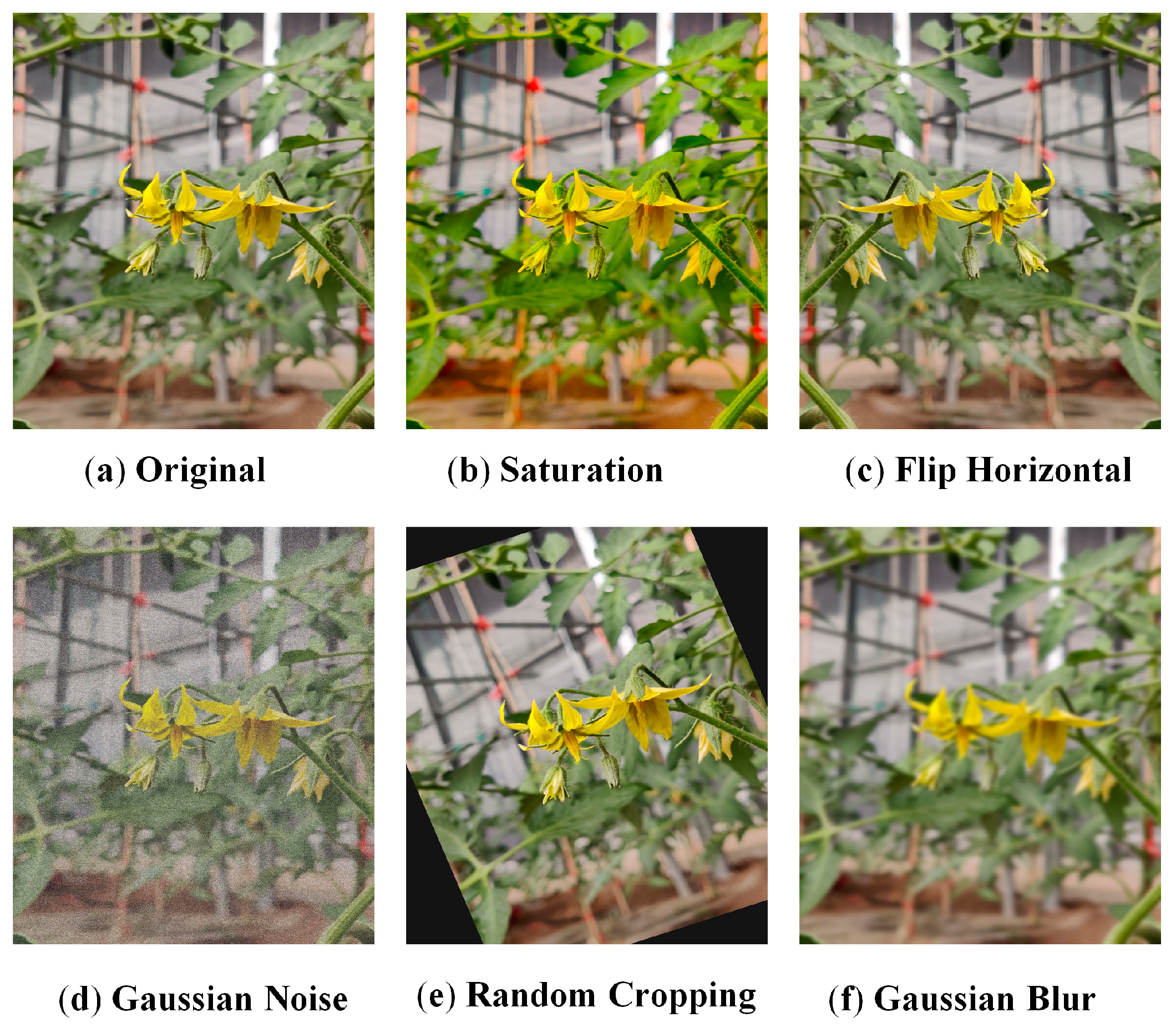
2.2. Data Preprocessing
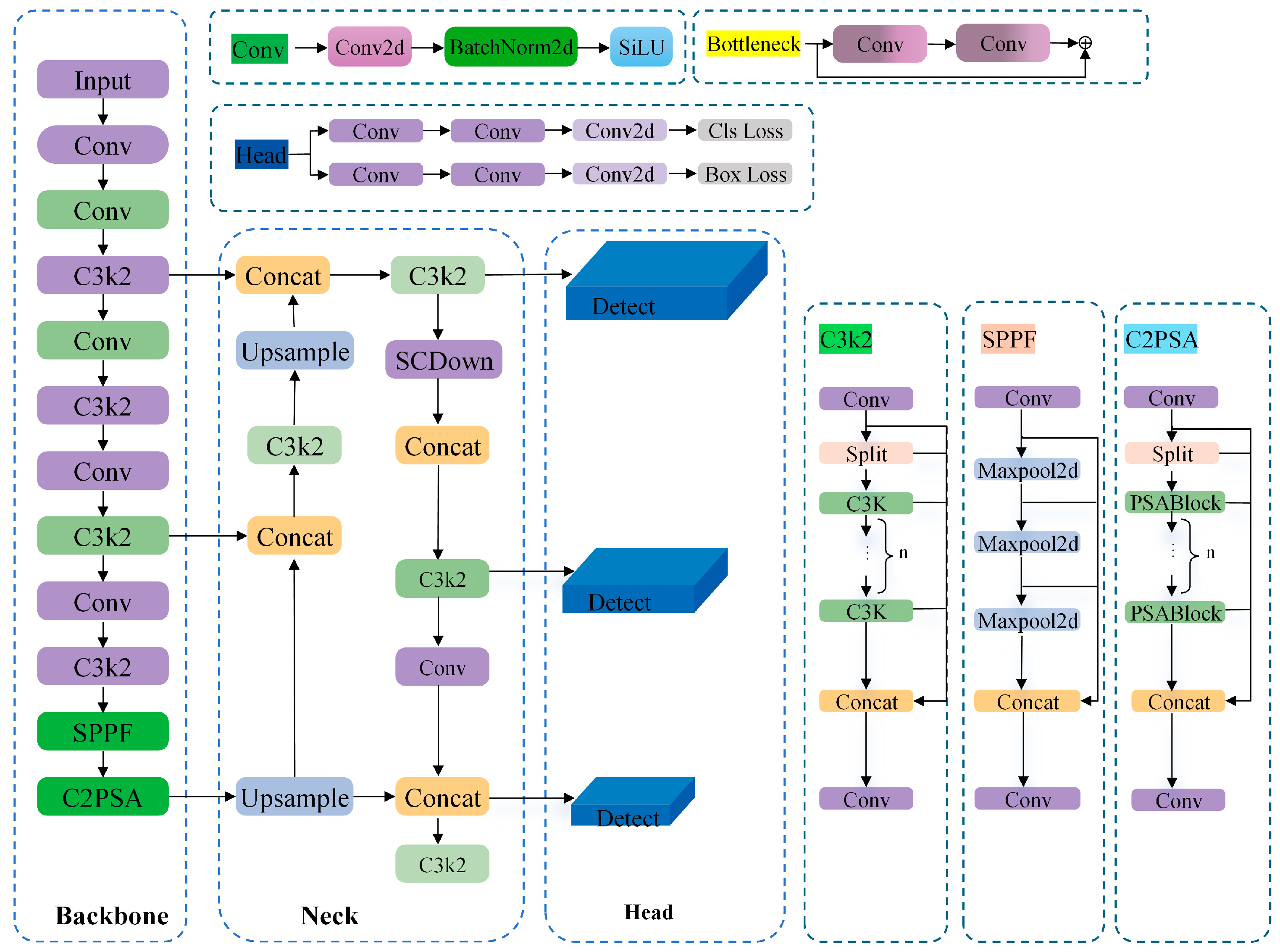
2.3. YOLOv11n Module
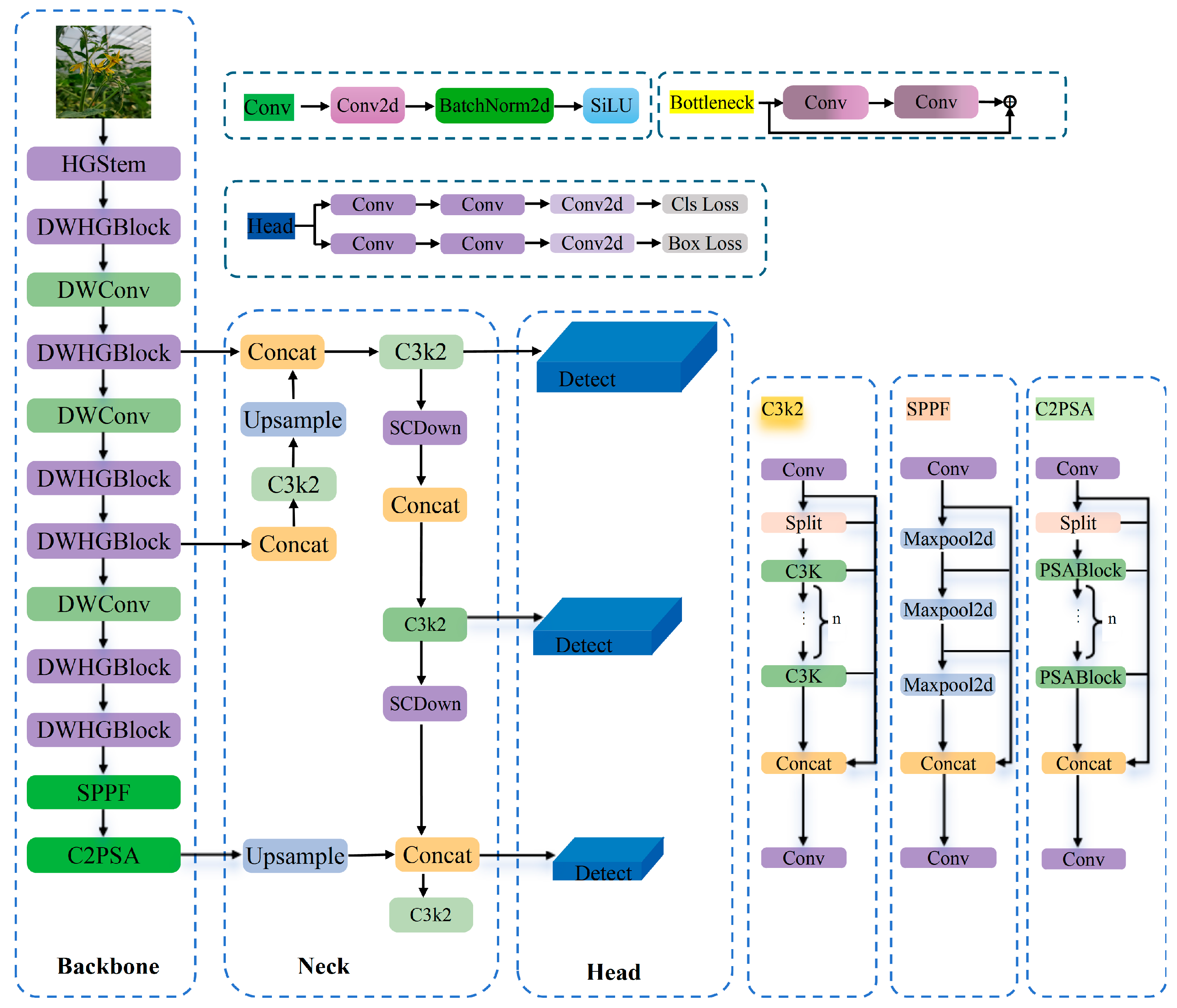
2.4. DSS-YOLO Module
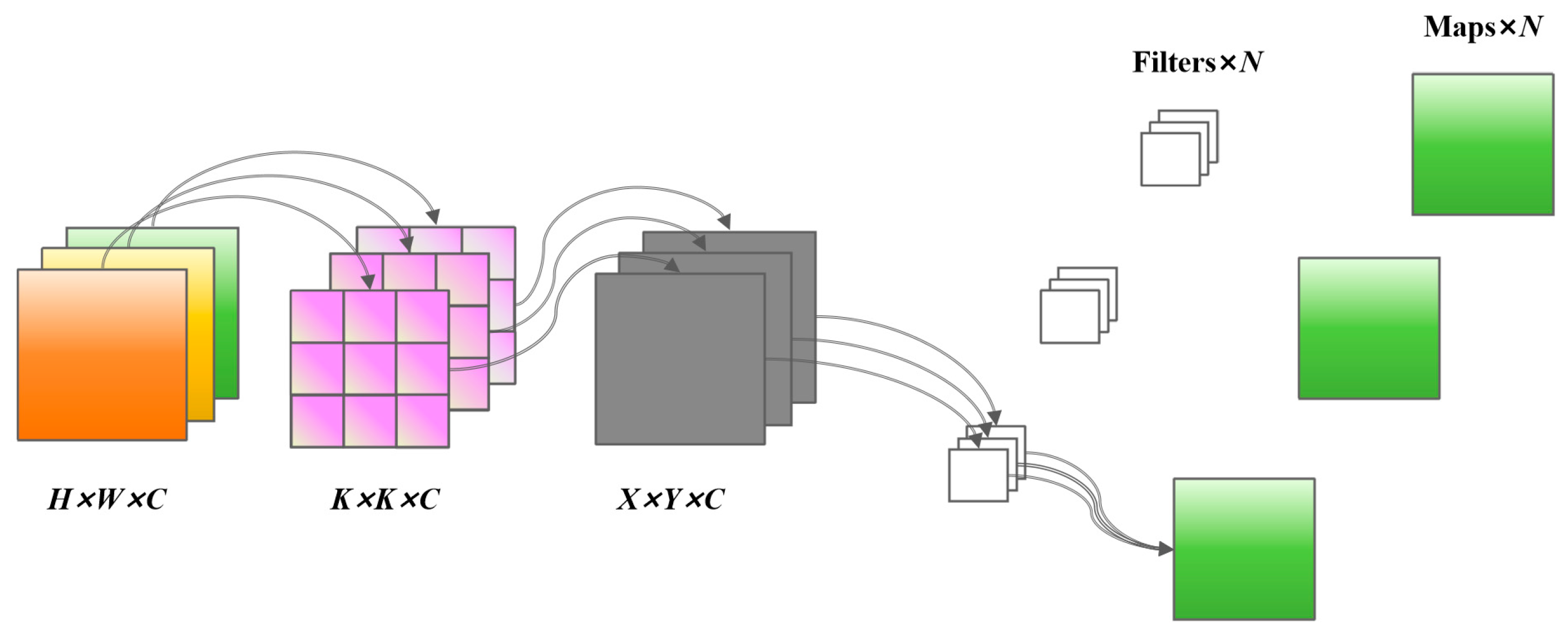
2.4.1. DWHGNetV2 Lightweight Backbone Network
2.4.2. SCDown Efficient Downsampling Module
2.4.3. SIoU Loss Function
2.5. Test Setup and Evaluation Criteria
2.5.1. Test Environment and Parameter Settings
2.5.2. Evaluation Indicators
3. Results
3.1. Ablation Experiment
3.2. Comparative Experiment of Mainstream Target Detection Algorithms
3.3. Comparison Experiments of Different Downsampling Layers
3.4. Comparison Experiments of Different Loss Functions
3.5. Visual Analysis of Results
4. Discussion
5. Conclusions
Author Contributions
Funding
Data Availability Statement
Conflicts of Interest
Correction Statement
References
- Ullah, F.; Ullah, H.; Ishfaq, M.; Gul, S.L.; Kumar, T.; Li, Z. Improvement of Nutritional Quality of Tomato Fruit with Funneliformis mosseae Inoculation Under Greenhouse Conditions. Horticulturae 2023, 9, 448. [Google Scholar] [CrossRef] [Scilit]
- Safeer, S.; Pulvento, C. Blockchain-Backed Sustainable Management of Italian Tomato Processing Industry. Agriculture 2024, 14, 1120. [Google Scholar] [CrossRef] [Scilit]
- Magalhães, S.A.; Castro, L.; Moreira, G.; Santos, F.N.; Cunha, M.; Dias, J.; Moreira, A.P. Evaluating the Single-Shot MultiBox Detector and YOLO Deep Learning Models for the Detection of Tomatoes in a Greenhouse. Sensors 2021, 21, 3569. [Google Scholar] [CrossRef] [Scilit] [PubMed]
- Dingley, A.; Anwar, S.; Kristiansen, P.; Warwick, N.W.M.; Wang, C.-H.; Sindel, B.M.; Cazzonelli, C.I. Precision Pollination Strategies for Advancing Horticultural Tomato Crop Production. Agronomy 2022, 12, 518. [Google Scholar] [CrossRef] [Scilit]
- Sun, X.; Zhang, Q.; Zhang, H.; Niu, L.; Zhang, M.; Zhang, Y. A Set of Artificial Pollination Technical Measures: Improved Seed Yields and Active Ingredients of Seeds in Oil Tree Peonies. Plants 2024, 13, 1194. [Google Scholar] [CrossRef] [Scilit]
- Zhang, H.; Han, C.; Breeze, T.D.; Li, M.; Mashilingi, S.K.; Hua, J.; Zhang, W.; Zhang, X.; Zhang, S.; An, J. Bumblebee Pollination Enhances Yield and Flavor of Tomato in Gobi Desert Greenhouses. Agriculture 2022, 12, 795. [Google Scholar] [CrossRef] [Scilit]
- Chang, X.; Yan, X.; Lv, F.; Zhang, Y.; Breeze, T.D.; Li, X. The Pollinating Network of Pollinators and the Service Value of Pollination in Hanzhong City, China. Insects 2025, 16, 1223. [Google Scholar] [CrossRef] [Scilit]
- Chen, Z.; Lei, X.; Yuan, Q.; Qi, Y.; Ma, Z.; Qian, S.; Lyu, X. Key Technologies for Autonomous Fruit- and Vegetable-Picking Robots: A Review. Agronomy 2024, 14, 2233. [Google Scholar] [CrossRef] [Scilit]
- Rong, J.; Wang, P.; Wang, T.; Hu, L.; Yuan, T. Fruit pose recognition and directional orderly grasping strategies for tomato harvesting robots. Comput. Electron. Agric. 2022, 202, 107430. [Google Scholar] [CrossRef] [Scilit]
- Seo, D.; Cho, B.-H.; Kim, K.-C. Development of Monitoring Robot System for Tomato Fruits in Hydroponic Greenhouses. Agronomy 2021, 11, 2211. [Google Scholar] [CrossRef] [Scilit]
- Dorj, U.-O.; Lee, M.; Diyan-Ul-Imaan, N. A New Method for Tangerine Tree Flower Recognition. In Communications in Computer and Information Science; Springer: Berlin/Heidelberg, Germany, 2012; Volume 353, pp. 49–56. [Google Scholar] [CrossRef] [Scilit]
- Hočevar, M.; Širok, B.; Godeš, T.; Stopar, M. Flowering Estimation in Apple Orchards by Image Analysis. Precis. Agric. 2013, 15, 466–478. [Google Scholar] [CrossRef] [Scilit]
- McCarthy, A.; Raine, S. Automated variety trial plot growth and flowering detection for maize and soybean using machine vision. Comput. Electron. Agric. 2022, 194, 106727. [Google Scholar] [CrossRef] [Scilit]
- Das Choudhury, S.; Guha, S.; Das, A.; Das, A.K.; Samal, A.; Awada, T. FlowerPhenoNet: Automated Flower Detection from Multi-View Image Sequences Using Deep Neural Networks for Temporal Plant Phenotyping Analysis. Remote Sens. 2022, 14, 6252. [Google Scholar] [CrossRef] [Scilit]
- Zhang, C.; Craine, W.A.; McGee, R.J.; Vandemark, G.J.; Davis, J.B.; Brown, J.; Hulbert, S.H.; Sankaran, S. Image-Based Phenotyping of Flowering Intensity in Cool-Season Crops. Sensors 2020, 20, 1450. [Google Scholar] [CrossRef] [Scilit]
- Li, C.; Song, Z.; Wang, Y.; Zhang, Y. Research on Bud Counting of Cut Lily Flowers Based on Machine Vision. Multimed. Tools Appl. 2023, 82, 2709–2730. [Google Scholar] [CrossRef] [Scilit]
- Huang, Y.; Qian, Y.; Wei, H.; Lu, Y.; Ling, B.; Qin, Y. A Survey of Deep Learning-Based Object Detection Methods in Crop Counting. Comput. Electron. Agric. 2023, 215, 108425. [Google Scholar] [CrossRef] [Scilit]
- Jaju, S.; Chandak, M. A Transfer Learning Model Based on RESNET-50 for Flower Detection. In Proceedings of the 2022 International Conference on Applied Artificial Intelligence and Computing (ICAAIC), Hyderabad, India, 23–24 September 2022; pp. 307–311. [Google Scholar]
- Lin, P.; Lee, W.S.; Chen, Y.M.; Peres, N.; Fraisse, C. A Deep-Level Region-Based Visual Representation Architecture for Detecting Strawberry Flowers in an Outdoor Field. Precis. Agric. 2019, 21, 387–402. [Google Scholar] [CrossRef] [Scilit]
- Farjon, G.; Krikeb, O.; Hillel, A.B.; Alchanatis, V. Detection and Counting of Flowers on Apple Trees for Better Chemical Thinning Decisions. Precis. Agric. 2019, 21, 503–521. [Google Scholar] [CrossRef] [Scilit]
- Dias, P.A.; Tabb, A.; Medeiros, H. Multispecies Fruit Flower Detection Using a Refined Semantic Segmentation Network. IEEE Robot. Autom. Lett. 2018, 3, 3003–3010. [Google Scholar] [CrossRef] [Scilit]
- Sun, K.; Wang, X.; Liu, S.; Liu, C. Apple, peach, and pear flower detection using semantic segmentation network and shape constraint level set. Comput. Electron. Agric. 2021, 185, 106150. [Google Scholar] [CrossRef] [Scilit]
- Tian, Y.; Yang, G.; Wang, Z.; Li, E.; Liang, Z. Instance segmentation of apple flowers using the improved mask R–CNN model. Biosyst. Eng. 2020, 193, 264–278. [Google Scholar] [CrossRef] [Scilit]
- Mu, X.; He, L.; Heinemann, P.; Schupp, J.; Karkee, M. Mask R-CNN based apple flower detection and king flower identification for precision pollination. Smart Agric. Technol. 2023, 4, 100151. [Google Scholar] [CrossRef] [Scilit]
- Lyu, S.; Zhao, Y.; Liu, X.; Li, Z.; Wang, C.; Shen, J. Detection of male and female litchi flowers using YOLO-HPFD multi-teacher feature distillation and FPGA-embedded platform. Agronomy 2023, 13, 987. [Google Scholar] [CrossRef] [Scilit]
- Ren, R.; Sun, H.; Zhang, S.; Zhao, H.; Wang, L.; Su, M.; Sun, T. FPG-YOLO: A detection method for pollenable stamen in ‘Yuluxiang’ pear under non-structural environments. Sci. Hortic. 2024, 328, 112941. [Google Scholar] [CrossRef] [Scilit]
- Bai, Y.; Yu, J.; Yang, S.; Ning, J. An improved YOLO algorithm for detecting flowers and fruits on strawberry seedlings. Biosyst. Eng. 2024, 237, 1–12. [Google Scholar] [CrossRef] [Scilit]
- Wang, Z.Y.; Zhang, C.P. An improved chilli pepper flower detection approach based on YOLOv8. Plant Methods 2025, 21, 71. [Google Scholar] [CrossRef] [Scilit]
- Li, G.; Suo, R.; Zhao, G.; Gao, C.; Fu, L.; Shi, F.; Dhupia, J.; Li, R.; Cui, Y. Real-time detection of kiwifruit flower and bud simultaneously in orchard using YOLOv4 for robotic pollination. Comput. Electron. Agric. 2022, 193, 106641. [Google Scholar] [CrossRef] [Scilit]
- Xu, T.; Qi, X.; Lin, S.; Zhang, Y.; Ge, Y.; Li, Z.; Dong, J.; Yang, X. A neural network structure with attention mechanism and additional feature fusion layer for tomato flowering phase detection in pollination robots. Machines 2022, 10, 1076. [Google Scholar] [CrossRef] [Scilit]
- Shang, Y.; Zhang, Q.; Song, H. Application of deep learning using YOLOv5s to apple flower detection in natural scenes. Trans. Chin. Soc. Agric. Eng. 2022, 38, 222–229. [Google Scholar] [CrossRef]
- Zhong, M.; Li, Y.; Gao, Y. Research on Small-Target Detection of Flax Pests and Diseases in Natural Environment by Integrating Similarity-Aware Activation Module and Bidirectional Feature Pyramid Network Module Features. Agronomy 2025, 15, 187. [Google Scholar] [CrossRef] [Scilit]
- Zhao, A.; Lv, Y.; Xu, L.; Wei, M.; Wang, Z.; Dang, Q.; Liu, Y.; Chen, J. DETRs Beat YOLOs on Real-Time Object Detection. arXiv 2023, arXiv:2304.08069. [Google Scholar] [CrossRef] [Scilit]
- Zhang, K.; Zhang, Y.; Xu, H. Lightweight Domestic Pig Behavior Detection Based on YOLOv8. Appl. Sci. 2025, 15, 6340. [Google Scholar] [CrossRef] [Scilit]
- Wang, J.; Li, H.; Li, Y.; Qin, Z. A Lightweight CNN-Transformer Implemented via Structural Re-Parameterization and Hybrid Attention for Remote Sensing Image Super-Resolution. ISPRS Int. J. Geo-Inf. 2025, 14, 8. [Google Scholar] [CrossRef] [Scilit]
- Shi, Y.; Duan, Z.; Qing, S.; Zhao, L.; Wang, F.; Yuwen, X. YOLOV9S-Pear: A lightweight YOLOV9S-Based improved model for young Red Pear Small-Target recognition. Agronomy 2024, 14, 2086. [Google Scholar] [CrossRef] [Scilit]
- Ge, Z.; Liu, S.; Wang, F.; Li, Z.; Sun, J. YOLOX: Exceeding YOLO Series in 2021. arXiv 2021, arXiv:2107.08430. [Google Scholar] [CrossRef] [Scilit]
- Schwarz Schuler, J.P.; Also, S.R.; Puig, D.; Rashwan, H.; Abdel-Nasser, M. An Enhanced Scheme for Reducing the Complexity of Pointwise Convolutions in CNNs for Image Classification Based on Interleaved Grouped Filters without Divisibility Constraints. Entropy 2022, 24, 1264. [Google Scholar] [CrossRef] [Scilit]
- He, L.; Wang, M. SliceSamp: A Promising Downsampling Alternative for Retaining Information in a Neural Network. Appl. Sci. 2023, 13, 11657. [Google Scholar] [CrossRef] [Scilit]
- Peng, G.; Wang, K.; Ma, J.; Cui, B.; Wang, D. AGRI-YOLO: A Lightweight Model for Corn Weed Detection with Enhanced YOLO v11n. Agriculture 2025, 15, 1971. [Google Scholar] [CrossRef] [Scilit]
- Zheng, Z.; Wang, P.; Ren, D.; Liu, W.; Ye, R.; Hu, Q.; Zuo, W. Enhancing Geometric Factors in Model Learning and Inference for Object Detection and Instance Segmentation. IEEE Trans. Cybern. 2021, 52, 8574–8586. [Google Scholar] [CrossRef] [Scilit]
- Gevorgyan, Z. SIoU loss: More powerful learning for bounding box regression. arXiv 2022, arXiv:2205.12740. [Google Scholar] [CrossRef] [Scilit]
- Su, C.; Zhu, L.; Dai, W.; Zhou, J.; Wang, J.; Mao, Y.; Sun, J. Nav-YOLO: A Lightweight and Efficient Object Detection Model for Real-Time Indoor Navigation on Mobile Platforms. ISPRS Int. J. Geo-Inf. 2025, 14, 364. [Google Scholar] [CrossRef] [Scilit]
- Zhang, R.; Lu, Y.; Song, Z. YOLO sparse training and model pruning for street view house numbers recognition. J. Phys. Conf. Ser. 2023, 2646, 012025. [Google Scholar] [CrossRef] [Scilit]
- Dai, D.; Wu, H.; Wang, Y.; Ji, P. LHSDNet: A Lightweight and High-Accuracy SAR Ship Object Detection Algorithm. Remote Sens. 2024, 16, 4527. [Google Scholar] [CrossRef] [Scilit]
- Zhu, Y.X.; Hao, S.S.; Zheng, W.J.; Jin, C.Q.; Yin, X.; Zhou, P. Multi-teacher cotton field weed detection model based on knowledge distillation. Trans. Chin. Soc. Agric. Eng. 2025, 41, 200–210. [Google Scholar] [CrossRef]

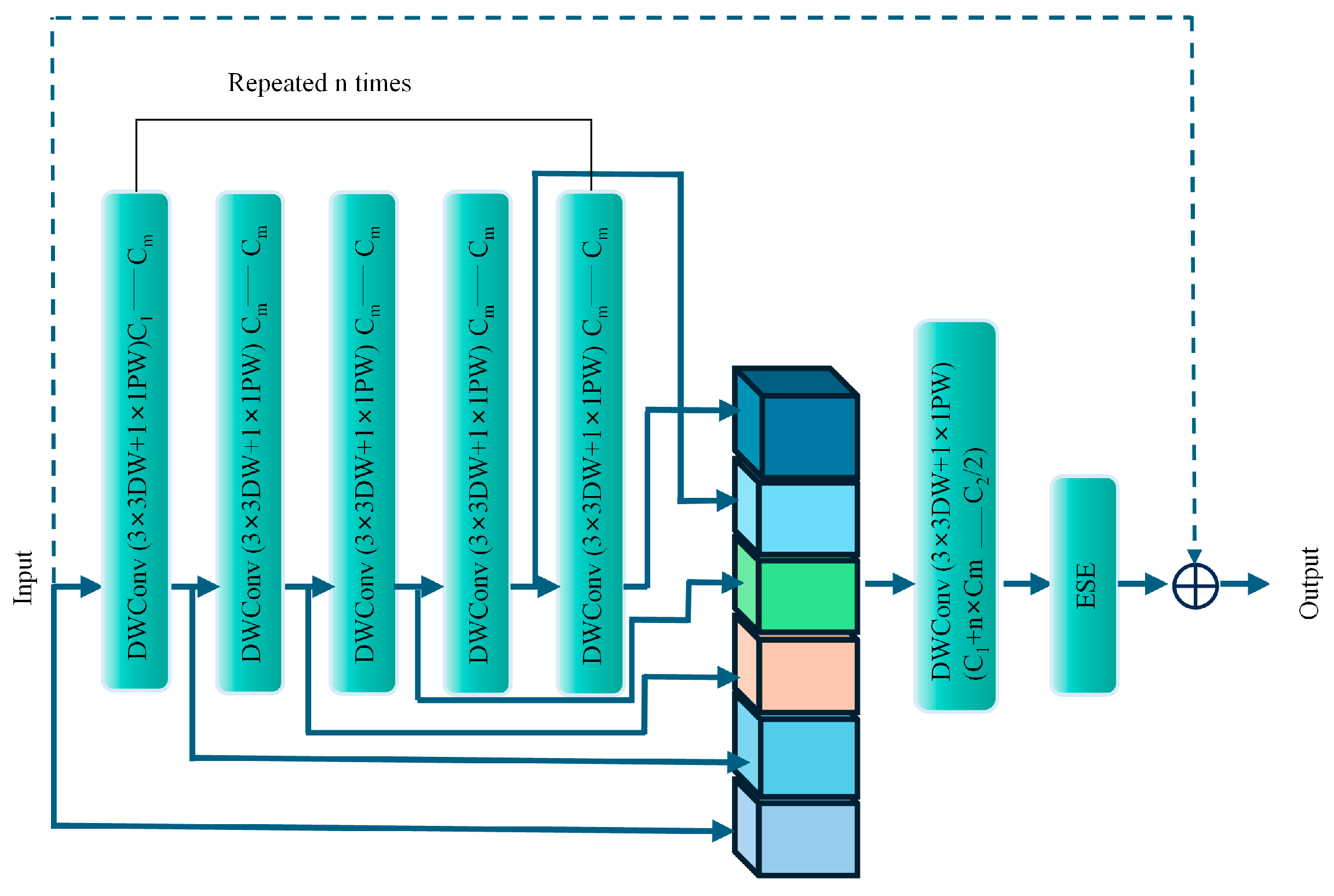

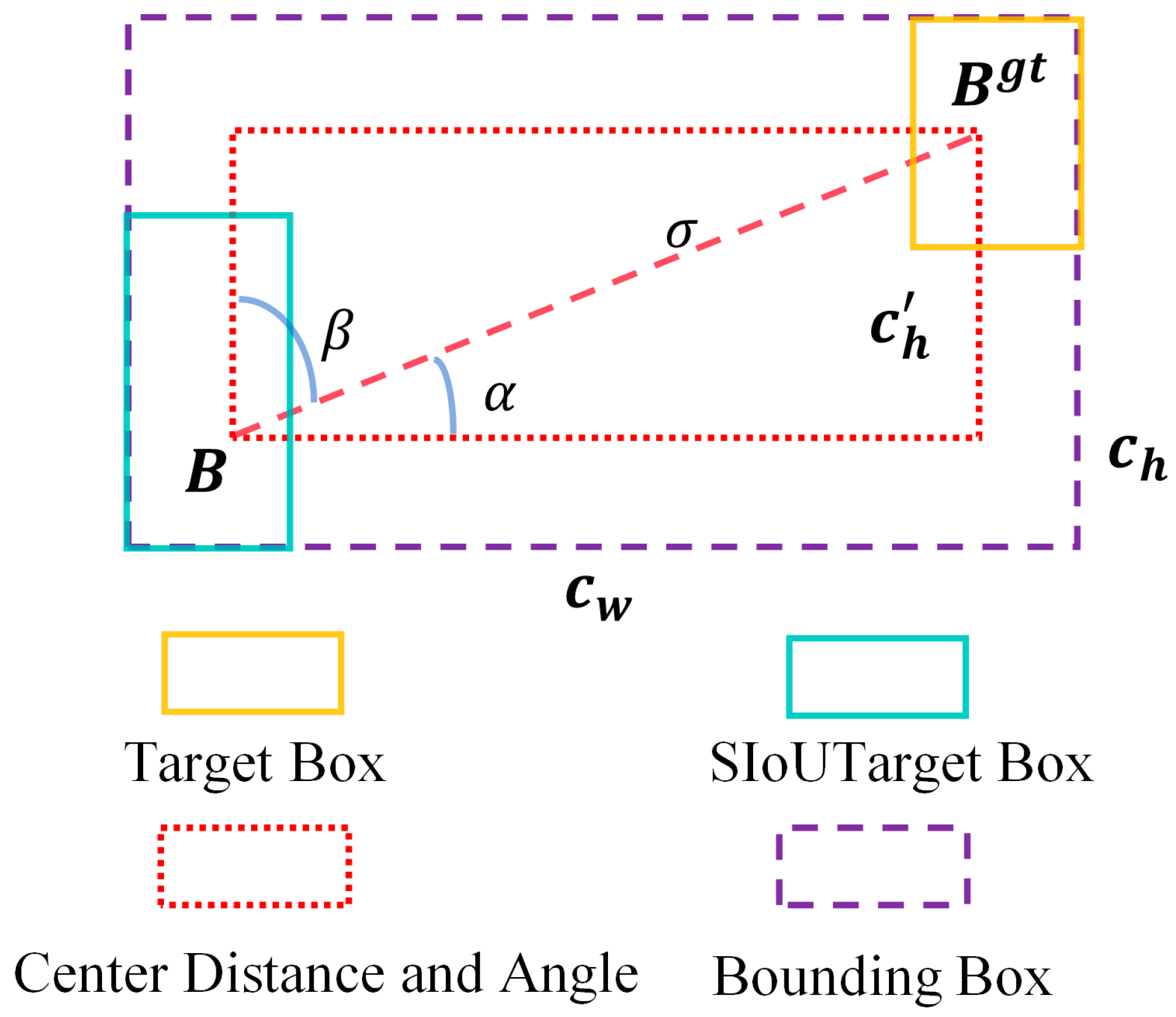
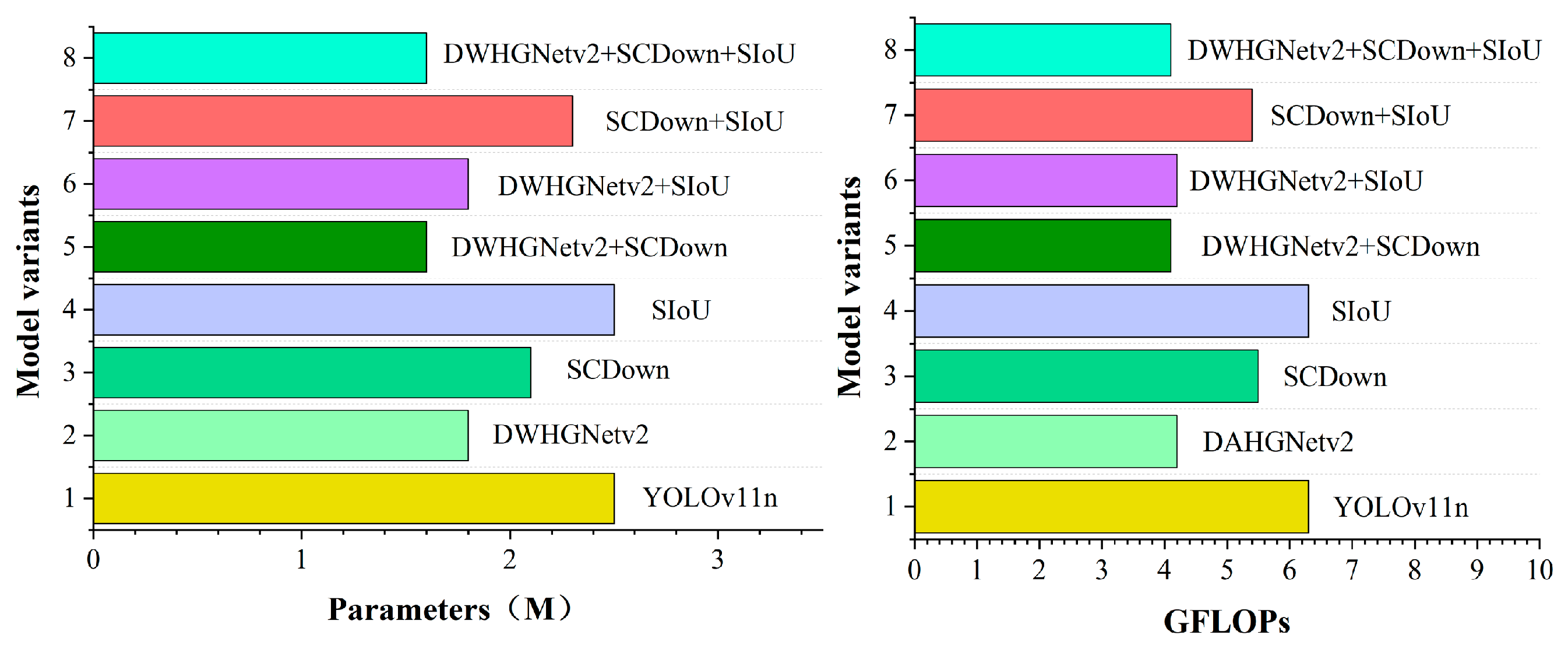
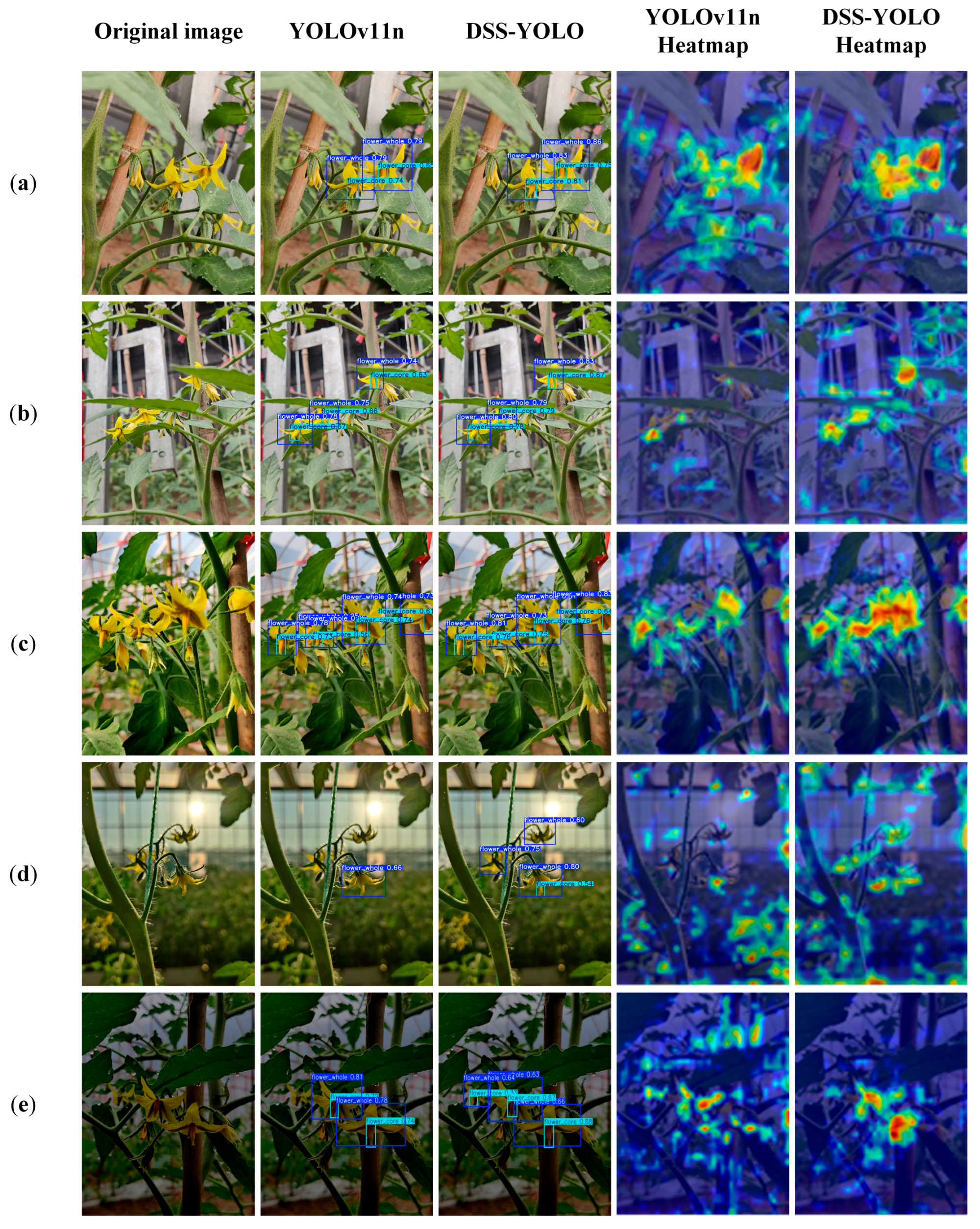

| Parameter | Parameter Value |
|---|---|
| Pointwise convolution | Kernel size: 1 × 1 |
| Deep Convolution | Kernel size: 3 × 3 |
| Downsampling Stride | 2 |
| Padding | 1 |
| Activation function | SiLU |
| Normalization layer | BatchNorm |
| Hyper-Parameters | Set Value |
|---|---|
| Epochs | 150 |
| Batch | 8 |
| Imgsz | 640 |
| Optimizer | SGD |
| Lr0, lrf | 0.01 |
| Weight_decay | 0.0005 |
| Label_smoothing | 0.01 |
| Mosaic | 1.0 |
| close_mosaic | 50 |
| MixUp | 0.2 |
| workers | 8 |
| Test | DWHGNetv2 | SCDown | SIoU | Precision/% | Recall/% | mAP50/% |
|---|---|---|---|---|---|---|
| YOLOv11n | - | - | - | 93.0 | 93.3 | 95.2 |
| A | √ | - | - | 93.5 | 91.7 | 94.6 |
| B | - | √ | - | 93.1 | 93.5 | 95.1 |
| C | - | - | √ | 93.5 | 93.3 | 95.3 |
| A + B | √ | √ | - | 93.3 | 93.6 | 95.4 |
| A + C | √ | - | √ | 93.8 | 92.8 | 95.6 |
| B + C | - | √ | √ | 93.9 | 93.5 | 95.7 |
| A + B + C | √ | √ | √ | 94.1 | 94.3 | 95.9 |
| Mainstream Algorithms | P /% | R /% | mAP50 /% | Weights /MB | Params /M | FLOPs /G | FPS (Frames·s−1) |
|---|---|---|---|---|---|---|---|
| Faster R-CNN | 92.9 | 90.2 | 94.3 | 521.5 | 137 | 370.2 | 10 |
| ShuffleNetV2 | 93.5 | 92.4 | 94.8 | 3.5 | 1.7 | 4.1 | 63 |
| MobileNetV4 | 92.9 | 91.2 | 94.3 | 3.7 | 1.7 | 4.2 | 60 |
| YOLOv3-tiny | 93.4 | 90.5 | 93.7 | 18.2 | 9.5 | 14.3 | 43 |
| YOLOv5n | 93.2 | 94.6 | 95.5 | 4.4 | 2.1 | 5.8 | 53 |
| YOLOv6n | 93.8 | 95.1 | 94.6 | 8.1 | 4.1 | 11.5 | 31 |
| YOLOv8n | 93.2 | 94.1 | 95.4 | 5.3 | 2.6 | 6.8 | 50 |
| YOLOv9-tiny | 92.7 | 95.3 | 95.2 | 3.9 | 1.7 | 6.4 | 53 |
| YOLOv10n | 93.1 | 93.0 | 95.5 | 5.4 | 2.6 | 8.2 | 48 |
| DSS-YOLO | 94.1 | 94.3 | 95.9 | 3.4 | 1.6 | 4.1 | 65 |
| Model | Precision/% | Recall/% | mAP50/% | Weights /MB | Parameters /M | FLOPs /G |
|---|---|---|---|---|---|---|
| ADown | 92.9 | 93.2 | 95.0 | 4.3 | 2.1 | 5.1 |
| SAConv | 92.4 | 92.8 | 94.9 | 7.2 | 3.4 | 4.8 |
| SPDConv | 92.0 | 92.5 | 94.5 | 8.8 | 4.5 | 11.4 |
| SCDown | 93.1 | 93.5 | 95.1 | 4.1 | 2.0 | 5.5 |
| Loss Functions | Precision/% | Recall/% | mAP50/% |
|---|---|---|---|
| GIoU | 93.1 | 93.1 | 94.5 |
| EIoU | 92.5 | 92.8 | 95.3 |
| WIoU | 91.4 | 90.2 | 94.1 |
| SIoU | 93.5 | 93.3 | 95.3 |
Disclaimer/Publisher’s Note: The statements, opinions and data contained in all publications are solely those of the individual author(s) and contributor(s) and not of MDPI and/or the editor(s). MDPI and/or the editor(s) disclaim responsibility for any injury to people or property resulting from any ideas, methods, instructions or products referred to in the content. |
© 2025 by the authors. Licensee MDPI, Basel, Switzerland. This article is an open access article distributed under the terms and conditions of the Creative Commons Attribution (CC BY) license.
Share and Cite
Zhang, S.; Zhang, D.; Zhang, J.; Wang, J.; Zhang, Y.; Fan, X.; Zhou, Y. DSS-YOLO: A Lightweight Flower and Stamen Detection Model for Greenhouse Tomato Pollination Assistance. Agronomy 2026, 16, 67. https://doi.org/10.3390/agronomy16010067
Zhang S, Zhang D, Zhang J, Wang J, Zhang Y, Fan X, Zhou Y. DSS-YOLO: A Lightweight Flower and Stamen Detection Model for Greenhouse Tomato Pollination Assistance. Agronomy. 2026; 16(1):67. https://doi.org/10.3390/agronomy16010067
Chicago/Turabian StyleZhang, Shan, Dongfang Zhang, Jun Zhang, Jiaqi Wang, Yibing Zhang, Xiaofei Fan, and Yuhong Zhou. 2026. "DSS-YOLO: A Lightweight Flower and Stamen Detection Model for Greenhouse Tomato Pollination Assistance" Agronomy 16, no. 1: 67. https://doi.org/10.3390/agronomy16010067
APA StyleZhang, S., Zhang, D., Zhang, J., Wang, J., Zhang, Y., Fan, X., & Zhou, Y. (2026). DSS-YOLO: A Lightweight Flower and Stamen Detection Model for Greenhouse Tomato Pollination Assistance. Agronomy, 16(1), 67. https://doi.org/10.3390/agronomy16010067