Article

Agronomic and Functional Evaluation of Nine Gamma-Irradiated Colored Wheat Mutants for Whole-Crop Forage Production

1
Advanced Radiation Technology Institute, Korea Atomic Energy Research Institute, 29 Geumgu, Jeongeup 56212, Republic of Korea
2
Department of Plant Resources, College of Industrial Sciences, Kongju National University, 54 Daehak-ro, Yesan-eup, Yesan-gun 32439, Republic of Korea
*
Author to whom correspondence should be addressed.
These authors contributed equally to this work.
Agronomy 2026, 16(1), 49; https://doi.org/10.3390/agronomy16010049
Submission received: 12 November 2025 / Revised: 22 December 2025 / Accepted: 23 December 2025 / Published: 24 December 2025
(This article belongs to the Section Farming Sustainability)

Abstract

Wheat (Triticum aestivum L.), a key global cereal for food and feed, is being improved through gamma irradiation to enhance its nutritional and functional value for forage use. This study examined the forage potential and functional traits of gamma-irradiated colored wheat mutants through integrated analyses of agronomic performance, chemical composition, silage quality, and antioxidant capacity. Nine mutant lines (S1–S9), original colored wheat, and two control cultivars, ‘Cheongwoo’ (forage type) and ‘Keumkang’ (bread type), were evaluated under field conditions. Gamma irradiation (200 Gy) broadened phenotypic and biochemical diversity within the colored wheat background, generating genotypes with distinct biomass and compositional profiles. Several lines, particularly S6 and S8, produced high dry matter yields with balanced crude protein and fiber contents comparable to ‘Cheongwoo’ while maintaining optimal fiber levels for ruminant feeding. Most mutants showed stable fermentation and buffering properties, indicating that radiation-induced variation did not impair silage quality. Antioxidant analyses revealed clear genotypic variation, with the S3 and S1 lines exhibiting elevated phenolic and anthocyanin contents associated with strong radical scavenging activity. Overall, gamma irradiation proved to be an effective approach for generating colored wheat lines with enhanced agronomic performance and functional value, highlighting S3 as a promising dual-purpose whole-crop forage candidate.

1. Introduction

Wheat (Triticum aestivum L.) is the world’s second most produced cereal after maize, and its production and consumption are central to global food and feed systems. In recent years, global challenges such as climate change, population growth, and the COVID-19 pandemic have intensified pressures on food security and sustainable agricultural production [1]. Wheat farming is a complex, dynamic sector of global agriculture, shaped by environmental and human factors. Achieving sustainable and productive wheat systems is crucial for meeting growing food and feed demands while minimizing environmental impacts.
Wheat is a nutritionally rich, containing carbohydrates, proteins, fibers, and minerals [2,3]. It serves as both a human staple and a key livestock feed resource [4,5]. As forage, wheat provides energy that supports healthy animal growth and metabolism through highly digestible proteins and carbohydrates. Whole-crop wheat forage, which utilizes leaves, stems, and spikes, offers a sustainable and resource-efficient feed option within integrated crop–livestock systems [6].
Whole-crop wheat is typically preserved as silage. Proper ensiling involves chopping fresh biomass into small pieces, compacting to remove oxygen, and maintaining adequate moisture to promote anaerobic fermentation. During ensiling, soluble sugars convert to organic acids, such as lactic acid, which reduce pH and stabilize the material. Excess moisture can impair fermentation and yield undesirable by-products. Under optimal conditions, well-fermented silage retains nutritional quality for months and ensures long-term feed preservation [7].
Colored wheat cultivars have garnered attention for their nutritional and functional benefits compared with conventional white wheat. Pigmented lines, such as purple, blue, or black wheat, contain high concentrations of anthocyanins (potent antioxidants that help support human and animal health) and are often rich in other phytochemicals, including dietary fiber, vitamins, and minerals [8,9,10]. Black wheat with high anthocyanin content can act as a natural colorant, adding color and health-promoting value in food processing [11]. Consumers are increasingly drawn to unique products, and colored wheat-based foods have the potential to gain market advantage. These cultivars are also expected to influence future crop improvement and dietary innovation in plant breeding.
Although wheat is a valuable feed crop, the coarse awns on spikes reduce livestock palatability, limiting its direct forage use. Radiation breeding, a long-established technique, accelerates cultivar development using physical mutagens to induce useful mutations affecting traits such as flower and color, beneficial metabolite production, maturity, and adaptability to cultivation environments [12,13]. In bread wheat (Triticum aestivum L.), gamma irradiation has generated novel phenotypes with altered morphology, enhanced metabolite profiles, and improved agronomic traits without requiring transgenic modification [14,15]. Such mutagenesis shortens breeding cycles and broadens genetic diversity by creating beneficial mutations associated with morphology, metabolism, and stress tolerance. Therefore, radiation breeding offers an efficient strategy for generating phenotypic diversity and expanding crop improvement potential.
In this study, colored wheat mutant lines were developed through gamma irradiation and field selection, displaying diverse phenotypes favorable for forage use. Two commercial cultivars served as benchmarks: ‘Cheongwoo’, a forage-type wheat bred for high biomass, and ‘Keumkang’, a bread-type wheat widely cultivated in Korea. The study aimed to evaluate the forage potential of colored wheat mutants through comparative analyses of agronomic traits, chemical composition, silage fermentation characteristics, and antioxidant capacity. Overall, this research provides an initial assessment of the potential of colored wheat mutants as novel feed resources combining nutritional functionality with acceptable forage quality. Although the study is exploratory, its findings will help identify promising genetic materials for the improvement of functional forage wheat, with broader implications for enhancing livestock nutrition, optimizing feed formulation, and guiding future breeding strategies for dual-purpose cereal crops. future improvement of functional forage wheat.

2. Materials and Methods

2.1. Plant Materials and Agronomic Traits

Deep-purple-grained wheat seeds were used as the original plant materials for gamma irradiation. Colored wheat seeds were irradiated with 200 Gy for 8 h using a 60Co gamma irradiator (150 TBq capacity; Nordion, Ottawa, ON, Canada) at the Korea Atomic Energy Research Institute [10]. From the mutagenized population, 1069 M7 mutant lines were initially obtained, and these were advanced through successive generations with continuous phenotyping screening. Based on stable inheritance of key traits–such as increased plant height, awnlessness, culm strength, and consistent biomass productivity–nine promising mutant lines were ultimately selected for evaluation in this study. These lines, advanced through successive generations to trait fixation, were evaluated at the M11 generation (S1–S9). Two reference cultivars were included for comparison: ‘Keumkang’ (bread-type) and ‘Cheongwoo’ (forage-type).
Field trials were conducted over two consecutive growing seasons (2021–2022 and 2022–2023) at the Korea Atomic Energy Research Institute experimental field (35.5699° N, 126.9722° E; Jeongeup-si, Jeollabuk-do, Republic of Korea) (Supplementary Tables S1 and S2). All genotypes were sown in mid-October under standard local cultivation practices. Each genotype was grown in three biological replicates, each consisting of five rows (1.5-m-long, with 40 cm between rows). The experimental layout was arranged sequentially by line identity and maintained consistently to minimize environmental variation. Agronomic traits were systematically evaluated. Heading date was recorded when ≥50% of plants in a plot exhibited fully emerged spikes. Plant height was measured from the soil surface to the base of the spike, excluding awns. Spike length was recorded from the first to terminal spikelet. Collected biomass was used for subsequent agronomic and forage-quality assessments.

2.2. Plant Sampling

For forage-quality analysis, samples were collected at the milk stage (Zadoks Code DC 75-77) [16]. Harvested plants were processed via two treatments: (1) hay, prepared by air-drying whole plants to ~85% dry matter and (2) silage, prepared by ensiling fresh chopped plants as described below. All samples were processed and analyzed for forage value characteristics.

2.3. Preparation of Hay and Silage Samples

For hay, whole plants were oven-dried at 65 °C for ≥72 h in a forced-air dryer. Dry matter content was determined from dry weight (DW). Dried materials were then ground using a mill for analysis. For silage, harvested plants were chopped to ~1.5 cm in length and ensiled in plastic jars without additives. Samples were stored in the dark at 22–24 °C for 60 days to allow anaerobic fermentation. After fermentation, jars were opened, and subsamples were collected for pH and chemical composition analyses.

2.4. Chemical Composition Analysis

Hay and silage samples were analyzed for chemical composition. A pH meter was used to measure pH (SevenCompact, Mettler Toledo, Greifensee, Switzerland). Crude protein, ash, and fiber levels were determined following Association of Official Analytical Chemists procedures [17]. Crude ash was obtained via incineration at 550 °C for 3 h. Water-soluble carbohydrates were measured via the anthrone assay [18]. Neutral detergent fiber (NDF) and acid detergent fiber (ADF) levels were quantified using the method of Van Soest et al. [19]. Total digestible nutrients (TDNs) and relative feed values (RFVs) were calculated using standard equations based on fiber composition.

2.5. Additional Analysis of Hay Samples

Structural carbohydrate composition of hay was further evaluated by calculating cellulose, hemicellulose, and lignin contents from NDF, ADF, and acid detergent lignin fractions, as described by Van Soest et al. (1991) [19]. Total flavonoid content was determined using the aluminum chloride colorimetric method. Absorbance was measured at 510 nm using a spectrophotometer (Evolution 260 Bio, Thermo Scientific, Waltham, MA, USA), and results were expressed as quercetin equivalents (mg quercetin g−1 DW).

2.5.1. Extraction and Quantification of Antioxidant Components

Powdered wheat samples were extracted with 10 mL of 80% methanol via sonication in an ultrasonic bath at 25 °C for 30 min, maximizing the release of soluble metabolites. Extracts were filtered through 0.45-µm syringe filters, and filtrates were stored at −20 °C until analysis. These methanolic extracts were used for antioxidant activity, total phenolic content (TPC), and flavonoid concentration assays.

2.5.2. Evaluation of Antioxidant Activity

Antioxidant potential was assessed using 2,2′-azino-bis (3-ethylbenzothiazoline-6-sulfonic acid) (ABTS), 2,2-diphenyl-1-picrylhydrazyl (DPPH), ferric reducing antioxidant power (FRAP), and total antioxidant capacity assays. For ABTS radical scavenging, the radical (ABTS•+) solution was generated by reacting 7 mM ABTS with 2.45 mM potassium persulfate and incubating the mixture in darkness for 12 h, followed by dilution with 80% methanol to an absorbance of 0.70 ± 0.02 at 734 nm. A 10 µL extract aliquot was mixed with 190 µL of ABTS•+ solution, and absorbance was read at 734 nm after 6 min.
For DPPH, 0.2 mL of extract was combined with 3.8 mL of DPPH solution and incubated in darkness at 24 °C for 30 min. Absorbance was measured at 517 nm using a UV–Vis spectrophotometer. Radical scavenging activity (%) was calculated as follows:
[(AcontrolAsample)/Acontrol] × 100,
where Acontrol represents blank absorbance and Asample is extract absorbance.
FRAP was measured using a commercial kit (Sigma-Aldrich, St. Louis, MO, USA) following the manufacturer’s protocol, with the reaction conducted at 37 °C. Absorbance was monitored at 595 nm kinetically for 60 min using a microplate reader (Bio-Rad, Hercules, CA, USA). Results were expressed as millimoles of Fe2+ equivalents.
Total antioxidant capacity was quantified using the Cu2+-reducing method (MAK187, Sigma-Aldrich). Briefly, 10 µL of extract was reacted with 10 µL of 50× diluted Cu2+ reagent and incubated for 90 min in darkness at room temperature. Absorbance was measured at 570 nm, and total antioxidant capacity was expressed as Trolox equivalents based on a standard calibration curve.

2.5.3. Determination of TPC

TPC was measured using a phenolic compound assay kit (MAK365, Sigma-Aldrich) following the manufacturer’s instructions. A mixture containing 40 µL of extract, 20 µL of phenolic probe, and 80 µL of assay buffer was incubated for 10 min at room temperature. Absorbance was read at 480 nm, and phenolic concentration was calculated using a catechin standard curve.

2.5.4. Measurement of Total Anthocyanin Content

Total anthocyanin content was determined spectrophotometrically following the method of Hong et al. [10] with modifications. Briefly, 0.5 g of homogenized wheat grains was extracted with 10 mL of acidified methanol (containing 1% HCl, w/v) and incubated at 4 °C in darkness for 24 h. Extracts were centrifuged at 14,000 rpm for 20 min at 4 °C, with supernatants then filtered through a 0.2 μm syringe filter. Absorbance was measured at 530 and 657 nm using a UV–Vis spectrophotometer (Evolution 260 Bio, Thermo Scientific, Waltham, MA, USA). Total anthocyanin concentration was calculated as follows:
Q = (A530 − 0.25A657) × M−1,
where Q is total anthocyanin concentration; A530 and A657 are absorbances at 530 and 657 nm, respectively; and M denotes sample weight (g).

2.6. Additional Analysis of Silage Samples

The buffering capacity of ground wheat plants was measured following Playne and McDonald (1966) [20]. Briefly, 20 g of sample was mixed with 80 mL of distilled water maintained at 4 °C for 18 h, and then filtered, after which pH was measured using a glass electrode pH meter (SevenCompact, Mettler Toledo, Greifensee, Switzerland).
Organic acids were quantified after homogenizing ~2 g of silage sample with 4 mL of distilled water, incubating the mixture for 24 h at room temperature, centrifuging at 4500 rpm for 20 min, and filtering the supernatant through a 0.2 μm membrane. Filtrates were analyzed using high-performance liquid chromatography (HPLC; Waters 1260, Waters Corporation, Milford, MA, USA), and acetic acids were quantified via gas chromatography (GC-17A, Shimadzu, Tokyo, Japan). Organic acids (acetic, lactic, and malic acids) and soluble sugars (fructose and glucose) were measured via HPLC (LC20A, Shimadzu, Tokyo, Japan).

2.7. Statistical Analysis

All statistical analyses were performed to evaluate variation among mutant lines and control varieties. Data are presented as mean ± standard error (SE) based on three independent biological replicates. One-way analysis of variance (ANOVA) was conducted to test for differences among genotypes, and mean separation was performed using Duncan’s multiple range test at the 0.05 significance level. To verify the validity of parametric inference, statistical assumptions were further examined in R software (version 4.3). For each trait, residuals from the ANOVA model (Trait~Genotype) were subjected to the Shapiro–Wilk test to assess normality and to the Brown–Forsythe version of Levene’s test to assess homogeneity of variances. Traits that met both assumptions (Shapiro–Wilk p > 0.05 and Levene’s test p > 0.05) were analyzed using parametric ANOVA followed by Duncan’s test. If either assumption was violated, or if the residual distribution deviated from normality, the trait was reanalyzed using the non-parametric Kruskal–Wallis test. Traits exhibiting identical values across all observations were excluded from statistical testing. All test statistics and p-values—including results from the Shapiro–Wilk test, Levene’s test, and Kruskal–Wallis analysis—are provided in Supplementary Table S3 and were used to determine whether a parametric or non-parametric approach was applied for each trait.

3. Results

3.1. Phenotypic Variation and Morphological Diversity Among Mutant Lines

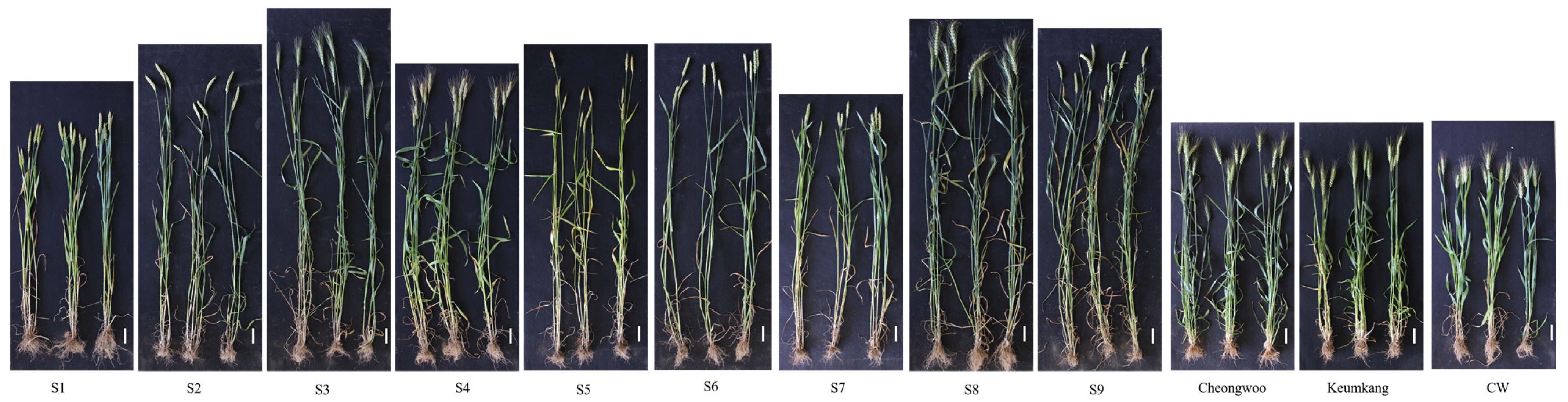
Significant morphological variation was observed among colored wheat mutant lines (S1–S9), original colored wheat (CW), and control cultivars (‘Cheongwoo’ and ‘Keumkang’) across growth and developmental stages. These nine mutant lines were selected from a larger irradiated population based on their suitability for forage use, as demonstrated through multi-year field evaluations. Specifically, lines exhibiting tall plant stature, awnless or reduced-awn spikes, strong culm structure, and stable grain and biomass productivity were prioritized, as these traits are essential for improving whole-crop forage yield and handling efficiency. Overall growth progression highlighted clear differences in canopy vigor, tillering, and maturation among genotypes (Supplementary Figure S1). Representative whole-plant morphology at heading emphasized differences in culm robustness and plant architecture (Figure 1), and spike morphological assessment at the same stage revealed variation in awn length, spike compactness, and overall inflorescence structure (Supplementary Figure S2). Quantitative comparisons of plant height and spike length showed that all mutant lines were taller than ‘Cheongwoo’, ‘Keumkang’, and CW, with S8 exhibiting the greatest plant height (Table 1). All three control cultivars (‘Cheongwoo’, ‘Keumkang’, and CW) showed consistently shorter spike lengths compared with the mutant lines, whereas S8 displayed the longest spikes among all genotypes (Table 1). At maturity, mutants displayed distinct variations in height, leaf color, and senescence compared with CW and control cultivars. Grains showed a wide range of pigmentations (from deep purple to light brown) and sizes among mutants, reflecting gamma irradiation-induced phenotypic diversity (Supplementary Figure S3).

3.2. Biomass Productivity and Dry Matter Characteristics

Significant differences were observed among the mutant lines, CW, and control cultivars in fresh weight (FW), dry weight (DW), and the FW/DW ratio (Table 2). Most mutants produced FW comparable to ‘Cheongwoo’, excluding S2 and S3 along with CW, which showed lower biomass accumulation. ‘Cheongwoo’ and ‘Keumkang’ recorded the highest FW and were similar, reflecting vigorous vegetative growth and canopy development under field conditions. For DW, S8 had significantly higher values relative to all other entries, indicating higher structural biomass accumulation. Other mutants generally exhibited intermediate DW, comparable to the controls. Variation in DW among mutants indicates that gamma irradiation introduced diversity in biomass productivity within the colored wheat background. The FW/DW ratio was highest in ‘Cheongwoo’ and ‘Keumkang’, consistent with their higher moisture content and lower tissue density, whereas S8 had the lowest ratio, reflecting a higher proportion of dry matter. Differences in FW/DW ratios among mutants indicate varying water retention and tissue composition, influencing their suitability for forage or silage. Collectively, these results demonstrate substantial variation in biomass traits among the gamma-irradiated mutants, CW, and control cultivars.

3.3. Composition of Hay-Type Forage

Significant differences were observed among the mutant lines, CW, and control cultivars across major compositional parameters (Table 3). Crude protein content varied among genotypes: S9 and S1 had the highest and lowest mean values, respectively, with S9 levels exceeding those of the controls. Crude fiber content ranged widely, with S8 and S1 showing the highest and lowest values, respectively, and ‘Cheongwoo’ and ‘Keumkang’ near the group average. Crude ash content also varied, with S8 and S9 accumulating the most minerals, whereas S1, S3, and S7 accumulated the least. Carbohydrate content differed slightly among lines, although most mutants exhibited levels similar to the controls.
For fiber-related traits, mean NDF was highest in S3 and S8 and lowest in ‘Cheongwoo’. ADF followed a similar trend, with values higher in S3, S8, and S9 than in ‘Cheongwoo’; S1 and S4 exhibited the lowest values. Mean RFV varied among genotypes, with S4 and ‘Cheongwoo’ displaying the highest values and S3 and S8 the lowest. TDNs showed minor differences, despite some grouping into distinct statistical subsets, indicating relatively consistent nutrient availability across entries. Overall, these results demonstrate that gamma irradiation generated substantial phenotypic diversity in compositional and fiber-related traits, providing a valuable genetic basis for selecting lines optimized for forage quality and nutrition.
Significant differences were detected in cellulose, hemicellulose, and lignin content as well as pH (p < 0.05; Table 4). Mean cellulose content was highest in S8 and S9, similar to ‘Cheongwoo’, with ‘Keumkang’ exhibiting the lowest content. Mutants S1 and S7 had intermediate cellulose levels comparable to control levels. Mean hemicellulose content also varied across genotypes, with S2, S3, S7, and S8 having higher levels than control levels, whereas ‘Keumkang’ and CW showed the lowest content. Mean lignin concentrations showed minor variation across lines, although S3, S5, S7, and S8 levels were slightly elevated, and ‘Keumkang’ had the lowest levels.
Hay-type of whole-crop forage pH was stable across genotypes (5.9–6.1), with minor statistical differences; all entries-maintained pH levels suitable for proper fermentation. Collectively, these findings indicate that gamma irradiation produced modest but measurable differences in structural carbohydrate composition among colored wheat mutants, whereas overall ensiling characteristics remained uniform across mutants.

3.4. Composition of Silage-Type Forage

The mutant lines, CW, and control cultivars exhibited clear variation in major silage composition parameters (Table 5). Crude protein content differed significantly among genotypes, with S3 and S6 showing the highest mean levels, forming a distinct statistical group separated from ‘Cheongwoo’. Crude fiber content did not differ significantly among genotypes, although S3 and S5 had slightly higher mean values compared with the control cultivars. Crude ash content also showed no statistical differences, but CW, S3, and S6 presented relatively higher mean values to the other entries. Carbohydrate content was statistically uniform across genotypes, although S5 showed the highest mean concentration. NDF content showed no significant variation among genotypes, despite S5 and ‘Keumkang’ exhibiting notably high and low mean values, respectively. Mean ADF content was slightly higher in S5 than in ‘Cheongwoo’, suggesting greater structural fiber accumulation. RFVs were statistically comparable among genotypes, although ‘Keumkang’ exhibited a notably higher mean value within the same statistical subset as other entries. Finally, TDN content showed minimal variation across genotypes, with nearly uniform means among entries; only S5 formed a separate statistical subset, deviating slightly from the overall trend. Collectively, these results showed that gamma irradiation-induced mutants display moderate diversity in nutritional traits while maintaining silage quality comparable to that of the control cultivars.

3.5. Fermentation Characteristics of Silage

The mutant lines, CW, and control cultivars exhibited distinct variation in major silage fermentation traits (Table 6). Glucose concentration showed clear grouping patterns among genotypes, with only S1 clustering with ‘Cheongwoo’, ‘Keumkang’, and CW, whereas the other mutants formed a separate group with significantly lower mean glucose levelsFructose concentrations also differed significantly; CW and all mutants (S1–S9) formed a lower statistical subset compared with ‘Cheongwoo’ and ‘Keumkang’, which had higher mean fructose levels. Lactic acid content varied notably among genotypes, as S2, S3, and S4 clustered with ‘Cheongwoo’, showing higher mean concentrations, whereas S6 and S8 had lower values. Silage pH differed significantly among genotypes, with S6 and S8 in higher subsets, whereas ‘Cheongwoo’, ‘Keumkang’, and CW were grouped into the lowest. Acetic acid content showed clear statistical differences: ‘Cheongwoo’ exhibited the highest mean value, forming a distinct upper subset, whereas all other genotypes were grouped into lower subsets. Citric acid content did not differ significantly among genotypes, although ‘Keumkang’ had the highest mean value. Finally, malic acid content showed no significant differences, but ‘Cheongwoo’ displayed the highest mean value. These results indicate variable sugar and acid metabolism among genotypes, with mutants generally showing reduced fermentable sugar content compared with controls.

3.6. Buffering Capacity Parameters of Silage

The mutant lines, CW, and control cultivars exhibited marked variation in buffering capacity parameters (Table 7). Acid buffering capacity (aBC) differed substantially among genotypes, with S8 exhibiting the highest value, followed by S6, highlighting their enhanced resistance to pH decline under acidic conditions. ‘Cheongwoo’, ‘Keumkang’, and CW showed undetectable aBC levels, suggesting minimal acid-neutralizing potential. Similarly, S4 and S9 had near-zero aBC values, comparable with the control cultivars, indicating that only a few mutants retained measurable acid buffering capacity. Basic buffering capacity (bBC) did not differ significantly among genotypes, despite evident numerical differences. S4 exhibited a mean bBC similar to that of ‘Cheongwoo’, highlighting its resistance to alkaline conditions, whereas S6 and S8 had the lowest mean bBC values. Total buffering capacity followed a similar trend, with S4 and S6 exhibiting the highest and lowest mean values, respectively, although differences were not significant.

3.7. Antioxidant Properties of Hay from Mutant and Control Wheat Lines

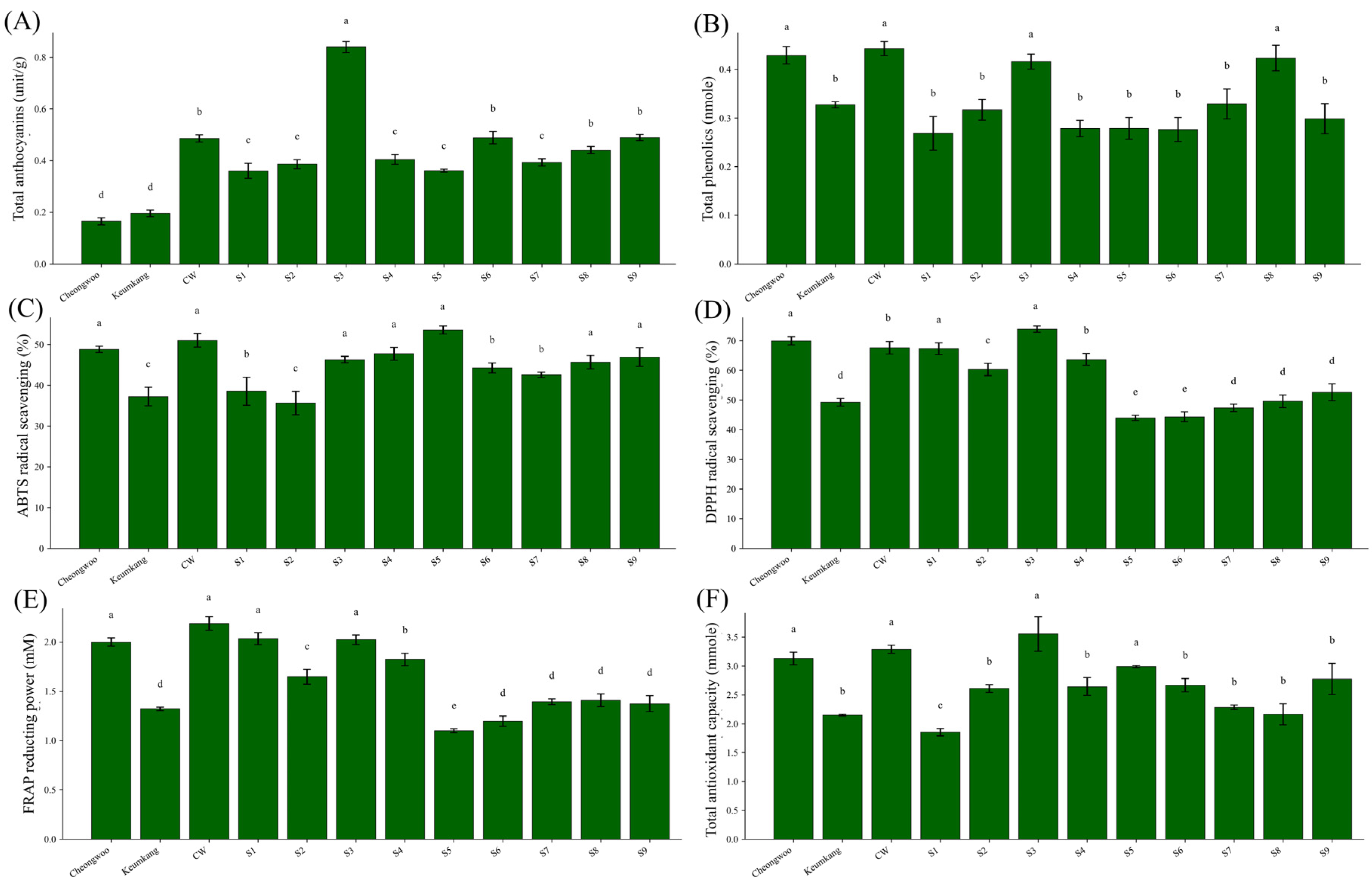
The mutant lines, CW, and control cultivars displayed substantial differences in antioxidant characteristics (Figure 2A–F). Total anthocyanin content (Figure 2A) differed distinctly among genotypes, with CW and the derived mutant lines grouped separately from the control cultivars. Among these, S3 had the highest mean total anthocyanin content, forming a distinct upper subset, whereas ‘Cheongwoo’ and ‘Keumkang’ exhibited the lowest. TPC (Figure 2B) varied significantly among genotypes; ‘Cheongwoo’, CW, S3, and S8 showed the highest values, whereas ‘Keumkang’ and the remaining mutants formed lower subsets with reduced phenolic content. ABTS radical scavenging activity (Figure 2C) showed a similar pattern, with CW and several mutant lines exhibiting activities comparable to ‘Cheongwoo’, placing them in the upper subset, whereas ‘Keumkang’ and S2 showed the lowest scavenging capacities. For DPPH radical scavenging activity (Figure 2D), S1 and S3 showed similarly high scavenging potential, shared with ‘Cheongwoo’, whereas ‘Keumkang’ and S5–S9 formed the lowest statistical subsets. FRAP reducing power (Figure 2E) was significantly stronger in ‘Cheongwoo’, CW, S1, and S3 compared with ‘Keumkang’ and S5–S9. Although total antioxidant capacity (Figure 2F) did not differ significantly among genotypes, S3 had a slightly higher mean value relative to ‘Cheongwoo’ and CW, suggesting enhanced antioxidant potential. Overall, the mutants displayed substantial biochemical diversity in antioxidant composition and activity, reflecting physiological differentiation due to gamma irradiation.

4. Discussion

This study evaluated the forage and silage potential of gamma irradiation-induced colored wheat mutant lines through an integrated assessment of agronomic performance, compositional traits, fermentation quality, and antioxidant capacity. Gamma irradiation is a proven mutagenic approach for increasing genetic variability and accelerating novel phenotype development in cereal crops, including wheat. The mutant population examined in this study displayed diverse morphological and biochemical variations relevant to whole-crop utilization. Compared with the forage-type control cultivar ‘Cheongwoo’, several mutants showed equal or superior performance in biomass accumulation and compositional quality while maintaining acceptable fermentation and antioxidant profiles. These results demonstrate that physical mutagenesis derived from gamma irradiation can induce marked phenotypic diversity without transgenic modification, offering a valuable resource for developing functional forage wheat germplasm that combines nutritional and agronomic advantages. Unlike chemical mutagens or targeted genome-editing approaches, gamma irradiation generates a wide spectrum of random mutations with relatively stable inheritance, enabling the discovery of novel allelic variations that may not be accessible through conventional breeding. Although the approach requires extensive phenotypic screening to identify desirable traits, its non-transgenic nature and broad mutational coverage make it a practical and environmentally acceptable tool for crop improvement, particularly in developing functional forage wheat lines.
The pronounced variation in fresh and dry biomass among the colored wheat mutants reflects genetic and physiological heterogeneity caused by gamma irradiation. Consistent with previous studies on radiation-mutagenized cereals, gamma treatment can create considerable variability in vegetative growth- and structural development-related traits [21,22]. Several mutant lines achieved dry matter yields equal to or exceeding the forage-type control ‘Cheongwoo’, suggesting that mutagenesis did not compromise biomass productivity. Notably, S8 accumulated significantly greater DW relative to the controls, likely due to enhanced stem robustness and increased assimilate partitioning to structural tissues. Similar observations were made in soybean, where Rogers et al. [23] reported that forage-type genotypes produced significantly more stem biomass compared with grain-type cultivars.
The lower FW/DW ratio observed in S8 further indicates a higher structural dry matter proportion and reduced water content, traits desirable for silage production, as excessive moisture can hinder fermentation [24,25]. Conversely, ‘Cheongwoo’ and ‘Keumkang’ exhibited higher FW/DW ratios, reflecting greater moisture retention and softer tissue composition, which favor palatability in fresh forage but reduce long-term silage stability. Therefore, variation in water retention and tissue density among mutants may indicate distinct utilization potential, i.e., lines with higher DW and lower FW/DW ratios may suit silage production, whereas those with higher FW may be better suited for green-forage systems. Overall, these findings suggest that gamma irradiation-induced variation in biomass productivity and dry matter composition provides a foundation for selecting highly adaptable colored wheat mutants with biomass traits suited to forage or silage applications.
To further evaluate the mutants’ potential as hay-type whole-crop forage resources, proximate and fiber compositions were analyzed relative to the forage-type control ‘Cheongwoo’ and bread-type control ‘Keumkang’. Substantial differences in crude protein levels, fiber fractions, and mineral content among genotypes indicated that gamma irradiation effectively induced metabolic and structural diversity within the colored wheat background. Crude protein content strongly influences forage nutritional value and digestibility [25]. Several mutants, particularly S9, exhibited crude protein concentrations comparable to or higher than those of ‘Cheongwoo’, implying that certain radiation-induced lines can maintain adequate protein content despite altered plant architecture. Similar protein variation has been reported among gamma irradiation-induced cereal mutants, where mutagenesis affects nutrient uptake, utilization efficiency, and storage protein allocation [22,26,27].
S8 exhibited the highest crude fiber and NDF levels, along with elevated cellulose and hemicellulose contents, indicating increased structural carbohydrate accumulation. Although high fiber levels can reduce digestibility, moderate increases in NDF and cellulose contents have been linked to improved standability and biomass stability in whole-crop forage systems. Prior studies have shown that NDF digestibility depends on cell wall composition and lignin biosynthesis [28,29]. The high cellulose and lignin concentrations observed in several mutants (e.g., S3, S7, and S8) suggest carbon partitioning toward secondary cell wall formation, potentially linked to delayed senescence and enhanced biomass resilience. These compositional modifications may influence forage digestibility and silage fermentation, as cellulose and lignin determine fiber-bound nutrient availability and microbial degradation [30].
‘Cheongwoo’ maintained balanced fiber and crude protein levels, yielding a high RFV, consistent with its known forage performance. Conversely, mutants with elevated structural fiber content (e.g., S8) displayed reduced RFVs but higher dry matter concentrations, improving their ensiling suitability. The similarity in TDNs and stable forage pH across all lines indicates that radiation-induced modification of structural carbohydrate composition did not negatively affect overall nutritional balance or fermentability. Collectively, these findings show that gamma irradiation generates valuable variation in forage-related traits, ranging from high-protein to high-fiber phenotypes, thereby broadening the genetic base for developing colored wheat cultivars optimized for specific forage purposes.
To determine whether gamma-irradiated colored wheat lines could also serve as silage resources, their nutrient composition, fermentation characteristics, and buffering capacities were compared with those of ‘Cheongwoo’ and ‘Keumkang’. Overall, the mutants maintained silage nutritional profiles similar to control cultivar profiles, indicating that radiation-induced mutations did not compromise ensiling potential. Crude protein and carbohydrate levels were largely consistent across genotypes; thus, substrates essential for fermentation, primarily soluble sugars and degradable nitrogen, remained within an optimal range for lactic acid fermentation [7,31]. Some mutants, such as S3 and S6, exhibited elevated crude protein levels that may enhance microbial activity during early fermentation, whereas S5, despite slightly higher structural fiber fractions (NDF and ADF), maintained acceptable RFVs. These findings align with previous reports that adequate fermentable carbohydrate and nitrogen availability ensures efficient lactic acid fermentation and stable silage quality in forage crops [32,33].
Fermentation acid profile analysis revealed clear genotype-specific patterns. S2–S4 showed higher lactic acid accumulation comparable to that of ‘Cheongwoo’, indicating efficient fermentation and adequate sugar supply [34,35]. In contrast, S6 and S8 exhibited higher silage pH and lower lactic acid content, highlighting slower acidification and reduced microbial efficiency [36]. ‘Cheongwoo’ produced abundant acetic acid, often linked to improved aerobic stability, whereas most mutants generated lower levels, consistent with a more homofermentative profile favoring short-term preservation but offering less protection against aerobic spoilage [37,38]. These findings align with prior studies showing that lactic acid bacteria inoculation or inherent genotype differences can shape organic acid balance and stability in wheat and corn silage.
Buffering capacity measurements supported these interpretations. S6 and S8 showed markedly higher aBC, reflecting greater resistance to pH change that could slow acidification during early fermentation. Similar outcomes have been reported for fermented feedstuffs, where higher buffering capacity delayed pH decline [39]. Conversely, most mutants, including S1, S4, and S9, showed near-zero aBC values comparable to those of ‘Cheongwoo’ and ‘Keumkang’, indicating lower resistance to acid change and faster pH reduction, favoring more stable preservation. This finding is supported by prior research showing that lower forage buffering capacity is associated with faster pH decline during ensiling [40]. Collectively, these results indicate that most gamma-irradiated colored wheat lines retained desirable silage fermentation characteristics, although some physiological differences were evident. S3 and S6 combined higher crude protein content with stable fermentation, showing potential for dual-use systems, whereas lines with elevated buffering capacity, e.g., S8, may require co-ensiling with more fermentable crops. Nevertheless, considering the broader objective of identifying whole-crop forage candidates, most mutants (particularly those with high dry matter and moderate fiber content) appear better suited for fresh or dried forage rather than silage-specific applications.
Analysis of antioxidant profiles among the gamma-irradiated colored wheat lines revealed marked genotypic variation in anthocyanin accumulation, phenolic content, and radical scavenging activity, reflecting substantial mutation-induced metabolic diversification. All colored wheat lines, including the original line and its derived mutants, were clearly separated from nonpigmented control cultivars, confirming stable expression of pigmentation through successive mutation generations. This is consistent with reports that seed color and anthocyanin-rich phenotypes remain heritable in wheat. Retention of anthocyanin biosynthetic capacity aligns with previous findings showing that colored wheats maintain stable anthocyanin profiles and that processing or environmental factors may alter quantitative phenolic levels without suppressing pigment pathways [41,42].
Moreover, studies in cereals have further demonstrated that gamma irradiation can alter grain phenolic composition, increasing bound phenolic acids or modifying phenolic fractions while leaving anthocyanin biosynthesis largely intact, indicating that irradiation primarily changes quantitative profiles rather than eliminating pigmentation potential [43,44]. Among the mutants, S3 exhibited the highest total anthocyanin and phenolic levels, along with superior antioxidant activity across ABTS, DPPH, and FRAP assays. These results suggest that S3 underwent metabolic reprogramming favoring enhanced synthesis or accumulation of phenylpropanoid-derived antioxidants. Consistent with prior research, higher TPC correlates strongly with increased antioxidant activity in crops [45,46]. Conversely, several mutants (e.g., S5–S9) displayed reduced DPPH and FRAP activities despite moderate pigment intensity, indicating that qualitative differences in phenolic composition, rather than pigment concentration alone, govern antioxidant capacity. Such genotype-specific antioxidant patterns are typical among colored wheat accessions differing in their acylation and flavonoid composition [47]. ‘Cheongwoo’, although nonpigmented, displayed unexpectedly high TPC and antioxidant values, likely owing to the accumulation of nonanthocyanin phenolics, such as ferulic acid and flavones, common in lignified tissues. Therefore, forage-type morphology and antioxidant metabolism may be partially linked, as lignin biosynthesis shares upstream precursors with the phenylpropanoid pathways responsible for antioxidant formation [48,49].
Practically, mutants with high antioxidant potential, especially S1 and S3, offer added value beyond forage productivity. Their elevated phenolic and anthocyanin contents may enhance feed oxidative stability and support functional feed or food applications. Thus, incorporating such lines into whole-crop forage systems could provide dual benefits: high-yield with nutrient-rich biomass production and natural antioxidant capacity to improve feed quality and animal health. Although this study primarily examined the forage value, fermentation characteristics, and antioxidant traits of colored wheat mutant lines, several physiological and nutritional aspects warrant further investigation. Future controlled-environment studies should evaluate the mutants’ sensitivity to UV exposure, particularly during germination, to clarify whether pigment accumulation contributes to photoprotection or DNA repair. In addition, comparative analyses of trace elements (e.g., selenium, zinc) and antioxidant metabolites such as glutathione between mutant and control lines would help reveal potential nutritional advantages and their relevance to climate-related stress tolerance. Such work would further elucidate the functional value of colored wheat germplasm for both agricultural and human health applications.


5. Conclusions

This study assessed gamma-irradiated colored wheat mutant lines (S1–S9), CW, and ‘Cheongwoo’ and ‘Keumkang’ control cultivars for agronomic performance, forage composition, silage quality, and antioxidant traits. Gamma irradiation effectively broadened phenotypic and biochemical diversity within the colored wheat background, generating genotypes with distinct biomass, compositional, and antioxidant profiles. Several mutants achieved biomass productivity and dry matter accumulation comparable to or exceeding those of ‘Cheongwoo’ while maintaining balanced crude protein and fiber levels suitable for ruminant feeding. Variation in fiber fractions, lignin content, and hemicellulose levels indicated that induced structural changes may influence both standability and nutritional flexibility in whole-crop systems. Although minor differences were observed in fermentation behavior and buffering capacity, most mutants maintained adequate silage stability, implying that irradiation did not substantially impair ensiling potential. Functionally, S1 and S3 combined high antioxidant capacity with elevated phenolic and anthocyanin contents, highlighting their potential as dual-purpose lines integrating forage productivity and functional quality. Conversely, lines with higher buffering capacity, such as S8, may be more suitable for dry forage use or mixed silage systems. Overall, these findings demonstrate that gamma irradiation is a viable breeding strategy for expanding the genetic and metabolic diversity of colored wheat, enabling selection of cultivars with enhanced adaptability, compositional balance, and added functional value. Among the tested lines, S3 emerged as the most promising candidate for further evaluation as a whole-crop forage type with favorable dry matter yield, nutrient composition, and antioxidant capacity. Future multiyear trials integrating digestibility and metabolomic analyses will help clarify the physiological mechanisms driving these improvements.

Supplementary Materials

The following supporting information can be downloaded at: https://www.mdpi.com/article/10.3390/agronomy16010049/s1, Figure S1: Growth progression of gamma-irradiated colored wheat mutant lines (S1–S9), CW, and control cultivars ‘Cheongwoo’ and ‘Keumkang’. Morphological variation in canopy vigor, tillering, and maturation throughout cultivation is shown; Figure S2. Spike morphology of gamma-irradiated colored wheat lines (S1–S9), CW, and control cultivars ‘Cheongwoo’ and ‘Keumkang’ at the heading stage. Differences in awn length, spike compactness, and inflorescence structure among genotypes are illustrated. Scale bar: 2 cm; Figure S3. Grain morphology of gamma-irradiated colored wheat lines (S1–S9), CW, and control cultivars ‘Cheongwoo’ and ‘Keumkang’. Grains exhibited a wide range of pigmentations (from deep purple to light brown) and sizes, reflecting gamma irradiation-induced phenotypic diversity. Table S1: Agronomic traits of colored wheat mutant lines during 2021–2022. Table S2: Fresh weight and dry weight of colored wheat mutants and control varieties assessed across two consecutive growing seasons (2021–2022 and 2022–2023). Table S3: Summary of normality (Shapiro–Wilk test), homogeneity of variances (Brown-Forsythe version of Levene’s test), and Kruskal–Wallis test results for all measured traits across genotypes.

Author Contributions

M.J.H.: Conceptualization, Data curation, Formal analysis, Funding acquisition, Investigation, Methodology, Validation, Writing—original draft, Writing—review and editing. J.-B.K.: Formal analysis, Data curation, Investigation, Methodology, Writing—review and editing. D.Y.K.: Supervision, Conceptualization, Writing—original draft, Writing—review and editing. All authors have read and agreed to the published version of the manuscript.

Funding

This work was supported by the research program of the Korea Atomic Energy Research Institute (Project No. 523420-25).

Data Availability Statement

All data relevant to this study are included within the article and its Supplementary Materials files.

Conflicts of Interest

The authors declare no conflicts of interest.

Abbreviations

The following abbreviations are used in this manuscript:
ABTS2,2′-azino-bis (3-ethylbenzothiazoline-6-sulfonic acid
ADFAcid detergent fiber
CWColored Wheat
DPPH2,2-diphenyl-1-picrylhydrazyl
DWDry weight
FRAPferric reducing antioxidant power
FWFresh weight
HPLChigh-performance liquid chromatography
NDFNeutral detergent fiber
RFVsRelative feed values
TDNsTotal digestible nutrients
TPCTotal phenolic content

References

  1. Paudel, D.; Neupane, R.C.; Sigdel, S.; Poudel, P.; Khanal, A.R. COVID-19 Pandemic, Climate Change, and Conflicts on Agriculture: A Trio of Challenges to Global Food Security. Sustainability 2023, 15, 8280. [Google Scholar] [CrossRef]
  2. Carré, B.; Mignon-Grasteau, S.; Péron, A.; Juin, H.; Bastianelli, D. Wheat Value: Improvements by Feed Technology, Plant Breeding and Animal Genetics. World’s Poult. Sci. J. 2007, 63, 585–596. [Google Scholar] [CrossRef]
  3. Zhu, Y.; Sang, S. Phytochemicals in Whole Grain Wheat and their Health-promoting Effects. Mol. Nutr. Food Res. 2017, 61, 1600852. [Google Scholar] [CrossRef] [PubMed]
  4. Samireddypalle, A.; Prasad, K.V.; Ravi, D.; Khan, A.A.; Reddy, R.; Angadi, U.B.; Blümmel, M. Embracing Whole Plant Optimization of Rice and Wheat to Meet the Growing Demand for Food and Feed. Field Crops Res. 2019, 244, 107634. [Google Scholar] [CrossRef]
  5. Shewry, P.R.; Hey, S.J. The Contribution of Wheat to Human Diet and Health. Food Energy Secur. 2015, 4, 178–202. [Google Scholar] [CrossRef]
  6. Lang, X.; Yang, M.; Saleem, A.M.; Zhao, X.; Xu, H.; Li, Y.; Xu, R.; Cao, J.; Xu, C.; Cui, Y. Nutritional Value, Fermentation Characteristics and in Vitro Degradability of Whole Wheat Hay Harvested at Three Stages of Maturity. Animals 2022, 12, 1466. [Google Scholar] [CrossRef]
  7. Borreani, G.; Tabacco, E.; Schmidt, R.J.; Holmes, B.J.; Muck, R.a. Silage Review: Factors Affecting Dry Matter and Quality Losses in Silages. J. Dairy Sci. 2018, 101, 3952–3979. [Google Scholar] [CrossRef]
  8. Abdel-Aal, E.M.; Young, J.C.; Rabalski, I. Anthocyanin Composition in Black, Blue, Pink, Purple, and Red Cereal Grains. J. Agric. Food Chem. 2006, 54, 4696–4704. [Google Scholar] [CrossRef]
  9. Han, A.; Hong, M.J.; Nam, B.; Kim, B.; Park, H.H.; Baek, I.; Kil, Y.; Nam, J.; Jin, C.H.; Kim, J. Comparison of Flavonoid Profiles in Sprouts of Radiation Breeding Wheat Lines (Triticum aestivum L.). Agronomy 2020, 10, 1489. [Google Scholar] [CrossRef]
  10. Hong, M.J.; Kim, D.Y.; Nam, B.M.; Ahn, J.; Kwon, S.; Seo, Y.W.; Kim, J. Characterization of Novel Mutants of Hexaploid Wheat (Triticum aestivum L.) with various Depths of Purple Grain Color and Antioxidant Capacity. J. Sci. Food Agric. 2019, 99, 55–63. [Google Scholar] [CrossRef] [PubMed]
  11. Shin, O.H.; Kim, D.Y.; Seo, Y.W. Effects of Different Depth of Grain Colour on Antioxidant Capacity during Water Imbibition in Wheat (Triticum aestivum L.). J. Sci. Food Agric. 2017, 97, 2750–2758. [Google Scholar] [CrossRef]
  12. Jan, S.; Parween, T.; Siddiqi, T.O.; Mahmooduzzafar. Effect of Gamma Radiation on Morphological, Biochemical, and Physiological Aspects of Plants and Plant Products. Environ. Rev. 2012, 20, 17–39. [Google Scholar] [CrossRef]
  13. Rahimi, M.M.; Bahrani, A. Influence of Gamma Irradiation on some Physiological Characteristics and Grain Protein in Wheat (Triticum aestivum L.). World Appl. Sci. J. 2011, 15, 654–659. [Google Scholar]
  14. Ahumada-Flores, S.; Pando, L.R.G.; Cota, F.I.P.; de la Cruz Torres, E.; Sarsu, F.; de los Santos Villalobos, S. Gamma Irradiation Induces Changes of Phenotypic and Agronomic Traits in Wheat (Triticum turgidum ssp. Durum). Appl. Radiat. Isot. 2021, 167, 109490. [Google Scholar] [CrossRef]
  15. Kiani, D.; Borzouei, A.; Ramezanpour, S.; Soltanloo, H.; Saadati, S. Application of Gamma Irradiation on Morphological, Biochemical, and Molecular Aspects of Wheat (Triticum aestivum L.) Under Different Seed Moisture Contents. Sci. Rep. 2022, 12, 11082. [Google Scholar] [CrossRef]
  16. Zadoks, J.C.; Chang, T.T.; Konzak, C.F. A Decimal Code for the Growth Stages of Cereals. Weed Res. 1974, 14, 415–421. [Google Scholar] [CrossRef]
  17. Agroindustriais, P. AOAC. Official Methods of Analysis of the Association of Official Analytical Chemists. Caracterização, Propagação E Melhoramento Genético De Pitaya Comercial E Nativa Do Cerrado. Available online: https://sgpcpac.nuvem.ti.embrapa.br/publico/usuarios/uploads/reuniaopitaiahidrolandia/tesecris2013.pdf#page=78 (accessed on 13 August 2025).
  18. Murphy, R.P. A Method for the Extraction of Plant Samples and the Determination of Total Soluble Carbohydrates. J. Sci. Food Agric. 1958, 9, 714–717. [Google Scholar] [CrossRef]
  19. Van Soest, P.v.; Robertson, J.B.; Lewis, B.A. Methods for Dietary Fiber, Neutral Detergent Fiber, and Nonstarch Polysaccharides in Relation to Animal Nutrition. J. Dairy Sci. 1991, 74, 3583–3597. [Google Scholar] [CrossRef] [PubMed]
  20. Playne, M.J.; McDonald, P. The buffering constituents of herbage and of silage. J. Sci. Food Agric. 1966, 17, 264–268. [Google Scholar] [CrossRef]
  21. Francis, A.P.M.; Selvaraj, R. A Comprehensive Review on Mutation Breeding Milestones in Cereals: Conventional to Advanced Molecular Approaches to Achieve Sustainable Goals in Trait Improvement. Horizon 2024, 11, 641–653. [Google Scholar]
  22. Riviello-Flores, M.d.l.L.; Cadena-Iñiguez, J.; Ruiz-Posadas, L.d.M.; Arévalo-Galarza, M.d.L.; Castillo-Juárez, I.; Soto Hernández, M.; Castillo-Martínez, C.R. Use of Gamma Radiation for the Genetic Improvement of Underutilized Plant Varieties. Plants 2022, 11, 1161. [Google Scholar] [CrossRef] [PubMed]
  23. Rogers, J.; Florez-Palacios, L.; Chen, P.; Orazaly, M.; Jaureguy, L.M.; Zeng, A.; Wu, C. Evaluation of Diverse Soybean Germplasm for Forage Yield and Quality Attributes. Crop Sci. 2017, 57, 1020–1026. [Google Scholar] [CrossRef]
  24. Yi, Q.; Yu, M.; Wang, P.; Du, J.; Zhao, T.; Jin, Y.; Tang, H.; Yuan, B. Effects of Moisture Content and Silage Starter on the Fermentation Quality and In Vitro Digestibility of Waxy Corn Processing Byproduct Silage. Fermentation 2023, 9, 1025. [Google Scholar] [CrossRef]
  25. Katongole, C.B.; Yan, T. Effect of Varying Dietary Crude Protein Level on Feed Intake, Nutrient Digestibility, Milk Production, and Nitrogen Use Efficiency by Lactating Holstein-Friesian Cows. Animals 2020, 10, 2439. [Google Scholar] [CrossRef]
  26. Gao, R.; Guo, G.; Fang, C.; Huang, S.; Chen, J.; Lu, R.; Huang, J.; Fan, X.; Liu, C. Rapid Generation of Barley Mutant Lines with High Nitrogen Uptake Efficiency by Microspore Mutagenesis and Field Screening. Front. Plant Sci. 2018, 9, 450. [Google Scholar] [CrossRef]
  27. Tokhetova, L.A.; Sultan, N.Z.; Baimbetova, G.Z.; Zhalbyrov, A.E.; Nurymova, R.D. Induced Mutagenesis in Breeding of Spring Barley (Hordeum vulgare L.). Braz. J. Biol. 2025, 85, e293020. [Google Scholar] [CrossRef]
  28. Ferreira, G.; Thomas, S.E.; Teets, C.L.; Corl, B.A. Intrinsic and Extrinsic Factors Affecting Neutral Detergent Fiber (NDF) Digestibility of Vegetative Tissues in Corn for Silage. Agriculture 2023, 13, 1485. [Google Scholar] [CrossRef]
  29. Tedeschi, L.O.; Adams, J.M.; Vieira, R.A. Forages and Pastures Symposium: Revisiting Mechanisms, Methods, and Models for Altering Forage Cell Wall Utilization for Ruminants. J. Anim. Sci. 2023, 101, skad009. [Google Scholar] [CrossRef] [PubMed]
  30. Detmann, E.; de Sousa, L.C.O.; Lima, N.S.; Franco, M.O. What is the Impact of Neutral Detergent Fibre Digestibility on Productive Performance of Beef Cattle Fed Tropical Forages? Livest. Sci. 2024, 290, 105608. [Google Scholar] [CrossRef]
  31. Wei, S.N.; Li, Y.F.; Jeong, E.C.; Kim, H.J.; Kim, J.G. Effects of Formic Acid and Lactic Acid Bacteria Inoculant on Main Summer Crop Silages in Korea. J. Anim. Sci. Technol. 2021, 63, 91. [Google Scholar] [CrossRef]
  32. Guo, X.; Xu, D.; Li, F.; Bai, J.; Su, R. Current Approaches on the Roles of Lactic Acid Bacteria in Crop Silage. Microb. Biotechnol. 2023, 16, 67–87. [Google Scholar] [CrossRef]
  33. Wodebo, K.Y.; Ejeta, T.T.; Cherkos, S.D.; Terefe, W.G.; Wamatu, J.N.A.; Equle, M.Z. Fermentation Characteristics and Nutritional Value of Avena Sativa Genotypes Ensiled with or Without Napier Grass (Pennisetum purpureum). Sustainability 2023, 15, 1260. [Google Scholar] [CrossRef]
  34. Filya, I.; Sucu, E. The Effects of Lactic Acid Bacteria on the Fermentation, Aerobic Stability and Nutritive Value of Maize Silage. Grass Forage Sci. 2010, 65, 446–455. [Google Scholar] [CrossRef]
  35. Zhu, Y.; Xiong, H.; Wen, Z.; Tian, H.; Chen, Y.; Wu, L.; Guo, Y.; Sun, B. Effects of Different Concentrations of Lactobacillus Plantarum and Bacillus Licheniformis on Silage Quality, In Vitro Fermentation and Microbial Community of Hybrid Pennisetum. Animals 2022, 12, 1752. [Google Scholar] [CrossRef] [PubMed]
  36. Ni, K.; Wang, Y.; Cai, Y.; Pang, H. Natural Lactic Acid Bacteria Population and Silage Fermentation of Whole-Crop Wheat. Asian-Australas. J. Anim. Sci. 2015, 28, 1123. [Google Scholar] [CrossRef]
  37. Danner, H.; Holzer, M.; Mayrhuber, E.; Braun, R. Acetic Acid Increases Stability of Silage Under Aerobic Conditions. Appl. Environ. Microbiol. 2003, 69, 562–567. [Google Scholar] [CrossRef] [PubMed]
  38. Arriola, K.G.; Oliveira, A.S.; Jiang, Y.; Kim, D.; Silva, H.M.; Kim, S.C.; Amaro, F.X.; Ogunade, I.M.; Sultana, H.; Cervantes, A.A.P. Meta-Analysis of Effects of Inoculation with Lactobacillus Buchneri, with or Without Other Bacteria, on Silage Fermentation, Aerobic Stability, and Performance of Dairy Cows. J. Dairy Sci. 2021, 104, 7653–7670. [Google Scholar] [CrossRef]
  39. Bujňák, L.; Maskaľová, I.; Vajda, V. Determination of Buffering Capacity of Selected Fermented Feedstuffs and the Effect of Dietary Acid-Base Status on Ruminal Fluid pH. Acta Vet. Brno 2011, 80, 269–273. [Google Scholar] [CrossRef]
  40. Russo, V.M.; Leury, B.J.; Kennedy, E.; Hannah, M.C.; Auldist, M.J.; Wales, W.J. Forage Type Influences Milk Yield and Ruminal Responses to Wheat Adaptation in Late-Lactation Dairy Cows. J. Dairy Sci. 2018, 101, 9901–9914. [Google Scholar] [CrossRef]
  41. Abdel-Aal, E.M.; Hucl, P.; Rabalski, I. Compositional and Antioxidant Properties of Anthocyanin-Rich Products Prepared from Purple Wheat. Food Chem. 2018, 254, 13–19. [Google Scholar] [CrossRef]
  42. Zilic, S.; Dodig, D.; Vancetović, J.; Grcic, N.; Peric, V.; Titan, P.; Maksimović, V. Composition of Anthocyanins in Colored Grains and the Relationship of their Non-Acylated and Acylated Derivatives. Pol. J. Food Nutr. Sci. 2019, 69, 137–146. [Google Scholar] [CrossRef]
  43. Zhu, F.; Cai, Y.; Bao, J.; Corke, H. Effect of gamma-Irradiation on Phenolic Compounds in Rice Grain. Food Chem. 2010, 120, 74–77. [Google Scholar] [CrossRef]
  44. Singh, K.S.; Saxena, S.; Sinam, Y.; Gautam, S.; Devi, G.S. Effect of Gamma Radiation Processing on the Quality Characteristics of Anthocyanin Rich Ethnic Rice Cultivars. Appl. Food Res. 2022, 2, 100081. [Google Scholar] [CrossRef]
  45. Li, S.; Yin, M.; Wang, P.; Gao, L.; Lv, F.; Yang, R.; Li, Y.; Wang, Q.; Li, L.; Liu, Y. Phenolic Compounds and Antioxidant Capacity Comparison of Wild-Type and Yellow-Leaf Gl1 Mutant of Lagerstroemia Indica. Plants 2024, 13, 315. [Google Scholar] [CrossRef] [PubMed]
  46. Pott, D.M.; Vallarino, J.G.; Cruz-Rus, E.; Willmitzer, L.; Sanchez-Sevilla, J.F.; Amaya, I.; Osorio, S. Genetic Analysis of Phenylpropanoids and Antioxidant Capacity in Strawberry Fruit Reveals mQTL Hotspots and Candidate Genes. Sci. Rep. 2020, 10, 20197. [Google Scholar] [CrossRef]
  47. Liu, Q.; Qiu, Y.; Beta, T. Comparison of Antioxidant Activities of Different Colored Wheat Grains and Analysis of Phenolic Compounds. J. Agric. Food Chem. 2010, 58, 9235–9241. [Google Scholar] [CrossRef] [PubMed]
  48. Horvat, D.; Šimić, G.; Drezner, G.; Lalić, A.; Ledenčan, T.; Tucak, M.; Plavšić, H.; Andrić, L.; Zdunić, Z. Phenolic Acid Profiles and Antioxidant Activity of Major Cereal Crops. Antioxidants 2020, 9, 527. [Google Scholar] [CrossRef]
  49. Vanholme, R.; De Meester, B.; Ralph, J.; Boerjan, W. Lignin Biosynthesis and its Integration into Metabolism. Curr. Opin. Biotechnol. 2019, 56, 230–239. [Google Scholar] [CrossRef]
Figure 1. Representative whole-plant morphology of gamma-irradiated colored wheat lines (CW and S1–S9) and control cultivars (‘Cheongwoo’ and ‘Keumkang’) at the heading stage. Differences in culm robustness and overall plant architecture are illustrated. Scale bar: 10 cm.
Agronomy 16 00049 g001
Figure 2. Antioxidant properties of silage from colored wheat mutant lines (S1–S9), CW, and control cultivars ‘Cheongwoo’ and ‘Keumkang’. (A) Total anthocyanins, (B) total phenolic content, (C) ABTS radical scavenging activity, (D) DPPH radical scavenging activity, (E) FRAP, and (F) total antioxidant capacity. Data are means ± standard errors (n = 3). Different letters above bars indicate significant differences according to Duncan’s multiple range test (p < 0.05).
Agronomy 16 00049 g002
Table 1. Agronomic traits of colored wheat mutant lines during 2022–2023.
LinesPlant HeightSpike LengthHeading Date (Days to Heading)
S190.5 ± 2.958.03 ± 0.5224th April (179)
S2128.0 ± 3.879.87 ± 0.476th May (191)
S3123.0 ± 2.5110.5 ± 0.4511th May (196)
S4114.1 ± 3.098.77 ± 0.2824th April (179)
S5121.9 ± 2.279.1 ± 0.3125th April (180)
S6120.9 ± 3.0911.16 ± 0.5510th May (195)
S789.2 ± 2.247.63 ± 0.4129th April (184)
S8128.1 ± 2.6914.88 ± 0.415th May (190)
S9119.9 ± 4.2412.03 ± 10269th May (194)
Cheongwoo83.6 ± 3.057.15 ± 0.1917th April (172)
Keumkang83 ± 2.347.97 ± 0.5018th April (173)
CW76.7 ± 2.607.4 ± 0.3729th April (184)
Table 2. Fresh weight, dry weight, and FW/DW ratio of the colored wheat mutant lines (S1–S9), CW, and control cultivars ‘Cheongwoo’ and ‘Keumkang’.
LinesFresh Weight (kg/m2)Dry Weight (kg/m2)FW:DW Ratio
S11.87 ± 0.19 a0.78 ± 0.04 b2.39 ± 0.12 b
S21.65 ± 0.1 b0.76 ± 0.06 b2.17 ± 0.06 b
S31.54 ± 0.03 b0.73 ± 0.02 b2.10 ± 0.05 b
S42.13 ± 0.03 a0.88 ± 0.01 b2.43 ± 0.02 b
S51.87 ± 0.09 a0.86 ± 0.05 a2.19 ± 0.11 b
S61.80 ± 0.10 a0.78 ± 0.06 b2.31 ± 0.06 b
S71.79 ± 0.08 a0.87 ± 0.03 a2.05 ± 0.03 b
S81.95 ± 0.06 a1.03 ± 0.04 a1.90 ± 0.03 c
S91.79 ± 0.08 a0.82 ± 0.06 b2.23 ± 0.25 b
Cheongwoo2.12 ± 0.09 a0.74 ± 0.03 b2.85 ± 0.02 a
Keumkang1.54 ± 0.16 a0.71 ± 0.03 b2.99 ± 0.03 a
CW1.79 ± 0.08 b0.75 ± 0.08 b2.05 ± 0.01 b
Data are means ± standard errors (SEs) of three biological replicates. Superscript letters (a–c) indicate statistically significant differences among genotypes according to Duncan’s multiple range test following one-way ANOVA (p < 0.05).
Table 3. Hay-type forage composition and feed value among colored wheat mutant lines (S1–S9), CW, and control cultivars ‘Cheongwoo’ and ‘Keumkang’.
LinesCrude Protein (%)Crude Fiber (%)Crude Ash (%)Carbohydrate (%)NDF (%)ADF (%)RFV (%)TDNs (%)
S11.18 ± 0.24 b21.16 ± 0.41 d4.34 ± 0.13 d84.07 ± 0.68 a47.56 ± 0.42 c27.99 ± 0.21 a131.25 ± 0.98 a66.79 ± 0.17 a
S21.54 ± 0.11 b23.80 ± 0.53 c4.57 ± 0.18 c83.76 ± 0.32 a53.41 ± 1.01 b31.46 ± 0.3 a113.11 ± 2.90 b64.55 ± 0.60 a
S31.74 ± 0.16 a27.00 ± 0.50 a4.15 ± 0.01 d83.83 ± 0.29 a56.93 ± 1.39 a34.5 ± 0.47 a101.67 ± 3.48 c61.74 ± 0.71 b
S41.64 ± 0.14 a22.38 ± 0.31 c4.57 ± 0.13 c83.78 ± 0.34 a46.80 ± 0.60 c27.99 ± 0.21 b133.79 ± 1.40 a66.99 ± 0.16 a
S51.56 ± 0.07 b24.33 ± 0.37 b5.10 ± 0.01 b83.38 ± 0.06 a51.18 ± 0.29 b30.82 ± 0.77 a117.40 ± 0.77 b64.24 ± 0.18 a
S61.79 ± 0.10 a23.58 ± 0.11 c4.46 ± 0.12 c81.86 ± 0.24 b50.29 ± 0.55 b34.38 ± 0.89 a121.98 ± 1.61 a65.61 ± 0.15 a
S71.48 ± 0.10 b22.30 ± 0.53 c4.33 ± 0.05 d82.25 ± 0.43 b52.05 ± 0.46 b27.73 ± 0.2 b118.68 ± 1.38 b66.07 ± 0.19 a
S81.90 ± 0.06 a27.55 ± 0.18 a5.67 ± 0.09 a81.10 ± 0.22 b58.65 ± 0.71 a31.21 ± 0.23 a98.83 ± 1.16 c61.92 ± 0.16 b
S92.23 ± 0.16 a25.64 ± 0.82 b5.44 ± 0.05 a80.76 ± 0.31 c53.49 ± 2.84 b29.48 ± 0.18 b106.92 ± 7.91 b60.68 ± 2.79 b
Cheongwoo1.78 ± 0.02 a22.02 ± 0.34 c4.81 ± 0.06 c81.78 ± 0.10 b44.84 ± 1.11 c30.88 ± 2.24 a134.61 ± 3.50 a64.50 ± 1.77 a
Keumkang1.74 ± 0.07 a23.91 ± 0.73 c5.24 ± 0.09 b80.75 ± 0.32 b50.41 ± 1.22 b34.5 ± 0.47 a114.61 ± 3.08 b61.65 ± 0.37 b
CW1.56 ± 0.21 b21.83 ± 0.31 c5.27 ± 0.06 b79.75 ± 0.37 c48.72 ± 1.05 b31.46 ± 0.3 a123.08 ± 2.79 a64.05 ± 0.24 a
Data represent mean ± standard error (SE) of three biological replicates. Statistical significance was determined by one-way ANOVA followed by Duncan’s multiple range test (p < 0.05). Different letters indicate significant differences among genotypes within each parameter.
Table 4. Cellulose, hemicellulose, lignin, and pH in hay-type samples of colored wheat mutant lines (S1–S9), CW, and control cultivars ‘Cheongwoo’ and ‘Keumkang’.
LinesCellulose (%)Hemicellulose (%)Lignin (%)pH
S124.35 ± 0.24 b19.58 ± 0.57 a3.64 ± 0.41 a5.96 ± 0.01 a
S227.05 ± 0.72 a22.59 ± 0.88 a3.77 ± 0.06 a5.90 ± 0.01 a
S329.82 ± 0.64 a22.55 ± 0.84 a4.56 ± 0.39 a5.84 ± 0.02 b
S424.19 ± 0.50 b19.07 ± 0.80 a3.54 ± 0.36 a5.99 ± 0.01 a
S526.61 ± 0.45 a19.96 ± 0.35 a4.06 ± 0.68 a5.98 ± 0.01 a
S626.06 ± 0.22 b20.81 ± 0.37 a3.42 ± 0.05 a5.77 ± 0.01 b
S724.42 ± 0.73 b23.15 ± 0.23 a4.48 ± 0.58 a5.94 ± 0.01 a
S829.32 ± 0.25 a24.51 ± 0.79 a4.83 ± 0.09 a5.91 ± 0.01 a
S931.91 ± 3.45 a17.77 ± 4.20 a3.80 ± 0.17 a5.83 ± 0.01 b
Cheongwoo29.58 ± 1.28 a15.91 ± 1.19 b4.12 ± 0.45 a6.01 ± 0.01 a
Keumkang22.76 ± 0.58 b11.95 ± 1.05 c3.26 ± 0.36 a6.04 ± 0.01 a
CW27.55 ± 0.61 a17.26 ± 1.06 b3.91 ± 0.31 a6.00 ± 0.01 a
Data are means ± standard errors (SEs) of three biological replicates. Different letters indicate significant differences according to Duncan’s multiple range test following one-way ANOVA (p < 0.05).
Table 5. Silage composition of colored wheat mutant lines (S1–S9), CW, and control cultivars ‘Cheongwoo’ and ‘Keumkang’.
LinesCrude Protein (%)Crude Fiber (%)Crude Ash (%)Carbohydrate (%)NDF (%)ADF (%)RFV (%)TDNs (%)
S11.97 ± 0.09 a9.82 ± 0.36 a1.56 ± 0.03 a27.23 ± 0.20 a17.60 ± 0.31 b11.58 ± 0.29 b422.56 ± 8.63 b79.75 ± 0.23 a
S21.83 ± 0.12 a8.55 ± 0.39 a1.52 ± 0.15 a21.13 ± 3.27 a16.25 ± 1.81 a10.70 ± 1.20 b472.77 ± 52.32 b79.43 ± 1.07 a
S32.20 ± 0.14 a10.3 ± 0.12 a1.75 ± 0.03 a25.07 ± 0.35 a18.34 ± 0.20 b12.57 ± 0.35 a401.35 ± 5.61 b78.97 ± 0.28 a
S41.56 ± 0.17 b9.33 ± 1.25 a1.33 ± 0.11 a24.46 ± 2.20 a17.41 ± 2.04 a11.98 ± 1.35 a440.11 ± 64.42 b79.43 ± 1.07 a
S52.10 ± 0.06 a10.8 ± 0.90 a1.65 ± 0.05 a31.04 ± 0.34 a22.68 ± 0.54 a15.61 ± 0.30 a315.10 ± 8.34 b76.57 ± 0.24 b
S62.42 ± 0.13 a9.94 ± 0.24 a1.74 ± 0.06 a26.13 ± 0.58 a17.49 ± 0.44 a12.74 ± 0.23 b420.53 ± 11.24 b78.84 ± 0.18 a
S71.98 ± 0.15 a9.18 ± 0.51 a1.52 ± 0.03 a25.56 ± 0.34 a16.71 ± 0.84 a11.45 ± 0.58 b447.77 ± 24.00 b79.86 ± 0.46 a
S81.67 ± 0.27 b9.07 ± 1.13 a1.57 ± 0.14 a22.33 ± 2.94 a17.32 ± 1.89 a12.25 ± 1.30 a437.41 ± 51.43 b79.23 ± 1.02 a
S91.50 ± 0.12 b8.41 ± 1.00 a1.55 ± 0.17 a25.44 ± 2.64 a14.98 ± 0.41 b12.25 ± 1.14 a493.65 ± 14.79 b79.22 ± 0.90 a
Cheongwoo1.67 ± 0.08 b9.18 ± 0.19 a1.46 ± 0.08 a28.82 ± 0.56 a17.44 ± 0.15 a10.95 ± 0.32 b428.66 ± 2.33 b80.25 ± 0.26 a
Keumkang1.75 ± 0.19 a8.05 ± 0.67 a1.38 ± 0.12 a23.72 ± 2.41 a11.94 ± 2.32 b9.57 ± 0.76 b446.72 ± 53.42 a80.17 ± 0.99 a
CW1.97 ± 0.04 a9.17 ± 1.01 a1.71 ± 0.17 a28.69 ± 2.90 a17.21 ± 2.06 a11.05 ± 1.26 b680.18 ± 118.88 b81.34 ± 0.60 a
Data are means ± standard errors (SEs) of three biological replicates. Different letters indicate significant differences (p < 0.05).
Table 6. Silage fermentation characteristics of colored wheat mutant lines (S1–S9), CW, and control cultivars ‘Cheongwoo’ and ‘Keumkang’.
LinesGlucose (%)Fructose (%)Lactic Acid (%)pHAcetic Acid (%)Citric Acid (%)Malic Acid (%)
S12.31 ± 0.19 a4.04 ± 0.50 b0.24 ± 0.02 a5.00 ± 0.06 b0.15 ± 0.01 b0.06 ± 0.01 a36.55 ± 10.31 a
S22.08 ± 0.13 b2.30 ± 0.24 b0.35 ± 0.03 a5.02 ± 0.05 b0.13 ± 0.01 b0.07 ± 0.001 a34.88 ± 7.46 a
S32.02 ± 0.10 b2.47 ± 0.44 b0.39 ± 0.02 a5.11 ± 0.13 b0.15 ± 0.02 b0.07 ± 0.01 a50.91 ± 13.04 a
S42.03 ± 0.22 b3.38 ± 0.26 b0.35 ± 0.05 a4.67 ± 0.03 c0.15 ± 0.02 b0.06 ± 0.001 a26.48 ± 7.24 b
S51.40 ± 0.02 b3.49 ± 0.22 b0.27 ± 0.06 a4.93 ± 0.11 b0.14 ± 0.01 b0.07 ± 0.01 a52.35 ± 14.04 a
S61.82 ± 0.40 b3.27 ± 0.89 b0.18 ± 0.03 b5.40 ± 0.10 a0.11 ± 0.01 c0.06 ± 0.01 a59.59 ± 11.66 a
S72.00 ± 0.24 b3.35 ± 0.56 b0.31 ± 0.01 a5.15 ± 0.06 b0.10 ± 0.01 c0.07 ± 0.01 a61.54 ± 16.71 a
S81.73 ± 0.23 b1.40 ± 0.20 c0.19 ± 0.01 b5.50 ± 0.07 a0.17 ± 0.03 b0.07 ± 0.001 a56.78 ± 8.92 a
S91.98 ± 0.07 b4.13 ± 0.47 b0.30 ± 0.04 a4.70 ± 0.01 c0.16 ± 0.01 b0.06 ± 0.001 a44.37 ± 3.06 a
Cheongwoo3.01 ± 0.10 a6.50 ± 0.68 a0.29 ± 0.04 a4.62 ± 0.05 c0.33 ± 0.02 a0.07 ± 0.01 a86.52 ± 9.48 a
Keumkang2.83 ± 0.36 a6.64 ± 0.64 a0.22 ± 0.04 b4.81 ± 0.06 c0.21 ± 0.03 b0.08 ± 0.01 a61.60 ± 17.55 a
CW2.51 ± 0.16 a4.64 ± 0.29 b0.33 ± 0.01 a4.79 ± 0.04 c0.13 ± 0.01 b0.06 ± 0.001 a37.37 ± 5.96 a
Data represent standard errors (n = 3). Different letters indicate significant differences among genotypes according to Duncan’s multiple range test (p < 0.05).
Table 7. Silage buffering capacity of colored wheat mutant lines (S1–S9), CW, and control cultivars ‘Cheongwoo’ and ‘Keumkang’.
LinesAcid Buffering Capacity (aBC)Basic Buffering Capacity (bBC)Total Buffering Capacity (BC)
S10.13 ± 0.1 c3.10 ± 0.30 a3.23 ± 0.25 a
S20.17 ± 0.15 c3.60 ± 0.37 a3.77 ± 0.34 a
S30.28 ± 0.22 b3.11 ± 0.39 a3.38 ± 0.12 a
S4N.D. c4.66 ± 0.38 a4.66 ± 0.38 a
S50.05 ± 0.03 c2.83 ± 0.59 a2.89 ± 0.56 a
S60.79 ± 0.23 b2.03 ± 0.18 b2.82 ± 0.11 a
S70.36 ± 0.12 b2.91 ± 0.45 a3.27 ± 0.38 a
S81.24 ± 0.28 a2.54 ± 0.14 b3.77 ± 0.41 a
S9N.D. c4.12 ± 0.78 a4.12 ± 0.78 a
CheongwooN.D. c4.54 ± 0.40 a4.54 ± 0.40 a
KeumkangN.D. c4.84 ± 0.27 a4.84 ± 0.27 a
CWN.D. c3.86 ± 0.51 a3.86 ± 0.51 a
N.D., not detected. Data are means ± standard errors (n = 3). Different letters indicate significant differences according to Duncan’s multiple range test (p < 0.05).
Disclaimer/Publisher’s Note: The statements, opinions and data contained in all publications are solely those of the individual author(s) and contributor(s) and not of MDPI and/or the editor(s). MDPI and/or the editor(s) disclaim responsibility for any injury to people or property resulting from any ideas, methods, instructions or products referred to in the content.