Review

Cenchrus setaceus as an Invasive Weed: Invasiveness, Distribution, and Management (A Review)

by
Sima Sohrabi
1,*,
Antonia M. Rojano-Delgado
2,*,
Javid Gherekhloo
3,
Candelario Palma-Bautista
4 and
Rafael De Prado
5
1
Rice Research Institute of Iran (RRII), Rasht 41635-3464, Iran
2
Department of Agricultural Chemistry, Soil Science and Microbiology, University of Córdoba, 14014 Cordoba, Spain
3
Department of Agronomy, Gorgan University of Agricultural Sciences and Natural Resources, Gorgan 49138-15739, Iran
4
Departamento de Parasitología Agrícola, Universidad Autónoma Chapingo, Texcoco 56230, Mexico
5
Agroforestry and Plant Biochemistry, Proteomics and Systems Biology, Department of Biochemistry and Molecular Biology, University of Cordoba, 14014 Cordoba, Spain
*
Authors to whom correspondence should be addressed.
Agronomy 2026, 16(1), 125; https://doi.org/10.3390/agronomy16010125
Submission received: 25 November 2025 / Revised: 24 December 2025 / Accepted: 29 December 2025 / Published: 4 January 2026
(This article belongs to the Topic Plant Invasion: 2nd Edition)

Abstract

Invasive alien plants (IAPs) disrupt biodiversity, ecosystem functions, rural livelihoods, and human health/well-being. Hence, the negative impact of Cenchrus setaceus (syn. Pennisetum setaceum) as an invasive weed poses many concerns in terms of environmental and socio-economic impact. The abundance in previous research on invasion ecology, weed biology, and the management of C. setaceus establishes the chance to carry out an in-depth evaluation of this invasive alien species for a cohesive understanding, closely linked to policy development. This systematic review aims to provide a comprehensive evaluation of previous research, identify knowledge gaps, and incorporate recent practical research findings on C. setaceus to elucidate management options. Standard methods were used to collect the literary evidence on multiple thematic aspects linked with its traits and management. Results revealed the substantial negative impacts of C. setaceus on ecosystems, ascribed to multiple physiological, biochemical, and ecological features. Further, a multitude of plant traits such as rapid seed distribution and efficient reproductive strategies imposed serious challenges in the control of C. setaceus. Deployment of integrated control methods for at least three years in depleting seed bank conjunction by planting native grass may help in its confinement. In conclusion, policy measures like strict biosecurity/legal regulations, explicit elucidation of weed biology, early detection and response, ecological modeling, and long-term monitoring with community participation can expand the horizon of C. setaceus control and help achieve its sustainable management.

1. Introduction

Over the last several decades, the number of plant invasions has increased worldwide due to human actions, ongoing climate change, and the destruction of natural habitats [1]. An invasive plant poses many negative impacts on local biodiversity and ecosystems, such as depleting native biodiversity through competition or the secretion of secondary metabolites and altering the ecological succession in natural habitats by modifying the soil microbial environment and physicochemical properties [2]. It has been shown that a high portion of invasive plant species invade grassland ecosystems [3]. Grassland ecosystems are vital for the development of animal husbandry and sustainability of specific ecological functions in environmental protection and biodiversity conservation [4]. However, grassland ecosystems are fragile and vulnerable to climate change and anthropogenic disturbance, and they can easily become new habitats for invasive alien species [5]. Many alien grass species invade grasslands and lead to degradation, including a change in dominant species from native to invasive and associated reduction in good forage and decrease in biodiversity [6]. One of the alien grasses that threaten the grassland is Cenchrus setaceus (Forssk) Morrone (Synonyms: Pennisetum setaceum (Forssk) Chiov). It is native to N. Africa and Afghanistan. It is perennial and grows primarily in the seasonally dry tropical biome [7]. This species is introduced to several countries for ornamentation as fountain grass (C. setaceus (Forssk.) Morrone). This species, like Chinese fountain grass (C. alopecuroides (L.) Thunb), Feathertop grass (C. longisetus M. C. Johnst.) and White fountain grass (C. orientalis (Rich.) Morrone), has fluffy inflorescences [8]. However, it is considered an invasive species in several countries such as the United States, Namibia, South Africa, China, France, Italy, Spain, Mexico, Puerto Rico, New Zealand, and New Caledonia [9,10]. Many studies highlighted its invasion potential and subsequent environmental and economic impacts. Its constantly expanding alien range in arid and semiarid coastal habitats such as thermo-xerophilous grasslands and shrublands from urbanized areas toward natural ones, along with fire-prone effects that can cause dramatic environmental changes, make it a troublesome weed in many parts [11,12,13]. Pest risk analysis (PRA) identified Pennisetum setaceum as one of nineteen species that has a high priority in Europe [14]. It is listed in the EU Regulation 1143/2014 as among the invasive species of concern by the European Union. Despite numerous studies on C. setaceus [15,16,17], additional information concerning its invasiveness, distribution, and management strategies is crucial for enhancing its sustainable management and directing future research.

2. Literature Review Method

The published peer-reviewed original and review research articles on many aspects of C. setaceus and P. setaceum (as synonyms) were retrieved from international scientific databases and publishers. These include Springer, Elsevier, Taylor & Francis, SAGE, Scopus, Wiley-Blackwell, PLOS ONE, Hindawi, MDPI, the Directorate of Open Access Journals, and the Web of Science. We examined over one hundred (100) publications with an emphasis on plant functional characteristics, invasion potential, distribution models, and the impact of the species on the environment and biodiversity. Unpublished research materials and pre-printed articles were not used.

3. Taxonomy and Botanical Description

The genus Cenchrus is part of the subtribe Cenchrinae, tribe Paniceae, and subfamily Panicoideae [18]. It consists of approximately 107 species (including the genus Pennisetum s. str.). The genera Cenchrus L. and Pennisetum Rich. have been historically viewed as closely related. The two genera can be differentiated by the characteristics of the bristles that support the spikelets; in Cenchrus, they are united well above the base, while in Pennisetum, they are either separate or fused only at the base. Recent molecular phylogenetic studies have confirmed that most Cenchrus species belong to Pennisetum. Many studies offer strong evidence to combine the two genera. Consequently, under the generic name Cenchrus being prioritized, all Pennisetum species were transferred to Cenchrus [19,20].
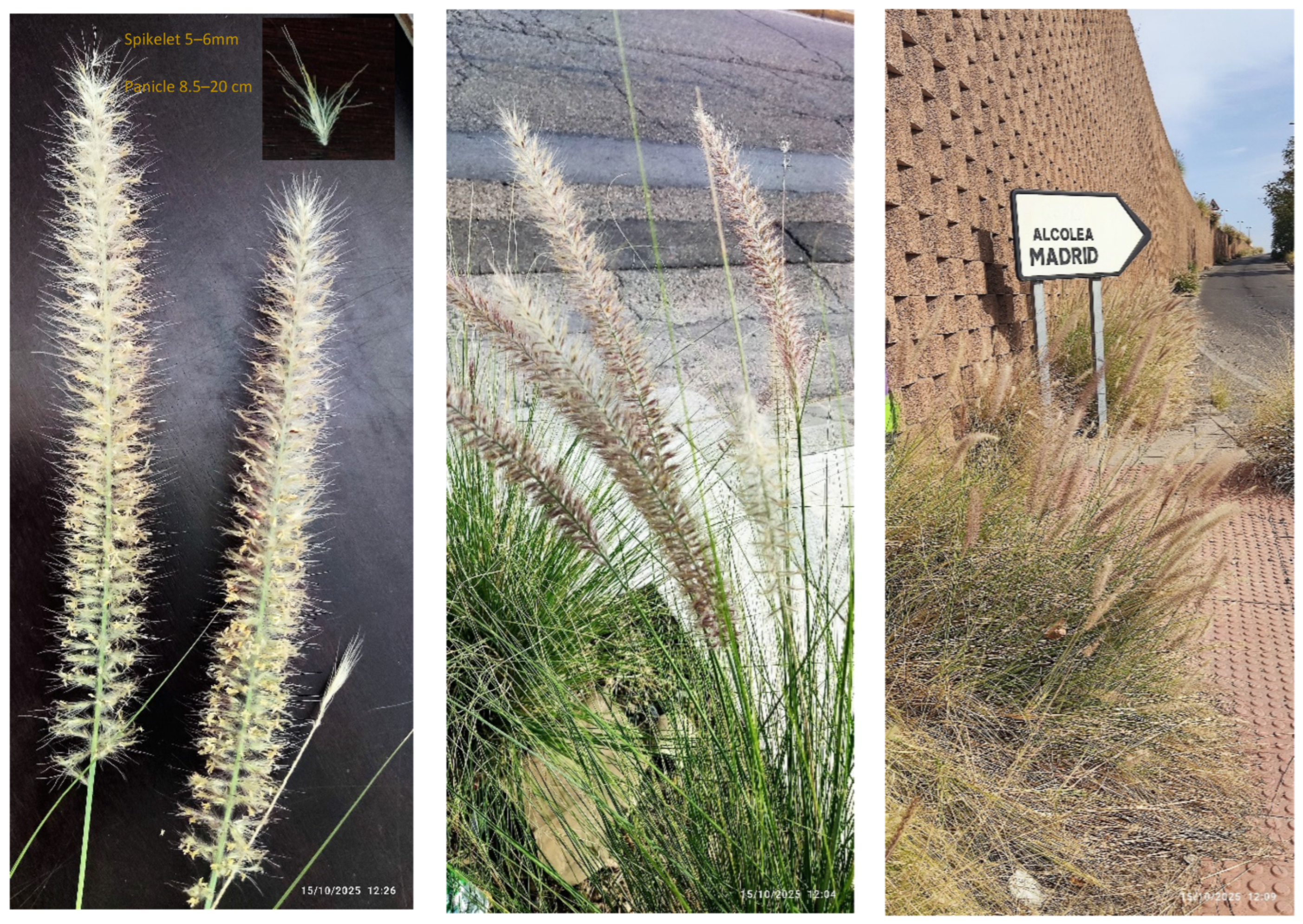
Cenchrus setaceus is a densely clustered perennial, wind-dispersed, apomictic, C4 bunchgrass that can grow up to 100 cm. This species has thin, enrolled leaves that branch inward and have a light green base. Sheath curved or mildly ridged on top, semi-leathery, margins long-ciliate. Ligule 0.3–0.7 mm, a membranous densely ciliate rim. Collar hairs to 2.5 mm. Blade 15–30 cm × 0.5–1.5 mm, stiff, folded, or involute, long-tapering, adaxially very scabrid; margins especially with a few scattered long hairs, tip filiform, acute. Culm 30–45 cm, erect, internodes with many finely scabrid ridges. Panicle 8.5–20 cm, slender-cylindrical, compact, spike-shaped, frequently shaded reddish-purple; rachis hairs are brief and soft. Spikelets measuring 5–6 mm, lance-shaped, pointed, ranging from pale green to purple, found alone or in clusters of 2–3 on ciliate pedicels up to 3 mm; involucre consisting of many fine, unequal, plumose bristles, with one bristle being longer but not thicker, reaching up to 35 mm (Figure 1). Lower glume a translucent scale to 1 mm or 0. Upper glume 2–2.5 mm, 1-veined, translucent, slightly rough. Lower floret is male or sterile; lemma measures 4.5–5 mm, has 3 nerves, membranous, with minutely scaberulous nerves near the tip; palea matches lemma, is hyaline, rounded, and keeled near the tip, with minutely scaberulous texture, or palea measures 0; anthers are 2–3 mm or 0. Upper floret is hermaphroditic; lemma measures 5.5–6 mm, has 5 nerves, membranous, with scaberulous nerves near the mucronate apex; palea is 4.5–5 mm, hyaline, and keels are barely scaberulous at the tip; lodicules measure 0.3–0.4 mm; anthers range from 2 to 3 mm; styles are connate while stigmas remain free; caryopsis is approximately 3 × 1.2 mm2 [21].

4. Invasiveness

Invasiveness is the propensity of an introduced species to invade a recipient ecosystem, with its expected determinants including introduction history, species traits, and ecological and evolutionary processes [22]. Cenchrus setaceus (fountain grass) is well-known as a globally pervasive invasive species, which can be explained as a prime example of an escaped horticultural ornamental [23,24]. It has naturalized in New South Wales, Western Australia, and South Australia, particularly along roadsides, and it is considered a weed in Hawaii, mainland United States, and South Africa [25,26]. The invasion history of this species in South Africa, dating back to 40 years ago, causes significant issues with native vegetation and pastures, as well as contamination of seed products [27]. Nonetheless, in the United States, Namibia, South Africa, China, France, Italy, Spain, Mexico, Puerto Rico, New Zealand, and New Caledonia, it is regarded as an invasive species [9,10]. The main ecological and biological traits of this species are related to its life cycle, reproduction ability, seed dormancy, dispersal aids, fungal community assembly, and broad germination requirements.
As a perennial plant that can live for up to 20 years, flowering occurs over a prolonged period from spring to summer. It produces numerous seeds, though the percentage of viable seeds within each head may be relatively low. Seeds can remain viable in the soil for many years, potentially up to 6 years or longer [28]. The majority of seeds require several months to mature after flowering, which can be an important ecological tactic to survive under challenging environmental conditions. Seeds can germinate across a wide range of temperatures, with optimal germination, which often happens at 25 °C. They typically germinate from late spring through early summer [28]. The relatively broad germination requirements and being drought-resistant accelerate its spread in many regions, especially in arid environments with limited water availability [28,29]. In addition, fungal community assembly in C. setaceus contributed to broader ecological understandings relevant to invasive species under stress conditions [30]. The lack of specificity of the relationships between this species and mycorrhizal fungi provide advantages for its establishment in semi-arid Mediterranean regions [31]. This species’ ability to tolerate water stress well, both at the seed germination stage and during vegetative growth, will favor the spread of this species in areas with a dry climate such as the Mediterranean. One distinctive characteristic of this species, contributing to its higher drought tolerance, appears to be the increase in root K+ concentration in response to drought conditions [32]. In addition, higher resources allocated to the roots may be attributed to the tolerance of C. setaceus [33].
Seed production, both asexually (apomictic; asexual reproduction, where embryos develop without fertilization) and sexually (out-crossing; to a lesser extent), results in progeny that are adaptable to various environmental conditions [34]. The success of several apomictic species as invasive species has been presumed to be associated with high levels of phenotypic plasticity and a general-purpose genotype [35,36,37]. However, pollination is necessary for the development of apomictic seeds. The seeds, often dispersed within spiny burs, are readily spread by wind, water, animals, and human activity (Figure 1). For instance, the rainy season in Tenerife facilitates the spread of seeds downriver and is a major factor in expanding its range in southern parts [17]. It is assumed that induced pseudo-vivipary in this grass is another mechanism that facilitates the spread of this species in seasonally flooding rivers in arid regions [38]. Fountain grass is highly suited for regrowth after fires, and burning could aid in its spread, as fires that are hotter than those affecting native grasses cause harm to native plant species and communities that are less tolerant to fire [39]. The ability to regenerate by vegetative methods makes it possible to form dense stands (monocultures) that exclude all other plants once they have escaped. Once the seedlings have overcome the critical seedling stage, they are able to establish themselves despite harsh environmental conditions, and flowering can happen within six months [40]. The ecophysiological traits of C. setaceus support its large size, extensive canopy, and shorter leaf senescence period. They confer considerable competitive advantage on the invader and partially explain its success in the Canary Islands [11]. The higher nitrogen-use efficiency and water-use efficiency led to higher and longer-lasting use of photosystem II in C. setaceus than in native grasses. This species is more tolerant to low-stress habitats than native species due to high performance and survival on the historically disturbed mine dumps as a result of resource facilitation and fluctuating resource levels that promote plant invasion [40]. The competitive ability and lack of natural enemies are related to these species’ evolutionary processes. Understanding the invasive grasses’ interaction with abiotic and biotic filters of invasion, including natural enemies and competitors, will offer insights into the potential progression of invasions [41].

5. Geographic Distribution and Habitat

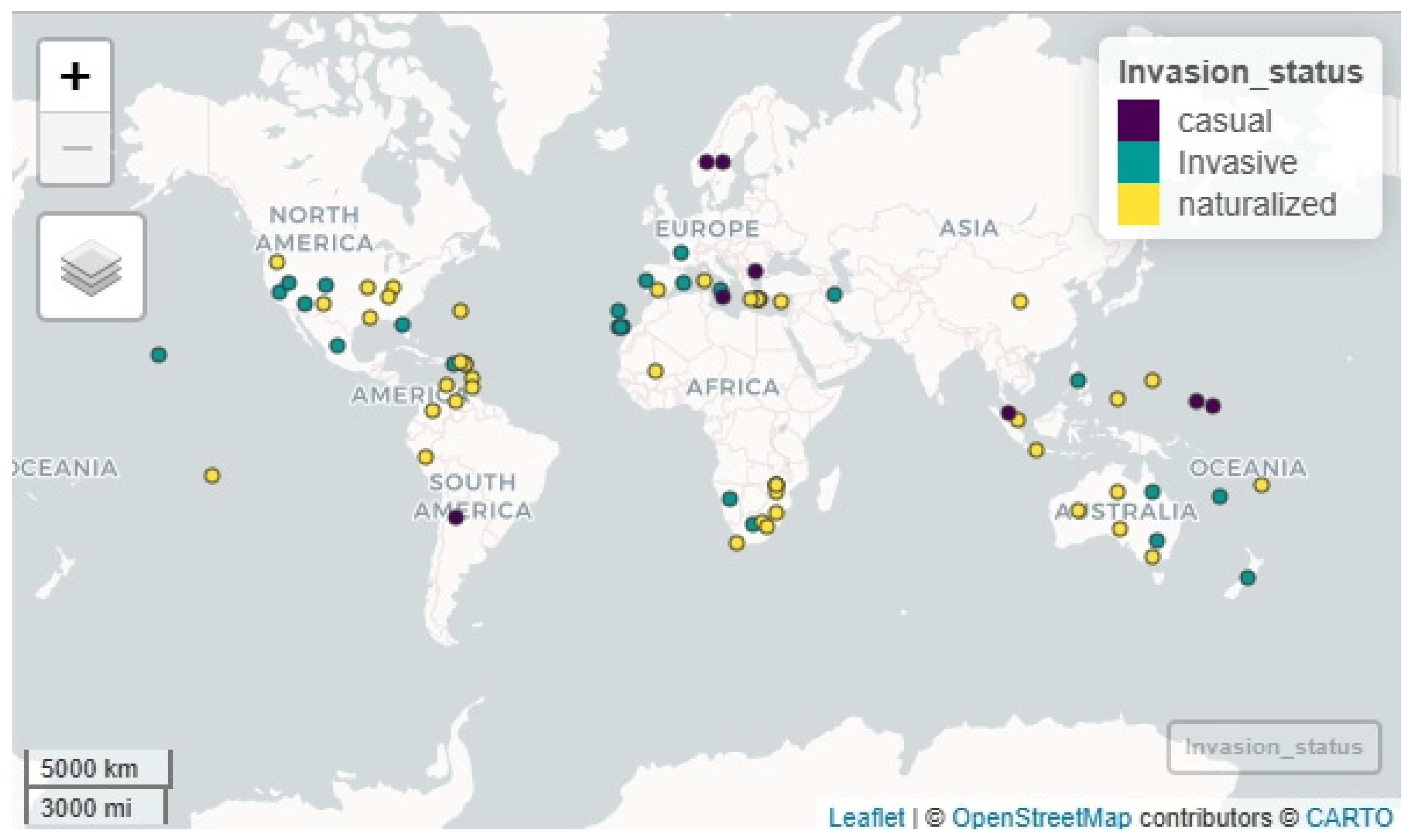
Fountain grass is extensively grown as an ornament globally and frequently invades natural ecosystems. It invades many types of natural areas, from bare lava flows to rangelands, in Hawaii [42]. It has a wide elevation range but is limited to areas with an average yearly rainfall of below 1250 mm. In southern California, C. setaceus invades grasslands, deserts, canyons, and roadsides. Considering climate change scenarios, C. setaceus’s suitable areas are characterized by an elevation shift to higher elevation, although it prefers coastal areas, with higher habitat suitability near cities and below 800 m a.s.l. under current climate condition [17]. This species grows from the sea level to 450–500 m a.s.l. on disturbed soils, on scree slopes at the base of the cliffs, as well as on rocky habitats [43,44]. Many habitats can have facilitated the establishment of this species, especially the distributed ones [40,43,45]. The affinity of C. setaceus to habitats of characteristically high P availability may reflect other, similar characteristics of these habitats, such as high disturbance rates [15]. Reduced competition from resident indigenous species accelerated the successful establishment and performance rates of C. setaceus along a climatic gradient through three South African biomes [40]. Based on different invasion status (casual, naturalized, and invasive) [46,47] of this grass, there are 11 cases of invasion records in Europe, Oceania, and North America. Furthermore, there are more than 80 cases that showed its naturalized status [9]. Seemingly, different islands are more exposed to invasion of C. setaceus (Figure 2). Due to shifting climate conditions and the unregulated expansion of this species, its potential for future spread is expected to grow. The potential distribution areas of invasive weeds under climate change scenarios will be essential to predicting the future extension and subsequent damage in different habitats [48,49,50]. The global biogeographic pattern of the suitability of fountain grass generally increases from the equator toward subtropical areas and then decreases at the north and south portions of the globe [51]. Areas with the highest suitability occur along broad ecotonal zones between deserts and Mediterranean regions. Models indicated human footprint and annual mean temperature contributed the most to explaining the global suitability patterns of fountain grass [51]. Climate change analysis showed a high potential contraction of the potential range of fountain grass in the Mediterranean as well as in tropical areas of the southwest USA, northern Mexico, northeast Brazil, and South Africa. Results also indicated a potential moderate expansion in its range, mainly in tropical areas of the southwest USA and East Africa [51]. Da Re et al. [17] suggested that despite being drought-resistant, the orographic precipitations and humidity, which are carried by trade winds, are necessary for supporting this species’ growth.

6. Environmental Impacts

The environmental impact of invasive species is the range of ecological changes of the native biota impacted (individual, population, or community) after invasion. Based on IUCN EICAT categories and criteria, six main mechanisms are defined to assess the environmental impact of alien species [1].

6.1. Competition

This grass is an aggressive invader in dry parts of the islands, outcompeting other plants for water and space. It reduces moisture availability to surrounding plants and can alter nutrient cycling due to its lower leaf area, which reduces transpiration and increases water-use efficiency; lower leaf nitrogen, indicating higher nitrogen-use efficiency; a higher and longer-lasting photosystem [52]. Many alien Cenchrus species have shown the competitive ability that threatens native ecosystems, especially those susceptible to invasion [53,54]. The shoot and root dry masses of P. setaceum seedlings were more than 4 times higher than those of Ampelodesmos mauritanicus (as native) seedlings in sub-arid and Mediterranean-climate areas [55]. The biomass produced and the speed of growth of Pennisetum demonstrated the seedling competition of P. setaceum (Poaceae) with three native weeds of La Primavera wood, Guadalajara, Jalisco (México), which can be a real alarm for the conservation of local germplasm [56]. Alien fountain grass (P. setaceum, C4) has a higher competitive ability than native purple peedle grass (Stipa pulchra, C3) in California [57]. The significant reproductive output (seeds/plant) and potential (ovules/plant), fast seed germination, swift recovery from disturbances, and phenotypic plasticity when facing drought are associated with its competitive ability, especially following wildfires [58]. Seeds buried at depths of 2.5–5 cm can avoid the intense heat of a fire and germinate rapidly since they do not need light for germination [28]. Furthermore, the plant competition is influenced by multiple interactions across resource gradients, focusing on plant–plant competition, resource availability, and natural enemies [41]. It is suggested to consider certain interactions that may be related to alien grass invasiveness.

6.2. Allelopathy

Many Cenchrus species have proven their allelopathic potential. For example, naturalized alien C. echinatus L. represents a threat to the urban vegetation via allelopathic potential in Egypt [59]. Leachates from the leaves and roots of C. ciliaris were shown to reduce germination rates of seeds and the radicle length of many native plants [60]. Certain phytotoxic compounds in the leaf debris and leaf extracts of P. purpureum Schumach was detected by Ismail et al. [61]. Cenchrus ciliaris L. is shown to have allelopathic potential [62]. Eight different phenolic compounds are presented in C. setaceus, which would relate to this plant allelopathic potential [63]. It seems that C. setaceus has allelopathic potential and further studies are essential to figuring out this impact properly. It is recommended to consider the allelopathic potential of this species in relation to soil conditions, as the toxicological impact of these allelopathic substances changes in soil conditions. Fundamental ecological and coexistence research can better reveal the actual toxicity impact of this species on native biota [2,64].

6.3. Hybridization

There is a possibility of hybridization between C. clandestinus and C. setaceus, but the chance of hybridization will be increased with a climatic overlap at similar elevations [65]. Genetic homogenization and biodiversity loss are the result of hybridization between native and introduced plants or populations; they are recognized as an additional consequence of introduction of alien species [1,42]. The risk of extinction of rare species of endangered plants will increase with the possibility of hybridization. There is a lack of knowledge in this area; additional research is needed to evaluate the hybridization potential and likelihood of fertile progeny in the invaded zones.

6.4. Transmission of Disease and Pests

Many fungal pathogens have been detected on this species in the Canary Islands [66]. There are reports that showed Cenchrus species has potential to spread diseases. For example, fungal leaf spot disease (seed-borne) in buffel grass (Cenchrus ciliaris) cause leaf spot diseases in several other tropical forage grass species in Tanzania [67]. ln Mauritius, Cenchrus echinatus and Coix lacryma-jobi were described as hosts of streak virus isolates (presumably SSMV isolates) [68]. The first reports of leafhoppers, Chloropelix canariensis Lindberg 1936 and Balclutha brevis Lindberg 1954 (Hemiptera, Cicadellidae), in the Canary Islands were associated with P. setaceum (Forsskal) Chiovenda (Poaceae) [69]. Spittlebug (Aeneolamia contigua Walker and Prosapia simulans Walker), as an important pest of sugarcane (Saccharum sp.) plantations in the Mexican tropics, typically complete their life cycle in P. setaceum [70]. In Sicily, adults and immature stages of Balclutha brevis Lindberg (Rhynchota Cicadellidae) have been found to be associated with the spike in P. setaceum (Forsskal) Chiovenda (Poaceae) practically all the year round [71].

6.5. Altering the Community Dynamics

While C. setaceus is replacing native species and altering community dynamics, it is not necessarily leading to a drastic loss of species richness [72]. However, the potential ecological impacts of this invasion, such as altered ecosystem functions, changes in plant–animal interactions, and the potential displacement of rarer species, warrant continued attention [73,74]. Moreover, the dry biomass generated by P. setaceum raises fire frequency and spread by enhancing fuel loads. The significant alteration in the structure and makeup of certain woodlands in central Australia may be linked to the vegetation influenced by heightened fire intensity related to buffel grass invasion [75]. P. setaceum invasion has produced an intense interaction with the soil bacterial community, shifting its structure, composition, and protease activity, which may be altering the function of the invaded ecosystem [74].

6.6. Chemical Impact on Soil

The invasion of Cenchrus species could bring some substantial modifications in soil conditions such as soil pH, ammonium nitrate, total phosphorus, and organic carbon that facilitated the competition ability of this invaded species [76]. Nitrogen cycling is affected in the invaded soils by P. setaceum [74]. It appears that soil chemical is influenced that it changes the organism community within the soil. Further research is required on the nutrient availability in the invaded soils.

7. Socio-Economic Impact

The socio-economic impacts of invasive plants are defined by affecting the different constituents of human well-being (security; material and non-material assets; health; social, spiritual and cultural relations; freedom of choice and action) [77]. The economic and social impacts of C. setaceus encompass influences on property values, agricultural productivity, public utility operations, human health, as well as costs associated with its control efforts. This species adversely affects pasture productivity because of inferior grass quality. It diminishes the quality of grazing lands, especially in arid regions. The economic cost associated with threatening brush lands pertains to their ability to promote fires and serve as highly effective fuel for brush fires. As a weed of pastures, grasslands, and along transportation routes such as railways, roads, trails, paths, and waterways, it can heighten fire danger compared to other roadside weeds that gather less dry matter [78,79]. Management costs and the subsequent ecological impact of herbicide applications can be considered as its negative impact on socio-economic aspects. Further studies are required to determine its economic cost on both agricultural and natural ecosystems. Caution is required since fire may have undesirable side effects such as reducing resource availability and promoting soil erosion [80]. In addition, there may also be costs associated with loss of grazing capacity [81]. The management cost of buffel grass (Cenchrus ciliaris L.) and fountain grass (Pennisetum setaceum) highlight the urgent policy, research, and financing initiatives essential to safeguarding threatened species, ecosystems, and cultural values of Aboriginal people in central Australia and Hawaiian dry forest [82,83]. Furthermore, the present of fountain grass is related to the survival and development of malaria mosquitoes. Asmare et al. [84] showed that the size of pollen grains of fountain grass has significant impact on survival and development of larval Anopheles arabiensis (Diptera: Culicidae). It is necessary to evaluate the additional possible impact of this species on human health. Numerous alien plants produce allergenic pollen, leading to considerable economic costs. Grasses have consistently been a major factor in the high prevalence of allergenic invasive species [85]. Evaluating the impact of air temperature and changing species composition is crucial to assess the allergenic potential of invasive plants as well.

8. Management

As the management of C. setaceus is difficult (owing to its rapid spread and regrowth), applying multiple strategies is recommended to eradicate or diminish its spread [86,87,88]. The continuous monitoring and repeating management are essential due to the long-lived seeds. Studies indicate that fountain grass seeds can stay viable in the soil for as long as 10 years, suggesting a substantial seed bank that necessitates ongoing monitoring following control treatments [39,89]. In addition, the decisions about invasive plant management can efficiently provide with mapped predicted distributions across spatial scales [49]. General management of this species can be categories in non-chemical and chemical methods.

8.1. Non-Chemical Control

Non-chemical control includes all management options apart from applying herbicides. Control efforts should first focus on peripheral populations, then proceed to address the central area. Minor infestations of fountain grass can be eliminated by uprooting, removing, and destroying the seed heads. Cutting and mowing (as mechanical weed control) can aid in decreasing the quantity of seed heads formed, but it is a highly productive seed producer and this approach is only temporary. Manual removal (as a physical control) of seedlings and plants every 1–2 months has shown some effectiveness in Hawaii Volcanoes National Park.” [89]. Manual removal treatment is superior to herbicide application in enhancing the growth of native plants and boosting their competitiveness against Fountain grass [24]. Planting competitive summer annual species (as a cultural method) in the infected areas might provide additional competitive suppression of Pennisetum as a component of proactive management programs in southern California [57]. The strategy of removing grass and providing shade (as a physical control) could be a successful method for restoring degraded tropical dry forests in Hawaii affected by the spread of fountain grass [90]. Following the removal of grass, native species demonstrated enhanced productivity and resource acquisition, which resulted in an increase in leaf-level photosynthesis and intrinsic water-use efficiency. Often, mechanical removal like using a mower or tilling is not feasible because of the rocky terrain where fountain grass typically thrives. In these cases, it can sometimes be carefully cut back with a weed trimmer. Burning is not recommended as the grass grows back rapidly following fire [91]. Nonetheless, the propagules of fountain grass are susceptible to cold environments; in some cases, chilling may prove advantageous [92]. Considering its seed emergence depth (2–5 cm), employing deep tillage might be recommended as another method to reduce the seed bank of this weed. Additional research is recommended to assess the efficacy of physical and mechanical control methods. Biological control is an alternative that should be employed more frequently if practitioners adhere to adequately strict risk assessment protocols. The risk of grass biological control is no higher than for other weedy species [93].

8.2. Chemical Control

In many cases when preventing and early detection proves to be inadequate, herbicides are the primary tools used to limit and control invasive weeds. Extensive infestations of fountain grass are likely most effectively managed using herbicides alongside mechanical methods (Johnson undated) [94]. Foliar spraying and wick-wipe are efficient methods of application. The combination of nicosulfuron + metsulfuron are suggested as an effective solution for field sandbur (Cenchrus spinifex Cav.) control [94]. Management of Southern Sandbur (C. echinatus L.) can be achieved with pre- and post-emergent herbicides such as pendimethalin (at 1.1–4.2 quarts per acre) and indaziflam (at 3 to 5 oz per acre), though effective control requires rainfall and the presence of germinated seeds. The suggested post-emerged herbicides are the combination of nicosulfuron + metsulfuron (at 1.0–1.5 ounces per acre), imazapic (at 4 ounces per acre), and glyphosate (at 8–11 ounces per acre) [95]. To manage of Cenchrus ciliaris on Airlie Island in Western Australia, two to four sprays annually are required, influenced by rainfall, for a minimum of three years (considered the soil seed bank’s approximate age), along with ongoing monitoring and backpack spot spraying or hand removal. Eulalia aurea (Bory) Kunth, a dominant native grass that is perennial, should ideally be planted at the end of the three-year spraying program to prevent damage from sprays and to facilitate operations for controlling buffel grass [96]. Different herbicides were tested to evaluate their efficacy on C. setaceus in Andalusia [97]. All tested herbicides were effective (with 100% reduction) apart from Diflufenican (DFF) as a PDS inhibitor (Table 1).
Regarding management recommendations for escaped weeds that survive herbicide applications, herbicide mixtures of different herbicides is the main practice for management. The use of more than one herbicide mechanism of action is considered one of the key practices that should be used for weed management [98,99].
Overall, the approaches for managing invasive plants include prevention, eradication, and control. Preventive measures rely on (i) prohibiting imports of targeted species, (ii) regulating major introduction pathways like horticulture, and (iii) creating predictive models [34]. Eradication techniques can be effective at reducing infestation levels with spot application of glyphosate (at a 0.5% concentration) [95]. Depending on the phases of the overall invasion curve, the practicality of intervention would differ. For instance, the invasion of C. setaceus in Pantelleria (a volcanic island situated in the Sicily Channel (Italy)) is in its initial phases; therefore, management is likely to be effective [100].

8.3. Integrated Management

Combining various weed control methods can frequently contribute to an effective management of perennial weed [101]. Farmers within the European Union must utilize integrated weed management (IPM) strategies. A key principle of IPM is that preventive strategies should be preferred to direct control approaches, and non-chemical techniques should be favored over pesticides [102]. Therefore, there is a requirement for effective IPM approaches to control weeds in grassland renewal that do not heavily depend on herbicides or tillage, and that are financially beneficial for farmers [103]. Anyway, herbicide application in most cases is inevitable and usually combined with other non-chemical methods. Plowing and broad-spectrum herbicides (such as glyphosate) are both effective techniques for managing perennial weed species, each influencing the weed population in unique ways [104]. The combination of physical or manual control along with herbicide application is recommended as a typical control approach for this species in Hawaii [105]. However, a better and cost-effective technique for replacing this weed will vary based on the size and location (in cropland or ornamental areas) of the infested area [24]. For example, using cover crops and tillage are more reasonable in croplands while regrowing native plants is suggested in the ornamental areas and grasslands.
To address the need for effective management, as well as coordination in some cases, national legislation is highlighted [106]. Many national initiatives, which are nested in national scientific or technical bodies, can be more active in ensuring coordination and catalyzing action through a direct involvement of the key national agencies along with improving information sharing. Interlinking with the agricultural and plant health sector as well as the environment sector is crucially important for the efficacy of the national policies relevant to invasive alien species.

9. Conclusions and Future Direction

As C. setaceus has a high growth and invasion potential in many areas, especially in disturbed habitats, more research and effective integrated management are essential for its continued distribution. While basic biological and ecological aspects are now understood, many unanswered questions still exist that limit the comprehensive understanding of this species’ potential as an invasive species. For example, more work is needed to understand its actual environmental impact, especially considering the biotic and abiotic interactions. Its ability for hybridization, its impact on soil microbes, and the availability of nutrients are all poorly understood. The allergic potential of this species pollen is obscure; it is assumed that it may have negative impact on human health. Based on our finding in this review, if management is not applied properly, this species will continue to have a negative economic and environmental impact on the land it invades. An appropriate management program of this species requires not only more studies, but also appropriate legal frameworks for banning its further spread. This study has demonstrated that conservation authorities concerned with management of C. setaceus invasion need to give more attention to these habitats that act as hotspots for seed production and subsequent distribution. C. setaceus is already present at these sites and will easily invade near-natural areas if it is not managed effectively. Both biotic and abiotic factors and their interactions promote the establishment and growth of C. setaceus. We recommend long-term management, especially land cover change, which enhanced competition of indigenous species and hence reduced the C. setaceus establishment. Management efforts should also aim to reduce seed production and establishment of C. setaceus along roadsides, which act as conduits into near-natural sites and initiated of resistant populations, which may cause further socio-economic impacts. Finally, our results contribute significantly to our understanding of basic processes that affect emerging invaders, especially grasses in new environments in the Mediterranean Basin. Results confirm the status of this grass as an important emerging weed and invader that must be prohibited and controlled in Southern Spain.

Author Contributions

Conceptualization, R.D.P., S.S. and J.G.; investigation, S.S. and A.M.R.-D.; resources curation, J.G. and S.S.; writing—review and editing, S.S., J.G., A.M.R.-D., C.P.-B. and R.D.P.; supervision, R.D.P. All authors have read and agreed to the published version of the manuscript.

Funding

This research received no external funding.

Data Availability Statement

No new data were created or analyzed in this study.

Conflicts of Interest

The authors have declared that no competing interests exist.

References

  1. Bacher, S.; Ryan-Colton, E.; Coiro, M.; Cassey, P.; Galil, B.S.; Nuñez, M.A.; Ansong, M.; Dehnen-Schmutz, K.; Fayvush, G.; Fernandez, R.D.; et al. Global Impacts Dataset of Invasive Alien Species (GIDIAS). Sci. Data 2025, 12, 832. [Google Scholar] [CrossRef]
  2. Miniat, C.F.; Fraterrigo, J.M.; Brantley, S.T.; Callaham, M.A.; Cordell, S.; Dukes, J.S.; Giardina, C.P.; Jose, S.; Lovett, G. Impacts of Invasive Species on Forest and Grassland Ecosystem Processes in the United States. In Invasive Species in Forests and Rangelands of the United States; Poland, T.M., Patel-Weynand, T., Finch, D.M., Miniat, C.F., Hayes, D.C., Lopez, V.M., Eds.; Springer: Cham, Switzerland, 2021; pp. 41–55. [Google Scholar]
  3. Świerszcz, S.; Czarniecka-Wiera, M.; Szymura, T.H.; Szymura, M. From Invasive Species Stand to Species-Rich Grassland: Long-Term Changes in Plant Species Composition during Solidago Invaded Site Restoration. J. Environ. Manag. 2024, 353, 120216. [Google Scholar] [CrossRef] [PubMed]
  4. Hao, L.F.; Han, Y.X.; Wu, Q.M.; Wang, R.; Lin, K.J. Status of Invasive Alien Species in Grassland of China and Suggestions for Prevention and Control. Plant Prot. 2022, 48, 10–20. [Google Scholar] [CrossRef]
  5. Schuster, M.J.; Wragg, P.D.; Reich, P.B. Using Revegetation to Suppress Invasive Plants in Grasslands and Forests. J. Appl. Ecol. 2018, 55, 2362–2373. [Google Scholar] [CrossRef]
  6. Sohrabi, S.; Gherekhloo, J.; Gonzalez-Andujar, J.L.; Vilà, M. Impact of Alien Grasses on the Environment, Biodiversity and Crops in Iran. Ecosistemas 2025, 34, 2888. [Google Scholar] [CrossRef]
  7. Royal Botanic Gardens. Cenchrus Setaceus (Forssk.) Morrone. Available online: https://powo.science.kew.org/taxon/urn:lsid:ipni.org:names:77106046-1 (accessed on 9 June 2025).
  8. Wessapak, P.; Ngernsaengsaruay, C.; Duangjai, S. A Taxonomic Revision of Cenchrus L. (Poaceae) in Thailand, with Lectotypification of Pennisetummacrostachyum Benth. PhytoKeys 2023, 234, 1–33. [Google Scholar] [CrossRef] [PubMed]
  9. Areces-Berazain, F. Pennisetum setaceum (Fountain Grass). CABI Compend. 2023, 1–16. [Google Scholar] [CrossRef]
  10. Global Invasive Species Database. Cenchrus setaceus. Available online: https://www.iucngisd.org/gisd/speciesname/Cenchrus+setaceus (accessed on 8 November 2025).
  11. González-Rodríguez, A.M.; Baruch, Z.; Palomo, D.; Cruz-Trujillo, G.; Jiménez, M.S.; Morales, D. Ecophysiology of the Invader Pennisetum setaceum and Three Native Grasses in the Canary Islands. Acta Oecologica 2010, 36, 248–254. [Google Scholar] [CrossRef]
  12. Walentowitz, A.J.; Irl, S.D.H.; Acevedo Rodríguez, A.J.; Palomares-Martínez, Á.; Vetter, V.; Zennaro, B.; Medina, F.M.; Beierkuhnlein, C. Graminoid Invasion in an Insular Endemism Hotspot and Its Protected Areas. Diversity 2019, 11, 192. [Google Scholar] [CrossRef]
  13. D’Antonio, C.M.; Vitousek, P.M. Biological Invasions by Exotic Grasses, the Grass/Fire Cycle, and Global Change. Annu. Rev. Ecol. Syst. 1992, 23, 63–87. [Google Scholar] [CrossRef]
  14. Tanner, R.; Branquart, E.; Brundu, G.; Buholzer, S.; Chapman, D.; Ehret, P.; Fried, G.; Starfinger, U.; van Valkenburg, J. The Prioritisation of a Short List of Alien Plants for Risk Analysis within the Framework of the Regulation (EU) No. 1143/2014. NeoBiota 2017, 35, 87–118. [Google Scholar] [CrossRef]
  15. Morrison, G.R.; Questad, E.J. Elevated Soil Nitrogen, but Not Phosphorus, Increases Growth and Reproduction in Crimson Fountain Grass, Pennisetum setaceum (Poaceae). J. Torrey Bot. Soc. 2019, 146, 262–268. [Google Scholar] [CrossRef]
  16. Rahlao, S.J.; Milton, S.J.; Esler, K.J.; Van Wilgen, B.W.; Barnard, P. Effects of Invasion of Fire-Free Arid Shrublands by a Fire-Promoting Invasive Alien Grass (Pennisetum setaceum) in South Africa. Austral Ecol. 2009, 34, 920–928. [Google Scholar] [CrossRef]
  17. Da Re, D.; Tordoni, E.; De Pascalis, F.; Negrín-Pérez, Z.; Fernández-Palacios, J.M.; Arévalo, J.R.; Rocchini, D.; Medina, F.M.; Otto, R.; Arlé, E.; et al. Invasive Fountain Grass (Pennisetum setaceum (Forssk.) Chiov.) Increases Its Potential Area of Distribution in Tenerife Island under Future Climatic Scenarios. Plant Ecol. 2020, 221, 867–882. [Google Scholar] [CrossRef]
  18. Soreng, R.J.; Peterson, P.M.; Zuloaga, F.O.; Romaschenko, K.; Clark, L.G.; Teisher, J.K.; Gillespie, L.J.; Barberá, P.; Welker, C.A.D.; Kellogg, E.A.; et al. A Worldwide Phylogenetic Classification of the Poaceae (Gramineae) III: An Update. J. Syst. Evol. 2022, 60, 476–521. [Google Scholar] [CrossRef]
  19. Donadío, S.; Giussani, L.M.; Kellogg, E.A.; Zuolaga, F.O.; Morrone, O. A Preliminary Molecular Phylogeny of Pennisetum and Cenchrus (Poaceae-Paniceae) Based on the TrnL-F, Rpl16 Chloroplast Markers. Taxon 2009, 58, 392–404. [Google Scholar] [CrossRef]
  20. Verloove, F.; Gullón, E.S. A Taxonomic Revision of Non-Native Cenchrus str. (Paniceae, Poaceae) in the Mediterranean Area. Willdenowia 2012, 42, 67–75. [Google Scholar] [CrossRef]
  21. Edgar, E.; Connor, H.E. Flora of New Zealand Volume V: Gramineae (Grasses); Manaaki Whenua Press: Lincoln, New Zealand, 2000; Volume 5, ISBN 9780478093315. [Google Scholar]
  22. Van Kleunen, M.; Dawson, W.; Schlaepfer, D.; Jeschke, J.M.; Fischer, M. Are Invaders Different? A Conceptual Framework of Comparative Approaches for Assessing Determinants of Invasiveness. Ecol. Lett. 2010, 13, 947–958. [Google Scholar] [CrossRef]
  23. Smith, C.W. Impact of alien plants on Hawaii’s native biota. Hawaii’s Terr. Ecosyst. Preserv. Manag. 1985, 180–250. [Google Scholar]
  24. Rowe, H.I.; Sprague, T.A.; Staker, P. Comparing Common Fountain Grass Removal Techniques: Cost Efficacy and Response of Native Plant Community. Biol. Invasions 2022, 24, 3817–3830. [Google Scholar] [CrossRef]
  25. Holm, L.; Pancho, J.V.; Herberger, J.P.; Plucknett, D.L. A Geographical Atlas of World Weeds; John Wiley and Sons: Hoboken, NJ, USA, 1979. [Google Scholar]
  26. Wells, M.J.; Balsinhas, A.A.; Joffe, H.; Engelbrecht, V.M.; Harding, G.; Stirton, C.H. A Catalogue of Problem Plants in Southern Africa: Incorporating the National Weed List of Southern Africa. Mem. Bot. Surv. S. Afr. 1986, 53, 1–658. [Google Scholar]
  27. Csurhes, S. Invasive Plant Risk Assessment: African Fountain Grass; Queensland Government: Queensland, Australia, 2016. [Google Scholar]
  28. Adkins, E.; Cordell, S.; Drake, D.R. Role of Fire in the Germination Ecology of Fountain Grass (Pennisetum setaceum), an Invasive African Bunchgrass in Hawai’i. Pac. Sci. 2011, 65, 17–25. [Google Scholar] [CrossRef]
  29. Goergen, E.; Daehler, C.C. Reproductive Ecology of a Native Hawaiian Grass (Heteropogon contortus; Poaceae) versus Its Invasive Alien Competitor (Pennisetum setaceum; Poaceae). Int. J. Plant Sci. 2001, 162, 317–326. [Google Scholar] [CrossRef]
  30. Cosoveanu, A.; González-Carracedo, M.A.; Lasala, J.S.; Pérez, J.A.P.; Cabrera, R. Shaping Fungal Communities in Cenchrus setaceus: Host Fitness and Habitat Filtering. Res. Sq. 2025. [Google Scholar] [CrossRef]
  31. Rodríguez-Caballero, G.; Caravaca, F.; Roldán, A. The Unspecificity of the Relationships between the Invasive Pennisetum setaceum and Mycorrhizal Fungi May Provide Advantages during Its Establishment at Semiarid Mediterranean Sites. Sci. Total Environ. 2018, 630, 1464–1471. [Google Scholar] [CrossRef]
  32. Mircea, D.M.; Estrelles, E.; Al Hassan, M.; Soriano, P.; Sestras, R.E.; Boscaiu, M.; Sestras, A.F.; Vicente, O. Effect of Water Deficit on Germination, Growth and Biochemical Responses of Four Potentially Invasive Ornamental Grass Species. Plants 2023, 12, 1260. [Google Scholar] [CrossRef]
  33. Corona, P.; Badalamenti, E.; Pasta, S.; La Mantia, T. Carbon Storage of Mediterranean Grasslands. An. Jardín Botánico Madr. 2016, 73, e029. [Google Scholar] [CrossRef]
  34. Simpson, C.E.; Bashaw, E.C. Cytology and Reproductive Characteristics in Pennisetum setaceum. Am. J. Bot. 1969, 56, 31–36. [Google Scholar] [CrossRef]
  35. Williams, D.G.; Mack, R.N.; Black, R.A. Ecophysiology of Introduced Pennisetum setaceum on Hawaii: The Role of Phenotypic Plasticity. Ecology 1995, 76, 1569–1580. [Google Scholar] [CrossRef]
  36. Poulin, J.; Sakai, A.K.; Weller, S.G.; Nguyen, T. Phenotypic Plasticity, Precipitation, and Invasiveness in the Fire-promoting Grass Pennisetum setaceum (Poaceae). Am. J. Bot. 2007, 94, 533–541. [Google Scholar] [CrossRef] [PubMed]
  37. Baker, H.G. Characteristics and Modes of Origin of Weeds. In The Genetics of Colonizing Species; Baker, H.G., Stebbins, G.L., Eds.; Academic Press: New York, NY, USA, 1965; pp. 147–172. [Google Scholar]
  38. Milton, S.J.; Dean, W.R.J.; Rahlao, S.J. Evidence for Induced Pseudo-Vivipary in Pennisetum setaceum (Fountain Grass) Invading a Dry River, Arid Karoo, South Africa. S. Afr. J. Bot. 2008, 74, 348–349. [Google Scholar] [CrossRef]
  39. Brodie, C.J.; Lang, P.J. Regional Landscape Surveillance for New Weed Threats Project 2020–2021. In Milestone: Annual Report on New Plant Naturalisations in South Australia; Enviro Data SA: Adelaide, Australia, 2021. [Google Scholar]
  40. Rahlao, S.J.; Milton, S.J.; Esler, K.J.; Barnard, P. Performance of Invasive Alien Fountain Grass (Pennisetum setaceum) along a Climatic Gradient through Three South African Biomes. S. Afr. J. Bot. 2014, 91, 43–48. [Google Scholar] [CrossRef]
  41. Rhodes, A.C.; Plowes, R.M.; Bowman, E.A.; Gaitho, A.; Ng’Iru, I.; Martins, D.J.; Gilbert, L.E. Systematic Reduction of Natural Enemies and Competition across Variable Precipitation Approximates Buffelgrass Invasiveness (Cenchrus ciliaris) in Its Native Range. Ecol. Evol. 2024, 14, e11350. [Google Scholar] [CrossRef]
  42. Daehler, C.C.; Carino, D.A. Recent Replacement of Native Pili Grass (Heteropogon contortus) by Invasive African Grasses in the Hawaiian Islands. Pac. Sci. 1988, 52, 220–227. [Google Scholar]
  43. Pasta, S.; Badalamenti, E.; La Mantia, T. Tempi e Modi Di Un’invasione Incontrastata: Pennisetum setaceum (Forssk.) Chiov. (Poaceae) in Sicilia. Nat. Sicil. 2010, 34, 487–525. [Google Scholar]
  44. D’Amico, A.; Gianguzzi, L.A. Note Ecologiche e Distributive Su Poaceae Di Interesse Fitogeografico in Sicilia. Nat. Sicil. 2006, 30, 59–74. [Google Scholar]
  45. Gudžinskas, Z.; Žalneravičius, E.; Petrulaitis, L. Assessment of the Potential of Introduction, Establishment and Further Spread of Invasive Alien Plant Species of European Union Concern in Lithuania. Botanica 2018, 24, 37–48. [Google Scholar] [CrossRef]
  46. Richardson, D.M.; Pyšek, P.; Rejmánek, M.; Barbour, M.G.; Panetta, F.D.; West, C.J. Naturalization and Invasion of Alien Plants: Concepts and Definitions. Divers. Distrib. 2000, 6, 93–107. [Google Scholar] [CrossRef]
  47. Blackburn, T.M.; Pyšek, P.; Bacher, S.; Carlton, J.T.; Duncan, R.P.; Jarošík, V.; Wilson, J.R.U.; Richardson, D.M. A Proposed Unified Framework for Biological Invasions. Trends Ecol. Evol. 2011, 26, 333–339. [Google Scholar] [CrossRef]
  48. Colwell, R.K.; Brehm, G.; Cardeluús, C.L.; Gilman, A.C.; Longino, J.T. Global Warming, Elevational Range Shifts, and Lowland Biotic Attrition in the Wet Tropics. Science 2008, 322, 258–261. [Google Scholar] [CrossRef]
  49. Young, N.E.; Jarnevich, C.S.; Sofaer, H.R.; Pearse, I.; Sullivan, J.; Engelstad, P.; Stohlgren, T.J. A Modeling Workflow That Balances Automation and Human Intervention to Inform Invasive Plant Management Decisions at Multiple Spatial Scales. PLoS ONE 2020, 15, e0229253. [Google Scholar] [CrossRef]
  50. Mousavi, S.K.; Sohrabi, S.; Gonzalez-Andujar, J.L.; Ghanbari, A.; Ghorbani, R.; Baghestani, M.A. Prediction of Wild Einkorn Wheat (Triticum monococcum Subsp. Aegilopoides (Link) Thell.) Global Geographical Distribution Using Climate Match Index. Adv. Weed Sci. 2025, 43, e020250039. [Google Scholar] [CrossRef]
  51. Albuquerque, F.; Macías-Rodríguez, M.Á.; Búrquez, A.; Rowe, H. Toward an Understanding of Broad-Scale Patterns of the Habitat Suitability of Fountain Grass (Cenchrus setaceus (Forssk.) Morrone, Poaceae). Plant Ecol. 2020, 221, 1029–1043. [Google Scholar] [CrossRef]
  52. Western Australian Herbarium. Cenchrus setaceus (Forssk.) Morrone. Available online: https://florabase.dbca.wa.gov.au/browse/profile/41568 (accessed on 9 November 2025).
  53. Mnif, L.; Belgacem, A.O.; Cortina, J.; Chaieb, M. A Comparative Analysis of Establishment of Cenchrus ciliaris Provenances in Arid Zone of Tunisia. Arid. Land. Res. Manag. 2005, 19, 341–351. [Google Scholar] [CrossRef]
  54. Hazelton, C.M. Consequences of Cenchrus ciliaris Invasion on Native Vegetation and Competition with Native Species in Semi-Arid Rangelands of South Texas. Master’s Thesis, Texas Tech University, Lubbock, TX, USA, 2022. [Google Scholar]
  55. Badalamenti, E.; Militello, M.; La Mantia, T.; Gugliuzza, G. Seedling Growth of a Native (Ampelodesmos mauritanicus) and an Exotic (Pennisetum setaceum) Grass. Acta Oecologica 2016, 77, 37–42. [Google Scholar] [CrossRef]
  56. Bertolini, V.; Sedano Ibarra, O.A.; Valle Mora, J.F.; Gallegos Rodríguez, A.; Hernández Álvarez, E.; Rojas Velázquez, Á.N. Seedling Competition between Pennisetum setaceum (Poaceae) and Three Native Weeds of La Primavera Wood, Guadalajara, Jalisco (México). Magna Sci. UCEVA 2023, 3, 165–174. [Google Scholar] [CrossRef]
  57. Sweet, L.C.; Holt, J.S. Establishment Stage Competition between Exotic Crimson Fountaingrass (Pennisetum setaceum, C4) and Native Purple Needlegrass (Stipa pulchra, C3). Invasive Plant Sci. Manag. 2015, 8, 139–150. [Google Scholar] [CrossRef]
  58. Goergen, E.; Daehler, C.C. Factors Affecting Seedling Recruitment in an Invasive Grass (Pennisetum setaceum) and a Native Grass (Heteropogon contortus) in the Hawaiian Islands. Plant Ecol. 2002, 161, 147–156. [Google Scholar] [CrossRef]
  59. Hassan, M.O.; Mohamed, H.Y.; Okla, M.K.; Kiani, B.H.; Amro, A. Dense Cover, but Not Allelopathic Potential, of Naturalized Alien Cenchrus echinatus L. Threatens the Native Species in Urban Vegetation. Plants 2023, 12, 3736. [Google Scholar] [CrossRef]
  60. Fulbright, N.; Fulbright, T.E. Germination of 2 Legumes in Leachate from Introduced Grasses. J. Range Manag. 1990, 43, 466. [Google Scholar] [CrossRef]
  61. Ismail, B.S.; Tan, P.W.; Chuah, T.S. Assessment of the Potential Allelopathic Effects of Pennisetum purpureum Schumach. On the Germination and Growth of Eleusine indica (L.) Gaertn. Sains Malays. 2015, 44, 269–274. [Google Scholar] [CrossRef]
  62. Hussain, F.; Ilahi, I.; Malik, S.A.; Dasti, A.A.; Ahmad, B. Allelopathic Effects of Rain Leachates and Root Exudates of Cenchrus ciliaris L. and Bothriochloa pertusa (L.) A. Camus. Pak. J. Bot. 2011, 43, 341–350. [Google Scholar]
  63. Al-Halaseh, L.; Issa, R.; Said, R.; Al-suhaimat, R. Antioxidant Activity, Phytochemical Screening, and LC/MS-MS Characterization of Polyphenol Content of Jordanian Habitat of Pennisetum setaceum Aqueous Leaf Extract. Jordan J. Pharm. Sci. 2024, 17, 706–716. [Google Scholar] [CrossRef]
  64. Sohrabi, S.; Gherekhloo, J.; Hassanpour-Bourkheili, S.; Ghaderi-Far, F.; Siahmarguee, A.; Taheri, M.; Atashii, S. Allelopathic potential impact of Senecio angulatus L.F. on native plants. Plant Signal. Behav. 2025, 20, 2526886. [Google Scholar] [CrossRef]
  65. Faccenda, K.; Yorkston, M.; Ross, M.C.; Morden, C.W. Spontaneous Hybridization among Invasive Poaceae in Hawai‘i: Chloris × Pseudosagrana Nothosp. Nov. and Cenchrus × Peregrinus Nothosp. Nov. Phytotaxa 2024, 638, 155–164. [Google Scholar] [CrossRef]
  66. Sopena, J.; Sierra Cornejo, N.; Cosoveanu, A.; Rodriguez, C.G.; Cabrera, R. Rapid Methods to Select Facultative Pathogens on Invader Cenchrus setaceus. Rom. J. Plant Prot. 2021, 14, 127–140. [Google Scholar] [CrossRef]
  67. Mlay, J.A.; Kuwi, S.O.; Maleko, D.; Mtengetic, E.J. Incidences of Fungal Leaf Spot Disease in Buffel Grass (Cenchrus ciliaris) in Some Selected Pasture Farms in Tanzania. Multidiscip. Sci. J. 2022, 4, e2022015. [Google Scholar] [CrossRef]
  68. Peterschmitt, M. Characterization of Maize Streak Virus Isolates Using Monoclonal and Polyclonal Antibodies and by Transmission to a Few Hosts. Plant Dis. 1991, 75, 27–32. [Google Scholar] [CrossRef]
  69. D’Urso, V.; Sánchez, I.; Bella, S. Chloropelix canariensis Lindberg and Balclutha brevis Lindberg (Auchenorrhyncha, Cicadellidae) Two New Leafhoppers to Continental Europe, with a Review of the Alien Auchenorrhyncha Species Established in the Continent. Phytoparasitica 2019, 47, 163–178. [Google Scholar] [CrossRef]
  70. Cruz-Zapata, G.d.l.; García-López, E.; Sánchez-Soto, S.; Bautista-Martínez, N.; Ortiz-Díaz, J.J.; Osorio-Osorio, R. Identity of Spittlebugs (Hemiptera:Cercopidae) and Their Hosts in Sugarcane Fields in Cardenas, Tabasco, Mexico. Southwest. Entomol. 2016, 41, 145–151. [Google Scholar] [CrossRef]
  71. Bella, S.; D’urso, V. First Record in the Mediterranean Basin of the Alien Leafhopper Balclutha Brevis Living on Invasive Pennisetum setaceum. Bull. Insectol. 2012, 65, 195–198. [Google Scholar]
  72. Cordell, S.; Sandquist, D.R. The Impact of an Invasive African Bunchgrass (Pennisetum setaceum) on Water Availability and Productivity of Canopy Trees within a Tropical Dry Forest in Hawaii. Funct. Ecol. 2008, 22, 1008–1017. [Google Scholar] [CrossRef]
  73. Musarella, C.M.; Sciandrello, S.; Domina, G. Competition between Alien and Native Species in Xerothermic Steno-Mediterranean Grasslands: Cenchrus setaceus and Hyparrhenia hirta in Sicily and Southern Italy. Vegetos 2024, 38, 1055–1062. [Google Scholar] [CrossRef]
  74. Rodríguez-Caballero, G.; Caravaca, F.; Alguacil, M.M.; Fernández-López, M.; Fernández-González, A.J.; Roldán, A. Striking Alterations in the Soil Bacterial Community Structure and Functioning of the Biological N Cycle Induced by Pennisetum setaceum Invasion in a Semiarid Environment. Soil Biol. Biochem. 2017, 109, 176–187. [Google Scholar] [CrossRef]
  75. Miller, G.; Friedel, M.; Adam, P.; Chewings, V. Ecological Impacts of Buffel Grass (Cenchrus ciliaris L.) Invasion in Central Australia–Does Field Evidence Support a Fire-Invasion Feedback? Rangel. J. 2010, 32, 353–365. [Google Scholar] [CrossRef]
  76. Meng, M.; Ren, B.; Yu, J.; Li, D.; Li, H.; Li, J.; Yang, J.; Bai, L.; Feng, Y. Cenchrus spinifex Invasion Alters Soil Nitrogen Dynamics and Competition. Microorganisms 2024, 12, 2120. [Google Scholar] [CrossRef]
  77. Probert, A.F.; Vimercati, G.; Kumschick, S.; Volery, L.; Bacher, S. Clarification and Guidance on the Use of the Socio-Economic Impact Classification for Alien Taxa (SEICAT) Framework. NeoBiota 2023, 89, 45–70. [Google Scholar] [CrossRef]
  78. D’antonio, C.M.; Flint Hughes, R.; Vitousek, P.M. Factors Influencing Dynamics of Two Invasive C4 Grasses in Seasonally Dry Hawaiian Woodlands. Ecology 2001, 82, 89–104. [Google Scholar] [CrossRef]
  79. D’Antonio, C.M.; Tunison, J.T.; Loh, R.K. Variation in the Impact of Exotic Grasses on Native Plant Composition in Relation to Fire across an Elevation Gradient in Hawaii. Austral. Ecol. 2000, 25, 507–522. [Google Scholar] [CrossRef]
  80. Franks, A.J. The Ecological Consequences of Buffel Grass Cenchrus ciliaris Establishment within Remnant Vegetation of Queensland. Pac. Conserv. Biol. 2002, 8, 99–107. [Google Scholar] [CrossRef]
  81. Hodgkinson, K.C.; Harrington, G.N.; Griffin, G.F.; Noble, J.C.; Young, M.D. Management of Vegetation with Fire. In Management of Australia’s Rangelands; Harrington, G.N., Wilson, A.D., Young, M.D., Eds.; CSIRO: Melbourne, Australia, 1984; pp. 141–156. [Google Scholar]
  82. Wada, C.A.; Bremer, L.L.; Burnett, K.; Trauernicht, C.; Giambelluca, T.; Mandle, L.; Parsons, E.; Weil, C.; Kurashima, N.; Ticktin, T. Estimating Cost-Effectiveness of Hawaiian Dry Forest Restoration Using Spatial Changes in Water Yield and Landscape Flammability Under Climate Change1. Pac. Sci. 2017, 71, 401–424. [Google Scholar] [CrossRef]
  83. Read, J.L.; Firn, J.; Grice, A.C.; Murphy, R.; Ryan-Colton, E.; Schlesinger, C.A. Ranking Buffel: Comparative Risk and Mitigation Costs of Key Environmental and Socio-cultural Threats in Central Australia. Ecol. Evol. 2020, 10, 12745–12763. [Google Scholar] [CrossRef]
  84. Asmare, Y.; Hopkins, R.J.; Tekie, H.; Hill, S.R.; Ignell, R. Grass Pollen Affects Survival and Development of Larval Anopheles Arabiensis (Diptera: Culicidae). J. Insect Sci. 2017, 17, 93. [Google Scholar] [CrossRef] [PubMed]
  85. Hrabovský, M.; Ščevková, J.; Rendeková, A.; Zahradníková, E.; Jarolímek, I. Long-Term Changes in the Allergenic Potential of Ruderal Vegetation in a Central European Urban Area. Reg. Environ. Change 2025, 25, 35. [Google Scholar] [CrossRef]
  86. Cabin, R.J.; Weller, S.G.; Lorence, D.H.; Flynn, T.W.; Sakai, A.K.; Sandquist, D.; Hadway, L.J. Effects of Long-Term Ungulate Exclusion and Recent Alien Species Control on the Preservation and Restoration of a Hawaiian Tropical Dry Forest. Conserv. Biol. 2000, 14, 439–453. [Google Scholar] [CrossRef]
  87. Andreu, J.; Vilà, M. Assessment of the Alien Plant Management in Natural Areas of Spain. Ecosistemas 2007, 16, 109–124. [Google Scholar]
  88. Brunel, S.; Brundu, G.; Fried, G. Eradication and Control of Invasive Alien Plants in the Mediterranean Basin: Towards Better Coordination to Enhance Existing Initiatives. EPPO Bull. 2013, 43, 290–308. [Google Scholar] [CrossRef]
  89. USDA Forest Service. Available online: https://www.fs.usda.gov (accessed on 9 November 2025).
  90. Thaxton, J.M.; Cordell, S.; Cabin, R.J.; Sandquist, D.R. Non-Native Grass Removal and Shade Increase Soil Moisture and Seedling Performance during Hawaiian Dry Forest Restoration. Restor. Ecol. 2012, 20, 475–482. [Google Scholar] [CrossRef]
  91. Zedler, P.H. Fire Effects on Grasslands. In Plant Disturbance Ecology; Johnson, E.A., Miyanishi, K., Eds.; Academic Press: Cburlington, MA, USA, 2007; pp. 397–439. ISBN 978-0-12-088778-1. [Google Scholar]
  92. Padhye, S.R.; Cregg, B.M.; Cameron, A.C. Chilling Sensitivity of Stored Purple Fountain Grass Propagules. Postharvest Biol. Technol. 2008, 49, 235–240. [Google Scholar] [CrossRef]
  93. Sutton, G.F.; Canavan, K.; Day, M.D.; den Breeyen, A.; Goolsby, J.A.; Cristofaro, M.; McConnachie, A.; Paterson, I.D. Grasses as Suitable Targets for Classical Weed Biological Control. BioControl 2019, 64, 605–622. [Google Scholar] [CrossRef]
  94. Matocha, M.A.; Grichar, W.J.; Grymes, C. Field Sandbur (Cenchrus spinifex) Control and Bermudagrass Response to Nicosulfuron Tank Mix Combinations. Weed Technol. 2010, 24, 510–514. [Google Scholar] [CrossRef]
  95. Sellers, B.; Smith, H.; Ferrell, J. Identification and Control of Southern Sandbur (Cenchrus echinatus L.) in Hayfields. 2025. Available online: https://edis.ifas.ufl.edu/publication/AG373 (accessed on 7 September 2025).
  96. Dixon, I.R.; Dixon, K.W.; Barrett, M. Eradication of Buffel Grass (Cenchrus ciliaris) on Airlie Island, Pilbara Coast, Western Australia. In Turning the Tide: Eradication of Invasive Species; Veitch, C.R., Clout, M.N., Eds.; International Union for the Conservation of Nature SSC Invasive Species Specialist Group: Gland, Switzerland, 2002; Volume 27, pp. 92–101. ISBN 2-8317-0682-3. [Google Scholar]
  97. Saavedra, M.; Hidalgo, J.C.; Hidalgo, J.; Alcántara, C. Pennisetum setaceum. Planta Invasora Con Gran Peligro Potencial; IFAPA: Córdoba, Spain, 2014. [Google Scholar]
  98. Riar, D.S.; Norsworthy, J.K.; Steckel, L.E.; Stephenson, D.O.; Bond, J.A. Consultant Perspectives on Weed Management Needs in Midsouthern United States Cotton: A Follow-Up Survey. Weed Technol. 2013, 27, 778–787. [Google Scholar] [CrossRef]
  99. Gherekhloo, J.; Alcántara-De La Cruz, R.; Osuna, M.D.; Sohrabi, S.; Prado, R. Assessing Genetic Variation and Spread of Phalaris minor Resistant to Accase Inhibiting Herbicides in Iran. Planta Daninha 2020, 38, e020195618. [Google Scholar] [CrossRef]
  100. Minissale, P.; Cambria, S.; Montoleone, E.; Tavilla, G.; Giusso del Galdo, G.; Sciandrello, S.; Badalamenti, E.; La Mantia, T. The Alien Vascular Flora of the Pantelleria Island National Park (Sicily Channel, Italy): New Insights into the Distribution of Some Potentially Invasive Species. Bioinvasions Rec. 2023, 12, 861–885. [Google Scholar] [CrossRef]
  101. Miller, T.W. Integrated Strategies for Management of Perennial Weeds. Invasive Plant Sci. Manag. 2016, 9, 148–158. [Google Scholar] [CrossRef]
  102. Riemens, M.; Sønderskov, M.; Moonen, A.C.; Storkey, J.; Kudsk, P. An Integrated Weed Management Framework: A Pan-European Perspective. Eur. J. Agron. 2022, 133, 126443. [Google Scholar] [CrossRef]
  103. Kumar, P.; Hashemi, M.; Herbert, S.J.; Jahanzad, E.; Safari-Katesari, H.; Battaglia, M.; Zandvakili, O.R.; Sadeghpour, A. Integrated Management Practices for Establishing Upland Switchgrass Varieties. Agronomy 2021, 11, 1400. [Google Scholar] [CrossRef]
  104. Koning, L.A.; de Mol, F.; Gerowitt, B. Effects of Management by Glyphosate or Tillage on the Weed Vegetation in a Field Experiment. Soil. Tillage Res. 2019, 186, 79–86. [Google Scholar] [CrossRef]
  105. Cordell, S.; Cabin, R.J.; Weller, S.G.; Lorence, D. Simple and Cost-Effective Methods Control Fountain Grass in Dry Forests (Hawaii). Ecol. Restor. 2002, 20, 139–140. [Google Scholar]
  106. García-Mozo, H. Assessment of the Diversity, Abundance and Range of Invasive Alien Plant Species in Córdoba, a Mediterranean Urban Area. Diversity 2024, 16, 777. [Google Scholar] [CrossRef]
Figure 1. The spikelet, panicle, plant of Cenchrus setaceus in Cordoba, Spain.
Agronomy 16 00125 g001
Figure 2. Alien distribution of Cenchrus setaceus based on three categories of invasion status.
Agronomy 16 00125 g002
Table 1. Growth reduction (%) of different herbicides at field doses on different populations of C. setaceus [97].
MoA (HRAC Group)Field Dose (g ai ha−1)Growth Reduction (%)
Control----00
Diclofop-methylACCase inhibitor500100
Quizalofop-p-ethylACCase inhibitor120100
FlazasulfuronALS inhibitor25100
Tribenuron-methylALS inhibitor15100
GlyphosateEPSPS inhibitor960100
DiflufenicanPDS inhibitor12538.4
OxyfluorfenPPO inhibitor120100
ChlorotoluronPSII150100
TerbutilazinaPSII750100
DiquatPSI150100
Diflufenican + chlorotoluronPDS + PSII inhibitor60 + 90100
Diflufenican + glyphosatePDS + EPSPS inhibitor120 + 750100
Diflufenican + oxyfluorfenPDS + PPO inhibitor40 + 150100
Flazasulfuron + glyphosateALS + EPSPS inhibitor15 + 720100
MoA: Mode of action; HRAC; Herbicide-Resistance Action Committee; g ai ha−1: grams of active ingredient per hectare; ACCase inhibitor: Acetyl coenzyme A carboxylase inhibitor; ALS inhibitor: Acetolactate synthase inhibitor; EPSPS inhibitor: C5-enolpyruvylshikimate-3-phosphate inhibitor; PDS inhibitor: Phytoene desaturase inhibitor; PPO inhibitor: Protoporphyrinogen oxidase inhibitor; PSII: Photosystem II inhibitors.
Disclaimer/Publisher’s Note: The statements, opinions and data contained in all publications are solely those of the individual author(s) and contributor(s) and not of MDPI and/or the editor(s). MDPI and/or the editor(s) disclaim responsibility for any injury to people or property resulting from any ideas, methods, instructions or products referred to in the content.