Article

Green Manure Enables Reduced Water and Nitrogen Inputs with Sustained Yield in Maize


State Key Laboratory of Aridland Corp Science, Seed Industry Research Institute, College of Agronomy, Gansu Agricultural University, Lanzhou 730070, China
*
Authors to whom correspondence should be addressed.
These authors contributed equally to this work.
Agronomy 2026, 16(1), 120; https://doi.org/10.3390/agronomy16010120
Submission received: 28 November 2025 / Revised: 25 December 2025 / Accepted: 30 December 2025 / Published: 2 January 2026
(This article belongs to the Section Farming Sustainability)

Abstract

Legume green manure incorporation offers a potential pathway for sustainable cropping in arid irrigated areas. This study aimed to determine whether water and nitrogen inputs could be concurrently reduced without compromising maize productivity under this practice. A two-year field experiment (2024–2025) was conducted using a split-plot design with three irrigation levels (I1: 4045, I2: 3240, I3: 2430 m3·ha−1) and three nitrogen rates (N1: 360, N2: 288, N3: 216 kg·ha−1). Compared with conventional management (I1N1), 20% co-reduction in water and nitrogen (I2N2) maintained stable leaf area index (LAI), net photosynthetic rate (Pn), transpiration rate (Tr), DM, and GY, while significantly increasing water use efficiency (WUE) by 7.6% and nitrogen use efficiency for grain yield (NUtEg) by 11.7%. Excessive water reduction (I3) or nitrogen reduction (N3) significantly inhibited growth and reduced yield (p < 0.05). Soil water content under I2N2 did not differ significantly from I1N1 in the 0–110 cm profile, and soil total nitrogen remained higher at silking.) Structural equation model (SEM) revealed SWC and STN indirectly affected Pn and Tr via regulating LAI and SPAD (path coefficients: 0.48–0.62), which drove DM accumulation and determined GY (R2 = 0.81). These short-term results suggest that moderate water-nitrogen reduction with green manure can sustain yield while improving resource efficiency, offering a promising practice for arid irrigated maize systems, though longer-term validation is needed.

1. Introduction

In arid and semi-arid regions worldwide, ensuring stable and high-yield crop production is essential for safeguarding food security [1]. However, achieving this goal is challenged not only by water scarcity and inefficient nutrient management [2,3], but also by the growing pressures of climate change, environmental degradation, and the need to reduce agricultural emissions. The arid irrigated region of Northwest China exemplifies these challenges. While benefiting from abundant light and heat resources, the region suffers from scarce rainfall, making agriculture heavily reliant on irrigation. Notably, it supports intensive cropping systems with only about 5.7% of the nation’s freshwater resources, leading to severe water-use imbalance and groundwater over-exploitation [4]. Furthermore, conventional high-input practices result in low nitrogen use efficiency (<40%) [5,6,7] and suboptimal water productivity [8,9]. Beyond resource inefficiency, such management contributes to environmental concerns including nitrogen leaching, soil degradation, salinization, and increased emissions of nitrous oxide (N2O)—a potent greenhouse gas [4,7,8,10,11]. Therefore, developing sustainable cropping systems that synergistically enhance maize yield, improve water and nitrogen use efficiency, and mitigate environmental impacts is crucial for reconciling food production with ecological resilience in water-limited regions.
Internationally, the incorporation of leguminous green manure crops into the soil is widely recognized as an effective strategy for improving soil health and enhancing system productivity [6,9,12,13,14]. Notably, biological nitrogen fixation by legumes can partially replace chemical nitrogen fertilizer [7,15], reducing reliance on external inputs and their associated environmental footprint. Simultaneously, green manure incorporation improves soil aggregate structure by increasing soil organic matt, thereby enhancing soil water retention [16] and potential carbon sequestration. In the wheat-maize rotation system, planting green manure after wheat harvest with full incorporation coupled with no-tillage can significantly increase maize yield and nitrogen uptake efficiency [17,18]. Although the soil improvement effects of green manure incorporation have been widely confirmed, in the Hexi Oasis Irrigated Region, traditional irrigation (4050 m3·ha−1) and nitrogen application (360 kg·ha−1) rates are still commonly used for the subsequent maize crop following leguminous green manure incorporation [19]. This practice fails to fully exploit the potential of green manure in substituting nitrogen fertilizer and optimizing soil water utilization. Consequently, against the backdrop of green manure incorporation, a key scientific and practical question remains: how can water and nitrogen inputs be precisely optimized to achieve stable yield, improved resource efficiency, and enhanced environmental outcomes in arid irrigated maize systems?
The effects of water and nitrogen supply on crop yield are mediated through multiple physiological and ecological processes within the soil–plant system. Water and nitrogen, as two primary limiting factors for maize growth, are known to exhibit a coupling interaction that shapes soil water and nitrogen availability [20], which in turn regulates key photosynthetic traits such as leaf area index (LAI), net photosynthetic rate (Pn), and transpiration rate (Tr) across the growth cycle [21,22]. These traits ultimately determine dry matter accumulation, partitioning, and final grain yield [23]. While processes such as soil structure improvement and long-term nitrogen mineralization are inherently gradual, this study examines the short-term (two-year) agronomic and physiological responses of maize under combined water-nitrogen reduction following green manure incorporation. As an initial assessment, we test the hypothesis that a moderate, synchronized reduction in irrigation and nitrogen fertilizer under green manure incorporation can improve the soil water-nitrogen environment during critical stages—particularly at silking—and help sustain physiological function in maize. This approach is expected to enhance water and nitrogen use efficiencies without compromising yield over the short experimental period. The present work therefore serves as a preliminary evaluation of the feasibility and early-stage responses of such integrated management in the arid irrigated areas of Northwest China, providing a basis for future longer-term investigations into system stability and adaptation.

2. Materials and Methods

2.1. Site Description

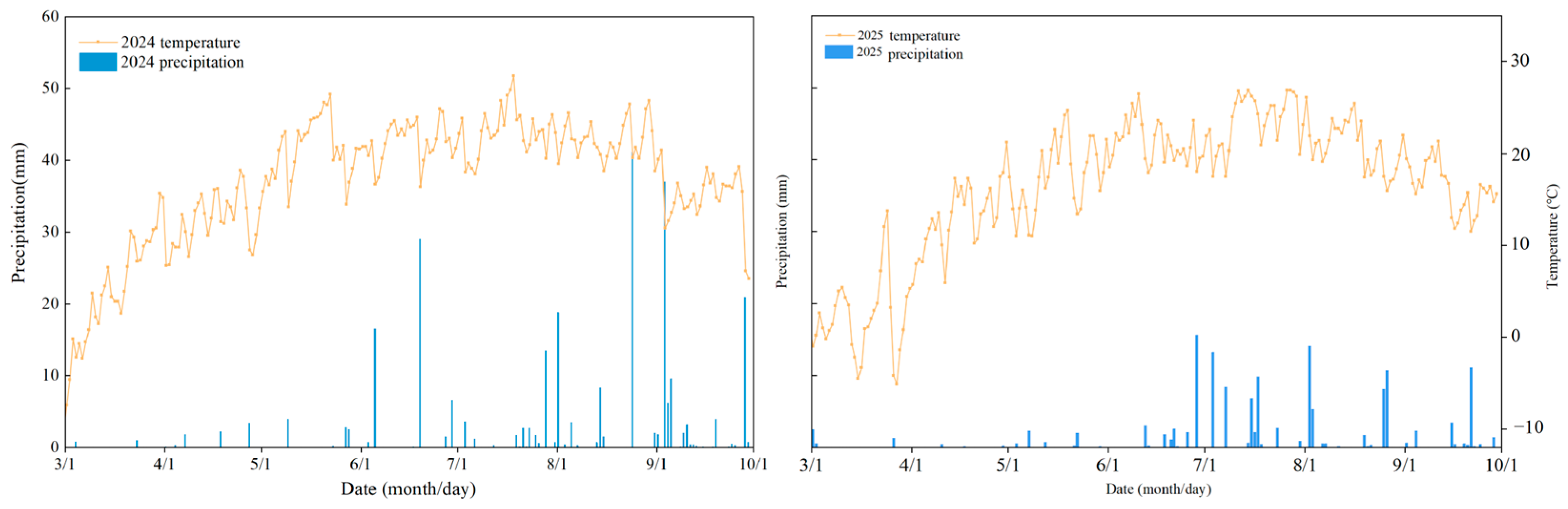
The experiment was conducted from 2023 to 2025 at the Wuwei Oasis Agricultural Comprehensive Experiment Station of Gansu Agricultural University (103°5′ E, 37°31′ N) (Figure 1). Located at the eastern end of the Hexi Corridor, the site has an altitude of 1770 m, with a mean annual temperature of 7.2 °C and an average accumulated temperature ≥ 10 °C of 2985 °C. The area experiences a frost-free period of 156 days per year and annual sunshine duration of 2950 h, falling within a cold-temperate arid climate zone. The mean annual precipitation is approximately 160 mm, with the majority of rainfall occurring between July and September. Temperature and rainfall data during maize growing season are presented in Figure 2. The soil type is classified as thick irrigation-siltation soil, and the baseline soil properties before the experiment are presented in Table 1.

2.2. Experimental Design

Previous research by our team demonstrated that no-tillage with total green manure incorporation significantly enhanced maize yield (34.3%), Water use efficiency (39.2%), and nitrogen uptake efficiency (26.3%) relative to conventional practices spring wheat–common vetch–maize rotation planting pattern [17,18]. Building on this approach, a 20% reduction in nitrogen application rate was found to maintain stable yield while further increasing Water use efficiency (by 1.8% to 26.6%) [19].
The experiment was initiated in March 2023, following a spring wheat–common vetch–maize rotation system. Spring wheat was planted in March 2023, and after its harvest in July, common vetch was sown as a succeeding crop. The vetch was harvested at full bloom in October and returned to the field as no-tillage with total green manure incorporation. During incorporation, the average moisture content of green manure plants was 89%, with nitrogen content at 4.4% and 8.2%, respectively. The application rate was uniformly 37,600 kg·hm−2. The following year, the field was rototilled, covered with plastic film, and sown with maize in flat planting. Maize (cv. ‘Xianyu 1225’) was planted at a density of 82,500 plants·ha−1 and fertilized with 360 kg N·ha−1 and 180 kg P2O5·ha−1, with all phosphorus applied basally. Spring wheat (cv. ‘Ningchun 4’) was sown at 6,750 plants·ha−1 and received a basal fertilizer application of 180 kg N·ha−1 and 90 kg P2O5·ha−1. Green manure (cv. ‘Lanjian 2’) was seeded at a rate of 75 kg·ha−1. Urea (46% N) and single superphosphate (16% P2O5) served as the nitrogen and phosphorus sources, respectively. Given the region’s high background soil potassium level, no potassium fertilizer was applied.
A split-plot design was adopted with irrigation amount as the main plot and nitrogen application rate as the sub-plot (Table 2). The experiment included a total of nine treatments, each replicated three times, with a plot size of 50 m2 (12.5 m × 4 m).

2.3. Measurement and Calculation

2.3.1. Soil Water Content (SWC)

Soil water content (SWC, %) in the 0–110 cm soil layer was determined using the gravimetric method during key maize growth stages (jointing, V6; silking, R1; milk, R3; and maturity, R6). Soil samples were collected in layers: from 0 to 30 cm at 10 cm intervals and from 30 to 110 cm at 20 cm intervals. Each layer was placed into an aluminum container of known mass and weighed. The samples were then dried in an oven at 105 ± 5 °C until constant weight (typically 16–24 h), cooled, and reweighed. The SWC for each layer was calculated based on the mass difference before and after drying. Supplementary measurements were conducted after each irrigation or rainfall event.

2.3.2. Soil Total Nitrogen (STN)

Similarly, soil samples were collected at key growth period of maize. Three sampling points were selected per plot, and soil cores were taken from the 0–110 cm depth using a soil auger. After air-drying, the samples were passed through a 0.2 mm sieve. STN was subsequently determined using a Smartchem 450 fully automated discrete chemical analyzer (AMS Alliance, Rome, Italy).

2.3.3. Leaf Area Index (LAI) and Leaf Area Duration (LAD)

Leaf area (LA) was measured at the maize seedling (V3), jointing (V6), bell (V12), silking (R1), milk (R3), wax (R5), and full maturity (R6) stages using the length–width coefficient method. The leaf area index (LAI) was calculated using Equation (1) [24].
LAI = C × P × i = 1 n a i × b i
where C is the correction coefficient (0.75 for expanded leaves and 0.5 for unexpanded leaves), P is the number of basic seedlings, a and b are the length and width of the leaf, respectively, and i is the number of leaves. S represents the land area.

2.3.4. Net Photosynthetic Rate (Pn), Transpiration Rate (Tr), and Relative Chlorophyll Content (SPAD)

From the jointing to the wax maturity stage of maize, Pn, Tr and SPAD were measured between 9:30 and 11:30 AM on clear days. For each plot, three representative plants with uniform growth were randomly selected. During the jointing stage, the second fully expanded leaf from the top was measured. At the bell, silking, grain-filling, and wax maturity stages, the ear-leaf was selected. Measurements were taken at the middle part of the leaf, avoiding the midrib and leaf margin.
Pn and Tr were measured using an LI-6800XT portable photosynthesis system (LI-COR, Lincoln, NE, USA) equipped with a 2 cm2 leaf chamber. The flow rate was set at 500 μmol·s−1, and the photosynthetically active photon flux density (PPFD) was maintained at 1200 μmol·m−2·s−1. During measurements, leaf temperature was kept consistent with ambient air temperature, and relative humidity was maintained at 55%.
The relative chlorophyll content was measured using a SPAD-502 Plus chlorophyll meter (Konica Minolta, Tokyo, Japan). The timing, date, and leaf position for SPAD measurements were consistent with those for gas exchange parameters.

2.3.5. Dry Matter (DM)

From the maize seedling stage, plants were sampled every 15–20 days using an S-shaped pattern. Samples were oven-dried (105 °C for 1 h, then 80 °C to constant weight) to determine dry matter.

2.3.6. Grain Yield (GY)

At maize maturity, plants from a 5 m length within the full film width (1.2 m) in each plot were harvested and threshed for grain. GY per unit area was calculated based on a standard moisture content of 14%. After maturity, 10 pre-reserved plants from each plot were sampled for yield component analysis, including kernel number per ear and 1000-kernel weight. The number of effective ears per unit area was determined concurrently with the yield measurement.

2.3.7. Water Use Efficiency (WUE)

WUE (kg·m−3) was calculated by Equation (2) [25]:
WUE = GY / ET c
where GY is grain yield, ETc is actual crop evapotranspiration (mm).
ETc (mm) for each plot was determined using the water balance Equation (3) [17].
ET c = P + I + C r D p R f ± Δ S
where P is effective precipitation, I is irrigation, Cr is upward capillary flow, Rf is surface runoff, Dp is deep percolation, and ΔS is the change in soil water storage. In Equation (3), Cr is justifiably set to zero, given that the groundwater level was 100 m deep. Rf is considered negligible owing to the absence of observed runoff during the entire drip irrigation period. Additionally, Dp is disregarded because the soil water content beneath the 100 cm depth never attained saturation at any point during the monitoring period.

2.3.8. Nitrogen Utilization Efficiency for Grain Yield (NUtEg)

Nitrogen use efficiency for grain yield (NUtEg, kg·m−3) was calculated by Equation (4) [26]:
NUtEg = GY / NA
where GY (kg·ha−1) is grain yield, NA (kg·ha−1) is nitrogen absorption of plants at mature stage, which is equal to the aboveground dry matter weight of the plant multiplied by the nitrogen content of the plant. This index reflects the physiological efficiency of crops in converting absorbed nitrogen into grain yield.

2.4. Statistical Analysis

The data were collated using Microsoft Excel 2021 and analyzed with SPSS 27.0. Two-factor analysis of variance and Duncan’s multipolar test (α = 0.05) were used for comparison between treatments. Use Origin 2021 for data visualization. Structural equation modeling was carried out in AMOS 22.0 to quantify the direct and indirect influences.

3. Results

3.1. WUE and NUtEg

Irrigation amount (I), nitrogen application rate (N), and their interaction (I × N) significantly affected maize water use efficiency (WUE) and nitrogen use efficiency (NUtEg) (Table 3). Main effects analysis revealed that reducing irrigation by 20% (I2) did not significantly affect WUE or NUtEg compared to conventional irrigation (I1), whereas a 40% reduction (I3) significantly decreased WUE by 17.4% and NUtEg by 18.5% (p < 0.05). Similarly, a 20% reduction in nitrogen (N2) had no significant impact on either efficiency metric relative to conventional nitrogen (N1), while a 40% nitrogen reduction (N3) significantly lowered WUE by 17.6% and NUtEg by 10.4% (p < 0.05).
The interaction analysis, benefiting from the increased precision for the subplot (nitrogen) factor, showed that the combined 20% reduction in both irrigation and nitrogen (I2N2) significantly improved NUtEg by 11.7% compared to the conventional practice (I1N1) (p < 0.05). For WUE, both I2N1 and I2N2 treatments achieved significant increases of 8.3% and 7.6%, respectively, over I1N1. In contrast, all treatments under severe water reduction (I3) significantly reduced both WUE and NUtEg, with decreases ranging from 17.4% to 23.6% (p < 0.05). No other treatment combinations differed significantly from I1N1 in terms of NUtEg.
These results demonstrate that within the tested ranges, a moderate 20% co-reduction in both water and nitrogen inputs can enhance resource use efficiency in the short term without compromising yield, whereas severe reductions in either input are detrimental. The split-plot design effectively allowed for a precise evaluation of nitrogen levels, confirming N2 as the optimal level under reduced irrigation.

3.2. GY and Its Constituent Factors

Irrigation amount (I), nitrogen application rate (N), and their interaction (I × N) significantly influenced maize grain yield (GY) and its components (ear number, kernel number per ear, and 1000-kernel weight) (Table 4). Main effects analysis showed that reducing irrigation by 20% (I2) did not significantly affect GY or any yield component compared to full irrigation (I1). In contrast, a 40% irrigation reduction (I3) significantly decreased GY by 33.4%, ear number by 22.7%, kernel number per ear by 18.9%, and 1000-kernel weight by 18.1% (p < 0.05). Similarly, a 20% nitrogen reduction (N2) had no significant effect on yield or its components relative to conventional nitrogen (N1), whereas a 40% nitrogen reduction (N3) significantly reduced GY by 19.9%, ear number by 12.3%, kernel number per ear by 12.2%, and 1000-kernel weight by 12.8% (p < 0.05).
Interaction analysis, conducted with increased precision for the subplot (nitrogen) factor, indicated that the combined 20% reduction in both irrigation and nitrogen (I2N2) maintained GY and all yield components at levels comparable to the conventional practice (I1N1). Similarly, treatments I1N2 and I2N1 showed no significant reduction in yield or its components relative to I1N1. In contrast, all treatments involving either severe nitrogen reduction (N3) or severe water reduction (I3) resulted in significant declines in GY (ranging from 17.9% to 42.0%) and concomitant reductions in ear number, kernel number per ear, and 1000-kernel weight (p < 0.05).
These findings demonstrate that within the two-year experimental period, a moderate and synchronized 20% reduction in both water and nitrogen inputs under green manure incorporation can sustain maize yield by preserving key yield-forming traits. The split-plot design effectively enabled the precise evaluation of nitrogen levels, identifying N2 (20% reduction) as the optimal level under reduced irrigation (I2) for maintaining stable production.

3.3. DM

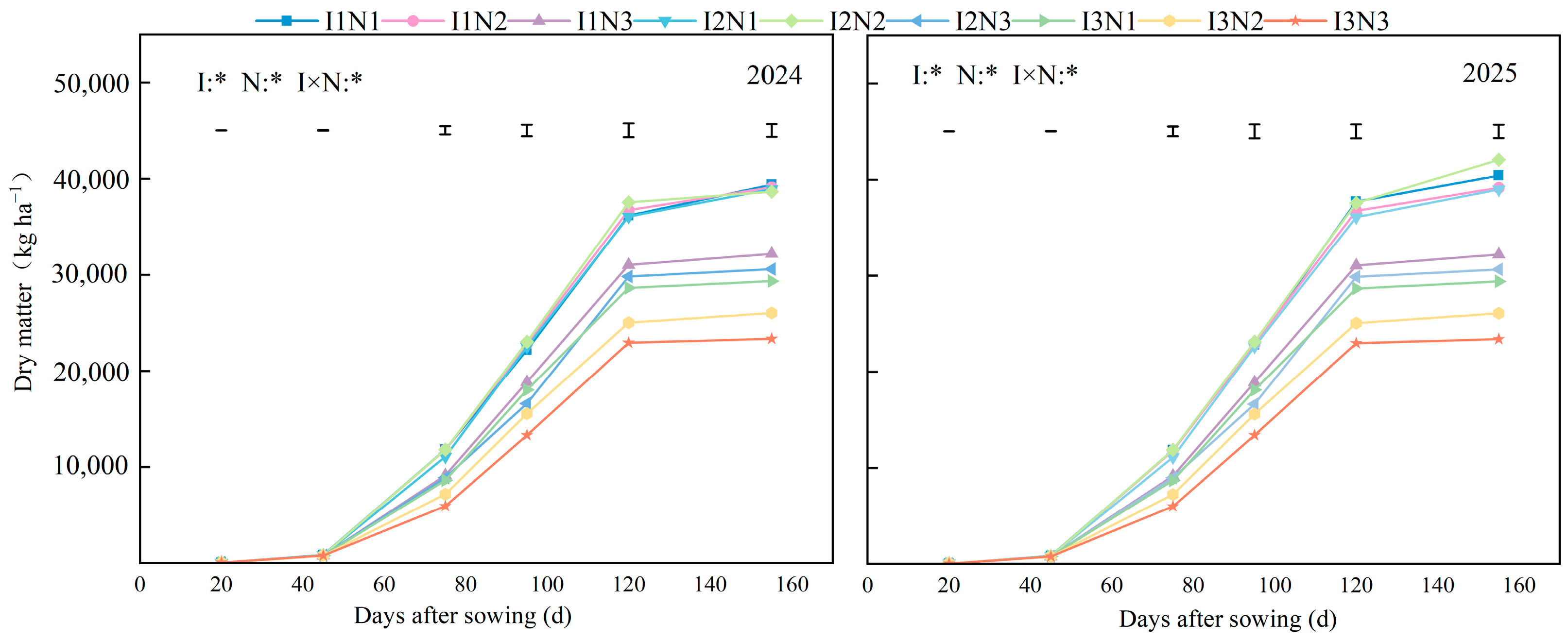
Irrigation amount, nitrogen application rate, and their interaction significantly affected maize DM (Figure 3). During the V12–R6 stages, under the same nitrogen regime, DM under I2 remained largely unchanged from I1, whereas I3 significantly reduced DM by 29.2% to 33.4% relative to I1 (p < 0.05). Under the same irrigation regime, no significant difference was found between N2 and N1, but N3 significantly decreased DM by 20.3% to 33.4% compared to N1 (p < 0.05). The interaction analysis revealed that from V6 to R6 stages, the DM values in I1N2, I2N1, and I2N2 did not show a significant reduction relative to I1N1. In contrast, I1N3, I2N3, I3N1, I3N2, and I3N3 significantly reduced DM by 6.5–19.3%, 5.9–23.3%, 6.4–26.4%, 8.7–34.6%, and 7.7–41.1%, respectively (p < 0.05). These results demonstrate that a 20% reduction in both irrigation and nitrogen input under green manure incorporation effectively maintains high aboveground DM accumulation during the middle and late growth stages of maize, thereby laying a foundation for stable or increased yield.
The dynamic process of aboveground DM accumulation (Y) in maize for all treatments over the two experimental years was well described by the logistic equation as a function of days after emergence (t) (R2 > 0.99; Table 5). Throughout the two experimental years, under green manure incorporation, irrigation amount, nitrogen application rate, and their interaction significantly influenced the maximum DM accumulation rate (Vmax), the mean accumulation rate (Vmean), and the time to reach the maximum rate (t50) in maize. Both Vmax and Vmean gradually decreased with reductions in irrigation and nitrogen input. Compared to I1, the I3 treatment significantly reduced Vmax and Vmean by 20.9% and 27.6%, respectively (p < 0.05). Similarly, compared to N1, the N3 treatment significantly decreased Vmax and Vmean by 16.1% and 19.5%, respectively (p < 0.05). Relative to I1N1, the Vmax of I1N2, I2N1, and I2N2 increased by 5.3%, 4.4%, and 9.3%, respectively (p < 0.05). In contrast, I1N3, I2N3, I3N1, I3N2, and I3N3 significantly reduced Vmax and Vmean by 11.5% and 17.5%, 18.4% and 22.4%, 17.1% and 24.3%, 27.3% and 32.8%, and 31.6% and 39.2%, respectively (p < 0.05). The t50 for I2N2, I3N1, and I3N2 was delayed by 2.9, 3.3, and 2.0 days, respectively, compared to I1N1. These results indicate that under green manure incorporation, individual 20% reductions in either water or nitrogen input, or a combined 20% reduction in both (I2N2), enhance the maximum dry matter accumulation rate (Vmax), prolong the duration to reach the maximum rate (t50), and ultimately maintain high DM accumulation.

3.4. LAI

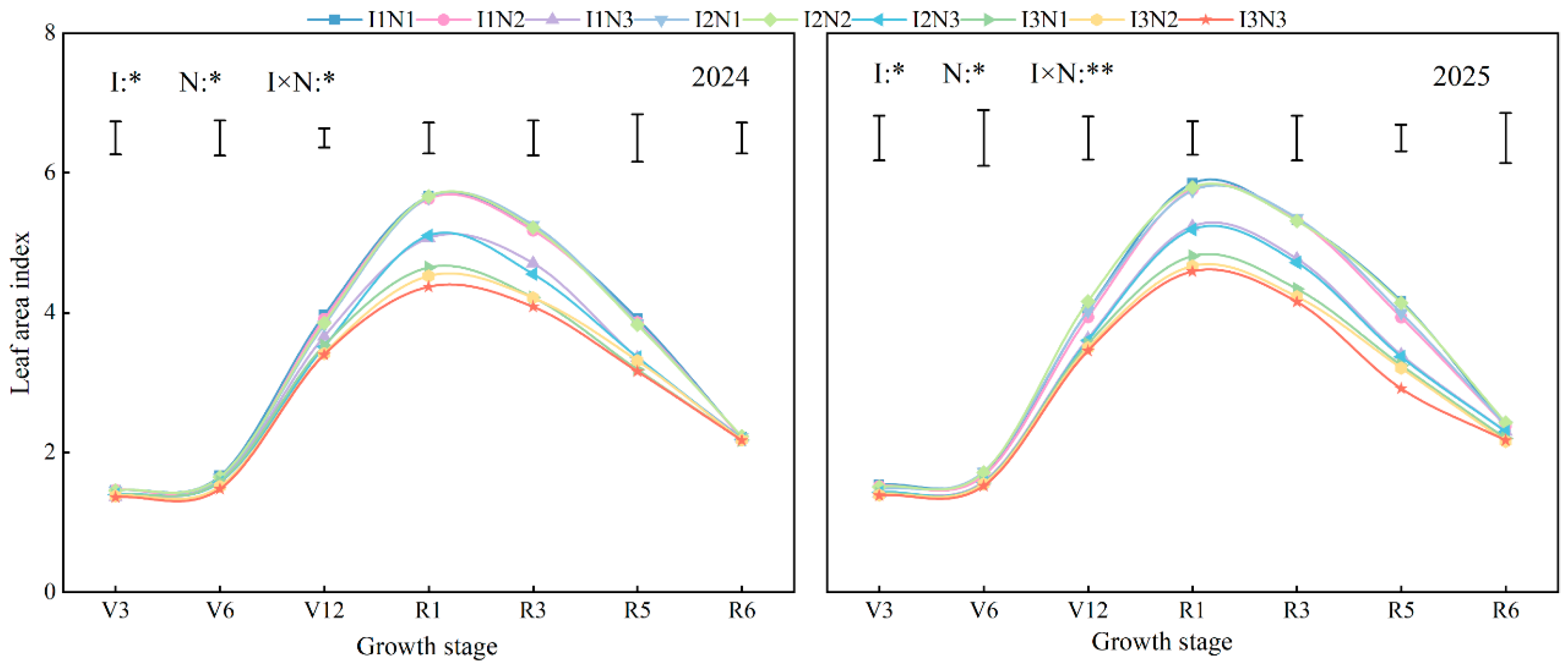
Irrigation amount, nitrogen application rate, and their interaction significantly affected the LAI of maize throughout the entire growth cycle (Figure 4). Under the same nitrogen regime, from the jointing to the wax maturity stage, compared with treatment I1, I2 did not significantly reduce LAI, whereas I3 significantly reduced LAI by 6.2% to 16.3% (p < 0.05). Under the same irrigation regime, Compared with N1, the reduction in LAI under N2 did not reach a significant level, but N3 significantly reduced LAI by 7.2% to 12.9% (p < 0.05). The interaction analysis revealed that, compared to I1N1, the treatments I1N2, I2N1, and I2N2 showed no significant difference in LAI. In contrast, I1N3, I2N3, I3N1, I3N2, and I3N3 significantly reduced LAI by 8.8–16.3%, 10.9–16.5%, 11.4–20.3%, 13.6–19.2%, and 14.3–25.8%, respectively (p < 0.05). These results indicate that combining green manure incorporation with a 20% reduction in both irrigation and nitrogen (i.e., the I2N2 treatment) can maintain a high LAI in maize, particularly by ensuring sufficient photosynthetic area during the middle and late growth stages.

3.5. SPAD

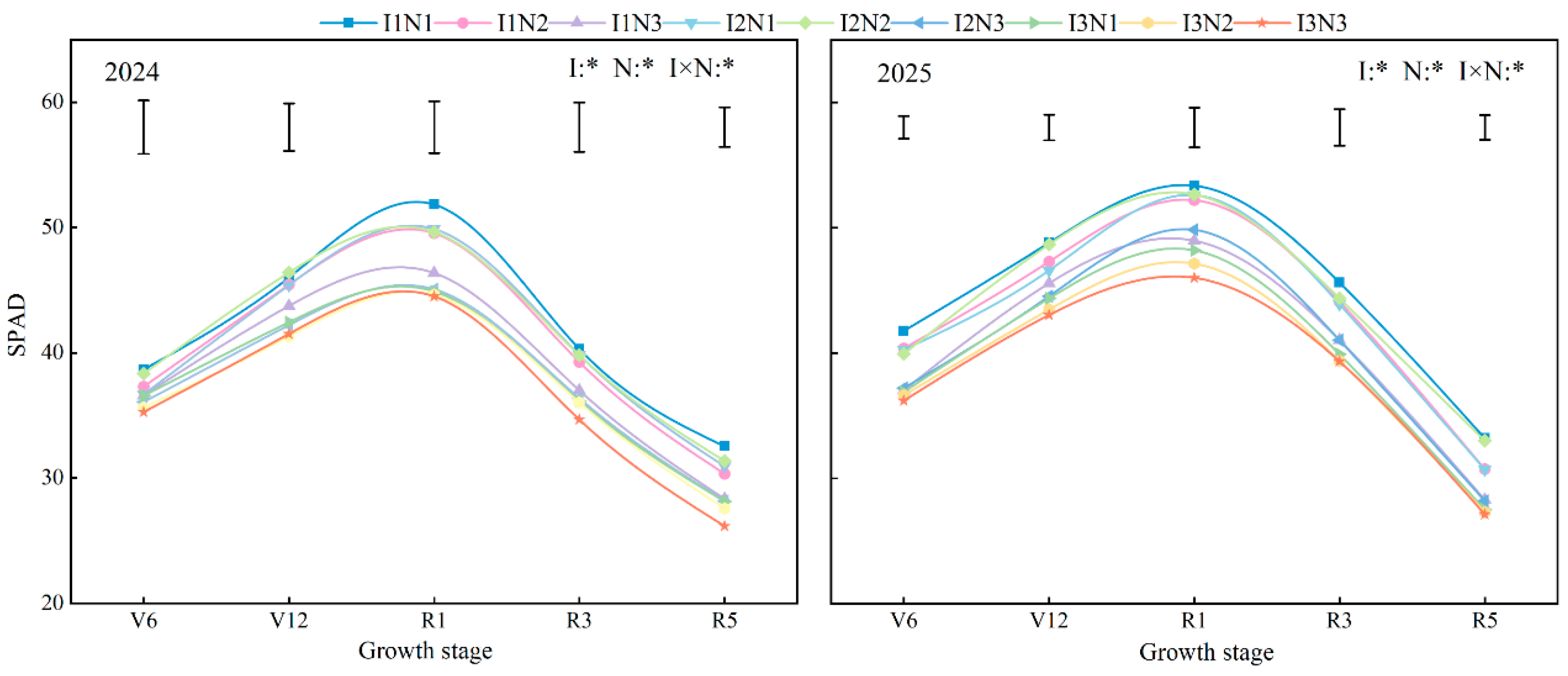
Irrigation amount, nitrogen application rate, and their interaction significantly influenced the SPAD value of maize throughout the growth cycle (Figure 5). Under the same irrigation level from V6 to R5, no significant difference was observed between N2 processing of SPAD and N1, while N3 significantly reduced it by 7.2% to 9.1% compared to N1 (p < 0.05). Under the same nitrogen level from V6 to V12, no significant changes in SPAD were observed among irrigation treatments. From R1 to R5, the SPAD value under I2 remained essentially unchanged from I1, whereas I3 significantly reduced it by 9.5% to 10.7% compared to I1 (p < 0.05). The interaction analysis revealed that from V6 to R5, the SPAD values under I1N2, I2N1, and I2N2 were not significantly different from I1N1. In contrast, I1N3, I2N3, I3N1, I3N2, and I3N3 significantly reduced SPAD by 8.3–13.8%, 8.8–14.2%, 8.5–15.4%, 10.1–16.5%, and 11.1–18.9%, respectively (p < 0.05). These findings indicate that under green manure incorporation, individual 20% reductions in either water or nitrogen input, or a combined 20% reduction in both (I2N2), can effectively maintain chlorophyll content during the mid to late growth stages of maize, thereby promoting sustained leaf greenness.

3.6. Pn and Tr

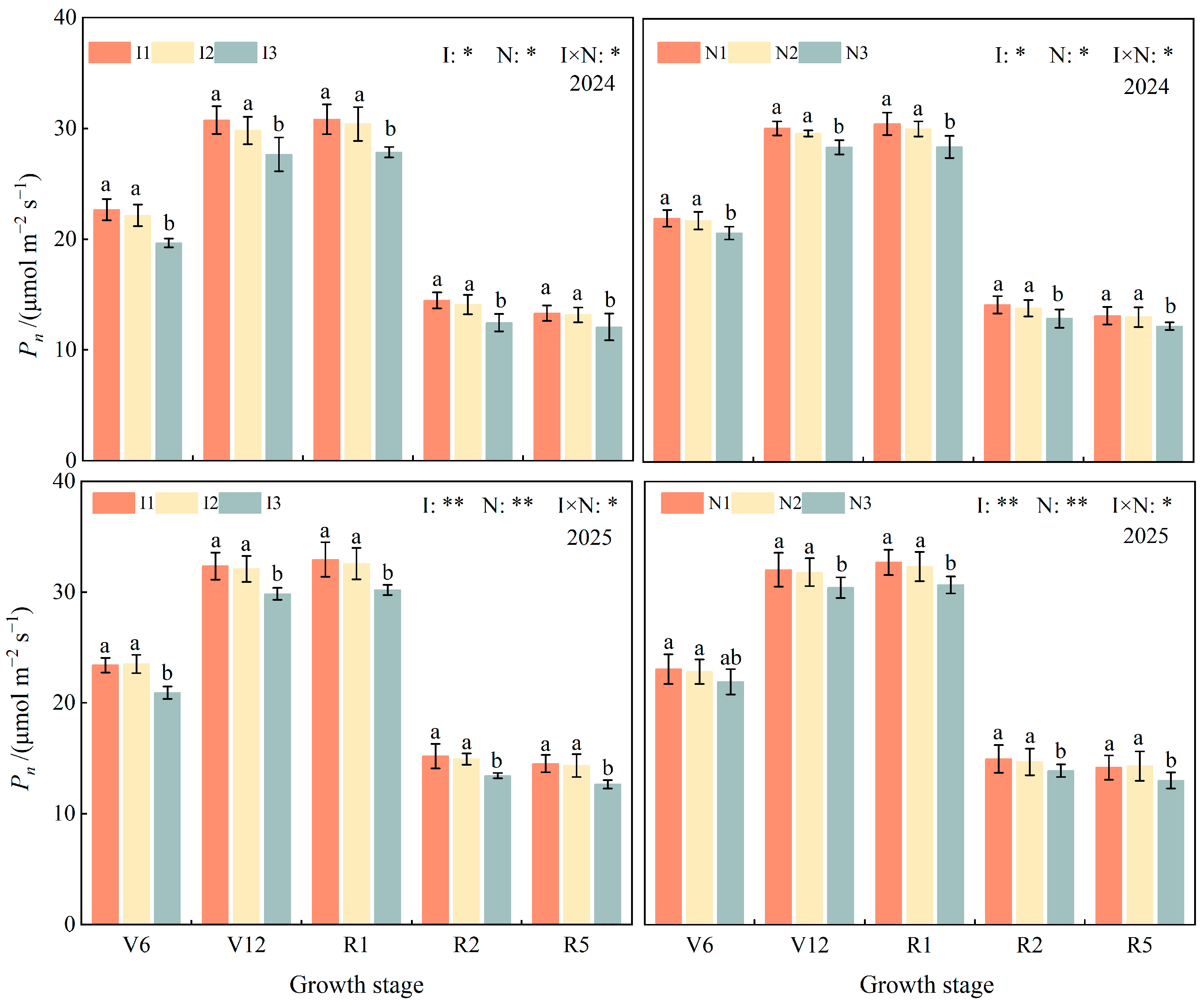
Irrigation amount, nitrogen application rate, and their interaction significantly affected the Pn of maize at key growth stages (Figure 6). Under the same nitrogen regime during the V6-R5 stages, Pn under I2 showed no significant difference compared to I1, whereas I3 significantly reduced Pn by 7.7% to 11.9% relative to I1 (p < 0.05). Under the same irrigation regime from V12 to R5, no significant difference in Pn was observed between N2 and N1, but N3 significantly decreased Pn by 5.0% to 7.7% compared to N1. The interaction analysis revealed that during the V12-R5 period, Pn in I1N2, I2N1, and I2N2 did not show significant differences compared to I1N1. In contrast, I1N3, I2N3, I3N1, I3N2, and I3N3 significantly reduced Pn by 7.5–9.3%, 9.4–10.9%, 10.8–12.3%, 12.4–13.6%, and 13.1–16.3%, respectively (p < 0.05). These results demonstrate that a 20% reduction in both irrigation and nitrogen input effectively maintains the Pn of maize, thereby establishing a photosynthetic foundation for stabilizing or increasing yield during the middle and late growth stages.
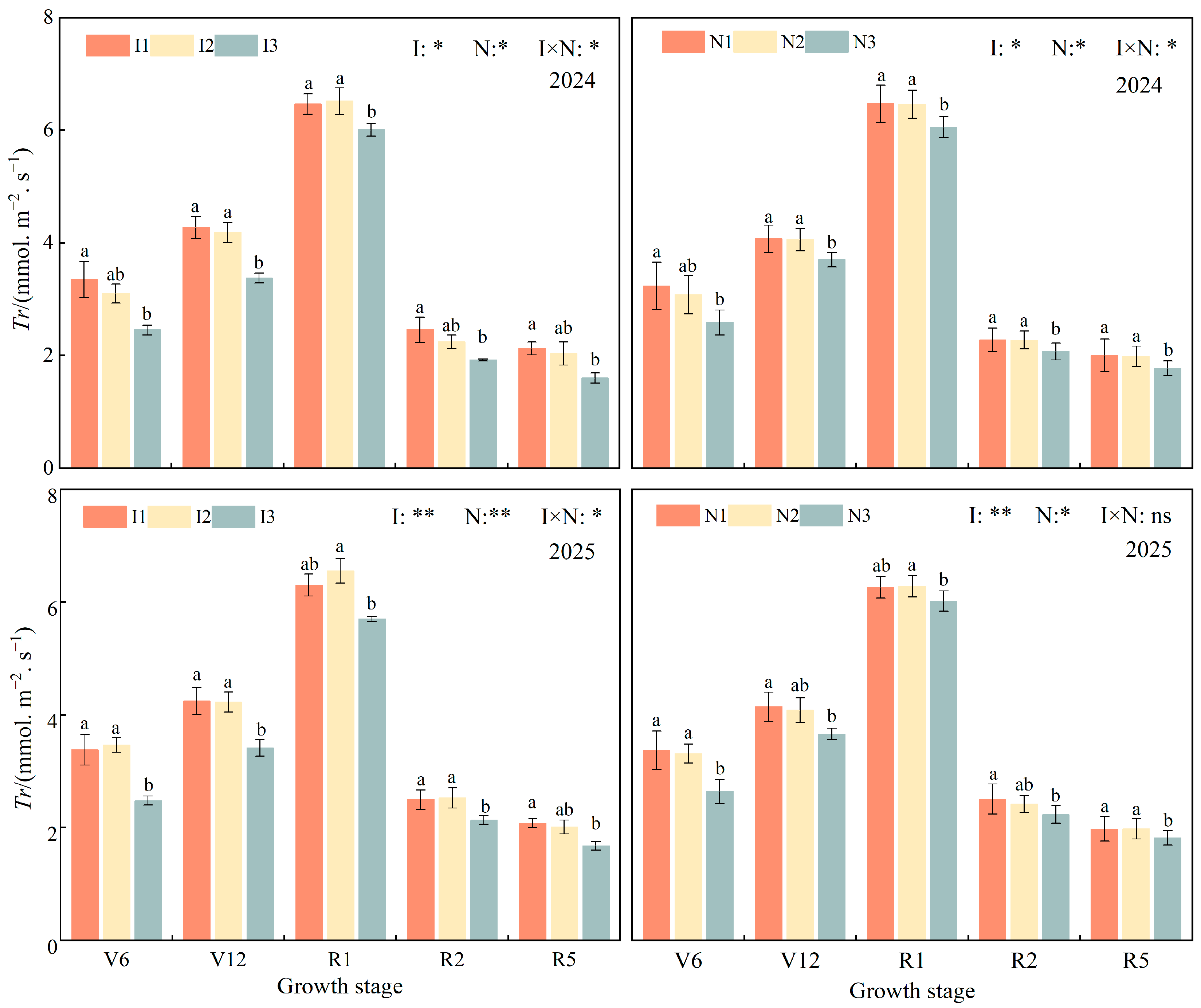
Irrigation amount, nitrogen application rate, and their interaction significantly affected the Tr of maize at key growth stages (Figure 7). The variation trend of Tr was similar to that of Pn. During the V6-R5 stages, whereas I3 significantly reduced Tr by 22.3% to 26.6% compared to I1 (p < 0.05). Similarly, N3 significantly decreased Tr by 9.8% to 20.8% relative to N1 (p < 0.05). The interaction analysis revealed that during the V6–R5 period, the Tr in I1N2, I2N1, and I2N2 were not significantly different from I1N1. In contrast, I1N3, I2N3, I3N1, I3N2, and I3N3 significantly reduced Tr by 6.5–15.6%, 14.0–25.8%, 20.5–33.1%, 21.6–35.5%, and 27.7–37.3%, respectively (p < 0.05). These results indicate that combining green manure incorporation with a 20% reduction in both irrigation and nitrogen (I2N2) maintains a relatively high Tr during the maize growth period, thereby preserving a favorable photosynthetic environment and enhancing overall photosynthetic performance.

3.7. SWC

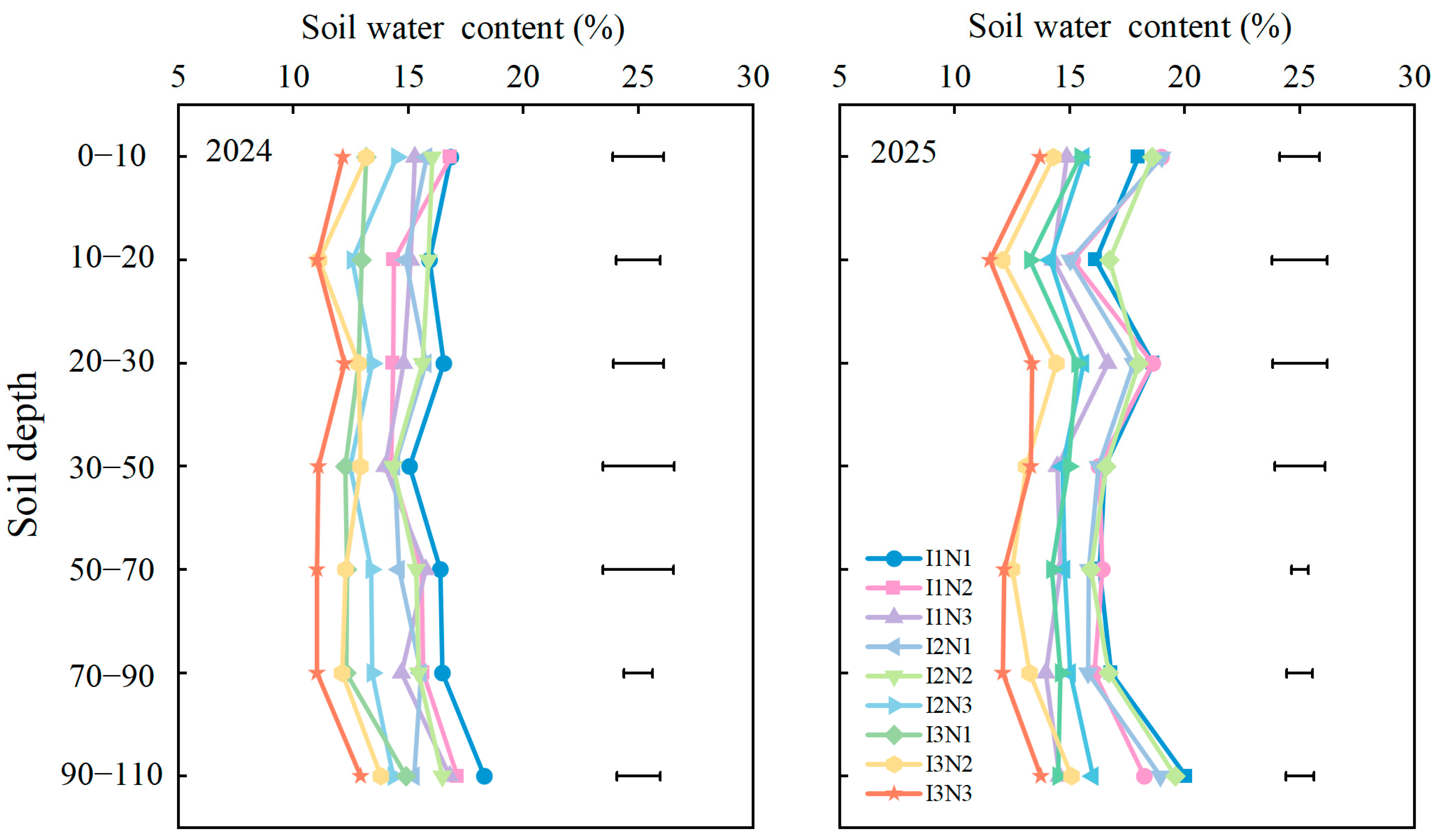
The soil water content (SWC) under different water and nitrogen treatments was shown in Figure 8. In the 0–30 cm layer, I3N1, I3N2, and I3N3 treatments significantly reduced SWC by 18.7%, 23.7%, and 27.5%, respectively, compared to I1N1 (p < 0.05), no significant differences were observed in the 0–30 cm soil water content (SWC) across all other treatments. Within the 30–90 cm depth, significant reductions in SWC of 10.4%, 14.1%, 17.3%, 21.9%, and 27.6% were found for I1N3, I2N3, I3N1, I3N2, and I3N3, respectively; however, I1N2 and I2N1 showed no significant difference from I1N1. In the 90–110 cm layer, all treatments except I2N2 (which was not significant) resulted in a significant decrease in SWC, with reductions ranging from 7.6% to 30.5% relative to I1N1 (p < 0.05). It is indicated that moderately reducing irrigation and nitrogen application (I2N2) provides a favorable soil water environment for the soil. However, the combination of high nitrogen usage (N3) and significant reduction in irrigation (I3) causes the most severe consumption of soil water.

3.8. STN

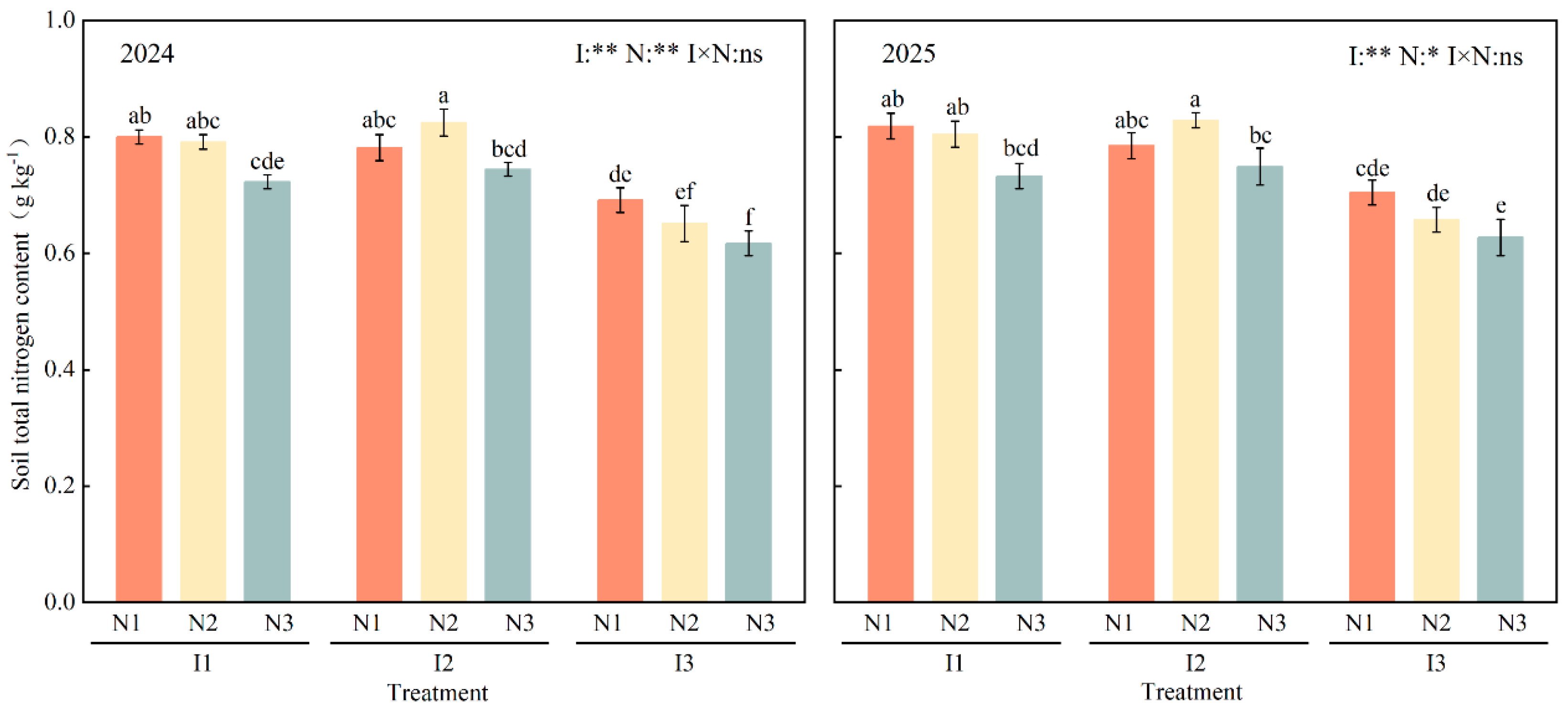
Both irrigation and nitrogen application rates significantly influenced soil total nitrogen (STN) at the maize silking stage (Figure 9). Under the same nitrogen regime, the STN between I2 and I1 was similar, with differences not reached statistical significance, whereas I3 significantly reduced STN by 15.4% compared to I1 (p < 0.05). Under the same irrigation regime, no significant difference was observed between N2 and N1, but N3 significantly decreased STN by 8.5% relative to N1 (p < 0.05). The interaction effect revealed that the I2N2 treatment resulted in the highest STN. No significant differences in STN were found among I1N1, I1N2, I1N3, I2N1, and I2N3. In contrast, I3N1, I3N2, and I3N3 significantly reduced STN by 13.8%, 19.1%, and 23.1%, respectively, compared to I1N1 (p < 0.05). These results indicate that under green manure incorporation, a 20% reduction in both irrigation and nitrogen inputs (i.e., the I2N2 treatment) can effectively maintain STN at the silking stage.

3.9. Structural Equation Modeling (SEM)

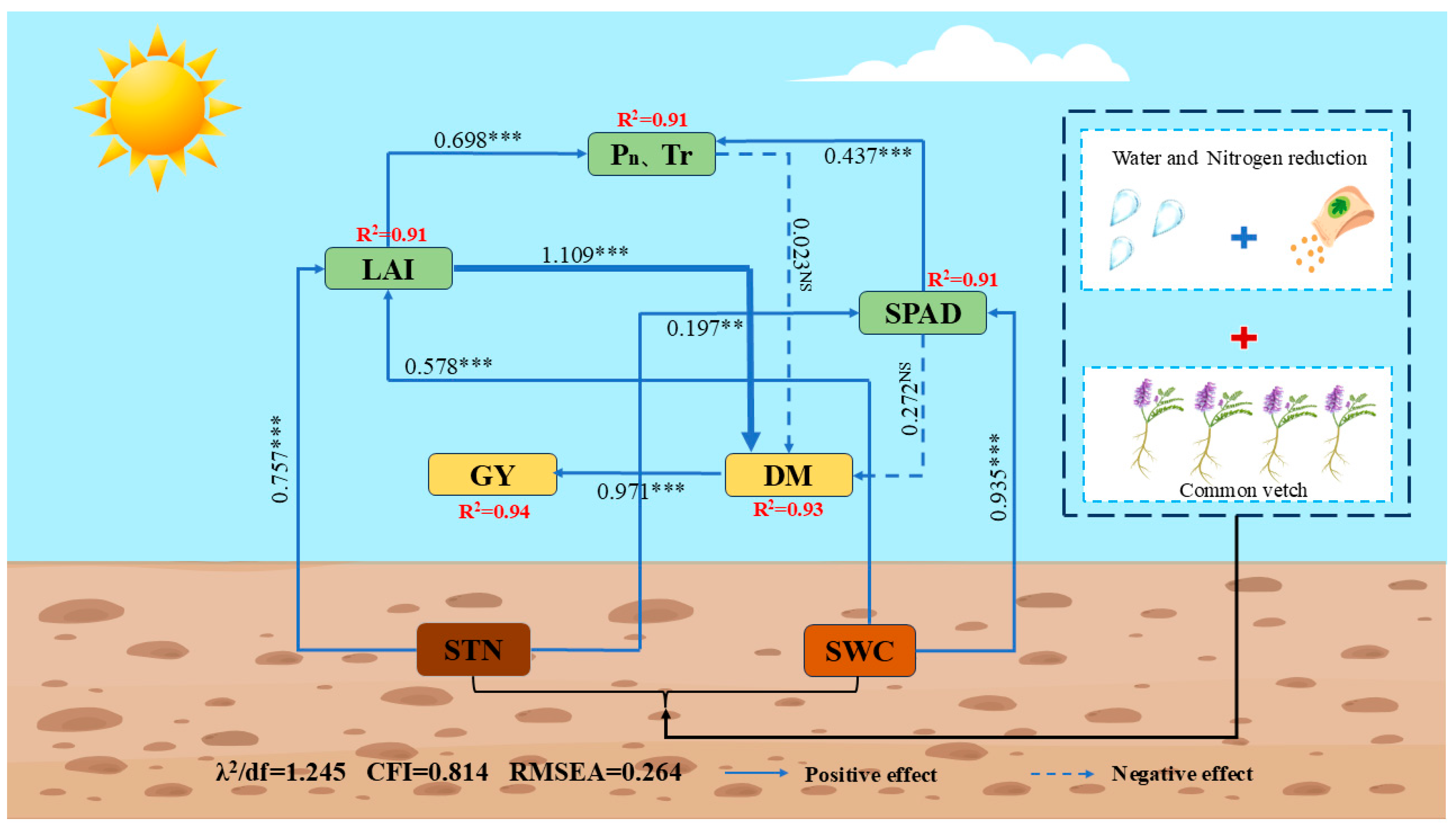
Structural Equation Modeling (SEM) was performed to examine the hypothesized relationships among subsurface soil physicochemical properties, aboveground photosynthetic traits, and maize yield (Figure 10). The analysis was based on n = 54 observations (pooled across treatments and years), with all continuous variables standardized prior to modeling. The final model showed an acceptable fit to the data, with fit indices as follows: x2/df = 1.245, CFI = 0.814, RMSEA = 0.264, all within commonly accepted thresholds. Path analysis indicated that soil water content (SWC) and soil total nitrogen (STN) were positively associated with leaf area index (LAI), which in turn significantly promoted dry matter accumulation (DM; p < 0.001) and ultimately grain yield. Furthermore, the effects of SWC and STN on key photosynthetic parameters—net photosynthetic rate (Pn) and transpiration rate (Tr)—were primarily mediated through their influence on LAI and SPAD. Meanwhile, LAI contributed to yield mainly via enhancing DM accumulation. It is important to note that these path coefficients reflect statistical relationships derived from observational data and do not imply causal mechanisms. This integrated pathway illustrates how yield formation under the tested system may be influenced by the coordinated roles of soil water and nitrogen status on canopy development and photosynthetic function. These findings are based on a two-year dataset and represent preliminary physiological associations; longer-term studies are needed to validate the stability and generality of these relationships.

4. Discussion

4.1. Green Manure Incorporation Combined with Water-Nitrogen Reduction Stable GY and Improved WUE and NUtEg

How to improve crop WUE and NUtEg through various agronomic measures is a core challenge for global sustainable agricultural development [27,28,29]. Studies in rainfed and irrigated areas have shown that green manure incorporation increases the GY, WUE, and NUtEg of subsequent crops [30,31,32]. The results of this study indicated that under green manure incorporation, moderate water and nitrogen reduction (I2N2 treatment) significantly improved WUE by 7.6% and NUtEg by 11.7% compared with conventional water and nitrogen application rates (Table 3). This finding is consistent with the research on wheat, which reported that incorporating 30,000 kg ha−1 leguminous green manure combined with a 15% reduction in nitrogen application increased the WUE of spring wheat by 22.7% [33]. These results demonstrate that under the synergistic effect of green manure, a simultaneous 20% reduction in water and nitrogen enhanced the conversion efficiency of maize for unit water and nitrogen [34,35]. Notably, both I2N1 and I2N2 treatments exhibited excellent performance in terms of WUE and NUtEg. This is consistent with the research conclusions on double-cropping rice [36], wheat [33], and maize [34]. These studies indicate that green manure can compensate for the potential crop GY loss caused by nitrogen reduction by improving the micro-environment in the root zone. It suggests that even under nitrogen reduction conditions, efficient resource utilization can still be achieved by combining green manure with moderate irrigation. This result holds significant practical implications for promoting green and low-carbon agricultural development and implementing water-saving agriculture strategies. When popularizing the technology of green manure incorporation combined with synergistic water and nitrogen reduction in similar ecological regions in the future, priority should be given to the adaptability of soil types, green manure species, and water/nitrogen reduction ratios to achieve a win-win situation for ecology and GY.
From the perspective of yield components, there were no significant differences in GY and its component indicators between the I2N2 treatment and the I1N1 (conventional) treatment (Table 4). This indicates that under the background of green manure incorporation, a simultaneous 20% reduction in water and nitrogen can achieve the goal of reducing inputs without reducing GY. This effect is mainly attributed to the additional nitrogen sources provided by green manure [37,38] and the improvement of the rhizosphere micro-environment by active organic matter [11,36,39], thereby enhancing the physiological buffering capacity of plants under moderate stress. Furthermore, the SEM revealed the causal pathways of key factors in the system: SWC and STN indirectly affected Pn and Tr rate by regulating LAI and SPAD values (path coefficients: 0.48–0.62), which in turn drove DM accumulation and ultimately determined yield (R2 = 0.81) (Figure 10). This suggests that green manure incorporation combined with water and nitrogen reduction does not rely on the independent role of a single factor, but rather achieves stable GY through systematic optimization of the entire chain of soil-canopy-photosynthesis-material production-yield formation.
It is worth noting that based on a two-year short-term experiment, this study provides preliminary insights into the effects of reducing water and nitrogen inputs on the physiological processes and yield formation of maize under the addition of green manure. It should be pointed out that these findings reflect initial and short-term reactions, and the gradual improvement of soil structure and long-term nitrogen balance processes may not be fully apparent. Future research should focus on the following aspects: first, conducting multi-year continuous observations to analyze the relationships between key climatic variables—such as rainfall and accumulated temperature—and yield as well as water and nitrogen use efficiency, with the goal of establishing a climate adaptability evaluation framework for this cropping system. Second, implementing long-term fixed-site monitoring to comprehensively assess the role of soil microorganisms in carbon and nitrogen cycling within the system. Furthermore, special attention should be given to tracking possible shifts in soil nitrogen availability and balance over extended periods.

4.2. Green Manure Incorporation Combined with Water and Nitrogen Reduction Optimizes Maize Canopy Characteristics and Dry Matter Accumulation

LAI and SPAD values are key indicators characterizing crop canopy structure development and leaf physiological functions [40]. In this study, there were no significant differences in LAI and SPAD values between the I2N2 treatment and conventional water-nitrogen management (I1N1) throughout the entire growth period (LAI fluctuation range: ±5.2%; SPAD value difference: <3.8%), and both indicators maintained high levels during the mid-filling stage (R3–R5) (Figure 4 and Figure 5). This is highly consistent with the compensation effect of green manure on wheat photosynthetic sources (LAI and LAD) under deficit irrigation [41]. The main reason is that moderate water and nitrogen reduction did not lead to a reduction in photosynthetic area or inhibition of chlorophyll synthesis; instead, under the synergy between slow-release nutrients provided by green manure and water regulation, the leaf senescence process was effectively delayed [42,43]. This study also found that there were no significant differences in Pn and Tr between the I2N2 treatment and I1N1, while under I3 or N3 conditions, Pn and Tr decreased significantly by 11.9–26.6% and 20.8–26.6%, respectively (Figure 6 and Figure 7). This may be because green manure incorporation significantly alleviated the adverse effects of mild water and nitrogen stress on the function of photosynthetic organs, maintaining the synergistic balance between carbon assimilation and water transpiration [17]. Therefore, appropriate reductions in water and nitrogen inputs under green manure incorporation may represent an effective approach to enhance crop photosynthetic stability and drought tolerance. However, long-term field trials are required to systematically evaluate the stability and climate adaptability of this integrated practice system. Dry matter accumulation dynamics constitute the physiological basis of crop yield formation, and their accumulation characteristics directly determine final yield performance [44]. Compared with conventional water—nitrogen management (I1N1), the I2N2 treatment showed no significant difference in total dry matter accumulation (Figure 3). However, its maximum accumulation rate (Vmax) and mean accumulation rate (Vmean) increased by 4.4–9.3% and 3.2–5.1%, respectively, while the time to reach the maximum rate (t50) was delayed by 2.0–3.3 days (Table 5). This pattern may be attributed to the fact that appropriate reductions in water and nitrogen inputs under green manure incorporation extended the active growth period of maize, which favors sustained photosynthate synthesis and efficient translocation to grains [19,45]. These findings align with observations in a green manure-wheat system [46], where delayed peak dry matter accumulation was accompanied by increased accumulation, further supporting the role of green manure in physiologically compensating for water and nitrogen limitations.
Although the same amount of green manure was applied in this experiment, the precise quantity of nitrogen supplied by the green manure to the maize field under different water-nitrogen regimes remains difficult to determine. Subsequent studies could employ 15N isotope labeling to trace nitrogen derived from green manure. This approach would help clarify how different water-nitrogen treatments affect the nitrogen-release capacity of green manure and allow quantification of legume-green-manure-derived nitrogen supply. Such research would provide a clearer basis for maintaining dry matter accumulation under a 20% reduction in water-applied nitrogen.

4.3. Water and Nitrogen Reduction Under Green Manure Incorporation Improves the Soil Water–Nitrogen Environment

Based on a two-year experiment, this study examined how reducing water and nitrogen inputs under green manure incorporation affects soil water and nitrogen distribution. The results show that water and nitrogen reduction significantly altered soil water profiles. In the 0–30 cm layer, severe water reduction (I3) decreased SWC by 18.7–27.5% compared with the conventional practice (I1N1) (p < 0.05; Figure 8), indicating that even with green manure cover, large irrigation cuts can still cause topsoil water deficit—possibly due to increased microbial water demand during early green-manure decomposition [47]. In deeper layers (30–110 cm), most reduction treatments also lowered SWC, whereas the moderate, coordinated 20% reduction (I2N2) maintained SWC levels similar to I1N1 across the profile (Figure 7). This short-term pattern suggests that synchronized, moderate cuts in water and nitrogen, together with green manure, can help preserve soi–water equilibrium, potentially through improved aggregation [34,48] and root-channel development [17,25]; however, long-term stability remains to be verified.
Regarding soil total nitrogen (STN), severe reductions in either water (I3) or nitrogen (N3) lowered STN, while the moderate co-reduction treatment (I2N2) increased STN by 3.1–5.2% relative to I1N1 (Figure 9). This implies that under balanced water-nitrogen supply, green manure may help buffer soil-N depletion by stimulating mineralization-immobilization turnover [32,49], whereas excessive cuts could decouple green-manure N release from crop uptake. These observations align with earlier reports on coordinated water-nitrogen management for soil-N conservation [38,39,50].
The short-term data also hint that green manure incorporation, under reduced water and nitrogen inputs, could partially substitute mineral fertilizers and enhance certain soil biological traits (e.g., arbuscular mycorrhizal fungal abundance [18]), offering a preliminary framework for linking soil health, resource efficiency, and crop productivity. It should be stressed, however, that soil structural improvement and full ecosystem-service gains are inherently long-term processes.
The present study has several constraints that qualify the interpretation of the results: The design did not include a no-green-manure control, so the specific contribution of green manure cannot be isolated from the integrated system response. Although soil mineral N (NO3–N and NH4+–N) dynamics were monitored during the season, those data are presented separately; thus, discussions of N-transformation mechanisms here remain inferential and would benefit from direct microbial and process-based evidence. All findings are derived from a two-year trial in a single cropping system and region; their generality across different arid environments and longer time frames requires validation through extended multi-location experiments. Future work should employ 15N-labeled green manure and explicit microbial assays to quantify N fluxes and functional responses, and should test the water-nitrogen reduction strategy across a wider range of climatic and soil conditions.

5. Conclusions

Based on a two-year short-term trial conducted in an arid irrigation area, the preliminary results suggest that incorporating leguminous green manure while reducing both water and nitrogen inputs by 20% may help maintain an adequate photosynthetic area, stable leaf greenness, and relatively high net photosynthetic rates during the mid-to-late growth stages of maize. This practice appears to support photosynthetic capacity, thereby contributing to stable yield formation without reducing grain output under the experimental conditions. Additionally, this treatment increased water use efficiency by 7.6% and nitrogen use efficiency by 11.7%, indicating its potential as a promising integrated strategy for synergistically enhancing both productivity and resource efficiency in the short term. It should be emphasized that these results were obtained under a system where green manure was applied uniformly across all plots. Longer-term studies across varying climatic conditions and soil environments are needed to validate the sustainability and general applicability of this approach before broader agronomic recommendations can be made.

Author Contributions

Conceptualization, F.W. and A.Y.; methodology, F.W. and Y.Y.; software, Y.Y., X.P. and Y.S.; validation, Y.S. and Z.F.; formal analysis, F.W. and Y.Y.; investigation, Y.Y. and X.P.; resources, F.W. and A.Y.; data curation, Y.Y., F.W., W.Y. and F.H.; writing—original draft preparation, F.W., Y.Y. and X.P.; writing—review and editing, Y.Y., F.W., A.Y., Y.S., Z.F., W.Y., F.H., W.H. and Y.N.; visualization, F.W. and Y.Y.; supervision, W.H., Y.N. and A.Y.; project administration, F.W. and A.Y.; funding acquisition, F.W. and A.Y. All authors have read and agreed to the published version of the manuscript.

Funding

This work was financially supported by the Research Program the State Key Laboratory of Aridland Crop Science of China (GSCS-2023-16), National Natural Science Foundation of China (32460549), National Key Research and Development Program of China (2022YFD1900200, 2022YFD1900300), Gansu Province Research and Production Integration Technology Empowerment Program Project (25FNNA003-2-2), Corn Industry Technology System for Modern Cold and Arid Agriculture in Gansu Province (GSARS08-05), Innovation Fund for Higher Education Institutions Teacher in Gansu Province (2025A-081), Gansu Province Joint Research Foundation of China (24JRRA844), Gansu Agricultural University Public Recruitment Doctoral Scientific Research Startup Project (GAU-KYQD-2021-16).

Data Availability Statement

The original contributions presented in this study are included in the article. Further inquiries can be directed to the corresponding authors.

Conflicts of Interest

The authors declare that they have no known competing financial interests or personal relationships that could have appeared to influence the work reported in this paper.

References

  1. FAO. The State of the World’s Land and Water Resources for Food and Agriculture 2021—Systems at Breaking Point; Main Report; FAO: Rome, Italy, 2022. [Google Scholar]
  2. Yan, B.; Wang, X.H.; Groenigen, K.J.V.; Bruce, A.L.; Christoph, M.; Li, T.; Yang, J.C.; Jonas, J.; Qin, Y.; Zhou, F. Improved alternate wetting and drying irrigation increases global water productivity. Nat. Food 2024, 5, 1005–1013. [Google Scholar] [CrossRef] [PubMed]
  3. Xu, J.M.; Ren, C.C.; Zhang, X.M.; Wang, C.; Wang, S.T.; Ma, B.; He, Y.; Hu, L.F.; Liu, X.M.; Zhang, F.Z.; et al. Soil health contributes to variations in crop production and nitrogen use efficiency. Nat. Food 2025, 6, 597–609. [Google Scholar] [CrossRef] [PubMed]
  4. Wang, Z.M.; Li, Z.F.; Zhan, H.B.; Yang, S.F. Effect of long-term saline mulched drip irrigation on soil-groundwater environ-ment in arid Northwest China. Sci. Total Environ. 2022, 820, 153222. [Google Scholar] [CrossRef]
  5. Gao, Y.; Ding, D.W.; Zhang, Y.M.; Li, P.; Li, K.Y.; Ruan, T.H.; Han, Y.; Ma, C.Y. Evaluation of carrying capacity of agricultural water and soil resources and targeted regional management in Northwest China. J. Environ. Manag. 2025, 395, 127841. [Google Scholar] [CrossRef]
  6. Zhou, G.P.; Li, G.L.; Liang, H.; Liu, R.; Ma, Z.B.; Gao, S.J.; Chang, D.N.; Liu, J.; Chadwick, D.R.; Jones, D.L.; et al. Green manure coupled with straw returning increases soil organic carbon via decreased priming effect and enhanced microbial carbon pump. Global Change Biol. 2025, 31, e70232. [Google Scholar] [CrossRef] [PubMed]
  7. Ying, H.; Ye, Y.L.; Cui, Z.L.; Chen, X.P. Managing nitrogen for sustainable wheat production. J. Clean. Prod. 2017, 162, 1308–1316. [Google Scholar] [CrossRef]
  8. Du, C.H.; Liu, Y.; Guo, J.R.; Zhang, W.Q.; Xu, R.L.; Zhou, B.J.; Xiao, X.C.; Zhang, Z.; Gao, Z.Q.; Zhang, Y.H.; et al. Novel annual nitrogen management strategy improves crop yield and reduces greenhouse gas emissions in wheat-maize rotation systems under limited irrigation. J. Environ. Manag. 2024, 353, 120236. [Google Scholar] [CrossRef]
  9. Vukicevich, E.; Lowery, T.; Bowen, P.; Úrbez-Torres, J.R.; Hart, M. Cover crops to increase soil microbial diversity and mitigate decline in perennial agriculture. a review. Agron. Sustain. Dev. 2016, 36, 48. [Google Scholar] [CrossRef]
  10. Xu, Y.; Tian, Q.; Yu, Y.; Li, M.; Li, C. Water-Saving efficiency and inequality of virtual water trade in China. Water 2021, 13, 2994. [Google Scholar] [CrossRef]
  11. Umair, M.; Hussain, T.; Jiang, H.; Ahmad, A.; Yao, J.; Qi, Y.; Zhang, Y.; Min, L.; Shen, Y. Water-saving potential of subsurface drip irrigation for winter wheat. Sustainability 2019, 11, 2978. [Google Scholar] [CrossRef]
  12. Lee, H.H.; Kim, S.U.; Han, H.R.; Hur, D.Y.; Owens, V.N.; Kumar, S.; Hong, C.O. Mitigation of global warming potential and greenhouse gas intensity in arable soil with green manure as source of nitrogen. Environ. Pollut. 2021, 288, 117724. [Google Scholar] [CrossRef]
  13. Asghar, W.; Kataoka, R. Green manure incorporation accelerates enzyme activity, plant growth, and changes in the fungal community of soil. Arch. Microbiol. 2022, 204, 7. [Google Scholar] [CrossRef]
  14. Naher, U.A.; Choudhury, A.T.M.A.; Biswas, J.C.; Panhwar, Q.A.; Kennedy, I.R. Prospects of using leguminous green manuring crop sesbania rostrata for supplementing fertilizer nitrogen in rice production and control of environmental pollution. J. Plant Nutr. 2020, 43, 285–296. [Google Scholar] [CrossRef]
  15. Yuan, M.M.; Liu, Q.; Zhang, S.L. Effects of biological nitrogen fixation and plow-down of green manure crop on rice yield and soil nitrogen in paddy field. Acta Pedol. Sin. 2011, 48, 797–803. (In Chinese) [Google Scholar]
  16. Park, S.; Lee, G.J. Green manure improves humification and aggregate stability in paddy soils. Soil Biol. Biochem. 2025, 206, 109796. [Google Scholar] [CrossRef]
  17. Wang, F.; Wang, Y.L.; Lyu, H.Q.; Fan, Z.L.; Hu, F.L.; He, W.; Yin, W.; Zhao, C.; Chai, Q.; Yu, A.Z. No-tillage mulch with legu-minous green manure retention reduces soil evaporation and increases yield and water productivity of maize. Agric. Water Manag. 2023, 290, 108573. [Google Scholar] [CrossRef]
  18. Lyu, H.Q.; Yu, A.Z.; Chai, Q.; Wang, Y.L.; Wang, F.; Wang, P.F.; Shang, Y.P. Arbuscular mycorrhizal fungi mediate soil N dy-namics, mitigating N2O emissions and N-leaching while promoting crop N uptake in green manure systems. Sci. Total Environ. 2024, 957, 177592. [Google Scholar] [CrossRef] [PubMed]
  19. Wang, P.F.; Yu, A.Z.; Wang, Y.L.; Su, X.X.; Li, Y.; Lyu, H.Q.; Chai, J.; Yang, H.W. Effects of returning green manure to field combined with reducing nitrogen application on the dry matter accumulation, distribution and yield of maize. Sci. Agric. Sin. 2023, 56, 1283–1294. (In Chinese) [Google Scholar]
  20. Cossani, C.M.; Sadras, V. Water-nitrogen colimitation in grain crops. Adv. Agron. 2018, 150, 231–274. [Google Scholar]
  21. Liu, Q.; Chen, Y.; Liu, Y.; Wen, X.; Liao, Y. Coupling effects of plastic film mulching and urea types on water use efficiency and grain yield of maize in the Loess plateau, China. Soil Tillage Res. 2016, 157, 1–10. [Google Scholar] [CrossRef]
  22. Guo, Y.; Yin, W.; Fan, H.; Fan, Z.L.; Hu, F.L.; Yu, A.Z.; Zhao, C.; Chai, Q.; Aziiba, E.A.; Zhang, X.J. Photosynthetic physiological characteristics of water and nitrogen coupling for enhanced high-density tolerance and increased yield of maize in arid irriga-tion regions. Front. Plant Sci. 2021, 12, 726568. [Google Scholar] [CrossRef]
  23. Shen, F.; Fei, L.; Peng, Y.; Gao, Y. Temperature-driven regulatory mechanism of dry matter accumulation and yield optimization in summer maize under mulched water-nitrogen coupling. J. Agric. Food Res. 2025, 24, 102442. (In Chinese) [Google Scholar]
  24. Wu, X.Y.; Li, P.; Wei, J.G.; Fan, H.; He, W.; Fan, Z.L.; Hu, F.L.; Chai, Q.; Yin, W. Effect of reduced irrigation and combined ap-plication of organic and chemical fertilizers on photosynthetic physiology, grain yield and quality of maize in northwestern ir-rigation areas. Acta Agric. Sin. 2024, 50, 1065–1079. (In Chinese) [Google Scholar]
  25. Wang, F.; Xie, R.Z.; Ming, B.; Wang, K.R.; Hou, P.; Chen, J.L.; Liu, G.Z.; Zhang, G.Q.; Xue, J.; Li, S.K. Dry matter accumulation after silking and kernel weight are the key factors for increasing maize yield and water use efficiency. Agric. Water Manag. 2021, 254, 106938. [Google Scholar] [CrossRef]
  26. Yan, F.L.; Zhang, F.C.; Fan, X.K.; Fan, J.L.; Wang, Y.; Zou, H.Y.; Wang, H.D.; Li, G.D. Determining irrigation amount and fertilization rate to simultaneously optimize grain yield, grain nitrogen accumulation and economic benefit of drip-fertigated spring maize in northwest China. Agric. Water Manag. 2021, 243, 106440. [Google Scholar] [CrossRef]
  27. Piri, H.; Naserin, A. Effect of different levels of water, applied nitrogen and irrigation methods on yield, yield components and IWUE of onion. Sci. Hortic. 2020, 268, 109361. [Google Scholar] [CrossRef]
  28. Mashhadi, B.S.; Nadi, M.; Naftchali, A.D.; Soqanloo, S.S. Improving sustainability of rice-canola rotation through water and nitrogen management in a humid region. Agric. Water Manag. 2024, 305, 109106. [Google Scholar] [CrossRef]
  29. Kaur, T.; Sharma, P.K.; Brar, A.S.; Vashisht, B.B.; Choudhary, A.K. Optimizing crop water productivity and delineating root architecture and water balance in cotton-wheat cropping system through sub-surface drip irrigation and foliar fertilization strategy in an alluvial soil. Field Crops Res. 2024, 309, 109337. [Google Scholar] [CrossRef]
  30. Aulakh, M.S.; Singh, D.; Sadana, U.S. Direct and Direct and residual effects of green manure and fertilizer nitrogen in a rice-rapeseed production system in the semiarid subtropics. J. Sustain. Agric. 2005, 25, 97–115. [Google Scholar] [CrossRef]
  31. Li, X.S.; Chen, J.; Shi, J.L.; Tian, X.H. Legume green manure further improves the effects of fertilization on the long-term yield and water and nitrogen utilization of winter wheat in rainfed agriculture. Plants 2025, 14, 2476. [Google Scholar] [CrossRef]
  32. Ma, D.K.; Yin, L.N.; Ju, W.L.; Li, X.K.; Liu, X.X.; Deng, X.P.; Wang, S.W. Meta-analysis of green manure effects on soil proper-ties and crop yield in northern China. Field Crops Res. 2021, 266, 108146. [Google Scholar] [CrossRef]
  33. Yin, B.; Yu, A.Z.; Wang, P.F.; Wang, Y.L.; Shang, Y.P.; Zhang, D.L.; Liu, Y.L.; Pang, X.N.; Jiang, K.Q.; Huo, J.Z.; et al. Green manure incorporation with nitrogen reduction improves water productivity of spring wheat in arid areas. Agric. Water Manag. 2025, 318, 109706. [Google Scholar] [CrossRef]
  34. Wang, P.F.; Yu, A.Z.; Wang, F.; Wang, Y.L.; Lyu, H.Q.; Shang, Y.P.; Yang, X.H.; Liu, Y.L.; Yin, B.; Zhang, D.L.; et al. Nitrogen reduction by 20 % with green manure retention reduces soil evaporation, promotes maize transpiration and improves water productivity in arid areas. Field Crops Res. 2024, 315, 109488. [Google Scholar] [CrossRef]
  35. Lyu, H.Q.; Yu, A.Z.; Chai, Q.; Wang, F.; Wang, Y.L.; Wang, P.; Shang, Y.P.; Yang, X.H. No-tillage with total green manure in-corporation: A better strategy to higher maize yield and nitrogen uptake in arid irrigation areas. J. Integr. Agric. 2025, 24, 3403–3417. [Google Scholar] [CrossRef]
  36. Zhang, L.; Xu, C.X.; Liu, J.; Li, S.; Gao, S.J.; Cao, W.D. Effects of green manure on yield and nitrogen utilization of double rice under reduced 20% chemical fertilizer input in Jiangxi Province. J. Plant Nutr. Fertil. 2022, 28, 845–856. (In Chinese) [Google Scholar]
  37. Singh, A.K.; Dutta, G.; Goswami, T.; Kar, G. Enhancing root nodulation and boosting soil nitrogen mineralisation through strategic incorporation of sunnhemp as a green manure. Soil Res. 2025, 63, SR25015. [Google Scholar] [CrossRef]
  38. Yao, Z.Y.; Xu, Q.; Chen, Y.P.; Liu, N.; Li, Y.; Zhang, S.Q.; Cao, W.D.; Zhai, B.N.; Wang, Z.H.; Zhang, D.B.; et al. Le-guminous green manure enhances the soil organic nitrogen pool of cropland via disproportionate increase of nitrogen in par-ticulate organic matter fractions. Catena 2021, 207, 105574. [Google Scholar]
  39. Guan, T.T.; Zhang, Y.; Tao, H.N.; Dong, X.; Shen, Y.Y. Effects of green manure return on soil organic carbon component and carbon invertase enzyme activities. Sci. Agric. Sin. 2024, 57, 2791–2802. (In Chinese) [Google Scholar]
  40. Fang, X.M.; Li, Y.S.; Nie, J.; Wang, C.; Huang, K.H.; Zhang, Y.K.; Zhang, Y.L.; She, H.Z.; Liu, X.B.; Ruan, R.W. Effects of nitrogen fertilizer and planting density on the leaf photosynthetic characteristics, agronomic traits and grain yield in common buck-wheat (Fagopyrum esculentum M.). Field Crops Res. 2018, 219, 160–168. [Google Scholar] [CrossRef]
  41. Yang, Z.; Chai, Q.; Wang, Y.; Gou, Z.W.; Fan, Z.L.; Hu, F.L.; Yin, W. Compensation of green manure on photosynthetic source and yield loss of wheat caused by reduced irrigation in Hexi oasis irrigation area. J. Plant Nutr. Fertil. 2022, 28, 1003–1014. (In Chinese) [Google Scholar]
  42. Fei, L.W.; Pan, Y.H.; Ma, H.L.; Guo, R.J.; Wang, M.; Ling, N.; Shen, Q.R.; Guo, S.W. Optimal organic-inorganic fertilization increases rice yield through source-sink balance during grain filling. Field Crops Res. 2024, 308, 109285. [Google Scholar] [CrossRef]
  43. Ru, C.; Hu, X.T.; Wang, W.N.; Yan, H. Impact of nitrogen on photosynthesis, remobilization, yield, and efficiency in winter wheat under heat and drought stress. Agric. Water Manag. 2024, 302, 109013. [Google Scholar] [CrossRef]
  44. Liu, W.M.; Hou, P.; Liu, G.Z.; Yang, Y.S.; Guo, X.X.; Ming, B.; Xie, R.Z.; Wang, K.R.; Liu, Y.E.; Li, S.K. Contribution of total dry matter and harvest index to maize grain yield-a multisource data analysis. Food Energy Secur. 2020, 9, e256. [Google Scholar] [CrossRef]
  45. Xue, J.; Gao, S.; Li, L.L.; Xu, H.G.; Ming, B.; Wang, K.R.; Hou, P.; Xie, R.Z.; Li, S.K. Synergistic development of maize stalk as a strategy to reduce lodging risk. Agron. J. 2020, 112, 4962–4975. [Google Scholar] [CrossRef]
  46. Chai, J.; Yu, A.Z.; Wang, Y.L.; Su, X.X.; Li, Y.; Wang, P.F.; Lu, H.Q. Effect of combined green manure return and chemical ni-trogen fertilizer on dry matter accumulation and wheat yield in oasis irrigated area. Acta Agric. Boreali-Occident. Sin. 2024, 33, 787–797. (In Chinese) [Google Scholar]
  47. Xia, Y.H.; Gao, P.; Lei, W.S.; Gao, J.S.; Luo, Y.; Peng, F.X.; Mou, T.S.; Zhao, Z.W.; Zhang, K.; Guggenberger, G.; et al. Covering green manure increases rice yields via improving nitrogen cycling between soil and crops in paddy fields. Agric. Ecosyst. Environ. 2025, 383, 109517. [Google Scholar] [CrossRef]
  48. Wang, G.C.; Li, H.T.; Hu, F.L.; Yin, W.; Fan, Z.L.; Fan, H.; Sun, Y.L.; He, W.; Chai, Q. Application of green manure combined with synthetic nitrogen fertilizer enhances soil aggregate stability in an arid wheat cropping system. Appl. Soil Ecol. 2025, 206, 105849. [Google Scholar]
  49. Chang, F.D.; Zhang, H.Y.; Zhao, P.Y.; Zhao, N.; Song, J.S.; Yu, R.; Wang, J.; Wang, X.Q.; Han, D.X.; Liu, X.D.; et al. Green manure roots return drives saline-alkali soil organic carbon accumulation via microbial necromass formation. Soil Tillage Res. 2025, 251, 106550. [Google Scholar] [CrossRef]
  50. Cao, W.D.; Zhou, G.P.; Gao, S.J. Effects and mechanisms of green manure on endogenous improving soil health. J. Plant Nutr. Fertil. 2024, 30, 1274–1283. (In Chinese) [Google Scholar]
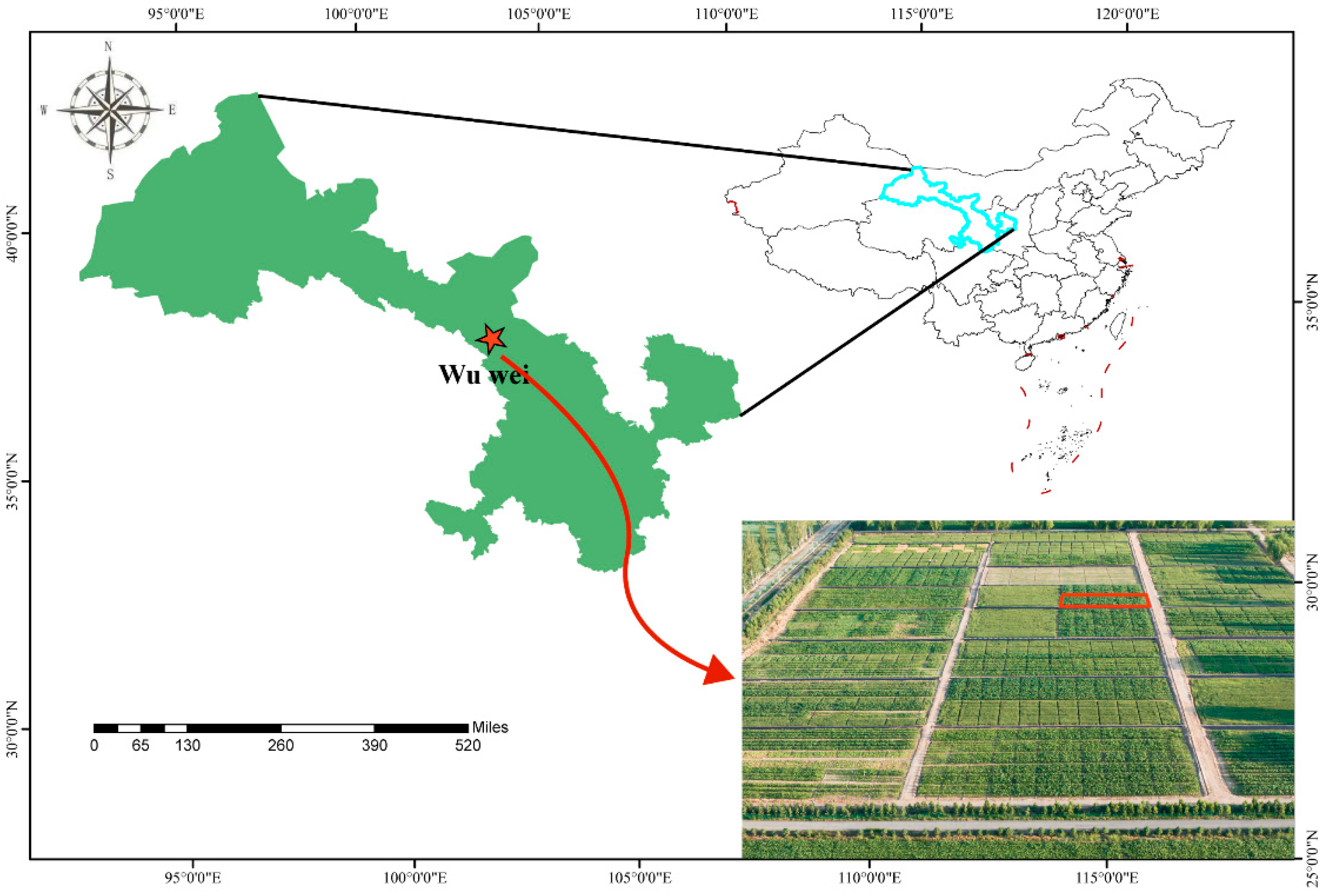
Figure 1. Location of experimental site in the Wuwei oasis agricultural comprehensive experiment station.
Agronomy 16 00120 g001
Figure 2. Temperature and precipitation of maize growing season in the 2024–2025 experimental area.
Agronomy 16 00120 g002
Figure 3. Dry matter (DM) accumulation during the growth period of maize under different water and nitrogen treatments. I indicate irrigation amount, N indicate nitrogen application rate, I × N indicate interaction between irrigation amount and nitrogen application rate. * indicate significant differences among treatments (p < 0.05).
Agronomy 16 00120 g003
Figure 4. Dynamics of leaf area index (LAI) of maize during Growth period under different water and nitrogen treatments. I indicate irrigation amount, N indicate nitrogen application rate, I × N indicate interaction between irrigation amount and nitrogen application rate. * and ** indicate significant differences among treatments (p < 0.05 and p < 0.01).
Agronomy 16 00120 g004
Figure 5. SPAD value of maize during the growth period under different water and nitrogen treatments. I indicate irrigation amount, N indicate nitrogen application rate, I × N indicate interaction between irrigation amount and nitrogen application rate. * indicate significant differences among treatments (p < 0.05).
Agronomy 16 00120 g005
Figure 6. The net photosynthetic rate (Pn) of maize growth period under different treatments. I indicate irrigation amount, N indicate nitrogen application rate, I × N indicate interaction between irrigation amount and nitrogen application rate. Different lowercase letters in the table indicate significant differences among treatments (p < 0.05). * and ** indicate significant differences among treatments (p < 0.05 and p < 0.01).
Agronomy 16 00120 g006
Figure 7. The transpiration rate (Tr) of maize growth period under different treatments. I indicate irrigation amount, N indicate nitrogen application rate, I × N indicate interaction between irrigation amount and nitrogen application rate. Different lowercase letters in the table indicate significant differences among treatments (p < 0.05). * and ** indicate significant differences among treatments (p < 0.05 and p < 0.01), ns indicate no significant difference.
Agronomy 16 00120 g007
Figure 8. Soil water content (SWC) during the maize silking stage under different treatments.
Agronomy 16 00120 g008
Figure 9. The soil total nitrogen (STN) of maize during the spinning stage under different treatments. I indicate irrigation amount, N indicate nitrogen application rate, I × N indicate interaction between irrigation amount and nitrogen application rate. Different lowercase letters in the table indicate significant differences among treatments (p < 0.05). * and ** indicate significant differences among treatments (p < 0.05 and p < 0.01), ns indicate no significant.
Agronomy 16 00120 g009
Figure 10. The soil water content (SWC), total nitrogen content (STN), photosynthetic parameters (Pn, Tr, LAI and SPAD) of leaves and dry matter (DM) accumulation during the silk production stage affect the grain yield (GY) of biological SEM. ** and *** indicate significant differences among treatments (p < 0.01 and p < 0.001), ns indicate no significant.
Agronomy 16 00120 g010
Table 1. Basic physicochemical properties of the soil at 0–30 cm depth.
Volume Weight
(g·cm−3)
pHOrganic Carbon
(g·kg−1)
Total Nitrogen
(g·kg−1)
Rapid Available Phosphorus
(g·kg−1)
Rapid Available Potassium
(g·kg−1)
1.408.410.90.8928.7155
Note: Soil samples were collected from the 0–30 cm layer prior to seeding, air-dried indoors, and ground to pass through a 150-mesh sieve. Soil pH was measured using a pH meter (soil-water ratio 1:2.5). Soil organic carbon, total nitrogen, available phosphorus, and available potassium contents were determined using the potassium dichromate-external heating method, Kjeldahl nitrogen determination, molybdenum blue colorimetric method, and flame photometer method, respectively.
Table 2. Irrigation and fertilizer regime during the growing season of maize.
CodeTreatmentApplication Amount During the Growth Period
(Unit: Irrigation in mm; Fertilization in kg·ha−1)
Total Amount
I1No irrigation reductionJointing stage: 90; Big trumpet stage: 75; Tasseling stage: 90; Silking period: 75; Filling period: 75405 mm
I2Reduce irrigation by 20%Jointing stage: 72; Big trumpet stage: 60; Tasseling stage: 72; Silking period: 60; Filling period: 60324 mm
I3Reduce irrigation by 40%Jointing stage: 54; Big trumpet stage: 45; Tasseling stage: 54; Silking period: 45; Filling period: 45243 mm
N1No nitrogen reductionBase fertilizer: 108; Flare opening staged: 180; Filling stage: 72360 kg·ha−1
N2Reduce Nitrogen by 20%Base fertilizer: 87; Flare opening stage: 144; Filling stage: 58288 kg·ha−1
N3Reduce Nitrogen by 40%Base fertilizer: 65; Flare opening stage: 108; Filling stage: 43216 kg·ha−1
Table 3. Maize water use efficiency (WUE) and maize nitrogen utilization rate (NUtEg) under different water and nitrogen treatments.
Year20242025
TreatmentWUE (kg·m−3)NUtEg (kg·m−3)WUE (kg·m−3)NUtEg (kg·m−3)
I1N122.76 b33.32 bc23.76 b33.40 bc
I1N222.94 b35.75 ab23.60 b36.09 ab
I1N318.70 cd29.67 cd18.70 cd29.90 cd
I2N124.64 a33.99 ab24.98 a34.26 ab
I2N224.50 a37.87 a25.50 a37.21 a
I2N318.56 cd29.42 cd19.89 c29.91 cd
I3N120.53 bc27.06 d19.20 c27.51 d
I3N218.73 cd26.83 d18.40 d26.85 d
I3N316.58 d26.41 d16.92 d24.54 d
Significance
Irrigation level (I)*******
Nitrogen level (N)*ns****
I × N*ns**
Note: Different lowercase letters in the table indicate significant differences among treatments (p < 0.05). **: p < 0.01; *: p < 0.05; ns: no significant difference.
Table 4. Maize grain yield (GY) and its constituent factors under different water and nitrogen treatments.
YearTreatmentSpike Number
(×104 ha−1)
Kernel Number
per Spike
Thousand-Kernel
Weight (g)
GY
(kg ha−1)
2024I1N177 a727 a554 a15,889 a
I1N279 a717 a560 a15,988 a
I1N369 b638 b478 b12,964 bc
I2N176 a722 a556 a15,153 ab
I2N276 a707 a563 a15,080 ab
I2N366 b609 c466 bc11,380 cd
I3N162 c584 cd450 cd10,865 cd
I3N258 d569 d437 de9877 de
I3N354 e538 e415 e8773 e
2025I1N179 a729 a556 a15,929 a
I1N280 a725 a561 a16,088 a
I1N370 b641 b480 b13,131 b
I2N178 a726 a558 a15,320 a
I2N279 a727 a565 a15,279 a
I2N367 b611c468 c11,413 bc
I3N162 c586 cd452 cd10,932 c
I3N260 cd571 d439 d9977 d
I3N355 d540 e419 e9673 e
Significance
Irrigation level (I)********
Nitrogen level (N)********
I × N*ns**
Note: Different lowercase letters in the table indicate significant differences among treatments (p < 0.05). **: p < 0.01; *: p < 0.05; ns: no significant difference.
Table 5. Fitting of logistic equation for the accumulation of DM in maize and its characteristic parameters.
YearTreatmentRegression EquationR2Maximum Increase Rate
(kg·ha−1·d−1)
The Days of MIR
(d)
Average Increase
Rate
(kg·ha−1·d−1)
2024I1N1Y = 40284.8/(1 + 6.004e−0.066t)0.997664.70 c90.97 abc261.52 a
I1N2Y = 40006.6/(1 + 6.228e−0.070t)0.997700.12 ab88.97 cde262.42 a
I1N3Y = 33083.0/(1 + 6.616e−0.074t)0.997612.04 d89.41 cde219.20 b
I2N1Y = 39667.5/(1 + 6.326e−0.070t)0.998694.18 b90.37 bcd261.74 a
I2N2Y = 39801.6/(1 + 6.448e−0.073t)0.996726.38 a88.33 de262.13 a
I2N3Y = 31824.8/(1 + 6.440e−0.071t)0.992564.89 e90.70 a206.25 c
I3N1Y = 30127.8/(1 + 6.688e−0.076t)0.997572.43 e88.00 e201.19 d
I3N2Y = 26664.4/(1 + 6.739e−0.075t)0.998499.96 f89.85 de178.44 e
I3N3Y = 40284.8/(1 + 7.117e−0.078t)0.996470.16 g91.24 ab161.29 f
2025I1N1Y = 41711.9/(1 + 6.237e−0.069t)0.993717.3 a90.7 ab270.4 a
I1N2Y = 40052.6/(1 + 6.229e−0.071t)0.997697.5 a89.4 b262.8 b
I1N3Y = 33109.6/(1 + 6.619e−0.074t)0.997609.7 b89.8 b219.5 c
I2N1Y = 39707.5/(1 + 6.329e−0.070t)0.998698.1 a90.1 ab262.2 b
I2N2Y = 43516.3/(1 + 6.037e−0.066t)0.996706.4 a92.2 a278.4 a
I2N3Y = 31910.8/(1 + 6.419e−0.070t)0.992561.0 bc91.3 a206.5 c
I3N1Y = 30181.1/(1 + 6.668e−0.076t)0.997570.9 b88.1 c201.5 c
I3N2Y = 26733.4/(1 + 6.720e−0.075t)0.998503.4 cd89.2 b178.8 d
I3N3Y = 24208.1/(1 + 7.097e−0.078t)0.996473.9 d90.6 ab161.9 d
Significance
Irrigation level (I)//******
Nitrogen level (N)//******
I × N//*****
Note: Different lowercase letters in the table indicate significant differences among treatments (p < 0.05). **: p < 0.01; *: p < 0.05.
Disclaimer/Publisher’s Note: The statements, opinions and data contained in all publications are solely those of the individual author(s) and contributor(s) and not of MDPI and/or the editor(s). MDPI and/or the editor(s) disclaim responsibility for any injury to people or property resulting from any ideas, methods, instructions or products referred to in the content.