Article

Transcriptome Analysis of the Response of Aphis glycines Feeding on Ambrosia artemisiifolia

Key Laboratory of Crop Pests in Northern Cold Regions of Heilongjiang Province, College of Plant Protection, Northeast Agricultural University, No. 600 Changjiang Road, Harbin 150030, China
*
Author to whom correspondence should be addressed.
Agronomy 2026, 16(1), 11; https://doi.org/10.3390/agronomy16010011 (registering DOI)
Submission received: 5 November 2025 / Revised: 17 December 2025 / Accepted: 18 December 2025 / Published: 19 December 2025
(This article belongs to the Special Issue Recent Advances in Legume Crop Protection—2nd Edition)

Abstract

Common ragweed, Ambrosia artemisiifolia L., a noxious invasive plant, produces novel secondary metabolites. However, it attracts soybean aphid, Aphis glycines, a significant pest of soybean, to feed on it. Elucidating the molecular mechanisms of A. glycines adaptation to A. artemisiifolia may help identify target genes useful for pest management. High-throughput transcriptome sequencing identified 4250 differentially expressed genes (DEGs), with 2399 upregulated and 1851 downregulated. KEGG pathway enrichment analysis suggested that these DEGs were significantly involved in core detoxification-related pathways, including metabolism of xenobiotics by cytochrome P450, drug metabolism, ascorbate and aldarate metabolism, and pentose and glucuronate interconversions. Further analysis revealed significant upregulation of 17 UDP-glycosyltransferase (UGT) genes, with AgUGT342B2, AgUGT343B2, AgUGT344J2, AgUGT344L2, and AgUGT344N2 showing 6.34-, 6.22-, 2.14-, 3.98-, and 7.49-fold higher expression, respectively, than in A. glycines fed on soybean. Bioassays demonstrated that A. glycines reared on A. artemisiifolia exhibited significantly reduced sensitivity to three common insecticides, imidacloprid, thiamethoxam, and lambda-cyhalothrin, with LC50 values increasing by 5.8-fold, 2.8-fold, and 3.6-foldhigher, respectively, than those reared on soybean. These findings indicate that feeding on A. artemisiifolia induces UGT gene family upregulation in A. glycines, conferring cross-resistance to multiple insecticide classes. This study reveals a molecular mechanism linking host adaptation to insecticide resistance, highlighting the ecological and evolutionary consequences of invasive plant-herbivore interactions.

1. Introduction

The soybean aphid, Aphis glycines, is a significant pest in soybean (Glycine max) fields. It damages host plants by feeding on phloem sap, causing symptoms including leaf curling, stunted growth, impaired root development, and reduced pod set. Severe infestations further result in plant wilting and mortality [1,2]. Beyond direct feeding damage, A. glycines acts as a vector for plant viruses such as soybean mosaic virus [3], alfalfa mosaic virus [4], and potato virus Y [5]. In addition, aphid honeydew secreted onto leaves promotes sooty mold colonization, further disturbs photosynthesis [2]. For a long time, chemical control has served as the primary strategy for managing A. glycines. However, overreliance on insecticides, particularly neonicotinoids, has driven high levels of resistance in many regions, posing significant challenges to the development of sustainable management strategies.
The common ragweed, Ambrosia artemisiifolia L., is native to North America, has emerged as a globally invasive weed [6,7]. In China, it was first recorded in northeastern regions during the 1930s and has since become widespread, attributed to its robust reproductive capacity and competitive ability [8]. Through strong interspecific competition and allelopathic effects, aboveground aqueous extracts and volatile organic compounds (VOCs) of A. artemisiifolia inhibit seed germination and early growth of crops, including soybean, maize, wheat, and rice [9]. As an arable weed, it reduces crop yields and threatens ecosystems and human health; autumn pollen production makes it a primary trigger of allergic rhinitis and asthma [10].
In northeastern China, A. artemisiifolia invades soybean fields from field margins [11]. As an exotic invasive plant, it often produces novel secondary metabolites, such as psilostachyin, polyphenols, and flavonoids, they may enhance plants resistance to herbivores [12,13]. Native insect herbivores, however, have evolved counter-adaptations to mitigate these chemical defenses through long-term coevolution [14,15]. Notably, recent observations indicate that A. glycines now feeds on A. artemisiifolia along soybean field borders and establishes viable populations on this weed. This suggests A. artemisiifolia may serve as an alternative food source or host for A. glycines. Critically, it has been reported that host adaptation enabling tolerance to plant secondary metabolites could confer enhanced resistance to insecticides [16,17,18]. Therefore, A. glycines populations adapted to A. artemisiifolia may exhibit increased insecticide resistance, making them more difficult to control.
The UDP-glycosyltransferase (UGT) gene family plays a pivotal role in insect counter-defensive responses to plant chemicals. UGTs catalyze the transfer of sugar moieties from UDP-activated donors (typically UDP-glucose) to hydrophobic acceptors (bearing hydroxyl, carboxyl, amino, or thiol groups), a process termed glycosylation [19]. This modification masks reactive functional groups of phytotoxins, enhances their polarity and water solubility, and facilitates excretion [20,21]. Mounting evidence demonstrates that UGT gene expression is significantly altered when insects metabolize bioactive secondary metabolites. For example, UGTs mediate gossypol glycosylation in Helicoverpa armigera and Heliothis virescens [22]; nicotine metabolism in Myzus persicae [23]; and detoxification of benzoxazinoid DIMBOA in Spodoptera frugiperda [24]. Furthermore, UGTs are linked to pest insecticide sensitivity, UGT353G2 has been implicated in neonicotinoid resistance in Bemisia tabaci [25]. While UGT2B10 contributes to fenvalerate, deltamethrin, cyantraniliprole, acetamiprid, and lufenuron detoxification in H. armigera [26].
A. artemisiifolia is known to be rich in various bioactive secondary metabolites, including sesquiterpene lactones (e.g., psilostachyin, polyphenols, and flavonoids), which collectively constitute a potent chemical challenge to herbivorous insects [12,27,28]. In order to adapt to A. artemisiifolia, A. glycines likely activates detoxification pathways, potentially driving enhanced insecticide resistance. With the aim of delving the adaptation mechanism of A. glycines towards A. artemisiifolia. In this study, we compared transcriptomic changes in A. glycines before and after feeding on A. artemisiifolia and validated findings through bioassays. These results will enhance our understanding of how local insects adapt to invasive plants and provide new insights into the development of insecticide resistance for pests.

2. Materials and Methods

2.1. Aphid and Hosts

A. glycines was collected from a soybean field at Northeast Agricultural University (NEAU), Harbin, Heilongjiang Province, China (126.72° E, 45.74° N) in 2021. The soybean cultivar used for aphid rearing is Heinong 51 (Fangyuan Agricultural Co., Ltd., Wuchang, Heilongjiang Province, China). Seeds of A. artemisiifolia were collected from Mudanjiang city, Heilongjiang Province (131.23° E, 44.05° N) in October 2022, and stored at 4 °C. A single apterous adult aphid was transferred to G. max plants (Ag-G) or A. artemisiifolia plants (Ag-A) for continuous rearing for more than ten generations. They were maintained in a nylon mesh insect-rearing cage (40 × 40 × 40 cm) in an RTOP-D Intelligent Climate Chamber (Zhejiang TOP Cloud-agri Technology Co., Ltd., Hangzhou, China) with a condition of 25 ± 1 °C, 70 ± 5% RH, and a photoperiod of 16:8 (L:D) h.

2.2. RNA Extraction and Transcriptome Sequencing

Total RNA was extracted from the following groups: aphids reared on G. max plants and A. artemisiifolia plants from separate cages. The extraction was performed on the one-day-old apterous adult A. glycines using Trizol reagent (Invitrogen, Carlsbad, CA, USA) according to the manufacturer’s instructions. A NanoDrop spectrophotometer (Thermo Fisher Scientific, Waltham, MA, USA) was used to determine the RNA quality and concentration. The mRNA was purified from total RNA using poly-T oligo-attached magnetic beads. After fragmentation, the first strand cDNA synthesized was conducted using random hexamer primers followed by the second strand cDNA synthesis. The library was ready after end repairing, A-tailing, adapter ligation, size selection, amplification, and purification. The library was checked with Qubit 2.0 Fluorometer (Thermo Fisher Scientific, Waltham, MA, USA) and real-time PCR for quantification and Bioanalyzer 2100 System (Agilent Technologies, Santa Clara, CA, USA) for size distribution detection. Subsequently, different libraries were pooled based on the effective concentration and targeted data amount, then subjected to Illumina sequencing. The library construction and quality inspection were completed with the assistance of Beijing Novogene Technology Co., Ltd., Beijing, China.

2.3. Transcriptome Assembly and Unigene Functional Annotation

Raw reads were filtered with fastp 0.19.7 software to obtain clean reads by removing adapters, poly-N sequences, and low-quality bases. Transcriptome assembly was conducted using Trinity 2.15.1, which employs Inchworm, Chrysalis, and Butterfly modules to generate full-length transcripts. Redundant transcripts were clustered into genes using Corset.

2.4. Functional Annotation and Differential Expression Analysis

Assembled transcripts were annotated against public databases including Nr, Nt, Pfam, KOG/COG, Swiss-Prot, KEGG, and GO. Clean reads were mapped to the transcriptome reference using RSEM. Differential expression analysis was performed with DESeq2 (for replicates) or edgeR (without replicates), with thresholds of |log2FC| ≥ 1 and adjusted p-value ≤ 0.05 (DESeq2) or ≤0.005 (edgeR). Enrichment analyses for GO and KEGG were conducted using GOseq and KOBAS, respectively.

2.5. Quantitative Real-Time Reverse Transcriptase PCR (qRT-PCR)

First strand cDNA synthesis was performed using 1.0 μg total RNA and the Fast First-Strand cDNA Synthesis Mix for RT kit (Goonie, Guangzhou, China). Quantitative real-time PCR (qRT-PCR) was subsequently conducted using the Hieff qPCR SYBR Green Master Mix kit (Yeasen, Shanghai, China) on a Bio-Rad CFX Maestro system (BioRad, Hercules, CA, USA). The qRT-PCR protocol involved an initial denaturation at 95 °C for 5 min, followed by 40 amplification cycles (95 °C for 10 s, 60 °C for 30 s, 72 °C for 20 s), and a final extension at 72 °C for 10 min. To verify amplification specificity, melting curve analysis was conducted between 60 °C and 95 °C. The specific qRT-PCR primers were designed using Beacon Designer 7 and shown in Table 1. Expression levels were normalized against EF1α, a previously validated stable reference gene in A. glycines [29]. Relative gene expression levels were calculated using the 2−∆∆Ct method [30,31]. All experiments incorporated three biological replicates with three technical replicates.

2.6. Bioassays

Three insecticides, imidacloprid, thiamethoxam, and lambda-cyhalothrin (all active ingredient 98% w/w, Binnong Technology Co., Ltd., Binzhou, Shandong Provence, China) were used in this study. Because these insecticides the most commonly used ones for controlling A. glycines. These insecticides were dissolved in dimethylformamide (DMF) to prepare a stock solution with a concentration of 100 mg/mL. Dilute the mother solution to different concentrations with 0.1% (v/v) Triton X-100 aqueous solution. The controls were treated using a 0.1% (v/v) Triton X-100 aqueous solution and ddH2O. The bioassays were performed using a leaf-dip method, plant leaves were fully dipped in each solution for 10 s, then air-dried. Twenty one-day-old apterous adult aphids feeding on G. max and A. artemisiifolia were, respectively, transferred onto the treated leaves and maintained at 25 ± 1 °C. After 24 h, the aphid mortality was recorded. Three biological replicates were performed for each concentration. The median lethal concentration (LC50) for imidacloprid, thiamethoxam, and lambda-cyhalothrin was calculated with Probit analysis using SPSS 27 (IBM Corp. 2020, Armonk, NY, USA).

2.7. Data Analysis

Significant differences in relative expression levels of AgUGT genes between two experimental A. glycines populations were determined with Student’s t-test using SPSS 27.

3. Results

3.1. mRNA Sequencing, Assembly, and Functional Annotation

After the raw data filtering, sequencing error rate checking, and GC content distribution checking of the A. glycines transcriptome, a total of 38.24 Gb of qualified data was obtained. The qualified data of all 6 samples were about 6.0 Gb, with an error rate of 1% for each. The percentage of Q20 bases was above 99.28%, and the percentage of Q30 bases was above 96.96%. The GC content ranged from 38.57% to 39.15%. This indicates that the measured data is accurate (Table 2).
A total of 34,078 unigenes were obtained and the average length and N50 length were 1272 and 2149 bp, respectively. The transcriptomes of A. glycines were annotated in the seven major databases. In the Nr, Nt, Pfam, GO, Swiss-prot, KO and KOG databases, 15,418, 33,676, 10,343, 5799, 8865, 7347, 10,343 genes have been annotated, respectively (Table 3). The correlation coefficient of each treatment was very high (Figure S1), indicating that the data were reliable for further analysis.

3.2. Analysis of Differentially Expressed Genes

To investigate transcriptomic differences in A. glycines before and after feeding on A. artemisiifolia, we performed a statistical analysis of the gene expression data. Comparative transcriptomic analysis revealed a total of 4250 differentially expressed genes, among which 1851 genes were downregulated and 2399 genes were upregulated (Figure 1a). The GO enrichment classification analyses result showed that there are a large number of differentially expressed genes involved in molecular functions, followed by those involved in biological processes. These genes with significant difference were mainly involved in DNA recombination, and their functions are related to the catalytic activity of DNA and hydrolase activity (Figure 1b). The KEGG pathway analyses result indicated that the 953 differential genes were annotated into 238 different pathways in KEGG, and the enriched pathways were mainly involved ascorbate and aldarate metabolism, chemical carcinogenesis, metabolism of xenobiotics by cytochrome P450, steroid hormone biosynthesis, drug metabolism—cytochrome P450, drug metabolism—other enzymes, retinol metabolism, pentose and glucuronate interconversions, and so forth (Figure 1c).

3.3. Data Validation by qRT-PCR

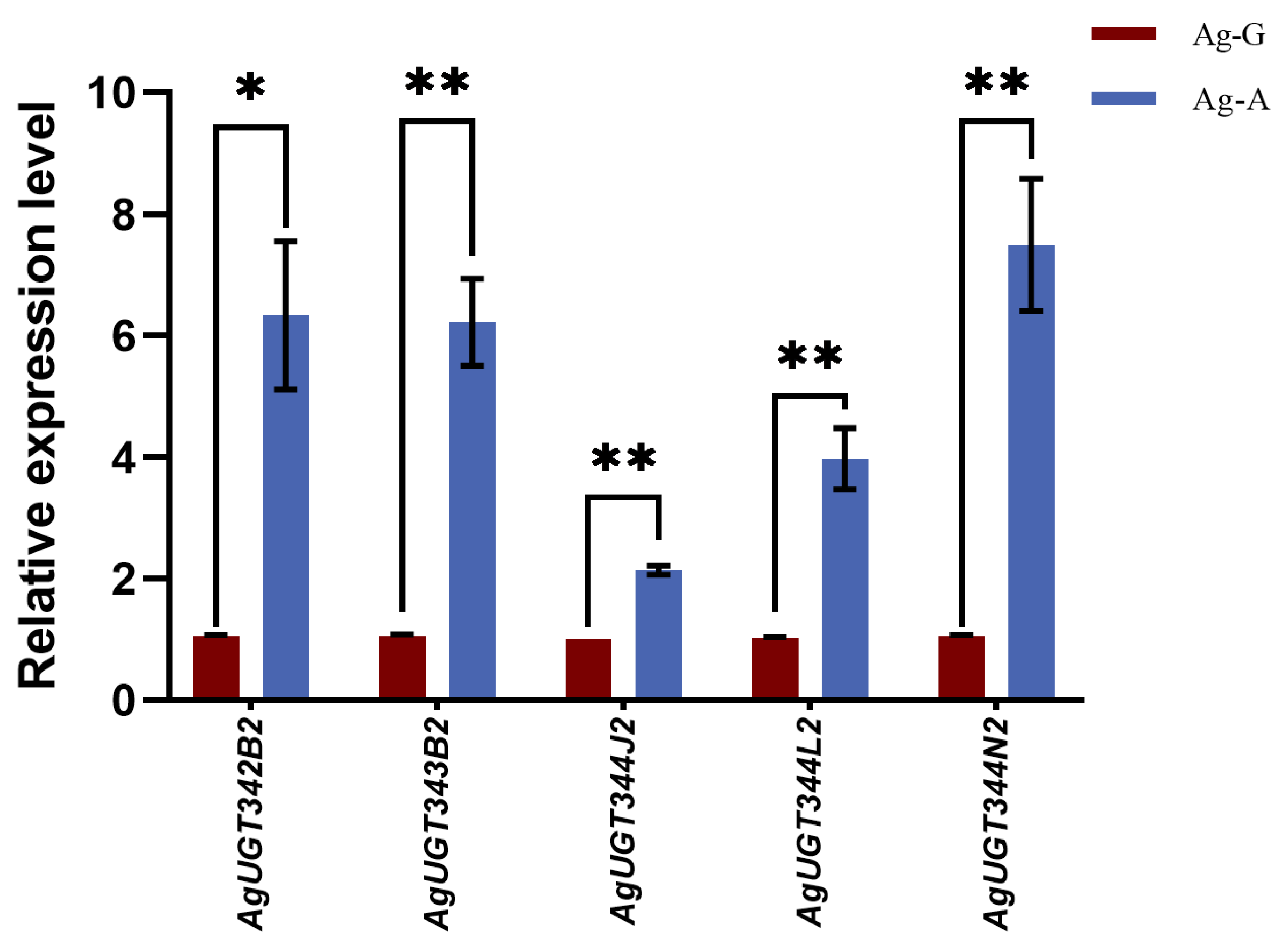
Differential gene analysis revealed that UDP-glycosyltransferase (UGT) genes were the most prominently enriched functional category among detoxification-related metabolism genes, prompting targeted validation of UGT expression via reverse transcription-quantitative polymerase chain reaction (qRT-PCR). A total of 17 UGT genes were identified in A. glycines. Among them, genes AgUGT342B2, AgUGT343B2, AgUGT344J2, AgUGT344L2, and AgUGT344N2 showed significant upregulation in aphids fed on A. artemisiifolia compared to those fed on G. max. Specifically, their expression levels were 6.34-, 6.22-, 2.14-, 3.98-, and 7.49-fold higher, respectively (Figure 2).

3.4. The Sensitivity of A. glycines to Insecticides After Feeding on A. artemisiifolia

The median lethal concentrations (LC50) of all three insecticides were higher for A. glycines reared on A. artemisiifolia than for conspecifics reared on G. max, indicating increased insecticide resistance (Table 4). Following feeding on A. artemisiifolia, the LC50 values of imidacloprid, thiamethoxam, and lambda-cyhalothrin for A. glycines were 5.8-, 2.8-, and 3.6-fold higher, respectively, than those of aphids fed G. max.

4. Discussion

In nature, insects and plants exhibit a coevolutionary relationship [32]. Host plants not only provide habitat and nutritional resources for insects, but also shape their population dynamics and fitness [33,34]. Plant nutrients influence insect morphology and physiology [35]. Insects recognize host plants via specific chemical cues, whereas plants deploy diverse chemical and morphological defenses to counter attack [36,37]. Host plants produce a wide array of defensive compounds, primarily secondary metabolites [38]. Terpenoids, present in many plants, form volatile mixtures of monoterpenes and sesquiterpenes (essential oils) with well-documented attractive and toxic effects on insects [39,40]. Concurrently, insects have evolved detoxification systems, with insect detoxification enzymes serving as a key pathway for adapting to host plants [41,42,43].
Our comparative transcriptomic analysis revealed that 4250 genes in A. glycines were differentially expressed after feeding on A. artemisiifolia, with 2399 upregulated and 1851 downregulated (Figure 1a). KEGG pathway enrichment analysis indicated that these DEGs were significantly enriched in several core pathways intimately linked to detoxification metabolism and responses to xenobiotics. These included metabolism of xenobiotics by cytochrome P450, drug metabolism-cytochrome P450, drug metabolism-other enzymes, ascorbate and aldarate metabolism, and pentose and glucuronate interconversions (Figure 1c). This pattern aligns with the classic model wherein insects activate multi-level, synergistic detoxification networks under chemical stresses [33,44].
Within this network, phase I detoxification enzymes, particularly cytochrome P450 monooxygenases (P450s), typically initiate detoxification by oxidizing or reducing plant toxins or insecticides, thereby introducing functional groups (e.g., hydroxyl groups) for subsequent conjugation [45]. Phase II enzymes, such as UGTs and glutathione S-transferases (GSTs), then conjugate these modified intermediates or parent compounds to form water-soluble products for excretion [41,46,47,48,49,50]. The synergy between UGTs and P450s is a well-established mechanism enabling insects to cope with complex chemical environments and develop resistance [51]. For instance, in Nilaparvata lugens with high thiamethoxam resistance, co-expression and synergy of specific P450/UGT genes drive resistance [52]. Similarly, the suppression of UGT344M2 significantly increased the sensitivity of A. gossypii nymphs to spirotetramat [53]. Across species, these examples highlight the conserved and crucial role of UGTs, often in concert with P450s, in insecticide resistance.
Additionally, the enrichment of the pentose and glucuronate interconversions pathway is particularly noteworthy, as this pathway generates essential sugar donors, such as UDP-glucose and UDP-glucuronic acid, required for UGT-mediated glycosylation reactions [54]. This suggests that the metabolic response of A. glycines extends beyond the regulation of detoxification enzyme to include primary metabolic pathways supplying substrates, reflecting the comprehensiveness of its adaptive strategy. Concurrently, enrichment of DNA recombination and repair pathways indicates prolonged exposure to potent chemical stressors of A. artemisiifolia challenges aphid genomic stability, potentially triggering adaptive genomic evolution [55].
As key components of phase II detoxification system in insects, UGTs play an indispensable role in mediating the detoxification of plant secondary metabolites. They enhance the water solubility and excretion efficiency of xenobiotics by transferring sugar moieties from donors like UDP-glucose to functional groups on the toxins, representing a core biochemical mechanism for overcoming host plant chemical defenses [56,57]. In this study, 17 UGT genes were significantly upregulated in A. glycines fed on A. artemisiifolia, with seven showing 2.14–7.49-fold higher expression than those fed on G. max (Figure 2). This finding is consistent with reports in other systems. For example, UGT84A involved in gallotannin biosynthesis and hydrolysis in Chinese gallnut [58]. The result of transcriptomes of two distinct biotypes of the Sitobion avenae on wheat and barley indicates that their potentially critical roles in the divergence of S. avenae biotypes [59]. Meanwhile, UGTs also regulate endogenous processes in response to environmental cues [60], likely linking to adaptation to plant secondary metabolites. Given the richness of A. artemisiifolia in bioactive secondary metabolites, including sesquiterpene lactones (e.g., psilostachyin), polyphenols, and flavonoids [12], the widespread UGT upregulation here likely represents a targeted adaptation to this chemical challenge, forming the physiological basis for A. glycines successfully colonizes this invasive plant.
Phytophagous insect adaptation to new hosts often correlates with changes in insecticide sensitivity [61,62,63,64]. Mechanisms of resistance to host plant secondary metabolites overlap with those for insecticides, suggesting cross-resistance between the two [15,41]. Therefore, insects adapting to new hosts frequently exhibit increased insecticide resistance [16,17,62]. Our bioassays confirm that A. glycines reared on A. artemisiifolia showed significantly reduced sensitivity (i.e., increased resistance) to three insecticides: imidacloprid (neonicotinoid), thiamethoxam (neonicotinoid), and lambda-cyhalothrin (pyrethroid). The LC50 values increased by 5.8-fold, 2.8-fold, and 3.6-fold, respectively (Table 4).
Initially, UGTs were found to detoxify plant secondary metabolites in insects. For instance, UGTs glycosylate gossypol into the diglycosylated isomer 5, a key step in H. armigera [22]. Additionally, stereoselective reglucosylation of benzoxazinoids by UGTs mediates detoxification in S. littoralis [64]. We posit that A. artemisiifolia-induced UGT upregulation is a key molecular adaptation driving increased insecticide resistance in A. glycines. More importantly, this host-mediated resistance may exhibit evolutionary persistence. In field ecosystems, invasive A. artemisiifolia may have inadvertently facilitated the evolution of A. glycines [65], continuously exerting strong chemical selection pressure on exposed A. glycines populations, thereby favoring and maintaining individuals with high basal detoxification enzyme activity [66]. This eco-evolutionary pathway, driven by species interactions, may outpace traditional single-insecticide resistance evolution, challenging existing pest management frameworks [67].

5. Conclusions

In conclusion, this study demonstrates that feeding on the invasive plant A. artemisiifolia induces upregulation of the UGT gene family in A. glycines. This upregulation systemically enhances its detoxification capacity and confers cross-resistance to multiple classes of insecticides. In the future, the knock-out experiments should be performed to show how insecticide resistance or host adaptation is lost after knocking out specific UGT family genes. Overall, these findings advance our understanding of the complex tripartite interactions among phytophagous insects, host plants, and insecticides. Consequently, in an integrated pest management (IPM) system, potential new hosts for pests should be promptly eliminated, especially toxic invasive plants, to prevent the evolution of insecticide resistance.

Supplementary Materials

The following supporting information can be downloaded at: https://www.mdpi.com/article/10.3390/agronomy16010011/s1, Figure S1. Pearson correlation coefficients of transcript levels. Figure S2. Transcription levels of UGTs in A. glycines. Table S1. GO enrichment results of differential genes. Table S2. KEGG enrichment results of differential genes.

Author Contributions

Conceptualization, Z.T., C.D., and J.L.; methodology, Z.T.; investigation, Z.T., C.D., J.L., and X.H.; software, X.H.; resources, Z.T.; data curation, Z.T. and X.H.; writing—original draft, Z.T., X.H., and C.D.; writing—review and editing, Z.T. and X.H.; formal analysis, X.H.; visualization, X.H.; supervision, Z.T.; project administration, Z.T.; funding acquisition, Z.T. All authors have read and agreed to the published version of the manuscript.

Funding

This work was supported by the National Natural Science Foundation of China (32202301), and the “Young Talents” Project of Northeast Agricultural University (2023-KYYWF-1166).

Data Availability Statement

All data are presented within the article and Supplementary Materials.

Conflicts of Interest

The authors declare no conflicts of interest.

References

  1. Ragsdale, D.W.; Landis, D.A.; Brodeur, J.; Heimpel, G.E.; Desneux, N. Ecology and management of the soybean aphid in North America. Annu. Rev. Entomol. 2011, 56, 375–399. [Google Scholar] [CrossRef]
  2. Wu, Z.; Schenk-Hamlin, D.; Zhan, W.; Ragsdale, D.W.; Heimpel, G.E. The soybean aphid in China: A historical review. Ann. Entomol. Soc. Am. 2004, 97, 209–218. [Google Scholar] [CrossRef]
  3. Wang, R.-Y.; Ghabrial, S.A. Effect of aphid behavior on efficiency of transmission of soybean mosaic virus by the soybean-colonizing aphid, Aphis glycines. Plant Dis. 2002, 86, 1260–1264. [Google Scholar] [CrossRef]
  4. Hill, J.H.; Alleman, R.; Hogg, D.B.; Grau, C.R. First report of transmission of soybean mosaic virus and alfalfa mosaic virus by Aphis glycines in the new world. Plant Dis. 2001, 85, 561. [Google Scholar] [CrossRef]
  5. Davis, J.A.; Radcliffe, E.B.; Ragsdale, D.W. Soybean aphid, Aphis glycines Matsumura, a new vector of potato virus Y in potato. Am. J. Potato Res. 2005, 82, 197–201. [Google Scholar] [CrossRef]
  6. Essl, F.; Biró, K.; Brandes, D.; Broennimann, O.; Bullock, J.M.; Chapman, D.S.; Follak, S. Biological flora of the British Isles: Ambrosia artemisiifolia. J. Ecol. 2015, 103, 1069–1098. [Google Scholar] [CrossRef]
  7. Zhou, Z.S.; Guo, J.Y.; Wan, F.H. Review on management of Ambrosia artemisiifolia using natural enemy insects. Chin. J. Biol. Control. 2015, 31, 657–665. [Google Scholar]
  8. Wan, F.H.; Wang, R. Occurrence, damage, and control of ragweed (Ambrosia artemisiifolia L.) in China. Agric. Sci. Technol. Commun. 1988, 5, 24–25. [Google Scholar]
  9. Wang, D.L.; Zhu, X.Y. Research on allelopathy of Ambrosia artemisiifolia. Acta Ecol. Sin. 1996, 16, 11–19. [Google Scholar]
  10. Smith, M.; Cecchi, L.; Skjøth, C.A.; Karrer, G.; Šikoparija, B. Common ragweed: A threat to environmental health in Europe. Environ. Int. 2013, 61, 115–126. [Google Scholar] [CrossRef]
  11. Wang, Y.H.; Yang, D.M.; Liu, M.Q.; Li, J.; Zhang, L. Control effect of 12 herbicides against ragweed. Agrochemicals 2023, 62, 933–936. [Google Scholar]
  12. Macel, M.; de Vos, R.C.H.; Jansen, J.J.; van der Putten, W.H.; van Dam, N.M. Novel chemistry of invasive plants: Exotic species have more unique metabolomic profiles than native congeners. Ecol. Evol. 2014, 4, 2777–2786. [Google Scholar] [CrossRef] [PubMed]
  13. Kato-Noguchi, H.; Kurniadie, D. The invasive mechanisms of the noxious alien plant species Bidens pilosa. Plants 2024, 13, 356. [Google Scholar] [CrossRef] [PubMed]
  14. War, A.R.; Paulraj, M.G.; Ahmad, T.; Buhroo, A.A.; Hussain, B.; Ignacimuthu, S.; Sharma, H.C. Mechanisms of plant defense against insect herbivores. Plant Signal. Behav. 2012, 7, 1306–1320. [Google Scholar] [CrossRef] [PubMed]
  15. Feyereisen, R.; Dermauw, W.; Van Leeuwen, T. Genotype to phenotype, the molecular and physiological dimensions of resistance in arthropods. Pestic. Biochem. Physiol. 2015, 121, 61–77. [Google Scholar] [CrossRef]
  16. Liang, P.; Cui, J.; Yang, X.; Gao, X. Effects of host plants on insecticide susceptibility and carboxylesterase activity in Bemisia tabaci biotype B and greenhouse whitefly, Trialeurodes vaporariorum. Pest Manag. Sci. 2007, 63, 365–371. [Google Scholar] [CrossRef]
  17. Wen, X.; Wang, S.; Wu, Q.; Xie, W.; Zhang, Y. Induction effects of host plants on insecticide susceptibility and detoxification enzymes of Bemisia tabaci (Hemiptera: Aleyrodidae). Pest Manag. Sci. 2011, 67, 87–93. [Google Scholar] [CrossRef]
  18. Alyokhin, A.; Chen, Y.H. Adaptation to toxic hosts as a factor in the evolution of insecticide resistance. Curr. Opin. Insect Sci. 2017, 21, 33–38. [Google Scholar] [CrossRef]
  19. Mackenzie, P.I.; Bock, K.W.; Burchell, B.; Guillemette, C.; Ikushiro, S.; Iyanagi, T.; Miners, J.O.; Owens, I.S.; Nebert, D.W. Nomenclature update for the mammalian UDP glycosyltransferase (UGT) gene superfamily. Pharmacogenet. Genom. 2005, 15, 677–685. [Google Scholar] [CrossRef]
  20. Ahmad, S.; Hopkins, T.L. Phenol β-glucosyltransferase and β-glucosidase activities in the tobacco hornworm larva Manduca sexta (L.): Properties and tissue localization. Arch. Insect Biochem. Physiol. 1992, 21, 207–224. [Google Scholar] [CrossRef]
  21. Dimunová, D.; Matoušková, P.; Podlipná, R.; Boušová, I.; Skálová, L. The role of UDP-glycosyltransferases in xenobiotic resistance. Drug Metab. Rev. 2022, 54, 282–298. [Google Scholar] [CrossRef]
  22. Krempl, C.; Sporer, T.; Reichelt, M.; Ahn, S.J.; Heidel-Fischer, H.; Vogel, H.; Heckel, D.G. Potential detoxification of gossypol by UDP-glycosyltransferases in the two Heliothine moth species Helicoverpa armigera and Heliothis virescens. Insect Biochem. Mol. Biol. 2016, 71, 49–57. [Google Scholar] [CrossRef] [PubMed]
  23. Pan, Y.; Xu, P.J.; Zeng, X.C.; Liu, X.M.; Shang, Q.L. Characterization of UDP-glucuronosyltransferases and the potential contribution to nicotine tolerance in Myzus persicae. Int. J. Mol. Sci. 2019, 20, 3637. [Google Scholar] [CrossRef] [PubMed]
  24. Israni, B.; Wouters, F.C.; Luck, K.; Seibel, E.; Ahn, S.J.; Paetz, C.; Reinert, M.; Vogel, H.; Erb, M.; Heckel, D.G. The fall armyworm Spodoptera frugiperda utilizes specific UDP-glycosyltransferases to inactivate maize defensive benzoxazinoids. Front. Physiol. 2020, 11, 604754. [Google Scholar] [CrossRef] [PubMed]
  25. Du, T.-H.; Yin, C.; Gui, L.-Y.; Liang, J.-J.; Liu, S.-N.; Fu, B.-L.; He, C.; Yang, J.; Wei, X.-G.; Gong, P.-P.; et al. Over-expression of UDP-glycosyltransferase UGT353G2 confers resistance to neonicotinoids in whitefly (Bemisia tabaci). Pestic. Biochem. Physiol. 2023, 196, 105635. [Google Scholar] [CrossRef]
  26. Zheng, J.; Chen, X.; Xie, Y.; Zhang, Y.; Huang, Y.; Wu, P.; Lv, J.; Qiu, L. Knocking out of UDP–Glycosyltransferase gene UGT2B10 via CRISPR/Cas9 in Helicoverpa armigera reveals its function in detoxification of insecticides. J. Agric. Food Chem. 2024, 72, 20862–20871. [Google Scholar] [CrossRef]
  27. Izhaki, I. Emodin—A secondary metabolite with multiple ecological functions in higher plants. New Phytol. 2002, 155, 205–217. [Google Scholar] [CrossRef]
  28. Simmonds, M.S.J. Flavonoid–insect interactions: Recent advances in our knowledge. Phytochemistry 2003, 64, 21–30. [Google Scholar] [CrossRef]
  29. Han, X.; Jia, Y.; Dai, C.; Wang, X.; Liu, J.; Tian, Z. Expression of Heat shock protein 90 genes induced by high temperature mediated sensitivity of Aphis glycines Matsumura (Hemiptera: Aphididae) to insecticides. Insects 2025, 16, 772. [Google Scholar] [CrossRef]
  30. Livak, K.J.; Schmittgen, T.D. Analysis of relative gene expression data using real-time quantitative PCR and the 2−∆∆CT method. Methods 2001, 25, 402–408. [Google Scholar] [CrossRef]
  31. Pfaffl, M.W. A new mathematical model for relative quantification in real-time RT–PCR. Nucleic Acids Res. 2001, 29, e45. [Google Scholar] [CrossRef]
  32. Sharma, G.; Malthankar, P.A.; Mathur, V. Insect-plant interactions: A multilayered relationship. Ann. Entomol. Soc. Am. 2020, 114, 1–16. [Google Scholar] [CrossRef]
  33. Lv, N.; Ma, K.; Li, R.; Liang, P.; Liang, P.; Gao, X. Sublethal and lethal effects of the imidacloprid on the metabolic characteristics based on high-throughput non-targeted metabolomics in Aphis gossypii Glover. Ecotoxicol. Environ. Saf. 2021, 212, 111969. [Google Scholar] [CrossRef]
  34. Liu, S.; Liu, B.X.; Zhang, T.T.; Wang, W.X.; Zhang, Y.J. Effects of host plants on aphid feeding behavior, fitness, and Buchnera aphidicola titer. Insect Sci. 2024, 32, 927–942. [Google Scholar] [CrossRef]
  35. Zhang, W.; Li, H.; Zhang, C.; Hou, J.; Guo, X.; Dong, D.; Li, X. Impact of maize nutrient composition on the developmental defects of Spodoptera frugiperda. Agronomy 2024, 14, 1690. [Google Scholar] [CrossRef]
  36. Aljbory, Z.; Chen, M.-S. Indirect plant defense against insect herbivores: A review. Insect Sci. 2018, 25, 2–23. [Google Scholar] [CrossRef]
  37. Wang, C.; Li, G.; Miao, C.; Zhao, M.; Wang, B.; Guo, X. Nonanal modulates oviposition preference in female Helicoverpa assulta (Lepidoptera: Noctuidae) via the activation of peripheral neurons. Pest Manag. Sci. 2020, 76, 3159–3167. [Google Scholar] [CrossRef]
  38. Engelberth, J. Secondary metabolites and plant defense. In Plant Physiology, 4th ed.; Taiz, L., Zeiger, E., Eds.; Sinauer Associates: Sunderland, UK, 2006; pp. 315–344. [Google Scholar]
  39. Thomas, A.M.; Williams, R.S.; Swarthout, R.F. Distribution of the specialist aphid Uroleucon nigrotuberculatum (Homoptera: Aphididae) in response to host plant semiochemical induction by the gall fly Eurosta solidaginis (Diptera: Tephritidae). Environ. Entomol. 2019, 48, 1138–1148. [Google Scholar] [CrossRef]
  40. Trapp, S.; Croteau, R. Defensive resin biosynthesis in conifers. Annu. Rev. Plant Physiol. Plant Mol. Biol. 2001, 52, 689–724. [Google Scholar] [CrossRef]
  41. Heidel-Fischer, H.M.; Vogel, H. Molecular mechanisms of insect adaptation to plant secondary compounds. Curr. Opin. Insect Sci. 2015, 8, 8–14. [Google Scholar] [CrossRef]
  42. Rane, R.V.; Ghodke, A.B.; Hoffmann, A.A.; Edwards, O.R.; Walsh, T.K.; Oakeshott, J.G. Detoxifying enzyme complements and host use phenotypes in 160 insect species. Curr. Opin. Insect Sci. 2019, 31, 131–138. [Google Scholar] [CrossRef] [PubMed]
  43. Shen, R.; Hussain, K.; Liu, N.; Li, G.; Liu, Y.; Li, Z. Ecotoxicity of cadmium along the soil-cotton plant-cotton bollworm system: Biotransfer, trophic accumulation, plant growth, induction of insect detoxification enzymes, and immunocompetence. J. Agric. Food Chem. 2024, 72, 14326–14336. [Google Scholar] [CrossRef] [PubMed]
  44. Li, X.; Schuler, M.A.; Berenbaum, M.R. Molecular mechanisms of metabolic resistance to synthetic and natural xenobiotics. Annu. Rev. Entomol. 2007, 52, 231–253. [Google Scholar] [CrossRef] [PubMed]
  45. Berenbaum, M.R.; Johnson, R.M. Xenobiotic detoxification pathways in honey bees. Curr. Opin. Insect Sci. 2015, 10, 51–58. [Google Scholar] [CrossRef]
  46. Enayati, A.A.; Ranson, H.; Hemingway, J. Insect glutathione transferases and insecticide resistance. Insect Mol. Biol. 2005, 14, 3–8. [Google Scholar] [CrossRef]
  47. Bock, K.W. The UDP-glycosyltransferase (UGT) superfamily expressed in humans, insects and plants: Animal-plant arms-race and co-evolution. Biochem. Pharmacol. 2016, 99, 11–17. [Google Scholar] [CrossRef]
  48. Bowles, D.; Isayenkova, J.; Lim, E.K.; Poppenberger, B. Glycosyltransferases: Managers of small molecules. Curr. Opin. Plant Biol. 2005, 8, 254–263. [Google Scholar] [CrossRef]
  49. Heckel, D.G. Insect detoxification and sequestration strategies. In Annual Plant Reviews; Wiley-Blackwell: Hoboken, NJ, USA, 2014; Volume 47, pp. 77–114. [Google Scholar]
  50. Mackenzie, P.I.; Gardner-Stephen, D.A.; Miners, J.O. The UDP-glucuronosyl-transferases. In Comprehensive Toxicology, 2nd ed.; McQueen, C.A., Ed.; Elsevier: Amsterdam, The Netherlands, 2010; Volume 4, pp. 413–433. [Google Scholar]
  51. Zeng, X.; Pan, Y.; Tian, F.; Li, J.; Xu, H.; Liu, X.; Chen, X.; Gao, X.; Peng, T.; Bi, R.; et al. Functional validation of key cytochrome P450 monooxygenase and UDP-glycosyltransferase genes conferring cyantraniliprole resistance in Aphis gossypii Glover. Pestic. Biochem. Physiol. 2021, 176, 104879. [Google Scholar] [CrossRef]
  52. Yang, Z.; Xiao, T.; Lu, K. Contribution of UDP-glycosyltransferases to chlorpyrifos resistance in Nilaparvata lugens. Pestic. Biochem. Physiol. 2023, 190, 105321. [Google Scholar] [CrossRef]
  53. Pan, Y.; Wen, S.; Chen, X.; Gao, X.; Zeng, X.; Liu, X.; Tian, F.; Shang, Q. UDP-glycosyltransferases contribute to spirotetramat resistance in Aphis gossypii Glover. Pestic. Biochem. Physiol. 2020, 166, 104565. [Google Scholar] [CrossRef]
  54. Cui, K.; Zhao, Y.; He, L.; Ding, J.; Li, B.; Mu, W.; Liu, F. Comparison of transcriptome profiles of the fungus Botrytis cinerea and insect pest Bradysia odoriphaga in response to benzothiazole. Front. Microbiol. 2020, 11, 1043. [Google Scholar] [CrossRef] [PubMed]
  55. Bass, C.; Field, L.M. Gene amplification and insecticide resistance. Pest Manag. Sci. 2011, 67, 886–890. [Google Scholar] [CrossRef] [PubMed]
  56. Ahn, S.J.; Vogel, H.; Heckel, D.G. Comparative analysis of the UDP-glycosyltransferase multigene family in insects. Insect Biochem. Mol. Biol. 2012, 42, 133–147. [Google Scholar] [CrossRef] [PubMed]
  57. Wang, H.; Song, J.; Hunt, B.J.; Zuo, K.; Zhou, H.; Hayward, A.; Li, B.; Xiao, Y.; Geng, X.; Bass, C.; et al. UDP-glycosyltransferases act as key determinants of host plant range in generalist and specialist Spodoptera species. Proc. Natl. Acad. Sci. USA 2024, 121, e2402045121. [Google Scholar] [CrossRef]
  58. Ni, B.-B.; Liu, H.; Wang, Z.-S.; Zhang, G.-Y.; Sang, Z.-Y.; Liu, J.-J.; He, C.-Y.; Zhang, J.-G. A chromosome-scale genome of Rhus chinensis Mill. provides new insights into plant–insect interaction and gallotannins biosynthesis. Plant J. 2024, 118, 766–786. [Google Scholar] [CrossRef]
  59. Wang, D.; Shi, X.; Liu, D.; Yang, Y.; Shang, Z. Transcriptome profiling revealed potentially critical roles for digestion and defense-related genes in insects’ use of resistant host plants: A case study with Sitobion avenae. Insects 2020, 11, 90. [Google Scholar] [CrossRef]
  60. Thomas, C.; Giron, D.; Glevarec, G.; Mhamdi, M. Detoxification gene families in phylloxera: Endogenous functions and roles in response to the environment. Comp. Biochem. Physiol. Part D Genom. Proteom. 2021, 40, 100867. [Google Scholar] [CrossRef]
  61. Dermauw, W.; Wybouw, N.; Rombauts, S.; Menten, B.; Vontas, J.; Grbić, M.; Clark, R.M.; Feyereisen, R.; Van Leeuwen, T. A link between host plant adaptation and pesticide resistance in the polyphagous spider mite Tetranychus urticae. Proc. Natl. Acad. Sci. USA 2013, 110, E113–E122. [Google Scholar] [CrossRef]
  62. Rane, R.V.; Walsh, T.K.; Pearce, S.L.; Jermiin, L.S.; Gordon, K.H.J.; Richards, S.; Oakeshott, J.G. Are feeding preferences and insecticide resistance associated with the size of detoxifying enzyme families in insect herbivores? Curr. Opin. Insect Sci. 2016, 13, 70–76. [Google Scholar] [CrossRef]
  63. Crossley, M.S.; Snyder, W.E.; Hardy, N.B. Insect-plant relationships predict the speed of insecticide adaptation. Evol. Appl. 2021, 14, 290–296. [Google Scholar] [CrossRef]
  64. Wouters, F.C.; Reichelt, M.; Glauser, G.; Bauer, E.; Erb, M.; Gershenzon, J.; Vassão, D.G. Reglucosylation of the benzoxazinoid DIMBOA with inversion of stereochemical configuration is a detoxification strategy in lepidopteran herbivores. Angew. Chem. Int. Ed. 2014, 53, 11320–11324. [Google Scholar] [CrossRef]
  65. Beran, F.; Köllner, T.G.; Gershenzon, J.; Tholl, D. Chemical convergence between plants and insects: Biosynthetic origins and functions of common secondary metabolites. New Phytol. 2019, 223, 52–67. [Google Scholar] [CrossRef]
  66. Carrière, Y.; Crowder, D.W.; Tabashnik, B.E. Evolutionary ecology of insect adaptation to Bt crops. Evol. Appl. 2010, 3, 561–573. [Google Scholar] [CrossRef]
  67. Furlong, M.J.; Wright, D.J.; Dosdall, L.M. Diamondback moth ecology and management: Problems, progress, and prospects. Annu. Rev. Entomol. 2013, 58, 517–541. [Google Scholar] [CrossRef]
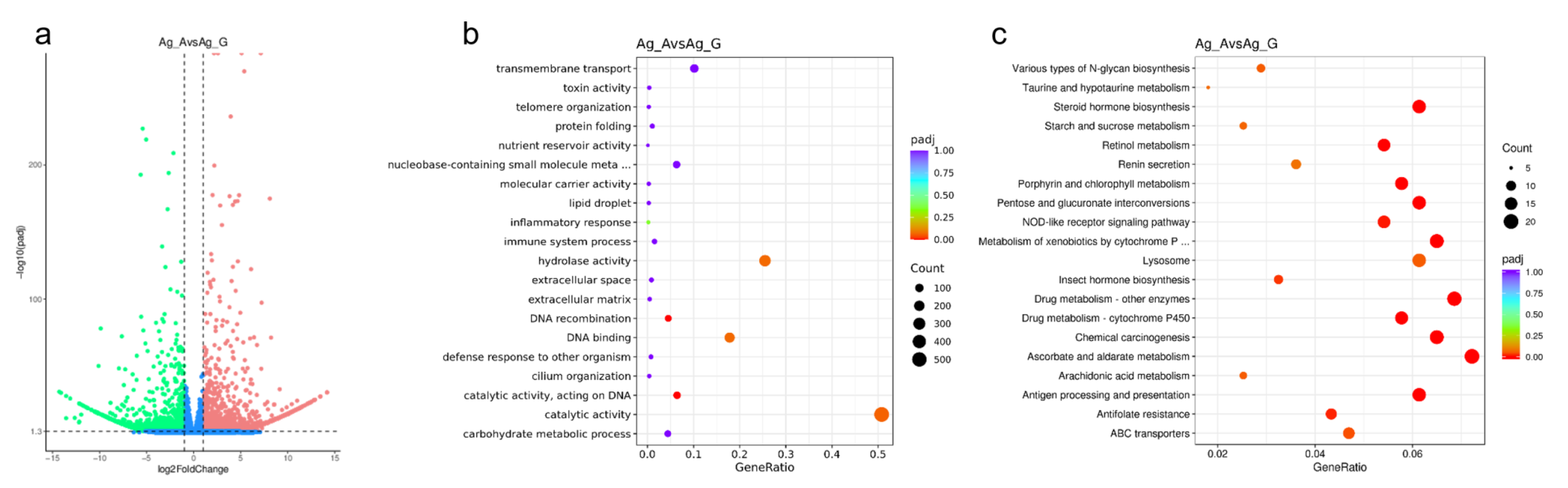
Figure 1. Differential gene expression. (a) Differentially expressed genes volcano map of A. glycines feeding on G. max and A. artemisiifolia, (b) The top 20 DEGs involved in different CO classifications. (c) The top 20 significantly enriched KEGG pathways. The vertical axis represents the pathway names, the horizontal axis represents the Gene Ratio corresponding to the GO classification and KEGG classification, the size of the padj is indicated by the color of the points—the smaller the padj, the closer the color is to red, and the number of differential genes contained in each pathway is represented by the size of the points.
Agronomy 16 00011 g001
Figure 2. Transcription levels of UGTs in A. glycines. * indicates p < 0.05, ** indicates p < 0.01 (Student’s t-test).
Agronomy 16 00011 g002
Table 1. Primers used for real-time quantitative PCR validation.
Gene NamePrimer Sequences (5′-3′)
AgUGT329A3F: ACATTAACCGGCC TAGGCAC
R: ATTGCTTCGTCTCTGGTCCG
AgUGT344N2F: TCACTGAAACAGCCTCGTCA
R: TTCGGCCCGTCTCCAAATAC
AgUGT344L2F: GGTTGCCTCAACTGCACAAA
R: GCCATGCCTGACTCGACTAA
AgUGT344M2F: AACGTCCGGATGATGTACCG
R: GATGCCGCCGATCTGTATCA
AgUGT342B2F: AGATTTCTGGACCGTGCTCG
R: AGGATTTCCAAACTCGCCGT
AgUGT344C5F: TGTCGTCGGAGTGTTCATCC
R: GGTGATCATCGGCGAAGGAA
AgUGT344A12F: GTATGTCCGAGTGTGTGGCA
R: TCGCTCTGCAAACGTTTTGG
AgUGT344J2F: CTTCGGATCAGTCGTAGCC
R: TGTGGAAACCAGTTGCCTGT
AgUGT330A2F: AATCCGTCCCGAAAACGTCA
R: TTCCCATTAGACCACCGTGc
AgUGT344A11F: CGACCCATGTCACCAACAGA
R: AACGAGACGACAAAGGCGAT
AgUGT344D6F: CAGTCATTACGCCACCGAGT
R: CGTGGAACCGAGTGTGAAGA
AgUGT341A4F: TATCCAAAAGGGGACGTGCC
R: CCGTTTTCATCATGGACCGC
AgUGT345A2F: TGGTTACCGC AACGTGCTAT
R: TCCCG CGCTTACAGTTTCAT
AgUGT343B2F: ACCTCTTGT CGAACCAGCTG
R: TGACAACTGGAGC GCTGAAT
AgUGT343C2F: AATCCAGGCCTTCGCTTGAA
R: GGGCTCTTTGATGTGCATACC
AgUGT349A2F: GCCCAGACAACCCTTCCTAC
R: TGCTGGCCATTCACTGTGAT
AgUGT351A4F: AACGACACCCAAGGATTCCC
R: TTATGCCATGGATTCCCCCG
Table 2. Transcriptome sequencing data statistics of A. glycines.
SampleRaw Reads NumberRaw Bases (Gb)Clean Reads NumberClean Bases (Gb)Error RateQ20 RatioQ30 RatioGC Content (%)
Ag-A121,869,7226.56 G21,321,7476.4 G0.0199.4197.1438.77
Ag-A223,145,1456.94 G22,543,4556.76 G0.0199.4297.3139.15
Ag-A322,872,3886.86 G22,396,3936.72 G0.0198.9896.9638.45
Ag-G120,623,3716.19 G20,161,8576.05 G0.0199.289738.57
Ag-G220,122,6306.04 G19,611,8435.88 G0.0199.497.1239.12
Ag-G322,025,2546.61 G21,438,0476.43 G0.0199.3997.1939.15
Table 3. Assembly and annotation results of the transcriptome of A. glycines.
Sequencing/AnnotationNumber
Total number of transcripts80,642
Total number ofunigenes34,078
Mean length of transcripts (bp)1846
Mean length ofunigenes (bp)1272
N50 length of transcripts (bp)2869
N50 length of unigenes (bp)2149
NR annotated15,418
NT annotated33,676
Pfam annotated10,343
KOG annotated5799
Swiss-Prot annotated8865
KEGG annotated7347
GO annotated10,343
All annotated34,002
Table 4. Resistance of different populations of Aphis glycines to insecticides.
ImidaclopridThiamethoxamLambda-Cyhalothrin
Ag-GSlope (±SE)1.59 ± 0.332.90 ± 1.411.51 ± 0.42
LC50 (mg/L)4.910.281.75
95% FL2.60–8.540.17–0.400.55–3.18
df555
χ21.781.110.45
R20.980.950.98
Ag-ASlope (±SE)0.90 ± 0.461.90 ± 0.741.62 ± 0.62
LC50 (mg/L)28.560.706.36
95% FL12.39–111.850.42–1.113.57–11.18
df555
χ22.930.991.63
R20.910.970.95
Disclaimer/Publisher’s Note: The statements, opinions and data contained in all publications are solely those of the individual author(s) and contributor(s) and not of MDPI and/or the editor(s). MDPI and/or the editor(s) disclaim responsibility for any injury to people or property resulting from any ideas, methods, instructions or products referred to in the content.