


Abstract
Biochar (B) has low nutrient content and is recalcitrant to biodegradation. Supplementing B with a fast-releasing nutrient source may improve soil fertility and physical conditions and increase crop productivity. A three-season field study was conducted on sandy loam and sandy clay loam textured soils to investigate the effect of B mixed with livestock manure (LM) on soil properties (pH, organic carbon (OC), cation exchange capacity (CEC), total Nitrogen (TN), available Phosphorus (Avail P)), and French bean yield (Phaseolus vulgaris L.) in Rwanda. The study used a factorial randomized block design with four replications. Treatments comprised three levels of B (0, 1, and 3 t/ha) and three levels of LM (0, 1, and 3 t/ha). Biochar was used from S. sesban, G. sepium, A. angustissima, Eucalyptus, and Grevillea sp., prepared using a drum kiln, while LM was prepared using the pit method. The Analysis of Variance (ANOVA), Tukey (HSD) function at p < 0.05, and linear mixed-effects model were performed in R software version 4.3.3 (R Core Team, 2024). The analysis showed that the treated plots significantly increased French bean yield compared to the control plots, with the highest value found in plots treated with 3 t/ha. The combined plots showed an increased yield compared to sole Biochar or manure. The seasonal increase has been observed, with percentage increases recorded as follows: 16%, 33.56%, 173.06% in sole B plots; 40.28%, 14.43%, and 11.76% in sole LM plots and 125%, 156%, and 209.8% in B + LM plots for season 1, 2, and 3, respectively. Furthermore, the results indicated that the application of B alone or combined with LM significantly enhanced soil pH, OC, TN, avail P, and CEC with the pH ranging from 6.77 to 5.43 for B alone, 6.7–5.35 for LM alone, 8.53–6.06 for B-LM plots, and 4.34–3.78 for control plots. Applying Biochar, either alone or in combination with LM, at a low rate demonstrated positive effects on French bean yield and soil nutrients in smallholder farmers. This study encourages using natural materials such as B and LM to improve soil fertility and increase vegetable production while reducing chemical fertilizers that can cause pollution and damage the environment.
1. Background
Soil nutrient mining is the most common form of soil degradation; it threatens future soil productivity, especially in Sub-Saharan Africa [1,2,3]. In Rwanda, liming of acidic soils, increasing the use of inorganic or organic fertilizers [4], and promoting agroforestry systems [5] have been proposed as solutions to soil fertility problems. However, the use of inorganic fertilizers is problematic due to their adverse environmental effects and high cost [4]. In addition, soil organic amendments such as manure or compost have proven to enhance the soil health, but due to their high rapid decomposition and mineralization, they are ineffective for the reclamation of highly weathered soils on a long-term basis [6,7].
French bean (Phaseolus vulgaris L.) belongs to the family Fabaceae and is widely consumed for its nutritional and economic benefits in Rwanda [8]. However, the production is hindered by soil-related problems, including soil acidity, nutrient leaching, and depletion of organic matter. Therefore, implementing soil amendment strategies that optimize crop yields while minimizing environmental degradation is paramount. One such strategy is the application of Biochar, a C-rich material produced through the pyrolysis of biomass that can endure in soil for thousands of years [9]. B’s porous nature and high surface area increase soil water retention and nutrient-holding capacity, potentially reducing the need for chemical fertilizers and irrigation [10]. However, while B has been shown to affect soil positively, its nutrient supplier efficiency is limited due to its relative nutrient content and recalcitrance to biodegradation [11]. When combined with LM, B could enhance plant nutrient availability through its intermediate nutrient-holding capacity and improve soil physical and biological properties. Recent studies have demonstrated that mixing organic amendments with B reduces Nitrogen (N) loss while simultaneously enhancing humification and producing LM with a high fertilizer value [12], thus increasing the yield of crops. Due to its recalcitrant nature, Adekiya et al. [12] reported that B alone could not positively improve the radish yield in the first year of application. Wisnubroto et al. [13] reported that the highest yield of red chili (Capsicum annum L.) was obtained from plots with B and LM. In Nigeria, the results revealed that B+poultry manure and B+chemical fertilizer (NPK) improved soil physical and chemical properties, growth, and ginger yield compared to their sole forms [14]. Most experiments carried out to date on the effect of B combined with organic amendment on soil properties and crop/vegetable yields have used high rates of this amendment. For example, 10 t/ha [15,16,17], 39 t/ha, >50 t/ha [18,19,20,21] that are not practically feasible at the farmer level. Furthermore, most of the studies were carried out in greenhouses and focused mainly on crops such as maize, while limited data on vegetable production under field conditions are available [22].
However, despite the potential advantages of B-LM amendments, there is a lack of a comprehensive understanding of their effectiveness in the tropical soil context, particularly concerning their effect on soil properties and vegetable yield. Specifically, the impact of B + LM amendments on French beans, an economically significant crop in Rwanda, remains largely unexplored. Concentrating limited resources such as LM and B in small areas that can stimulate substantial economic and nutritional benefits is imperative. This study aimed to test whether the effects of a one-time application of B and LM at low rates, separately and in combination, on soil quality and vegetable growth could be improved and sustained over several seasons. To this end, we tested the following hypothesis: “The combined application of B and LM at a low rate induces a synergistic and persistent effect on soil health and French bean yield”.
2. Material and Methods
2.1. Description of the Study Site and Experiments
The trial sites were at the Tonga Research Station, Huye District, and Rusagara farm station, Bugesera District, Rwanda. The site characteristics and soil properties are summarized in Table 1. The field experiments were conducted over three seasons: for the Huye field experiment, during the period September 2022–September 2023, and for the Bugesera field experiment, during the period December 2022–December 2023.

Table 1.
The characteristics of the studied areas and soil properties at the start of the experiments.
In the study areas, the soil was classified as sandy clay loam (65.4% sand, 26% clay, and 9.03% silt) and sandy loam (63.4% sand, 16.1% silt, and 20% clay) in Huye and Bugesera, respectively (U.S. textural classification triangle [23]). The soil was acidic in nature. Soil OC, TN, available P, Potassium (K+), Calcium (Ca2+), and Magnesium (Mg2+) were rated as very low according to the critical levels of 3% soil OC, 0.2 0% TN, 10 mg/kg available P, 0.20 cmol/kg K+, 2.0 cmol/kg Ca2+, and 0.40 cmol/kg Mg2+ [24]. The low soil CEC (<5 cmol(+)/kg) has been recorded [25] in both sites, indicating poor soil fertility (Table 1). Consequently, the soil will be unable to sustain crop yield without the addition of external inputs. The chemical composition of LM and B is characterized by a relatively high TN, available P, K, Ca, Mg, organic C (OC), and CEC at the level required for the growth of French beans [26] (Table 2).
Table 2.
Properties of livestock manure and Biochar used.
Eighteen treatments with four replicates were placed in plots in a randomized block design. Treatments consisted of a factorial combination of three levels of B (0, 1, and 3 tons/hectare (t/ha) and three levels of LM (0, 1, and 3 t/ha). The treatments were set up assuming all kinds of B were equal (Table 3). The B was crushed and incorporated alone or with LM into a seedbed and stayed for 7 days before sowing. French bean seeds obtained from the local market were directly sown into seedbeds with a depth of 15 cm, maintaining a 30 × 20 cm spacing within plots measuring 2 × 3 m. Except for in the control plots, decomposed LM and B were uniformly applied at specified rates (Table 2). The crushed Biochar and mature were incorporated in the soil, 1 week before seed plantation. The hoe-weeding activities were carried out manually for 2 weeks post-sowing to avoid competition and to reduce insect pest infestation.
Table 3.
Treatments of the field experiments with the dose of Biochar and manure.
2.2. Biochar and Manure Preparation
To produce B, S. sesban, G. sepium, A. angustissima, Eucalyptus sp., and Grevillea sp. were collected from a local farmer’s field and pyrolyzed using a drum kiln method (slow pyrolysis) (Figure 1A,B). Each species was manually cut into appropriate sizes (average 20–25 cm length and 10–15 mm diameter) to load the kiln with feedstocks in a uniform manner and for the uniform heat transfer during the pyrolysis process. The drum kiln method utilizes indirect heating, in which the feedstock is heated by burning fuel outside the drum. This indirect heat helps sustain a relatively stable temperature inside the drum, typically around 4000 °C, suitable for Biochar production. The wood from the various species was sun-dried separately to reduce the moisture content below 10%. All B samples were ground and sieved at <0.154 mm for their chemical analyses.
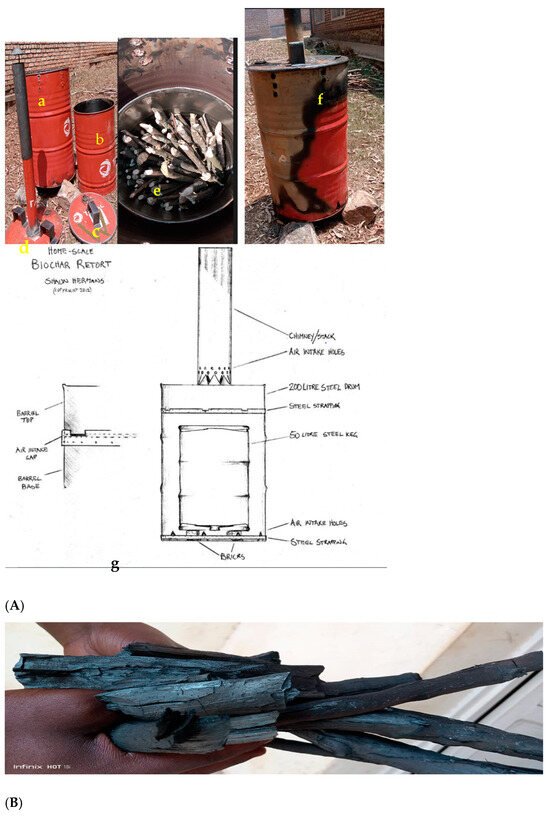
Figure 1.
(A). (a) Biochar drum kiln, (b) inner kiln, (c) drum kiln lid with chimney column, (d) inner kiln lid, (e) loaded fuel in the inner drum kiln, (f) ignited fuel, (g) drum kiln design. (B). produced Biochar from the kiln.
The pit method was used to prepare LM, which lasted 3 weeks to allow mineralization. Detailed information on B and LM properties is provided in Table 2.
2.3. Soil, Biochar, and Livestock Manure Analysis
In September 2022, before the experiments began and after the harvest of French beans in December 2023, the samples of soils were collected from the top 0–20 cm depth using a random sampling design, with four soil samples taken per plot. These individual samples were combined to create a composite sample for subsequent analysis. Soil pH was measured potentiometrically in water and 1N Potassium chloride (KCl) at 1:2.5 soil: water and KCl [27]. Soil TN was determined using the Kjeldahl method [28], while available P was extracted using Bray 1 solution and determined by spectroscopy at 882 nm wavelength following color development by the molybdenum bleu method [27]. OC was determined by the Walkley and Black wet oxidation method [29]. Soil CEC and exchangeable bases were extracted by saturating soils with neutral 1M NH4OAc (ammonium acetate [30] and the absorbed NH4+) by K+ using 1M KCl and then determined by Kjeldahl distillation method for the estimation of CEC of NH4+ were measured by atomic absorption spectrophotometer [30]. The properties of B were calculated using the American Society for Testing and Materials (ASTM) methods [31].
The LM properties were analyzed using the same methods as for soil analysis. To determine ash content, we first measured moisture content by drying a 5 g sample in an oven at 103 °C for 12 h and expressed as the percentage loss of weight of the original sample. Secondly, we measured volatile matter, where the oven-dried sample was incinerated in a muffle furnace for 7 min at 900 °C and weighed after cooling. Volatile matter was expressed as the percentage of weight loss in the original sample. Then, the ash content was determined using the cooled incinerated sample, which was returned to the muffle furnace at 900 °C for 1.5 h, and the weight was expressed as a percentage of the weight of the original sample.
2.4. Determination of French Bean Yield
After 45 days, green pods were harvested at regular intervals (three times) from each unit plot, and their weight was recorded. The total weight of pods per season was recorded for each unit plot and was expressed in kilograms (kgs). The pod yield per plot was converted to yield per ha and was expressed into t/ha.
2.5. Statistical Analysis
The Analysis of Variance (ANOVA) was performed to test for differences in soil parameters across the four study treatments (B, B + LM, LM, and control no additions). Tukey Honest Significance Differences (HSD) post hoc analysis implemented in Tukey (HSD) function at p < 0.05 was further performed on the study treatments. The linear mixed-effects model was applied to generate the relationship between the dependent variable (green pod yield (t/ha) and fixed effects (site and seasons), while treatments were the random effect [32]. Statistical analyses were performed in R software (version 4.3.3) (R Core Team; 2024).
3. Results
3.1. The Effect of Co-Applying Biochar with Manure on French Bean Yield
Generally, the yield of French beans in the treatment plots significantly differed (p < 0.05) from that in the control plots (Figure 2), with the highest values (31.02, 36.1, and 40.93 t/ha for seasons 1, 2, and 3) observed in plots amended with combined B3 + LM3 plot. Across the three growing seasons, plots treated with B or LM at 3 t/ha exhibited significantly higher French bean yields than plots treated with the same amendments at a 1 t/ha rate. In addition, during the first growing season, plots treated with LM alone yielded higher than those treated with B alone. However, in subsequent seasons, the yields in plots treated with LM decreased while the ones in B plots increased, as depicted in Figure 2. In addition, in the plots treated with B alone or combined with LM, there was a pronounced seasonal effect on yields, with the peak values recorded during the third growing season.in the first season, the green pod yield was 7.2, 7.7, and 13.9 for B alone; 8.7, 6.6, and 5.7 t/ha for LM alone; 13.9, 14.9, and 15.8 t/ha for B + LM plots; and 6.2, 5.8 and 5.1 t/ha for control plots.
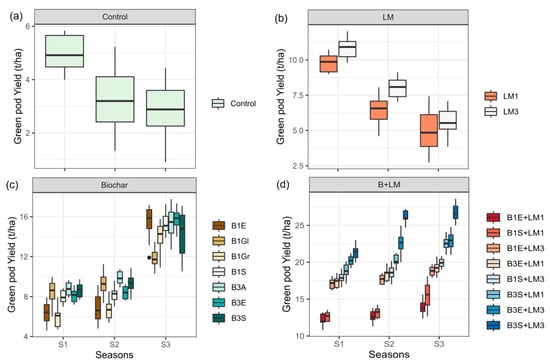
Figure 2.
Effect of B amendments and LM on green pod yield, within (a) control, (b) LM plots, (c) B alone, and (d) B-LM. Bars represent values of four replicates and contain a standard error of means (n = 4). Bars with different letters differ significantly from each other at p < 0.05. B1E/B3E: Biochar produced from Eucalyptus wood and applied at 1 or 3 tons/ha. B1Gl: Biochar produced from Gliricidia wood and applied at 1 or 3 tons/ha. B1S/B3S: Biochar produced from Sesbania wood and applied at 1 or 3 tons/ha. B1Gr: Biochar produced from Grevillea wood and applied at 1 or 3 tons/ha. B3A: Biochar produced from Acacia wood and applied at 1 or 3 tons/ha.
3.2. The Effect of Biochar and Biochar + Manure on Soil Chemical Properties
The results obtained on soil pH influenced by B and B-LM were presented in Supplementary Table S1 and Figure 3. The site factor was not significantly different for soil pH. The statistical analysis revealed a significant (p < 0.05) increase in pH following sole and combined applications of LM and B in both soils (Figure 3). The soil pH ranged from 6.77 to 5.43 for B plots, 6.7–5.35 for LM plots, 8.53–6.06 for B-LM plots, and 4.34–3.78 for control plots. Plots with 3 t/ha showed higher pH values than those amended with 1 t/ha (Supplementary Table S1).
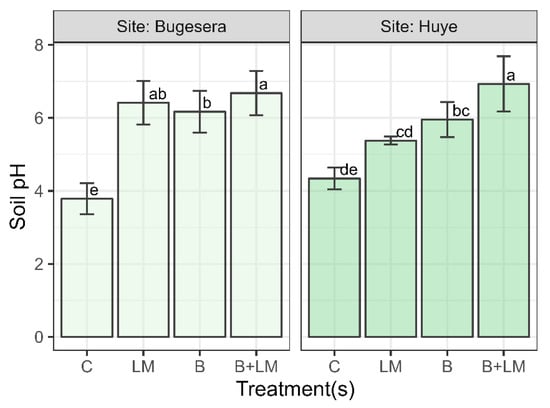
Figure 3.
Effect of Biochar amendments and LM on Soil pH and Bars represents values of four replicates and contain a standard error of means (n = 4). Bars with different letters differ significantly from each other at p < 0.05.
The findings showed that Huye District was significantly high in soil OC but low compared to the Bugesera site (Figure 4). Compared to the control or sole treatment plots, the combined plots showed the highest value of OC ranging between 5.5 and 4.58 for B3Eucalptus + LM3 plots and 4.59 and 4.04 for B3Sesbania + LM3 plots (Table S1).
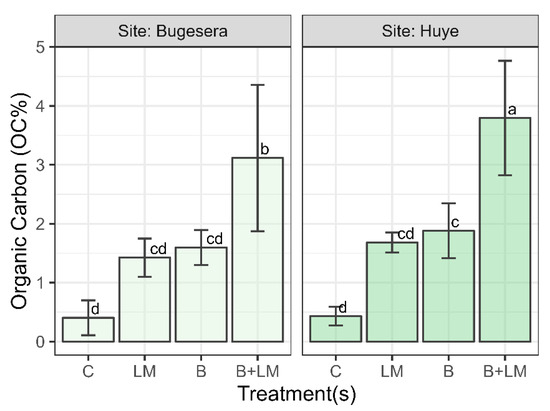
Figure 4.
Effect of B amendments and LM on soil OC (percentage). Bars represent values of four replicates and contain a standard error of means (n = 4). Bars with different letters differ significantly from each other at p < 0.05.
The Huye site was significantly (p ≤ 0.05) high in soil T.N. but low in available P compared to the Bugesera site (Figure 5). The TN content ranged from 0.04 to 0.24% for B alone, 0.05–0.12% for LM alone, 0.4–0.11% for B + LM, and 0.43–0.41% for control plots. The available P ranged from 6.77 to 5.6 mg/kg, 6.7–5.34 mg/kg, 8.5–6.6 mg/kg, and 4.34–3.78 ppm for B alone, LM alone, B + LM, and controls plots, respectively. Furthermore, applying a higher level of 3 t/ha showed a significant increase than 1 t/ha.
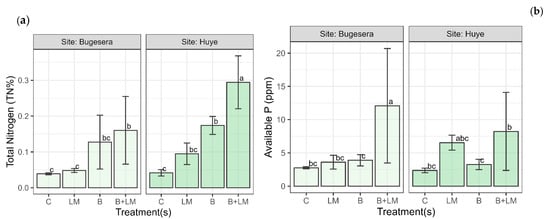
Figure 5.
Effect of B amendments and LM on (a) soil TN (%) and (b) available P (ppm). Bars represent values of four replicates and contain a standard error of means (n = 4). Bars with different letters differ significantly from each other at p < 0.05.
The effect of B addition on CEC (Figure 6) and the contents of exchangeable bases (Table S1) in studied soils are in Figure 6. The analysis of variance showed that CEC and exchangeable bases including Ca2+, Mg2+, and K+ were significantly (p < 0.05) increased by application of B with the highest increase recorded in the soil amended with B and LM at 3 t/ha (Table S1) and this increase in CEC results in increment of basic cations. On the other hand, B addition did not significantly affect Sodium (Na+). The soil CEC ranged between 17.89 and 8.1, 13.23 and 9.38, 24.05 and 11.42, and 6.42 and 5.51 cmol+/kg for B alone, LM alone, B + LM, and controls plots, respectively.
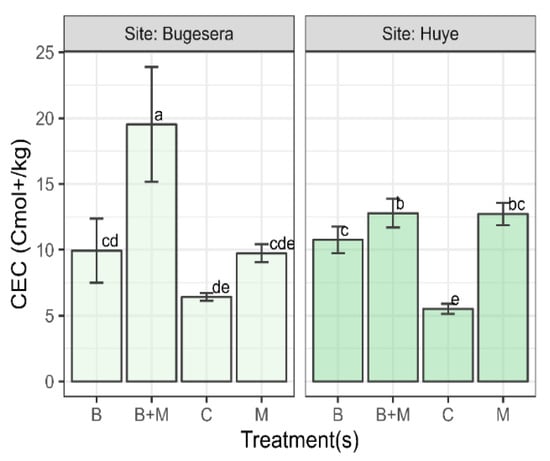
Figure 6.
Effect of B amendments and LM on EC. Bars represent values of four replicates and contain a standard error of means (n = 4). Bars with different letters differ significantly from each other at p < 0.05.
4. Discussion
Biochar and Biochar + Manure Effect on Yield of French Beans in the Studied Soils
French beans are essential for smallholder farmers; therefore, concentrating limited resources such as LM and B on valuable vegetables like French beans can raise soil fertility by improving soil structure and water retention capacity, increasing yield [14]. Economically, this approach may increase income by focusing on crops with better market prices while reducing the need for inorganic inputs, lowering production costs, and promoting sustainability [33]. B’s C sequestration capabilities help combat climate change, enhancing crop resilience to extreme weather. Efficient nutrient use through targeted application minimizes waste and optimizes resource benefits [34] (present study, the high seasonal yield was found in the B-LM plots where the maximum significant values were recorded in B + LM at a 3 t/ha application level). The higher yields may be due to the increased activity of meristematic tissues of plants at optimum fertility levels as B + LM plays a role in cell differentiation, meristematic division, and higher translocation of food materials in plants, thereby resulting in higher production of yield [35]. Furthermore, the application of B led to enhanced N-fixing organism activity and subsequently improved total crop biomass, indicating that B’s resistance to chemical and biological processes promotes its long-term agronomic and environmental advantages with a residence period that could reach up to hundreds to thousands of years [36]. The yield increase was attributed to the integrated use of B along with LM improved soil health, creating a favorable environment for the growth and development of the crop [37,38,39]. This is in line with the study by Agbede et al. [40], reporting that the application of sole poultry manure did not enhance the growth and yield of cucumber but resulted in a substantial decrease in output after 1 month of application.
We observed a continuous increase in yield throughout three seasons, which may be attributed to the residual effect caused by the co-application of B and LM in the study areas. In the first growing season, the plots with LM alone showed a higher yield than those with B alone. Manure provides readily available nutrients for early-season plant growth, decomposes quickly (with declining nutrient release over time), and contributes SOM to enhance soil fertility. On the other hand, B has a gradual nutrient release, persists in the soils for an extended period, enhances SOM content, and reduces nutrient leaching through its porous structure [40]. The substantial decrease in the control plots was attributed to soil acidity that adversely affects synergistic interaction amid the legume crops and their linked rhizobia [34]. The residual effect revealed the sustainability of French bean production using B mixed with LM. The results obtained here are promising as they support the integrated soil nutrient management technology [40]. In addition, the results support that B was recalcitrant (i.e., stays longer in the soil), as reported by other authors [20,39]. Several authors [12,19,21] reported that combining B and M resulted in the highest radish yield and improved soil microbial community richness. According to Shifa et al. [19], B co-applied with LM at total rates showed the highest soil property and plant growth improvements relative to control. Ayito et al. [38] concluded that fruit length, weight, and yield were significantly improved by B treatments, with the combination of palm kernel husk B and poultry manure yielding the highest fruit weight. Increasing crop yield and performance due to the co-application of B with organic amendments have also been reported for crops including lettuce [9], maize [12], soya bean [19], tomatoes [10], mung bean [14], and radish [20].
The findings show that soil properties, at the end of three consecutive seasons, were improved, as showed by a higher yield of French beans in the areas of study (Section Biochar and Biochar + Manure Effect on Yield of French Beans in the Studied Soils). The Huye site was statistically significantly higher in soil OC, TN, pH, and CEC but low in available P (Table S1) compared to the Bugesera site. This was probably because the site was dominated by fine-textured soils (sandy clay loam), which contain a high percentage of clay and silt and tend to have naturally higher amounts of organic matter. The increase in soil pH in the B + LM plots can be attributed to the synergistic effect between B and LM. This was due to the high pH from B’s inherent capacity to increase pH, alongside LM’s contribution facilitated by the complexation of its organic anions released into the soil exchange sites [15]. The pH values recorded in this study were consistent with those reported by Habieb et al. [15], who concluded that the application of B + LM could improve soil quality by increasing soil pH.
The combined plots showed higher values of OC, TN, and available P content than the sole application plots. For OC, it was because of the C added by the B and the additional C from the organic matter through the LM addition [17]. For TN and available P, B improves the capacity of LM to improve acidic soil, increase CEC, and supplement the soil with nutrients released from their organic matter. Shifa et al. [19] also revealed the higher organic C and total N at the ancient terra preta compared with adjacent soils. The findings of Antonangelo et al. [22] confirmed that B-amended soils have more readily available P contents than soils without treatment. Similar results reported by Nguyen et al. [9] and Huang et al. [34] indicated that soil amended with B has a higher available P than unamended soil. The increase in the OC or other nutrients observed after the B and LM application agrees with the findings of Adekiya et al. [12,14] and de la Rosa et al. [17]. In addition, B addition to LM showed a significantly higher (p < 0.005) CEC content than the control or other treatments. This was due to the high surface area of B and highly porous, variable charge organic material from LM that could potentially increase CEC, surface sorption capacity, and base saturation when added to the soil. Within combined plots, high values of exchangeable bases might be attributed to the presence of ash in B and the organic matter derived from LM. The ash content of B helps in the immediate release of occluded mineral nutrients like Ca, K, and N for crop use [38]. The results of the present study also agree with previous studies [33,34,35], which reported the highest exchangeable bases in B-applied soils. The low levels of Na in the studied soils do not present deficiencies as it was regarded as a beneficial nutrient needed in a low quantity to avoid damage to soil structure, permeability, and plant growth.
5. Conclusions
Degraded tropical soils have low total OC, available P, N, and soil pH; hence, they have low crop yield. Therefore, restoration of degraded tropical soil was needed to ensure crop productivity. This study showed that the application of B, either alone or in combination with LM, significantly increased the green pod yield compared to control plots, with the highest values found in B + LM plots at 3 t/ha. LM plots yielded higher in the first growing season but decreased in subsequent seasons, with peak values recorded in the third season. The high yield was attributed to improved soil quality indicators and the residual effect caused by combining B + LM Biochar alone or combined with LM has improved chemical properties such as soil pH, soil OC, CEC, and soil nutrients (TN and avail P). The results of this study confirmed that the use of B together with LM for amending soils for vegetable cultivation could be an economically reasonable and environmentally justified way to enhance both agricultural productivity and soil quality, especially with coarse-textured soils. These findings showed that the co-application of B and LM could restore degraded soil in the tropics and increase the productivity of crops/vegetables. In addition, this integrated approach, which concentrates on limited resources such as B and LM, can benefit smallholder farmers when applied to their farms. This study recommends developing and promoting integrated soil fertility management programs that include B production and application and training of farmers on producing and using Biochar effectively. Longer-term effects shall be investigated to assess the effect of B on soil quality and crop production considering soil environment and using diverse feedstocks available in the Rwandan landscape to produce Biochar.
Supplementary Materials
The following supporting information can be downloaded at: https://www.mdpi.com/article/10.3390/agronomy14092020/s1, Table S1: Soil properties as induced by biochar alone or combined with livestock manure in study areas.
Author Contributions
S.U. conceptualized the study, conducted fieldwork and laboratory analyses, and wrote manuscript drafts; J.N., G.N. and S.A.O.C. conceptualized the study, commented on drafts, and contributed to the writing. All authors have read and agreed to the published version of the manuscript.
Funding
This research was funded by Sida (Swedish International Development Agency), grant number (13394) and the APC was funded by REFOREST (Regional Research School in Forest Sciences) programme.
Data Availability Statement
The original contributions presented in the study are included in the article/Supplementary Material, further inquiries can be directed to the corresponding author.
Acknowledgments
Many thanks go to laboratory and field technicians for their assistance during laboratory assistance and field data collection. Lastly, we would like to thank smallholder farmers’ active participation and cooperation, without which this work would not have been achieved.
Conflicts of Interest
The authors declare no conflicts of interest.
References
- Uwiragiye, Y.; Ngaba, M.J.Y.; Zhao, M.; Elrys, A.S.; Heuvelink, G.B.; Zhou, J. Modelling and mapping soil nutrient depletion in humid highlands of East Africa using ensemble machine learning: A case study from Rwanda. Catena 2022, 217, 106499. [Google Scholar] [CrossRef]
- Vanlauwe, B.; Descheemaeker, K.; Giller, K.E.; Huising, J.; Merckx, R.; Nziguheba, G.; Wendt, J.; Zingore, S. Integrated soil fertility management in sub-Saharan Africa: Unravelling local adaptation. SOIL 2015, 1, 491–508. [Google Scholar] [CrossRef]
- Stewart, Z.P.; Pierzynski, G.M.; Middendorf, B.J.; Prasad, P.V.V. Approaches to improve soil fertility in sub-Saharan Africa. J. Exp. Bot. 2020, 71, 632–641. [Google Scholar] [CrossRef] [PubMed]
- Nduwumuremyi, A.; Habimana, S.; Twizerimana, A.; Mupenzi, J. Soil acidity analysis and estimation of lime requirement for rectifying soil acidity. Int. Invent. J. Agric. 2017, 2, 22–26. [Google Scholar]
- Mukurarinda, A.; Ndayambaje, J.D.; Iiyama, M.; Ndoli, A.; Musana, B.S.; Garrity, D.; Ling, S. Taking to Scale Tree-Based Systems in Rwanda to Enhance Food Security, Restore Degraded Land, Improve Resilience to Climate Change and Sequester Carbon; PROFOR, ICRAF: Washington, DC, USA, 2016; 46p. [Google Scholar]
- Sangsuk, S.; Buathong, C.; Suebsiri, S. High-energy conversion efficiency of drum kiln with heat distribution pipe for charcoal and biochar production. Energy Sustain. Dev. 2020, 59, 1–7. [Google Scholar] [CrossRef]
- Ndambi, O.A.; Pelster, D.E.; Owino, J.O.; de Buisonjé, F.; Vellinga, T. Manure Management Practices and Policies in Sub-Saharan Africa: Implications on Manure Quality as a Fertilizer. Front. Sustain. Food Syst. 2019, 3, 29. [Google Scholar] [CrossRef]
- Ministry of Agriculture and Animal Resource (Minagri). Annual Report FY 2015-2016. p. 123. Kigali, Rwanda. Available online: https://innspub.net/the-effect-of-biochar-and-cowmanure-to-increase-soil-fertility-in-entisol-darussalam/ (accessed on 15 July 2022).
- Nguyen, B.T.; Trinh, N.; Le, C.M.T.; Nguyen, T.T.; Tran, T.V.; Thai, B.V.; Le, T.V. The interactive effects of biochar and cow manure on rice growth and selected properties of salt-affected soils. Arch. Agron. Soil Sci. 2018, 64, 1744–1758. [Google Scholar] [CrossRef]
- Razzaghi, F.; Obour, P.B.; Arthur, E. Does biochar improve soil water retention? A systematic review and meta-analysis. Geoderma 2019, 361, 114055. [Google Scholar] [CrossRef]
- Partey, S.T.; Preziosi, R.F.; Robson, G.D. Short-Term Interactive Effects of Biochar, Green Manure, and Inorganic Fertilizer on Soil Properties and Agronomic Characteristics of Maize. Agric. Res. 2014, 3, 128–136. [Google Scholar] [CrossRef]
- Adekiya, A.O.; Agbede, T.M.; Ejue, W.S.; Aboyeji, C.M.; Dunsin, O.; Aremu, C.O.; Owolabi, A.O.; Ajiboye, B.O.; Okunlola, O.F.; Adesola, O.O. Biochar, poultry manure and NPK fertilizer: Sole and combine application effects on soil properties and ginger (Zingiber officinale Roscoe) performance in a tropical Alfisol. Open Agric. 2020, 5, 30–39. [Google Scholar] [CrossRef]
- Wisnubroto, E.I.; Tunggadewi, M.U.T.; Utomo, W.H.; Indrayatie, E.R. Residual Effect of Biochar on Growth and Yield of Red Chili (Capsicum annum L.). J. Adv. Agric. Technol. 2017, 4, 28–32. [Google Scholar] [CrossRef]
- Adekiya, A.O.; Agbede, T.M.; Aboyeji, C.M.; Dunsin, O.; Simeon, V.T. Effects of biochar and poultry manure on soil characteristics and the yield of radish. Sci. Hortic. 2019, 243, 457–463. [Google Scholar] [CrossRef]
- Habieb, M.; Zaitun, S. The effect of biochar and cow manure to increase soil fertility in Entisol Darussalam. Int. J. Agron. Agrc. Res. 2018, 13, 1–7. [Google Scholar]
- Dai, Z.; Zhang, X.; Tang, C.; Muhammad, N.; Wu, J.; Brookes, P.C.; Xu, J. Potential role of biochars in decreasing soil acidification—A critical review. Sci. Total Environ. 2017, 581–582, 601–611. [Google Scholar] [CrossRef] [PubMed]
- de la Rosa, J.M.; Rosado, M.; Paneque, M.; Miller, A.Z.; Knicker, H. Effects of aging under field conditions on biochar structure and composition: Implications for biochar stability in soils. Sci. Total Environ. 2018, 613–614, 969–976. [Google Scholar] [CrossRef]
- Li, G.; Nazir, M.M.; Zulfiqar, F.; Siddique, K.H.; Iqbal, B.; Du, D. Harnessing soil carbon sequestration to address climate change challenges in agriculture. Soil Tillage Res. 2024, 237, 105959. [Google Scholar] [CrossRef]
- Shifa, S.; Worku, M.; Beyene, A. Co-application of compost and biochar improves soil properties and Desho grass growth on acidic soils in a tropical environment of Southwestern Ethiopia. Cogent Food Agric. 2023, 10, 2290338. [Google Scholar] [CrossRef]
- Dong, X.; Li, G.; Lin, Q.; Zhao, X. Quantity and quality changes of biochar aged for 5 years in soil under field conditions. Catena 2017, 159, 136–143. [Google Scholar] [CrossRef]
- Solaiman, Z.M.; Shafi, M.I.; Beamont, E.; Anawar, H.M. Poultry Litter Biochar Increases Mycorrhizal Colonisation, Soil Fertility and Cucumber Yield in a Fertigation System on Sandy Soil. Agriculture 2020, 10, 480. [Google Scholar] [CrossRef]
- Antonangelo, J.A.; Culman, S.; Zhang, H. Comparative analysis and prediction of cation exchange capacity via summation: Influence of biochar type and nutrient ratios. Front. Soil Sci. 2024, 4, 1371777. [Google Scholar] [CrossRef]
- I.U.S.S. Working Group. World Reference Base for Soil Resources 2014 Update 2016. International Soil Classification System for Naming Soils and Creating Legends for Soil Maps; World Soil Resources Reports (2016); No. 106; FAO: Rome, Italy, 2016. [Google Scholar]
- Akinrinde, E.A.; Obigbesan, G.O. Evaluation of fertility status of selected soil for crop production in five ecological areas of Nigeria. In Proceedings of the 26th Annual Conference of Soil Science Society of Nigeria, Ibadan, Nigeria, 6–10 December 2000; pp. 279–288. [Google Scholar]
- Wogi, L.; Dechassa, N.; Haileselassie, B.; Mekuria, F.; Abebe, A.; Tamene, L.D. A Guide to Standardized Methods of Analysis for Soil, Water, Plant, and Fertilizer Resources for Data Documentation and Sharing in Ethiopia; International Center for Tropical Agriculture. Publication: Addis Ababa, Ethiopia, 2021; p. 41. [Google Scholar]
- Glaser, B.; Lehr, V.-I. Biochar effects on phosphorus availability in agricultural soils: A meta-analysis. Sci. Rep. 2019, 9, 9338. [Google Scholar] [CrossRef]
- Okalebo, J.R.; Gathua, K.W.; Woomer, P.L. Laboratory Methods of Soil and Plant Analysis: Working Manual, 2nd ed.; Springer: Berlin/Heidelberg, Germany, 2002; p. 128. [Google Scholar]
- Bremmer, J.M.; Mulvaney, C.S. Total nitrogen. In Methods of Soil Analysis, Part 2, 2nd ed.; Page, L.A., Miller, R.H., Keeney, D.R., Eds.; American Society Agronomy: Madison, WI, USA, 1982; pp. 595–624. [Google Scholar]
- Nelson, D.W.; Sommers, L.E. Total organic carbon. In Methods of Soil Analysis, Part 2. Chemical and Microbiological Properties; Page, A.L., Ed.; American Society of Agronomy: Madison, WI, USA, 1982; Volume 2, pp. 539–579. [Google Scholar]
- Thomas, G.W. Exchangeable cations. In Methods of Soil Analysis, 2nd ed.; Page, L.A., Miller, R.H., Keeney, D.R., Eds.; American Society Agronomy & Soil Science Society of America: Madison, WI, USA, 1982; pp. 595–624. [Google Scholar]
- D3174-12; Ash in the Analysis Sample of Coal and Coke from Coal. Standards ASTM International: West Conshohocken, PA, USA, 2018.
- Bates, D.; Mächler, M.; Bolker, B.; Walker, S. Fitting Linear Mixed-Effects Models Using lme4. J. Stat. Softw. 2015, 67, 48. [Google Scholar] [CrossRef]
- Oni, B.A.; Oziegbe, O.; Olawole, O.O. Significance of biochar application to the environment and economy. Ann. Agric. Sci. 2019, 64, 222–236. [Google Scholar] [CrossRef]
- Huang, Y.; Tao, B.; Lal, R.; Lorenz, K.; Jacinthe, P.-A.; Shrestha, R.K.; Bai, X.; Singh, M.P.; Lindsey, L.E.; Ren, W. A global synthesis of biochar’s sustainability in climate-smart agriculture—Evidence from field and laboratory experiments. Renew. Sustain. Energy Rev. 2023, 172, 113042. [Google Scholar] [CrossRef]
- Gudade, B.; Malik, G.C.; Das, A.; Bhupenchandra, I.; Malik, C.; Das, A.; Babu, S.; Kumar, A. Effect of biochar levels and inte-grated nutrient-management practices on agro-physiological performance and productivity of maize (Zea mays). Indian J. Agron. 2022, 67, 380–385. [Google Scholar] [CrossRef]
- Khan, Z.; Xu Jian, Y.; Fu, Y.; Joseph, S.; Khan, M.N.; Alam, I.; Shen, H. Engineered Biochar improves nitrogen use efficiency via stabilizing soil water-stable macro aggregates and enhancing nitrogen transformation. Biochar 2023, 5, 2–37. [Google Scholar] [CrossRef]
- Olmo, M.; Villar, R.; Salazar, P.; Alburquerque, J.A. Changes in soil nutrient availability explain biochar’s impact on wheat root development. Plant Soil 2015, 399, 333–343. [Google Scholar] [CrossRef]
- Ayito, E.O.; John, K.; Benjamin, O.I.; John, N.M.; Mngadi, S.; Heung, B.; Abbey, L.; Agyeman, P.C.; Moodley, R. Synergistic effects of biochar and poultry manure on soil and cucumber (Cucumis sativus) performance: A case study from the southeastern Nigeria. Soil Sci. Annu. 2023, 74, 183903. [Google Scholar] [CrossRef]
- Liu, M.; Linna, C.; Ma, S.; Ma, Q.; Song, W.; Shen, M.; Song, L.; Cui, K.; Zhou, Y.; Wang, L. Biochar combined with organic and inorganic fertilizers promoted the rapeseed nutrient uptake and improved the purple soil quality. Front. Nutr. 2022, 9, 997151. [Google Scholar] [CrossRef]
- Agbede, T.M.; Adekiya, A.O.; Eifediyi, E.K. Impact of Poultry Manure and NPK Fertilizer on Soil Physical Properties and Growth and Yield of Carrot. J. Hortic. Res. 2017, 25, 81–88. [Google Scholar] [CrossRef]
Disclaimer/Publisher’s Note: The statements, opinions and data contained in all publications are solely those of the individual author(s) and contributor(s) and not of MDPI and/or the editor(s). MDPI and/or the editor(s) disclaim responsibility for any injury to people or property resulting from any ideas, methods, instructions or products referred to in the content. |
© 2024 by the authors. Licensee MDPI, Basel, Switzerland. This article is an open access article distributed under the terms and conditions of the Creative Commons Attribution (CC BY) license (https://creativecommons.org/licenses/by/4.0/).