1. Background
As indicated by the recent IPCC report on climate change, the growing number of extreme climatic events (e.g., droughts and floods) has already affected food production and livelihoods [1]. One of the reasons for this may be that most of the crops grown on arable land are grown in monoculture systems, which are particularly vulnerable to climate change as well as biotic stresses, due to their ecological and genetic homogeneity [2]. Furthermore, the expected increase of the global population to 9.8 billion by 2050, coupled with the impact of climate change, is estimated to decrease food security over time [3]. Thus, to mitigate this risk, European farmers must provide sufficient, high-quality, and accessible products which comply with the principles of environmental sustainability, according to the EU Green Deal and Farm to Fork strategy. In recent years, the operation of the farming sector has come at the cost of environmental degradation, land and water body pollution, decreases in biodiversity, and a high carbon footprint.
Although there is no one-size-fits-all solution, agroecology offers promising tools to meet the EU’s food production needs while also addressing both the environmental and climatic requirements of sustainable agriculture, such as lower GHG emissions [4,5]. According to the Food and Agriculture Organization of the UN (FAO), agroecology is a holistic, transdisciplinary, and integrated approach that applies ecological and social concepts and principles to the design and management of sustainable agri-food systems, with a long-term perspective. The agroecological measures for adaptation—which can facilitate increases in the productivity, sustainability, and resilience of farm production—include the diversification of agroecosystems in the form of variety mixtures and polycultures, agroforestry systems, and crop–livestock mixed systems coupled with soil organic matter management, water conservation and harvesting, and a general enhancement of local plant diversity and complexity [3].
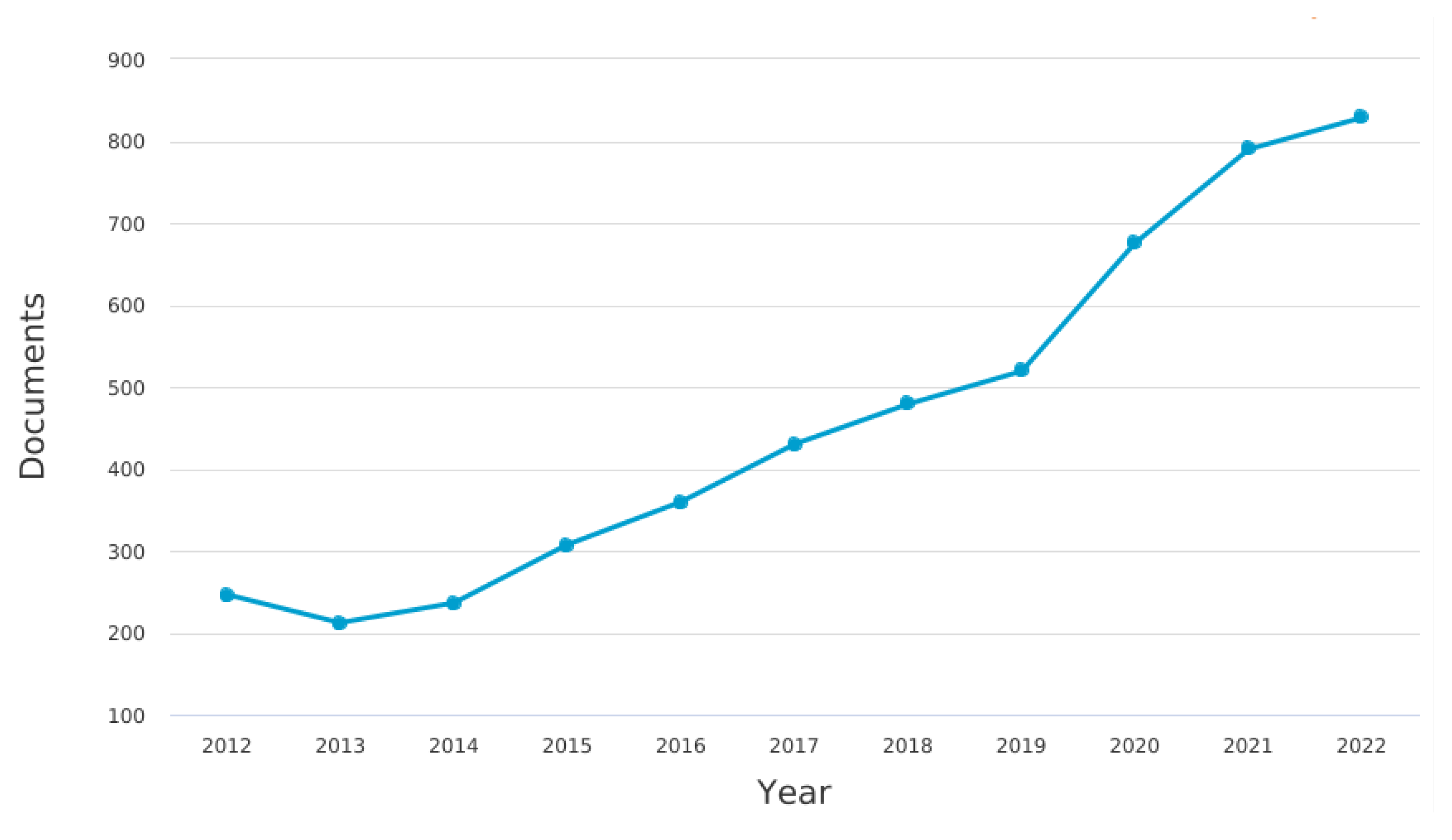
Figure 1 shows the number of published articles, indexed by Scopus in a 10-year period (2012–2022), which include the terms “agroecology” OR “agro-ecology” in the search done within the title, abstract, and keywords. The figure clearly indicates a significant increasing trend, with a value 94.8% higher in 2022, compared to the average of the previous years. This result highlights the growing interest in an agroecological approach.
Figure 1.
Documents by year including the terms “agroecology” OR “agro-ecology” in the search within title, abstract, and keywords (source: Scopus).
2. Why Launch the Section, “Agroecology Innovation: Achieving System Resilience”?
The Section, “Agroecology Innovation: Achieving System Resilience” of Agronomy (MDPI), would highlight and promote a broad range of research and innovation activities, showcasing how agroecology can support the resilience of agroecosystems through a shift from highly simplified cropping systems towards more diversified systems. It welcomes original articles, critical reviews, and short communications pertaining to the study of agroecology, covering a wide range of disciplines, from an inter- and multidisciplinary perspective.
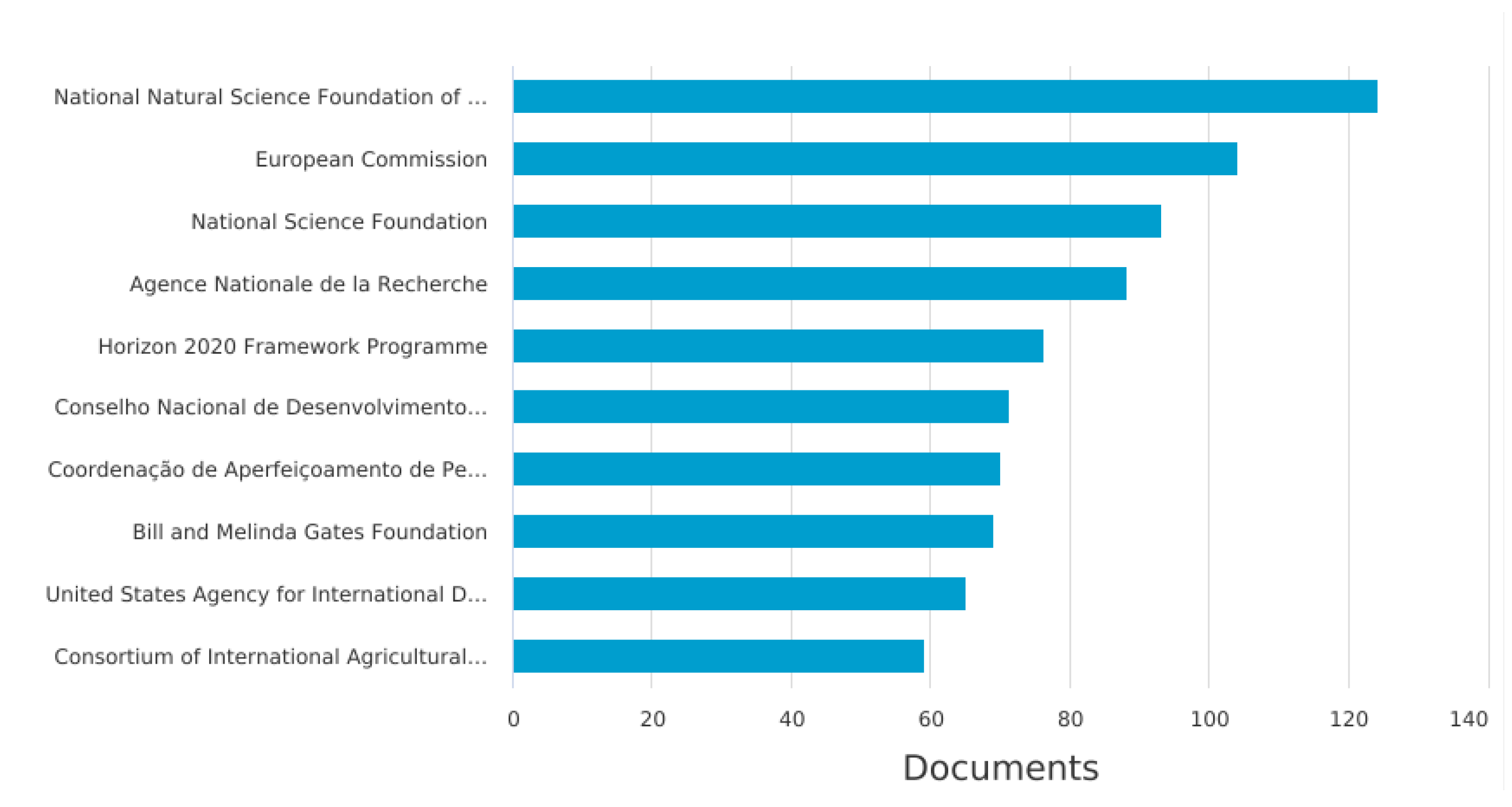
It is interesting to consider the funding sponsors of published articles on agroecology indexed by Scopus in the analyzed 10-year period (Figure 2). Along with the many occurrences of the National Natural Science Foundation of China, the top five funding sponsors comprise both the European Commission and the Horizon 2020 Framework Programme. To update this outcome, we should consider that European Commission, EU Member States, and countries associated with Horizon Europe have co-created the foundation for a partnership for the agroecological transition of the agri-food sector towards resilient, ecosystem- and society-friendly farming systems, through living labs and research infrastructures, to be launched in 2024. Therefore, the new Section of Agronomy will likely also be a collector of the obtained results of such a partnership, particularly focusing on the role of agroecology in achieving agroecosystem resilience in the context of climate change.
Figure 2.
Documents by funding sponsor including the terms “agroecology” OR “agro-ecology” in the search within title, abstract, and keywords (Source: Scopus).
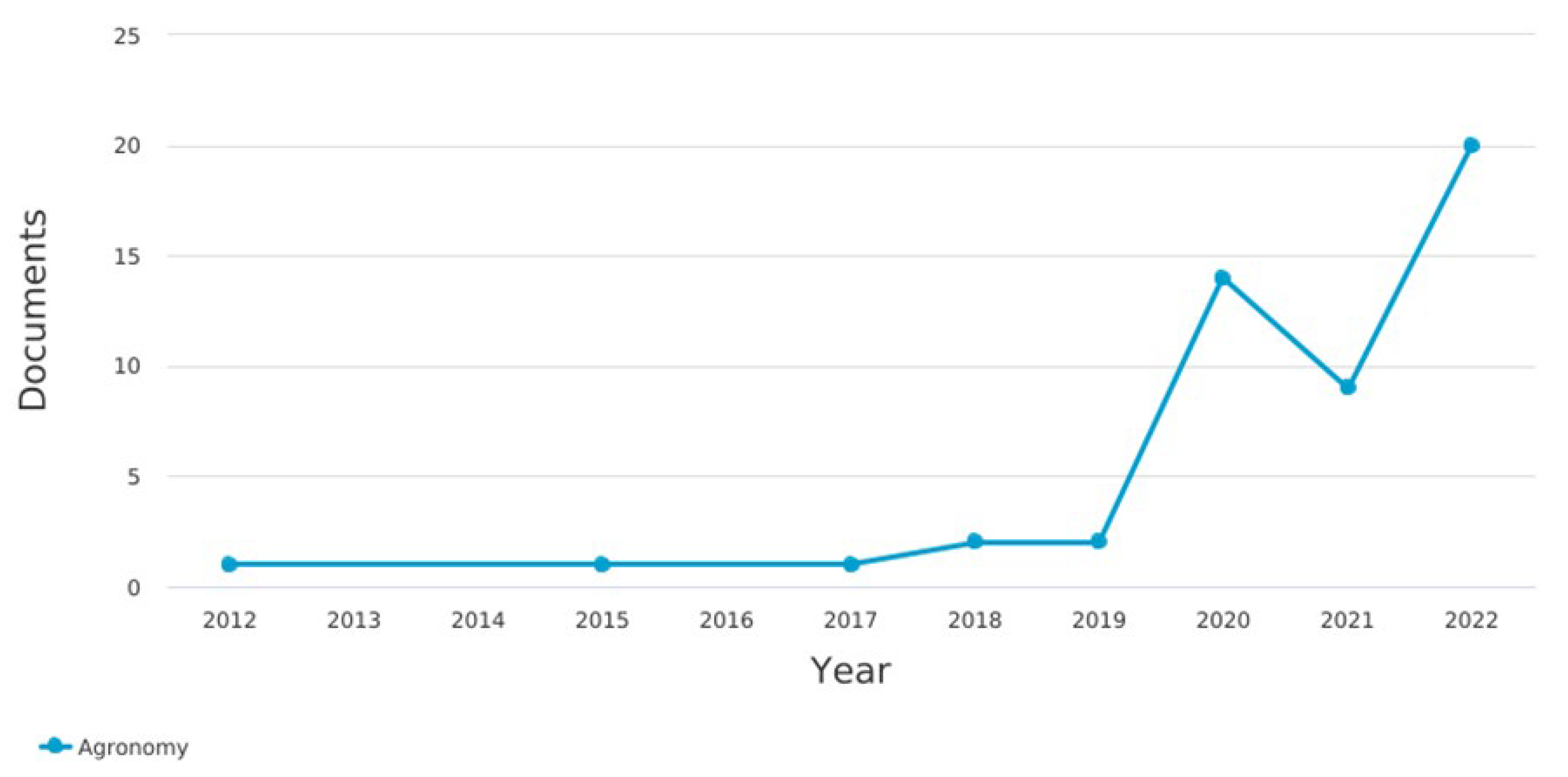
The core principle of the co-creation of knowledge is the basis of the agroecological approach and requires putting farmers and other stakeholders at the center of defining research questions and developing solutions, alongside researchers [6,7]. Horizon 2020 and its successor, Horizon Europe, are playing a key role in developing the agroecological approach in Europe by supporting specific research and innovation projects, mainly through field trials, new technologies, living labs, and site-specific stakeholder networks. Given this scenario, in the near future it is reasonable to expect a progressive increase in scientific contributions to the Section “Agroecology Innovation: Achieving System Resilience”. This perspective could allow to step up and stabilize over time the number of articles published in Agronomy on topics relevant to the Section, given the relatively low volume of articles published in the observed period, compared to the general results, as reported in Figure 3.
Figure 3.
Documents per year published, up to the present, in Agronomy (MDPI), including the terms “agroecology” OR “agro-ecology” in the search within title, abstract, and keywords (Source: Scopus).
Author Contributions
Conceptualization, M.D. and F.M.; methodology, M.D. and F.M.; writing—original draft preparation, M.D.; writing—review and editing, M.D. and F.M. All authors have read and agreed to the published version of the manuscript.
Data Availability Statement
Data available in the cited source (Scopus—Elsevier B.V.)
Conflicts of Interest
The authors declare no conflict of interest.
References
- IPCC. Summary for Policymakers. In Climate Change 2022: Impacts, Adaptation, and Vulnerability; Contribution of Working Group II to the Sixth Assessment Report of the Intergovernmental Panel on Climate Change; Pörtner, H.-O., Roberts, D.C., Tignor, M., Poloczanska, E.S., Mintenbeck, K., Alegría, A., Craig, M., Langsdorf, S., Löschke, S., Möller, V., et al., Eds.; Cambridge University Press: Cambridge, UK, 2022. [Google Scholar]
- Heinemann, J.A.; Massaro, M.; Coray, D.S.; Agapito-Tenfen, S.Z.; Wen, J.D. Sustainability and innovation in staple crop production in the US Midwest. Int. J. Agric. Sustain. 2014, 12, 71–88. [Google Scholar] [CrossRef]
- Altieri, M.A.; Nicholls, C.I.; Henao, A.; Lana, M.A. Agroecology and the design of climate change-resilient farming systems. Agron. Sustain. Dev. 2015, 35, 869–890. [Google Scholar] [CrossRef]
- Diacono, M.; Persiani, A.; Fiore, A.; Montemurro, F.; Canali, S. Agro-ecology for potential adaptation of horticultural systems to climate change: Agronomic and energetic performance evaluation. Agronomy 2017, 7, 35. [Google Scholar] [CrossRef]
- Persiani, A.; Montemurro, F.; Fiore, A.; Scazzarriello, R.; Diacono, M. On-farm fertilizing materials in organic horticulture: Agronomic performance, energy use and GHG emissions evaluation. Arch. Agron. Soil Sci. 2021, 67, 1944–1960. [Google Scholar] [CrossRef]
- Wezel, A.; Herren, B.G.; Kerr, R.B.; Barrios, E.; Gonçalves, A.L.R.; Sinclair, F. Agroecological principles and elements and their implications for transitioning to sustainable food systems. A review. Agron. Sustain. Dev. 2020, 40, 40. [Google Scholar] [CrossRef]
- Ciaccia, C.; Testani, E.; Fiore, A.; Iocola, I.; Di Pierro, M.; Mele, G.; Ferlito, F.; Cutuli, M.; Montemurro, F.; Farina, R.; et al. Organic agroforestry long-term field experiment designing trough actors’ knowledge towards food system sustainability. Sustainability 2021, 13, 5532. [Google Scholar] [CrossRef]
Disclaimer/Publisher’s Note: The statements, opinions and data contained in all publications are solely those of the individual author(s) and contributor(s) and not of MDPI and/or the editor(s). MDPI and/or the editor(s) disclaim responsibility for any injury to people or property resulting from any ideas, methods, instructions or products referred to in the content. |
© 2023 by the authors. Licensee MDPI, Basel, Switzerland. This article is an open access article distributed under the terms and conditions of the Creative Commons Attribution (CC BY) license (https://creativecommons.org/licenses/by/4.0/).