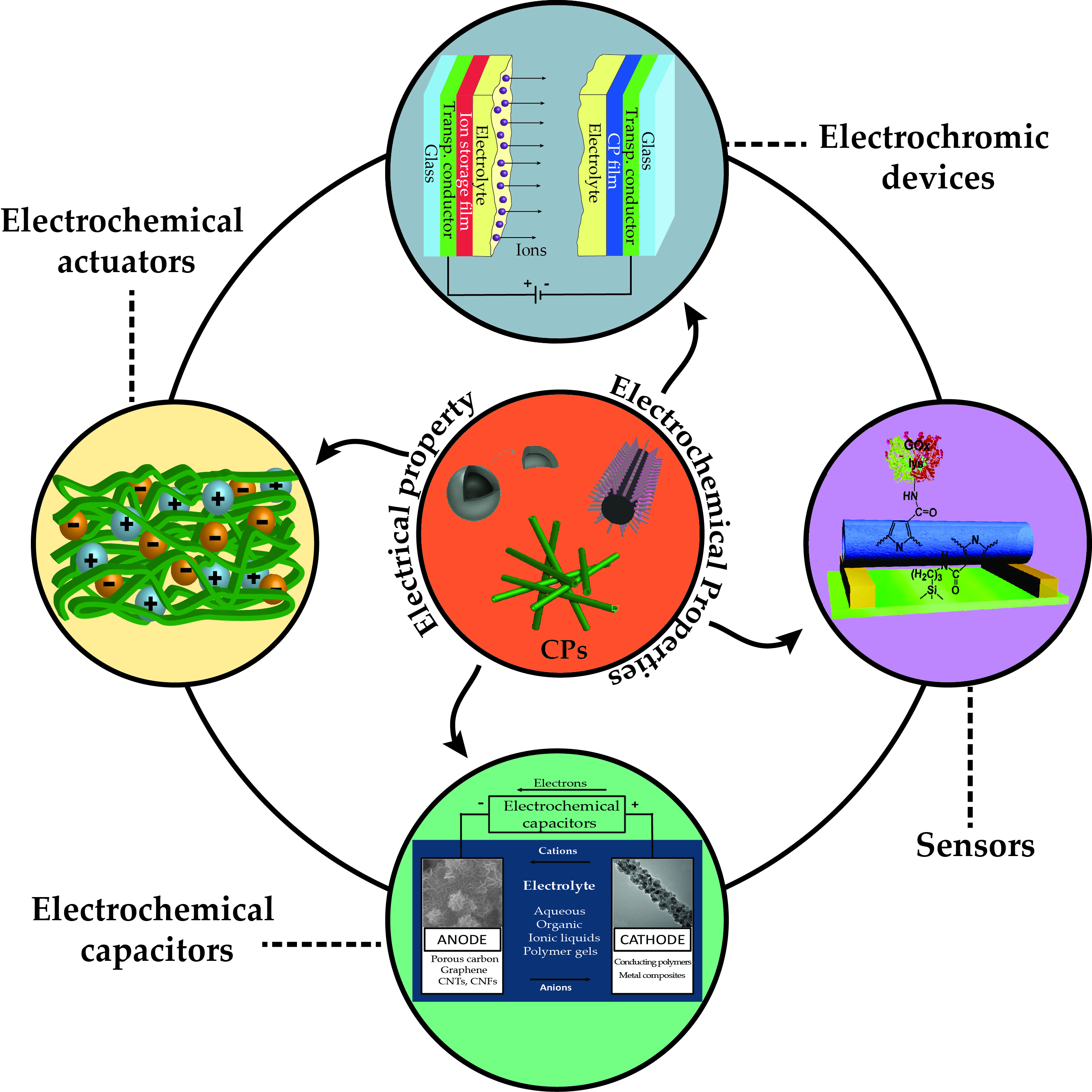
Electrical and Electrochemical Properties of Conducting Polymers



Abstract
1. Introduction
2. Conductive Mechanism
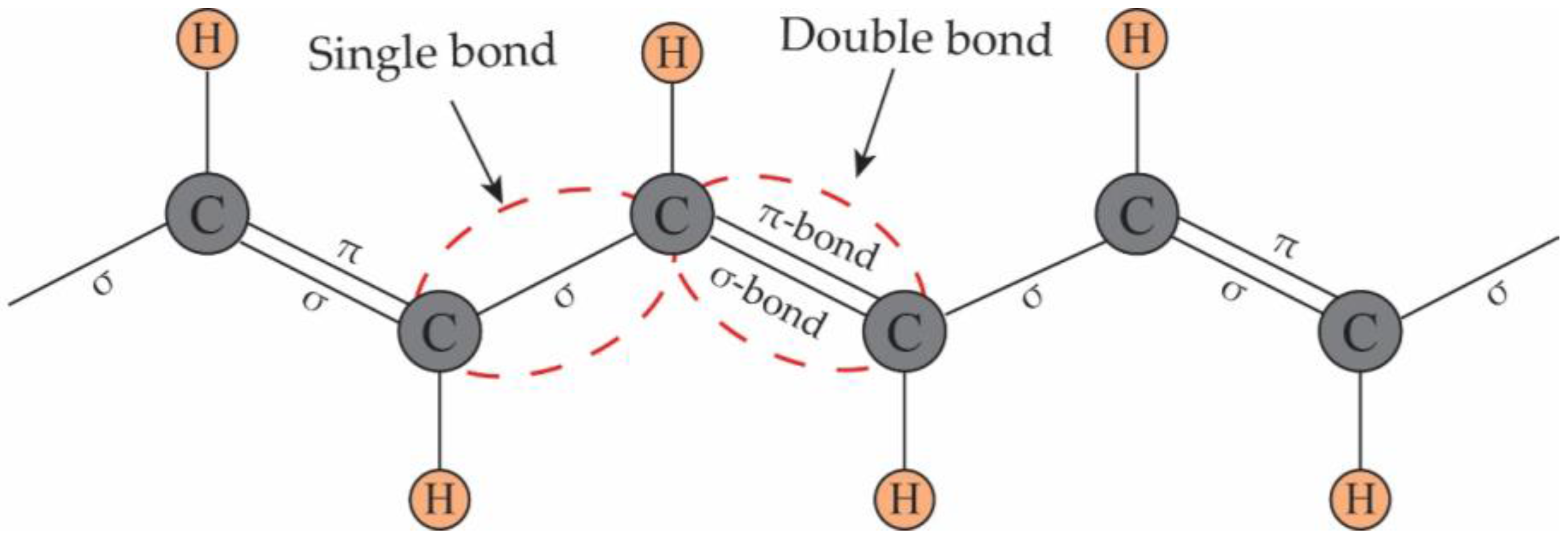
2.1. Inherent Molecular Structure
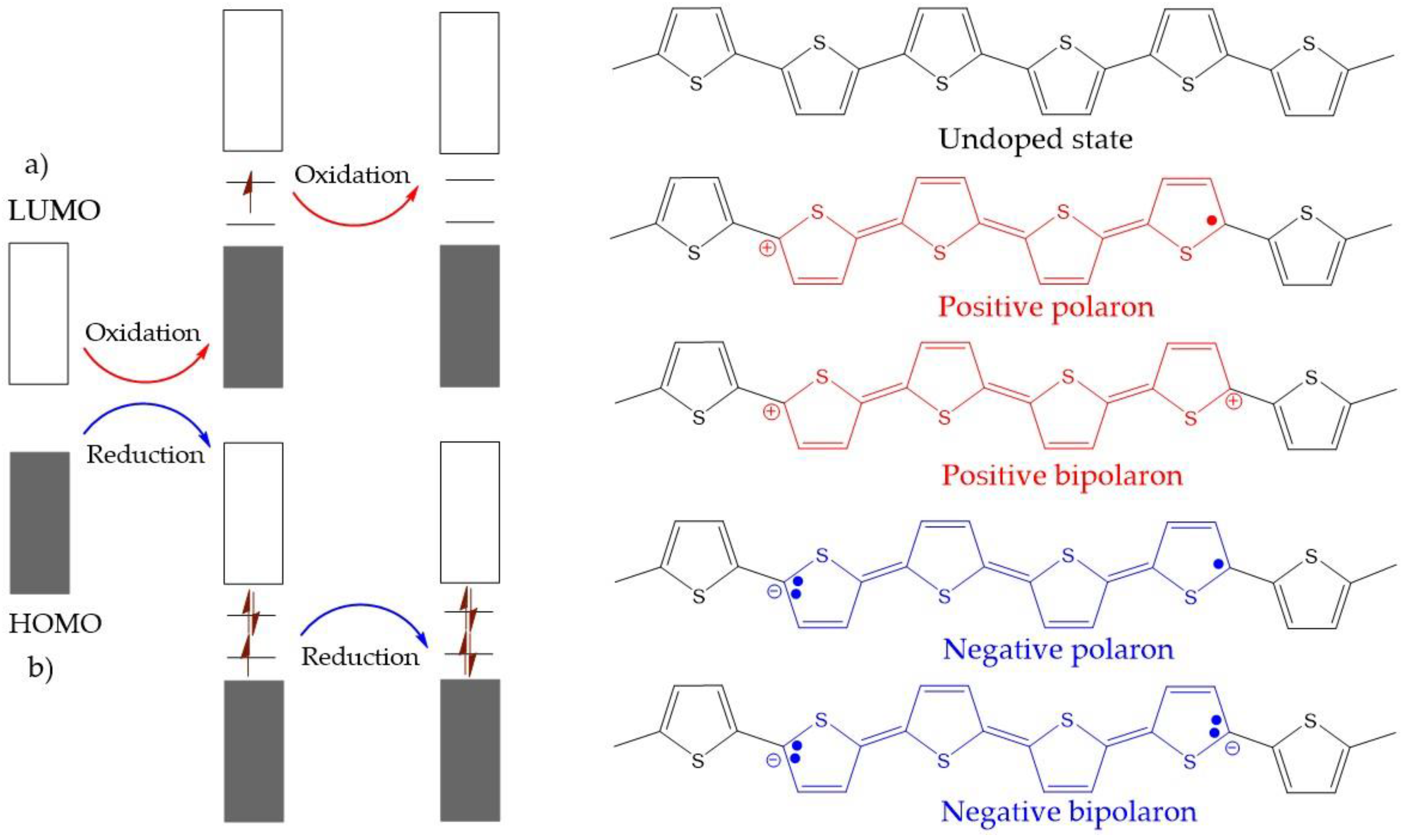
2.2. Doping
3. Electrical Properties
3.1. Tunable Conductivity
3.2. Charge Carrier Transport Models
3.3. Temperature Dependence
4. Electrochemical Properties
4.1. Reversible Oxidation/Reduction
4.2. Pseudocapacitance
4.3. Swelling and De-Swelling
4.4. Electrochromism
5. Applications
5.1. Electrochemical Capacitors
5.2. CP Sensors
5.2.1. Chemical Sensors
5.2.2. Biosensors
6. Conclusions and Outlook
Acknowledgments
Author Contributions
Conflicts of Interest
Abbreviations
| CPs | Conducting polymers |
| PPy | Polypyrrole |
| PANI | Polyaniline |
| PT | Polythiophene |
| PEDOT | Poly(3,4-ethylenedioxythiophene) |
| PPV | Poly(p-phenylene vinylene) |
| HOMO | Highest occupied molecular orbital |
| LUMO | Lowest unoccupied molecular orbital |
| CSA | Camphor sulfonic acid |
| CV | Cyclic voltammetry |
| EDLCs | Electrochemical double layer capacitors |
| RGO | Graphene oxide |
| NCFC | Nitrogen-doped carbon fiber cloth |
| CNTs | Carbon nanotubes |
| PPCL | PPy/cellulose |
| FET | Field-effect transistor |
| CPNTs | Carboxylated polypyrrole nanotubes |
| GOx | Glucose oxidase |
| PSA | Prostate-specific antigen |
| BRCA1 | Breast cancer susceptibility gene |
References
- Hall, N. Twenty-five years of conducting polymers. Chem. Commun. 2003, 7, 1–4. [Google Scholar]
- Huang, W.S.; Humphrey, B.D.; MacDiarmid, A.G. Polyaniline, a novel conducting polymer. Morphology and chemistry of its oxidation and reduction in aqueous electrolytes. J. Chem. Soc. Faraday Trans. 1 1986, 82, 2385–2400. [Google Scholar] [CrossRef] [Scilit]
- McCullough, R.D.; Lowe, R.D.; Jayaraman, M.; Anderson, D.L. Design, synthesis, and control of conducting polymer architectures: Structurally homogeneous poly(3-alkylthiophenes). J. Org. Chem. 1993, 58, 904–912. [Google Scholar] [CrossRef] [Scilit]
- Wang, J.; Dai, J.; Yarlagadda, T. Carbon nanotube conducting polymer composite nanowires. Langmuir 2005, 21, 9–12. [Google Scholar] [CrossRef] [Scilit] [PubMed]
- Lee, B.H.; Lee, J.H.; Kahng, Y.H.; Kim, N.; Kim, Y.J.; Lee, J.; Lee, T.; Lee, K. Graphene-conducting polymer hybrid transparent electrodes for efficient organic optoelectronic devices. Adv. Funct. Mater. 2014, 24, 1847–1856. [Google Scholar] [CrossRef] [Scilit]
- Gupta, S.; McDonald, B.; Carrizosa, S.B.; Price, C. Microstructure, residual stress, and intermolecular force distribution maps of graphene/polymer hybrid composites: Nanoscale morphology-promoted synergistic effects. Compos. Part B 2016, 92, 175–192. [Google Scholar] [CrossRef] [Scilit]
- Gupta, S.; Price, C.; Heintzman, E. Conducting polymer nanostructures and nanocomposites with carbon nanotubes: Hierarchical assembly by molecular electrochemistry, growth aspects and property characterization. J. Nanosci. Nanotechnol. 2016, 16, 374–391. [Google Scholar] [CrossRef] [Scilit] [PubMed]
- Cantwell, W.J.; Morton, J. The impact resistance of composite materials—A review. Composites 1991, 22, 347–362. [Google Scholar] [CrossRef] [Scilit]
- Gribkova, O.L.; Omelchenko, O.D.; Tameev, A.R.; Lypenko, D.A.; Nekrasov, A.A.; Posudievskii, O.Y.; Koshechko, V.G.; Vannikov, A.V. The specific effect of graphene additives in polyaniline-based nanocomposite layers on performance characteristics of electroluminescent and photovoltaic devices. High Energy Chem. 2016, 50, 134–138. [Google Scholar] [CrossRef] [Scilit]
- Biju, P.; Jining, X.; Jose, K.A.; Vijay, K.V. A new synthetic route to enhance polyaniline assembly on carbon nanotubes in tubular composites. Smart Mater. Struct. 2004, 13, N105. [Google Scholar]
- Kuo, C.T.; Chiou, W.H. Field-effect transistor with polyaniline thin film as semiconductor. Synth. Met. 1997, 88, 23–30. [Google Scholar] [CrossRef] [Scilit]
- Tang, H.; Kumar, P.; Zhang, S.; Yi, Z.; Crescenzo, G.D.; Santato, C.; Soavi, F.; Cicoira, F. Conducting polymer transistors making use of activated carbon gate electrodes. ACS Appl. Mater. Interfaces 2015, 7, 969–973. [Google Scholar] [CrossRef] [Scilit] [PubMed]
- Zhao, L.; Zhao, L.; Xu, Y.; Qiu, T.; Zhi, L.; Shi, G. Polyaniline electrochromic devices with transparent graphene electrodes. Electrochim. Acta 2009, 55, 491–497. [Google Scholar] [CrossRef] [Scilit]
- Shen, K.Y.; Hu, C.W.; Chang, L.C.; Ho, K.C. A complementary electrochromic device based on carbon nanotubes/conducting polymers. Sol. Energy Mater. Sol. Cells 2012, 98, 294–299. [Google Scholar] [CrossRef] [Scilit]
- García-Gallegos, J.C.; Martín-Gullón, I.; Conesa, J.A.; Vega-Cantú, Y.I.; Rodríguez-Macías, F.J. The effect of carbon nanofillers on the performance of electromechanical polyaniline-based composite actuators. Nanotechnology 2016, 27, 015501. [Google Scholar] [CrossRef] [Scilit] [PubMed]
- May, T.; Van-Tan, T.; Geoffrey, M.S.; Gordon, G.W. Carbon nanotube and polyaniline composite actuators. Smart Mater. Struct. 2003, 12, 626. [Google Scholar]
- Jiang, X.; Setodoi, S.; Fukumoto, S.; Imae, I.; Komaguchi, K.; Yano, J.; Mizota, H.; Harima, Y. An easy one-step electrosynthesis of graphene/polyaniline composites and electrochemical capacitor. Carbon 2014, 67, 662–672. [Google Scholar] [CrossRef] [Scilit]
- Memon, M.A.; Bai, W.; Sun, J.; Imran, M.; Phulpoto, S.N.; Yan, S.; Huang, Y.; Geng, J. Conjunction of conducting polymer nanostructures with macroporous structured graphene thin films for high-performance flexible supercapacitors. ACS Appl. Mater. Interfaces 2016, 8, 11711–11719. [Google Scholar] [CrossRef] [Scilit] [PubMed]
- Lee, J.; Kang, H.; Kee, S.; Lee, S.H.; Jeong, S.Y.; Kim, G.; Kim, J.; Hong, S.; Back, H.; Lee, K. Long-term stable recombination layer for tandem polymer solar cells using self-doped conducting polymers. ACS Appl. Mater. Interfaces 2016, 8, 6144–6151. [Google Scholar] [CrossRef] [Scilit] [PubMed]
- Johansson, E.M.J.; Yang, L.; Gabrielsson, E.; Lohse, P.W.; Boschloo, G.; Sun, L.; Hagfeldt, A. Combining a small hole-conductor molecule for efficient dye regeneration and a hole-conducting polymer in a solid-state dye-sensitized solar cell. J. Phys. Chem. C 2012, 116, 18070–18078. [Google Scholar] [CrossRef] [Scilit]
- Janata, J.; Josowicz, M. Conducting polymers in electronic chemical sensors. Nat. Mater. 2003, 2, 19–24. [Google Scholar] [CrossRef] [Scilit] [PubMed]
- Yoon, H. Current trends in sensors based on conducting polymer nanomaterials. Nanomaterials 2013, 3, 524. [Google Scholar] [CrossRef] [Scilit] [PubMed]
- Stafström, S.; Chao, K.A. Polaron-bipolaron–soliton doping in polyacetylene. Phys. Rev. B 1984, 30, 2098–2103. [Google Scholar] [CrossRef] [Scilit]
- Bredas, J.L.; Street, G.B. Polarons, bipolarons, and solitons in conducting polymers. Acc. Chem. Res. 1985, 18, 309–315. [Google Scholar] [CrossRef] [Scilit]
- Ravichandran, R.; Sundarrajan, S.; Venugopal, J.R.; Mukherjee, S.; Ramakrishna, S. Applications of conducting polymers and their issues in biomedical engineering. J. R. Soc. Interface 2010, 7, S559–S579. [Google Scholar] [CrossRef] [Scilit] [PubMed]
- Wise, D.L.; Wnek, G.E.; Trantolo, D.J.; Cooper, T.M.; Gresser, J.D.; Marcel, D. Electrical and Optical Polymer Systems: Fundamentals, Methods and Application; CRC Press: Boca Raton, FL, USA, 1998; pp. 1031–1040. [Google Scholar]
- Saxena, V.; Malhotra, B.D.; Menon, R. Charge transport and electrical properties of doped conjugated polymers. In Handbook of Polymers in Electronics; Malhotra, B.D., Ed.; Rapra Technology Limited: Shrewsbury, Shropshire, UK, 2002; pp. 3–65. [Google Scholar]
- Su, W.P.; Schrieffer, J.R.; Heeger, A.J. Solitons in polyacetylene. Phys. Rev. Lett. 1979, 42, 1698–1701. [Google Scholar] [CrossRef] [Scilit]
- MacDiarmid, A.G.; Mammone, R.J.; Kaner, R.B.; Porter, S.J.; Pethig, R.; Heeger, A.J.; Rosseinsky, D.R. The concept of ‘doping’ of conducting polymers: The role of reduction potentials. Phil. Trans. R. Soc. A 1985, 314, 3–15. [Google Scholar] [CrossRef] [Scilit]
- Cuuran, S.; Hauser, A.S.; Roth, S. Conductive polymers: Synthesis and electrical properties. In Handbook of Organic Conductive Molecules and Polymers; Hari, S.N., Ed.; John Wiley & Sons: New York, NY, USA, 1997; Volume 2, pp. 1–60. [Google Scholar]
- Wan, M. Conducting Polymers with Micro or Nanometer Structure; Springer: New York, NY, USA, 2008; pp. 1–13. [Google Scholar]
- Li, Y. Conducting polymer. In Organic Optoelectronic Materials; Li, Y., Ed.; Springer International Publishing: New York, NY, USA, 2015; pp. 23–50. [Google Scholar]
- Zhang, Y.; de Boer, B.; Blom, P.W.M. Controllable molecular doping and charge transport in solution-processed polymer semiconducting layers. Adv. Funct. Mater. 2009, 19, 1901–1905. [Google Scholar] [CrossRef] [Scilit]
- Zhang, Y.; Blom, P.W.M. Electron and hole transport in poly(fluorene-benzothiadiazole). Appl. Phys. Lett. 2011, 98, 143504. [Google Scholar] [CrossRef] [Scilit]
- Nollau, A.; Pfeiffer, M.; Fritz, T.; Leo, K. Controlled n-type doping of a molecular organic semiconductor: Naphthalenetetracarboxylic dianhydride (NTCDA) doped with bis(ethylenedithio)-tetrathiafulvalene (BEDT-TTF). J. Appl. Phys. 2000, 87, 4340–4343. [Google Scholar] [CrossRef] [Scilit]
- Bajpai, M.; Srivastava, R.; Dhar, R.; Tiwari, R.S. Review on optical and electrical properties of conducting polymers. Indian J. Eng. Mater. Sci. 2016, 2016, 1–8. [Google Scholar] [CrossRef] [Scilit]
- Patil, A.O.; Heeger, A.J.; Wudl, F. Optical properties of conducting polymers. Chem. Rev. 1988, 88, 183–200. [Google Scholar] [CrossRef] [Scilit]
- Borchert, H. Solar Cells Based on Colloidal Nanocrystals; Springer International Publishing: New York, NY, USA, 2014; pp. 39–60. [Google Scholar]
- Roth, S.; Bleier, H. Solitons in polyacetylene. Adv. Phys. 1987, 36, 385–462. [Google Scholar] [CrossRef] [Scilit]
- Heeger, A.J.; Kivelson, S.; Schrieffer, J.R.; Su, W.P. Solitons in conducting polymers. Rev. Mod. Phys. 1988, 60, 781–850. [Google Scholar] [CrossRef] [Scilit]
- Tsukamoto, J. Recent advances in highly conductive polyacetylene. Adv. Phys. 1992, 41, 509–546. [Google Scholar] [CrossRef] [Scilit]
- Tsukamoto, J.; Takahashi, A.; Kawasaki, K. Structure and electrical properties of polyacetylene yielding a conductivity of 105 S/cm. Jpn. J. Appl. Phys. 1990, 29, 125. [Google Scholar] [CrossRef] [Scilit]
- Mott, N.F.; Davis, E. Electronic Processes in Non-Crystalline Materials; Oxford University Press: New York, NY, USA, 1979; pp. 7–97. [Google Scholar]
- Lee, P.A.; Ramakrishnan, T.V. Disordered electronic systems. Rev. Mod. Phys. 1985, 57, 287–337. [Google Scholar] [CrossRef] [Scilit]
- Markus, A.; Reghu, M. The localization-interaction model applied to the direct-current conductivity of metallic conducting polymers. J. Phys. Condens. Matter 1998, 10, 7171. [Google Scholar]
- Anderson, P.W. Absence of diffusion in certain random lattices. Phys. Rev. 1958, 109, 1492–1505. [Google Scholar] [CrossRef] [Scilit]
- Epstein, A.J.; Joo, J.; Kohlman, R.S.; Du, G.; MacDiarmid, A.G.; Oh, E.J.; Min, Y.; Tsukamoto, J.; Kaneko, H.; Pouget, J.P. Inhomogeneous disorder and the modified Drude metallic state of conducting polymers. Synth. Met. 1994, 65, 149–157. [Google Scholar] [CrossRef] [Scilit]
- Kohlman, R.S.; Zibold, A.; Tanner, D.B.; Ihas, G.G.; Ishiguro, T.; Min, Y.G.; MacDiarmid, A.G.; Epstein, A.J. Limits for metallic conductivity in conducting polymers. Phys. Rev. Lett. 1997, 78, 3915–3918. [Google Scholar] [CrossRef] [Scilit]
- Kohlman, R.S.; Joo, J.; Min, Y.G.; MacDiarmid, A.G.; Epstein, A.J. Crossover in electrical frequency response through an insulator-metal transition. Phys. Rev. Lett. 1996, 77, 2766–2769. [Google Scholar] [CrossRef] [Scilit] [PubMed]
- Joo, J.; Long, S.M.; Pouget, J.P.; Oh, E.J.; MacDiarmid, A.G.; Epstein, A.J. Charge transport of the mesoscopic metallic state in partially crystalline polyanilines. Phys. Rev. B 1998, 57, 9567–9580. [Google Scholar] [CrossRef] [Scilit]
- Zuo, F.; Angelopoulos, M.; MacDiarmid, A.G.; Epstein, A.J. Transport studies of protonated emeraldine polymer: A granular polymeric metal system. Phys. Rev. B 1987, 36, 3475–3478. [Google Scholar] [CrossRef] [Scilit]
- Guimard, N.K.; Gomez, N.; Schmidt, C.E. Conducting polymers in biomedical engineering. Prog. Polym. Sci. 2007, 32, 876–921. [Google Scholar] [CrossRef] [Scilit]
- Wang, P.C.; MacDiarmid, A.G. Vapor phase secondary doping of polyaniline (emeraldine salt) thin films with o-chlorophenol investigated by UV-VIS-NIR: Effects of primary dopants, substrate surfaces, and pre-treatments of organic vapors. React. Funct. Polym. 2008, 68, 201–207. [Google Scholar] [CrossRef] [Scilit]
- Kulszewicz-Bajer, I.; Proń, A.; Abramowicz, J.; Jeandey, C.; Oddou, J.L.; Sobczak, J.W. Lewis acid doped polyaniline: Preparation and spectroscopic Characterization. Chem. Mater. 1999, 11, 552–556. [Google Scholar] [CrossRef] [Scilit]
- Chiang, C.K.; Blubaugh, E.A.; Yap, W.T. Electrochemical studies on doping of polyacetylene. Polymer 1984, 25, 1112–1116. [Google Scholar] [CrossRef] [Scilit]
- Chiang, C.K.; Druy, M.A.; Gau, S.C.; Heeger, A.J.; Louis, E.J.; MacDiarmid, A.G.; Park, Y.W.; Shirakawa, H. Synthesis of highly conducting films of derivatives of polyacetylene, (CH)x. J. Am. Chem. Soc. 1978, 100, 1013–1015. [Google Scholar] [CrossRef] [Scilit]
- Ivory, D.M.; Miller, G.G.; Sowa, J.M.; Shacklette, L.W.; Chance, R.R.; Baughman, R.H. Highly conducting charge-transfer complexes of poly(p-phenylene). J. Chem. Phys 1979, 71, 1506–1507. [Google Scholar] [CrossRef] [Scilit]
- Han, C.C.; Elsenbaumer, R.L. Protonic acids: Generally applicable dopants for conducting polymers. Synth. Met. 1989, 30, 123–131. [Google Scholar] [CrossRef] [Scilit]
- Wnek, G.E.; Chien, J.C.W.; Karasz, F.E.; Lillya, C.P. Electrically conducting derivative of poly(p-phenylene vinylene). Polymer 1979, 20, 1441–1443. [Google Scholar] [CrossRef] [Scilit]
- Jeon, I.-R.; Noma, N.; Claridge, R.F.C.; Shirota, Y. Electrochemical doping of poly(3-vinylperylene) and electrical properties of doped polymers. Polym. J. 1992, 24, 273–279. [Google Scholar] [CrossRef] [Scilit]
- Salmon, M.; Diaz, A.F.; Logan, A.J.; Krounbi, M.; Bargon, J. Chemical modification of conducting polypyrrole films. Mol. Cryst. Liq. Cryst. 1982, 83, 265–276. [Google Scholar] [CrossRef] [Scilit]
- Gupta, S. Template-free synthesis of conducting-polymer polypyrrole micro/nanostructures using electrochemistry. Appl. Phys. Lett. 2006, 88, 063108. [Google Scholar] [CrossRef] [Scilit]
- Brie, M.; Turcu, R.; Neamtu, C.; Pruneanu, S. The effect of initial conductivity and doping anions on gas sensitivity of conducting polypyrrole films to NH3. Sens. Actuators B 1996, 37, 119–122. [Google Scholar] [CrossRef] [Scilit]
- Maddison, D.S.; Jenden, C.M. Dopant exchange in conducting polypyrrole films. Polym. Int. 1992, 27, 231–235. [Google Scholar] [CrossRef] [Scilit]
- Arribas, C.; Rueda, D. Preparation of conductive polypyrrole-polystyrene sulfonate by chemical polymerization. Synth. Met. 1996, 79, 23–26. [Google Scholar] [CrossRef] [Scilit]
- Lee, J.E.; Lee, Y.; Ahn, K.J.; Huh, J.; Shim, H.W.; Sampath, G.; Im, W.B.; Huh, Y.I.; Yoon, H. Role of co-vapors in vapor deposition polymerization. Sci. Rep. 2015, 5, 8420. [Google Scholar] [CrossRef] [Scilit] [PubMed]
- Taunk, M.; Kapil, A.; Chand, S. Chemical synthesis and low temperature electrical transport in polypyrrole doped with sodium bis(2-ethylhexyl) sulfosuccinate. J. Mater. Sci. Mater. Electron. 2011, 22, 136–142. [Google Scholar] [CrossRef] [Scilit]
- Holland, E.R.; Pomfret, S.J.; Adams, P.N.; Monkman, A.P. Conductivity studies of polyaniline doped with CSA. J. Phys. Condens. Matter 1996, 8, 2991. [Google Scholar] [CrossRef] [Scilit]
- Macdiarmid, A.G.; Chiang, J.-C.; Halpern, M.; Huang, W.-S.; Mu, S.-L.; Nanaxakkara, L.D.; Wu, S.W.; Yaniger, S.I. “Polyaniline”: Interconversion of metallic and insulating forms. Mol. Cryst. Liq. Cryst. 1985, 121, 173–180. [Google Scholar] [CrossRef] [Scilit]
- Lee, Y.W.; Do, K.; Lee, T.H.; Jeon, S.S.; Yoon, W.J.; Kim, C.; Ko, J.; Im, S.S. Iodine vapor doped polyaniline nanoparticles counter electrodes for dye-sensitized solar cells. Synth. Met. 2013, 174, 6–13. [Google Scholar] [CrossRef] [Scilit]
- Palaniappan, S.; Devi, S.L. Novel chemically synthesized polyaniline electrodes containing a fluoroboric acid dopant for supercapacitors. J. Appl. Polym. Sci. 2008, 107, 1887–1892. [Google Scholar] [CrossRef] [Scilit]
- Kao, C.Y.; Lee, B.; Wielunski, L.S.; Heeney, M.; McCulloch, I.; Garfunkel, E.; Feldman, L.C.; Podzorov, V. Doping of conjugated polythiophenes with alkyl silanes. Adv. Funct. Mater. 2009, 19, 1906–1911. [Google Scholar] [CrossRef] [Scilit]
- Glaudell, A.M.; Cochran, J.E.; Patel, S.N.; Chabinyc, M.L. Impact of the doping method on conductivity and thermopower in semiconducting polythiophenes. Adv. Energy Mater. 2015, 5, 1401072. [Google Scholar] [CrossRef] [Scilit]
- Chayer, M.; Faïd, K.; Leclerc, M. Highly conducting water-soluble polythiophene derivatives. Chem. Mater. 1997, 9, 2902–2905. [Google Scholar] [CrossRef] [Scilit]
- Dillingham, T.R.; Cornelison, D.M.; Townsend, S.W. Structural and chemical characterization of vapor-deposited polythiophene films. J. Vac. Sci. Technol. A 1996, 14, 1494–1498. [Google Scholar] [CrossRef] [Scilit]
- Su, N. Improving electrical conductivity, thermal stability, and solubility of polyaniline-polypyrrole nanocomposite by doping with anionic spherical polyelectrolyte brushes. Nanoscale Res. Lett. 2015, 10, 301. [Google Scholar] [CrossRef] [Scilit] [PubMed]
- Ahlskog, M.; Reghu, M.; Heeger, A.J. The temperature dependence of the conductivity in the critical regime of the metal-insulator transition in conducting polymers. J. Phys. Condens. Matter 1997, 9, 4145. [Google Scholar] [CrossRef] [Scilit]
- Ahlskog, M.; Reghu, M.; Heeger, A.J.; Noguchi, T.; Ohnishi, T. Electronic transport in the metallic state of oriented poly(p-phenylenevinylene). Phys. Rev. B 1996, 53, 15529–15537. [Google Scholar] [CrossRef] [Scilit]
- Chiang, C.K.; Park, Y.W.; Heeger, A.J.; Shirakawa, H.; Louis, E.J.; MacDiarmid, A.G. Conducting polymers: Halogen doped polyacetylene. J. Chem. Phys 1978, 69, 5098–5104. [Google Scholar] [CrossRef] [Scilit]
- Roth, S.; Bleier, H.; Pukacki, W. Charge transport in conducting polymers. Farad. Discuss. 1989, 88, 223–233. [Google Scholar] [CrossRef] [Scilit]
- Roth, S.; Carroll, D. One-Dimensional Metals: Conjugated Polymers, Organic Crystals, Carbon Nanotubes; Wiley-VCH: Weinheim, Germany, 2004; pp. 200–300. [Google Scholar]
- Aleshin, A.; Kiebooms, R.; Menon, R.; Wudl, F.; Heeger, A.J. Metallic conductivity at low temperatures in poly(3,4-ethylenedioxythiophene) doped with PF6. Phys. Rev. B 1997, 56, 3659–3663. [Google Scholar] [CrossRef] [Scilit]
- Lee, K.; Cho, S.; Heum Park, S.; Heeger, A.J.; Lee, C.-W.; Lee, S.-H. Metallic transport in polyaniline. Nature 2006, 441, 65–68. [Google Scholar] [CrossRef] [Scilit] [PubMed]
- Diaz, A.F.; Castillo, J.I.; Logan, J.A.; Lee, W.-Y. Electrochemistry of conducting polypyrrole films. J. Electroanal. Chem. Interfacial Electrochem. 1981, 129, 115–132. [Google Scholar] [CrossRef]
- Guay, J.; Paynter, R.; Dao, L.H. Synthesis and characterization of poly(diarylamines): A new class of electrochromic conducting polymers. Macromolecules 1990, 23, 3598–3605. [Google Scholar] [CrossRef] [Scilit]
- Park, H.W.; Kim, T.; Huh, J.; Kang, M.; Lee, J.E.; Yoon, H. Anisotropic growth control of polyaniline nanostructures and their morphology-dependent electrochemical characteristics. ACS Nano 2012, 6, 7624–7633. [Google Scholar] [CrossRef] [Scilit] [PubMed]
- Bull, R.A.; Fan, F.R.F.; Bard, A.J. Polymer films on electrodes: VII. Electrochemical behavior at polypyrrole-coated platinum and tantalum electrodes. J. Electrochem. Soc. 1982, 129, 1009–1015. [Google Scholar] [CrossRef] [Scilit]
- Beck, F.; Braun, P.; Oberst, M. Organic electrochemistry in the solid state-overoxidation of polypyrrole. Ber. Bunsenges. Phys. Chem. 1987, 91, 967–974. [Google Scholar] [CrossRef] [Scilit]
- Novák, P.; Rasch, B.; Vielstich, W. Overoxidation of polypyrrole in propylene carbonate: An in situ FTIR study. J. Electrochem. Soc. 1991, 138, 3300–3304. [Google Scholar] [CrossRef] [Scilit]
- Lewis, T.W.; Wallace, G.G.; Kim, C.Y.; Kim, D.Y. Studies of the overoxidation of polypyrrole. Synth. Met. 1997, 84, 403–404. [Google Scholar] [CrossRef] [Scilit]
- Li, Y.; Qian, R. Electrochemical overoxidation of conducting polypyrrole nitrate film in aqueous solutions. Electrochim. Acta 2000, 45, 1727–1731. [Google Scholar] [CrossRef] [Scilit]
- Hou, J.; Cao, C.; Idrees, F.; Ma, X. Hierarchical porous nitrogen-doped carbon nanosheets derived from silk for ultrahigh-capacity battery anodes and supercapacitors. ACS Nano 2015, 9, 2556–2564. [Google Scholar] [CrossRef] [Scilit] [PubMed]
- Zhang, Z.J.; Xie, D.H.; Cui, P.; Chen, X.Y. Conversion of a zinc salicylate complex into porous carbons through a template carbonization process as a superior electrode material for supercapacitors. RSC Adv. 2014, 4, 6664–6671. [Google Scholar] [CrossRef] [Scilit]
- Hu, F.; Li, W.; Zhang, J.; Meng, W. Effect of graphene oxide as a dopant on the electrochemical performance of graphene oxide/polyaniline composite. J. Mater. Sci. Technol. 2014, 30, 321–327. [Google Scholar] [CrossRef] [Scilit]
- Wang, G.; Zhang, L.; Zhang, J. A review of electrode materials for electrochemical supercapacitors. Chem. Soc. Rev. 2012, 41, 797–828. [Google Scholar] [CrossRef] [Scilit] [PubMed]
- Pieta, P.; Obraztsov, I.; D’Souza, F.; Kutner, W. Composites of conducting polymers and various carbon nanostructures for electrochemical supercapacitors. ECS J. Solid State Sci. Technol. 2013, 2, M3120–M3134. [Google Scholar] [CrossRef] [Scilit]
- Tang, C.; Chen, N.; Hu, X. Conducting polymer nanocomposites: Recent developments and future prospects. In Conducting Polymer Hybrids, 1st ed.; Kumar, V., Kalia, S., Swart, H.C., Eds.; Springer International Publishing AG: Cham, Switzerland, 2017; pp. 1–45. [Google Scholar]
- Pei, Q.; Inganaes, O. Electrochemical applications of the bending beam method. 1. Mass transport and volume changes in polypyrrole during redox. J. Phys. Chem. 1992, 96, 10507–10514. [Google Scholar] [CrossRef] [Scilit]
- Lizarraga, L.; Marı́a Andrade, E.; Victor Molina, F. Swelling and volume changes of polyaniline upon redox switching. J. Electroanal. Chem. 2004, 561, 127–135. [Google Scholar] [CrossRef] [Scilit]
- Otero, T.F.; Angulo, E.; Rodríguez, J.; Santamaría, C. Electrochemomechanical properties from a bilayer: Polypyrrole/non-conducting and flexible material-artificial muscle. J. Electroanal. Chem. 1992, 341, 369–375. [Google Scholar] [CrossRef] [Scilit]
- Bay, L.; Jacobsen, T.; Skaarup, S.; West, K. Mechanism of actuation in conducting polymers: Osmotic expansion. J. Phys. Chem. B 2001, 105, 8492–8497. [Google Scholar] [CrossRef] [Scilit]
- Kilmartin, P.A.; Travas-Sejdic, J. Nanostructural aspects of conducting-polymer actuators. In Nanostructured Conductive Polymers, 1st ed.; Eftekhari, A., Ed.; John Wiley & Sons: New York, NY, USA, 2010; pp. 599–630. [Google Scholar]
- Wataru, T.; Shyam, S.P.; Masaki, F.; Keiichi, K. Cyclic step-voltammetric analysis of cation-driven and anion-driven actuation in polypyrrole films. Jpn. J. Appl. Phys. 2002, 41, 7532. [Google Scholar]
- Maw, S.; Smela, E.; Yoshida, K.; Stein, R.B. Effects of monomer and electrolyte concentrations on actuation of PPy(DBS) bilayers. Synth. Met. 2005, 155, 18–26. [Google Scholar] [CrossRef] [Scilit]
- Aydemir, N.; Kilmartin, P.A.; Travas-Sejdic, J.; Kesküla, A.; Peikolainen, A.-L.; Parcell, J.; Harjo, M.; Aabloo, A.; Kiefer, R. Electrolyte and solvent effects in PPy/DBS linear actuators. Sens. Actuators B 2015, 216, 24–32. [Google Scholar] [CrossRef] [Scilit]
- Pagès, H.; Topart, P.; Lemordant, D. Wide band electrochromic displays based on thin conducting polymer films. Electrochim. Acta 2001, 46, 2137–2143. [Google Scholar] [CrossRef] [Scilit]
- Barnes, A.; Despotakis, A.; Wong, T.C.P.; Anderson, A.P.; Chambers, B.; Wright, P.V. Towards a ‘smart window’ for microwave applications. Smart Mater. Struct. 1998, 7, 752. [Google Scholar] [CrossRef] [Scilit]
- Stafström, S.; Brédas, J.L.; Epstein, A.J.; Woo, H.S.; Tanner, D.B.; Huang, W.S.; MacDiarmid, A.G. Polaron lattice in highly conducting polyaniline: Theoretical and optical studies. Phys. Rev. Lett. 1987, 59, 1464–1467. [Google Scholar] [CrossRef] [Scilit] [PubMed]
- Ray, A.; Richter, A.F.; MacDiarmid, A.G.; Epstein, A.J. Polyaniline: Protonation/deprotonation of amine and imine sites. Synth. Met. 1989, 29, 151–156. [Google Scholar] [CrossRef] [Scilit]
- Banerjee, A.; Bhatnagar, S.; Upadhyay, K.K.; Yadav, P.; Ogale, S. Hollow Co0.85Se nanowire array on carbon fiber paper for high rate pseudocapacitor. ACS Appl. Mater. Interfaces 2014, 6, 18844–18852. [Google Scholar] [CrossRef] [Scilit] [PubMed]
- Schwendeman, I.; Hwang, J.; Welsh, D.M.; Tanner, D.B.; Reynolds, J.R. Combined visible and infrared electrochromism using dual polymer devices. Adv. Mater. 2001, 13, 634–637. [Google Scholar] [CrossRef] [Scilit]
- Gupta, V.; Miura, N. High performance electrochemical supercapacitor from electrochemically synthesized nanostructured polyaniline. Mater. Lett. 2006, 60, 1466–1469. [Google Scholar] [CrossRef] [Scilit]
- Kalaji, M.; Murphy, P.J.; Williams, G.O. The study of conducting polymers for use as redox supercapacitors. Synth. Met. 1999, 102, 1360–1361. [Google Scholar] [CrossRef] [Scilit]
- Nagamuthu, S.; Vijayakumar, S.; Muralidharan, G. Biopolymer-assisted synthesis of λ-MnO2 nanoparticles as an electrode material for aqueous symmetric supercapacitor devices. Ind. Eng. Chem. Res. 2013, 52, 18262–18268. [Google Scholar] [CrossRef] [Scilit]
- Singh, A.K.; Sarkar, D.; Khan, G.G.; Mandal, K. Hydrogenated NiO nanoblock architecture for high performance pseudocapacitor. ACS Appl. Mater. Interfaces 2014, 6, 4684–4692. [Google Scholar] [CrossRef] [Scilit] [PubMed]
- Muller, G.A.; Cook, J.B.; Kim, H.-S.; Tolbert, S.H.; Dunn, B. High Performance Pseudocapacitor Based on 2D Layered Metal Chalcogenide Nanocrystals. Nano Lett. 2015, 15, 1911–1917. [Google Scholar] [CrossRef] [Scilit] [PubMed]
- Zhou, J.; Fang, G.; Pan, A.; Liang, S. Oxygen-incorporated MoS2 nanosheets with expanded interlayers for hydrogen evolution reaction and pseudocapacitor applications. ACS Appl. Mater. Interfaces 2016, 8, 33681–33689. [Google Scholar] [CrossRef] [Scilit] [PubMed]
- Sahoo, R.; Sasmal, A.K.; Ray, C.; Dutta, S.; Pal, A.; Pal, T. Suitable morphology makes CoSn(OH)6 nanostructure a superior electrochemical pseudocapacitor. ACS Appl. Mater. Interfaces 2016, 8, 17987–17998. [Google Scholar] [CrossRef] [Scilit] [PubMed]
- Chen, W.; Rakhi, R.B.; Alshareef, H.N. Morphology-dependent enhancement of the pseudocapacitance of template-guided tunable polyaniline nanostructures. J. Phys. Chem. C 2013, 117, 15009–15019. [Google Scholar] [CrossRef] [Scilit]
- Wang, Z.L.; He, X.J.; Ye, S.H.; Tong, Y.X.; Li, G.R. Design of polypyrrole/polyaniline double-walled nanotube arrays for electrochemical energy storage. ACS Appl. Mater. Interfaces 2014, 6, 642–647. [Google Scholar] [CrossRef] [Scilit] [PubMed]
- Chen, W.; Rakhi, R.B.; Alshareef, H.N. Facile synthesis of polyaniline nanotubes using reactive oxide templates for high energy density pseudocapacitors. J. Mater. Chem. A 2013, 1, 3315–3324. [Google Scholar] [CrossRef] [Scilit]
- Wang, K.; Huang, J.; Wei, Z. Conducting polyaniline nanowire arrays for high performance supercapacitors. J. Phys. Chem. C 2010, 114, 8062–8067. [Google Scholar] [CrossRef] [Scilit]
- Lee, Y.; Noh, S.; Kim, M.S.; Kong, H.J.; Im, K.; Kwon, O.S.; Kim, S.; Yoon, H. The effect of nanoparticle packing on capacitive electrode performance. Nanoscale 2016, 8, 11940–11948. [Google Scholar] [CrossRef] [Scilit] [PubMed]
- Kang, M.; Lee, J.E.; Shim, H.W.; Jeong, M.S.; Im, W.B.; Yoon, H. Intrinsically conductive polymer binders for electrochemical capacitor application. RSC Adv. 2014, 4, 27939–27945. [Google Scholar] [CrossRef] [Scilit]
- Tiwari, S.K.; Mishra, J.; Hatui, G.; Nayak, G.C. Conductive polymer composites based on carbon nanomaterials. In Conducting Polymer Hybrids, 1st ed.; Kumar, V., Kalia, S., Swart, H.C., Eds.; Springer International Publishing AG: Cham, Switzerland, 2017; pp. 117–142. [Google Scholar]
- Choi, H.; Ahn, K.J.; Lee, Y.; Noh, S.; Yoon, H. Free-standing, multilayered graphene/polyaniline-glue/graphene nanostructures for flexible, solid-state electrochemical capacitor application. Adv. Mater. Interfaces 2015, 2, 1500117. [Google Scholar] [CrossRef] [Scilit]
- Yu, P.; Li, Y.; Zhao, X.; Wu, L.; Zhang, Q. Graphene-wrapped polyaniline nanowire arrays on nitrogen-doped carbon fabric as novel flexible hybrid electrode materials for high-performance supercapacitor. Langmuir 2014, 30, 5306–5313. [Google Scholar] [CrossRef] [Scilit] [PubMed]
- Zhang, H.; Cao, G.; Wang, Z.; Yang, Y.; Shi, Z.; Gu, Z. Tube-covering-tube nanostructured polyaniline/carbon nanotube array composite electrode with high capacitance and superior rate performance as well as good cycling stability. Electrochem. Commun. 2008, 10, 1056–1059. [Google Scholar] [CrossRef] [Scilit]
- Huang, Z.H.; Song, Y.; Xu, X.X.; Liu, X.X. Ordered polypyrrole nanowire arrays grown on a carbon cloth substrate for a high-performance pseudocapacitor electrode. ACS Appl. Mater. Interfaces 2015, 7, 25506–25513. [Google Scholar] [CrossRef] [Scilit] [PubMed]
- Xu, D.; Xu, Q.; Wang, K.; Chen, J.; Chen, Z. Fabrication of free-standing hierarchical carbon nanofiber/graphene oxide/polyaniline films for supercapacitors. ACS Appl. Mater. Interfaces 2014, 6, 200–209. [Google Scholar] [CrossRef] [Scilit] [PubMed]
- Gupta, S.; Price, C. Investigating graphene/conducting polymer hybrid layered composites as pseudocapacitors: Interplay of heterogeneous electron transfer, electric double layers and mechanical stability. Compos. Part B 2016, 105, 46–59. [Google Scholar] [CrossRef] [Scilit]
- Lee, T.; Yun, T.; Park, B.; Sharma, B.; Song, H.-K.; Kim, B.-S. Hybrid multilayer thin film supercapacitor of graphene nanosheets with polyaniline: Importance of establishing intimate electronic contact through nanoscale blending. J. Mater. Chem. 2012, 22, 21092–21099. [Google Scholar] [CrossRef] [Scilit]
- Liu, T.; Finn, L.; Yu, M.; Wang, H.; Zhai, T.; Lu, X.; Tong, Y.; Li, Y. Polyaniline and polypyrrole pseudocapacitor electrodes with excellent cycling stability. Nano Lett. 2014, 14, 2522–2527. [Google Scholar] [CrossRef] [Scilit] [PubMed]
- Jabeen, N.; Xia, Q.; Yang, M.; Xia, H. Unique core-shell nanorod arrays with polyaniline deposited into mesoporous NiCo2O4 support for high-performance supercapacitor electrodes. ACS Appl. Mater. Interfaces 2016, 8, 6093–6100. [Google Scholar] [CrossRef] [Scilit] [PubMed]
- Kumar, V.; Lee, P.S. Redox active polyaniline-h-MoO3 hollow nanorods for improved pseudocapacitive performance. J. Phys. Chem. C 2015, 119, 9041–9049. [Google Scholar] [CrossRef] [Scilit]
- Huang, J.; Virji, S.; Weiller, B.H.; Kaner, R.B. Polyaniline nanofibers: Facile synthesis and chemical sensors. J. Am. Chem. Soc. 2003, 125, 314–315. [Google Scholar] [CrossRef] [Scilit] [PubMed]
- Sen, T.; Mishra, S.; Shimpi, N.G. Synthesis and sensing applications of polyaniline nanocomposites: A review. RSC Adv. 2016, 6, 42196–42222. [Google Scholar] [CrossRef] [Scilit]
- Talaie, A. Conducting polymer based pH detector: A new outlook to pH sensing technology. Polymer 1997, 38, 1145–1150. [Google Scholar] [CrossRef] [Scilit]
- Chandrasekhar, P. Conducting Polymers, Fundamentals and Applications; Springer International Publishing: New York, NY, USA, 1999; pp. 483–508. [Google Scholar]
- Forzani, E.S.; Li, X.; Tao, N. Hybrid amperometric and conductometric chemical sensor based on conducting polymer nanojunctions. Anal. Chem. 2007, 79, 5217–5224. [Google Scholar] [CrossRef] [Scilit] [PubMed]
- Athawale, A.A.; Bhagwat, S.V.; Katre, P.P. Nanocomposite of Pd-polyaniline as a selective methanol sensor. Sens. Actuators B 2006, 114, 263–267. [Google Scholar] [CrossRef] [Scilit]
- Choudhury, A. Polyaniline/silver nanocomposites: Dielectric properties and ethanol vapour sensitivity. Sens. Actuators B 2009, 138, 318–325. [Google Scholar] [CrossRef] [Scilit]
- Sharma, S.; Nirkhe, C.; Pethkar, S.; Athawale, A.A. Chloroform vapour sensor based on copper/polyaniline nanocomposite. Sens. Actuators B 2002, 85, 131–136. [Google Scholar] [CrossRef] [Scilit]
- Barkade, S.S.; Pinjari, D.V.; Singh, A.K.; Gogate, P.R.; Naik, J.B.; Sonawane, S.H.; Ashokkumar, M.; Pandit, A.B. Ultrasound assisted miniemulsion polymerization for preparation of polypyrrole-zinc oxide (PPy/ZnO) functional latex for liquefied petroleum gas sensing. Ind. Eng. Chem. Res. 2013, 52, 7704–7712. [Google Scholar] [CrossRef] [Scilit]
- Suri, K.; Annapoorni, S.; Sarkar, A.K.; Tandon, R.P. Gas and humidity sensors based on iron oxide-polypyrrole nanocomposites. Sens. Actuators B 2002, 81, 277–282. [Google Scholar] [CrossRef] [Scilit]
- Geng, L.; Wang, S.; Zhao, Y.; Li, P.; Zhang, S.; Huang, W.; Wu, S. Study of the primary sensitivity of polypyrrole/r-Fe2O3 to toxic gases. Mater. Chem. Phys. 2006, 99, 15–19. [Google Scholar] [CrossRef] [Scilit]
- Tongpool, R. Effect of nitrogen dioxide and temperature on the properties of lead phthalocyanine in polypyrrole. Thin Solid Films 2003, 438–439, 14–19. [Google Scholar] [CrossRef] [Scilit]
- Kwon, O.S.; Hong, J.Y.; Park, S.J.; Jang, Y.; Jang, J. Resistive gas sensors based on precisely size-controlled polypyrrole nanoparticles: Effects of particle size and deposition method. J. Phys. Chem. C 2010, 114, 18874–18879. [Google Scholar] [CrossRef] [Scilit]
- Kwon, O.S.; Park, S.J.; Yoon, H.; Jang, J. Highly sensitive and selective chemiresistive sensors based on multidimensional polypyrrole nanotubes. Chem. Commun. 2012, 48, 10526–10528. [Google Scholar] [CrossRef] [Scilit] [PubMed]
- Kwon, O.S.; Park, S.J.; Lee, J.S.; Park, E.; Kim, T.; Park, H.-W.; You, S.A.; Yoon, H.; Jang, J. Multidimensional conducting polymer nanotubes for ultrasensitive chemical nerve agent sensing. Nano Lett. 2012, 12, 2797–2802. [Google Scholar] [CrossRef] [Scilit] [PubMed]
- Kwon, O.S.; Park, C.S.; Park, S.J.; Noh, S.; Kim, S.; Kong, H.J.; Bae, J.; Lee, C.S.; Yoon, H. Carboxylic acid-functionalized conducting-polymer nanotubes as highly sensitive nerve-agent chemiresistors. Sci. Rep. 2016, 6, 33724. [Google Scholar] [CrossRef] [Scilit] [PubMed]
- Lee, J.E.; Shim, H.W.; Kwon, O.S.; Huh, Y.-I.; Yoon, H. Real-time detection of metal ions using conjugated polymer composite papers. Analyst 2014, 139, 4466–4475. [Google Scholar] [CrossRef] [Scilit] [PubMed]
- Kim, M.-S.; Kim, S.; Kong, H.J.; Kwon, O.S.; Yoon, H. Tunable electrical-sensing performance of random-alternating layered graphene/polyaniline nanoarchitectures. J. Phys. Chem. C 2016, 120, 18289–18295. [Google Scholar] [CrossRef] [Scilit]
- Yoon, H.; Ko, S.; Jang, J. Field-effect-transistor sensor based on enzyme-functionalized polypyrrole nanotubes for glucose detection. J. Phys. Chem. B 2008, 112, 9992–9997. [Google Scholar] [CrossRef] [Scilit] [PubMed]
- Yoon, H.; Jang, J. A field-effect-transistor sensor based on polypyrrole nanotubes coupled with heparin for thrombin detection. Mol. Cryst. Liq. Cryst. 2008, 491, 21–31. [Google Scholar] [CrossRef] [Scilit]
- Park, S.J.; Song, H.S.; Kwon, O.S.; Chung, J.H.; Lee, S.H.; An, J.H.; Ahn, S.R.; Lee, J.E.; Yoon, H.; Park, T.H.; et al. Human dopamine receptor nanovesicles for gate-potential modulators in high-performance field-effect transistor biosensors. Sci. Rep. 2014, 4, 4342. [Google Scholar] [CrossRef] [Scilit] [PubMed]
- Kwon, O.S.; Ahn, S.R.; Park, S.J.; Song, H.S.; Lee, S.H.; Lee, J.S.; Hong, J.Y.; Lee, J.S.; You, S.A.; Yoon, H.; et al. Ultrasensitive and selective recognition of peptide hormone using close-packed arrays of hPTHR-conjugated polymer nanoparticles. ACS Nano 2012, 6, 5549–5558. [Google Scholar] [CrossRef] [Scilit] [PubMed]
- Song, H.S.; Kwon, O.S.; Lee, S.H.; Park, S.J.; Kim, U.K.; Jang, J.; Park, T.H. Human taste receptor-functionalized field effect transistor as a human-like nanobioelectronic tongue. Nano Lett. 2013, 13, 172–178. [Google Scholar] [CrossRef] [Scilit] [PubMed]
- Yoon, H.; Lee, S.H.; Kwon, O.S.; Song, H.S.; Oh, E.H.; Park, T.H.; Jang, J. Polypyrrole nanotubes conjugated with human olfactory receptors: High-performance transducers for FET-type bioelectronic noses. Angew. Chem. Int. Ed. 2009, 48, 2755–2758. [Google Scholar] [CrossRef] [Scilit] [PubMed]
- Dey, A.; Kaushik, A.; Arya, S.K.; Bhansali, S. Mediator free highly sensitive polyaniline-gold hybrid nanocomposite based immunosensor for prostate-specific antigen (PSA) detection. J. Mater. Chem. 2012, 22, 14763–14772. [Google Scholar] [CrossRef] [Scilit]
- Hui, N.; Sun, X.; Niu, S.; Luo, X. PEGylated polyaniline nanofibers: Antifouling and conducting biomaterial for electrochemical DNA sensing. ACS Appl. Mater. Interfaces 2017, 9, 2914–2923. [Google Scholar] [CrossRef] [Scilit] [PubMed]
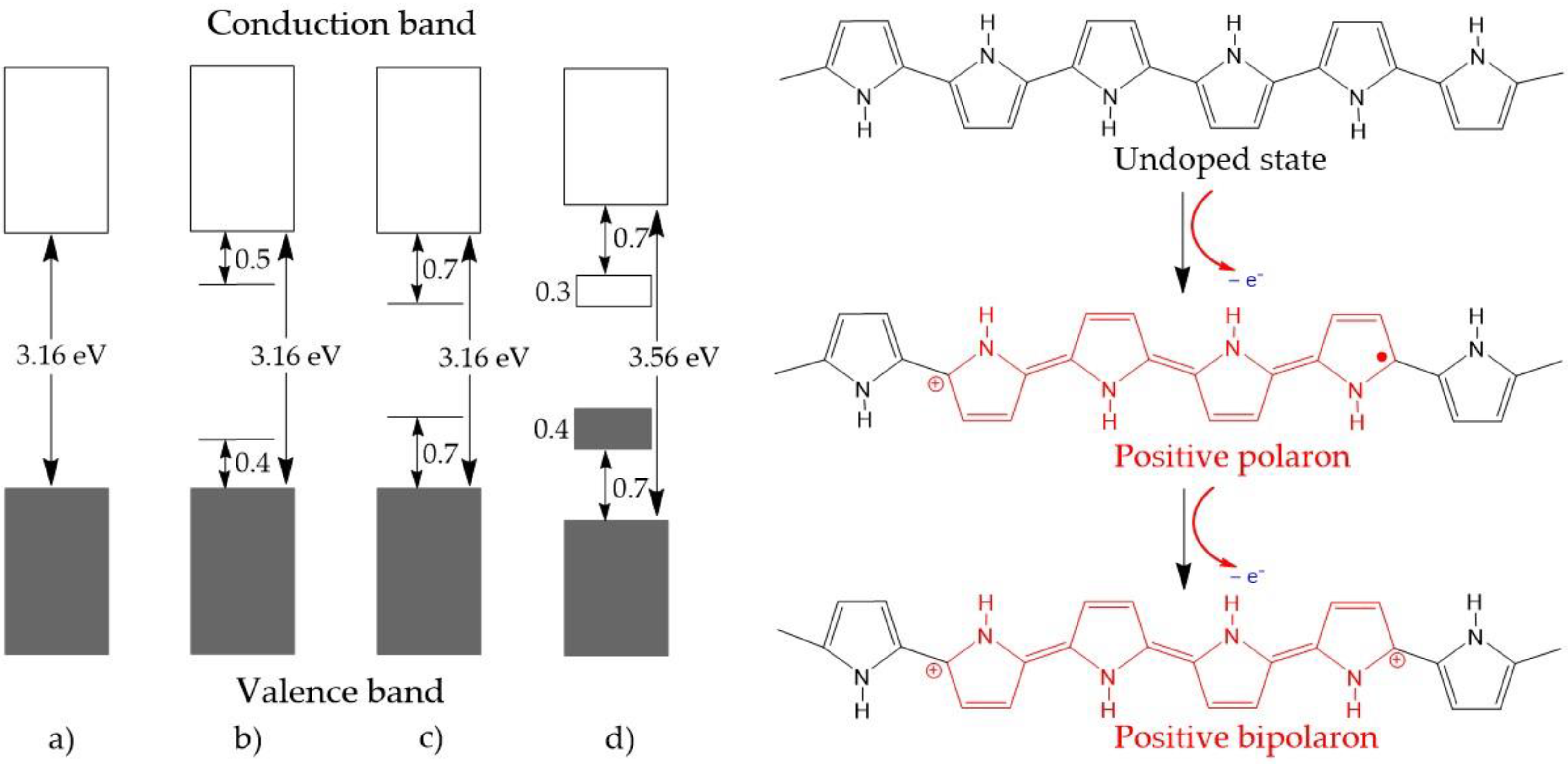
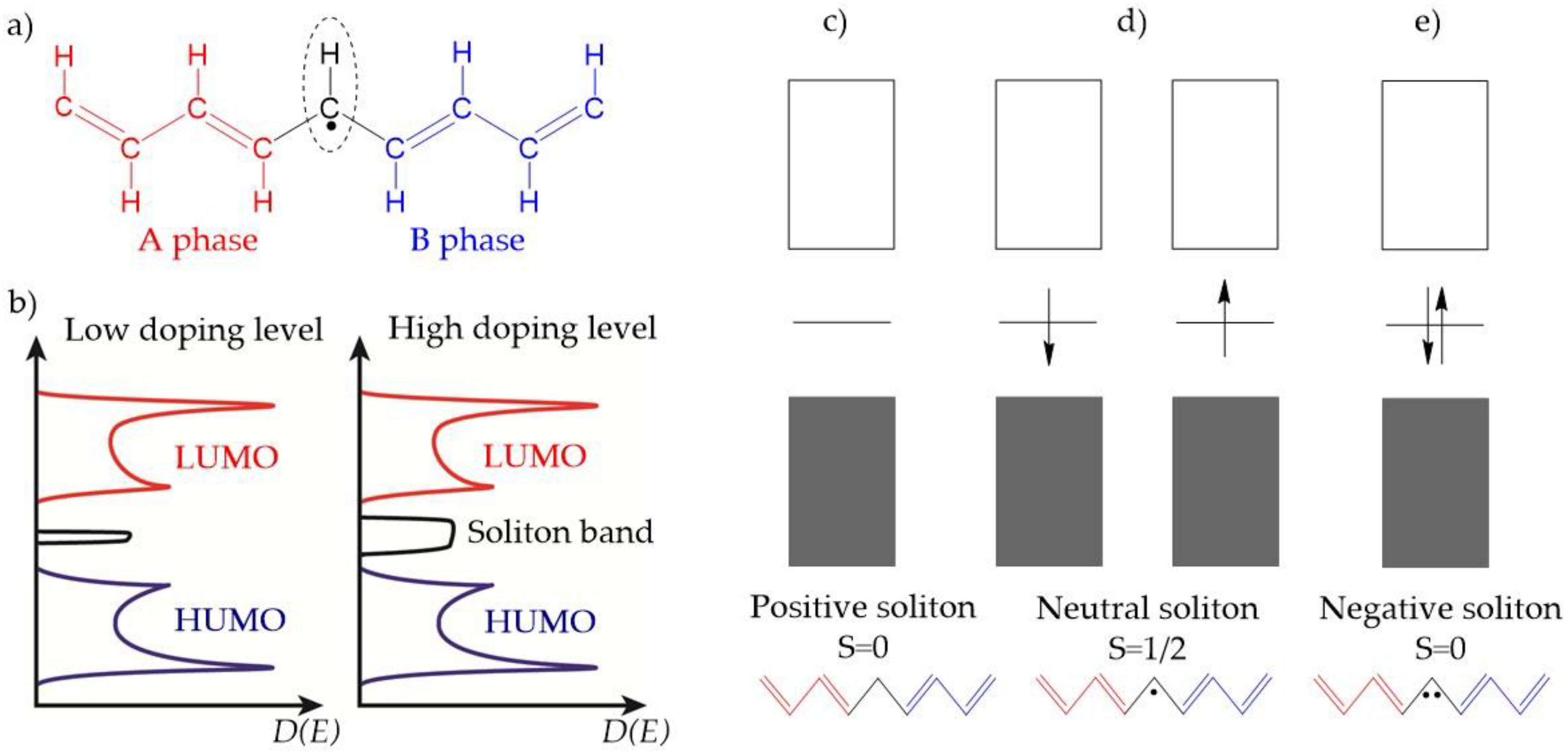
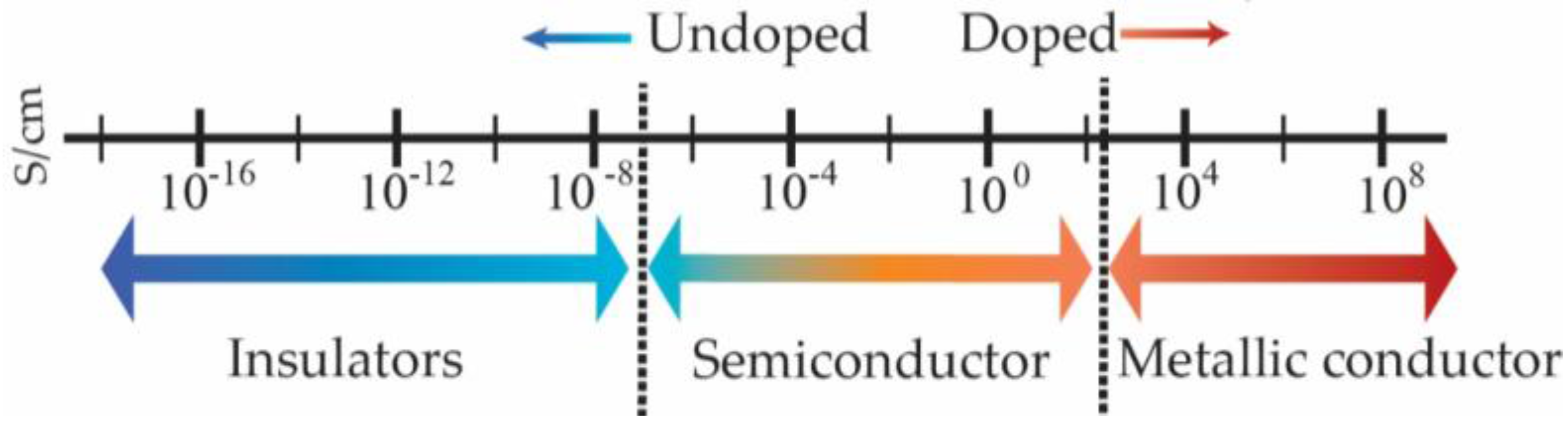
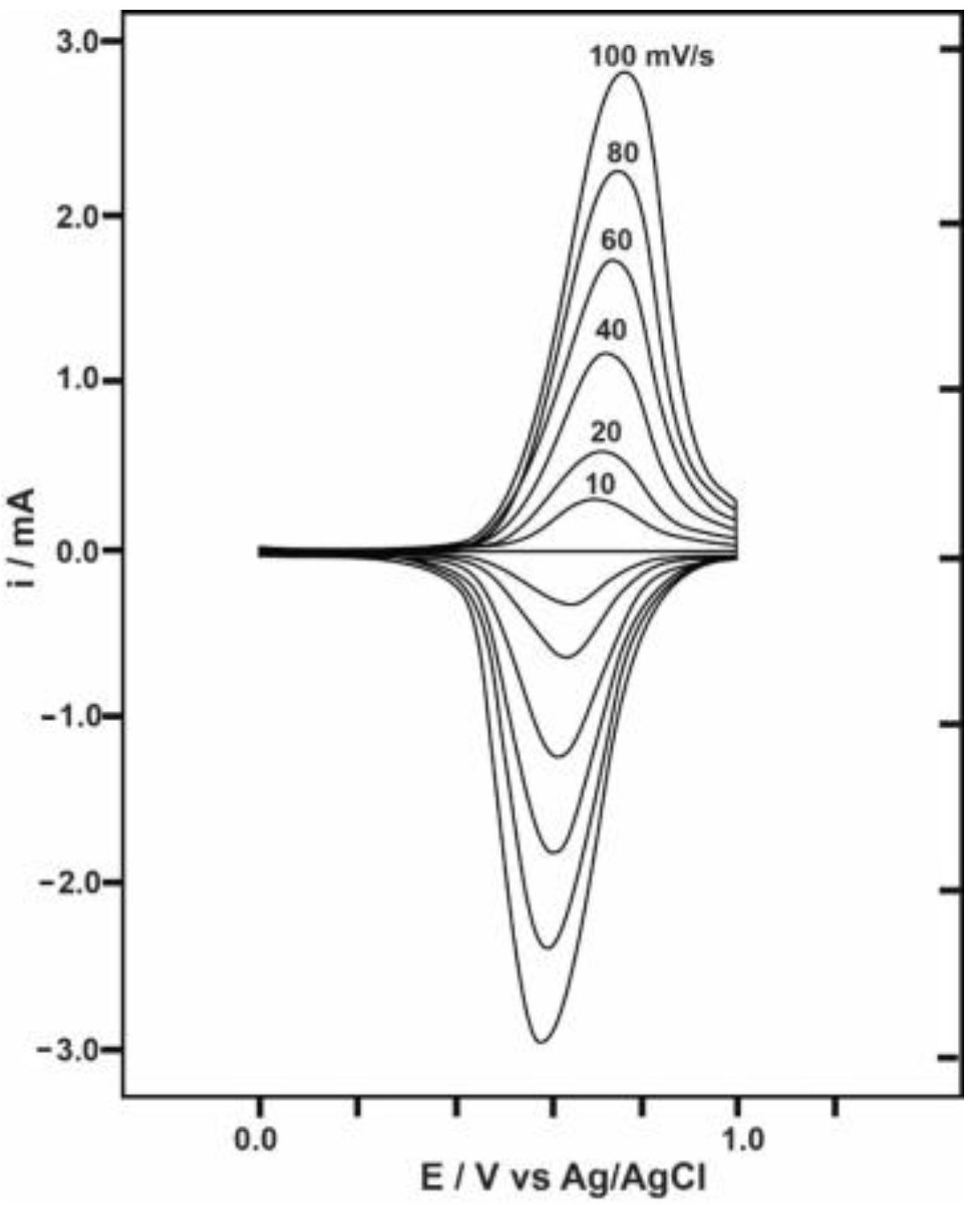
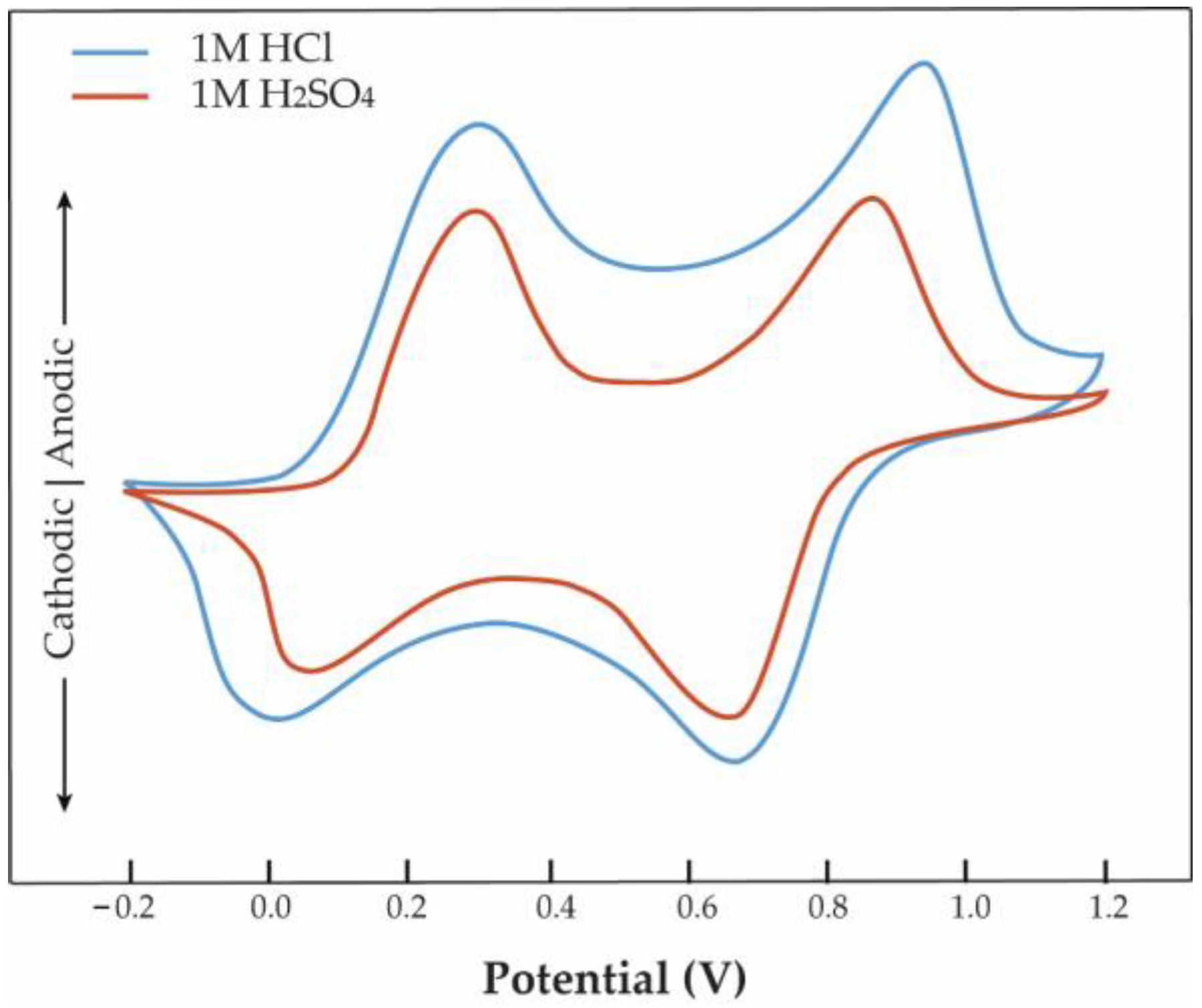
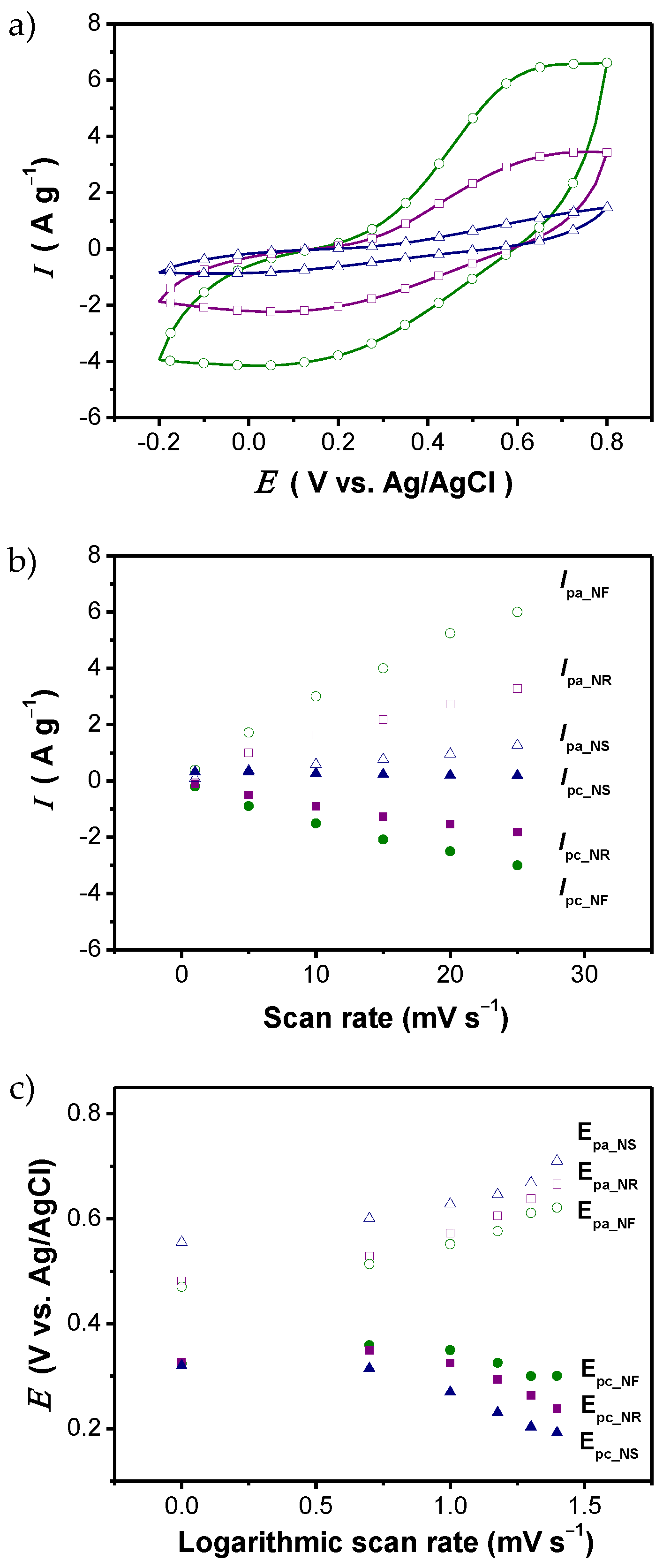
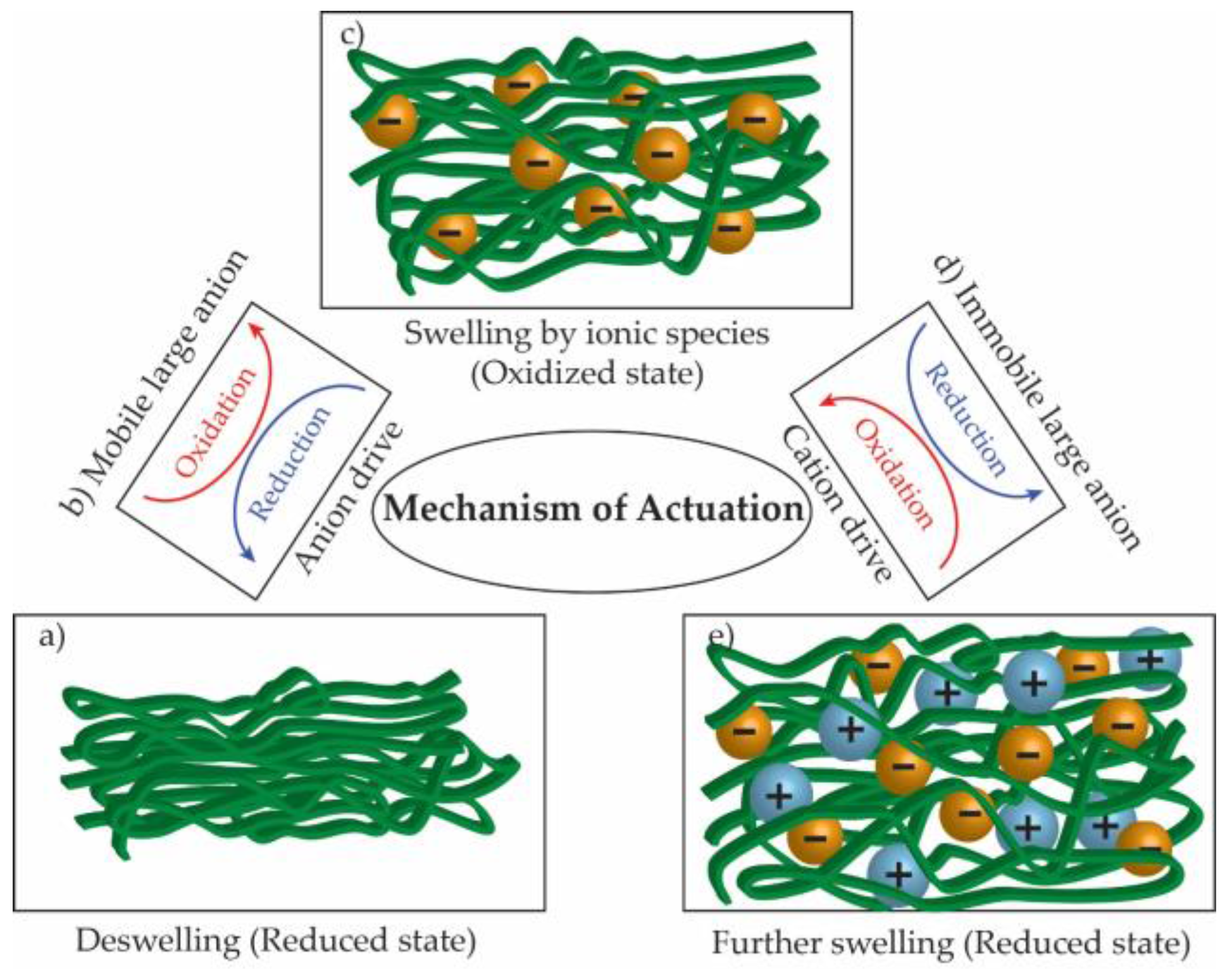
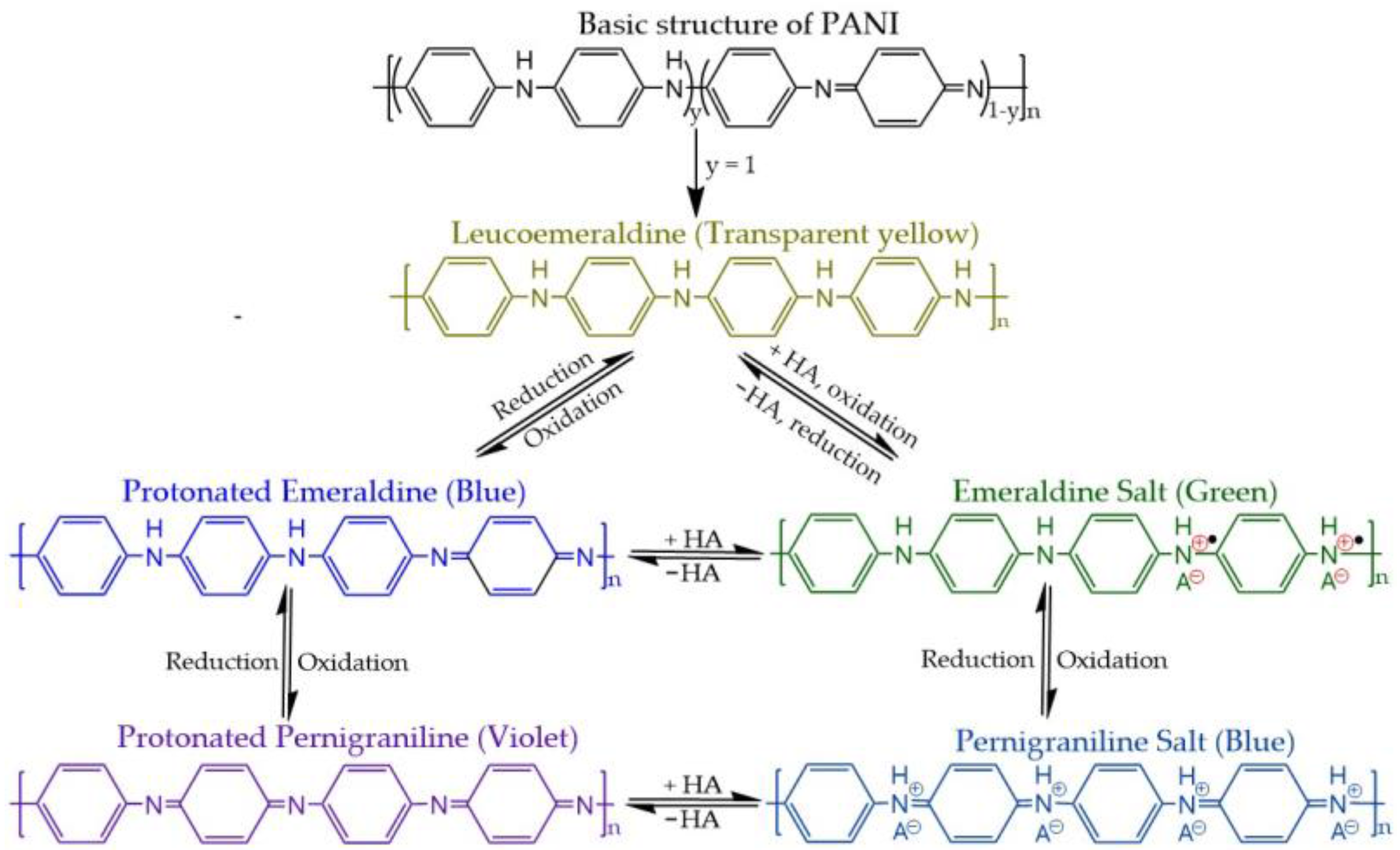
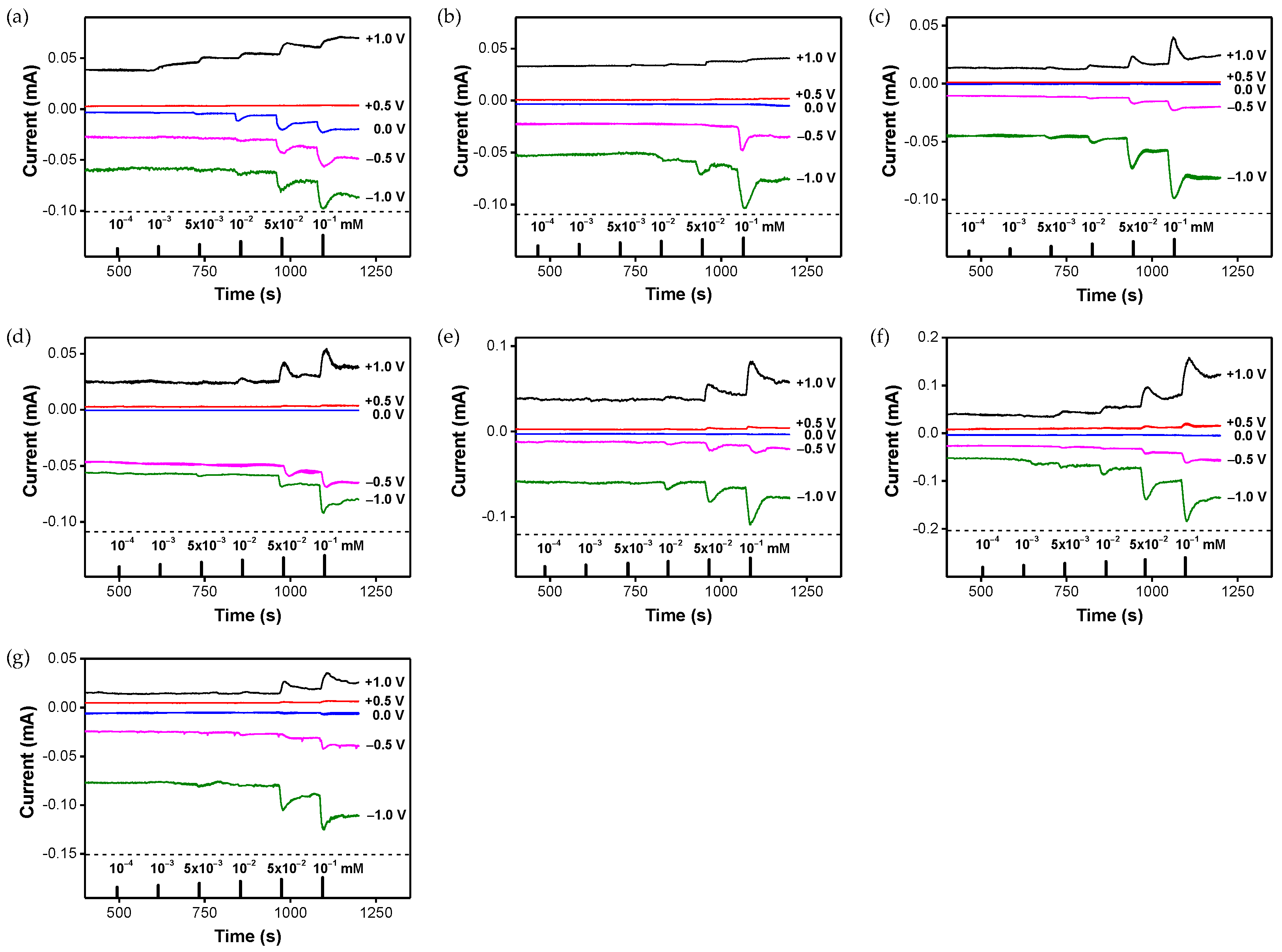
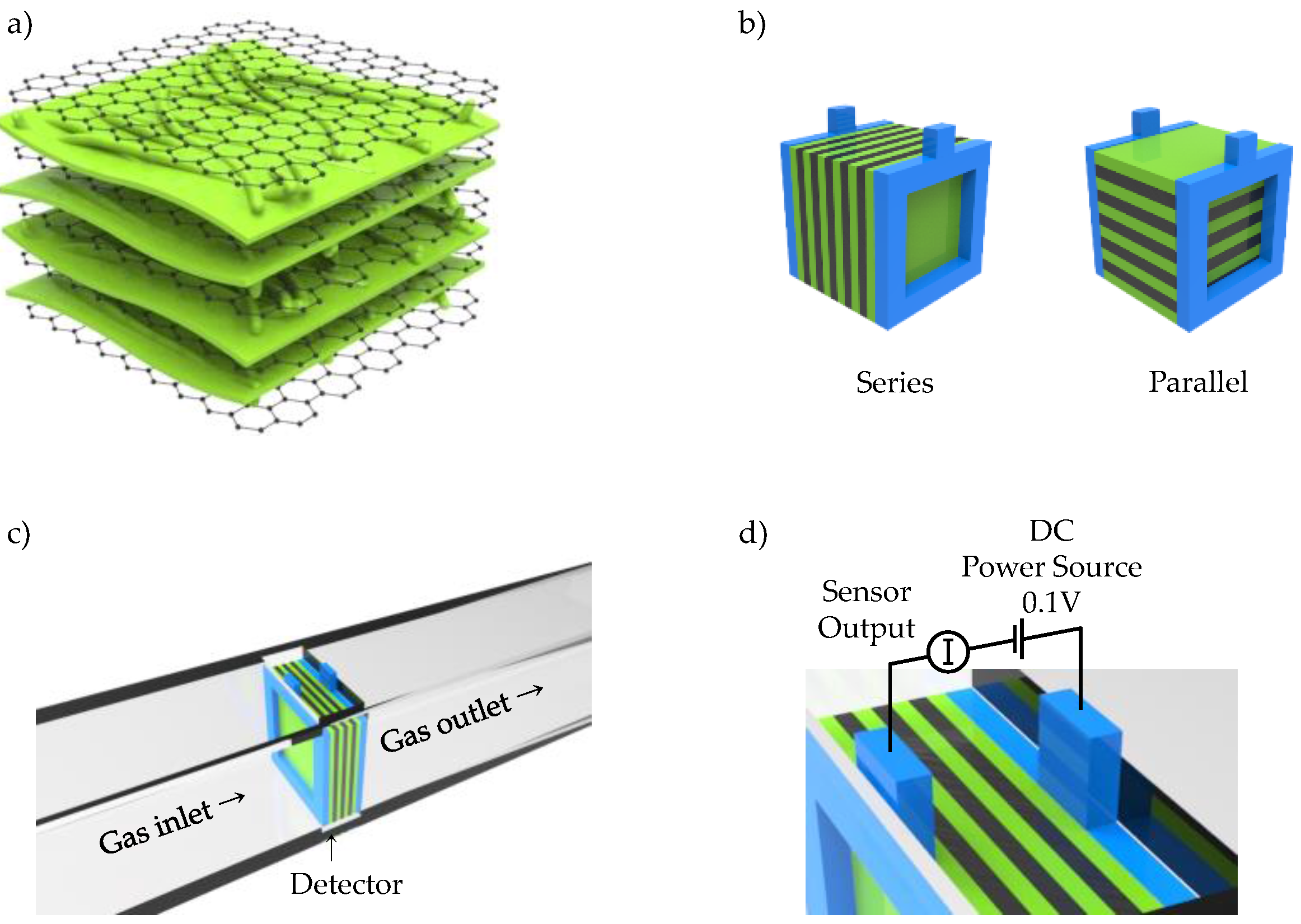


| CP | Repeat Unit | Chain Orientation | Conductivity (S·cm−1) |
|---|---|---|---|
| Polyacetylene | C2H2 | High | 104–105 |
| PPV | C6H4–C2H2 | High | 104 |
| PPy | C5H2N | Low | 400 |
| PANI | C6H4–NH | Low | 400 |
| Poly(3-methylthiophene) | C5H2S–CH3 | Low | 400 |
| PEDOT | C7H4O2S | Low | 300 |
| CP Type | Dopant | Chemical Source | Doping Method | Conductivity | References |
|---|---|---|---|---|---|
| Trans-polyacetylene | Na+ | (C10H8)Na | Solution doping | 80 | [56] |
| Poly(p-phenylene) | Vapor phase doping | 1.5 × 10⁴ | [57] | ||
| Poly(p-phenylene vinylene) | CH3SO3H | CH3SO3H | Non-redox doping | 10.7 | [58] |
| Vapor phase doping | 57 | [59] | |||
| Poly(3-vinylperylene) | (C4H9)4N(ClO4) | Electrochemical doping | 10−5 | [60] | |
| PPy | C16H36AsF6N, (CH3)4N(PF6), (C2H5)4N(BF4) | Electrochemical doping | 30–100 | [61] | |
| NSA | 2-naphthalene sulfonic acid (NSA) | Electrochemical doping | 1–50 | [62] | |
| LiClO4 | Electrochemical doping | 65 | [63] | ||
| NaCl | Electrochemical doping | 10 | [64] | ||
| PSS/ | PSS/FeCl3 | Solution doping | 4 | [65] | |
| MeOH | MeOH | Vapor phase doping | 0.74 | [66] | |
| (C4H9)4N(HSO4) | Electrochemical doping | 0.3 | [61] | ||
| C20H37O4SO3− | C20H37O4SO3Na | Solution doping | 4.5 | [67] | |
| PANI | C10H15OSO3− | C10H16O4S | Solution doping | 300 | [68] |
| HC1 | HC1 | Non-redox doping | 10 | [69] | |
| I3− | I2 | Vapor phase doping | 9.3 | [70] | |
| BF4− | HBF4 | Solution doping | (2.3 × 10⁻¹) | [71] | |
| PBTTT 1 | FTS 2 | C8H4F13SiCl3 | Vapor phase doping | 604–1.1 × 10³ | [72,73] |
| Poly(2-(3-thienyloxy)ethanesulfonate) | Na2SO3 | Na2SO3 | Solution doping | 5 | [74] |
| PT | FeCl3 | Vapor phase doping | 10–25 | [75] | |
| PANI-PPy | ASPB | Anionic spherical polyelectrolyte brushes (ASPB) | Electrochemical doping | 8.3 | [76] |
| Doping Method | Controlled Variables | Advantages | Disadvantages |
|---|---|---|---|
| Chemical doping | Vapor pressure, Exposure time to dopant | Simple way to obtain doping upon exposure of the sample to a vapor of the dopant or immersion into a solution with the dopant | Performed as slowly as possible to avoid inhomogeneous doping |
| The doping levels obtained are not stable with respect to time | |||
| Unexpected structural distortion may cause electrical conductivity decay | |||
| Doping/de-doping shows low reversibility | |||
| Electrochemical doping | Amount of current passed | Doping level can be easily controlled by using an electrochemical cell with a controlled amount of current passed | Unexpected structural distortion may cause electrical conductivity decay |
| Doping/de-doping is highly reversible and clean polymer can be retrieved | |||
| Can be achieved with many dopant species | |||
| Photo doping | Radiation energy of light beam | Charge carrier is formed without chemical compound (dopants) | The electrical conductivity disappears rapidly when irradiation is discontinued due to recombination of electrons and holes |
| No distortion of the material structure | |||
| Non-redox doping | Protonic acid strength | Number of electrons generally does not change | Depends on the degree of oxidation of CPs and degree of protonation of the material |
| Low conductivities are observed for some CPs | |||
| Charge-injection doping | Applying an appropriate potential on the polymer structure | Does not generate counter ions. Minimized distortion | Coulombic interaction between charge and dopant ion is very strong and can lead to change in the energetics of the system |
| CP Type | Metallic | Critical | Insulating | |||
|---|---|---|---|---|---|---|
| σ (S·cm−1) | σ (S·cm−1) | σ (S·cm−1) | ||||
| Polyacetylene-I2 | <10 | >5000 | 10–20 | 3–5 × 10⁴ | >20 | <3000 |
| Polyacetylene-I2 | <5 | >5 × 10⁴ | 9.8–165 | 2–5 × 10⁴ | >400 | <2 × 10⁴ |
| Polyacetylene-FeCl3 | <2 | >2 × 10⁴ | 2.6–11.4 | 1–2 × 10⁴ | >27 | <104 |
| PPV-AsF5 | <5 | 300–2400 | 9.7–34 | 100–300 | >50 | <100 |
| PPV-H2SO4 | <2 | >4 × 10³–104 | 4.7–27 | 1000–4000 | >60 | <1000 |
| PPy | <2 | 300–400 | 2–10 | 200–300 | >10 | <200 |
| PANI | <2 | 250–350 | 2–5 | 200–250 | >10 | <200 |
© 2017 by the authors. Licensee MDPI, Basel, Switzerland. This article is an open access article distributed under the terms and conditions of the Creative Commons Attribution (CC BY) license (http://creativecommons.org/licenses/by/4.0/).
Share and Cite
Le, T.-H.; Kim, Y.; Yoon, H. Electrical and Electrochemical Properties of Conducting Polymers. Polymers 2017, 9, 150. https://doi.org/10.3390/polym9040150
Le T-H, Kim Y, Yoon H. Electrical and Electrochemical Properties of Conducting Polymers. Polymers. 2017; 9(4):150. https://doi.org/10.3390/polym9040150
Chicago/Turabian StyleLe, Thanh-Hai, Yukyung Kim, and Hyeonseok Yoon. 2017. "Electrical and Electrochemical Properties of Conducting Polymers" Polymers 9, no. 4: 150. https://doi.org/10.3390/polym9040150
APA StyleLe, T.-H., Kim, Y., & Yoon, H. (2017). Electrical and Electrochemical Properties of Conducting Polymers. Polymers, 9(4), 150. https://doi.org/10.3390/polym9040150