NIR Spectroscopy for Non-Destructive Prediction of Greenhouse Gas Emissions and Global Warming Potential by Biomass Combustion

 ,
,  ,
,  ,
,  , and
, and 
Abstract
1. Greenhouse Gas (GHG) Emissions and Global Warming Potential (GWP)
1.1. GHG Emissions and GWP of Biomass Combustion
1.2. Direct Measurement and Estimation of GHG Emissions in Biomass Sample Combustion and Its GWP
- Direct Measurement of Emissions
- Laboratory Biomass Burning Experiment and Instrument Set-up
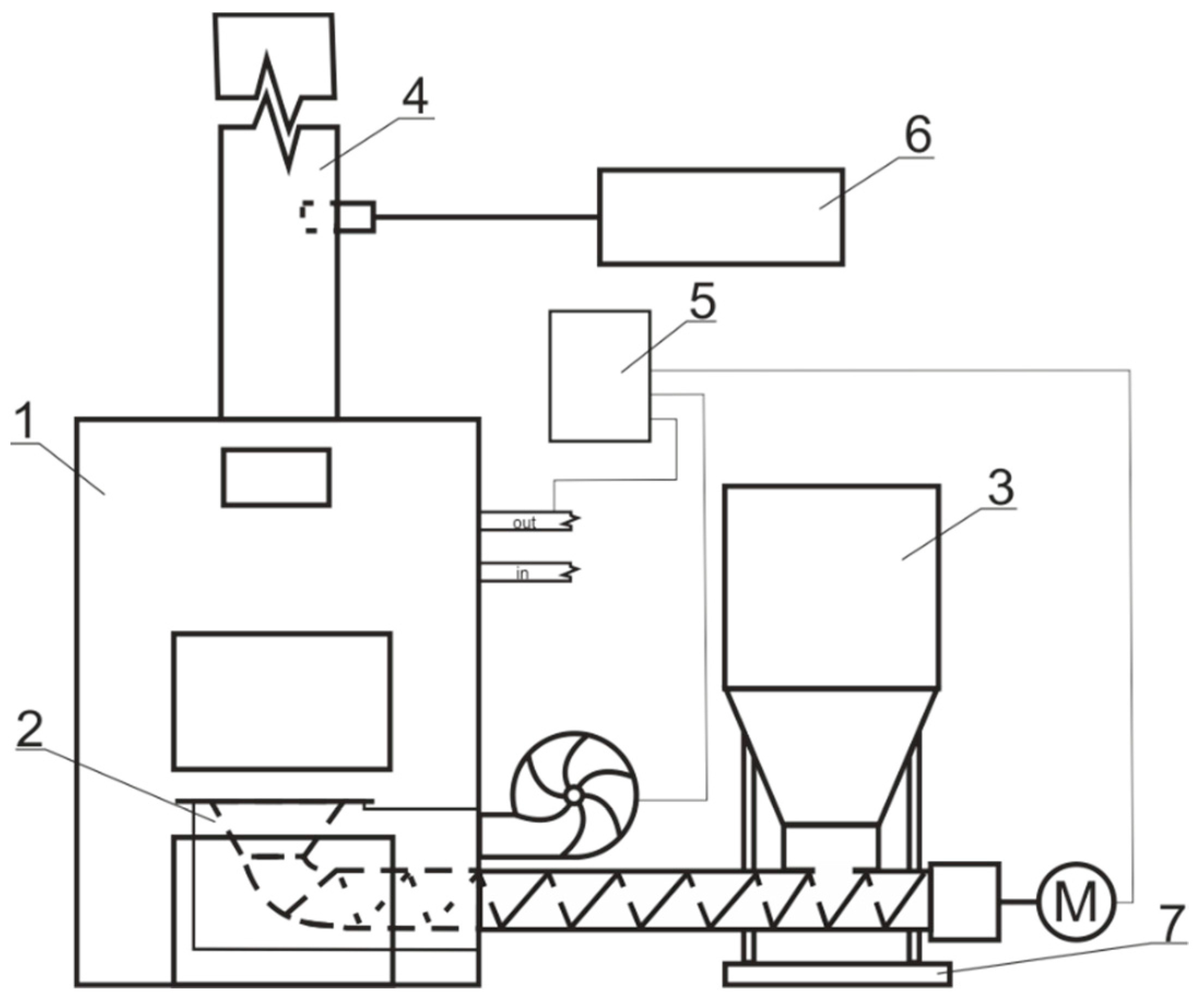
- Laboratory-Scale Boiler Using Biomass Burning Experiment and Instrument Set-up
- Laboratory-Scale Furnace for Biomass Pellet Burning Experiment and Instrument Set-up
- Estimation of Emissions
- Field Biomass Burning Experiment and Instrument Set-up
1.3. IPCC Guidelines for Using Higher Heating Value of Biomass for GHG Emissions and GWP Calculation
= Sum [GWP of GHG (kg CO2eq) × GHG Emission (kg [ton of fuel burned]−1)]
= [(1 × CO2 Emission) + (29.8 × CH4 Emission) + (273 × N2O Emission)] × 1000 kg (metric ton) of fuel burned
= GWP total of 1 kg biomass (kg CO2eq) × 1000 kg (metric ton) of fuel burned
1.4. GHG Emission Estimation from Biomass Combustion of Power Plant Using Unmanned Aerial Vehicles (UAVs)
1.5. GHG Emission Estimation from Biomass Burning Using Satellite Measured Radiation Interacting with Atmospheric Gases or Satellite-Derived Data
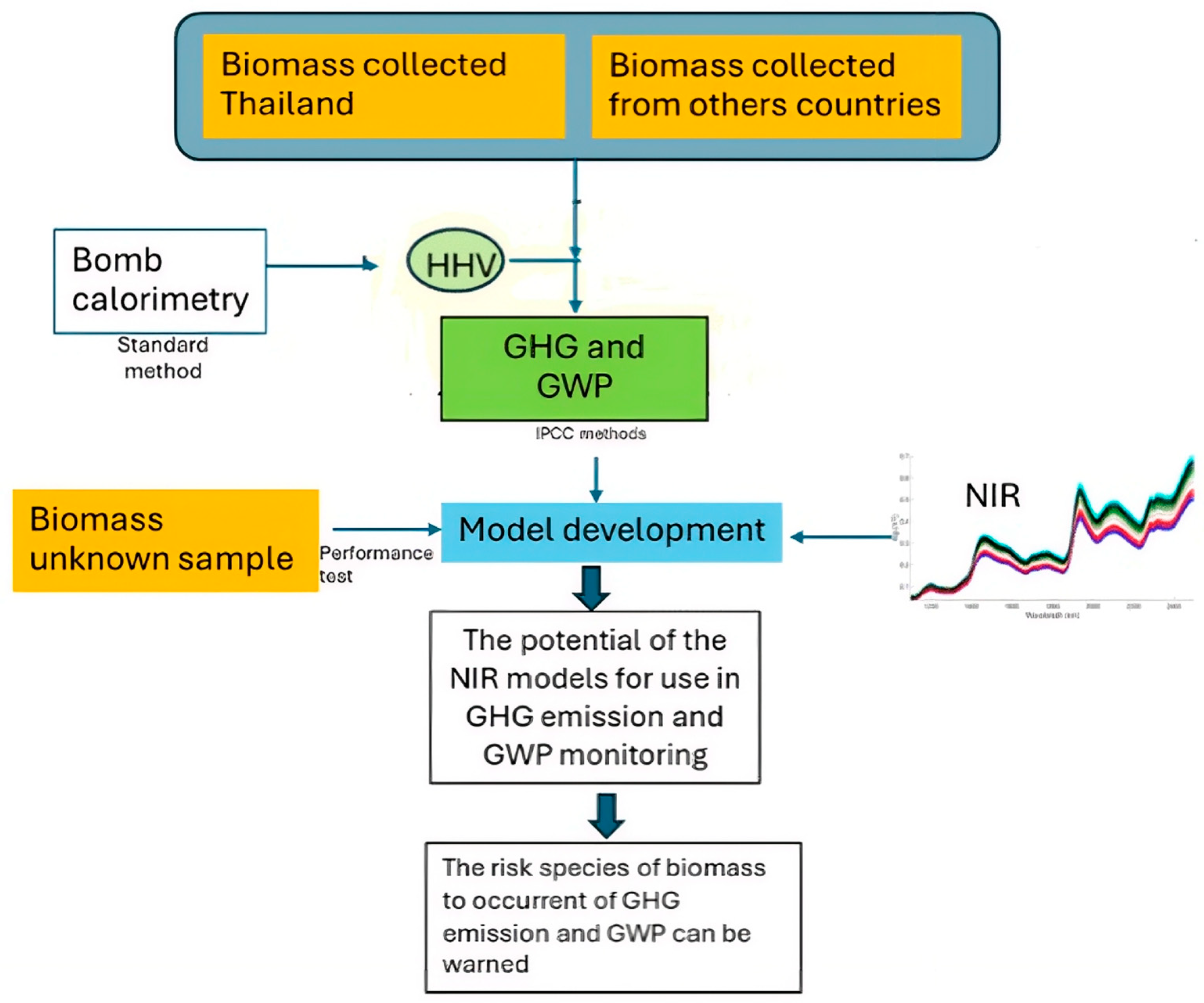
2. GHG Emissions and GWP of Biomass Combustion Prediction by NIR Spectra Scanned on Intact Biomass Chips or Powder Calibrated Using HHV According to IPCC Guidelines
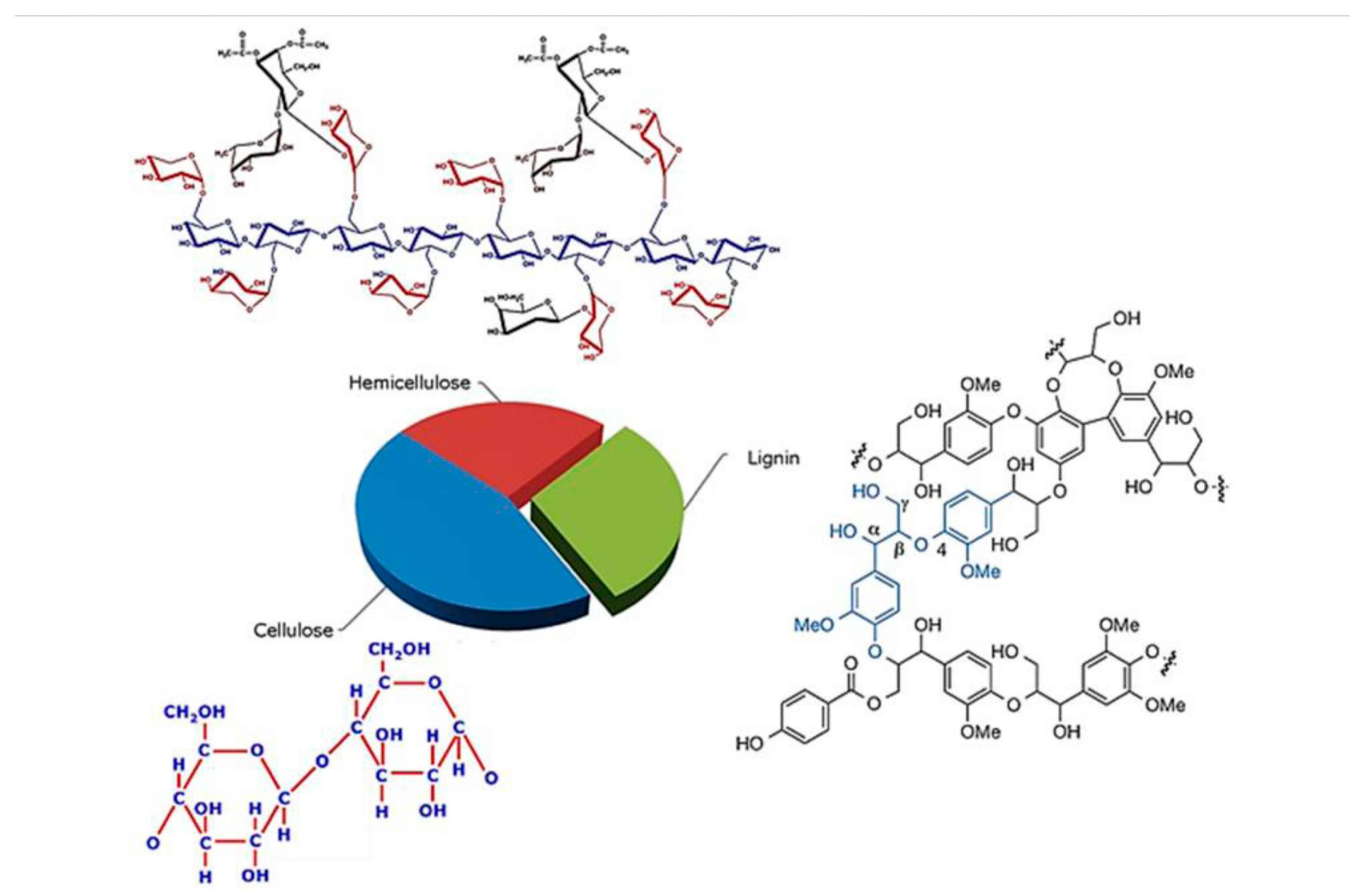
2.1. Relationship of Lignocellulosic Constituents and Elements in Biomass and HHV and GHG Emissions
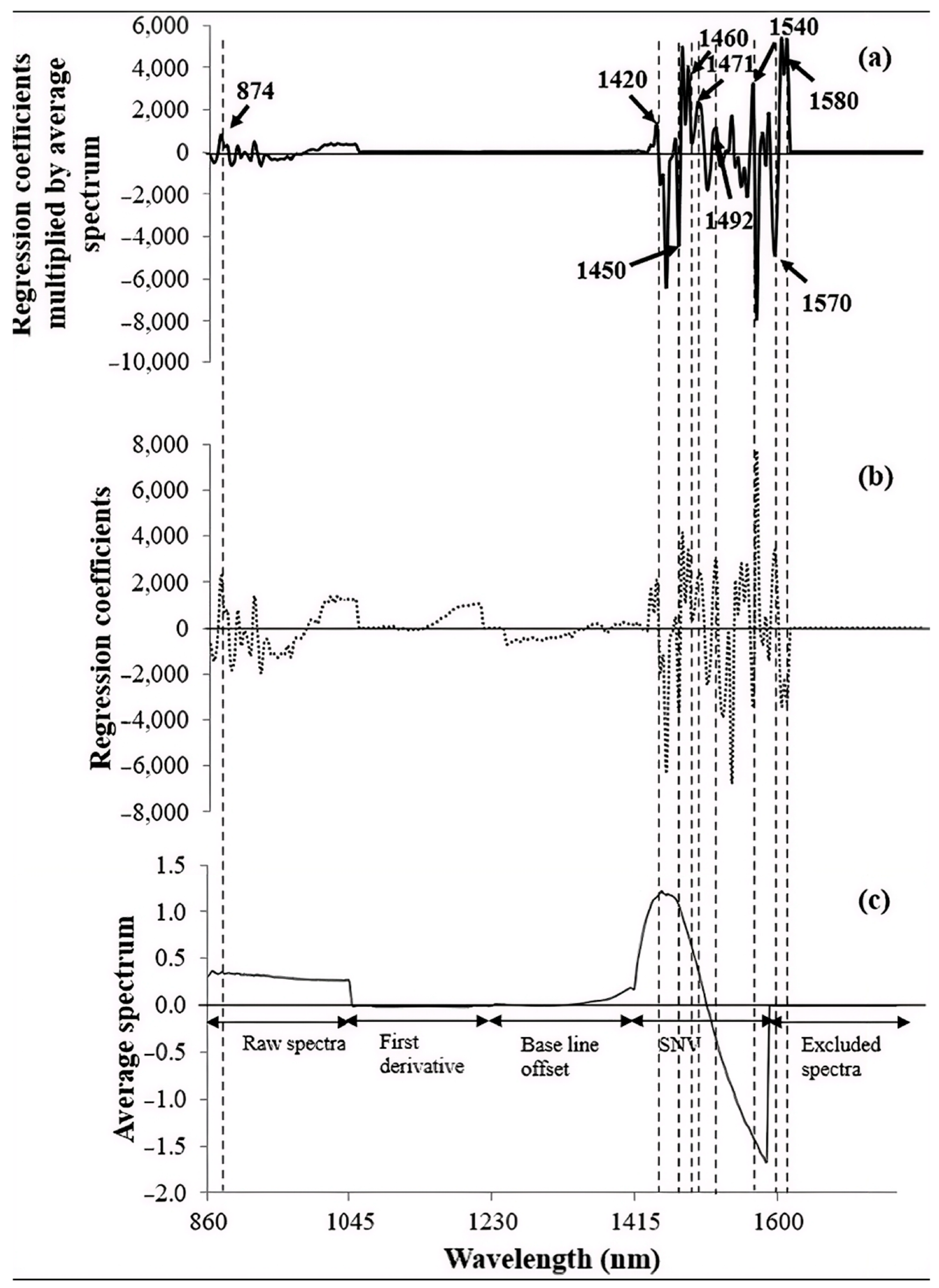
2.2. Molecular Vibration of Hydrogen Bonds Caused by NIR Radiation Related to GHG Emissions

| References | Biomass | Reference Parameter | Sample Size | Spectral Range | Preprocessing Method | Calibration–Validation Strategy | Model Algorithm | Hyperparameter | Performance Metrics (R2P, SEP/RMSEP, RPD, Bias) | Applicability (Refer to Table 3) ^^ |
|---|---|---|---|---|---|---|---|---|---|---|
| [74] Posom and Sirisomboon, 2017 | Ground and chipped bamboo | LHV C H N S | LHV: 80 C: 80 H: 79 N: 79 S: 78 O: 80 | LHV: 8373.9–7853.2, 6827.2–5793.5 C: 12,493.3–11,602.3, 10,715.2–9824.2, 8937–7155, 6267.9–4485.9 H: 9403.8–7498.3, 5450.2–4597.7 N: 7857–6823.3, 5797.3–4246.7 S: 9403.8–7340.2, 6827.2–5276.6, 4763.6–4246.7 O: 8890.7–8370, 6310.3–5793.5 | LHV: MSC C: 2nd derivative H: Constant offset elimination N: Min–max normalization S: MSC O: Straight-line substation | LHV: 64:16 C: 64:16 H: 63:16 N: 63:16 S: 62:16 O: 64:16 | PLSR with external test set | Latent variables optimized by CV LHV: 3 C: 4 H: 9 N: 8 S: 8 O: 5 | LHV: 0.934, 0.119 MJ kg−1, 4.0, −0.0187 MJ kg−1 C: 0.803, 0.532%, 2.3, −0.118% H: 0.856, 0.0427%, 2.7, −0.00524% N: 0.973, 0.0276%, 6.6, 0.0103% S: 0.785, 0.00761%, 2.2, −0.00139% O: 0.522, 1.110%, 1.5, −0.158% | LHV: f C: d H: e N: f S: d O: c |
| [75] Pitak et al., 2021 | Different species of biomass pellets | C H N S | C: 160 H: 159 N: 159 S: 157 | C: iGA selected 102 variables H: iGA selected 102 variables N: Full range 256 variables S: Full range 256 variables | C: SNV H: SNV N: SNV S: 2nd derivative | C: 116:44 H: 116:43 N: 115:44 S: 114:43 | PLSR with external test set | Latent variables optimized by CV C: 6 H: 7 N: 7 S: 7 | C: 0.83, 1.33%, 2.5, 3.3% H: 0.84, 0.17%, 2.8, 2.8% N: 0.91, 0.094%, 3.4, 13.2% S: 0.31, 0.026%, 1.3, 19.3% | C: e H: e N: e S: b |
| [76] Nakawajana et al., 2018 | Ground rice husk | LHV HHV | 65 | LHV: 7425–5446.3 and 4601.6–4246.7 cm−1 HHV: 7425–5446.3 and 4601.6–4246.7 cm−1 | LHV: MSC HHV: MSC | Calibration set: unknown set 50:15 | PLSR with CV calibration and validated with unknown set | Latent variables optimized by CV LHV: 7 HHV: 7 | LHV: 0.780, 119 J g−1, 2.1, −2.52 J g−1 HHV: 0.778, 119 J g−1, 2.1, −2.49 J g−1 | LHV: d HHV: d |
| [77] Posom and Nakawajana, 2018 | Milled maize cob | HHV | 60 | 5450.2–4246.7 cm−1 | 2nd derivative | Calibration set: unknown set 50:10 | PLSR with CV calibration and validated with unknown set | Latent variables optimized by CV HHV: 3 | 0.73, 91 J g−1, 1.9, 0.293 J g−1 | |
| [78] Nakawajana and Posom, 2019 | Ground cassava rhizome | LHV HHV | LHV: 49 HHV: 49 | 12,500- 3600 cm−1 | PLS/SVM LHV: SNV/2nd derivative HHV: | Full CV LHV: 49 HHV: 49 | PLSR with CV calibration | Latent variables optimized by CV for both PLSR and SVM LHV: 1 HHV: 1 | PLSR LHV: 0.90, 241 J g−1, -, 0.224 J g−1, HHV: 0.90, 240 J g−1, -, 0.522 J g−1 SVM LHV: 0.85, 365 J g−1, -, −47.6 J g−1 HHV: 0.84, 364 J g−1, -, −47.2 J g−1 | LHV: e HHV: e |
| [79] Posom and Sirisomboon, 2017 | Ground bamboo | HHV | 80 | 6102- 4597.7 cm−1 | Min–max normalization | 64:16 | PLSR with external test set | Latent variables optimized by CV HHV: 7 | 0.92, 122 J g−1, 3.7 and 14.4 J g−1 | f |
| [80] Sirisomboon et al., 2020 | Bamboo chip | LHV HHV | LHV: 82 HHV: 83 | LHV: 9403.8–5446.3, 4605.4–4242.9 cm−1 HHV: 8377.7–7853.2, 7344–6819.5 cm−1 | LHV: 1st derivative + MSC HHV: Min–Max normalization | LHV 66:16 HHV 67:16 | PLSR with external test set | Latent variables optimized by CV LHV: 5 HHV: 7 | LHV 0.89, 0.12 MJ kg−1, 3.1, 0.016 MJ kg−1, HHV 0.84, 0.15 MJ kg−1, 2.5, 0.001 MJ kg−1 | LHV: e HHV: e |
| [89] Posom et al., 2022 | Sugarcane bagasse | HHV | 100 | 860.6–1754.1 nm | Multiblock ^ | 75:25 | PLSR with external test set | Latent variables optimized by CV HHV: 8 | 0.71, 206.6 J g−1, 1.9, −6.5 J g−1 |
| R2 Range | Applicable Work | RPD—Biomass Constituents, Such as C, H, N, O, S, Cellulose, Hemicellulose, Lignin and GHG Emissions Measured Using Instrument | RPD—Biomass Functional Parameters Such as LHV, HHV, IPCC GHG Emissions, and IPCC GWP | Applicable Work ^ |
|---|---|---|---|---|
| ≤0.25 | Cannot be used in NIR spectroscopy calibration | 0.0 and 2.3 | 0.0–1.9 | Its use is not recommended, a |
| 0.26–0.49 | Poor correlation and reason should be researched | 2.4 and 3.0 | 2.0–2.4 | Rough screening, b |
| 0.50 and 0.64 | Rough screening | 3.1 and 4.9 | 2.5–2.9 | Screening, c |
| 0.66 and 0.81 | Screening and some other “approximate” calibration | 5.0 and 6.4 | 3.0–3.4 | Quality control, d |
| 0.83 and 0.90 | Can be used with caution for most applications | 6.5 and 8.0 | 3.5–4.0 | Process control, e |
| 0.92 and 0.96 | Suitable for most applications | ≥8.1 | ≥4.1 | Any application, f |
| ≥0.98 | Excellent and usable for any application | g |
- A description of model development and validation procedures
2.3. Sugarcane Bagasse’s and Other Biomass Species’ GHG Emissions and GWP
2.4. Comparative Advantages and Limitations of NIR Spectroscopy with Respect to Other Methods
- NIR spectroscopy proposed compared to UAV and satellite systems
- NIR spectroscopy proposed compared to field biomass burning experiments
- NIR spectroscopy proposed compared to laboratory biomass direct combustion-based experiments
- Advantages of NIR spectroscopy proposed (pre-combustion prediction)
- Disadvantages of NIR spectroscopy proposed (pre-combustion prediction)
3. Conclusions
Author Contributions
Funding
Institutional Review Board Statement
Informed Consent Statement
Data Availability Statement
Acknowledgments
Conflicts of Interest
Abbreviations
| AEDP | Alternative Energy Development Plan |
| AFOLU | Agriculture, forestry and other land use |
| ANN | Artificial neural network |
| AR5 | Fifth assessment report |
| AR6 | Sixth assessment report |
| BTG | Boiler, turbine, and generator technology |
| C | Carbon |
| CAGR | Compound annual growth rate |
| CC | Carbon content |
| CEM | Continuous emission monitoring systems |
| Cf | Combustion efficiency |
| CH4 | Methane |
| CHNOS | Biomass elements, including carbon, hydrogen, nitrogen, oxygen, and sulfur |
| CNN | Convolutional neural network |
| COP | Conference of the parties (UNFCCC) |
| CO2 | Carbon dioxide |
| COVM | Covariance matrix |
| CRDS | Cavity ring-down spectroscopy |
| QCL | Dual-comb spectroscopy, quantum cascade laser |
| E | Energy content of fuel burned |
| EF | Emission factor |
| EFx | Emission factor of gas x |
| EPA | Environmental Protection Agency |
| Ex | Mass of gas x emitted |
| FTIR | Fourier transform infrared |
| GC | Gas chromatography |
| GC-ECD | GC-electron capture detector |
| GC-FID | GC-flame ionization detector |
| GC-TCD | GC-thermal conductivity detector |
| GHG | Greenhouse gas |
| GWP | Global warming potential |
| H | Hydrogen |
| HHV | Higher heating value |
| IEA | International Energy Agency |
| iGA | Improved genetic algorithm |
| IPCC | Intergovernmental Panel on Climate Change |
| LDC | Least developed country |
| LHV | Lower heating value |
| MAE | Mean absolute error |
| MBE | Mean bias error |
| N | Nitrogen |
| NDIR | Non-dispersive infrared |
| NI-PT-CIMS | Negative-ion proton-transfer chemical ionization mass spectrometry |
| NZE | Net zero emissions |
| NIR | Near-infrared |
| N2O | Nitrous oxide |
| O | Oxygen |
| OA-ICOS | Off axis integrated cavity output spectroscopy |
| OF | Fraction of carbon oxidized |
| OP-FTIR | Open-path Fourier transform infrared spectroscopy |
| PLSR | Partial least-squares regression |
| PIT-MS | Proton-transfer-reaction ion-trap mass spectrometry |
| PTR-MS | Proton-transfer-reaction mass spectrometry |
| R2 | Coefficient of determination |
| R2P | Coefficient of determination of prediction |
| RMSECV | Root mean square error of cross-validation |
| RMSEP | Root mean square error of prediction |
| RPD | Ratio of prediction to deviation |
| S | Sulfur |
| SDGs | Sustainable Development Goals |
| SEP | Standard error of prediction |
| SNV | Standard normal variate |
| Solar PV | Solar photovoltaics |
| SVM | Support vector machine |
| TDLA | Tunable diode laser absorption spectroscopy |
| TGA/DTA | Thermogravimetric analysis and derivative thermogravimetric analysis |
| UAV | Unmanned aerial vehicle |
| UNFCCC | United Nations Framework Convention on Climate Change |
References
- Arif, A.; Arif, U.; Shaheen, S.; Habib, M.D.; Bekun, F.V.; Haseki, M.I. Climate change and environment Kuznets curve in developing economies (D-8 nations). Int. J. Environ. Sci. Dev. 2025, 16, 174–181. [Google Scholar] [CrossRef]
- Advanced Energy Technologies. Energy Industry in Thailand. Available online: https://aenert.com/fileadmin/default/templates/images/Thailand/aenert_Thailand.pdf (accessed on 1 December 2025).
- U.S. Energy Information Administration. International Energy Statistics. Available online: http://www.eia.gov/ (accessed on 1 December 2025).
- Ministry of Energy, Thailand. Alternative Energy Development Plan 2018–2037 (AEDP 2018–2037). Available online: https://policy.asiapacificenergy.org (accessed on 15 May 2024).
- International Energy Agency. Energy System of Thailand. Available online: https://www.iea.org/countries/thailand (accessed on 2 December 2025).
- Irmak, S.; Kurtuluş, M.; Hasanoğlu, A.; Erbatur, O. Gasification efficiencies of cellulose, hemicellulose and lignin fractions of biomass in aqueous media using Pt on activated carbon catalyst. Biomass Bioenergy 2013, 49, 102–108. [Google Scholar] [CrossRef]
- Hoppin, P.; Jacobs, M. Emissions and health effects of wood biomass combustion. In Wood-Based Energy in the Northern Forests; Springer: New York, NY, USA, 2014; pp. 187–217. [Google Scholar] [CrossRef]
- Benterbusch, U.; Husar, J. Getting It Right; International Energy Agency: Paris, France, 2013; p. 223. Available online: https://www.oecd.org/content/dam/oecd/en/publications/reports/2013/06/getting-it-right_g1g26cd1/9789264190320-en.pdf#page=225 (accessed on 2 December 2025).
- Mastrandrea, M.D.; Field, C.B.; Stocker, T.F.; Edenhofer, O.; Ebi, K.L.; Frame, D.J.; Held, H.; Kriegler, E.; Mach, K.J.; Matschoss, P.R.; et al. Guidance Note for Lead Authors of the IPCC Fifth Assessment Report on Consistent Treatment of Uncertainties; IPCC: Geneva, Switzerland, 2010; Available online: https://pure.mpg.de/rest/items/item_2147184/component/file_2147185/content.
- International Energy Agency (IEA). Global Energy Review 2025. Available online: https://www.iea.org/reports/global-energy-review-2025 (accessed on 2 December 2025).
- Böhler, L.; Görtler, G.; Krail, J.; Kozek, M. Carbon monoxide emission model for small-scale biomass combustion wooden pellets. Appl. Energy 2019, 124, 113668. [Google Scholar] [CrossRef]
- Krumal, K.; Mikuska, P.; Horak, J.; Hopan, F.; Krpec, K. Comparison of emissions of gaseous and particulate pollutants from combustion of biomass and coal in modern and old-type boilers used for residential heating. Chemosphere 2019, 229, 51–59. [Google Scholar] [CrossRef]
- Maxwell, D.; Gudka, B.A.; Jones, J.M.; Williams, A. Emissions from combustion of torrefied and raw biomass fuels in a domestic heating stove. Fuel Process. Technol. 2020, 199, 106266. [Google Scholar] [CrossRef]
- Adamczyk, J.; Smołka-Danielowska, D. Assessment of pollution by potentially toxic elements of agri-food biomass combustion ashes under different temperature regimes. Arch. Environ. Prot. 2025, 50, 64–74. [Google Scholar] [CrossRef]
- IPCC. Climate Change and Land: An IPCC Special Report; IPCC: Geneva, Switzerland, 2019; Available online: https://www.ipcc.ch/srccl/ (accessed on 2 December 2025).
- International Energy Agency (IEA). Net Zero by 2050: A Roadmap for the Global Energy System; IEA: Paris, France, 2021; Available online: https://iea.blob.core.windows.net/assets/deebef5d-0c34-4539-9d0c-10b13d840027/NetZeroby2050-ARoadmapfortheGlobalEnergySector_CORR.pdf (accessed on 2 December 2025).
- IPCC. Global Warming of 1.5 °C; IPCC: Geneva, Switzerland, 2018; Available online: https://www.ipcc.ch/sr15/ (accessed on 2 December 2025).
- Chen, J.; Li, C.; Ristovski, Z.; Milic, A.; Gu, Y.; Islam, M.S.; Wang, S.; Hao, J.; Zhang, H.; He, C.; et al. A review of biomass burning: Emissions and impacts on air quality, health and climate in China. Sci. Total Environ. 2017, 579, 1000–1034. [Google Scholar] [CrossRef]
- Yadav, I.C.; Devi, N.L.; Li, J.; Syed, J.H.; Zhang, G.; Watanabe, H. Biomass burning in Indo-China peninsula and its impacts on regional air quality and global climate change: A review. Environ. Pollut. 2017, 227, 414–427. [Google Scholar] [CrossRef] [PubMed]
- Gyawali, P.; Shrestha, B.; Phanomsophon, T.; Posom, J.; Pornchaloempong, P.; Sirisomboon, P.; Shrestha, B.P.; Funke, A. Predicting biomass global warming potential with FT-NIR spectroscopy. Sci. Rep. 2025, 15, 33725. [Google Scholar] [CrossRef]
- Searchinger, T.; Heimlich, R.; Houghton, R.A.; Dong, F.; Elobeid, A.; Fabiosa, J.; Tokgoz, S.; Hayes, D.; Yu, T.H. Use of U.S. croplands for biofuels increases greenhouse gases through emissions from land-use change. Science 2008, 319, 1238–1240. [Google Scholar] [CrossRef]
- Fargione, J.; Hill, J.; Tilman, D.; Polasky, S.; Hawthorne, P. Land clearing and the biofuel carbon debt. Science 2008, 319, 1235–1238. [Google Scholar] [CrossRef] [PubMed]
- Houghton, R.A. Carbon emissions and the drivers of deforestation and forest degradation in the tropics. Curr. Opin. Environ. Sustain. 2012, 4, 597–603. [Google Scholar] [CrossRef]
- Mitchell, S.R.; Harmon, M.E.; O’Connell, K.E.B. Carbon debt and carbon sequestration parity in forest bioenergy production. GCB Bioenergy 2012, 4, 818–827. [Google Scholar] [CrossRef]
- Holtsmark, B. The outcome is in the assumptions: Analyzing the effects on atmospheric CO2 levels of increased use of bioenergy from forest biomass. GCB Bioenergy 2012, 4, 467–472. [Google Scholar] [CrossRef]
- Walker, T.; Cardellichio, P.; Colnes, A.; Gunn, J.; Kittler, B.; Perschel, R.; Recchia, C.; Saah, D.; Walker, T. Carbon accounting for woody biomass from Massachusetts (USA) managed forests. J. Sustain. For. 2013, 32, 130–158. [Google Scholar] [CrossRef]
- Njakou Djomo, S.; Ceulemans, R. A comparative analysis of the carbon intensity of biofuels caused by land use changes. Glob. Change Biol. Bioenergy 2012, 4, 392–407. [Google Scholar] [CrossRef]
- Cherubini, F.; Bird, N.D.; Cowie, A.; Jungmeier, G.; Schlamadinger, B.; Woess-Gallasch, S. Energy- and greenhouse gas-based LCA of biofuel and bioenergy systems. Resour. Conserv. Recycl. 2009, 53, 434–447. [Google Scholar] [CrossRef]
- Stephenson, A.L.; MacKay, D.J.C.; Scott, S.A. Life cycle impacts of biomass electricity in 2020. Energy Policy 2010, 38, 5531–5540. [Google Scholar] [CrossRef]
- Andreae, M.O.; Merlet, P. Emission of trace gases and aerosols from biomass burning. Glob. Biogeochem. Cycles 2001, 15, 955–966. [Google Scholar] [CrossRef]
- Akagi, S.K.; Yokelson, R.J.; Wiedinmyer, C.; Alvarado, M.J.; Reid, J.S.; Karl, T.; Crounse, J.D.; Wennberg, P.O. Emission factors for open and domestic biomass burning. Atmos. Chem. Phys. 2011, 11, 4039–4072. [Google Scholar] [CrossRef]
- Bond, T.C.; Streets, D.G.; Yarber, K.F.; Nelson, S.M.; Woo, J.-H.; Klimont, Z. A technology-based global inventory of black and organic carbon emissions from combustion. J. Geophys. Res. Atmos. 2004, 109, D14203. [Google Scholar] [CrossRef]
- Cherubini, F.; Guest, G.; Strømman, A.H. Application of probability distributions to the modeling of biogenic CO2 fluxes in life cycle assessment. GCB Bioenergy 2012, 4, 784–798. [Google Scholar] [CrossRef]
- Helin, T.; Sokka, L.; Soimakallio, S.; Pingoud, K.; Pajula, T. Approaches for inclusion of forest carbon cycle in life cycle assessment. GCB Bioenergy 2013, 5, 475–486. [Google Scholar] [CrossRef]
- Haberl, H.; Sprinz, D.; Bonazountas, M.; Cocco, P.; Desaubies, Y.; Henze, M.; Hertel, O.; Johnson, R.K.; Kastrup, U.; Laconte, P.; et al. Correcting a fundamental error in greenhouse gas accounting related to bioenergy. Energy Policy 2012, 45, 18–23. [Google Scholar] [CrossRef]
- Liu, Z.; Ciais, P.; Deng, Z.; Lei, R.; Davis, S.J.; Feng, S.; Zheng, B.; Cui, D.; Dou, X.; Zhu, B.; et al. Near-real-time monitoring of global CO2 emissions reveals the effects of the COVID-19 pandemic. Nat. Commun. 2020, 11, 5172. [Google Scholar] [CrossRef]
- Xu, L.; Saatchi, S.S.; Yang, Y.; Yu, Y.; Pongratz, J.; Bloom, A.A.; Bowman, K.; Worden, J.; Liu, J.; Yin, Y.; et al. Changes in global terrestrial live biomass over the 21st century. Sci. Adv. 2021, 7, eabe9829. [Google Scholar] [CrossRef]
- Grassi, G.; Conchedda, G.; Federici, S.; Abad Viñas, R.; Korosuo, A.; Melo, J.; Rossi, S.; Sandker, M.; Somogyi, Z.; Vizzarri, M.; et al. Carbon fluxes from land 2000–2020: Bringing clarity to countries’ reporting. Earth Syst. Sci. Data 2022, 14, 4643–4666. [Google Scholar] [CrossRef]
- Escobar, N.; Seber, G.; Skalsky, R.; Wögerer, M.; Jung, M.; Malina, R. Spatially-explicit land use change emissions and carbon payback times of biofuels under the Carbon Offsetting and Reduction Scheme for International Aviation (CORSIA). Sci. Total Environ. 2024, 948, 174635. [Google Scholar] [CrossRef] [PubMed]
- Wang, H.; Ciais, P.; Yang, H.; Smith, P.; Grassi, G.; Schwingshackl, C.; Panagos, P.; Bar-On, Y.; Sitch, S.; Chevallier, F.; et al. Land use-induced soil carbon loss in the dry tropics nearly offsets gains in northern lands. Nat. Commun. 2025, 16, 10008. [Google Scholar] [CrossRef] [PubMed]
- Wang, Y.; Tian, Y.; Shi, Y. Estimation of Biomass Burning Emissions in South and Southeast Asia Based on FY-4A Satellite Observations. Atmosphere 2025, 16, 582. [Google Scholar] [CrossRef]
- Gilman, J.B.; Lerner, B.M.; Kuster, W.C.; Goldan, P.D.; Warneke, C.; Veres, P.R.; Roberts, J.M.; De Gouw, J.A.; Burling, I.R.; Yokelson, R.J. Biomass burning emissions and potential air quality impacts of volatile organic compounds and other trace gases from fuels common in the US. Atmos. Chem. Phys. 2015, 15, 13915–13938. [Google Scholar] [CrossRef]
- Burling, I.R.; Yokelson, R.J.; Griffith, D.W.T.; Johnson, T.J.; Veres, P.; Roberts, J.M.; Warneke, C.; Urbanski, S.P.; Reardon, J.; Weise, D.R.; et al. Laboratory measurements of trace gas emissions from biomass burning of fuel types from the southeastern and southwestern United States. Atmos. Chem. Phys. 2010, 10, 11115–11130. [Google Scholar] [CrossRef]
- Wasilewski, J.; Zając, G.; Szyszlak-Bargłowicz, J.; Kuranc, A. Evaluation of greenhouse gas emission levels during the combustion of selected types of agricultural biomass. Energies 2022, 15, 7335. [Google Scholar] [CrossRef]
- Roy, M.M.; Dutta, A.; Corscadden, K. An experimental study of combustion and emissions of biomass pellets in a prototype pellet furnace. Appl. Energy 2013, 108, 298–307. [Google Scholar] [CrossRef]
- Bougma, P.T.C.; Bondé, L.; Yaro, V.S.O.; Gebremichael, A.W.; Ouédraogo, O. Assessing carbon emissions from biomass burning in croplands in Burkina Faso, West Africa. Fire 2023, 6, 402. [Google Scholar] [CrossRef]
- Acar, S.; Ayanoglu, A. Determination of higher heating values (HHVs) of biomass fuels. Energy Educ. Sci. Technol. Part A 2012, 28, 749–758. Available online: https://www.researchgate.net/profile/Abdulkadir-Ayanoglu/publication/283743694_Determination_of_higher_heating_values_HHVs_of_biomass_fuels/links/57f22fbe08ae886b89792b10/Determination-of-higher-heating-values-HHVs-of-biomass-fuels.pdf (accessed on 2 December 2025).
- Intergovernmental Panel on Climate Change (IPCC). Climate Change 2021: The Physical Science Basis; Cambridge University Press: Cambridge, UK, 2021; Available online: https://www.ipcc.ch/report/ar6/wg1/ (accessed on 2 December 2025).
- Intergovernmental Panel on Climate Change (IPCC). 2006 IPCC Guidelines for National Greenhouse Gas Inventories, Volume 2: Energy; IPCC: Geneva, Switzerland, 2006; Available online: https://www.ipcc-nggip.iges.or.jp/public/2006gl/ (accessed on 2 December 2025).
- Intergovernmental Panel on Climate Change (IPCC). 2019 Refinement to the 2006 IPCC Guidelines for National Greenhouse Gas Inventories; IPCC: Geneva, Switzerland, 2019; Available online: https://www.ipcc-nggip.iges.or.jp/public/2019rf/ (accessed on 2 December 2025).
- Zhao, T.; Yang, D.; Guo, D.; Wang, Y.; Yao, L.; Ren, X.; Fan, M.; Cai, Z.; Wu, K.; Liu, Y. Low-cost UAV coordinated carbon observation network: Carbon dioxide measurement with multiple UAVs. Atmos. Environ. 2024, 332, 120609. [Google Scholar] [CrossRef]
- Yang, D.; Zhao, T.; Yao, L.; Guo, D.; Fan, M.; Ren, X.; Li, M.; Wu, K.; Wang, J.; Cai, Z.; et al. Toward Establishing a Low-cost UAV Coordinated Carbon Observation Network (LUCCN): First Integrated Campaign in China. Adv. Atmos. Sci. 2024, 41, 1–7. [Google Scholar] [CrossRef]
- Ren, X.; Wu, K.; Yang, D.; Liu, Y.; Wang, Y.; Wang, T.; Cai, Z.; Yao, L.; Zhao, T.; Wang, J.; et al. Effects of Environmental Factors on the Performance of Ground-Based Low-Cost CO2 Sensors. Sensors 2025, 25, 6114. [Google Scholar] [CrossRef] [PubMed]
- Kuze, A.; Suto, H.; Nakajima, M.; Hamazaki, T. Thermal and near infrared sensor for carbon observation Fourier-transform spectrometer on the Greenhouse Gases Observing Satellite for greenhouse gases monitoring. Appl. Opt. 2009, 48, 6716–6733. [Google Scholar] [CrossRef]
- Suto, H.; Kataoka, F.; Kikuchi, N.; Knuteson, R.O.; Butz, A.; Haun, M.; Buijs, H.; Shiomi, K.; Imai, H.; Kuze, A. Thermal and near-infrared sensor for carbon observation Fourier transform spectrometer-2 (TANSO-FTS-2) on the Greenhouse gases Observing SATellite-2 (GOSAT-2) during its first year in orbit. Atmos. Meas. Tech. 2021, 14, 2013–2039. [Google Scholar] [CrossRef]
- Imasu, R.; Matsunaga, T.; Nakajima, M.; Yoshida, Y.; Shiomi, K.; Morino, I.; Saitoh, N.; Niwa, Y.; Someya, Y.; Oishi, Y.; et al. Greenhouse gases Observing SATellite 2 (GOSAT-2): Mission overview. Prog. Earth Planet. Sci. 2023, 10, 33. [Google Scholar] [CrossRef]
- Noël, S.; Reuter, M.; Buchwitz, M.; Borchardt, J.; Hilker, M.; Schneising, O.; Bovensmann, H.; Burrows, J.P.; Di Noia, A.; Parker, R.J.; et al. Retrieval of greenhouse gases from GOSAT and GOSAT-2 using the FOCAL algorithm. Atmos. Meas. Tech. 2022, 15, 3401–3437. [Google Scholar] [CrossRef]
- Saito, M.; Niwa, Y.; Yoshida, Y.; Suto, H.; Shiomi, K.; Kamei, A.; Kataoka, F.; Morino, I.; Noda, H.; Ohyama, H.; et al. Satellite-based inversion of global methane fluxes: Capabilities and implications of GOSAT-2 measurements. Earth Syst. Sci. Data Discuss. 2026, 2026, 1–31. [Google Scholar] [CrossRef]
- Schooling, C.N.; Feng, L.; Woodwark, A.J.P.; Palmer, P.I. Potential of point source imaging satellite instruments to infer diffuse methane emissions: A theoretical case study of the Near-Infrared Multispectral Camera (NIMCAM). EGUsphere 2026, 2026, 1–27. [Google Scholar] [CrossRef]
- Ibitoye, S.E.; Mahamood, R.M.; Jen, T.-C.; Loha, C.; Akinlabi, E.T. An overview of biomass solid fuels: Biomass sources, processing methods, and morphological and microstructural properties. J. Bioresour. Bioprod. 2023, 8, 333–360. [Google Scholar] [CrossRef]
- Kaewsiri, U.; Innet, S. Optimizing biomass combustion and mitigating potassium induced slag formation with deep learning. Fuel 2025, 401, 135843. [Google Scholar] [CrossRef]
- FAO. Emissions Due to Agriculture: Global, Regional and Country Trends 2000–2018; FAOSTAT Analytical Brief Series No. 18; FAO: Rome, Italy, 2021; Available online: https://openknowledge.fao.org/server/api/core/bitstreams/cc09fbbc-eb1d-436b-a88a-bed42a1f12f3/content (accessed on 2 December 2025).
- Azarya, E.A.; Nugraha, M.G.; Saptoadi, H. Evaluation of catalytic converter utilization in biomass combustion flue gas treatment. Karya Int. J. Biofuel Bioenergy 2025, 1, 48–57. [Google Scholar] [CrossRef]
- Collard, F.-X.; Blin, J. A review on pyrolysis of biomass constituents: Mechanisms and composition of products obtained from the conversion of cellulose, hemicelluloses and lignin. Renew. Sustain. Energy Rev. 2014, 38, 594–608. [Google Scholar] [CrossRef]
- Vertes, A.A.; Qureshi, N.; Blaschek, H.P.; Yukawa, H. Biomass to Biofuels: Strategies for Global Industries; Wiley: Hoboken, NJ, USA, 2010; Available online: https://onlinelibrary.wiley.com/doi/book/10.1002/9780470750025.
- Cai, J.; He, Y.; Yu, X.; Banks, S.W.; Yang, Y.; Zhang, X.; Yu, Y.; Liu, R.; Bridgwater, A.V. Review of physicochemical properties and analytical characterization of lignocellulosic biomass. Renew. Sustain. Energy Rev. 2017, 76, 309–322. [Google Scholar] [CrossRef]
- Posom, J.; Shrestha, B.; Maraphum, K.; Pitak, K.; Saengprachatanarug, K.; Sirisomboon, P.; Shrestha, B.P. Near-infrared spectroscopy, hyperspectral and multispectral imaging principles and applications in energy properties of biomass. In A Guide to Near-Infrared Spectroscopy; García Martín, J.F., Ed.; Nova Science Publishers: New York, NY, USA, 2023; pp. 133–200. [Google Scholar] [CrossRef]
- Akash, B. Thermochemical depolymerization of biomass. Procedia Comput. Sci. 2015, 52, 827–834. [Google Scholar] [CrossRef]
- Nkoua Ngavouka, M.D.; Mayala, T.S.; Douma, D.H.; Brown, A.E.; Hammerton, J.M.; Ross, A.B.; Nsongola, G.; M’Passi-Mabiala, B.; Lovett, J.C. Characterization of Congolese woody biomass and its potential as a bioenergy source. Appl. Sci. 2025, 15, 371. [Google Scholar] [CrossRef]
- Yin, C.-Y. Prediction of higher heating values of biomass from proximate and ultimate analyses. Fuel 2011, 90, 1128–1132. [Google Scholar] [CrossRef]
- Li, X.; Dai, G.; Wang, G.; Luo, Y.; Lin, H.; Wang, P.; Zhang, Y.; Zhang, J.; Tan, H.; Wang, X. NOx emission of pressurized oxy-biomass combustion: Experimental and modeling study in a pressurized entrained flow reactor. Appl. Therm. Eng. 2025, 262, 125111. [Google Scholar] [CrossRef]
- Waziri, S.A.; Dhada, I.; Das, R. A comprehensive database for characterizing potential of common biomass feedstocks. Biomass Convers. Biorefin. 2025, 15, 16737–16763. [Google Scholar] [CrossRef]
- Lyon, R.E. Thermal dynamics of bomb calorimeters. Rev. Sci. Instrum. 2015, 86, 125103. [Google Scholar] [CrossRef] [PubMed]
- Posom, J.; Sirisomboon, P. Evaluation of lower heating value and elemental composition of bamboo using near infrared spectroscopy. Energy 2017, 121, 147–158. [Google Scholar] [CrossRef]
- Pitak, L.; Sirisomboon, P.; Saengprachatanarug, K.; Wongpichet, S.; Posom, J. Rapid elemental composition measurement of commercial pellets using line-scan hyperspectral imaging analysis. Energy 2021, 220, 119698. [Google Scholar] [CrossRef]
- Nakawajana, N.; Posom, J.; Paeoui, J. Prediction of higher heating value, lower heating value and ash content of rice husk using FT-NIR spectroscopy. Eng. J. 2018, 22, 45–56. [Google Scholar] [CrossRef]
- Posom, J.; Nakawajana, N. Gross calorific value estimation for milled maize. MATEC Web Conf. 2018, 192, 03022. [Google Scholar] [CrossRef]
- Nakawajana, N.; Posom, J. Comparison of PLS and SVM algorithms for estimation of moisture content, HHV and LHV of cassava rhizome using FT-NIR spectroscopy. IOP Conf. Ser. Earth Environ. Sci. 2019, 301, 012032. [Google Scholar] [CrossRef]
- Posom, J.; Sirisomboon, P. Evaluation of HHV, volatile matter, fixed carbon and ash content of ground bamboo using NIR spectroscopy. J. Near Infrared Spectrosc. 2017, 25, 301–310. [Google Scholar] [CrossRef]
- Sirisomboon, P.; Funke, A.; Posom, J. Improvement of proximate data and calorific value assessment of bamboo through near-infrared acquisition. Renew. Energy 2020, 147, 1921–1931. [Google Scholar] [CrossRef]
- Rao, Y.V. Leucaena plantations—A farming experience. Leucaena Res. Rep. 1984, 5, 48–49. Available online: https://winrock.org/leucaena-research-reports-volume-5-1984/ (accessed on 2 December 2025).
- Parthasarathy, P.; Narayanan, K.S.; Arockiam, L. Study on kinetic parameters of biomass samples using thermogravimetric analysis. Biomass Bioenergy 2013, 58, 58–66. [Google Scholar] [CrossRef]
- El-Sayed, S.A.; Mostafa, M.E. Pyrolysis characteristics and kinetic parameters determination of biomass fuel powders by TGA/DTG. Energy Convers. Manag. 2014, 85, 165. [Google Scholar] [CrossRef]
- Workman, J., Jr.; Weyer, L. Practical Guide to Interpretive Near-Infrared Spectroscopy; CRC Press: Boca Raton, FL, USA, 2008. [Google Scholar] [CrossRef]
- Osborne, B.; Fearn, T.; Hindle, P.H. Practical NIR Spectroscopy with Applications in Food and Beverage Analysis; Longman Scientific & Technical: Harlow, UK, 1993; Available online: https://www.cabidigitallibrary.org/doi/full/10.5555/19931464035 (accessed on 2 December 2025).
- Liu, L.; Chen, H. Prediction of maize stover components with near infrared reflectance spectroscopy. Spectrosc. Spect. Anal. 2007, 27, 275–278. Available online: https://europepmc.org/article/med/17514954 (accessed on 2 December 2025).
- Jin, S.; Chen, H. Near-infrared analysis of chemical composition of rice straw. Ind. Crop. Prod. 2007, 26, 207–211. [Google Scholar] [CrossRef]
- Saboteur, D.; Thuries, L.; Bastianelli, D.; Dardenne, P. Rapid prediction of lignocellulosic compounds of sugarcane biomass by NIR spectroscopy. J. Near Infrared Spectrosc. 2012, 20, 371–385. [Google Scholar] [CrossRef]
- Posom, J.; Phuphaphud, A.; Saengprachatanarug, K.; Maraphum, K.; Saijan, S.; Pongkan, K.; Srimai, K. Real-time measuring energy characteristics of cane bagasse using NIR spectroscopy. Sens. Bio-Sens. Res. 2022, 38, 100519. [Google Scholar] [CrossRef]
- Williams, P.; Manley, M.; Antoniszyn, J. Near infrared technology: Getting the best out of light. African Sun Media; Stellenbosch University Campus: Stellenbosch, South Africa, 2019. [Google Scholar] [CrossRef]
- Chu, X.; Huang, Y.; Yun, Y.H.; Bian, X. Chemometric Methods in Analytical Spectroscopy Technology; Springer Nature: Berlin/Heidelberg, Germany, 2022. [Google Scholar] [CrossRef]
- Barnes, R.J.; Dhanoa, M.S.; Lister, S.J. Standard normal variate transformation and de-trending of near-infrared diffuse reflectance spectra. Appl. Spectrosc. 1989, 43, 772–777. [Google Scholar] [CrossRef]
- Pandyaswargo, A.; Pang, D.; Ihara, I.; Onoda, H. Japan-supported biomass energy projects technology readiness and distribution in the emerging Southeast Asian Countries: Exercising the J-TRA methodology and GIS. Int. J. Environ. Sci. Dev. 2020, 11, 1–8. [Google Scholar] [CrossRef]
- Shrestha, B.; Posom, J.; Sirisomboon, P.; Shrestha, B.P. Comprehensive assessment of biomass properties for energy usage using NIR spectroscopy and Spectral Multi-Preprocessing Techniques. Energies 2023, 16, 5351. [Google Scholar] [CrossRef]
- Pérez, N.P.; Travieso, J.A.R.; Shelton, E.D.E.; Pedroso, D.T.; Machin, E.B.; Tuna, C.E.; Silveira, J.L. Unlocking the potential of sugarcane bagasse: A comprehensive analysis for advanced energy conversion. Bioresour. Bioprocess. 2025, 12, 60. [Google Scholar] [CrossRef]
- da Silva Aires, F.I.; Freitas, I.S.; dos Santos, K.M.; da Silva Vieira, R.; Nascimento Dari, D.; Junior, P.G.D.S.; Serafim, L.F.; Menezes Ferreira, A.A.; Galvão da Silva, C.; da Silva, É.D.L.; et al. Sugarcane bagasse as renewable energy resource: A bibliometric analysis. ACS Sustain. Resour. Manag. 2025, 2, 1551–1561. Available online: https://pubs.acs.org/doi/10.1021/acssusresmgt.5c00253?goto=supporting-info (accessed on 2 December 2025). [CrossRef]
- Savastano, H.; Santos, S.F.; Fiorelli, J.; Agopyan, V. Sustainable use of vegetable fibres and particles in civil construction. In Sustainable Construction Materials; Woodhead Publishing: Cambridge, UK, 2016; pp. 477–520. [Google Scholar] [CrossRef]
- Mohlala, L.M.; Bodunrin, M.O.; Awosusi, A.A.; Daramola, M.O.; Cele, N.P.; Olubambi, P.A. Beneficiation of corncob and sugarcane bagasse for energy generation and materials development in Nigeria and South Africa: A short overview. Alex. Eng. J. 2016, 55, 3025–3036. [Google Scholar] [CrossRef]
- Micheal, A.; Moussa, R.R. Investigating economic and environmental effects of integrating sugarcane bagasse fibers in cement bricks. Ain Shams Eng. J. 2021, 12, 3297–3303. [Google Scholar] [CrossRef]
- Cevallos-Molina, E.R.; Vélez-Vélez, T.V.; Baquerizo-Crespo, R.J.; Gómez-Salcedo, Y. Anaerobic treatment of sugarcane bagasse. An opportunity for sustainability in rural environments? Environ. Adv. 2023, 13, 100427. [Google Scholar] [CrossRef]
- Botha, T.; von Blottnitz, H.A. Environmental benefits of bagasse-derived electricity and ethanol on life-cycle basis. Energy Policy 2006, 34, 2654–2661. [Google Scholar] [CrossRef]
- Hermiati, E.; Laksana, R.P.B.; Fatriasari, W.; Kholida, L.N.; Thontowi, A.; Yopi; Arnieyanto, D.R.; Champreda, V.; Watanabe, T. Microwave-assisted acid pretreatment for enhancing enzymatic saccharification of sugarcane trash. Biomass Conv. Bioref. 2022, 12, 3037–3054. [Google Scholar] [CrossRef]
- Hajiha, H.; Sain, M. The use of sugarcane bagasse fibres as reinforcements in composites. In Biofiber Reinforcements in Composite Materials; Faruk, O., Sain, M., Eds.; Woodhead Publishing: Cambridge, UK, 2015; pp. 525–549. [Google Scholar] [CrossRef]
- Sun, X.Z.; Fujimoto, S.; Minowa, T. Comparison of power generation and ethanol production using sugarcane bagasse for GHG mitigation. Energy Policy 2013, 57, 624–629. [Google Scholar] [CrossRef]
- IPCC. Climate Change 2007: The Physical Science Basis; Cambridge University Press: Cambridge, UK, 2007. [Google Scholar]
- Framwork on Climate Change; United Nation. Large-scale Methodology: Fuel switch from fossil fuels to biomass in heat generation equipment. Version 5. 2018. Available online: https://cdm.unfccc.int/UserManagement/FileStorage/1DO5H7Q29FNSV3YRW6MZC8PU4I0EGJ (accessed on 2 December 2025).
- Macedo, I.C.; Leal, M.R.; Silva, E.A.R. Assessment of Greenhouse Gas Emissions in the Production and Use of Fuel Ethanol in Brazil; Government of the State of São Paulo: São Paulo, Brazil, 2004. Available online: https://www.wilsoncenter.org/sites/default/files/media/documents/event/brazil.unicamp.macedo.greenhousegas.pdf (accessed on 2 December 2025).
- Kumar, J.V.; Pratt, B.C. Determination of calorific values of some renewable biofuels. Thermochim. Acta 1996, 279, 111–120. [Google Scholar] [CrossRef]
- Demirbaş, A. Calculation of higher heating values of biomass fuels. Fuel 1997, 76, 431–434. [Google Scholar] [CrossRef]
- Núñez-Regueira, L.; Rodríguez-Añón, J.A.; Proupín-Castiñeiras, J.; Vilanova-Diz, A.; Montero-Santoveña, N. Determination of calorific values of forest waste biomass by static bomb calorimetry. Thermochim. Acta 2001, 371, 23–31. [Google Scholar] [CrossRef]
- Gravalos, I.; Xyradakis, P.; Kateris, D.; Gialamas, T.; Bartzialis, D.; Giannoulis, K. An experimental determination of gross calorific value of different agroforestry species and bio-based industry residues. Nat. Resour. 2016, 7, 57–68. [Google Scholar] [CrossRef]
- Cordero, T.; Marquez, F.; Rodríguez-Mirasol, J.; Rodríguez, J.J. Predicting heating values of lignocellulosics and carbonaceous materials from proximate analysis. Fuel 2001, 80, 1567–1571. [Google Scholar] [CrossRef]
- Park, J.E.; Lee, G.B.; Jeong, C.J.; Kim, H.; Kim, C.G. Determination of relationship between higher heating value and atomic ratio of hydrogen to carbon in spent coffee grounds by hydrothermal carbonization. Energies 2021, 14, 6551. [Google Scholar] [CrossRef]


| Factor [References] | Mechanism | Governing Equation |
|---|---|---|
| Supply chain [36,37] | Harvesting, transport, processing emissions | Emission_total = Emission_combustion + Emission_supply_chain |
| Carbon debt [38,39] | Time lag between emission and regrowth | Carbon debt = Emission_initial − Emission_uptake(t) |
| Land-use change (LUC) [39,40] | Loss of biomass + soil carbon | ΔC = C_before − C_after |
| Combustion inefficiency [41] | Incomplete combustion → CH4, N2O | GWP = CO2 + 29.8 CH4 + 273 N2O |
| Content Prediction | Wavenumber (cm−1) (nm) | Prediction Model Regression Coefficient and X-Loading |
|---|---|---|
| C | 12331 (810 nm) | 808 nm corresponded to 2 × N–H stretching + 2 × N–H deformation + 2 × C–H stretching |
| 5273 (1896 nm) | 1900 nm corresponded to O–H stretching + 2 × C–O stretching of starch; X-loading peaks observed at ~5331 cm−1 (1876 nm) | |
| 5253 (1903 nm) | 1900 nm corresponded to O–H stretching + 2 × C=O stretching of starch | |
| 5238 (1909 nm) | 1908 nm corresponded to O–H stretching first overtone | |
| H | 5265 (1899 nm) | 1900 nm corresponded to O–H stretching + 2 × C–O stretching of starch |
| 5230 (1912 nm) | 1908 nm corresponded to O–H stretching first overtone | |
| 5180 (1930 nm) | O–H stretching and HOH bending combination (polysaccharides); X-loading peaks at ~5215 cm−1 (1918 nm) | |
| 4779 (2093 nm) | 2090 nm corresponded to O–H combination | |
| N | 4424, 4366 (2260, 2290, 2294 nm) | N–H stretching + C=O stretching of amino acid; important peaks at ~5107 cm−1 (1958, 1960 nm N–H asymmetric stretching, amide II) |
| 5180 (1930 nm) | O–H stretching and HOH bending combination of polysaccharides | |
| 6920 (1445 nm) | N–H primary aromatic amine | |
| O | 8470, 8613 (1161, 1180 nm) | 1160 nm C=O (carbonyl >C=O) for regression coefficient |
| 6117 (1635 nm) | C–H vinyl C–H (associated with –CH2–CH–) | |
| 5982 (1672 nm) | C–H aromatic C–H (aryl) | |
| 6306 (1586, 1583 nm) | O–H stretching band of alcohol or water (O–H) for X-loading plots | |
| S | 5346, 5446 (1836, 1870 nm) | High peaks observed |
| 5280 (1892, 1894 nm) | O–H bending bonding between water and exposed polyvinyl alcohol OH | |
| 4416, 4424, 5797 (1725, 2260, 2265 nm) | C–H stretching first overtone peaks of X-loading |
| GHGs | Emission by IPCC (kg [kg Biomass−1]) | Emission by NIR (kg [kg Biomass−1]) | GWP by IPCC (kg CO2eq) | GWP by NIR (Both by HHV PLSR Model Equal to by GWP PLSR Model) (kg CO2eq) |
|---|---|---|---|---|
| CO2 | 0.001687784 | 0.001714832 | 0.001687784 | 0.001714832 |
| CH4 | 0.000452085 | 0.000459330 | 0.013472133 | 0.013688034 |
| N2O | 0.000060278 | 0.000061244 | 0.016455894 | 0.016719612 |
| Total | 0.002200147 | 0.002235406 | 0.031615811 | 0.032122478 |
| GHG | EF by Reference [104] | EF Used for NIR Prediction d (kg TJ−1) | GWP b,c (kg CO2eq) | CO2eq b (kg CO2eq [Ton Bagasse]−1) | GWP d (kg CO2eq) | CO2eq (kg CO2eq [Ton Bagasse]−1) | CO2eq by NIR (kg CO2eq [Ton Bagasse]−1) |
|---|---|---|---|---|---|---|---|
| CH4 | 41.1 e kg TJ−1 | 30 | 25 | 7.74 | 29.8 | 13.47 | 13.69 |
| N2O | 4.22 f g mm−1 Btu−1 | 4 | 298 | 8.98 | 273 | 16.46 | 16.72 |
| Total | 16.72 | 29.93 | 30.41 |
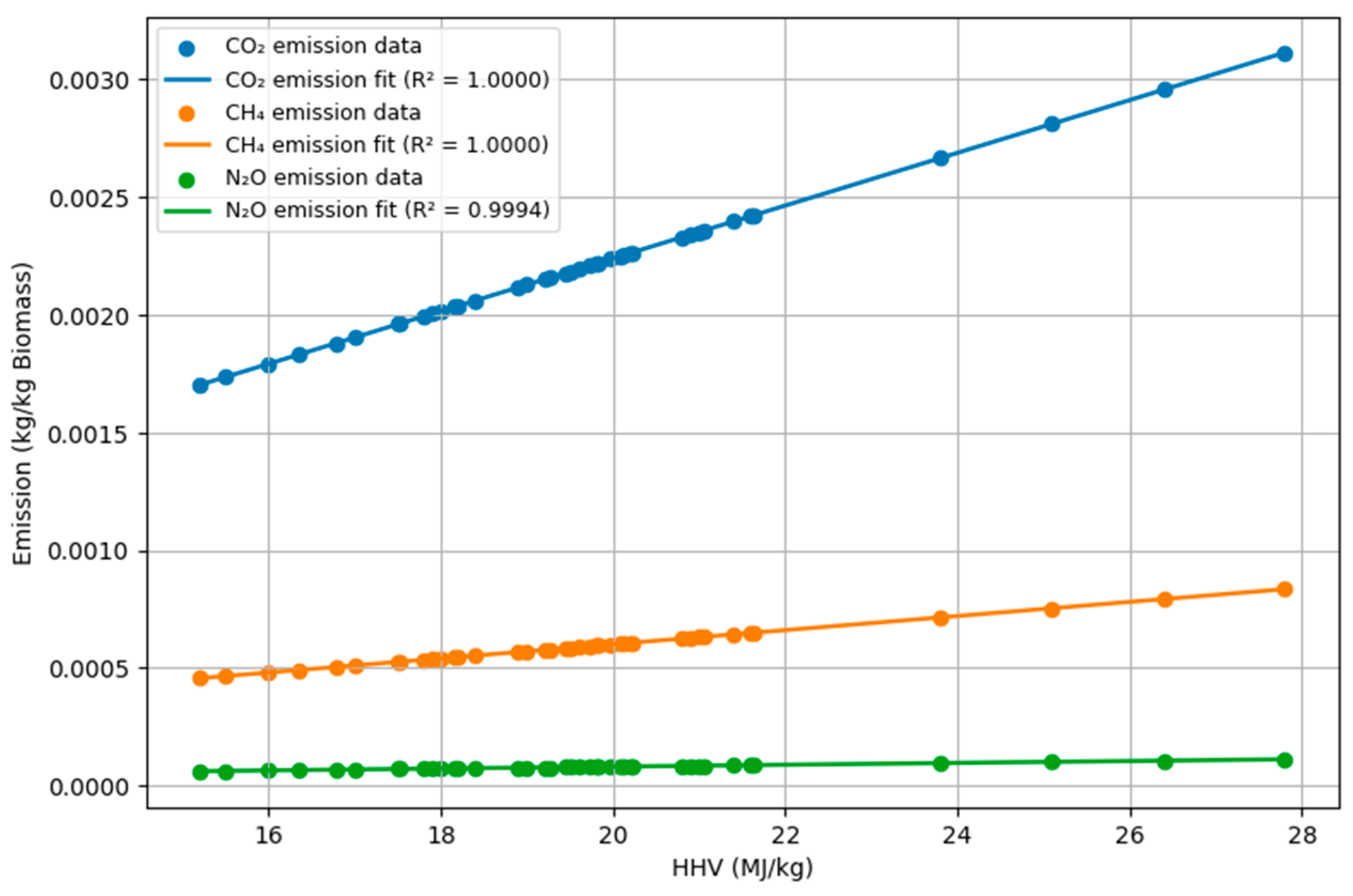
| No. | Biomass Sample | HHV (MJ kg−1) | CO2 Emissions (kg [kg Biomass] −1) × 10−5 | CH4 Emissions (kg [kg Biomass]−1) × 10−5 | N2O Emissions (kg [kg Biomass]−1) × 10−5 | IPCC-Based GWP (kg CO2eq) × 10−5 | Source |
|---|---|---|---|---|---|---|---|
| 1 | Bagasse | 17.5 | 196.0 | 52.5 | 7.0 | 3671.5 | [108] Kumar & Pratt (1996) |
| 2 | Rice husk | 15.2 | 170.2 | 45.6 | 6.1 | 3189.0 | |
| 3 | Rice straw | 15.5 | 173.6 | 46.5 | 6.2 | 3251.9 | |
| 4 | Wheat straw | 16.0 | 179.2 | 48.0 | 6.4 | 3356.8 | |
| 5 | Groundnut shell | 18.2 | 203.8 | 54.6 | 7.3 | 3818.4 | |
| 6 | Coconut shell | 20.8 | 233.0 | 62.4 | 8.3 | 4363.8 | |
| 7 | Wood | 19.6 | 219.5 | 58.8 | 7.8 | 4114.1 | |
| 8 | Sawdust | 18.9 | 211.7 | 56.7 | 7.6 | 3965.2 | |
| 9 | Bark | 19.8 | 221.8 | 59.4 | 7.9 | 4156.0 | |
| 10 | Beech wood | 19.2 | 215.0 | 57.6 | 7.7 | 4028.2 | [109] Demirbaş (1997) |
| 11 | Ailanthus wood | 19.0 | 212.8 | 57.0 | 7.6 | 3986.2 | |
| 12 | Corncob | 17.0 | 190.4 | 51.0 | 6.8 | 3566.6 | |
| 13 | Corn stover | 17.8 | 199.4 | 53.4 | 7.1 | 3734.4 | |
| 14 | Sunflower shell | 18.0 | 201.6 | 54.0 | 7.2 | 3776.4 | |
| 15 | Hazelnut shell | 20.2 | 226.2 | 60.6 | 8.1 | 4238.0 | |
| 16 | Walnut shell | 21.6 | 241.9 | 64.8 | 8.6 | 4531.7 | |
| 17 | Olive husk | 20.9 | 234.1 | 62.7 | 8.4 | 4384.8 | |
| 18 | Eucalyptus leaves | 21.0 | 235.2 | 63.0 | 8.4 | 4405.8 | [110] Núñez-Regueira et al. (2001) |
| 19 | Eucalyptus branches | 18.4 | 206.1 | 55.2 | 7.4 | 3860.3 | |
| 20 | Pinus wood | 20.2 | 226.2 | 60.6 | 8.1 | 4238.0 | |
| 21 | Pinus branches | 19.5 | 218.4 | 58.5 | 7.8 | 4093.1 | |
| 22 | Shrub (Erica arborea) | 21.4 | 239.7 | 64.2 | 8.6 | 4489.7 | |
| 23 | Poplar wood | 19.44 | 217.7 | 58.3 | 7.8 | 4078.5 | [111] Gravalos et al. (2016) |
| 24 | Willow wood | 19.26 | 215.7 | 57.8 | 7.7 | 4040.7 | |
| 25 | Eucalyptus wood | 19.83 | 222.1 | 59.5 | 7.9 | 4160.2 | |
| 26 | Pine wood | 20.12 | 225.3 | 60.4 | 8.0 | 4221.2 | |
| 27 | Oak wood | 19.97 | 223.7 | 59.9 | 8.0 | 4189.7 | |
| 28 | Wheat straw | 16.34 | 183.0 | 49.0 | 6.5 | 3428.1 | |
| 29 | Barley straw | 16.78 | 187.9 | 50.3 | 6.7 | 3520.4 | |
| 30 | Corn residues | 17.52 | 196.2 | 52.6 | 7.0 | 3675.7 | |
| 31 | Sunflower residues | 17.89 | 200.4 | 53.7 | 7.2 | 3753.3 | |
| 32 | Quercus robur | 19.73 | 221.0 | 59.2 | 7.9 | 4139.2 | [112] Cordero et al. (2001) |
| 33 | Pinus halepensis | 20.22 | 226.5 | 60.7 | 8.1 | 4242.2 | |
| 34 | Eucalyptus sp. | 20.08 | 224.9 | 60.2 | 8.0 | 4212.8 | |
| 35 | Wheat straw | 18.15 | 203.3 | 54.4 | 7.3 | 3807.8 | |
| 36 | Olive material | 21.06 | 235.9 | 63.2 | 8.4 | 4418.4 | |
| 37 | SCG (raw) | 21.64 | 242.4 | 64.9 | 8.7 | 4540.1 | [113] Park et al. (2021) |
| 38 | SCG hydrochar 180 °C | 23.8 | 266.6 | 71.4 | 9.5 | 4995.2 | |
| 39 | SCG hydrochar 200 °C | 25.1 | 281.1 | 75.3 | 10.0 | 5265.0 | |
| 40 | SCG hydrochar 220 °C | 26.4 | 295.7 | 79.2 | 10.6 | 5538.7 | |
| 41 | SCG hydrochar 240 °C | 27.8 | 311.4 | 83.4 | 11.1 | 5832.4 | |
| 42 | Alnus nepalensis | 17.932 | 200.8 | 53.8 | 7.2 | 3762.1 | [94] Shrestha et al. (2023) |
| 43 | Pinus roxburghii | 18.349 | 205.5 | 55.0 | 7.3 | 3849.6 | |
| 44 | Bambusa vulgaris | 17.310 | 193.9 | 51.9 | 6.9 | 3631.6 | |
| 45 | Eucalyptus camaldulensis | 17.105 | 191.6 | 51.3 | 6.8 | 3588.6 | |
| 46 | Bombax ceiba | 17.077 | 191.3 | 51.2 | 6.8 | 3582.8 | |
| 47 | Zea mays (cob) | 17.297 | 193.7 | 51.9 | 6.9 | 3628.9 | |
| 48 | Zea mays (shell) | 16.409 | 183.8 | 49.2 | 6.6 | 3442.6 | |
| 49 | Zea mays (stover) | 16.753 | 187.6 | 50.3 | 6.7 | 3514.8 | |
| 50 | Oryza sativa | 15.417 | 172.7 | 46.3 | 6.2 | 3234.5 | |
| 51 | Saccharum officinarum | 17.029 | 190.7 | 51.1 | 6.8 | 3572.7 |
Disclaimer/Publisher’s Note: The statements, opinions and data contained in all publications are solely those of the individual author(s) and contributor(s) and not of MDPI and/or the editor(s). MDPI and/or the editor(s) disclaim responsibility for any injury to people or property resulting from any ideas, methods, instructions or products referred to in the content. |
© 2026 by the authors. Licensee MDPI, Basel, Switzerland. This article is an open access article distributed under the terms and conditions of the Creative Commons Attribution (CC BY) license.
Share and Cite
Sirisomboon, P.; Gyawali, P.; Posom, J.; Lapcharoensuk, R.; Shrestha, B.P.; Funke, A. NIR Spectroscopy for Non-Destructive Prediction of Greenhouse Gas Emissions and Global Warming Potential by Biomass Combustion. Polymers 2026, 18, 1142. https://doi.org/10.3390/polym18091142
Sirisomboon P, Gyawali P, Posom J, Lapcharoensuk R, Shrestha BP, Funke A. NIR Spectroscopy for Non-Destructive Prediction of Greenhouse Gas Emissions and Global Warming Potential by Biomass Combustion. Polymers. 2026; 18(9):1142. https://doi.org/10.3390/polym18091142
Chicago/Turabian StyleSirisomboon, Panmanas, Prakash Gyawali, Jetsada Posom, Ravipat Lapcharoensuk, Bim Prasad Shrestha, and Axel Funke. 2026. "NIR Spectroscopy for Non-Destructive Prediction of Greenhouse Gas Emissions and Global Warming Potential by Biomass Combustion" Polymers 18, no. 9: 1142. https://doi.org/10.3390/polym18091142
APA StyleSirisomboon, P., Gyawali, P., Posom, J., Lapcharoensuk, R., Shrestha, B. P., & Funke, A. (2026). NIR Spectroscopy for Non-Destructive Prediction of Greenhouse Gas Emissions and Global Warming Potential by Biomass Combustion. Polymers, 18(9), 1142. https://doi.org/10.3390/polym18091142