Multi-Criteria Decision Analysis for Mechanical Recyclability Assessment of Different Types of PET Packaging Waste

 ,
,  ,
, 

Abstract
1. Introduction
2. Materials and Methods
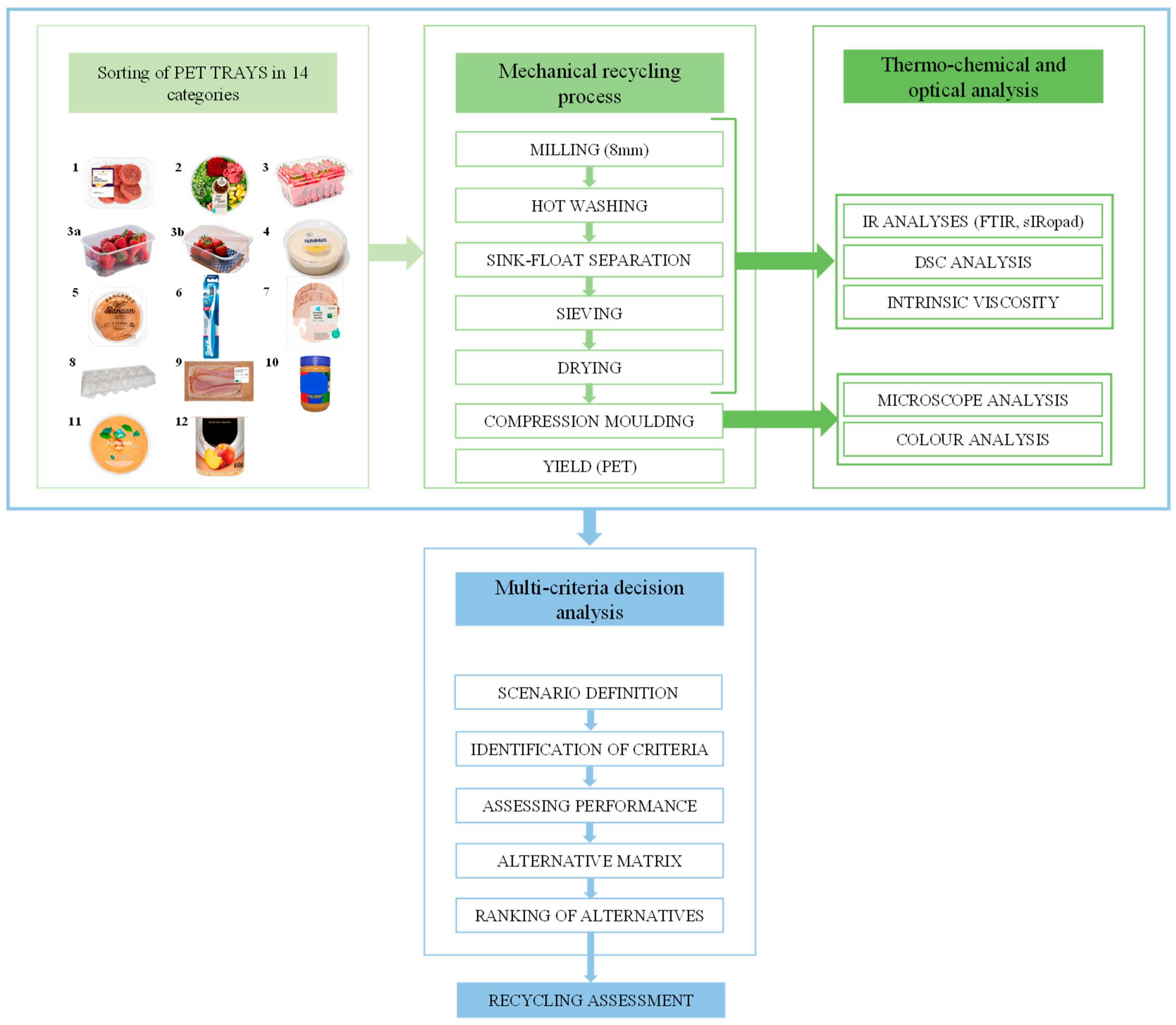
2.1. Framework of the Research
2.2. Materials
2.3. Methods
2.3.1. Mechanical Recycling
2.3.2. rPET Characterization
2.3.3. Mass Balance and Calculation of the Washing Process
2.3.4. Recyclability Assessment Method
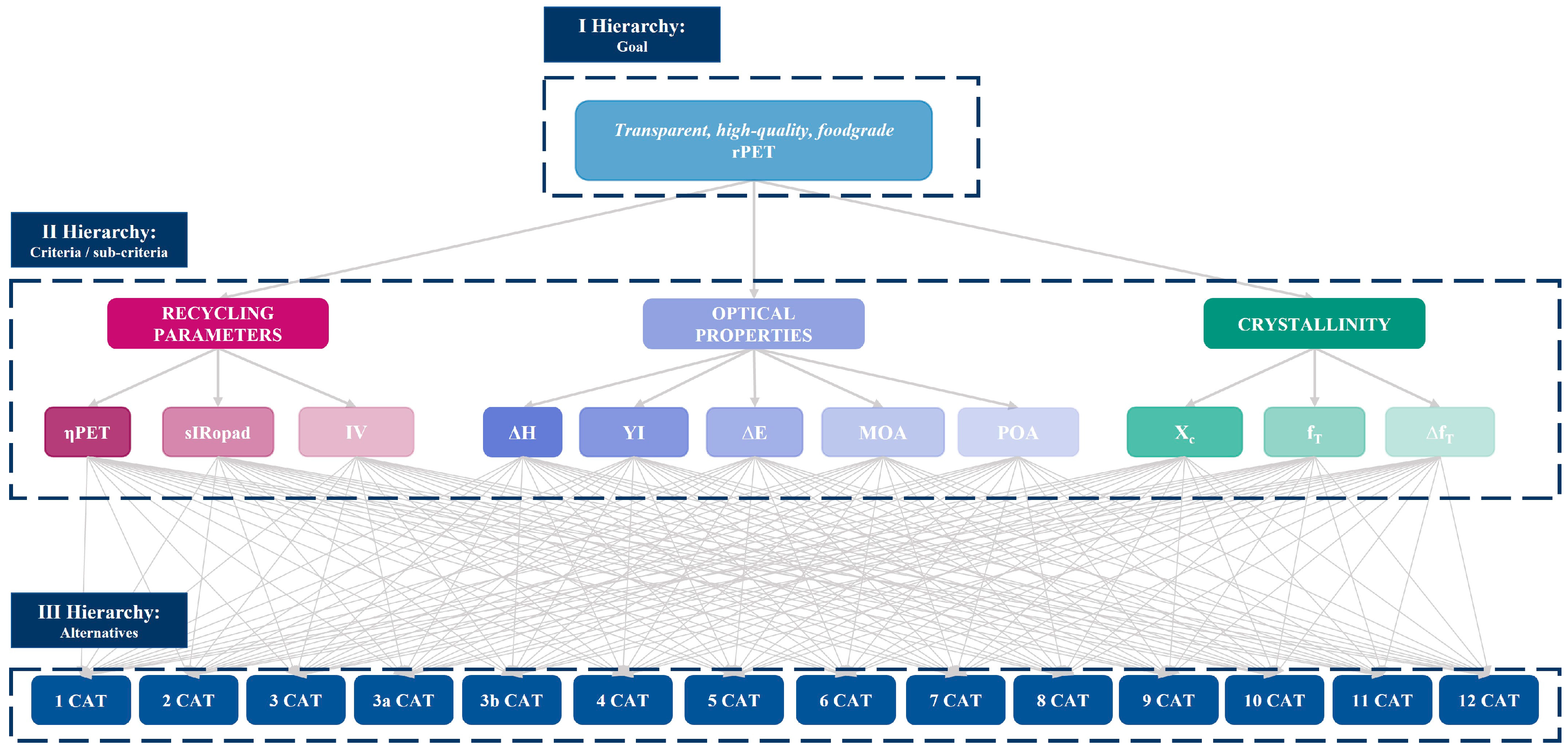
- The yield (ŋPET) of the recycling process, in terms of recovered PET, could quantify the weight losses due to milling and alkaline hot washing, measured as described in Section 2.3.3.
- The content of impurities (sIRopad) detected by IR and sIRopad analyses in the final flake samples allows the definition of how well the standard recycling process removes some contaminants [40].
- The intrinsic viscosity (IV) of the recycled PET polymer relates to its molecular weight and determines its properties and applicability. Each mechanical treatment causes a decrease in IV value and, also, the high level of moisture and impurities leads to the reduction in rPET intrinsic viscosity during mechanical treatments [41], especially after thermal processes.
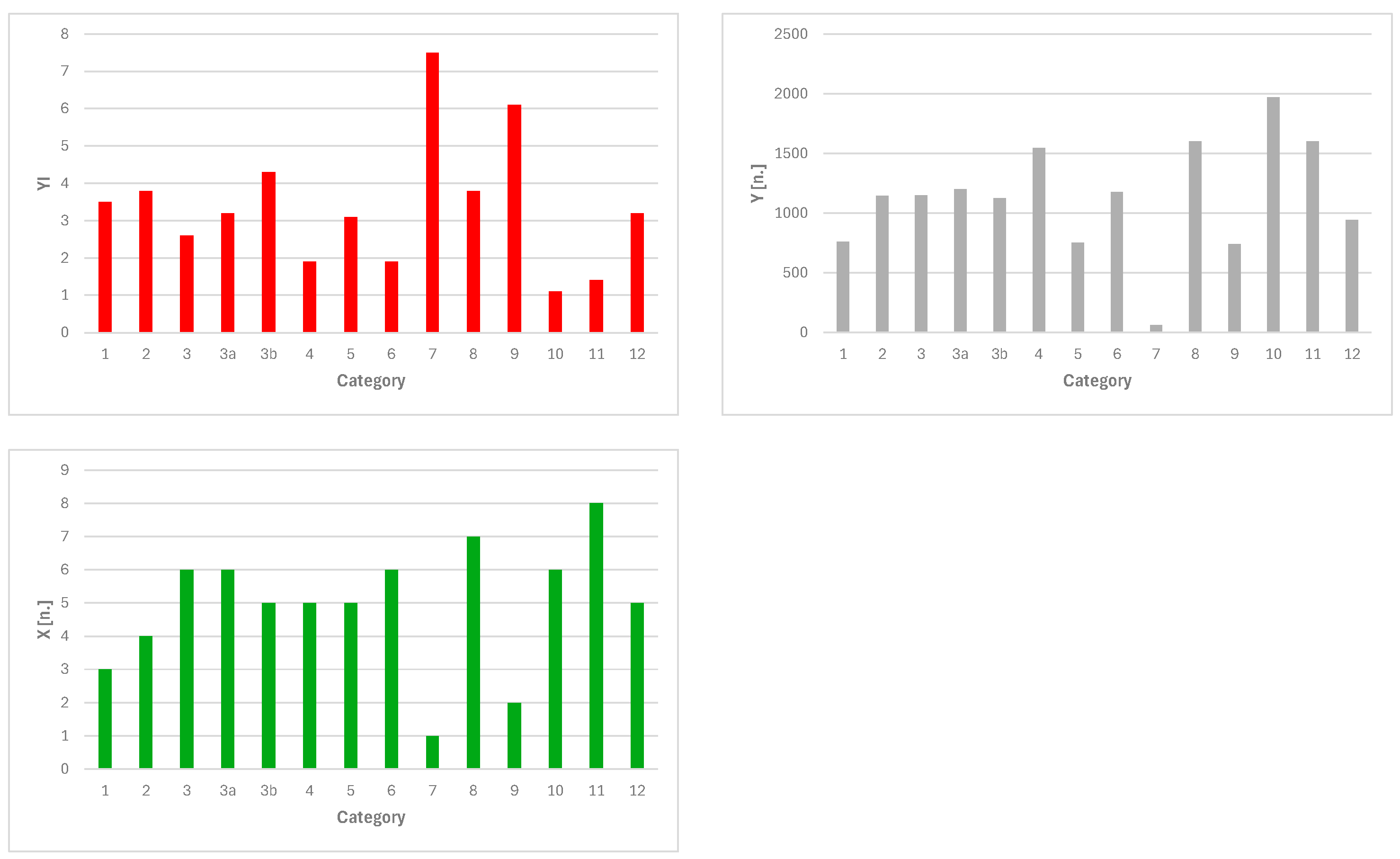
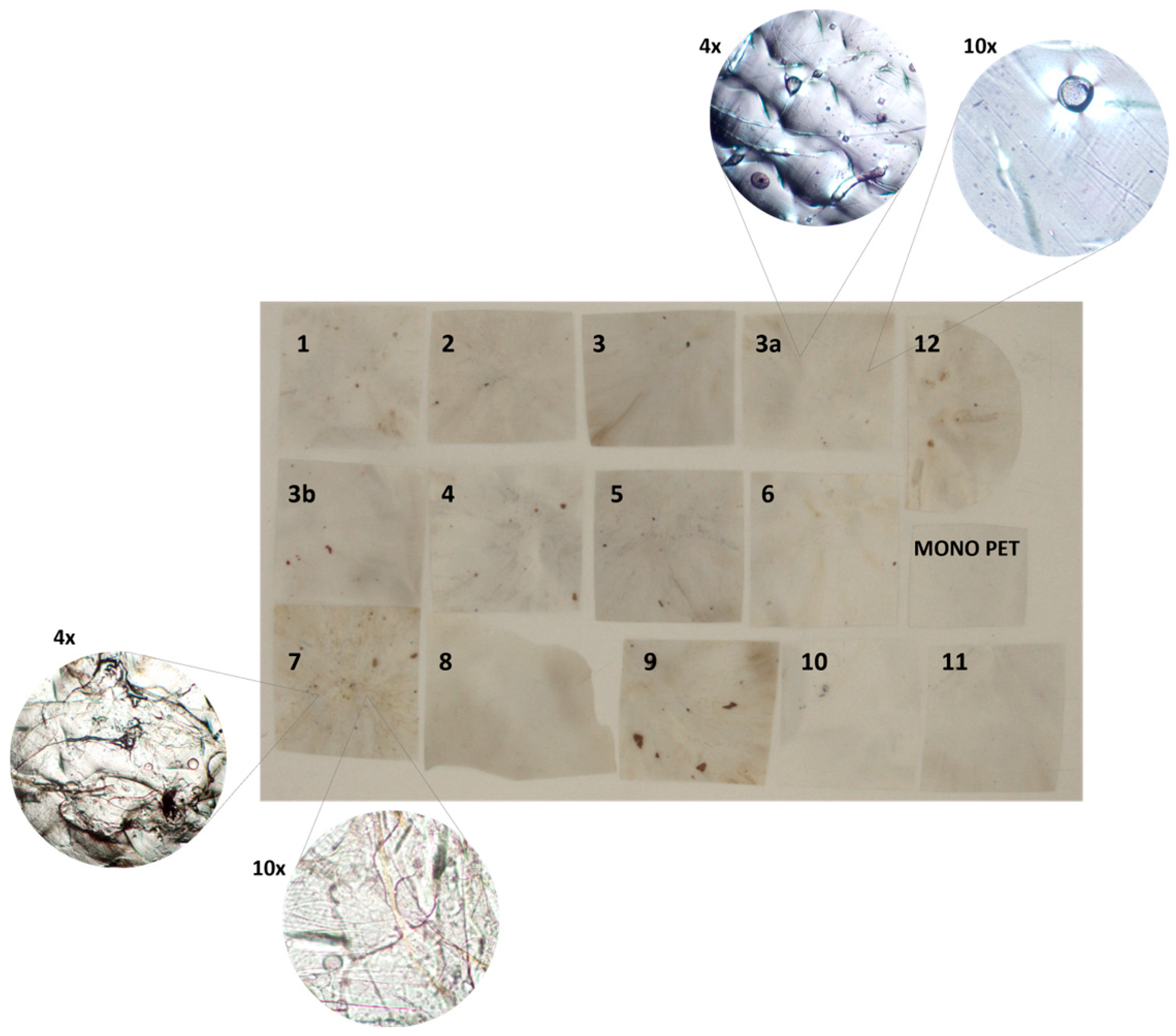
- The optical properties in terms of color (ΔE), yellowness (YI) and haze (ΔH) of the final obtained sheets and visually detected impurities (MOA: microscope optical analysis; POA: photo optical analysis). For PET packaging, optical properties, such as color and clarity, are key factors that may limit their applicability [5]. Also, the yellowing index contributes to determining the degree of degradation of rPET [46].
3. Results
3.1. Mechanical Recycling Process
3.1.1. Recycling Yield
3.1.2. Quality of the Recycled PET Made from Different PET Trays
3.2. Recyclability Assessment
4. Discussion
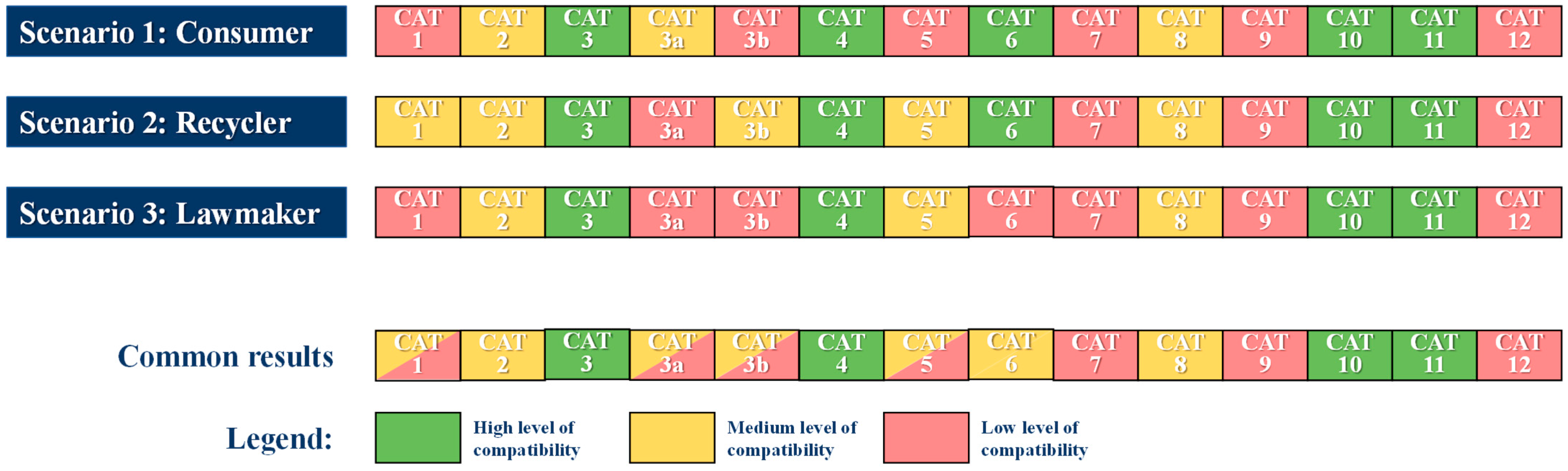
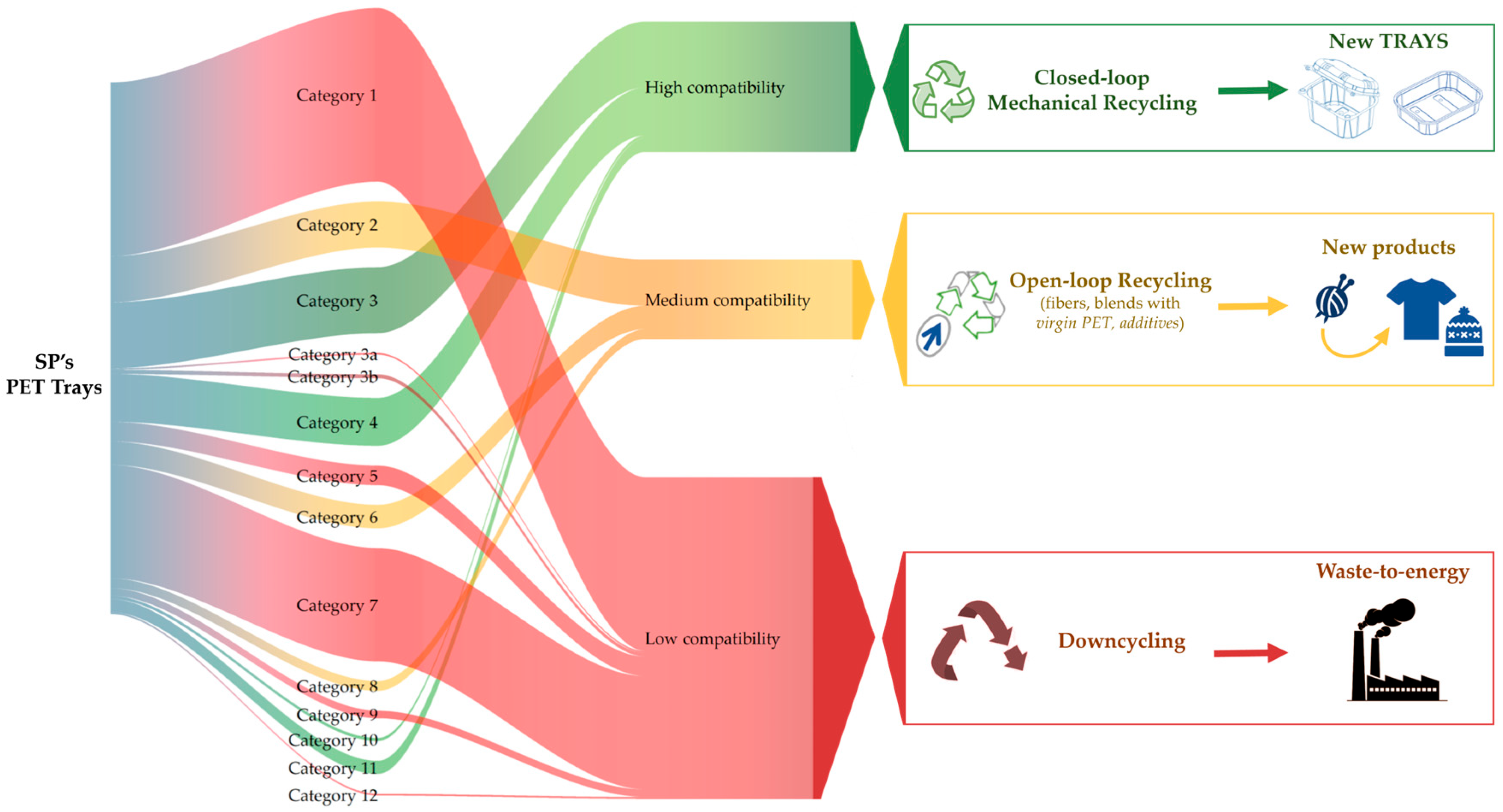
- Categories 3, 4, 10, and 11 were found to be highly recyclable via mechanical recycling and suitable for closed-loop recycling.
- Categories 2, 6 and 8 were classified with medium compatibility for mechanical recycling; the EoW pathway involves open-loop recycling in rPET.
- The largest number of sorted products (as evident in Figure 6), comprising 7 of the 14 categories (1, 3a, 3b, 5, 7, 9, and 12), had the lowest mechanical recycling compatibility.
5. Conclusions
- About 72% of sorted products (7 of the 14 categories) were recoverable through chemical or thermal recycling, which are considered secondary recycling processes, as they yield lower-value recovery compared to primary recycling, which maintains material quality and enables true closed-loop recycling.
- Only around 28% of the sorted products (from the remaining 7 categories) resulted in enabling mechanical recycling.
Supplementary Materials
Author Contributions
Funding
Institutional Review Board Statement
Data Availability Statement
Acknowledgments
Conflicts of Interest
Abbreviations
References
- EU. Regulation (EU) 2025/40 Regulation (EU) 2025/40 of the European Parliament and of the Council of 19 December 2024 on Packaging and Packaging Waste, Amending Regulation (EU) 2019/1020 and Directive (EU) 2019/904, and Repealing Directive 94/62/EC; EU: Luxembourg, 2024. [Google Scholar]
- Navarro, R.; Ferrándiz, S.; López, J.; Seguí, V.J. The Influence of Polyethylene in the Mechanical Recycling of Polyethylene Terephtalate. J. Mater. Process Technol. 2008, 195, 110–116. [Google Scholar] [CrossRef]
- Andreasi Bassi, S.; Tonini, D.; Saveyn, H.; Astrup, T.F. Environmental and Socioeconomic Impacts of Poly(Ethylene Terephthalate) (PET) Packaging Management Strategies in the EU. Environ. Sci. Technol. 2022, 56, 501–511. [Google Scholar] [CrossRef] [PubMed]
- Gracida-Alvarez, U.R.; Xu, H.; Benavides, P.T.; Wang, M.; Hawkins, T.R. Circular Economy Sustainability Analysis Framework for Plastics: Application for Poly(Ethylene Terephthalate) (PET). ACS Sustain. Chem. Eng. 2023, 11, 514–524. [Google Scholar] [CrossRef]
- Pinter, E.; Welle, F.; Mayrhofer, E.; Pechhacker, A.; Motloch, L.; Lahme, V.; Grant, A.; Tacker, M. Circularity Study on Pet Bottle-to-Bottle Recycling. Sustainability 2021, 13, 7370. [Google Scholar] [CrossRef]
- Brouwer, M.; Thoden van Velzen, E.U.; Augustinus, A.; Soethoudt, H.; De Meester, S.; Ragaert, K. Predictive Model for the Dutch Post-Consumer Plastic Packaging Recycling System and Implications for the Circular Economy. Waste Manag. 2018, 71, 62–85. [Google Scholar] [CrossRef]
- Santomasi, G.; Aquilino, R.; Brouwer, M.; De Gisi, S.; Smeding, I.; Todaro, F.; Notarnicola, M.; Thoden van Velzen, E.U. Strategies to Enhance the Circularity of Non-Bottle PET Packaging Waste Based on a Detailed Material Characterisation. Waste Manag. 2024, 186, 293–306. [Google Scholar] [CrossRef] [PubMed]
- Roosen, M.; Mys, N.; Kleinhans, K.; Lase, I.S.; Huysveld, S.; Brouwer, M.; Thoden van Velzen, E.U.; Van Geem, K.M.; Dewulf, J.; Ragaert, K.; et al. Expanding the Collection Portfolio of Plastic Packaging: Impact on Quantity and Quality of Sorted Plastic Waste Fractions. Resour. Conserv. Recycl. 2022, 178, 106025. [Google Scholar] [CrossRef]
- Thoden van Velzen, E.U.; Chu, S.; Molenveld, K.; Jašo, V. Effect of Poly Lactic Acid Trays on the Optical and Thermal Properties of Recycled Poly (Ethylene Terephthalate). Packag. Technol. Sci. 2022, 35, 351–360. [Google Scholar] [CrossRef]
- Tamizhdurai, P.; Mangesh, V.L.; Santhosh, S.; Vedavalli, R.; Kavitha, C.; Bhutto, J.K.; Alreshidi, M.A.; Yadav, K.K.; Kumaran, R. A State-of-the-Art Review of Multilayer Packaging Recycling: Challenges, Alternatives, and Outlook. J. Clean. Prod. 2024, 447, 141403. [Google Scholar] [CrossRef]
- Fabrizio, L.; Arrigo, R.; Scrivani, M.T.; Monti, M.; Fina, A. Upcycling of PET from Recycled Food Packaging Trays via Vitrimers Chemistry. Polymer 2023, 266, 125618. [Google Scholar] [CrossRef]
- Barredo, A.; Asueta, A.; Amundarain, I.; Leivar, J.; Miguel-Fernández, R.; Arnaiz, S.; Epelde, E.; López-Fonseca, R.; Gutiérrez-Ortiz, J.I. Chemical Recycling of Monolayer PET Tray Waste by Alkaline Hydrolysis. J. Environ. Chem. Eng. 2023, 11, 109823. [Google Scholar] [CrossRef]
- Ügdüler, S.; Van Geem, K.M.; Denolf, R.; Roosen, M.; Mys, N.; Ragaert, K.; De Meester, S. Towards Closed-Loop Recycling of Multilayer and Coloured PET Plastic Waste by Alkaline Hydrolysis. Green. Chem. 2020, 22, 5376–5394. [Google Scholar] [CrossRef]
- Eriksen, M.K.; Christiansen, J.D.; Daugaard, A.E.; Astrup, T.F. Closing the Loop for PET, PE and PP Waste from Households: Influence of Material Properties and Product Design for Plastic Recycling. Waste Manag. 2019, 96, 75–85. [Google Scholar] [CrossRef] [PubMed]
- Delva, L.; Deceur, C.; Van Damme, N.; Ragaert, K. Compatibilization of PET-PE Blends for the Recycling of Multilayer Packaging Foils. In Proceedings of the AIP Conference Proceedings; American Institute of Physics Inc.: College Park, MD, USA, 2019; Volume 2055. [Google Scholar] [CrossRef]
- Küppers, B.; Chen, X.; Seidler, I.; Friedrich, K.; Raulf, K.; Pretz, T.; Feil, A.; Pomberger, R.; Vollprecht, D. Influences and Consequences of Mechanical Delabelling on Pet Recycling. Detritus 2019, 6, 39–46. [Google Scholar] [CrossRef]
- Krehula, L.K.; Siročić, A.P.; Dukić, M.; Hrnjak-Murgić, Z. Cleaning Efficiency of Poly(Ethylene Terephthalate) Washing Procedure in Recycling Process. J. Elastomers Plast. 2013, 45, 429–444. [Google Scholar] [CrossRef]
- Seier, M.; Archodoulaki, V.M.; Koch, T.; Duscher, B.; Gahleitner, M. Polyethylene Terephthalate Based Multilayer Food Packaging: Deterioration Effects during Mechanical Recycling. Food Packag. Shelf Life 2022, 33, 100890. [Google Scholar] [CrossRef]
- Todaro, F.; Barjoveanu, G.; De Gisi, S.; Teodosiu, C.; Notarnicola, M. Sustainability Assessment of Reactive Capping Alternatives for the Remediation of Contaminated Marine Sediments. J. Clean. Prod. 2021, 286, 124946. [Google Scholar] [CrossRef]
- Vlachokostas, C.; Michailidou, A.V.; Achillas, C. Multi-Criteria Decision Analysis towards Promoting Waste-to-Energy Management Strategies: A Critical Review. Renew. Sustain. Energy Rev. 2021, 138, 110563. [Google Scholar] [CrossRef]
- Gomes, C.F.S.; Nunes, K.R.A.; Helena Xavier, L.; Cardoso, R.; Valle, R. Multicriteria Decision Making Applied to Waste Recycling in Brazil. Omega 2008, 36, 395–404. [Google Scholar] [CrossRef]
- Lerche, N.; Wilkens, I.; Schmehl, M.; Eigner-Thiel, S.; Geldermann, J. Using Methods of Multi-Criteria Decision Making to Provide Decision Support Concerning Local Bioenergy Projects. Socioecon. Plan. Sci. 2019, 68, 100594. [Google Scholar] [CrossRef]
- Soltani, A.; Sadiq, R.; Hewage, K. Selecting Sustainable Waste-to-Energy Technologies for Municipal Solid Waste Treatment: A Game Theory Approach for Group Decision-Making. J. Clean. Prod. 2016, 113, 388–399. [Google Scholar] [CrossRef]
- Gruene Punkt Gruener Punkt—Website. Available online: https://www.gruener-punkt.de/en/downloads (accessed on 5 September 2023).
- Thoden van Velzen, E.U.; Brouwer, M.T.; Molenveld, K. Technical Quality of RPET: Technical Quality of RPET That Can Be Obtained from Dutch PET Bottles That Have Been Collected, Sorted and Mechanically Recycled in Different Manners; (Report/Wageningen UR Food & Biobased Research; No. 1661); Wageningen UR Food & Biobased Research: Wageningen, The Netherlands, 2016; ISBN 9789462577237. Available online: https://edepot.wur.nl/392306 (accessed on 5 March 2026).
- Bauer, M.; Lehner, M.; Schwabl, D.; Flachberger, H.; Kranzinger, L.; Pomberger, R.; Hofer, W. Sink–Float Density Separation of Post-Consumer Plastics for Feedstock Recycling. J. Mater. Cycles Waste Manag. 2018, 20, 1781–1791. [Google Scholar] [CrossRef]
- Alvarado Chacon, F.; Brouwer, M.T.; Thoden van Velzen, E.U.; Smeding, I.W. A First Assessment of the Impact of Impurities in PP and PE Recycled Plastics; Wageningen Food & Biobased Research: Wageningen, The Netherlands, 2020. [Google Scholar] [CrossRef]
- Hoekstra, E.; Mieth, A.; Simoneau, C. Guidance for the Identification of Polymers in Multilayer Films Used in Food Contact Materials: User Guide of Selected Practices to Determine the Nature of Layers; Publications Office: Luxembourg, 2016. [Google Scholar] [CrossRef]
- Bertoldo, M.; Labardi, M.; Rotella, C.; Capaccioli, S. Enhanced Crystallization Kinetics in Poly(Ethylene Terephthalate) Thin Films Evidenced by Infrared Spectroscopy. Polymer 2010, 51, 3660–3668. [Google Scholar] [CrossRef]
- Kumagai, M.; Kumagai, M.; Suyama, H.; Sato, T.; Amano, T.; Ogawa, N. Discrimination of Plastics Using a Portable NIR Spectrometer Discrimination of Plastics Using a Portable near Infrared Spectrometer. J. Near Infrared Spectrosc. 2002, 10, 247–255. [Google Scholar] [CrossRef]
- Masoumi, H.; Safavi, S.M. Identification and Classification of Plastic Resins Using near Infrared Reflectance Spectroscopy. Int. J. Mech. Ind. Eng. 2012, 6, 213–220. [Google Scholar] [CrossRef]
- Rani, M.; Marchesi, C.; Federici, S.; Rovelli, G.; Alessandri, I.; Vassalini, I.; Ducoli, S.; Borgese, L.; Zacco, A.; Bilo, F.; et al. Miniaturized Near-Infrared (MicroNIR) Spectrometer in Plastic Waste Sorting. Materials 2019, 12, 2740. [Google Scholar] [CrossRef]
- He, J.J.; Gilpatrick, B. Applications of DSC in conjunction with FTIR in plastic identification. In SPE/ANTEC 1999 Proceedings (Society of Plastics Engineers Annual Technical Conference and Exhibit); CRC Press: Boca Raton, FL, USA, 1999. [Google Scholar]
- Torres, N.; Robin, J.J.; Boutevin, B.; Re, C.E.; Ma, P. Study of Thermal and Mechanical Properties of Virgin and Recycled Poly(Ethylene Terephthalate) before and after Injection Molding. Eur. Polym. J. 1999, 36, 2075–2080. [Google Scholar] [CrossRef]
- Hosseini, S.S.; Taheri, S.; Zadhoush, A.; Mehrabani-Zeinabad, A. Hydrolytic Degradation of Poly(Ethylene Terephthalate). J. Appl. Polym. Sci. 2007, 103, 2304–2309. [Google Scholar] [CrossRef]
- Billmeyer, F.W. Methods for Estimating Intrinsic Viscosity. J. Polym. Sci. 1949, 4, 83–86. [Google Scholar] [CrossRef]
- Adebayo, G.O.; Yahya, R. Characterisation of Heat Modified Mangrove Fibre for Polymer Composite Applications. In Proceedings of the Scholar Summit 2017 Conference, Depok, Indonesia, 10–11 October 2017. [Google Scholar]
- Arrieta, M.P.; López, J.; Ferrándiz, S.; Peltzer, M.A. Characterization of PLA-Limonene Blends for Food Packaging Applications. Polym. Test. 2013, 32, 760–768. [Google Scholar] [CrossRef]
- Boehme, M.; Charton, C. Properties of ITO on PET Film in Dependence on the Coating Conditions and Thermal Processing. Surf. Coat. Technol. 2005, 200, 932–935. [Google Scholar] [CrossRef]
- Thoden van Velzen, E.U.; Jansen, M.; Brouwer, M.T.; Feil, A.; Molenveld, K.; Pretz, T. Efficiency of Recycling Post-Consumer Plastic Packages. In Proceedings of the AIP Conference Proceedings; American Institute of Physics Inc.: College Park, MD, USA, 2017; Volume 1914. [Google Scholar] [CrossRef]
- Oromiehie, A.; Mamizadeh, A. Recycling PET Beverage Bottles and Improving Properties. Polym. Int. 2004, 53, 728–732. [Google Scholar] [CrossRef]
- Awaja, F.; Pavel, D. Recycling of PET. Eur. Polym. J. 2005, 41, 1453–1477. [Google Scholar] [CrossRef]
- Everall, N.; Mackerron, D.; Winter, D. Characterisation of Biaxial Orientation Gradients in Poly(Ethylene Terephthalate) films and Bottles Using Polarised Attenuated Total Reflection FTIR Spectroscopy. Polymer 2002, 43, 4217–4223. [Google Scholar] [CrossRef]
- Badía, J.D.; Vilaplana, F.; Karlsson, S.; Ribes-Greus, A. Thermal Analysis as a Quality Tool for Assessing the Influence of Thermo-Mechanical Degradation on Recycled Poly(Ethylene Terephthalate). Polym. Test. 2009, 28, 169–175. [Google Scholar] [CrossRef]
- Badia, J.D.; Strömberg, E.; Karlsson, S.; Ribes-Greus, A. The Role of Crystalline, Mobile Amorphous and Rigid Amorphous Fractions in the Performance of Recycled Poly (Ethylene Terephthalate) (PET). Polym. Degrad. Stab. 2012, 97, 98–107. [Google Scholar] [CrossRef]
- Alvarado Chacon, F.; Brouwer, M.T.; Thoden van Velzen, E.U. Effect of Recycled Content and RPET Quality on the Properties of PET Bottles, Part I: Optical and Mechanical Properties. Packag. Technol. Sci. 2020, 33, 347–357. [Google Scholar] [CrossRef]
- Braun, A.B.; Trentin, A.W.D.S.; Visentin, C.; Thomé, A. Proposal for an Optimized Method for Sustainable Remediation Evaluation and Application: Implementation of a Multi-Criteria Process. Environ. Sci. Pollut. Res. 2019, 26, 35996–36006. [Google Scholar] [CrossRef] [PubMed]
- Goletsis, Y.; Psarras, J.; Samouilidis, J.-E. Project Ranking in the Armenian Energy Sector Using a Multicriteria Method for Groups; Kluwer Academic Publishers: Dordrecht, The Netherlands, 2003; Volume 120. [Google Scholar]
- Simmonds, G.; Spence, C. Thinking inside the Box: How Seeing Products on, or through, the Packaging Influences Consumer Perceptions and Purchase Behaviour. Food Qual. Prefer. 2017, 62, 340–351. [Google Scholar] [CrossRef]
- Kuang, T.Y.; Yang, D.; Zou, D. The Impact of Transparent Packaging: How Transparent Packaging for Organic Foods Affects Tourists’ Green Purchasing Behavior. Front. Nutr. 2024, 11, 1328596. [Google Scholar] [CrossRef]
- Li-Na, J. Study on Preparation Process and Properties of Polyethylene Terephthalate (Pet). Appl. Mech. Mater. 2013, 312, 406–410. [Google Scholar] [CrossRef]
- Sanches, N.B.; Dias, M.L.; Pacheco, E.B.A.V. Comparative Techniques for Molecular Weight Evaluation of Poly (Ethylene Terephthalate) (PET). Polym. Test. 2005, 24, 688–693. [Google Scholar] [CrossRef]
- Benyathiar, P.; Kumar, P.; Carpenter, G.; Brace, J.; Mishra, D.K. Polyethylene Terephthalate (PET) Bottle-to-Bottle Recycling for the Beverage Industry: A Review. Polymers 2022, 14, 2366. [Google Scholar] [CrossRef]
- Berg, D.; Schaefer, K.; Koerner, A.; Kaufmann, R.; Tillmann, W.; Moeller, M. Reasons for the Discoloration of Postconsumer Poly(Ethylene Terephthalate) during Reprocessing. Macromol. Mater. Eng. 2016, 301, 1454–1467. [Google Scholar] [CrossRef]
- Franz, R.; Welle, F. Recycled Poly(Ethylene Terephthalate) for Direct Food Contact Applications: Challenge Test of an Inline Recycling Process. Food Addit. Contam. 2002, 19, 502–511. [Google Scholar] [CrossRef]
- Franz, R.; Welle, F. Contamination Levels in Recollected PET Bottles from Non-Food Applications and Their Impact on the Safety of Recycled PET for Food Contact. Molecules 2020, 25, 4998. [Google Scholar] [CrossRef]
- Barthélémy, E.; Spyropoulos, D.; Milana, M.R.; Pfaff, K.; Gontard, N.; Lampi, E.; Castle, L. Safety Evaluation of Mechanical Recycling Processes Used to Produce Polyethylene Terephthalate (PET) Intended for Food Contact Applications. Food Addit. Contam.—Part A 2014, 31, 490–497. [Google Scholar] [CrossRef]
- Geueke, B.; Groh, K.; Muncke, J. Food Packaging in the Circular Economy: Overview of Chemical Safety Aspects for Commonly Used Materials. J. Clean. Prod. 2018, 193, 491–505. [Google Scholar] [CrossRef]
- Chairat, S.; Gheewala, S.H. Life Cycle Assessment and Circularity of Polyethylene Terephthalate Bottles via Closed and Open Loop Recycling. Environ. Res. 2023, 236, 116788. [Google Scholar] [CrossRef]
- Chilton, T.; Burnley, S.; Nesaratnam, S. A Life Cycle Assessment of the Closed-Loop Recycling and Thermal Recovery of Post-Consumer PET. Resour. Conserv. Recycl. 2010, 54, 1241–1249. [Google Scholar] [CrossRef]
- Rieckmann, T.; Frei, F.; Völker, S. Modelling of PET Quality Parameters for a Closed-Loop Recycling System for Food Contact. In Proceedings of the Macromolecular Symposia; WILEY-VCH Verlag: Weinheim, Germany, 2011; Volume 302, pp. 34–45. [Google Scholar] [CrossRef]
- Kiliaris, P.; Papaspyrides, C.D.; Pfaendner, R. Reactive-Extrusion Route for the Closed-Loop Recycling of Poly(Ethylene Terephthalate). J. Appl. Polym. Sci. 2007, 104, 1671–1678. [Google Scholar] [CrossRef]
- Trossaert, L.; De Vel, M.; Cardon, L.; Edeleva, M. Lifting the Sustainability of Modified PET-Based Multilayer Packaging Material with Enhanced Mechanical Recycling Potential and Processing. Polymers 2022, 14, 196. [Google Scholar] [CrossRef]
- La Mantia, F.P. Polymer Mechanical Recycling: Downcycling or Upcycling? Prog. Rubber Plast. Recycl. Technol. 2004, 20, 11–24. [Google Scholar]
- Mulakkal, M.C.; Castillo Castillo, A.; Taylor, A.C.; Blackman, B.R.K.; Balint, D.S.; Pimenta, S.; Charalambides, M.N. Advancing Mechanical Recycling of Multilayer Plastics through Finite Element Modelling and Environmental Policy. Resour. Conserv. Recycl. 2021, 166, 105371. [Google Scholar] [CrossRef]
- Liu, Y.; Xu, H.; Liu, G.; Pu, S. Core/Shell Morphologies in Recycled Poly(Ethylene Terephthalate)/Linear Low-Density Polyethylene/Poly(Styrene-b-(Ethylene-Co-Butylene)-b-Styrene) Ternary Blends. Polym. Bull. 2017, 74, 4223–4233. [Google Scholar] [CrossRef]
- Abdel Tawab, K.; Ibrahim, S.M.; Magida, M.M. The Effect of Gamma Irradiation on Mechanical, and Thermal Properties of Recycling Polyethylene Terephthalate and Low Density Polyethylene (R-PET/LDPE) Blend Compatibilized by Ethylene Vinyl Acetate (EVA). J. Radioanal. Nucl. Chem. 2013, 295, 1313–1319. [Google Scholar] [CrossRef]
- Lei, Y.; Wu, Q.; Clemons, C.M.; Guo, W. Phase Structure and Properties of Poly(Ethylene Terephthalate)/High-Density Polyethylene Based on Recycled Materials. J. Appl. Polym. Sci. 2009, 113, 1710–1719. [Google Scholar] [CrossRef]
- Zhang, Y.; Zhang, H.; Yu, Y.; Guo, W.; Wu, C. Recycled Poly(Ethylene Terephthalate)/Linear Low-Density Polyethylene Blends through Physical Processing. J. Appl. Polym. Sci. 2009, 114, 1187–1194. [Google Scholar] [CrossRef]
- Gouissem, L.; Douibi, A.; Benachour, D. The Evolution of Properties of Recycled Poly(Ethylene Terephthalate) as Function of Chain Extenders, the Extrusion Cycle and Heat Treatment. Polym. Sci.—Ser. A 2014, 56, 844–855. [Google Scholar] [CrossRef]
- Allen, N.S.; Edge, M.; Hussain, S. Perspectives on Yellowing in the Degradation of Polymer Materials: Inter-Relationship of Structure, Mechanisms and Modes of Stabilisation. Polym. Degrad. Stab. 2022, 201, 109977. [Google Scholar] [CrossRef]
- Welle, F. Simulation of the Decontamination Efficiency of PET Recycling Processes Based on Solid-State Polycondensation. Packag. Technol. Sci. 2014, 27, 141–148. [Google Scholar] [CrossRef]
- Fitaroni, L.B.; de Oliveira, É.C.; Marcomini, A.L.; Paranhos, C.M.; Freitas, F.L.; Cruz, S.A. Reprocessing and Solid State Polymerization on Contaminated Post-Consumer PET: Thermal and Crystallization Behavior. J. Polym. Environ. 2020, 28, 91–99. [Google Scholar] [CrossRef]
- Enache, A.-C.; Grecu, I.; Samoila, P. Polyethylene Terephthalate (PET) Recycled by Catalytic Glycolysis: A Bridge toward Circular Economy Principles. Materials 2024, 17, 2991. [Google Scholar] [CrossRef]
- Karayannidis, G.P.; Achilias, D.S. Chemical Recycling of Poly(Ethylene Terephthalate). Macromol. Mater. Eng. 2007, 292, 128–146. [Google Scholar] [CrossRef]
- Crippa, M.; Morico, B. PET Depolymerization: A Novel Process for Plastic Waste Chemical Recycling. Stud. Surf. Sci. Catal. 2019, 179, 215–229. [Google Scholar] [CrossRef]
- Ügdüler, S.; Van Geem, K.M.; Roosen, M.; Delbeke, E.I.P.; De Meester, S. Challenges and Opportunities of Solvent-Based Additive Extraction Methods for Plastic Recycling. Waste Manag. 2020, 104, 148–182. [Google Scholar] [CrossRef]
- Dogu, O.; Pelucchi, M.; Van de Vijver, R.; Van Steenberge, P.H.M.; D’hooge, D.R.; Cuoci, A.; Mehl, M.; Frassoldati, A.; Faravelli, T.; Van Geem, K.M. The Chemistry of Chemical Recycling of Solid Plastic Waste via Pyrolysis and Gasification: State-of-the-Art, Challenges, and Future Directions. Prog. Energy Combust. Sci. 2021, 84, 100901. [Google Scholar] [CrossRef]
- Vuppaladadiyam, S.S.V.; Vuppaladadiyam, A.K.; Sahoo, A.; Urgunde, A.; Murugavelh, S.; Šrámek, V.; Pohořelý, M.; Trakal, L.; Bhattacharya, S.; Sarmah, A.K.; et al. Waste to Energy: Trending Key Challenges and Current Technologies in Waste Plastic Management. Sci. Total Environ. 2024, 913, 169436. [Google Scholar] [CrossRef]
- Alassali, A.; Picuno, C.; Chong, Z.K.; Guo, J.; Maletz, R.; Kuchta, K. Towards Higher Quality of Recycled Plastics: Limitations from the Material’s Perspective. Sustainability 2021, 13, 13266. [Google Scholar] [CrossRef]
- Ding, Q.; Zhu, H. The Key to Solving Plastic Packaging Wastes: Design for Recycling and Recycling Technology. Polymers 2023, 15, 1485. [Google Scholar] [CrossRef]
- Soares, C.T.D.M.; Ek, M.; Östmark, E.; Gällstedt, M.; Karlsson, S. Recycling of Multi-Material Multilayer Plastic Packaging: Current Trends and Future Scenarios. Resour. Conserv. Recycl. 2022, 176, 105905. [Google Scholar] [CrossRef]
- European Parliament and Council. Directive (EU) 2018/852 Amending Directive 94/62/EC on Packaging and Packaging Waste; European Parliament and Council: Brussels, Belgium, 2018. [Google Scholar]
- Li, H.; Aguirre-Villegas, H.A.; Allen, R.D.; Bai, X.; Benson, C.H.; Beckham, G.T.; Bradshaw, S.L.; Brown, J.L.; Brown, R.C.; Cecon, V.S.; et al. Expanding Plastics Recycling Technologies: Chemical Aspects, Technology Status and Challenges. Green. Chem. 2022, 24, 8899–9002. [Google Scholar] [CrossRef]
- Tomić, T.; Schneider, D.R. The Role of Energy from Waste in Circular Economy and Closing the Loop Concept—Energy Analysis Approach. Renew. Sustain. Energy Rev. 2018, 98, 268–287. [Google Scholar] [CrossRef]
- Vlasopoulos, A.; Malinauskaite, J.; Żabnieńska-Góra, A.; Jouhara, H. Life Cycle Assessment of Plastic Waste and Energy Recovery. Energy 2023, 277, 127576. [Google Scholar] [CrossRef]
- Venkatachalam, V.; Pohler, M.; Spierling, S.; Nickel, L.; Barner, L.; Endres, H.J. Design for Recycling Strategies Based on the Life Cycle Assessment and End of Life Options of Plastics in a Circular Economy. Macromol. Chem. Phys. 2022, 223, 2200046. [Google Scholar] [CrossRef]
- Bauer, A.S.; Tacker, M.; Uysal-Unalan, I.; Cruz, R.M.S.; Varzakas, T.; Krauter, V. Recyclability and Redesign Challenges in Multilayer Flexible Food Packaging—A Review. Foods 2021, 10, 2702. [Google Scholar] [CrossRef]
- Berkowitz, S. Viscosity-Molecular Weight Relationships for Poly(Ethy1ene Terephthalate) in Hexafluoroisopropanol-Pentafluorophenol Using SEC-LALLS. J. Appl. Polym. Sci. 1984, 29, 4353–4361. [Google Scholar] [CrossRef]
- Saberi, B.; Thakur, R.; Vuong, Q.V.; Chockchaisawasdee, S.; Golding, J.B.; Scarlett, C.J.; Stathopoulos, C.E. Optimization of Physical and Optical Properties of Biodegradable Edible Films Based on Pea Starch and Guar Gum. Ind. Crops Prod. 2016, 86, 342–352. [Google Scholar] [CrossRef]
- Candal, M.V.; Safari, M.; Fernández, M.; Otaegi, I.; Múgica, A.; Zubitur, M.; Gerrica-Echevarria, G.; Sebastián, V.; Irusta, S.; Loaeza, D.; et al. Structure and Properties of Reactively Extruded Opaque Post-Consumer Recycled PET. Polymers 2021, 13, 3531. [Google Scholar] [CrossRef]
- Cole, K.C.; Ajjii, A.; Pellerin, É. New Insights into the Development of Ordered Structure in Poly(Ethylene Terephthalate). 1. Results from External Reflection Infrared Spectroscopy. Macromolecules 2002, 35, 770–784. [Google Scholar] [CrossRef]
- Dubelley, F.; Planes, E.; Bas, C.; Pons, E.; Yrieix, B.; Flandin, L. The Hygrothermal Degradation of PET in Laminated Multilayer. Eur. Polym. J. 2017, 87, 1–13. [Google Scholar] [CrossRef]
- Kong, Y.; Hay, J.N. The Measurement of the Crystallinity of Polymers by DSC. Polymer 2002, 43, 3873–3878. [Google Scholar] [CrossRef]
- Olabisi, O.; Adewale, K.P. Handbook of Thermoplastics, 2nd ed.; CRC Press: Boca Raton, FL, USA, 2016; Plastics Engineering; Volume 41. [Google Scholar]
- Bashir, Z.; Al-Aloush, I.; Al-Raqibah, I.; Ibrahim, M. Evaluation of Three Methods for the Measurement of Crystallinity of PET Resins, Preforms, and Bottles. Polym. Eng. Sci. 2000, 40, 2442–2455. [Google Scholar] [CrossRef]
- Demirel, B.; Yaraș, A.; Elçiçek, H. Crystallization Behavior of PET Materials. BAÜ Fen Bil. Enst. Derg. 2011, 13, 26–35. [Google Scholar]



| Method | Instrument | Parameter | Reference |
|---|---|---|---|
| Infrared (IR) spectroscopy analysis | IoSys-SIROpad NIR analyzer (IOSYS GmbH, Steinhauserstrasse 14, Ratingen, Germany) | PET content in rPET flakes | [27] |
| Bruker Alpha Fourier Transform IR (FTIR) (Bruker Nederland BV, Elisabethhof 15, Leiderdorp, The Netherlands) | Fraction of glycol moieties in the trans configuration | [28,29,30,31,32] | |
| Differential scanning calorimetry (DSC) analysis | Perkin-Elmer DSC-8000 calorimeter (Perkin-Elmer Nederland BV, Nieuwe Langeweg 41, Hoogvliet, The Netherlands) | Crystallinity degree | [33,34] |
| Intrinsic Viscosity (IV) measurement | Schott Geräte CT1250 Schott Geräte AVS350 (Schott Benelux BV, Randweg 3A, Rotterdam, The Netherlands) | Intrinsic viscosity η Molecular weight | [35,36] |
| Microscope optical analysis (MOA) | Konica Minolta Chroma meter CR—5 (Konica Minolta business solutions BV, Capellalaan 65, Hoofddorp, The Netherlands) | Total color difference ΔE Yellowness index YI | [37,38] |
| Photos optical analysis (POA) | BRESSER Science MPO 401 Microscope MikroCam II 20 MP 1 “Lightening cabinet” (Bresser GmbH, Gutenbergstrasse 2, Rhede, Germany) | Visible impurities (counts X and Y) | [39] |
| (a) | SUB-CRITERIA | ||
| Criteria | ID Criteria | Order of Priority of the Evaluation Sub-Criteria | |
| Recycling Parameters | RP | ηPET > sIRopad > IV | |
| Optical Properties | OP | ΔH > YI = ΔE > MOA > POA | |
| Crystallinity | C | DSC > fT > ΔfT | |
| (b) | STAKEHOLDER SCENARIOS | ||
| Stakeholder Scenario | ID Scenario | Order of Priority of the Evaluation Criteria | |
| Consumer | Scenario 1 | OP > RP > C | |
| Recycler | Scenario 2 | RP > C > OP | |
| Lawmaker | Scenario 3 | RP = OP > C | |
| CAT | ŋPET [%] | sIRopad [%] | IV [dL/g] | Xc [%] | fT (Tray) [%] | fT (Flakes) [%] | ∆H [%] | ∆E [-] | YI [-] | Y [n.] | X [n.] |
|---|---|---|---|---|---|---|---|---|---|---|---|
| 1 | 91.84 | 98.2 | 0.62 | 34 | 0.12 | 0.27 | 62 | 1.1 | 3.5 | 760 | 3 |
| 2 | 89.40 | 100 | 0.63 | 38 | 0.11 | 0.22 | 69 | 1.0 | 3.8 | 1147 | 4 |
| 3 | 89.74 | 99.72 | 0.60 | 33 | 0.106 | 0.12 | 35 | 1.0 | 2.6 | 1148 | 6 |
| 3a | 75.97 | 100 | 0.60 | 33 | 0.14 | 0.25 | 52 | 0.9 | 3.2 | 1200 | 6 |
| 3b | 91.08 | 100 | 0.61 | 32 | 0.13 | 0.50 | 78 | 1.3 | 4.3 | 1127 | 5 |
| 4 | 81.85 | 99.7 | 0.60 | 33 | 0.12 | 0.21 | 22 | 0.4 | 1.9 | 1544 | 5 |
| 5 | 90.08 | 96.8 | 0.62 | 30 | 0.11 | 0.28 | 50 | 0.8 | 3.1 | 753 | 5 |
| 6 | 91.74 | 99.8 | 0.66 | 32 | 0.11 | 0.27 | 23 | 0.03 | 1.9 | 1176 | 6 |
| 7 | 92.21 | 87.4 | 0.61 | 32 | 0.12 | 0.24 | 148 | 0.9 | 7.5 | 62 | 1 |
| 8 | 84.95 | 99.998 | 0.58 | 34 | 0.10 | 0.28 | 66 | 0.5 | 3.8 | 1600 | 7 |
| 9 | 79.07 | 93.44 | 0.60 | 34.5 | 0.10 | 0.25 | 120 | 0.6 | 6.1 | 740 | 2 |
| 10 | 86.74 | 99.9 | 0.70 | 34 | 0.23 | 0.26 | 5 | 0.4 | 1.1 | 1970 | 6 |
| 11 | 90.07 | 99.2 | 0.57 | 34 | 0.10 | 0.28 | 12 | 0.2 | 1.4 | 1600 | 8 |
| 12 | 75.70 | 99.5 | 0.62 | 34 | 0.14 | 0.17 | 55 | 0.3 | 3.2 | 945 | 5 |
Disclaimer/Publisher’s Note: The statements, opinions and data contained in all publications are solely those of the individual author(s) and contributor(s) and not of MDPI and/or the editor(s). MDPI and/or the editor(s) disclaim responsibility for any injury to people or property resulting from any ideas, methods, instructions or products referred to in the content. |
© 2026 by the authors. Licensee MDPI, Basel, Switzerland. This article is an open access article distributed under the terms and conditions of the Creative Commons Attribution (CC BY) license.
Share and Cite
Santomasi, G.; Todaro, F.; Notarnicola, M.; Thoden van Velzen, E.U. Multi-Criteria Decision Analysis for Mechanical Recyclability Assessment of Different Types of PET Packaging Waste. Polymers 2026, 18, 1063. https://doi.org/10.3390/polym18091063
Santomasi G, Todaro F, Notarnicola M, Thoden van Velzen EU. Multi-Criteria Decision Analysis for Mechanical Recyclability Assessment of Different Types of PET Packaging Waste. Polymers. 2026; 18(9):1063. https://doi.org/10.3390/polym18091063
Chicago/Turabian StyleSantomasi, Giusy, Francesco Todaro, Michele Notarnicola, and Eggo Ulphard Thoden van Velzen. 2026. "Multi-Criteria Decision Analysis for Mechanical Recyclability Assessment of Different Types of PET Packaging Waste" Polymers 18, no. 9: 1063. https://doi.org/10.3390/polym18091063
APA StyleSantomasi, G., Todaro, F., Notarnicola, M., & Thoden van Velzen, E. U. (2026). Multi-Criteria Decision Analysis for Mechanical Recyclability Assessment of Different Types of PET Packaging Waste. Polymers, 18(9), 1063. https://doi.org/10.3390/polym18091063