Influence of Multiple Recycling Cycles on the Mechanical, Rheological and Thermal Behaviour of a Commercial Cellulose Acetate Blend


Abstract
1. Introduction
2. Materials and Methods
2.1. Materials
2.2. Sample Preparation
2.3. Characterisation
2.3.1. Rotational Rheometry
2.3.2. Infrared Spectrometry
2.3.3. Differential Scanning Calorimetry
2.3.4. Tensile Testing
2.3.5. Charpy Impact Testing
2.3.6. Statistical Analysis
3. Results and Discussion
3.1. Sample Preparation
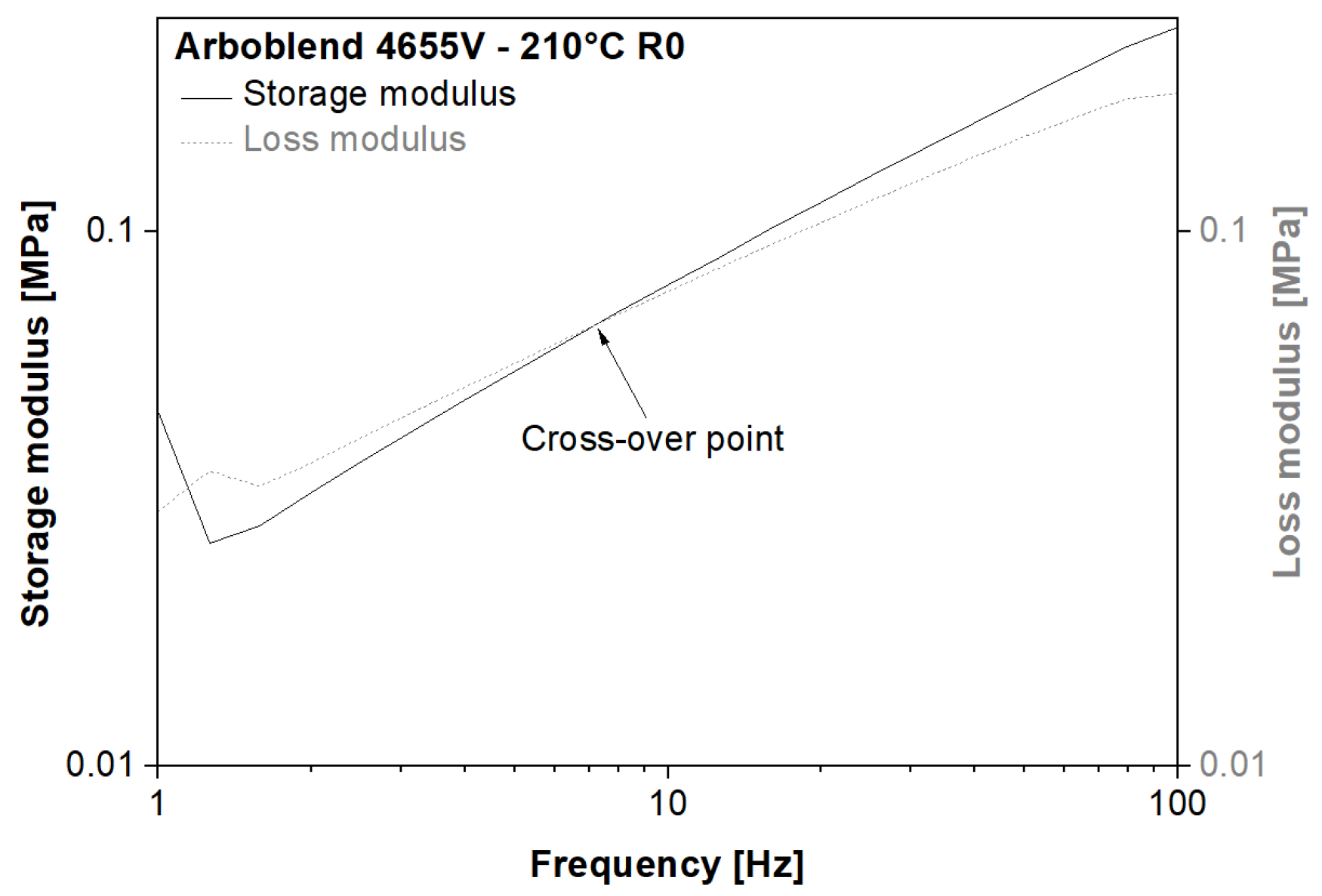
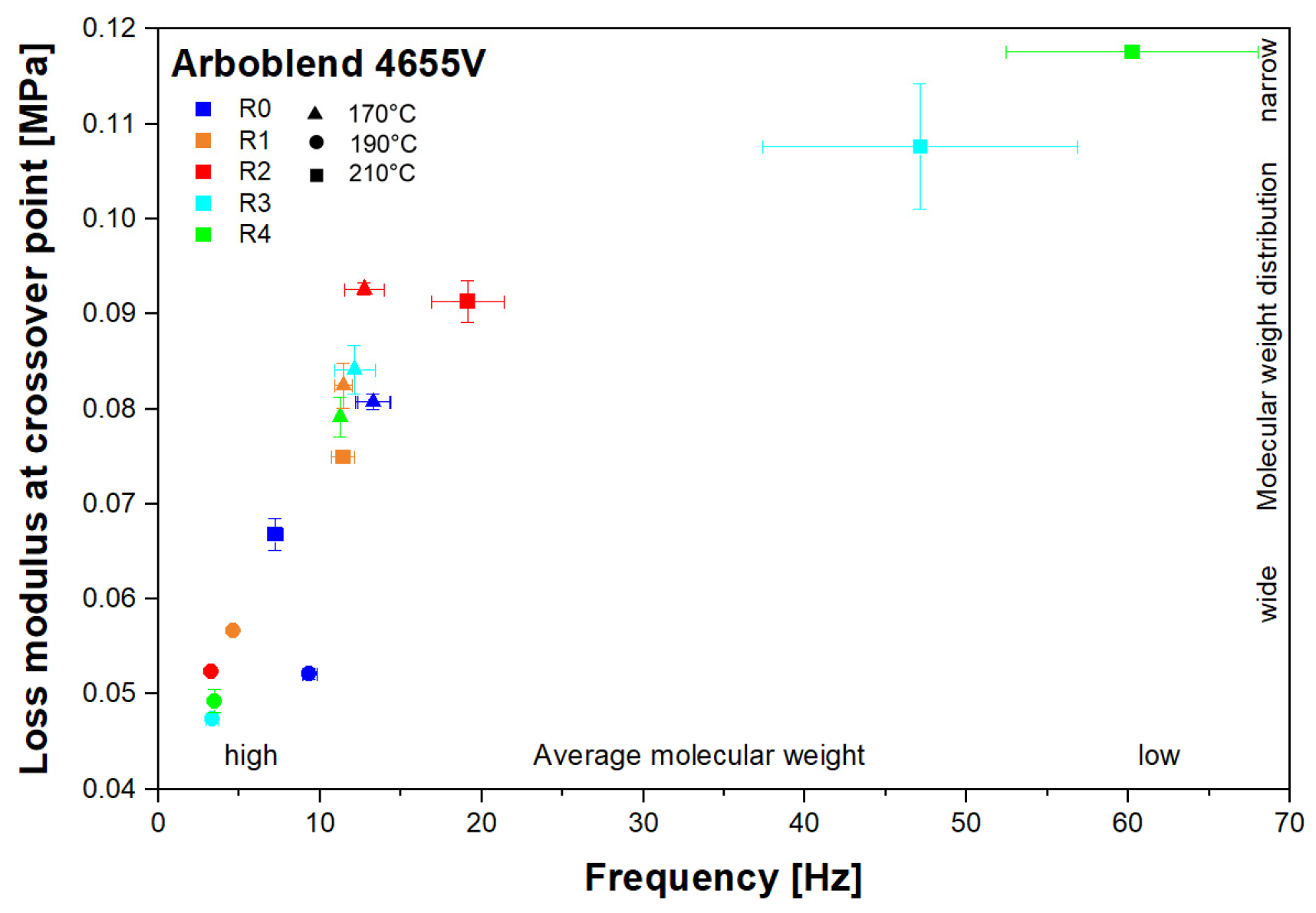
3.2. Rheological Behaviour
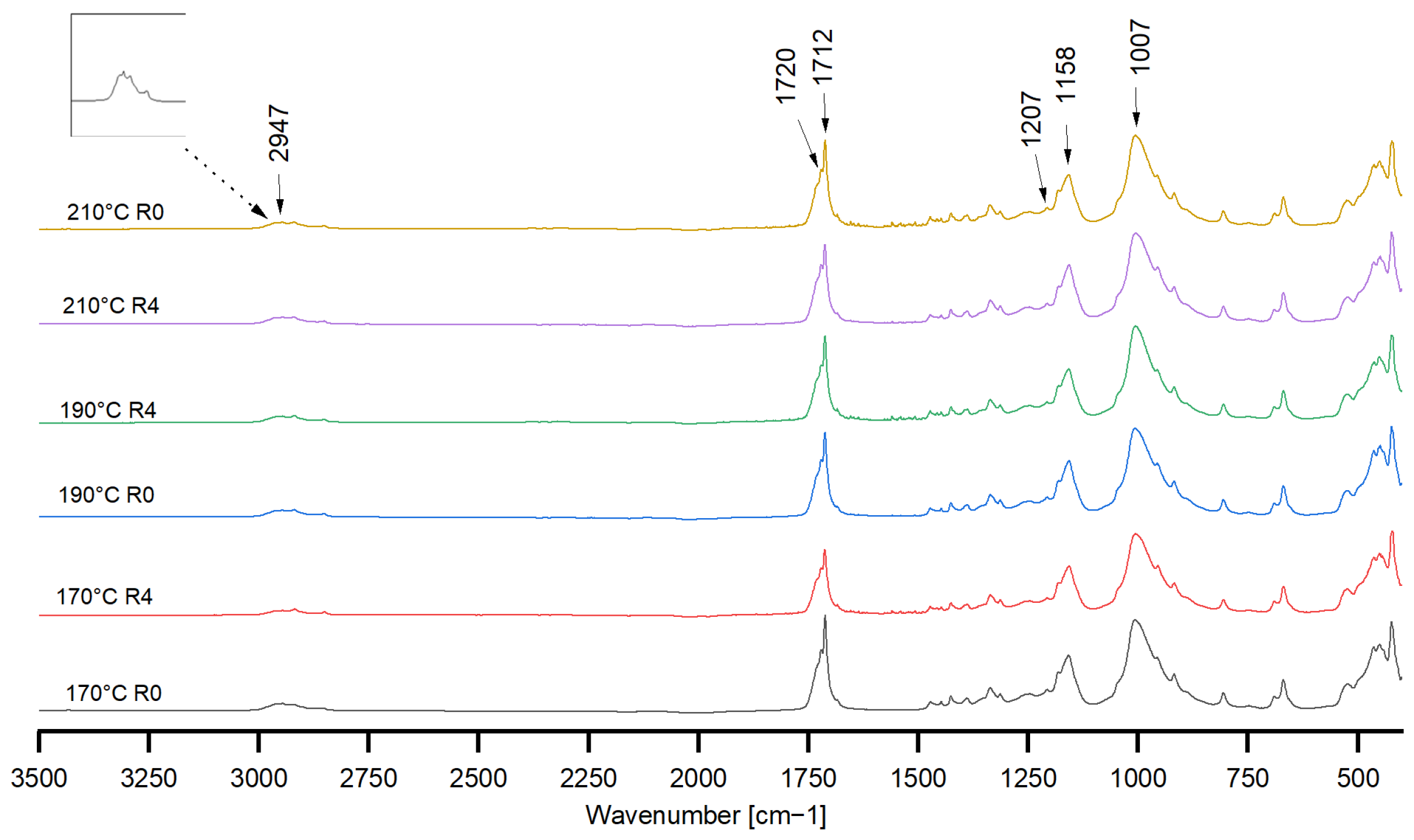
3.3. Chemical Structure
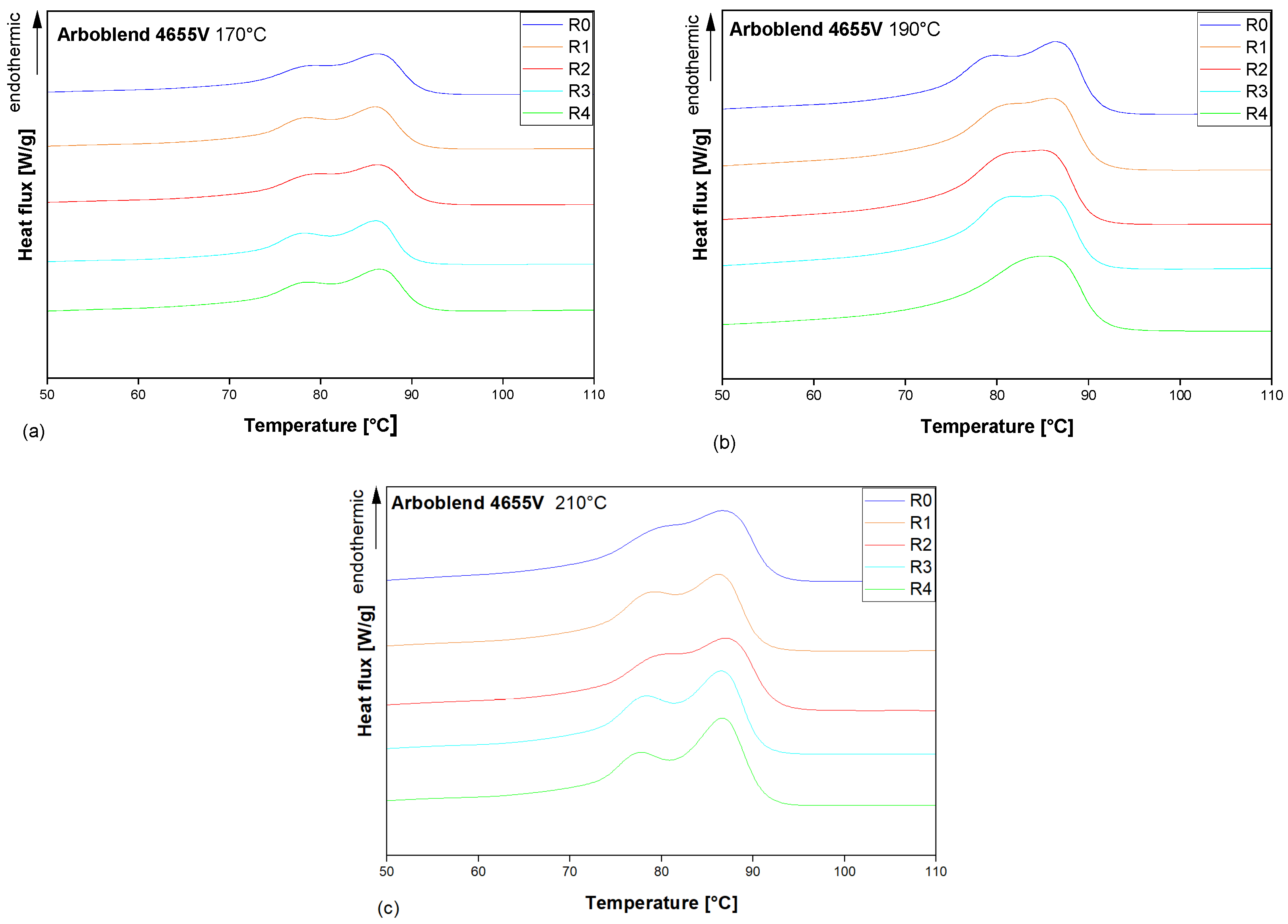
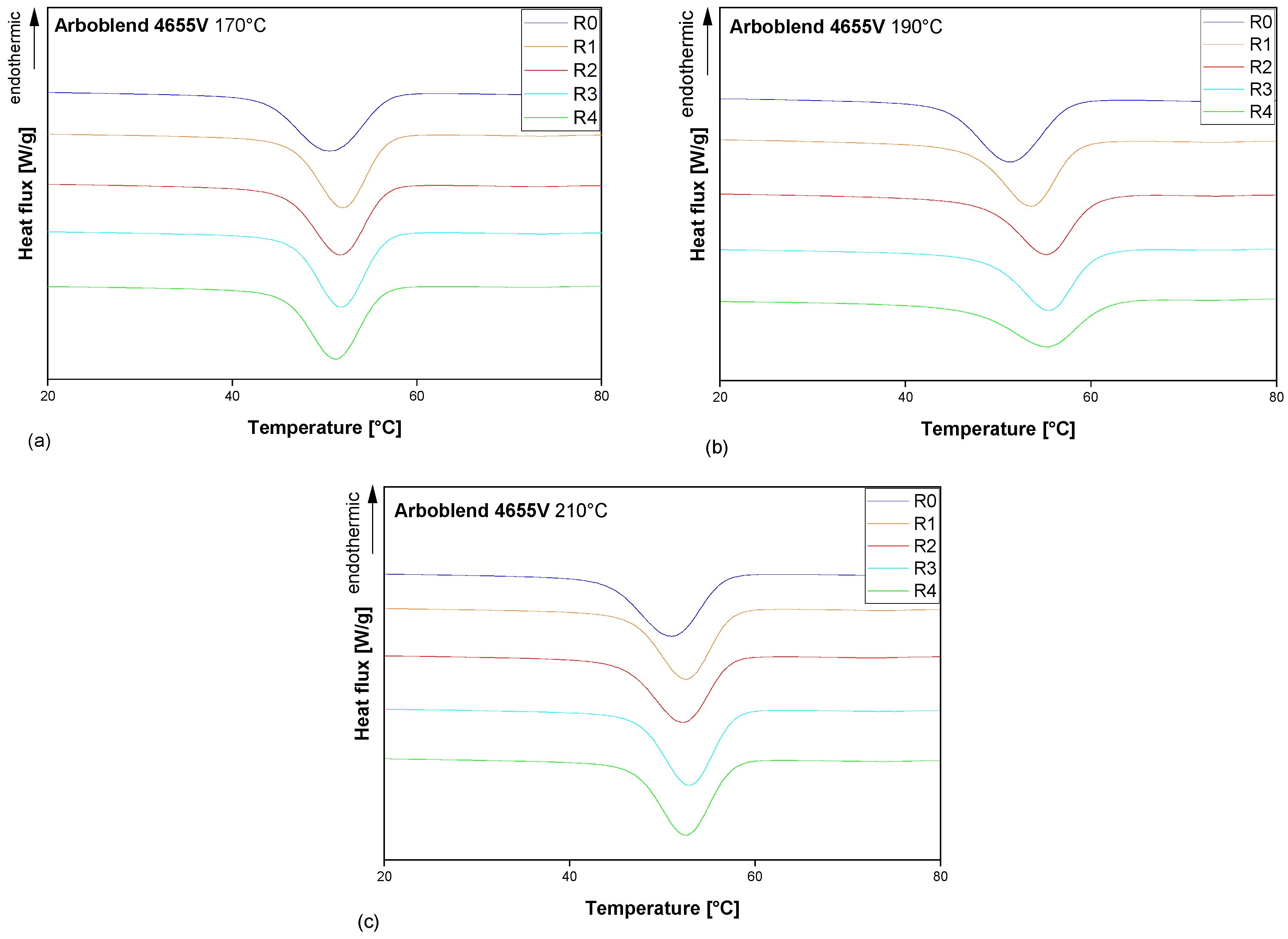
3.4. Thermal Behaviour
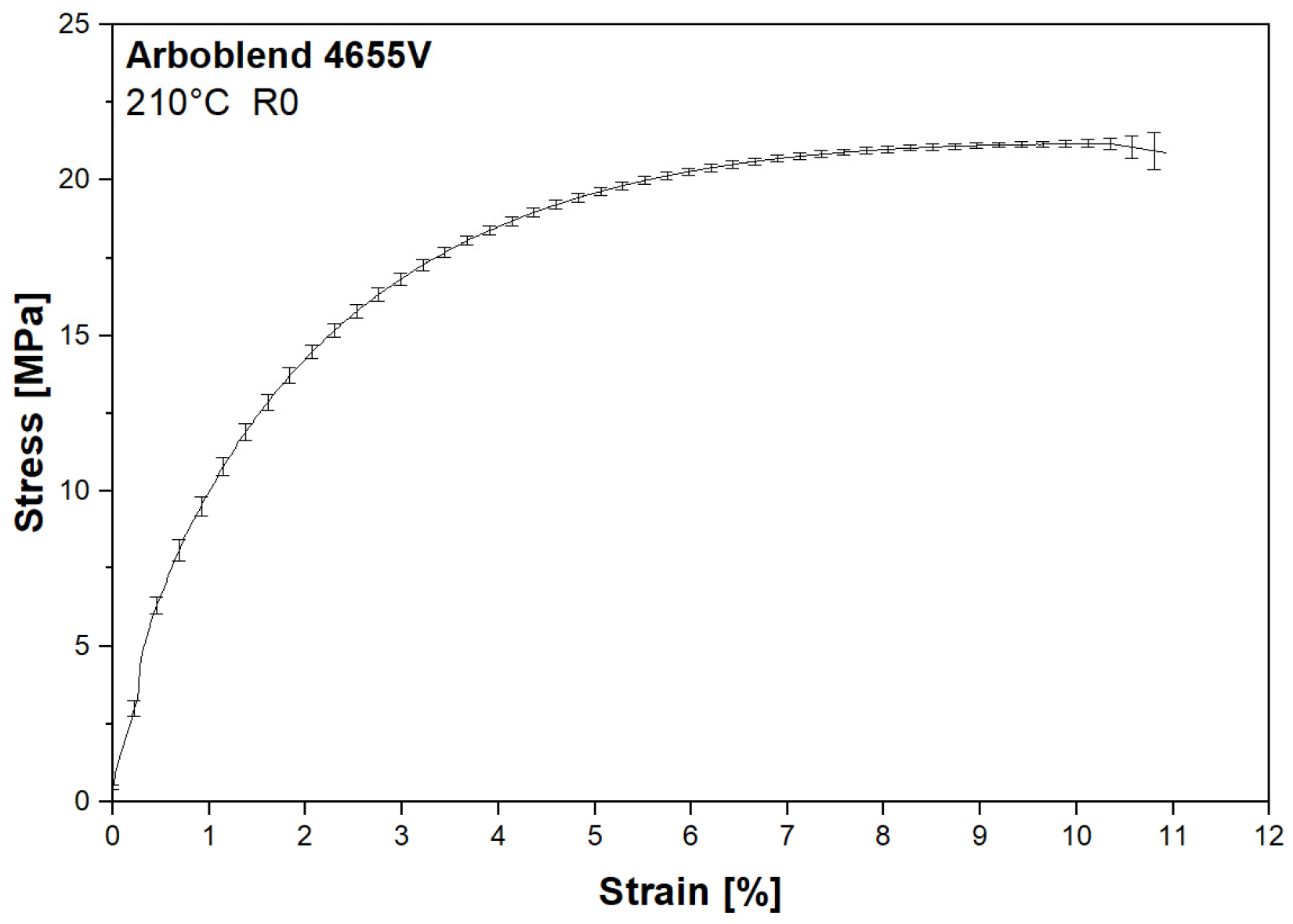
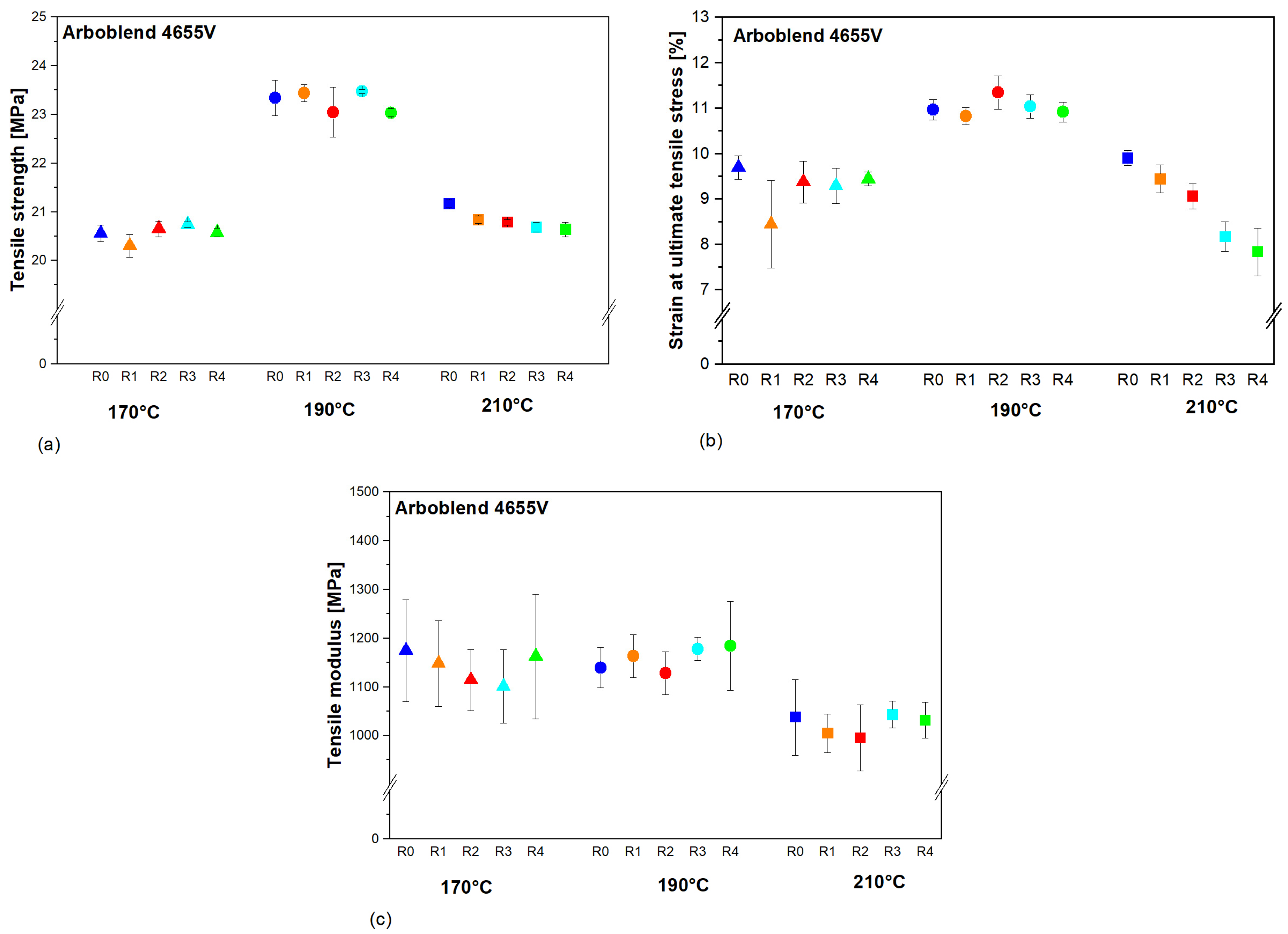
3.5. Tensile Testing
3.6. Charpy Impact Testing
4. Conclusions
Author Contributions
Funding
Institutional Review Board Statement
Data Availability Statement
Acknowledgments
Conflicts of Interest
Abbreviations
| ATR | attenuated total reflection |
| CA | cellulose acetate |
| DS | degree of acetyl substitution |
| DSC | differential scanning calorimetry |
| IR | infrared |
| M.W. | molecular weight |
| MFR | melt flow rate |
| MWD | molecular weight distribution |
| PA | polyamide |
| PCL | polycaprolactone |
| PE-HD | high-density polyethylene |
| PE-LD | low-density polyethylene |
| PET | polyethylene terephthalate |
| PHA | polyhydroxyalkanoates |
| PHBV | poly(3-hydroxybutyrate-co-3-hydroxyvalerate) |
| PLA | polylactic acid |
| PP | polypropylene |
| SEM | scanning electron microscopy |
| TGA | thermogravimetric analysis |
References
- Future Market Insights. Market Value of Plastics Worldwide in 2023, with a Forecast for 2033 (in Billion U.S. Dollars). Available online: https://www.statista.com/statistics/1060583/global-market-value-of-plastic/ (accessed on 28 February 2026).
- Wöhrle, D. Kunststoffe. Chem. Nserer Zeit 2019, 53, 50–64. [Google Scholar] [CrossRef]
- PlasticsEurope. Anteile der Verwendung von Kunststoff nach Einsatzgebieten in Deutschland im Jahr 2023. Available online: https://de.statista.com/statistik/daten/studie/226759/umfrage/verwendung-von-kunststoff-in-deutschland-nach-einsatzgebieten/ (accessed on 19 March 2025).
- Internetredaktion LpB BW. Plastikmüll Wie Gefährlich sind Kunststoffabfälle für uns und Unsere Umwelt? Available online: https://www.lpb-bw.de/plastikmuell (accessed on 1 April 2025).
- Wojnowska-Baryła, I.; Kulikowska, D.; Bernat, K. Effect of Bio-Based Products on Waste Management. Sustainability 2020, 12, 2088. [Google Scholar] [CrossRef]
- Baron, C.; Donadio, F.; Scherdel, M.; Taha, I. Bio-based epoxy and unsaturated polyester resins: Research and market overview. Proc. Inst. Mech. Eng. Part C J. Mech. Eng. Sci. 2024, 238, 8730–8738. [Google Scholar] [CrossRef]
- European Bioplastics, Nova-Institute. Available online: https://docs.european-bioplastics.org/publications/market_data/2024/EUBP_Market_Data_Report_2024.pdf (accessed on 28 February 2026).
- Skoczinski, P.; Carus, M.; Tweddle, G.; Ruiz, P.; Hark, N.; Zhang, A.; de Guzman, D.; Ravenstijn, J.; Käb, H.; Raschka, A. Bio-Based Building Blocks and Polymers: Global Capacities, Production and Trends 2023–2028. Industrial Biotechnology, Industry Report. 2024. Available online: https://renewable-carbon.eu (accessed on 28 February 2026).
- European Bioplastics. Bioplastics—Facts and Figures. 2023. Available online: https://docs.european-bioplastics.org/publications/EUBP_Facts_and_figures.pdf (accessed on 28 February 2026).
- Polman, E.M.N.; Gruter, G.-J.M.; Parsons, J.R.; Tietema, A. Comparison of the aerobic biodegradation of biopolymers and the corresponding bioplastics: A review. Sci. Total Environ. 2021, 753, 141953. [Google Scholar] [CrossRef]
- Liu, L.; Xu, M.; Ye, Y.; Zhang, B. On the degradation of (micro)plastics: Degradation methods, influencing factors, environmental impacts. Sci. Total Environ. 2022, 806, 151312. [Google Scholar] [CrossRef]
- Yadav, N.; Hakkarainen, M. Degradable or not? Cellulose acetate as a model for complicated interplay between structure, environment and degradation. Chemosphere 2021, 265, 128731. [Google Scholar] [CrossRef] [PubMed]
- PlasticsEurope. Plastics-the Fast Facts. 2023. Available online: https://plasticseurope.org/knowledge-hub/plastics-the-fast-facts-2023/ (accessed on 29 April 2025).
- Conversio Market & Strategy. Stoffstrombild Kunststoffe in Deutschland 2023—Zahlen und Fakten zum Lebensweg von Kunststoffen. Available online: https://www.vci.de/ergaenzende-downloads/kurzfassung-stoffstrombild-2023.pdf (accessed on 28 February 2026).
- Available online: https://plasticseurope.org (accessed on 28 February 2026).
- OECD. Global Plastics Outlook. Policy Scenarios to 2060; OECD Publishing: Paris, France, 2022. [Google Scholar] [CrossRef]
- OECD. Available online: https://www.oecd.org/en/about/news/press-releases/2022/02/plastic-pollution-is-growing-relentlessly-as-waste-management-and-recycling-fall-short.html (accessed on 28 February 2026).
- Martens, H.; Goldmann, D. Recyclingtechnik; Springer Fachmedien Wiesbaden: Wiesbaden, Germany, 2016. [Google Scholar]
- Moneke, M. Kunststoffwerkstoffe; Carl Hanser Verlag: München, Germany, 2022. [Google Scholar]
- Ben Amor, I.; Klinkova, O.; Baklouti, M.; Elleuch, R.; Tawfiq, I. Mechanical Recycling and Its Effects on the Physical and Mechanical Properties of Polyamides. Polymers 2023, 15, 4561. [Google Scholar] [CrossRef]
- Langwieser, J.; Schweighuber, A.; Felgel-Farnholz, A.; Marschik, C.; Buchberger, W.; Fischer, J. Determination of the Influence of Multiple Closed Recycling Loops on the Property Profile of Different Polyolefins. Polymers 2022, 14, 2429. [Google Scholar] [CrossRef]
- Shojaeiarani, J.; Bajwa, D.S.; Rehovsky, C.; Bajwa, S.G.; Vahidi, G. Deterioration in the Physico-Mechanical and Thermal Properties of Biopolymers Due to Reprocessing. Polymers 2019, 11, 58. [Google Scholar] [CrossRef]
- Gonçalves, L.M.G.; Rigolin, T.R.; Frenhe, B.M.; Bettini, S.H.P. On the Recycling of a Biodegradable Polymer: Multiple Extrusion of Poly (Lactic Acid). Mat. Res. 2020, 23, e20200274. [Google Scholar] [CrossRef]
- Available online: https://biokunststofftool.de/werkstoffe/cellulose/#1549294499827-168566b9-2fc1 (accessed on 8 June 2024).
- Available online: https://www.sphericalinsights.com/de/reports/cellulose-acetate-market (accessed on 28 February 2026).
- Kabasci, S. Bio-Based Plastics: Materials and Applications; John Wiley & Sons Inc.: Chichester, UK, 2014. [Google Scholar]
- Erdmann, R.; Kabasci, S.; Heim, H.-P. Thermal Properties of Plasticized Cellulose Acetate and Its β-Relaxation Phenomenon. Polymers 2021, 13, 1356. [Google Scholar] [CrossRef] [PubMed]
- Puls, J.; Wilson, S.A.; Hölter, D. Degradation of Cellulose Acetate-Based Materials: A Review. J. Polym. Environ. 2011, 19, 152–165. [Google Scholar] [CrossRef]
- Tecnaro. Available online: https://bioeconomy-congress.uni-hohenheim.de/fileadmin/einrichtungen/bioeconomy-congress/3._Biooekonomiekongress/2019-09_TECNARO_Werkstoffuebersicht.pdf (accessed on 28 February 2026).
- DIN EN ISO 527-2; DIN Deutsches Institut für Normung e. V. Kunststoffe—Bestimmung der Zugeigenschaften—Teil 2: Prüfbedingungen für Form- und Extrusionsmassen. DIN Deutsches Institut für Normung e. V. Kunststoffe: Berlin, Germany, 2012.
- Rapid. Available online: https://www.rapidgranulator.com/de/produkte/schneidmuhlen/150-serie/ (accessed on 28 February 2026).
- DIN EN ISO 527-1; DIN Deutsches Institut für Normung e. V. Kunststoffe—Bestimmung der Zugeigenschaften—Teil 1: Allgemeine Grundsätze. DIN Deutsches Institut für Normung e. V. Kunststoffe: Berlin, Germany, 2019.
- DIN EN ISO 179-1; DIN Deutsches Institut für Normung e. V. Kunststoffe– Bestimmung der Charpy-Schlageigenschaften–Teil 1: Nicht instrumentierte Schlagzähigkeitsprüfung. DIN Deutsches Institut für Normung e. V. Kunststoffe: Berlin, Germany, 2023.
- DIN EN ISO 3167; DIN Deutsches Institut für Normung e. V. Kunststoffe—Vielzweckprobekörper. DIN Deutsches Institut für Normung e. V. Kunststoffe: Berlin, Germany, 2014.
- Mezger, T.G. Das Rheologie Handbuch; Vincentz Network: Hannover, Germany, 2016. [Google Scholar]
- Johansson, E.E.; Lind, J. The general link between random scissions in linear polymers, changes in average chain length and the Mark–Houwink equation. Polym. Degrad. Stab. 2005, 88, 159–167. [Google Scholar] [CrossRef]
- Lee, J.; Lee, J.; Jeon, H.; Park, H.; Oh, S.; Chung, I. Studies on the melt viscosity and physico-chemical properties of cellulose acetate propionate composites with lactic acid blends. Mol. Cryst. Liq. Cryst. 2020, 707, 8–20. [Google Scholar] [CrossRef]
- Biswas, A.; Shogren, R.L.; Selling, G.; Salch, J.; Willett, J.L.; Buchanan, C.M. Rapid and environmentally friendly preparation of starch esters. Carbohydr. Polym. 2008, 74, 137–141. [Google Scholar] [CrossRef]
- Tatsushima, T.; Ogata, N.; Nakane, K.; Ogihara, T. Structure and physical properties of cellulose acetate butyrate/poly(butylene succinate) blend. J. Appl. Polym. Sci. 2005, 96, 400–406. [Google Scholar] [CrossRef]
- Zhou, W.; Yuan, S.; Chen, Y.; Le, B. Morphology and hydrogen-bond restricted crystallization of poly(butylene succinate)/cellulose diacetate blends. J. Appl. Polym. Sci. 2012, 124, 3124–3131. [Google Scholar] [CrossRef]
- Hu, X.; Su, T.; Pan, W.; Li, P.; Wang, Z. Difference in solid-state properties and enzymatic degradation of three kinds of poly(butylene succinate)/cellulose blends. RSC Adv. 2017, 7, 35496–35503. [Google Scholar] [CrossRef]
- Sango, T.; Koubaa, A.; Ragoubi, M.; Yemele, M.-C.N.; Leblanc, N. Activities of cellulose acetate and microcrystalline cellulose on the thermal and morphomechanical performances of a biobased hybrid composite made polybutylene succinate. Int. J. Biol. Macromol. 2023, 253, 126918. [Google Scholar] [CrossRef]
- Huang, Y.; Zhou, T.; Liu, J.; Zhang, A. Analysis on Structural Changes of Poly(vinyl acetate) by Two-Dimensional Correlation Infrared Spectroscopy. Asian J. Chem. 2014, 26, 7915–7920. [Google Scholar] [CrossRef]
- Slejko, E.A.; Tuan, A.; Scuor, N. From Waste to Value: Characterization of Recycled Cellulose Acetate for Sustainable Waste Management. Available online: https://www.sciencedirect.com/science/article/pii/S2949750723000329 (accessed on 28 February 2026).
- Bernal-Ballén, A.; Kuritka, I.; Saha, P. Preparation and Characterization of a Bioartificial Polymeric Material: Bilayer of Cellulose Acetate-PVA. Int. J. Polym. Sci. 2016, 2016, 3172545. [Google Scholar] [CrossRef]
- Sultana, Q.N.; Absar, S.; Hulsey, S.; Schanz, H.; Khan, M. Synthesis and Processing of Solution Spun Cellulose Acetate Fibers Reinforced with Carbon Nanotubes; ASME: New York, NY, USA, 2015. [Google Scholar]
- Papaspyrides, C.D.; Vouyiouka, S.; Georgousopoulou, I.-N.; Marinkovic, S.; Estrine, B.; Joly, C.; Dole, P. Feasibility of Solid-State Postpolymerization on Fossil- and Bio-Based Poly(butylene succinate) Including Polymer Upcycling Routes. Ind. Eng. Chem. Res. 2016, 55, 5832–5842. [Google Scholar] [CrossRef]
- Hsu, K.-H.; Chen, C.-W.; Wang, L.-Y.; Chan, H.-W.; He, C.-L.; Cho, C.-J.; Rwei, S.-P.; Kuo, C.-C. Bio-based thermoplastic poly(butylene succinate-co-propylene succinate) copolyesters: Effect of glycerol on thermal and mechanical properties. Soft Matter 2019, 15, 9710–9720. [Google Scholar] [CrossRef]
- Wang, X.; Zhou, J.; Li, L. Multiple melting behavior of poly(butylene succinate). Eur. Polym. J. 2007, 43, 3163–3170. [Google Scholar] [CrossRef]
- Svintradze, D.V. Generalization of Young-Laplace, Kelvin, and Gibbs-Thomson equations for arbitrarily curved surfaces. Biophys. J. 2023, 122, 892–904. [Google Scholar] [CrossRef]
- Frick, A.; Stern, C. DSC-Prüfung in der Anwendung; Carl Hanser Verlag: München, Germany, 2013. [Google Scholar]
- Ehrenstein, G.W.; Pongratz, S. Beständigkeit von Kunststoffen; Carl Hanser Verlag: München, Germany, 2007. [Google Scholar]
- Dahlmann, R.; Haberstroh, E.; Menges, G. Menges Werkstoffkunde Kunststoffe; Carl Hanser Verlag: München, Germany, 2022. [Google Scholar]
- Heinrich, G. Leibniz-Institut für Polymerforschung Dresden. Available online: https://www.ipfdd.de/fileadmin/user_upload/el/Mitarbeiter/Heinrich/4_GH_Polymerwerkstoffe_2.pdf (accessed on 28 February 2026).



| Process Parameter | Value |
|---|---|
| Injection speed [s] | 2.6 |
| Cooling time [s] | 15 |
| Screw speed [mm/s] | 200 |
| Holding pressure [bar] | 600 |
| Holding time [s] | 13 |
| Back pressure [bar] | 70 |
| Mould temperature [°C] | 30 |
| Nozzle temperature [°C] | 170/180/200 |
| Temperature (Zone 3) [°C] | 170/190/210 |
| Temperature (Zone 2) [°C] | 160/180/200 |
| Temperature (Zone 1) [°C] | 150/170/190 |
| Temperature (Feed) [°C] | 40 |
| Processing Temperature | Recycling Run | 1st Peak [°C] | 2nd Peak [°C] | Onset [°C] | Offset [°C] | Enthalpy [J/g] |
|---|---|---|---|---|---|---|
| Mean (SD) | Mean (SD) | Mean (SD) | Mean (SD) | Mean (SD) | ||
| 170 °C | R0 | 78.99 (0.82) | 86.45 (0.33) | 74.12 (1.45) | 91.13 (0.58) | 34.69 (0.03) |
| R1 | 79.31 (1.19) | 86.28 (0.20) | 71.54 (0.37) | 90.77 (0.95) | 34.99 (0.11) | |
| R2 | 80.87 (1.88) | 86.28 (0.15) | 69.61 (0.90) | 91.28 (0.57) | 35.14 (0.02) | |
| R3 | 78.32 (0.18) | 86.11 (0.01) | 70.67 (0.01) | 90.15 (0.21) | 35.95 (0.02) | |
| R4 | 78.64 (0.16) | 86.42 (0.33) | 70.48 (0.21) | 91.04 (0.27) | 34.90 (0.73) | |
| 190 °C | R0 | 80.75 (1.27) | 86.46 (0.34) | 69.71 (0.20) | 91.22 (0.33) | 35.03 (0.24) |
| R1 | 82.27 (1.13) | 86.13 (0.34) | 71.67 (0.38) | 91.01 (0.41) | 34.98 (0.28) | |
| R2 | 83.96 (0.85) | * | 71.46 (0.09) | 90.41 (0.17) | 34.37 (1.11) | |
| R3 | 83.62 (1.8) | * | 72.22 (0.01) | 90.89 (0.56) | 34.39 (0.12) | |
| R4 | 85.14 (0.02) | * | 71.28 (0.76) | 91.54 (0.16) | 35.28 (0.80) | |
| 210 °C | R0 | 82.46 (0.44) | 86.78 (0.65) | 69.68 (0.28) | 92.24 (0.22) | 36.32 (1.07) |
| R1 | 79.33 (0.50) | 86.30 (0.17) | 73.89 (1.40) | 90.84 (0.47) | 34.83 (0.14) | |
| R2 | 81.59 (1.07) | 87.15 (0.33) | 70.58 (0.04) | 92.40 (0.37) | 35.11 (0.36) | |
| R3 | 78.50 (0.34) | 86.45 (0.34) | 71.03 (0.10) | 90.90 (0.41) | 33.59 (1.80) | |
| R4 | 77.84 (0.66) | 86.78 (0.34) | 70.63 (0.17) | 91.15 (0.79) | 34.86 (0.06) |
| Processing Temperature | Recycling Run | Peak [°C] | Onset [°C] | Offset [°C] | Enthalpy [J/g] |
|---|---|---|---|---|---|
| Mean (SD) | Mean (SD) | Mean (SD) | Mean (SD) | ||
| 170 °C | R0 | 50.42 (0.51) | 56.91 (0.20) | 43.33 (0.32) | 29.69 (0.03) |
| R1 | 51.86 (0.44) | 56.66 (0.23) | 46.02 (0.88) | 28.63 (0.21) | |
| R2 | 51.72 (0.31) | 56.66 (0.06) | 45.54 (0.47) | 28.17 (0.19) | |
| R3 | 51.81 (0.17) | 56.61 (0.03) | 46.26 (0.16) | 28.26 (0.11) | |
| R4 | 51.31 (0.00) | 56.21 (0.05) | 45.41 (0.11) | 26.81 (0.67) | |
| 190 °C | R0 | 51.42 (0.83) | 56.22 (0.01) | 44.40 (0.72) | 29.80 (0.07) |
| R1 | 53.60 (0.34) | 58.47 (0.17) | 46.83 (0.50) | 30.15 (0.43) | |
| R2 | 55.25 (0.00) | 60.39 (0.04) | 48.15 (0.25) | 29.72 (0.21) | |
| R3 | 55.42 (0.16) | 60.85 (0.23) | 48.17 (0.52) | 30.13 (0.02) | |
| R4 | 55.19 (0.02) | 61.66 (0.13) | 46.19 (0.31) | 30.40 (0.10) | |
| 210 °C | R0 | 51.10 (0.16) | 56.58 (0.09) | 43.86 (0.15) | 30.05 (0.26) |
| R1 | 52.45 (0.17) | 57.43 (0.09) | 46.51 (0.50) | 29.98 (0.04) | |
| R2 | 52.26 (0.33) | 57.29 (0.13) | 45.59 (0.39) | 30.01 (0.15) | |
| R3 | 52.80 (0.17) | 57.73 (0.12) | 47.16 (0.43) | 31.23 (0.63) | |
| R4 | 52.47 (0.18) | 57.66 (0.00) | 47.43 (0.00) | 31.51 (0.55) |
| Processing Temperature | Recycling Run | Number of Specimens | Impact Strength |
|---|---|---|---|
| 170 °C | R0 | 5 | N |
| R1 | 7 | N | |
| R2 | 5 | N | |
| R3 | 7 | N (59.38 ± 9.72 KJ/mm2 C two Samples) | |
| R4 | 4 | N (47.13 ± 0.53 KJ/mm2 C two Samples) | |
| 190 °C | R0 | 5 | N |
| R1 | 5 | N | |
| R2 | 5 | N | |
| R3 | 5 | N | |
| R4 | 5 | N | |
| 210 °C | R0 | 5 | N |
| R1 | 5 | N | |
| R2 | 5 | 72.75 ± 5.06 KJ/mm2 C | |
| R3 | 5 | 63.05 ± 5.39 KJ/mm2 C | |
| R4 | 5 | 46.1 ± 10.82 KJ/mm2 C |
Disclaimer/Publisher’s Note: The statements, opinions and data contained in all publications are solely those of the individual author(s) and contributor(s) and not of MDPI and/or the editor(s). MDPI and/or the editor(s) disclaim responsibility for any injury to people or property resulting from any ideas, methods, instructions or products referred to in the content. |
© 2026 by the authors. Licensee MDPI, Basel, Switzerland. This article is an open access article distributed under the terms and conditions of the Creative Commons Attribution (CC BY) license.
Share and Cite
Taha, I.; Trussina-Miltz, L. Influence of Multiple Recycling Cycles on the Mechanical, Rheological and Thermal Behaviour of a Commercial Cellulose Acetate Blend. Polymers 2026, 18, 858. https://doi.org/10.3390/polym18070858
Taha I, Trussina-Miltz L. Influence of Multiple Recycling Cycles on the Mechanical, Rheological and Thermal Behaviour of a Commercial Cellulose Acetate Blend. Polymers. 2026; 18(7):858. https://doi.org/10.3390/polym18070858
Chicago/Turabian StyleTaha, Iman, and Lara Trussina-Miltz. 2026. "Influence of Multiple Recycling Cycles on the Mechanical, Rheological and Thermal Behaviour of a Commercial Cellulose Acetate Blend" Polymers 18, no. 7: 858. https://doi.org/10.3390/polym18070858
APA StyleTaha, I., & Trussina-Miltz, L. (2026). Influence of Multiple Recycling Cycles on the Mechanical, Rheological and Thermal Behaviour of a Commercial Cellulose Acetate Blend. Polymers, 18(7), 858. https://doi.org/10.3390/polym18070858