Enhancing Strength and Ductility of Rubberized Concrete Using Low-Cost Glass Jackets

 , ,
, ,  , , and
Abstract
1. Introduction
2. Experimental Program
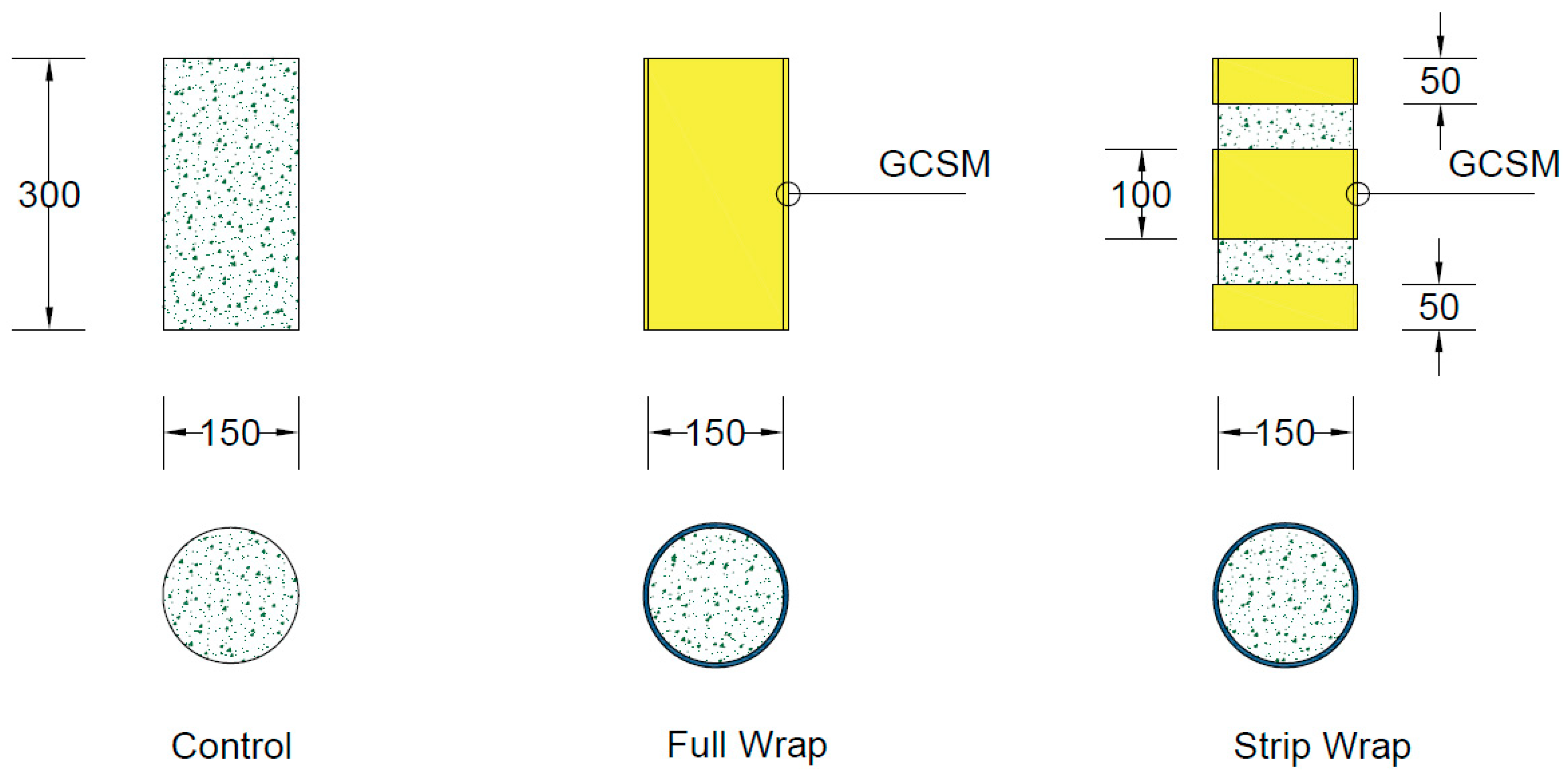
2.1. Test Matrix
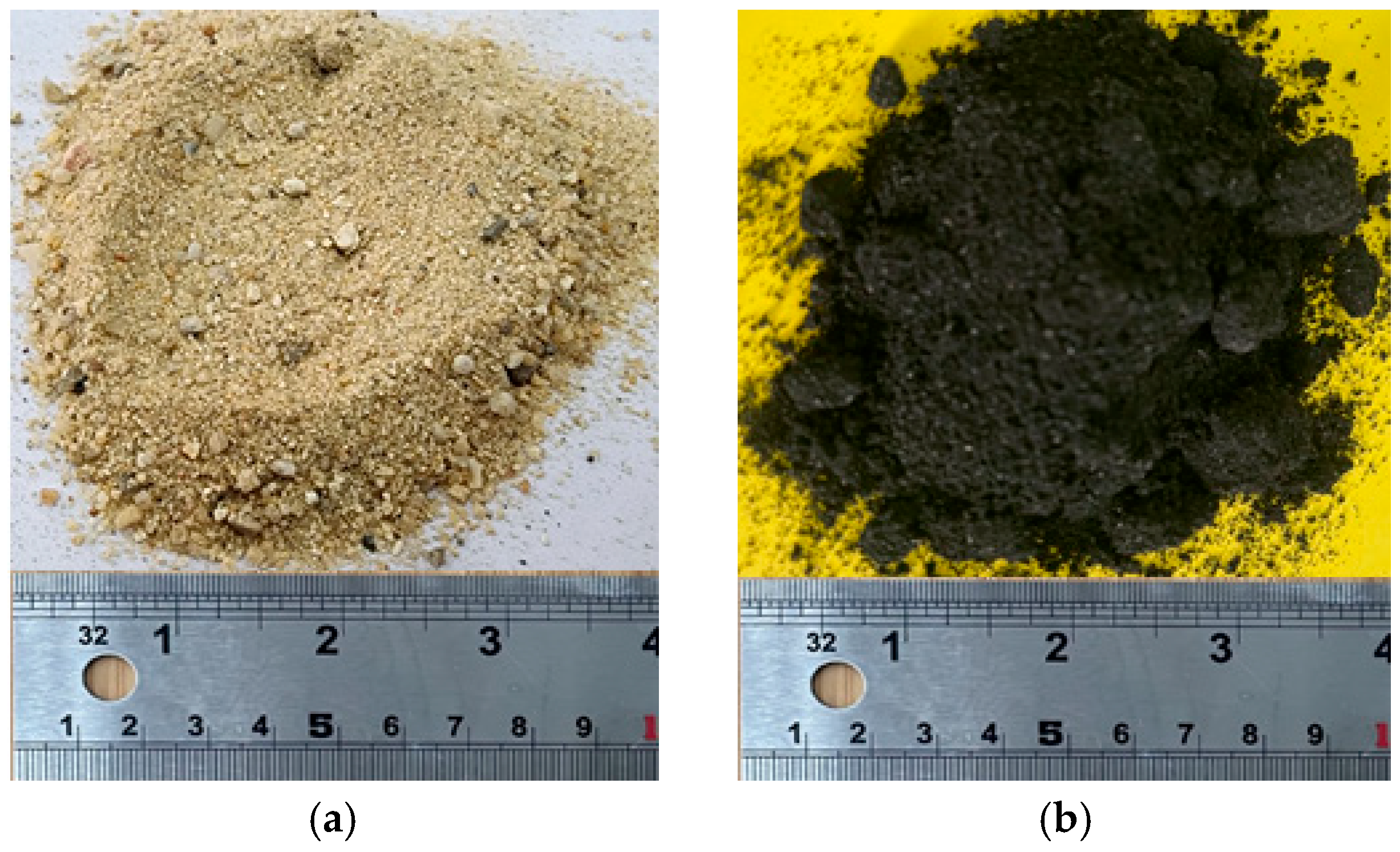
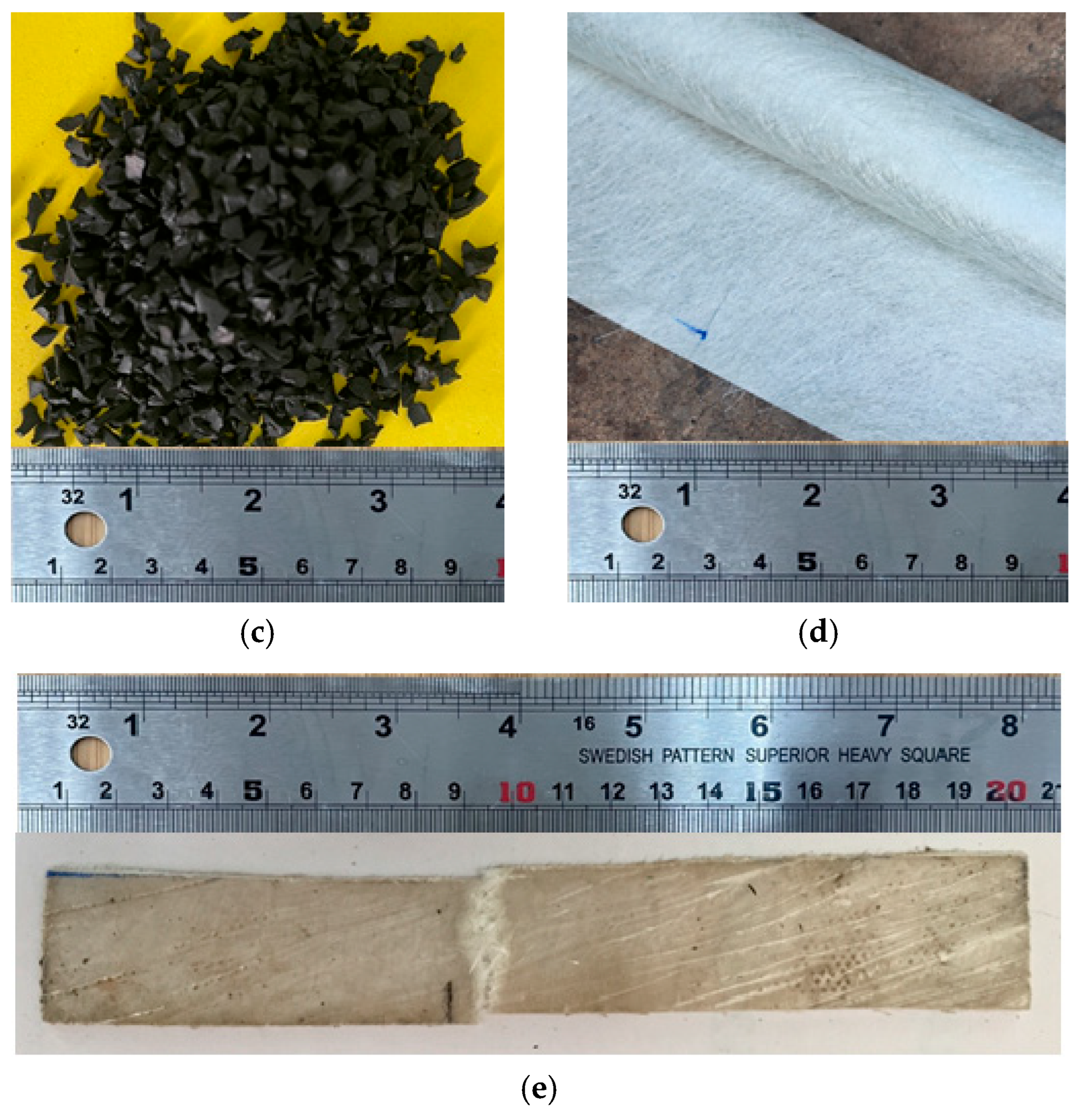
2.2. Materials
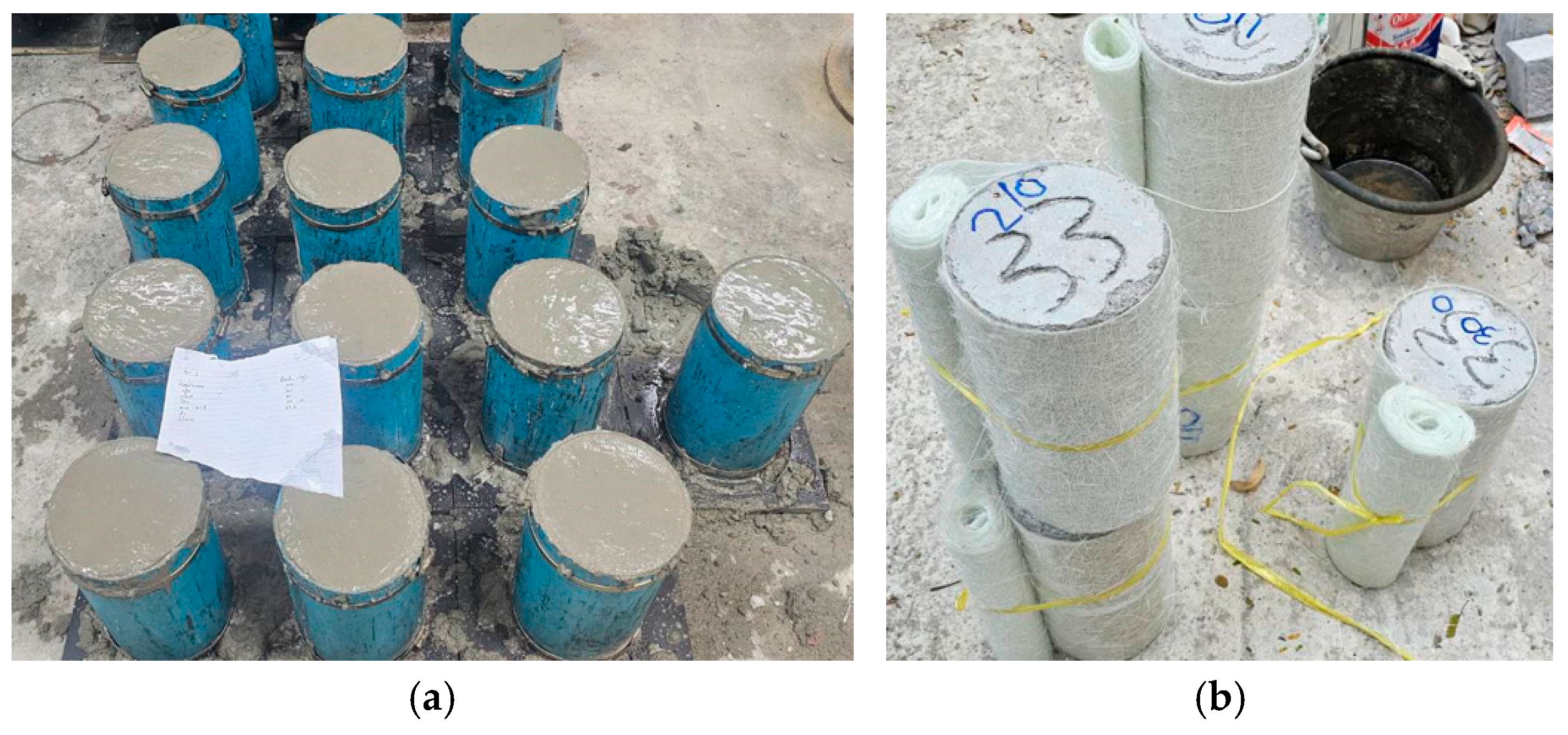
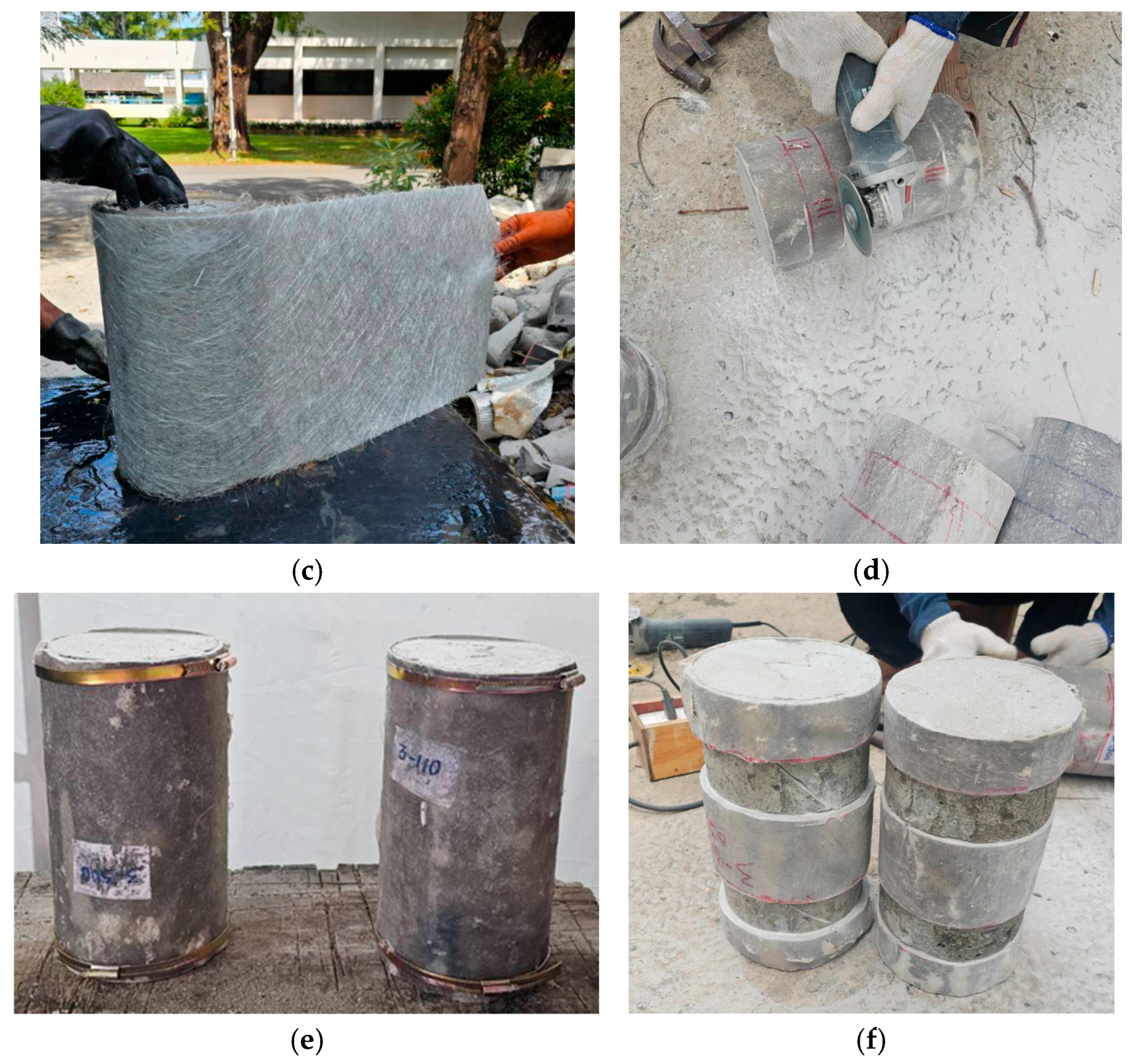
2.3. Specimen Preparation and Strengthening Procedure
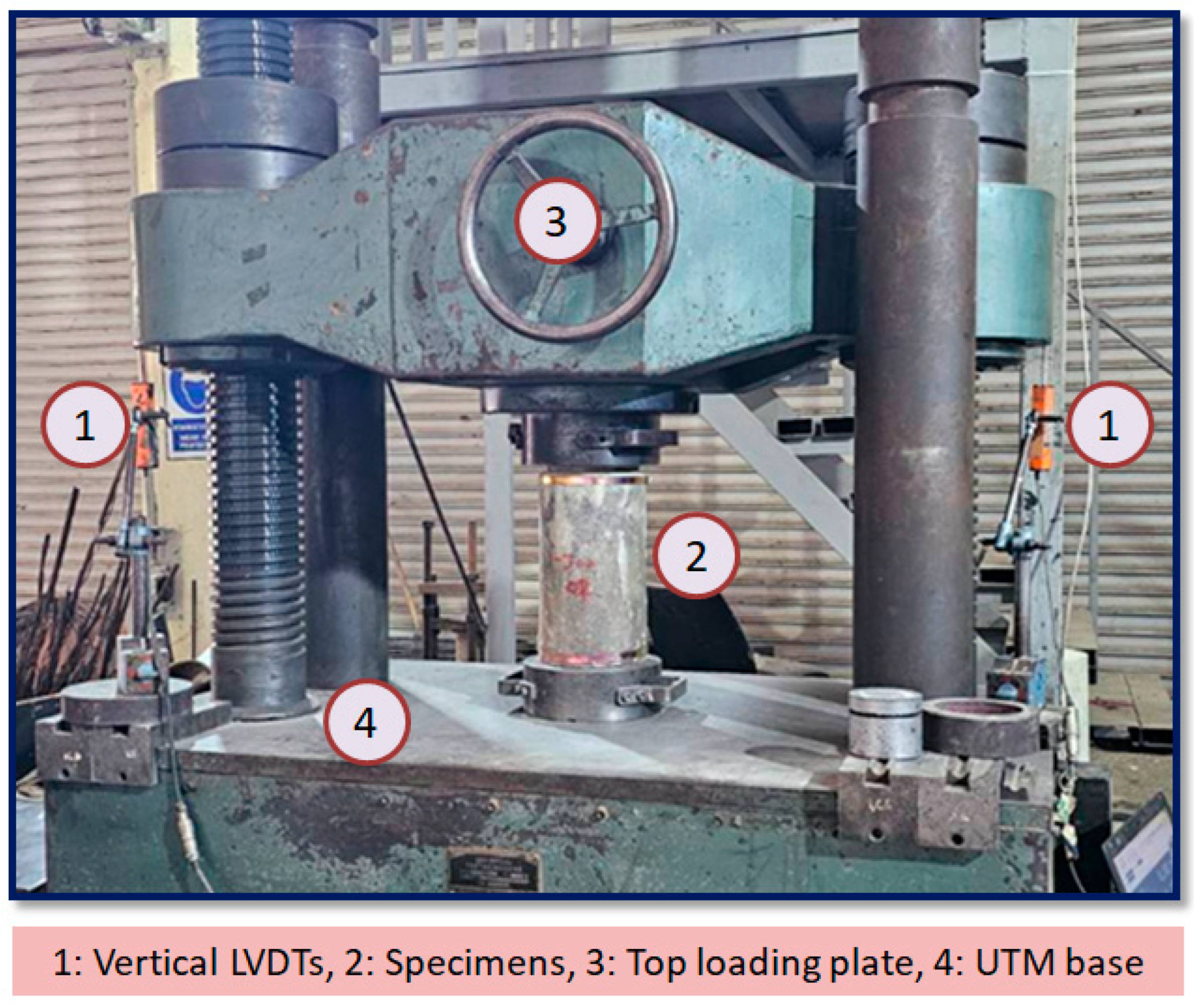
2.4. Instrumentation and Test Setup
3. Results and Discussion
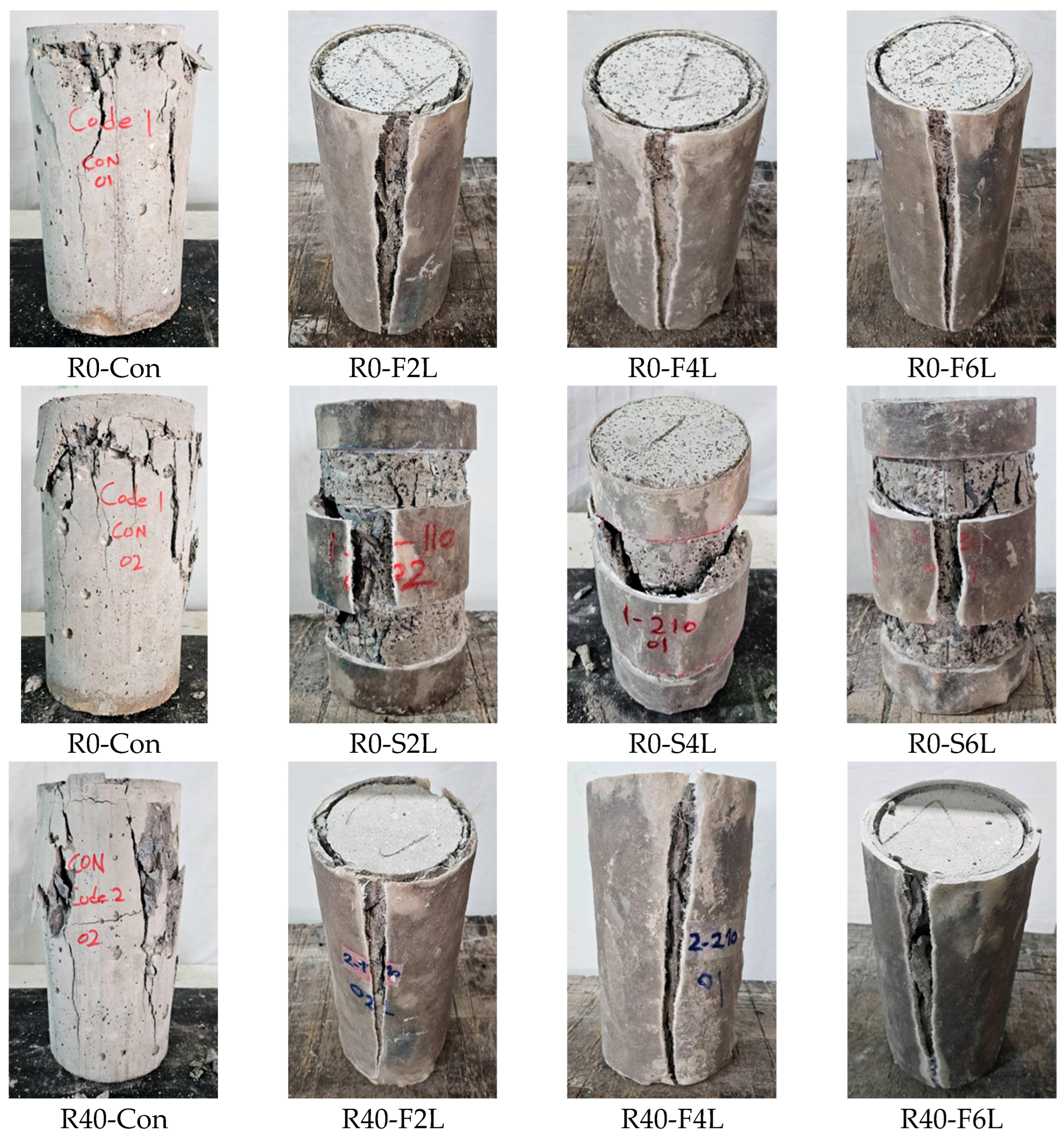
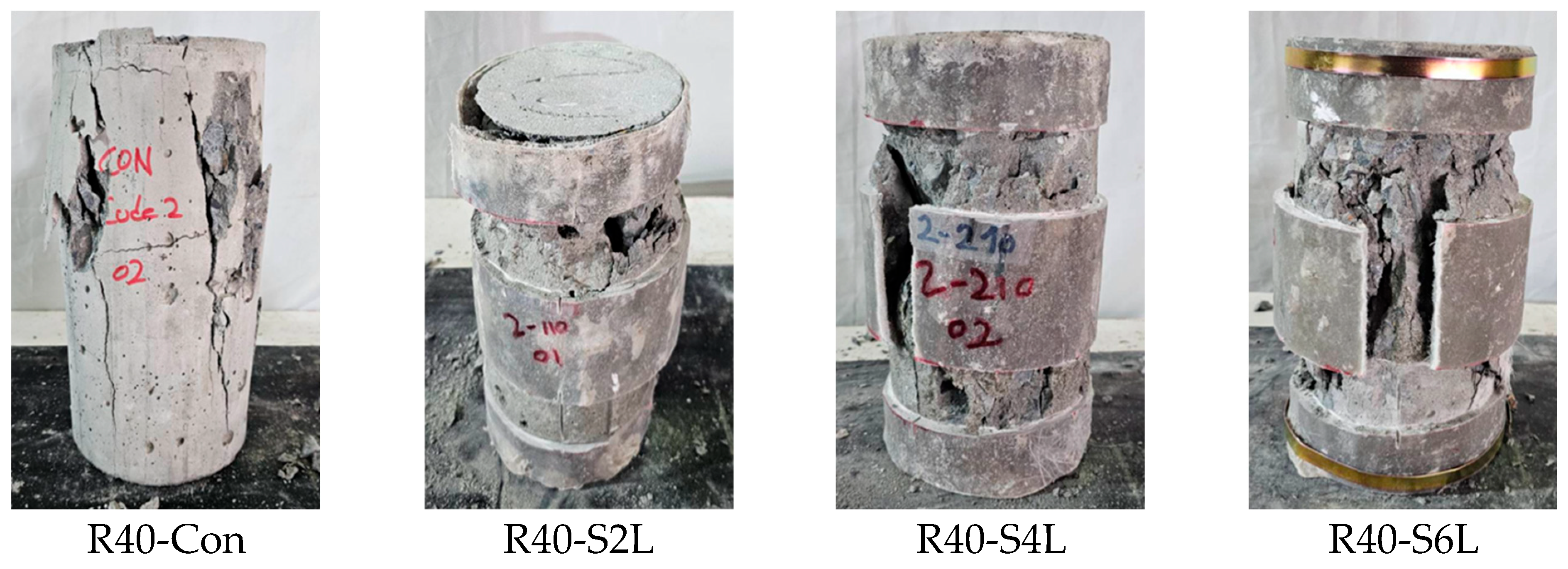
3.1. Failure Modes
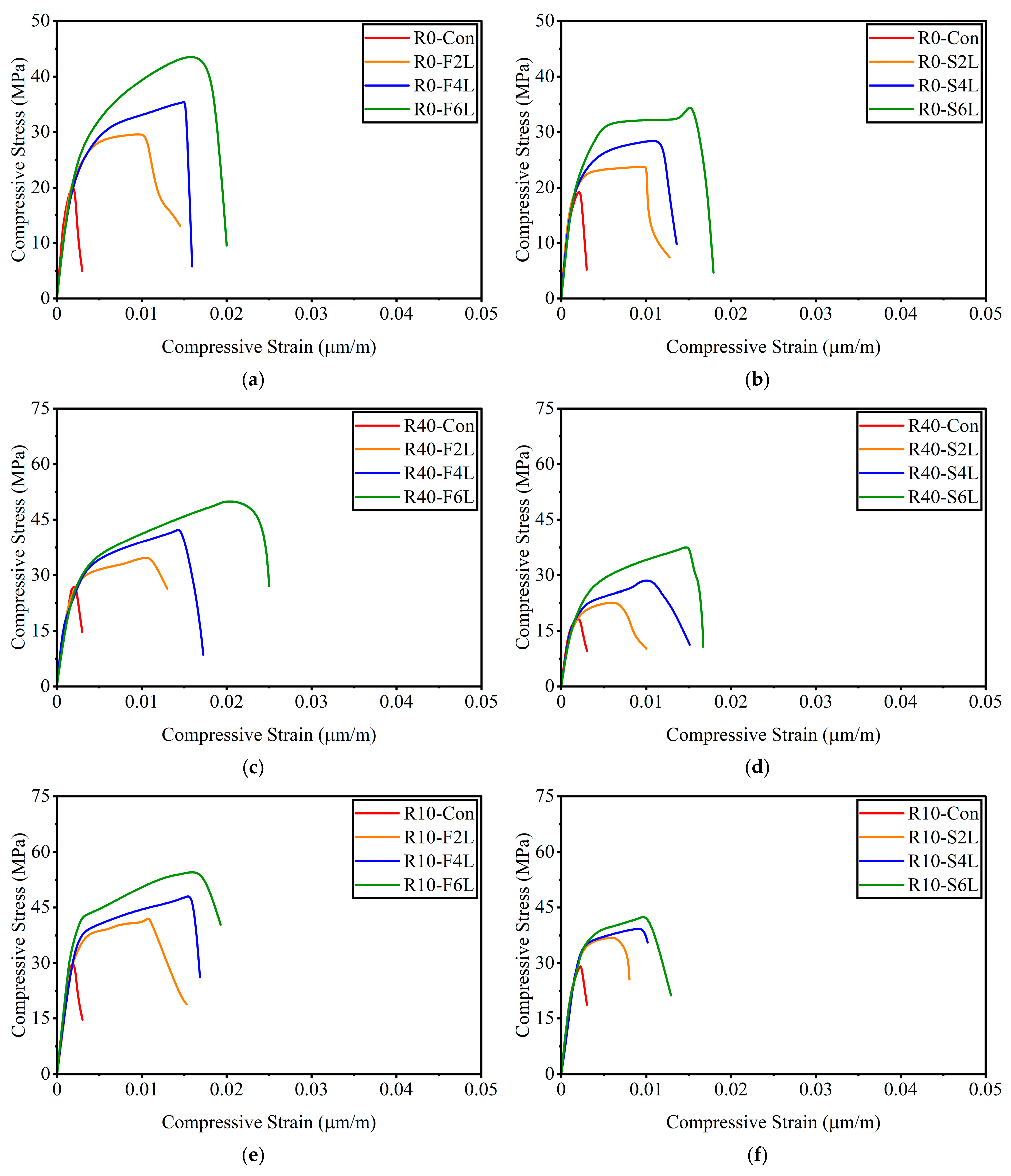
3.2. Effect of GCSM Jacket on Compressive Stress–Strain Behaviour
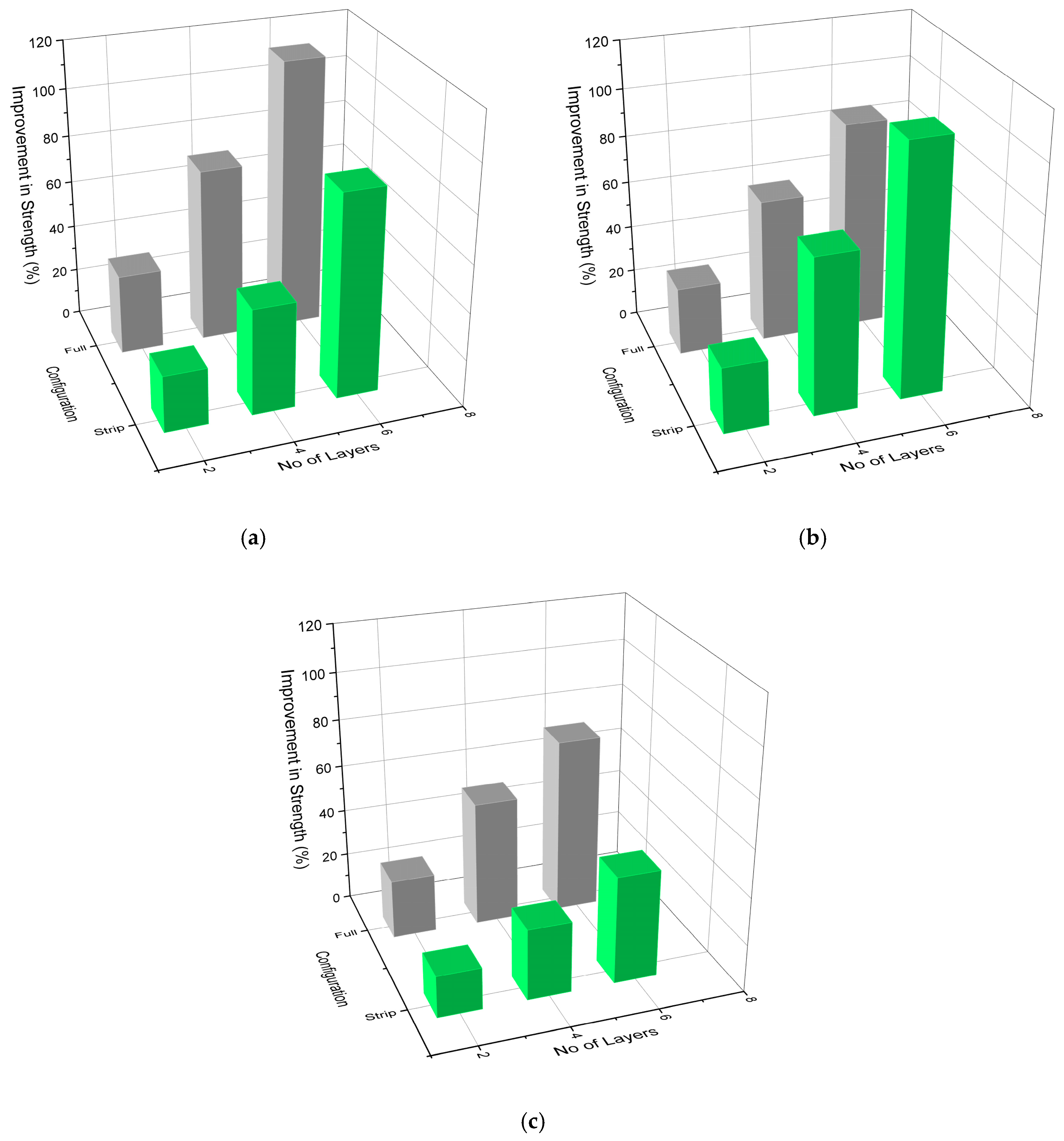
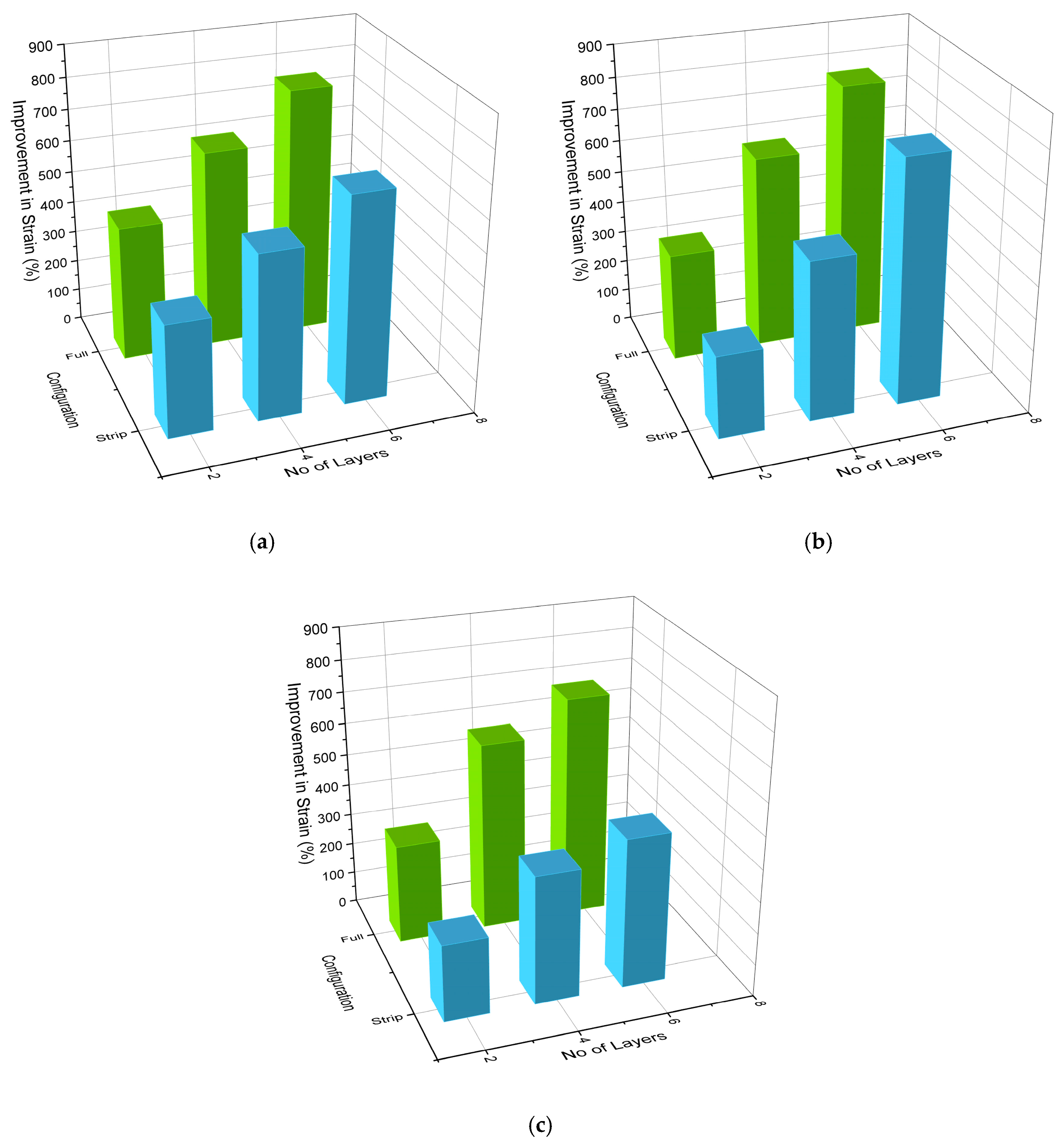
3.3. Quantitative Evaluation of Strength and Strain Improvement
3.4. Influence of Confinement Configuration and Number of GCSM Layers
3.5. Discussion
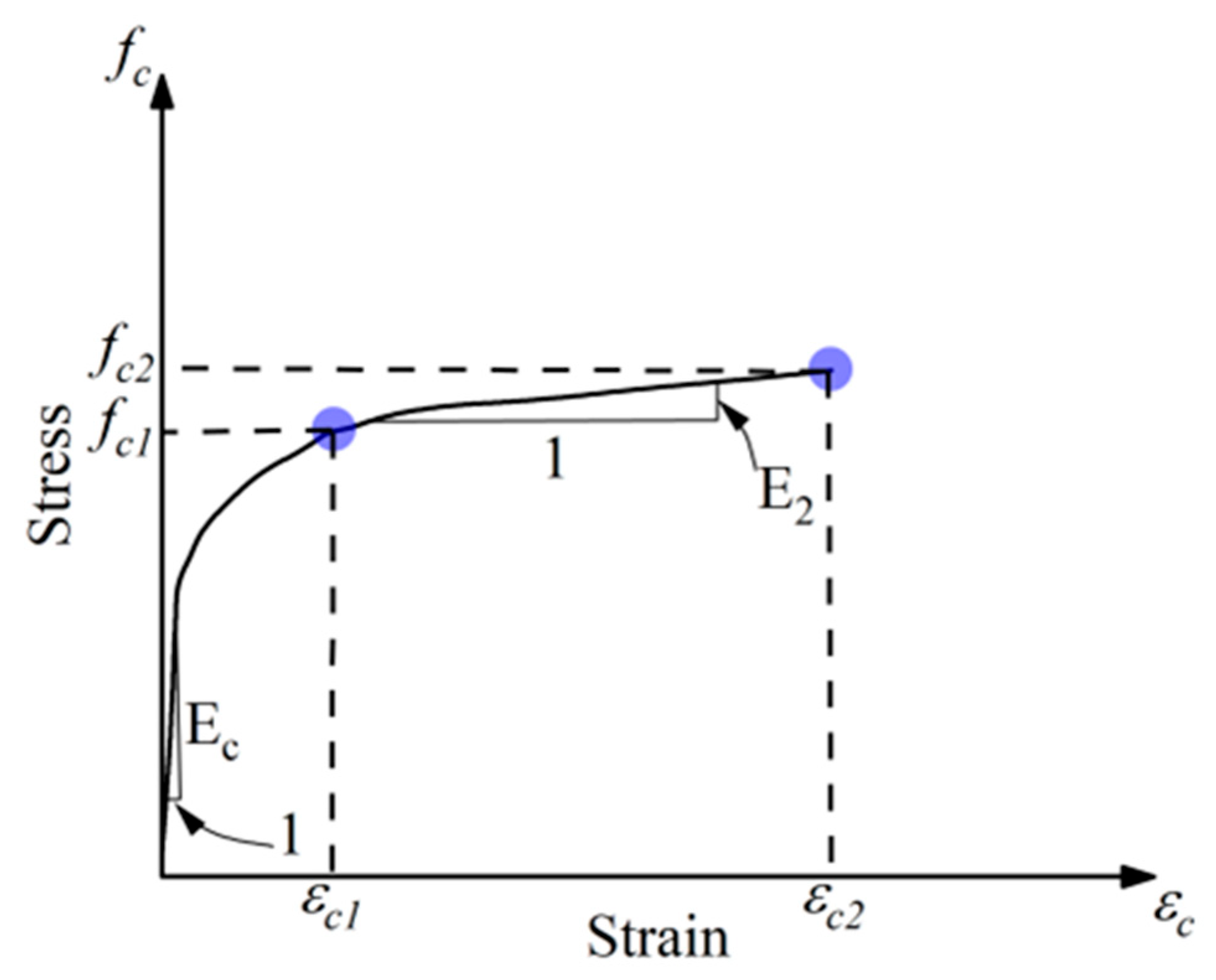
4. Analytical Modelling
4.1. Analytical Modelling for Natural Aggregate Concrete
4.1.1. Analytical Expression for Peak Strength
4.1.2. Analytical Expression for
4.1.3. Analytical Expression for and
4.1.4. Analytical Expression for
4.1.5. Comparison of Predicted and Experimental Curves
4.2. Analytical Modelling for Rubberized Concrete
4.2.1. Expression for Peak Strength for RuC
4.2.2. Expression for for RuC
4.2.3. Expression for and for RuC
4.2.4. Expression for for RuC
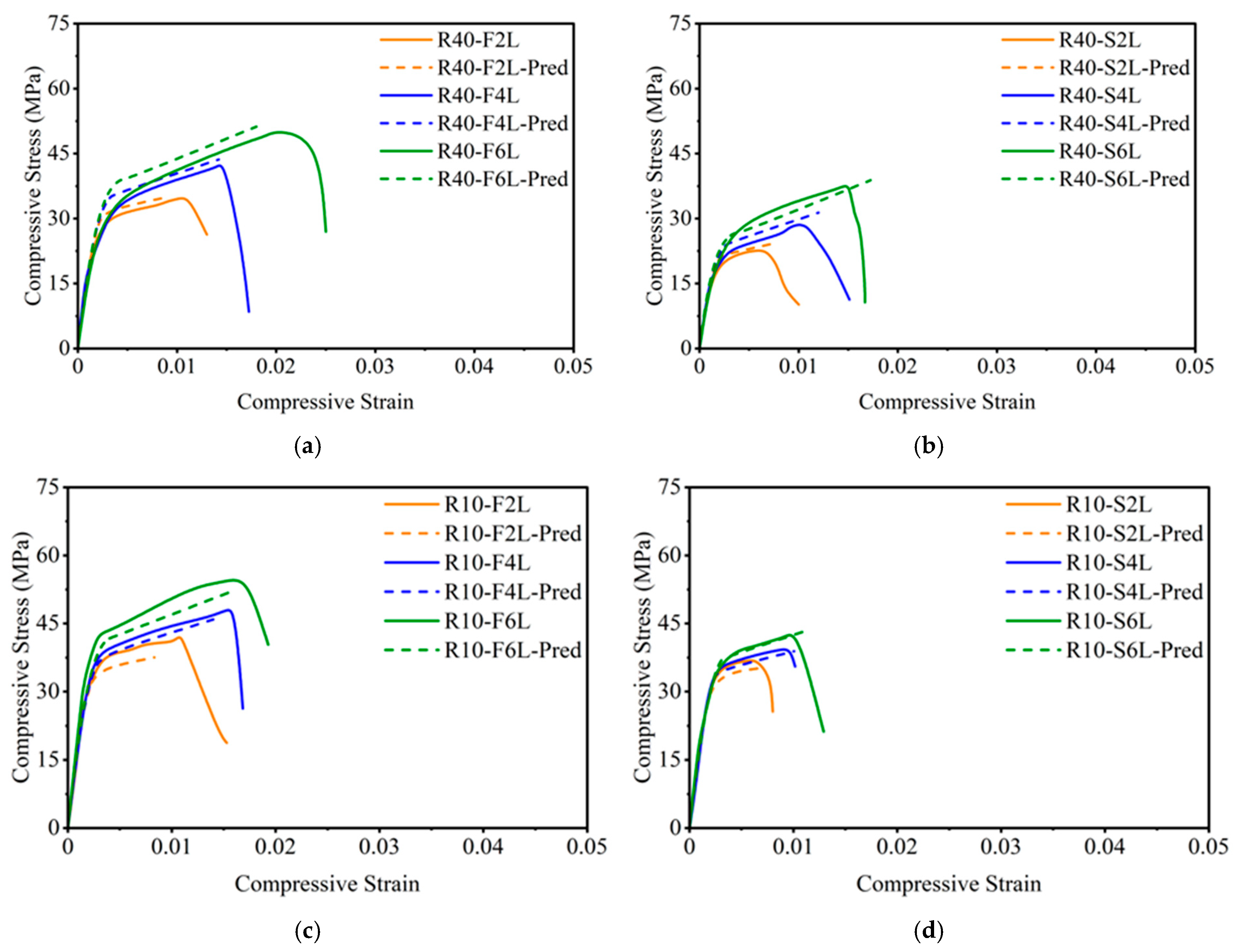
4.2.5. Comparison of Predicted and Experimental Curves for RuC
5. Practical Implementation of GCSM Confinement
6. Conclusions
- GCSM wrapping effectively transformed the brittle failure of concrete into a more gradual and ductile mode characterized by fine vertical cracking and localized bulging instead of abrupt spalling.
- Full GCSM wrapping provided the highest confinement efficiency, increasing compressive strength by up to 115% for NAC specimens and 90% for RuC specimens compared with unconfined concrete. In addition, the ultimate axial strain increased by more than 1300%, demonstrating a significant improvement in deformation capacity.
- Strip wrapping also improved the mechanical performance but with lower efficiency, producing compressive strength gains ranging from 25% to 45% and strain improvements between 250% and 500%, while offering a more economical solution due to reduced material usage.
- RuC mixes showed higher deformability and confinement sensitivity as compared to NAC. Fine-rubber mixes (R40) achieved superior strain enhancement due to improved lateral ductility, whereas coarse rubber (R10) exhibited greater lateral expansion but slightly lower confinement efficiency.
- Increasing the number of GCSM layers consistently improved both compressive strength and ductility due to higher hoop stiffness and delayed rupture of the composite jacket.
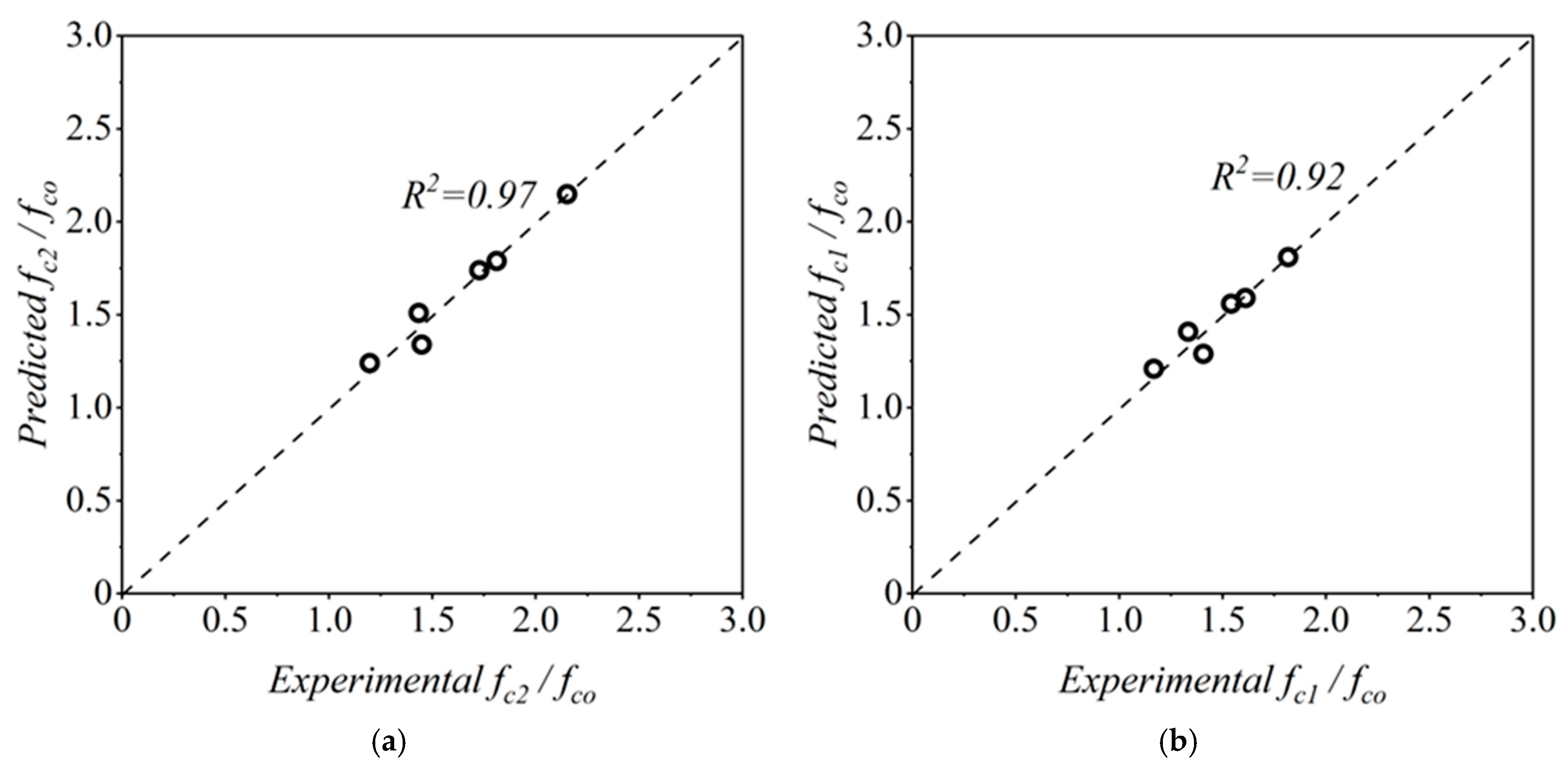
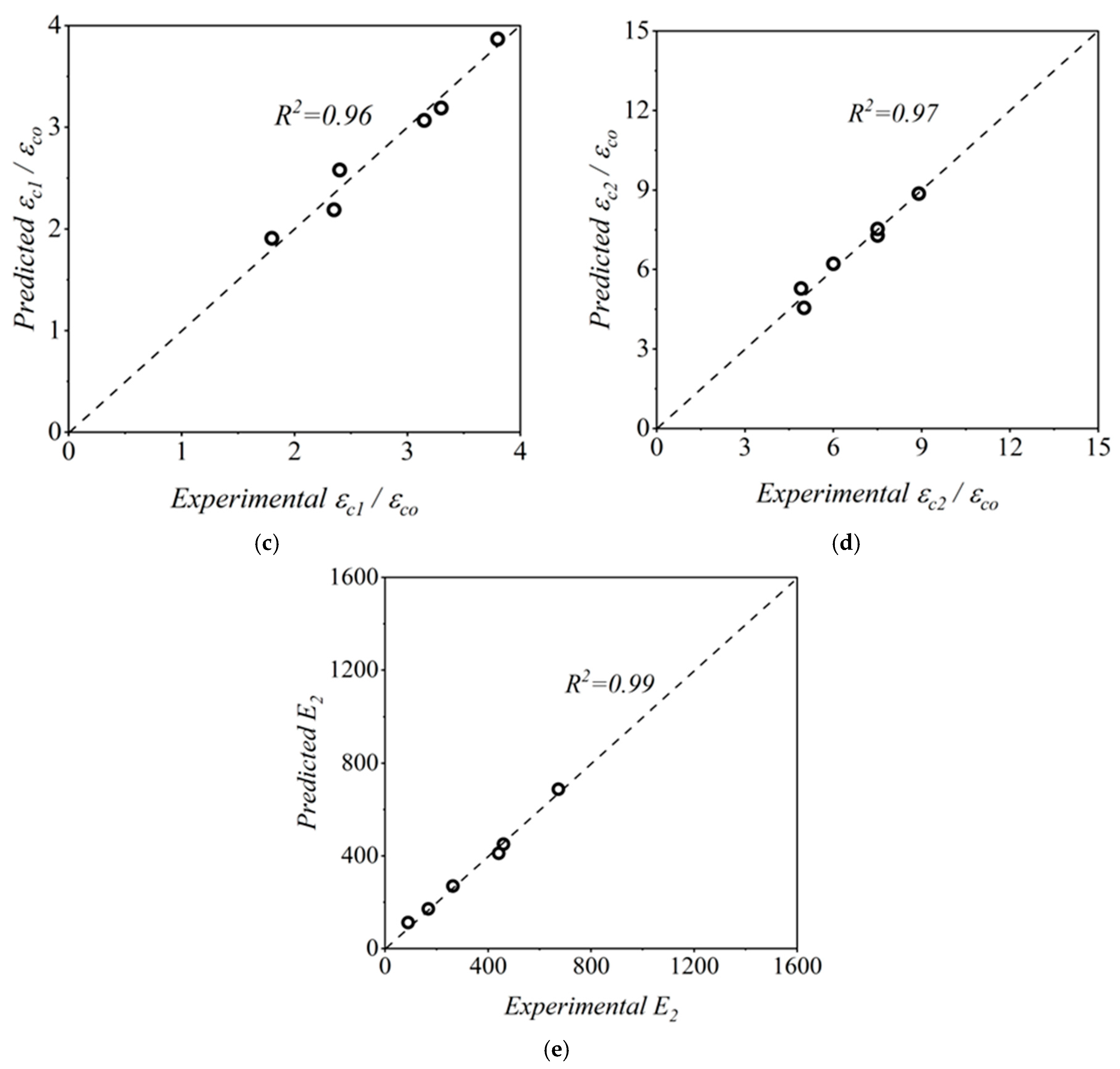
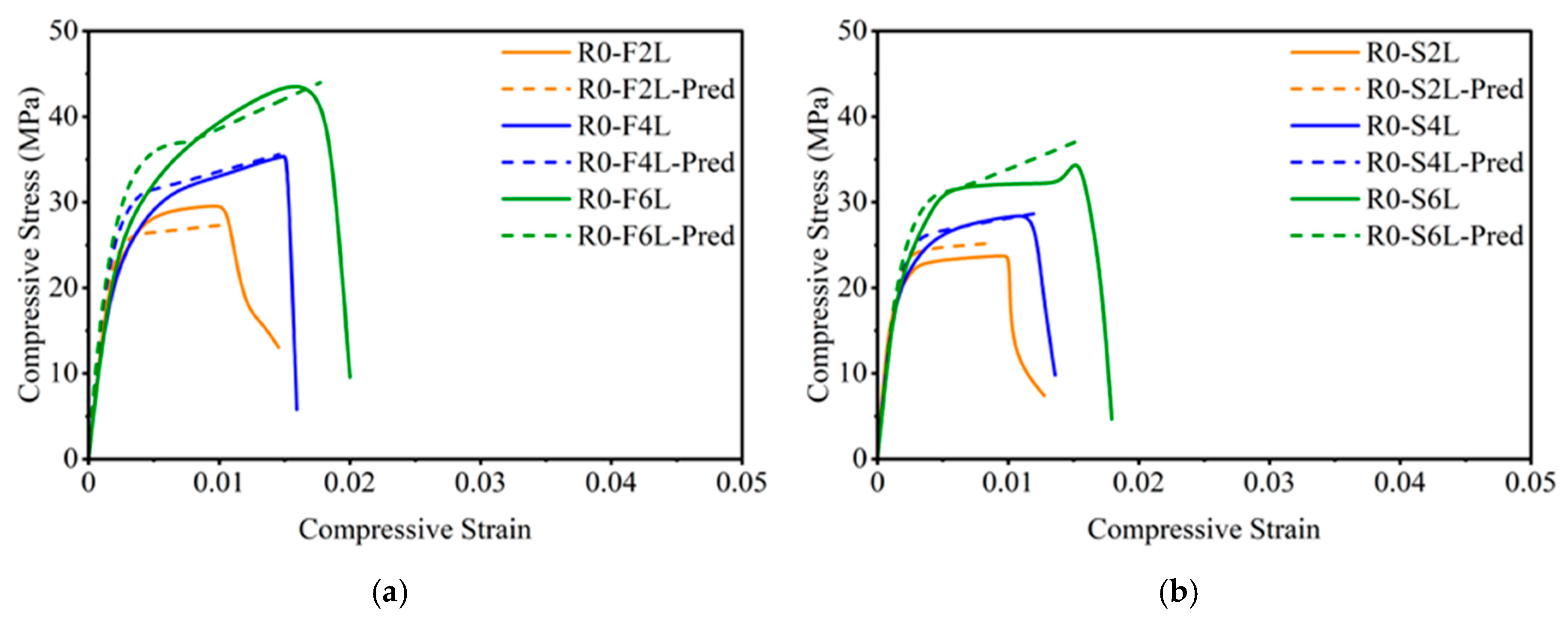
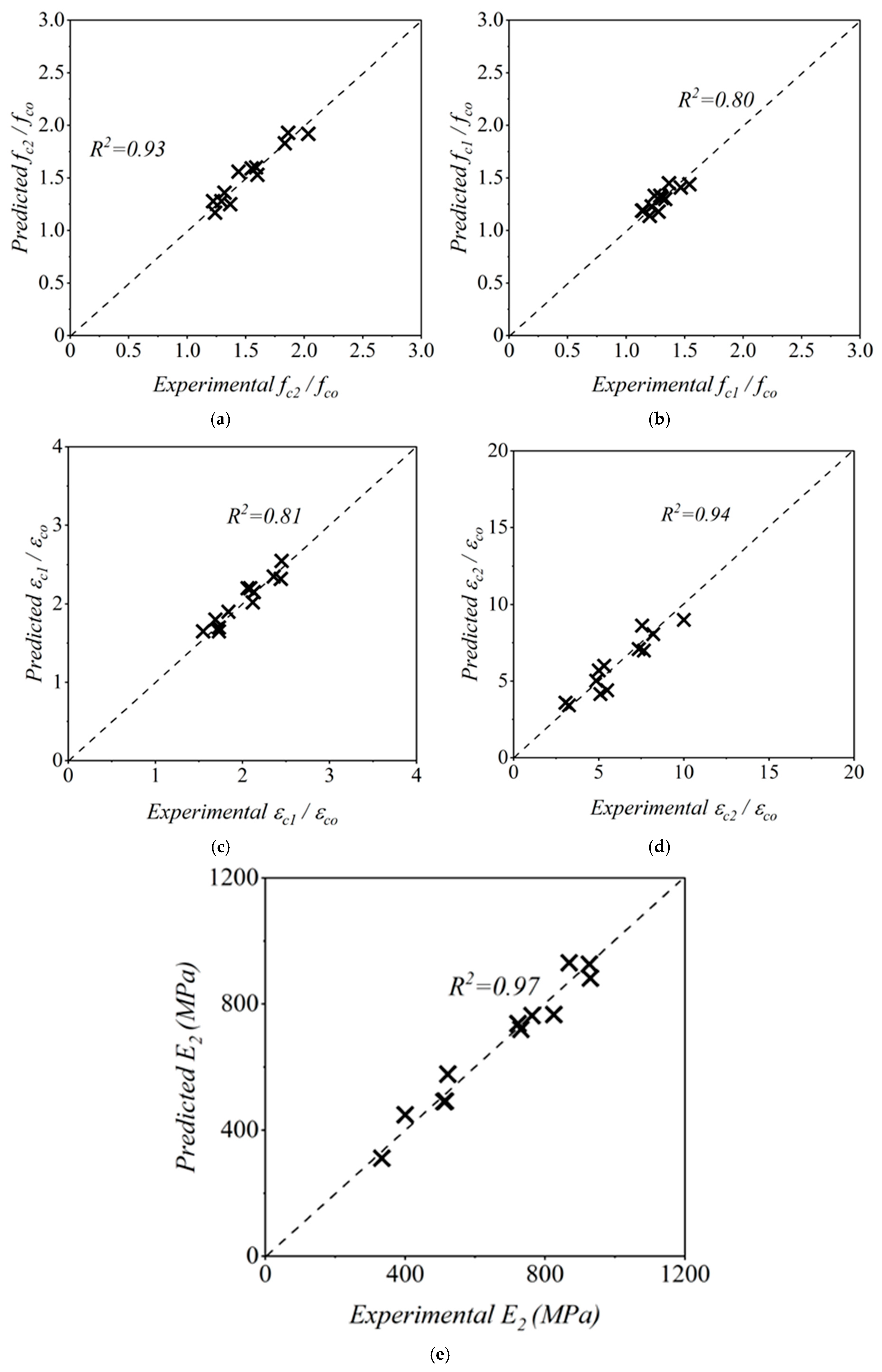
- The regression-based models developed for both NAC and RuC accurately predicted the stress–strain response, including transition and peak stresses, strain enhancement, and post-peak modulus, with excellent correlation (R2 = 0.80–0.99).
- Overall, GCSM confinement demonstrated strong potential as a cost-effective and sustainable strengthening technique, providing substantial strength improvements (up to 115%) and exceptional strain enhancement (exceeding 1300%), making it a promising alternative to conventional FRP systems for retrofitting rubberized concrete in resource-constrained regions.
Author Contributions
Funding
Institutional Review Board Statement
Data Availability Statement
Conflicts of Interest
References
- Hamdi, A.; Abdelaziz, G.; Farhan, K.Z. Scope of reusing waste shredded tires in concrete and cementitious composite materials: A review. J. Build. Eng. 2021, 35, 102014. [Google Scholar] [CrossRef]
- Raffoul, S.; Garcia, R.; Escolano-Margarit, D.; Guadagnini, M.; Hajirasouliha, I.; Pilakoutas, K. Behaviour of unconfined and FRP-confined rubberised concrete in axial compression. Constr. Build. Mater. 2017, 147, 388–397. [Google Scholar] [CrossRef]
- Chen, R.; Li, Q.; Zhang, Y.; Xu, X.; Zhang, D. Pyrolysis kinetics and mechanism of typical industrial non-tyre rubber wastes by peak-differentiating analysis and multi kinetics methods. Fuel 2019, 235, 1224–1237. [Google Scholar] [CrossRef]
- Islam, M.M.U.; Li, J.; Roychand, R.; Saberian, M.; Chen, F. A comprehensive review on the application of renewable waste tire rubbers and fibers in sustainable concrete. J. Clean. Prod. 2022, 374, 133998. [Google Scholar] [CrossRef]
- Bu, C.; Zhu, D.; Lu, X.; Liu, L.; Sun, Y.; Yu, L.; Xiao, T.; Zhang, W. Modification of Rubberized Concrete: A Review. Buildings 2022, 12, 999. [Google Scholar] [CrossRef]
- Youssf, O.; Elchalakani, M.; Hassanli, R.; Roychand, R.; Zhuge, Y.; Gravina, R.J.; Mills, J.E. Mechanical performance and durability of geopolymer lightweight rubber concrete. J. Build. Eng. 2022, 45, 103608. [Google Scholar] [CrossRef]
- Roychand, R.; Gravina, R.J.; Zhuge, Y.; Ma, X.; Youssf, O.; Mills, J.E. A comprehensive review on the mechanical properties of waste tire rubber concrete. Constr. Build. Mater. 2020, 237, 117651. [Google Scholar] [CrossRef]
- Abd-Elaal, E.-S.; Araby, S.; Mills, J.E.; Youssf, O.; Roychand, R.; Ma, X.; Zhuge, Y.; Gravina, R.J. Novel approach to improve crumb rubber concrete strength using thermal treatment. Constr. Build. Mater. 2019, 229, 116901. [Google Scholar] [CrossRef]
- Assaggaf, R.; Maslehuddin, M.; Al-Osta, M.A.; Al-Dulaijan, S.U.; Ahmad, S. Properties and sustainability of treated crumb rubber concrete. J. Build. Eng. 2022, 51, 104250. [Google Scholar] [CrossRef]
- Nadi, S.; Nezhad, H.B.; Sadeghi, A. Experimental study on the durability and mechanical properties of concrete with crumb rubber. J. Build. Pathol. Rehabil. 2022, 7, 17. [Google Scholar] [CrossRef]
- Hossain, F.Z.; Shahjalal, M.; Islam, K.; Tiznobaik, M.; Alam, M.S. Mechanical properties of recycled aggregate concrete containing crumb rubber and polypropylene fiber. Constr. Build. Mater. 2019, 225, 983–996. [Google Scholar] [CrossRef]
- Bompa, D.; Elghazouli, A. Stress–strain response and practical design expressions for FRP-confined recycled tyre rubber concrete. Constr. Build. Mater. 2020, 237, 117633. [Google Scholar] [CrossRef]
- Chan, C.; Yu, T.; Zhang, S.; Xu, Q. Compressive behaviour of FRP-confined rubber concrete. Constr. Build. Mater. 2019, 211, 416–426. [Google Scholar] [CrossRef]
- Pham, T.M.; Zhang, X.; Elchalakani, M.; Karrech, A.; Hao, H.; Ryan, A. Dynamic response of rubberized concrete columns with and without FRP confinement subjected to lateral impact. Constr. Build. Mater. 2018, 186, 207–218. [Google Scholar] [CrossRef]
- Youssf, O.; Hassanli, R.; Mills, J.E. Mechanical performance of FRP-confined and unconfined crumb rubber concrete containing high rubber content. J. Build. Eng. 2017, 11, 115–126. [Google Scholar] [CrossRef]
- Moustafa, A.; ElGawady, M.A. Strain Rate Effect on Properties of Rubberized Concrete Confined with Glass Fiber–Reinforced Polymers. J. Compos. Constr. 2016, 20, 04016014. [Google Scholar] [CrossRef]
- Ali, Y.M.; Wang, X.; Wu, Z. Bond-slip behavior and failure mechanism of Basalt-FRP bars with different surface treatments in crumb rubber concrete. Constr. Build. Mater. 2025, 490, 142464. [Google Scholar] [CrossRef]
- Nawar, M.T.; Selim, M.; Zaghlal, M.; El-Zohairy, A.; Emara, M. Performance of GFRP-Confined Rubberized Engineered Cementitious Composite Columns. J. Compos. Sci. 2024, 8, 330. [Google Scholar] [CrossRef]
- Tufail, R.F.; Feng, X.; Zahid, M. Behavior of unconfined and CFRP confined rubberized concrete. Int. J. Low-Carbon Technol. 2020, 15, 65–83. [Google Scholar] [CrossRef]
- Joyklad, P.; Saingam, P.; Ali, N.; Ejaz, A.; Hussain, Q.; Khan, K.; Chaiyasarn, K. Low-Cost Fiber Chopped Strand Mat Composites for Compressive Stress and Strain Enhancement of Concrete Made with Brick Waste Aggregates. Polymers 2022, 14, 4714. [Google Scholar] [CrossRef]
- Chaimahawan, P.; Shaingchin, S.; Sua-Iam, G.; Chatveera, B.; Hussain, Q.; Ahmad, A. Experimental and Analytical Study on Rectangular Concrete Confined with Glass Chopped Strand Mats Under Axial Load. Buildings 2025, 15, 3204. [Google Scholar] [CrossRef]
- Lam, L.; Khan, A.Q.; Pimanmas, A. Shear strengthening of RC deep beams using glass chopped strand mat (GCSM) composite. Case Stud. Constr. Mater. 2022, 16, e01018. [Google Scholar] [CrossRef]
- Saingam, P.; Gadagamma, C.K.; Hussain, Q.; Ejaz, A.; Hlaing, H.H.; Suwannatrai, R.; Khan, K.; Suparp, S. Large rupture strain cotton ropes hybridized with affordable fiberglass chopped strand mat sheets for enhanced compressive behavior of reinforced concrete columns. Heliyon 2024, 10, e39675. [Google Scholar] [CrossRef]
- Thansirichaisree, P.; Mohamad, H.; Zhou, M.; Ejaz, A.; Saingam, P.; Hussain, Q.; Suparp, S. Behavior of shallow concrete beams strengthened using low-cost GCSM and mechanical anchors. AIMS Mater. Sci. 2024, 11, 858–881. [Google Scholar] [CrossRef]
- Saingam, P.; Gadagamma, C.K.; Hussain, Q.; Hlaing, H.H.; Suwannatrai, R.; Qureshi, M.I.; Khan, K.; Ejaz, A. Modeling and comparative analysis of sustainable cotton rope confinement: Full vs. STrip wrapping for enhanced concrete strength and ductility. Case Stud. Constr. Mater. 2025, 22, e04134. [Google Scholar] [CrossRef]
- Hanif, M.A.; Ejaz, A.; Rizwan, M.; Bloach, M.A.; Iqbal, M.J. Experimental and Numerical Assessment of Bond Strength of Lap Spliced Steel Bars in Recycled Brick Aggregate Concrete. Arab. J. Sci. Eng. 2026, 51, 5317–5336. [Google Scholar] [CrossRef]
- Abadel, A.A.; Federowicz, K.; Elrahman, M.A. Mechanical properties, high temperature resistance and microstructure of eco-friendly ultra-high performance geopolymer concrete: Role of ceramic waste addition. Constr. Build. Mater. 2023, 401, 132677. [Google Scholar] [CrossRef]
- Abbas, S.; Fatima, A.; Kazmi, S.M.S.; Munir, M.J.; Ali, S.; Rizvi, M.A. Effect of Particle Sizes and Dosages of Rubber Waste on the Mechanical Properties of Rubberized Concrete Composite. Appl. Sci. 2022, 12, 8460. [Google Scholar] [CrossRef]
- Gholampour, A.; Ozbakkaloglu, T.; Hassanli, R. Behavior of rubberized concrete under active confinement. Constr. Build. Mater. 2017, 138, 372–382. [Google Scholar] [CrossRef]
- Cao, Y.; Li, L.; Liu, M.; Wu, Y. Mechanical behavior of FRP confined rubber concrete under monotonic and cyclic loading. Compos. Struct. 2021, 272, 114205. [Google Scholar] [CrossRef]
- Gholampour, A.; Pour, A.F.; Hassanli, R.; Ozbakkaloglu, T. Behavior of Actively Confined Rubberized Concrete under Cyclic Axial Compression. J. Struct. Eng. 2019, 145, 04019131. [Google Scholar] [CrossRef]
- Abbara, A.A.; Abdelhalim, A.; Al-Ajamee, M.; Ahmed, O.; Adhikary, S.K.; Ahmed, M. Uniaxial compressive stress-strain relationship for rubberized concrete with coarse aggregate replacement up to 100%. Case Stud. Constr. Mater. 2022, 17, e01336. [Google Scholar] [CrossRef]
- Liu, H.; Wang, X.; Jiao, Y.; Sha, T. Experimental Investigation of the Mechanical and Durability Properties of Crumb Rubber Concrete. Materials 2016, 9, 172. [Google Scholar] [CrossRef]
- Liao, J.; Zeng, J.-J.; Jiang, C.; Li, J.-X.; Yuan, J.-S. Stress-strain behavior and design-oriented model for FRP spiral strip-confined concrete. Compos. Struct. 2022, 293, 115747. [Google Scholar] [CrossRef]
- Zeng, J.-J.; Guo, Y.-C.; Gao, W.-Y.; Chen, W.-P.; Li, L.-J. Stress-strain behavior of concrete in circular concrete columns partially wrapped with FRP strips. Compos. Struct. 2018, 200, 810–828. [Google Scholar] [CrossRef]
- ASTM C150; Standard Specification for Portland Cement. American Society for Testing Materials: West Conshohocken, PA, USA, 2022.
- Youssf, O.; Mills, J.E.; Ellis, M.; Benn, T.; Zhuge, Y.; Ma, X.; Gravina, R.J. Practical Application of Crumb Rubber Concrete in Residential Slabs. Structures 2022, 36, 837–853. [Google Scholar] [CrossRef]
- Mo, J.; Ren, F.; Ye, Y.; Tian, S.; Lai, C. Effect of different crumb rubber particle sizes on the flexural properties of crumb rubber concrete. Mater. Lett. 2022, 326, 132960. [Google Scholar] [CrossRef]
- ASTM D3039/D3039M-08; Standard Test Method for Tensile Properties of Polymer Matrix Composite Materials. ASTM International: West Conshohocken, PA, USA, 2008. [CrossRef]
- Zeng, J.-J.; Ye, Y.-Y.; Gao, W.-Y.; Smith, S.T.; Guo, Y.-C. Stress-strain behavior of polyethylene terephthalate fiber-reinforced polymer-confined normal-, high- and ultra high-strength concrete. J. Build. Eng. 2020, 30, 101243. [Google Scholar] [CrossRef]
- Zeng, J.-J.; Guo, Y.-C.; Liao, J.; Shi, S.-W.; Bai, Y.-L.; Zhang, L. Behavior of hybrid PET FRP confined concrete-filled high-strength steel tube columns under eccentric compression. Case Stud. Constr. Mater. 2022, 16, e00967. [Google Scholar] [CrossRef]
- Guo, Y.-C.; Xiao, S.-H.; Shi, S.-W.; Zeng, J.-J.; Wang, W.-Q.; Zhao, H.-C. Axial compressive behavior of concrete-filled FRP-steel wire reinforced thermoplastics pipe hybrid columns. Compos. Struct. 2020, 244, 112237. [Google Scholar] [CrossRef]
- ASTM C39; Standard Test Method for Compressive Strength of Cylindrical Concrete Specimens. American Society for Testing Materials: West Conshohocken, PA, USA, 2021.
- Skyrianou, I.; Valiakou, E.I.; Koutas, L.N.; Papakonstantinou, C.G. Behaviour of carbon or glass FRP-confined rubberised concrete under monotonic compression. Constr. Build. Mater. 2023, 406, 133287. [Google Scholar] [CrossRef]
- Saingam, P.; Hussain, Q.; Ejaz, A.; Nawaz, A.; Joklad, P.; Khan, K. Enhancing compressive behavior of concrete with novel low-cost hybrid passive confinement including large rupture strain cotton ropes: Experimental findings and a design-oriented model. Case Stud. Constr. Mater. 2024, 21, e03496. [Google Scholar] [CrossRef]
- Ghani, M.U.; Ahmad, N.; Abraha, K.G.; Manj, R.Z.A.; Sharif, M.H.; Wei, L. Review and Assessment of Material, Method, and Predictive Modeling for Fiber-Reinforced Polymer (FRP) Partially Confined Concrete Columns. Polymers 2024, 16, 1367. [Google Scholar] [CrossRef]
- Suthumma, C.; Ejaz, A.; Iqbal, M.J.; Yooprasertchai, E.; Hussain, Q.; Sua-Iam, G.; Chatveera, B.; Chaimahawan, P.; Saingam, P. Axial compressive performance of sustainable BFRP-confined rectangular columns using recycled brick aggregates. Compos. Part C Open Access 2025, 18, 100653. [Google Scholar] [CrossRef]
- Tufail, R.F.; Feng, X.; Farooq, D.; Abdelmelek, N.; Lublóy, É. Behavior and Strength Predictions for CFRP Confined Rubberized Concrete under Axial Compression. Period. Polytech. Civ. Eng. 2021, 66, 164–178. [Google Scholar] [CrossRef]
- Liu, X.; Wu, T.; Chen, H.; Liu, Y. Compressive stress-strain behavior of CFRP-confined lightweight aggregate concrete reinforced with hybrid fibers. Compos. Struct. 2020, 244, 112288. [Google Scholar] [CrossRef]
- Li, Q.; Zhong, Y.; Xu, M.; Pan, C.; Nie, F.; Yang, H. Axial compressive behavior of partial CFRP-jacketed coal samples: Effects of CFRP layers and strip coverage ratio. Polym. Test. 2025, 149, 108871. [Google Scholar] [CrossRef]
- Pham, T.M.; Hadi, M.N.S.; Youssef, J. Optimized FRP Wrapping Schemes for Circular Concrete Columns under Axial Compression. J. Compos. Constr. 2015, 19, 04015015. [Google Scholar] [CrossRef]
- Lam, L.; Teng, J. Design-oriented stress–strain model for FRP-confined concrete. Constr. Build. Mater. 2003, 17, 471–489. [Google Scholar] [CrossRef]
- Ombres, L.; Verre, S. Structural behaviour of fabric reinforced cementitious matrix (FRCM) strengthened concrete columns under eccentric loading. Compos. Part B Eng. 2015, 75, 235–249. [Google Scholar] [CrossRef]
- Triantafillou, T.C. Strengthening of existing concrete structures: Concepts and structural behavior. Text. Fibre Compos. Civ. Eng. 2016, 19, 303–322. [Google Scholar] [CrossRef]
- Lam, L.; Teng, J.G. Ultimate Condition of Fiber Reinforced Polymer-Confined Concrete. J. Compos. Constr. 2004, 8, 539–548. [Google Scholar] [CrossRef]
- Suparp, S.; Ali, N.; Al Zand, A.W.; Chaiyasarn, K.; Rashid, M.U.; Yooprasertchai, E.; Hussain, Q.; Joyklad, P. Axial Load enhancement of lightweight aggregate concrete (LAC) using environmentally sustainable composites. Buildings 2022, 12, 851. [Google Scholar] [CrossRef]
- Yooprasertchai, E.; Tiawilai, Y.; Wittayawanitchai, T.; Angsumalee, J.; Joyklad, P.; Hussain, Q. Effect of shape, number, and location of openings on punching shear capacity of flat slabs. Buildings 2021, 11, 484. [Google Scholar] [CrossRef]
- Joyklad, P.; Ali, N.; Verre, S.; Magbool, H.M.; Elnemr, A.; Qureshi, M.I.; Hussain, Q.; Chaiyasarn, K. Experimental study on the out-of-plane behavior of brick masonry walls strengthened with mortar and wire mesh: A Pioneer Study. Infrastructures 2021, 6, 165. [Google Scholar] [CrossRef]



| Group | Specimens ID | Rubber Content (%) | Rubber Size (Mesh) | Strengthening Configuration | Number of Layers |
|---|---|---|---|---|---|
| 1 | R0-Con | 0 | - | None | None |
| R0-F2L | 0 | - | Full | 2 | |
| R0-F4L | 0 | - | Full | 4 | |
| RO-F6L | 0 | - | Full | 6 | |
| R0-S2L | 0 | - | Strip | 2 | |
| R0-S4L | 0 | - | Strip | 4 | |
| R0-S6L | 0 | - | Strip | 6 | |
| 2 | R40-Con | 20 | 40 | None | None |
| R40-F2L | 20 | 40 | Full | 2 | |
| R40-F4L | 20 | 40 | Full | 4 | |
| R40-F6L | 20 | 40 | Full | 6 | |
| R40-S2L | 20 | 40 | Strip | 2 | |
| R40-S4L | 20 | 40 | Strip | 4 | |
| R40-S6L | 20 | 40 | Strip | 6 | |
| 3 | R10-Con | 20 | 10 | None | None |
| R10-F2L | 20 | 10 | Full | 2 | |
| R10-F4L | 20 | 10 | Full | 4 | |
| R10-F6L | 20 | 10 | Full | 6 | |
| R10-S2L | 20 | 10 | Strip | 2 | |
| R10-S4L | 20 | 10 | Strip | 4 | |
| R10-S6L | 20 | 10 | Strip | 6 |
| Group | Specimen ID | Stress (MPa) | Increase in Stress (%) | Ultimate Strain (mm) | Increase in Strain (%) |
|---|---|---|---|---|---|
| 1 | R0-Con | 20.45 | - | 0.002 | - |
| R0-F2L | 27.40 | 34 | 0.0106 | 429 | |
| R0-F4L | 35.58 | 74 | 0.0146 | 629 | |
| R0-F6L | 43.97 | 115 | 0.0177 | 787 | |
| R0-Con | 19.88 | - | 0.002 | - | |
| R0-S2L | 24.65 | 24 | 0.0091 | 356 | |
| R0-S4L | 28.81 | 44.91 | 0.0124 | 522 | |
| R0-S6L | 37.00 | 86.12 | 0.0151 | 654 | |
| 2 | R40-Con | 27.08 | - | 0.002 | - |
| R40-F2L | 34.89 | 28.83 | 0.0088 | 341 | |
| R40-F4L | 43.65 | 61.19 | 0.0142 | 610 | |
| R40-F6L | 51.21 | 89.12 | 0.018 | 800 | |
| R40-Con | 18.83 | - | 0.002 | - | |
| R40-S2L | 24.09 | 27.92 | 0.0072 | 260 | |
| R40-S4L | 31.36 | 66.53 | 0.012 | 500 | |
| R40-S6L | 38.84 | 106.29 | 0.01724 | 762 | |
| 3 | R10-Con | 30.00 | - | 0.002 | - |
| R10-F2L | 37.52 | 25.07 | 0.0083 | 316 | |
| R10-F4L | 45.91 | 53.04 | 0.014 | 600 | |
| R10-F6L | 52.39 | 74.63 | 0.0161 | 707 | |
| R10-Con | 29.89 | - | 0.002 | - | |
| R10-S2L | 35.18 | 17.69 | 0.0068 | 242 | |
| R10-S4L | 38.89 | 30.10 | 0.0101 | 403 | |
| R10-S6L | 43.48 | 45.47 | 0.0114 | 470 |
Disclaimer/Publisher’s Note: The statements, opinions and data contained in all publications are solely those of the individual author(s) and contributor(s) and not of MDPI and/or the editor(s). MDPI and/or the editor(s) disclaim responsibility for any injury to people or property resulting from any ideas, methods, instructions or products referred to in the content. |
© 2026 by the authors. Licensee MDPI, Basel, Switzerland. This article is an open access article distributed under the terms and conditions of the Creative Commons Attribution (CC BY) license.
Share and Cite
Saingam, P.; Noman, M.; Chatveera, B.; Sua-Iam, G.; Mehmood, T.; Hussain, Q.; Alameri, M.; Joyklad, P. Enhancing Strength and Ductility of Rubberized Concrete Using Low-Cost Glass Jackets. Polymers 2026, 18, 841. https://doi.org/10.3390/polym18070841
Saingam P, Noman M, Chatveera B, Sua-Iam G, Mehmood T, Hussain Q, Alameri M, Joyklad P. Enhancing Strength and Ductility of Rubberized Concrete Using Low-Cost Glass Jackets. Polymers. 2026; 18(7):841. https://doi.org/10.3390/polym18070841
Chicago/Turabian StyleSaingam, Panumas, Muhammad Noman, Burachat Chatveera, Gritsada Sua-Iam, Tahir Mehmood, Qudeer Hussain, Mohammad Alameri, and Panuwat Joyklad. 2026. "Enhancing Strength and Ductility of Rubberized Concrete Using Low-Cost Glass Jackets" Polymers 18, no. 7: 841. https://doi.org/10.3390/polym18070841
APA StyleSaingam, P., Noman, M., Chatveera, B., Sua-Iam, G., Mehmood, T., Hussain, Q., Alameri, M., & Joyklad, P. (2026). Enhancing Strength and Ductility of Rubberized Concrete Using Low-Cost Glass Jackets. Polymers, 18(7), 841. https://doi.org/10.3390/polym18070841