Hybrid Nanocomposites Based on Poly(2,5-dichloro-3,6-bis(phenylamino)-p-benzoquinone) and MWCNTs: Synthesis, Structure, and the Role of ZnO
 , , , and
Abstract
1. Introduction
2. Materials and Methods
2.1. Materials
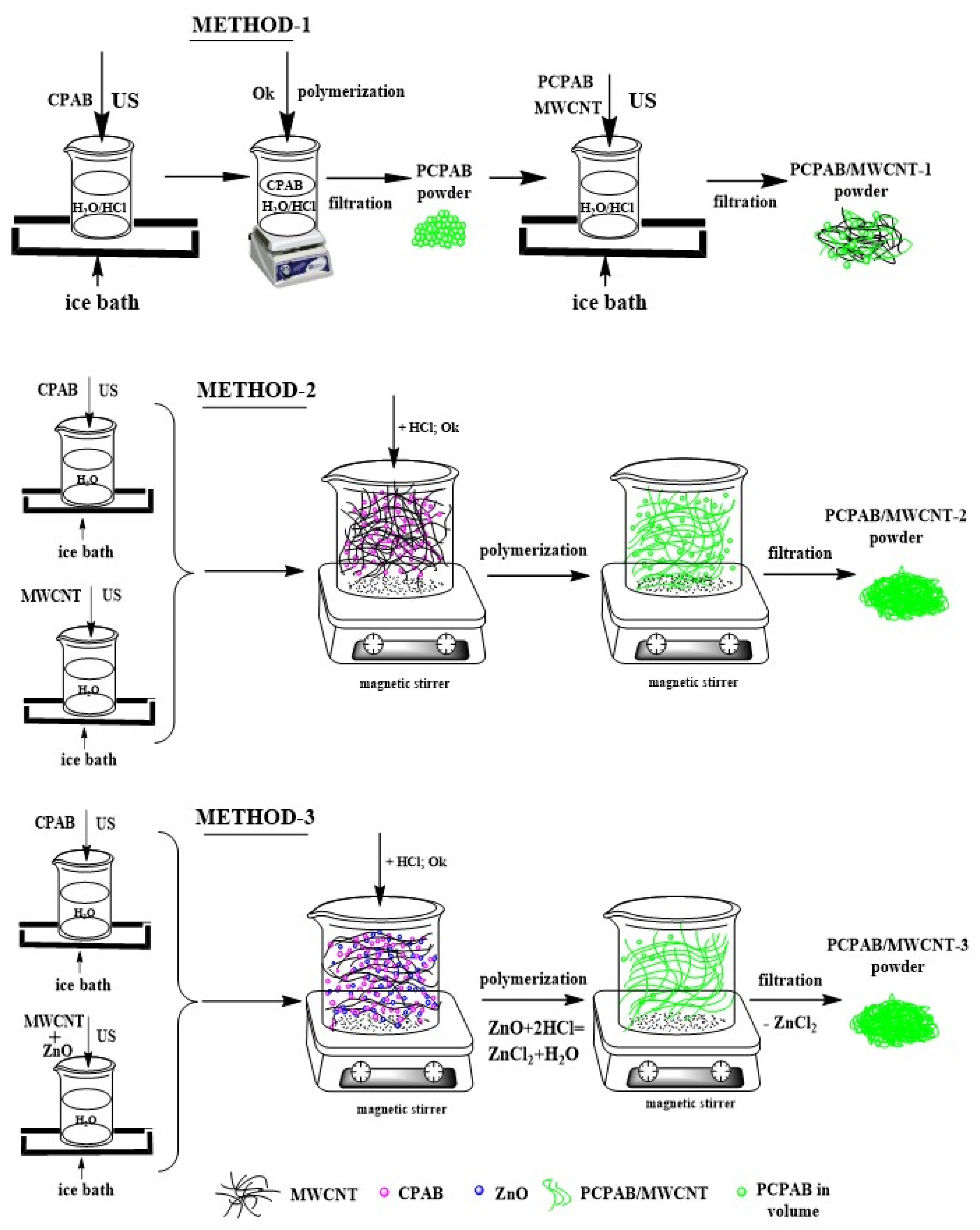
2.2. Synthesis of Composites Based on PCPAB and MWCNTs
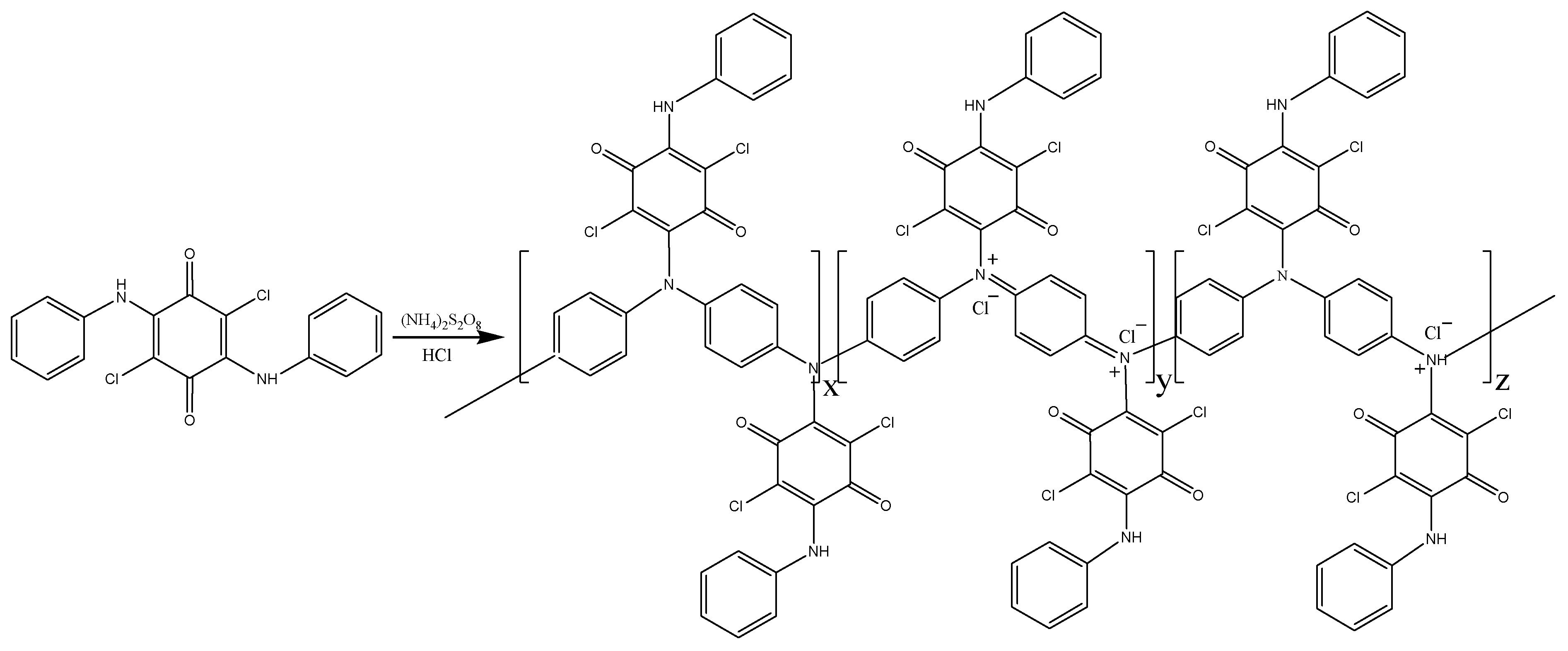
2.2.1. Synthesis of PCPAB and PCPAB/ZnO
2.2.2. Synthesis of PCPAB/MWCNTs by Mixing PCPAB and MWCNTs
2.2.3. Synthesis of PCPAB/MWCNTs via In Situ Oxidative Polymerization of CPAB in the Presence of MWCNTs
- –
- Separately, using ultrasonic dispersion under cooling (~5 °C), 2 suspensions were prepared: (1) 0.002 mol of the CPAB monomer were gradually added into 30 mL of water, and the suspension was sonicated for 15 min; and (2) MWCNTs weight portion (6 (12) wt% of CPAB) was added to 20 mL of water, and the suspension was sonicated for 10 min.
- –
- A suspension of CPAB was added to the vessel with the MWCNTs suspension and additionally dispersed for 15 min and dried at 60 °C for 24 h.
- –
- While stirring, 10 mL of HCl solution of a certain concentration was added to the resulting mixture (to obtain a reaction solution of the required concentration) and thermostatted at 18 °C.
2.2.4. Synthesis of P CPAB/MWCNTs via In Situ Oxidative Polymerization of CPAB in the Presence of MWCNTs and ZnO
- –
- Separately, using ultrasonic dispersion under cooling (~5 °C), 2 suspensions were prepared: (1) MWCNT weight portion (6 (12) wt% of CPAB) and ZnO 25 wt% of CPAB were added to 30 mL of water, and the suspension was sonicated for 15 min; and (2) 0.002 mol of the CPAB monomer was added to 20 mL of water, and the suspension was sonicated for 10 min.
- –
- A suspension of CPAB was added to the vessel with the MWCNT and ZnO (MWCNT/ZnO) suspension and additionally dispersed for 15 min.
- –
- While stirring, 10 mL of HCl solution of a certain concentration was added to the resulting mixture (to obtain a reaction solution of the required concentration) and thermostatted at 18 °C.
2.3. Materials Characterization
3. Results and Discussion
3.1. Structure of PCPAB/MWCNT Composites
3.2. Electrical Conductivity of Composites Based on PCPAB and MWCNTs
3.3. Thermal Stability of Nanocomposites Based on PCPAB and MWCNTs
4. Conclusions
Supplementary Materials
Author Contributions
Funding
Institutional Review Board Statement
Data Availability Statement
Acknowledgments
Conflicts of Interest
References
- Baughman, R.H.; Zakhidov, A.A.; De Heer, W.A. Carbon nanotubes—The route toward applications. Science 2002, 297, 787–792. [Google Scholar] [CrossRef]
- Li, H.; Xu, C.; Srivastava, N.; Banerjee, K. Carbon nanomaterials for next-generation interconnects and passives: Physics, status, and prospects. IEEE Trans. Electron Devices 2009, 56, 1799–1821. [Google Scholar] [CrossRef]
- Zaporotskova, I.V.; Boroznina, N.P.; Parkhomenko, Y.N.; Kozhitov, L.V. Carbon nanotubes: Sensor properties. A review. Modern Electronic Materials. Mod. Electron. Mater. 2016, 2, 95–105. [Google Scholar] [CrossRef]
- Oueiny, C.; Berlioz, S.; Perrin, F.-X. Carbon nanotube–polyaniline composites. Prog. Polym. Sci. 2014, 39, 707–748. [Google Scholar] [CrossRef]
- Anzar, N.; Hasan, R.; Tyagi, M.; Yadav, N.; Narang, J. Carbon nanotube—A review on Synthesis, Properties and plethora of applications in the field of biomedical science. Sens. Int. 2020, 1, 100003. [Google Scholar] [CrossRef]
- Gȕney, S. Electrosynthesis of Molecularly Imprinted Poly-o-phenylenediamine on MWCNT Modified Electrode for Selective Determination of Meldonium. Electroanalysis 2019, 31, 661–670. [Google Scholar] [CrossRef]
- Pisarevskaya, E.Y.; Ozkan, S.Z.; Petrov, V.A.; Efimov, O.; Karpacheva, G.P. New electrodes based on composites of polyphenothiazine with carbon nanomaterials. Mater. Chem. Phys. 2024, 312, 128668. [Google Scholar] [CrossRef]
- Jariwala, D.; Sangwan, V.K.; Lauhon, L.J.; Marks, T.J.; Hersam, M.C. Carbon nanomaterials for electronics, optoelectronics, photovoltaics, and sensing. Chem. Soc. Rev. 2013, 42, 2824–2860. [Google Scholar] [CrossRef]
- Fan, W.; Zhang, Y.; Guo, C.-Y.; Chen, G. Toward high thermoelectric performance for polypyrrole composites by dynamic 3-phase interfacial electropolymerization and chemical doping of carbon nanotubes. Compos. Sci. Technol. 2019, 183, 107794. [Google Scholar] [CrossRef]
- Xue, Y.; Gao, C.; Liang, L.; Wang, X.; Chen, G. Nanostructure controlled construction of high-performance thermoelectric materials of polymers and their composites. J. Mater. Chem. A 2018, 6, 22381–22390. [Google Scholar] [CrossRef]
- Mathew, R.J.; Chandran, A.R.; Syamkishor, K.S.; Joseph, L.K.; Saji, K.J.; Sajeev, U.S. Tunable nonlinear optical properties in polyaniline-multiwalled carbon nanotube (PANI-MWCNT) system probed under pulsed Nd:YAG laser. Next Mater. 2025, 6, 100431. [Google Scholar] [CrossRef]
- Lehman, J.H.; Terrones, M.; Mansfield, E.; Hurst, K.E.; Meunier, V. Evaluating the characteristics of multiwall carbon nanotubes. Carbon 2011, 49, 2581–2602. [Google Scholar] [CrossRef]
- Ansari, S.A.; Parveen, N.; Ansari, M.Z.; Alsulaim, G.M.; Alam, M.W.; Khan, M.Y.; Umar, A.; Hussain, I.; Zhang, K. Exploring recent advances in the versatility and efficiency of carbon materials for next generation supercapacitor applications: A comprehensive review. Prog. Mater. Sci. 2025, 154, 101493. [Google Scholar] [CrossRef]
- Lawal, A.T. Recent application of carbon nanotubes in energy storage and conversion devices. Carbon Trends 2025, 19, 100470. [Google Scholar] [CrossRef]
- Prasannakumar, A.T.; Rohith, R.; Manju, V.; Mohan, R.R.; Varma, S.J. High energy density electrodes based on solution intercalated, self-stabilized dispersion polymerized polyaniline/MWCNT hybrids for supercapacitors. J. Energy Storage 2024, 76, 109732. [Google Scholar] [CrossRef]
- Sun, Y.; Wilson, S.R.; Schuster, D.I. High Dissolution and Strong Light Emission of Carbon Nanotubes in Aromatic Amine Solvents. J. Am. Chem. Soc. 2001, 123, 5348–5349. [Google Scholar] [CrossRef]
- Rajput, S.; Panwar, A.K.; Gupta, A. Study of lithium diffusion properties and electrochemical performance of SnSe/C and SnSe/MWCNT composite anode for Li-ion batteries. Solid State Ion. 2023, 394, 116206. [Google Scholar] [CrossRef]
- Gandara, M.; Gonçalves, E.S. Polyaniline supercapacitor electrode and carbon fiber graphene oxide: Electroactive properties at the charging limit. Electrochim. Acta 2020, 345, 136197. [Google Scholar] [CrossRef]
- Ha, J.-S.; Lee, J.-M.; Lee, H.-R.; Huh, P.; Jo, N.-J. Polymer nanocomposite electrode consisting of polyaniline and modified multi-walled carbon nanotube for rechargeable battery. J. Nanosci. Nanotechnol. 2015, 15, 8977–8983. [Google Scholar] [CrossRef]
- Manimekalai, A.; Velu, K.S.; Mohandoss, S.; Ahma, R.W.N.; Seo, J.H.; Sun, S.; Lee, Y.R. Poly(aniline)-multiwall carbon nanotube (PANI@MWCNT) composite as high-cost Pt free counter electrode for dye-sensitized solar cells. Curr. Appl. Phys. 2024, 68, 230–237. [Google Scholar] [CrossRef]
- Gao, Y.; He, S.; Hu, J.; Wu, C.; Chen, Z.; Cen, H. A simple strategy to significantly improve the anticorrosion and aging resistance of epoxy coatings by adding polyaniline modified multi-walled carbon nanotubes. Polym. Degrad. Stab. 2024, 230, 111027. [Google Scholar] [CrossRef]
- Wu, Z.; Yao, X.; Xing, Y.; Huang, P.; Li, B.; Liu, L. Enhanced electromagnetic shielding and surface modulation of electrospun cellulose acetate-based fiber membranes via multi-walled carbon nanotubes and in-situ polyaniline polymerization. Colloids Surf. A Physicochem. Eng. Asp. 2025, 718, 136957. [Google Scholar] [CrossRef]
- Kaushik, P.; Bharti, R.; Sharma, R.; Verma, M.; Olsson, R.T.; Pandey, A. Progress in synthesis and applications of Polyaniline-Coated Nanocomposites: A comprehensive review. Eur. Polym. J. 2024, 221, 113574. [Google Scholar] [CrossRef]
- Stejskal, J. Polymers of phenylenediamines. Prog. Polym. Sci. 2015, 41, 1–31. [Google Scholar] [CrossRef]
- Jadoun, S.; Riaz, U.; Yáñez, J.; Chauhan, N.P.S. Synthesis, characterization and potential applications of Poly(o-phenylenediamine) based copolymers and Nanocomposites: A comprehensive review. Eur. Polym. J. 2021, 156, 110600. [Google Scholar] [CrossRef]
- Cataldo, F.; Maltese, P. Synthesis of alkyl and N-alkyl-substituted polyanilines: A study on their spectral properties and thermal stability. Eur. Polym. J. 2002, 38, 1791–1803. [Google Scholar] [CrossRef]
- Manohar, S.K.; MacDiarmid, A.G.; Cromack, K.R.; Ginder, J.M.; Epstein, A.J. N-substituted derivatives of polyaniline. Synth. Met. 1989, 29, 349–356. [Google Scholar] [CrossRef]
- Bhadra, S.; Singha, N.K.; Khastgir, D. Effect of aromatic substitution in aniline on the properties of polyaniline. Eur. Polym. J. 2008, 44, 1763–1770. [Google Scholar] [CrossRef]
- Zhang, Y.; Duan, Y.; Liu, J.; Ma, G.; Huang, M. Wormlike Acid-Doped Polyaniline: Controllable Electrical Properties and Theoretical Investigation. J. Phys. Chem. C 2018, 122, 2032–2040. [Google Scholar] [CrossRef]
- Lin, K.-Y.; Hu, L.-W.; Chen, K.-L.; Siao, M.-D.; Ji, W.-F.; Yang, C.-C.; Yeh, J.-M.; Chiu, K.-C. Characterization of polyaniline synthesized from chemical oxidative polymerization at various polymerization temperatures. Eur. Polym. J. 2017, 88, 311–319. [Google Scholar] [CrossRef]
- Bhadra, S.; Khastgir, D.; Singha, N.K.; Lee, J.H. Progress in preparation, processing and applications of polyaniline. Prog. Polym. Sci. 2009, 34, 783–810. [Google Scholar] [CrossRef]
- Palaniappan, S.; John, A. Polyaniline materials by emulsion polymerization pathway. Prog. Polym. Sci. 2008, 33, 732–758. [Google Scholar] [CrossRef]
- Alabdullah, S.S.M.; Ismail, H.K.; Ryder, K.S.; Abbott, A.P. Evidence supporting an emulsion polymerisation mechanism for the formation of polyaniline. Electrochim. Acta 2020, 354, 136737. [Google Scholar] [CrossRef]
- Li, J.; Cui, M.; Lai, Y.; Zhang, Z.; Lu, H.; Fang, J.; Liu, Y. Investigation of polyaniline co-doped with Zn2+ and H+ as the electrode material for electrochemical supercapacitors. Synth. Met. 2010, 160, 1228–1233. [Google Scholar] [CrossRef]
- Ghosh, D.; Giri, S.; Mandal, A.; Das, C.K. Supercapacitor based on H+ and Ni2+ co-doped polyaniline–MWCNTs nanocomposite: Synthesis and electrochemical characterization. RSC Adv. 2013, 3, 11676. [Google Scholar] [CrossRef]
- Zhang, H.; Yuan, J.; Liu, Y.; Zheng, R.; Jia, C. Zn2+ assisted co-construction of polyaniline electrochromic device with enhanced infrared modulation. Electrochim. Acta 2025, 529, 146354. [Google Scholar] [CrossRef]
- Iijima, S. Helical microtubules of graphitic carbon. Nature 1991, 354, 56–58. [Google Scholar] [CrossRef]
- Hughes, K.J.; Iyer, K.A.; Bird, R.E.; Ivanov, J.; Banerjee, S.; Georges, G.; Zhou, Q.A. Review of Carbon Nanotube Research and Development: Materialsand Emerging Applications. ACS Appl. Nano Mater. 2024, 7, 18695–18713. [Google Scholar] [CrossRef]
- Gajendran, P.; Saraswathi, R. Polyaniline-carbon nanotube composites. Pure Appl. Chem. 2008, 80, 2377–2395. [Google Scholar] [CrossRef]
- Guo, M.; Chen, J.; Li, J.; Tao, B.; Yao, S. Fabrication of polyaniline/carbon nanotube composite modified electrode and its electrocatalytic property to the reduction of nitrite. Anal. Chim. Acta 2005, 532, 71–77. [Google Scholar] [CrossRef]
- Tan, W.; Stallard, J.C.; Jo, C.; De Volder, M.F.L.; Fleck, N.A. The mechanical and electrochemical properties of polyaniline-coated carbon nanotube mat. J. Energy Storage 2021, 41, 102757. [Google Scholar] [CrossRef]
- Okotrub, A.V.; Asanov, I.P.; Galkin, P.S.; Bulusheva, L.G.; Chekhova, G.N.; Kurenya, A.G.; Shubin, Y.V. Composites Based on Polyaniline and Aligned Carbon Nanotubes. Polym. Sci. Ser. B 2010, 52, 101–108. [Google Scholar] [CrossRef]
- Wu, R.; Yuan, H.; Liu, C.; Lan, J.-L.; Yang, X.; Lin, Y.-H. Flexible PANI/SWCNT thermoelectric films with ultrahigh electrical conductivity. RSC Adv. 2018, 8, 26011–26019. [Google Scholar] [CrossRef] [PubMed]
- Feng, L.; Wu, R.; Liu, C.; Lan, J.; Lin, Y.-H.; Yang, X. Facile Green Vacuum-Assisted Method for Polyaniline/SWCNT Hybrid Films with Enhanced Thermoelectric Performance by Interfacial Morphology Control. ACS Appl. Energy Mater. 2021, 4, 4081–4089. [Google Scholar] [CrossRef]
- Nagaraja, K.K.; Pramodini, S.; Poornesh, P.; Telenkov, M.P.; Kityk, I.V. Nonlinear optical properties of polyaniline and poly(o-toluidine) composite thin films with multi walled carbon nano tubes. Phys. B Condens. Matter 2017, 512, 45–53. [Google Scholar] [CrossRef]
- Joseph, L.; Flora, J.R.V.; Park, Y.-G.; Badawy, M.; Saleh, H.; Yoon, Y. Removal of natural organic matter from potential drinking water sources by combined coagulation and adsorption using carbon nanomaterials. Sep. Purif. Technol. 2012, 95, 64–72. [Google Scholar] [CrossRef]
- Yang, K.; Xing, B. Adsorption of fulvic acid by carbon nanotubes from water. Environ. Pollut. 2009, 157, 1095–1100. [Google Scholar] [CrossRef]
- Konyushenko, E.N.; Stejskal, J.; Trchova, M.; Hradil, J.; Kovářová, J.; Prokeš, J.; Cieslar, M.; Hwang, J.Y.; Chen, K.H.; Sapurina, I. Multi-wall carbon nanotubes coated with polyaniline. Polymer 2006, 47, 5715–5723. [Google Scholar] [CrossRef]
- Cochet, M.; Maser, W.K.; Benito, A.M.; Callejas, M.A.; Martínez, M.T.; Benoit, J.-M.; Schreiber, J.; Chauvet, O. Synthesis of a new polyaniline/nanotube composite: “in-situ” polymerization and charge transfer through site-selective interaction. Chem. Commun. 2001, 16, 1450–1451. [Google Scholar] [CrossRef]
- Oraon, R.; De Adhikari, A.; Tiwari, S.K.; Nayak, G.C. Enhanced Specific Capacitance of Self-Assembled Three-Dimensional Carbon Nanotube/Layered Silicate/Polyaniline Hybrid Sandwiched Nanocomposite for Supercapacitor Applications. ACS Sustain. Chem. Eng. 2016, 4, 1392–1403. [Google Scholar] [CrossRef]
- Kim, J.-W.; Siochi, E.J.; Carpena-Núñez, J.; Wise, K.E.; Connell, J.W.; Lin, Y.; Wincheski Russell, A. Polyaniline/Carbon Nanotube Sheet Nanocomposites: Fabrication and Characterization. ACS Appl. Mater. Interfaces 2013, 5, 8597–8606. [Google Scholar] [CrossRef] [PubMed]
- Roy, A.; Ray, A.; Saha, S.; Das, S. Investigation on energy storage and conversion properties of multifunctional PANI-MWCNT composite. Int. J. Hydrogen Energy 2018, 43, 7128–7139. [Google Scholar] [CrossRef]
- Salvatierra, R.V.; Zitzer, G.; Savu, S.-A.; Alves, A.P.; Zarbin, A.J.G.; Chassé, T.; Casu, M.B.; Rocco, M.L.M. Carbon nanotube/polyaniline nanocomposites: Electronic structure, doping level and morphology investigations. Synth. Met. 2015, 203, 16–21. [Google Scholar] [CrossRef]
- Yao, Q.; Chen, L.; Zhang, W.; Liufu, S.; Chen, X. Enhanced Thermoelectric Performance of Single-Walled Carbon Nanotubes/Polyaniline Hybrid Nanocomposites. ACS Nano 2010, 4, 2445–2451. [Google Scholar] [CrossRef]
- Ogurtsov, N.A.; Noskov, Y.V.; Bliznyuk, V.N.; Ilyin, V.G.; Wojkiewicz, J.-L.; Fedorenko, E.A.; Pud, A.A. Evolution and Interdependence of Structure and Properties of Nanocomposites of Multiwall Carbon Nanotubes with Polyaniline. J. Phys. Chem. C 2015, 120, 230–242. [Google Scholar] [CrossRef]
- Deb, K.; Sarkar, K.; Bera, A.; Debnath, A.; Sah, B. Coupled polaron-electron charge transport in graphite functionalized polyaniline on cellulose: Metal free flexible p-type semiconductor. Synth. Met. 2018, 245, 96–101. [Google Scholar] [CrossRef]
- Ginic-Markovic, M.; Matisons, J.G.; Cervini, R.; Simon, G.P.; Fredericks, P.M. Synthesis of New Polyaniline-Nanotube Composites Using Ultrasonically Initiated Emulsion Polymerization. Chem. Mater. 2006, 18, 6258–6265. [Google Scholar] [CrossRef]
- Ardani, M.R.; Pang, A.; Pal, U.; Zheng, R.; Arsad, A.; Hamzah, A.A.; Ahmadipour, M. Ultrasonic-assisted polyaniline-multiwall carbon nanotube photocatalyst for efficient photodegradation of organic pollutants. J. Water Process Eng. 2022, 46, 102557. [Google Scholar] [CrossRef]
- Suckeveriene, R.Y.; Zelikman, E.; Mechrez, G.; Tzur, A.; Frisman, I.; Cohen, Y.; Narkis, M. Synthesis of Hybrid Polyaniline-Carbon Nanotube Nanocomposites by Dynamic Interfacial Inverse Emulsion Polymerization Under Sonication. J. Appl. Polym. Sci. 2011, 120, 676–682. [Google Scholar] [CrossRef]
- Zelikman, E.; Suckeveriene, R.Y.; Mechrez, G.; Narkis, M. Fabrication of composite polyaniline/CNT nanofibers using an ultrasonically assisted dynamic inverse emulsion polymerization technique. Polym. Adv. Technol. 2010, 21, 150–152. [Google Scholar] [CrossRef]
- Liu, X.; Sun, Y.; Tong, Y.; Wang, X.; Zheng, J.; Wu, Y.; Li, H.; Niu, L.; Hou, Y. Exploration in materials, electrolytes and performance towards metal ion (Li, Na, K, Zn and Mg)-based hybrid capacitors: A review. Nano Energy 2021, 86, 106070. [Google Scholar] [CrossRef]
- Kim, S.W.; Kim, T.; Kim, Y.S.; Choi, H.S.; Lim, H.J.; Yang, S.J.; Park, C.R. Surface modifications for the effective dispersion of carbon nanotubes in solvents and polymers. Carbon 2012, 50, 3–33. [Google Scholar] [CrossRef]
- Wei, K.; Tang, H.; Qu, G.; Pan, K. Selective detection of hydroxyl radicals by molecularly imprinted electrochemical sensors constructed with MWCNTs-COOH-modified electrodes. Microchem. J. 2024, 205, 111194. [Google Scholar] [CrossRef]
- Naqvi, S.T.R.; Rasheed, T.; Hussain, D.; Ha, M.N.; Majeed, S.; Shafi, S.; Ahmed, N.; Nawaz, R. Modification strategies for improving the solubility/dispersion of carbon nanotubes. J. Mol. Liq. 2020, 297, 111919. [Google Scholar] [CrossRef]
- Teoh, W.-C.; Yeoh, W.-M.; Mohamed, A.R. Evaluation of Different Oxidizing Agents on Effective Covalent Functionalization of Multiwalled Carbon Nanotubes. Fuller. Nanotub. Carbon Nanostructures 2018, 26, 846–850. [Google Scholar] [CrossRef]
- Jun, L.Y.; Mubarak, N.M.; Yon, L.S.; Bing, C.H.; Khalid, M.; Abdullah, E.C. Comparative study of acid functionalization of carbon nanotube via ultrasonic and reflux mechanism. J. Environ. Chem. Eng. 2018, 6, 5889–5896. [Google Scholar] [CrossRef]
- Osorio, G.; Silveira, I.C.L.; Bueno, V.L.; Bergmann, C.P. H2SO4/HNO3/HCl–Functionalization and its Effect on Dispersion of Carbon Nanotubes in Aqueous Media. Appl. Surf. Sci. Part 1 2008, 255, 2485–2489. [Google Scholar] [CrossRef]
- Hernadi, K.; Siska, A.; Thiên-Nga, L.; Forró, L.; Kiricsi, I. Reactivity of Different Kinds of Carbon During Oxidative Purification of Catalytically Prepared Carbon Nanotubes. Solid State Ion. 2001, 141–142, 203–209. [Google Scholar] [CrossRef]
- Wang, M.W.; Wang, J.; Qu, J.W. Study on the Chemical Modification of the Walls of Carbon Nanotubes by K2Cr2O7and HNO3. Adv. Mater. Res. 2011, 197–198, 571–574. [Google Scholar] [CrossRef]
- Huang, J.-Q.; Zhang, Q.; Zhao, M.-Q.; Wei, F. The Release of Free Standing Vertically aligned Carbon Nanotube Arrays from a Substrate Using CO2 Oxidation. Carbon 2010, 48, 1441–1450. [Google Scholar] [CrossRef]
- Ran, M.; Sun, W.; Liu, Y.; Chu, W.; Jiang, C. Functionalization of Multi-walled Carbon Nanotubes Using Water-assisted Chemical Vapor Deposition. J. Solid State Chem. 2013, 197, 517–522. [Google Scholar] [CrossRef]
- Solhy, A.; Machado, B.F.; Beausoleil, J.; Kihn, Y.; Gonçalves, F.; Pereira, M.; Órfão, J.; Figueiredo, J.; Serp, P. MWCNT Activation and its Influence on the Catalytic Performance of Pt/MWCNT Catalysts for Selective Hydrogenation. Carbon 2008, 46, 1194–1207. [Google Scholar] [CrossRef]
- Chen, L.; Xie, H. Surfactant-free nano fluids containing double- and single-walled carbon nanotubes functionalized by a wet-mechanochemical reaction. Thermochim. Acta 2010, 497, 67–71. [Google Scholar] [CrossRef]
- Basiuk, E.V.; Basiuk, V.A.; Banuelos, J.-G.; Saniger-Blesa, J.-M.; Pokrovskiy, V.A.; Gromovoy, T.Y.; Mischanchuk, A.V.; Mischanchuk, B.G. Interaction of Oxidized Single-walled Carbon Nanotubes with Vaporous Aliphatic Amines. J. Phys. Chem. B 2002, 10, 1588–1597. [Google Scholar] [CrossRef]
- Choudhury, A.; Kar, P. Doping effect of carboxylic acid group functionalized multi-walled carbon nanotube on polyaniline. Compos. Part. B Eng. 2011, 42, 1641–1647. [Google Scholar] [CrossRef]
- Xu, J.; Yao, P.; Li, X.; He, F. Synthesis and characterization of water-soluble and conducting sulfonated polyaniline/para-phenylenediamine-functionalized multi-walled carbon nanotubes nanocomposite. Mater. Sci. Eng. B 2008, 151, 210–219. [Google Scholar] [CrossRef]
- Ziegler, K.J.; Gu, Z.; Peng, H.; Flor, E.L.; Hauge, R.H.; Smalley, R.E. Controlled Oxidative Cutting of Single-Walled Carbon Nanotubes. J. Am. Chem. Soc. 2005, 127, 1541–1547. [Google Scholar] [CrossRef]
- Worsley, K.A.; Kalinina, I.; Bekyarova, E.; Haddon, R.C. Functionalization and Dissolution of Nitric Acid Treated Singlewalled Carbon Nanotubes. J. Am. Chem. Soc. 2009, 131, 18153–18158. [Google Scholar] [CrossRef]
- Sezer, N.; Koç, M. Oxidative acid treatment of carbon nanotubes. Surf. Interfaces 2019, 14, 1–8. [Google Scholar] [CrossRef]
- Bumika, M.; Mallick, M.K.; Mohanty, S.; Nayak, S.K.; Palai, A.K. One-pot electrodeposition of polyaniline/SWCNT/ZnO film and its positive influence on photovoltaic performance as counter electrode material. Mater. Lett. 2020, 279, 128473. [Google Scholar] [CrossRef]
- Amenu, B.; Taddesse, A.M.; Kebede, T.; Mengesha, E.T.; Bezu, Z. Polyaniline-supported MWCNTs/ZnO/Ag2CO3 composite with enhanced photocatalytic and antimicrobial applications. Environ. Nanotechnol. Monit. Manag. 2024, 21, 100926. [Google Scholar] [CrossRef]
- Khan, A.A.; Khalid, M. Synthesis of nano-sized ZnO and polyaniline-zinc oxide composite: Characterization, stability in terms of DC electrical conductivity retention and application in ammonia vapor detection. J. Appl. Polym. Sci. 2010, 117, 1601–1607. [Google Scholar] [CrossRef]
- Sharma, B.K.; Gupta, A.K.; Kharea, N.; Dhawan, S.K.; Gupta, H.C. Synthesis and characterization of polyaniline–ZnO composite and its dielectric behavior. Synth. Met. 2009, 159, 391–395. [Google Scholar] [CrossRef]
- Jalali, H.; Eslami-Farsani, R.; Ramezanzadeh, B. Zinc-doped sulfonated polyaniline tailored Multi-walled carbon nanotubes (Zn-SPANI-MWCNT); A novel nano-hybrid for designing a smart self-healable epoxy coating. J. Ind. Eng. Chem. 2023, 122, 397–414. [Google Scholar] [CrossRef]
- Najmi, P.; Keshmiri, N.; Ramezanzadeh, M.; Ramezanzadeh, B. Highly improving the mechanical-responses/thermal-stability of the epoxy nano-composite using novel highly-oxidized multi-walled carbon nanotubes (OMWCNT) functionalized by Zinc-doped Polyaniline (PANI) nanofibers. J. Taiwan Inst. Chem. Eng. 2021, 119, 245–258. [Google Scholar] [CrossRef]
- Ong, P.J.; Lee, H.Y.S.; Wang, S.; Thitsartarn, W.; Zhang, X.; Kong, J.; Kai, D.; Tan, B.H.; Wang, P.; Qu, Z.; et al. Recent advances in enhanced thermal property in phase change materials using carbon nanotubes: A review. Sol. Energy Mater. Sol. Cells 2025, 279, 113228. [Google Scholar] [CrossRef]
- Lavagna, L.; Nistico, R.; Musso, S.; Pavese, M. Functionalization as a way to enhance dispersion of carbon nanotubes in matrices: A review. Mater. Today Chem. 2021, 20, 100477. [Google Scholar] [CrossRef]
- Zhou, Y.; Fang, Y.; Ramasamy, R.P. Non-Covalent Functionalization of Carbon Nanotubes for Electrochemical Biosensor Development. Sensors 2019, 19, 392. [Google Scholar] [CrossRef]
- Hwang, J.-Y.; Nish, A.; Doig, J.; Douven, S.; Chen, C.-W.; Chen, L.-C.; Nicholas, R.J. Polymer Structure and Solvent Effects on the Selective Dispersion of Single-Walled Carbon Nanotubes. J. Am. Chem. Soc. 2008, 130, 3543–3553. [Google Scholar] [CrossRef]
- Yu, J.; Grossiord, N.; Koning, C.E.; Loos, J. Controlling the dispersion of multi-wall carbon nanotubes in aqueous surfactant solution. Carbon 2007, 45, 618–623. [Google Scholar] [CrossRef]
- Star, A.; Liu, Y.; Grant, K.; Ridvan, L.; Stoddart, J.F.; Steuerman, D.W.; Boukai, M.R.; Heath, J.R. Noncovalent side-wall functionalization of single-walled carbon nanotubes. Macromolecules 2003, 36, 553–560. [Google Scholar] [CrossRef]
- Panczyk, T.; Wolski, P.; Jagusiak, A.; Drach, M. Molecular dynamics study of Congo red interaction with carbon nanotubes. RSC Adv. 2014, 4, 47304–47312. [Google Scholar] [CrossRef]
- Wu, T.-M.; Chang, H.-L.; Lin, Y.-W. Synthesis and characterization of conductive polypyrrole/multi-walled carbon nanotubes composites with improved solubility and conductivity. Compos. Sci. Technol. 2009, 69, 639–644. [Google Scholar] [CrossRef]
- Hekmat, F.; Shahrokhian, S.; Mirzaei, Y. Effect of Long-Chain Ionic Liquids on the Capacitive Performance of Carbon Nanotube-Sulfonated Polyaniline Hydrogels for Energy Storage Applications. J. Phys. Chem. C 2020, 124, 9810–9821. [Google Scholar] [CrossRef]
- Ginder, J.M.; Epstein, A.J.; MacDiarmid, A.G. Phenyl ring rotations, structural order and electronic states in polyaniline. Synth. Met. 1990, 37, 45–55. [Google Scholar] [CrossRef]
- MacDiarmid, A.G.; Epstein, A.J. The concept of secondary doping as applied to polyaniline. Synth. Met. 1994, 65, 103–116. [Google Scholar] [CrossRef]
- Umeyama, T.; Kawabata, K.; Tezuka, N.; Matano, Y.; Miyato, Y.; Matsushige, K.; Tsujimoto, M.; Isoda, S.; Takano, M.; Imahor, H. Dispersion of carbon nanotubes by photo- and thermal-responsive polymers containing azobenzene unit in the backbone. Chem. Commun. 2010, 46, 5969–5971. [Google Scholar] [CrossRef]
- Bilalis, P.; Katsigiannopoulos, D.; Avgeropoulos, A.; Sakellariou, G. Non-covalent functionalization of carbon nanotubes with polymers. RSC Adv. 2014, 4, 2911–2934. [Google Scholar] [CrossRef]
- Orlov, A.V.; Kiseleva, S.G.; Karpacheva, G.P.; Muratov, D.G. Peculiarities of Oxidative Polymerization of Diarylaminodichlorobenzoquinones. Polymers 2021, 13, 3657. [Google Scholar] [CrossRef]
- Kiseleva, S.G.; Orlov, A.V.; Bondarenko, G.N.; Karpacheva, G.P. Oxidative polymerization of 3,6-dianiline-2,5-dichlorbenzoquinone and its copolymerization with aniline. Polym. Sci. Ser. B 2018, 60, 717–726. [Google Scholar] [CrossRef]
- Abalyaeva, V.V.; Nikolaeva, G.V.; Kabachkov, E.N.; Kiseleva, S.G.; Orlov, A.V.; Efimov, O.N.; Karpacheva, G.P. Preparation and comparative study of electrochemical behavior of composite electrodes based on polyaniline and its N-substituted. Polym. Sci. 2018, 60, 511–520. [Google Scholar] [CrossRef]
- Kiseleva, S.G.; Bondarenko, G.N.; Orlov, A.V.; Muratov, D.G.; Kozlov, V.V.; Vasilev, A.A.; Karpacheva, G.P. Hybrid Nanocomposites Based on Poly(3,6-dianiline-2,5-dichloro-1,4-benzoquinone): Synthesis, Structure and Properties. Polymers 2024, 16, 1832. [Google Scholar] [CrossRef] [PubMed]
- Kondratyuk, P.; Yates, J.T., Jr. Molecular Views of Physical Adsorption Inside and Outside of Single-Wall Carbon. Nanotubes. Acc. Chem. Res. 2007, 40, 995–1004. [Google Scholar] [CrossRef] [PubMed]
- Fu, F.; Wang, Q. Removal of heavy metal ions from wastewaters: A review. J. Environ. Manag. 2011, 92, 407–418. [Google Scholar] [CrossRef]
- Han, J.; Dai, J.; Guo, R. Highly efficient adsorbents of poly(o-phenylenediamine) solid and hollow sub-microspheres towards lead ions: A comparative study. J. Colloid Interface Sci. 2011, 356, 749–756. [Google Scholar] [CrossRef]
- Bhadra, S.; Khastgir, D. Determination of crystal structure of polyaniline and substituted polyanilines through powder X-ray diffraction analysis. Polym. Test. 2008, 27, 851–857. [Google Scholar] [CrossRef]
- Stejskal, J.; Riede, A.; Hlavata, D.; Prokes, J.; Helmstedt, M.; Holler, P. The effect of polymerization temperature on molecular weight, crystallinity, and electrical conductivity of polyaniline. Synth. Met. 1998, 96, 55–61. [Google Scholar] [CrossRef]
- Pouget, J.P.; Jozefowicz, M.E.; Epstein, A.J.; Tang, X.; MacDiarmid, A.G. X-ray Structure of Polyaniline. Macromolecules 1991, 4, 779–789. [Google Scholar] [CrossRef]
- Palaniappan, I.S. Benzoyl peroxide oxidation route to polyaniline salts—Part I. Polym. Adv. Technol. 2004, 15, 111–117. [Google Scholar] [CrossRef]
- Kim, B.-J.; Oh, S.-G.; Han, M.-G.; Im, S.-S. Synthesis and characterization of polyaniline nanoparticles in SDS micellar solutions. Synth. Met. 2001, 122, 297–304. [Google Scholar] [CrossRef]
- Rafiq, S.; Lovely, M.A.; Mim, S.R.; Islam, M.S.; Hasan, M.; Billah, M.M. Structure controlled enhanced photocatalytic activity of polyaniline (PANI). Heliyon 2025, 11, 42888. [Google Scholar] [CrossRef] [PubMed]
- Gospodinova, N.; Terlemezyan, L. Conducting polymers prepared by oxidative polymerization: Polyaniline. Prog. Polym. Sci. 1998, 23, 1443–1484. [Google Scholar] [CrossRef]
- Orlov, A.V.; Kiseleva, S.G.; Yurchenko, O.Y.; Karpacheva, G.P. Oxidative polymerization of polyaniline in the presence of additional substrate. Polym. Sci. Part A 2000, 42, 1292–1297. [Google Scholar]
- Mathew, R.J.; Radhakrishnan, P.; Pragash, R.; John, J.; Kumar, K.V.A.; Sajeev, U.S. The synergistic impact of multi walled carbon nanotubes on microstructural, morphological, and optical properties of polyaniline films. ChemistrySelect 2024, 9, 2023042102. [Google Scholar] [CrossRef]
- Sharma, A.K.; Jain, P.K.; Vyas, R.; Mathur, V.; Jain, V.K. Study of thermal stability and dielectric behavior of PANI/MWCNT nanocomposite. Mater. Today Proc. 2021, 38, 1259–1262. [Google Scholar] [CrossRef]
- Zou, L.; Lan, C.; Yang, L.; Xu, Z.; Chu, C.; Liu, Y.; Qiu, Y. The optimization of nanocomposite coating with polyaniline coated carbon nanotubes on fabrics for exceptional electromagnetic interference shielding. Diam. Relat. Mater. 2020, 104, 107757. [Google Scholar] [CrossRef]
- Sreevidya, U.; Shalini, V.; Kavirajan, S.; Maiyelvaganan, K.R.; Prakash, M.; Bharathi, K.K.; Kumar, E.S.; Archana, J.; Harish, S.; Navaneethan, M. Investigation of non-covalent interactions in Polypyrrole/Polyaniline/Carbon black ternary complex for enhanced thermoelectric properties via interfacial carrier scattering and p-p stacking. J. Colloid Interface Sci. 2023, 630, 46–60. [Google Scholar] [CrossRef]
- Ma, J.; Nan, X.; Liu, J.; Zhu, W.; Qin, W. Dispersion of pristine and polyaniline functionalized carbon nanotubes in designed solvent mixtures by Hansen solubility parameters. Mater. Today Commun. 2018, 14, 99–105. [Google Scholar] [CrossRef]
- Baibarac, M.; Baltog, I.; Lefrant, S.; Mevellec, J.Y.; Chauvet, O. Polyaniline and Carbon Nanotubes Based Composites Containing Whole Units and Fragments of Nanotubes. Chem. Mater. 2003, 15, 4149–4156. [Google Scholar] [CrossRef]
- Sukhananazerin, A.; Thalakkotur, L.M.; Biji, P. Highly sensitive, room temperature gas sensor based on polyaniline-multiwalled carbon nanotubes (PANI/MWCNTs) nanocomposite for trace-level ammonia detection. Sens. Actuators B Chem. 2015, 221, 1523–1534. [Google Scholar] [CrossRef]
- Thanasamy, D.; Jesuraj, D.; Avadhanam, V.; Chinnadurai, K.; Kann, S.K.K. Microstructural effect of various polyaniline-carbon nanotube core-shell nanocomposites on electrochemical supercapacitor electrode performance. J. Energy Storage 2022, 53, 105087. [Google Scholar] [CrossRef]
- Jiménez, P.; Castell, P.; Sainz, R.; Ansón, A.; Martínez, M.T.; Benito, A.M.; Maser, W.K. Carbon Nanotube Effect on Polyaniline Morphology in Water Dispersible Composites. J. Phys. Chem. B 2010, 114, 1579–1585. [Google Scholar] [CrossRef] [PubMed]
- Awata, R.; Shehab, M.; El Tahan, A.; Soliman, M.; Ebrahim, S. High performance supercapacitor based on camphor sulfonic acid doped polyaniline/multiwall carbon nanotubes nanocomposite. Electrochim. Acta 2020, 347, 136229. [Google Scholar] [CrossRef]
- Xavier, P.A.F.; Benoy, M.D.; Stephen, S.K.; Varghese, T. Enhanced electrical properties of polyaniline carbon nanotube composites: Analysis of temperature dependence of electrical conductivity using variable range hopping and fluctuation induced tunneling models. J. Solid State Chem. 2021, 300, 122232. [Google Scholar] [CrossRef]
- Asen, P.; Shahrokhian, S.; Zad, A.I. Transition metal ions-doped polyaniline/rapheme oxide nanostructure as high performance electrode for supercapacitor applications. J. Solid State Electrochem. 2018, 22, 983–996. [Google Scholar] [CrossRef]
- Saini, P.; Choudhary, V.; Singh, B.P.; Mathur, R.B.; Dhawan, S.K. Polyaniline–MWCNT nanocomposites for microwave absorption and EMI shielding. Mater. Chem. Phys. 2009, 113, 919–926. [Google Scholar] [CrossRef]
- Ahmed, F.; Kumar, S.; Arshi, N.; Anwar, M.S.; Su-Yeon, L.; Kil, G.-S.; Park, D.-W.; Koo, B.H.; Lee, C.G. Preparation and characterizations of polyaniline (PANI)/ZnO nanocomposites film using solution casting method. Thin Solid Film. 2011, 519, 8375–8378. [Google Scholar] [CrossRef]
- Kocherginsky, N.M.; Lei, W.; Wang, Z. Redox Reactions without Direct Contact of the Reactants. Electron and Ion coupled Transport through Polyaniline Membrane. J. Phys. Chem. A 2005, 109, 4010–4016. [Google Scholar] [CrossRef]
- Nunes, W.G.; Pires, B.M.; Thaines, E.H.N.S.; Pereira, G.M.A.; da Silva, L.M.; Freitas, R.G.; Zanin, H.J. Operando Raman spectroelectrochemical study of polyaniline degradation: A joint experimental and theoretical analysis. J. Energy Storage 2022, 55, 105770. [Google Scholar] [CrossRef]
- Vijayakumar, T.; Joe, I.H.; Nair, C.P.R.; Jayakumar, V.S. Efficient p-electrons delocalization in prospective push–pull non-linear optical chromophore 4-[N,N-dimethylamino]-40-nitro stilbene (DANS): A vibrational spectroscopic study. Chem. Phys. 2008, 343, 83–99. [Google Scholar] [CrossRef]
- Salvatierra, R.V.; Oliveira, M.M.; Zarbin, A.J.G. One-Pot Synthesis and Processing of Transparent, Conducting, and Freestanding Carbon Nanotubes/Polyaniline Composite Films. Chem. Mater. 2010, 22, 5222–5234. [Google Scholar] [CrossRef]
- Correa, A.A.; de Araújo, M.A.; Mascaro, L.H.; Mattoso, L.H.C. In situ polymerized polyaniline films over multi-walled carbon nanotubes coatings for enhanced photoelectrochemical performance. Polymer 2024, 298, 126869. [Google Scholar] [CrossRef]
- Yesilyurt, E.I.; Pionteck, J.; Simon, F.; Voit, B. Fabrication of PANI/MWCNT supercapacitors based on a chitosan binder and aqueous electrolyte for enhanced energy storage. RSC Appl. Polym. 2023, 1, 97. [Google Scholar] [CrossRef]
- Cochet, M.; Louarn, G.; Quillard, S.; Buisson, J.P.; Lefrant, S. Theoretical and experimental vibrational study of emeraldine in salt form. Part II. J. Raman Spectrosc. 2000, 31, 1041–1049. [Google Scholar] [CrossRef]
- Paul, S.J.; Gupta, B.K.; Chandra, P. Probing the electrical and dielectric properties of polyaniline multiwalled carbon nanotubes nanocomposites doped in different protonic acids. Polym. Bull. 2021, 78, 5667–5683. [Google Scholar] [CrossRef]
- Lindfors, T.; Ivaska, A. Raman based pH measurements with polyaniline. J. Electroanal. Chem. 2005, 580, 320–329. [Google Scholar] [CrossRef]
- Acisli, O.; Khataee, A.; Karaca, S.; Sheydae, M. Modification of nanosized natural montmorillonite for ultrasound enhanced adsorption of Acid Red 17. Ultrason. Sonochemistry 2016, 31, 116–121. [Google Scholar] [CrossRef]
- Šeděnková, I.; Trchová, M.; Stejskal, J. Thermal degradation of polyaniline films prepared in solutions of strong and weak acids and in water—FTIR and Raman spectroscopic studies. Polym. Degrad. Stab. 2008, 93, 2147–2157. [Google Scholar] [CrossRef]
- Rozlívková, Z.; Trchová, M.; Šeděnková, I.; Špírková, M.; Stejskal, J. Structure and stability of thin polyaniline films deposited in situ on silicon and gold during precipitation and dispersion polymerization of aniline hydrochloride. Thin Solid Film. 2011, 519, 5933–5941. [Google Scholar] [CrossRef]
- Mahalakshmi, S.; Sridevi, V. Tailoring the synergy between polyaniline and reduced graphene oxide using organic acid dopant, pTSA for enhanced performance as electrode material for supercapacitor applications. J. Phys. Chem. Solids 2022, 165, 110673. [Google Scholar] [CrossRef]
- Abbasi, S.; Hasanpour, M. Variation of the photocatalytic performance of decorated MWCNTs (MWCNTs-ZnO) with pH for photo degradation of methyl orange. J. Mater. Sci. Mater. Electron. 2017, 28, 11846–11855. [Google Scholar] [CrossRef]
- Choudhury, A. Carboxyl-functionalized MWCNT doped poly(o-toluidine) nanohybrids: Synthesis, characterization with AC electrical and dielectric properties. Synth. Met. 2014, 188, 13–20. [Google Scholar] [CrossRef]
- Das, M.; Akbar, A.; Sarkar, D. Investigation on dielectric properties of polyaniline (PANI) sulphonic acid (SA) composites prepared by interfacial polymerization. Synth. Met. 2019, 249, 69–80. [Google Scholar] [CrossRef]
- Zuppiroli, L.; Bussac, M.N.; Paschen, S.; Chauvet, O.; Forro, L. Hopping in disordered conducting polymers. Phys. Rev. 1994, 50, 5196–5203. [Google Scholar] [CrossRef]
- Shi, S.-L.; Zhang, L.-Z.; Li, J.-S. Electrical and dielectric properties of multiwall carbon nanotube/polyaniline composites. J. Polym. Res. 2009, 16, 395–399. [Google Scholar] [CrossRef]
- Abalyaeva, V.V.; Tkachenko, L.I.; Nikolaeva, G.V.; Orlov, A.V.; Kiseleva, S.G.; Efimov, O.N.; Karpacheva, G.P. synthesis and electrochemical properties of nanocomposites containing poly(3,6-bis(phenylamino)-2,5-dichlorobenzoquinone and multiwalled carbon nanotubes. Polym. Science. Ser. B 2017, 59, 459–471. [Google Scholar] [CrossRef]
- Muzaffar, A.; Ahamed, M.B.; Deshmukh, K.; Thirumalai, J. A review on recent advances in hybrid supercapacitors: Design, fabrication and applications. Renew. Sustain. Energy. Rev. 2019, 101, 123–145. [Google Scholar] [CrossRef]
- Zeng, S.; Chen, H.; Cai, F.; Kang, Y.; Chen, M.; Li, Q. Electrochemical fabrication of carbon nanotube/polyaniline hydrogel film for all-solid-state flexible supercapacitor with high areal capacitance. J. Mater. Chem. 2015, 47, 23864–23870. [Google Scholar] [CrossRef]
- Abalyaeva, V.V.; Bogatyrenko, V.R.; Anoshkin, I.V.; Efimov, O.N. Composite Materials Based on Polyaniline and Multiwalled Carbon Nanotubes: Morphology and Electrochemical Behavior. Polym. Sci. Ser. B 2010, 52, 252–262. [Google Scholar] [CrossRef]
- Zhang, J.; Kong, L.-B.; Wang, B.; Luo, Y.-C.; Kang, L. In-situ electrochemical polymerization of multi-walled carbon nanotube/polyaniline composite films for electrochemical supercapacitors. Synth. Met. 2009, 159, 260–266. [Google Scholar] [CrossRef]
- Arami, H.; Mazloumi, M.; Khalifehzadeh, R.; Emami, S.H.; Sadrnezhaad, S.K. Performance of the chemical and Electrochemical Composites of PPy/CNT as Electrodes in Type I Supercapacitors. J. Nanomater. 2015, 2015, 560164. [Google Scholar] [CrossRef]
- Abalyaeva, V.V.; Nikolaeva, G.V.; Efimov, O.N. Preparation and Study of Polyaniline and Multiwalled Carbon Nanotube based Composite Materials. Russ. J. Electrochem. 2008, 44, 828–834. [Google Scholar] [CrossRef]
- Lindfors, T.; Latonen, R.M. Improved charging/discharging behavior of electropolymerized nanostructured composite films of polyaniline and electrochemically reduced graphene oxide. Carbon 2014, 69, 122–131. [Google Scholar] [CrossRef]
- Li, K.; Liu, X.; Chen, S.; Pan, W.; Zhang, J. A flexible solid-state supercapacitor based on graphene/polyaniline paper electrodes. J. Energy Chem. 2019, 32, 166–173. [Google Scholar] [CrossRef]
- Ansari, M.O.; Mohammad, F. Thermal stability and electrical properties of dodecyl-benzene-sulfonic-acid doped nanocomposites of polyaniline and multi-walled carbon nanotubes. Compos. Part B Eng. 2012, 43, 3541–3548. [Google Scholar] [CrossRef]
- Bhadra, S.; Khastgir, D. Glass–rubber transition temperature of polyaniline: Experimental and molecular dynamic simulation. Synth. Met. 2009, 159, 1141–1146. [Google Scholar] [CrossRef]
- Arulmani, S.; Wu, J.J.; Anandan, S. Amphiphilic Triblock Copolymer guided Polyaniline embraced CNT nanohybrid with outcropping whiskers as an energy storage electrode. Electrochim. Acta 2017, 246, 737–747. [Google Scholar] [CrossRef]
- Rahman, M.M.; Shawon, M.R.; Rahman, M.H.; Alam, I.; Faruk, M.O.; Khan, M.M.R.; Okoli, O. Synthesis of polyaniline-graphene oxide based ternary nanocomposite for supercapacitor application. J. Energy Storage 2023, 67, 107615. [Google Scholar] [CrossRef]
- Morávková, Z.; Trchová, M.; Tomsík, E.; Cechvala, J.; Stejskal, J. Enhanced thermal stability of multi-walled carbon nanotubes after coating with polyaniline salt. Polym. Degrad. Stab. 2012, 97, 1405–1414. [Google Scholar] [CrossRef]
- Chen, C.-H. Thermal and Morphological Studies of Chemically Prepared Emeraldine-Base-Form Polyaniline Powder. J. Appl. Polym. Sci. 2003, 89, 2142–2148. [Google Scholar] [CrossRef]
- Bandyopadhyaya, R.; Nativ-Roth, E.; Regev, O.; Yerushalmi-Rozen, R. Stabilization of Individual Carbon Nanotubes in Aqueous Solutions. Nano Lett. 2002, 2, 25–28. [Google Scholar] [CrossRef]
- Strano, M.S.; Moore, V.C.; Miller, M.K.; Allen, M.J.; Haroz, E.H.; Kittrell, C.; Hauge, R.H.; Smalley, R.E. The Role of Surfactant Adsorption during Ultrasonication in the Dispersion of Single-Walled Carbon Nanotubes. J. Nanosci. Nanotech. 2003, 3, 81–86. [Google Scholar] [CrossRef]
- Vargas, L.R.; Poli, A.K.D.S.; Dutra, R.d.C.L.; De Souza, C.B.; Baldan, M.R.; Gonçalves, E.S. Formation of Composite Polyaniline and Graphene Oxide by Physical Mixture Method. J. Aerosp. Technol. Manag. 2017, 9, 29–38. [Google Scholar] [CrossRef]







| Sample | wt% |
|---|---|
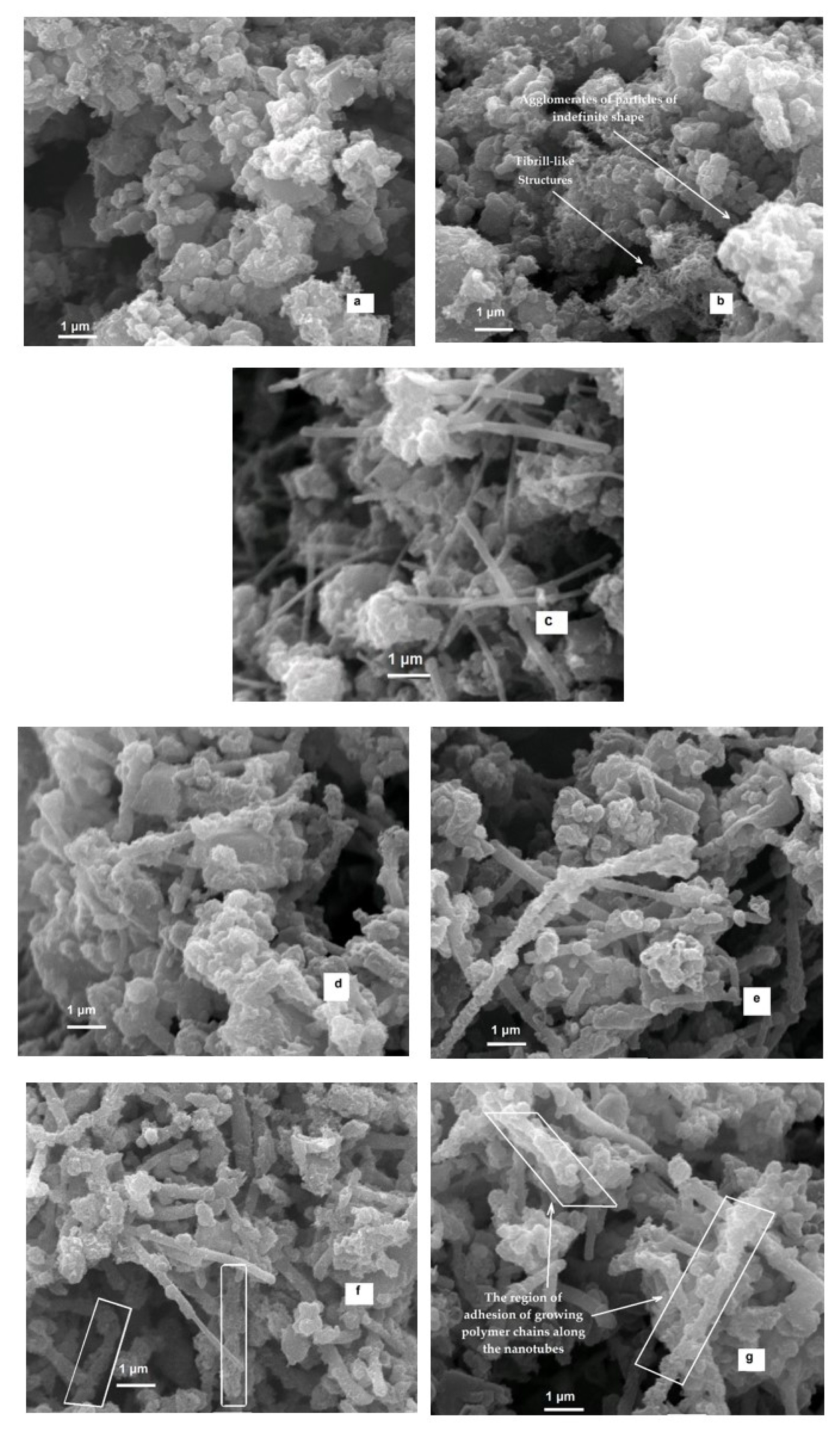
| PCPAB/ZnO | <detection limit |
| P/MWCNT-3.1 | 0.1 |
| P/MWCNT-3.2 | 0.4 |
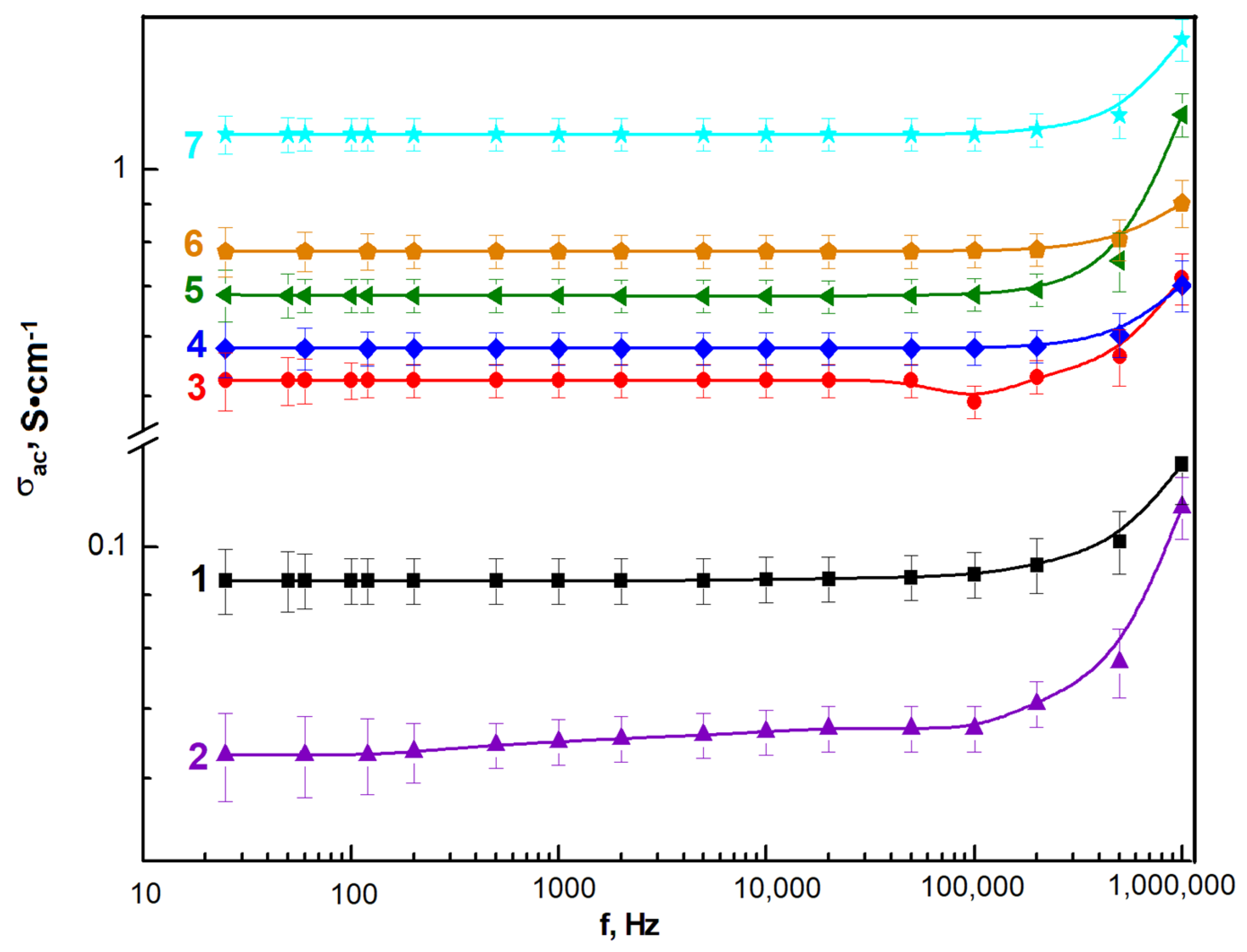
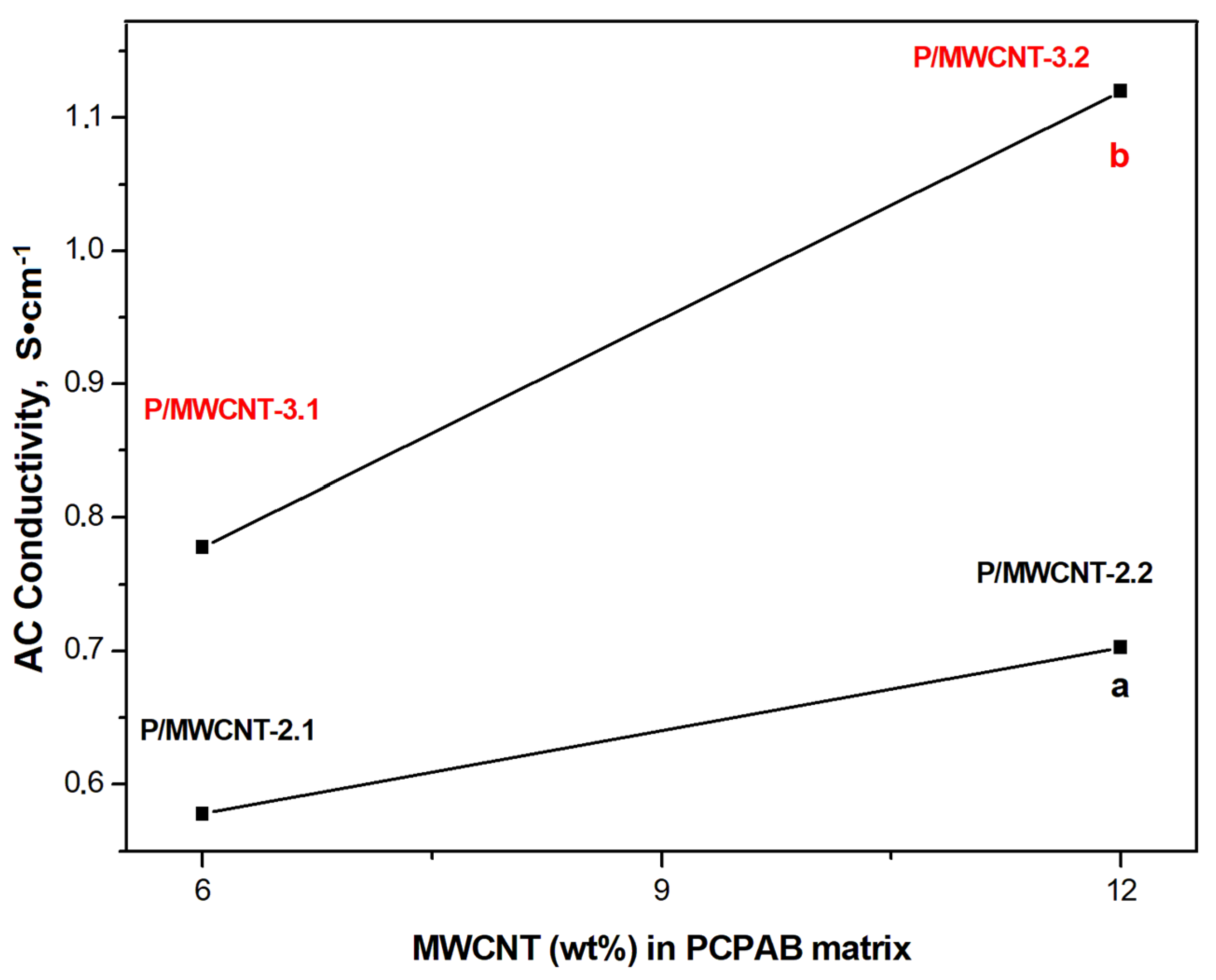
| SAMPLE | σdc, S⋅cm−1 | σac (25 Hz), S⋅cm−1 | σac (1 MHz), S⋅cm−1 | n |
|---|---|---|---|---|
| PCPAB | 9.2 × 10⁻² | 9.3 × 10⁻² | 1.2 × 10⁻¹ | 0.99 |
| PCPAB/ZnO | 6.1 × 10⁻² | 6.2 × 10⁻² | 1.0 × 10⁻¹ | 0.91 |
| P/MWCNT-1 | 5.2 × 10⁻¹ | 5.3 × 10⁻¹ | 7 × 10⁻¹ | 0.95 |
| P/MWCNT-2.1 | 5.7 × 10⁻¹ | 5.8 × 10⁻¹ | 7 × 10⁻¹ | 0.84 |
| P/MWCNT-2.2 | 6.7 × 10⁻¹ | 6.8 × 10⁻¹ | 1.18 | 0.88 |
| P/MWCNT-3.1 | 7.8 × 10⁻¹ | 7.8 × 10⁻¹ | 9 × 10⁻¹ | 0.89 |
| P/MWCNT-3.2 | 1.12 | 1.13 | 1.52 | 0.9 |
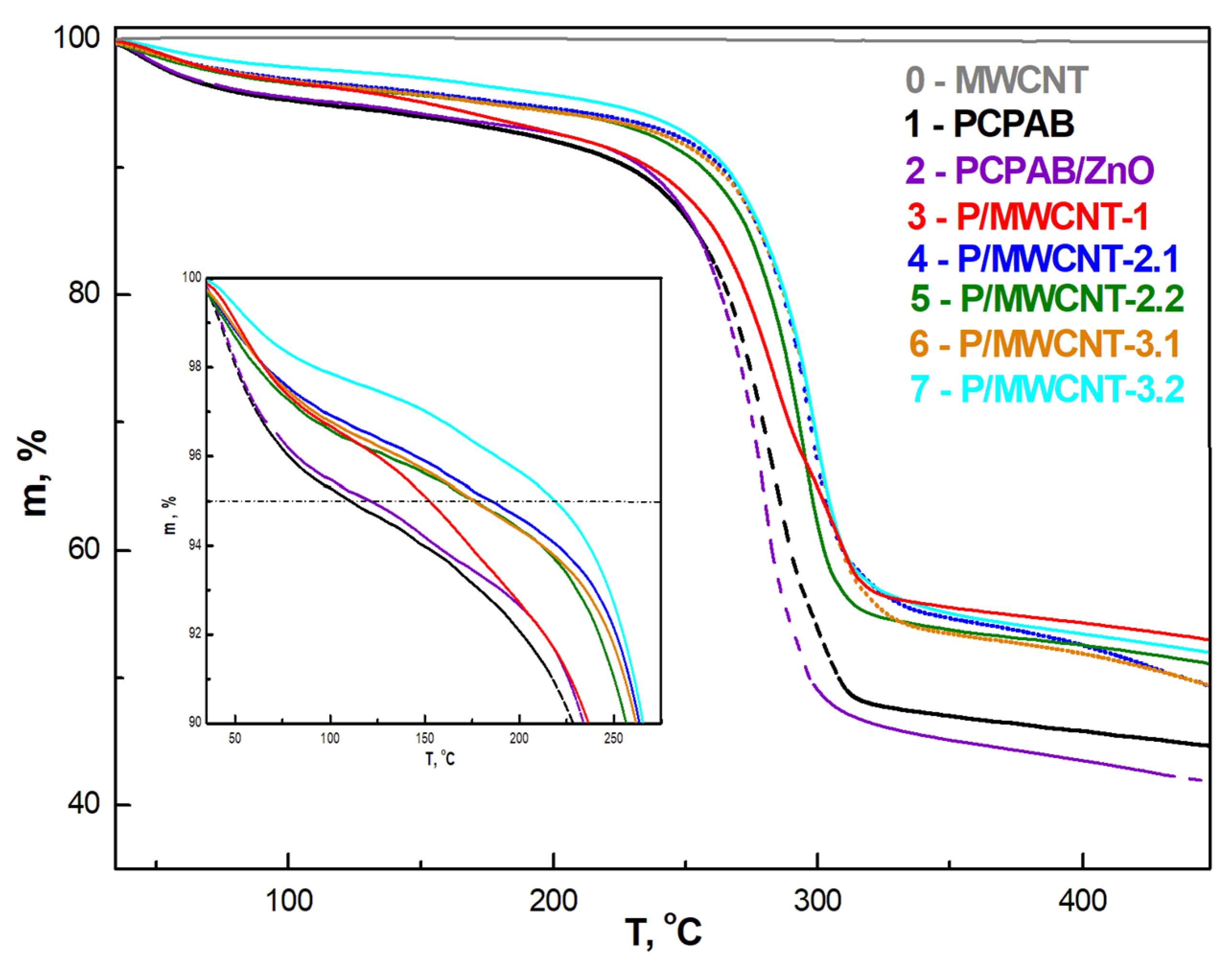
| SAMPLE | T5%, °C | T50%, °C | Tmax.dm/dt, °C | mres, % |
|---|---|---|---|---|
| MWCNTs | 99.8 | |||
| PCPAB | 110.7 | 307.9 | 286.2 | 44.7 |
| PCPAB/ZnO | 121.4 | 296.5 | 282.7 | 41.8 |
| P/MWCNT-1 | 152.5 | >450 | 283.5 | 53 |
| P/MWCNT-2.1 | 185 | 436.7 | 296.7 | 49.3 |
| P/MWCNT-2.2 | 177 | >450 | 295 | 51.1 |
| P/MWCNT-3.1 | 176 | 438.4 | 297 | 49.4 |
| P/MWCNT-3.2 | 218.9 | >450 | 298.4 | 52 |
Disclaimer/Publisher’s Note: The statements, opinions and data contained in all publications are solely those of the individual author(s) and contributor(s) and not of MDPI and/or the editor(s). MDPI and/or the editor(s) disclaim responsibility for any injury to people or property resulting from any ideas, methods, instructions or products referred to in the content. |
© 2026 by the authors. Licensee MDPI, Basel, Switzerland. This article is an open access article distributed under the terms and conditions of the Creative Commons Attribution (CC BY) license.
Share and Cite
Kiseleva, S.G.; Bondarenko, G.N.; Muratov, D.G.; Kozlov, V.V.; Vasilev, A.A.; Karpacheva, G.P. Hybrid Nanocomposites Based on Poly(2,5-dichloro-3,6-bis(phenylamino)-p-benzoquinone) and MWCNTs: Synthesis, Structure, and the Role of ZnO. Polymers 2026, 18, 754. https://doi.org/10.3390/polym18060754
Kiseleva SG, Bondarenko GN, Muratov DG, Kozlov VV, Vasilev AA, Karpacheva GP. Hybrid Nanocomposites Based on Poly(2,5-dichloro-3,6-bis(phenylamino)-p-benzoquinone) and MWCNTs: Synthesis, Structure, and the Role of ZnO. Polymers. 2026; 18(6):754. https://doi.org/10.3390/polym18060754
Chicago/Turabian StyleKiseleva, Svetlana G., Galina N. Bondarenko, Dmitriy G. Muratov, Vladimir V. Kozlov, Andrey A. Vasilev, and Galina P. Karpacheva. 2026. "Hybrid Nanocomposites Based on Poly(2,5-dichloro-3,6-bis(phenylamino)-p-benzoquinone) and MWCNTs: Synthesis, Structure, and the Role of ZnO" Polymers 18, no. 6: 754. https://doi.org/10.3390/polym18060754
APA StyleKiseleva, S. G., Bondarenko, G. N., Muratov, D. G., Kozlov, V. V., Vasilev, A. A., & Karpacheva, G. P. (2026). Hybrid Nanocomposites Based on Poly(2,5-dichloro-3,6-bis(phenylamino)-p-benzoquinone) and MWCNTs: Synthesis, Structure, and the Role of ZnO. Polymers, 18(6), 754. https://doi.org/10.3390/polym18060754