Photo-Triggered Charge Control Induces Dissociation of Complex Coacervates



Abstract
1. Introduction
2. Materials and Methods
2.1. Materials
2.2. Measurements
2.3. Preparation of P(MTAC/MPDME43/NBM3)
2.4. Preparation of P(MTAC/MPA43/NBM3)
2.5. Preparation of P(MTAC/MPA43/NBM3)/PAMPS Complex
3. Results and Discussion
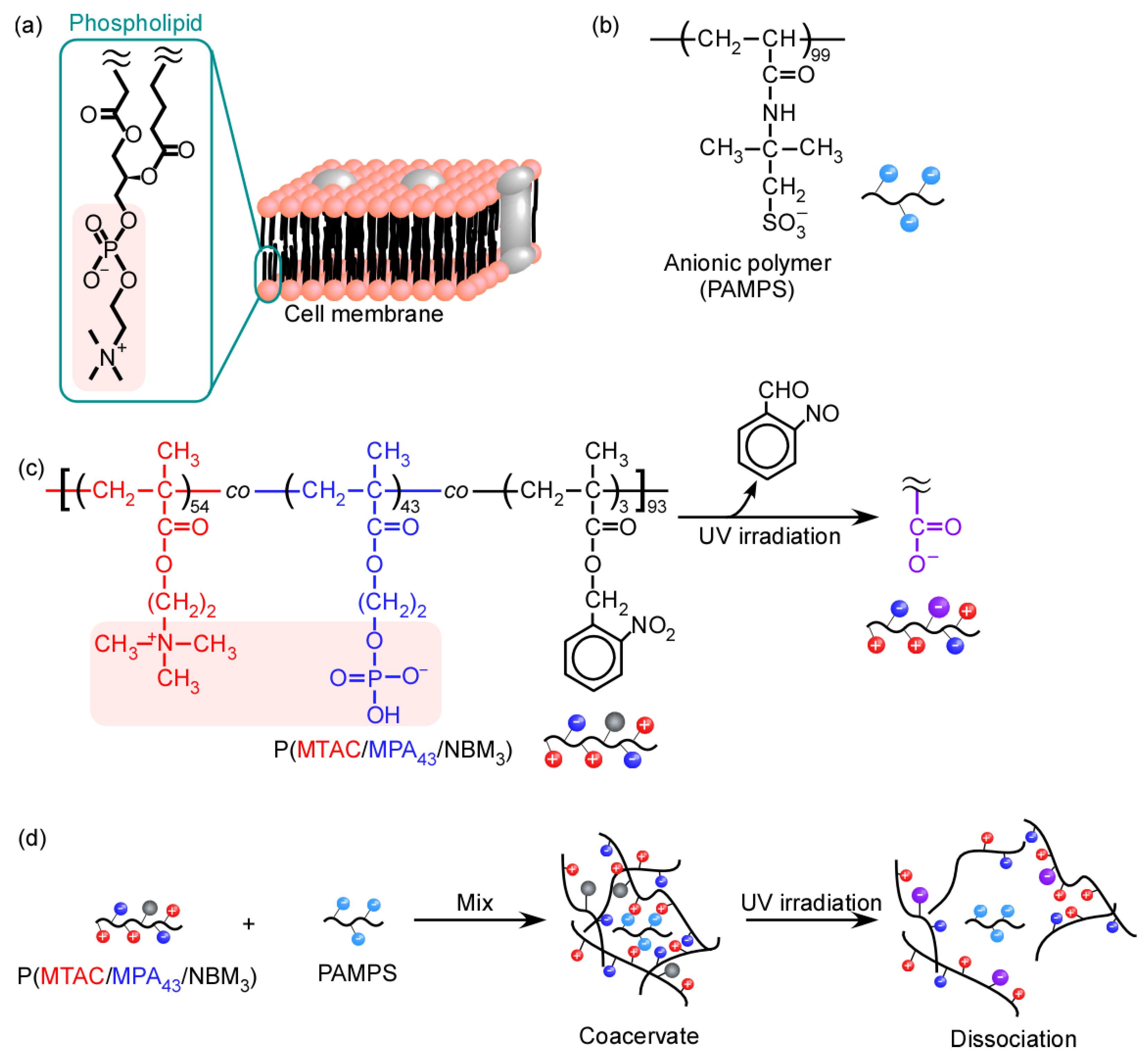
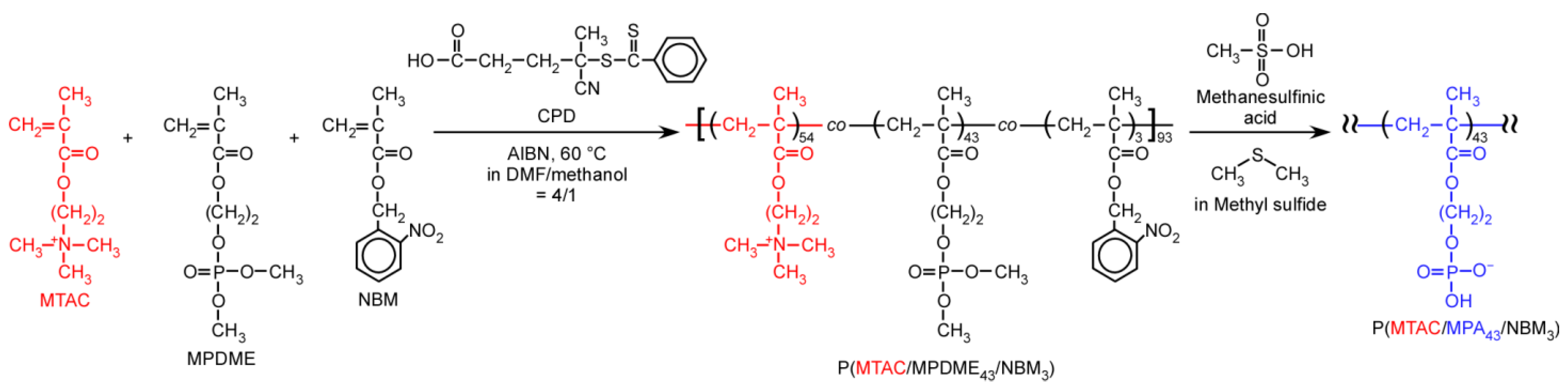
3.1. Synthesis of P(MTAC/MPA43/NBM3)
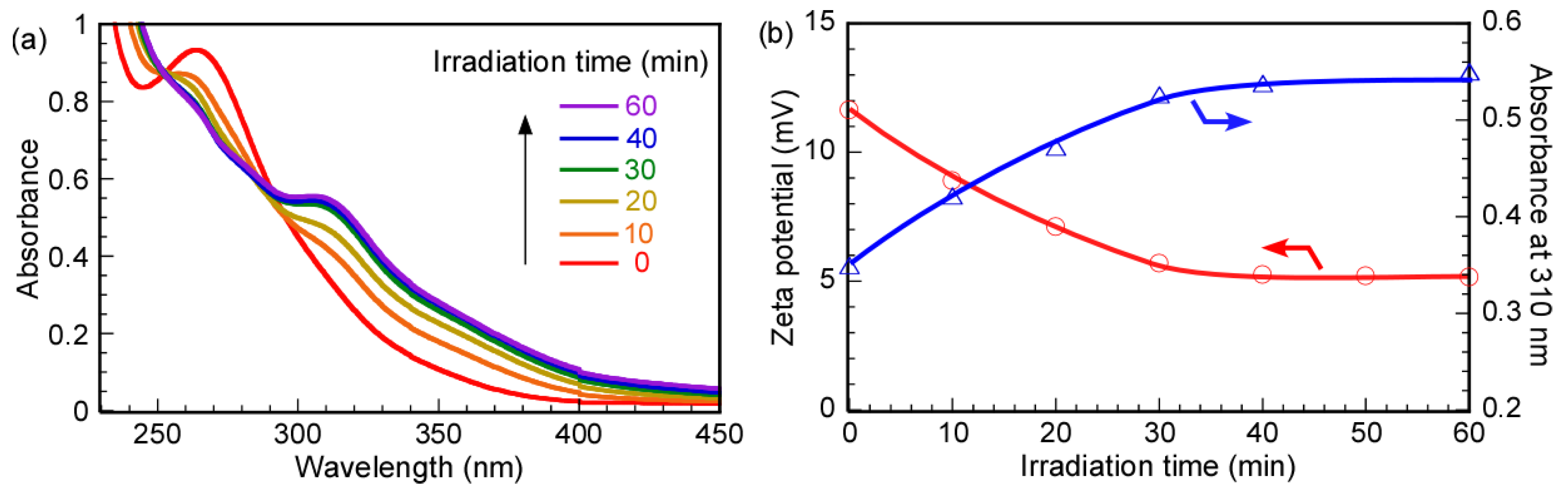
3.2. Characterization of P(MTAC/MPA43/NBM3)
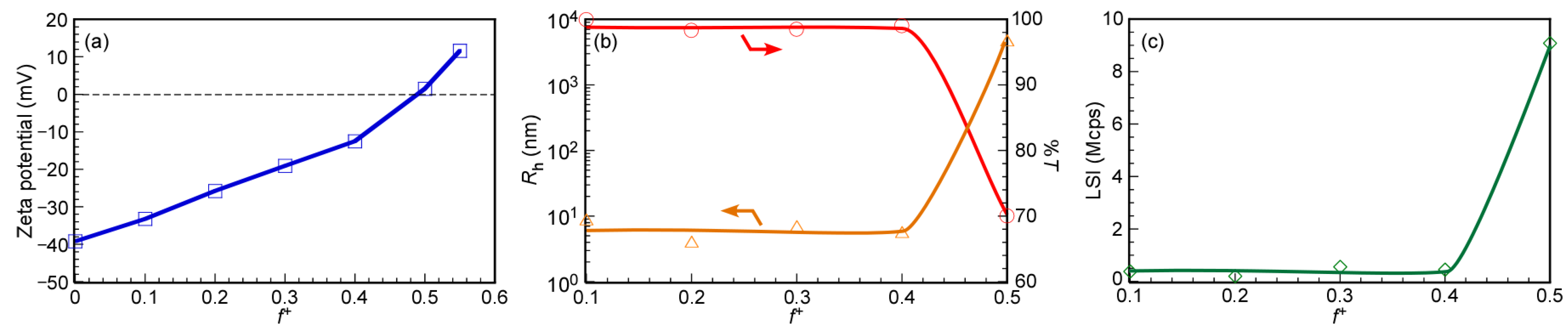
3.3. Formation of Coacervates
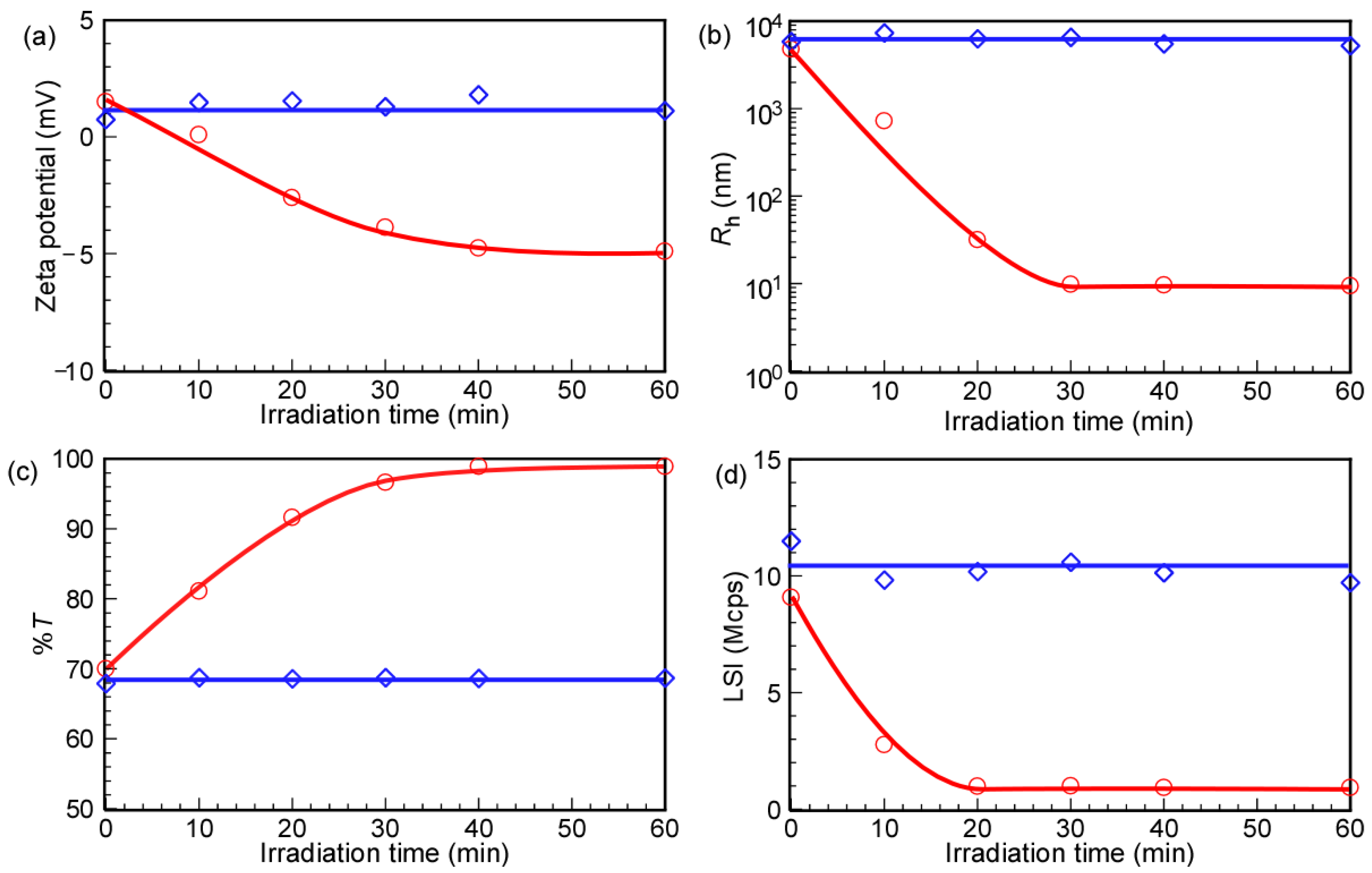
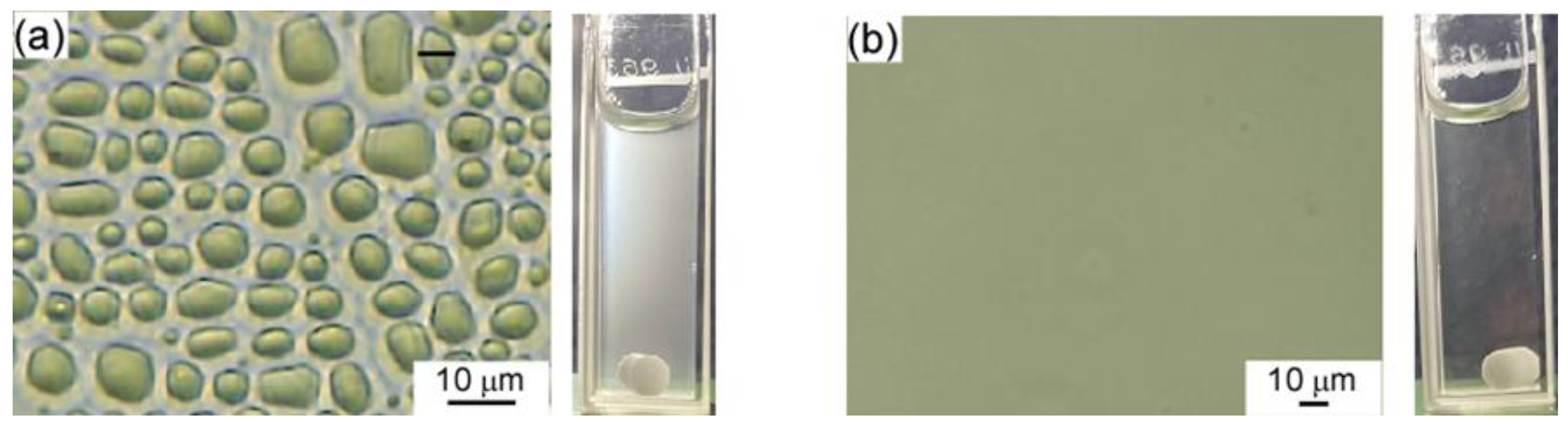
3.4. Photoresponsive Coacervates
4. Conclusions
Supplementary Materials
Author Contributions
Funding
Institutional Review Board Statement
Data Availability Statement
Acknowledgments
Conflicts of Interest
References
- Hong, Y.; Kim, Y.S.; Yoo, S.; Han, J.; Kim, J.; Lee, Y.; Jho, Y.S.; Hwang, D.S. Influence of the Backbone Chemistry and Ionic Functional Groups of Five Pairs of Oppositely Charged Polyelectrolytes on Complex Coacervation. Commun. Chem. 2024, 7, 182. [Google Scholar] [CrossRef]
- Priftis, D.; Tirrell, M. Phase Behavior and Complex Coacervation of Aqueous Polypeptide Solutions. Soft Matter 2012, 8, 9396–9405. [Google Scholar]
- Astoricchio, E.; Alfano, C.; Rajendran, L.; Temussi, P.A.; Pastore, A. The Wide World of Coacervates: From the Sea to Neurodegeneration. Trends Biochem. Sci. 2020, 45, 706–717. [Google Scholar] [CrossRef]
- Aumiller, W.M., Jr.; Keating, C.D. Phosphorylation-Mediated RNA/Peptide Complex Coacervation as a Model for Intracellular Liquid Organelles. Nat. Chem. 2016, 8, 129–137. [Google Scholar] [CrossRef]
- Aumiller, W.M., Jr.; Cakmak, F.P.; Davis, B.W.; Keating, C.D. RNA-Based Coacervates as a Model for Membraneless Organelles: Formation, Properties, and Interfacial Liposome Assembly. Langmuir 2016, 32, 10042–10053. [Google Scholar] [CrossRef] [PubMed]
- Donau, C.; Späth, F.; Sosson, M.; Kriebisch, B.A.K.; Schnitter, F.; Tena-Solsona, M.; Kang, H.-S.; Salibi, E.; Sattler, M.; Mutschler, H.; et al. Active Coacervate Droplets as a Model for Membraneless Organelles and Protocells. Nat. Commun. 2020, 11, 5167. [Google Scholar] [CrossRef] [PubMed]
- Karoui, H.; Seck, M.J.; Martin, N. Self-Programmed Enzyme Phase Separation and Multiphase Coacervate Droplet Organization. Chem. Sci. 2021, 12, 2794–2802. [Google Scholar] [CrossRef] [PubMed]
- de Silva, U.K.; Brown, J.L.; Lapitsky, Y. Poly(Allylamine)/Tripolyphosphate Coacervates Enable High Loading and Multiple-Month Release of Weakly Amphiphilic Anionic Drugs: An In Vitro Study with Ibuprofen. RSC Adv. 2018, 8, 19409–19419. [Google Scholar] [CrossRef]
- Eratte, D.; Wang, B.; Dowling, K.; Barrow, C.J.; Adhikari, B.P. Complex Coacervation with Whey Protein Isolate and Gum Arabic for the Microencapsulation of Omega-3-Rich Tuna Oil. Food Funct. 2014, 5, 2743–2750. [Google Scholar] [CrossRef]
- Spoelstra, W.K.; van der Sluis, E.O.; Dogterom, M.; Reese, L. Nonspherical Coacervate Shapes in an Enzyme-Driven Active System. Langmuir 2020, 36, 1956–1964. [Google Scholar] [CrossRef]
- Lee, H.H.; Choi, J.H.; Kim, D.S.; Jeon, S.; Stach, E.A.; Cho, H.K. Electrochemical Glycerol Valorization Using Tolerant Pt Embedded Bi Platform Electrocatalysts Derived from Photoactive Bismuth Oxyiodide Nanosheet Intermediates. EcoMat 2024, 6, e12504. [Google Scholar] [CrossRef]
- Nan, J.; Guo, S.; Alhashmialameer, D.; He, Q.; Meng, Y.; Ge, R.; El-Bahy, S.M.; Naik, N.; Murugadoss, V.; Huang, M.; et al. Hydrothermal Microwave Synthesis of Co3O4/In2O3 Nanostructures for Photoelectrocatalytic Reduction of Cr(VI). ACS Appl. Nano Mater. 2022, 5, 8755–8766. [Google Scholar] [CrossRef]
- Mo, Y.; Li, H.; Hou, J.; Zhao, H.; Zhao, L.; Xu, B.B.; Zhu, L.; Dai, C. Light-Activated Fluorinated Porphyrin COFs: Dual Oxygen/Drug Carriers Reshaping Tumor Hypoxia for Precision Photodynamic-Chemo Therapy. Microchem. J. 2025, 219, 116175. [Google Scholar] [CrossRef]
- Yang, F.; Cao, Z.; Wang, G. Micellar Assembly of a Photo- and Temperature-Responsive Amphiphilic Block Copolymer for Controlled Release. Polym. Chem. 2015, 6, 7995–8002. [Google Scholar] [CrossRef]
- Zhang, Y.; Fang, C.; Zhang, S.; Campbell, R.E.; Serpe, M.J. Controlled Osteogenic Differentiation of Human Mesenchymal Stem Cells Using Dexamethasone-Loaded Light-Responsive Microgels. ACS Appl. Mater. Interfaces 2021, 13, 7051–7059. [Google Scholar] [CrossRef]
- Doh, J.; Irvine, D.J. Photogenerated Polyelectrolyte Bilayers from an Aqueous-Processible Photoresist for Multicomponent Protein Patterning. J. Am. Chem. Soc. 2004, 126, 9170–9171. [Google Scholar] [CrossRef]
- Love, C.; Steinkühler, J.; Gonzales, D.T.; Yandrapalli, N.; Robinson, T.; Dimova, R.; Tang, T.-Y.D. Reversible pH-Responsive Coacervate Formation in Lipid Vesicles Activates Dormant Enzymatic Reactions. Angew. Chem. Int. Ed. 2020, 59, 5950–5957. [Google Scholar] [CrossRef] [PubMed]
- Lu, T.; Nakashima, K.K.; Spruijt, E. Temperature-Responsive Peptide–Nucleotide Coacervates. J. Phys. Chem. B 2021, 125, 3080–3091. [Google Scholar] [CrossRef] [PubMed]
- Wang, J.; Abbas, M.; Huang, Y.; Wang, J.; Li, Y. Redox-Responsive Peptide-Based Complex Coacervates as Delivery Vehicles with Controlled Release of Proteinous Drugs. Commun. Chem. 2023, 6, 243. [Google Scholar] [CrossRef]
- Ikeuchi, N.; Komachi, T.; Murayama, K.; Asanuma, H.; Maruyama, A.; Shimada, N. Light-Regulated Liquid–Liquid Phase Separation for Spatiotemporal Protein Recruitment and Cell Aggregation. ACS Appl. Mater. Interfaces 2021, 13, 5652–5659. [Google Scholar] [CrossRef] [PubMed]
- Auepattana-Aumrung, K.; Bishop, L.M.; Stevens, K.C.; Stewart, K.A.; Crespy, D.; Sumerlin, B.S. Photoinduced Polyelectrolyte Complexation for the Formation of Stable Films with Reversible Crosslinking. Chem. Sci. 2025, 16, 5976–5985. [Google Scholar] [CrossRef]
- Sawada, D.; Kojima, T.; Asakura, K.; Banno, T. Light-Triggered Coacervation of Low-Molecular-Weight Amphiphiles for Tunable Chemical Reactivity. Bull. Chem. Soc. Jpn. 2025, 98, uoaf091. [Google Scholar] [CrossRef]
- Lewis, A.; Tang, Y.; Brocchini, S.; Choi, J.W.; Godwin, A. Poly(2-Methacryloyloxyethyl Phosphorylcholine) for Protein Conjugation. Bioconjug. Chem. 2008, 19, 2144–2155. [Google Scholar] [CrossRef]
- Iwasaki, Y.; Ishihara, K. Cell Membrane-Inspired Phospholipid Polymers for Developing Medical Devices with Excellent Biointerfaces. Sci. Technol. Adv. Mater. 2012, 13, 064101. [Google Scholar] [CrossRef]
- Ishihara, K.; Iwasaki, Y. Reduced Protein Adsorption on Novel Phospholipid Polymers. J. Biomater. Appl. 1998, 13, 111–127. [Google Scholar] [CrossRef] [PubMed]
- Ishihara, K.; Nomura, H.; Mihara, T.; Kurita, K.; Iwasaki, Y.; Nakabayashi, N. Why Do Phospholipid Polymers Reduce Protein Adsorption? J. Biomed. Mater. Res. 1998, 39, 323–330. [Google Scholar] [CrossRef]
- Chrit, L.; Bastien, P.; Biatry, B.; Simonnet, J.T.; Potter, A.; Minondo, A.M.; Flament, F.; Bazin, R.; Sockalingum, G.D.; Leroy, F.; et al. In Vitro and In Vivo Confocal Raman Study of Human Skin Hydration: Assessment of a New Moisturizing Agent, pMPC. Biopolymers 2007, 85, 359–369. [Google Scholar] [CrossRef]
- Tairy, O.; Kampf, N.; Driver, M.J.; Armes, S.P.; Klein, J. Dense, Highly Hydrated Polymer Brushes via Modified Atom-Transfer-Radical-Polymerization: Structure, Surface Interactions, and Frictional Dissipation. Macromolecules 2015, 48, 140–151. [Google Scholar] [CrossRef]
- Ishihara, K.; Ueda, T.; Nakabayashi, N. Preparation of Phospholipid Polymers and Their Properties as Polymer Hydrogel Membranes. Polym. J. 1990, 22, 355–360. [Google Scholar] [CrossRef]
- Yu, X.; Liu, Z.; Janzen, J.; Chafeeva, I.; Horte, S.; Chen, W.; Kainthan, R.K.; Kizhakkedathu, J.N.; Brooks, D.E. Polyvalent Choline Phosphate as a Universal Biomembrane Adhesive. Nat. Mater. 2012, 11, 468–476. [Google Scholar] [CrossRef]
- Suzuki, K.; Hiroi, Y.; Abe-Fukasawa, N.; Nishino, T.; Shouji, T.; Katayama, J.; Kageyama, T.; Fukuda, J. Cell Repellent Polyampholyte for Conformal Coating on Microstructures. Sci. Rep. 2022, 12, 10815. [Google Scholar] [CrossRef]
- Wang, P.-H.; Lin, C.-H.; Wen, T.-C. Tough and Antifouling Polyampholyte Hydrogels via Photopolymerization of Equivalent Ionic Monomers with Poly(ethylene glycol) Diacrylate. J. Taiwan Inst. Chem. Eng. 2020, 113, 101–106. [Google Scholar] [CrossRef]
- Nakahata, R.; Yusa, S. Solution Properties of Amphoteric Random Copolymers Bearing Pendant Sulfonate and Quaternary Ammonium Groups with Controlled Structures. Langmuir 2019, 35, 1690–1698. [Google Scholar] [CrossRef] [PubMed]
- Nakahata, R.; Yusa, S. Preparation of Water-Soluble Polyion Complex (PIC) Micelles Covered with Amphoteric Random Copolymer Shells with Pendant Sulfonate and Quaternary Amino Groups. Polymers 2018, 10, 205. [Google Scholar] [CrossRef] [PubMed]
- Zhao, H.; Sterner, E.S.; Coughlin, E.B.; Theato, P. Photo-responsive polymers based on o-nitrobenzyl derivatives: From structural design to applications. Prog. Polym. Sci. 2023, 146, 101741. [Google Scholar]
- Ju, Y.; Varma, R.S. Formation of o-nitrosobenzaldehyde from hydrolysis of o-nitrobenzyl tosylate. Evidence of intramolecular nucleophilic interaction. Tetrahedron Lett. 1998, 39, 5351–5354. [Google Scholar]
- Zhu, J.S.; Kraemer, N.; Li, C.J.; Haddadin, M.J.; Kurth, M.J. Photochemical Preparation of 1,2-Dihydro-3H-indazol-3-ones in Aqueous Solvent at Room Temperature. J. Org. Chem. 2018, 83, 15493–15498. [Google Scholar] [CrossRef]
- Guo, L.; Guan, J.; Zhao, X.; Lin, B.; Yang, H. Design, Synthesis, and Photosensitive Performance of Polymethacrylate-Positive Photoresist Bearing o-Nitrobenzyl Group. J. Appl. Polym. Sci. 2015, 132, 41733. [Google Scholar] [CrossRef]
- Wieboldt, R.; Ramesh, D.; Jabri, E.; Karplus, P.A.; Carpenter, B.K.; Hess, G.P. Synthesis and Characterization of Photolabile o-Nitrobenzyl Derivatives of Urea. J. Org. Chem. 2002, 67, 8827–8831. [Google Scholar] [CrossRef]
- Romano, A.; Roppolo, I.; Rossegger, E.; Schlögl, S.; Sangermano, M. Recent Trends in Applying Ortho-Nitrobenzyl Esters for the Design of Photo-Responsive Polymer Networks. Materials 2020, 13, 2777. [Google Scholar] [CrossRef]
- Kim, H.; Choi, W.; Lee, S.; Kim, S.; Ham, J.; Seo, J.-H.; Jang, S.; Lee, Y. Synthesis of Biomembrane-Mimic Polymers with Various Phospholipid Head Groups. Polymer 2014, 55, 517–524. [Google Scholar] [CrossRef]
- Mitsukami, Y.; Donovan, M.S.; Lowe, A.B.; McCormick, C.L. Water-Soluble Polymers. 81. Direct Synthesis of Hydrophilic Styrenic-Based Homopolymers and Block Copolymers in Aqueous Solution via RAFT. Macromolecules 2001, 34, 2248–2256. [Google Scholar] [CrossRef]
- Jacob, L.; Julia, M.; Pfeiffer, B.; Rolando, C. On the Influence of Phosphoric Ester Groups in Geranyldiphosphate Biosynthesis. Bull. Soc. Chim. Fr. 1983, 24, 4327–4330. [Google Scholar]
- Chen, Y.; Zeng, Y.; Wu, Y.; Chen, T.; Qiu, R.; Liu, W. Flame-Retardant and Recyclable Soybean Oil-Based Thermosets Enabled by the Dynamic Phosphate Ester and Tannic Acid. ACS Appl. Mater. Interfaces 2023, 15, 5963–5973. [Google Scholar] [CrossRef]
- Hanochi, H.; Lien, N.T.; Yusa, S.; Nakamura, Y.; Fujii, S. Colloidal Stabilizer-Assisted Polymerization-Induced Precipitation Method toward Colloidally Stable Polyacid Particles. Langmuir 2019, 35, 6993–7002. [Google Scholar]
- Franklin, D.S.; Guhanathan, S. Simple, Convenient, Low-Cost, and Solventless Greener Way to pH-Responsive Polymeric Hydrogels: Synthesis and Characterization. J. Appl. Polym. Sci. 2015, 132, 41921. [Google Scholar] [CrossRef]
- Lázaro Martínez, J.M.; Chattah, A.K.; Torres Sánchez, R.M.; Buldain, G.Y.; Campo Dall’Orto, V. Synthesis and Characterization of Novel Polyampholyte and Polyelectrolyte Polymers Containing Imidazole, Triazole, or Pyrazole. Polymer 2012, 53, 1288–1297. [Google Scholar] [CrossRef]



| Polymer | DP (Theo) | Mn(Theo) (g/mol) | DP (NMR) | Mn(NMR) (g/mol) | Mn(GPC) (g/mol) | Mw/Mn |
|---|---|---|---|---|---|---|
| P(MTAC/MPDME43/NBM3) | 96 | 2.16 × 10⁴ | 93 | 2.08 × 10⁴ | 1.41 × 10⁴ | 1.08 |
| P(MTAC/MPA43/NBM3) | - | - | 93 | 1.97 × 10⁴ | 1.25 × 10⁴ | 1.21 |
Disclaimer/Publisher’s Note: The statements, opinions and data contained in all publications are solely those of the individual author(s) and contributor(s) and not of MDPI and/or the editor(s). MDPI and/or the editor(s) disclaim responsibility for any injury to people or property resulting from any ideas, methods, instructions or products referred to in the content. |
© 2026 by the authors. Licensee MDPI, Basel, Switzerland. This article is an open access article distributed under the terms and conditions of the Creative Commons Attribution (CC BY) license.
Share and Cite
Kakitani, R.; Nishimura, T.; Vu, T.N.; Kizaki, C.; Yusa, S.-i. Photo-Triggered Charge Control Induces Dissociation of Complex Coacervates. Polymers 2026, 18, 739. https://doi.org/10.3390/polym18060739
Kakitani R, Nishimura T, Vu TN, Kizaki C, Yusa S-i. Photo-Triggered Charge Control Induces Dissociation of Complex Coacervates. Polymers. 2026; 18(6):739. https://doi.org/10.3390/polym18060739
Chicago/Turabian StyleKakitani, Rei, Tomoya Nishimura, Thi Ngan Vu, Chisato Kizaki, and Shin-ichi Yusa. 2026. "Photo-Triggered Charge Control Induces Dissociation of Complex Coacervates" Polymers 18, no. 6: 739. https://doi.org/10.3390/polym18060739
APA StyleKakitani, R., Nishimura, T., Vu, T. N., Kizaki, C., & Yusa, S.-i. (2026). Photo-Triggered Charge Control Induces Dissociation of Complex Coacervates. Polymers, 18(6), 739. https://doi.org/10.3390/polym18060739