Review

Polymer–Ceramic Hybrid Composites for Lightweight Solar Thermal Collector Absorbers: Thermal Transport, Optical Selectivity, and Durability

1
Surface Science and Tribology Lab, Department of Mechanical Engineering, Shiv Nadar Institution of Eminence, Gautam Buddha Nagar, Greater Noida 201314, India
2
Department of Physics, GLA University, Mathura 281406, India
3
Department of Physics & Environmental Sciences, Sharda School of Engineering & Science, Sharda University, Greater Noida 201310, India
4
Department of Physics and Material Science, Jaypee University, Anoopshahr 203390, India
5
Institute of Education and Research, Mangalayatan University, Aligarh 202146, India
6
Faculty of Mechanical Engineering, University of Ljubljana, Aškerčeva 6, 1000 Ljubljana, Slovenia
*
Author to whom correspondence should be addressed.
Polymers 2026, 18(6), 678; https://doi.org/10.3390/polym18060678
Submission received: 21 January 2026 / Revised: 4 March 2026 / Accepted: 9 March 2026 / Published: 11 March 2026
(This article belongs to the Special Issue Polymeric Materials for Solar Cell Applications)

Abstract

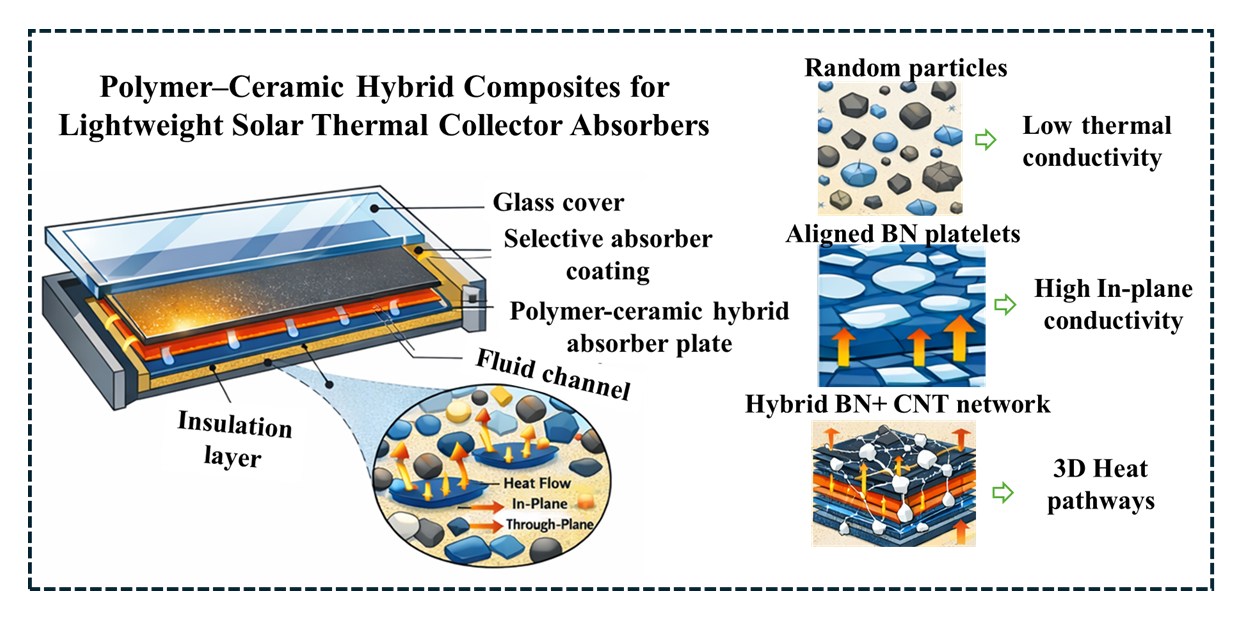
Polymer–ceramic hybrid composites are emerging as attractive candidates for lightweight, corrosion-resistant absorber components in solar thermal collectors; however, their adoption is constrained by the intrinsically low thermal conductivity of polymers, processing-induced anisotropic heat transport, interfacial thermal resistance at tube/laminate joints, and durability challenges under outdoor exposure. This review provides a collector-centered synthesis of polymer–ceramic hybrid materials, emphasizing the translation of composite properties into collector-level outcomes rather than conductivity enhancement alone. A structure–property–performance mapping approach is presented to connect directional thermal conductivity ((k_in-plane), (k_perp)), thermal diffusivity, heat capacity, coefficient of thermal expansion, and service temperature with collector performance parameters such as heat removal effectiveness, overall heat losses, and stagnation behavior. Ceramic fillers (e.g., boron nitride, aluminum nitride, silicon carbide, alumina) are examined for stable conduction-network formation, coating compatibility, and long-term reliability, while carbon fillers (graphite, graphene nanoplatelets, carbon nanotubes) are evaluated for combined heat spreading and solar absorption benefits, with attention to emissivity penalties. Hybrid ceramic–carbon architectures and multilayer absorber designs are identified as the most promising routes to balance thermal transport, optical selectivity (high solar absorptance and low thermal emittance), manufacturability, and durability under UV, humidity, and thermal cycling.

Graphical Abstract

1. Introduction

Solar thermal collectors are among the most efficient technologies for converting solar irradiation into usable heat for domestic hot water, space heating, industrial process heat, and emerging applications such as low-temperature desalination and absorption cooling. Conventional flat-plate and evacuated tube collectors typically employ metallic absorber components, most commonly copper or aluminum, because of their high thermal conductivity and effective integration with heat exchangers [1,2,3]. However, metal absorbers increase system weight and cost and may suffer from corrosion during long-term outdoor operation, which has motivated the exploration of lightweight and corrosion-resistant alternatives [4,5]. Polymer-based materials have therefore attracted increasing attention for solar thermal systems operating in low-to-moderate temperature ranges (generally below 120–150 °C). Their low density, design flexibility, corrosion resistance, and compatibility with scalable manufacturing methods such as extrusion, compression molding, and roll-to-roll processing make them attractive candidates for lightweight collector components [6,7]. A key limitation, however, is the intrinsically low thermal conductivity of most polymers (typically ~0.1–0.5 W·m−1·K−1), which restricts heat spreading within absorber structures and can lead to increased temperature gradients during operation [8]. These gradients may reduce heat removal efficiency and accelerate degradation processes such as creep, thermo-oxidative aging, and coating or interface delamination.
To address these challenges, polymer–ceramic hybrid composites have emerged as promising materials for next-generation lightweight solar thermal absorbers [9,10,11]. Incorporating thermally conductive ceramic fillers (e.g., Al2O3, SiC, AlN, BN, TiO2) and carbon-based reinforcements (e.g., graphene, carbon nanotubes, and graphite) into polymer matrices can create conductive heat-transfer pathways while preserving the inherent advantages of polymers, including corrosion resistance and manufacturing flexibility [12,13]. In addition to improving thermal transport, these fillers can enhance mechanical stiffness, reduce the coefficient of thermal expansion (CTE), and improve resistance to UV exposure and moisture, all of which are important for long-term outdoor durability in solar collector environments.
Beyond thermal transport, absorber materials must satisfy multiple performance requirements that determine collector efficiency and long-term reliability. In solar thermal systems, performance is governed by the balance between absorbed solar energy, effective heat removal, and thermal losses [14]. Consequently, absorber materials must exhibit suitable optical properties, including high solar absorptance (α) and low thermal emittance (ε), either intrinsically or through compatibility with selective surface coatings. In addition, real collector operation involves thermal cycling, humidity exposure, freeze–thaw conditions, and stagnation events that may exceed normal operating temperatures [15]. These conditions can degrade polymer composites through mechanisms such as hydrolytic aging, UV-induced chain scission, and filler–matrix interfacial weakening, which may gradually reduce thermal transport performance and structural stability [16]. For this reason, polymer–ceramic hybrid materials intended for solar collectors must be evaluated using collector-relevant metrics and durability testing protocols rather than thermal conductivity values alone [17]. Although thermally conductive polymer composites have been widely studied for electronic thermal management, their application in solar thermal collectors introduces additional constraints related to optical selectivity, coating adhesion, environmental durability, and performance translation from material properties to collector efficiency [18]. Furthermore, reported thermal conductivities vary widely across the literature due to differences in filler morphology, loading fraction, dispersion quality, orientation, and processing methods. Comparisons between studies are often complicated by inconsistent reporting of measurement direction (in-plane versus through-plane conductivity), temperature conditions, and testing methodologies. These inconsistencies highlight the need for a systematic synthesis that evaluates polymer–ceramic hybrid materials using collector-relevant performance criteria.
This review presents a collector-oriented assessment of polymer–ceramic hybrid composites for lightweight solar thermal absorber components. Rather than focusing solely on thermal conductivity enhancement, the analysis integrates thermal transport, optical selectivity, durability under outdoor exposure, and manufacturing feasibility to evaluate the practical suitability of these materials for collector applications. This review establishes collector-relevant material property targets including thermal conductivity, coefficient of thermal expansion, thermal stability limits (Tg/Tm), optical absorptance and emittance (α/ε), and durability thresholds and examines how these parameters influence collector design and long-term performance. The manuscript is organized as follows: Section 2 outlines collector requirements and key material property targets; Section 3 discusses candidate polymer matrices; Section 4 reviews ceramic and carbon fillers; Section 5 examines structure–property–performance relationships; Section 6 summarizes fabrication and manufacturing considerations; Section 7 addresses durability and outdoor aging; and Section 8 provides a comparative synthesis of collector-ready composite strategies.

2. Solar Thermal Collector Requirements and Material Property Targets

The performance of solar thermal collectors is governed by the balance between absorbed solar energy and thermal losses, commonly described using the Hottel–Whillier model for flat-plate collectors [19]. Collector efficiency (η) can be expressed as follows:
η = F R ( τ α ) F R U L ( T i n T a ) / G ,
where F R is the heat removal factor, τ α represents the effective optical gain, U L is the overall heat loss coefficient, T i n and T a denote the inlet and ambient temperatures, and G is the solar irradiance [20,21]. Although this formulation is traditionally applied to metallic absorber plates, it also provides a useful framework for evaluating polymer–ceramic hybrid absorbers. In such systems, the thermal and mechanical properties of the absorber material influence heat removal effectiveness, temperature gradients within the absorber, and long-term operational stability.
A primary requirement for polymer–ceramic hybrid absorber materials is adequate thermal transport to ensure efficient heat spreading and transfer to the working fluid [22]. Conductive fillers such as boron nitride, aluminum nitride, alumina, silicon carbide, graphite, graphene, and carbon nanotubes are commonly incorporated into polymer matrices to establish thermally conductive pathways. However, composite absorbers frequently exhibit anisotropic thermal transport due to filler alignment and processing-induced orientation effects [23,24]. From a collector design perspective, in-plane thermal conductivity governs lateral heat spreading and uniform surface temperature distribution across the absorber plate [25,26], whereas through-plane conductivity controls heat transfer into flow channels or bonded tubes. Consequently, collector-grade hybrid absorbers typically aim for in-plane conductivity values of ≥5 W·m−1·K−1 (preferably higher) and through-plane conductivity of approximately 1–2 W·m−1·K−1.
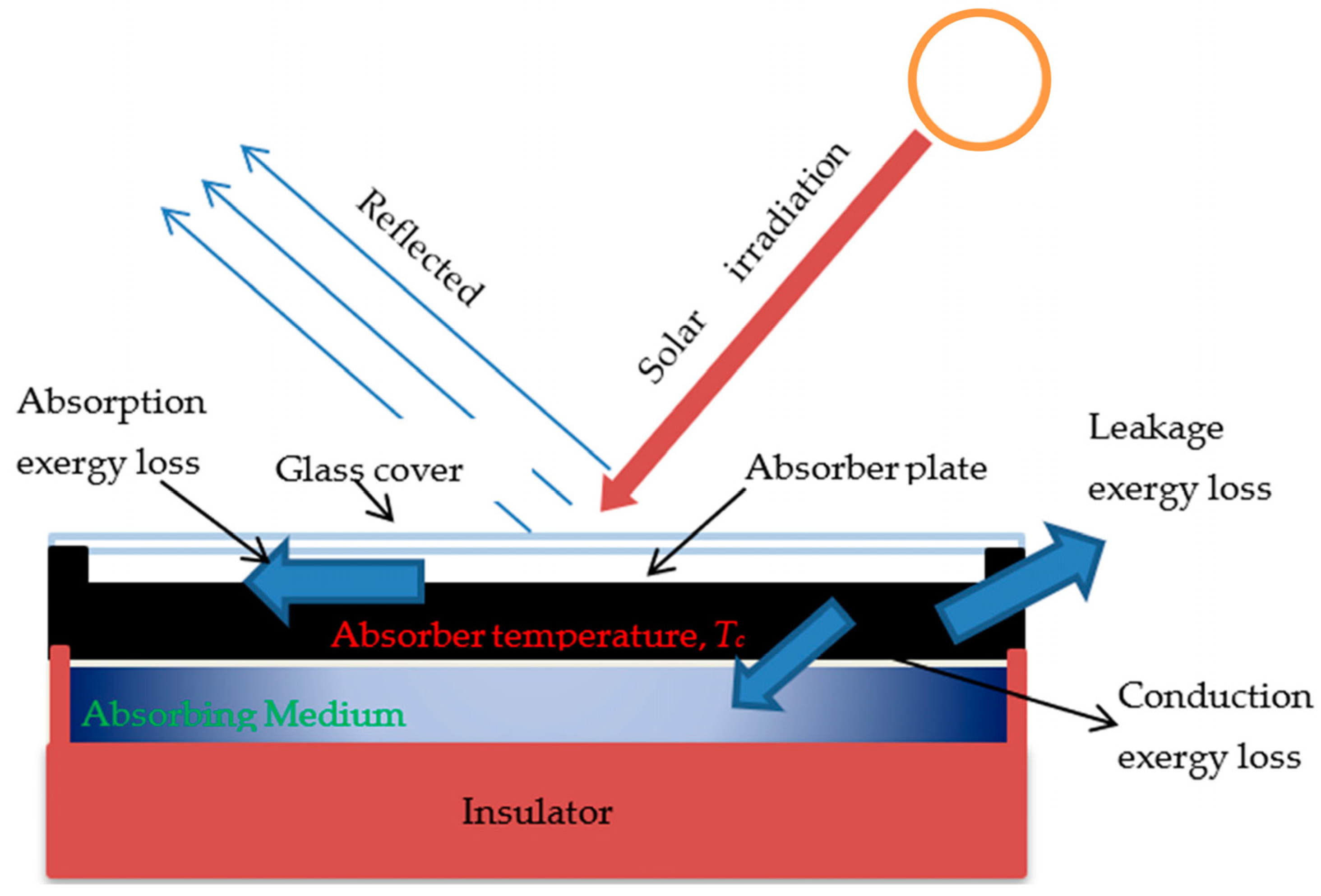
Thermal transport properties should also be considered alongside thermal diffusivity and heat capacity, particularly during transient operating conditions. Thermal diffusivity α k / ρ C p determines how rapidly heat spreads within the absorber during fluctuations in solar irradiance or fluid flow [27]. While filler incorporation can enhance conductivity, it may also affect density and heat capacity, influencing overall heat-transfer behavior [28]. Balanced improvements in conductivity and diffusivity are therefore desirable to minimize hot-spot formation and maintain stable absorber temperatures during operation. Thermal stability is another critical requirement, particularly during stagnation events when solar irradiation remains high but heat removal is limited or interrupted. Under these conditions, absorber temperatures may exceed normal operating levels, potentially causing polymer softening, creep deformation, or dimensional distortion [29]. Elevated temperatures can also accelerate thermo-oxidative degradation and interfacial damage between the polymer matrix, fillers, coatings, and bonding layers [30]. For this reason, polymer–ceramic hybrid absorbers should possess sufficient thermal stability, with glass transition or melting temperatures (Tg/Tm) exceeding the maximum expected operating temperatures [31]. In addition, controlling the coefficient of thermal expansion (CTE) is essential because polymer absorber plates are frequently bonded to metal tubes or coated with selective surfaces. Reducing CTE through filler incorporation can improve interfacial stability and mitigate delamination during thermal cycling [32]. Optical performance is equally important because collector efficiency strongly depends on absorber solar absorptance ( α s o l a r ) and thermal emittance ( ε t h e r m a l ). High absorptance (typically α ≥ 0.90) maximizes solar energy capture, while low emittance (ε ≤ 0.20) suppresses radiative heat losses at elevated temperatures [33,34]. Since polymers generally lack intrinsic optical selectivity, absorber surfaces usually require compatible selective coatings, high-absorptance paints, or engineered surface structures. Ceramic fillers may improve coating adhesion and dimensional stability, whereas carbon fillers can enhance broadband solar absorption but must be carefully optimized to avoid excessive thermal emissivity [33]. Collector performance can also be interpreted from an exergy perspective, which highlights where useful energy is degraded within the system. As illustrated in Figure 1, irreversibilities arise from absorption losses during conversion of solar radiation to absorber heat, leakage losses to the ambient environment, and conduction losses during heat transfer from the absorber plate to the working fluid [34]. Reducing temperature gradients within the absorber and minimizing heat leakage pathways are therefore important strategies for improving overall collector performance.
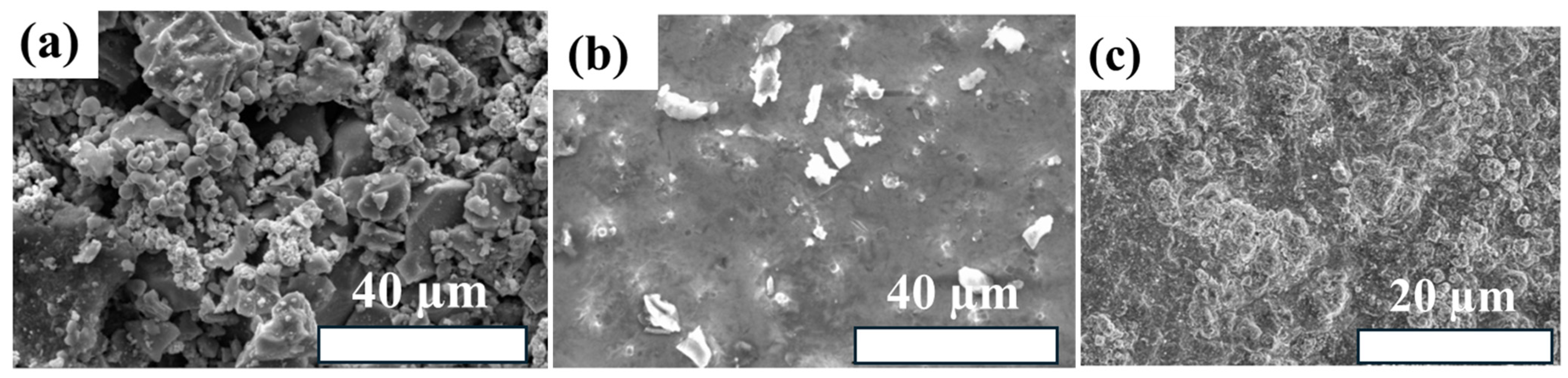
Microstructural integrity plays a key role in maintaining the optical selectivity and thermal stability of cermet absorber coatings. As shown in Figure 2a–c, the coating surface exhibits a hierarchical granular morphology composed of densely packed ceramic and metallic domains with finer dispersed features, characteristic of multi-scale cermet structures rather than uniform single-phase films [35]. This microstructural organization enhances photothermal performance by promoting light trapping and enabling controlled effective refractive index gradients. At the same time, the dense and well-bonded structure improves high-temperature stability by limiting crack propagation and suppressing microstructural coarsening. Such features also reduce oxygen diffusion and interfacial degradation during thermal cycling, thereby helping to maintain stable absorptance and emissivity under prolonged high-temperature operation.
Durability under outdoor conditions represents another important requirement for absorber materials. Solar collectors are typically expected to operate for decades under ultraviolet radiation, humidity cycling, temperature fluctuations, and environmental exposure. These conditions may induce polymer degradation, interfacial weakening, and coating instability if materials are not properly designed. Consequently, polymer–ceramic hybrid absorbers should demonstrate stable thermal conductivity, maintained coating adhesion, and resistance to filler–matrix debonding after accelerated aging tests such as UV exposure, humidity aging, thermal cycling, and stagnation simulations [35,36,37]. To facilitate practical material selection for solar thermal collectors, the requirements discussed above can be translated into representative property targets for polymer–ceramic hybrid absorber components. These targets reflect the combined thermal, optical, and durability constraints imposed by collector operation. In particular, high in-plane conductivity promotes effective heat spreading across absorber surfaces, while adequate through-plane conductivity supports heat transfer into fluid channels or bonded tubes, thereby influencing the heat removal factor and overall collector efficiency. At the same time, controlled thermal expansion, high service temperature, and environmental stability ensure reliable operation under long-term outdoor exposure. Table 1 summarizes recommended property ranges and their relevance to collector-level performance, providing a practical framework for evaluating polymer–ceramic hybrid materials intended for solar thermal absorber applications.

Translation of Material Properties to Collector Performance

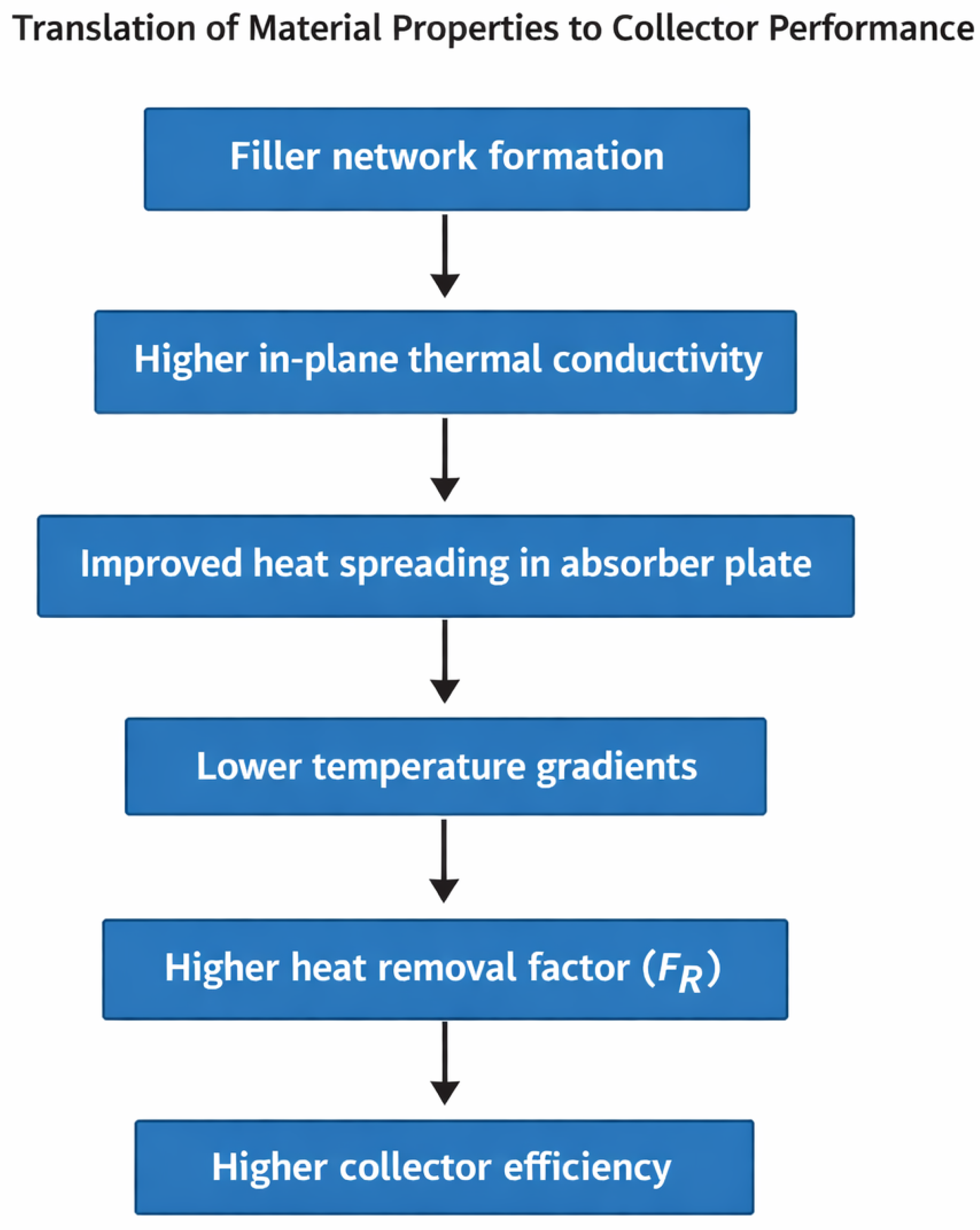
The practical value of polymer–ceramic hybrid absorbers can only be fully assessed by linking composite material properties with collector-level performance metrics. Within the Hottel–Whillier framework, solar collector efficiency depends on optical gain, heat removal effectiveness, and thermal losses [36]. Consequently, improvements in composite thermal transport properties must ultimately translate into enhanced heat removal and reduced temperature gradients within the absorber structure. Thermal conductivity plays a particularly important role in determining absorber temperature distribution and heat transfer to the working fluid [37,38]. Increased in-plane thermal conductivity improves lateral heat spreading across the absorber plate, reducing localized hot spots and promoting uniform temperature distribution under non-uniform solar irradiation. Improved temperature uniformity directly contributes to higher heat removal effectiveness by enabling more efficient transfer of absorbed heat to fluid channels or bonded tubes [39]. In contrast, through-plane thermal conductivity governs heat transfer from the absorber surface toward the fluid pathways and therefore directly influences the heat removal factor in flat-plate collectors. Thermo-mechanical properties also influence collector performance and long-term reliability [41]. Reduced coefficients of thermal expansion and improved composite stiffness help maintain stable tube–absorber interfaces and prevent coating delamination during thermal cycling [42]. These characteristics are particularly important under stagnation conditions, where absorber temperatures may temporarily exceed normal operating limits. Materials with improved thermal transport and dimensional stability therefore contribute to both higher collector efficiency and improved durability during long-term outdoor operation [43,44,45]. The relationship between composite microstructure and collector performance can be conceptually represented as a materials-to-system translation pathway (Figure 3). In practical absorber designs, even moderate increases in composite conductivity can significantly influence temperature uniformity and heat transfer. For instance, increasing absorber plate thermal conductivity from approximately 0.5 Wm−1 K−1 (typical polymer) to around 5 Wm−1 K−1 (polymer–ceramic composite) can reduce temperature gradients across polymer absorber plates by more than 50%, thereby improving heat removal effectiveness and reducing stagnation-induced degradation risks [44,45]. Such improvements demonstrate why thermal conductivity targets, presented earlier in Table 1, are directly relevant to collector-level design and performance.

3. Polymer Matrices for Collector-Grade Polymer–Ceramic Hybrid Absorbers

The polymer matrix plays a central role in determining the service temperature, thermo-mechanical stability, durability, and processing compatibility of polymer–ceramic hybrid absorber components. While ceramic and carbon fillers establish thermally conductive pathways, the matrix governs filler dispersion, interfacial adhesion, and resistance to environmental degradation. In solar thermal collectors, the matrix must tolerate prolonged exposure to elevated temperatures and outdoor conditions without excessive creep, embrittlement, or interfacial deterioration [49,50]. Consequently, matrix selection represents a critical design constraint that determines whether conductivity enhancements achieved through fillers translate into reliable absorber performance [51].
Polyolefins such as polyethylene (PE) and polypropylene (PP) have attracted interest due to their low cost, low density, and compatibility with large-scale extrusion processing. These characteristics make them attractive for low-temperature polymer absorber concepts and cost-sensitive collector designs. However, their relatively limited thermal stability and susceptibility to creep deformation at elevated temperatures restrict their use in demanding collector environments [50,51]. In addition, UV-induced oxidation and relatively high coefficients of thermal expansion can compromise long-term dimensional stability unless stabilization strategies or protective encapsulation are applied. As a result, PE- and PP-based composites are generally most suitable for low-temperature collectors where stagnation conditions are controlled or mechanical stresses are minimized.
Engineering polymers such as polyamide (PA), polycarbonate (PC), polyphenylene oxide (PPO), and acrylonitrile butadiene styrene (ABS) provide improved mechanical strength and higher operating temperature limits compared with commodity polymers. These materials can serve as intermediate candidates for moderate-temperature collector components. Nevertheless, challenges such as moisture absorption, hydrolytic degradation (particularly for PA), and UV sensitivity must be addressed through stabilizers, coatings, or material modifications to ensure long-term durability [52,53]. For absorber plates or channel structures requiring dimensional stability, these polymers may offer a useful balance between cost, processability, and thermal capability when properly protected. High-temperature polymers including polyphenylene sulfide (PPS), polyether ether ketone (PEEK), polyetherimide (PEI), polyimide (PI), and high-temperature fluoropolymers represent the most promising matrix class for collector applications where stagnation tolerance and long-term durability are critical [52]. PPS and PEEK in particular exhibit excellent chemical resistance [54], high thermal stability, and reduced creep susceptibility relative to commodity polymers [55]. These characteristics make them suitable for absorber components exposed to elevated temperatures and repeated thermal cycling. Although these materials increase system cost, they enable hybrid absorbers capable of operating at higher temperatures with improved structural reliability. Importantly, their superior thermal stability also helps maintain filler network integrity during thermal cycling, preventing loss of conductivity caused by matrix softening or interfacial debonding.
Thermosetting matrices, including epoxy, phenolic, and silicone-based resins, provide an additional material platform for polymer–ceramic hybrid absorbers [56]. Thermosets generally offer good dimensional stability, strong adhesion to coatings and fillers, and improved resistance to creep at elevated temperatures [57]. However, brittleness and microcrack formation under repeated thermal cycling may limit long-term durability unless toughening strategies are implemented [58]. Silicone-based matrices are particularly attractive for absorber encapsulation or coating-compatible substrates because of their high thermal stability and UV resistance, although their lower mechanical stiffness can restrict structural applications unless reinforced. From a manufacturing perspective, thermosets are typically less compatible with high-volume extrusion processes than thermoplastics, but they remain useful for specialized absorber architectures or multilayer composite designs.
Overall, polymer matrix selection for solar thermal collectors must be guided by collector-specific constraints rather than generic composite design considerations. The most important selection criteria include: (i) service temperature and stagnation tolerance [59]; (ii) creep resistance and thermo-mechanical stability during thermal cycling [60]; (iii) coefficient of thermal expansion and compatibility with metallic tubes or selective coatings [61]; (iv) resistance to UV radiation and moisture exposure [62]; and (v) manufacturability in absorber geometries suitable for collector integration [63]. Table 2 summarizes commonly used polymer matrices and compares their thermal capability, durability limitations, and suitability for polymer–ceramic hybrid absorber components. This overview provides practical guidance for selecting matrix systems capable of maintaining filler-network integrity and long-term reliability in solar collector environments.

4. Ceramic and Carbon Fillers for Collector-Grade Polymer–Ceramic Hybrid Absorbers

Thermally conductive fillers are essential for enabling polymer-based absorber components in solar thermal collectors, where unfilled polymers generally exhibit insufficient thermal conductivity for efficient heat spreading and transfer into flow channels or bonded heat exchangers. In collector applications, filler selection must consider not only conductivity enhancement but also optical behavior, stability under stagnation conditions, compatibility with selective coatings, and long-term environmental durability. Unlike electronic thermal management systems, solar collectors impose coupled thermal–optical constraints, meaning that fillers that improve thermal transport may also influence solar absorptance, thermal emittance, surface roughness, and coating adhesion. Consequently, filler selection for polymer–ceramic hybrid absorbers must be evaluated within a collector-centered performance framework.
Ceramic fillers such as hexagonal boron nitride (h-BN) [77], boron nitride nanosheets (BNNS) [78], aluminum nitride (AlN) [79], silicon carbide (SiC) [80], alumina (Al2O3) [81], titanium dioxide (TiO2) [82], and zinc oxide (ZnO) [83] are widely studied for thermally conductive polymer composites due to their thermal stability, chemical resistance, and mechanical reinforcement capability. Among these, boron nitride is particularly attractive for solar absorber composites because it combines high intrinsic thermal conductivity with electrical insulation and strong resistance to oxidation. Platelet-shaped h-BN and BN nanosheets also tend to align during processing, enabling enhanced in-plane heat spreading that helps reduce temperature non-uniformity and local hot spots in absorber plates. Aluminum nitride and silicon carbide offer similarly high thermal conductivity and mechanical strength [84,85], although AlN requires moisture control in humid environments and SiC can increase composite density when used at high loading fractions. Alumina is more economical and chemically robust but generally provides smaller conductivity improvements unless high filler fractions are used. TiO2 and ZnO are typically employed as functional additives rather than primary thermal fillers, contributing to UV shielding and optical tuning that improves the long-term stability of polymer matrices.
Carbon-based fillers, including graphite, graphene nanoplatelets (GNP), carbon nanotubes (CNTs), and carbon black, provide a complementary approach to enhancing absorber performance. In addition to improving thermal transport, these materials can significantly increase broadband solar absorption [86,87], which is beneficial for absorber surfaces requiring high solar absorptance. However, carbon fillers may also increase thermal emittance, potentially raising radiative heat losses at elevated operating temperatures. Graphite and graphene platelets are particularly effective for enhancing in-plane thermal conductivity through aligned conductive networks, enabling efficient heat spreading across absorber surfaces. Carbon nanotubes can achieve percolated conductive networks at relatively low loading fractions due to their high aspect ratio [88], although dispersion challenges and increased processing viscosity may limit large-scale applications [89]. Carbon black is commonly used as a low-cost absorber pigment because of its strong optical absorption [90,91], although its contribution to thermal conductivity is relatively modest compared with platelet or nanotube fillers [92].
Hybrid filler architectures that combine ceramic and carbon components represent a promising strategy for balancing thermal and optical performance in polymer–ceramic absorbers. Ceramic-dominant networks such as BN-based systems provide stable heat conduction and good coating compatibility, while controlled fractions of carbon fillers can enhance solar absorptance without excessively increasing thermal emittance [93,94]. Hybrid networks can also reduce interfacial thermal resistance and improve conduction pathways through multi-scale particle packing, where larger ceramic fillers form the primary conduction framework and nanoscale carbon fillers bridge gaps between particles. Such designs are particularly attractive for collectors operating at moderate to high temperatures, where both thermal transport and optical selectivity must be carefully balanced.
Filler morphology also plays an important role in determining conduction pathways and anisotropic thermal transport. Platelet fillers such as BN, graphite, and graphene tend to align during extrusion or compression processing, producing composites with high in-plane conductivity but relatively limited through-plane heat transfer. Fiber-like fillers such as CNTs can promote three-dimensional conductive networks but require careful dispersion to prevent aggregation. In contrast, spherical or irregular ceramic particles such as Al2O3, TiO2, and ZnO generally produce more isotropic thermal transport but often require higher loading fractions to achieve collector-relevant conductivity levels [95,96]. These microstructural characteristics directly influence absorber performance and must therefore be considered alongside intrinsic filler conductivity. To facilitate collector-oriented material selection, Table 3 summarizes the principal ceramic and carbon fillers used in polymer–ceramic hybrid absorbers, highlighting their thermal conductivity potential, anisotropy behavior, optical influence, durability considerations, and processing characteristics. The comparison indicates that BN-based fillers generally offer the most favorable combination of thermal performance, chemical stability, and coating compatibility, while carbon fillers provide valuable optical absorption but require careful optimization to control emissivity. Hybrid ceramic–carbon architectures therefore represent a particularly promising pathway for achieving balanced thermal and optical performance in lightweight solar thermal absorber materials.
Overall, the comparison in Table 3 highlights that no single filler simultaneously optimizes thermal transport, optical response, and durability for solar thermal collectors. Ceramic fillers, particularly BN-based systems, generally provide the most stable thermal conduction networks and strong compatibility with selective absorber coatings, making them well suited for maintaining long-term collector reliability. Carbon fillers offer strong solar absorption and efficient heat spreading but require careful control of loading fraction and surface design to avoid excessive thermal emittance. Consequently, hybrid ceramic–carbon architectures are increasingly viewed as the most promising approach for collector-grade polymer–ceramic composites, as they allow for thermal conductivity, solar absorptance, and emissivity to be tuned simultaneously while maintaining durability under outdoor operating conditions.

5. Structure–Property–Performance Relationships in Polymer–Ceramic Hybrid Absorbers

The thermal and functional performance of polymer–ceramic hybrid absorbers in solar thermal collectors is governed not only by filler selection but also by how fillers are distributed, oriented, and coupled to the polymer matrix across multiple length scales. In collector-grade absorber components, composite microstructure determines the formation of thermally conductive pathways and therefore controls the extent to which improvements in intrinsic composite properties translate into collector-level performance gains, reduce stagnation risk, and improved long-term durability [107,108]. Unlike metallic absorbers, polymer-based absorber plates or channel structures are often limited by internal conduction resistance and localized temperature gradients, making microstructure design critical for effective heat spreading and thermal stability during operation [108].
Thermal transport in polymer–ceramic hybrids is enhanced through several mechanisms, including the formation of percolated filler networks, reduction in phonon scattering through high-conductivity pathways, and improved interfacial thermal coupling between the filler and polymer matrix. At low filler loading, heat transfer is dominated by the polymer matrix and isolated fillers provide only modest conductivity gains. As filler concentration increases, particle–particle contacts become more frequent and interconnected conduction networks emerge, producing a rapid rise in thermal conductivity once a percolation-like threshold is reached [109]. In collector applications, this transition is particularly important because conductivity must exceed practical thresholds before meaningful improvements in absorber heat spreading are realized. However, excessively high filler loading can increase melt viscosity, reduce processing quality, and introduce brittleness or interfacial crack initiation under thermal cycling [110]. Consequently, collector-oriented composite design requires balancing thermal conductivity enhancement with manufacturability, mechanical stability, and environmental durability [111].
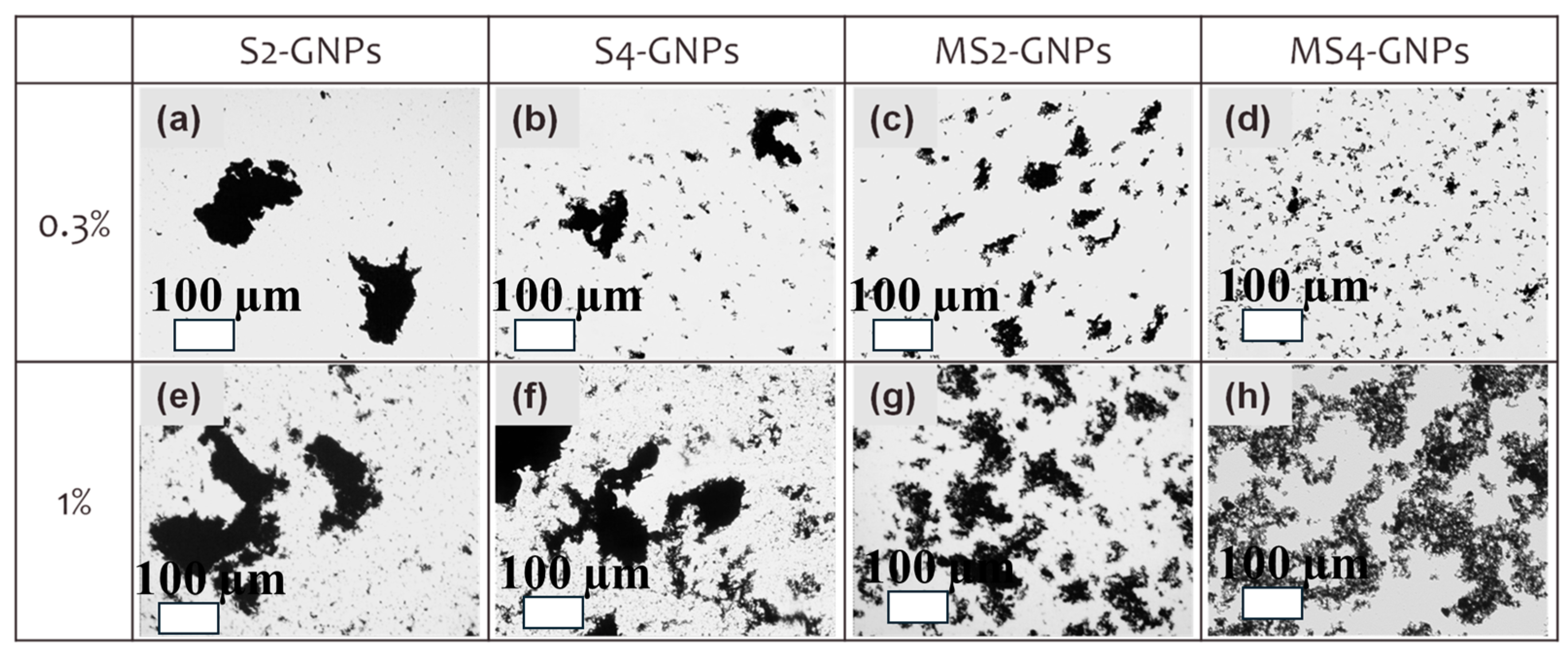
A major factor limiting thermal transport in polymer composites is interfacial thermal resistance, often referred to as Kapitza resistance, which arises from phonon mismatch between filler particles and the surrounding polymer matrix as well as imperfect interfacial bonding [109,110]. Even fillers possessing very high intrinsic thermal conductivity may provide limited composite improvement if heat transfer across the filler–matrix interface is inefficient [111,112]. Figure 4a–h illustrates the influence of dispersion and agglomeration on conductive network formation in graphene nanoplatelet (GNP)–filled epoxy composites. At low loading (0.3 wt.%), large GNP variants exhibit pronounced micron-scale clustering with isolated agglomerates, whereas mechanically processed or milled GNPs display a more distributed platelet population. At higher loading (1 wt.%), the probability of platelet–platelet contact increases, initiating the formation of conductive pathways [112]. However, excessive clustering can create interfacial voids and weak interphase regions that limit stress transfer and create localized heat-flow bottlenecks. This dispersion-controlled transition from isolated clusters to interconnected platelet networks represents a key microstructural driver governing both thermal and mechanical performance in platelet-filled composites [111,112].
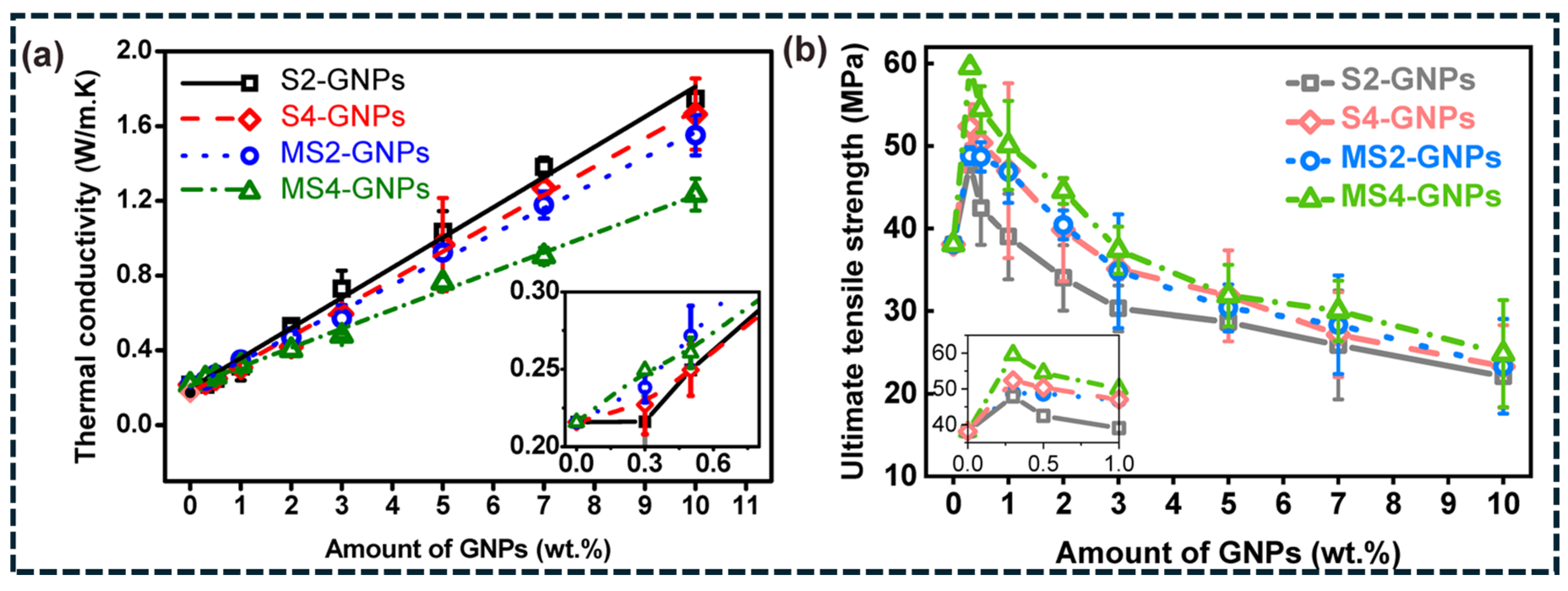
Consistent with this mechanism, Figure 5a shows a monotonic increase in thermal conductivity with increasing GNP fraction, driven by percolation-assisted platelet networking and reduced polymer-dominated heat-flow length. The magnitude of conductivity enhancement depends strongly on platelet morphology and processing history. Larger or less-fragmented platelets produced through sonication-only processing provide higher conductivity at equivalent loading due to their higher aspect ratio and larger contact area, which lowers junction resistance between platelets [112]. In contrast, milling-induced fragmentation improves dispersion but increases the number of platelets–platelet interfaces and therefore raises cumulative interfacial resistance. At the same time, Figure 5b demonstrates that tensile strength peaks at low GNP concentrations but decreases at higher loading levels due to agglomeration-induced stress concentration and interphase debonding. These results highlight the trade-off between maximizing conductive pathway connectivity and maintaining mechanical integrity under thermal cycling conditions [112].
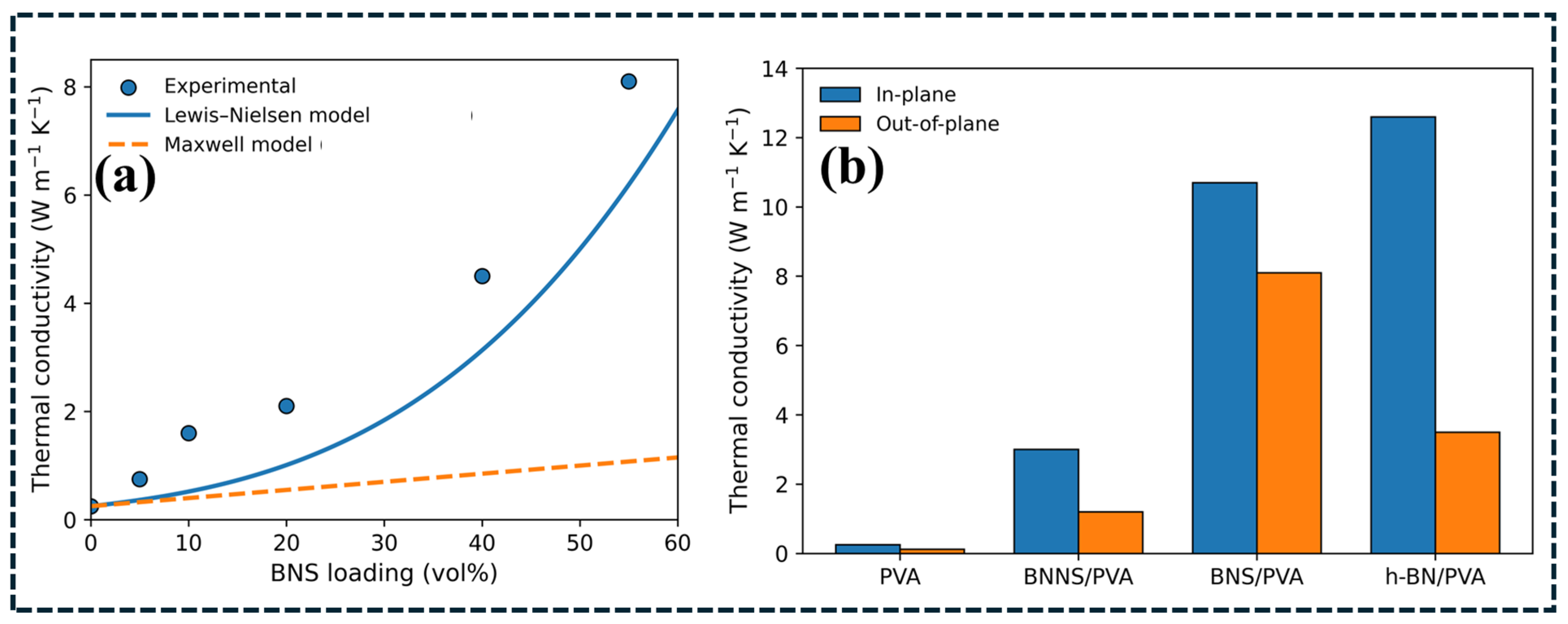
The influence of filler connectivity and anisotropic heat transport is further illustrated in Figure 6, which presents thermal conductivity trends for BN-based composites. As shown in Figure 6a, the thermal conductivity of BNS/PVA composites increases sharply with rising boron nitride sheet loading, deviating from the Maxwell dilute-filler prediction and approaching the Lewis–Nielsen model [113]. This deviation reflects the transition from isolated filler dispersion to connectivity-assisted heat transport dominated by BN–BN conduction pathways [114]. Figure 6b further reveals pronounced anisotropic behavior, where in-plane thermal conductivity is substantially higher than out-of-plane conductivity due to preferential alignment of two-dimensional fillers during processing. While the aligned network enhances lateral heat spreading along the composite plane, through-plane conduction remains limited by interlayer junction resistance and polymer-rich regions [115]. For solar absorber plates, such anisotropic transport can be advantageous because enhanced in-plane conductivity promotes uniform surface temperature distribution and reduces localized overheating.
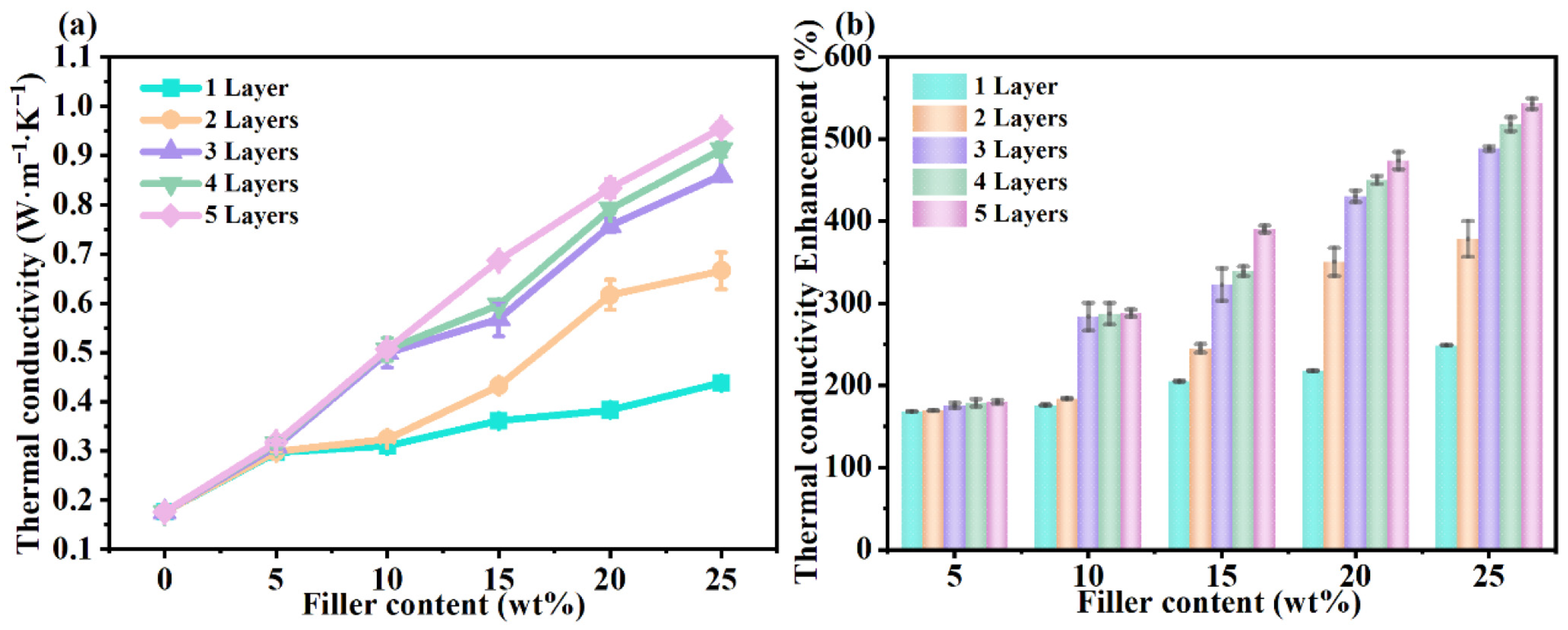
A similar structure–property relationship is observed in oriented BN multilayer architectures, as shown in Figure 7. Figure 7a demonstrates that thermal conductivity increases systematically with filler content and that conductivity gains become larger as the number of oriented BN layers increases. This trend confirms that multilayer alignment strengthens continuous in-plane conduction pathways and reduces phonon scattering along the heat-spreading direction. Figure 7b further quantifies this effect through thermal conductivity enhancement percentages, revealing a strong synergistic improvement when multiple oriented layers are stacked. These results indicate that multilayer-oriented platelet architecture provides an effective strategy to enhance absorber heat spreading without requiring excessively high filler loading [116].
Hybrid filler architectures offer an additional strategy for balancing anisotropic heat transport while maintaining high conductivity at moderate filler loading levels [113]. Multi-scale hybrid networks commonly combine ceramic platelets such as BNNS or h-BN [114] with one-dimensional fillers (e.g., CNTs) [115] or small particles (e.g., Al2O3) [116] or that bridge gaps between aligned platelets. This bridging mechanism reduces contact resistance and promotes three-dimensional conduction pathways while preserving efficient in-plane heat spreading. In solar collector absorbers, hybrid filler systems can also help decouple thermal and optical requirements. Ceramic networks maintain structural stability, compatibility with selective coatings, and limited emissivity impact, while controlled carbon fractions enhance solar absorptance and contribute to heat spreading [114,115,116]. Such hybrid networks are often more robust under thermal cycling because conduction pathways exist across multiple length scales.
In addition to conductivity enhancement, composite microstructure strongly influences thermo-mechanical stability and environmental durability. High filler loading and strong filler networks can reduce the coefficient of thermal expansion and suppress creep deformation, improving dimensional stability under cyclic heating conditions typical of solar collectors [114]. Conversely, poorly dispersed fillers, agglomerates, or voids act as stress concentrators that accelerate crack initiation and degrade thermal pathways during thermal cycling. Aging processes such as UV exposure and thermo-oxidative degradation can further weaken filler–matrix interfaces, gradually reducing conductivity and mechanical integrity over long-term operation [110,111,112,113,114,115,116]. In collector systems, these degradation mechanisms may manifest as increasing temperature gradients, reduced heat transfer efficiency, and eventual delamination of absorber coatings or bonded interfaces. To establish practical structure–property–performance relationships, composite thermal behavior must be interpreted in terms of both anisotropic conductivity and effective heat removal within the collector. High in-plane thermal conductivity promotes uniform absorber surface temperatures, reducing radiative losses and limiting hot spots that accelerate coating degradation [117]. In contrast, higher through-plane conductivity improves heat transfer into fluid channels or bonded tubes, increasing the heat removal factor F R and enhancing useful heat output. Consequently, conductivity enhancement strategies should be evaluated not only based on maximum laboratory conductivity values but also on whether the resulting microstructure provides the conduction orientation required by the collector architecture [114,115,116,117]. Table 4 summarizes how different processing routes influence filler orientation, interfacial quality, anisotropic conductivity, and their implications for collector-level performance.

6. Fabrication Techniques and Manufacturing Considerations for Collector-Grade Polymer–Ceramic Hybrid Absorbers

The manufacturability of polymer–ceramic hybrid materials is a critical factor for their practical deployment in solar thermal collectors. Absorber components must be produced at scale while maintaining consistent thermal performance, dimensional stability, and durability under outdoor conditions [125]. In contrast to laboratory-scale composite studies, collector absorbers require strict control of thickness uniformity, tube–absorber bonding quality, surface finish for selective coatings, and resistance to leakage or delamination during thermal cycling. Consequently, fabrication routes must be considered as a collector-level design parameter, since processing methods directly influence filler dispersion, orientation anisotropy, interfacial bonding, porosity, and the reproducibility of thermal conductivity enhancement. Melt processing techniques, particularly extrusion and injection molding, are widely used in industrial polymer manufacturing and therefore represent attractive routes for large-scale production of collector absorber components. Extrusion is especially suitable for producing absorber plates with integrated flow channels, where continuous profiles can be manufactured with tailored cross-sections for heat collection and fluid transport [117]. In polymer–ceramic hybrids, extrusion induces shear-driven alignment of platelet fillers such as boron nitride and graphite, resulting in enhanced in-plane thermal conductivity that supports lateral heat spreading across absorber plates. However, this alignment can reduce through-plane conductivity and create orientation gradients across the thickness, which may limit heat transfer into bonded tubes unless additional design measures such as conductive interlayers or hybrid filler networks are employed. Injection molding enables the fabrication of complex geometries including manifolds, connectors, and integrated absorber modules. Nevertheless, high filler loading can introduce weld-line defects, warpage, and nonuniform filler orientation, potentially affecting dimensional accuracy and long-term sealing reliability. Compression molding and hot pressing remain valuable fabrication routes when high filler loading and low void content are required. These methods enable densification and improved particle contact, thereby reducing interfacial voids and lowering thermal resistance [118]. Hot pressing is particularly effective for platelet-based filler systems, producing aligned laminar structures with high in-plane thermal conductivity. In collector absorber designs, such heat-spreader layers can be combined with polymer channel structures through lamination or bonding, creating hybrid architectures where one layer enhances heat spreading while another provides fluid transport and mechanical support. However, compression-based processes typically have limited capability for complex geometries and often require additional joining steps to integrate tubing or manifolds.
Solution-based processing and in situ polymerization techniques offer improved control over filler dispersion and interfacial bonding, particularly for nanoscale fillers such as boron nitride nanosheets, graphene, and carbon nanotubes. In situ polymerization can produce strong filler–matrix interphases that reduce interfacial thermal resistance and enhance stability under thermal cycling [120]. For collector-grade absorber components, these approaches may enable high-performance materials with improved conductivity retention and mechanical durability. However, challenges related to solvent removal, curing control, and scale-up must be carefully managed to avoid microvoid formation and ensure stable adhesion of selective coatings. Additive manufacturing methods, particularly fused filament fabrication (FFF/FDM), have recently been explored for fabricating customized absorber geometries and complex flow-channel structures [126,127]. In polymer–ceramic composites, additive manufacturing can enable tailored anisotropic conduction by controlling print orientation and layer stacking [128]. However, porosity and weak interlayer bonding frequently reduce through-plane thermal conductivity and compromise leakage resistance, which remain critical limitations for practical collector deployment. As a result, additive manufacturing currently appears more suitable for prototyping and design optimization rather than large-scale commercial absorber production. In addition to bulk fabrication, joining and assembly processes play an important role in determining collector performance. Tube–absorber bonding interfaces, adhesive joints, and lamination layers can introduce significant thermal contact resistance even when high-conductivity composites are used. Interface engineering strategies such as thermally conductive adhesives, bonding films, co-molding, and mechanical interlocking designs are therefore essential to minimize heat-transfer losses and maintain reliability during thermal cycling [124]. Surface finish is also important because polymer–ceramic substrates must be compatible with solar selective coatings, which require stable adhesion under ultraviolet exposure, humidity cycling, and temperature fluctuations.
For practical implementation in solar collectors, fabrication routes must be evaluated not only by achievable composite conductivity but also by scalability, geometry flexibility, anisotropy control, void suppression capability, and compatibility with collector assembly processes. Processing methods strongly influence filler network formation and therefore determine the balance between in-plane heat spreading and through-plane heat transfer into fluid channels. Consequently, manufacturing strategy directly affects collector efficiency, stagnation tolerance, and long-term reliability. Table 5 further compares the major fabrication techniques in terms of microstructural characteristics, collector advantages, and manufacturing limitations, providing guidance for selecting processing routes suitable for large-scale solar collector deployment.

7. Durability, Outdoor Aging, and Reliability of Polymer–Ceramic Hybrid Absorbers

The long-term durability of absorber components is a critical requirement for solar thermal collectors, which are typically expected to operate for service lifetimes of 10–25 years under continuous outdoor exposure. For polymer–ceramic hybrid absorbers, durability determines whether improvements in thermal conductivity and optical performance can be maintained during real operation. Although laboratory studies often demonstrate significant conductivity enhancement, the practical viability of these materials depends on the stability of filler networks, resistance of the polymer matrix to environmental degradation, retention of coating adhesion, and reliability of bonded interfaces during repeated thermal cycling. Therefore, collector-grade evaluation must consider time-dependent degradation processes that influence thermal transport, optical performance, and structural integrity. Ultraviolet irradiation represents one of the most significant environmental stressors for polymer-based absorber systems [136]. UV exposure can induce photo-oxidation, polymer chain scission, and progressive embrittlement, leading to surface cracking, discoloration, and reduced mechanical toughness. These changes may accelerate crack propagation during thermal cycling and compromise coating stability. In addition, UV aging can weaken filler–matrix interfaces, increasing interfacial thermal resistance and reducing effective heat-conduction pathways. The severity of UV degradation depends strongly on polymer chemistry, stabilizer formulation, and absorber architecture, particularly whether the polymer substrate is directly exposed to sunlight or protected by glazing or coatings. Ceramic fillers such as TiO2 and ZnO may provide beneficial UV-shielding effects by reducing radiation penetration into the polymer matrix; however, their optical scattering behavior must be carefully controlled to avoid reducing solar absorptance of the absorber surface [136]. Consequently, UV durability assessment should include both mechanical integrity and retention of optical properties.
Moisture exposure and humidity cycling present additional durability challenges in solar collectors, particularly under conditions involving daily temperature fluctuations and condensation. Moisture ingress can lead to swelling of the polymer matrix, hydrolysis in susceptible polymers, and degradation of filler–matrix interfaces, especially when hydrophilic fillers attract water at the interface. Over time, these processes may cause interfacial debonding, void formation, and reduced thermal conductivity. Moisture-related effects are especially critical for absorbers that incorporate bonded tubes or lamination interfaces, where swelling and CTE mismatch can generate stresses that promote delamination [137]. Ceramic fillers often improve moisture resistance by increasing composite stiffness and limiting matrix mobility; however, certain fillers such as aluminum nitride may require careful moisture control due to hydrolysis sensitivity [138].
Thermal aging and thermo-oxidative degradation are particularly relevant under collector operating temperatures and stagnation conditions. Prolonged exposure to elevated temperature in the presence of oxygen can cause oxidation of polymer chains, resulting in chain scission, changes in crystallinity, and reduced mechanical ductility. These processes may weaken filler networks and increase the likelihood of microcrack formation during subsequent thermal cycling [136,137]. Thermo-oxidative degradation is often accelerated in localized hot spots, which may occur in absorber designs with insufficient heat spreading or poor thermal contact with fluid channels. Consequently, improving in-plane thermal conductivity and ensuring efficient heat transfer to fluid paths are important strategies for limiting peak temperatures and enhancing durability. High-temperature matrices such as PPS, PEEK, and polyimides offer improved resistance to thermal degradation, whereas commodity polymers require stabilization strategies and careful collector design to avoid creep or softening during stagnation [138].
Thermal cycling represents one of the most severe mechanical stresses encountered in solar thermal collectors. Daily and seasonal temperature fluctuations induce repeated expansion and contraction, and polymer absorbers may experience fatigue damage due to their relatively high coefficient of thermal expansion compared with metallic tubes and coatings [139]. When absorber plates are bonded to metal tubes or coated with selective surfaces, cyclic mismatch stresses can lead to cracking or delamination, increasing thermal contact resistance and reducing heat transfer efficiency. Repeated cycling may also alter filler orientation or disrupt conductive networks if the polymer matrix softens near its glass transition temperature [140]. Hybrid filler architectures can improve cycling stability by providing multi-scale conduction pathways that remain functional even when localized damage occurs. In addition, freeze–thaw cycles in cold climates may introduce further stresses due to moisture expansion, highlighting the need for adequate sealing and moisture-barrier strategies.
The durability of selective absorber coatings and coating–substrate adhesion is equally important because collector efficiency is highly sensitive to optical performance. Even if thermal conductivity remains stable, degradation of the selective coating can reduce solar absorptance or increase thermal emittance, leading to efficiency losses [141]. Polymer–ceramic hybrid substrates should therefore provide stable surface chemistry, appropriate roughness, and sufficient stiffness to maintain coating adhesion during thermal cycling. Ceramic fillers such as boron nitride, alumina, and silicon carbide often improve coating compatibility by increasing surface hardness and dimensional stability, while carbon-rich surfaces may require intermediate layers to ensure reliable coating adhesion [139]. Durability evaluation should therefore include adhesion testing and optical performance monitoring following environmental exposure. To ensure consistent comparison between studies and facilitate translation to collector applications, durability assessment should follow standardized accelerated aging protocols that replicate the major environmental stress modes experienced by solar collectors. These tests should report not only exposure conditions but also retention of key properties after aging, including directional thermal conductivity, mechanical integrity, coating adhesion, and optical absorptance/emittance. Conductivity retention is particularly important because polymer–ceramic hybrids may initially exhibit high thermal conductivity that gradually declines due to interfacial degradation or matrix cracking. Similarly, optical property retention is essential for absorber systems, as changes in solar absorptance or thermal emittance directly affect collector efficiency. Table 6 summarizes recommended accelerated aging protocols and reporting metrics that can support consistent qualification of polymer–ceramic hybrid absorber materials for solar thermal collector applications.

8. Comparative Synthesis and Collector-Ready Performance Evidence

Performance data for thermally conductive polymer–ceramic hybrid composites remain difficult to compare across the literature because studies employ different filler morphologies, loading definitions (wt% versus vol%), dispersion protocols, processing routes, and thermal conductivity measurement techniques. As a result, reported conductivity values vary widely even for nominally similar composite systems. Another limitation is incomplete reporting of conductivity direction. Many studies provide only a single conductivity value without clarifying whether it represents in-plane or through-plane transport, although platelet fillers such as boron nitride, graphite, and graphene often produce highly anisotropic composites. Because absorber plates primarily require efficient in-plane heat spreading while tube or channel interfaces require adequate through-plane conduction, directional conductivity reporting is essential for translating laboratory results into collector design. Therefore, collector-oriented comparison of materials should include conductivity directionality, measurement method, fabrication route, test temperature, and durability evaluation. From a collector performance perspective, conductivity enhancement is beneficial only when it reduces absorber temperature gradients and improves heat transfer to the working fluid. Platelet-based boron nitride networks consistently deliver high in-plane conductivity due to strong filler alignment and high intrinsic conductivity, making them effective heat-spreading materials for absorber plates. However, these networks frequently exhibit limited through-plane conductivity, which may restrict heat transfer into tubes or channels unless hybrid filler architectures or interface engineering strategies are implemented. Carbon-based fillers such as graphite and graphene can simultaneously enhance thermal transport and solar absorption, but their application in collector absorbers requires careful control of thermal emittance and optical stability under ultraviolet exposure and stagnation conditions. Hybrid ceramic–carbon architectures offer a balanced strategy by combining thermal conductivity enhancement with tunable optical response and improved coating compatibility when carbon content is carefully controlled. Polymer matrix selection also plays a critical role in maintaining long-term performance under collector operating conditions. Commodity polymers enable cost-effective processing but may exhibit creep deformation and accelerated aging at elevated temperatures, limiting stagnation tolerance. High-temperature matrices such as PPS, PEEK, and polyimides provide improved thermal stability and better preservation of filler network integrity during thermal cycling [149]. Thermosetting matrices may further improve dimensional stability and coating adhesion, although their brittleness under repeated thermal loading must be addressed through suitable toughening strategies [150]. Several studies report that composites lacking appropriate interphase engineering experience conductivity degradation after aging due to filler–matrix debonding, microcrack formation, and increased interfacial thermal resistance [151]. Consequently, collector-grade evaluation should emphasize conductivity retention, coating adhesion stability, and optical property retention rather than only reporting peak conductivity values measured for as-fabricated materials. To facilitate comparison across studies, Table 7 summarizes representative polymer–ceramic hybrid composites that demonstrate collector-relevant thermal performance together with durability evaluation. The compiled evidence highlights that conductivity retention after environmental aging is a critical metric for assessing real absorber suitability.
Comparative evaluation of the most promising studies indicates that collector-compatible polymer–ceramic hybrids typically rely on three design principles: (i) formation of connected filler pathways that provide stable conductivity enhancement at practical filler loading levels [164]; (ii) interphase engineering (e.g., coupling agents or surface functionalization) to reduce interfacial thermal resistance and prevent conductivity decay [165]; and (iii) processing strategies that control filler orientation and suppress porosity, since voids and microcracks rapidly degrade both thermal transport and mechanical reliability during cycling [166]. Platelet-dominant ceramic systems, particularly boron nitride-based composites, are highly effective for in-plane heat spreading and generally provide good chemical stability and coating compatibility [167,168]. Hybrid ceramic–carbon networks can further enhance thermal transport and solar absorption [94,169]; however, emissivity control and optical stability remain important design considerations. Multilayer absorber architectures provide an additional strategy by separating functions: a ceramic-rich heat-spreading layer provides thermal conduction, while a thin selective coating governs optical performance ( α s o l a r and ε t h e r m a l ), reducing dependence on carbon-rich bulk composites [170,171]. For practical collector implementation, composite strategies should be grouped according to absorber component function rather than material class alone. Table 8 therefore summarizes the most effective composite families according to their role within the collector system, linking material design strategies to functional requirements. In addition to component-level optimization, material selection must also consider trade-offs between thermal performance, optical behavior, durability, and manufacturing feasibility. Table 9 presents a simplified decision matrix that links common polymer–filler systems to collector requirements and highlights the primary trade-offs governing absorber design.
Overall, current evidence indicates that ceramic-dominant conduction networks, particularly boron nitride-based systems, offer the most balanced combination of thermal conductivity enhancement, coating compatibility, and long-term durability for solar thermal absorber components [181]. Carbon-rich systems provide strong solar absorption but require careful surface engineering to control emissivity and maintain stability under outdoor exposure. Hybrid ceramic–carbon networks and multilayer absorber architectures appear particularly promising because they allow for simultaneous optimization of thermal transport, optical selectivity, and environmental durability. Future studies should prioritize standardized reporting of directional conductivity, temperature-dependent behavior, and property retention after accelerated aging protocols to enable reliable comparison across materials systems and facilitate translation of laboratory-scale composite developments into collector-ready absorber technologies.

9. Challenges, Research Gaps, and Future Roadmap for Collector-Grade Polymer–Ceramic Hybrid Absorbers

Despite significant progress in thermally conductive polymer composites, the translation of polymer–ceramic hybrid materials into reliable absorber components for solar thermal collectors remains constrained by coupled material, component, and system-level challenges [182]. Many studies report impressive thermal conductivity enhancement under laboratory conditions but lack validation under collector-relevant exposure environments, including ultraviolet irradiation, humidity cycling, thermal cycling, and stagnation events [183]. In addition, comparison across studies is often hindered by inconsistent reporting of conductivity direction, measurement conditions, and processing methods, which limits robust synthesis and prevents identification of scalable composite architectures [184]. Addressing these gaps is necessary to transition polymer–ceramic hybrids from laboratory demonstrations to collector-grade technologies. One of the primary challenges is the limited connection between material-level metrics and collector-level performance outcomes [185]. Thermal conductivity enhancement alone does not guarantee collector efficiency improvement, which depends on absorber geometry, heat spreading, tube coupling, bonding interfaces, and fluid flow distribution [186]. Many studies report composite conductivity values without evaluating their influence on the heat-removal factor F R , absorber temperature uniformity, or stagnation temperature mitigation [8]. Future research should therefore incorporate component-level validation, including thermal imaging of absorber temperature distribution, heat-transfer measurements in channel structures, and quantification of thermal resistance at tube-bonding interfaces. Such experiments would provide stronger evidence that microstructure-engineered composites deliver meaningful collector-level performance improvements.
Optical selectivity and optical stability remain additional challenges for polymer-based absorber systems [187]. Efficient collectors require high solar absorptance combined with low thermal emittance, yet polymer substrates do not inherently provide selective absorber behavior [14]. Carbon fillers can increase absorptance but may also increase thermal emittance unless selective surface engineering is applied [188]. Ceramic fillers are generally optically stable but require selective coatings to achieve high absorptance [189]. Consequently, compatibility between polymer–ceramic hybrid substrates and selective absorber coatings is an important research area. Future studies should emphasize coating–substrate interface engineering, including surface functionalization, primer layers, graded interphases, and controlled roughness, to maintain optical performance and coating adhesion during long-term environmental exposure.
Interfacial thermal resistance is another critical limitation in polymer absorber systems [190]. Even when the composite material exhibits high intrinsic thermal conductivity, contact resistance at interfaces such as between absorber plates and tubes or between laminated layers may dominate the overall heat-transfer resistance [191]. Polymer substrates are particularly susceptible to this issue because their lower stiffness and higher coefficient of thermal expansion can promote micro-gaps or delamination during thermal cycling [192]. Future research should therefore integrate interface engineering strategies into absorber design, including thermally conductive adhesives, conductive interlayers, mechanical interlocking geometries, and co-molded tube-coupling structures. Ensuring interface durability during repeated thermal cycling is essential for maintaining long-term collector efficiency.
Long-term outdoor durability remains the most decisive challenge for collector-grade implementation [193]. Environmental stressors such as ultraviolet exposure, moisture ingress, thermo-oxidative aging, and thermal cycling can progressively degrade polymer matrices and filler networks. In many published studies, aging tests are either absent or insufficiently standardized, and retention of thermal or optical properties is rarely reported quantitatively. Future development of polymer–ceramic absorber materials therefore requires standardized durability testing protocols that include UV weathering, humidity exposure, stagnation simulation, and thermal cycling, together with reporting of directional conductivity retention, coating adhesion, and optical α/ε stability after aging [194]. Combined aging tests are particularly important because synergistic degradation mechanisms often accelerate performance loss beyond single-factor exposures. In addition, polymer matrix selection must account for stagnation tolerance to avoid softening or creep near the glass-transition temperature [195]. Manufacturing scalability and quality control represent another important research gap. Many high-performance composites rely on fabrication routes such as solution casting or laboratory hot pressing, which may not easily scale industrial absorber production. High filler loading can increase melt viscosity, complicate extrusion or injection molding, and introduce voids that degrade conductivity and coating adhesion. Practical collector adoption therefore requires composite formulations compatible with scalable processing methods such as extrusion, compression molding, and lamination. Improved dispersion strategies and process control are also necessary to minimize filler aggregation and porosity while maintaining reproducible conductivity enhancement.
Looking forward, the most promising pathway toward collector-grade polymer–ceramic hybrid absorbers lies in engineered multifunctional architectures rather than single-layer bulk composites. Multilayer absorber designs can separate thermal conduction and optical selectivity functions, enabling ceramic-rich conduction layers for heat spreading combined with thin selective coatings that control absorptance and emittance. Hybrid ceramic–carbon networks may further enhance thermal transport while maintaining optical performance when carbon content is carefully optimized. To accelerate technological maturity, future research should also emphasize technology-readiness-level (TRL) validation through absorber module testing under outdoor conditions, including stagnation events and long-term exposure. Such module-level demonstrations are essential to bridge the gap between laboratory material development and commercial solar collector deployment. Table 10 summarizes the key challenges, research gaps, and recommended research directions for advancing polymer–ceramic hybrid materials toward collector-grade solar thermal absorber applications.

10. Conclusions

Polymer–ceramic hybrid composites have emerged as promising candidates for lightweight solar thermal absorber components due to their potential to combine corrosion resistance, reduced weight, and scalable manufacturability with enhanced thermal transport. However, successful implementation in solar thermal collectors requires optimization beyond simple conductivity enhancement. This review has presented a collector-centered evaluation of polymer–ceramic hybrid materials, emphasizing the coupled roles of thermal transport, optical selectivity, durability, and manufacturing readiness in determining absorber performance. Thermally conductive fillers such as boron nitride, aluminum nitride, silicon carbide, and carbon-based materials enable the formation of conductive pathways that significantly improve heat spreading within polymer matrices. Among these systems, platelet-based ceramic networks—particularly boron nitride—consistently provide effective in-plane thermal conductivity enhancement while maintaining chemical stability and compatibility with selective coatings. Hybrid filler architecture combining ceramic and carbon phases can further enhance thermal transport and solar absorption, although careful design is required to avoid increases in thermal emittance or long-term optical instability. At the same time, polymer matrix selection plays a decisive role in determining thermal stability, resistance to environmental degradation, and retention of conductive network integrity during long-term operation.
Microstructure engineering and processing routes strongly influence the resulting thermal performance and durability of polymer–ceramic hybrid absorbers. Filler alignment, dispersion quality, and interfacial bonding determine the balance between in-plane heat spreading and through-plane conduction to fluid channels. Manufacturing strategies such as extrusion, compression molding, lamination, and co-molding must therefore be integrated with composite design to ensure scalable production and consistent thermal performance. In addition, interface engineering at tube–absorber joints and multilayer interfaces is essential to minimize contact resistance and maintain collector efficiency. Durability considerations remain central to the deployment of polymer–ceramic absorbers in real solar collector systems. Environmental stressors including ultraviolet exposure, humidity cycling, thermo-oxidative aging, and repeated thermal cycling can progressively degrade polymer matrices and filler networks if materials are not carefully designed and stabilized. Reliable collector-grade materials must therefore demonstrate long-term retention of thermal conductivity, coating adhesion, and optical performance under realistic aging conditions.
Comparative analysis of available performance data suggests that the most promising absorber architecture combines ceramic-dominant conduction networks with optimized interphase design and scalable processing routes. Multilayer absorber configurations, in which heat-spreading and optical selectivity functions are separated into different layers, represent an especially attractive pathway for balancing thermal transport, optical performance, and durability. Future research should increasingly focus on bridging the gap between material-level characterization and collector-level validation. Standardized reporting of directional conductivity, temperature-dependent behavior, and property retention after accelerated aging will improve comparability across studies. In addition, component- and module-level demonstrations under realistic operating conditions are essential to confirm that microstructure-engineered composites deliver measurable improvements in collector efficiency and long term reliability. Through such integrated material, processing, and system-level development, polymer–ceramic hybrid absorbers have the potential to enable durable, lightweight, and cost-effective solar thermal collector technologies.


Author Contributions

Conceptualization, S.K.S., R.P., L.K.S., Y.S., D.K. and D.B.; methodology S.K.S., R.P., Y.P., D.K. and D.B.; formal analysis, writing—original draft preparation, S.K.S.; writing—review and editing, S.K.S., R.P., D.K., D.B., M.S., L.K.S. and Y.S.; visualization, S.K.S., L.K.S., Y.S., Y.P. and M.S.; resources, D.K.; supervision, D.K. All authors have read and agreed to the published version of the manuscript.

Funding

This research was funded by the Slovenian Research Agency under grant number P2-0270, and bilateral project Weave N2-0328.

Data Availability Statement

No new data were created or analyzed in this study.

Acknowledgments

The project proposal was also partly supported by EU ERASMUS+ Strategic Partnership Key Action 2, number: 2024-1-RO01-KA220-HED-000244949 (SMARTIE) and 2023-1-RO01-KA220-HED-000158031 (ANGIE).

Conflicts of Interest

The authors declare no conflicts of interest.

References

  1. Moss, R.W.; Shire, G.S.F.; Henshall, P.; Eames, P.C.; Arya, F.; Hyde, T. Design and fabrication of a hydroformed absorber for an evacuated flat plate solar collector. Appl. Therm. Eng. 2018, 138, 456–464. [Google Scholar] [CrossRef]
  2. Chen, H.; Lu, W.-B.; Liu, Z.-G.; Zhang, J.; Zhang, A.-Q.; Wu, B. Experimental demonstration of microwave absorber using large-area multilayer graphene-based frequency selective surface. IEEE Trans. Microw. Theory Tech. 2018, 66, 3807–3816. [Google Scholar] [CrossRef]
  3. Danlee, Y.; Huynen, I.; Bailly, C. Frequency-selective multilayer electromagnetic bandgap structure combining carbon nanotubes with polymeric or ceramic substrates. Appl. Phys. Lett. 2014, 105, 123118. [Google Scholar] [CrossRef]
  4. Melchers, R.E. Predicting long-term corrosion of metal alloys in physical infrastructure. npj Mater. Degrad. 2019, 3, 4. [Google Scholar] [CrossRef]
  5. Chichango, F.; Cristóvão, L.; Nhambiu, J.; Cumbe, F.; Mavanga, G.G. Literature review of potential materials for the construction of an alternative flat-plate solar collector. Res. Soc. Dev. 2024, 13, e0513545674. [Google Scholar] [CrossRef]
  6. Palacios, A.; Krabben, Y.; Linder, E.; Thamm, A.-K.; Arpagaus, C.; Paranjape, S.; Bless, F.; Carbonell, D.; Schuetz, P.; Worlitschek, J. Thermal Energy Storage Technology Roadmap for Decarbonising Medium-Temperature Heat Processes—A Review. Sustainability 2025, 17, 9693. [Google Scholar] [CrossRef]
  7. Panahi-Sarmad, M.; Guo, T.; Hashemi, S.A.; Ghaffarkhah, A.; Wuttke, S.; Arjmand, M.; Rojas, O.J.; Jiang, F. Hierarchically MOF-Based Porous Monolith Composites for Atmospheric Water Harvesting. Adv. Mater. 2025, 38, 2413353. [Google Scholar] [CrossRef]
  8. Wang, Z.; Wu, Z.; Weng, L.; Ge, S.; Jiang, D.; Huang, M.; Mulvihill, D.M.; Chen, Q.; Guo, Z.; Jazzar, A. A roadmap review of thermally conductive polymer composites: Critical factors, progress, and prospects. Adv. Funct. Mater. 2023, 33, 2301549. [Google Scholar] [CrossRef]
  9. Kaur, S.; Gallei, M.; Ionescu, E. Polymer–ceramic nanohybrid materials. In Organic-Inorganic Hybrid Nanomaterials; Springer: Berlin/Heidelberg, Germany, 2014; pp. 143–185. [Google Scholar]
  10. Iannazzo, D.; Pistone, A.; Salamò, M.; Galvagno, S. Hybrid ceramic/polymer composites for bone tissue regeneration. In Hybrid Polymer Composite Materials; Elsevier: Amsterdam, The Netherlands, 2017; pp. 125–155. [Google Scholar]
  11. Liu, B.; Sun, J.; Zhao, J.; Yun, X. Hybrid graphene and carbon nanotube–reinforced composites: Polymer, metal, and ceramic matrices. Adv. Compos. Hybrid Mater. 2025, 8, 1. [Google Scholar] [CrossRef]
  12. Han, Y.; Guo, Y.; Gu, J. Thermally conductive fillers. In Thermally Conductive Polymer Composites; Elsevier: Amsterdam, The Netherlands, 2023; pp. 111–147. [Google Scholar]
  13. Kim, H.T. High thermal conductivity ceramics and their composites for thermal management of integrated electronic packaging. In Heat Transfer-Models, Methods and Applications; IntechOpen: London, UK, 2018; pp. 1–27. [Google Scholar]
  14. Kalogirou, S.A. Solar thermal collectors and applications. Prog. Energy Combust. Sci. 2004, 30, 231–295. [Google Scholar] [CrossRef]
  15. Harrison, S.; Cruickshank, C.A. A review of strategies for the control of high temperature stagnation in solar collectors and systems. Energy Procedia 2012, 30, 793–804. [Google Scholar] [CrossRef]
  16. Ghasemi, J.B.; Arab, B.; Seidi, S. Smart Coatings Including Antibacterial Coatings, Anti-Fogging Coatings and Self-Healing Materials. In Green Polymer Composites Technology: Properties and Applications; CRC: Boca Raton, FL, USA, 2016; p. 93. [Google Scholar]
  17. Riffat, S.B.; Cuce, E. A review on hybrid photovoltaic/thermal collectors and systems. Int. J. Low-Carbon Technol. 2011, 6, 212–241. [Google Scholar] [CrossRef]
  18. Garimella, S.V.; Persoons, T.; Weibel, J.A.; Gektin, V. Electronics thermal management in information and communications technologies: Challenges and future directions. IEEE Trans. Compon. Packag. Manuf. Technol. 2016, 7, 1191–1205. [Google Scholar] [CrossRef]
  19. Florschuetz, L.W. Extension of the Hottel-Whillier model to the analysis of combined photovoltaic/thermal flat plate collectors. Sol. Energy 1979, 22, 361–366. [Google Scholar] [CrossRef]
  20. Chen, M.; He, Y.; Zhu, J.; Wen, D. Investigating the collector efficiency of silver nanofluids based direct absorption solar collectors. Appl. Energy 2016, 181, 65–74. [Google Scholar] [CrossRef]
  21. Daabo, A.M.; Mahmoud, S.; Al-Dadah, R.K. The optical efficiency of three different geometries of a small scale cavity receiver for concentrated solar applications. Appl. Energy 2016, 179, 1081–1096. [Google Scholar] [CrossRef]
  22. Choy, C.L. Thermal conductivity of polymers. Polymer 1977, 18, 984–1004. [Google Scholar] [CrossRef]
  23. Bauld, R.; Choi, D.-Y.W.; Bazylewski, P.; Divigalpitiya, R.; Fanchini, G. Thermo-optical characterization and thermal properties of graphene–polymer composites: A review. J. Mater. Chem. C 2018, 6, 2901–2914. [Google Scholar] [CrossRef]
  24. Cunningham, B.D.; Huang, J.; Baird, D.G. Review of materials and processing methods used in the production of bipolar plates for fuel cells. Int. Mater. Rev. 2007, 52, 1–13. [Google Scholar] [CrossRef]
  25. Zhang, G.; Xue, S.; Chen, F.; Fu, Q. An efficient thermal interface material with anisotropy orientation and high through-plane thermal conductivity. Compos. Sci. Technol. 2023, 231, 109784. [Google Scholar] [CrossRef]
  26. Lee, S.; Yang, F.; Suh, J.; Yang, S.; Lee, Y.; Li, G.; Sung Choe, H.; Suslu, A.; Chen, Y.; Ko, C. Anisotropic in-plane thermal conductivity of black phosphorus nanoribbons at temperatures higher than 100 K. Nat. Commun. 2015, 6, 8573. [Google Scholar] [CrossRef]
  27. Karamati, A.; Han, M.; Duan, X.; Xie, Y.; Wang, X. Thermal diffusivity characterization of semiconductive 1D micro/nanoscale structures. Int. J. Heat Mass Transf. 2024, 233, 126012. [Google Scholar] [CrossRef]
  28. Weidenfeller, B.; Höfer, M.; Schilling, F.R. Thermal conductivity, thermal diffusivity, and specific heat capacity of particle filled polypropylene. Compos. Part A Appl. Sci. Manuf. 2004, 35, 423–429. [Google Scholar] [CrossRef]
  29. Kennedy, C.E. Review of Mid-to High-Temperature Solar Selective Absorber Materials; National Renewable Energy Lab. (NREL): Golden, CO, USA, 2002. [Google Scholar]
  30. Tsotsis, T.K.; Lee, S.M. Long-term thermo-oxidative aging in composite materials: Failure mechanisms. Compos. Sci. Technol. 1998, 58, 355–368. [Google Scholar] [CrossRef]
  31. Duan, W.; Yin, X.; Li, Q.; Schlier, L.; Greil, P.; Travitzky, N. A review of absorption properties in silicon-based polymer derived ceramics. J. Eur. Ceram. Soc. 2016, 36, 3681–3689. [Google Scholar] [CrossRef]
  32. Hamilton, P.J.; Pollet, B.G. Polymer electrolyte membrane fuel cell (PEMFC) flow field plate: Design, materials and characterisation. Fuel Cells 2010, 10, 489–509. [Google Scholar] [CrossRef]
  33. Liang, H.; Wang, F.; Cheng, Z.; Xu, C.; Li, G.; Shuai, Y. Full-spectrum solar energy utilization and enhanced solar energy harvesting via photon anti-reflection and scattering performance using biomimetic nanophotonic structure. ES Energy Environ. 2020, 8, 29–41. [Google Scholar]
  34. Mostafizur, R.M.; Rasul, M.G.; Nabi, M.N. Energy and exergy analyses of a flat plate solar collector using various nanofluids: An analytical approach. Energies 2021, 14, 4305. [Google Scholar] [CrossRef]
  35. Pang, X.; Wei, Q.; Zhou, J.; Ma, H. High-temperature tolerance in multi-scale cermet solar-selective absorbing coatings prepared by laser cladding. Materials 2018, 11, 1037. [Google Scholar] [CrossRef] [PubMed]
  36. Ding, Z.; Jiang, J.-W.; Pei, Q.-X.; Zhang, Y.-W. In-plane and cross-plane thermal conductivities of molybdenum disulfide. Nanotechnology 2015, 26, 065703. [Google Scholar] [CrossRef] [PubMed]
  37. Feng, C.; Ji, J.; Xu, S.; Hou, L.; Cui, G.; Lan, H.; Wei, F.; Yang, J.; Yang, W. Scalable thermal interface materials with close-packed structure and high through-plane thermal conductivity. Polym. Compos. 2025, 46, 10187–10196. [Google Scholar] [CrossRef]
  38. Xie, H.; Cai, A.; Wang, X. Thermal diffusivity and conductivity of multiwalled carbon nanotube arrays. Phys. Lett. A 2007, 369, 120–123. [Google Scholar] [CrossRef]
  39. Ma, B.; Zhou, X.-Y.; Liu, J.; You, Z.; Wei, K.; Huang, X.-F. Determination of specific heat capacity on composite shape-stabilized phase change materials and asphalt mixtures by heat exchange system. Materials 2016, 9, 389. [Google Scholar] [CrossRef] [PubMed]
  40. Aaron, K.M.; Hashemi, A.; Morris, P.A.; Nienberg, J. Space Interferometry Mission (SIM) Thermal Design; SPIE: Bellingham, DC, USA, 2003; pp. 279–288. [Google Scholar]
  41. Fang, W.; Lo, C.-Y. On the thermal expansion coefficients of thin films. Sens. Actuators A Phys. 2000, 84, 310–314. [Google Scholar] [CrossRef]
  42. Liu, M.; Gomez, J.C.; Turchi, C.S.; Tay, N.H.S.; Saman, W.; Bruno, F. Determination of thermo-physical properties and stability testing of high-temperature phase-change materials for CSP applications. Sol. Energy Mater. Sol. Cells 2015, 139, 81–87. [Google Scholar] [CrossRef]
  43. Okui, N. Relationships between melting temperature, maximum crystallization temperature and glass transition temperature. Polymer 1990, 31, 92–94. [Google Scholar] [CrossRef]
  44. Wang, Q.; Li, G.; Cao, J.; Hu, M.; Pei, G.; Yang, H. An analytical study on optimal spectral characters of solar absorbing coating and thermal performance potential of solar power tower. Renew. Energy 2022, 200, 1300–1315. [Google Scholar] [CrossRef]
  45. Haddad, F.; Hatti, M.; Rahmoun, K.; Ziouche, K. Selective Surfaces for Photo-Thermal Conversion for Medium Solar Temperature Applications. Int. J. Heat Technol. 2022, 40, 219–224. [Google Scholar] [CrossRef]
  46. Bierwagen, G.P.; He, L.; Li, J.; Ellingson, L.; Tallman, D.E. Studies of a new accelerated evaluation method for coating corrosion resistance—Thermal cycling testing. Prog. Org. Coat. 2000, 39, 67–78. [Google Scholar] [CrossRef]
  47. Mallégol, J.; Poelman, M.; Olivier, M.G. Influence of UV weathering on corrosion resistance of prepainted steel. Prog. Org. Coat. 2008, 61, 126–135. [Google Scholar] [CrossRef]
  48. Soleyn, K. Humidity control: Preventing moisture contamination: Key to managing humidity is the ability to precisely measure temperature and humidity conditions. Chem. Eng. 2003, 110, 50–52. [Google Scholar]
  49. Lee, W.; Hong, J.; Song, J.; Yang, W.; Kim, J. Fabrication of high-performance thermally conductive phase change material composites with porous ceramic filler network for efficient thermal management. Compos. Sci. Technol. 2023, 240, 110092. [Google Scholar] [CrossRef]
  50. Barnes, K.A.; Karim, A.; Douglas, J.F.; Nakatani, A.I.; Gruell, H.; Amis, E.J. Suppression of dewetting in nanoparticle-filled polymer films. Macromolecules 2000, 33, 4177–4185. [Google Scholar] [CrossRef]
  51. Tian, Y.; Zhao, C.-Y. A review of solar collectors and thermal energy storage in solar thermal applications. Appl. Energy 2013, 104, 538–553. [Google Scholar] [CrossRef]
  52. Delgado-Sanchez, J.-M. Luminescent solar concentrators: Photo-stability analysis and long-term perspectives. Sol. Energy Mater. Sol. Cells 2019, 202, 110134. [Google Scholar] [CrossRef]
  53. Andrady, A.L.; Pandey, K.K.; Heikkilä, A.M. Interactive effects of solar UV radiation and climate change on material damage. Photochem. Photobiol. Sci. 2019, 18, 804–825. [Google Scholar] [CrossRef] [PubMed]
  54. Tiwari, S.; Bag, D.S.; Mishra, P.; Lal, G.; Dwivedi, M. High-performance PPS/PEEK blend and its composites with milled carbon fiber: Study on their mechanical, thermal and dielectric properties. Polym. Compos. 2024, 45, 11845–11859. [Google Scholar] [CrossRef]
  55. Mokaddem, A.; Belkheir, M.; Rouissat, M.; Boutaous, A. Temperature effect on interface damage of thermoplastic polymers composites materials: CF/PEEK, CF/PMMA, and CF/PPS. Strength Mater. 2023, 55, 1089–1099. [Google Scholar] [CrossRef]
  56. Qian, H.; Jiang, B. Silicone resin applications for heat-resistant coatings: A review. Polym. Sci. Ser. C 2023, 65, 206–219. [Google Scholar] [CrossRef]
  57. Bîrcă, A.; Gherasim, O.; Grumezescu, V.; Grumezescu, A.M. Introduction in thermoplastic and thermosetting polymers. In Materials for Biomedical Engineering; Elsevier: Amsterdam, The Netherlands, 2019; pp. 1–28. [Google Scholar]
  58. Eberhart-Phillips, D.; Stanley, W.D.; Rodriguez, B.D.; Lutter, W.J. Surface seismic and electrical methods to detect fluids related to faulting. J. Geophys. Res. Solid Earth 1995, 100, 12919–12936. [Google Scholar] [CrossRef]
  59. Zlatanović, L.; van der Hoek, J.P.; Vreeburg, J.H.G. An experimental study on the influence of water stagnation and temperature change on water quality in a full-scale domestic drinking water system. Water Res. 2017, 123, 761–772. [Google Scholar] [CrossRef]
  60. Ding, J.; Li, F.-X.; Kang, K.-J. Effects of material creep on displacement instability in a surface groove under thermo-mechanical cycling. Surf. Coat. Technol. 2009, 204, 157–164. [Google Scholar] [CrossRef]
  61. Grünling, H.W.; Schneider, K.; Singheiser, L. Mechanical properties of coated systems. Mater. Sci. Eng. 1987, 88, 177–189. [Google Scholar] [CrossRef]
  62. Weng, C.-N.; Yang, H.-C.; Tsai, C.-Y.; Chen, S.-H.; Chen, Y.-S.; Chen, C.-H.; Huang, K.-M.; Meng, H.-F.; Chao, Y.-C.; Chang, C.-Y. The influence of UV filter and Al/Ag moisture barrier layer on the outdoor stability of polymer solar cells. Sol. Energy 2020, 199, 308–316. [Google Scholar] [CrossRef]
  63. Luque, S.; Menéndez, G.; Roccabruna, M.; González-Aguilar, J.; Crema, L.; Romero, M. Exploiting volumetric effects in novel additively manufactured open solar receivers. Sol. Energy 2018, 174, 342–351. [Google Scholar] [CrossRef]
  64. Aggarwal, S.L.; Sweeting, O.J. Polyethylene: Preparation, structure, and properties. Chem. Rev. 1957, 57, 665–742. [Google Scholar] [CrossRef]
  65. Shubhra, Q.T.H.; Alam, A.K.M.M.; Quaiyyum, M.A. Mechanical properties of polypropylene composites: A review. J. Thermoplast. Compos. Mater. 2013, 26, 362–391. [Google Scholar] [CrossRef]
  66. Khan, S.M.; Gull, N.; Khan, R.U.; Butt, M.T.Z. Polyvinylchloride (PVC): Structure and properties relationship. In Polyvinylchloride-Based Blends: Preparation, Characterization and Applications; Springer: Berlin/Heidelberg, Germany, 2021; pp. 19–47. [Google Scholar]
  67. Suarez, H.; Barlow, J.W.; Paul, D.R. Mechanical properties of ABS/polycarbonate blends. J. Appl. Polym. Sci. 1984, 29, 3253–3259. [Google Scholar] [CrossRef]
  68. Chavarria, F.; Paul, D.R. Comparison of nanocomposites based on nylon 6 and nylon 66. Polymer 2004, 45, 8501–8515. [Google Scholar] [CrossRef]
  69. Szostak, M. Mechanical and thermal properties of PET/PBT blends. Mol. Cryst. Liq. Cryst. 2004, 416, 209–215. [Google Scholar] [CrossRef]
  70. Mohan, P. A critical review: The modification, properties, and applications of epoxy resins. Polym.-Plast. Technol. Eng. 2013, 52, 107–125. [Google Scholar] [CrossRef]
  71. Zhu, Q.; Wang, Z.; Zeng, H.; Yang, T.; Wang, X. Effects of graphene on various properties and applications of silicone rubber and silicone resin. Compos. Part A Appl. Sci. Manuf. 2021, 142, 106240. [Google Scholar] [CrossRef]
  72. Korshak, V.V.; Gribova, I.A.; Kolosova, T.A.; Vinogradova, O.V.; Sergeyev, V.A.; Nedel’kin, V.I.; Teplyakov, M.M.; Khotina, I.A.; Yunnikov, V.V. Influence of the chemical structure of polyarylene sulphides on properties of the filled polymers. Polym. Sci. USSR 1982, 24, 1934–1939. [Google Scholar] [CrossRef]
  73. Miller, D.; Kumar, V. Microcellular and nanocellular solid-state polyetherimide (PEI) foams using sub-critical carbon dioxide II. Tensile and impact properties. Polymer 2011, 52, 2910–2919. [Google Scholar] [CrossRef]
  74. Skirbutis, G.; Dzingutė, A.; Masiliūnaitė, V.; Šulcaitė, G.; Žilinskas, J. A review of PEEK polymer’s properties and its use in prosthodontics. Stomatologija 2017, 19, 19–23. [Google Scholar] [PubMed]
  75. Liaw, D.-J.; Wang, K.-L.; Huang, Y.-C.; Lee, K.-R.; Lai, J.-Y.; Ha, C.-S. Advanced polyimide materials: Syntheses, physical properties and applications. Prog. Polym. Sci. 2012, 37, 907–974. [Google Scholar] [CrossRef]
  76. Ameduri, B. Fluoropolymers: The right material for the right applications. Chem.–A Eur. J. 2018, 24, 18830–18841. [Google Scholar] [CrossRef] [PubMed]
  77. Angizi, S.; Alem, S.A.A.; Pakdel, A. Towards integration of two-dimensional hexagonal boron nitride (2D h-BN) in energy conversion and storage devices. Energies 2022, 15, 1162. [Google Scholar] [CrossRef]
  78. Chen, Y.; Liu, Y.; Liu, X.; Li, P.; Li, Z.; Jiang, P.; Huang, X. On-Demand Preparation of Boron Nitride Nanosheets for Functional Nanocomposites. Small Methods 2024, 8, 2301386. [Google Scholar] [CrossRef]
  79. Huang, K.-C.; Chen, P.-Y.; Vittal, R.; Ho, K.-C. Enhanced performance of a quasi-solid-state dye-sensitized solar cell with aluminum nitride in its gel polymer electrolyte. Sol. Energy Mater. Sol. Cells 2011, 95, 1990–1995. [Google Scholar] [CrossRef]
  80. Ceballos-Mendivil, L.G.; Cabanillas-López, R.E.; Tánori-Córdova, J.C.; Murrieta-Yescas, R.; Pérez-Rábago, C.A.; Villafán-Vidales, H.I.; Arancibia-Bulnes, C.A.; Estrada, C.A. Synthesis of silicon carbide using concentrated solar energy. Sol. Energy 2015, 116, 238–246. [Google Scholar] [CrossRef]
  81. Konttinen, P.; Lund, P.D. Thermal stability and moisture resistance of C/Al2O3/Al solar absorber surfaces. Sol. Energy Mater. Sol. Cells 2004, 82, 361–373. [Google Scholar] [CrossRef]
  82. Li, W.; Elzatahry, A.; Aldhayan, D.; Zhao, D. Core–shell structured titanium dioxide nanomaterials for solar energy utilization. Chem. Soc. Rev. 2018, 47, 8203–8237. [Google Scholar] [CrossRef]
  83. Uikey, P.; Vishwakarma, K. Review of zinc oxide (ZnO) nanoparticles applications and properties. Int. J. Emerg. Technol. Comput. Sci. Electron. 2016, 21, 239–242. [Google Scholar]
  84. Tran, D.Q.; Carrascon, R.D.; Iwaya, M.; Monemar, B.; Darakchieva, V.; Paskov, P.P. Thermal conductivity of Alx Ga1−x N (0 ≤ x ≤ 1) epitaxial layers. Phys. Rev. Mater. 2022, 6, 104602. [Google Scholar] [CrossRef]
  85. Bhaskar, S.; Kumar, M.; Patnaik, A. Mechanical and Tribological overview of ceramic particulates reinforced aluminium alloy composites. Rev. Adv. Mater. Sci. 2019, 58, 280–294. [Google Scholar] [CrossRef]
  86. Bilisik, K.; Akter, M. Polymer nanocomposites based on graphite nanoplatelets (GNPs): A review on thermal-electrical conductivity, mechanical and barrier properties. J. Mater. Sci. 2022, 57, 7425–7480. [Google Scholar] [CrossRef]
  87. Abdelrazik, A.S.; Saidur, R.; Al-Sulaiman, F.A.; Al-Ahmed, A.; Ben-Mansour, R. Multiwalled CNT and graphene nanoplatelets based nano-enhanced PCMs: Evaluation for the thermal performance and its implications on the performance of hybrid PV/thermal systems. Mater. Today Commun. 2022, 31, 103618. [Google Scholar] [CrossRef]
  88. Li, J.; Ma, P.C.; Chow, W.S.; To, C.K.; Tang, B.Z.; Kim, J.K. Correlations between percolation threshold, dispersion state, and aspect ratio of carbon nanotubes. Adv. Funct. Mater. 2007, 17, 3207–3215. [Google Scholar] [CrossRef]
  89. Song, S.; Zhang, M.; Gong, X.; Shi, S.; Fang, J.; Wang, X. Advances in Wearable Sensors for Health Management: From Advanced Materials to Intelligent Systems. Adv. Funct. Mater. 2025, 36, e18767. [Google Scholar] [CrossRef]
  90. Dung, D.T.; Lam, D.V.; Kim, Y.; Jung, W.; Yim, K.; Lee, S.M. Maya Blue-Inspired Hybrid Coating for Robust and Superhydrophilic Solar Evaporators Using Commercial Black Acrylic Paint. Adv. Funct. Mater. 2025, 36, e18312. [Google Scholar] [CrossRef]
  91. Bogaerts, W.F.; Lampert, C.M. Materials for photothermal solar energy conversion. J. Mater. Sci. 1983, 18, 2847–2875. [Google Scholar] [CrossRef]
  92. Meng, Q.; Zhang, H.; Song, Y.; Yang, X.; Yu, J.; Li, J.; Li, Y. Efficient thermal transport network construction within epoxy composites with hybrid ceramic fillers. Compos. Commun. 2021, 28, 100943. [Google Scholar] [CrossRef]
  93. Wang, A.; Gao, X.; Giese, R.F., Jr.; Chung, D.D.L. A ceramic–carbon hybrid as a high-temperature structural monolith and reinforcing filler and binder for carbon/carbon composites. Carbon 2013, 59, 76–92. [Google Scholar] [CrossRef]
  94. Ramírez, C.; Belmonte, M.; Miranzo, P.; Osendi, M.I. Applications of ceramic/graphene composites and hybrids. Materials 2021, 14, 2071. [Google Scholar] [CrossRef]
  95. Galusek, D.; Ghillányová, K. Ceramic oxides. Ceram. Sci. Technol. 2010, 2, 4. [Google Scholar]
  96. Molaei, M.J.; Younas, M.; Rezakazemi, M. A comprehensive review on recent advances in two-dimensional (2D) hexagonal boron nitride. ACS Appl. Electron. Mater. 2021, 3, 5165–5187. [Google Scholar] [CrossRef]
  97. Li, M.; Han, S.; Dan, C.; Wu, T.; You, F.; Jiang, X.; Wu, Y.; Dang, Z.M. Boron Nitride-Polymer Composites with High Thermal Conductivity: Preparation, Functionalization Strategy and Innovative Structural Regulation. Small 2025, 21, 2412447. [Google Scholar] [CrossRef] [PubMed]
  98. Dou, Z.; Lei, C.; Wu, K.; Yu, G. The development of thermal interface materials. Nat. Electron. 2025, 8, 1146–1155. [Google Scholar] [CrossRef]
  99. Qian, M.; Xu, X.; Qin, Z.; Yan, S. Silicon carbide whiskers enhance mechanical and anti-wear properties of PA6 towards potential applications in aerospace and automobile fields. Compos. Part B Eng. 2019, 175, 107096. [Google Scholar] [CrossRef]
  100. Saini, R.S.; Alshadidi, A.A.F.; Gurumurthy, V.; Okshah, A.; Vaddamanu, S.K.; Binduhayyim, R.I.H.; Chaturvedi, S.; Bavabeedu, S.S.; Heboyan, A. Quantum mechanical analysis of yttrium-stabilized zirconia and alumina: Implications for mechanical performance of esthetic crowns. Eur. J. Med. Res. 2024, 29, 254. [Google Scholar] [CrossRef] [PubMed]
  101. Dai, K.; Cao, S.; Yuan, J.; Wang, Z.; Li, H.; Yuan, C.; Yan, X.; Xing, R. Recent Advances of Sustainable UV Shielding Materials: Mechanisms and Applications. ACS Appl. Mater. Interfaces 2025, 17, 30402–30422. [Google Scholar] [CrossRef]
  102. Jule, L.T. Theoretical and Experimental Study of Core-Shell Structured ZnO/ZnS and Growth Mechanism of Un-Doped and Doped ZnO Nanomaterials. Ph.D. Thesis, University of the Free State, Bloemfontein, South Africa, 2017. [Google Scholar]
  103. Sun, J.; Xu, H.; Shen, Y.; Bi, H.; Liang, W.; Yang, R.-B. Enhanced microwave absorption properties of the milled flake-shaped FeSiAl/graphite composites. J. Alloys Compd. 2013, 548, 18–22. [Google Scholar] [CrossRef]
  104. Yuan, J. Percolation of carbon nanomaterials for high-k polymer nanocomposites. Chin. Chem. Lett. 2017, 28, 2036–2044. [Google Scholar] [CrossRef]
  105. Zhang, K.; Li, G.-H.; Feng, L.-M.; Wang, N.; Guo, J.; Sun, K.; Yu, K.-X.; Zeng, J.-B.; Li, T.; Guo, Z. Ultralow percolation threshold and enhanced electromagnetic interference shielding in poly (L-lactide)/multi-walled carbon nanotube nanocomposites with electrically conductive segregated networks. J. Mater. Chem. C 2017, 5, 9359–9369. [Google Scholar] [CrossRef]
  106. Uttaravalli, A.N.; Dinda, S.; Kakara, V.R.; Rao, A.V.R.; Daida, T.; Gidla, B.R. Sustainable use of recycled soot (carbon black) for the cleaner production of value-added products: A compendium. Chem. Eng. J. Adv. 2022, 11, 100324. [Google Scholar] [CrossRef]
  107. Ma, R.; Cheng, C.; Wang, J.; Hu, X.; Fan, R. Tunable negative permittivity behavior in alumina ceramic composites with different carbon fillers. Ceram. Int. 2025, 51, 2043–2051. [Google Scholar] [CrossRef]
  108. Čekon, M.; Struhala, K.; Kopkáně, D. Preparation and characterization of a selective polymer-based solar absorber for building integration. Appl. Sci. 2020, 10, 7861. [Google Scholar] [CrossRef]
  109. Su, Y.; Li, J.J.; Weng, G.J. Theory of thermal conductivity of graphene-polymer nanocomposites with interfacial Kapitza resistance and graphene-graphene contact resistance. Carbon 2018, 137, 222–233. [Google Scholar] [CrossRef]
  110. Chen, J.; Xu, X.; Zhou, J.; Li, B. Interfacial thermal resistance: Past, present, and future. Rev. Mod. Phys. 2022, 94, 025002. [Google Scholar] [CrossRef]
  111. Gao, M.-Y.; Zhai, L.; Mo, S.; Jia, Y.; Liu, Y.; He, M.-H.; Fan, L. Thermally conductive polyimide/boron nitride composite films with improved interfacial compatibility based on modified fillers by polyimide brushes. Chin. J. Polym. Sci. 2023, 41, 1921–1936. [Google Scholar] [CrossRef]
  112. Agustina, E.; Goak, J.C.; Lee, S.; Kim, Y.; Hong, S.C.; Seo, Y.; Lee, N. Effect of graphite nanoplatelet size and dispersion on the thermal and mechanical properties of epoxy-based nanocomposites. Nanomaterials 2023, 13, 1328. [Google Scholar] [CrossRef] [PubMed]
  113. Zeng, K.; Liu, J.; Wu, Z.; Qin, Y.; Shen, J.; Huang, F.; Peng, H. A Material Viewpoint on Metal-Backboned Polymers. Adv. Mater. 2025, e09064. [Google Scholar] [CrossRef]
  114. Shtansky, D.V.; Matveev, A.T.; Permyakova, E.S.; Leybo, D.V.; Konopatsky, A.S.; Sorokin, P.B. Recent progress in fabrication and application of BN nanostructures and BN-based nanohybrids. Nanomaterials 2022, 12, 2810. [Google Scholar] [CrossRef] [PubMed]
  115. Jiang, H.; Mateti, S.; Cai, Q.; Shao, H.; Huang, S.; Wu, Z.S.; Zhi, C.; Chen, Y.I. Quasi-isotropic thermal conductivity of polymer films enhanced by binder-free boron nitride spheres. Compos. Sci. Technol. 2022, 230, 109769. [Google Scholar] [CrossRef]
  116. Liu, Y.; Cao, C.; Zheng, D.; Li, G.; Qu, X. Controllable Preparation of Oriented Boron Nitride Nanosheets/Polyacrylate Pressure-Sensitive Adhesive Composites with Enhanced Thermal Conductivity. Polymers 2025, 17, 1604. [Google Scholar] [CrossRef] [PubMed]
  117. Maniruzzaman, M.; Nokhodchi, A. Continuous manufacturing via hot-melt extrusion and scale up: Regulatory matters. Drug Discov. Today 2017, 22, 340–351. [Google Scholar] [CrossRef]
  118. Bonderer, L.J.; Feldman, K.; Gauckler, L.J. Platelet-reinforced polymer matrix composites by combined gel-casting and hot-pressing. Part I: Polypropylene matrix composites. Compos. Sci. Technol. 2010, 70, 1958–1965. [Google Scholar] [CrossRef]
  119. Kamal, M.R.; Tan, V. Orientation in injection molded polystyrene. Polym. Eng. Sci. 1979, 19, 558–563. [Google Scholar] [CrossRef]
  120. Zhong, J.; Sun, W.; Wei, Q.; Qian, X.; Cheng, H.-M.; Ren, W. Efficient and scalable synthesis of highly aligned and compact two-dimensional nanosheet films with record performances. Nat. Commun. 2018, 9, 3484. [Google Scholar] [CrossRef]
  121. Hu, N.; Zhou, H.; Dang, G.; Rao, X.; Chen, C.; Zhang, W. Efficient dispersion of multi-walled carbon nanotubes by in situ polymerization. Polym. Int. 2007, 56, 655–659. [Google Scholar] [CrossRef]
  122. Singh, D.; Singh, M.P.; Shrivastava, Y. Influence of part orientation on the quality and performance of 3D printed components: A comprehensive review. Prog. Addit. Manuf. 2025, 10, 10649–10684. [Google Scholar] [CrossRef]
  123. Shahbazi, M.-A.; Ghalkhani, M.; Maleki, H. Directional freeze-casting: A bioinspired method to assemble multifunctional aligned porous structures for advanced applications. Adv. Eng. Mater. 2020, 22, 2000033. [Google Scholar] [CrossRef]
  124. Dautartas, M.F.; Fisher, J.; Luo, H.; Datta, P.; Jeantilus, A. Hybrid optical packaging, challenges and opportunities. In Proceedings of the 52nd Electronic Components and Technology Conference, San Diego, CA, USA, 28–31 May 2002; pp. 787–793. [Google Scholar]
  125. Chow, T.T. A review on photovoltaic/thermal hybrid solar technology. Renew. Energy 2018, 87, 365–379. [Google Scholar]
  126. Kantaros, A.; Soulis, E.; Petrescu, F.I.T.; Ganetsos, T. Advanced composite materials utilized in FDM/FFF 3D printing manufacturing processes: The case of filled filaments. Materials 2023, 16, 6210. [Google Scholar] [CrossRef] [PubMed]
  127. Kantaros, A.; Katsantoni, M.; Ganetsos, T.; Petrescu, N. The evolution of thermoplastic raw materials in high-speed FFF/FDM 3D printing era: Challenges and opportunities. Materials 2025, 18, 1220. [Google Scholar] [CrossRef]
  128. Ma, Q.; Dong, K.; Li, F.; Jia, Q.; Tian, J.; Yu, M.; Xiong, Y. Additive manufacturing of polymer composite millimeter-wave components: Recent progress, novel applications, and challenges. Polym. Compos. 2025, 46, 14–37. [Google Scholar] [CrossRef]
  129. Alharbi, A. Layered Extrusion of Engineering Metal Alloys (LEMA) Using Semi-Solid Thixotropic Feedstock. Ph.D. Thesis, University of Sheffiel, Sheffield, UK, 2023. [Google Scholar]
  130. Li, X.-J.; Zuo, Z.-M.; Mi, H.-Y.; Dong, B.-B.; Antwi-Afari, M.-F.; Liu, C.-T.; Shen, C.-Y. A review of research progress on the minimization of weld lines in injection molding. Int. J. Adv. Manuf. Technol. 2024, 132, 5179–5210. [Google Scholar] [CrossRef]
  131. Peng, Y.; Li, M.; Yang, X.; Sun, B.; Lv, S. Improving porosity distribution and mechanical performance of multilayer sandwich composites using a new strategy of gradient curing cycles during internal thermal expansion molding process. Thin-Walled Struct. 2025, 212, 113244. [Google Scholar] [CrossRef]
  132. Gaskins, J.T.; Hopkins, P.E.; Merrill, D.R.; Bauers, S.R.; Hadland, E.; Johnson, D.C.; Koh, D.; Yum, J.H.; Banerjee, S.; Nordell, B.J. Investigation and review of the thermal, mechanical, electrical, optical, and structural properties of atomic layer deposited high-k dielectrics: Beryllium oxide, aluminum oxide, hafnium oxide, and aluminum nitride. ECS J. Solid State Sci. Technol. 2017, 6, N189. [Google Scholar] [CrossRef]
  133. Caldarelli, A.; Gaudino, E.; De Luca, D.; Farooq, U.; Musto, M.; Di Gennaro, E.; Russo, R. Low emissivity thin film coating to enhance the thermal conversion efficiency of selective solar absorber in high vacuum flat plate collectors. Thin Solid Film. 2023, 764, 139632. [Google Scholar] [CrossRef]
  134. Li, Z.; Gao, Y.; Wang, W.; Wu, J.; Zhu, Y.; Zhang, J.; Yu, Q. In situ bridging soft polymer and robust metal-organic frameworks as electrolyte for long-cycling solid-state potassium-organic batteries. Energy Storage Mater. 2024, 72, 103732. [Google Scholar] [CrossRef]
  135. Zhang, J.; Yin, H.-F.; Tang, Y.; Yuan, H.-D.; Wei, Y. The influence of CF and TLCP co-reinforced on the mechanical properties of PA6-based composites. Mater. Res. Express 2018, 5, 055303. [Google Scholar] [CrossRef]
  136. Tripathy, D.B.; Gupta, A. Nanocomposites as sustainable smart materials: A review. J. Reinf. Plast. Compos. 2024. [Google Scholar] [CrossRef]
  137. Zhou, R.; Hu, Y.; Xiao, P.; Gu, J.; Chen, T. Advances in Hygroscopic Polymer Gels toward Efficient Atmospheric Moisture Capture and Management. Adv. Sci. 2025, 12, e18062. [Google Scholar] [CrossRef] [PubMed]
  138. Kumar, R.; Pandey, R.K.; Shukla, S.S.; Gidwani, B. Ceramic fillers, fibers, and acrylics. In Magnetic Polymer Composites and Their Emerging Applications; CRC Press: Boca Raton, FL, USA, 2024; pp. 289–313. [Google Scholar]
  139. Ahmad, I.; Islam, M.; Subhani, T.; Zhu, Y. Toughness enhancement in graphene nanoplatelet/SiC reinforced Al2O3 ceramic hybrid nanocomposites. Nanotechnology 2016, 27, 425704. [Google Scholar] [CrossRef]
  140. Bourgeat-Lami, E.; Duguet, E. Polymer encapsulation of inorganic particles. In Functional Coatings: By Polymer Microencapsulation; Wiley: New York, NY, USA, 2006; pp. 85–152. [Google Scholar]
  141. Hu, J.Y.; Liu, M.X.; Lan, Y.; Tao, G.M.; Zhang, S.S. Challenges and Opportunities for Aging of Fiber-Reinforced Polymer Under Intensive Solar Radiation. Polym. Compos. 2025, 47, 3039–3057. [Google Scholar] [CrossRef]
  142. Huang, B.-T.; Chatillon, Y.; Bonnet, C.; Lapicque, F.; Leclerc, S.; Hinaje, M.; Raël, S. Experimental investigation of air relative humidity (RH) cycling tests on MEA/cell aging in PEMFC part I: Study of high RH cycling test with air RH at 62%/100%. Fuel Cells 2012, 12, 335–346. [Google Scholar] [CrossRef]
  143. Shruthi, T.K.; Walton, J.; McFall-Boegeman, S.; Westre, S.; Swain, G.M. Investigation of the trivalent chromium process conversion coating as a sealant for anodized AA2024-T3. J. Electrochem. Soc. 2020, 167, 111504. [Google Scholar] [CrossRef]
  144. Pospıšil, J.; Horák, Z.; Pilař, J.; Billingham, N.C.; Zweifel, H.; Nešpůrek, S. Influence of testing conditions on the performance and durability of polymer stabilisers in thermal oxidation. Polym. Degrad. Stab. 2003, 82, 145–162. [Google Scholar] [CrossRef]
  145. Kim, T.K.; Li, X.; Wang, C. Temperature dependent capacity contribution of thermally treated anode current collectors in lithium ion batteries. Appl. Surf. Sci. 2013, 264, 419–423. [Google Scholar] [CrossRef]
  146. Nair, C.; Cooper, J.; Cha, C.M.; Chelliah, H.K. Life Cycle Analysis of SiC Samples in a Stagnation-Point Reacting Flow. In Proceedings of the ASME Turbo Expo 2023: Turbomachinery Technical Conference and Exposition, Boston, MA, USA, 27–29 June 2023; p. V002T02A008. [Google Scholar]
  147. Zhang, Q.; Chen, W.; Fan, W. Protecting earthen sites by soil hydrophobicity under freeze–thaw and dry–wet cycles. Constr. Build. Mater. 2020, 262, 120089. [Google Scholar] [CrossRef]
  148. Abouelsaad, A.; White, G. The combined effect of ultraviolet irradiation and temperature on hot mix asphalt mixture aging. Sustainability 2022, 14, 5942. [Google Scholar] [CrossRef]
  149. Vardhan, R.K.; Kumar, M.; Xavier, J. Light-driven micro/nanobots. Nanophotonics 2025, 14, 4821–4874. [Google Scholar] [CrossRef]
  150. Shekari, M.; Naderi, G.; Khonakdar, H.A. Flexible Polymer Foams in Thermal Management Technologies: Recent Advances and Applications. Polym. Eng. Sci. 2025, 65, 5033–5062. [Google Scholar] [CrossRef]
  151. López-Herraiz, M.; Fernández, A.B.; Martinez, N.; Gallas, M. Effect of the optical properties of the coating of a concentrated solar power central receiver on its thermal efficiency. Sol. Energy Mater. Sol. Cells 2017, 159, 66–72. [Google Scholar] [CrossRef]
  152. Cao, L.; Wang, J.; Dong, J.; Zhao, X.; Li, H.-B.; Zhang, Q. Preparation of highly thermally conductive and electrically insulating PI/BNNSs nanocomposites by hot-pressing self-assembled PI/BNNSs microspheres. Compos. Part B Eng. 2020, 188, 107882. [Google Scholar] [CrossRef]
  153. Yang, F.; Li, J.; Han, S.; Ma, N.; Li, Q.; Liu, D.; Sui, G. Wear resistant PEEK composites with great mechanical properties and high thermal conductivity synergized with carbon fibers and h-BN nanosheets. Polym. Adv. Technol. 2023, 34, 2224–2234. [Google Scholar] [CrossRef]
  154. Zhu, B.L.; Wang, J.; Ma, J.; Wu, J.; Yung, K.C.; Xie, C.S. Preparation and properties of aluminum nitride-filled epoxy composites: Effect of filler characteristics and composite processing conditions. J. Appl. Polym. Sci. 2013, 127, 3456–3466. [Google Scholar] [CrossRef]
  155. Amuthan, T.; Rathinam, V.; Subbarayan, M.R.; Radha Krishnan, B. Processing and characterisation of epoxy–SiC functionally graded polymer matrix composites. J. Inorg. Organomet. Polym. Mater. 2022, 32, 2634–2652. [Google Scholar] [CrossRef]
  156. Kalaitzidou, K.; Fukushima, H.; Drzal, L.T. Mechanical properties and morphological characterization of exfoliated graphite–polypropylene nanocomposites. Compos. Part A Appl. Sci. Manuf. 2007, 38, 1675–1682. [Google Scholar] [CrossRef]
  157. Li, J.; Leng, J.; Jiang, Y.; Zhang, J. Experimental characterization of 3D printed PP/h-BN thermally conductive composites with highly oriented h-BN and the effects of filler size. Compos. Part A Appl. Sci. Manuf. 2021, 150, 106586. [Google Scholar] [CrossRef]
  158. Meena, R.; Mali, H.S.; Meena, A.; Sharma, P.N.; Kumar, P.; Choudhary, K. Influence of alumina powder (Al2O3) on mechanical and tribological properties of injection molded polyoxymethylene composites. Mater. Today Proc. 2023; in press. [Google Scholar] [CrossRef]
  159. Fu, Z.; Jiang, Z.; Hu, D.; Wang, F.; Zhong, L.; Song, X.; Ning, K. Surface Charge Dissipation Characteristics of Al2O3/Silicone Rubber Composites With Different Weight Percentages. IEEE Access 2024, 12, 33337–33346. [Google Scholar] [CrossRef]
  160. Huang, L.; Qu, Y.; Huang, Z.-x.; Qu, J.-p. Enhancing thermal conductivity of segregated structural PE/PVDF/BN composites: Role of viscosities. Compos. Part A Appl. Sci. Manuf. 2022, 156, 106893. [Google Scholar] [CrossRef]
  161. Kim, K.; Kim, J. BN-MWCNT/PPS core-shell structured composite for high thermal conductivity with electrical insulating via particle coating. Polymer 2016, 101, 168–175. [Google Scholar] [CrossRef]
  162. Yang, H.; Gong, J.; Wen, X.; Xue, J.; Chen, Q.; Jiang, Z.; Tian, N.; Tang, T. Effect of carbon black on improving thermal stability, flame retardancy and electrical conductivity of polypropylene/carbon fiber composites. Compos. Sci. Technol. 2015, 113, 31–37. [Google Scholar] [CrossRef]
  163. Yang, Z.; Luo, F.; Zhou, W.; Jia, H.; Zhu, D. Design of a thin and broadband microwave absorber using double layer frequency selective surface. J. Alloys Compd. 2017, 699, 534–539. [Google Scholar] [CrossRef]
  164. Liu, S.; Liu, W.; Ba, D.; Zhao, Y.; Ye, Y.; Li, Y.; Liu, J. Filler-integrated composite polymer electrolyte for solid-state lithium batteries. Adv. Mater. 2023, 35, 2110423. [Google Scholar] [CrossRef] [PubMed]
  165. Wang, S.; Duan, Z.; Yang, C. A Review of the Mechanical Properties and Enhancement Mechanisms of Nanomodified Structural Adhesives in Engineering Joints. Polym. Compos. 2026. [Google Scholar] [CrossRef]
  166. Hoe, A.J.; Tarafdar, A.; Lin, W.; Fiske, M.R.; Edmunson, J.E.; Wang, Y. Balancing Strength and Extreme Thermal Resilience in Lunar Regolith Composites: The Role of Multi-Walled Carbon Nanotubes. Small 2025, 21, 2502220. [Google Scholar] [CrossRef] [PubMed]
  167. Rehman, M.U.; Maqsood, M.F.; Sajjad, L.; Nadeem, A.; Elahi, E.; Assiri, M.A.; Khan, K.; Rehman, S.; Rehman, M.A.; Cheng, Q. Thermal Conductivity of BN-Based Polymer Composites for Thermal Interface Management: Progress and Applications. Int. J. Energy Res. 2025, 2025, 1963336. [Google Scholar] [CrossRef]
  168. Yan, Q.; Dai, W.; Gao, J.; Tan, X.; Lv, L.; Ying, J.; Lu, X.; Lu, J.; Yao, Y.; Wei, Q. Ultrahigh-aspect-ratio boron nitride nanosheets leading to superhigh in-plane thermal conductivity of foldable heat spreader. Acs Nano 2021, 15, 6489–6498. [Google Scholar] [CrossRef] [PubMed]
  169. Wang, S.; Gong, H.; Zhang, Y.; Ashfaq, M.Z. Microwave absorption properties of polymer-derived SiCN (CNTs) composite ceramics. Ceram. Int. 2021, 47, 1294–1302. [Google Scholar] [CrossRef]
  170. Peng, G.; Ke, P.-X.; Tseng, L.-C.; Yang, C.-F.; Chen, H.-C. The design of a multilayer and planar metamaterial with the multi-functions of a high-absorptivity and ultra-broadband absorber and a narrowband sensor. Photonics 2023, 10, 804. [Google Scholar] [CrossRef]
  171. Wang, B.X.; Xu, C.; Duan, G.; Xu, W.; Pi, F. Review of broadband metamaterial absorbers: From principles, design strategies, and tunable properties to functional applications. Adv. Funct. Mater. 2023, 33, 2213818. [Google Scholar] [CrossRef]
  172. Usiskin, C.M.; Sparrow, E.M. Thermal radiation between parallel plates separated by an absorbing—Emitting nonisothermal gas. Int. J. Heat Mass Transf. 1960, 1, 28–36. [Google Scholar] [CrossRef]
  173. Davletshin, I.A.; Dushina, O.A.; Mikheev, N.I.; Shakirov, R.R. Heat transfer and flow structure in a plane diverging channel. Int. J. Heat Mass Transf. 2022, 189, 122744. [Google Scholar] [CrossRef]
  174. Chu, A.; Li, C.; Zhou, Z.; Liu, B.; Zhang, Y.; Yang, M.; Gao, T.; Liu, M.; Zhang, N.; Dambatta, Y.S. Nanofluids minimal quantity lubrication machining: From mechanisms to application. Lubricants 2023, 11, 422. [Google Scholar] [CrossRef]
  175. Jalil, S.A.; Lai, B.; ElKabbash, M.; Zhang, J.; Garcell, E.M.; Singh, S.; Guo, C. Spectral absorption control of femtosecond laser-treated metals and application in solar-thermal devices. Light Sci. Appl. 2020, 9, 14. [Google Scholar] [CrossRef] [PubMed]
  176. Antonaia, A.; Addonizio, M.L.; Esposito, S.; Ferrara, M.; Castaldo, A.; Guglielmo, A.; D’Angelo, A. Adhesion and structural stability enhancement for Ag layers deposited on steel in selective solar coatings technology. Surf. Coat. Technol. 2014, 255, 96–101. [Google Scholar] [CrossRef]
  177. Cros, S.; De Bettignies, R.; Berson, S.; Bailly, S.; Maisse, P.; Lemaitre, N.; Guillerez, S. Definition of encapsulation barrier requirements: A method applied to organic solar cells. Sol. Energy Mater. Sol. Cells 2011, 95, S65–S69. [Google Scholar] [CrossRef]
  178. Kim, P.S.; Le Mong, A.; Kim, D. Thermal, mechanical, and electrochemical stability enhancement of Al2O3 coated polypropylene/polyethylene/polypropylene separator via poly (vinylidene fluoride)-poly (ethoxylated pentaerythritol tetraacrylate) semi-interpenetrating network binder. J. Membr. Sci. 2020, 612, 118481. [Google Scholar] [CrossRef]
  179. Zhou, Z.; Huang, R.; Liu, H.; Zhao, Y.; Miao, Z.; Wu, Z.; Zhao, W.; Huang, C.; Li, L. Dielectric AlN/epoxy and SiC/epoxy composites with enhanced thermal and dynamic mechanical properties at low temperatures. Prog. Nat. Sci. Mater. Int. 2022, 32, 304–313. [Google Scholar] [CrossRef]
  180. Khan, Q.U.; Mushtaq, M.A.; Khan, S.A.; Kiani, M.; Zaman, F.; Khan, K.; Mehmood, I.; Tahir, K.; Tareen, A.K.; Khan, U. Enhancement of mechanical and electrical properties for in-situ compatibilization of immiscible polypropylene/polystyrene blends. Mater. Res. Express 2019, 6, 105301. [Google Scholar] [CrossRef]
  181. Ouikhalfan, M.; Sarı, A.; Hekimoğlu, G.; Gencel, O.; Tyagi, V.V. Thermal energy storage properties, thermal conductivity, chemical/and thermal reliability of three different organic phase change materials doped with hexagonal boron nitride. Surf. Interfaces 2022, 32, 102176. [Google Scholar] [CrossRef]
  182. Gao, C.; Hu, J.; Zhao, S.; Wang, J.; Fu, Y.; Wang, W. Systematic Review on the Heat Transfer Optimization of Solar Collectors. Int. J. Thermophys. 2025, 46, 185. [Google Scholar] [CrossRef]
  183. Shaker, L.M.; Al-Amiery, A.A.; Hanoon, M.M.; Al-Azzawi, W.K.; Kadhum, A.A.H. Examining the influence of thermal effects on solar cells: A comprehensive review. Sustain. Energy Res. 2024, 11, 6. [Google Scholar] [CrossRef]
  184. Simões, S. High-performance advanced composites in multifunctional material design: State of the art, challenges, and future directions. Materials 2024, 17, 5997. [Google Scholar] [CrossRef]
  185. Zeng, J.; Yin, S.; Tong, L.; Liu, C.; Wang, L.; Li, Y. Enhanced thermochemical energy storage of magnesium chloride hexahydrate by coupling CuO with expanded graphite. Appl. Therm. Eng. 2025, 280, 128469. [Google Scholar] [CrossRef]
  186. Wang, X.; Yang, C.; Li, Y.; Yuan, Y.; Zhang, L.-C. High-performance Titanium Alloys and Lattice Structures: Design, Processing and Mechanical Properties; Cambridge Scholars Publishing: Newcastle upon Tyne, UK, 2025; p. 443. [Google Scholar]
  187. Gao, X.-H.; Guo, Z.-M.; Geng, Q.-F.; Ma, P.-J.; Liu, G. Structure, optical properties and thermal stability of TiC-based tandem spectrally selective solar absorber coating. Sol. Energy Mater. Sol. Cells 2016, 157, 543–549. [Google Scholar] [CrossRef]
  188. Guo, T.; Chen, X.; Zeng, G.; Yang, J.; Huang, X.; Li, C.; Tang, X.-Z. Impregnating epoxy into N-doped-CNTs@ carbon aerogel to prepare high-performance microwave-absorbing composites with extra-low filler content. Compos. Part A Appl. Sci. Manuf. 2021, 140, 106159. [Google Scholar] [CrossRef]
  189. Xu, J.; Zhou, C.; Yang, S. Self-cleaning ceramic coating with high adhesion and corrosion resistance for solar-reflective cooling building envelopes. J. Build. Eng. 2025, 108, 112772. [Google Scholar] [CrossRef]
  190. Gu, J.; Ruan, K. Breaking through bottlenecks for thermally conductive polymer composites: A perspective for intrinsic thermal conductivity, interfacial thermal resistance and theoretics. Nano-Micro Lett. 2021, 13, 110. [Google Scholar] [CrossRef]
  191. Liang, L.; Gu, W.; Wu, Y.; Zhang, B.; Wang, G.; Yang, Y.; Ji, G. Heterointerface engineering in electromagnetic absorbers: New insights and opportunities. Adv. Mater. 2022, 34, 2106195. [Google Scholar] [CrossRef]
  192. Yan, Y.; Chen, Y.; Mao, Z.; Bai, Y.; Zhao, M.; Wang, D.; Chen, J.; Shi, X. Bridging the Thermal Divide: Nano-Architectonics and Interface Engineering Strategies for High-Performance 2D Material-Based Polymer Composites. ACS Nano 2025, 19, 20357–20402. [Google Scholar] [CrossRef]
  193. Hegedus, S.S.; Luque, A. Status, trends, challenges and the bright future of solar electricity from photovoltaics. In Handbook of Photovoltaic Science and Engineering; Wiley: New York, NY, USA, 2003; pp. 1–43. [Google Scholar]
  194. Gao, X.-H.; Wang, C.-B.; Guo, Z.-M.; Geng, Q.-F.; Theiss, W.; Liu, G. Structure, optical properties and thermal stability of Al2O3-WC nanocomposite ceramic spectrally selective solar absorbers. Opt. Mater. 2016, 58, 219–225. [Google Scholar] [CrossRef]
  195. Hanzon, D.W.; He, X.; Yang, H.; Shi, Q.; Yu, K. Creep-induced anisotropy in covalent adaptable network polymers. Soft Matter 2017, 13, 7061–7073. [Google Scholar] [CrossRef] [PubMed]
  196. Donegan, S.; Williamson, P.; Gamble, C.; Tudur-Smith, C. Indirect comparisons: A review of reporting and methodological quality. PLoS ONE 2010, 5, e11054. [Google Scholar] [CrossRef]
  197. Kondylis, F.; Mueller, V.; Zhu, S. Measuring agricultural knowledge and adoption. Agric. Econ. 2015, 46, 449–462. [Google Scholar] [CrossRef]
  198. Qiu, X.-L.; He, C.-Y.; Zhao, P.; Liu, B.-H.; Guo, H.-X.; Liu, G.; Gao, X.-H. Reinforcement optical performance and thermal tolerance in a TiB2-HfB2-based double-layer spectral selective absorber via a pre-annealing strategy. Mater. Today Phys. 2022, 24, 100690. [Google Scholar] [CrossRef]
  199. Acosta, R.I.; Gross, K.C.; Perram, G.P. Combustion kinetics of laser irradiated porous graphite from imaging Fourier transform spectroscopy. Combust. Flame 2016, 163, 90–99. [Google Scholar] [CrossRef]
  200. Huan, L.; Xie, W.; Geng, D.; Miao, X.; Chen, J.; Yang, X.; Hou, P.; Zeng, H. Microwave-Driven Ultrafast Te4+ Doping in Cs2ZrCl6 Realizing Multiple Self-Trapped Excitons and TADF-Mediated Energy Transfer Toward Near-Unity PLQY. Laser Photonics Rev. 2025, 20, e01960. [Google Scholar] [CrossRef]
  201. Lau, J.; Fan, X. Warpage management in semiconductor packaging. In Hybrid Bonding, Advanced Substrates, Failure Mechanisms, and Thermal Management for Chiplets and Heterogeneous Integration; Springer: Berlin/Heidelberg, Germany, 2025; pp. 232–261. [Google Scholar]
  202. Wirges, M.; Funke, A.; Serno, P.; Knop, K.; Kleinebudde, P. Development and in-line validation of a Process Analytical Technology to facilitate the scale up of coating processes. J. Pharm. Biomed. Anal. 2013, 78, 57–64. [Google Scholar] [CrossRef] [PubMed]
  203. Shang, X.; Marques, E.A.S.; Machado, J.J.M.; Carbas, R.J.C.; Jiang, D.; Da Silva, L.F.M. A strategy to reduce delamination of adhesive joints with composite substrates. Proc. Inst. Mech. Eng. Part L J. Mater. Des. Appl. 2019, 233, 521–530. [Google Scholar] [CrossRef]
Figure 1. Schematic representation of exergy loss mechanisms in a flat-plate solar collector, including absorption exergy loss (solar radiation → absorber), leakage exergy loss (absorber → ambient), and conduction exergy loss (absorber → working medium) [34].
Polymers 18 00678 g001
Figure 2. (ac) SEM micrographs of multi-scale cermet solar selective absorber coatings showing hierarchical granular morphology and dense microstructural packing, which governs light trapping, oxidation resistance, and thermal-cycling stability at elevated temperatures [35].
Polymers 18 00678 g002
Figure 3. Schematic representation linking polymer–ceramic composite microstructure to solar collector performance. Enhanced filler networks increase in-plane thermal conductivity, improve heat spreading in the absorber plate, reduce temperature gradients, and increase the heat removal factor ( F R ), resulting in higher collector efficiency.
Polymers 18 00678 g003
Figure 4. (ah) Optical micrographs showing dispersion and agglomeration states of graphene nanoplatelets (GNPs) in epoxy composites at 0.3 wt.% and 1 wt.% loading for different processing routes. S2-GNPs and S4-GNPs correspond to sonication-only processing (2 and 4 h), whereas MS2-GNPs and MS4-GNPs denote bead-milled followed by sonicated samples. The images illustrate the transition from isolated platelet clusters to more interconnected conductive networks with increasing filler loading [112].
Polymers 18 00678 g004
Figure 5. Thermal and mechanical behavior of GNP-filled epoxy composites as a function of GNP loading. (a) Thermal conductivity increase associated with platelet network formation and reduced polymer-dominated heat transport. (b) Tensile strength variation showing the trade-off between enhanced conductivity and mechanical degradation at higher filler loadings due to agglomeration and interfacial defects [112].
Polymers 18 00678 g005
Figure 6. Thermal conductivity behavior of boron nitride sheet (BNS) filled PVA composites. (a) Thermal conductivity as a function of BNS loading compared with effective-medium predictions (Lewis–Nielsen and Maxwell models), illustrating the transition from dilute dispersion to network-assisted heat transport. (b) Comparison of in-plane and out-of-plane conductivity demonstrating strong anisotropy resulting from preferential alignment of two-dimensional fillers [115].
Polymers 18 00678 g006
Figure 7. Thermal conductivity evolution in oriented BN multilayer polymer composites. (a) Thermal conductivity as a function of filler content for composites with different numbers of aligned BN layers. (b) Corresponding conductivity enhancement (%) demonstrating the synergistic effect of multilayer alignment on conductive network formation and heat spreading [116].
Polymers 18 00678 g007
Table 1. Key material property targets for polymer–ceramic hybrid solar absorber materials.
PropertyRepresentationCollector-Grade
Target Window
Collector Relevance
Thermal transport properties
In-plane thermal conductivity [36](kin-plane) (W·m−1·K−1)≥5 (preferably ≥10)Improves lateral heat spreading and temperature uniformity
Through-plane thermal conductivity [37](kperp) (W·m−1·K−1)≥1–2Enables heat transfer into flow channels or tube interfaces
Thermal diffusivity [38]α (mm2·s−1)≥1Supports rapid heat spreading and reduces hot-spot formation
Specific heat capacity [39] ( C p ) (J·g−1·K−1)≥1.0 and stable after agingModerates temperature rise during transient or stagnation conditions
Thermo-mechanical stability
Density (design constraint) [40]ρ (g·cm−3)minimized while meeting k/CTE targetsMaintains lightweight collector structures
Coefficient of thermal expansion [41]CTE (µm·m−1·K−1)≤40–60Reduces mismatch with metal tubes or coatings
Service temperature/thermal stability [42]°C≥150 °C (≥200 °C desirable)Ensures stability during stagnation events
Glass transition/melting margin [43]Tg/TmTg > maximum operating temperaturePrevents softening and creep deformation
Optical performance
Solar absorptance (final absorber) [44] α s o l a r ≥0.90Maximizes absorbed solar radiation
Thermal emittance (final absorber) [45] ε t h e r m a l ≤0.20Reduces radiative heat loss
Durability and environmental resistance
Coating compatibility & adhesion [46]Stable after thermal cyclingEnsures durability of selective coatings
UV/weathering resistance [47]Minimal degradation after UV exposureMaintains optical and mechanical stability outdoors
Moisture/humidity tolerance [48]Stable after humidity or soak testingProtects filler–matrix interface and coating adhesion
Table 2. Polymer matrices for polymer–ceramic hybrid absorbers: collector suitability overview.
Polymer Matrix Thermal
Capability
Key AdvantagesKey LimitationsSuitability
PE (polyethylene) [64]≤80–90 °CLow cost, lightweight, easy processingHigh creep, UV degradationLow
PP (polypropylene) [65]≤90–110 °CLow density, scalable processingCreep, UV aging, high CTELow
PVC/CPVC [66]≤90–120 °CChemical resistance, low costUV degradation, brittlenessLow
ABS/PC blends [67]≤120 °CGood stiffness, machinabilityUV yellowing, creepLow
PA (nylon) [68]≤120–140 °CHigh strength, good filler interactionMoisture absorption, hydrolysisLow
PBT/PET [69]≤120–150 °CDimensional stabilityHydrolysis risk, UV agingModerate
Epoxy (thermoset) [70]≤150–200 °CStrong adhesion, stable geometryBrittleness under cyclingHigh
Silicone resin [71]≤200 °CExcellent thermal and UV stabilityLow stiffnessModerate–High
PPS (polyphenylene sulfide) [72] ≤200 °CThermal stability, low creepHigher costHigh
PEI (polyetherimide) [73]≤200 °CHigh stiffness, dimensional stabilityCost, processing limitsHigh
PEEK [74]≤250 °CExcellent thermal stabilityHigh cost, high processing THigh
PI (polyimide) [75]≤250 °CExtreme heat resistanceComplex processing, costHigh
Fluoropolymers (PVDF/PTFE) [76]variableWeathering resistanceLower stiffness, bonding issuesModerate
Table 3. Collector-centered overview of ceramic and carbon fillers used in polymer–ceramic hybrid absorber composites.
Filler Primary Role in AbsorberThermal Transport PotentialOptical/Durability ImpactProcessing Considerations
Hexagonal boron nitride (h-BN) [96]Heat spreading fillerHigh; strong in-plane conductionOptically neutral; excellent chemical and UV stabilityPlatelet alignment enhances conductivity; surface treatment improves dispersion
Boron nitride nanosheets (BNNS) [97]High-performance conduction networkVery high at low loadingStable optical response; excellent aging stabilityRequires exfoliation and dispersion control
Aluminum nitride (AlN) [98]Through-thickness heat conductionHighThermally stable; moisture sensitivity must be controlledRequires moisture control and coupling agents
Silicon carbide (SiC) [99]Conductivity + mechanical reinforcementHighVery stable; may increase absorption depending on gradeHigher density; moderate dispersion complexity
Alumina (Al2O3) [100]Mechanical reinforcement + moderate conductionModerateChemically stable; minimal optical impactEasy processing but higher loading needed
Titania (TiO2) [101]UV protection and optical tuningLow–moderateStrong UV shielding; improves weathering resistanceMainly used as stabilizer or pigment
Zinc oxide (ZnO) [102]UV shielding and optical modificationLow–moderateStable; provides UV protectionLoading must be optimized for optical balance
Graphite (microflake) [103]Heat spreading + absorption enhancementHigh; strong in-plane conductionStrong solar absorption but may increase emissivityAlignment increases anisotropy
Graphene nanoplatelets (GNP) [104]Percolated conduction networksVery highHigh solar absorptance; emissivity control neededAgglomeration risk; functionalization recommended
Carbon nanotubes (CNTs) [105]Percolation network at low loadingHighStrong absorption; emissivity increases possibleDispersion challenges; viscosity increase
Carbon black [106]Optical absorption pigmentLow–moderateVery high absorptance; emissivity may increaseEasy processing; widely used pigment
Hybrid ceramic + carbon systems [107]Balanced thermal and optical designVery high potentialTunable absorptance/emittance with good durabilityRequires optimization of filler ratios
Table 4. Processing–microstructure–property mapping for polymer–ceramic hybrid absorbers.
Processing RouteMicrostructural EffectAnisotropyEffect on ConductivityCollector Relevance
Melt extrusion [117]Platelet alignment along melt flow directionHighStrong increase in in-plane conductivity; moderate increase in through-plane conductivityEnhances lateral heat spreading across absorber plates
Compression molding/hot pressing [118]Dense packing with reduced void formationModerate to highSignificant improvement in in-plane conductivity with moderate improvement in through-plane conductivityPromotes uniform absorber temperature and improved durability
Injection molding [119]Flow-induced orientation gradients across part thicknessHigh but nonuniformLocalized enhancement in in-plane conductivity with limited through-plane transportSuitable for scalable manufacturing of absorber components
Solution casting [120]Improved dispersion of nanosheets and plateletsModerate to highHigh in-plane conductivity with moderate through-plane conductivitySuitable for thin absorber layers or coatings
In situ polymerization [121]Strong interfacial bonding and uniform filler distributionLow to moderateBalanced improvement in both in-plane and through-plane conductivitySupports long-term conductivity retention and durability
3D printing (FDM/FFF) [122]Layer-by-layer orientation with possible porosityHighDirectional conductivity; through-plane conductivity often limited due to interlayer resistanceEnable customized absorber geometries
Freeze-casting/templating [123]Engineered three-dimensional filler networksDesigned anisotropyTailored directional conductivity depending on network structureSuitable for advanced high-performance absorber designs
Hybrid multilayer lamination [124]Layered structures combining functional materialsDesigned anisotropyHigh in-plane conductivity with tunable through-plane conductivityEnables separation of optical and thermal functions
Table 5. Collector-centered comparison of fabrication methods for polymer–ceramic hybrid absorber components.
Fabrication TechniqueTypical Absorber ComponentsProcessing Scale Collector AdvantagesKey Limitations
Melt extrusion [129]Absorber plates, channel profilesIndustrial, continuous processingScalable production; good heat spreading in absorber platesLimited through-plane conductivity; orientation gradients
Injection molding [130]Manifolds, connectors, absorber modulesIndustrial mass productionEnables complex geometries; high throughputWarpage, weld-line defects, nonuniform conductivity
Compression molding [131]Flat absorber plates, lamination layersIndustrial batch processingDense parts with stable thermal performanceLimited capability for complex geometries
Hot pressing [132] Heat spreader layersIndustrial/laboratory scaleHigh in-plane conductivity and strong heat spreadingAdditional joining required for collector integration
Solution casting [133]Thin films, coating substratesLaboratory to pilot scaleGood filler dispersion and coating compatibilitySolvent removal and scale-up challenges
In situ polymerization [134]High-performance absorber layersLaboratory to pilot scaleStrong filler–matrix bonding and conductivity stabilityProcessing complexity and curing control
3D printing (FDM/FFF) [126]Prototypes, complex channel absorbersPrototype/emerging manufacturingDesign flexibility and rapid prototypingPorosity, leakage risk, limited through-plane conductivity
Lamination/co-molding [135]Multilayer absorbers, tube interfacesIndustrial assembly processImproved thermal contact and anisotropy controlBond durability under thermal cycling
Table 6. Recommended accelerated aging protocols and reporting metrics for collector-grade polymer–ceramic hybrid absorber qualification.
Exposure TypeTypical Accelerated Test ConditionsMajor Degradation RisksKey Evaluation MetricsTarget Performance Criteria
UV weathering [141]UV-A/UV-B exposure (500–2000 h) with cyclic irradiation/condensationPhoto-oxidation, embrittlement, discolorationαsolar retention, surface cracking, coating stability≤10% drop in αsolar; no severe cracking
Humidity aging [142]85 °C/85% RH for 500–1000 hSwelling, hydrolysis, interface debondingThermal conductivity retention, adhesion strength≥90% conductivity retention
Water immersion/soak [143]Water exposure at RT or 60–90 °CMoisture diffusion, interface weakeningMechanical retention, dimensional stabilityStable geometry; ≥85–90% conductivity retention
Thermal aging (oxidative) [144]120–200 °C exposure in airOxidation, embrittlement, creepTg changes, modulus retention, crack formationNo severe degradation
Thermal cycling [145]−20 to 120 °C for 200–1000 cyclesFatigue cracking, delaminationAdhesion strength, conductivity retentionNo interface failure
Stagnation simulation [146]150–220 °C static or cyclic exposureSoftening, creep deformationDimensional stability, conductivity stabilityMinimal warpage
Freeze–thaw [147]Wet cycles −20 to 20 °CMicrocracking, leakage riskLeak testing, microcrack monitoringNo leakage or structural failure
Combined aging [148]UV + humidity + thermal cyclingSynergistic degradationOptical retention (α/ε), conductivity retentionMinimal performance loss
Table 7. Collector-ready performance evidence for polymer–ceramic hybrid composites.
CompositeFabrication RouteAging ConditionProperty Retention (%)Collector Relevance
PPS + BNNS [152]Hot pressingThermal cycling (≥500 cycles)≥90Absorber heat spreader
PEEK + h-BN [153]Compression moldingThermal aging (150–200 °C)≥85High-temperature absorber plate
Epoxy + AlN [154]Casting + curingHumidity aging (85 °C/85% RH)≥85Tube coupling/interface layer
Epoxy + SiC [155]Casting + curingThermal cycling≥85Interface laminate
PP + graphite [156]ExtrusionUV weathering (≥1000 h)≥80Low-temperature absorber sheet
PP + h-BN [157]ExtrusionHumidity exposure≥85Heat-spreading absorber
PA + Al2O3 [158]Injection moldingHumidity aging≥80Structural absorber parts
Silicone + Al2O3 [159]Mixing + curingUV + thermal aging≥85Encapsulation/barrier layer
PVDF + BN [160]Melt compoundingMoisture exposure≥85Weather-resistant absorber plate
PPS + BN + CNT (hybrid) [161]Melt compounding + pressingCycling + thermal aging≥90High-performance absorber
PP + BN + carbon black [162]ExtrusionUV aging≥80Absorber with enhanced solar absorptance
Multilayer absorber (ceramic conduction + selective surface) [163]Lamination/co-moldingCombined aging≥90Collector-grade architecture
Table 8. Recommended polymer–ceramic composite strategies for different collector components.
Collector Component RoleKey RequirementRecommended Composite StrategyPerformance AdvantageDesign Consideration
Absorber plate heat spreading [172]High in-plane conductivityBNNS or h-BN platelet networksEfficient lateral heat spreadingLimited through-plane conductivity
Channel-wall conduction [173]Balanced directional conductivityBN platelets with particle bridges (Al2O3/AlN)Improved 3D heat conductionHigher processing viscosity
Tube/heat exchanger coupling layer [174]Low thermal contact resistanceHybrid filler + conductive bonding layerReduced interface resistanceBond durability under cycling
Optical absorption enhancement [175]High solar absorptanceGraphite or graphene with ceramic stabilizerEnhanced absorption and conductionEmissivity control required
Selective coating substrate [176]Coating adhesion stabilityCeramic-rich surface (BN/Al2O3)Improved adhesion and stabilitySurface roughness control
Encapsulation/weather barrier [177]UV and moisture resistanceSilicone or fluoropolymer with ceramic stabilizersOutdoor durabilityLower stiffness
Table 9. Collector-grade decision matrix linking polymer–filler systems to absorber requirements.
DesignThermal BenefitDurabilityManufacturing ScalabilityTypical Collector Application
PP/PE + Al2O3 [178]Moderate conductivity improvementModerate (requires stabilization)ExcellentLow-temperature polymer absorbers
PP/PE + BNHigh in-plane conductivityHighExcellentHeat-spreading absorber sheets
PPS/PEEK + BNNS [54]Very high conductivity potentialVery highGoodHigh-temperature absorber plates
Epoxy + AlN/SiC [179]High through-plane conductivityHighModerateInterface layers and laminates
PP/PPS + graphite/GNP [180]High conductivity + solar absorptionModerate–highGoodAbsorbers requiring high αsolar
Hybrid BN + graphene/CNT [11]Highest conductivity potentialHighModerateAdvanced collector absorbers
Table 10. Key challenges, research gaps, and recommended research directions for collector-grade polymer–ceramic hybrid absorbers.
Challenge/GapCollector-Level ImpactRecommended Research DirectionPriorityTechnology Implication
Inconsistent reporting of k directionality & methods [196]Difficult comparison across studiesReport directional conductivity and test conditionsHighStandardization needed
Weak link between k improvement and collector η [197]Overestimated efficiency gainsComponent and module-level testingHighRequired for design validation
Interfacial thermal resistance at tube bonds [110]Reduced heat transfer efficiencyConductive adhesives, interlayers, co-moldingVery highCritical for absorber performance
Optical selectivity (α/ε) trade-off [198]Increased radiative lossesMultilayer absorbers and selective coatingsVery highKey absorber design challenge
Emissivity increase in carbon-rich systems [199]Uncertain long-term performanceStandardized aging tests with property retention reportingVery highEssential for collector reliability
Durability under UV/humidity/cycling not validated [200]Warpage and structural instabilityHigh-temperature matrices and CTE controlVery highRequired for long-term operation
Stagnation tolerance and creep [201]Difficulty in industrial productionExtrusion-compatible composite formulationsHighBarrier to commercialization
Manufacturing scale-up (viscosity/voids) [202]Optical degradation and delaminationSurface treatments and primer layersHighImportant for optical stability
Coating adhesion on composite substrates [203]Limits economic viabilityTechno-economic evaluation of filler systemsMediumImportant for commercial adoption
Disclaimer/Publisher’s Note: The statements, opinions and data contained in all publications are solely those of the individual author(s) and contributor(s) and not of MDPI and/or the editor(s). MDPI and/or the editor(s) disclaim responsibility for any injury to people or property resulting from any ideas, methods, instructions or products referred to in the content.