Fatigue Analysis and Numerical Simulation of Loess Reinforced with Permeable Polyurethane Polymer Grouting

 ,
,
Abstract
1. Introduction
2. Materials and Methods
2.1. Experimental Materials
2.1.1. Characteristics of the Loess
2.1.2. Polymer Grouting Material
2.2. Test Procedure
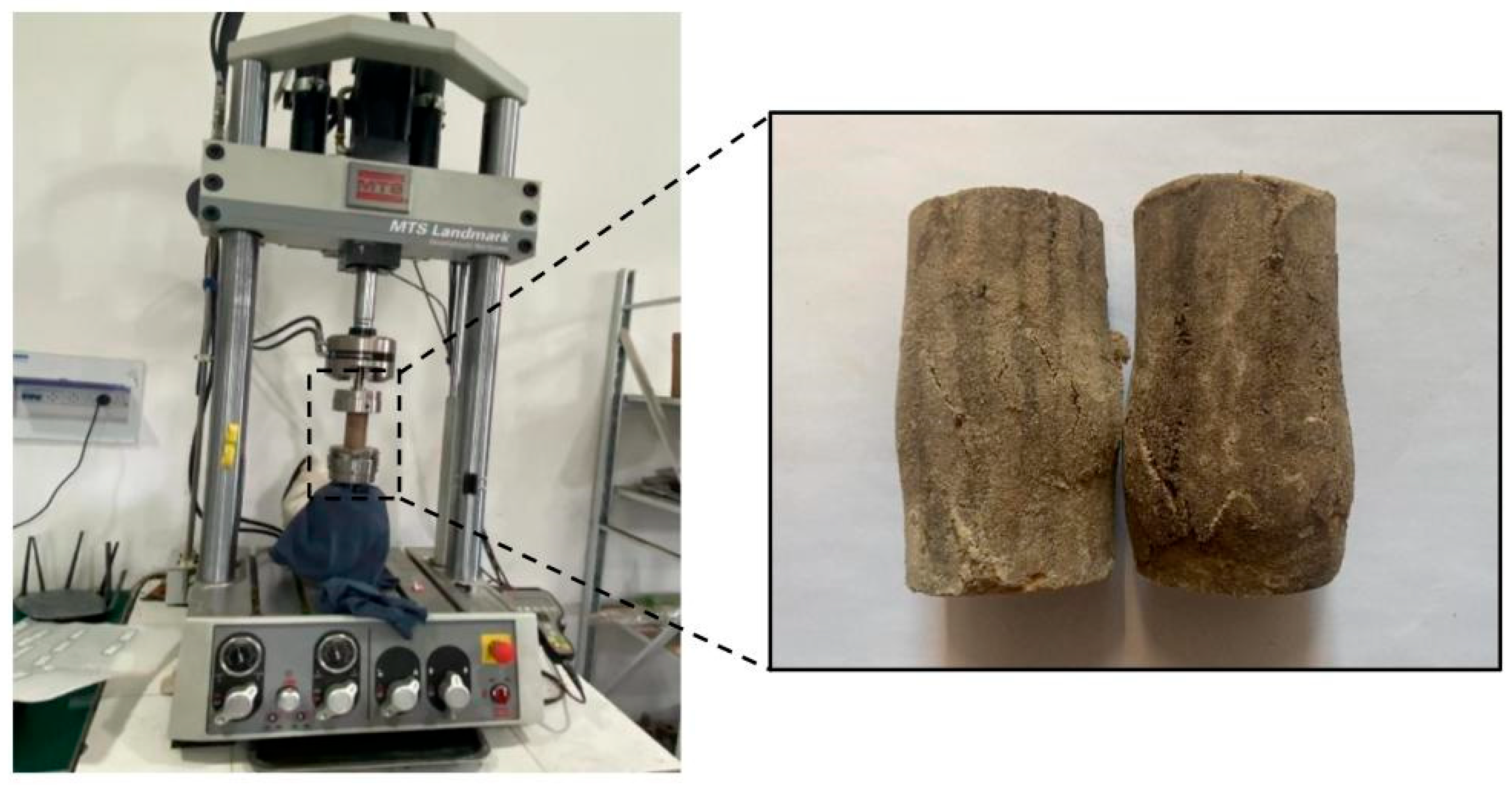
2.2.1. Test Apparatus
2.2.2. Setting of Test Parameters
3. Result Analysis
3.1. Analysis of Fatigue Loading Results
- (1)
- The initial stage accounts for approximately 10% to 15% of the total fatigue life. Microcracks begin to form within the specimen, and fatigue strain starts to increase. During this phase, specimens contain a small number of pores and fissures. As the number of cycles increases, the pores between particles gradually diminish under cyclic loading, and fissures progressively close. Components such as loess particles and polymers within the specimen become denser under cyclic loading. No damage occurs internally, yet fatigue strain continues to increase.
- (2)
- The mid-stage accounts for approximately 70–80% of the total fatigue life. Microcracks grow steadily, with microscopic cracks developing into macroscopic cracks, while the fatigue strain remains unchanged. Concurrently, minute fissures emerge within the specimen, with both their quantity and width increasing with accumulated cycles. Under cyclic loading, deformation and displacement occur between the soil particle skeleton and polymer matrix, disrupting the adhesive bond between the soil particles and polymer. This facilitates the propagation of existing internal fissures while generating new cracks extending outward.
- (3)
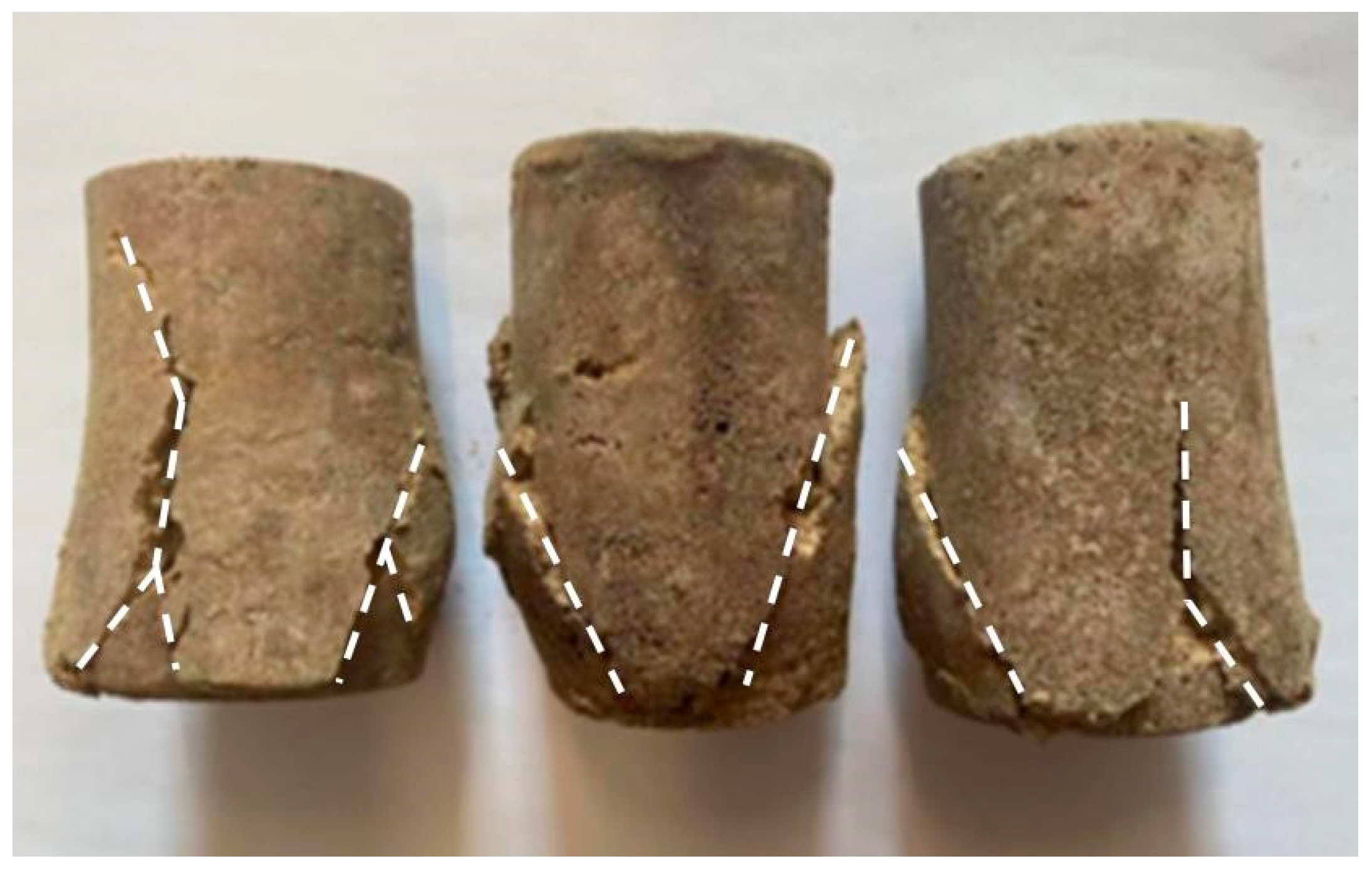
- During the final stage, the total strain increases sharply, leading to specimen failure within a relatively short period. This phase accounts for 10% to 15% of the fatigue life. Fatigue strain increases rapidly during this stage; at this point, the soil stress reaches its ultimate value; and existing microcracks within the specimen propagate further, with all fissures interconnecting to form a fracture surface, all of which result in specimen failure.
3.2. Establishment of Fatigue Life Equations
3.2.1. Fatigue Life Prediction Model
3.2.2. Probability Model of Fatigue Life Distribution
- (1)
- Normal distribution
- (2)
- Log-normal distribution
- (3)
- Weibull distribution
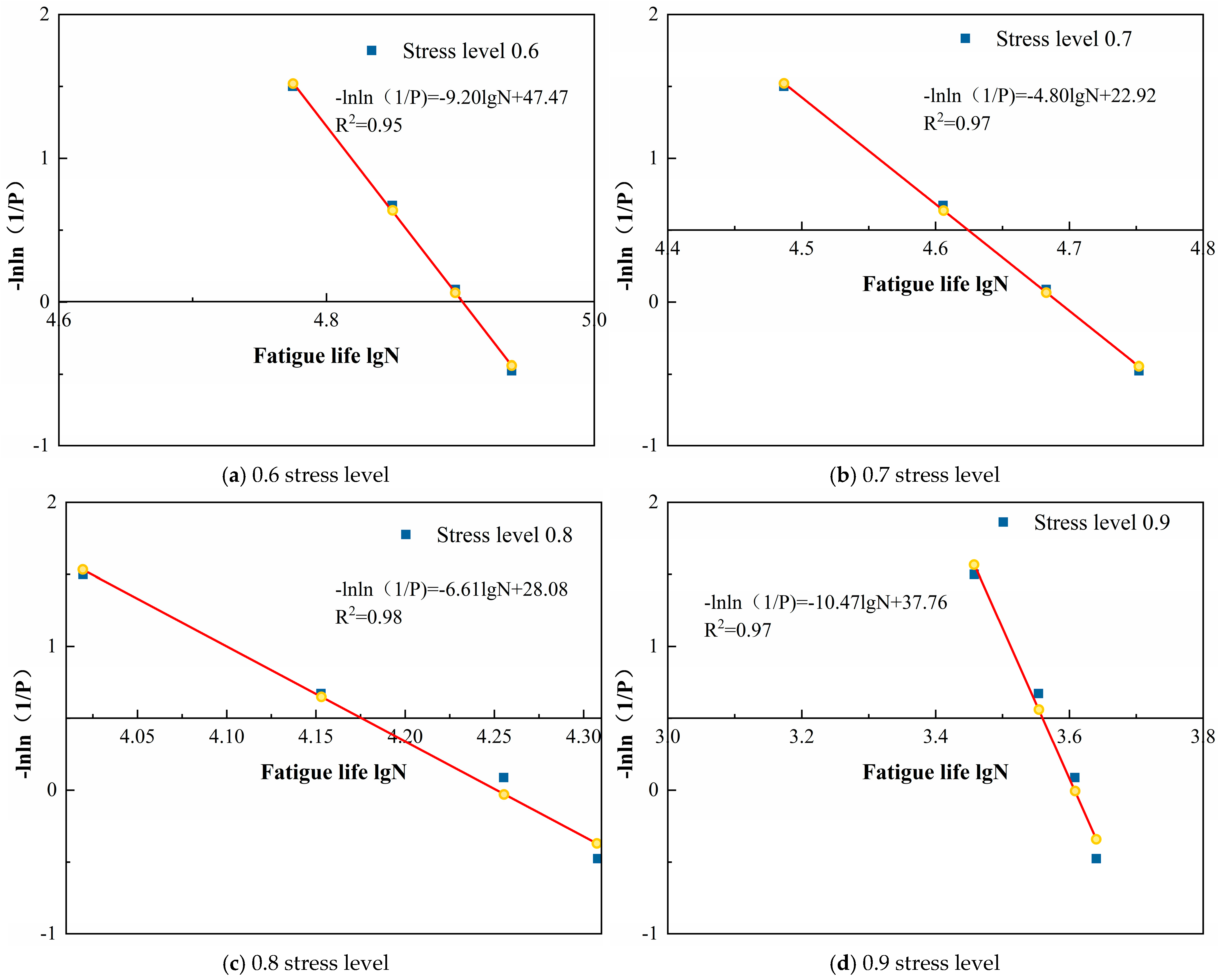
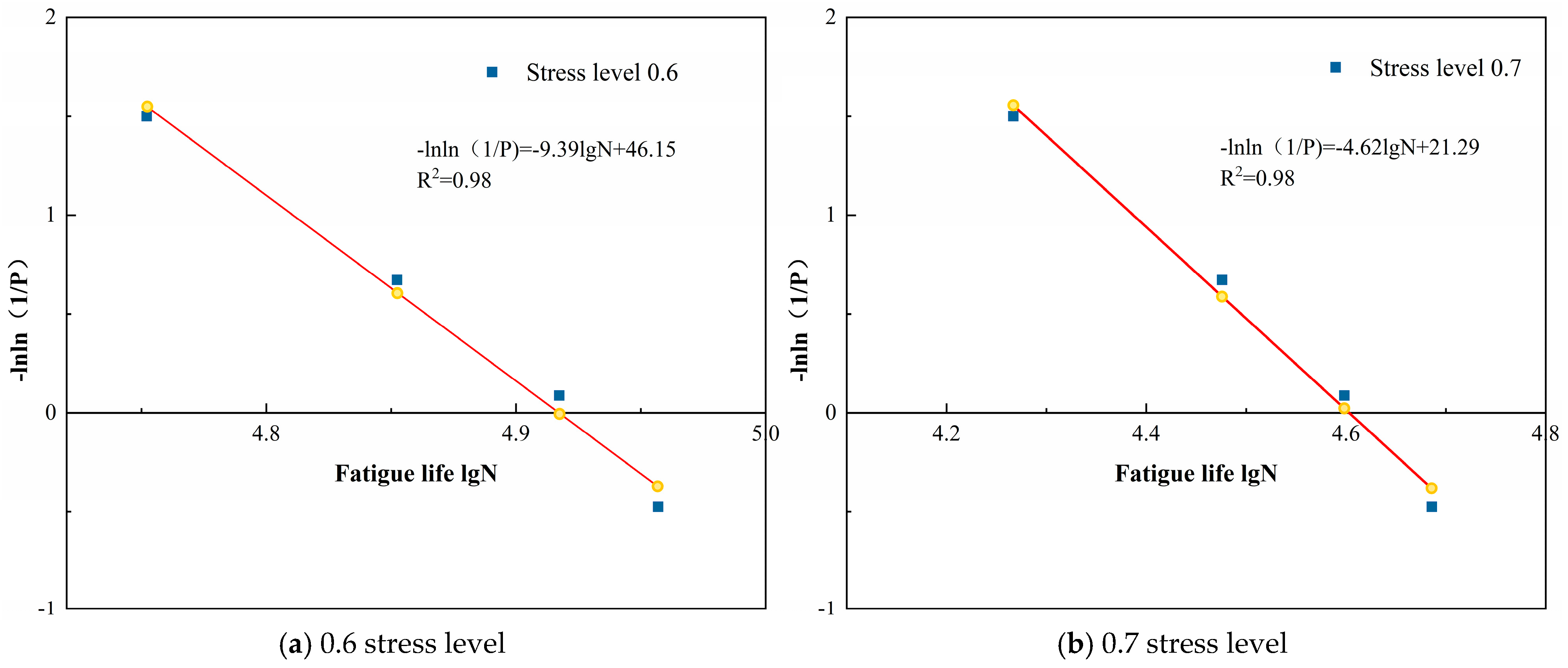
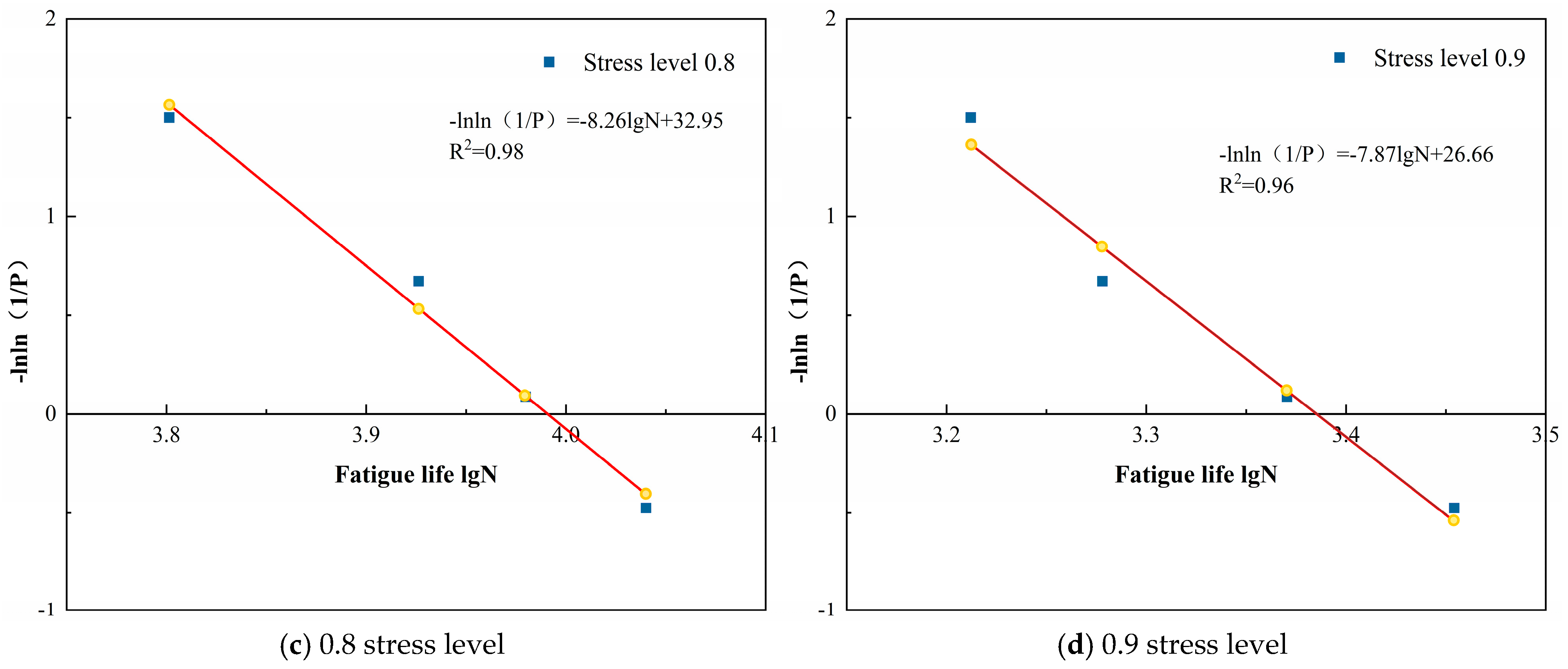
3.2.3. Weibull Distribution Test of Fatigue Life
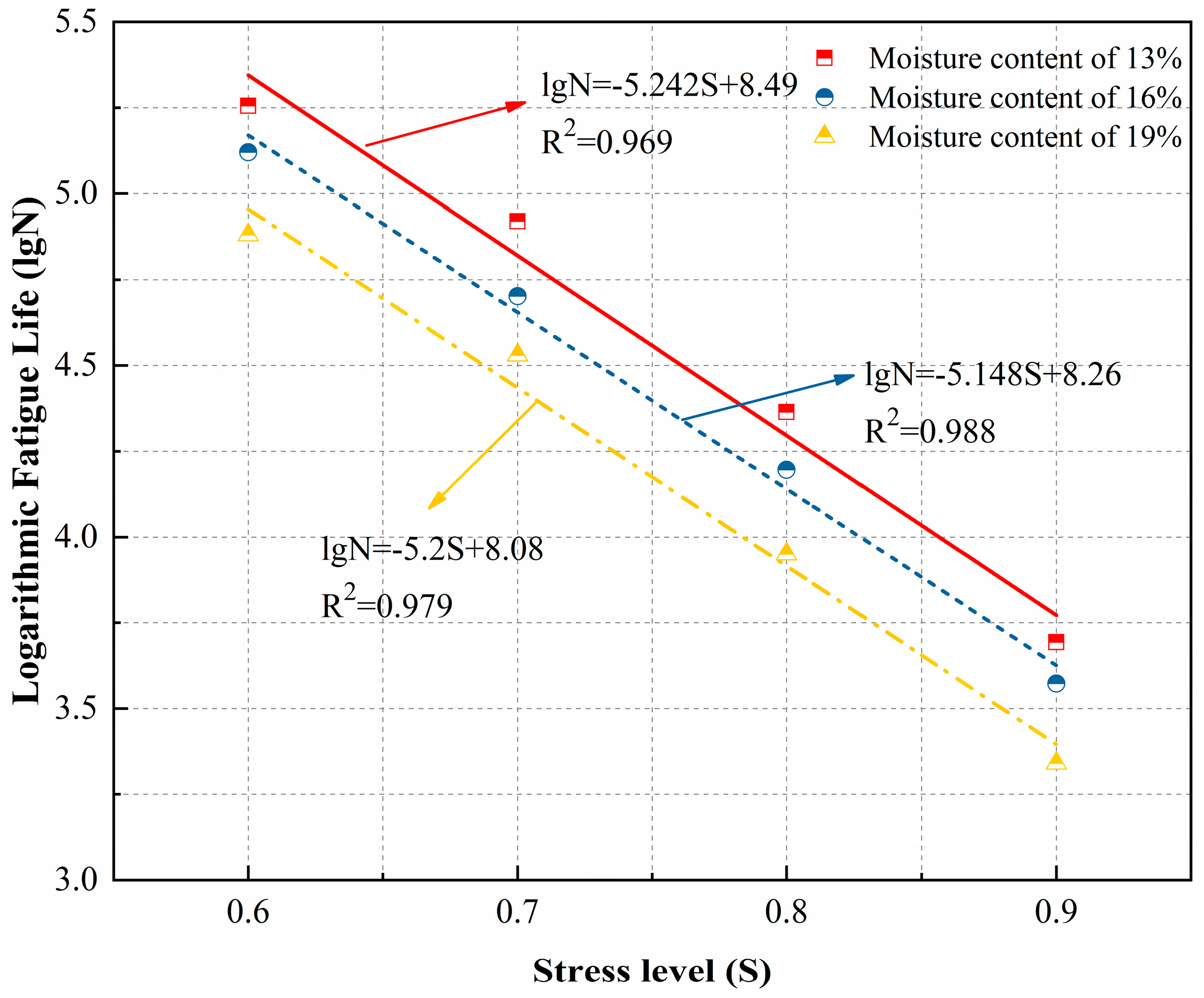
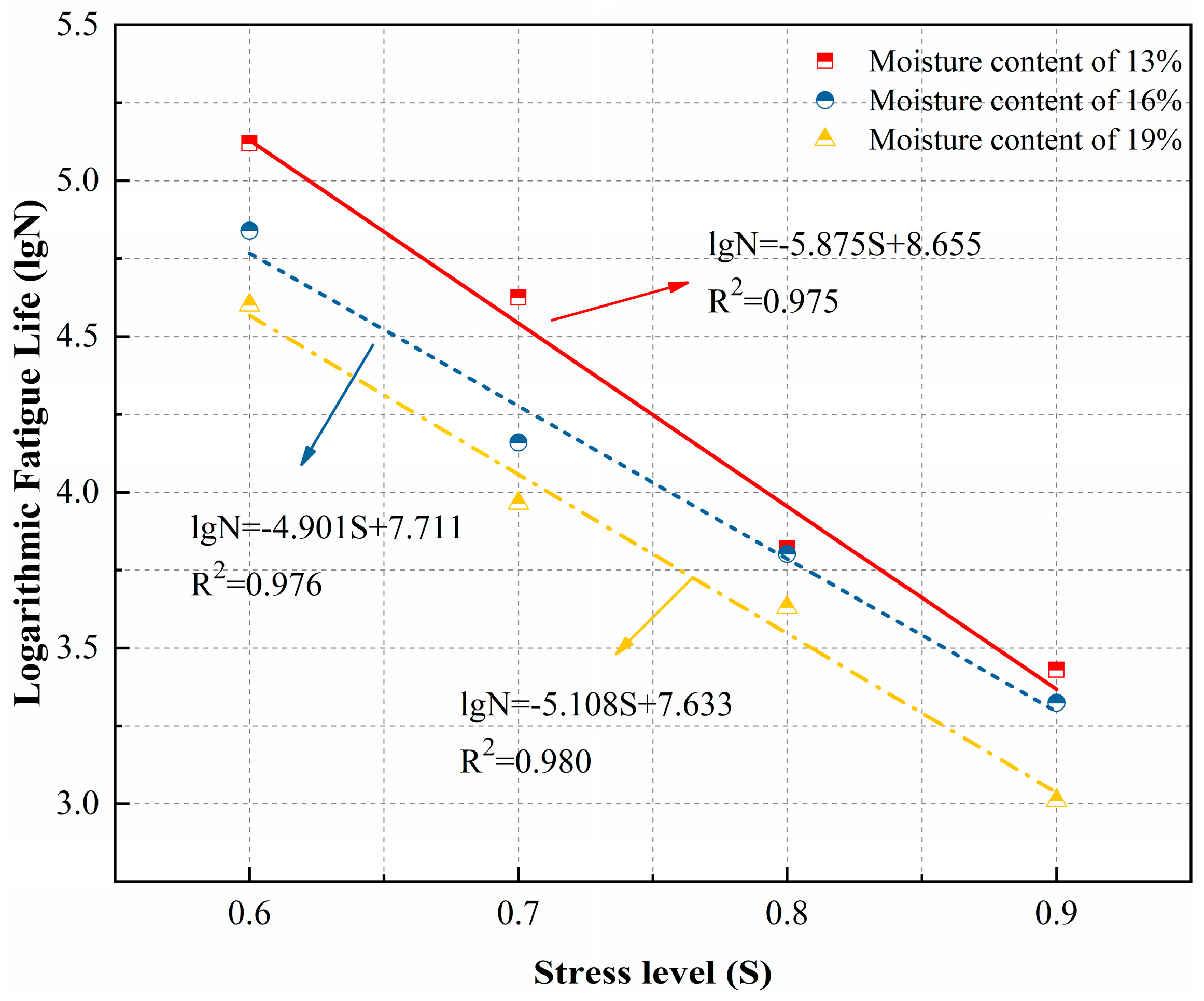
3.2.4. Fatigue Equation Based on Weibull Distribution
4. Numerical Simulation Study on Grouting Reinforcement of Loess Subgrades
4.1. Calculate Model Parameters
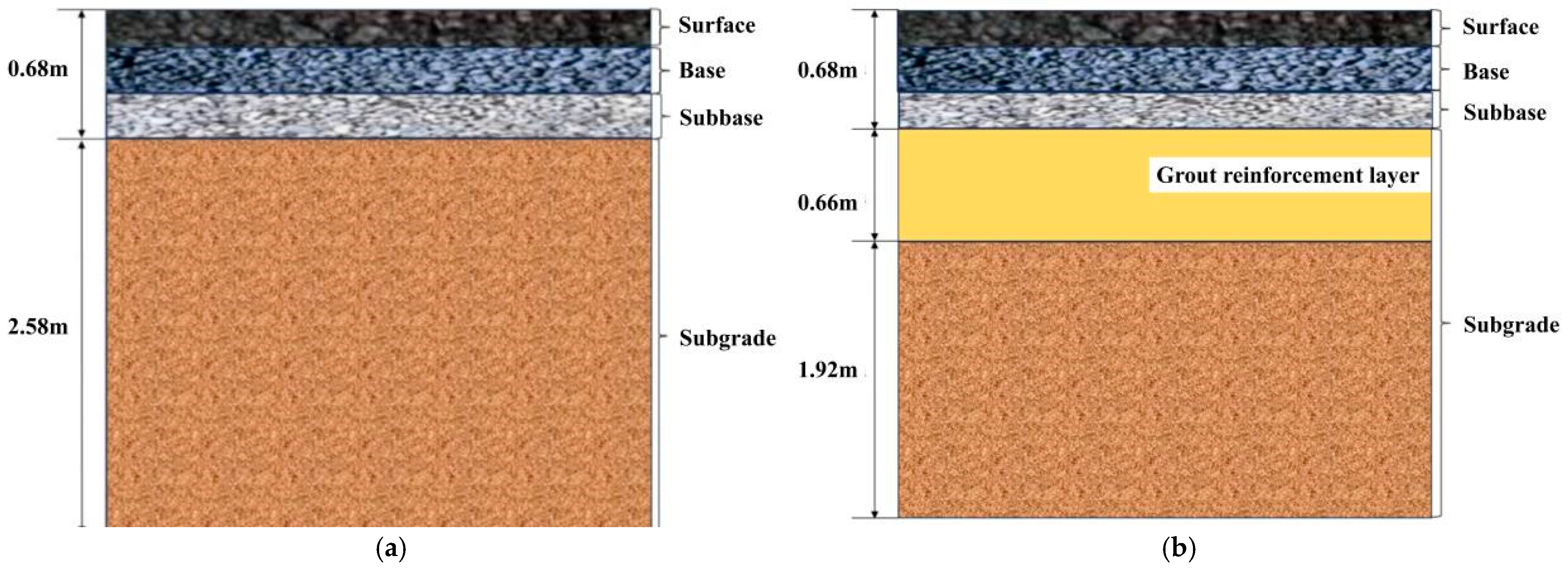
4.1.1. Model Dimensions and Road Surface Parameter Settings
4.1.2. Subgrade Parameter Settings
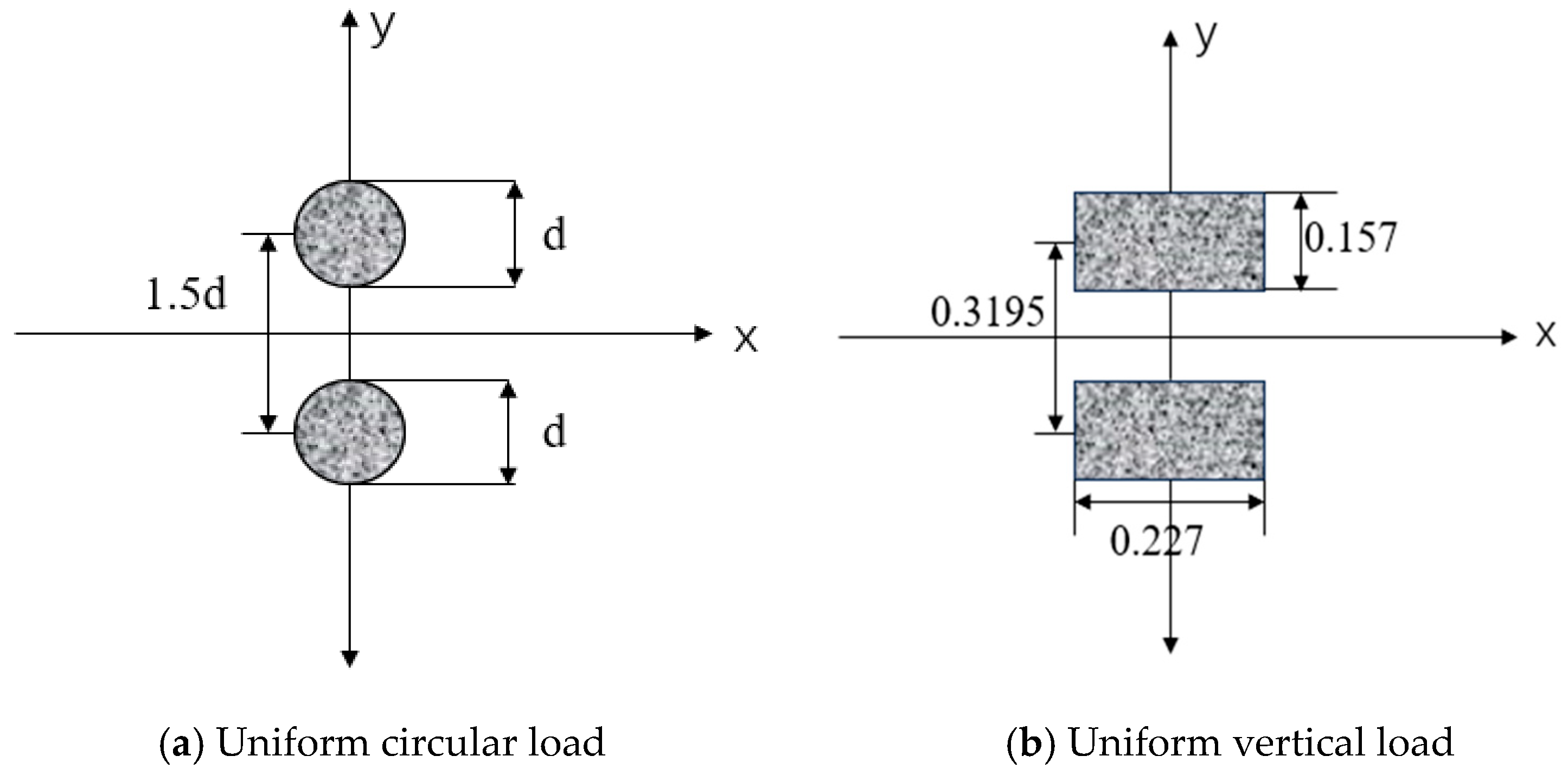
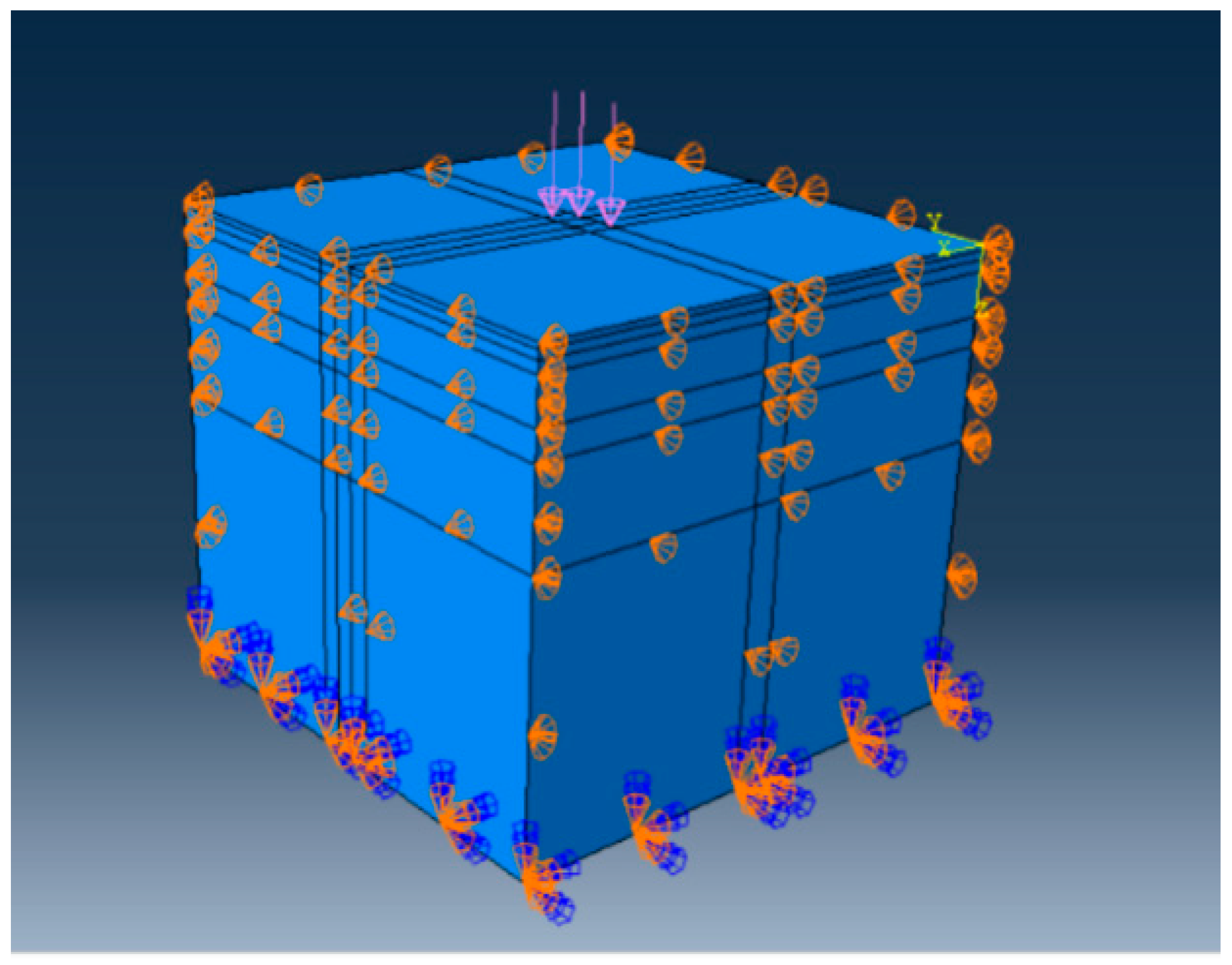
4.1.3. Loads and Boundary Conditions
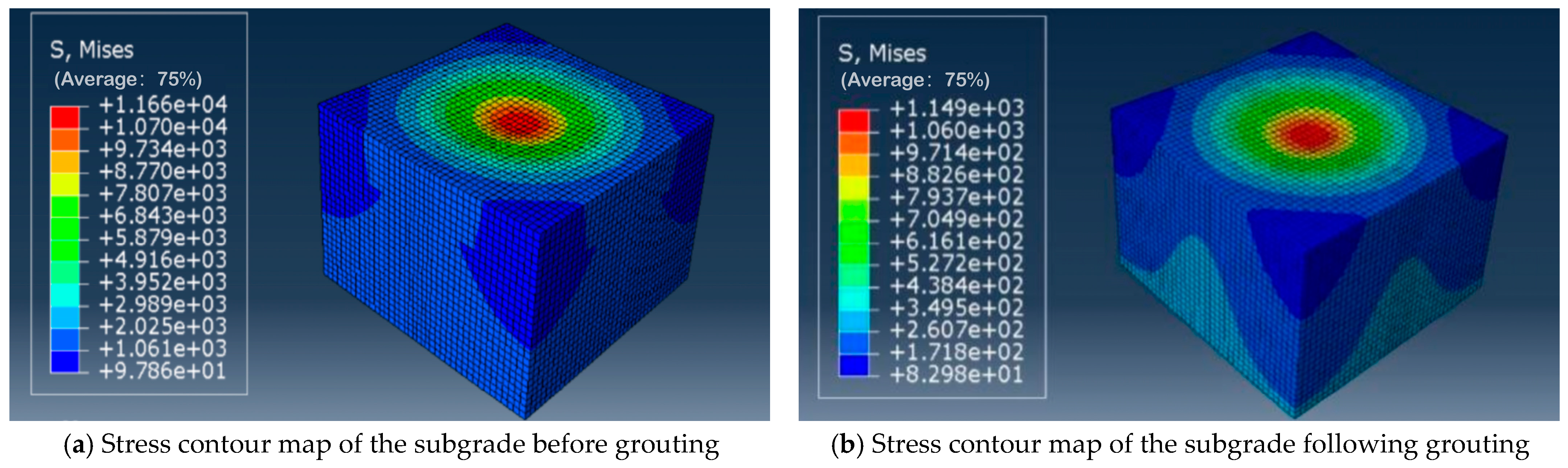
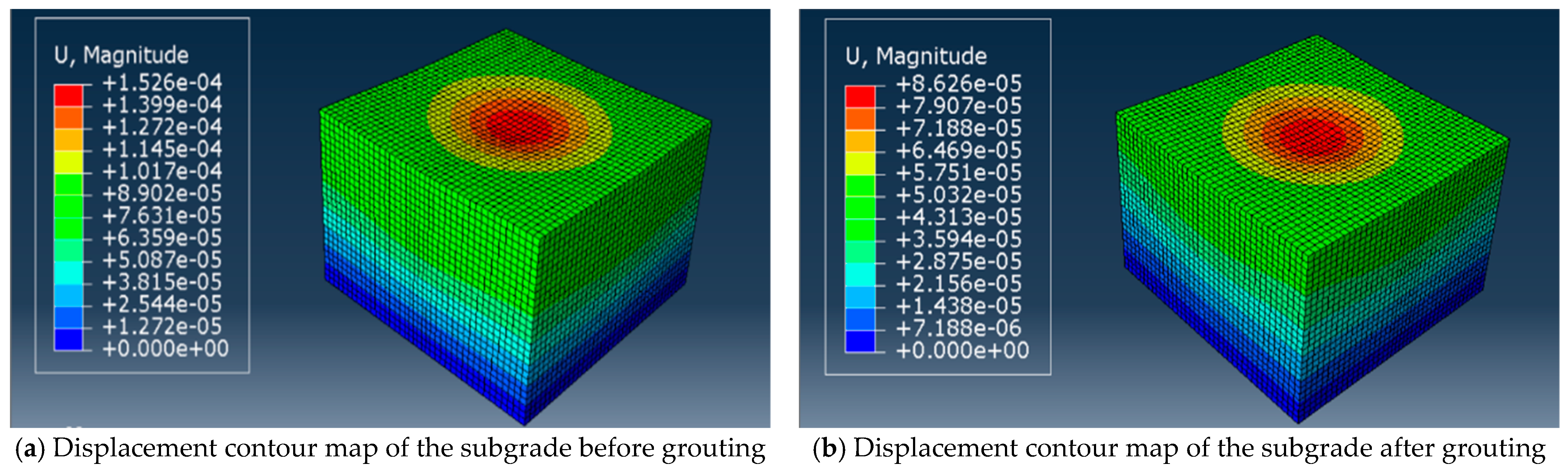
4.2. Analysis Based on Abaqus Computational Results
4.3. Subgrade Fatigue Life Prediction Based on Fe-Safe
4.3.1. Parameter Settings and Operational Procedures
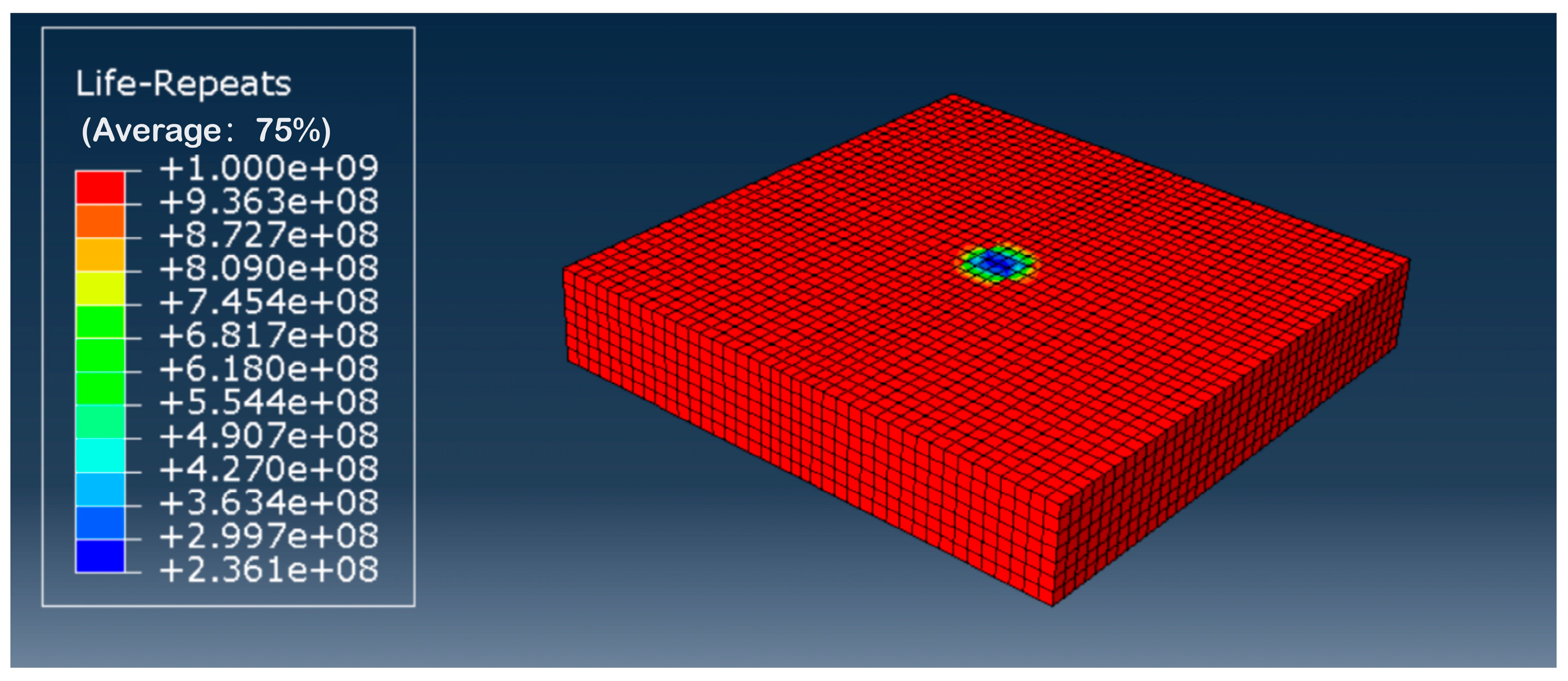
4.3.2. Fatigue Life Prediction for Grouting Reinforcement Layers
4.3.3. Prediction of Fatigue Life for Subgrade
5. Conclusions
- (1)
- Following grouting reinforcement, loess specimens achieved a fatigue life of 200,000 cycles. Stress levels and the moisture content significantly influenced the fatigue life of the grouted specimens. As stress levels increased, the load borne by the specimens progressively approached their bearing capacity, resulting in reduced fatigue life. At equivalent stress levels, fatigue life decreased with rising moisture content.
- (2)
- The fatigue failure process of the grouted specimens was categorized into three stages based on their respective contributions to the total fatigue life. During the latter phase of the third stage, the specimens exhibited a ‘multiple-crack’ failure pattern. This indicated that the specimens reinforced with permeable polyurethane polymer grouting achieved a more uniform stress distribution, mitigating localized stress concentrations. Consequently, their resistance to fatigue loading was enhanced, thereby extending their fatigue life.
- (3)
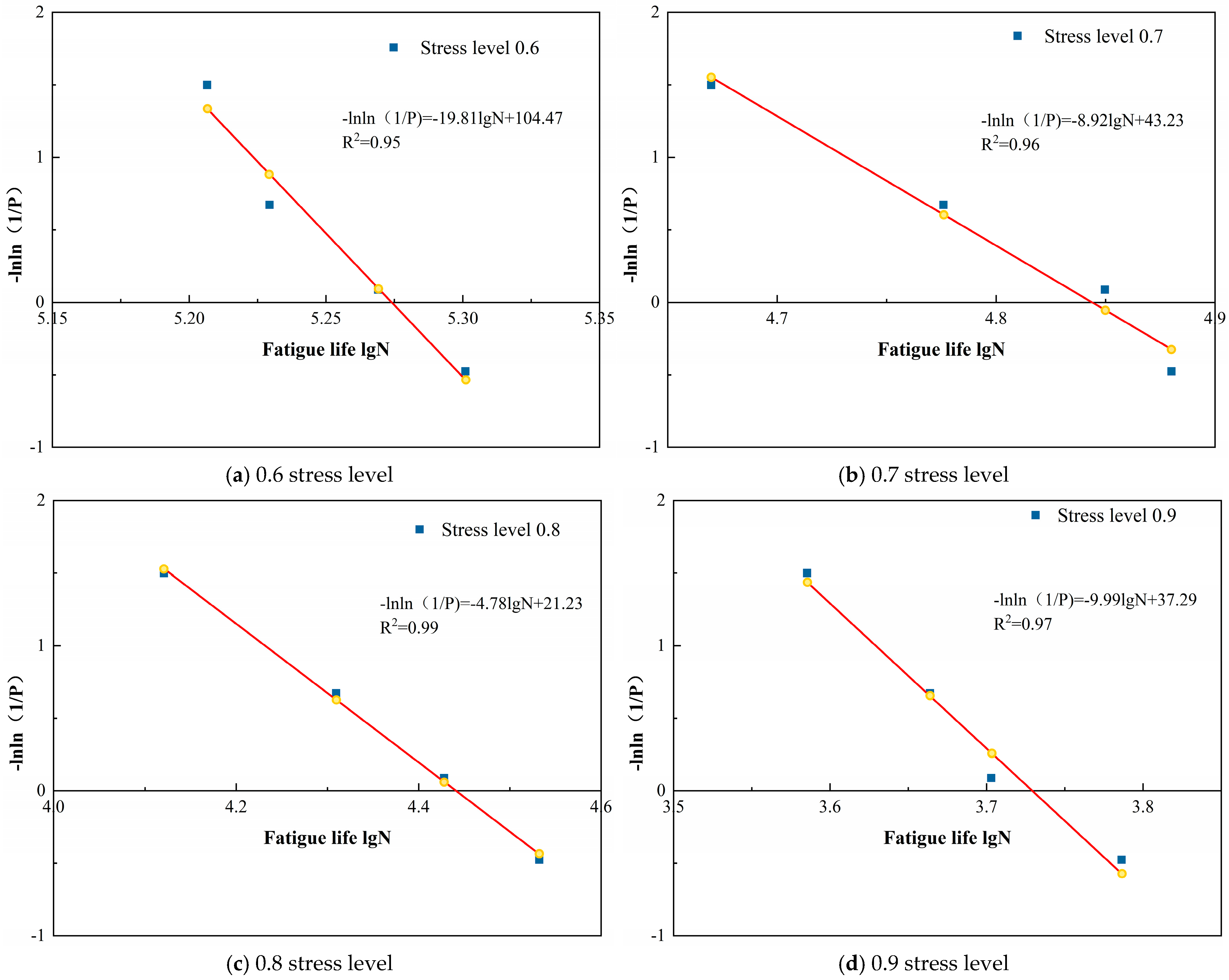
- Mathematical statistical methods verified that the fatigue life of the loess specimens after permeable polyurethane polymer grouting followed a two-parameter Weibull distribution, exhibiting a good linear relationship between the logarithmic fatigue life and the stress level. Based on this, a fatigue life prediction equation for grouted loess specimens was established, accounting for different moisture contents and assurance factors.
- (4)
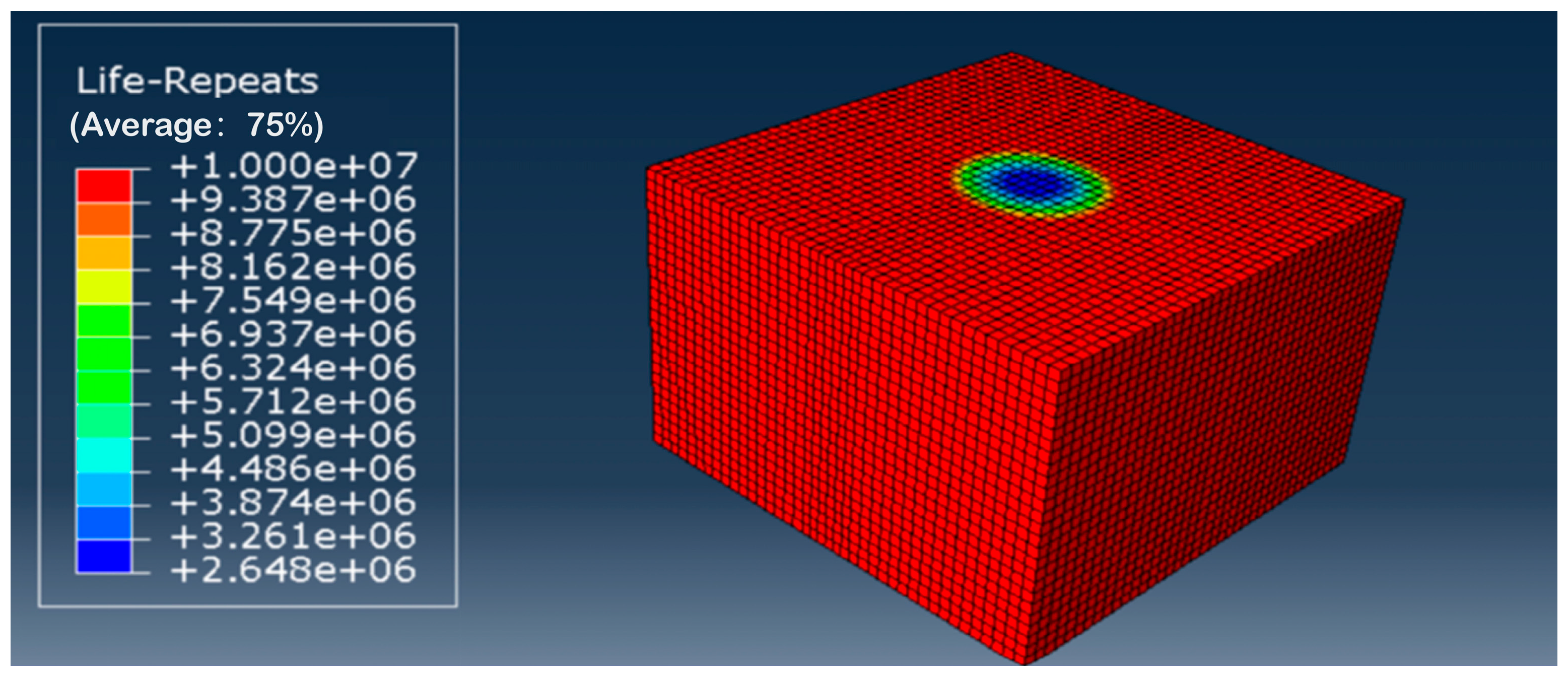
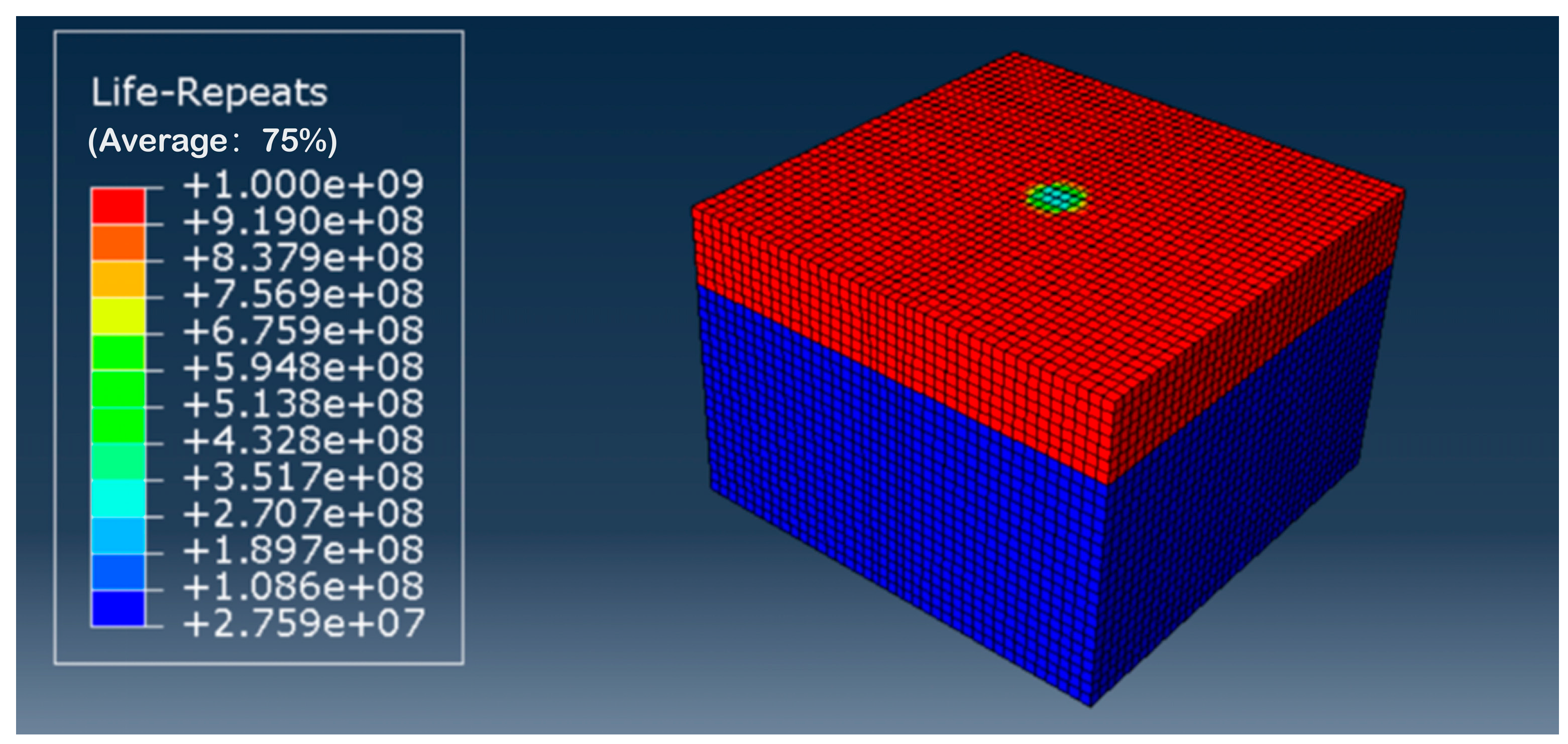
- The fatigue life cycles of grouted loess subgrades calculated using the Fe-safe fatigue program significantly exceeded the pre-grouting values. The polymer grout reinforcement layer achieved a fatigue life of 2.707 × 10⁸ cycles, demonstrating its efficacy in enhancing loess subgrade fatigue resistance.
- (5)
- The fatigue life of the permeable polyurethane polymer grout reinforcement layers predicted using the Fe-safe fatigue calculation software aligned with the results obtained from the experimentally derived fatigue equations at comparable magnitudes. This validates the accuracy of the numerical model while providing a reference basis for predicting the fatigue life of permeable polyurethane polymer grout-reinforced loess subgrades in practical engineering applications.
Author Contributions
Funding
Data Availability Statement
Acknowledgments
Conflicts of Interest
References
- Wang, Z.; Shao, S.; Shao, S.; Wu, H.; Zhang, S.; Fu, W. True triaxial macroscopic mechanical behaviour and microstructural evolution of deep loess on the Loess Plateau. Bull. Eng. Geol. Environ. 2025, 84, 425. [Google Scholar] [CrossRef]
- Yang, X.; Hu, Z.; Wang, Y.; Wang, Z. Mechanical properties and environmental sustainability of loess reinforced with recycled zongzi-leaf fibers. Case Stud. Constr. Mater. 2025, 23, e05244. [Google Scholar] [CrossRef]
- Wu, H.; Shao, S.; Shao, S.; Zhang, S.; Wang, Z. Shear Strength and Damage Characteristics of Undisturbed Loess Exposed to Dry–Wet Cycles. Int. J. Geomech. 2025, 25, 04025252. [Google Scholar] [CrossRef]
- You, Z.; Wang, T.; Zhang, L.; Wang, J. Experimental and DEM Investigation of Shear Behaviors of a Loess and Rough Concrete Interface. Buildings 2025, 15, 3178. [Google Scholar] [CrossRef]
- Guo, C.C.; Yang, X.D.; Zhao, W.F. Experimental Study on Compressibility and Microstructure of Loess Solidified by permeable polymer. KSCE J. Civ. Eng. 2024, 28, 1739–1752. [Google Scholar] [CrossRef]
- Wei, T.; Zhou, Y.; Fang, J.; Fan, W. Loess shear failure micro-mechanisms: Insights from pre- and post-shear microstructural changes and sensitivity analysis. Eng. Geol. 2025, 357, 108345. [Google Scholar] [CrossRef]
- Yang, N.; Deng, Y.; Li, L.; Mu, H. Study on creep constitutive model of loess considering hardening and damage effects. Bull. Eng. Geol. Environ. 2025, 84, 436. [Google Scholar] [CrossRef]
- He, Z.; Mu, Q.; Ma, P.; Jia, Z.; Peng, J. A unified understanding and calculation method of the compression behavior of loess with different particle size distributions and sample preparation methods across the Chinese Loess Plateau. Comput. Geotech. 2025, 187, 107459. [Google Scholar] [CrossRef]
- Bao, H.; Song, Z.; Lan, H.; Ma, Y.; Yan, C.; Liu, S. Analysis of the mechanical effects and influencing factors of cut-fill interface within loess subgrade. Eng. Fail. Anal. 2024, 163, 108488. [Google Scholar] [CrossRef]
- He, P.; Guo, J.; Zhang, S. Investigation of Stability and Underlying Mechanism of Unstable Subgrades Loess Modified by Carbide Slag in Road Construction Projection. Buildings 2023, 13, 2176. [Google Scholar] [CrossRef]
- Ye, W.; Ma, Q.; Xu, Z.; Tian, J.; Wang, J.; Wang, Y. Mechanical Behavior and Microscopic Mechanisms of Glass Fiber–Modified Loess in Seasonally Frozen Regions. J. Mater. Civ. Eng. 2025, 37, 04024475. [Google Scholar] [CrossRef]
- Yue, J.; Zhang, H.; Zhang, Y.; Xu, S. Experimental investigation of influence of amide polymer on loess for subgrade. Sci. Rep. 2024, 14, 12229. [Google Scholar] [CrossRef]
- Li, H.; Tao, J.; Wei, L.; Liu, Y. Explosive compaction technology for loess embankment settlement control: Numerical simulation and field implementation. Acta Geotech. 2020, 15, 975–997. [Google Scholar] [CrossRef]
- Xu, T.; Zhou, Z.; Yan, R.; Zhang, Z.; Zhu, L.; Chen, C.; Xu, F.; Liu, T. Real-Time Monitoring Method for Layered Compaction Quality of Loess Subgrade Based on Hydraulic Compactor Reinforcement. Sensors 2020, 20, 4288. [Google Scholar] [CrossRef]
- Wang, F.; Pang, W.; Qin, X.; Han, L.; Jiang, Y. Durability-Aimed Design Criteria of Cement-Stabilized Loess Subgrade for Railway. Appl. Sci. 2021, 11, 5061. [Google Scholar] [CrossRef]
- Wang, R.; Hu, Z.; Ma, J.; Ren, X.; Li, F.; Zhang, F. Dynamic Response and Long-Term Settlement of a Compacted Loess Embankment under Moving Train Loading. KSCE J. Civ. Eng. 2021, 25, 4075–4087. [Google Scholar] [CrossRef]
- Zheng, N.; Li, Y.; Wang, Z.; Gao, X. Analysis of regular disease process of loess tunnel support structure based on field investigation and testing. Environ. Earth Sci. 2024, 83, 431. [Google Scholar] [CrossRef]
- Yan, Z.; Zeng, Z.; An, B.; Lu, J.; Sun, B. Research on the application of 3D GPR in the detection of road collapse diseases in loess region of Ningxia. J. Phys. Conf. Ser. 2024, 2887, 012023. [Google Scholar] [CrossRef]
- Luo, Z.; Zheng, Y.; Zhang, X.; Wang, L.; Gao, Y.; Liu, K.; Han, S. Effect of Phase Change Materials on Mechanical Properties of Stabilized Loess Subgrade Subjected to Freeze–Thaw Cycle. J. Mater. Civ. Eng. 2023, 35, 04023217. [Google Scholar] [CrossRef]
- Choobbasti, A.J.; Samakoosh, M.A.; Kutanaei, S.S. Mechanical properties soil stabilized with nano calcium carbonate and reinforced with carpet waste fibers. Constr. Build. Mater. 2019, 211, 1094–1104. [Google Scholar] [CrossRef]
- Jia, L.; Guo, J.; Wei, Z.; Wu, R. Mix optimization and mechanical properties evaluation of lime-fly ash-stabilized loess in various engineering applications. Case Stud. Constr. Mat. 2024, 20, e03208. [Google Scholar] [CrossRef]
- Gu, L.; Lv, Q.; Wang, S.; Xiang, J.; Guo, L.; Jiang, J. Effect of sodium silicate on the properties of loess stabilized with alkali-activated fly ash-based. Constr. Build. Mater. 2021, 280, 122515. [Google Scholar] [CrossRef]
- Tabarsa, A.; Latifi, N.; Meehan, C.L.; Manahiloh, K.N. Laboratory investigation and field evaluation of loess improvement using nanoclay—A sustainable material for construction. Constr. Build. Mater. 2018, 158, 454–463. [Google Scholar] [CrossRef]
- Kong, R.; Zhang, F.; Wang, G.; Peng, J. Stabilization of Loess Using Nano-SiO2. Materials 2018, 11, 1014. [Google Scholar] [CrossRef] [PubMed]
- Wang, L.; Yang, X.; Diao, Y.; Guo, C. Study on Bonding Characteristics of Polymer Grouted Concrete-Soil Interface. Polymers 2024, 16, 2207. [Google Scholar] [CrossRef]
- Pei, L.; Qin, L.; Shi, F.; Yang, X.; Chu, X.; Feng, L.; Li, S.; Guo, C. Fracture mechanisms of filling layer self-compacting concrete before and after polymer repair in CRTS-III: Insights from the perspective of AE and DIC. Measurement 2026, 257, 118757. [Google Scholar] [CrossRef]
- Zhao, L.; Wang, C.; Guo, C.; Ma, X.; Li, Z.; Du, X.; Jiang, W. Properties of Low-Exothermic polymer grouting materials and its application on highway. Constr. Build. Mater. 2023, 408, 133771. [Google Scholar] [CrossRef]
- Guo, C.; Pei, L.; Guan, H.; Chu, X.; Wang, H.; Shi, F.; An, Z.; Qin, L. Experimental study on interfacial damage mechanisms of polymer-concrete composite structure. J. Build. Eng. 2023, 75, 106968. [Google Scholar] [CrossRef]
- Hao, Y.; Guo, C.; Shi, M.; Wang, F.; Xia, Y.; Wang, C. Application of polymer split grouting technology in earthen dam: Diffusion law and applicability. Constr. Build. Mater. 2023, 369, 130612. [Google Scholar] [CrossRef]
- Guo, C.; Yang, X.; Guo, C.; Li, P. Analysis of Deformation of Deep and Large Foundation Pit Support Structure and Impact on Neighbouring Buildings in Complex Environments. Buildings 2025, 15, 1435. [Google Scholar] [CrossRef]
- Li, H.L.; Sun, J.S.; Li, B. Analysis on the mechanical and fatigue properties of foamed lightweight soil. In Proceedings of the 2017 2nd International Conference on Civil, Transportation and Environmental Engineering, Shenzhen, China, 10–11 May 2017; Atlantis Press: Dordrecht, The Netherlands, 2017; Volume 135, pp. 27–30. [Google Scholar]
- Zhao, X.K.; Dong, Q.; Chen, X.Q.; Xiao, Y.J.; Zheng, D.B. Fatigue damage numerical simulation of cement-treated base materials by discrete element method. Constr. Build. Mater. 2021, 276, 122142. [Google Scholar] [CrossRef]
- Zhang, J.; Teixeira, J.E.S.L.; Little, D.N.; Kim, Y.R. Prediction of fatigue crack growth behavior of chemically stabilized materials using simple monotonic fracture test integrated with computational cohesive zone modeling. Compos. Part B Eng. 2020, 200, 108367. [Google Scholar] [CrossRef]
- Lv, S.; Xia, C.; You, L.; Wang, X.; Li, J.; Zheng, J. Unified fatigue characteristics model for cement-stabilized macadam under various loading modes. Constr. Build. Mater. 2019, 223, 775–783. [Google Scholar] [CrossRef]
- Wu, H.; Wu, M.; Wu, X.; Zhang, F.; Zhang, J.; Qiao, H.; Zhang, Y.; Zhang, Y. Study on the performance of collapsible loess subgrade improved by steel slag. J. Build. Eng. 2024, 84, 108642. [Google Scholar] [CrossRef]
- GB/T 50123-2019; Standard for Geotechnical Testing Method. Ministry of Housing and Urban-Rural Development of the People’s Republic of China: Beijing, China, 2019.
- Nan, Y.; Wei, N.Y.; Liu, K.; Cao, Y. Quantitative 3D Characterization of Pore Structure in Malan Loess from Different Regions of the Loess Plateau. Water 2023, 15, 3151. [Google Scholar] [CrossRef]
- Luo, X.; Kong, L.; Yan, J.; Gao, Z.; Tian, S. In-situ Mechanical Property and Mechanism Analysis of Shallow Expansive Soil under the Influence of Water Content and Fissures. KSCE J. Civ. Eng. 2024, 28, 4281–4292. [Google Scholar] [CrossRef]
- Wang, Y.; Chen, Y.; He, Y.; Li, C. Experimental Study of Loess Mechanical Properties with Different Water Content. KSCE J. Civ. Eng. 2024, 28, 2210–2220. [Google Scholar] [CrossRef]
- Guo, C.; Lin, Z.; Wang, F.; Kravchenko, E. Sealing Mechanism of Foamable Polymer for Rehabilitation of Underground Structures. J. Mater. Civ. Eng. 2025, 37, 04024481. [Google Scholar] [CrossRef]
- Wen, Z.; Wang, F.; Wan, J.; Wang, Y.; Yang, F.; Guo, C. Assessment of the tropical cyclone-induced risk on offshore wind turbines under climate change. Nat. Hazards 2024, 120, 5811–5839. [Google Scholar] [CrossRef]
- Pan, W.; Han, Y.; Wang, Z.; Wang, C.; Zhang, C.; Zhu, P.; Fang, H.; Wang, F.; Qin, Z. Degradation mechanisms of polyurethane grouting materials under quasi-static and cyclic compression loading: Density and size effects. Constr. Build. Mater. 2023, 408, 133795. [Google Scholar] [CrossRef]
- JTG B01-2014; Technical Standard of Highway Engineering. Ministry of Transport of the People’s Republic of China: Beijing, China, 2014.
- Miarka, P.; Seitl, S.; Bilek, V.; Cifuentes, H. Assessment of fatigue resistance of concrete: S-N curves to the Paris’ law curves. Constr. Build. Mater. 2022, 341, 127811. [Google Scholar] [CrossRef]
- Liu, X.B.; Zhang, Y.; Zhu, J.J.; Li, X.T.; Xue, S.F. Fatigue Lifetime Prediction for Oil Tube Material Based on ABAQUS and FE-SAFE. J. Fail. Anal. Prev. 2020, 20, 936–943. [Google Scholar] [CrossRef]
- Wang, S.Q.; Huang, X.M.; Ma, T.; Zhu, T.Y.; Tang, T.; Liu, W.C. Numerical analysis of reflective cracking and fatigue lives of semi-rigid pavement structures using Abaqus and Fe-safe. J. Southeast Univ. 2015, 31, 541–546. [Google Scholar]



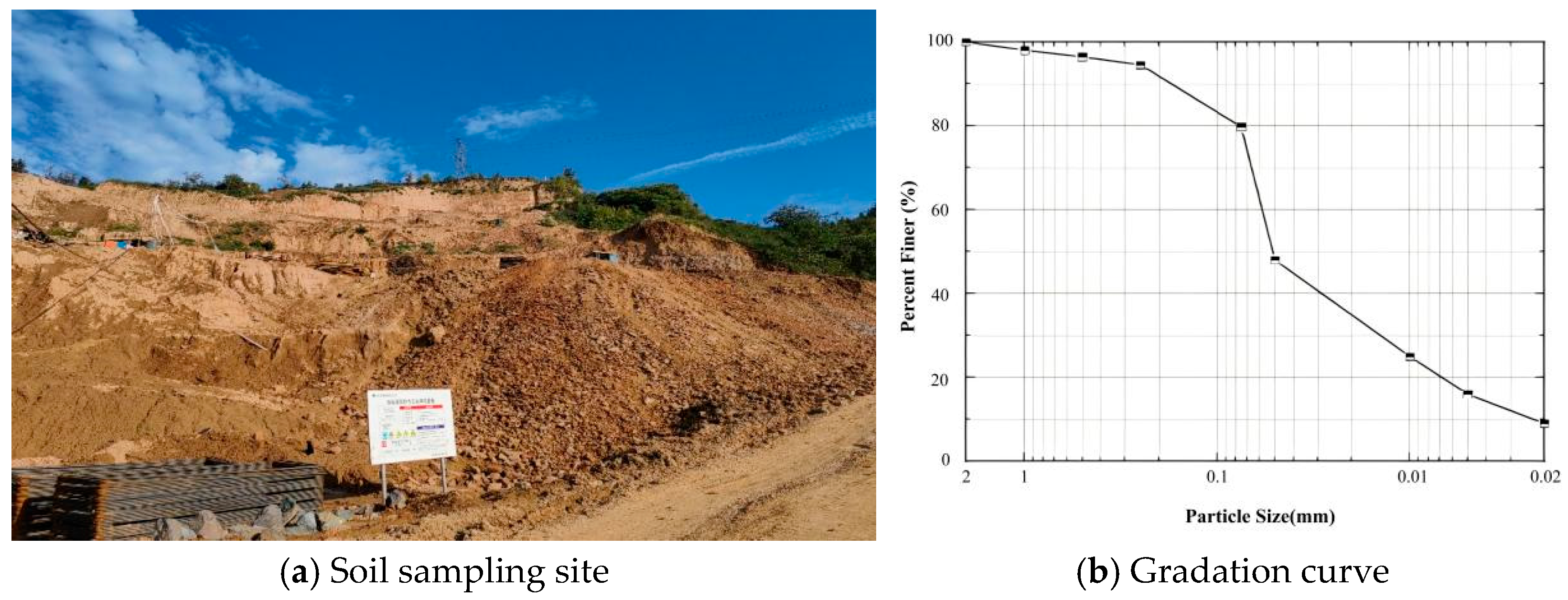
| Particle Size (mm) | 2 | 1 | 0.5 | 0.25 | 0.075 |
|---|---|---|---|---|---|
| Percentage below this particle size (%) | 100 | 98.1 | 96.5 | 94.6 | 79.8 |
| Soil Particle Proportion | Plastic Limit (%) | Liquid Limit (%) | Plasticity Index | Maximum Dry Density (g/cm3) | Optimum Moisture Content (%) |
|---|---|---|---|---|---|
| 2.70 | 13.4 | 31.9 | 18.7 | 1.76 | 12.7 |
| Component | Size Viscosity (MPa·s) | Slurry Density (g/cm3) | Gelation Time (min) |
|---|---|---|---|
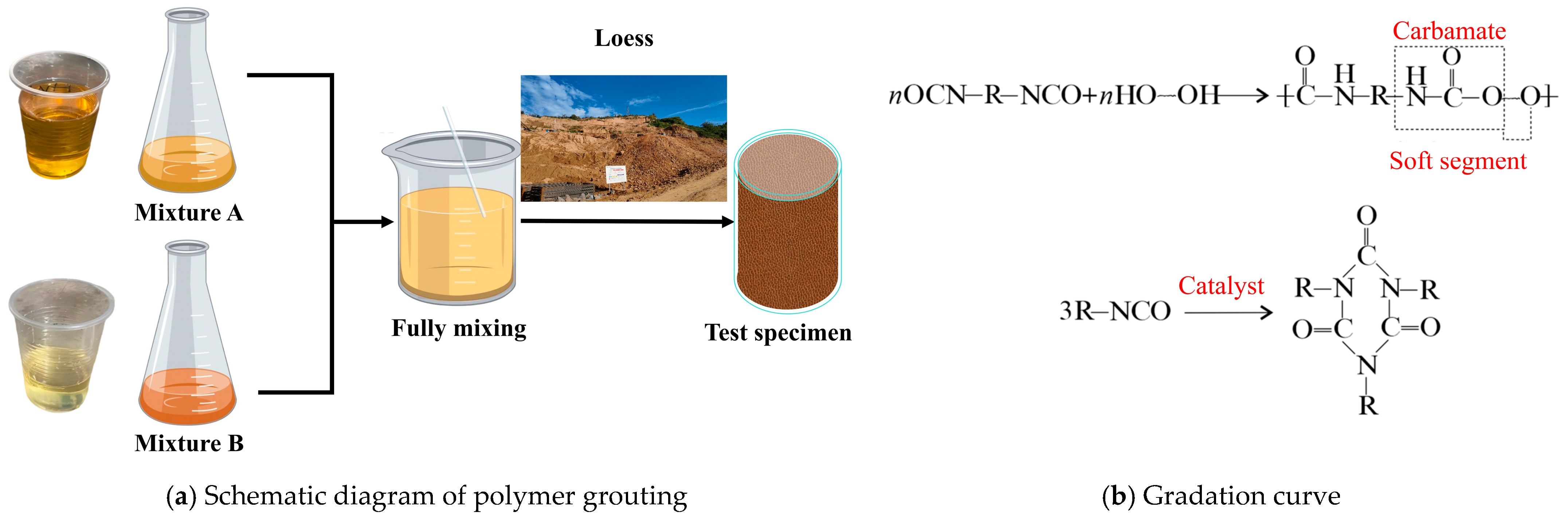
| Mixture A | 4 | 1.05 | 30 |
| Mixture B | 23 | 1.20 |
| Ingredient Name | Molecular Formula | Content | |
|---|---|---|---|
| A | Polyether polyols | C8H22O7 | 30–60% |
| Tris Nphosphate | C9H18Cl3O4P | 10–40% | |
| B | Polymeric MDI | C15H10N2O2 | 50–70% |
| MDI | C15H10N2O2 | 30–50% | |
| Moisture Content (%) | Load Applied at Various Stress Levels (MPa) | |||
|---|---|---|---|---|
| 0.6 Stress Level | 0.7 Stress Level | 0.8 Stress Level | 0.9 Stress Level | |
| 13 | 3.6 | 4.3 | 4.9 | 5.5 |
| 16 | 3.1 | 3.6 | 4.1 | 4.6 |
| 19 | 2.4 | 2.8 | 3.2 | 3.6 |
| Moisture Content (%) | Fatigue Life of Specimens Under Different Stress Levels (Number of Cycles) | |||
|---|---|---|---|---|
| 0.6 | 0.7 | 0.8 | 0.9 | |
| 13 | 200,005 | 105,879 | 34,061 | 6114 |
| 185,806 | 96,748 | 26,788 | 5047 | |
| 169,607 | 75,699 | 20,398 | 4612 | |
| 160,927 | 66,762 | 13,206 | 3849 | |
| 16 | 156,764 | 76,501 | 20,322 | 4369 |
| 148,748 | 58,167 | 18,000 | 4057 | |
| 12,661 | 40,329 | 14,218 | 3581 | |
| 99,541 | 30,663 | 10,459 | 2870 | |
| 19 | 90,567 | 48,529 | 9647 | 2846 |
| 82,671 | 39,668 | 8867 | 2347 | |
| 71,185 | 29,226 | 7349 | 1897 | |
| 56,507 | 18,489 | 7012 | 1630 | |
| Moisture Content (%) | Specimen Number | Logarithmic Fatigue Life of Specimens at Different Stress Levels (lgN) | Guarantee Rate P = 1 − i/(n + 1) | −ln ln(1/P) | |||
|---|---|---|---|---|---|---|---|
| 0.6 | 0.7 | 0.8 | 0.9 | ||||
| 13 | 1 | 5.2066 | 4.8245 | 4.1208 | 3.5853 | 0.8 | 1.5 |
| 2 | 5.2294 | 4.8791 | 4.3096 | 3.6639 | 0.6 | 0.6717 | |
| 3 | 5.2691 | 4.9856 | 4.4279 | 3.703 | 0.4 | 0.0874 | |
| 4 | 5.301 | 5.0248 | 4.5323 | 3.7863 | 0.2 | −0.4759 | |
| 16 | 1 | 4.998 | 4.4866 | 4.0195 | 3.4579 | 0.8 | 1.5 |
| 2 | 5.0816 | 4.6056 | 4.1528 | 3.554 | 0.6 | 0.6717 | |
| 3 | 5.1725 | 4.7647 | 4.2553 | 3.6082 | 0.4 | 0.0874 | |
| 4 | 5.1952 | 4.8837 | 4.3078 | 3.6404 | 0.2 | −0.4759 | |
| 19 | 1 | 4.7521 | 4.2669 | 3.8014 | 3.2122 | 0.8 | 1.5 |
| 2 | 4.8524 | 4.476 | 3.9263 | 3.2781 | 0.6 | 0.6717 | |
| 3 | 4.9174 | 4.5984 | 3.9799 | 3.3705 | 0.4 | 0.0874 | |
| 4 | 4.957 | 4.686 | 4.0402 | 3.4542 | 0.2 | −0.4759 | |
| Moisture Content (%) | Guarantee Rate | −ln ln(1/P) | Logarithmic Fatigue Life of Specimens at Different Stress Levels (lgN) | |||
|---|---|---|---|---|---|---|
| 0.6 | 0.7 | 0.8 | 0.9 | |||
| 13 | 0.50 | 0.3665 | 5.23 | 4.92 | 4.36 | 3.69 |
| 0.95 | 2.9702 | 5.12 | 4.63 | 3.82 | 3.43 | |
| 16 | 0.50 | 0.3665 | 5.12 | 4.70 | 4.20 | 3.57 |
| 0.95 | 2.9702 | 4.84 | 4.16 | 3.80 | 3.32 | |
| 19 | 0.50 | 0.3665 | 4.88 | 4.53 | 3.95 | 3.34 |
| 0.95 | 2.9702 | 4.60 | 3.97 | 3.63 | 3.01 | |
| Moisture Content (%) | Fatigue Equations at Different Safety Factors | |
|---|---|---|
| 0.50 Guarantee Rate | 0.95 Guarantee Rate | |
| 13 | lg n = −5.24 S + 8.49 | lg n = −5.88 S + 8.66 |
| 16 | lg n = −5.15 S + 8.26 | lg n = −4.90 S + 7.71 |
| 19 | lg n = −5.20 S + 8.08 | lg n = −5.11 S + 7.63 |
| Structure Layer | Thickness (cm) | Density (kg/cm3) | Modulus of Elasticity (MPa) | Poisson’s Ratio |
|---|---|---|---|---|
| Asphalt surface layer | 4 | 2300 | 1300 | 0.30 |
| Asphalt middle layer | 6 | 2300 | 1300 | 0.30 |
| Asphalt base course | 8 | 2300 | 1300 | 0.30 |
| Semi-rigid base layer | 30 | 2000 | 1600 | 0.25 |
| Sub-base | 20 | 2000 | 1200 | 0.25 |
| Material Name | Modulus of Elasticity (MPa) | Cohesion (kPa) | Internal Friction Angle (°) | Poisson’s Ratio |
|---|---|---|---|---|
| Subgrade after grouting reinforcement | 122.3 | 258 | 45.8 | 0.3 |
| Subgrade before grouting reinforcement | 40 | 12 | 25 | 0.25 |
Disclaimer/Publisher’s Note: The statements, opinions and data contained in all publications are solely those of the individual author(s) and contributor(s) and not of MDPI and/or the editor(s). MDPI and/or the editor(s) disclaim responsibility for any injury to people or property resulting from any ideas, methods, instructions or products referred to in the content. |
© 2026 by the authors. Licensee MDPI, Basel, Switzerland. This article is an open access article distributed under the terms and conditions of the Creative Commons Attribution (CC BY) license.
Share and Cite
Yue, L.; Yang, X.; Liu, S.; Guo, C.; Guo, Z.; Du, L.; Wang, L. Fatigue Analysis and Numerical Simulation of Loess Reinforced with Permeable Polyurethane Polymer Grouting. Polymers 2026, 18, 242. https://doi.org/10.3390/polym18020242
Yue L, Yang X, Liu S, Guo C, Guo Z, Du L, Wang L. Fatigue Analysis and Numerical Simulation of Loess Reinforced with Permeable Polyurethane Polymer Grouting. Polymers. 2026; 18(2):242. https://doi.org/10.3390/polym18020242
Chicago/Turabian StyleYue, Lisha, Xiaodong Yang, Shuo Liu, Chengchao Guo, Zhihua Guo, Loukai Du, and Lina Wang. 2026. "Fatigue Analysis and Numerical Simulation of Loess Reinforced with Permeable Polyurethane Polymer Grouting" Polymers 18, no. 2: 242. https://doi.org/10.3390/polym18020242
APA StyleYue, L., Yang, X., Liu, S., Guo, C., Guo, Z., Du, L., & Wang, L. (2026). Fatigue Analysis and Numerical Simulation of Loess Reinforced with Permeable Polyurethane Polymer Grouting. Polymers, 18(2), 242. https://doi.org/10.3390/polym18020242