Dual-Functional Polyurethane Sponge-Based Pressure Sensors Incorporating BZT/BTO, Polypyrrole, and Carbon Nanotubes with Energy Generation Capability



Abstract
1. Introduction
2. Experimental Section/Methods
2.1. Materials
2.2. BZT/BTO Coating by Sol–Gel Process
2.3. Polypyrrole Coating by In Situ Polymerization
2.4. Carbon Nanotube Coating Process
2.5. Silicone Elastomer Film Production
2.6. Fabrication of Polyurethane Sponge Pressure Sensors
2.7. Characterization of Conductive Polyurethane Sponges
2.8. Characterization of Polyurethane Sponge Pressure Sensors
3. Results and Discussion
3.1. Conductive Polyurethane Sponges
3.1.1. SEM-EDS Analysis
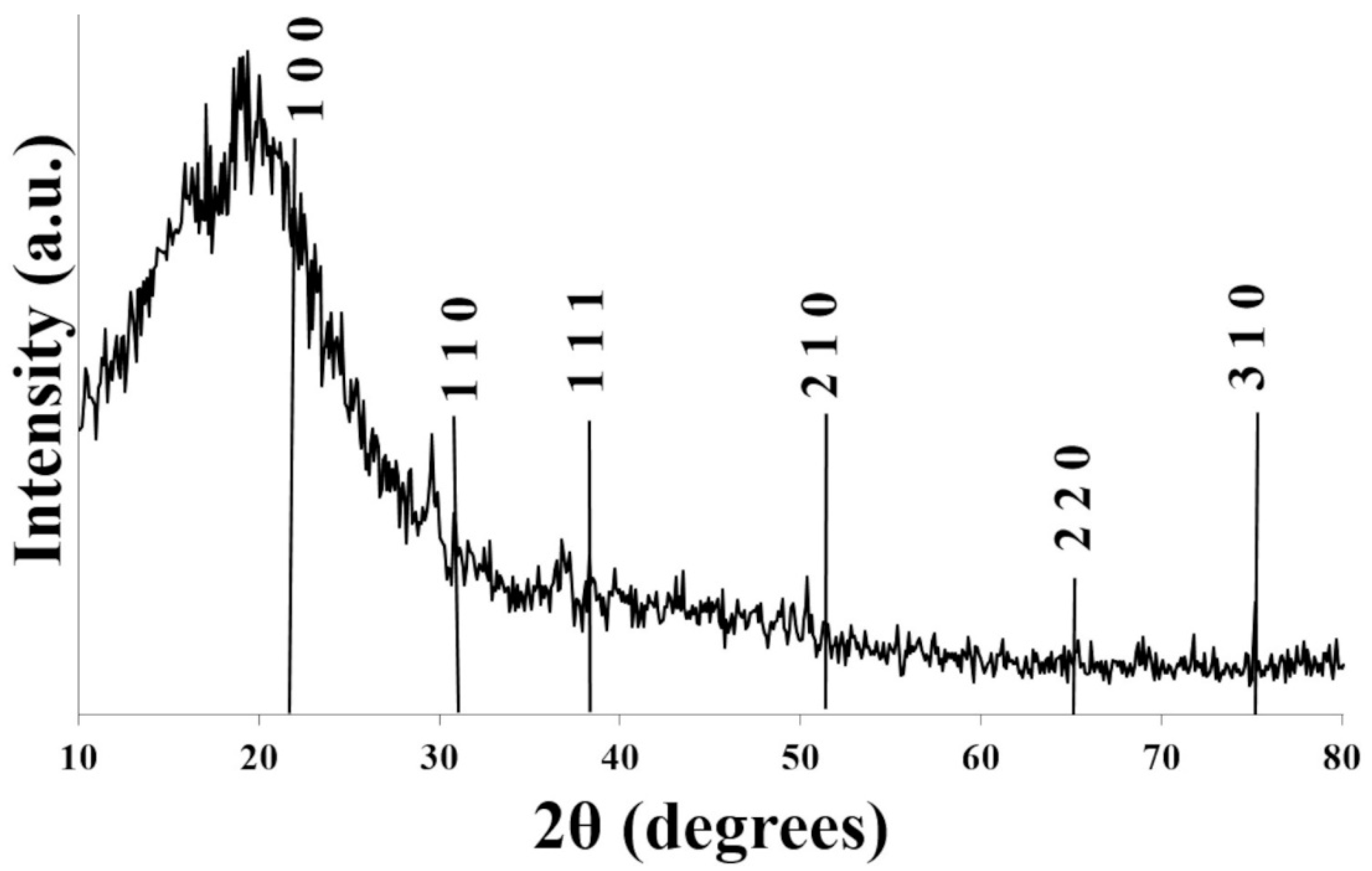
3.1.2. XRD Analysis
3.1.3. Electrical Properties
3.2. Polyurethane Sponge Pressure Sensors
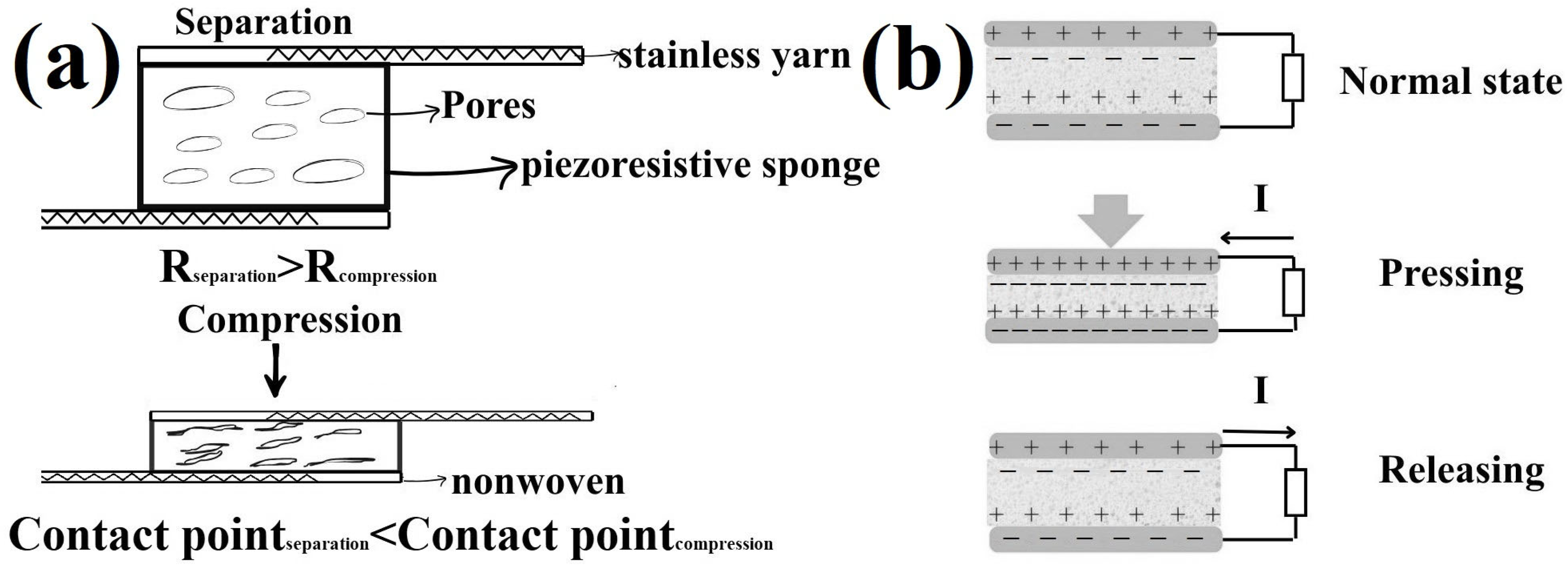
3.2.1. Sensing and Energy Generation Mechanisms
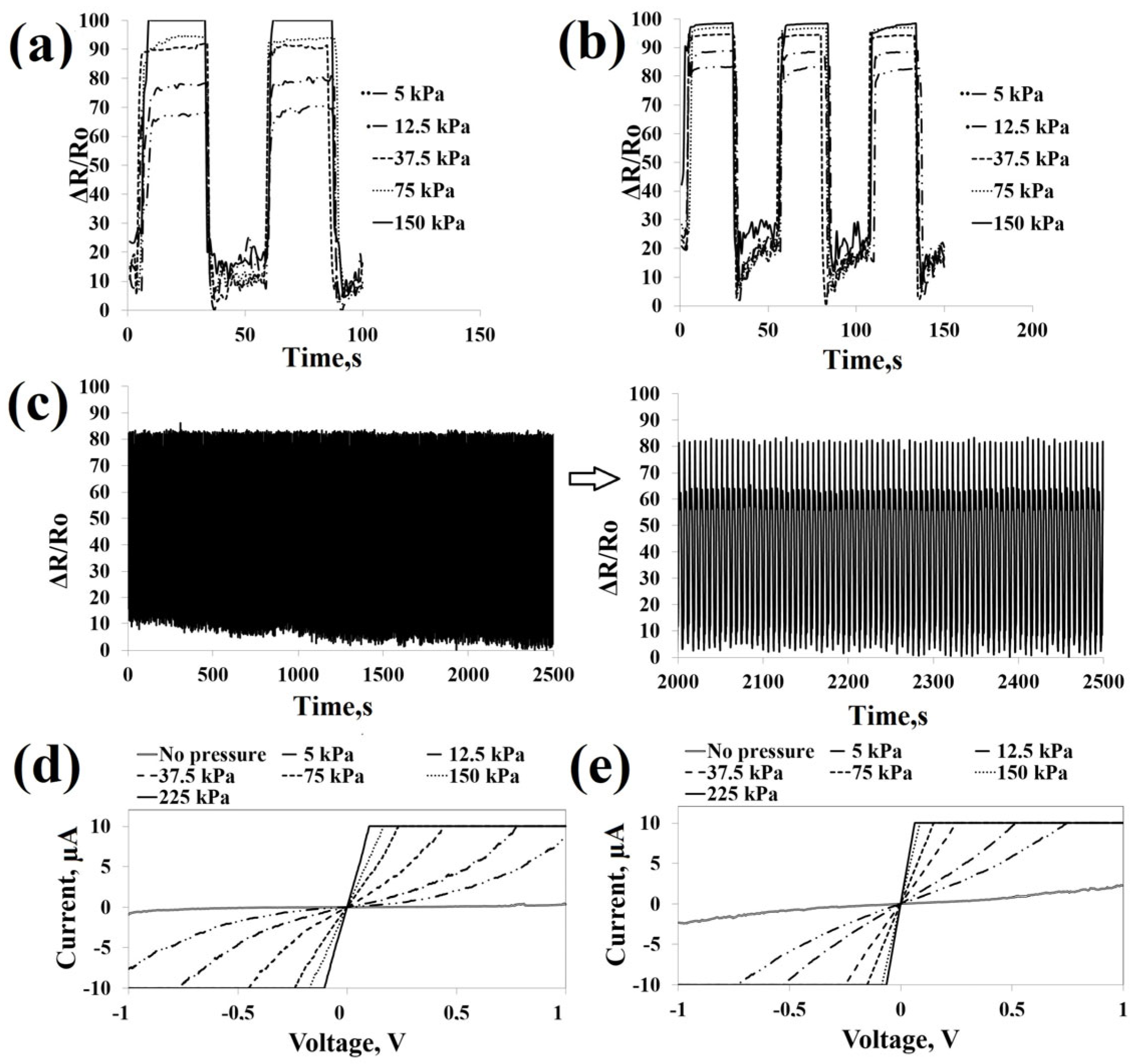
3.2.2. Electromechanical Analysis
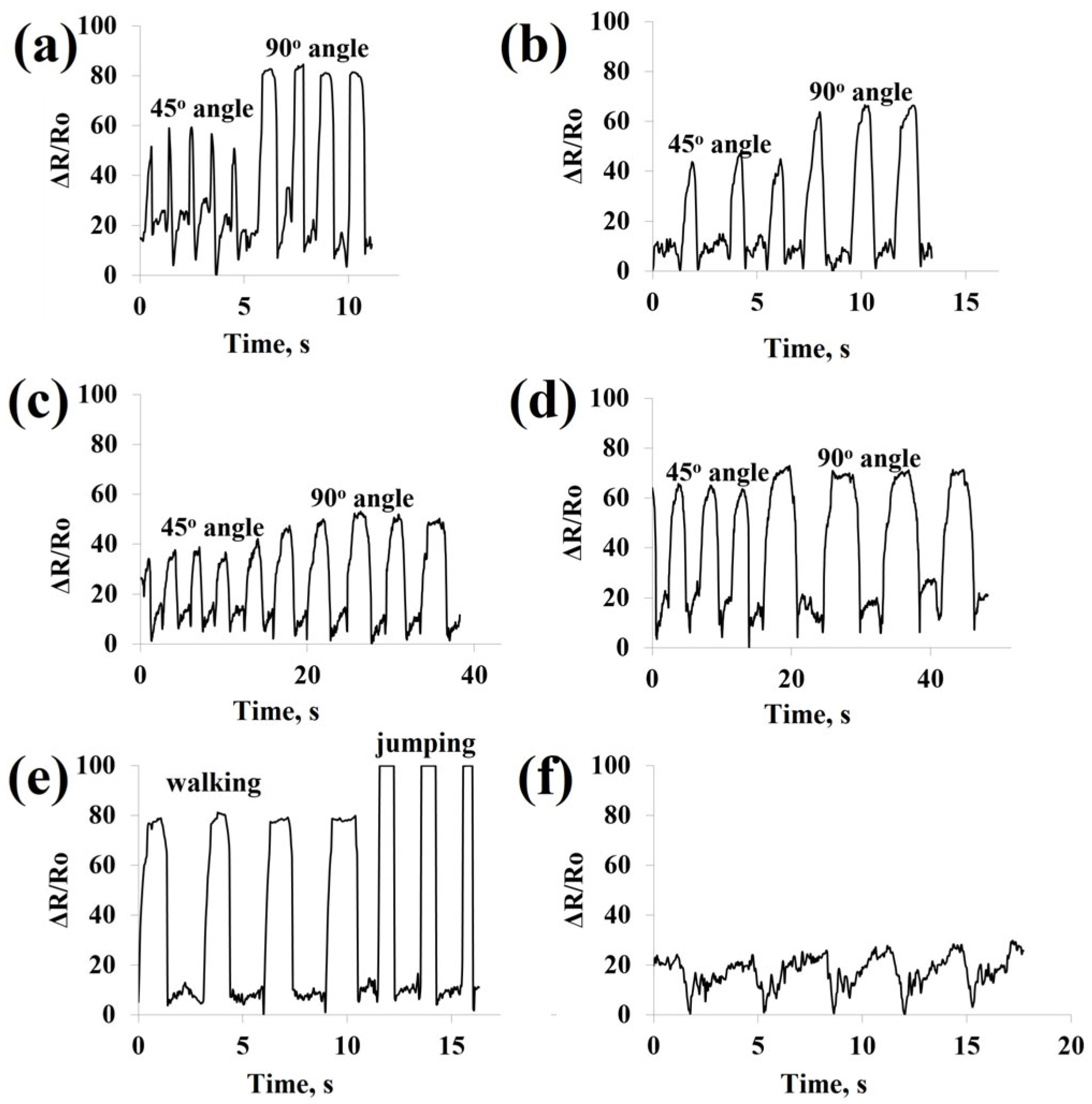
3.2.3. Real-Time Human Motion Monitoring
4. Conclusions
- ○
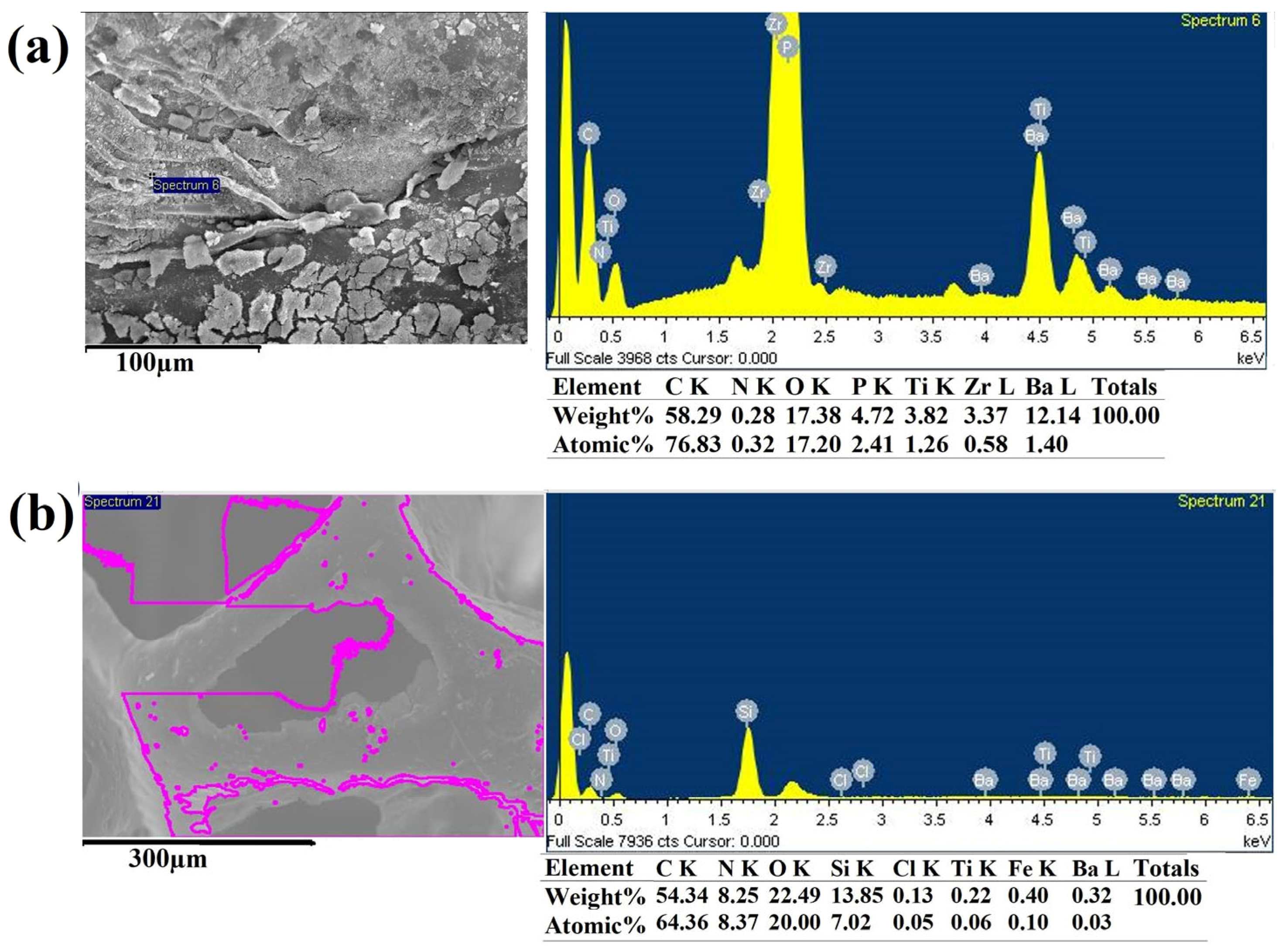
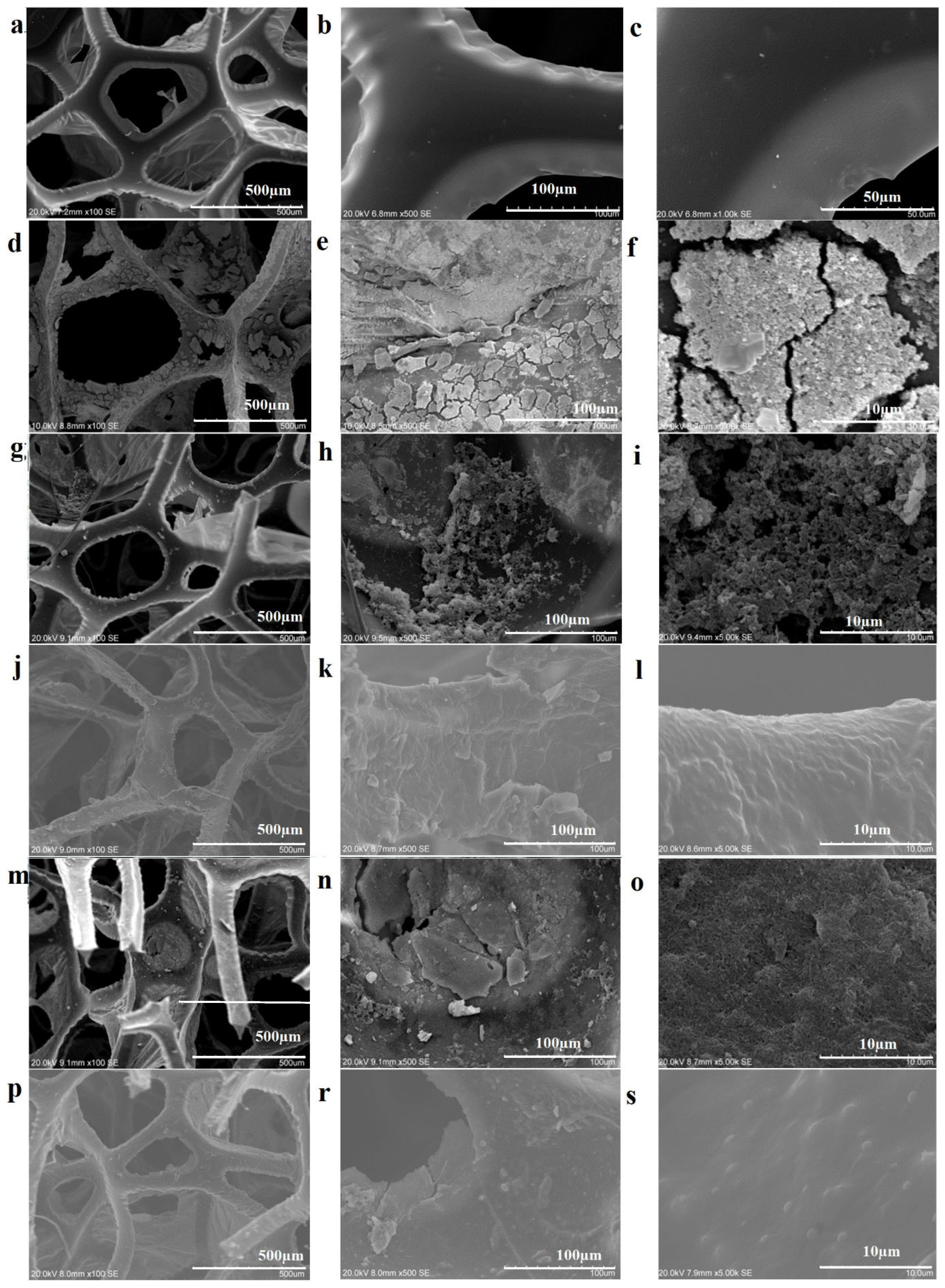
- EDS analysis validated the presence of Ba, Zr, and Ti in the sponge samples coated via the sol–gel process, while the subsequent PPy coating introduced nitrogen, iron and chlorine presence, and PDMS application resulted in Si content on the sensor samples.
- ○
- The presence of a rough surface structure in the coated samples without occluding the pores inherent to sponges was shown in the SEM analysis.
- ○
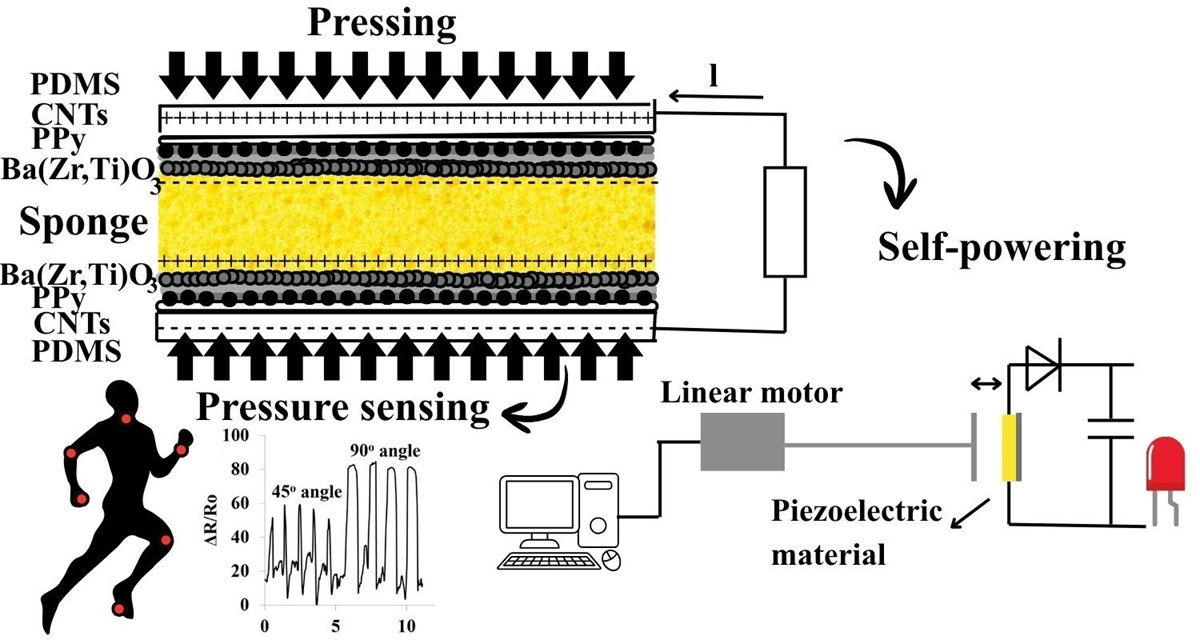
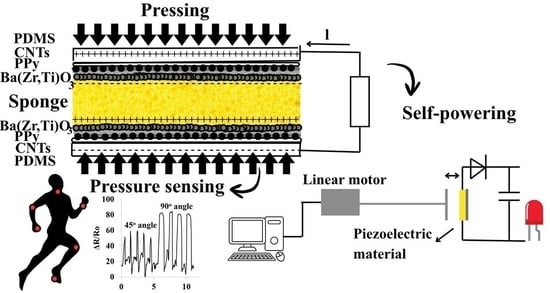
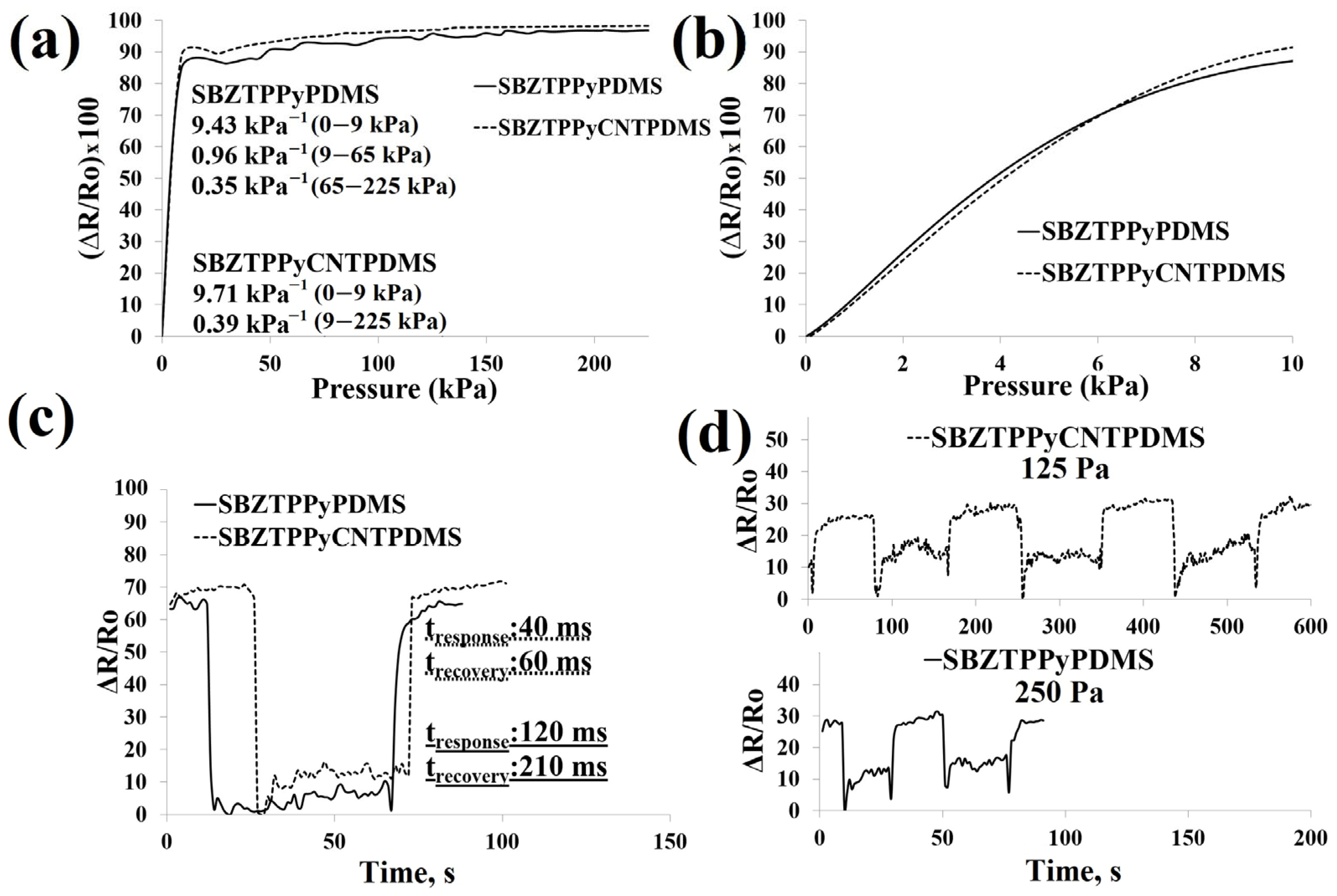
- In particular, the sensor displayed exceptional pressure-sensing capabilities under quasi-static compressive loading across a wide range of pressures, showing a high sensitivity (approximately 9.5 kPa−1 within the pressure range of 0–9 kPa), a low detection threshold (125 Pa), remarkable cyclic stability (>1125 cycles), and rapid response (40 ms) and recovery time (60 ms). Furthermore, the incorporation of CNT coating caused an enhancement in sensor performance.
- ○
- The sensor’s capability to monitor common human activities in real time was confirmed, emphasizing its potential for practical applications.
- ○
- Under periodic dynamic loading–unloading cycles at 2 Hz, the sensor produced a peak-to-peak voltage of 1.25 V, an output power of 0.93 µW, and a power density of 2.31 mW/m2, confirming energy generation under mechanical stimuli.
Supplementary Materials
Author Contributions
Funding
Institutional Review Board Statement
Data Availability Statement
Conflicts of Interest
Abbreviations
| PDMS | Polydimethylsiloxane |
| PPy | Polypyrrole |
| PANI | Polyaniline |
| CNTs | Carbon nanotubes |
| MWCNTs | Multiwalled carbon nanotubes |
| rGO | Reduced graphene oxide |
| PU | Polyurethane |
| CB | Carbon black |
| HGM | Hollow glass nanosphere |
| ADP | Ammonium dihydroge phosphate |
| PTFE | Polytetrafluoro ethylene |
| FEP | Fluorinated ethylene propylene |
| TPU | Thermoplastic polyurethane |
| PEDOT:PSS | Poly(3,4-ethylenedioxythiophene) polystyrene sulfonate |
| VOC | Open-circuit voltage |
| ISC | Short-circuit current |
| GF | Gauge factor |
| A-CNT | Aminated carbon nanotube |
| LED | Light-emitting diode |
| Qtr | Transfer charge |
| BTO | Barium titanate, BaTiO3 |
| BZT | Barium zirconium titanate, Ba(Zr,Ti)O3 |
| PVDF | Polyvinylidene fluoride |
| SD | Standard deviation |
| SDS | Sodium dodecyl sulfate |
| SDBS | Sodium dodecyl benzene sulphonate |
| CTAB | Cetyl trimethyl ammonium bromide |
| PP | Polypropylene |
| SEM | Scanning electron microscopy |
| EDS | Energy-dispersive X-ray spectroscopy |
| FTIR | Fourier-Transform Infra-red Spectroscopy |
| XRD | X-ray diffractometer |
| ANOVA | Analysis of variance |
References
- Feng, Z.; Zhao, Z.; Liu, Y.; Liu, Y.; Cao, X.; Yu, D.; Wang, K. Piezoelectric Effect Polyvinylidene Fluoride (PVDF): From Energy Harvester to Smart Skin and Electronic Textiles. Adv. Mater. Technol. 2023, 8, 2300021. [Google Scholar] [CrossRef]
- Tang, Y.-D.; Wang, P.; Li, G.-X.; Wang, G.-Y.; Yu, W.; Meng, C.-Z.; Guo, S.-J. Flexible and Ultra-Sensitive Planar Supercapacitive Pressure Sensor Based on Porous Ionic Foam. Adv. Eng. Mater. 2023, 25, 2200814. [Google Scholar] [CrossRef]
- Madbouly, A.I.; Hassanien, W.S.; Morsy, M. Tailoring the polyurethane foam/rGO/BaTiO3 pressure sensor for human activities. Diam. Relat. Mater. 2023, 136, 109940. [Google Scholar] [CrossRef]
- Yang, W.; Liu, Y.; Zhang, Z.; Li, Q.; Yu, T.; Li, Y. Scalable, flexible, and hierarchical porous conductive nanocomposites for self-powered and pressure sensing dual-mode integration. Compos. Sci. Technol. 2023, 232, 109884. [Google Scholar] [CrossRef]
- Wang, X.; Chai, Y.; Wang, Z.; Yu, J.; Chen, X. A linear and large-range pressure sensor based on hierarchical structural SnO2@carbon nanotubes/polyurethane sponge. Ceram. Int. 2023, 49, 30579–30585. [Google Scholar] [CrossRef]
- Zhang, M.; Duan, Z.; Huang, Z.; Yu, H.; Wang, C.; Zhang, H.; Li, T.; Huang, Q.; Yuan, Z.; Jiang, Y.; et al. Constructing a high-power self-powered electrochemical pressure sensor for multimode pressure detections. Nano Energy 2025, 136, 110747. [Google Scholar] [CrossRef]
- Lee, J.; Kim, J.; Shin, Y.; Jung, I. Ultra-robust wide-range pressure sensor with fast response based on polyurethane foam doubly coated with conformal silicone rubber and CNT/TPU nanocomposites islands. Compos. Part B Eng. 2019, 177, 107364. [Google Scholar] [CrossRef]
- Cao, W.; Luo, Y.; Dai, Y.; Wang, X.; Wu, K.; Lin, H.; Rui, K.; Zhu, J. Piezoresistive Pressure Sensor Based on a Conductive 3D Sponge Network for Motion Sensing and Human–Machine Interface. ACS Appl. Mater. Interfaces 2023, 15, 3131–3140. [Google Scholar] [CrossRef]
- Li, K.; Yang, W.; Shen, Z.; Zhang, X.; Yi, M. Flexible graphene pressure sensor based on sponge sewn with cotton. Sens. Actuators A Phys. 2023, 354, 114266. [Google Scholar] [CrossRef]
- Liu, Q.; Zhang, Y.; Sun, X.; Liang, C.; Han, Y.; Wu, X.; Wang, Z. All textile-based robust pressure sensors for smart garments. Chem. Eng. J. 2023, 454, 140302. [Google Scholar] [CrossRef]
- Ma, H.-Z.; Zhao, J.-N.; Tang, R.; Shao, Y.; Ke, K.; Zhang, K.; Yin, B.; Yang, M.-B. Polypyrrole@CNT@PU Conductive Sponge-Based Triboelectric Nanogenerators for Human Motion Monitoring and Self-Powered Ammonia Sensing. ACS Appl. Mater. Interfaces 2023, 15, 54986–54995. [Google Scholar] [CrossRef] [PubMed]
- Wang, Y.; Luo, W.; Wen, Y.; Zhao, J.; Chen, C.; Chen, Z.; Zhang, X.-S. Wearable, washable piezoresistive pressure sensor based on polyurethane sponge coated with composite CNT/CB/TPU. Mater. Today Phys. 2025, 52, 101681. [Google Scholar] [CrossRef]
- Wang, R.; Tan, Z.; Zhong, W.; Liu, K.; Li, M.; Chen, Y.; Wang, W.; Wang, D. Polypyrrole (PPy) attached on porous conductive sponge derived from carbonized graphene oxide coated polyurethane (PU) and its application in pressure sensor. Compos. Commun. 2020, 22, 100426. [Google Scholar] [CrossRef]
- Lv, B.; Chen, X.; Liu, C. A Highly Sensitive Piezoresistive Pressure Sensor Based on Graphene Oxide/Polypyrrole@Polyurethane Sponge. Sensors 2020, 20, 1219. [Google Scholar] [CrossRef]
- Zhang, T.; Zhang, W.; Li, Y.; Hu, X.; Yuan, H.; Jiang, T. High-efficient flexible pressure sensor based on nanofibers and carbon nanotubes for artificial electronic skin and human motion monitoring. J. Porous Mater. 2023, 30, 1797–1806. [Google Scholar] [CrossRef]
- Wang, F.; Zhang, W.; Song, Y.; Jiang, X.; Sun, N. Wearable and Cost-Effective Pressure Sensor Based on a Carbon Nanotube/Polyurethane Sponge for Motion Detection and Gesture Recognition. ACS Appl. Electron. Mater. 2023, 5, 6704–6715. [Google Scholar] [CrossRef]
- Ma, Z.; Wei, A.; Ma, J.; Shao, L.; Jiang, H.; Dong, D.; Ji, Z.; Wang, Q.; Kang, S. Lightweight, compressible and electrically conductive polyurethane sponges coated with synergistic multiwalled carbon nanotubes and graphene for piezoresistive sensors. Nanoscale 2018, 10, 7116–7126. [Google Scholar] [CrossRef]
- Ni, Y.; Huang, J.; Li, S.; Dong, X.; Zhu, T.; Cai, W.; Chen, Z.; Lai, Y. Robust Superhydrophobic rGO/PPy/PDMS Coatings on a Polyurethane Sponge for Underwater Pressure and Temperature Sensing. ACS Appl. Mater. Interfaces 2021, 13, 53271–53281. [Google Scholar] [CrossRef]
- Jo, I.; Kim, B.; Won, H.; Kim, S.; Choi, K.; Choi, D. Evaluation of MWCNT/PU sponge-based triboelectric nanogenerator for harvesting mechanical energy. Funct. Compos. Struct. 2025, 7, 035010. [Google Scholar] [CrossRef]
- Li, X.; Chen, Y.; Kumar, A.; Mahmoud, A.; Nychka, J.A.; Chung, H.-J. Sponge-Templated Macroporous Graphene Network for Piezoelectric ZnO Nanogenerator. ACS Appl. Mater. Interfaces 2015, 7, 20753–20760. [Google Scholar] [CrossRef]
- Zhou, B.; Li, C.; Zhou, Y.; Liu, Z.; Gao, X.; Wang, X.; Jiang, L.; Tian, M.; Zhou, F.-L.; Jerrams, S.; et al. A flexible dual-mode pressure sensor with ultra-high sensitivity based on BTO@MWCNTs core-shell nanofibers. Compos. Sci. Technol. 2022, 224, 109478. [Google Scholar] [CrossRef]
- Islam, S.; Khatun, N.; Habib, M.S.; Uddin Farhad, S.F.; Tanvir, N.I.; Ali Shaikh, M.A.; Tabassum, S.; Islam, D.; Hossain, M.S.; Siddika, A. Effects of yttrium doping on structural, electrical and optical properties of barium titanate ceramics. Heliyon 2022, 8, e10529. [Google Scholar] [CrossRef] [PubMed]
- Wei, X.; Liu, Y.; Zhao, D.; Ge, S.S. 3D printing of piezoelectric barium titanate with high density from milled powders. J. Eur. Ceram. Soc. 2020, 40, 5423–5430. [Google Scholar] [CrossRef]
- Schipf, D.R.; Yesner, G.H.; Sotelo, L.; Brown, C.; Guild, M.D. Barium titanate 3–3 piezoelectric composites fabricated using binder jet printing. Addit. Manuf. 2022, 55, 102804. [Google Scholar] [CrossRef]
- Patra, A.; Pal, A.; Sen, S. Polyvinylpyrrolidone modified barium zirconate titanate /polyvinylidene fluoride nanocomposites as self-powered sensor. Ceram. Int. 2018, 44, 11196–11203. [Google Scholar] [CrossRef]
- Camlibel, N.O.; Kandola, B.K. Highly sensitive textile pressure sensors with novel hierarchical architecture based on conductive polymers, silver nanoparticles and carbon nanotubes. Sens. Actuators A Phys. 2025, 382, 116166. [Google Scholar] [CrossRef]
- Wang, Y.; Yan, B.; Zhou, Y.; Zhao, G.; Liu, Q.; Liu, H.; Lin, Z.; Peng, X.; Chen, T. Hierarchical porous TPU@CNT sponge for high-performance triboelectric nanogenerators via dual contact electrification and self-powered sensing applications. Chem. Eng. J. 2025, 521, 166530. [Google Scholar] [CrossRef]
- ISO 6330:2021; Textiles—Domestic Washing and Drying Procedures for Textile Testing. ISO: Geneva, Switzerland, 2021.
- Onar, N.; Akşit, A.C.; Ebeoglugil, M.F.; Birlik, I.; Celik, E.; Ozdemir, I. Structural, electrical, and electromagnetic properties of cotton fabrics coated with polyaniline and polypyrrole. J. Appl. Polym. Sci. 2009, 114, 2003–2010. [Google Scholar] [CrossRef]
- Camlibel, N.O.; Kandola, B.K. Piezoresistive/Piezoelectric Hybrid Pressure Sensors via Towel Fabric Coated with PDMS/CNTs/PPy/ZnO. IEEE Sens. J. 2025, 25, 37683–37693. [Google Scholar] [CrossRef]
- Ferreira Oliveira, A.E.; Pereira, A.C.; Ferreira, L.F. Development of highly stable conductive multiwalled carbon nanotube ink using covalent and non-covalent functionalization for electrochemical sensors. J. Electrochem. Sci. Eng. 2021, 12, 105–126. [Google Scholar] [CrossRef]
- Pakdel, E.; Xie, W.; Wang, J.; Kashi, S.; Sharp, J.; Zhang, Q.; Varley, R.J.; Sun, L.; Wang, X. Superhydrophobic natural melanin-coated cotton with excellent UV protection and personal thermal management functionality. Chem. Eng. J. 2022, 433, 133688. [Google Scholar] [CrossRef]
- Gao, S.; Li, H.; Guan, H.; Zheng, L.; Lai, X.; Chen, W.; Zeng, X. Facile fabrication of superhydrophobic, flame-retardant and conductive cotton fabric for human motion detection. Cellulose 2022, 29, 605–617. [Google Scholar] [CrossRef]
- Yao, D.; Tang, Z.; Liang, Z.; Zhang, L.; Sun, Q.-J.; Fan, J.; Zhong, G.; Liu, Q.-X.; Jiang, Y.-P.; Tang, X.-G.; et al. Adhesive, multifunctional, and wearable electronics based on MXene-coated textile for personal heating systems, electromagnetic interference shielding, and pressure sensing. J. Colloid Interface Sci. 2023, 630, 23–33. [Google Scholar] [CrossRef] [PubMed]
- Rajendran, S.; Anand, S. Design and development of novel bandages for compression therapy. Br. J. Nurs. 2003, 12, S20–S29. [Google Scholar] [CrossRef] [PubMed][Green Version]
- Anand, S.C.; Rajendran, S. Effect of Fibre Type and Structure in Designing Orthopaedic Wadding for the Treatment of Venous Leg Ulcers. In Medical Textiles and Biomaterials for Healthcare; Elsevier: Amsterdam, The Netherlands, 2006; pp. 243–255. [Google Scholar] [CrossRef]
- Tie, J.; Mao, Z.; Zhang, L.; Zhong, Y.; Sui, X.; Xu, H. High strength and anti-freezing piezoresistive pressure sensor based on a composite gel. Polym. Adv. Technol. 2022, 33, 2448–2458. [Google Scholar] [CrossRef]
- Fan, S.; Wang, Z.; Liang, P.; Li, H.; Zhang, Y.; Fan, W.; Xu, G. Fabrication of polypyrrole coated superhydrophobic surfaces for effective oil/water separation. J. Mater. Res. Technol. 2022, 19, 4337–4349. [Google Scholar] [CrossRef]
- Omastová, M.; Mičušík, M.; Fedorko, P.; Pionteck, J.; Kovářová, J.; Chehimi, M.M. The synergy of ultrasonic treatment and organic modifiers for tuning the surface chemistry and conductivity of multiwalled carbon nanotubes. Surf. Interface Anal. 2014, 46, 940–944. [Google Scholar] [CrossRef]
- Gashti, M.P.; Ghehi, S.T.; Arekhloo, S.V.; Mirsmaeeli, A.; Kiumarsi, A. Electromagnetic shielding response of UV-induced polypyrrole/silver coated wool. Fibers Polym. 2015, 16, 585–592. [Google Scholar] [CrossRef]
- Parvinzadeh, M.; Moradian, S.; Rashidi, A.; Yazdanshenas, M.-E. Effect of the Addition of Modified Nanoclays on the Surface Properties of the Resultant Polyethylene Terephthalate/Clay Nanocomposites. Polym. Plast. Technol. Eng. 2010, 49, 874–884. [Google Scholar] [CrossRef]
- Kaushik, V.; Kumar, V.; Kumar, D.; Kumar, R.; Singh, V.; Kumar, M.; Sharma, S.K. Effect of aging on microstructural and optical properties of sol-gel dip coated BaTiO3 thin films. Appl. Surf. Sci. Adv. 2023, 16, 100418. [Google Scholar] [CrossRef]
- Su, Y.; Li, W.; Cheng, X.; Zhou, Y.; Yang, S.; Zhang, X.; Chen, C.; Yang, T.; Pan, H.; Xie, G.; et al. High-performance piezoelectric composites via β phase programming. Nat. Commun. 2022, 13, 4867. [Google Scholar] [CrossRef] [PubMed]
- Rehrig, P.W.; Park, S.-E.; Trolier-McKinstry, S.; Messing, G.L.; Jones, B.; Shrout, T.R. Piezoelectric properties of zirconium-doped barium titanate single crystals grown by templated grain growth. J. Appl. Phys. 1999, 86, 1657–1661. [Google Scholar] [CrossRef]
- Islam, S.; Molla, M.R.; Khatun, N.; Tanvir, N.I.; Hakim, M.; Islam, M.S. Exploring the effects of zirconium doping on barium titanate ceramics: Structural, electrical, and optical properties. Mater. Adv. 2025, 6, 1403–1413. [Google Scholar] [CrossRef]
- Patnam, H.; Dudem, B.; Alluri, N.R.; Mule, A.R.; Graham, S.A.; Kim, S.-J.; Yu, J.S. Piezo/triboelectric hybrid nanogenerators based on Ca-doped barium zirconate titanate embedded composite polymers for wearable electronics. Compos. Sci. Technol. 2020, 188, 107963. [Google Scholar] [CrossRef]
- Du, C.; Zhang, Y.; Zhang, D.; Zhang, B.; Zhao, W. An in situ polymerized polypyrrole/halloysite nanotube–silver nanoflower based flexible wearable pressure sensor with a large measurement range and high sensitivity. J. Mater. Chem. C 2021, 9, 13172–13181. [Google Scholar] [CrossRef]
- Wen, L.; Nie, M.; Wang, C.; Zhao, Y.N.; Yin, K.; Sun, L. Multifunctional, Light-Weight Wearable Sensor Based on 3D Porous Polyurethane Sponge Coated with MXene and Carbon Nanotubes Composites. Adv. Mater. Interfaces 2022, 9, 2101592. [Google Scholar] [CrossRef]
- Zeng, S.; Qi, P.; Ai, S.; Sun, X.; Kang, H.; Bian, D. Precise determination of the total nitrogen content in activated sludge by ultrasonic pre-treatment assisted wet method. Environ. Technol. 2024, 45, 5233–5243. [Google Scholar] [CrossRef]
- Qu, M.; Dong, Y.; Liu, Q.; Wang, Y.; Feng, P.; Zhang, Y.; Deng, Y.; Zhang, R.; Sun, C.L.; He, J. Piezoresistive Sensor Based on Porous Sponge with Superhydrophobic and Flame Retardant Properties for Motion Monitoring and Fire Alarm. ACS Appl. Mater. Interfaces 2025, 17, 2105–2116. [Google Scholar] [CrossRef]
- Zheng, Z.; Ren, L.; Huang, P.; Zhao, X. Preparation and properties of silicone coated glass fiber fabrics destined for firefighters’ protective clothing. Pigment Resin Technol. 2021, 50, 508–514. [Google Scholar] [CrossRef]
- Liu, Y.; Zheng, Y.; Wu, Z.; Zhang, L.; Sun, W.; Li, T.; Wang, D.; Zhou, F. Conductive elastic sponge-based triboelectric nanogenerator (TENG) for effective random mechanical energy harvesting and ammonia sensing. Nano Energy 2021, 79, 105422. [Google Scholar] [CrossRef]







| Weight %/Standard Deviation | C | O | P | N | Ti | Zr | Ba | Si | Fe | Cl |
|---|---|---|---|---|---|---|---|---|---|---|
| S | 58.04/6.09 | 24.99/2.88 | - | 16.98/7.68 | - | - | - | - | - | - |
| SBZT | 50.02/6.22 | 32.19/7.24 | 5.34/1.8 | 0.10/0.21 | 3.50/0.86 | 3.90/1.23 | 4.94/3.56 | - | - | - |
| SBZTPPy | 59.50/4.87 | 26.59/6.51 | - | 11.95/7.85 | 0.40/0.51 | 0.09/0.21 | 0.91/1.19 | - | 0.35/0.47 | 0.20/0.20 |
| SBZTPPyPDMS | 48.34/4.26 | 27.89/1.70 | - | 11.00/6.80 | 0.10/0.13 | - | 0.42/0.47 | 11.43/4.13 | 0.68/1.03 | 0.14/0.12 |
| SBZTPPyCNTPDMS | 47.25/7.41 | 17.76/8.58 | - | 7.87/2.86 | 0.14/0.13 | - | 1.29/1.82 | 24.96/13.6 | 0.33/0.51 | 0.41/0.36 |
| Add-On, % (SD *) | Resistance, kOhm (SD) | CV, % | Thickness, mm | |
|---|---|---|---|---|
| S | - | - | 4.50 | |
| SBZT | 14.13 (1.74) | - | 4.50 | |
| SBZTPPy | 18.83 (1.02) | 27 (6.3) | 23 | 4.50 |
| SBZTPPyPDMS | 41.36 (2.40) | 409 (91) | 22 | 4.50 |
| SBZTPPyCNT | 29.93 (2.03) | 74 (22) | 30 | 4.50 |
| SBZTPPyCNTPDMS | 61.73 (3.11) | 342 (154) | 45 | 4.60 |
| Sensitivity (kPa−1) | Detection Limit | Response Time, ms | Recovery Time, ms | Durability, Cycles | Peak-to-Peak Voltage | |
|---|---|---|---|---|---|---|
| (12.5 kPa) | (12.5 kPa) | Mean–SD | ||||
| SBZTPPyPDMS | 9.43 (0–9 kPa) 0.96 (9–65 kPa) 0.35 (65–225 kPa) | 250 Pa | 120 | 210 | >750 | 1.05 V–0.16 |
| SBZTPPyCNTPDMS | 9.71 (0–9 kPa) 0.39 (9–225 kPa) | 125 Pa | 40 | 60 | >1125 | 1.25 V–0.21 |
| Sum of Squares | df | Mean Square | F | Sig. | |
|---|---|---|---|---|---|
| Between Groups | 1.00 | 1 | 1.00 | 28.07 | 0.000 |
| Within Groups | 3.45 | 97 | 0.04 | ||
| Total | 4.45 | 98 |
Disclaimer/Publisher’s Note: The statements, opinions and data contained in all publications are solely those of the individual author(s) and contributor(s) and not of MDPI and/or the editor(s). MDPI and/or the editor(s) disclaim responsibility for any injury to people or property resulting from any ideas, methods, instructions or products referred to in the content. |
© 2026 by the authors. Licensee MDPI, Basel, Switzerland. This article is an open access article distributed under the terms and conditions of the Creative Commons Attribution (CC BY) license.
Share and Cite
Onar Camlibel, N.; Kandola, B.K. Dual-Functional Polyurethane Sponge-Based Pressure Sensors Incorporating BZT/BTO, Polypyrrole, and Carbon Nanotubes with Energy Generation Capability. Polymers 2026, 18, 241. https://doi.org/10.3390/polym18020241
Onar Camlibel N, Kandola BK. Dual-Functional Polyurethane Sponge-Based Pressure Sensors Incorporating BZT/BTO, Polypyrrole, and Carbon Nanotubes with Energy Generation Capability. Polymers. 2026; 18(2):241. https://doi.org/10.3390/polym18020241
Chicago/Turabian StyleOnar Camlibel, Nurhan, and Baljinder K. Kandola. 2026. "Dual-Functional Polyurethane Sponge-Based Pressure Sensors Incorporating BZT/BTO, Polypyrrole, and Carbon Nanotubes with Energy Generation Capability" Polymers 18, no. 2: 241. https://doi.org/10.3390/polym18020241
APA StyleOnar Camlibel, N., & Kandola, B. K. (2026). Dual-Functional Polyurethane Sponge-Based Pressure Sensors Incorporating BZT/BTO, Polypyrrole, and Carbon Nanotubes with Energy Generation Capability. Polymers, 18(2), 241. https://doi.org/10.3390/polym18020241