1. Introduction
Radiation shielding is essential in nuclear research and engineering to safeguard people, patients, and sensitive equipment from ionizing radiation [
1,
2]. Gamma rays, a form of ionizing radiation, pose particular challenges because their strong penetration demands dense, high-atomic-number (Z) materials for effective attenuation [
3]. Lead has historically been considered the standard shielding material because of its high density (11.34 g/cm
3) and atomic number (Z = 82). However, the increasing concern over lead toxicity and its detrimental environmental and health effects has restricted its use, especially in medical, industrial, and environmental applications [
4]. Concrete remains widely used for its affordability and availability; however, it requires large thicknesses to achieve adequate attenuation, resulting in heavy, non-portable shielding structures.
The shortcomings of conventional shields have encouraged the development of innovative materials that combine strong attenuation performance with low toxicity, reduced weight, and mechanical flexibility. Glass and ceramic matrices reinforced with heavy oxides such as WO
3, Bi
2O
3, and TeO
2 have shown improved gamma-ray shielding capability, but their brittleness and limited mechanical strength constrain practical applications [
5,
6,
7,
8]. Similarly, concrete enhanced with barite or magnetite demonstrates higher shielding efficiency but remains unsuitable where lightweight or mobile designs are required [
9].
Polymers, particularly high-density polyethylene (HDPE), present an attractive alternative because of their low density, processability, and ability to incorporate high-Z fillers [
10]. HDPE is especially valuable in mixed radiation fields owing to its high hydrogen content, which moderates neutrons while enhancing photon attenuation when combined with heavy reinforcements [
11]. This dual capability enables HDPE composites to serve as lightweight, multifunctional materials for both gamma- and neutron-radiation protection. Earlier studies examined PbO-filled HDPE composites that exhibited strong gamma-ray attenuation; however, the inherent toxicity of lead limited their practical applicability [
12,
13]. Subsequent research explored environmentally benign configurations, including recycled HDPE reinforced with alternative heavy-metal oxides and polymer-based layered composite systems [
14].
Among environmentally benign candidates, Bi
2O
3 has emerged as one of the most efficient and non-toxic lead-free substitutes, owing to its high atomic number (Z = 83), chemical stability, and environmental safety [
15,
16,
17]. Similarly, WO
3, Gd
2O
3, and TeO
2 have been recognized for their strong photon-interaction cross sections, thermal stability, and compatibility with polymer matrices [
18,
19,
20,
21]. Although these oxides have individually shown excellent attenuation capability, only a few studies have systematically compared their combined influence when incorporated into polymer composites. Moreover, hybrid analyses that integrate Monte Carlo (Geant4) simulations and semi-empirical (Phy-X/PSD) methods for HDPE-based oxide systems remain scarce—particularly across the wide photon-energy range covering photoelectric, Compton, and pair-production regions. This absence of integrated evaluation defines the knowledge gap addressed in the present work. In particular, no previous study has provided a unified, side-by-side assessment of Bi
2O
3, WO
3, Gd
2O
3, TeO
2, and their hybrid formulations within an HDPE matrix using a dual-method framework that spans the entire 0.015–15 MeV photon-energy range, which establishes the core novelty of the present investigation.
Building on this context, the present study systematically investigates six HDPE-based composites: pure HDPE (100 wt.%), HDPE + 60 wt.% Bi2O3, HDPE + 60 wt.% WO3, HDPE + 60 wt.% Gd2O3, HDPE + 60 wt.% TeO2, and a hybrid formulation containing HDPE + 30 wt.% Bi2O3 + 30 wt.% WO3. These compositions were designed to balance high-Z reinforcement with polymer flexibility, enabling effective gamma- and neutron-radiation attenuation while maintaining manufacturability and non-toxicity. The dual characteristics of HDPE—its lightweight nature and mechanical resilience—combined with the high-density oxides create composites that are safer to handle, easier to shape, and adaptable for both portable and fixed shielding applications. To quantitatively evaluate their performance, a hybrid computational framework was employed, coupling Phy-X/PSD for semi-empirical calculations of photon- and neutron-interaction parameters with Geant4 Monte Carlo simulations for detailed photon-transport modeling. This integrative approach bridges analytical and stochastic methods, providing a consistent basis for assessing how filler composition and photon energy affect attenuation behavior. The results support the development of sustainable, lead-free polymer-oxide shielding materials suitable for medical, nuclear, aerospace, and security applications.
2. Research Significance and Novelty
This study addresses a clear gap in the literature. It provides a unified, cross-validated comparison of several high-Z oxide fillers within an HDPE matrix, offering insight not available in previous shielding research. By integrating Phy-X/PSD with Geant4, the work combines complementary analytical and Monte Carlo approaches, strengthening the reliability of attenuation estimates across the entire 0.015–15 MeV energy range. The evaluation of the Bi2O3/WO3 hybrid composite adds particular novelty, as its potential to balance density, attenuation performance, and practical manufacturability has not been previously examined within a dual-method framework. Together, these elements define the significance of the present study and its contribution to the development of safer, more efficient, and lead-free radiation-shielding materials.
4. Results and Discussion
4.1. Gamma-Ray Attenuation Behavior (Linear Attenuation Coefficient, μ)
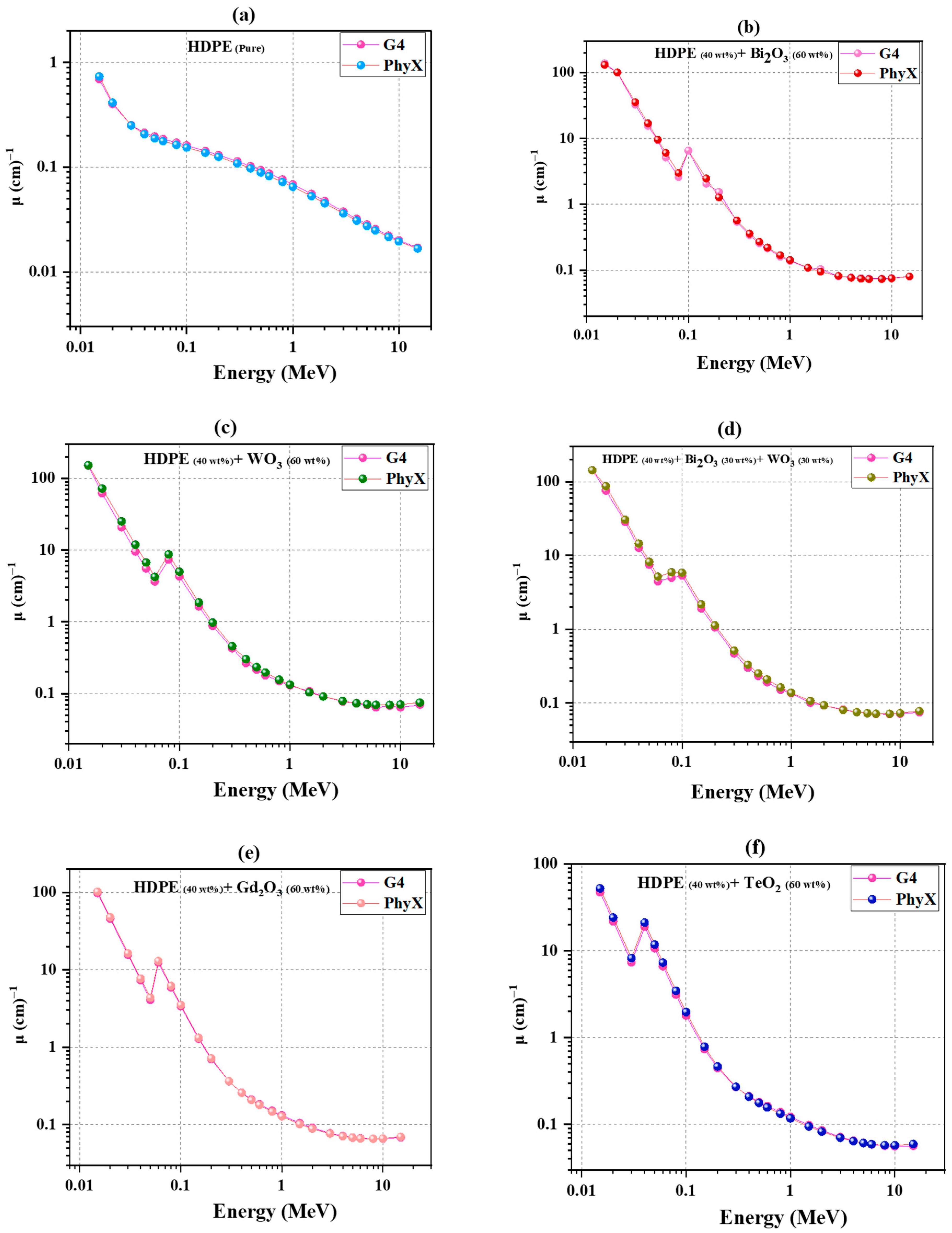
Figure 2 presents the variation in
μ with photon energy (0.015–15 MeV) for the HDPE-based composites (C1–C6, as defined in
Table 1). The Phy-X/PSD and Geant4 results exhibit very close agreement across the entire photon-energy range, confirming the reliability of both computational approaches. For C1 (HDPE),
μ decreases steadily from ≈0.7 cm
−1 at 0.015 MeV to ≈0.16 cm
−1 at 0.1 MeV, then to ≈0.07 cm
−1 at 1 MeV, and finally ≈0.02 cm
−1 at 15 MeV. This smooth decline reflects the expected transition from photoelectric absorption at low energies to Compton scattering and pair-production processes at higher energies. Incorporating high-Z oxides produces a marked enhancement of
μ, particularly in the low-energy region. At 0.015 MeV,
μ increases to ≈150 cm
−1 (Geant4) and ≈153 cm
−1 (Phy-X/PSD) for C4 (WO
3), ≈142–143 cm
−1 for C3 (Bi
2O
3/WO
3), ≈135 cm
−1 for C2 (Bi
2O
3), ≈100 cm
−1 for C5 (Gd
2O
3), and ≈50 cm
−1 for C6 (TeO
2), a dramatic improvement compared with neat HDPE (≈0.7 cm
−1). Distinct discontinuities between 30 and 90 keV correspond to the K-absorption edges of Te, Gd, W, and Bi, accurately resolved by both methods. The pronounced enhancement in this low-energy region reflects the steep
Zn dependence (
n ≈ 4–5) of the photoelectric effect, which strongly favors composites containing high-Z fillers such as Bi
2O
3 and WO
3. Although Bi
2O
3 contains a higher atomic number element than WO
3, the attenuation performance of HDPE-based composites depends on several factors beyond atomic number alone. In the present composites, the WO
3-filled system exhibits comparable or slightly higher attenuation due to the combined effects of composite density and energy-dependent photon interaction mechanisms, particularly in the low-energy region where the photoelectric effect dominates. At intermediate and high photon energies, the attenuation performance of WO
3- and Bi
2O
3-filled HDPE becomes very similar, indicating that density-weighted interaction probabilities, rather than atomic number alone, govern the overall shielding behavior.
At 1 MeV, μ values cluster around ≈0.13 cm−1 for C2–C4, ≈0.12 cm−1 for C5–C6, and ≈0.07 cm−1 for HDPE, confirming that the oxide-filled systems retain a clear attenuation advantage in the Compton-dominant region. At 10–15 MeV, μ remains ≈ 0.07–0.09 cm−1 for the composites versus ≈ 0.02 cm−1 for HDPE, indicating that dense fillers continue to enhance pair-production interactions at high photon energies. This sustained high-energy enhancement is linked to the increasing probability of electron–positron pair production, whose cross section grows with photon energy and is further amplified by the higher density of oxide-filled composites.
Overall, C4 (WO3) exhibits the highest μ across nearly all energies, followed by C3 (Bi2O3/WO3) and C2 (Bi2O3), while C5 (Gd2O3) and C6 (TeO2) show moderate enhancement, and C1 (HDPE) remains the least attenuating.
4.2. Mass Attenuation Coefficient (μ/ρ)
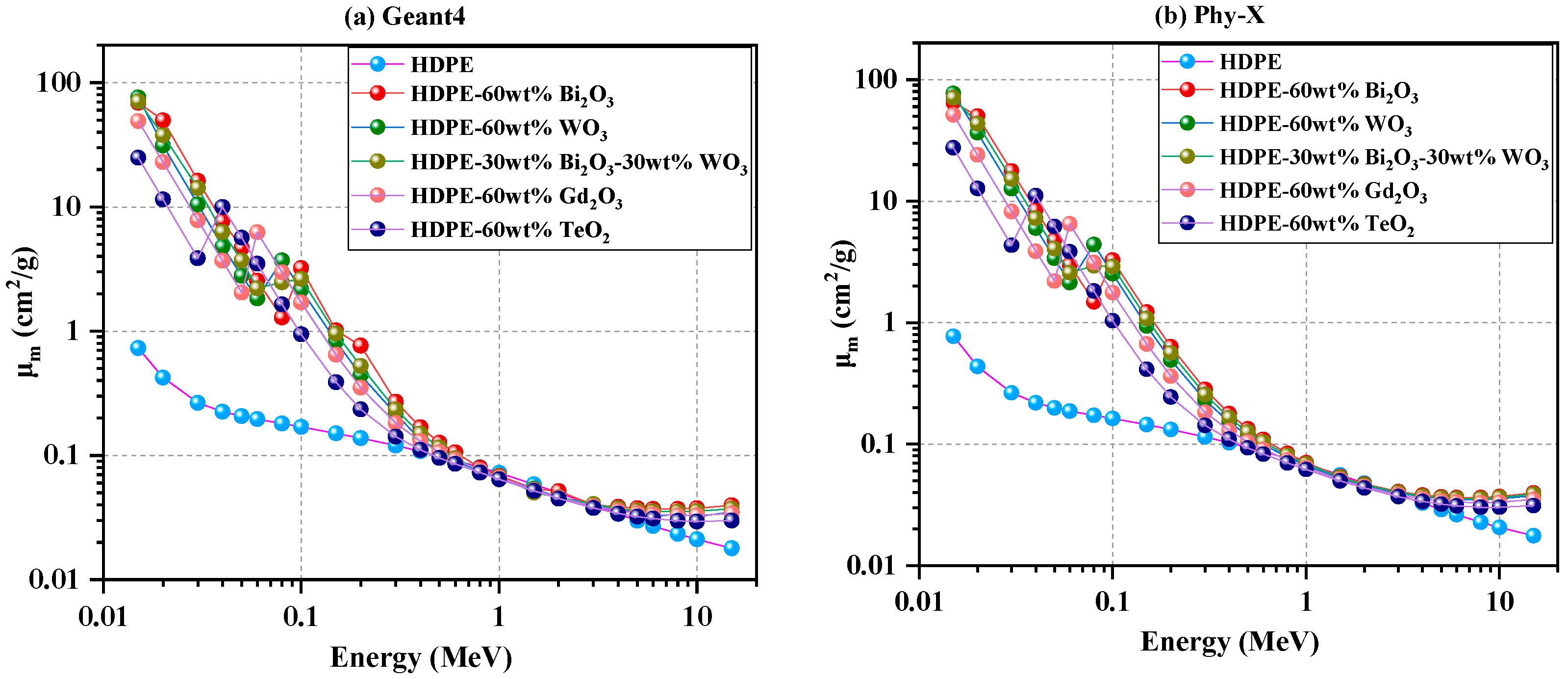
To enable direct comparison between the two computational frameworks,
μ/
ρ is plotted using Geant4 (
Figure 3a) and Phy-X/PSD (
Figure 3b). Both methods display trends consistent with those observed for
μ in
Figure 2.
At 0.015 MeV, the Bi
2O
3-, Bi
2O
3/WO
3-, and WO
3-reinforced composites (C2–C4) record
μ/
ρ values of about 70 cm
2 g
−1, with WO
3 reaching approximately 80 cm
2 g
−1. Gd
2O
3 (C5) and TeO
2 (C6) exhibit smaller values of roughly 50 cm
2 g
−1 and 25 cm
2 g
−1, respectively, compared with ≈0.7 cm
2 g
−1 for neat HDPE (C1). These elevated coefficients highlight the dominance of the photoelectric effect at low photon energies in materials containing high-atomic-number oxides. The strong low-energy enhancement observed here is fully consistent with the photon-interaction mechanisms discussed in
Section 4.1, particularly the steep
Zn dependence (
n ≈ 4–5) of the photoelectric cross section, which strongly favors materials incorporating heavy elements.
As energy increases toward 0.5–1 MeV, μ/ρ decreases sharply, and all curves converge to ≈0.07–0.10 cm2 g−1, signifying the Compton-scattering region where attenuation becomes nearly independent of atomic number. This convergence reflects the fact that Compton interactions depend primarily on electron density rather than Z, reducing compositional differences among the materials.
At 10–15 MeV,
μ/
ρ rises slightly to ≈0.03–0.04 cm
2 g
−1 for the composites and remains ≈0.02 cm
2 g
−1 for HDPE, reflecting renewed pair-production contributions at high photon energies. This divergence at multi-MeV energies follows the same density-driven pair-production trends outlined in
Section 4.1, where dense oxide fillers provide more nuclei capable of facilitating electron–positron creation as photon energy increases.
Among all systems, WO3 (C4) and Bi2O3/WO3 (C3) show the highest μ/ρ values throughout the studied energy range, confirming their superior photon-interaction capability within the Geant4 framework.
4.3. Mean Free Path (MFP) and Half-Value Layer (HVL)
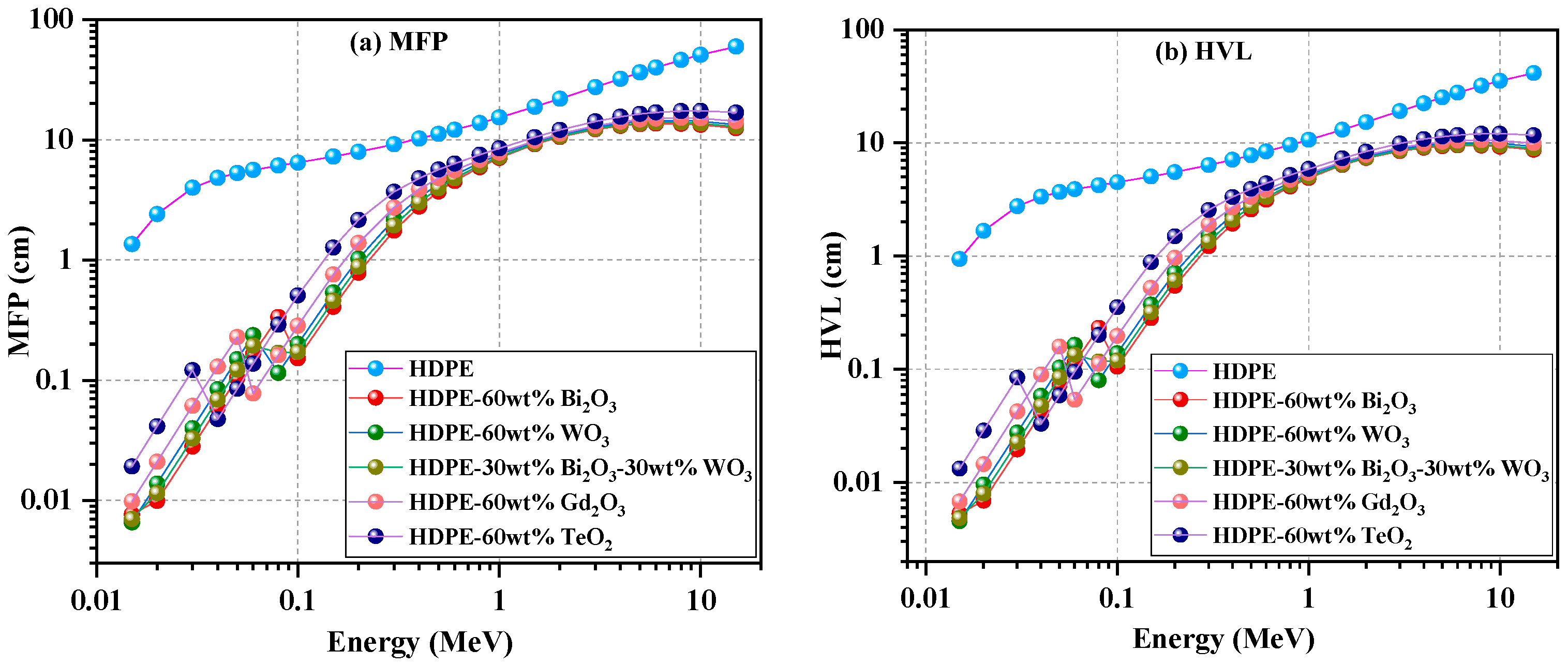
Figure 4 presents the mean free path (MFP) in panel (a) and the half-value layer (HVL) in panel (b), enabling direct comparison of the photon-attenuation behavior across the studied energy range.
As shown in
Figure 4a, at low photon energies below 0.05 MeV, the oxide-reinforced systems exhibit a substantial reduction in photon penetration depth. The Bi
2O
3-, Bi
2O
3/WO
3-, and WO
3-based composites (C2–C4) exhibit MFPs of ≈0.01–0.15 cm, while Gd
2O
3 (C5) and TeO
2 (C6) record slightly higher values of ≈0.1–0.3 cm, compared with ≈1.4–5 cm for neat HDPE (C1). This strong suppression reflects enhanced photoelectric absorption caused by the dense, high-Z oxide filler
As photon energy increases into the Compton region (≈0.1–1 MeV), MFP increases gradually for all materials. Around 0.3 MeV, HDPE reaches about 9 cm, whereas the composites remain between ≈2 and 4 cm, confirming the sustained attenuation advantage of the filled systems. Near 1 MeV, the composites converge around ≈7–8 cm, while HDPE extends to ≈15 cm, indicating that heavy oxide reinforcement continues to reduce photon penetration even under scattering-dominated conditions.
At higher energies above 1 MeV, particularly in the pair-production region (5–15 MeV), all samples show a further smooth rise in MFP. Nevertheless, the composites maintain shorter paths—≈13–15 cm compared with ≈50–60 cm for HDPE—demonstrating that dense oxides preserve significant interaction probability even at high photon energies.
The HVL trends in
Figure 4b mirror those of the MFP, as expected from its inverse relationship with the linear attenuation coefficient. At photon energies below 0.05 MeV, the Bi
2O
3-, Bi
2O
3/WO
3-, and WO
3-reinforced composites show HVL values of ≈0.005–0.15 cm, while Gd
2O
3 and TeO
2 fall within ≈0.1–0.3 cm, compared with ≈1–4 cm for HDPE. This confirms the strong photon-absorption capability imparted by dense oxide fillers.
In the intermediate energy region (0.1–1 MeV), HVL increases gradually for all materials. Around 0.3 MeV, HDPE reaches about 6–7 cm, while the composites remain within ≈1–3 cm, confirming the continued effectiveness of the heavy-oxide fillers under Compton-scattering conditions. Near 1 MeV, the filled systems converge around ≈5 cm, whereas HDPE exceeds 10 cm, maintaining a clear attenuation advantage.
At higher photon energies (5–15 MeV), HVL rises gradually but remains markedly lower for the composites, typically ≈9–10 cm compared with ≈25–40 cm for HDPE. This persistent difference indicates that the reinforced materials retain superior shielding performance even in the pair-production processes dominate regime
From a practical shielding perspective, the reduced MFP and HVL values observed for the oxide-reinforced HDPE composites have direct implications for shield thickness optimization. Lower HVL and MFP values indicate that a smaller material thickness is required to attenuate the incident photon intensity by 50%, enabling more compact shielding designs compared with neat HDPE. Similarly, the shorter MFP values reflect a higher probability of photon interaction per unit thickness, which contributes to improved attenuation efficiency within thinner layers. These characteristics are particularly important for applications where weight and space limitations are critical, such as medical radiation protection, portable shielding systems, and aerospace structures. The results, therefore suggest that incorporating high-Z oxides into HDPE can significantly reduce the required shield thickness while maintaining effective radiation attenuation, offering clear advantages over unfilled polymer matrices.
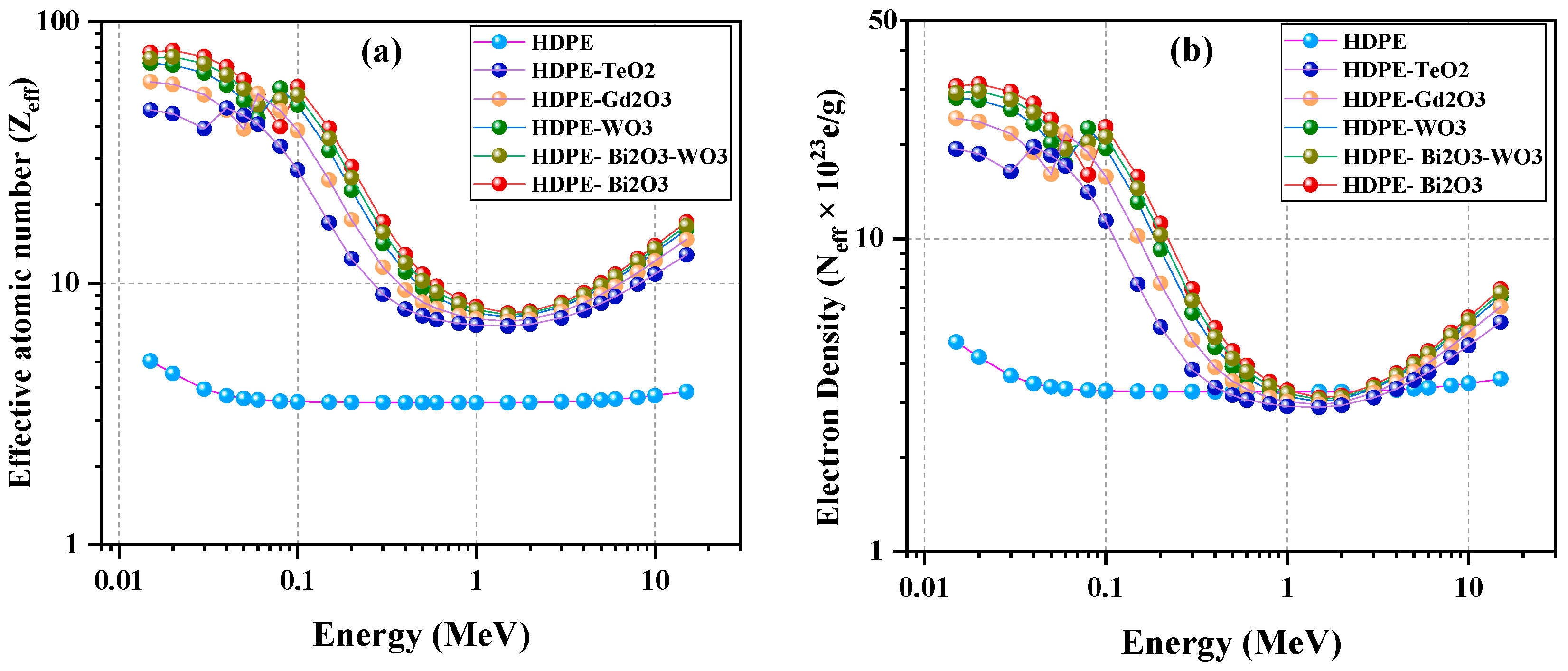
4.4. Effective Atomic Number (Zeff) and Effective Electron Density (Neff)
Z
eff and N
eff, defined in
Section 3.2, describe the composite’s effective atomic number and electron concentration and vary strongly with photon energy.
Figure 5a shows the variation in
Zeff, and
Figure 5b presents
Neff for the HDPE-based composites (C1–C6). The addition of heavy oxides markedly enhances both parameters at low photon energies, dominated by the photoelectric effect.
At 0.015 MeV, C1 (HDPE) records approximately Zeff ≈ 5.0 and Neff ≈ 5 × 10²³ e g−1, while C2 (Bi2O3) reaches about 80 and 30 × 1023 e g−1, respectively. Comparable low energy enhancements observed for C3 (Bi2O3/WO3) and C4 (WO3) with Zeff ≈ 70–73, and Neff ≈ 28–29 × 1023 e g−1, followed by C5 (Gd2O3) and C6 (TeO2), which still exceed the polymer baseline with Zeff ≈ 60, and 45 and Neff ≈ 24 × 1023 e g−1 and 20 × 1023 e g−1, respectively. With increasing energy, above about 0.2 MeV, both Zeff and Neff decrease and gradually converge among the composites as Compton scattering and pair production become dominant. Around 1 MeV, C2 retains the highest interaction probability (Zeff about 8; Neff about 3.0 × 10²³ e g−1), while HDPE remains the lowest (Zeff ≈ 3–4). However, in this Compton-dominant region, the Neff values of all systems—including neat HDPE—become nearly identical, reflecting the fact that Compton scattering depends mainly on the number of electrons per gram rather than on atomic number. At higher energies (up to 15 MeV), minor differences persist, confirming the sustained advantage of oxide-reinforced systems over the neat polymer.
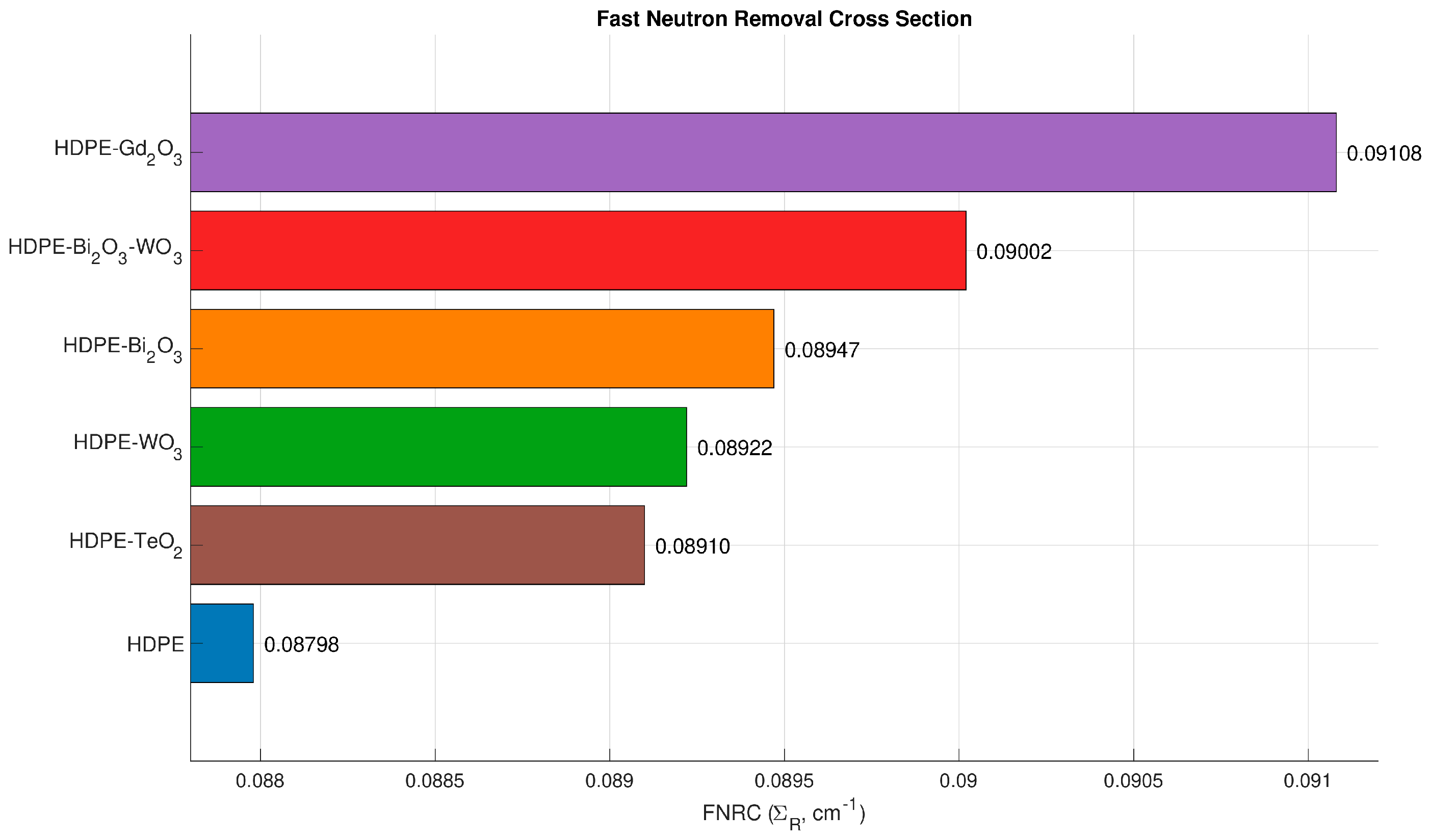
4.5. Fast-Neutron Shielding Performance (ΣR)
Figure 6 presents the fast-neutron removal cross section (Σ
R) for the HDPE-based systems C1–C6. The unfilled polymer (C1) shows the lowest value, Σ
R ≈ 0.0879 cm
−1. All oxide-reinforced composites show a modest but consistent enhancement in Σ
R, as described by the definition and interpretation provided in
Section 3.2. Among the filled systems, C5 (Gd
2O
3) achieves the highest Σ
R (≈0.0911 cm
−1), followed closely by the hybrid composite C3 (Bi
2O
3–WO
3) at ≈0.0900 cm
−1. This superior performance of the Gd
2O
3-filled composite is directly linked to the exceptionally large thermal-neutron absorption cross section of gadolinium (≈49,000 barns for natural Gd), one of the highest of any naturally occurring element, which significantly enhances its neutron-capture capability [
33]. The Bi
2O
3 (C2), WO
3 (C4), and TeO
2 (C6) systems yield Σ
R values of ≈0.0895, 0.0892, and 0.0891 cm
−1, respectively, all higher than that of neat HDPE. Although the numerical differences appear minor, the enhancement is physically meaningful, as even small increases in Σ
R reflect improved probabilities of fast-neutron attenuation within the composites. This improvement is primarily attributed to the synergistic moderation of hydrogen in HDPE and the superior neutron-capture potential of Gd
2O
3, which provides the most notable gain among all examined fillers.
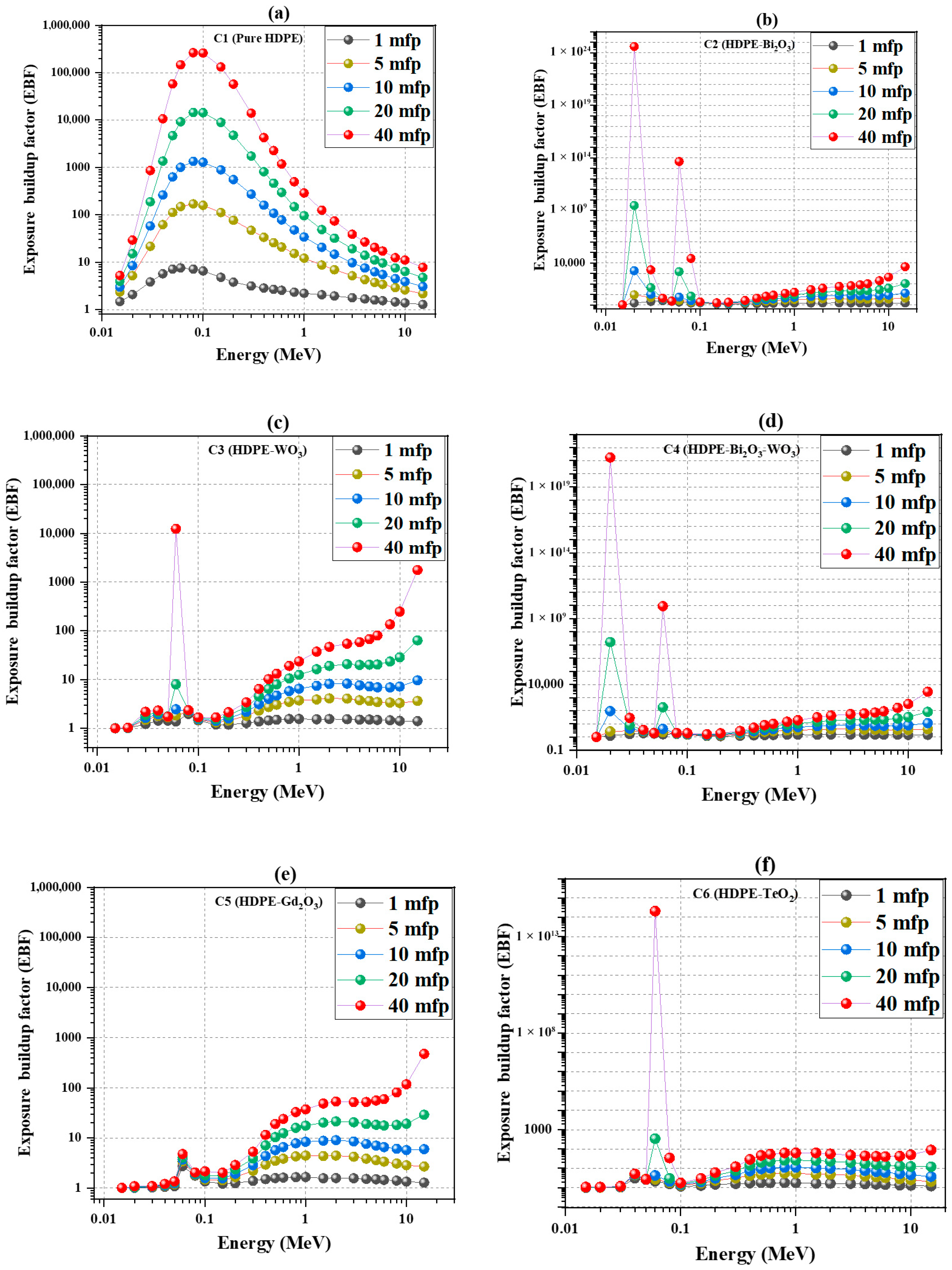
4.6. Buildup Factors: Exposure (EBF) and Energy-Absorption (EABF)
EBF and EABF, described in
Section 3.2, quantify the contribution of scattered photons to exposure and absorbed dose. Reducing these buildup factors is critical because excessive photon scatter increases dose beyond what primary-beam attenuation predicts, degrading shielding performance and potentially compromising radiation protection requirements.
Figure 7 illustrates the variation in the exposure buildup factor (EBF) with mean free path (MFP) for HDPE and its oxide-reinforced composites. Under identical conditions, C2 (Bi
2O
3) exhibits the lowest buildup, maintaining EBF ≈ 2 even at 40 mean free paths in the low-to-intermediate energy range (approximately 0.05–0.2 MeV). C3 (Bi
2O
3–WO
3) and C4 (WO
3) show similar behavior, while C5 (Gd
2O
3) and C6 (TeO
2) record slightly higher values but remain far below the polymer baseline (C1). In the Compton-dominated region (≈0.3–1 MeV), the contrast remains pronounced: at 1 MeV and 40 MFP, C1 reaches ≈300, whereas C2–C4 range between 25 and 40 and C5–C6 between 60 and 100. At higher energies (>3 MeV), all composites exhibit a moderate increase in buildup with increasing penetration depth, resulting from secondary photon and positron cascades. At 15 MeV and 40 MFP, C2 and C3 reach ≈(3–4) × 10
3, whereas C1 remains near 10, highlighting the role of dense oxides in enhancing high-energy photon interaction and attenuation.
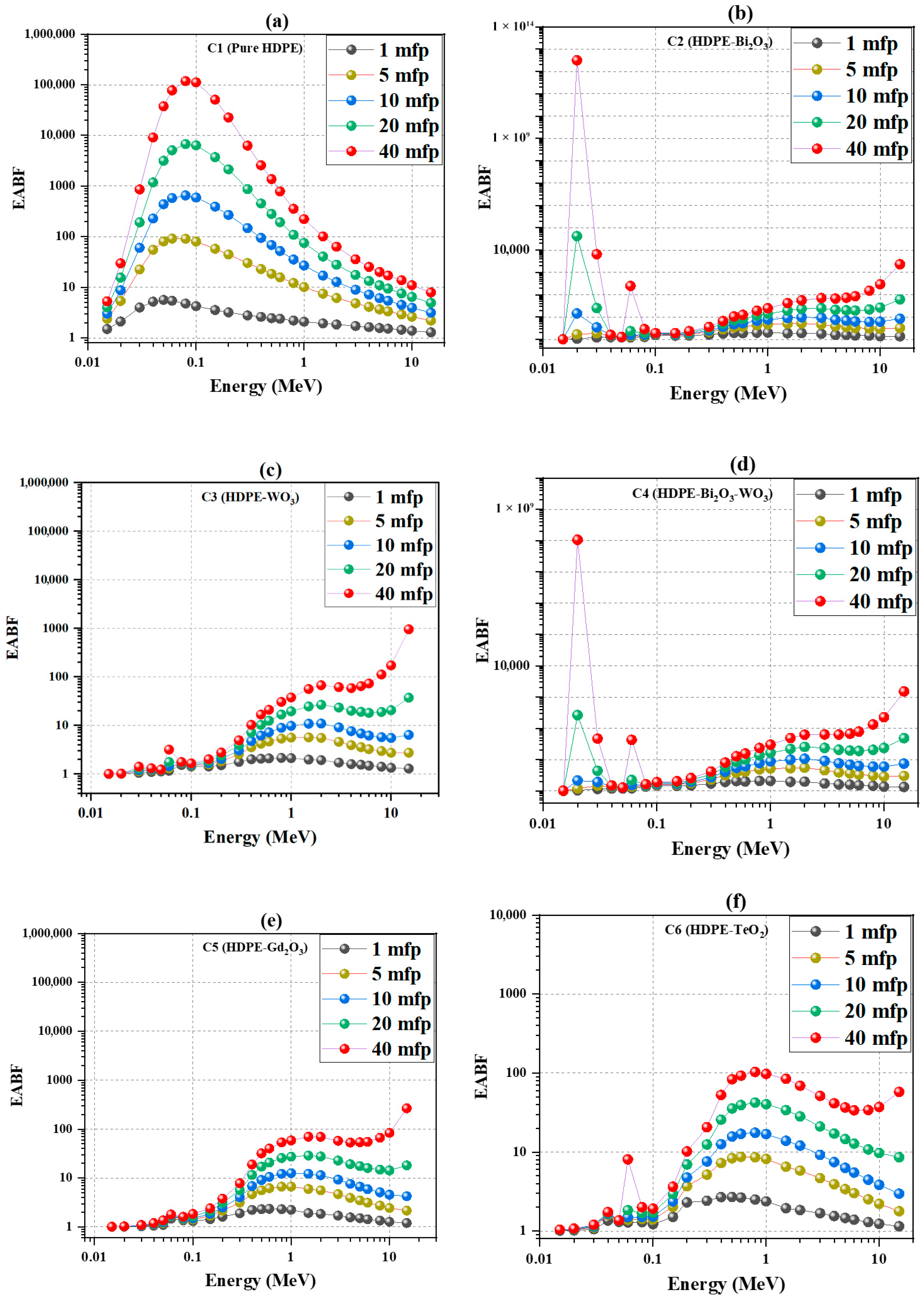
Figure 8 shows the energy-absorption buildup factor (EABF) versus MFP. At 0.1 MeV, C1 increases rapidly—from ≈4 at 1 MFP to ≈80 at 5 MFP, ≈600 at 10 MFP, ≈6000 at 20 MFP, and ≈1 × 10
4 at 40 MFP—while oxide-filled systems remain nearly constant near unity. Across most energies, the composites retain EABF ≈ 2 at both 10 and 40 MFP, confirming strong suppression of secondary photon buildup. The narrow spikes appearing at a few low-energy points arise near the K- or L-absorption edges of the high-Z fillers, where the photon cross sections exhibit abrupt discontinuities. Numerical interpolation across these discontinuities can introduce small overshoots that are not physical interaction processes but artifacts of the tabulated cross-section data, as noted in standard databases such as NIST XCOM [
28].
At 1 MeV, C1 reaches ≈200, whereas C2–C4 remain within 20–40, and C5–C6 between 60 and 100. At 15 MeV, the EABF of all systems increases slightly, with the dense composites showing a higher buildup than HDPE, supporting the concept of layered shielding designs that combine hydrogen-rich moderation with high-Z absorption for improved protection against mixed and high-energy radiation fields.
For practical relevance, it is useful to compare the present HDPE–oxide composites with standard commercial shielding materials. Lead provides excellent gamma attenuation because of its very high density (11.34 g·cm−3), but its toxicity and rigidity limit its use in many environments. Borated polyethylene (commonly 5–30 wt.% B) is highly effective for neutron moderation yet insufficient for gamma shielding. Barite-concrete offers a non-toxic alternative with moderate gamma attenuation, but is significantly heavier and less mechanically versatile. In contrast, the HDPE-based composites studied here combine effective photon attenuation, enhanced neutron interaction (notably for Gd2O3-filled systems), mechanical robustness, and reduced weight, underscoring their suitability as practical, lead-free shielding materials for medical, industrial, and aerospace applications.
5. Conclusions
This study comprehensively evaluated HDPE composites reinforced with high-Z oxides, Bi2O3, WO3, Gd2O3, TeO2, and a Bi2O3/WO3 hybrid (30/30 wt.%), for efficient gamma-ray and fast-neutron shielding over 0.015–15 MeV using Phy-X/PSD and Geant4 simulations. Incorporating dense oxides produced substantial gains in photon attenuation, particularly at low energies, where WO3 and the Bi2O3–WO3 hybrid exhibited the highest linear-attenuation coefficients, followed by Bi2O3; Gd2O3 and TeO2 provided moderate improvements. Around 0.662 MeV, which corresponds to the gamma-ray energy of the widely used Cs-137 emission line frequently employed in shielding experiments due to its availability as a stable sealed source and its intermediate penetration depth that represents many medical, industrial, and environmental gamma-ray fields, all composites maintained superior attenuation compared with neat HDPE, while Bi- and W-rich systems remained dominant. At multi-MeV energies, attenuation coefficients converged but continued to favor oxide-reinforced systems due to pair-production contributions. On a mass basis, the improvement was most pronounced at low energies, slightly reduced near 1 MeV, and increased again at multi-MeV levels due to pair-production effects. The buildup factors (EBF and EABF) stayed near unity up to ~1 MeV, confirming effective suppression of scattered-photon accumulation. At higher energies, a moderate rise in buildup indicated that layered configurations combining hydrogen-rich moderation and dense absorbers can further optimize performance. The fast-neutron removal cross section (ΣR) improved slightly for all filled composites, with Gd2O3 achieving the highest enhancement, confirming its dual gamma- and neutron-shielding potential. Excellent consistency between Phy-X/PSD and Geant4 outcomes validates the reliability of the hybrid computational framework. These lead-free HDPE-based composites present lightweight, flexible, and environmentally safe alternatives for radiation protection in medical, nuclear, and aerospace applications. Future work should emphasize experimental fabrication with improved filler dispersion, evaluation of mechanical and thermal stability, optimization of multilayer architectures, and benchmarking against conventional shielding materials under realistic radiation conditions.