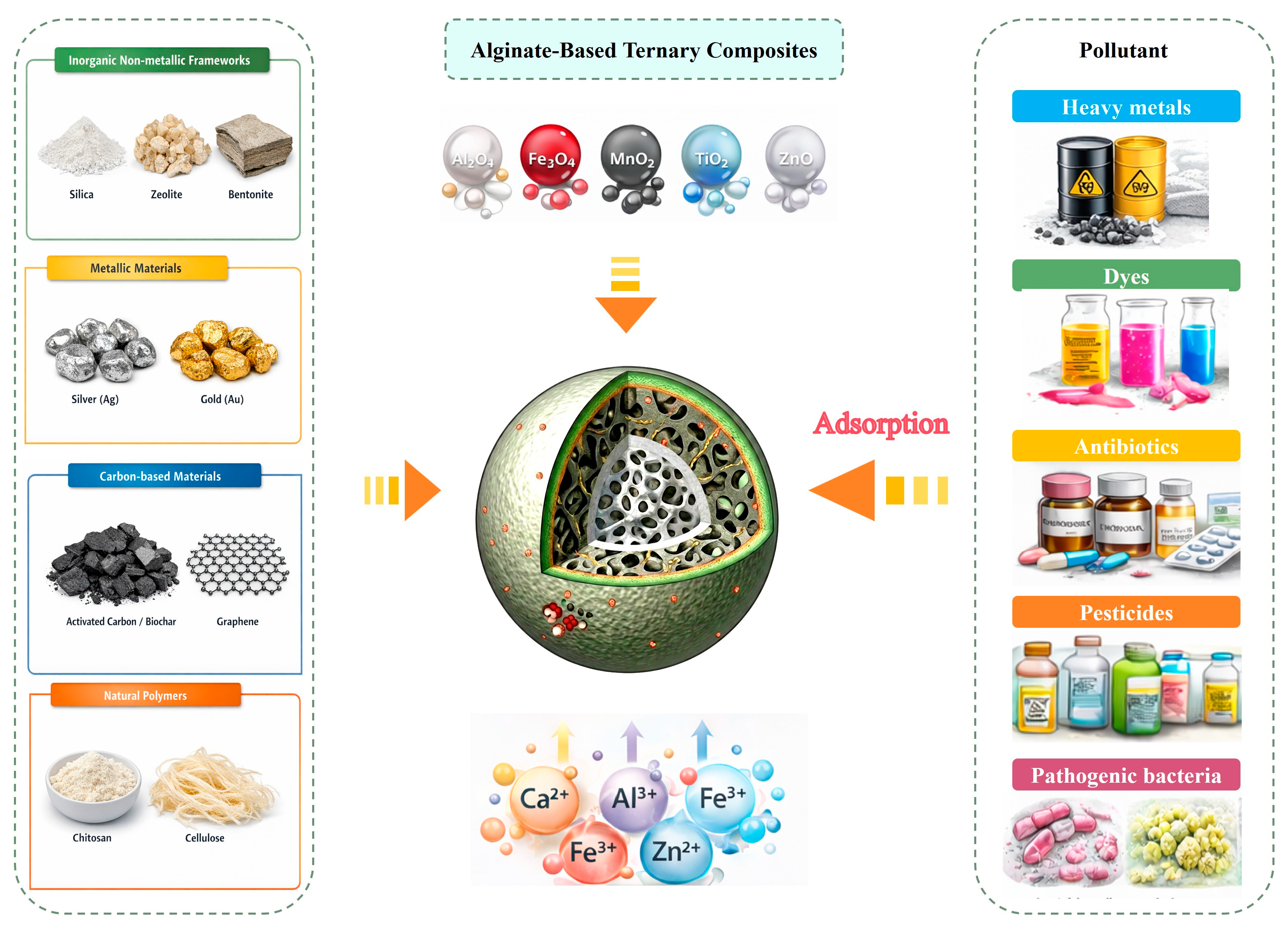


Alginate-Based Ternary Composites for Water Treatment: Synthesis, Mechanisms, and Applications




Abstract
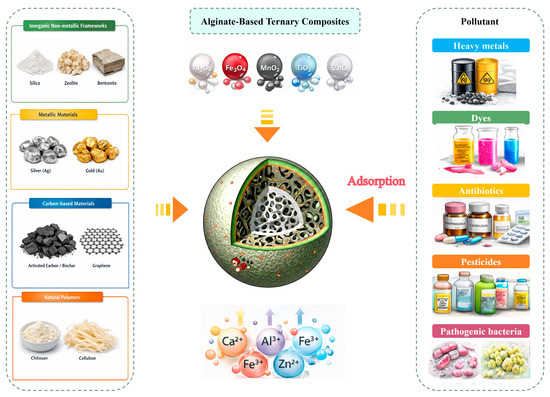
1. Introduction
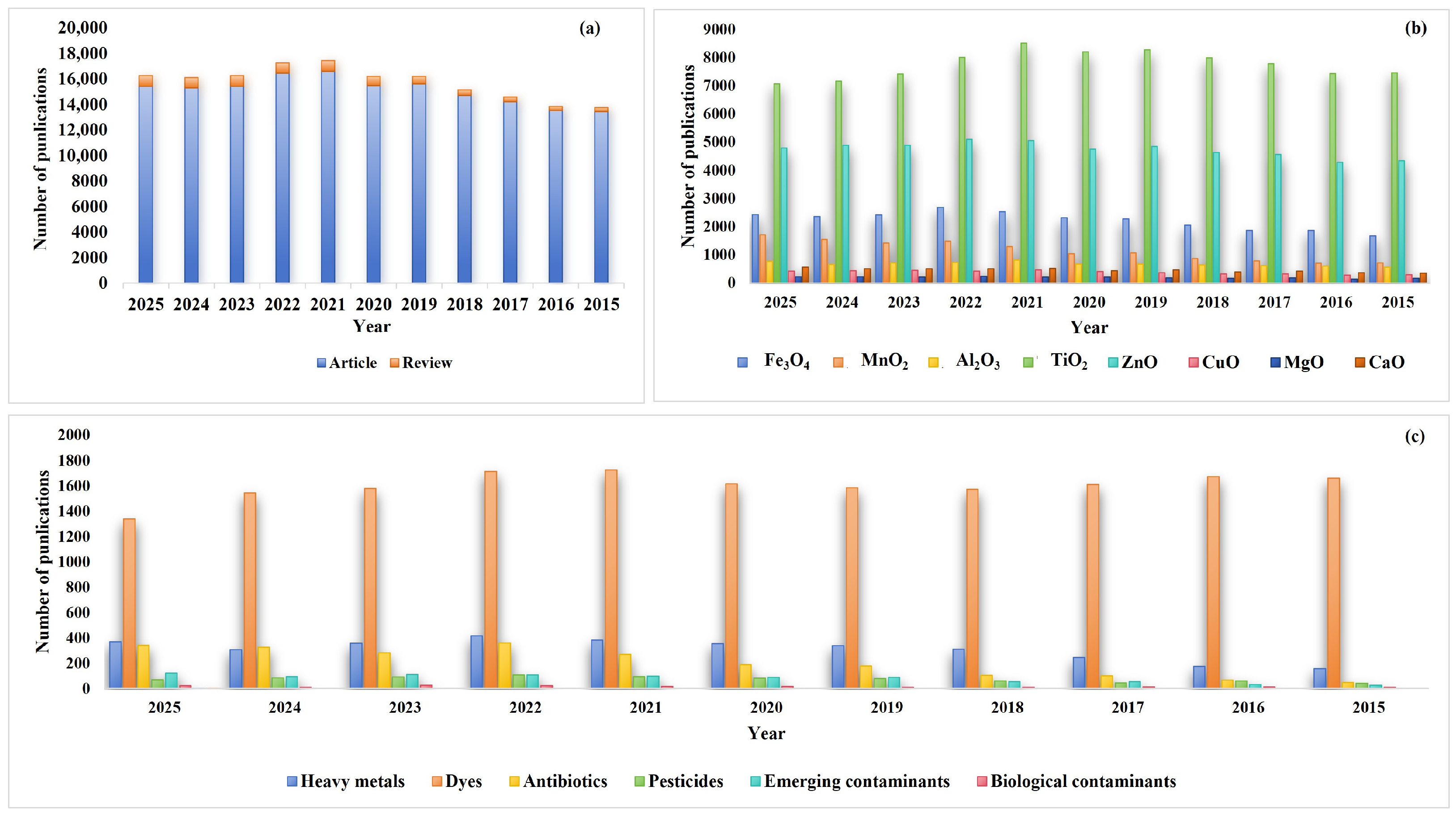
1.1. Water Pollution and Sustainable Water Treatment Technologies
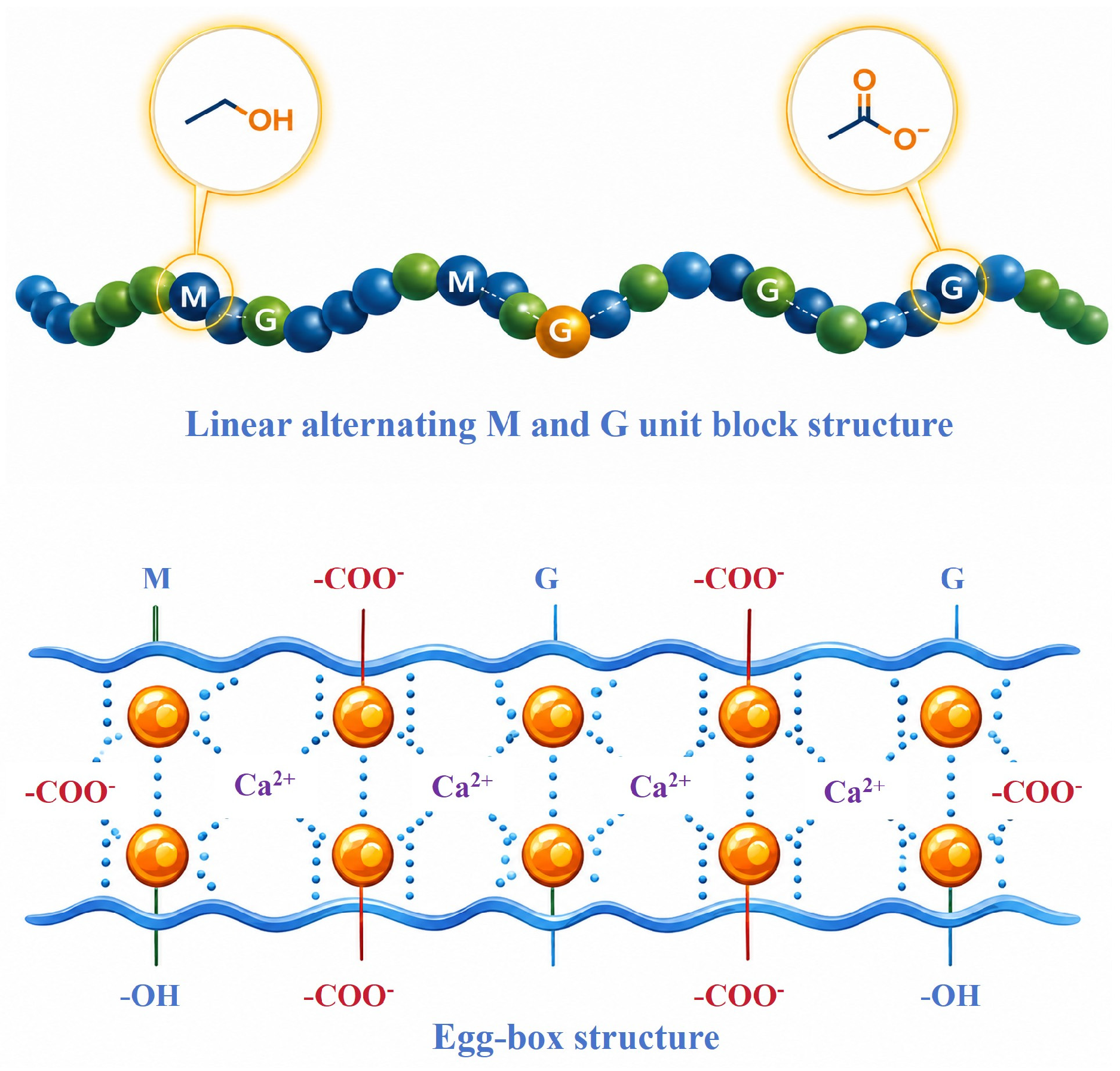
1.2. Sodium Alginate as a Bio-Based Adsorbent
1.3. SA/Metal Oxide Binary Composites
1.4. Motivation for Developing Ternary SA-Based Composites
2. Synthesis of Alginate-Based Composites
2.1. Synthesis of SA/Metal Oxide Binary Composites
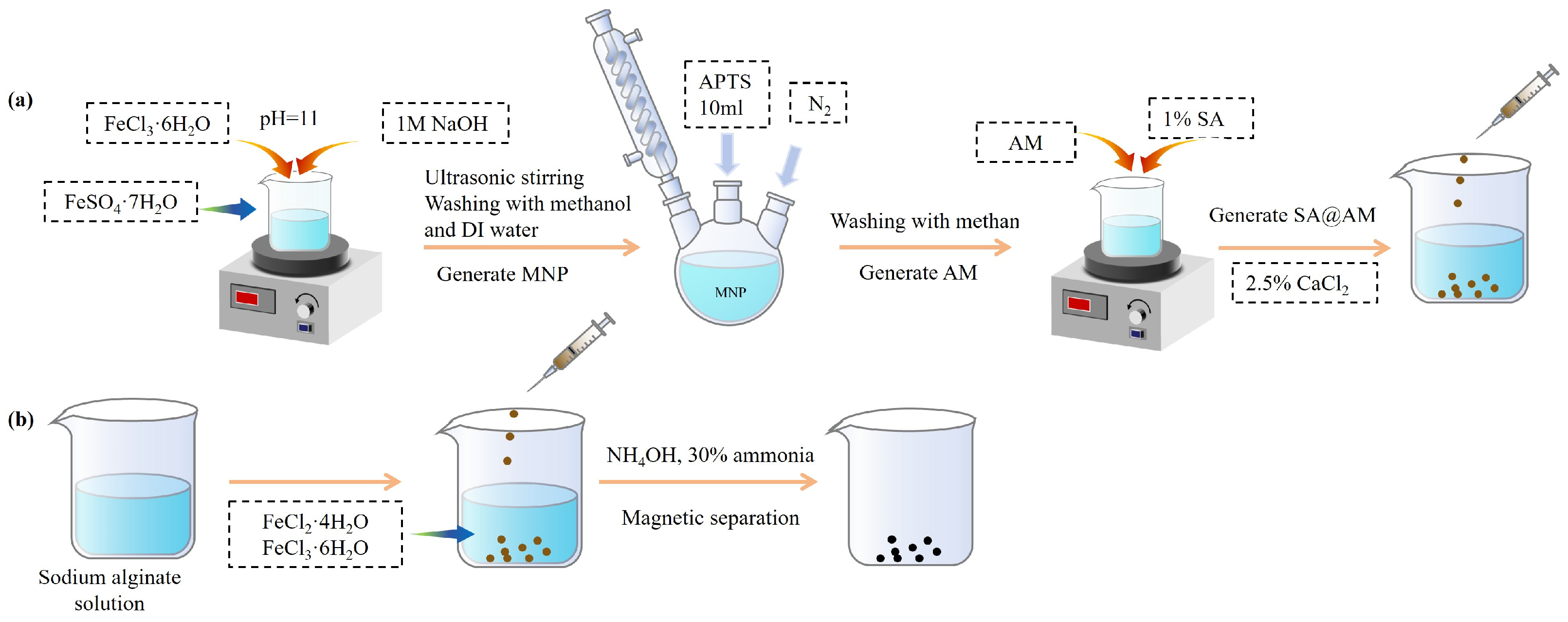
2.1.1. Ionic Crosslinking Method
2.1.2. In Situ Synthesis Method
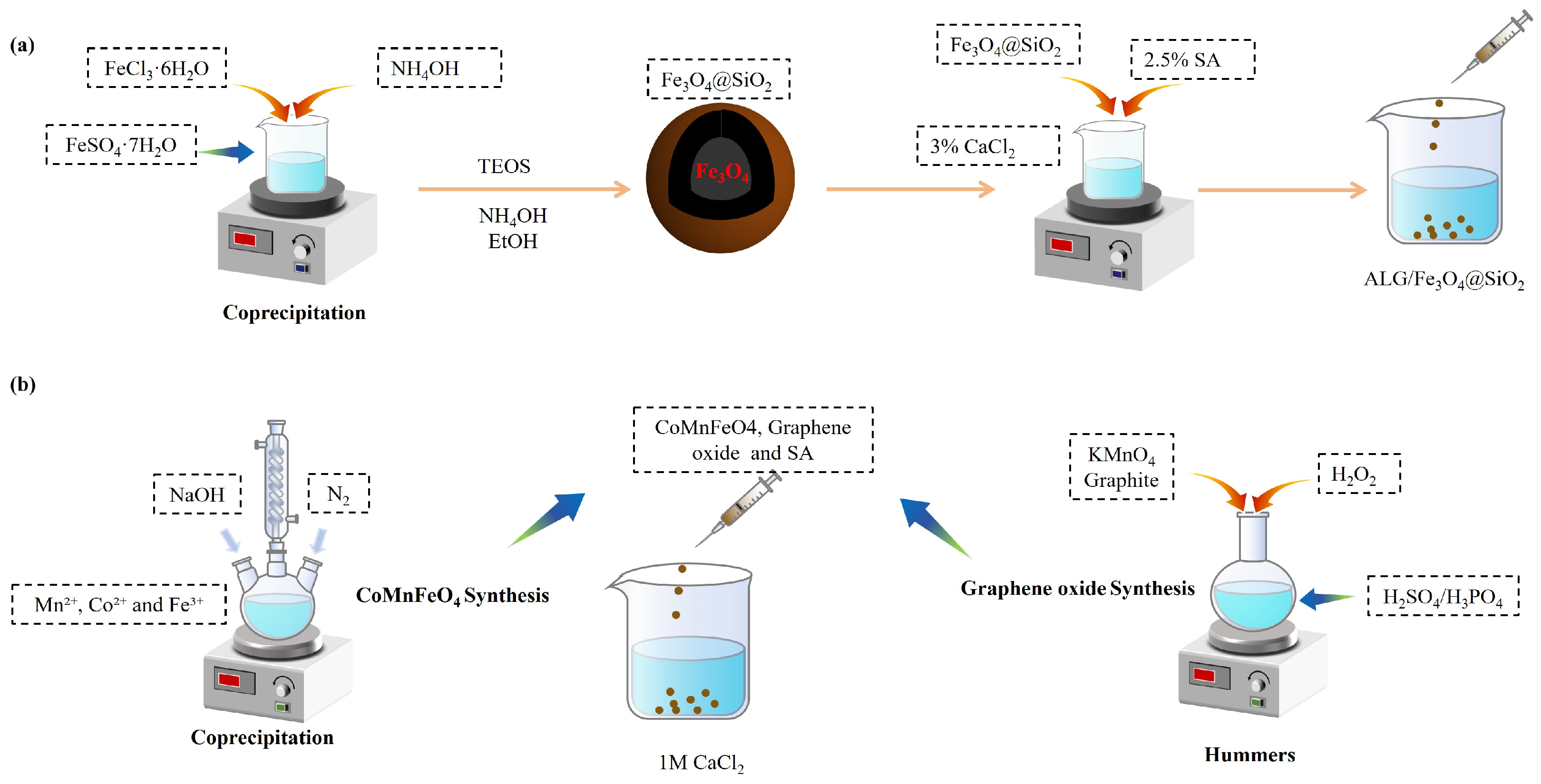
2.2. Synthesis of Ternary Composites
2.2.1. Ternary Systems Based on Inorganic Non-Metallic Frameworks
2.2.2. Ternary Systems Based on Metal Nanoparticles
2.2.3. Ternary Systems Based on Natural Polymer Materials
2.2.4. Ternary Systems Based on Porous Carbon-Based Materials
3. Applications of Alginate-Based Composites to Wastewater Treatment
3.1. Removal of Heavy Metals
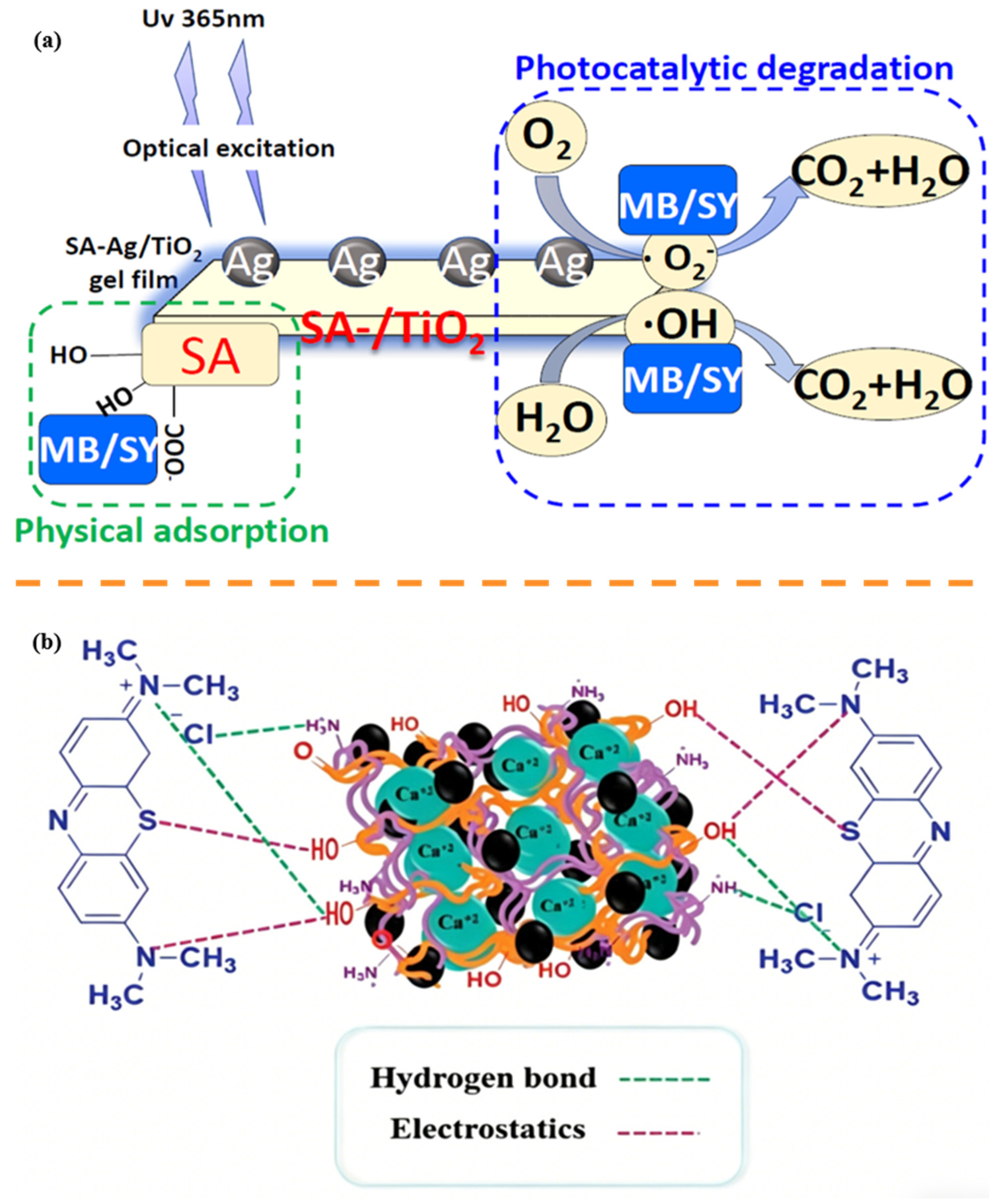
3.2. Removal of Dyes

3.3. Removal of Antibiotics
3.4. Removal of Other Pollutants
3.5. Comparative Evaluation of Binary and Ternary Alginate-Based Composites
3.6. Synergistic Mechanisms of Alginate-Based Ternary Composites
3.7. Critical Evaluation of Alginate-Based Ternary Composite Strategies
4. Limitations and Future Research Recommendations
5. Summary and Outlook
Author Contributions
Funding
Institutional Review Board Statement
Data Availability Statement
Acknowledgments
Conflicts of Interest
References
- Khoo, P.S.; Ilyas, R.A.; Aiman, A.; Wei, J.S.; Yousef, A.; Anis, N.; Zuhri, M.Y.M.; Abral, H.; Sari, N.H.; Syafri, E.; et al. Revolutionizing wastewater treatment: A review on the role of advanced functional bio-based hydrogels. Int. J. Biol. Macromol. 2024, 278, 135088. [Google Scholar] [CrossRef] [PubMed]
- Wang, J.; Li, F.; Bao, Y.; Zhan, S. A mini review on the synthesis of mesoporous silica and its application in antibiotic removal. Adv. Sustain. Syst. 2025, 9, 2400634. [Google Scholar] [CrossRef]
- Barani, S.; Sebastian, S.P.; Dhevagi, P.; Prasanthrajan, M.; Suganthi, A. Synthesis of silica nanoparticles (SiNPs) from agro-wastes for removal of heavy metals from an aqueous medium—A mini review. Green Chem. Lett. Rev. 2024, 17, 2422416. [Google Scholar] [CrossRef]
- Rashid, R.; Shafiq, I.; Akhter, P.; Iqbal, M.J.; Hussain, M. A state-of-the-art review on wastewater treatment techniques: The effectiveness of adsorption method. Environ. Sci. Pollut. Res. 2021, 28, 9050–9066. [Google Scholar] [CrossRef] [PubMed]
- Arman, N.Z.; Salmiati, S.; Aris, A.; Salim, M.R.; Nazifa, T.H.; Muhamad, M.S.; Marpongahtun, M. A review on emerging pollutants in the water environment: Existences, health effects and treatment processes. Water 2021, 13, 3258. [Google Scholar] [CrossRef]
- Rodriguez-Otero, A.; Vargas, V.; Galarneau, A.; Castillo, J.; Christensen, J.H.; Bouyssiere, B. Sustainable harnessing of SiO2 nanoparticles from rice husks: A review of the best synthesis and applications. Processes 2023, 11, 3373. [Google Scholar] [CrossRef]
- Tejedor, J.; Guerrero, V.H.; Vizuete, K.; Debut, A. Environmentally friendly synthesis of silicon dioxide nanoparticles and their application for the removal of emerging contaminants in aqueous media. J. Phys. Conf. Ser. 2022, 2238, 012005. [Google Scholar] [CrossRef]
- Taleb, M.A.; Kumar, R.; Barakat, M.A.; Almeelbi, T.; Seliem, M.K.; Ahmad, A. Recent advances in heavy metals uptake by tailored silica-based adsorbents. Sci. Total Environ. 2024, 955, 177093. [Google Scholar] [CrossRef] [PubMed]
- Ayhan, N.K.; Seker, S. Removal of reactive blue 4 dye from aqueous solution with magnetic Fe3O4@nd/alg beads. J. Polym. Environ. 2026, 34, 45. [Google Scholar] [CrossRef]
- Orisawayi, A.O.; Koziol, K.K.; Rahatekar, S.S. Bio-based composites of alginate, cellulose, and moringa oleifera for heavy metal removal in water purification: A comprehensive and critical review of mechanisms, fabrication, and performance. Environ. Sci. Adv. 2026, 5, 617–658. [Google Scholar] [CrossRef]
- Eltaweil, A.S.; El-Monaem, E.M.A.; Elshishini, H.M.; El-Aqapa, H.G.; Hosny, M.; Abdelfatah, A.M.; Ahmed, M.S.; Hammad, E.N.; El-Subruiti, G.M.; Fawzy, M.; et al. Recent developments in alginate-based adsorbents for removing phosphate ions from wastewater: A review. RSC Adv. 2022, 12, 8228–8248. [Google Scholar] [CrossRef] [PubMed]
- Alam, A.; Hassan, A.; Sultana, Z.; Das, N. Natural polymer-based bioadsorbents for wastewater treatment. RSC Sustain. 2025, 3, 5027–5050. [Google Scholar] [CrossRef]
- Ayed, S.B.; Aloui, L.; Mansour, L.; Ayari, F. Synthesized and characterization of calcium alginate beads as biosorbent of pollutants dye and phosphate from aqueous solution. Desalin. Water Treat. 2023, 314, 199–209. [Google Scholar] [CrossRef]
- Kamal, A.A.M.; Mahazan, S.N.A.B.; Abidin, N.H.Z.; Ramli, F.F.; Ibrahim, W.N.W. Pre-concentration of organochlorine pesticides using micro-solid phase extraction based on bio-sorbent alginate-silica beads derived from oil palm frond. Malays. J. Anal. Sci. 2024, 28, 441–460. [Google Scholar]
- Chen, S.; Wen, H.; Zheng, T.; Liu, X.; Wang, Z.; Tian, S.; Fan, H.; Chen, Y.; Zhao, H.; Wang, Y. Engineering sodium alginate-SiO2 composite beads for efficient removal of methylene blue from water. Int. J. Biol. Macromol. 2023, 239, 124279. [Google Scholar] [CrossRef] [PubMed]
- Alenezi, H.; Gad, E.S.; Albassami, N.A.; Alatawi, I.S.; Alshareef, S.A.; Aljowni, M.A.; Jame, R.; Abdelaziz, M.A.; El-din, A.S.B.; Saleh, A.K. Development of oxidized sodium alginate/silica hybrid as efficient adsorbent for anionic and cationic dyes: Mechanism and thermodynamic studies. Biomass Convers. Biorefinery 2025, 15, 18247–18261. [Google Scholar] [CrossRef]
- Lakshmi, D.; Radha, K.; Azeez, T.; Munisamy, S. A review on alginate-nanoparticle as a potential tool for managing water pollution. Eng. Technol. J. 2023, 42, 327–336. [Google Scholar] [CrossRef]
- Hosseinzadeh, H.; Abdi, K. Efficient removal of methylene blue using a hybrid organic–inorganic hydrogel nanocomposite adsorbent based on sodium alginate–silicone dioxide. J. Inorg. Organomet. Polym. Mater. 2017, 27, 1595–1612. [Google Scholar] [CrossRef]
- Dagil, G.J.; Nyuk-Ting, N.; Keyon, A.S.A.; Ibrahim, W.A.W.; Chandren, S. Novel alginate-chitosan amine-functionalized silica-coated magnetic composite for heavy metals removal in water. Malays. J. Anal. Sci. 2023, 27, 422–439. [Google Scholar]
- Wang, B.; Wan, Y.; Zheng, Y.; Lee, X.; Liu, T.; Yu, Z.; Huang, J.; Ok, Y.S.; Chen, J.; Gao, B. Alginate-based composites for environmental applications: A critical review. Crit. Rev. Environ. Sci. Technol. 2019, 49, 318–356. [Google Scholar] [CrossRef] [PubMed]
- Felicia, W.X.L.; Rovina, K.; Supri, S.; Matanjun, P.; Amin, S.F.M.; Rahman, M.N.A. Next-generation sodium alginate hydrogels for heavy metal ion removal: Properties, dynamic adsorption–desorption mechanisms, and sustainable application potential. Polym. Bull. 2025, 82, 10587–10637. [Google Scholar] [CrossRef]
- Wang, W.; Huang, Y.; Pan, Y.; Dabbour, M.; Dai, C.; Zhou, M.; He, R. Sodium alginate modifications: A critical review of current strategies and emerging applications. Foods 2025, 14, 3931. [Google Scholar] [CrossRef] [PubMed]
- Abakar, M.A.A.; Khan, S.B. Alginate-wrapped NiO-ZnO nanocomposites-based catalysts for water treatment. J. Exp. Nanosci. 2024, 19, 2375787. [Google Scholar] [CrossRef]
- Verma, P.; Sanwaria, S.; Patel, J.; Singh, A.K.; Jugade, R.; Carabineiro, S.A.C. Bioinspired fabrication of Ca-ZnO/CuO/alginate beads for enhanced wastewater treatment and antibacterial applications. Catalysts 2025, 15, 1107. [Google Scholar] [CrossRef]
- Ayed, S.B.; Mansour, L.; Vaiano, V.; Harrath, A.H.; Ayari, F.; Rizzo, L. Magnetic Fe3O4-natural iron ore/calcium alginate beads as heterogeneous catalyst for novacron blue dye degradation in water by (photo) fenton process. J. Photochem. Photobiol. A Chem. 2023, 438, 114566. [Google Scholar] [CrossRef]
- Khan, S.B.; Akhtar, K.; Bakhsh, E.M.; Kamal, T.; Asiri, A.M. Alginate biopolymer as a reactor container for copper oxide-tin oxide: Efficient nanocatalyst for reduction of different pollutants. Chemosphere 2022, 291, 132811. [Google Scholar] [CrossRef] [PubMed]
- Davarnejad, R.; Hassanvand, Z.R.; Mansoori, S.; Kennedy, J.F. Metronidazole elimination from wastewater through photo-fenton process using green-synthesized alginate-based hydrogel coated bimetallic iron-copper nanocomposite beads as a reusable heterogeneous catalyst. Bioresour. Technol. Rep. 2022, 18, 101068. [Google Scholar] [CrossRef]
- Wang, J.; Guo, M.; Luo, Y.; Shao, D.; Ge, S.; Cai, L.; Xia, C.; Lam, S.S. Production of magnetic sodium alginate polyelectrolyte nanospheres for lead ions removal from wastewater. J. Environ. Manag. 2021, 289, 112506. [Google Scholar] [CrossRef] [PubMed]
- Abbas, A.; Ahmad, T.; Hussain, S.; Noman, M.; Shahzad, T.; Iftikhar, A.; Cheema; Ijaz, M.; Tahir, M.; Gohari, G.; et al. Immobilized biogenic zinc oxide nanoparticles as photocatalysts for degradation of methylene blue dye and treatment of textile effluents. Int. J. Environ. Sci. Technol. 2022, 19, 11333–11346. [Google Scholar] [CrossRef]
- Ai, H.; Xu, L.; Zhang, Z.; Hu, X.; Chen, C.; Sun, W.; Fu, M.-L.; Yuan, B. Al2O3 encapsulated by calcium alginate as composite for efficient removal of phosphate from aqueous solutions: Batch and column studies. Water Sci. Technol. 2022, 85, 3315–3330. [Google Scholar] [CrossRef] [PubMed]
- Ahmad, A.R.D.; Imam, S.S.; Adnan, R.; Oh, W.D.; Latip, A.F.A.; Ahmad, A.A.D. Fenton degradation of ofloxacin antibiotic using calcium alginate beads impregnated with Fe3O4-montmorillonite composite. Int. J. Biol. Macromol. 2023, 229, 838–848. [Google Scholar] [CrossRef] [PubMed]
- Ahmadpoor, F.; Shojaosadati, S.A.; Mousavi, S.Z. Magnetic silica coated iron carbide/alginate beads: Synthesis and application for adsorption of Cu (II) from aqueous solutions. Int. J. Biol. Macromol. 2019, 128, 941–947. [Google Scholar] [CrossRef] [PubMed]
- Mansurov, R.; Pavlova, I.; Shabadrov, P.; Levchenko, A.; Krinochkin, A.; Kopchuk, D.; Nikonov, I.; Prokofyeva, A.; Safronov, A.; Grzhegorzhevskii, K. TiO2-embedded biocompatible hydrogel production assisted with alginate and polyoxometalate polyelectrolytes for photocatalytic application. Inorganics 2023, 11, 92. [Google Scholar] [CrossRef]
- Wu, Z.; Wu, J.; Huang, M.; Liang, H.; Sun, B. Preparation of reusable hydrogel spheres based on sodium alginate/Fe3O4 modified with carboxymethyl huangshui polysaccharide and the efficient adsorption performance for methylene blue. Food Chem. 2024, 438, 138064. [Google Scholar] [CrossRef] [PubMed]
- Njimou, J.R.; Njike, R.M.T.; Kepdieu, J.M.; Djangang, C.N.; Talla, A.; Elambo, N.G.; Fritsky, J.W.; Maicaneanu, S.A.; Rosso, D. Eco-friendly chitin-MnO2-alginate nanobiocomposite spheres for enhanced heavy metal removal from wastewater. Inorg. Chem. Commun. 2025, 172, 113719. [Google Scholar] [CrossRef]
- Li, J.; Yeszhan, Y.; Bexeitova, K.; Baimenov, A.; Kudaibergenov, K.; Adam, M.R.; Lee, J.; Azat, S. Recent progress in bio-based SiO2–metal oxide composites for water treatment applications: A review. Results Eng. 2026, 29, 109416. [Google Scholar] [CrossRef]
- Mansurov, Z.A.; Jandosov, J.M.; Kerimkulova, A.R.; Azat, S.; Zhubanova, A.A.; Digel, I.E.; Savistkaya, I.S.; Akimbekov, N.S.; Kistaubaeva, A.S.; Kistaubaeva, A.S. Nanostructured carbon materials for biomedical use. Eurasian Chem.-Technol. J. 2013, 15, 209–217. [Google Scholar] [CrossRef]
- Ajeel, S.A.; Sukkar, K.A.; Zedin, N.K. Extraction of high purity amorphous silica from rice husk by chemical process. IOP Conf. Ser. Mater. Sci. Eng. 2020, 881, 012096. [Google Scholar] [CrossRef]
- Inglezakis, V.J.; Azat, S.; Tauanov, Z.; Mikhalovsky, S.V. Functionalization of biosourced silica and surface reactions with mercury in aqueous solutions. Chem. Eng. J. 2021, 423, 129745. [Google Scholar] [CrossRef]
- Cha, J.H.; Choi, H.-H.; Jung, Y.-G.; Choi, S.-C.; An, G.S. Novel synthesis of core–shell structured Fe3O4@SiO2 nanoparticles via sodium silicate. Ceram. Int. 2020, 46, 14384–14390. [Google Scholar] [CrossRef]
- Han, X.; Liang, J.; Fukuda, S.; Zhu, L.; Wang, S. Sodium alginate–silica composite aerogels from rice husk ash for efficient absorption of organic pollutants. Biomass Bioenergy 2022, 159, 106424. [Google Scholar] [CrossRef]
- Seimukhanova, L.; Zhantikeyev, U.; Bexeitova, K.; Skwarek, E.; Lee, J.; Azat, S. Green sorbents for strontium and uranium adsorption at solid/liquid interfaces: A review. Sep. Purif. Technol. 2026, 383, 136169. [Google Scholar] [CrossRef]
- Li, H.; Wei, Y.; Wang, Y.; Zhao, Y.; Wang, L.; Feng, J.; Sun, F. Cooperative adsorption of Sb(V) in water by magnetic MgFe2O4-biochar composite beads. Colloids Surf. A Physicochem. Eng. Asp. 2024, 684, 133133. [Google Scholar] [CrossRef]
- El Fadl, F.I.A.; El-Toony, M.M.; Maziad, N.A. Application of tea waste/alginate/nanoparticles iron bio-nanocomposite beads for removal of crude oil. J. Polym. Environ. 2024, 32, 780–790. [Google Scholar] [CrossRef]
- Cai, C.; Gao, L.; Xiong, Y. Green recyclable chitosan/carboxymethyl cellulose/sodium alginate magnetic double-network composite hydrogels for adsorption of MB and Cu2+. J. Water Process Eng. 2024, 63, 105420. [Google Scholar] [CrossRef]
- Benettayeb, A.; Ghosh, S.; Usman, M.; Seihoub, F.Z.; Sohoo, I.; Chia, C.H.; Sillanpää, M. Some well-known alginate and chitosan modifications used in adsorption: A review. Water 2022, 14, 1353. [Google Scholar] [CrossRef]
- Facchi, D.P.; Cazetta, A.L.; Canesin, E.A.; Almeida, V.C.; Bonafé, E.G.; Kipper, M.J.; Martins, A.F. New magnetic chitosan/alginate/Fe3O4@SiO2 hydrogel composites applied for removal of Pb(II) ions from aqueous systems. Chem. Eng. J. 2018, 337, 595–608. [Google Scholar] [CrossRef]
- Pholnak, P.; Sittiyothee, S.; Sirisathitkul, C.; Sirisathitkul, Y. Dye removal efficiency of fresh and dry alginate beads incorporating zinc oxide. Arab. J. Basic. Appl. Sci. 2022, 29, 53–64. [Google Scholar] [CrossRef]
- Hezma, A.M.; Shaltout, W.A.; Kabary, H.A.; El-Bahy, G.S.; Abdelrazzak, A.B. Fabrication, characterization and adsorption investigation of nano zinc oxide–sodium alginate beads for effective removal of chromium (VI) from aqueous solution. J. Inorg. Organomet. Polym. Mater. 2023, 33, 1400–1408. [Google Scholar] [CrossRef]
- Ince, M.; Ince, O.K.; Aydogdu, B.; Alp, H. Green-synthesis of superparamagnetic Fe3O4/alginate bio-nanocomposites for heavy metal contamination removal from industrial wastewater. Res. Sq. 2022. [Google Scholar] [CrossRef] [PubMed]
- Safavi, S.; Raouf, F.; Naghavi, A. Fe-mn-alginate: A highly effective adsorbent for arsenic removal. Environ. Pollut. Bioavailab. 2025, 37, 2556181. [Google Scholar] [CrossRef]
- Monroy, L.H.; Tavares, J.R.; Dumont, M.-J. Photodegradation of ciprofloxacin using an alginate/TiO2 hydrogel for water remediation. J. Environ. Chem. Eng. 2025, 13, 115868. [Google Scholar] [CrossRef]
- Wan, S.; Zhao, W.; Xiong, D.; Li, S.; Ye, Y.; Du, L. Novel alginate immobilized TiO2 reusable functional hydrogel beads with high photocatalytic removal of dye pollutions. J. Polym. Eng. 2022, 42, 978–985. [Google Scholar] [CrossRef]
- Lam, W.H.; Tee, L.H.; Ban, Z.H. A facile and rapid immobilization method of titanium dioxide-alginate composite for the photocatalytic removal of reactive black-5. Bull. Chem. React. Eng. Catal. 2024, 19, 230–241. [Google Scholar] [CrossRef]
- Chen, Z.; Chen, M.; Koh, K.Y.; Neo, W.; Ong, C.N.; Chen, J.P. An optimized CaO2-functionalized alginate bead for simultaneous and efficient removal of phosphorous and harmful cyanobacteria. Sci. Total Environ. 2022, 806, 150382. [Google Scholar] [CrossRef] [PubMed]
- Soumia, A.; Adel, M.; Amina, S.; Bouhadjar, B.; Amal, D.; Farouk, Z.; Abdelkader, B.; Mohamed, S. Fe3O4-alginate nanocomposite hydrogel beads material: One-pot preparation, release kinetics and antibacterial activity. Int. J. Biol. Macromol. 2020, 145, 466–475. [Google Scholar] [CrossRef] [PubMed]
- Lucaci, A.-R.; Bulgariu, D.; Bulgariu, L. In situ functionalization of iron oxide particles with alginate: A promising biosorbent for retention of metal ions. Polymers 2021, 13, 3554. [Google Scholar] [CrossRef] [PubMed]
- Fernando, I.P.S.; Lee, W.; Han, E.J.; Ahn, G. Alginate-based nanomaterials: Fabrication techniques, properties, and applications. Chem. Eng. J. 2020, 391, 123823. [Google Scholar] [CrossRef]
- Peñas-Núñez, S.J.; Lecumberri, D.; Durán, A.; Peñas, F.J. Microfluidic fabrication of TiO2–hydrogel photocatalytic composites for water treatment. Crystals 2026, 16, 175. [Google Scholar] [CrossRef]
- Mekawy, Z.A.; Breky, M.M.E.; Abass, M.R. Preparation and characterization of MnO2-alginate composite and its application for sorption of 160Tb from aqueous media. Water Air Soil Pollut. 2025, 236, 587. [Google Scholar] [CrossRef]
- Azat, S.; Arkhangelsky, E.; Papathanasiou, T.; Zorpas, A.A.; Abirov, A.; Inglezakis, V.J. Synthesis of biosourced silica–Ag nanocomposites and amalgamation reaction with mercury in aqueous solutions. Comptes Rendus Chim. 2020, 23, 77–92. [Google Scholar] [CrossRef]
- Barzegarzadeh, M.; Asadi, S. Efficient chlorpyrifos removal using alginate-based bionanocomposite hydrogel beads (ALG/Fe3O4@SiO2) in the batch adsorption system. Int. J. Biol. Macromol. 2025, 333, 148729. [Google Scholar] [CrossRef] [PubMed]
- Hachemaoui, M.; Mokhtar, A.; Mekki, A.; Zaoui, F.; Abdelkrim, S.; Hacini, S.; Boukoussa, B. Composites beads based on Fe3O4@MCM-41 and calcium alginate for enhanced catalytic reduction of organic dyes. Int. J. Biol. Macromol. 2020, 164, 468–479. [Google Scholar] [CrossRef] [PubMed]
- Liu, Z.; Zhao, H.; Wang, J.; Wang, Z.; Di, S.; Xu, H.; Wang, Q.; Wang, X.; Qi, P. Green synthesis of Fe3O4@SiO2@salg particles for organophosphorus pesticides removal: Mechanisms, biosafety, and application. Chemosphere 2023, 332, 138751. [Google Scholar] [CrossRef] [PubMed]
- Gao, Y.; Liu, S. Synthesis, characterization and mechanism of alginate/Fe3+ coated Nanozro2/zms composite for the removal of nitrate from drinking water. SSRN 2022. [Google Scholar] [CrossRef]
- Swistun, E.; Sobczyk, M.; Kumar, A.S.K.; Tseng, W.-L.; Bajda, T. Synthetic zeolite derived from coal fly ash decorated with magnetic alginate bead: Application to detoxification of arsenic and vanadium. Mineralogia 2023, 54, 18–30. [Google Scholar] [CrossRef]
- Biswas, S.; Pal, A. Iron oxide-loaded alginate-bentonite hydrogel beads as a green and sustainable catalyst for 4-nitrophenol reduction. Mater. Today Commun. 2021, 28, 102588. [Google Scholar] [CrossRef]
- Chkirida, S.; Zari, N.; Achour, R.; Hassoune, H.; Lachehab, A.; Qaiss, A.E.K.; Bouhfid, R. Highly synergic adsorption/photocatalytic efficiency of alginate/bentonite impregnated TiO2 beads for wastewater treatment. J. Photochem. Photobiol. Chem. 2021, 412, 113215. [Google Scholar] [CrossRef]
- Ghorbani-Vaghei, R.; Veisi, H.; Aliani, M.H.; Mohammadi, P.; Karmakar, B. Alginate modified magnetic nanoparticles to immobilization of gold nanoparticles as an efficient magnetic nanocatalyst for reduction of 4-nitrophenol in water. J. Mol. Liq. 2021, 327, 114868. [Google Scholar] [CrossRef]
- Vinceković, M.; Genzić, L.Ž.; Jalšenjak, N.; Kaliterna, J.; Meštrović, I.R.; Majdak, M.; Šegota, S.; Marciuš, M.; Svečnjak, L.; Kos, I.; et al. Antifungal activity of ag and ZnO nanoparticles co-loaded in zinc–alginate microparticles. Sustainability 2025, 17, 11374. [Google Scholar] [CrossRef]
- Zeng, H.; Sun, S.; Xu, K.; Zhao, W.; Hao, R.; Zhang, J.; Li, D. Adsorption of as (V) by magnetic alginate-chitosan porous beads based on iron sludge. J. Clean. Prod. 2022, 359, 132117. [Google Scholar] [CrossRef]
- Gong, D.; Yang, P.; Zhao, J.; Jia, X. Selective removal of thallium from water by MnO2-doped magnetic beads: Performance and mechanism study. J. Environ. Manag. 2024, 353, 120147. [Google Scholar] [CrossRef] [PubMed]
- Biftu, W.K.; Ravindhranath, K. Simultaneous removal of phosphate and nitrate from polluted water using Zr-alginate beads doped with green synthesized nano-CeO2 and active carbon of epipremnum aureum plant as an effective adsorbent. Desalin. Water Treat. 2021, 226, 184–196. [Google Scholar] [CrossRef]
- Albqmi, M.; Alhathlaul, N.; Algethami, N.; Hasan, I.; Alshahrani, M.D.; Alali, I.; Aslam, M.; Mahmoud, Z.H. Alginate-based nanocomposite hydrogel beads incorporating graphene oxide and magnetic CoMnFeO4 nanoparticles for pirimicarb adsorption. Int. J. Biol. Macromol. 2026, 354, 151319. [Google Scholar] [CrossRef] [PubMed]
- Wang, Y.; Ren, Q.; Feng, Z.; Li, Y.; Du, Y.; Liu, Y.; Yuan, D.; Wang, C.; Wang, Y. Construction of magnetically separatable Mg/Fe bimetallic oxide-loaded biochar/sodium alginate aerogel beads for enhanced uranium(VI) capture. Surf. Interfaces 2024, 52, 104961. [Google Scholar] [CrossRef]
- Russo, E.; Sgarbossa, P.; Gelosa, S.; Copelli, S.; Sieni, E.; Barozzi, M. Adsorption of heavy metal ions on alginate-based magnetic nanocomposite adsorbent beads. Materials 2024, 17, 1942. [Google Scholar] [CrossRef] [PubMed]
- Yuan, B.; Huang, X.; Yang, S.; Yang, Y.; Lin, Z.; Semiat, R.; Chen, J.P. Development of a magnetic calcium-alginate hydrogel-sphere encapsulated with Fe–Mn–Zr ternary metal composite for heavy metal adsorption. Sep. Purif. Technol. 2023, 306, 122531. [Google Scholar] [CrossRef]
- Safari, M.; Rezaee, R.; Soltani, R.D.C.; Asgari, E. Dual immobilization of magnetite nanoparticles and biosilica within alginate matrix for the adsorption of Cd(II) from aquatic phase. Sci. Rep. 2022, 12, 11473. [Google Scholar] [CrossRef] [PubMed]
- Jawed, A.; Sharad, A.; Chutani, A.; Mehak; Pandey, L.M. Amine functionalized Fe(III)-doped-ZnO nanoparticles based alginate beads for the removal of Cu(II) from aqueous solution. Nano-Struct. Nano-Objects 2024, 38, 101199. [Google Scholar] [CrossRef]
- Gong, D.; Yang, P.; Zhao, J.-Y.; Jia, X.-Y. Selective removal of thallium from water by MnO2-doped magnetic porous beads: Performance and mechanism study. SSRN 2023. [Google Scholar] [CrossRef]
- Maslamani, N.; Khan, S.B.; Bakhsh, E.M.; Akhtar, K. Design of recyclable adsorbent for water pollutants based on chitosan-coated carboxymethyl cellulose-calcium alginate wrapped iron oxide-copper oxide composite beads. J. Nat. Fibers 2024, 21, 2408631. [Google Scholar] [CrossRef]
- Li, X.; Li, J.; Jia, X.; Liu, N.; Gao, X.; Zhou, Z.; Wei, B.; Yang, Z.; Fan, S.; Wu, H.; et al. Efficient elimination of inorganic/organic pollutants by Fe3O4/biochar@ sodium alginate gel beads. Langmuir 2024, 40, 22573–22581. [Google Scholar] [CrossRef] [PubMed]
- Luo, M.; Che, T.; Huang, C.; Zhu, C.; Yang, H.; Zhong, C. Efficient removal of aqueous Pb(II) ions by magnetic alginate composite microcapsules containing canola straw-derived biochar as the reinforcing fillers. J. Polym. Sci. 2024, 62, 1331–1349. [Google Scholar] [CrossRef]
- Malitha, S.B.; Mahmudunnabi, D.M.; Mazumder, S.; Hossain, K.S.; Nurnabi, M.; Alam, M.Z. Rapid adsorptive removal of Pb2+ ions from aqueous systems using a magnetic graphene oxide calcium alginate composite: Optimisation, isotherms, and kinetics. Environ. Sci. Adv. 2025, 4, 595–605. [Google Scholar] [CrossRef]
- Parlayıcı, Ş.; Pehlivan, E. Highly efficient hexavalent chromium removal using nano-Fe3O4/pomegranate peel biochar/alginate composite as an advanced biosorbent. Turk. J. Anal. Chem. 2025, 7, 22–32. [Google Scholar] [CrossRef]
- Elkholy, R.A.; Khalil, E.M.; Farag, A.B.; El-Fadl, M.M.A.; El-Aassar, A.M. Photocatalytic degradation of organic pollutants in wastewater using different nanomaterials immobilized on polymeric beads. Desalin. Water Treat. 2020, 193, 117–128. [Google Scholar] [CrossRef]
- Wardhani, S.; Mardiansyah, H.A.; Purwonugroho, D. Fe3O4-SiO2-alginate photocatalyst for textile dyes waste degradation. Sci. Technol. Indones. 2023, 8, 108–115. [Google Scholar] [CrossRef]
- Yang, Z.; Huang, J.; Li, X.; Fu, Y.; Liu, Z.; Fu, Y. Green synthesis on nanostructured ag/TiO2 alginate film for dye contaminants photodegradation. Nano Express 2026, 7, 015015. [Google Scholar] [CrossRef]
- Azeroual, S.; Khatib, K.; Belfkira, A.; Ablouh, E.-H.; Hanani, Z.; Taourirte, M.; Jalal, R. A novel approach for adsorption of organic dyes from aqueous solutions using a sodium alginate/titanium dioxide nanowire doped with zirconium cryogel beads. Front. Chem. 2024, 12, 1285230. [Google Scholar] [CrossRef] [PubMed]
- Roy, N.; Alex, S.A.; Chandrasekaran, N.; Kannabiran, K.; Mukherjee, A. Studies on the removal of acid violet 7 dye from aqueous solutions by green ZnO@Fe3O4 chitosan–alginate nanocomposite synthesized using camellia sinensis extract. J. Environ. Manag. 2022, 303, 114128. [Google Scholar] [CrossRef] [PubMed]
- Maslamani, N.; Khan, S.B.; Bakhsh, E.M.; Akhtar, K.; Alharbi, M. CuO-Fe2O3/calcium alginate-carboxymethylcellulose-chitosan as efficient nanocomposite beads for catalytic reduction of water pollutants. Results Chem. 2025, 13, 101936. [Google Scholar] [CrossRef]
- Rostami, E.; Hani, M.B.A.F.; Kiasat, A.; Larki, A. Magnetite–chitosan–alginate nanocomposite (CS/al@Fe3O4) for removal of methylene blue (MB) from aquatic environments: Preparation, characterization, and isotherms. Int. J. Chem. Eng. 2025, 2025, 5580331. [Google Scholar] [CrossRef]
- Asif, M.; Nasrullah, A. PVA-alginate beads loaded with activated carbon, Fe3O4 nanoparticles and ionic liquids for methylene blue adsorption and their comparison with membrane. Res. Sq. 2024. [Google Scholar] [CrossRef] [PubMed]
- Mohammadi, R.; Massoumi, B.; Emamalinasabb, B.; Eskandarloo, H. Cu-doped TiO2-graphene/alginate nanocomposite for adsorption and photocatalytic degradation of methylene blue from aqueous solutions. Desalin. Water Treat. 2017, 82, 81–91. [Google Scholar] [CrossRef]
- Saning, A.; Thanachayanont, C.; Suksai, L.; Watcharin, W.; Techasakul, S.; Chuenchom, L.; Dechtrirat, D. Green magnetic carbon/alginate biocomposite beads from iron scrap waste for efficient removal of textile dye and heavy metal. Int. J. Biol. Macromol. 2024, 261, 129765. [Google Scholar] [CrossRef] [PubMed]
- Albalwi, H.A.; El Fadl, F.I.A.; Taleb, M.F.A.; Ibrahim, M.M. Alginate/ZnO beads doped with radiation-induced silver nanoparticles for catalytic degradation of binary mixture of basic and acidic dyes. Appl. Organomet. Chem. 2022, 36, e6677. [Google Scholar] [CrossRef]
- Küçük, İ.; Küçük, N.Y. Composite formation of active biochar from pomegranate peel with magnetite and alginat beads for methylene blue adsorption using box–behnken design. Appl. Sci. 2025, 15, 2085. [Google Scholar] [CrossRef]
- Zheng, Z.; Shi, R.; Zhang, X.; Ni, Y.; Zhang, H. Preparation of activated carbon-reinforced composite beads based on MnO2/MCM-41@Fe3O4 and calcium alginate for efficient removal of tetracycline in aqueous solutions. Polymers 2024, 16, 1115. [Google Scholar] [CrossRef] [PubMed]
- Yang, J.; Du, Y.; Li, W.; Shan, S.; Hu, T.; Su, H. Iron oxide-alginate hydrogel composites for efficient removal of tetracycline using adsorption-coupled fenton-like reaction. SSRN 2023. [Google Scholar] [CrossRef]
- Roy, N.; Kannabiran, K.; Mukherjee, A. Studies on photocatalytic removal of antibiotics, ciprofloxacin and sulfamethoxazole, by Fe3O4-ZnO-chitosan/alginate nanocomposite in aqueous systems. Adv. Powder Technol. 2022, 33, 103691. [Google Scholar] [CrossRef]
- Prasannamedha, G.; Kumar, P.S.; Shivaani, S.; Kokila, M. Sodium alginate/magnetic hydrogel microspheres from sugarcane bagasse for removal of sulfamethoxazole from sewage water: Batch and column modeling. Environ. Pollut. 2022, 307, 119523. [Google Scholar] [CrossRef] [PubMed]
- Mohammadizadeh, Z.N.; Ahadifar, M.; Mobinikhaledi, M.; Ahadi, N. The green synthesis of environmentally friendly magnetic silver complex stabilized on MnCoFe2O4@sodium alginate nanoparticles (MCF@S-ALG/Ag) and evaluation of their antibacterial activity. Environ. Sci. Pollut. Res. 2022, 30, 37185–37196. [Google Scholar] [CrossRef] [PubMed]
- Biftu, W.K.; Mekala, S.; Ravindhranath, K. De-fluoridation of polluted water using aluminium alginate beads doped with green synthesized ‘nano SiO2+nano CeO2-ZrO2’, as an effective adsorbent. ChemistrySelect 2020, 5, 15061–15074. [Google Scholar] [CrossRef]



| Crosslinker | Concentration | Crosslinking Time | Characteristics | Influence on Properties |
|---|---|---|---|---|
| CaCl2 | 1–5 wt% | 10–60 min | Most widely used; mild ionic crosslinking | Good biocompatibility, balanced mechanical strength and porosity |
| BaCl2 | 1–5 wt% | 10–60 min | Stronger affinity to G blocks than Ca2+ | Higher mechanical strength and stability, but higher toxicity |
| ZnCl2 | 0.5–2 wt% | 10–60 min | Functional divalent crosslinker | Improved adsorption activity and antibacterial properties; excessive Zn2+ may reduce biocompatibility |
| FeCl3 | 0.1–1 wt% | 5–30 min | Trivalent ion with strong coordination ability | Higher crosslinking density and catalytic functionality, but may produce brittle gels and color changes |
| AlCl3 | 0.1–1 wt% | 5–30 min | High-valence ionic crosslinker | Increased gel rigidity and structural stability; excessive crosslinking may reduce swelling and diffusion |
| Construction Strategy | Advantages | Limitations |
|---|---|---|
| Physical mixing + ionic crosslinking | Simple preparation, low cost, scalable | Weak interfacial interaction, possible aggregation |
| Self-assembly + ionic crosslinking | Strong interfacial integration, uniform distribution | More complex synthesis conditions |
| Co-precipitation + ionic crosslinking | Good dispersion of nanoparticles, enhanced structural integration | Particle size and crystallinity are sensitive to reaction conditions |
| In situ loading + ionic crosslinking | High loading efficiency, improved active-site utilization | Multi-step preparation, relatively complicated process |
| Pollutant | Composites | Experimental Conditions | Adsorption Capacity Removal Efficiency | Performance Enhancement | Reusability | Kinetics Isotherm Models | Main Mechanism | Functional Role of Components | Ref |
|---|---|---|---|---|---|---|---|---|---|
| Cd2+ | SA/Fe3O4/ Bio-SiO2 | pH 7.0 25 °C Co = 10–320 mg/L dosage = 1.0 g/L | qmax = 35.36 mg/g 79.23% | — | 52.6% after 5 cycles | PSO, Langmuir (monolayer chemisorption, spontaneous exothermic) | Coordination, electrostatic interaction, physical enrichment, ion exchange | SA: 3D network with –COOH/–OH for coordination and ion exchange. Bio-SiO2: Porous structure increases SSA; prevents NP aggregation. Fe3O4: Magnetic separation and active sites. | [78] |
| Cu2+ | SA/ZnO/ NH2-Fe (III) | pH 4.0 25 °C Co = 50–1500 mg/L dosage = 1.0 g/L | 2144.5 mg/g 98.25% | SA/ZnO/Fe(III): 1266 mg/g Increase 70% | — | PSO, Langmuir (monolayer chemisorption, spontaneous exothermic) | Electrostatic interaction, coordination, surface deposition, H-bonding | SA: 3D network with –COOH/–OH for coordination and ion exchange. Fe(III)/ZnO: Provides abundant active sites. NH2-Fe(III): Enhances electrostatic and coordination binding. | [79] |
| Tl+ | SA/MnO2 + Fe3O4 /CMC | pH 6.0 30 °C Co = 0.7–214 mg/L dosage = 4.0 g/L | 38.8 mg/g 100% | MnO2:20.1 mg/g Increase 93% | 83.9% after 5 cycles | PSO, Freundlich (multilayer chemisorption, spontaneous endothermic) | Redox, ion exchange | SA/CMC: Porous matrix for MnO2 immobilization. MnO2: Redox mediator. Fe3O4: Magnetic separation and ion exchange. | [72] |
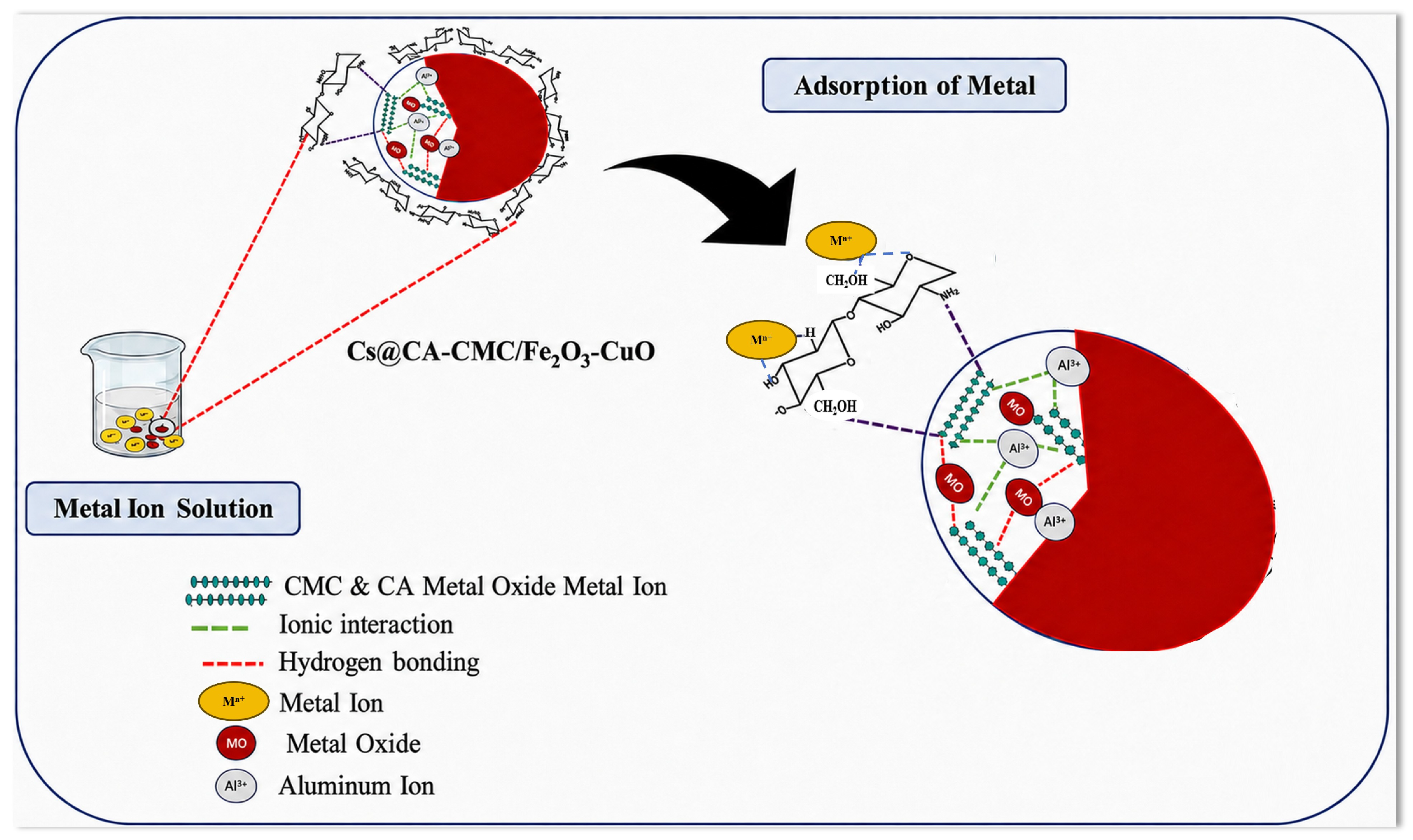
| Ag(I), Co(II) and Ni(II) | Cs@CA-CMC/ Fe2O3-CuO | pH 7.0 25 °C Co = 5 mg/L dosage = 1.0 g/L | Ag(I): 4.91 mg/g Co(II): 4.5 mg/g Ni(II): 3.0 mg/g | — | 70% 3 cycles | PSO, Langmuir (monolayer chemisorption, spontaneous exothermic) | Coordination bonding, electrostatic interaction, ion exchange | CS: Chelation of metal ions via –NH2/–OH groups. CMC: Ion exchange through –COO− groups. CA: Porous support matrix for adsorption. Fe2O3-CuO: Magnetic recovery and additional active adsorption sites. | [81] |
| Pb2+ | CS/SA/Fe3O4 @SiO2 | pH 4.2 20 °C Co = 20–500 mg/L dosage = 0.83 g/L | 234.77 mg/g 99.04% | — | 82% 3 cycles | Elovich, Langmuir (monolayer chemisorption) | CS: Chelation of metal ions via –NH2/–OH groups. SA: 3D network with –COOH/–OH for coordination. Fe3O4: Magnetic separation. SiO2: Provide stability and additional active sites. | [47] | |
| Cr6+ | SA/Fe3O4/ BC | pH 2.0 25 °C Co = 10–350 mg/L dosage = 1.0 g/L | 316.25 mg/g | — | 92.5% after 7 cycles | PSO, Langmuir (monolayer chemisorption, spontaneous endothermic) | Electrostatic interaction, redox, coordination | SA: 3D network with –COOH/–OH for coordination and ion exchange. BC: High SSA/porosity; drives redox (Cr(VI)→Cr(III)). Fe3O4: Magnetic separation and active sites. | [85] |
| Pb2+ | SA/Fe3O4/ GO | pH 6.0 28 °C Co = 20–50 mg/L dosage = 0.25 g/L | 270.27 mg/g 97.82% | — | 82.28% after 5 cycles | PSO, Langmuir Freundlich (monolayer and multilayer adsorption, chemisorption) | Electrostatic interaction, coordination, ion exchange | SA: 3D network with –COOH/–OH for coordination and ion exchange. GO: High SSA/functional groups for binding. Fe3O4: Magnetic and active sites. | [84] |
| Sb(V) | Fe/(MgFe2O4-BC) /SA | pH 5 ± 0.5 25 ± 1 °C Co = 10–300 mg/L dosage = 1.0 g/L | 125.65 mg/g | twice that of Fe/MgFeO | — | Elovich, Freundlich (chemisorption and non-homogeneous) | Electrostatic interaction, ligand exchange, inner-sphere complexation and hydrogen bonding | SA: 3D network with –COOH/–OH for electrostatic interaction. BC: Dispersion and support. MgFe2O4: -OH groups for ligand exchange, hydrogen bonding, inner-sphere complexation and provides magnetic separation performance. | [43] |
| Pollutant | Composites | Experimental Conditions | Adsorption Capacity Removal Efficiency | Performance Enhancement | Reusability | Kinetics Isotherm Models | Main Mechanism | Functional Role of Components | Ref |
|---|---|---|---|---|---|---|---|---|---|
| MB | SA/TiO2/ Bnt | room temperature nature pH Co = 320 mg/L dosage = 2.8 g/L | 112 mg/g 98% | SA: 83% Increase 16% | TiO2 leaching < 2 ppm after 5 cycles | — | Electrostatic interaction, porous enrichment, ion exchange, photocatalysis | SA: 3D network with –COOH/–OH for coordination and electrostatic interaction. Bnt: Structural enhancement and enrichment. TiO2: Photocatalytic mineralization (e−–h+/·OH). | [68] |
| MB | SA@Fe3O4@MCM-41 | room temperature nature pH Co = 6 mmol/L catalyst mass = 4.8 mg V = 3.5 mL NaBH4 = 0.6 mol/L | 5 min 100% | — | 5 cycles | — | Electrostatic interaction Electron transfer Catalytic reduction Pore diffusion | NaBH4: Electron donor/reducing agent. Fe3O4: Catalytic active center. MCM-41: Mesoporous dispersion support. SA: 3D network with –COOH/–OH for electrostatic interaction. | [63] |
| Basic blue11 Acid red 138 | SA/ZnO/ Ag | room temperature nature pH Co = 100 mg/L catalyst mass = 1 g V = 40 mL | Basic blue11: 3.8 mg/g 95% Acid red 138: 3.4 mg/g 85% | — | Basic blue11: 80% Acid red 138: 75% after 4 cycles | PFO, Langmuir (Monolayer physisorption) | Electrostatic interaction, coordination, catalytic reduction | SA: 3D network with –COOH/–OH for coordination and electrostatic interaction. ZnO: Semiconductor catalyst. Ag: Facilitates electron transfer. | [96] |
| MB | SA/Zr/TiO2 | pH 6.0 room temperature Co = 5–20 mg/L dosage = 25.0 g/L | 40.48 mg/g | — | Decreased by 24% after 3 cycles | PSO (Exothermic spontaneous chemisorption) | Electrostatic interaction, H-bonding | SA: 3D network with –COOH/–OH for electrostatic interaction, H-bonding. Zr/TiO2: Increase the specific surface area and active sites. | [89] |
| MB | SA/Fe3O4/ CS | pH 10.0 25 °C Co = 25–150 mg/L dosage = 0.3 g/L | 526.32 mg/g 75.03% | SA: 276.2 mg/g Increase 90% | 71% after 3 cycles | PSO, Langmuir (Monolayer chemisorption) | Electrostatic interaction, H-bonding, pore adsorption | CS/SA: –NH2/–OH/ -COOH groups for H-bonding and electrostatic interaction. Fe3O4: Magnetic separation and active sites. | [92] |
| MO | CuO-Fe2O3@SA-CMC-CS | room temperature nature pH Co = 0.01 Mm catalyst mass = 5–6 mg NaBH4 = 0.2 mol/L | 94% 3 min | — | 3 cycles | PFO physisorption | Electrostatic interaction, H-bonding, electron transfer | SA-CMC-CS:3D network with –NH2/–COOH/–OH/for electrostatic interaction, H-bonding. CuO-Fe2O3: The core of the catalytic reaction and electron transfer. | [91] |
| MB | SA/Fe3O4/ BC | pH 6.0 room temperature Co = 50–150 mg/L dosage = 2.0 g/LC0 = 100 | 153.2 mg/g 98% | — | — | PFO, Freundlich (Multilayer physisorption) | Electrostatic, hydrophobic, H-bonding, π–π stacking | SA: –OH/-COOH groups for H-bonding and electrostatic interaction. BC: High SSA and Porous structure; provides π-electron system. Fe3O4: Magnetic separation and active sites. | [97] |
| Pollutant | Composites | Experimental Conditions | Adsorption Capacity Removal Efficiency | Performance Enhancement | Reusability | Kinetics Isotherm Models | Main Mechanism | Functional Role of Components | Ref |
|---|---|---|---|---|---|---|---|---|---|
| TC | SA/Fe3O4/ SiO2-NH2 | pH 4.0 25 °C Co = 60 mg/L dosage = 20.2 g/L H2O2 = 100 μL | 588.41 mg/g 98.76% | SA: 400 mg/g Increase 47% | — | PSO, Freundlich (multilayer chemisorption) | π–π stacking, H-bonding, electrostatic, Fenton-like | SA: –OH/–COOH groups for H-bonding and electrostatic interaction. Fe3O4@SiO2-NH2: π–π/electrostatic binding; Fe2+/Fe3+ Fenton-like active centers. | [99] |
| TC | AC/FeMnMCM-41/SA | pH 5.44 30 °C Co = 10 mg/L dosage = 0.66 g/L H2O2 = 5% | 90 min 91% | The removal rate is 4.3 times that of SA/FeMnMCM-41 | 33 cycles | PFO physisorption | π–π interaction: electron transfer, redox cycling ROS generation H-bonding electrostatic interaction | AC: π–π interaction and pore adsorption. FeMnMCM-41: Electron transfer, redox cycling and ROS generation. SA:–OH/–COOH groups for H-bonding and electrostatic interaction. | [98] |
| CIP SMX | SA/Fe3O4-ZnO/ CS | pH 4 room temperature Co = 10 mg/L dosage = 10 g (CIP) and 15 g (SMX) H2O2 = 5% | CIP: 94.77% SMX: 93.31% | — | CIP: 41.72% SMX: 46.02% after 5 cycles | PFO, Langmuir (monolayer physisorption) | Photocatalysis electrostatic, H-bonding | SA/CS: –NH2/–OH/ -COOH groups for H-bonding and electrostatic interaction. .ZnO: Photocatalyst. Fe3O4: Magnetic separation; inhibits carrier recombination. | [100] |
| SMX | SA/Fe/Fe3C/γ-Fe2O3/BC | pH 6.2 room temperature Co = 50 mg/L dosage = 0.6 g/L | 58.44 mg/g 98.32% | — | 61.4% after 4 cycles | Elovich Freundlich Temkin (B > 0) (heterogeneous surface endothermic chemisorption) | H-bonding, electrostatic, EDA, π–π stacking | SA: –OH/–COOH groups for H-bonding and electrostatic interaction. Fe/Fe3C/γ-Fe2O3: High SSA and π-conjugation for EDA/π–π interactions; magnetic separation. | [101] |
| Pollutant | Ternary Composite and the Third Component | BET Surface Area (m2/g) | Experimental Conditions | Adsorption Capacity (mg/g) or Removal Efficiency (%) | Mechanical Strength | Ref |
|---|---|---|---|---|---|---|
| Cd2+ | SA/Fe3O4/Bio-SiO2 | / | / | / | The ternary composite formed a more integrated three-dimensional network structure, strengthened the interfacial interactions among the components, and improved the structural stability of the composite. | [78] |
| Cu2+ | SA/ZnO/NH2-Fe (III) | / | pH 4.0 25 °C Co = 50–1500 mg/L dosage = 1.0 g/L | 1266 to 2144.5 mg/g (69.4% increase) | SiO2 provided a stable support, while amine functionalization introduced additional active sites, jointly improving the structural integrity and adsorption activity. | [79] |
| Ti+ | SA/MnO2 + Fe3O4/CMC | / | / | / | CMC improved MnO2/Fe3O4 dispersion and promoted an open porous network. | [72] |
| Cr6+ | SA/Fe3O4/BC | / | / | / | Biochar provided a porous framework, while alginate stabilized Fe3O4 nanoparticles, improving structural stability and reusability. | [85] |
| MB | SA/TiO2/Bnt | / | room temperature nature pH Co = 320 mg/L dosage = 2.8 g/L | 88%to 96% (8% increase) | Bentonite provided a porous framework, promoted uniform TiO2 dispersion, and enhanced structural stability and adsorption performance. | [68] |
| Basic blue11 Acid red 138 | SA/ZnO/Ag | / | / | / | Ag was uniformly incorporated into the ZnO/alginate network, enhancing interfacial interaction and electron transfer to form a stable catalytic composite. | [96] |
| MB | SA/Fe3O4/CS | / | / | / | Chitosan enhanced porosity and mechanical stability, alginate provided a three-dimensional crosslinked network with abundant carboxyl groups, and Fe3O4 imparted magnetic separability, collectively forming a stable, efficient, and recyclable adsorption system. | [92] |
| MB | SA/Fe3O4/BC | / | / | / | Activated biochar provided a high specific surface area, abundant mesopores, and additional active adsorption sites, thereby enhancing mass transfer and adsorption performance. | [97] |
| TC | SA/Fe3O4/SiO2-NH2 | 21.15 to 54.98 m2/g (160% increase) | pH 4.0 25 °C Co = 60 mg/L dosage = 20.2 g/L H2O2 = 100 μL | 30 to 588.41 mg/g (36.8% increase) | SiO2 increased the specific surface area and pore volume, while amino groups introduced additional active sites, promoting uniform Fe3O4 dispersion and enhancing the structural stability and adsorption activity of the composite. | [99] |
| CIP SMX | SA/Fe3O4-ZnO/CS | / | / | / | Chitosan introduced abundant amino groups, strengthened the interfacial interaction with alginate, and provided additional active sites for antibiotic adsorption. | [100] |
| SMX | SA/Fe/Fe3C/γ-Fe2O3/BC | / | Magnetic biochar acted as a rigid framework, improving the mechanical stability of alginate hydrogels, suppressing swelling, and providing additional active adsorption sites. | [101] |
| Ternary Strategy | Main Contribution | Advantages | Limitations |
|---|---|---|---|
| Inorganic non-metallic framework | Improve pore structure and structural stability | Good mechanical strength, enhanced stability, and suppressed nanoparticle aggregation | Limited intrinsic adsorption activity; performance mainly relies on synergistic components |
| Carbon-based materials | Increase specific surface area and introduce π-conjugated structures | High adsorption capacity, enhanced electron transfer, and favorable for organic pollutants | High cost, aggregation/restacking, preparation complexity |
| Metal nanoparticles | Provide magnetic separation, photocatalysis or catalytic reduction | Multi-functionality and high removal efficiency | Possible nanoparticle aggregation, metal leaching, and long-term stability require further evaluation |
| Natural polymer materials | Improve compatibility, flexibility and structural integrity | Good biocompatibility, enhanced mechanical properties | Limited direct contribution to adsorption; usually requires a combination with other functional components |
Disclaimer/Publisher’s Note: The statements, opinions and data contained in all publications are solely those of the individual author(s) and contributor(s) and not of MDPI and/or the editor(s). MDPI and/or the editor(s) disclaim responsibility for any injury to people or property resulting from any ideas, methods, instructions or products referred to in the content. |
© 2026 by the authors. Licensee MDPI, Basel, Switzerland. This article is an open access article distributed under the terms and conditions of the Creative Commons Attribution (CC BY) license.
Share and Cite
Li, J.; Baimenov, A.; Lee, J.; Azat, S. Alginate-Based Ternary Composites for Water Treatment: Synthesis, Mechanisms, and Applications. Polymers 2026, 18, 1941. https://doi.org/10.3390/polym18161941
Li J, Baimenov A, Lee J, Azat S. Alginate-Based Ternary Composites for Water Treatment: Synthesis, Mechanisms, and Applications. Polymers. 2026; 18(16):1941. https://doi.org/10.3390/polym18161941
Chicago/Turabian StyleLi, Jia, Alzhan Baimenov, Jechan Lee, and Seitkhan Azat. 2026. "Alginate-Based Ternary Composites for Water Treatment: Synthesis, Mechanisms, and Applications" Polymers 18, no. 16: 1941. https://doi.org/10.3390/polym18161941
APA StyleLi, J., Baimenov, A., Lee, J., & Azat, S. (2026). Alginate-Based Ternary Composites for Water Treatment: Synthesis, Mechanisms, and Applications. Polymers, 18(16), 1941. https://doi.org/10.3390/polym18161941