


Sustainable Valorization of Agro-Industrial Waste and Polymer Residues for High-Plasticity Clay Stabilization: An Agro-Rubber Hybrid Approach

 ,
,  , and
, and
Abstract
1. Introduction
2. Materials and Methods
2.1. Materials
2.1.1. Soil
2.1.2. Eggshell Powder
2.1.3. Rubber Tire Powder
2.2. Test Sample Preparations
2.3. Laboratory Experiments
2.3.1. Modified Proctor Test
2.3.2. Unconfined Compressive Strength Test
2.3.3. One-Dimensional Consolidation Test
2.3.4. California Bearing Ratio Test
2.4. Statistical Analysis (SA)
3. Results and Discussion
3.1. Effect of ESP and RTP on Soil Atterberg Limits
3.2. Effect of ESP and RTP on Compaction Properties
3.3. Effect of ESP and RTP on Unconfined Compressive Strength
3.4. Effect of ESP and RTP on Swell Potential
3.5. Effect of ESP and RTP on California Bearing Ratio
4. Statistical Evaluation of ESP and RTP Effects
5. Comparative Evaluation of Engineering Properties
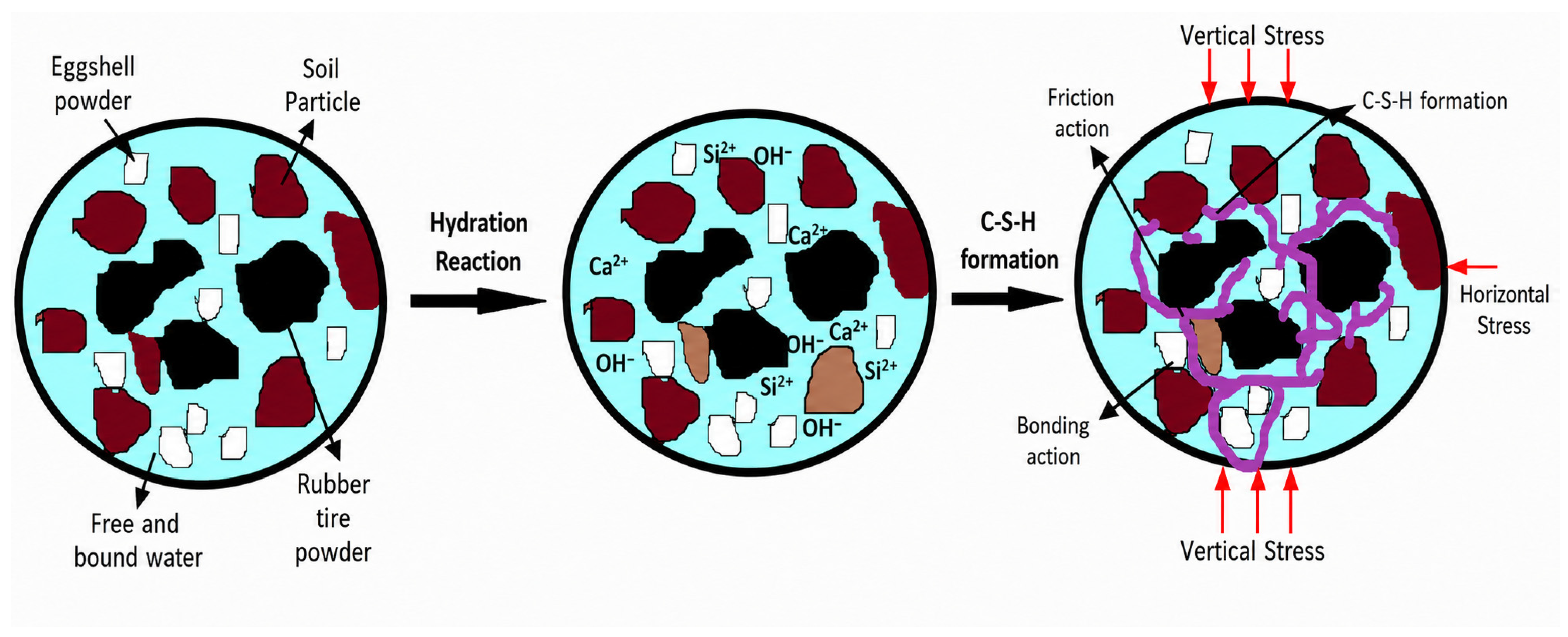
6. Stabilization Mechanism of ESP and RTP Treated Soil
7. Environmental, Sustainability, and Economic Implications
8. Limitations and Future Work
9. Conclusions
- (1)
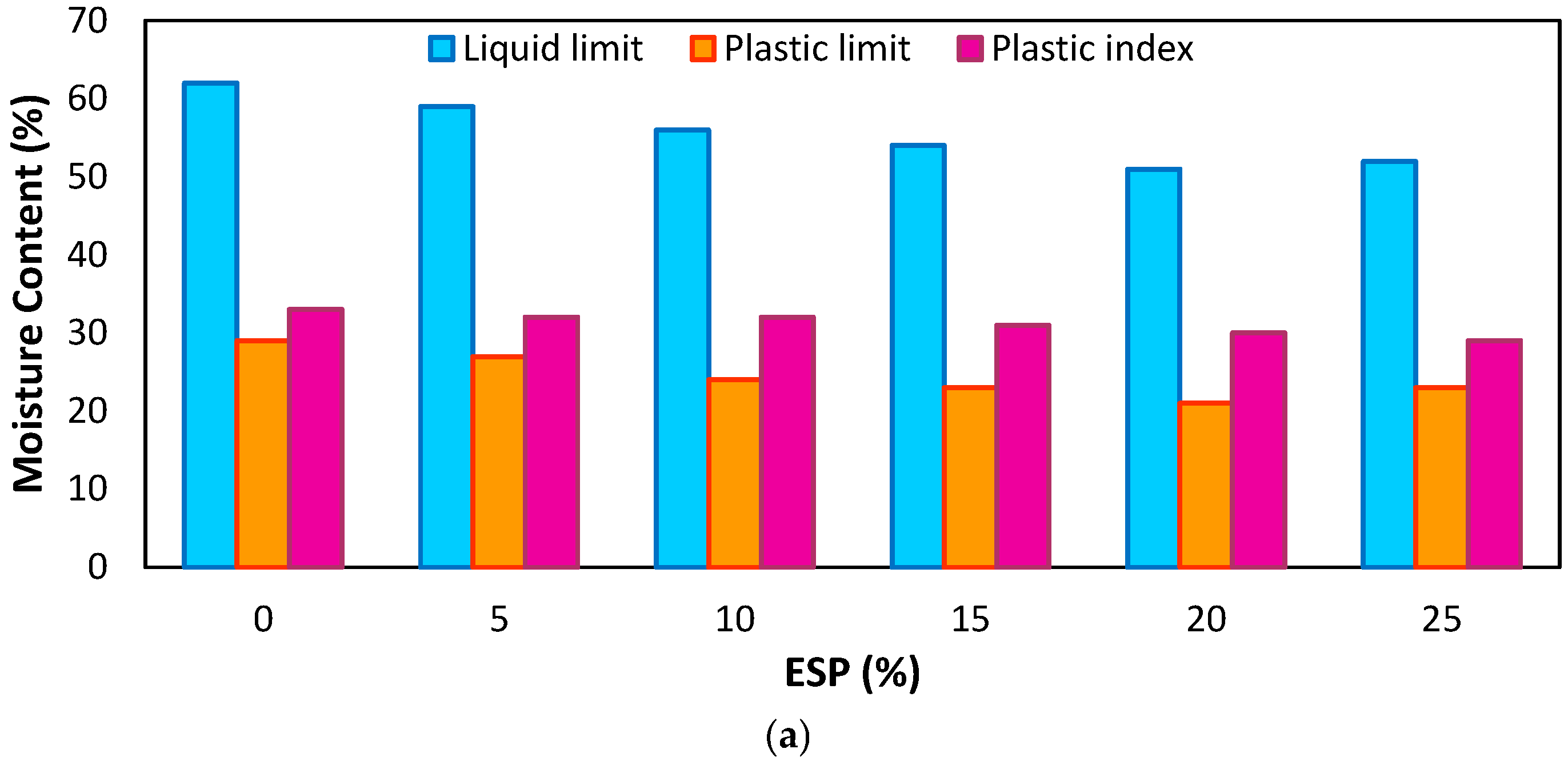
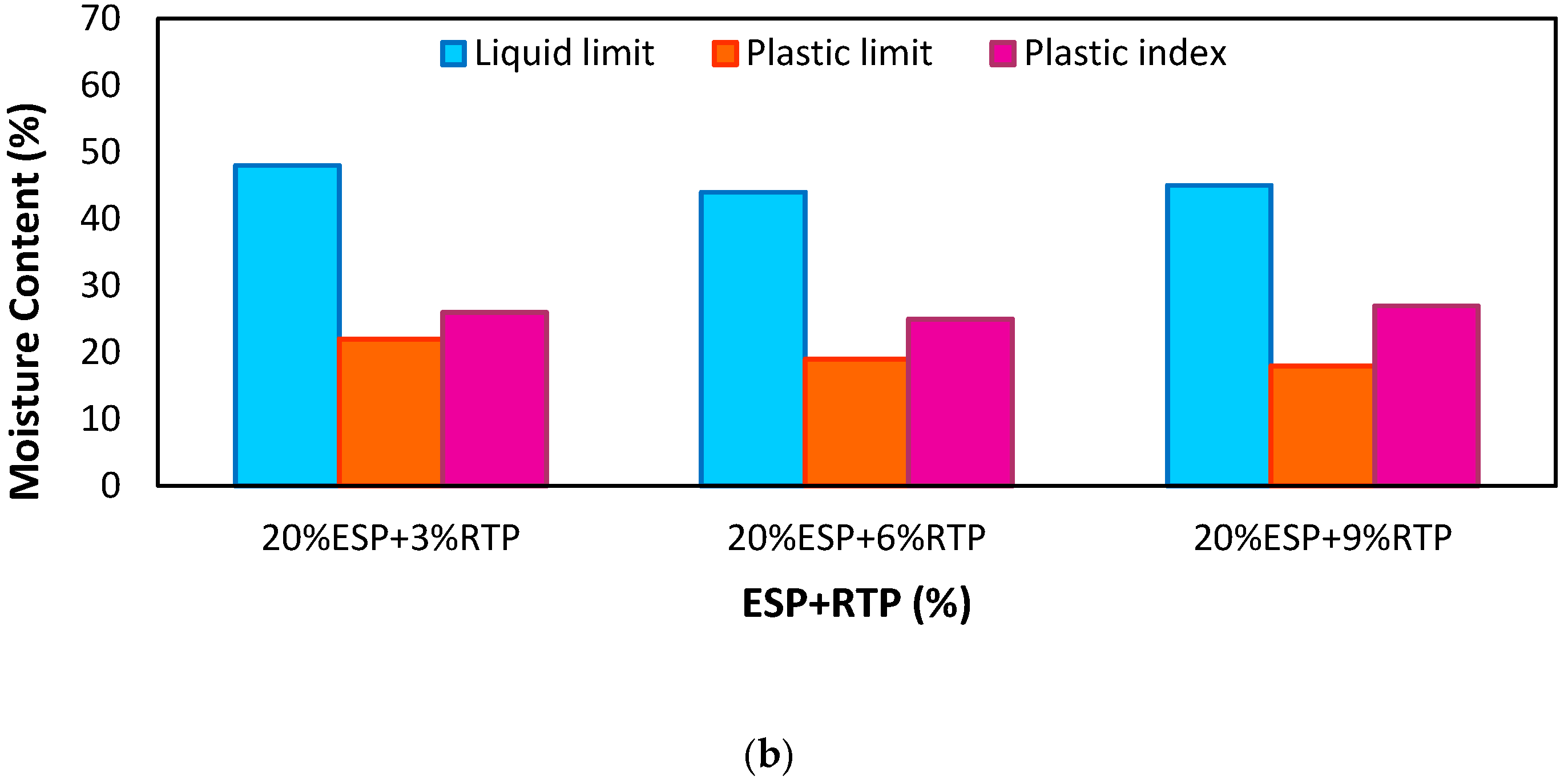
- The optimal combination of 20% ESP and 6% RTP led to a substantial reduction in soil plasticity, with the plasticity index (PI) decreasing from 33% to 25%, which improves soil workability and reduces susceptibility to deformation.
- (2)
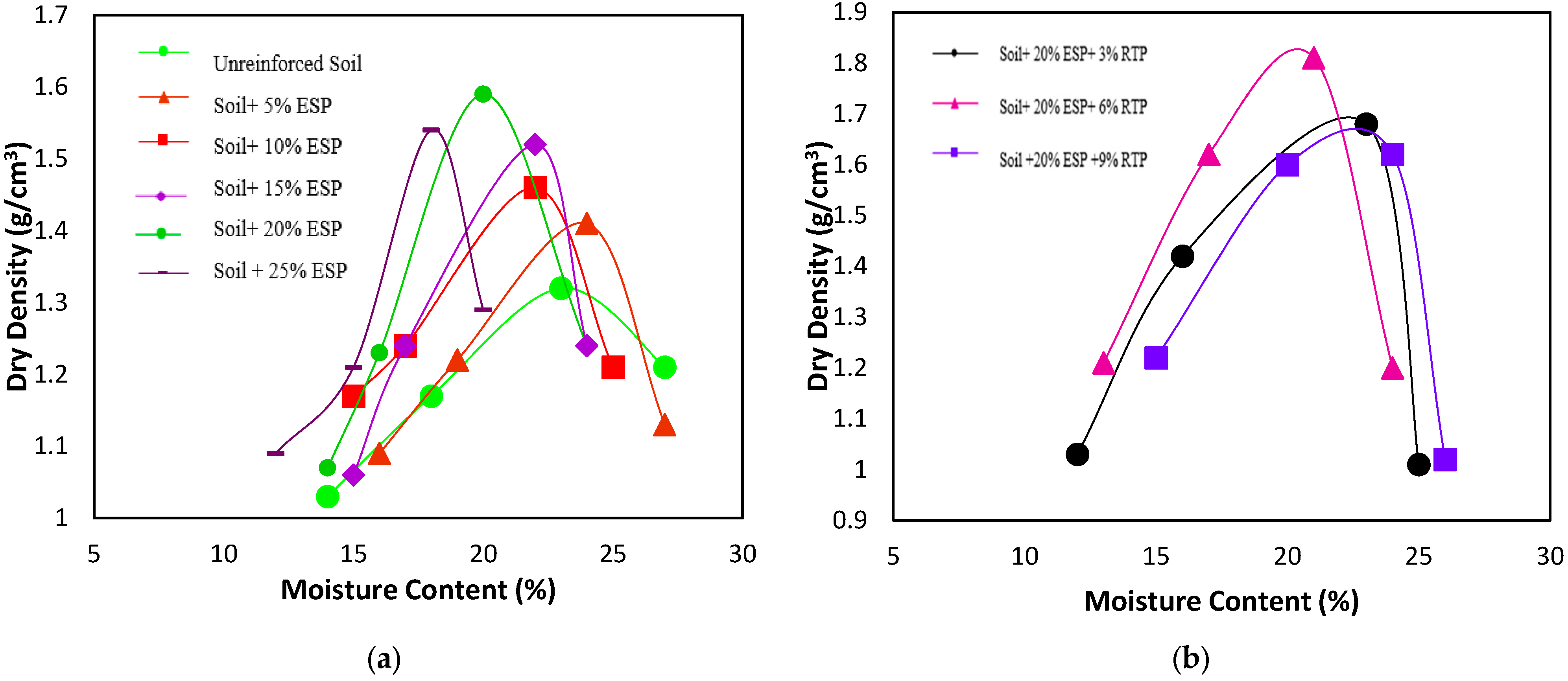
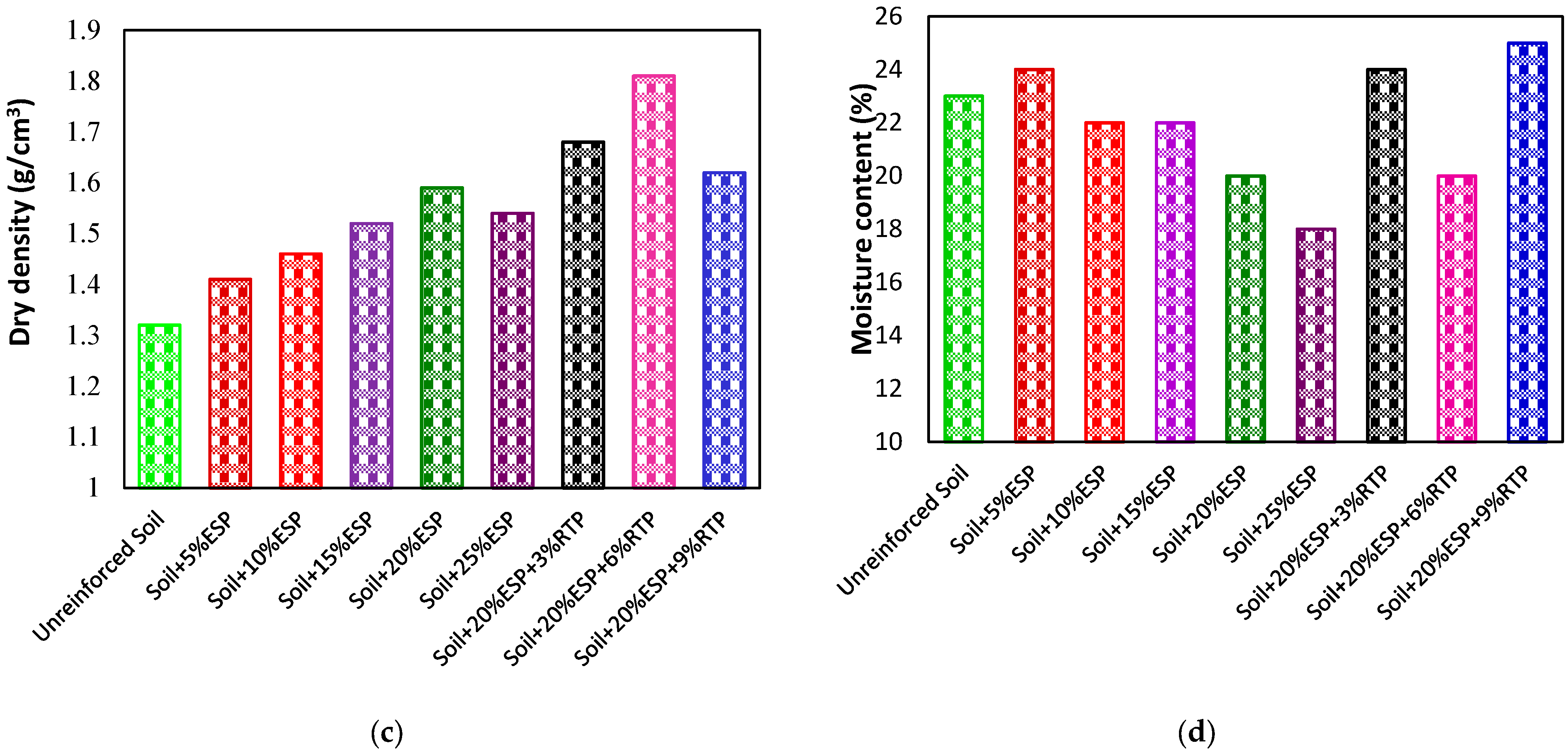
- Compaction characteristics were also enhanced, as the maximum dry density (MDD) increased from 1.32 g/cm3 to 1.81 g/cm3 and the optimum moisture content (OMC) decreased from 23% to 20% for the ESP + RTP-treated soil, while ESP-only treatment decreased the OMC to 18%, facilitating improved densification behavior. Furthermore, ANOVA showed that ESP significantly affected OMC (p < 0.0001), confirming that ESP addition influenced the moisture requirements of the soil during compaction.
- (3)
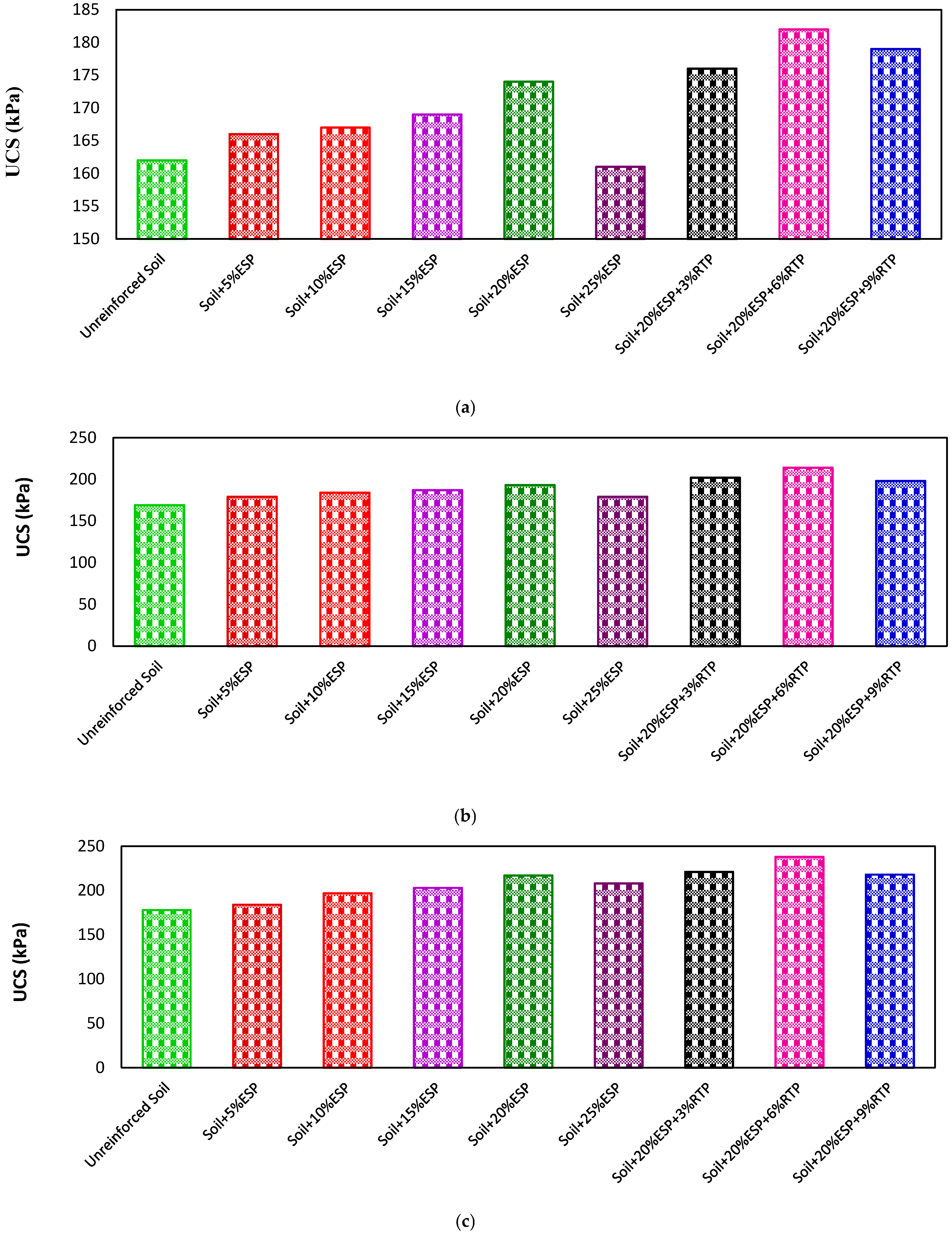
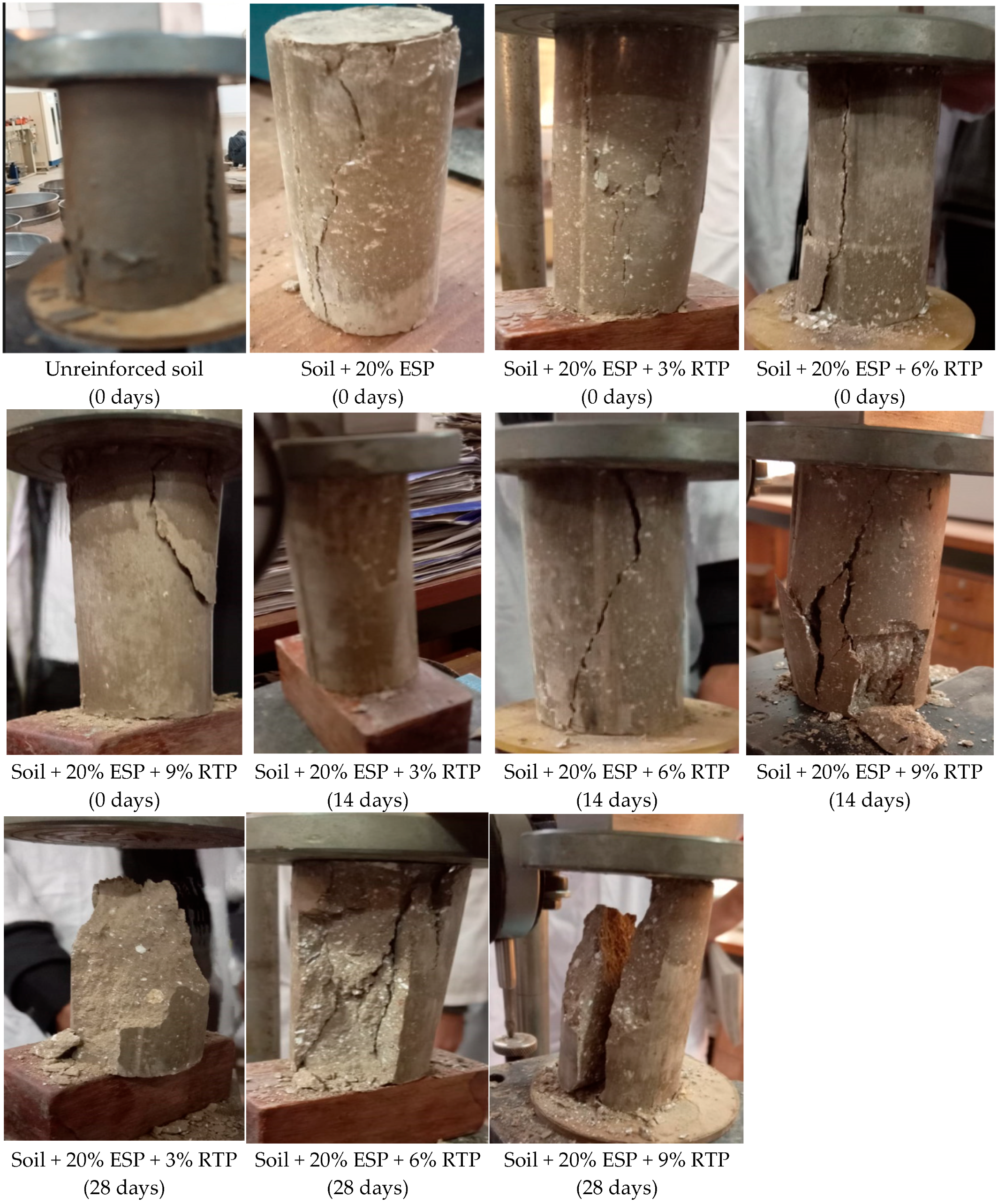
- Unconfined Compressive Strength (UCS) showed a notable improvement, rising from 162 kPa to 238 kPa over 28 days, confirming increased load-bearing capacity.
- (4)
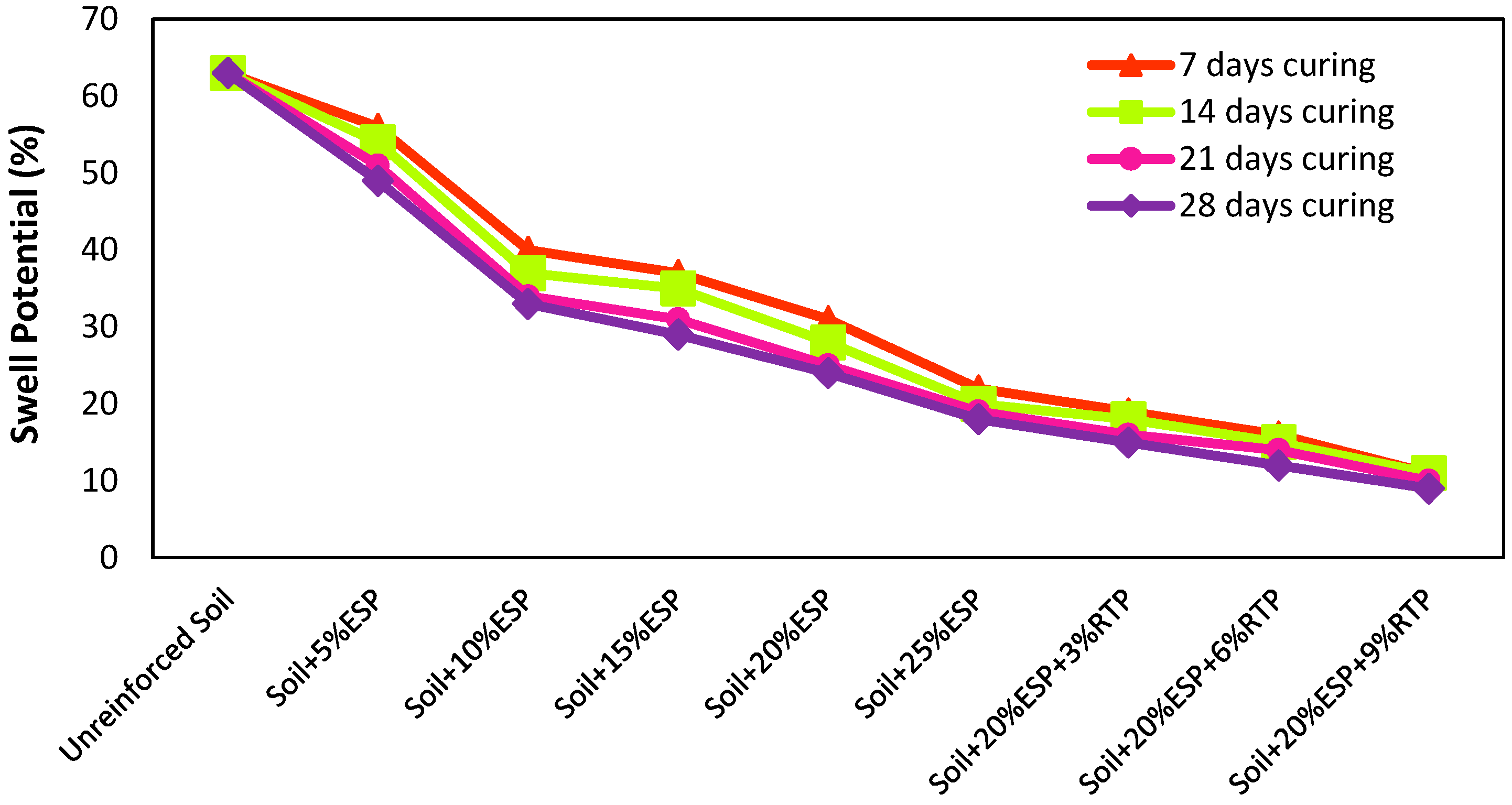
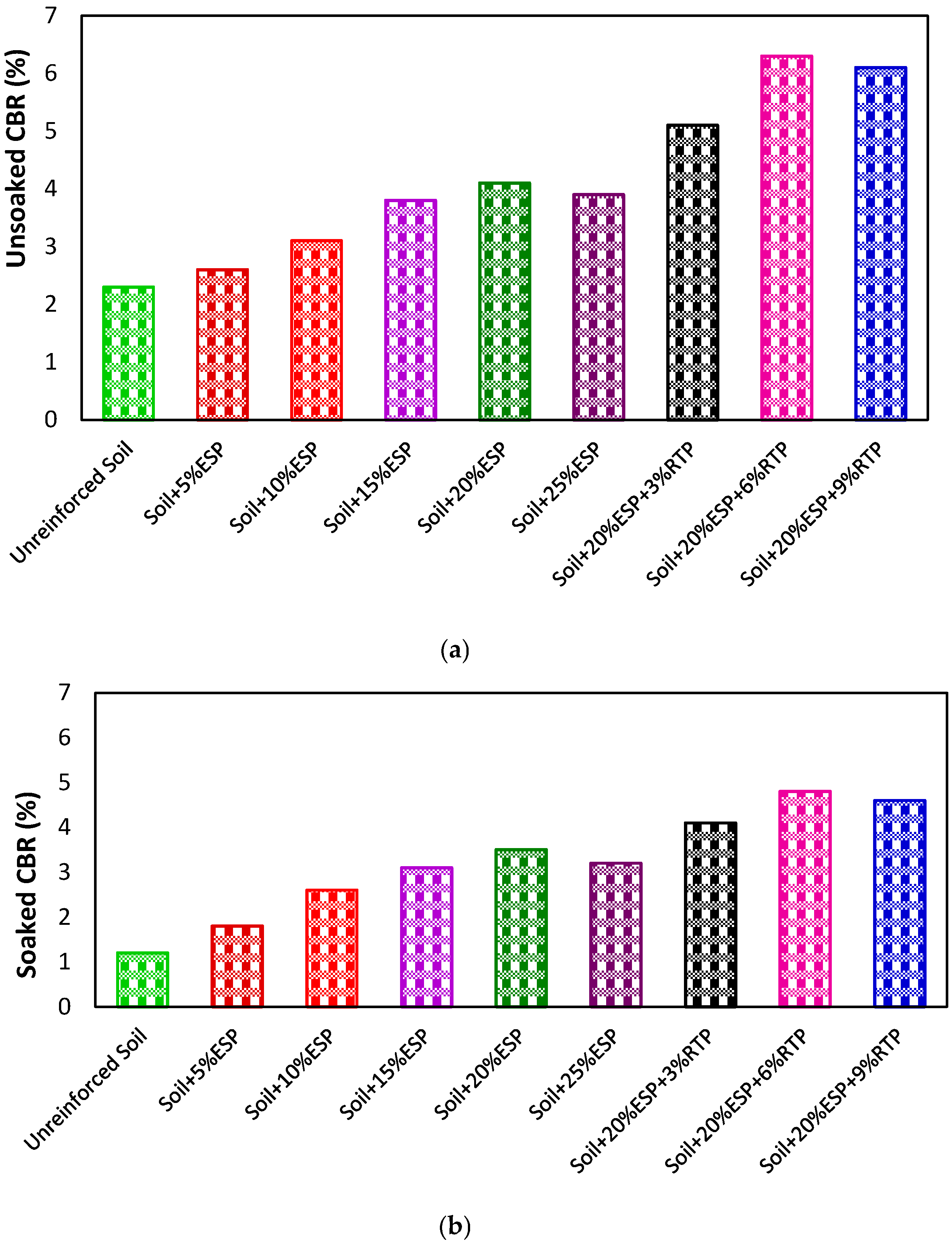
- Swelling potential was significantly reduced at both 6% and 9% RTP (80.9% and 85.7% after 28 days). The slightly greater swelling reduction at 9% RTP came with lower gains in MDD (27.1% vs. 18.5%), 28-day UCS (32.6% vs. 22.5%), and CBR (unsoaked increases of 174.0% vs. 165.2%; soaked increases of 300.0% vs. 283.3%). The optimal mixture was therefore 20% ESP + 6% RTP, based on the best overall balance among compaction, strength, plasticity, swelling, and CBR, not the maximum swelling reduction alone.
- (5)
- California Bearing Ratio (CBR) values also improved markedly, with unsoaked CBR reaching 6.3% and soaked CBR increasing to 4.8%, indicating enhanced performance for pavement applications.
- (6)
- Statistical analysis using one-way ANOVA and the Kruskal–Wallis test confirmed significant effects of ESP and RTP on most measured soil properties, supporting the reliability of the experimental findings.
Author Contributions
Funding
Institutional Review Board Statement
Informed Consent Statement
Data Availability Statement
Acknowledgments
Conflicts of Interest
References
- Gromko, G.J. Review of expansive soils. J. Geotech. Eng. Div. 1974, 100, 667–687. [Google Scholar] [CrossRef]
- Holtz, W.G. Expansive Clays—Properties and Problems; Commissioner’s Office, Bureau of Reclamation, United States Department of the Interior: Washington, DC, USA, 1959.
- Khalid, B.; Alshawmar, F. Comprehensive review of geotechnical engineering properties of recycled polyethylene terephthalate fibers and strips for soil stabilization. Polymers 2024, 16, 1764. [Google Scholar] [CrossRef] [PubMed]
- Khalid, B.; Alshawmar, F. Exploring the feasibility of using recycled PET strips with palm leaf ash for sustainable soil stabilization. Sustainability 2023, 15, 13542. [Google Scholar] [CrossRef]
- Hao, K.; Wang, W.; Guo, X.; Liu, F.; Xu, Y.; Guo, S.; Bai, L.; Liu, G.; Liu, M.; Guo, L. High-value recycling of waste tire rubber powder by wet mixing method. J. Clean. Prod. 2023, 384, 135592. [Google Scholar] [CrossRef]
- Haq, M.; Khan, M.A.; Ali, S.; Ali, K.; Yusuf, M.; Kamyab, H.; Irshad, K. Enhancing clayey soil performance with lime and waste rubber tyre powder: Mechanical, microstructural, and statistical analysis. Environ. Res. 2024, 256, 119217. [Google Scholar] [CrossRef] [PubMed]
- Trambitski, Y. Research of Structure and Durability of Natural Polymer Modified Clays. Ph.D. Thesis, Vilniaus Gedimino technikos Universitetas, Vilnius, Lithuania, 2024. [Google Scholar]
- Ma, H.; Liu, J.; Mao, Z.; Mu, H.; Xue, S.; Sun, Q.; Yang, W. Progress in Polymer-Based Pure Organic Room Temperature Phosphorescent Materials. Chem. Asian J. 2025, 20, e202500090. [Google Scholar] [CrossRef] [PubMed]
- Akbarimehr, D.; Eslami, A.; Aflaki, E.; Hajitaheriha, M.M. Investigating the effect of waste rubber in granular form on strength behavior of Tehran clay. Arab. J. Geosci. 2021, 14, 1831. [Google Scholar] [CrossRef]
- Yang, Z.; Lu, Z.; Shi, W.; Wang, C.; Ling, X.; Li, J.; Guan, D. Investigation of rubber content and size on dynamic properties of expansive soil–rubber. Geosynth. Int. 2024, 31, 269–282. [Google Scholar] [CrossRef]
- Baldovino, J.A.; Diaz, K.C.; Royero, J.M.; Sierra, R.S.; Nuñez de la Rosa, Y.E. Developing new geomaterials: The case of the natural rubber latex polymers in soil stabilization. Materials 2025, 18, 1720. [Google Scholar] [CrossRef] [PubMed]
- Siti, H.R. Environment-Friendly Ground Improvement Technique Using Waste Shell Husk. Ph.D. Thesis, Mie University, Tsu City, Japan, 2018. [Google Scholar]
- Etim, R.K.; Attah, I.C.; Ekpo, D.U.; Usanga, I.N. Evaluation on stabilization role of lime and cement in expansive black clay–oyster shell ash composite. Transp. Infrastruct. Geotechnol. 2022, 9, 729–763. [Google Scholar]
- Vinod, B.; Shobha, R.; Raghavendra, A.; Rakesh, M.; Pallavi, S. Stabilization on Expansive soil using sea shell powder and Rubber powder. In Proceedings of the IOP Conference Series: Materials Science and Engineering; IOP Publishing: Bristol, UK, 2020. [Google Scholar]
- Ahmed, T.A.; Wu, L.; Younes, M.; Hincke, M. Biotechnological applications of eggshell: Recent advances. Front. Bioeng. Biotechnol. 2021, 9, 675364. [Google Scholar] [CrossRef] [PubMed]
- McGahan, E.; Barker, S.; Tucker, R. Environmental Guidelines for the Australian Egg Industry; Australian Egg Co., Ltd.: North Sydney, NSW, Australia, 2008. [Google Scholar]
- Yang, B.; Yin, Z.; Hasheminezhad, A.; Alsheyab, M.A.; Ceylan, H.; Kim, S. Enhancing soil engineering properties with eggshell powder: A laboratory-based approach to sustainable road construction. J. Clean. Prod. 2025, 505, 145464. [Google Scholar] [CrossRef]
- Marut, J.; Dang, J. Investigating stabilisation of expansive soils using eggshell powder as an eco-friendly additive. PLASU J. Environ. Sci. 2025, 1, 117–128. [Google Scholar] [CrossRef]
- Sathiparan, N. Utilization prospects of eggshell powder in sustainable construction material–A review. Constr. Build. Mater. 2021, 293, 123465. [Google Scholar] [CrossRef]
- Zada, U.; Haleem, K.; Saqlain, M.; Abbas, A.; Khan, A.U. Reutilization of eggshell powder for improvement of expansive clayey soil. Iran. J. Sci. Technol. Trans. Civ. Eng. 2023, 47, 1059–1066. [Google Scholar]
- Anoop, S.P.; Beegom, H.; Johnson, J.P.; Midhula, J.; Muhammed, T.N.; Prasanth, S. Potential of egg shell powder as replacement of lime in soil stabilization. Int. J. Adv. Eng. Res. Sci. 2017, 4, 237244. [Google Scholar] [CrossRef]
- Alzaidy, M.N. Experimental study for stabilizing clayey soil with eggshell powder and plastic wastes. In Proceedings of the IOP Conference Series: Materials Science and Engineering; IOP Publishing: Bristol, UK, 2019. [Google Scholar]
- Anburuvel, A.; Sathiparan, N.; Dhananjaya, G.M.A.; Anuruththan, A. Characteristic evaluation of geopolymer based lateritic soil stabilization enriched with eggshell ash and rice husk ash for road construction: An experimental investigation. Constr. Build. Mater. 2023, 387, 131659. [Google Scholar] [CrossRef]
- Paul, A.; Anumol, V.; Moideen, F.; Jose, J.K.; Abraham, A. Studies on improvement of clayey soil using egg shell powder and quarry dust. Int. J. Eng. Res. Appl. 2014, 4, 55–63. [Google Scholar] [CrossRef]
- Atef, A.; Hossain, Z. Assessing the Impact of Rice Husk Ash on Soil Strength in Subgrade Layers: A Novel Approach to Sustainable Ground Engineering. Sustainability 2025, 17, 5457. [Google Scholar] [CrossRef]
- Karthikeyan, N.K.; Elavenil, S. Developing Integral Hydrophobic Cement Mortar Composite Using Sustainable Carbon Nanomaterial: Wettability and Surface Energy. Iran. J. Sci. Technol. Trans. Civ. Eng. 2025, 49, 2517–2538. [Google Scholar] [CrossRef]
- Wang, G.; Zhang, X.; Liu, X.; Gao, H.; Pan, Y. Stabilization of micaceous residual soil with industrial and agricultural byproducts: Perspectives from hydrophobicity, water stability, and durability enhancement. Constr. Build. Mater. 2024, 430, 136450. [Google Scholar] [CrossRef]
- Fatima, B.; Alshameri, B.; Hassan, W.; Maqsood, Z.; Jamil, S.M.; Madun, A. Sustainable incorporation of Plaster of Paris kiln dust for stabilization of dispersive soil: A potential solution for construction industry. Constr. Build. Mater. 2023, 397, 132459. [Google Scholar] [CrossRef]
- Hassan, W.; Alshameri, B.; Haider, A.; Maqsood, Z.; Jamil, S.M.; Shahzad, A. A novel technique for the construction industry to mitigate dispersibility and internal erosion problems of sodium rich clays by using Water-Soluble potassium rich ions material. Constr. Build. Mater. 2023, 400, 132780. [Google Scholar] [CrossRef]
- Hassan, W.; Alshameri, B.; Maqsood, Z.; Haider, A.; Jamil, S.M.; Mujtaba, H. An innovative application of fine marble dust for the construction industry to mitigate the piping, internal erosion and dispersion problems of sodium-rich clays. Constr. Build. Mater. 2023, 408, 133834. [Google Scholar] [CrossRef]
- Haseeb, M.; Maqsood, Z.; Baqir, M.; Sarwar, S.; Alshameri, B.; Hassan, W.; Haider, A.; Wenli, L.; Alam, M.; Xie, J.; et al. Sustainable fill solutions: Recycling EPS waste in shredded EPS-clayed soil composites for improved mechanical and compaction behaviour. Transp. Geotech. 2025, 54, 101614. [Google Scholar] [CrossRef]
- Hassan, W.; Alshameri, B.; Rashid, I.; Shahzad, A. Sustainable valorization of biomass residue for remediations of dispersive clays: Integrating environmental, geotechnical, and circular economy perspectives. Constr. Build. Mater. 2025, 494, 143538. [Google Scholar] [CrossRef]
- Hassan, W.; Mujtaba, H.; Alshameri, B.; Farooq, K.; Aamir, T.; Shahzad, A. Sustainable remediation: The role of styrene-butadiene rubber latex and chem-lite CR powder in stabilizing dispersive clay. J. Rock Mech. Geotech. Eng. 2025, 17, 8131–8148. [Google Scholar] [CrossRef]
- Hassan, W.; Alshameri, B.; Jamil, S.M.; Maqsood, Z.; Haider, A.; Shahzad, A. Incorporating potassium-rich waste material in a sustainable way to stabilize dispersive clay: A novel practical approach for the construction industry. Constr. Build. Mater. 2023, 400, 132717. [Google Scholar] [CrossRef]
- Mehmood, M.; Guo, Y.; Liu, Y.; Wang, L.; Nie, W.; Uge, B.U.; Ali, S.; Xuanyu, C.; Zhao, Y. Experimental study on the engineering characteristics of expansive soil improved conjointly using enzyme induced carbonate precipitation and eggshell powder. Soils Found. 2025, 65, 101567. [Google Scholar] [CrossRef]
- Hamzani; Munirwansyah; Hasan, M.; Sugiarto, S. Determining the properties of semi-flexible pavement using waste tire rubber powder and natural zeolite. Constr. Build. Mater. 2021, 266, 121199. [Google Scholar] [CrossRef]
- ASTM D6913; Standard Test Methods for Particle-Size Distribution (Gradation) of Soils Using Sieve Analysis. ASTM International: West Conshohocken, PA, USA, 2009.
- ASTM D7928; Standard Test Method for Particle-Size Distribution (Gradation) of Fine-Grained Soils Using the Sedimentation (Hydrometer) Analysis. ASTM International: West Conshohocken, PA, USA, 2017.
- ASTM D3282; Standard Practice for Classification of Soils and Soil-Aggregate Mixtures for Highway Construction Purposes. American Society for Testing & Materials: West Conshohocken, PA, USA, 2004.
- ASTM D2487; Standard Practice for Classification of Soils for Engineering Purposes (Unified Soil Classification System) 1. ASTM International: West Conshohocken, PA, USA, 2017.
- ASTM D4318; Standard Test Methods for Liquid Limit, Plastic Limit, and Plasticity Index of Soils. ASTM International: West Conshohocken, PA, USA, 2010.
- ASTM D2166; Standard Test Method for Unconfined Compressive Strength of Cohesive Soil, Annual Book of ASTM Standards. ASTM International: West Conshohocken, PA, USA, 2006.
- ASTM D698; Standard Test Methods for Laboratory Compaction Characteristics of Soil Using Standard Effort (12 400 Ft-lbf/ft3 (600 KN-m/m3)) 1. ASTM International: West Conshohocken, PA, USA, 2007.
- ASTM D4546-14; Standard Test Methods for One-Dimensional Swell or Collapse of Soils. ASTM International: West Conshohochen, PA, USA, 2014.
- ASTM D1883; Standard Test Method for California Bearing Ratio (CBR) of Laboratory-Compacted Soils. ASTM: West Conshohcken, PA, USA, 2016.
- Khandelwal, H.; Prakash, S. Synthesis and characterization of hydroxyapatite powder by eggshell. J. Miner. Mater. Charact. Eng. 2016, 4, 119–126. [Google Scholar] [CrossRef]
- ASTM D792; Standard Test Methods for Density and Specific Gravity (Relative Density) of Plastics by Displacement. American Society for Testing and Materials: West Conshohocken, PA, USA, 1991.
- Dick, J.S. Testing Mineral Fillers for Use in Rubber. In Basic Rubber Testing: Selecting Methods for a Rubber Test Program; Dick, J.S., Ed.; ASTM International: West Conshohocken, PA, USA, 2003; pp. 111–123. [Google Scholar] [CrossRef]
- ASTM D36; Standard Test Method for Softening Point of Bitumen (Ring-and-Ball Apparatus). ASTM: West Conshohocken, PA, USA, 2020.
- ASTM D1895; Standard Test Methods for Apparent Density, Bulk Factor, and Pourability of Plastic. ASTM International: West Conshohocken, PA, USA, 2003.
- ASTM D297; A Standard Test Methods for Rubber Products: Chemical Analysis. ASTM: West Conshohocken, PA, USA, 2015.
- Hassan, W.; Ahmad, M.; Farooq, A.; Ajwad, A.; Ali, H.Q.; Ilyas, Y. Correlation of maximum laboratory dry density and optimum moisture content of soil with soil parameters. NFC IEFR J. Eng. Sci. Res. 2017, 5, 1–6. [Google Scholar] [CrossRef]
- Hassan, W.; Alshameri, B.; Nawaz, M.N.; Qamar, S.U. Experimental study on shear strength behavior and numerical study on geosynthetic-reinforced cohesive soil slope. Innov. Infrastruct. Solut. 2022, 7, 349. [Google Scholar] [CrossRef]
- Hassan, W.; Farooq, K.; Mujtaba, H.; Alshameri, B.; Shahzad, A.; Nawaz, M.N.; Azab, M. Experimental investigation of mechanical behavior of geosynthetics in different soil plasticity indexes. Transp. Geotech. 2023, 39, 100935. [Google Scholar] [CrossRef]
- Hassan, W.; Kanwal, M.; Nawaz, M.; Shahzad, A. A comparative study on shear strength characteristics of geotextile reinforced soils. In Proceedings of the Hodja Akhmet Yassawi 4th International Conference on Scientific Research, Ankara, Turkey, 12–13 February 2021. [Google Scholar]
- Nawaz, M.N.; Chong, S.-H.; Nawaz, M.M.; Haider, S.; Hassan, W.; Kim, J.-S. Estimating the unconfined compression strength of low plastic clayey soils using gene-expression programming. Geomech. Eng. 2023, 33, 1–9. [Google Scholar]
- Attique, M.; Hassan, S.; Alshameri, B.; Hassan, W.; Ghani, S.; Ansari, A. Evaluating the impact of various tensile strengths of non-woven geotextiles on subgrade CBR enhancement: An experimental approach. Int. J. Pavement Res. Technol. 2025, 1–18. [Google Scholar] [CrossRef]
- Alqaisi, R.; Le, T.M.; Khabbaz, H. Applications of recycled sustainable materials and by-products in soil stabilization. In Proceedings of the Recent Thoughts in Geoenvironmental Engineering: Proceedings of the 3rd GeoMEast International Congress and Exhibition, Egypt 2019 on Sustainable Civil Infrastructures–The Official International Congress of the Soil-Structure Interaction Group in Egypt (SSIGE); Springer: Cham, Switzerland, 2020. [Google Scholar]
- Bapiraju, P.; Prasad, N.K. An experimental investigation on expansive soil in conjunction with egg shell powder and rock dust. Int. J. Adv. Res. Eng. Technol. 2019, 10, 9–21. [Google Scholar] [CrossRef]
- Yadav, J.; Tiwari, S. The impact of end-of-life tires on the mechanical properties of fine-grained soil: A review. Environ. Dev. Sustain. 2019, 21, 485–568. [Google Scholar] [CrossRef]
- Surjandari, N.S.; Dananjaya, R.H. The effect of egg shell powder on the compression strength of fine-grained soil. In Proceedings of the MATEC Web of Conferences; EDP Sciences: Les Ulis, France, 2018. [Google Scholar]
- Harikaran, M.; Kulanthaivel, P.; Gokulakannan, S.; Vinodhkumar, S. Eco-friendly soil stabilization: A combined approach using lime and waste eggshell powder. Glob. Nest J. 2023, 25, 120–130. [Google Scholar] [CrossRef]
- Wani, I.Y.; Khurshid, M.T.; Sharma, N. Analysis of geotechnical properties of an expansive soil mixed with polypropylene, saw dust ash and egg shell powder. Int. J. Eng. Appl. Sci. Technol. 2019, 4, 376–381. [Google Scholar] [CrossRef]
- Srinivasan, K.; Sagayam, S.A.V.; Jananandhini, P.; Shaarumathy, M. An experimental study on the stabilization of expansive soils using coir fibre, eggshell powder and steel fibre. Int. Res. J. Eng. Technol. 2021, 8, 1043–1048. [Google Scholar]
- de Araújo, M.T.; Ferrazzo, S.T.; Bruschi, G.J.J.; Consoli, N.C. Mechanical and environmental performance of eggshell lime for expansive soils improvement. Transp. Geotech. 2021, 31, 100681. [Google Scholar] [CrossRef]
- Naseem, A.; Mumtaz, W.; De Backer, H. Stabilization of expansive soil using tire rubber powder and cement kiln dust. Soil Mech. Found. Eng. 2019, 56, 54–58. [Google Scholar] [CrossRef]
- Al-Subari, L.; Ekinci, A. Strength and durability assessment of shredded tire rubber stabilized artificially cemented alluvial clay. Constr. Build. Mater. 2022, 345, 128312. [Google Scholar] [CrossRef]
- Prasad, D.; Kumar, K.B.; Sridevi, K.; Vishalakshi, K.; Raju, G.P.; Raju, K.J. Evaluation of Strength Characteristics on Black Cotton Soil–Stone Dust Mixtures Reinforced with Shredded Tyre Rubber. In Proceedings of the Indian Geotechnical Conference 2019: IGC-2019 Volume III; Springer: Singapore, 2021. [Google Scholar]
- Agbo, C.S. Effect of Flyash and Eggshell Powder on the Shear Strength of Clayey Soil; Department of Civil Engineering, Nnamdi Azikiwe University: Awka, Nigeria, 2023; Volume 2. [Google Scholar]
- Al-Subari, L.; Ekinci, A.; Aydın, E. The utilization of waste rubber tire powder to improve the mechanical properties of cement-clay composites. Constr. Build. Mater. 2021, 300, 124306. [Google Scholar] [CrossRef]
- Leonards, G.; Narain, J. Flexibility of clay and cracking of earth dams. J. Soil Mech. Found. Div. 1963, 89, 47–98. [Google Scholar] [CrossRef]
- Hallett, P.; Newson, T. Describing soil crack formation using elastic–plastic fracture mechanics. Eur. J. Soil Sci. 2005, 56, 31–38. [Google Scholar] [CrossRef]
- Wang, Y.; Zhu, Z.; Li, T. Dynamic failure behavior and characteristics of frozen soil under coupled compression–shear loading. Meccanica 2023, 58, 1385–1407. [Google Scholar] [CrossRef]
- Shukla, T.; Mistry, M.; Solanki, C.; Shukla, S.K.; Shukla, S. Influence of randomly distributed waste tire fibres on swelling behaviour of expansive soils. In Proceedings of the Problematic Soils and Geoenvironmental Concerns: Proceedings of IGC 2018; Springer: Singapore, 2021; pp. 319–332. [Google Scholar]
- Soltani, A. Mechanical Behavior of Tire Rubber–Reinforced Expansive Soils. Ph.D. Thesis, University of Adelaide, Adelaide, Australia, 2018. [Google Scholar]
- Carlina, M.; Apriyanti, Y.; Fahriani, F. The effect of addition of bagasse ash and eggshell powder on CBR value of clay soil. In Proceedings of the IOP Conference Series: Earth and Environmental Science; IOP Publishing: Bristol, UK, 2021. [Google Scholar]
- Ahmed, B.; Rahman, A.; Das, J. Eggshell powder utilization as CBR modifying agent to improve the subgrade soil. In Proceedings of the 3rd International Conference on Civil Engineering for Sustainable Development, Khulna, Bangladesh, 12–14 February 2016; pp. 1121–1126. [Google Scholar]
- Amu, O.; Fajobi, A.; Oke, B. Effect of eggshell powder on the stabilizing potential of lime on an expansive Clay Soil. Res. J. Agric. Biol. Sci. 2005, 1, 80–84. [Google Scholar]
- Veerabrahmam, K.; Prasad, D. A review on the effect of eggshell powder on engineering properties of expansive soil. Indian J. Sci. Technol. 2021, 14, 415–426. [Google Scholar] [CrossRef]
- Ramli, R.; Yahaya, N.; Bakar, N.; Dollah, Z.; Idrus, J.; Abdullah, N. Effectiveness of crushed coconut shell and eggshell powder to act as subgrade stabilizer. In Proceedings of the Journal of Physics: Conference Series; IOP Publishing: Bristol, UK, 2019. [Google Scholar]
- Kim, Y.-T.; Kang, H.-S. Shear and CBR characteristics of dredge soil-bottom ash-waste tire powder-mixed lightweight soil. J. Ocean Eng. Technol. 2011, 25, 34–39. [Google Scholar] [CrossRef]
- Ingle, G.S. Strength and swelling behavior of black cotton soil stabilized with waste rubber tyre. Indian J. Sci. Technol. 2021, 14, 2206–2214. [Google Scholar] [CrossRef]
- Oke, J.A.; Olowoyo, M.K. Stabilization of laterite soil with eggshell powder and sodium silicate used as fill material in road construction. Arid. Zone J. Eng. Technol. Environ. 2019, 15, 586–597. [Google Scholar]
- Lanzón, M.; Madrid-Mendoza, J.A.; Navarro-Moreno, D.; García-Vera, V.E. Use of eggshell waste: A green and effective method for the synthesis of pure calcium hydroxide suspensions. Constr. Build. Mater. 2023, 377, 131106. [Google Scholar] [CrossRef]
- Aina, S.T. Promoting Circular Economy and Sustainable Construction Practices: Investigating the Integration of Waste Upcycling for a Greener Future, with a Focus on Eggshell and Eggshell Membrane Utilization. Ph.D. Thesis, University of Pretoria, Pretoria, South Africa, 2023. [Google Scholar]
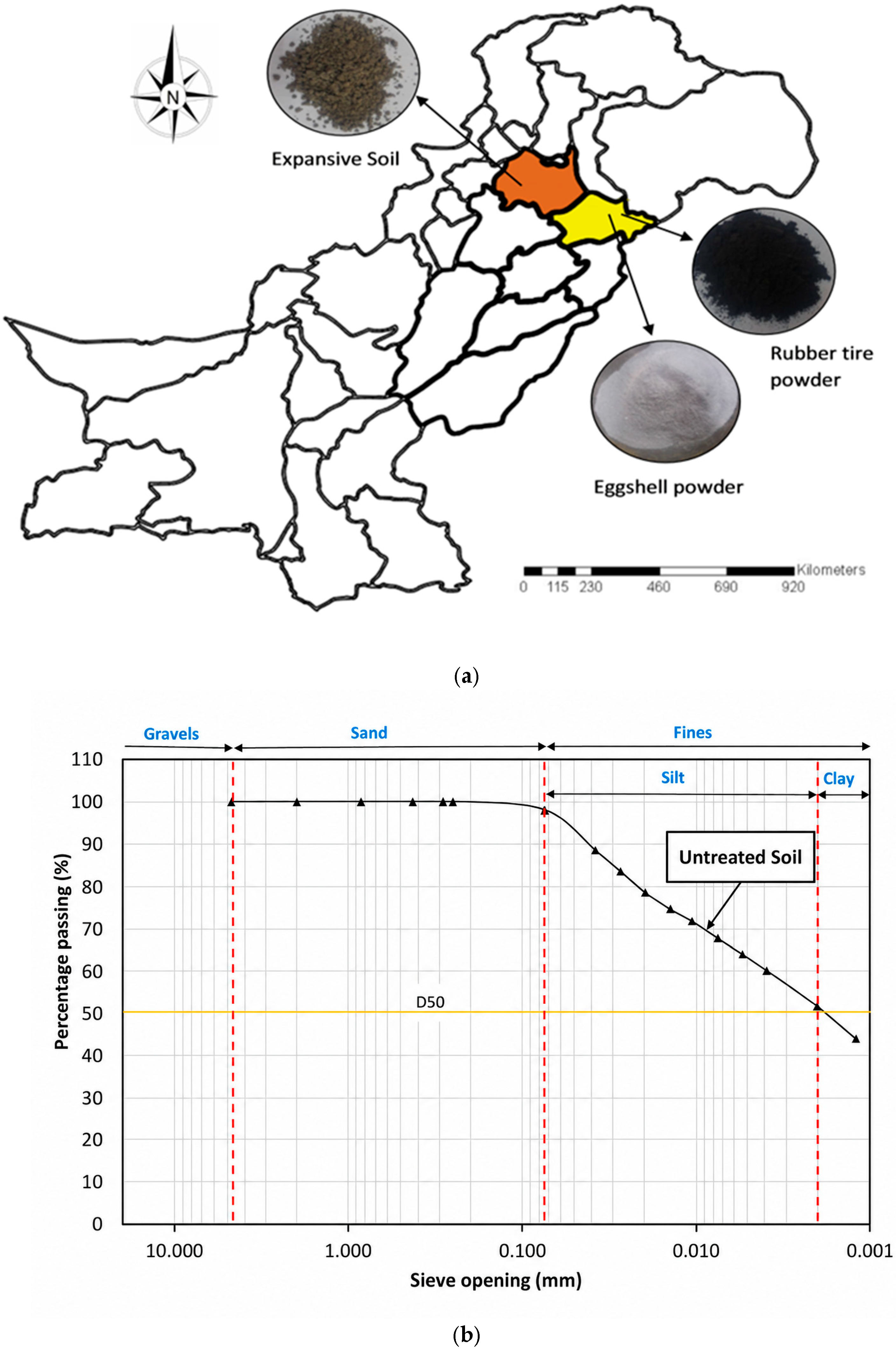

| Parameters | Expansive Soil | Standard |
|---|---|---|
| % Gravel | 0 | ASTM Code D6913 [37] |
| % Sand | 1.9 | ASTM Code D6913 [37] |
| % Fines | 98.1 | ASTM Code D7928 [38] |
| Soil Classification (AASHTO) | A-7-6 | ASTM Code D3282 [39] |
| Soil Classification (USCS) | CH | ASTM Code D2487 [40] |
| Liquid Limit, LL (%) | 62 | ASTM Code D4318 [41] |
| Plastic Limit, PL (%) | 29 | ASTM Code D4318 [41] |
| Plastic Index, PI (%) | 33 | ASTM Code D4318 [41] |
| Unconfined compressive strength, UCS (kPa) | 162 | ASTM Code D2166 [42] |
| Maximum dry density, MDD (g/cm3) | 1.32 | ASTM Code D698 [43] |
| Optimum moisture content, OMC (%) | 23% | ASTM Code D698 [43] |
| Swelling Potential, SP (%) | 63 | ASTM Code D4546 [44] |
| California bearing ratio for unsoaked (%) | 2.3 | ASTM Code D1883 [45] |
| California bearing ratio for soaked (%) | 1.2 | ASTM Code D1883 [45] |
| Parameters | Soil (%) | ESP (%) |
|---|---|---|
| SiO2 | 56.9 | 2.2 |
| Al2O3 | 22.4 | 1.7 |
| FeO | 11.2 | - |
| CaO | 3.9 | 78.4 |
| P2O5 | - | 1.3 |
| TiO2 | 2.2 | - |
| MgO | 1.4 | 2.6 |
| Na2O | 0.4 | 11.1 |
| Others | 1.6 | 2.7 |
| Parameters | Description | Standards |
|---|---|---|
| Physical | ||
| Appearance | Black color fines | - |
| Specific gravity | 1.08 | ASTM D792 [47] |
| Solubility | Insoluble | ASTM D 185 [48] |
| Softening Point (°C) | 165–170 | ASTM D36 [49] |
| Density (g/cm3) | 0.82 | ASTM D1895 [50] |
| Chemical | ||
| Rubber | 56% | ASTM D297 [51] |
| Carbon black | 27% | |
| Sulfur | 2% | |
| Zinc | 1% | |
| Other additives | 14% |
| Parameters | Statistical Test | df | Test Statistic | Effective Size (η2) | p-Value | Significant Effect |
|---|---|---|---|---|---|---|
| ESP | ||||||
| LL | OW ANOVA | F = 15.008 | 15.008 | η2 = 0.862 | 0.0001 | Yes |
| PL | OW ANOVA | F = 47.429 | 47.429 | η2 = 0.952 | <0.0001 | Yes |
| PI | Kruskal–Wallis | H = 5.538 | 5.538 | ε2 = 0.045 | 0.3538 | No |
| MDD | OW ANOVA | F = 36.870 | 36.87 | η2 = 0.939 | <0.0001 | Yes |
| OMC | OW ANOVA | F = 28.099 | 28.099 | η2 = 0.921 | <0.0001 | Yes |
| UCS (0 days) | OW ANOVA | F = 1.423 | 1.423 | η2 = 0.372 | 0.2846 | No |
| UCS (14 days) | Kruskal–Wallis | H = 10.637 | 10.637 | ε2 = 0.470 | 0.0591 | No |
| UCS (28 days) | OW ANOVA | F = 12.029 | 12.029 | η2 = 0.834 | 0.0002 | Yes |
| Swelling potential (7 days) | OW ANOVA | F = 140.938 | 140.938 | η2 = 0.983 | <0.0001 | Yes |
| Swelling potential (14 days) | OW ANOVA | F = 239.900 | 239.9 | η2 = 0.990 | <0.0001 | Yes |
| Swelling potential (21 days) | OW ANOVA | F = 295.430 | 295.43 | η2 = 0.992 | <0.0001 | Yes |
| Swelling potential (28 days) | OW ANOVA | F = 263.889 | 263.889 | η2 = 0.991 | <0.0001 | Yes |
| Unsoaked CBR | OW ANOVA | F = 36.540 | 36.54 | η2 = 0.938 | <0.0001 | Yes |
| Soaked CBR (28 days) | OW ANOVA | F = 76.474 | 76.474 | η2 = 0.970 | <0.0001 | Yes |
| RTP | ||||||
| LL | OW ANOVA | 3, 8 | F = 15.232 | η2 = 0.851 | 0.0011 | Yes |
| PL | OW ANOVA | 3, 8 | F = 22.551 | η2 = 0.894 | 0.0003 | Yes |
| PI | OW ANOVA | 3, 8 | F = 5.190 | η2 = 0.661 | 0.0279 | Yes |
| MDD | OW ANOVA | 3, 8 | F = 26.240 | η2 = 0.908 | 0.0002 | Yes |
| OMC | Kruskal–Wallis | 3 | H = 8.949 | ε2 = 0.744 | 0.0300 | Yes |
| UCS (0 days) | OW ANOVA | 3, 8 | F = 0.687 | η2 = 0.205 | 0.5851 | No |
| UCS (14 days) | OW ANOVA | 3, 8 | F = 3.677 | η2 = 0.580 | 0.0625 | No |
| UCS (28 days) | OW ANOVA | 3, 8 | F = 4.838 | η2 = 0.645 | 0.0332 | Yes |
| Swelling potential (7 days) | OW ANOVA | 3, 8 | F = 231.408 | η2 = 0.989 | <0.0001 | Yes |
| Swelling potential (14 days) | OW ANOVA | 3, 8 | F = 177.931 | η2 = 0.985 | <0.0001 | Yes |
| Swelling potential (21 days) | OW ANOVA | 3, 8 | F = 176.082 | η2 = 0.985 | <0.0001 | Yes |
| Swelling potential (28 days) | OW ANOVA | 3, 8 | F = 190.503 | η2 = 0.986 | <0.0001 | Yes |
| Unsoaked CBR | Kruskal–Wallis | 3 | H = 9.462 | ε2 = 0.808 | 0.0237 | Yes |
| Soaked CBR (28 days) | Kruskal–Wallis | 3 | H = 9.667 | ε2 = 0.833 | 0.0216 | Yes |
| Soil Mechanical Parameters | Additive | Shapiro–Wilk p-Value | Levene p-Value | Assumptions Satisfied | Statistical Test Used |
|---|---|---|---|---|---|
| PI | ESP | 0.0466 | 0.9522 | No | Kruskal–Wallis |
| UCS (14 days) | ESP | 0.0330 | 0.9957 | No | Kruskal–Wallis |
| OMC | RTP | 0.0367 | 0.9978 | No | Kruskal–Wallis |
| Unsoaked CBR | RTP | 0.0395 | 0.9961 | No | Kruskal–Wallis |
| Soaked CBR | RTP | 0.0197 | 0.9711 | No | Kruskal–Wallis |
| Parameter | Soil + 5% ESP | Soil + 10% ESP | Soil + 15% ESP | Soil + 20% ESP | Soil + 25% ESP | Soil + 20% ESP + 3% RTP | Soil + 20% ESP + 6% RTP | Soil + 20% ESP + 9% RTP | |
|---|---|---|---|---|---|---|---|---|---|
| LL | % | −4.8 | −9.6 | −12.9 | −17.7 | −16.1 | −22.6 | −29.0 | −27.4 |
 |  |  |  |  |  |  |  | ||
| PL | % | −6.8 | −17.2 | −20.6 | −27.5 | −20.6 | −24.1 | −34.4 | −37.9 |
 |  |  |  |  |  |  |  | ||
| PI | % | −3.0 | −3.0 | −6.0 | −9.0 | −12.1 | −21.2 | −24.2 | −18.2 |
 |  |  |  |  |  |  |  | ||
| MDD | % | 6.8 | 10.6 | 13.2 | 16.9 | 14.3 | 21.4 | 27.1 | 18.5 |
 |  |  |  |  |  |  |  | ||
| OMC | % | 4.0 | −4.0 | −4.0 | −13.0 | −21.6 | 4.0 | −13.0 | 8.6 |
 |  |  |  |  |  |  |  | ||
| UCS-0 day | % | 2.5 | 3.1 | 4.3 | 7.4 | −0.6 | 8.6 | 12.3 | 10.5 |
 |  |  |  |  |  |  |  | ||
| UCS-14 day | % | 5.9 | 8.9 | 10.7 | 14.2 | 5.9 | 19.5 | 26.6 | 17.2 |
 |  |  |  |  |  |  |  | ||
| UCS-28 day | % | 3.4 | 10.7 | 14.1 | 21.9 | 16.7 | 24.2 | 32.6 | 22.5 |
 |  |  |  |  |  |  |  | ||
| Percent swell-7 day | % | −11.1 | −36.5 | −41.3 | −50.8 | −65.1 | −69.8 | −74.6 | −82.5 |
 |  |  |  |  |  |  |  | ||
| Percent swell-14 day | % | −14.3 | −41.3 | −44.4 | −55.5 | −68.3 | −71.4 | −76.2 | −82.5 |
 |  |  |  |  |  |  |  | ||
| Percent swell-21 day | % | −19.1 | −46.0 | −50.1 | −60.3 | −69.8 | −74.6 | −77.8 | −84.1 |
 |  |  |  |  |  |  |  | ||
| Percent swell-28 day | % | −22.2 | −47.6 | −53.9 | −61.9 | −71.4 | −76.2 | −80.9 | −85.7 |
 |  |  |  |  |  |  |  | ||
| CBR (unsoaked) | times | 13.0 | 34.7 | 65.2 | 78.3 | 69.6 | 121.0 | 174.0 | 165.2 |
 |  |  |  |  |  |  |  | ||
| CBR (soaked)-28 days | times | 41.6 | 116.6 | 158.3 | 191.6 | 166.6 | 241.6 | 300.0 | 283.3 |
 |  |  |  |  |  |  |  |
 Increase (positive impact),
  Decrease (positive impact),
  Increase (negative impact),
  Decrease (negative impact).
Disclaimer/Publisher’s Note: The statements, opinions and data contained in all publications are solely those of the individual author(s) and contributor(s) and not of MDPI and/or the editor(s). MDPI and/or the editor(s) disclaim responsibility for any injury to people or property resulting from any ideas, methods, instructions or products referred to in the content. |
© 2026 by the authors. Licensee MDPI, Basel, Switzerland. This article is an open access article distributed under the terms and conditions of the Creative Commons Attribution (CC BY) license.
Share and Cite
Alshawmar, F.; Khalid, B.; Ullah, S.; Hassan, W.; Mehmood, M.; Sarwar, S. Sustainable Valorization of Agro-Industrial Waste and Polymer Residues for High-Plasticity Clay Stabilization: An Agro-Rubber Hybrid Approach. Polymers 2026, 18, 1907. https://doi.org/10.3390/polym18151907
Alshawmar F, Khalid B, Ullah S, Hassan W, Mehmood M, Sarwar S. Sustainable Valorization of Agro-Industrial Waste and Polymer Residues for High-Plasticity Clay Stabilization: An Agro-Rubber Hybrid Approach. Polymers. 2026; 18(15):1907. https://doi.org/10.3390/polym18151907
Chicago/Turabian StyleAlshawmar, Fahad, Bisma Khalid, Sana Ullah, Waqas Hassan, Mudassir Mehmood, and Sofia Sarwar. 2026. "Sustainable Valorization of Agro-Industrial Waste and Polymer Residues for High-Plasticity Clay Stabilization: An Agro-Rubber Hybrid Approach" Polymers 18, no. 15: 1907. https://doi.org/10.3390/polym18151907
APA StyleAlshawmar, F., Khalid, B., Ullah, S., Hassan, W., Mehmood, M., & Sarwar, S. (2026). Sustainable Valorization of Agro-Industrial Waste and Polymer Residues for High-Plasticity Clay Stabilization: An Agro-Rubber Hybrid Approach. Polymers, 18(15), 1907. https://doi.org/10.3390/polym18151907

