This is an early access version, the complete PDF, HTML, and XML versions will be available soon.
Review

Chitosan and Chitin-Derived Biomaterials in Orthopedics: A Structured Narrative Review of Polymer Design, Quantitative Performance, and Clinical Translation


Orthopedics and Traumatology, Erzincan Binali Yıldırım University, Erzincan 24100, Turkey
Polymers 2026, 18(13), 1644; https://doi.org/10.3390/polym18131644
Submission received: 30 May 2026 / Revised: 27 June 2026 / Accepted: 28 June 2026 / Published: 1 July 2026
(This article belongs to the Section Biobased and Biodegradable Polymers)

Abstract

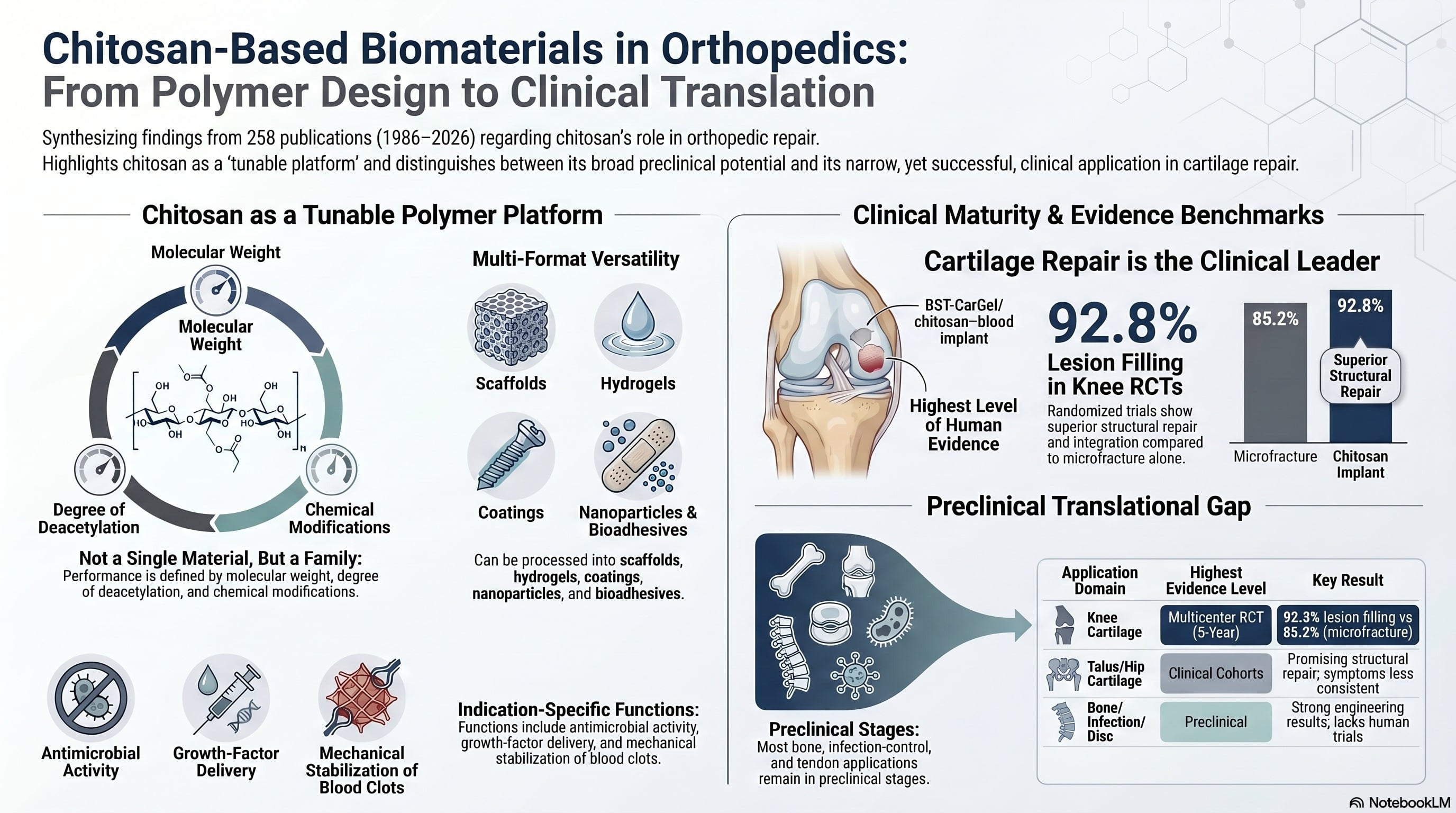
Chitosan and chitin-derived biomaterials, including native chitosan and chemically modified derivatives, have been widely investigated across orthopedic tissue engineering, implant functionalization, infection control, local delivery, and interface repair, but the evidence is dispersed across heterogeneous formats and indications. This single-author structured narrative review synthesizes 258 unique publications and interprets chitosan through a polymer design, quantitative performance, and clinical translation framework. Literature was identified (January–May 2026) using PubMed/MEDLINE as the primary database, with targeted verification in Web of Science, Scopus, and Google Scholar; no formal risk-of-bias or certainty grading was performed. Chitosan was studied as scaffolds, hydrogels, coatings, nanoparticles, microspheres, fibers, bioadhesives, bone-cement additives, cartilage adjuncts, tendon-to-bone systems, and intervertebral disk biomaterials. The highest human clinical evidence supported BST-CarGel/chitosan–blood implant augmentation of knee marrow stimulation, where randomized, 5-year, and biopsy data favored structural repair over microfracture alone; most other applications—bone regeneration, coatings, osteomyelitis hydrogels, bone cements, tendon/rotator cuff systems, and disk biomaterials—remain preclinical or translational-preclinical. Chitosan should be interpreted as a tunable polymer platform, not a single material; translation requires chemistry-defined formulation, indication-specific mechanical qualification, clinically relevant comparators, and standardized reporting.
Keywords: chitosan; orthopedic biomaterials; polymer platform; cartilage repair; bone regeneration; hydrogels; implant coatings; bone cement; intervertebral disk; clinical translation chitosan; orthopedic biomaterials; polymer platform; cartilage repair; bone regeneration; hydrogels; implant coatings; bone cement; intervertebral disk; clinical translation
Graphical Abstract