Successive Self-Nucleation and Annealing for the Characterization of Biomedical Ultra-High-Molecular-Weight PolyEthylene (UHMWPE) Formulations


Abstract
1. Introduction
1.1. Biomedical UHMWPE
1.2. Successive Self–Nucleation and Annealing Technique
2. Materials and Methods
2.1. Materials
2.2. Micro–FTIR Characterization
2.3. Gel Fraction and Crosslinking Density Measurements
2.4. Differential Scanning Calorimetry (DSC)
2.4.1. Standard Thermal Analysis
2.4.2. Successive Self–Nucleation and Annealing (SSA) Thermal Protocol
- (a)
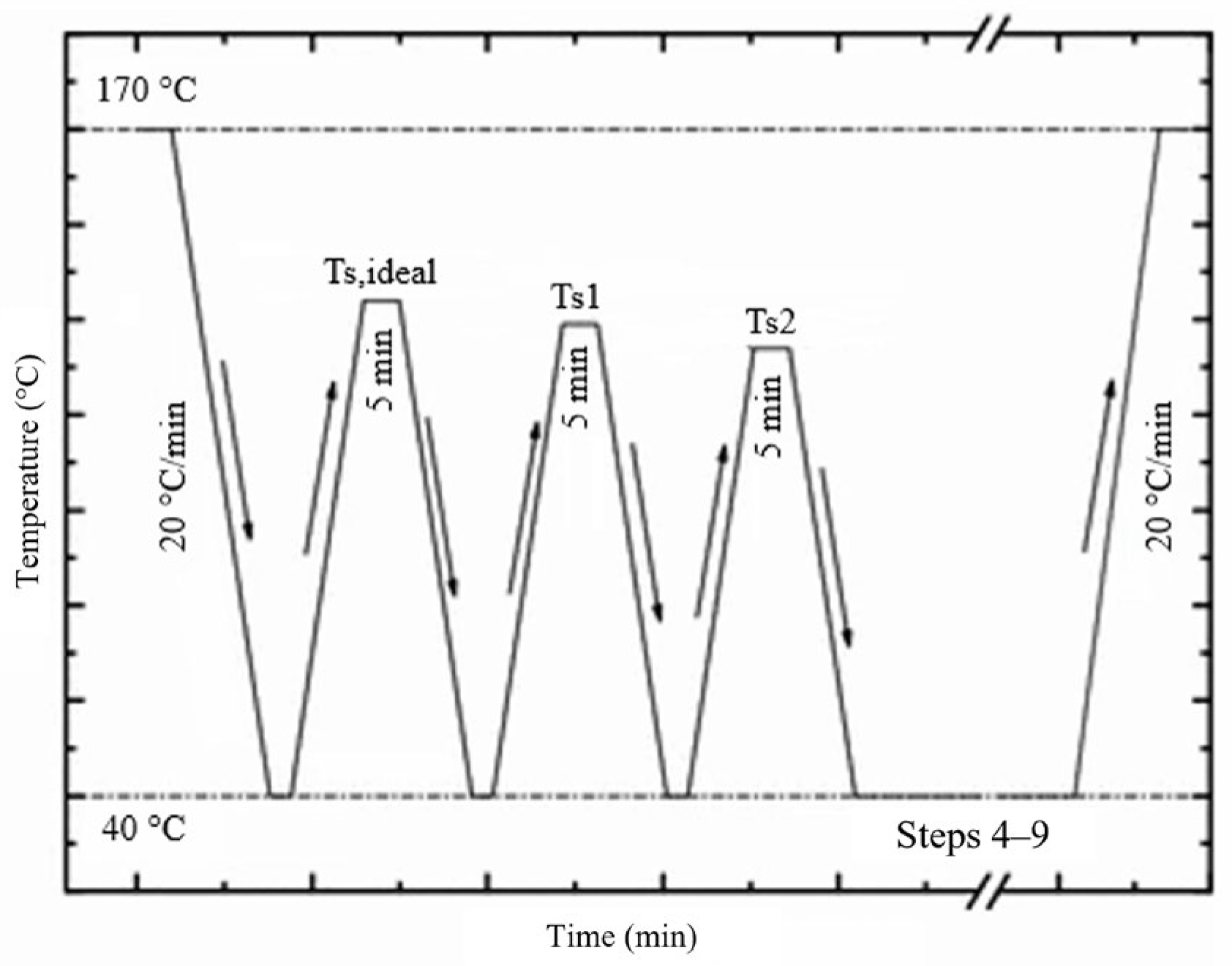
- The sample is held for 3 min at 170 °C (TMAX) to erase the crystalline memory.
- (b)
- The sample is cooled at a constant rate of 20 °C/min from 170 °C to 40 °C (TMIN) to allow the complete crystallization of the material. The peak crystallization temperature recorded during this cooling ramp is the “standard” crystallization temperature (Tc).
- (c)
- The sample is heated at 20 °C/min from 40 °C to the Ts,ideal measured in the previous Self-Nucleation experiment.
- (d)
- The sample is maintained at Ts for 5 min. This isothermal step results in partial melting and, depending on the Ts, in the annealing of unmelted crystalline fractions.
- (e)
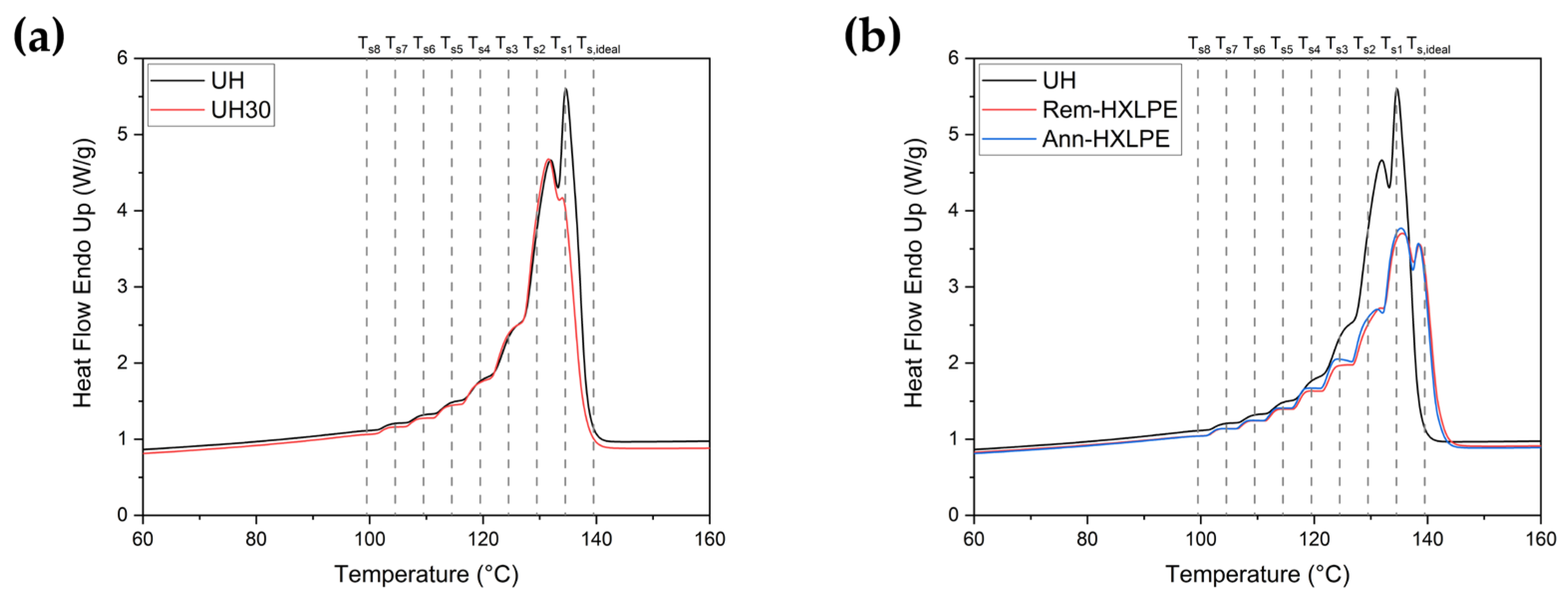
- The sample is cooled at 20 °C/min from Ts,ideal to 40 °C, thus the fraction that melted at Ts will crystallize. According to the definition of ‘Domains’ by Mueller et al. [4], if the sample lies within Domain I (complete melting domain), crystallization takes place at the standard Tc, whereas in Domain II (exclusive self-nucleation domain), it occurs at higher temperatures due to self-nucleation. Finally, if the sample lies within Domain III (self-nucleation and annealing domain), crystallization occurs immediately upon cooling, just below Ts.
- (f)
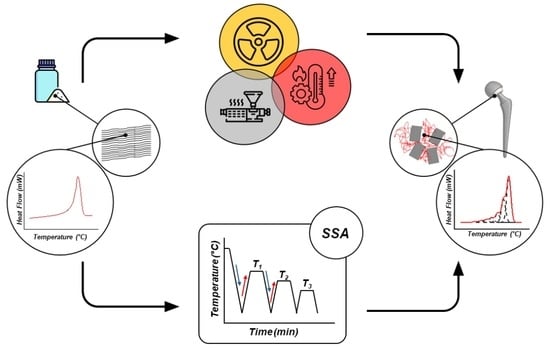
- Steps (c), (d), and (e) are repeated iteratively, gradually decreasing Ts by 5 °C in each sequence. This ΔT corresponds to the fractionation window, which defines the width of the thermal fraction and is kept constant throughout the SSA experiment. The number of repetitions is defined by choosing the value of the fractionation window (5 °C) and fractionation range (40 °C). In this work, the SSA thermal protocol consists of 9 cycles.
- (g)
- The last step involves a heating ramp, at a constant rate of 20 °C/min, to 170 °C. During this ramp, the fractionation profile is recorded.
2.5. Deconvolution Procedure
3. Results
4. Conclusions
Author Contributions
Funding
Institutional Review Board Statement
Data Availability Statement
Acknowledgments
Conflicts of Interest
References
- Bracco, P.; Bellare, A.; Bistolfi, A.; Affatato, S. Ultra-High Molecular Weight Polyethylene: Influence of the Chemical, Physical and Mechanical Properties on the Wear Behavior. A Review. Materials 2017, 10, 791. [Google Scholar] [CrossRef]
- Bistolfi, A.; Giustra, F.; Bosco, F.; Sabatini, L.; Aprato, A.; Bracco, P.; Bellare, A. Ultra-High Molecular Weight Polyethylene (UHMWPE) for Hip and Knee Arthroplasty: The Present and the Future. J. Orthop. 2021, 25, 98–106. [Google Scholar] [CrossRef]
- Sobieraj, M.C.; Rimnac, C.M. Ultra High Molecular Weight Polyethylene: Mechanics, Morphology, and Clinical Behavior. J. Mech. Behav. Biomed. Mater. 2009, 2, 433–443. [Google Scholar] [CrossRef]
- Costa, L.; Luda, M.P.; Trossarelli, L.; Brach del Prever, E.M.; Crova, M.; Gallinaro, P. In Vivo UHMWPE Biodegradation of Retrieved Prosthesis. Biomaterials 1998, 19, 1371–1385. [Google Scholar] [CrossRef] [PubMed]
- Besong, A.A.; Tipper, J.L.; Ingham, E.; Stone, M.H.; Wroblewski, B.M.; Fisher, J. Quantitative Comparison of Wear Debris from UHMWPE That Has and Has Not Been Sterilised by Gamma Irradiation. J. Bone Jt. Surg. Br. 1998, 80, 340–344. [Google Scholar] [CrossRef]
- Costa, L.; Bracco, P. Mechanisms of Crosslinking, Oxidative Degradation and Stabilization of UHMWPE. In UHMWPE Biomaterials Handbook; Kurtz, S.M., Ed.; Elsevier: Boston, MA, USA, 2009; pp. 309–323. [Google Scholar] [CrossRef]
- McKellop, H.; Shen, F.; Lu, B.; Campbell, P.; Salovey, R. Development of an Extremely Wear-resistant Ultra High Molecular Weight Polythylene for Total Hip Replacements. J. Orthop. Res. 1999, 17, 157–167. [Google Scholar] [CrossRef]
- Kurtz, S.M. The Origins of UHMWPE in Total Hip Arthroplasty. In The UHMWPE Handbook; Elsevier: Amsterdam, The Netherlands, 2004; pp. 53–70. [Google Scholar]
- Kurtz, S.M.; Manley, M.; Wang, A.; Taylor, S.; Dumbleton, J. Comparison of the Properties of Annealed Crosslinked (Crossfire) and Conventional Polyethylene as Hip Bearing Materials. Bull. Hosp. Jt. Dis. 2002, 61, 17–26. [Google Scholar]
- Muratoglu, O.K.; Merrill, E.W.; Bragdon, C.R.; O’Connor, D.; Hoeffel, D.; Burroughs, B.; Jasty, M.; Harris, W.H. Effect of Radiation, Heat, and Aging on In Vitro Wear Resistance of Polyethylene. Clin. Orthop. Relat. Res. 2003, 417, 253–262. [Google Scholar] [CrossRef] [PubMed]
- Wannomae, K.K.; Christensen, S.D.; Freiberg, A.A.; Bhattacharyya, S.; Harris, W.H.; Muratoglu, O.K. The Effect of Real-Time Aging on the Oxidation and Wear of Highly Cross-Linked UHMWPE Acetabular Liners. Biomaterials 2006, 27, 1980–1987. [Google Scholar] [CrossRef]
- Breese, K.D.; Lamèthe, J.-F.; DeArmitt, C. Improving Synthetic Hindered Phenol Antioxidants: Learning from Vitamin E. Polym. Degrad. Stab. 2000, 70, 89–96. [Google Scholar] [CrossRef]
- Bracco, P.; Brunella, V.; Zanetti, M.; Luda, M.P.; Costa, L. Stabilisation of Ultra-High Molecular Weight Polyethylene with Vitamin E. Polym. Degrad. Stab. 2007, 92, 2155–2162. [Google Scholar] [CrossRef]
- Kurtz, S.M.; Dumbleton, J.; Siskey, R.S.; Wang, A.; Manley, M. Trace Concentrations of Vitamin E Protect Radiation Crosslinked UHMWPE from Oxidative Degradation. J. Biomed. Mater. Res. A 2009, 90, 549–563. [Google Scholar] [CrossRef]
- Costa, L.; Bracco, P. Mechanisms of Cross-Linking, Oxidative Degradation, and Stabilization of UHMWPE. In UHMWPE Biomaterials Handbook; Kurtz, S.M., Ed.; Elsevier: Oxford, UK, 2016; pp. 467–487. [Google Scholar] [CrossRef]
- Oral, E.; Muratoglu, O.K. Vitamin E Diffused, Highly Crosslinked UHMWPE: A Review. Int. Orthop. 2011, 35, 215–223. [Google Scholar] [CrossRef] [PubMed]
- Bracco, P.; Oral, E. Vitamin E-Stabilized UHMWPE for Total Joint Implants: A Review. Clin. Orthop. Relat. Res. 2011, 469, 2286–2293. [Google Scholar] [CrossRef]
- Busch, A.; Jäger, M.; Klebingat, S.; Baghdadi, J.; Flörkemeier, T.; Hütter, F.; Grupp, T.M.; Haversath, M. Vitamin E-Blended Highly Cross-Linked Polyethylene Liners in Total Hip Arthroplasty: A Randomized, Multicenter Trial Using Virtual CAD-Based Wear Analysis at 5-Year Follow-Up. Arch. Orthop. Trauma. Surg. 2020, 140, 1859–1866. [Google Scholar] [CrossRef]
- Müller, A.J.; Hernández, Z.H.; Arnal, M.L.; Sánchez, J.J. Successive Self-Nucleation/Annealing (SSA): A Novel Technique to Study Molecular Segregation during Crystallization. Polym. Bull. 1997, 39, 465–472. [Google Scholar] [CrossRef]
- Müller, A.J.; Arnal, M.L. Thermal Fractionation of Polymers. Prog. Polym. Sci. 2005, 30, 559–603. [Google Scholar] [CrossRef]
- Pérez-Camargo, R.A.; Müller, A.J. Novel Applications of Successive Self-Nucleation and Annealing Thermal Fractionation for Polymer Characterization. ACS Appl. Polym. Mater. 2026, 8, 2542–2576. [Google Scholar] [CrossRef]
- de Gáscue, B.R.; Prin, J.L.; Hernández, G.; Vallés, E.M.; Lorenzo, A.T.; Müller, A.J. Use of the Successive Self-Nucleation and Annealing Technique to Characterize 60Co Gamma Irradiated HDPEs. J. Therm. Anal. Calorim. 2011, 103, 669–678. [Google Scholar] [CrossRef]
- Mansouri, A.; Ghasemi Hamedani, N.; Zou, C.; Mousavi, S.; Khonakdar, H.A.; Bahri-Laleh, N.; Rodríguez-Pizarro, M.; Brotons-Rufes, A.; Posada-Pérez, S.; Poater, A. Improving Environmental Stress Cracking Resistance of High-Density Polyethylene Grades by Comonomer Addition and Nanocomposite Approach. Chem.—A Eur. J. 2024, 30, e202401926. [Google Scholar] [CrossRef]
- Li, P.; Xue, Y.; Liu, W.; Sun, G.; Ji, X. Chain Structure Comparison of Two Low Density Polyethylene Resins Fractionated by Temperature Rising Elution Fractionation and Thermal Fractionation. J. Polym. Res. 2019, 26, 56. [Google Scholar] [CrossRef]
- Wang, M.; Yang, F.; Xiang, M.; Yang, F.; Wu, T. Design of Molecular Structure for Commercial Polyethylene 100 Pipe. J. Polym. Res. 2022, 29, 84. [Google Scholar] [CrossRef]
- Pérez, C.J.; Villarreal, N.; Pastor, J.M.; Failla, M.D.; Vallés, E.M.; Carella, J.M. The Use of SSA Fractionation to Detect Changes in the Molecular Structure of Model Ethylene–Butene Copolymers Modified by Peroxide Crosslinking. Polym. Degrad. Stab. 2009, 94, 1639–1645. [Google Scholar] [CrossRef]
- Wang, W.; Li, X.; Li, J.; Xin, S.; Jiang, S. Crystallization Behavior and Structure of Metallocene Polyethylene with Long-Chain Branch. Colloid. Polym. Sci. 2022, 300, 521–530. [Google Scholar] [CrossRef]
- ASTM F2102-17; Guide for Evaluating the Extent of Oxidation in Polyethylene Fabricated Forms Intended for Surgical Implants. ASTM International: West Conshohocken, PA, USA, 2017. [CrossRef]
- ASTM D2765-16; Test Methods for Determination of Gel Content and Swell Ratio of Crosslinked Ethylene Plastics. ASTM International: West Conshohocken, PA, USA, 2016. [CrossRef]
- Muratoglu, O.K.; O’Connor, D.O.; Bragdon, C.R.; Delaney, J.; Jasty, M.; Harris, W.H.; Merrill, E.; Venugopalan, P. Gradient Crosslinking of UHMWPE Using Irradiation in Molten State for Total Joint Arthroplasty. Biomaterials 2002, 23, 717–724. [Google Scholar] [CrossRef]
- Müller, A.J.; Michell, R.M.; Pérez, R.A.; Lorenzo, A.T. Successive Self-Nucleation and Annealing (SSA): Correct Design of Thermal Protocol and Applications. Eur. Polym. J. 2015, 65, 132–154. [Google Scholar] [CrossRef]
- Lorenzo, A.T.; Arnal, M.L.; Müller, A.J.; Boschetti de Fierro, A.; Abetz, V. High Speed SSA Thermal Fractionation and Limitations to the Determination of Lamellar Sizes and Their Distributions. Macromol. Chem. Phys. 2006, 207, 39–49. [Google Scholar] [CrossRef]
- Deplancke, T.; Lame, O.; Rousset, F.; Seguela, R.; Vigier, G. Mechanisms of Chain Reentanglement during the Sintering of UHMWPE Nascent Powder: Effect of Molecular Weight. Macromolecules 2015, 48, 5328–5338. [Google Scholar] [CrossRef]
- Wang, W.; Wang, H.; Chen, J. Tuning Chain Entanglement Density in UHMWPE via Sintering: Crystallization Suppression and Cryogenic Toughening Mechanism. Polymer 2025, 338, 129037. [Google Scholar] [CrossRef]
- Currier, B.H.; Van Citters, D.W.; Currier, J.H.; Carlson, E.M.; Tibbo, M.E.; Collier, J.P. In Vivo Oxidation in Retrieved Highly Crosslinked Tibial Inserts. J. Biomed. Mater. Res. B Appl. Biomater. 2013, 101, 441–448. [Google Scholar] [CrossRef]
- Premnath, V.; Harris, W.H.; Jasty, M.; Merrill, E.W. Gamma Sterilization of UHMWPE Articular Implants: An Analysis of the Oxidation Problem. Biomaterials 1996, 17, 1741–1753. [Google Scholar] [CrossRef]
- Benítez, A.; Sánchez, J.J.; Arnal, M.L.; Müller, A.J.; Rodríguez, O.; Morales, G. Abiotic Degradation of LDPE and LLDPE Formulated with a Pro-Oxidant Additive. Polym. Degrad. Stab. 2013, 98, 490–501. [Google Scholar] [CrossRef]
- Lerf, R.; Zurbrügg, D.; Delfosse, D. Use of Vitamin E to Protect Cross-Linked UHMWPE from Oxidation. Biomaterials 2010, 31, 3643–3648. [Google Scholar] [CrossRef] [PubMed]





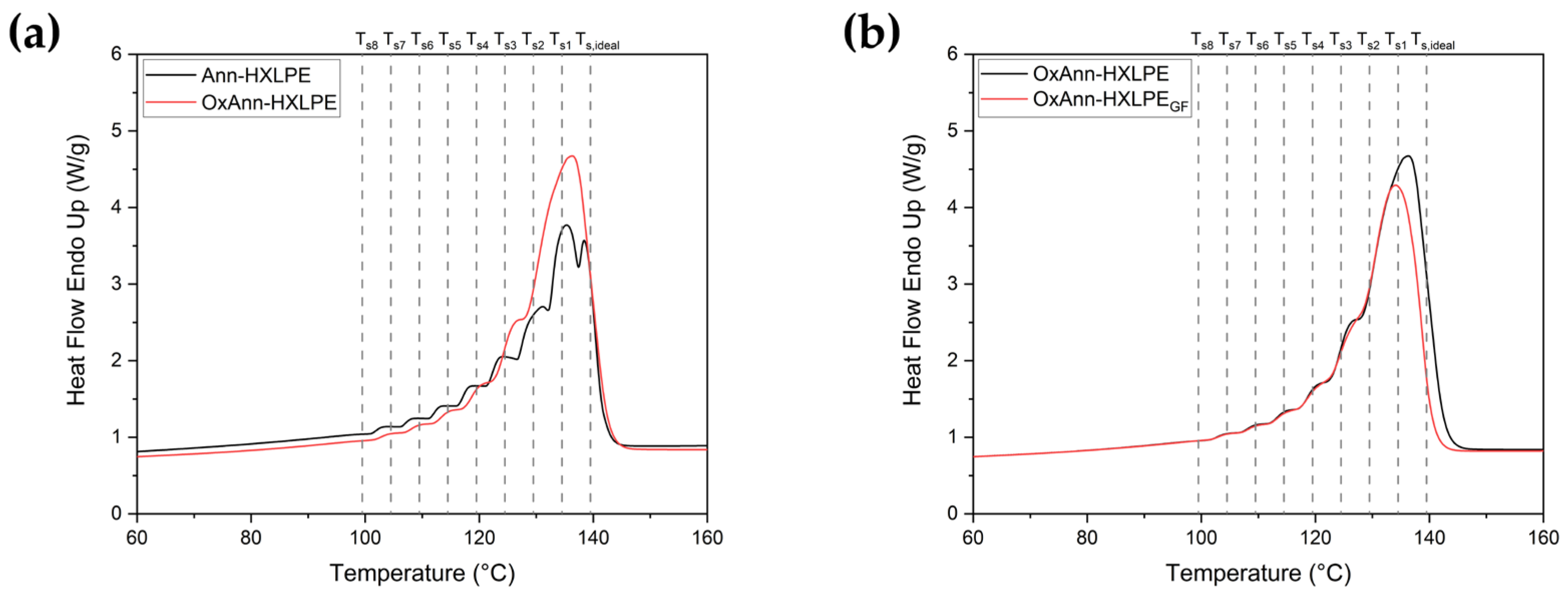
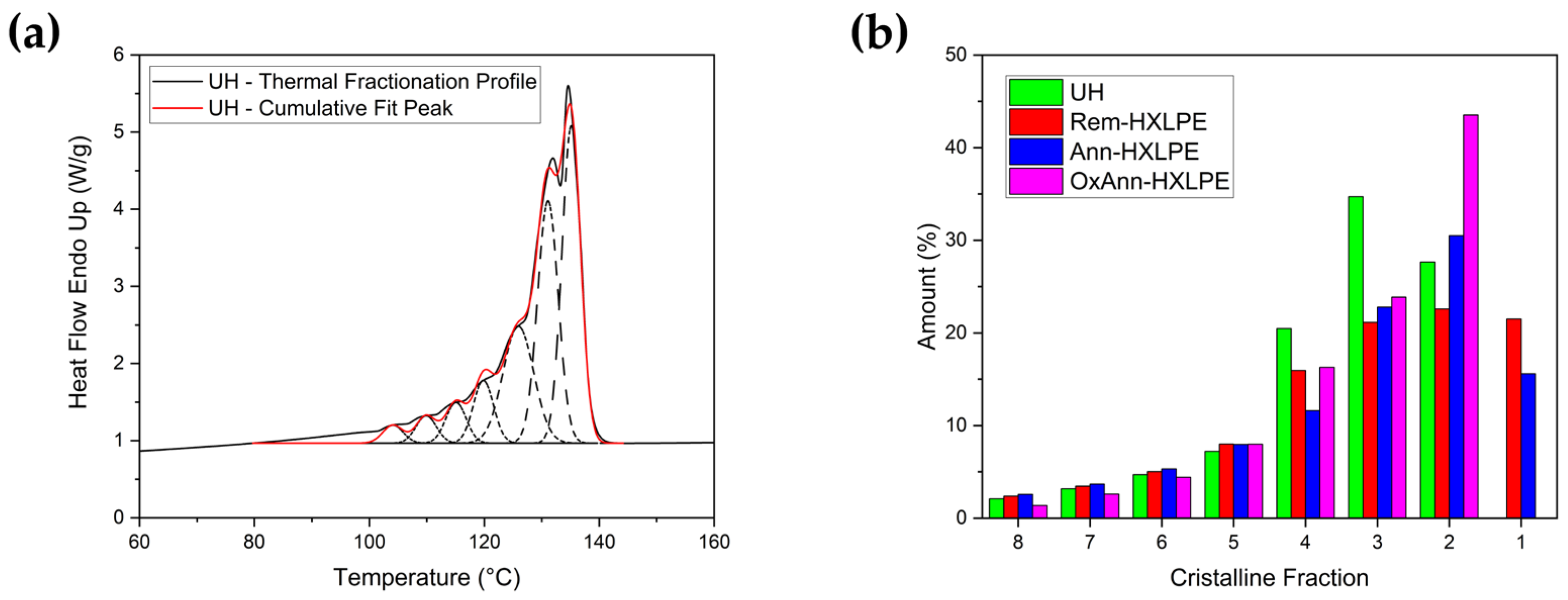
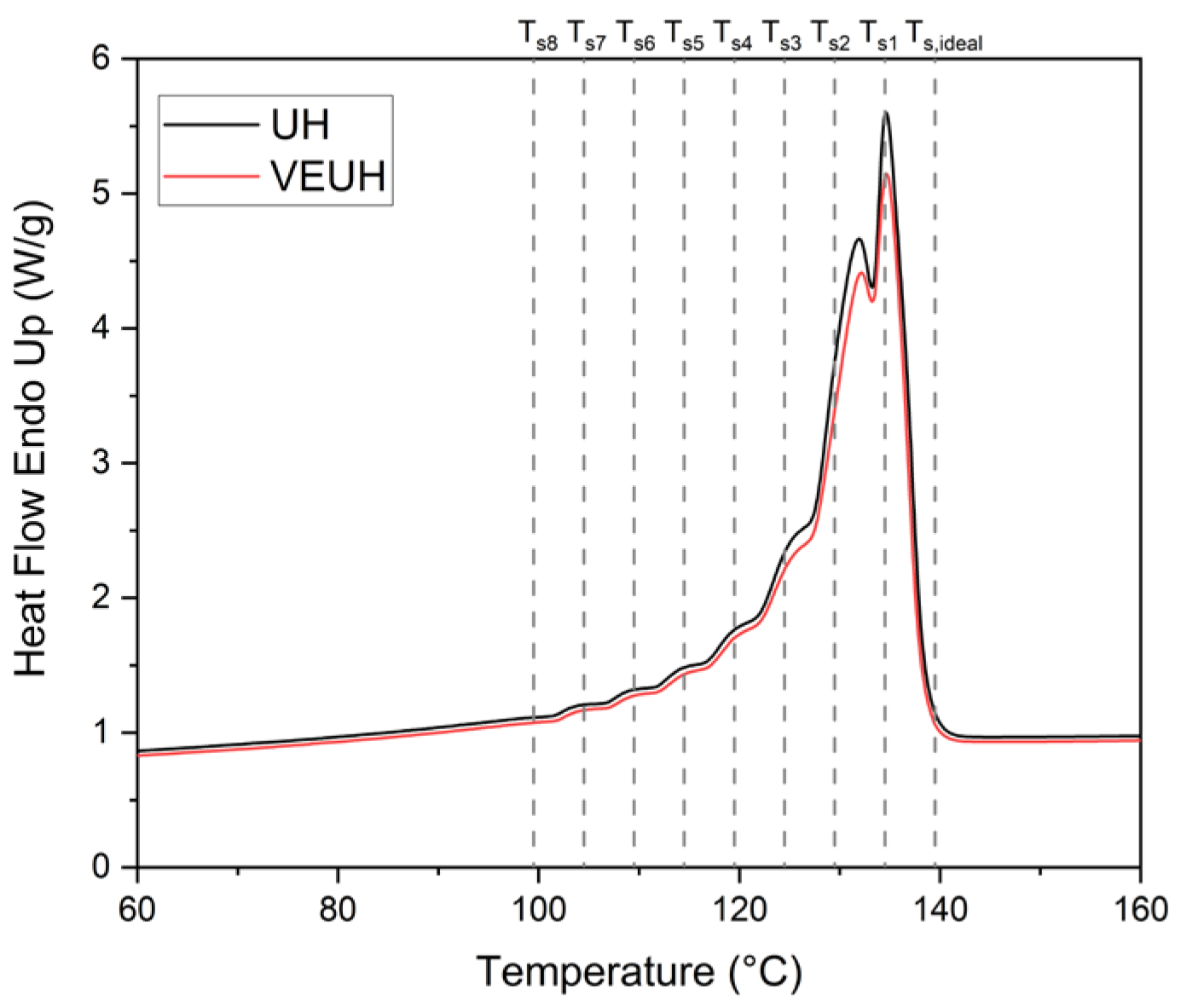
| Std. DSC | SSA | |||||||||
|---|---|---|---|---|---|---|---|---|---|---|
| Samples | Tm (°C) | Χc (%) | Tm8 (°C) | Tm7 (°C) | Tm6 (°C) | Tm5 (°C) | Tm4 (°C) | Tm3 (°C) | Tm2 (°C) | Tm1 (°C) |
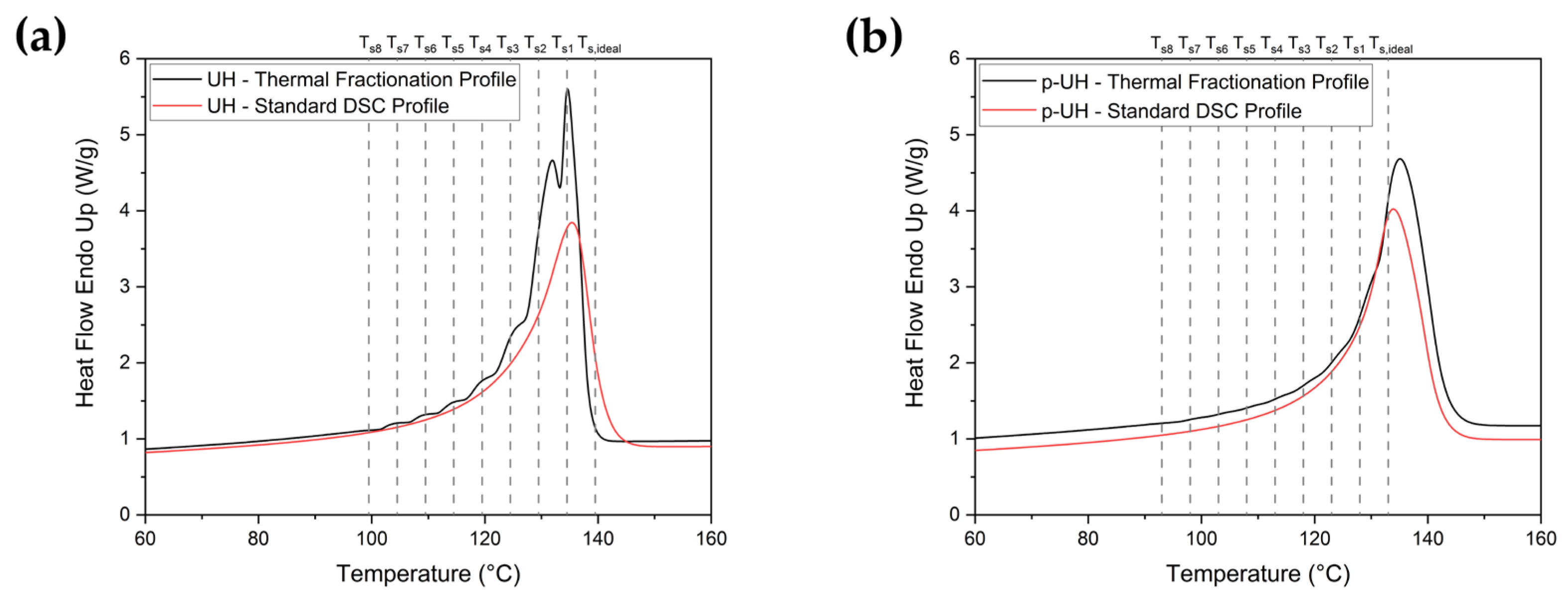
| p-UH | 133.9 | 48 | - | - | - | - | - | - | 135.2 | - |
| UH | 135.4 | 47 | 104.1 | 109.9 | 115.1 | 119.8 | 125.9 | 131.8 | 134.7 | - |
| UH30 | 133.5 | 45 | 103.6 | 109.1 | 114.6 | 119.7 | 125.2 | 131.5 | 134.1 | - |
| Ann-HXLPE | 136.5 | 43 | 103.7 | 109.1 | 114.3 | 119.4 | 124.2 | 131.1 | 135.3 | 138.4 |
| Rem-HXLPE | 138.6 | 44 | 103.9 | 109.3 | 114.2 | 119.3 | 125.4 | 131.5 | 135.5 | 138.5 |
| OxAnn-HXLPE | 130.8 | 54 | 104.5 | 110.1 | 115.1 | 121.0 | 126.9 | * | 136.4 | - |
| VEUH | 132.3 | 46 | 104.6 | 109.4 | 114.7 | 119.9 | 125.2 | 131.9 | 134.6 | - |
| Sample | Gel Fraction (%) |
|---|---|
| UH | - |
| UH30 | 96.9 ± 0.8 |
| Rem-HXLPE | 98.9 ± 0.1 |
| Ann-HXLPE | 98.4 ± 0.2 |
| OxAnn-HXLPE | 84.4 ± 4.1 |
Disclaimer/Publisher’s Note: The statements, opinions and data contained in all publications are solely those of the individual author(s) and contributor(s) and not of MDPI and/or the editor(s). MDPI and/or the editor(s) disclaim responsibility for any injury to people or property resulting from any ideas, methods, instructions or products referred to in the content. |
© 2026 by the authors. Licensee MDPI, Basel, Switzerland. This article is an open access article distributed under the terms and conditions of the Creative Commons Attribution (CC BY) license.
Share and Cite
Gianoglio, L.; Righetti, M.; Zanetti, M.; Bracco, P. Successive Self-Nucleation and Annealing for the Characterization of Biomedical Ultra-High-Molecular-Weight PolyEthylene (UHMWPE) Formulations. Polymers 2026, 18, 1428. https://doi.org/10.3390/polym18121428
Gianoglio L, Righetti M, Zanetti M, Bracco P. Successive Self-Nucleation and Annealing for the Characterization of Biomedical Ultra-High-Molecular-Weight PolyEthylene (UHMWPE) Formulations. Polymers. 2026; 18(12):1428. https://doi.org/10.3390/polym18121428
Chicago/Turabian StyleGianoglio, Luca, Matteo Righetti, Marco Zanetti, and Pierangiola Bracco. 2026. "Successive Self-Nucleation and Annealing for the Characterization of Biomedical Ultra-High-Molecular-Weight PolyEthylene (UHMWPE) Formulations" Polymers 18, no. 12: 1428. https://doi.org/10.3390/polym18121428
APA StyleGianoglio, L., Righetti, M., Zanetti, M., & Bracco, P. (2026). Successive Self-Nucleation and Annealing for the Characterization of Biomedical Ultra-High-Molecular-Weight PolyEthylene (UHMWPE) Formulations. Polymers, 18(12), 1428. https://doi.org/10.3390/polym18121428