3.1. Thermal Performance and Ablation Resistance
To assess the thermal insulation performance of the composite, its thermal conductivity was measured (as detailed in
Table 2). The thermal conductivity of Z
0T
0 devoid of ceramic fillers was observed to be 0.268 W·m
−1·K
−1. Owing to the filling effect of ZrSi
2 and TiB
2, defects such as micro-pores formed during the curing process were mitigated, thereby decreasing the interfacial thermal resistance. As a result, the thermal conductivity of Z
20T
25 increased to 0.405 W·m
−1·K
−1. While the incorporation of ceramic fillers enhanced the thermal conductivity of the composite, it nonetheless remained considerably lower than that of carbon fiber-reinforced carbon–phenolic resin composite (CF/CPR), carbon/carbon composites (C/C), and carbon fiber-reinforced ultra-high-temperature ceramic matrix composites (CF/UHTCM) [
38,
39,
40]. This phenomenon is primarily attributed to the low thermal conductivity of Al
2O
3f [
31], which confers excellent thermal insulation performance to the composite.
To further investigate the effects of ZrSi
2 and TiB
2 on the thermal stability of Al
2O
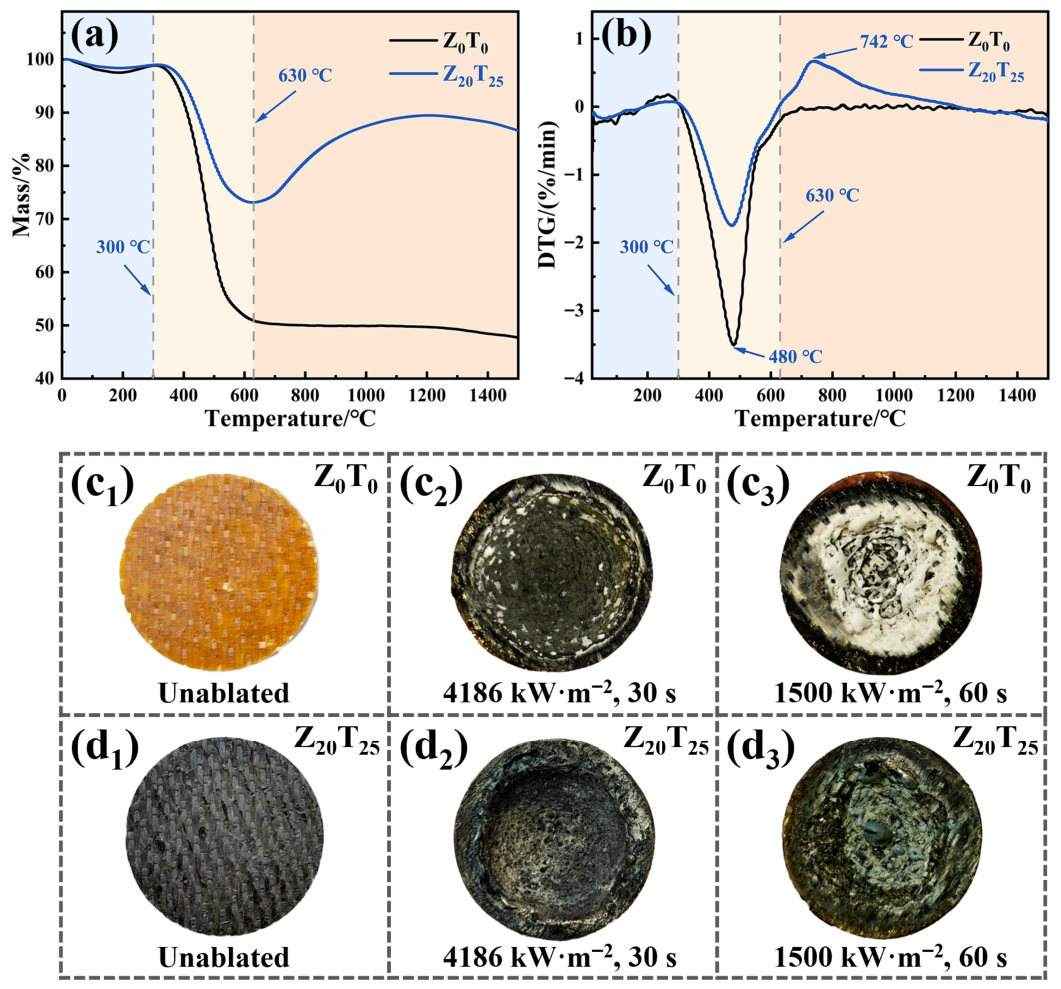
3f/BPR, thermogravimetric analysis (TG) and differential thermal gravimetric analysis (DTG) were conducted, and the results are presented in
Figure 2a,b.
The thermal decomposition and oxidation process of Z
0T
0 can be categorized into three distinct stages. The initial stage (<300 °C) exhibits a minor mass reduction of 1.1%, attributed to the volatilization of adsorbed water and the release of free phenols from the sample. The subsequent stage (300–630 °C) is characterized by intense thermal decomposition and oxidation, with a mass loss of 47.9% and a peak mass loss rate observed at 480 °C (
Figure 2b). The mass loss during this phase mainly results from the thermal decomposition of BPR, which releases small molecules such as CH
4, CO, H
2O, and phenol, in addition to the oxidation of the resultant pyrolytic carbon (PyC). During the final stage (630–1500 °C), the TG curve displays a gradual decline, with a total mass loss of only 3.3%. The mass loss in this stage is primarily due to the volatilization of B
2O
3, the oxidation product.
The pyrolysis process of Z
20T
25 containing ceramic fillers closely resembles that of Z
0T
0, also comprising three stages. Below 300 °C, the TG curves of both samples are essentially indistinguishable, each exhibiting a mass loss of 1.1%. This reduction in mass at this stage is ascribed to the volatilization of adsorbed water. Within the range of 300 °C to 630 °C, Z
20T
25 exhibits significant mass loss, following a trend consistent with Z
0T
0. However, its mass loss is only 25.8%, representing a 22.1% reduction compared to Z
0T
0. This decreased rate of mass loss is primarily due to the oxidation of the ceramic fillers in Z
20T
25, which consumes oxygen and thereby reduces the partial pressure of oxygen. Simultaneously, the produced oxides deposit onto the resin matrix and fiber surfaces, shielding contact between BPR and oxygen. This synergistic mechanism of oxygen depletion and the formation of an oxygen barrier effectively inhibits BPR pyrolysis and PyC oxidation, resulting in a notable decrease in mass loss. As illustrated in
Figure 2b, although both samples reached their maximum mass loss rates at 480 °C, the rate for Z
20T
25 remained consistently lower than that of Z
0T
0, supporting the aforementioned mechanism. During the high-temperature stage from 630 °C to 1500 °C, their thermal behaviors demonstrate significant divergence. In contrast to the gradual decrease observed in the TG curve of Z
0T
0, the TG curve of Z
20T
25 initially exhibits a rapid increase before gradually declining. This behavior is attributed to the ceramic fillers incorporated into Z
20T
25, which undergo ongoing oxidation, resulting in mass gain at high temperature. Its rate of weight gain surpasses the mass loss caused by B
2O
3 volatilization, resulting in an increase, rather than a decrease, in the residual mass of the sample. The DTG curve indicates that the oxidation mass gain rate of the ceramic fillers peaks at 742 °C. As most of the ceramic fillers are oxidized, the oxidation rate of the remaining fillers gradually diminishes, attenuating the mass gain trend of the sample. Consequently, the residual mass begins to decrease gradually.
The ablation resistance of the composite was assessed through oxygen-acetylene ablation tests.
Figure 2c,d illustrate the macroscopic morphology of the samples prior to and following ablation. Three samples were tested for each group, and the mean values and standard deviations of the detailed ablation data are provided in
Table 3. As depicted in
Figure 2(c
1,d
1), the unablated Z
0T
0 sample presents an orange-yellow appearance, whereas the Z
20T
25 sample appears grayish-black. Both samples display smooth surfaces with identifiable Al
2O
3f patterns.
Following an ablation duration of thirty seconds at a heat flux density of 4186 kW·m
−2, the surface of Z
0T
0 devoid of ceramic fillers (
Figure 2(c
2)) turned black due to oxidation, characterized by the formation of a prominent crater at the center of ablation surrounded by a region of white reaction products. Under these extreme conditions, the flame temperature at the ablation center attained 3000 °C [
41,
42], significantly surpassing the melting point of Al
2O
3 (2072 °C). This resulted in rapid oxidation pyrolysis of the BPR, with the melted Al
2O
3f being entirely eroded by the flame gases, leaving behind small quantities of partially melted white Al
2O
3f at the crater periphery. Owing to substantial loss of resin and fibers, Z
0T
0 demonstrated a high
LAR and
MAR of 0.1350 mm·s
−1 and 0.0652 g·s
−1, respectively. Under identical ablation conditions, the Z
20T
25 sample (
Figure 2(d
2)), which incorporates ceramic fillers, also exhibited pitted surface morphology post-ablation. However, the pits were marginally smaller, featuring pale white centers with no significant exposure of Al
2O
3f. This phenomenon is attributable to the oxidation of ceramic fillers during ablation, with oxidation products adhering to the sample surface, thereby offering partial protection to the resin matrix and fibers, and delaying their pyrolysis and melting processes. Nonetheless, the data presented in
Table 3 indicate that at this heat flux density, the
LAR of Z
20T
25 (0.1363 mm·s
−1) is nearly identical to that of Z
0T
0. Experimental results suggest that at exceedingly high temperatures, the
LAR is predominantly governed by the melting of Al
2O
3, with negligible influence exerted by the ceramic fillers. Conversely, the
MAR of Z
20T
25 decreases to 0.0570 g·s
−1, which is attributed to the oxidative protection conferred by the ceramic fillers and their associated oxidative mass gain.
Considering that the differences between Z
0T
0 and Z
20T
25 at a heat flux density of 4186 kW·m
−2 were not statistically significant, the heat flux density was modified to 1500 kW·m
−2, and the ablation duration was extended to 60 s. The post-ablation morphologies are presented in
Figure 2(c
3,d
3). Under these conditions, a pit approximately one-third the size of that in
Figure 2(c
2) manifests at the center of Z
0T
0 (
Figure 2(c
3)), with the sample surface remaining comparatively flat. The extensive white fibrous network surrounding the pit corresponds to exposed Al
2O
3f. This phenomenon occurs because the reduced heat flux density diminishes the sample temperature; however, the ablation center remains heated sufficiently to reach the melting point of Al
2O
3. Consequently, fibers within the ablation center melt and are eroded, forming the pit. While temperatures in the surrounding areas are insufficient to melt the fibers, they still induce rapid oxidation and pyrolysis of the resin, leaving the exposed fiber network intact. Compared to the high
LAR (0.1350 mm·s
−1) at 4186 kW·m
−2, the
LAR of Z
0T
0 at 1500 kW·m
−2 significantly decreased to 0.0343 mm·s
−1. This reduction is primarily attributed to a substantial decrease in molten Al
2O
3f, while the sample thickness remained relatively stable. Despite the reduction in fiber melting, the resin still undergoes rapid pyrolysis at high temperature. The extended ablation time of 60 s increases the pyrolysis mass of the resin, resulting in only a slight decrease in the
MAR of Z
0T
0 from 0.0652 g·s
−1 to 0.0502 g·s
−1.
At an identical heat flux density of 1500 kW·m
−2, the Z
20T
25 sample (
Figure 2(d
3)) also demonstrated pitting at the center following ablation. Nevertheless, its surface was covered with a grayish-green layer, and no extensive fiber exposure was observed. Z
20T
25 exhibited a
LAR of 0.0317 mm·s
−1, marginally lower than that of Z
0T
0 under comparable test conditions. However, its
MAR experienced a significant reduction to 0.0198 g·s
−1, accounting for only 62.5% of the
MAR value of Z
0T
0. This notable enhancement can be primarily attributed to the synergistic effect of ceramic fillers, which undergo oxidation at high temperature, consuming oxygen in the process. The resulting dense oxide layer effectively prevents oxygen contact with the resin and fibers. This mechanism substantially suppresses the oxidative pyrolysis of BPR. Simultaneously, the fillers gain additional mass through oxidation, collectively contributing to the marked decrease in
MAR.
In the context of thermal protection materials, the significance of exceptional ablation resistance is equally complemented by robust thermal insulation performance. During the oxyacetylene ablation test, the average backface temperature of the composite subjected to ablation was measured utilizing thermocouples, with the results detailed in
Table 3. After 30 s of ablation at a heat flux density of 4186 kW·m
−2, the backface temperature of Z
0T
0 was recorded at 40.1 °C, whereas that of Z
20T
25 was 52.9 °C. Following 60 s of ablation at a heat flux density of 1500 kW·m
−2, the backface temperature of Z
0T
0 reached 65.8 °C, in comparison to 71.0 °C for Z
20T
25. These findings suggest that incorporating ceramic fillers into the composite enhances its thermal conductivity, which subsequently reduces its thermal insulation performance. This observation aligns with the results obtained from previous thermal conductivity tests. Although Z
0T
0 exhibits superior thermal insulation performance, its ablation rate remains prohibitively high. Overall, the inclusion of ceramic fillers markedly improves the ablation resistance of the composite, with Z
20T
25 demonstrating superior overall performance.
3.2. High-Temperature Heat Treatment in Muffle Furnaces and the Evolution of Dimensions and Mechanical Strength
To evaluate the reusability characteristics of composites, flexural samples were subjected to thermal treatment in a muffle furnace maintained at 1200 °C for 30 min. Following cooling to room temperature after removal, the procedure was repeated, involving multiple successive cyclic heat treatments. Due to the limited thermal stability and ablation resistance of Z
0T
0, only Z
20T
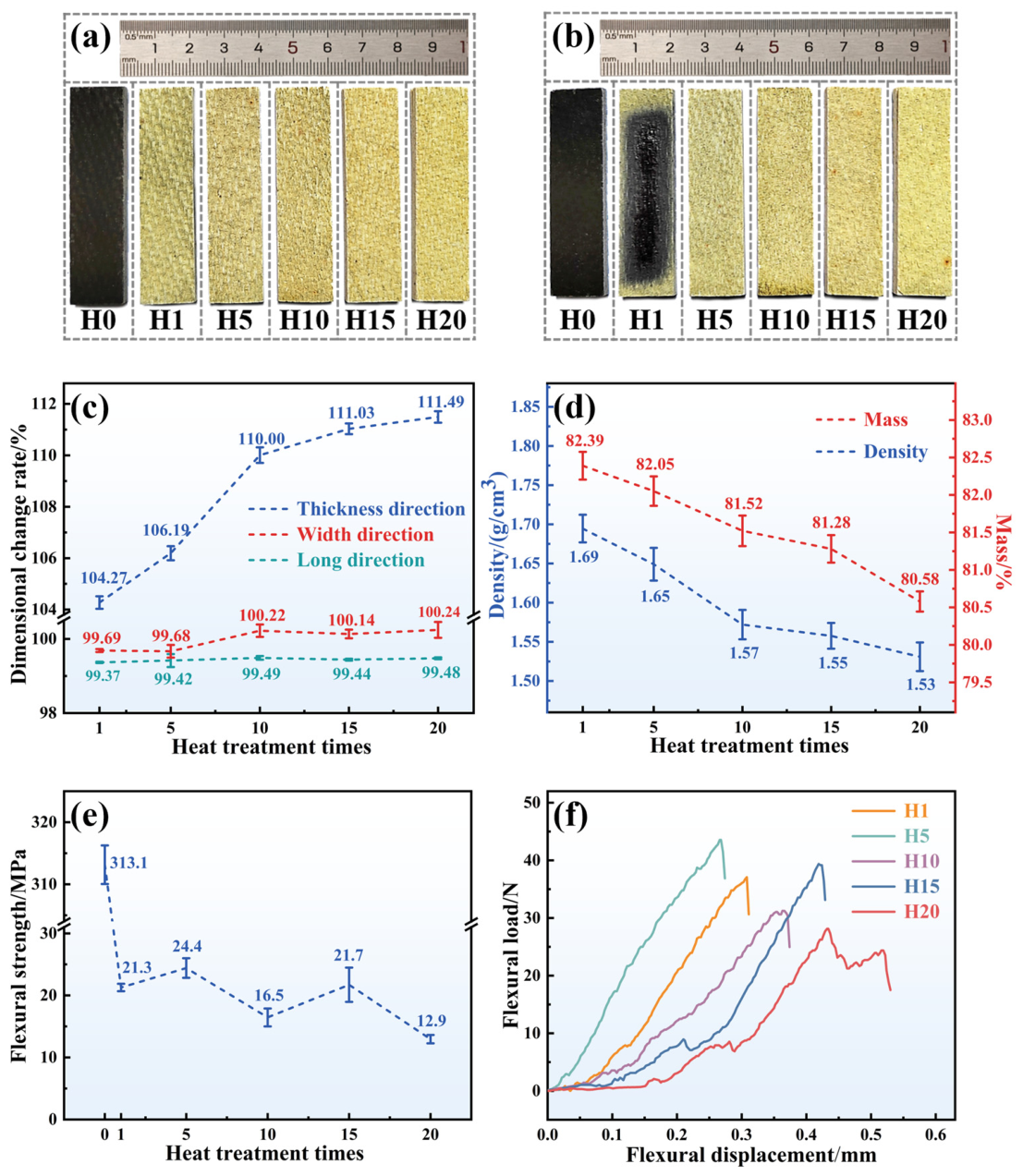
25, which exhibits superior overall performance, was selected for repeated thermal treatments. Samples subjected to 1, 5, 10, 15, and 20 heat treatments were designated as H1, H5, H10, H15, and H20, respectively (the untreated sample was designated as H0; macroscopic morphology is illustrated in
Figure 3a,b).
As illustrated in
Figure 3a, the initial sample H0 (depicted in black) rendered almost entirely yellow following the first heat treatment (H1). This transformation resulted from the pyrolysis of BPR and the oxidation of ceramic fillers. Fine-scale Al
2O
3f patterns were observable on the surface of H1; however, they were not exposed. As the number of thermal cycles increased, the residual black regions progressively diminished. By H15 and H20, the surface had completely adopted a yellow coloration, signifying complete oxidation of the ceramic fillers. Simultaneously, microcracks began to appear on the sample surface. Notably, slight delamination was observed on the side of the H20 sample, potentially leading to its diminished flexural strength. The pattern of color change on the reverse side of the sample was consistent with that of the front (
Figure 3b). Consistent color changes were shown on both the front and reverse sides of the sample (
Figure 3b). Nevertheless, owing to contact with the crucible, oxygen supply to the backside of the sample was relatively inadequate. The central region of H1 retained a grayish-black hue due to incomplete oxidation. As the number of thermal cycles increased, the back side of H5 turned entirely yellow, and the morphologies of the backsides of H10, H15, and H20 became essentially analogous to their front sides. A comparison of macroscopic morphology revealed that, after multiple high-temperature heat treatments, the samples exhibited no significant changes in shape or surface spalling beyond color alterations. This observation indicates that Z
20T
25 possesses excellent dimensional stability.
Regarding reusable thermal protection materials, it is crucial to verify their dimensional stability and mass consistency across successive applications. Therefore, the dimensions along the three orthogonal axes (length, width, and thickness) along with their corresponding masses, were recorded throughout heat treatment in a muffle furnace. The rates of dimensional variation and mass retention are depicted in
Figure 3c,d, respectively.
As demonstrated in
Figure 3c, during the initial 20 heat treatment cycles, the length and width dimensions of the samples showed remarkable stability. The rate of dimensional change in the longitudinal direction consistently remained below 0.2%, whereas in the transverse direction, it persisted below 0.6%. These measurements correspond to the axial orientation of the Al
2O
3f. The intrinsic dimensional stability of the fibers guarantees the overall dimensional stability of the composite. Conversely, the rate of change in thickness was markedly higher, increasing from 104.27% at H1 to 111.49% at H20, representing a 7.22% increase. Significantly, between H5 and H10, the dimensional change rate in thickness increased by 3.81%, despite only five additional heat treatment cycles. The composite is produced through stacking and pressing multiple layers of prepreg, which is the primary cause of the significant dimensional change in the thickness direction. After repeated long-term high-temperature treatments, the BPR undergoes oxidative pyrolysis, while the ZrSi
2 and TiB
2 ceramic fillers expand volumetrically upon oxidation. Notably, the B
2O
3 produced from TiB
2 oxidation demonstrates high volatility above 1000 °C [
43], leading to the interlaminar bond degradation and slight delamination, which subsequently results in a significant increase in thickness.
Calculations indicate that the initial density of Z
20T
25 is 2.11 g·cm
−3. As shown in
Figure 3d, both the mass retention rate and density of the sample gradually decrease with increasing heat treatments, with the mass retention rate consistently remaining above 80%. From H1 to H20, the mass retention rate declined by only 1.81%, and the density decreased by merely 0.16 g·cm
−3, further demonstrating the mass stability of Z
20T
25 during repeated heat treatments. Notably, although the mass retention rate exhibits a uniform decline with increasing heat treatments, the density change occurs in two distinct phases: Phase I (H1 to H10) shows a significant decrease in density, particularly a 3.79% drop between H5 and H10; Phase II (H10 to H20) experiences only a 1.90% reduction in density over 10 additional heat treatments. When examined in conjunction with the dimensional change data illustrated in
Figure 3c, it becomes apparent that the decrease in density, which occurs concurrently with minimal variations in mass, is predominantly attributable to the expansion of the sample dimensions—particularly its thickness. Excellent dimensional stability and consistent mass retention are vital for the high reliability of reusable thermal protection materials, while the load-bearing capacity during repeated testing cycles holds equal significance. Accordingly, flexural tests were performed on samples subjected to different heat treatment cycles to assess their long-term oxidation resistance and high-temperature load-bearing capacity.
As illustrated in
Figure 3e, the unheated Z
20T
25 (H0) exhibits a flexural strength of 313.1 MPa, signifying an outstanding load-bearing capacity at high temperature. After one heat treatment cycle (H1), the flexural strength substantially diminishes to 21.3 MPa. Subsequent heat treatments, conducted four additional times on H1 to yield H5, result in a slight rebound in flexural strength to 24.4 MPa. Further increments in the number of heat treatment cycles result in a decline in flexural strength to 16.5 MPa for H10, followed by a recovery to 21.7 MPa for H15. In contrast, H20, after twenty heat treatments, underwent a significant decrease in strength to 12.9 MPa. This trend indicates that flexural strength does not decrease linearly with increasing heat treatment cycles, but instead exhibits notable fluctuations. This phenomenon suggests that the thermal evolution is dominated by complex interactions among constituents, rather than being limited to individual processes like resin pyrolysis or filler oxidation. These transformations and their resulting products have a significant impact on the mechanical properties of the composites.
Figure 3f illustrates the load–displacement curves of samples following repeated heat treatment. The load–displacement curves for samples H1 and H5 are nearly linear, reaching a peak before experiencing a precipitous decline in load, thereby exemplifying typical brittle fracture behavior. Subsequent samples H10, H15, and H20 also demonstrated brittle fracture; however, their load–displacement curves before failure did not conform to a single straight line. Instead, they displayed a sawtooth pattern, a phenomenon that was markedly evident in H15 and H20. This suggests that, after multiple heat treatments, the interlaminar bonding within sample composites fabricated from multilayer prepregs diminished in cohesion. Under applied flexural loads, delamination occurred, manifesting as the sawtooth pattern observed in the load–displacement curve. The considerable delamination within the composite, coupled with dimensional expansion in the thickness direction, ultimately caused the flexural strength of H20 to decline sharply to 12.9 MPa.
3.3. Microstructural Evolution of Composite Surfaces
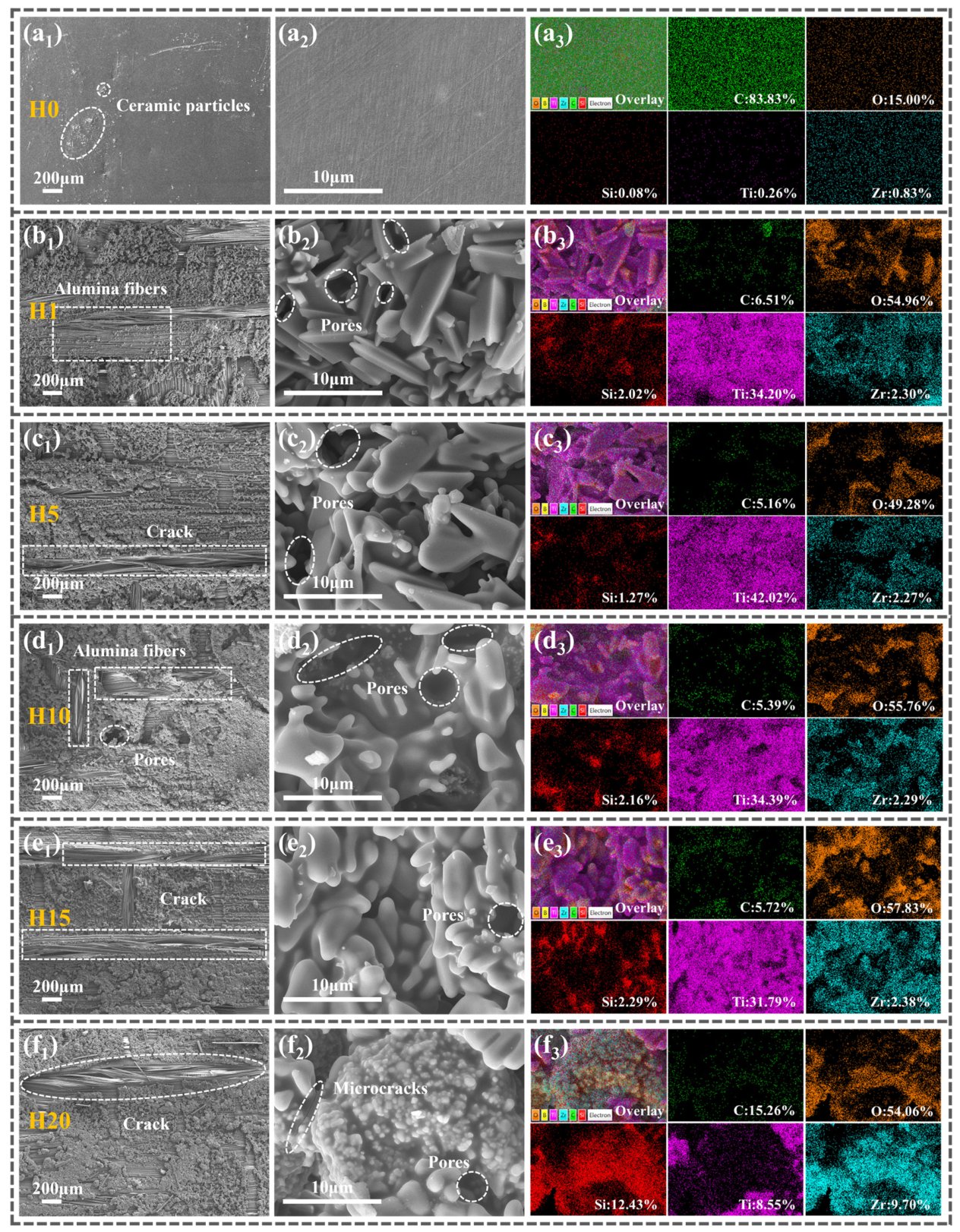
To investigate the causes of fluctuations in flexural strength in Z
20T
25 during repeated high-temperature heat treatment, the surface microstructure of samples H0–H20 was examined, and the elemental distribution and content in corresponding regions were analyzed, as illustrated in
Figure 4.
Figure 4(a
1–a
3) illustrates the microstructure of the untreated Z
20T
25 (H0) sample. The low-magnification image (
Figure 4(a
1)) shows a smooth, flat surface with only minor protrusions of ceramic fillers, free from voids or other defects. The high-magnification image (
Figure 4(a
2)) further confirms its dense microstructure. This indicates that, under the curing process utilized in this research, Al
2O
3f, BPR, ZrSi
2, and TiB
2 exhibit good compatibility, resulting in superior composite performance.
Figure 4(a
3) demonstrates a uniform distribution of elements without significant agglomeration, suggesting that the ceramic fillers are evenly dispersed within the BPR matrix. Energy dispersive X-ray spectroscopy analysis reveals that the surface of the sample is predominantly composed of BPR. The elements carbon (83.83%) and oxygen (15.00%), which constitute the highest proportions, both originate from BPR. Additionally, trace amounts of zirconium, silicon, and titanium from the ceramic fillers are uniformly distributed across the surface. Due to its low boron content and the difficulty in detection, its signal is not visible in the energy spectrum and is consequently not depicted in
Figure 4.
Following a single heat treatment (H1), significant modifications in surface morphology and elemental composition were observed (
Figure 4(b
1–b
3)). The surface became loose and porous (
Figure 4(b
1)), with extensive exposure of Al
2O
3f, attributable to high-temperature pyrolysis of BPR and oxidation of PyC. As illustrated in
Figure 4(b
3), the carbon content experienced an abrupt decline to 6.51%, while the oxygen content markedly increased to 54.96%. This reduction in carbon results from the volatilization of small molecules such as CH
4 and CO during BPR pyrolysis, as well as the oxidation of PyC. The substantial consumption of BPR exposed and oxidized additional ceramic fillers, resulting in a relative increase in the contents of zirconium, silicon, and titanium. The oxidation process consumed oxygen and produced oxides, thereby increasing the elemental oxygen content within the material. Furthermore,
Figure 4(b
3) shows that the prismatic material predominantly consists of TiO
2, an oxidation product of TiB
2. These oxides form a coating on the substrate surface intended to inhibit oxygen diffusion; however, their large particle size and sharp prismatic morphology (
Figure 4(b
2)), coupled with the abundance of voids between particles, impede the formation of a dense protective layer. Consequently, their protective efficacy on BPR and PyC remains limited.
Four additional heat treatments of H1 produced H5, with microstructure and elemental composition illustrated in
Figure 4(c
1–c
3). The low-magnification image (
Figure 4(c
1)) resembles H1, displaying a loose, porous structure with exposed fibers and cracks between fiber bundles. Energy dispersive spectroscopy (EDS) results are consistent with H1, indicating the chemical stability of the material during heat treatment. Nevertheless, the high-magnification image (
Figure 4(c
2)) demonstrates that the ceramic oxides here transition into smaller, disc-shaped structures. These conform more effectively to the surfaces of BPR and PyC, thereby offering enhanced protection. This morphological change in the ceramic oxide results from the high-temperature environment, causing high-surface-energy prismatic oxides to gradually convert into low-surface-energy lamellar oxides, while some larger particles decompose or break down into smaller particles. The refinement of the ceramic oxide serves to optimize stress distribution within the composite, reduce stress concentration, and improve interfacial bonding via crack deflection mechanisms. As a result, the flexural strength of H5 exhibits a slight increase compared to H1 (
Figure 3e).
The microstructure and elemental distribution of the H10 surface showed no significant alterations; however, the exposed fiber area increased with progressive thermal cycles (
Figure 4(d
1)).
Figure 4(d
2) demonstrates that the ceramic oxide particles became more refined and were enveloped by a film-like substance, which was identified as amorphous SiO
2 through elemental analysis. Notably, numerous interconnected pores emerged around the oxides. These pores predominantly resulted from the formation and volatilization of gas molecules such as B
2O
3, CH
4, and CO at high temperatures. The increased porosity contributed to an increase in the number of defects within the material. As flexural strength is susceptible to defects, the strength of H10 experienced a significant reduction (
Figure 3e).
The surface morphology of H15 (
Figure 4(e
1)) generally corresponds with that of H10, although the inter-fiber cracks are more conspicuous. Its high-magnification image (
Figure 4(e
2)) exhibits ceramic oxides as ellipsoidal particles, similarly coated with a glassy phase film. The principal distinction from H10 is the lack of large interconnected voids in the H15 sample. During subsequent heat treatment, the glass phase undergoes secondary viscous flow at high temperatures, refilling pores and microcracks. This process reduces surface energy and diminishes stress concentration. Furthermore, the refined oxide particles in H10 co-sinter with the glass phase, forming the more stable ellipsoidal structure observed in H15. This contributes to enhanced geometric continuity of the composite, resulting in a subsequent increase in the flexural strength of H15 (
Figure 3e).
The low-magnification image of the H20 sample (
Figure 4(f
1)) exhibits minimal alterations; however, the cracks between fiber bundles have further expanded. Its high-magnification image (
Figure 4(f
2)) exposes an irregular, coral-like morphology composed of numerous fine spherical protrusions clustered together, with lamellar oxides visible in the surrounding regions.
Figure 4(f
3) indicates a significant reduction in titanium content within this region, accompanied by a substantial increase in silicon and zirconium content. Integrating morphological and elemental data, it is inferred that the coral-like material predominantly consists of ZrSiO
4. The combined microscopic morphologies of H1–H20 demonstrate that two varieties of ceramic oxides coexist on the surface of the heat-treated sample: one being a plate-like structure primarily consisting of TiO
2 (observed in the H1–H15 region), and the other being a coral-like structure mainly composed of ZrSiO
4 (observed in the H20 region).
3.4. Microstructural Evolution of the Fracture Surface Under Flexural Loading
Through the characterization and analysis of the microstructure of the H0–H20 surface, we have initially elucidated some potential reasons for the fluctuations in the flexural strength of Z
20T
25 during repeated heat treatment. To conduct a comprehensive analysis of the evolution mechanism of flexural strength in Z
20T
25 during repeated high-temperature heat treatment, additional examinations were performed on the fracture surface morphology (
Figure 5) and element distribution (
Figure 6) of the H0–H20 samples.
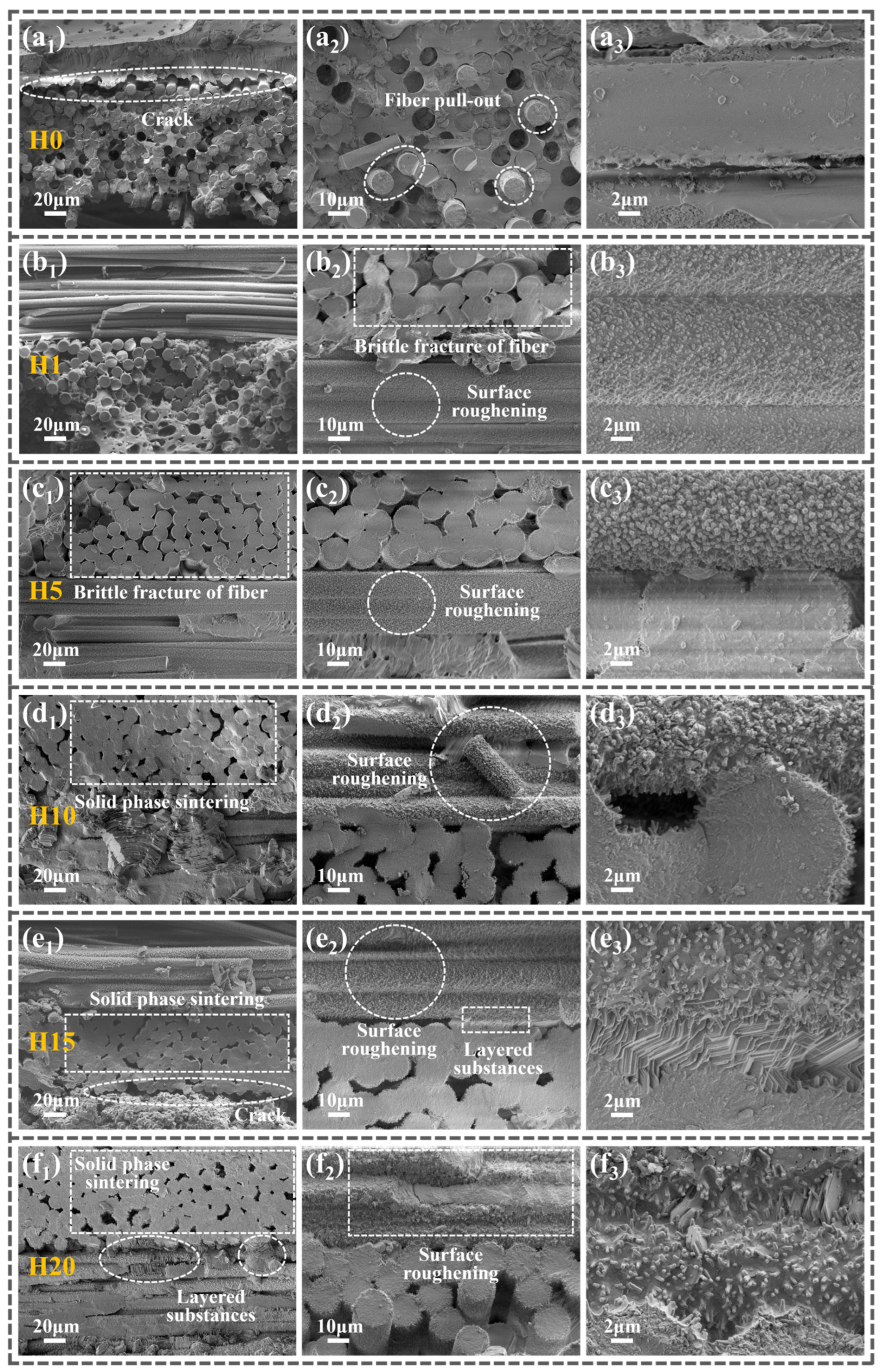
The microstructure of the H0 sample flexural fracture surface is illustrated in
Figure 5(a
1–a
3). Continuously aligned Al
2O
3f forms an effective load-bearing network within the composite (
Figure 5(a
1)), supporting primary stresses under flexural loads. Furthermore,
Figure 5(a
1) reveals resin fragments adhering to the pulled-out fibers, indicating robust interfacial bonding between the fibers and matrix. This strong interfacial adhesion facilitates efficient stress transfer and additional energy dissipation through fiber pull-out behavior during ultimate fracture.
Figure 5(a
2) illustrates distinct fiber pull-out phenomena, which substantially enhance the flexural strength of the sample. The combination of continuous fiber orientation and excellent interfacial adhesion collectively ensures the superior flexural performance of the material (313.1 MPa).
The fracture surface (
Figure 5(b
1)) revealed that the interlaminar bonding retained its integrity, characterized by a smooth fracture plane and mirror-like fiber fracture edges, with no evidence of fiber pull-out. Exposure to elevated temperatures led to increased crystallinity of Al
2O
3f and caused surface erosion (
Figure 5(b
2,b
3)) [
44], which can readily induce stress concentration. This combination of factors resulted in the observed brittle fracture behavior. High-magnification images (
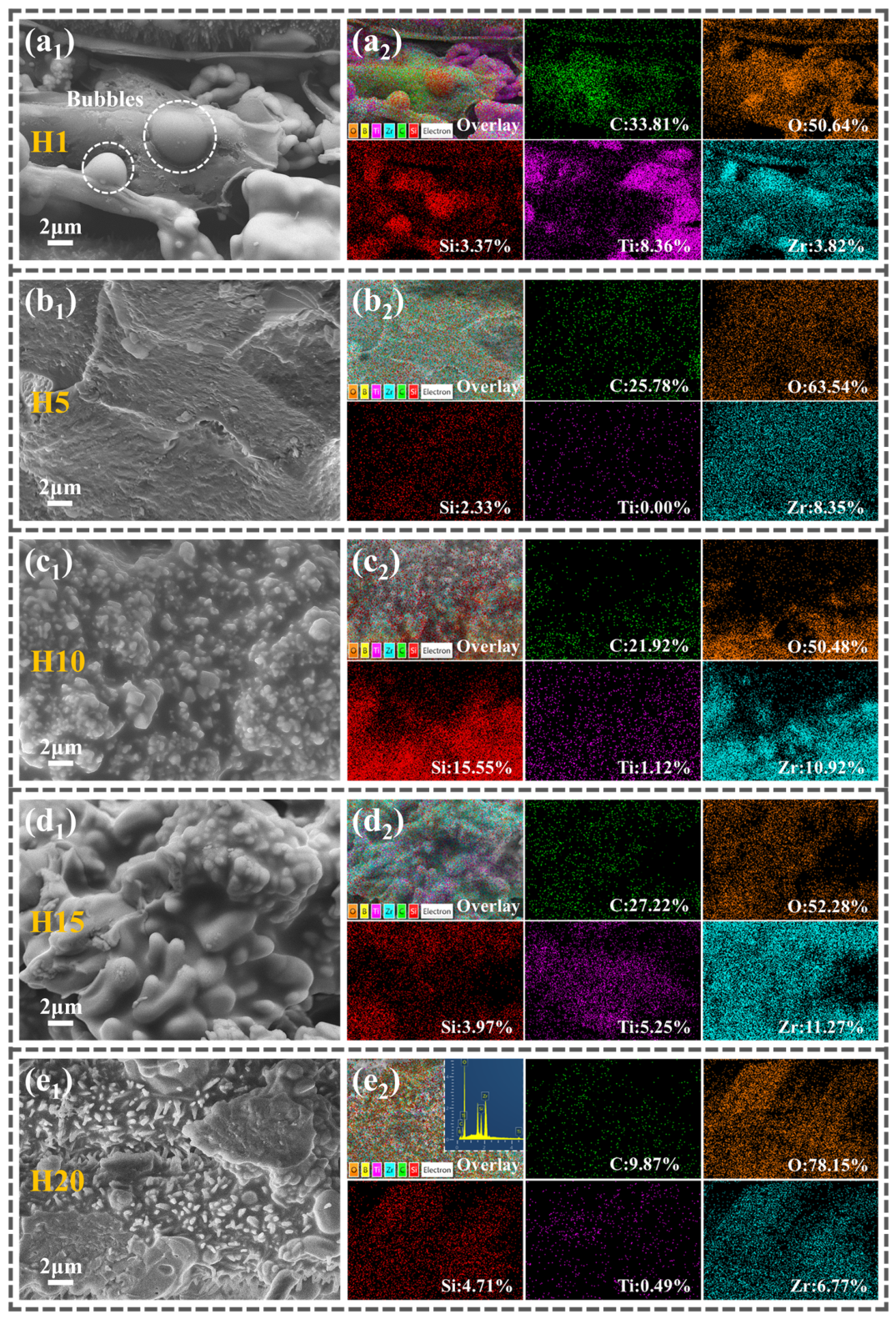
Figure 6(a
1)) revealed large voids within H1, where gases such as B
2O
3, CH
4, and CO were trapped by the surface glass phase, resulting in numerous bubbles. The synergistic effects of Al
2O
3f hardening and embrittlement, surface erosion of the fibers, and stress concentration at defect sites resulted in a significant decrease in the strength of H1.
Figure 6(a
2) indicates that the carbon content on the fracture surface of H1 was 33.81%, markedly higher than the 6.51% observed on its surface (
Figure 4(b
3)), signifying that the BPR and PyC within H1 were effectively better protected.
The fracture morphology of H5 (
Figure 5(c
1,c
2)) resembles that of H1, exhibiting tight interlamellar bonding, a smooth fracture surface, and brittle fracture characteristics. After four additional heat treatments, sintered necks formed at the contact points between adjacent fibers in H5 due to the flow of the glass phase (
Figure 5(c
2)) [
44]. Concurrently, Al
2O
3f erosion intensified, revealing prominent needle-like protrusions on the surface (
Figure 5(c
3)). Based on their distinctive morphology and location, these features are interpreted as Al
18B
4O
33 whiskers formed by the reaction between Al
2O
3 and the TiB
2 oxidation product B
2O
3 [
45]. H5 EDS analysis (
Figure 6(b
2)) indicates that this region primarily contains oxygen, silicon, and zirconium elements. Combined with
Figure 6(b
1), it is inferred that the main component is ZrSiO
4, consistent with the conclusion that both TiO
2 and ZrSiO
4 oxides coexist in the same sample.
The fracture surface of H10 (
Figure 5(d
1)) reveals more severe adhesion between Al
2O
3f, with multiple fibers fused and blurred boundaries, significantly compromising its load-bearing capacity. High-magnification images (
Figure 5(d
2,d
3)) reveal accelerated surface erosion of the fibers, resulting in reduced diameters. Coral-like oxides consistent with the sample surface morphology (
Figure 4(f
2)) are observed in
Figure 6(c
1). EDS confirms their primary composition as ZrSiO
4, matching the analysis results of the coral-like ceramic oxides in
Figure 4(f
2).
The fracture surface of H15 (
Figure 5(e
1)) demonstrates considerable debonding between the fibers and the matrix, indicative of further deterioration of the interfacial bonding. This delamination failure mode correlates with the jagged load–displacement curve observed in H15 (
Figure 3f). Progressive erosion of the fibers is evident (
Figure 5(e
1,e
2)), characterized by denser needle-like protrusions on the surface and the near-complete disappearance of fiber boundaries. Additionally, a lamellar structure consisting of multiple layers has been observed at the fiber intersections (
Figure 5(e
2,e
3)), tentatively identified as metastable Al
4B
2O
9 based on its morphology and growth environment [
46]. This morphology is driven by two factors: the inherent two-dimensional growth preference of Al
4B
2O
9 and the spatially limited environment in which it forms. The confined environment initially induces the formation of Al
4B
2O
9 while inhibiting its transformation into the stable needle-like Al
18B
4O
33 [
47]. Furthermore,
Figure 6(d
1) shows elongated and coral-like oxides, with EDS confirming their primary composition as TiO
2 and ZrSiO
4.
After 20 heat treatments, the Al
2O
3f structure of H20 severely deteriorated (
Figure 5(f
1)), exhibiting extreme inter-fiber fusion and increased multilayered flaky material at the interfaces.
After 20 thermal cycles, the Al
2O
3f structure in H20 underwent severe degradation (
Figure 5(f
1)), characterized by extensive fiber fusion and an increased accumulation of multilayered lamellar deposits at the intersections of longitudinal and transverse fibers.
Needle-like Al
18B
4O
33 whiskers further grew (
Figure 5(f
2)), with transverse fibers nearly losing their original shape entirely. Extended multiple heat treatments resulted in the deterioration of the mechanical support capability of the Al
2O
3f reinforcement, leading to a reduction in the flexural strength of H20 to 12.9 MPa (
Figure 3e). High-magnification imaging (
Figure 6(e
1)) reveals the oxide region surface covered with more significant needle-like protrusions, whose morphology matches that of Al
18B
4O
33 whiskers. EDS analysis (
Figure 6(e
2)) shows a strong characteristic aluminum peak at 1.5 keV, in addition to the major elements labeled in the Figure, further validating the inference that the needle-like structures are Al
18B
4O
33 whiskers.
3.5. High-Temperature Phase Evolution and Thermodynamic Analysis
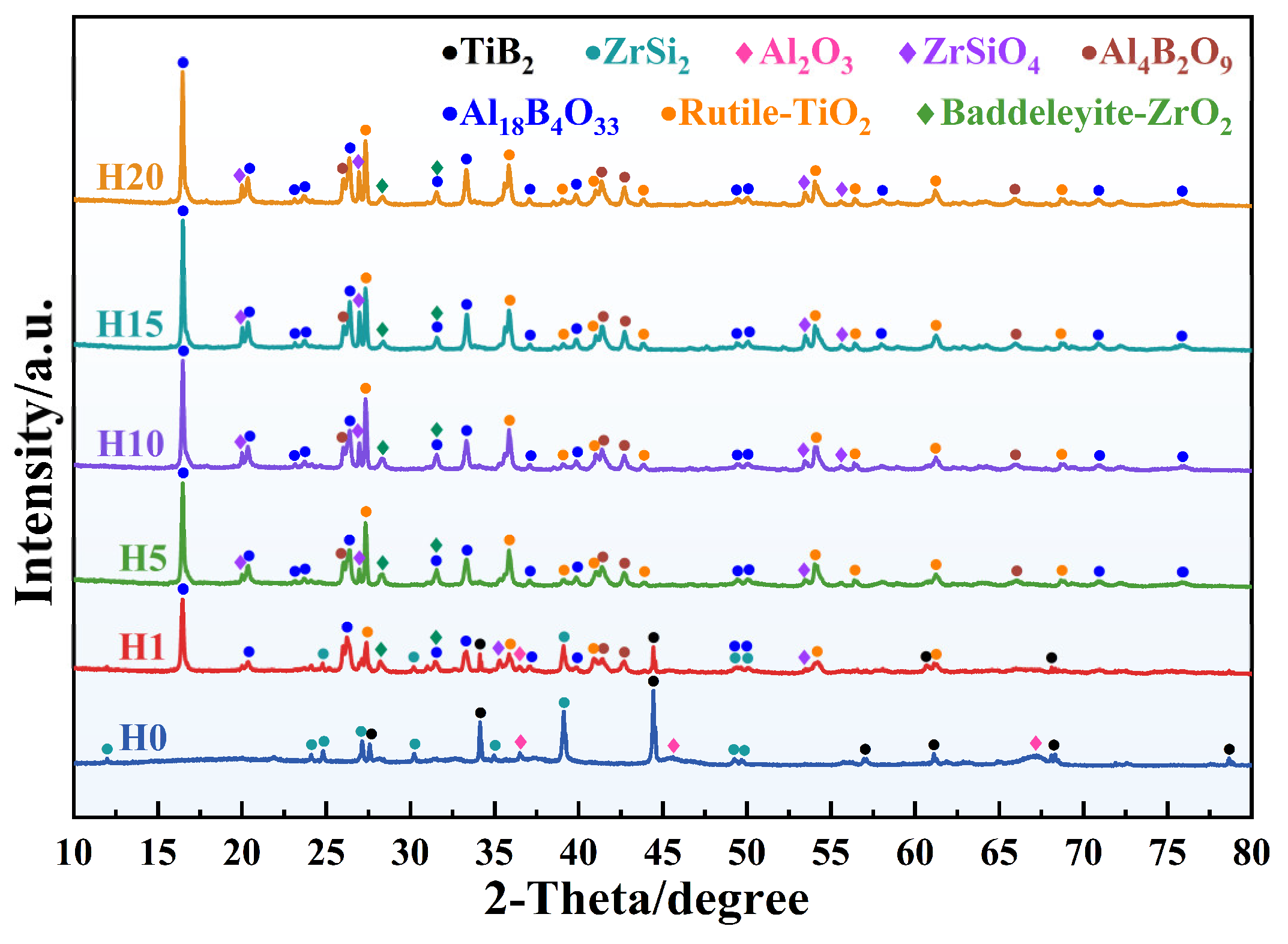
To elucidate the phase evolution and thermodynamic reaction pathways of ceramizable composites during heat treatment, this research employed X-ray diffraction (XRD) for phase characterization of a series of samples (
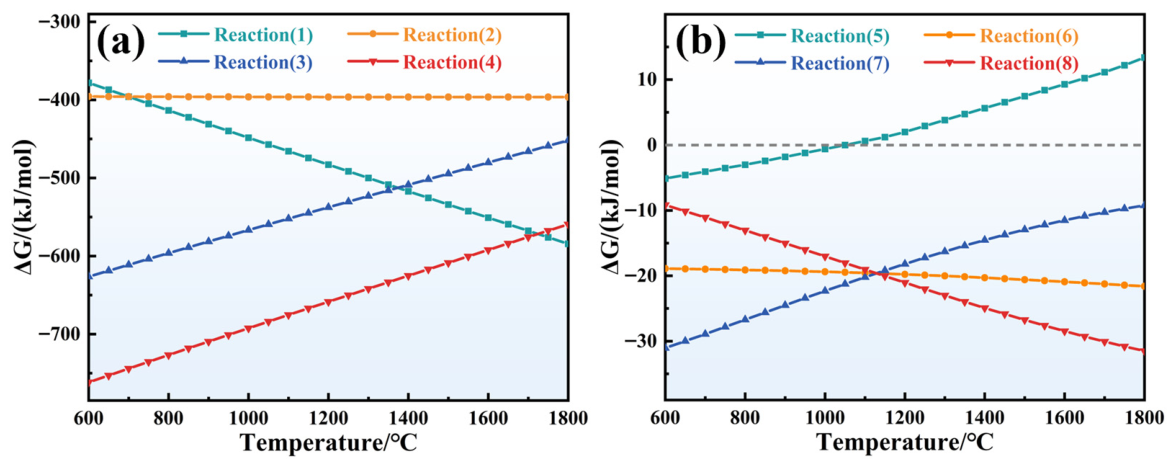
Figure 7). The Gibbs free energy change (ΔG) for relevant reactions was calculated using HSC Chemistry software (6.0), with results presented in
Figure 8.
The XRD results indicate that untreated Z20T25 (H0) primarily comprises ZrSi2 and TiB2 crystalline phases, in addition to trace quantities of Al2O3. During high-temperature heat treatment, BPR pyrolysis produces substantial amounts of PyC, which are readily oxidized in an environment of high temperature and oxygen. HSC calculations demonstrated that at 1200 °C, both Reactions 3 and 4 exhibited negative ΔG values, with Reaction 3 displaying a larger magnitude of ΔG. According to the Gibbs free energy criterion, the principal gaseous product resulting from PyC oxidation should be CO.
Following a single heat treatment (H1), the diffraction peak intensities of the original phases, such as ZrSi
2 and TiB
2, were significantly reduced; however, they did not entirely disappear, indicating partial transformation into more stable oxides or silicates. Concurrently, new diffraction peaks corresponding to rutile-type TiO
2 and zircon-type ZrO
2 emerged in the H1 spectrum, thereby further substantiating the oxidation of TiB
2 and ZrSi
2. This observation aligns with the SEM data (
Figure 4(b
2)), which suggests TiO
2 as the predominant oxide component. TiB
2 undergoes oxidation to produce TiO
2 and B
2O
3 (Reaction 5), while ZrSi
2 oxidizes to yield ZrO
2 and SiO
2 (Reaction 6). Thermodynamic assessments reveal that the ΔG values for both Reactions 5 and 6 are significantly negative, thereby confirming their high spontaneous propensity. Notably, while ZrO
2 was detected, no diffraction peaks for SiO
2 were observed; this is due to the rapid cooling of the post-heat-treated sample at room temperature, which inhibits SiO
2 crystallization and results in an amorphous glass phase. Furthermore, the diffraction peaks for ZrSiO
4 appeared in the H1 spectrum, originating from the subsequent reaction between amorphous SiO
2 and ZrO
2 to form ZrSiO
4 (Reaction 7). Although the ΔG for Reaction 7 at 1200 °C is marginally positive, the reaction becomes spontaneous during cooling to ambient temperature. Consequently, ZrSiO
4 was formed during H1, with its diffraction peak intensity increasing in proportion to the number of heat treatments.
Notably, the most prominent diffraction peak is observed near 2θ = 16.5°. Systematic analysis and comparative studies confirm that this position corresponds to the diffraction peak of Al
18B
4O
33. At a temperature of 1200 °C, B
2O
3 exists in a liquid phase and demonstrates high volatility, thereby enabling complete contact with the Al
2O
3 contained within the fibers. Consequently, Al
2O
3 reacts with B
2O
3 to produce significant quantities of Al
18B
4O
33 (Reaction 8). As the number of heat treatment cycles increases, Reaction 8 proceeds continuously, thereby intensifying the chemical erosion of Al
2O
3 fibers. Simultaneously, a minor diffraction peak corresponding to Al
4B
2O
9 (Reaction 9) was observed in the pattern, consistent with the presence of a small amount of multilayered flaky material in the fracture surface SEM. Thermodynamic calculations demonstrate that the ΔG values for Reactions 8 and 9 are comparable and both exhibit negative values. However, Al
4B
2O
9 is a metastable phase that can be transformed into the thermodynamically stable Al
18B
4O
33 at high temperature through Reaction 10. Therefore, the system ultimately produces a substantial quantity of Al
18B
4O
33, with only a minor residual amount of Al
4B
2O
9 remaining.
In the XRD patterns of the H5 sample, the diffraction peaks of the original phases, such as ZrSi2 and TiB2, have completely disappeared, indicating their complete conversion into more stable oxide or silicate phases. Simultaneously, the diffraction peaks of oxidation products like Al18B4O33 and TiO2 have further intensified, suggesting that compared to H1, fiber erosion has intensified, and the proportion of oxidation products within the system has significantly increased. In the subsequent series of heat-treated samples (H10–H20), the diffraction patterns reveal no shifts in phase peak positions while the diffraction peaks continue to intensify. This phenomenon demonstrates that the crystal structure and chemical composition of the composite remain stable throughout repeated thermal cycles, showcasing its broad application potential in reusable systems.
3.6. In Situ Ceramization Process and the Failure Mechanism
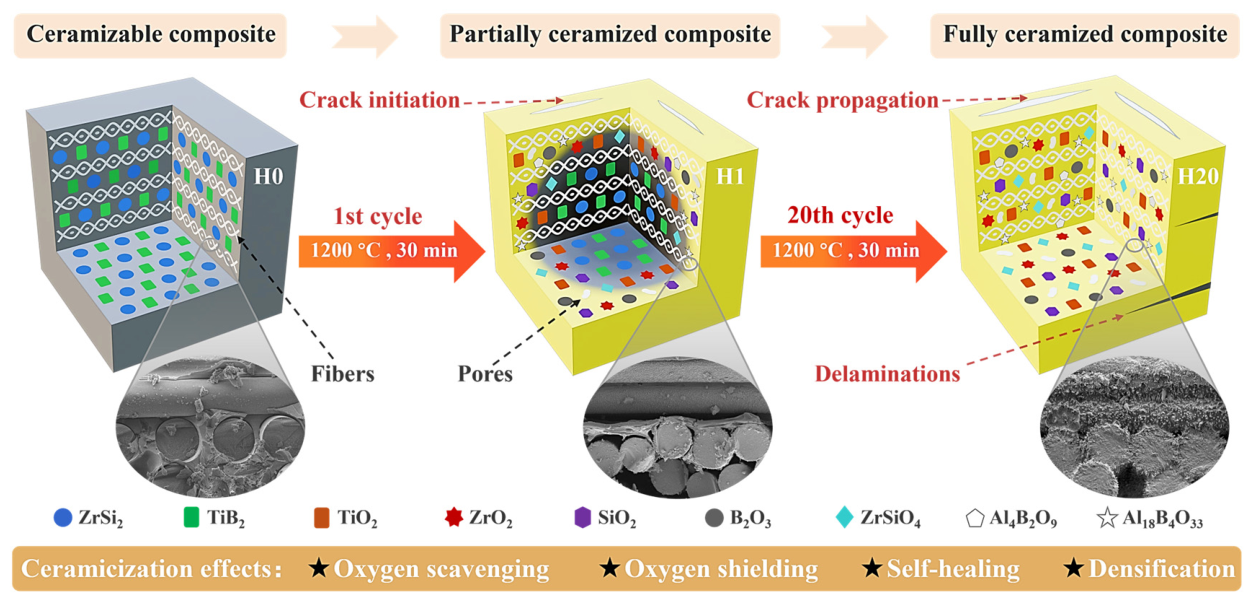
Through a comprehensive multidimensional analysis encompassing thermal properties, flexural strength evolution, microstructure (surface and fracture surface), phase composition, and thermodynamic calculations, this research elucidates the in situ ceramization process and failure mechanism of ceramizable composites (
Figure 9).
During heat treatment at temperatures of 1200 °C, the BPR in the Z20T25 sample undergoes pyrolysis, releasing volatile gases and forming PyC. Concurrently, the functional fillers ZrSi2 and TiB2 undergo passive oxidation, resulting in the in situ formation of oxides such as TiO2, B2O3, ZrO2, and SiO2. This process yields a significant synergistic protective effect: on one hand, the oxidation of ceramic fillers consumes oxygen, thereby reducing its partial pressure and delaying both BPR pyrolysis and PyC oxidation; on the other hand, the generated oxides form protective layers on the surfaces of fibers and the matrix, hindering further oxygen attack. Significantly, the low-viscosity liquid phase produced by B2O3 and SiO2 at high temperatures flows viscously, filling internal pores and microcracks, thus promoting self-healing and densification. The integration of these protective mechanisms enables the composite to maintain substantial mechanical load-bearing capacity and high mass even after prolonged exposure to high temperatures.
Nevertheless, as the number of heat treatment cycles progresses, the ongoing pyrolysis of BPR and the extensive oxidation of PyC inflict significant damage upon the matrix, resulting in surface crack propagation and a reduction in interlayer bonding strength. More detrimentally, the liquid phase of B2O3 interacts at the interface with Al2O3f, leading to the formation of Al18B4O33 and Al4B2O9, which causes chemical corrosion and structural deterioration of the reinforcing fibers, thereby considerably impairing their load-bearing capacity. Furthermore, as B2O3 continuously volatilizes and reacts with Al2O3, the pore-filling and self-healing properties of the liquid phase gradually decline, thereby increasing the internal porosity of the material. Ultimately, under the combined effects of interlaminar performance degradation, damage to the fiber skeleton, and the accumulation of pore defects, the composite undergoes severe damage or even fails.





 ,
,