Interphase Engineering in Lignin-Containing Nanocellulose Composites from Tropical Biomass: Evidence-Weighted Comparative Framework, Product Windows, and Biorefinery Constraints


Abstract
1. Introduction
2. Review Boundaries, Evidence Weighting, and Tropical Feedstocks
2.1. Review Boundaries, Architecture Classes, and Evidence Weighting
2.2. Tropical Feedstocks as Materials Systems and Process Geographies
2.3. Evidence Logic: From Residue Management to Biorefinery Constraints
2.4. Evidence Weighting and Comparative Synthesis Methodology
- Tier I (high confidence; 8–10 points): Studies reporting controlled lignin state, quantitative nanocellulose morphology, defined processing history, application-relevant testing under humidity or realistic processing conditions, and appropriate controls or statistical replication.
- Tier II (moderate confidence; 5–7 points): Studies reporting composition and basic morphology but lacking at least one of the following: full interfacial characterization, humidity conditioning, processing traceability, or application-specific benchmarking.
- Tier III (low confidence; 0–4 points): Studies relying primarily on nominal lignin content or limited structural descriptors without process traceability, controls, or service-relevant testing.
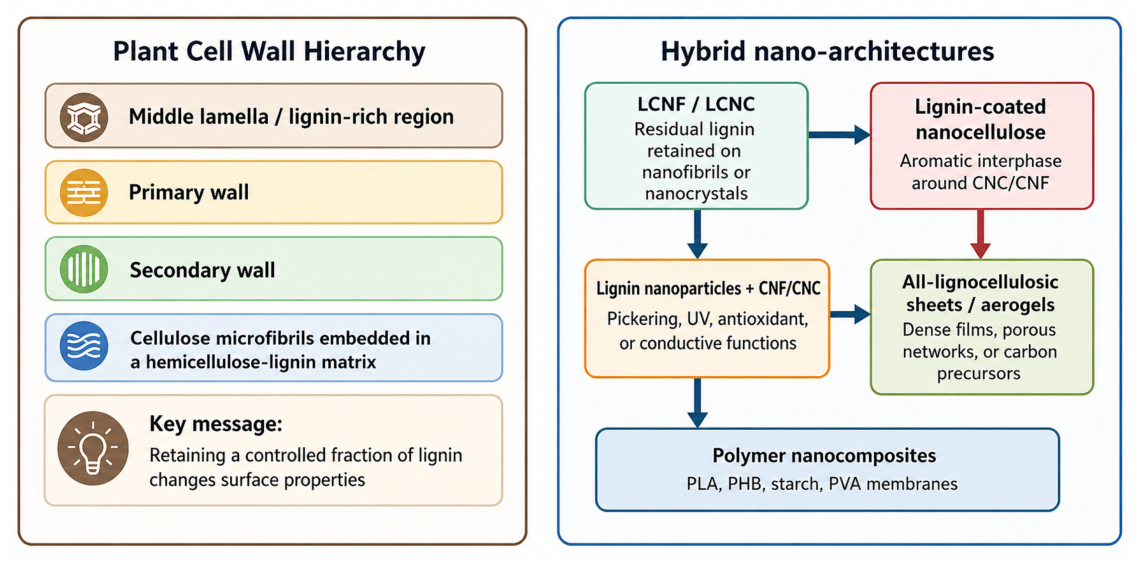
3. Distinct Hybrid Architectures and Interphase Logic
3.1. Chemical Complementarity Is Necessary, but Not Sufficient
3.2. Architecture Classes Should Not Be Merged Analytically
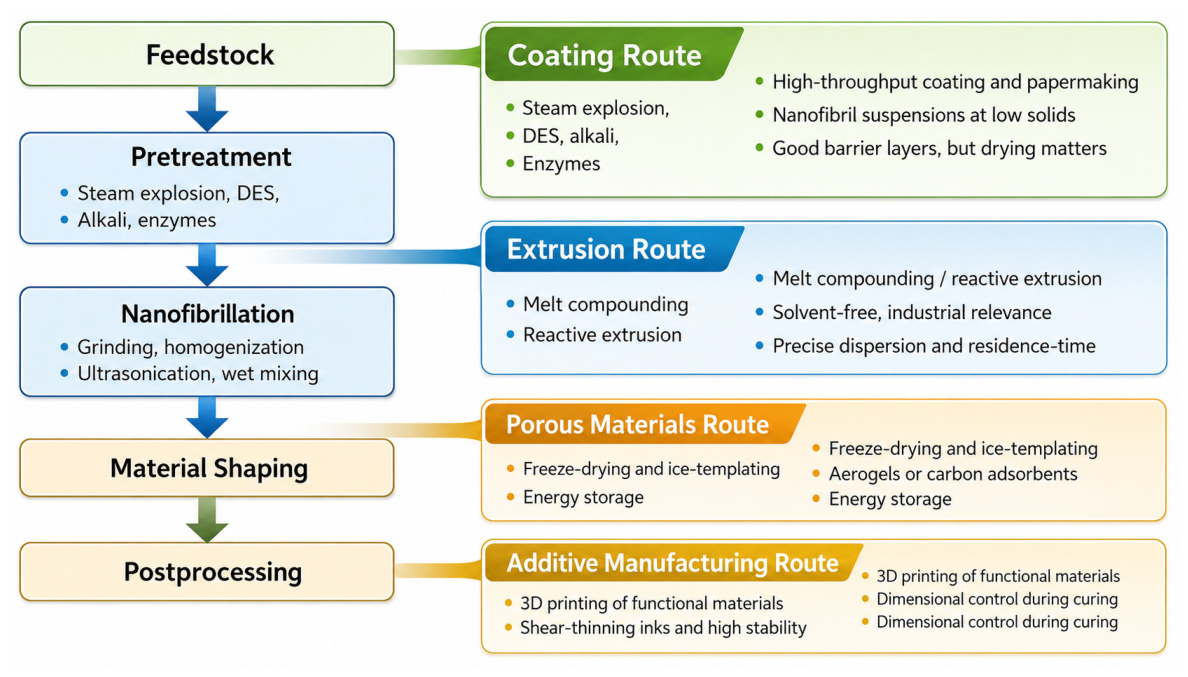
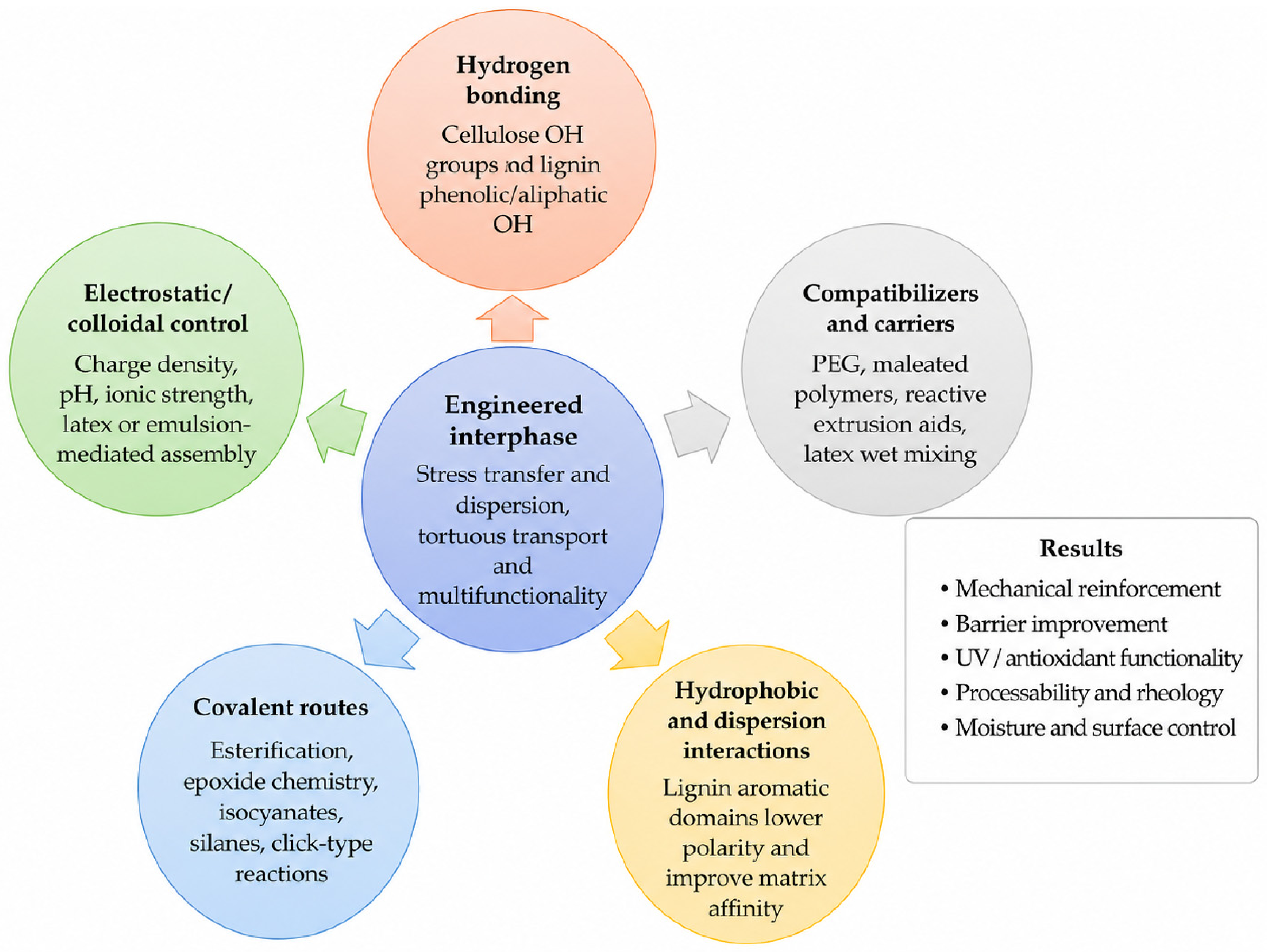
4. Interphase Engineering and Pretreatment Routes
4.1. Non-Equivalent Routes to Interphase Control
4.2. Pretreatment Severity, Fibrillation, and Failure Modes
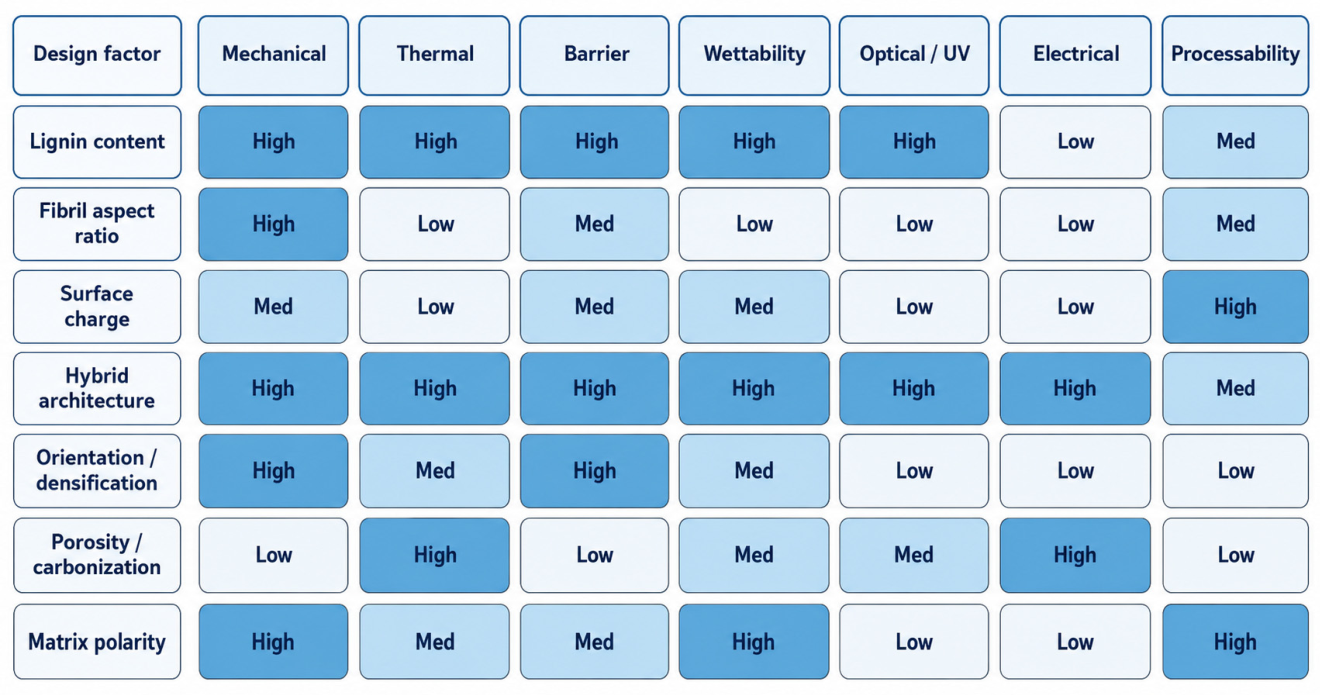
5. Comparative Structure–Property Synthesis
5.1. Mechanical Response and Stress Transfer
5.2. Barrier, Thermal, and Surface Performance
5.3. Rheology, Shaping, and Processability
5.4. Representative Quantitative Observations and Normalization Limits
5.5. What the Current Evidence Can and Cannot Support
6. Confidence-Ranked Product Windows and Application-Backward Design Rules
6.1. Selected Thermoplastics: A Medium-Confidence Window
6.2. High-Confidence Windows: Packaging Layers, Papers, Coatings, and Porous Media
6.3. Confidence-Ranked Design Rules and Application Matching
6.4. Emerging Uses Should Be Judged by Interphase Realism, Not Novelty Alone
7. Process Realism, Deployment Scenarios, Circularity, and Research Agenda
7.1. Deployment Scenarios, Sustainability Metrics, and Tropical Scale-Up
7.2. Critical Challenges and Standardization Priorities
7.3. Comparative Process Scenarios
7.4. Digital and AI-Assisted Research Agenda
8. Conclusions
Author Contributions
Funding
Institutional Review Board Statement
Informed Consent Statement
Data Availability Statement
Conflicts of Interest
Abbreviations
| CNFs | Cellulose Nanofibrils |
| CNC | Cellulose Nanocrystals |
| LCNF | Lignin-Containing Cellulose Nanofibrils |
| LCNCs | Lignin-Containing Cellulose Nanocrystals |
| PLA | Poly(lactic acid) |
| PHB | Polyhydroxybutyrate |
| PHAs | Polyhydroxyalkanoates |
| PVA | Poly(vinyl al-cohol) |
| DESs | Deep Eutectic Solvents |
| TEA | Techno-Economic Analysis |
| LCA | Life-Cycle Assessment |
| ML | Machine Learning |
References
- European Bioplastics. Bioplastics Market Development Update 2025; European Bioplastics e.V.: Berlin, Germany, 2026; Available online: https://www.european-bioplastics.org/market/ (accessed on 11 May 2026).
- Grand View Research. Lignin-Based Biopolymers Market Size, Share & Trends Analysis Report; Grand View Research: San Francisco, CA, USA, 2024; Available online: https://www.grandviewresearch.com/industry-analysis/lignin-based-biopolymers-market-report (accessed on 11 May 2026).
- Moon, R.J.; Martini, A.; Nairn, J.; Simonsen, J.; Youngblood, J. Cellulose nanomaterials review: Structure, properties and nanocomposites. Chem. Soc. Rev. 2011, 40, 3941–3994. [Google Scholar] [CrossRef]
- Habibi, Y.; Lucia, L.A.; Rojas, O.J. Cellulose nanocrystals: Chemistry, self-assembly, and applications. Chem. Rev. 2010, 110, 3479–3500. [Google Scholar] [CrossRef]
- Klemm, D.; Kramer, F.; Moritz, S.; Lindström, T.; Ankerfors, M.; Gray, D.; Dorris, A. Nanocelluloses: A new family of nature-based materials. Angew. Chem. Int. Ed. 2011, 50, 5438–5466. [Google Scholar] [CrossRef]
- Abitbol, T.; Rivkin, A.; Cao, Y.; Nevo, Y.; Abraham, E.; Ben-Shalom, T.; Lapidot, S.; Shoseyov, O. Nanocellulose, a tiny fiber with huge applications. Curr. Opin. Biotechnol. 2016, 39, 76–88. [Google Scholar] [CrossRef] [PubMed]
- Ferrer, A.; Pal, L.; Hubbe, M. Nanocellulose in packaging: Advances in barrier layer technologies. Ind. Crops Prod. 2017, 95, 574–582. [Google Scholar] [CrossRef]
- Pennells, J.; Godwin, I.D.; Amiralian, N.; Martin, D.J. Trends in the production of cellulose nanofibers from non-wood sources. Cellulose 2020, 27, 575–593. [Google Scholar] [CrossRef]
- de Amorim, J.D.P.; de Souza, K.C.; Duarte, C.R.; da Silva Duarte, I.; Ribeiro, F.A.S.; Silva, G.S.; Farias, P.M.A.; Stingl, A.; Costa, A.F.S.; Vinhas, G.M.; et al. Plant and bacterial nanocellulose: Production, properties and applications in medicine, food, cosmetics, electronics and engineering. A review. Environ. Chem. Lett. 2020, 18, 851–869. [Google Scholar] [CrossRef]
- Liao, J.J.; Latif, N.H.A.; Trache, D.; Brosse, N.; Hussin, M.H. Current advancement on the isolation, characterization and application of lignin. Int. J. Biol. Macromol. 2020, 162, 985–1024. [Google Scholar] [CrossRef]
- Thakur, V.K.; Thakur, M.K.; Raghavan, P.; Kessler, M.R. Progress in green polymer composites from lignin for multifunctional applications: A review. ACS Sustain. Chem. Eng. 2014, 2, 1072–1092. [Google Scholar] [CrossRef]
- Sadeghifar, H.; Ragauskas, A. Lignin as a UV light blocker—A review. Polymers 2020, 12, 1134. [Google Scholar] [CrossRef]
- Iravani, S.; Varma, R.S. Greener synthesis of lignin nanoparticles and their applications. Green Chem. 2020, 22, 612–636. [Google Scholar] [CrossRef]
- Vanniappan, G.; Naebe, M.; Haque, A.N.M.A.; Panda, T.K.; Bhattacharyya, D. Recent progress in lignin recovery and functionalization: Toward sustainable material application. Sustain. Mater. Technol. 2025, 45, e01554. [Google Scholar] [CrossRef]
- Liu, K.; Du, H.; Zheng, T.; Liu, W.; Zhang, M.; Liu, H.; Zhang, X.; Si, C. Lignin-containing cellulose nanomaterials: Preparation and applications. Green Chem. 2021, 23, 9723–9746. [Google Scholar] [CrossRef]
- Solala, I.; Iglesias, M.C.; Peresin, M.S. On the potential of lignin-containing cellulose nanofibrils (LCNFs): A review on properties and applications. Cellulose 2020, 27, 1853–1877. [Google Scholar] [CrossRef]
- Hu, M.; Lv, X.; Wang, Y.; Ma, L.; Zhang, Y.; Dai, H. Recent advance on lignin-containing nanocelluloses: The key role of lignin. Carbohydr. Polym. 2024, 343, 122460. [Google Scholar] [CrossRef] [PubMed]
- Zhang, X.; Zhang, L.; Fan, Y.; Wang, Z. The case-dependent lignin role in lignocellulose nanofibers preparation and functional application—A review. Green Energy Environ. 2023, 8, 1553–1566. [Google Scholar] [CrossRef]
- Trovagunta, R.; Zou, T.; Österberg, M.; Kelley, S.S.; Lavoine, N. Design strategies, properties and applications of cellulose nanomaterials-enhanced products with residual, technical or nanoscale lignin—A review. Carbohydr. Polym. 2021, 254, 117480. [Google Scholar] [CrossRef]
- Rojo, E.; Peresin, M.S.; Sampson, W.W.; Hoeger, I.C.; Vartiainen, J.; Laine, J.; Rojas, O.J. Comprehensive elucidation of the effect of residual lignin on the physical, barrier, mechanical and surface properties of nanocellulose films. Green Chem. 2015, 17, 1853–1866. [Google Scholar] [CrossRef]
- Herrera, M.; Thitiwutthisakul, K.; Yang, X.; Rujitanaroj, P.O.; Rojas, R.; Berglund, L.A. Preparation and evaluation of high-lignin content cellulose nanofibrils from eucalyptus pulp. Cellulose 2018, 25, 3121–3133. [Google Scholar] [CrossRef]
- Najahi, A.; Tarrés, Q.; Mutjé, P.; Delgado-Aguilar, M.; Putaux, J.L.; Boufi, S. Lignin-containing cellulose nanofibrils from TEMPO-mediated oxidation of date palm waste: Preparation, characterization, and reinforcing potential. Nanomaterials 2023, 13, 126. [Google Scholar] [CrossRef]
- Guo, S.; Li, X.; Kuang, Y.; Liao, J.; Liu, K.; Li, J.; Mo, L.; He, S.; Zhu, W.; Song, J.; et al. Residual lignin in cellulose nanofibrils enhances the interfacial stabilization of Pickering emulsions. Carbohydr. Polym. 2021, 253, 117223. [Google Scholar] [CrossRef] [PubMed]
- Chihaoui, B.; Tarrés, Q.; Delgado-Aguilar, M.; Mutjé, P.; Boufi, S. Lignin-containing cellulose fibrils as reinforcement of plasticized PLA biocomposites produced by melt processing using PEG as a carrier. Ind. Crops Prod. 2022, 175, 114287. [Google Scholar] [CrossRef]
- Kwon, G.-J.; Cho, S.-W.; Bandi, R.; Yang, B.-S.; Dadigala, R.; Han, S.-Y.; Ma, S.-Y.; Kim, J.-K.; Kim, N.-H.; Lee, S.-H. Production of lignocellulose nanofibrils by conventional and microwave-assisted deep-eutectic-solvent pretreatments: Mechanical, antioxidant, and UV-blocking properties. Cellulose 2023, 30, 4277–4292. [Google Scholar] [CrossRef]
- Serra-Parareda, F.; Aguado, R.; Tarrés, Q.; Mutjé, P.; Delgado-Aguilar, M. Chemical-free production of lignocellulosic micro- and nanofibers from high-yield pulps: Synergies, performance, and feasibility. J. Clean. Prod. 2021, 313, 127914. [Google Scholar] [CrossRef]
- Serra-Parareda, F.; Tarrés, Q.; Pèlach, M.À.; Mutjé, P.; Balea, A.; Monte, M.C.; Negro, C.; Delgado-Aguilar, M. Monitoring fibrillation in the mechanical production of lignocellulosic micro/nanofibers from bleached spruce thermomechanical pulp. Int. J. Biol. Macromol. 2021, 178, 354–362. [Google Scholar] [CrossRef]
- Serra-Parareda, F.; Tarrés, Q.; Sanchez-Salvador, J.L.; Campano, C.; Pèlach, M.À.; Mutjé, P.; Negro, C.; Delgado-Aguilar, M. Tuning morphology and structure of non-woody nanocellulose: Ranging between nanofibers and nanocrystals. Ind. Crops Prod. 2021, 171, 113877. [Google Scholar] [CrossRef]
- Boufi, S.; Gandini, A. Triticale crop residue: A cheap material for high performance nanofibrillated cellulose. RSC Adv. 2015, 5, 3141–3151. [Google Scholar] [CrossRef]
- Espinosa, E.; Tarrés, Q.; Delgado-Aguilar, M.; González, I.; Mutjé, P.; Rodríguez, A. Suitability of wheat straw semichemical pulp for the fabrication of lignocellulosic nanofibres and their application to papermaking slurries. Cellulose 2016, 23, 837–852. [Google Scholar] [CrossRef]
- Martínez, J.M.; Reguant, J.; Montero, M.A.; Montané, D.; Salvadó, J.; Farriol, X. Hydrolytic pretreatment of softwood and almond shells. Degree of polymerization and enzymatic digestibility of the cellulose fraction. Ind. Eng. Chem. Res. 1997, 36, 688–696. [Google Scholar] [CrossRef]
- Gea, S.; Siregar, A.H.; Zaidar, E.; Harahap, M.; Indrawan, D.P.; Perangin-Angin, Y.A. Isolation and characterisation of cellulose nanofibre and lignin from oil palm empty fruit bunches. Materials 2020, 13, 2290. [Google Scholar] [CrossRef]
- Chieng, B.W.; Lee, S.H.; Ibrahim, N.A.; Then, Y.Y.; Loo, Y.Y. Isolation and characterization of cellulose nanocrystals from oil palm mesocarp fiber. Polymers 2017, 9, 355. [Google Scholar] [CrossRef]
- Lani, N.S.; Ngadi, N.; Johari, A.; Jusoh, M. Isolation, characterization, and application of nanocellulose from oil palm empty fruit bunch fiber as nanocomposites. J. Nanomater. 2014, 2014, 702538. [Google Scholar] [CrossRef]
- Jonoobi, M.; Khazaeian, A.; Tahir, P.M.; Azry, S.S.; Oksman, K. Characteristics of cellulose nanofibers isolated from rubberwood and empty fruit bunches of oil palm using chemo-mechanical process. Cellulose 2011, 18, 1085–1095. [Google Scholar] [CrossRef]
- Fahma, F.; Iwamoto, S.; Hori, N.; Iwata, T.; Takemura, A. Isolation, preparation, and characterization of nanofibers from oil palm empty-fruit-bunch (OPEFB). Cellulose 2010, 17, 977–985. [Google Scholar] [CrossRef]
- Fatah, I.Y.A.; Khalil, H.P.S.A.; Hossain, M.S.; Aziz, A.A.; Davoudpour, Y.; Dungani, R.; Bhat, A.H. Exploration of a chemo-mechanical technique for the isolation of nanofibrillated cellulosic fiber from oil palm empty fruit bunch as a reinforcing agent in composites materials. Polymers 2014, 6, 2611–2624. [Google Scholar] [CrossRef]
- Idris, F.N.M.; Ariffin, H.; Tahir, P.M.; Ibrahim, R. Feasibility of lignin-containing cellulose nanofibrils derived from oil palm empty fruit bunch in enhancing the properties of non-wood handsheets. Ind. Crops Prod. 2024, 212, 118307. [Google Scholar] [CrossRef]
- Cherian, B.M.; Leão, A.L.; de Souza, S.F.; Thomas, S.; Pothan, L.A.; Kottaisamy, M. Isolation of nanocellulose from pineapple leaf fibres by steam explosion. Carbohydr. Polym. 2010, 81, 720–725. [Google Scholar] [CrossRef]
- Deepa, B.; Abraham, E.; Cherian, B.M.; Bismarck, A.; Blaker, J.J.; Pothan, L.A.; Leão, A.L.; de Souza, S.F.; Kottaisamy, M. Structure, morphology and thermal characteristics of banana nano fibers obtained by steam explosion. Bioresour. Technol. 2011, 102, 1988–1997. [Google Scholar] [CrossRef]
- Sreekala, M.S.; Kumaran, M.G.; Thomas, S. Oil palm fibers: Morphology, chemical composition, surface modification, and mechanical properties. J. Appl. Polym. Sci. 1997, 66, 821–835. [Google Scholar] [CrossRef]
- Souza, N.F.; Pinheiro, J.A.; Brígida, A.I.S.; Morais, J.P.S.; de Souza Filho, M.S.M.; de Freitas Rosa, M. Fibrous residues of palm oil as a source of green chemical building blocks. Ind. Crops Prod. 2016, 94, 480–489. [Google Scholar] [CrossRef]
- Norul Izani, M.A.; Paridah, M.T.; Anwar, U.M.K.; Mohd Nor, M.Y.; H’ng, P.S. Effects of fiber treatment on morphology, tensile and thermogravimetric analysis of oil palm empty fruit bunches fibers. Compos. Part B Eng. 2013, 45, 1251–1257. [Google Scholar] [CrossRef]
- Araya-Chavarria, K.; Rojas, R.; Ramirez-Amador, K.; Sulbaran-Rangel, B.; Rojas, O.; Esquivel-Alfaro, M. Cellulose nanofibers as functional biomaterial from pineapple stubbles via TEMPO oxidation and mechanical process. Waste Biomass Valorization 2022, 13, 1749–1758. [Google Scholar] [CrossRef]
- Waithaka, A.; Plakantonaki, S.; Kiskira, K.; Mburu, A.W.; Chronis, I.; Zakynthinos, G.; Githaiga, J.; Priniotakis, G. Cellulose-based biopolymers from banana pseudostem waste: Innovations for sustainable bioplastics. Waste 2025, 3, 37. [Google Scholar] [CrossRef]
- Ocampo-Gómez, Y.A.; Rico-Rodríguez, F.; González-Cuello, R.; Hernández-Fernández, J.; Ortega-Toro, R. Effect of the addition of banana stem lignin (Musa acuminata ssp. balbisiana var. Dominico-Harton) on the physicochemical properties of biodegradable composites based on methylhydroxyethylcellulose. J. Compos. Sci. 2025, 9, 244. [Google Scholar] [CrossRef]
- Li, X.; Ning, C.; Li, L.; Liu, W.; Ren, Q.; Hou, Q. Fabricating lignin-containing cellulose nanofibrils with unique properties from agricultural residues with assistance of deep eutectic solvents. Carbohydr. Polym. 2021, 274, 118650. [Google Scholar] [CrossRef]
- Ewulonu, C.M.; Liu, X.; Wu, M.; Huang, Y. Ultrasound-assisted mild sulphuric acid ball milling preparation of lignocellulose nanofibers (LCNFs) from sunflower stalks (SFS). Cellulose 2019, 26, 4371–4389. [Google Scholar] [CrossRef]
- Liu, X.; Li, Y.; Ewulonu, C.M.; Ralph, J.; Xu, F.; Zhang, Q.; Wu, M.; Huang, Y. Mild alkaline pretreatment for isolation of native-like lignin and lignin-containing cellulose nanofibers (LCNF) from crop waste. ACS Sustain. Chem. Eng. 2019, 7, 14135–14142. [Google Scholar] [CrossRef]
- Ämmälä, A.; Laitinen, O.; Sirviö, J.A.; Liimatainen, H. Key role of mild sulfonation of pine sawdust in the production of lignin containing microfibrillated cellulose by ultrafine wet grinding. Ind. Crops Prod. 2019, 140, 111664. [Google Scholar] [CrossRef]
- Dias, M.C.; Belgacem, M.N.; de Resende, J.V.; Martins, M.A.; Damásio, R.A.P.; Tonoli, G.H.D.; Ferreira, S.R. Eco-friendly laccase and cellulase enzymes pretreatment for optimized production of high content lignin-cellulose nanofibrils. Int. J. Biol. Macromol. 2022, 209, 413–425. [Google Scholar] [CrossRef]
- Bian, H.; Chen, L.; Dai, H.; Zhu, J.Y. Integrated production of lignin containing cellulose nanocrystals (LCNC) and nanofibrils (LCNF) using an easily recyclable di-carboxylic acid. Carbohydr. Polym. 2017, 167, 167–176. [Google Scholar] [CrossRef]
- Bian, H.; Luo, J.; Wang, R.; Zhou, X.; Ni, S.; Shi, R.; Fang, G.; Dai, H. Recyclable and reusable maleic acid for efficient production of cellulose nanofibrils with stable performance. ACS Sustain. Chem. Eng. 2019, 7, 20022–20031. [Google Scholar] [CrossRef]
- Cai, C.; Hirth, K.; Gleisner, R.; Lou, H.; Qiu, X.; Zhu, J.Y. Maleic acid as a dicarboxylic acid hydrotrope for sustainable fractionation of wood at atmospheric pressure. Green Chem. 2020, 22, 1605–1617. [Google Scholar] [CrossRef]
- Zhu, J.Y.; Chen, L.; Cai, C. Acid hydrotropic fractionation of lignocelluloses for sustainable biorefinery: Advantages, opportunities, and research needs. ChemSusChem 2021, 14, 3031–3046. [Google Scholar] [CrossRef]
- Cai, C.; Li, J.; Hirth, K.; Huber, G.; Lou, H.; Zhu, J.Y. Comparison of two acid hydrotropes for sustainable fractionation of birch wood. ChemSusChem 2020, 13, 4649–4659. [Google Scholar] [CrossRef] [PubMed]
- Fontes, A.M.; Pirich, C.L.; Tanobe, G.R.O.A.; Tarrés, Q.; Delgado-Aguilar, M.; Ramos, L.P. Micro/nanostructured lignonanocellulose obtained from steam-exploded sugarcane bagasse. Cellulose 2021, 28, 10163–10182. [Google Scholar] [CrossRef]
- Su, C.; Hirth, K.; Liu, Z.; Cao, Y.; Zhu, J.Y. Maleic acid hydrotropic fractionation of wheat straw to facilitate value-added multi-product biorefinery at atmospheric pressure. GCB Bioenergy 2021, 13, 1407–1424. [Google Scholar] [CrossRef]
- Ziegler-Devin, I.; Chrusciel, L.; Brosse, N. Steam explosion pretreatment of lignocellulosic biomass: A mini-review of the controlling factors. Front. Chem. 2021, 9, 705358. [Google Scholar] [CrossRef]
- Saito, T.; Kimura, S.; Nishiyama, Y.; Isogai, A. Cellulose nanofibers prepared by TEMPO-mediated oxidation of native cellulose. Biomacromolecules 2007, 8, 2485–2491. [Google Scholar] [CrossRef]
- Isogai, A.; Saito, T.; Fukuzumi, H. TEMPO-oxidized cellulose nanofibers. Nanoscale 2011, 3, 71–85. [Google Scholar] [CrossRef]
- Siró, I.; Plackett, D. Microfibrillated cellulose and new nanocomposite materials: A review. Cellulose 2010, 17, 459–494. [Google Scholar] [CrossRef]
- Cao, L.; Yu, I.K.M.; Liu, Y.; Ruan, X.; Tsang, D.C.W.; Hunt, A.J.; Ok, Y.S.; Song, H.; Zhang, S. Lignin valorization for the production of renewable chemicals: State-of-the-art review and future prospects. Bioresour. Technol. 2018, 269, 465–475. [Google Scholar] [CrossRef]
- Sagues, W.J.; Bao, H.; Nemenyi, J.L.; Tong, Z. A lignin-first approach to biorefining: Utilizing Fenton’s reagent and supercritical ethanol for the production of phenolics and sugars. ACS Sustain. Chem. Eng. 2018, 6, 4958–4965. [Google Scholar] [CrossRef]
- Leskinen, T.; Witos, J.; Valle-Delgado, J.J.; Lintinen, K.; Kostiainen, M.A.; Wiedmer, S.K.; Österberg, M.; Mattinen, M.L. Adsorption of proteins on colloidal lignin particles for advanced biomaterials. Biomacromolecules 2017, 18, 2767–2776. [Google Scholar] [CrossRef]
- Yang, W.; Fortunati, E.; Dominici, F.; Kenny, J.M.; Puglia, D. Effect of processing conditions and lignin content on thermal, mechanical and degradative behavior of lignin nanoparticles/polylactic acid bionanocomposites prepared by melt extrusion and solvent casting. Eur. Polym. J. 2015, 71, 126–139. [Google Scholar] [CrossRef]
- Bai, F.; Dong, T.; Chen, W.; Wang, J.; Li, X. Nanocellulose hybrid lignin complex reinforces cellulose to form a strong, water-stable lignin–cellulose composite usable as a plastic replacement. Nanomaterials 2021, 11, 3426. [Google Scholar] [CrossRef]
- Sun, Y.; Li, Q.; Du, X.; Thipe, V.; Vardhanabhuti, B.; Sengupta, S.; Katti, K.; Wan, C. Lignin-containing nanocellulose for in situ chemical-free synthesis of AgAu-based nanoparticles with potent antibacterial activities. ACS Omega 2022, 7, 41548–41558. [Google Scholar] [CrossRef]
- Nair, S.S.; Chen, H.; Peng, Y.; Huang, Y.; Yan, N. Polylactic acid biocomposites reinforced with nanocellulose fibrils with high lignin content for improved mechanical, thermal, and barrier properties. ACS Sustain. Chem. Eng. 2018, 6, 10058–10068. [Google Scholar] [CrossRef]
- Wang, X.; Jia, Y.; Liu, Z.; Miao, J. Influence of the lignin content on the properties of poly(lactic acid)/lignin-containing cellulose nanofibrils composite films. Polymers 2018, 10, 1013. [Google Scholar] [CrossRef]
- Huneault, M.A.; Li, H. Morphology and properties of compatibilized polylactide/thermoplastic starch blends. Polymer 2007, 48, 270–280. [Google Scholar] [CrossRef]
- Kumar, A.; Tumu, V.R.; Ray Chowdhury, S.; Ramana Reddy, S.V.S. A green physical approach to compatibilize a bio-based PLA/lignin blend for better mechanical, thermal and degradation properties. Int. J. Biol. Macromol. 2019, 121, 588–600. [Google Scholar] [CrossRef]
- Shao, Y.; Guizani, C.; Grosseau, P.; Chaussy, D.; Beneventi, D. Use of lignocellulosic materials and 3D printing for the development of structured monolithic carbon materials. Compos. Part B Eng. 2018, 149, 206–215. [Google Scholar] [CrossRef]
- Wang, L.; Ago, M.; Borghei, M.; Ishaq, A.; Papageorgiou, A.C.; Lundahl, M.; Rojas, O.J. Conductive carbon microfibers derived from wet-spun lignin/nanocellulose hydrogels. ACS Sustain. Chem. Eng. 2019, 7, 6013–6022. [Google Scholar] [CrossRef]
- Thomas, B.; Geng, S.; Wei, J.; Lycksam, H.; Sain, M.; Oksman, K. Ice-templating of lignin and cellulose nanofiber-based carbon aerogels: Implications for energy storage applications. ACS Appl. Nano Mater. 2022, 5, 7954–7966. [Google Scholar] [CrossRef]
- Trache, D.; Tarchoun, A.F.; Derradji, M.; Hamidon, T.S.; Masruchin, N.; Brosse, N.; Hussin, M.H. Nanocellulose: From fundamentals to advanced applications. Front. Chem. 2020, 8, 392. [Google Scholar] [CrossRef]
- Lizundia, E.; Sipponen, M.H.; Greca, L.G.; Balakshin, M.; Tardy, B.L.; Rojas, O.J.; Puglia, D. Multifunctional lignin-based nanocomposites and nanohybrids. Green Chem. 2021, 23, 6698–6760. [Google Scholar] [CrossRef]
- Yang, W.; Fortunati, E.; Gao, D.; Balestra, G.M.; Giovanale, G.; He, X.; Torre, L.; Kenny, J.M.; Puglia, D. Valorization of acid isolated high-yield lignin nanoparticles as innovative antioxidant/antimicrobial organic materials. ACS Sustain. Chem. Eng. 2018, 6, 3502–3514. [Google Scholar] [CrossRef]
- Figueiredo, P.; Lintinen, K.; Hirvonen, J.T.; Kostiainen, M.A.; Santos, H.A. Properties and chemical modifications of lignin: Towards lignin-based nanomaterials for biomedical applications. Prog. Mater. Sci. 2018, 93, 233–269. [Google Scholar] [CrossRef]
- Upton, B.M.; Kasko, A.M. Strategies for the conversion of lignin to high-value polymeric materials: Review and perspective. Chem. Rev. 2016, 116, 2275–2306. [Google Scholar] [CrossRef]
- Wen, Y.; Yuan, Z.; Liu, X.; Qu, J.; Yang, S.; Wang, A.; Wang, C.; Wei, B.; Xu, J.; Ni, Y. Preparation and characterization of lignin-containing cellulose nanofibril from poplar high-yield pulp via TEMPO-mediated oxidation and homogenization. ACS Sustain. Chem. Eng. 2019, 7, 6131–6139. [Google Scholar] [CrossRef]
- Filipova, I.; Serra, F.; Tarrés, Q.; Mutjé, P.; Delgado-Aguilar, M. Oxidative treatments for cellulose nanofibers production: A comparative study between TEMPO-mediated and ammonium persulfate oxidation. Cellulose 2020, 27, 10671–10688. [Google Scholar] [CrossRef]
- da Silva Perez, D.; Montanari, S.; Vignon, M.R. TEMPO-mediated oxidation of cellulose III. Biomacromolecules 2003, 4, 1417–1425. [Google Scholar] [CrossRef]
- Tarrés, Q.; Boufi, S.; Mutjé, P.; Delgado-Aguilar, M. Enzymatically hydrolyzed and TEMPO-oxidized cellulose nanofibers for the production of nanopapers: Morphological, optical, thermal and mechanical properties. Cellulose 2017, 24, 3943–3954. [Google Scholar] [CrossRef]
- Zhu, W.; Huang, W.; Zhou, W.; Qiu, Z.; Wang, Z.; Li, H.; Wang, Y.; Li, J.; Xie, Y. Sustainable and antibacterial sandwich-like Ag-pulp/CNF composite paper for oil/water separation. Carbohydr. Polym. 2020, 245, 116587. [Google Scholar] [CrossRef]
- Tayeb, A.H.; Amini, E.; Ghasemi, S.; Tajvidi, M. Cellulose nanomaterials—Binding properties and applications: A review. Molecules 2018, 23, 2684. [Google Scholar] [CrossRef]
- Privas, E.; Leroux, F.; Navard, P. Preparation and properties of blends composed of lignosulfonated layered double hydroxide/plasticized starch and thermoplastics. Carbohydr. Polym. 2013, 96, 91–100. [Google Scholar] [CrossRef]
- Tayeb, A.H.; Tajvidi, M.; Bousfield, D. Paper-based oil barrier packaging using lignin-containing cellulose nanofibrils. Molecules 2020, 25, 1344. [Google Scholar] [CrossRef]
- Kumar, V.; Elfving, A.G.L.; Koivula, H.; Bousfield, D.; Toivakka, M. Roll-to-roll processed cellulose nanofiber coatings. Ind. Eng. Chem. Res. 2016, 55, 3603–3613. [Google Scholar] [CrossRef]
- Wang, Y.; He, Y.; Li, H.; Yu, J.; Zhang, L.; Chen, L.; Bai, Y. Layer-by-layer construction of CS-CNCs multilayer modified mesh with robust anti-crude-oil-fouling performance for efficient oil/water separation. J. Membr. Sci. 2021, 639, 119776. [Google Scholar] [CrossRef]
- Alammar, A.; Hardian, R.; Szekely, G. Upcycling agricultural waste into membranes: From date seed biomass to oil and solvent-resistant nanofiltration. Green Chem. 2022, 24, 365–374. [Google Scholar] [CrossRef]
- Liu, Y.; Chen, W.; Xia, Q.; Guo, B.; Wang, Q.; Liu, S.; Liu, Y.; Li, J.; Yu, H. Efficient cleavage of lignin-carbohydrate complexes and ultrafast extraction of lignin oligomers from wood biomass by microwave-assisted treatment with deep eutectic solvent. ChemSusChem 2017, 10, 1692–1700. [Google Scholar] [CrossRef] [PubMed]
- Wang, H.; Li, J.; Zeng, X.; Tang, X.; Sun, Y.; Lei, T.; Lin, L. Extraction of cellulose nanocrystals using a recyclable deep eutectic solvent. Cellulose 2020, 27, 1301–1314. [Google Scholar] [CrossRef]
- Liu, Y.; Chen, B.; Lv, Y.; Ye, X.; Lin, C.; Liu, M. Insight into the performance of lignin-containing cellulose nanofibers (LCNFs) via lignin content regulation by p-toluenesulfonic acid delignification. Cellulose 2022, 29, 2273–2287. [Google Scholar] [CrossRef]
- Krapež Tomec, D.; Kariž, M. Use of wood in additive manufacturing: Review and future prospects. Polymers 2022, 14, 1174. [Google Scholar] [CrossRef]
- Chakrabarty, A.; Teramoto, Y. Recent advances in nanocellulose composites with polymers: A guide for choosing partners and how to incorporate them. Polymers 2018, 10, 517. [Google Scholar] [CrossRef]
- Chu, Y.; Sun, Y.; Wu, W.; Xiao, H. Dispersion properties of nanocellulose: A review. Carbohydr. Polym. 2020, 250, 116892. [Google Scholar] [CrossRef]
- Brodin, M.; Vallejos, M.; Opedal, M.T.; Area, M.C.; Chinga-Carrasco, G. Lignocellulosics as sustainable resources for production of bioplastics—A review. J. Clean. Prod. 2017, 162, 646–664. [Google Scholar] [CrossRef]
- Ching, Y.C.; Ali, M.E.; Abdullah, L.C.; Choo, K.W.; Kuan, Y.C.; Julaihi, S.; Chuah, C.H.; Liou, N.S. Rheological properties of cellulose nanocrystal-embedded polymer composites: A review. Cellulose 2016, 23, 1011–1030. [Google Scholar] [CrossRef]
- Gupta, A.; Simmons, W.; Schueneman, G.T.; Hylton, D.; Mintz, E.A. Rheological and thermo-mechanical properties of poly(lactic acid)/lignin-coated cellulose nanocrystal composites. ACS Sustain. Chem. Eng. 2017, 5, 1711–1720. [Google Scholar] [CrossRef]
- Spiridon, I.; Tănase, C.E. Design, characterization and preliminary biological evaluation of new lignin-PLA biocomposites. Int. J. Biol. Macromol. 2018, 114, 855–863. [Google Scholar] [CrossRef]
- Mousavioun, P.; Halley, P.J.; Doherty, W.O.S. Thermophysical properties and rheology of PHB/lignin blends. Ind. Crops Prod. 2013, 50, 270–275. [Google Scholar] [CrossRef]
- Zadeh, E.M.; O’Keefe, S.F.; Kim, Y.-T. Utilization of lignin in biopolymeric packaging films. ACS Omega 2018, 3, 7388–7398. [Google Scholar] [CrossRef]
- Hubbe, M.A.; Pruszyński, P. Greaseproof paper products: A review emphasizing ecofriendly approaches. BioResources 2020, 15, 1978–2004. [Google Scholar] [CrossRef]
- Mazhari Mousavi, S.M.; Afra, E.; Tajvidi, M.; Bousfield, D.W.; Dehghani Firouzabadi, M. Cellulose nanofiber/carboxymethyl cellulose blends as an efficient coating to improve the structure and barrier properties of paperboard. Cellulose 2017, 24, 3001–3014. [Google Scholar] [CrossRef]
- Wang, L.; Chen, C.; Wang, J.; Gardner, D.J.; Tajvidi, M. Cellulose nanofibrils versus cellulose nanocrystals: Comparison of performance in flexible multilayer films for packaging applications. Food Packag. Shelf Life 2020, 23, 100464. [Google Scholar] [CrossRef]
- Yang, C.; Topuz, F.; Park, S.H.; Szekely, G. Biobased thin-film composite membranes using nanocellulose as the support layer for high-performance separation. Green Chem. 2022, 24, 5291–5303. [Google Scholar] [CrossRef]
- Jiang, Y.; Zhang, Y.; Gao, C.; An, Q.; Xiao, Z.; Zhai, S. Superhydrophobic aerogel membrane with integrated functions of biopolymers for efficient oil/water separation. Sep. Purif. Technol. 2022, 282, 120138. [Google Scholar] [CrossRef]
- Liu, Z.; Yu, J.; Lin, W.; Yang, W.; Li, R.; Chen, H.; Zhang, X. Facile method for the hydrophobic modification of filter paper for applications in water-oil separation. Surf. Coat. Technol. 2018, 352, 313–319. [Google Scholar] [CrossRef]
- Wu, H.; Wu, L.; Lu, S.; Lin, X.; Xiao, H.; Ouyang, X.; Cao, S.; Chen, L.; Huang, L. Robust superhydrophobic and superoleophilic filter paper via atom transfer radical polymerization for oil/water separation. Carbohydr. Polym. 2018, 181, 419–425. [Google Scholar] [CrossRef]
- Yu, L.; Han, M.; He, F. A review of treating oily wastewater. Arab. J. Chem. 2017, 10, S1913–S1922. [Google Scholar] [CrossRef]
- Kummu, M.; Guillaume, J.H.A.; de Moel, H.; Eisner, S.; Flörke, M.; Porkka, M.; Siebert, S.; Veldkamp, T.I.E.; Ward, P.J. The world’s road to water scarcity: Shortage and stress in the 20th century and pathways towards sustainability. Sci. Rep. 2016, 6, 38495. [Google Scholar] [CrossRef]
- Huang, Y.; Zhan, H.; Li, D.; Chang, C. Tunicate cellulose nanocrystals modified commercial filter paper for efficient oil/water separation. J. Membr. Sci. 2019, 591, 117362. [Google Scholar] [CrossRef]
- Chen, C.; Weng, D.; Mahmood, A.; Chen, S.; Wang, J. Separation mechanism and construction of surfaces with special wettability for oil/water separation. ACS Appl. Mater. Interfaces 2019, 11, 11006–11027. [Google Scholar] [CrossRef]
- Li, Z.; Zhong, L.; Zhang, T.; Qiu, F.; Yang, D. Sustainable, flexible, and superhydrophobic functionalized cellulose aerogel for selective and versatile oil/water separation. ACS Sustain. Chem. Eng. 2019, 7, 9984–9994. [Google Scholar] [CrossRef]
- Kaelble, D.H. Dispersion-polar surface tension properties of organic solids. J. Adhes. 1970, 2, 66–81. [Google Scholar] [CrossRef]
- Dufresne, A. Nanocellulose: From Nature to High Performance Tailored Materials; De Gruyter: Berlin, Germany; Boston, MA, USA, 2013. [Google Scholar] [CrossRef]
- Trache, D.; Hussin, M.H.; Haafiz, M.K.M.; Thakur, V.K. Recent progress in cellulose nanocrystals: Sources and production. Nanoscale 2017, 9, 1763–1786. [Google Scholar] [CrossRef]
- Sehaqui, H.; Allais, M.; Zhou, Q.; Berglund, L.A. Wood cellulose biocomposites with fibrous structures at micro- and nanoscale. Compos. Sci. Technol. 2011, 71, 382–387. [Google Scholar] [CrossRef]
- Iglesias, M.C.; Hamade, F.; Aksoy, B.; Jiang, Z.; Davis, V.A.; Peresin, M.S. Correlations between rheological behavior and intrinsic properties of nanofibrillated cellulose from wood and soybean hulls with varying lignin content. BioResources 2021, 16, 4831–4845. [Google Scholar] [CrossRef]
- Almeida, R.O.; Ramos, A.; Kimiaei, E.; Österberg, M.; Maloney, T.C.; Gamelas, J.A.F. Improvement of the properties of nanocellulose suspensions and films by the presence of residual lignin. Cellulose 2024, 31, 10951–10967. [Google Scholar] [CrossRef]
- Mohanty, A.K.; Misra, M.; Hinrichsen, G. Biofibres, biodegradable polymers and biocomposites: An overview. Macromol. Mater. Eng. 2000, 276–277, 1–24. [Google Scholar] [CrossRef]
- Faruk, O.; Bledzki, A.K.; Fink, H.P.; Sain, M. Biocomposites reinforced with natural fibers: 2000–2010. Prog. Polym. Sci. 2012, 37, 1552–1596. [Google Scholar] [CrossRef]
- Berthet, M.A.; Angellier-Coussy, H.; Guillard, V.; Gontard, N. Vegetal fiber-based biocomposites: Which stakes for food packaging applications? J. Appl. Polym. Sci. 2016, 133, 42528. [Google Scholar] [CrossRef]
- Dhar, P.; Bhardwaj, U.; Kumar, A.; Katiyar, V. Poly(3-hydroxybutyrate)/cellulose nanocrystal films for food packaging applications: Barrier and migration studies. Polym. Eng. Sci. 2015, 55, 2388–2395. [Google Scholar] [CrossRef]
- Singh, S.; Mohanty, A.K. Wood fiber reinforced bacterial bioplastic composites: Fabrication and performance evaluation. Compos. Sci. Technol. 2007, 67, 1753–1763. [Google Scholar] [CrossRef]
- Choo, K.W.; Ching, Y.C.; Chuah, C.H.; Julai, S.; Liou, N.S. Preparation and characterization of polyvinyl alcohol-chitosan composite films reinforced with cellulose nanofiber with antioxidant properties. Materials 2016, 9, 644. [Google Scholar] [CrossRef]
- Kai, D.; Zhang, K.; Liow, S.S.; Loh, X.J. New dual functional PHB-grafted lignin copolymer: Synthesis, mechanical properties, and biocompatibility studies. ACS Appl. Bio Mater. 2019, 2, 127–134. [Google Scholar] [CrossRef]
- Stevens, E.S.; Klamczynski, A.; Glenn, G.M. Starch-lignin foams. Express Polym. Lett. 2010, 4, 311–320. [Google Scholar] [CrossRef]
- Tan, B.K.; Ching, Y.C.; Poh, S.C.; Abdullah, L.C.; Gan, S.N. A review of natural fiber reinforced poly(vinyl alcohol) based composites: Application and opportunity. Polymers 2015, 7, 2205–2222. [Google Scholar] [CrossRef]
- Shi, R.; Li, B. Preparation and characterization of corn starch and lignosulfonate blend film with a high content of lignosulfonate. BioResources 2016, 11, 8860–8874. [Google Scholar] [CrossRef]
- Baumberger, S.; Lapierre, C.; Monties, B.; Lourdin, D.; Colonna, P. Preparation and properties of thermally moulded and cast lignosulfonates-starch blends. Ind. Crops Prod. 1997, 6, 253–258. [Google Scholar] [CrossRef]
- Huang, J.; Zhang, L.; Chen, F. Effects of lignin as a filler on properties of soy protein plastics. I. Lignosulfonate. J. Appl. Polym. Sci. 2003, 88, 3284–3290. [Google Scholar] [CrossRef]
- Segal, L.; Creely, J.J.; Martin, A.E., Jr.; Conrad, C.M. An empirical method for estimating the degree of crystallinity of native cellulose using the X-ray diffractometer. Text. Res. J. 1959, 29, 786–794. [Google Scholar] [CrossRef]
- Faix, O. Investigation of lignin polymer models (DHP’s) by FTIR spectroscopy. Holzforschung 1986, 40, 273–280. [Google Scholar] [CrossRef]
- Yaku, F.; Yamada, Y.; Koshijima, T. Lignin carbohydrate complex Pt. II. Enzymic degradation of acidic polysaccharide in Björkman LCC. Holzforschung 1976, 30, 148–156. [Google Scholar] [CrossRef]
- Eriksson, Ö.; Goring, D.A.I.; Lindgren, B.O. Structural studies on the chemical bonds between lignins and carbohydrates in spruce wood. Wood Sci. Technol. 1980, 14, 267–279. [Google Scholar] [CrossRef]
- Rico-García, D.; Ruiz-Rubio, L.; Pérez-Alvarez, L.; Hernández-Olmos, S.L.; Guerrero-Ramírez, G.L.; Vilas-Vilela, J.L. Lignin-based hydrogels: Synthesis and applications. Polymers 2020, 12, 81. [Google Scholar] [CrossRef]
- Lin, N.; Dufresne, A. Nanocellulose in biomedicine: Current status and future prospect. Eur. Polym. J. 2014, 59, 302–325. [Google Scholar] [CrossRef]
- Jorfi, M.; Foster, E.J. Recent advances in nanocellulose for biomedical applications. J. Appl. Polym. Sci. 2015, 132, 41719. [Google Scholar] [CrossRef]
- Curvello, R.; Raghuwanshi, V.S.; Garnier, G. Engineering nanocellulose hydrogels for biomedical applications. Adv. Colloid Interface Sci. 2019, 267, 47–61. [Google Scholar] [CrossRef]
- Kim, D.; Jeong, J.; Ryu, J.-A.; Choi, S.R.; Lee, J.M.; Bunch, H. In vitro evaluation of lignin-containing nanocellulose. Materials 2020, 13, 3365. [Google Scholar] [CrossRef]
- Arvidsson, R.; Nguyen, D.; Svanström, M. Life cycle assessment of cellulose nanofibrils production by mechanical treatment and two different pretreatment processes. Environ. Sci. Technol. 2015, 49, 6881–6890. [Google Scholar] [CrossRef]
- Foroughi, F.; Rezvani Ghomi, E.; Morshedi Dehaghi, F.; Borayek, R.; Ramakrishna, S. A review on the life cycle assessment of cellulose: From properties to the potential of making it a low carbon material. Materials 2021, 14, 714. [Google Scholar] [CrossRef]
- Moretti, C.; Corona, B.; Hoefnagels, R.; Vural-Gürsel, I.; Gosselink, R.J.A.; Junginger, M. Review of life cycle assessments of lignin and derived products: Lessons learned. Sci. Total Environ. 2021, 770, 144656. [Google Scholar] [CrossRef]
- Penloglou, G.; Basna, A.; Pavlou, A.; Kiparissides, C. Techno-economic considerations on nanocellulose’s future progress: A short review. Processes 2023, 11, 2312. [Google Scholar] [CrossRef]
- Ragauskas, A.J.; Williams, C.K.; Davison, B.H.; Britovsek, G.; Cairney, J.; Eckert, C.A.; Frederick, W.J., Jr.; Hallett, J.P.; Leak, D.J.; Liotta, C.L.; et al. The path forward for biofuels and biomaterials. Science 2006, 311, 484–489. [Google Scholar] [CrossRef]
- Kirchherr, J.; Reike, D.; Hekkert, M. Conceptualizing the circular economy: An analysis of 114 definitions. Resour. Conserv. Recycl. 2017, 127, 221–232. [Google Scholar] [CrossRef]
- Ellen MacArthur Foundation. Towards the Circular Economy Vol. 1: An Economic and Business Rationale for an Accelerated Transition; Ellen MacArthur Foundation: Cowes, UK, 2013; Available online: https://www.ellenmacarthurfoundation.org/towards-the-circular-economy-vol-1-an-economic-and-business-rationale-for-an (accessed on 18 March 2026).
- Segers, B.; Nimmegeers, P.; Spiller, M.; Tofani, G.; Jasiukaitytė-Grojzdek, E.; Dace, E.; Kikas, T.; Marchetti, J.M.; Rajić, M.; Yildiz, G.; et al. Lignocellulosic biomass valorization: A review of feedstocks, processes and potential value chains and their implications for the decision-making process. RSC Sustain. 2024, 2, 3730–3749. [Google Scholar] [CrossRef]
- Esquivel-Alfaro, M.; Rojas-Carrillo, O.; Sulbarán-Rangel, B.; Rodríguez-Barquero, L.; Palacios-Hinestroza, H.; Rojas, O.J. Pineapple-derived nanocellulose for nanocomposites: Extraction, processing, and properties. J. Compos. Sci. 2025, 9, 652. [Google Scholar] [CrossRef]
- Thomas, S.P. A brief review on extraction and characterization of nanocellulose from date palm biomass. J. King Saud Univ. Eng. Sci. 2025, 37, 18. [Google Scholar] [CrossRef]
- Razali, M.P.H.; Ilyas, R.A.; Tengku Yasim-Anuar, T.A.; Husin, H.; Hawanis, H.S.N.; Razali, N. Nanocellulose from oil palm biomass: A pathway to sustainable high-performance paper and packaging materials. J. Environ. Chem. Eng. 2026, 14, 121311. [Google Scholar] [CrossRef]
- Rendón-Camargo, D.; Boom-Cárcamo, E.; Buelvas-Gutiérrez, L.; Maya-Gonzalez, A. Utilization of oil palm residual biomass within the framework of industrial symbiosis: A systematic review of the economic sectors involved in its valorization. Biomass 2026, 6, 10. [Google Scholar] [CrossRef]
- Priyadarshi, R.; Ghosh, T.; Purohit, S.D.; Prasannavenkadesan, V.; Rhim, J.-W. Lignin as a sustainable and functional material for active food packaging applications: A review. J. Clean. Prod. 2024, 469, 143151. [Google Scholar] [CrossRef]
- Saleem, A.; Wu, L.; Shi, H.; Wasim, M.; Huang, L.; Jia, W.; Arbab, A.; Tazeen, H. Cutting-edge innovations in lignin-based nanoparticles: A review of synthesis techniques, characterization, and diverse applications. Int. J. Biol. Macromol. 2025, 307, 142123. [Google Scholar] [CrossRef]
- Yeo, C.-E.; Sung, H.-J. Eco-friendly production of lignin-containing cellulose nanofibers from sugarcane bagasse fines via sequential thermal hydrolysis–deep eutectic solvents pretreatment. Polymers 2026, 18, 85. [Google Scholar] [CrossRef]
- Abdel Aziz, Y.S.; Liu, A.; Yu, S.; Hsiao, B.S. Nitro-oxidation process for sustainable production of carboxylated lignin-containing cellulose nanofibers from sugarcane bagasse. Carbohydr. Polym. 2025, 368, 124109. [Google Scholar] [CrossRef] [PubMed]
- Silva, L.P.C.; Lirio, P.H.C.; Keijok, W.J.; Valotto, R.S.; Cesário, L.M.; de Oliveira, J.P.; Campos, F.V.; Guimarães, M.C.C. Sustainable production of lignin-containing cellulose nanofibers and nanocrystals using design of experiments. Nano-Struct. Nano-Objects 2024, 38, 101130. [Google Scholar] [CrossRef]
- Zubair, M.; Rauf, Z.; Fatima, S.; Ullah, A. Lignin-derived bionanocomposites as functional food packaging materials. Sustain. Food Technol. 2024, 2, 945–966. [Google Scholar] [CrossRef]
- Madadi, M.; Kargaran, E.; Al Azad, S.; Saleknezhad, M.; Zhang, E.; Sun, F. Machine learning-driven optimization of biphasic pretreatment conditions for enhanced lignocellulosic biomass fractionation. Energy 2025, 326, 136241. [Google Scholar] [CrossRef]
- Mazumder, S.; Golbabaei, M.H.; Zhang, N. Advances in computational modeling and machine learning of cellulosic biopolymers: A comprehensive review. Biomimetics 2025, 10, 802. [Google Scholar] [CrossRef]



| Feedstock | Tropical-Specific Constraint/Opportunity | Most Credible Process Logic | Near-Term Product Window/Refs. |
|---|---|---|---|
| Oil-palm residues | Centralized, lignin-rich streams and heterogeneous fractions, but have strong mill integration | Wet chemo-mechanical or mild selective pretreatment integrated at the mills | Packaging layers, paper-like sheets, renewable coatings [32,33,34,35,36,37,38,41] |
| Sugarcane bagasse | Centralized mill residue is favorable for wet handling and fractionation integration | Steam explosion, hydrotropes, or mild oxidative routes that preserve an interpretable lignin state | Lignonanocellulose films, coatings, and hybrid fibrils [47,49] |
| Pineapple leaf fiber | High-cellulose and has long fibers, but involves diffuse collection and contamination risk | Near-source preprocessing plus steam explosion or oxidative fibrillation | Lightweight sheets, functional papers, selected high-value composites [42,44] |
| Banana pseudostems/stems | Abundant and low-value, but have a high water content and decentralized logistics | Near-source stabilization and conversion into fibers or biopolymer intermediates | Packaging-oriented biocomposites and functional fibers [43,45,46] |
| Date-palm waste | Regionally strategic residue with strong reinforcement potential | TEMPO-assisted or mild lignin-retaining fibrillation | Reinforcing LCNF and region-specific composite uses [22] |
| Criterion | 0 Points | 1 Point | 2 Points |
|---|---|---|---|
| Lignin state and distribution | Only nominal lignin content reported | Lignin content plus indirect spectroscopy or microscopy | Lignin content plus spatial distribution or morphology resolved by microscopy/spectroscopy |
| Nanocellulose morphology | No fibril/crystal morphology reported | Representative images only | Width, length/aspect ratio, degree of fibrillation, and distribution descriptors were reported |
| Process traceability | Pretreatment/drying history unclear | Pretreatment is described, but the drying/solids history is incomplete | Pretreatment, washing, drying/never-dried state, solids, and shaping history specified |
| Application-relevant testing | Only generic characterization | One relevant test without humidity or service context | Property testing aligned with product window, including humidity, wetting, rheology, or processing conditions |
| Controls and reproducibility | No lignin-free or process control | Partial controls or single replicate/limited statistics | Appropriate controls, replicates/statistics, and explicit limitations |
| Strategy | Main Mechanism | Expected Advantage/Dominant Liability | Refs. |
|---|---|---|---|
| Residual-lignin retention | Partial hydrophobic shielding with preserved fibrillar connectivity | Process simplification and UV/antioxidant function/risk of suppressed fibrillation or color variability if lignin is coarse | [15,16,20,21,22,69,70] |
| Lignin nanoparticles with CNFs/CNCs | Colloidal co-assembly and surface-localized aromatic domains | Active surfaces, UV barrier, Pickering stabilization/risk of colloidal instability or aggregation | [13,23,65,66,68] |
| Mild oxidation or charge tuning | Adjusts fibrillation and colloidal stability while preserving part of the lignin | Better dispersion and tunable rheology/risk of charge-induced drainage or assembly penalties | [22,47,51,81,82,83,84] |
| Reactive compatibilization | Ester, epoxide, silane, or other covalent coupling | Stronger coupling and reduced leaching/risk of synthetic complexity and altered colloidal behavior | [42,72,79,80] |
| Carrier-assisted melt processing | Temporary plasticization or dispersion aid during compounding | Better filler transfer into thermoplastics/risk of lost fibrillar continuity during drying and melt history | [24,69,71,72] |
| Layer-by-layer or coating assembly | Sequential deposition and dense nano-network formation | Thin high-functionality layers with high barrier potential/risk of humidity-sensitive consolidation and coat-weight dependence | [85,86,87,88,89,90,91] |
| System/Architecture | Quantitative Observations | Main Property Message | Interpretive Limitation | Refs. |
|---|---|---|---|---|
| Residual-lignin nanopapers (0–14% lignin) | Water contact angle increased from ca. 35° to 78°; oxygen permeability decreased by up to 200-fold; tensile strength 116–164 MPa; modulus 10.5–14.3 GPa. | Surface and oxygen-barrier gains exceeded changes in dry tensile response. | Film density and humidity history remain decisive; lignin content alone is not predictive. | [20] |
| CNF vs. LCNF paper coatings, 16 g m−2 coat weight | CNF and LCNF coatings both reached kit No. 12; WVP ca. 5.0–5.3 g mm m−2 kPa−1 day−1; WCA 59.4° for CNF and 82.2° for LCNF; OTR increased strongly at 90% RH. | LCNFs exhibited improved surface hydrophobicity and prolonged oil-holding behavior while retaining water-vapor barrier properties similar to those of CNFs. | The oxygen barrier remained moisture-sensitive, showing that hydrophobicity does not eliminate humidity effects. | [88] |
| PLA/LCNF thermoplastic films | Pure PLA: ca. 35.7 MPa and 1.8 GPa; PLA/9-LCNF: ca. 48.9 MPa and 2.9 GPa; Tg decreased from 61.2 °C to 52.6 °C in PLA/14-LCNF. | Moderate lignin improved PLA compatibility and stiffness/strength; excessive lignin shifted thermal-mechanical behavior. | Data are matrix-, dispersion-, and processing-specific; powder/redispersion routes can erase gains. | [70] |
| Cationic/enzymatic LCNF films | LCNF films reached ca. 50 MPa and 2.5 GPa; enzymatic films showed WVTR 144–153 g m−2 day−1 versus 418–440 g m−2 day-1 for cationic films; enzymatic LCNF had OTR below 2 cm3 m−2 day−1. | Pretreatment chemistry can dominate barrier and mechanical responses, even when lignin retention is similar. | Direct comparison requires density, charge, and conditioning normalization. | [121] |
| LCNF suspension rheology from wood and soybean hulls | Wood-derived CNF suspensions showed approximately ten-fold higher viscosity than soybean-derived CNFs; all samples were shear-thinning and primarily elastic, with tan delta around 0.1. | Rheology depends on morphology, charge, raw material, and associated hemicellulose/pectin/lignin, not only on lignin percentage. | Rheological values are concentration- and protocol-dependent; reporting solids and shear history is mandatory. | [120] |
| Application | Recommended Hybrid Architecture | Primary Design Objective | Key Processing Caution/Refs. |
|---|---|---|---|
| Grease/oil barrier paper, board, and multilayer papers (high confidence) | Residual-lignin CNF coatings; dense LCNF multilayers | Lower surface energy while preserving dense fibrillar tortuosity and coatability | Control coat weight, drying, humidity response, and rewetting [85,88,89,90,91,104,105,106] |
| PLA/PHA films and molded bioplastics (medium confidence) | Moderate-lignin LCNFs; carrier-assisted transfer into thermoplastics | Improve wetting and stress transfer without losing fibril reinforcement | Prevent lignin agglomeration and color heterogeneity during melt processing [24,69,70,71,72,98,99] |
| Selected porous sorbents and oil/water separation media (high confidence) | LCNF aerogels; selectively hydrophobized lignin-rich porous networks | Tune wettability, capillarity, and selective sorption | Avoid pore collapse and poor wet resilience during drying/rewetting [85,108,109,110,113,114,115] |
| Active or UV-shielding packaging and surface coatings (high confidence) | Surface-lignin-rich CNFs or CNFs combined with lignin nanoparticles | Exploit UV absorption and antioxidant functionality at the surface | Balance opacity/color with migration, appearance, and humidity requirements [12,13,66,80,88,100,138] |
| Carbon precursors, printed structures, and energy materials (low–medium confidence) | Wet-spun lignin/CNF hydrogels; ice-templated lignin-cellulose aerogels | Maximize carbon yield while preserving hierarchical precursor structure | Manage shrinkage, solids loading, and porosity evolution during thermal conversion [73,74,75] |
| Biomedical or biointerface materials (low confidence) | Purified or tightly characterized low-extractable LCNF formulations | Use surface area and antioxidant behavior without uncontrolled extractables | Require cytocompatibility, extractables, sterilization, and long-term validation [65,79,101,139,140,141,142] |
| Lignin State/Distribution | Typical Processing Context | Likely Interfacial Effect | Frequent Property Outcome | Refs. |
|---|---|---|---|---|
| Finely distributed residual lignin on fibril surfaces | Mild chemo-mechanical, organosolv, or hydrotropic fractionation followed by fibrillation | Lower apparent surface polarity with preserved nanofibrillar connectivity | Usually beneficial for UV screening, antioxidant function, selective wetting, and some less-polar compatibility; strongest evidence in coatings, papers, and selected thermoplastics | [15,16,17,18,19,21,22,81] |
| Coarse redeposited or phase-separated lignin domains | Insufficient fractionation control, lignin migration during drying, or poorly redispersed powders | Interphase discontinuity, stress concentration, and non-uniform wetting | Often detrimental: lower tensile reliability, heterogeneous color, unstable rheology, and poor film quality | [15,16,17,18,19,24,69,70,71,72] |
| Lignin nanoparticles combined with CNFs/CNCs | Colloidal co-assembly, coating routes, and Pickering-type formulations | Surface-localized aromatic multifunctionality without losing the cellulose nano-network | Credible route to active surfaces, UV barrier, emulsification, and carbon precursors when colloidal compatibility is maintained | [13,23,65,66,67,68,73,74,75] |
| Covalently compatibilized or carrier-assisted thermoplastic hybrids | Reactive compounding, surface coupling, or PEG-assisted transfer into thermoplastics | Stronger filler transfer and more stable interphase during melt processing | Potentially better stress transfer and moisture resistance, but benefits are route-sensitive and can disappear during processing | [24,42,71,72,79,80,98,99] |
| Strongly delignified nanocellulose networks | Severe bleaching and oxidation routes aimed at high purity | Maximized hydrogen-bonded cellulose network and optical clarity | Best transparency and dense barrier networks, but loss of lignin-enabled UV/antioxidant functions and some process-simplification advantages | [3,4,5,7,60,61,88,89,90,91,139] |
| Architecture | Typical Lignin State | Best-Fit Applications | Main Advantage | Main Limitation | Evidence Strength |
|---|---|---|---|---|---|
| Residual-lignin CNFs | Finely distributed | Coatings, paper, packaging | Process simplicity, UV function, oil resistance | Moisture sensitivity and color | High (multiple consistent studies) |
| Redeposited-lignin systems | Heterogeneous, coarse domains | Limited | No robust advantage consistently demonstrated | Poor interphase continuity and instability | Low (contradictory evidence) |
| Lignin nanoparticles + CNFs | Controlled colloidal phase | Active surfaces, coatings, Pickering systems | Functional interface design | Colloidal-stability constraints | Moderate–high |
| Reactive hybrids | Covalently modified interfaces | Thermoplastics | Stronger adhesion and reduced slippage | Process complexity | Moderate |
| All-lignocellulosic sheets | Distributed matrix-like lignin | Molded materials, water-stable sheets | Wet stability and plastic-replacement potential | Structural variability | Moderate |
| Parameter to Report or Define | Why It Matters | Minimum Recommended Evidence | If Omitted, the Main Interpretive Risk | Refs. |
|---|---|---|---|---|
| Feedstock identity, residue fraction, and pretreatment severity | Defines ash content, residual-lignin chemistry, accessibility, and lot-to-lot variability | Residue fraction, origin, season or lot, solids, time–temperature history, and reagent loading | Results cannot be transferred reliably across species or process routes | [32,33,34,35,36,37,38,41,42,43,44,45,46,53,54,55,56,57,58,59,82,83,84,92,93,94] |
| Lignin content and lignin state | Content alone does not explain performance unless distribution and chemistry are known | Acid-insoluble/soluble lignin plus spectroscopic or microscopic evidence of spatial distribution | False attribution of effects to lignin percentage alone | [15,16,17,18,19,21,22,81] |
| Fibril or crystal morphology | Controls percolation, network formation, and stress transfer | Width, length, or aspect ratio and representative microscopy with distribution descriptors | Reinforcement claims cannot be compared across studies | [3,4,5,15,16,17,18,19,60,61] |
| Surface chemistry, charge, and wetting | Governs dispersion, coating behavior, and colloidal stability | Zeta potential or charge density, FTIR/XPS or equivalent, and wetting descriptor when relevant | The origin of compatibility or instability remains speculative | [22,60,61,81,96,97] |
| Moisture state and conditioning | Strongly affects tensile, barrier, and dimensional data | Relative humidity conditioning before testing, water content if possible, and testing environment | Property gains are easily overstated or become irreproducible | [25,26,27,28,29,30,31,88,89,90,91,142] |
| Composite or coating processing window | Shear and thermal history can damage the interphase during scale-up | Solids content, drying route, temperature profile, residence time, and consolidation conditions | Property losses may be misassigned to chemistry rather than processing | [24,42,71,72,98,99,143,144,145,146] |
| Application window, deployment scenario, and sustainability metrics | Circularity requires more than renewable content and depends on where the material enters the value chain | Intended product window, centralized or decentralized route, water use, drying burden, solvent recovery, mass yield, and at least a TEA/LCA note when scale-up is claimed | Claims of scalability remain rhetorical instead of evidence-based | [76,143,144,145,146,147,148,149] |
| Route or Digital Tool | Main Benefit | Scale-Up Constraint | Best Tropical Fit | Decision Metric |
|---|---|---|---|---|
| Hydrotropic or recyclable organic-acid fractionation | Atmospheric or mild fractionation with potential acid recovery | Acid recovery, corrosion, and lignin redeposition control | Sugarcane bagasse; mill-integrated residues | Mass yield, acid recycling, lignin distribution |
| Deep eutectic solvents (DESs) | Selective lignin extraction and tunable solvent design | Viscosity, solvent recovery, water dilution, and impurity accumulation | Oil-palm and bagasse fractions, where the solvent loop can be centralized | Solvent loss, delignification, and fibrillation energy |
| Steam explosion/hydrothermal pretreatment | Chemical-light opening of the cell-wall structure | Inhibitor formation, fiber damage, lignin relocation | Pineapple leaf fiber, banana pseudostem, sugarcane bagasse | Severity factor, fiber quality, wet stabilization |
| Enzyme-assisted or mild oxidative pretreatment | Lower chemical intensity and better surface-charge control | Enzyme cost, residence time, and sensitivity to contamination | Near-source preprocessing of clean residues | Charge density, rheology, yield, contamination tolerance |
| AI/ML and active-learning workflows | Predict pretreatment–property windows and reduce experimental matrix size | Requires curated datasets with standardized descriptors | All residue families once the feedstock/process metadata are reported | Cross-validated prediction error, TEA/LCA objective function |
Disclaimer/Publisher’s Note: The statements, opinions and data contained in all publications are solely those of the individual author(s) and contributor(s) and not of MDPI and/or the editor(s). MDPI and/or the editor(s) disclaim responsibility for any injury to people or property resulting from any ideas, methods, instructions or products referred to in the content. |
© 2026 by the authors. Licensee MDPI, Basel, Switzerland. This article is an open access article distributed under the terms and conditions of the Creative Commons Attribution (CC BY) license.
Share and Cite
Vega-Baudrit, J.R.; Lopretti, M. Interphase Engineering in Lignin-Containing Nanocellulose Composites from Tropical Biomass: Evidence-Weighted Comparative Framework, Product Windows, and Biorefinery Constraints. Polymers 2026, 18, 1238. https://doi.org/10.3390/polym18101238
Vega-Baudrit JR, Lopretti M. Interphase Engineering in Lignin-Containing Nanocellulose Composites from Tropical Biomass: Evidence-Weighted Comparative Framework, Product Windows, and Biorefinery Constraints. Polymers. 2026; 18(10):1238. https://doi.org/10.3390/polym18101238
Chicago/Turabian StyleVega-Baudrit, José Roberto, and Mary Lopretti. 2026. "Interphase Engineering in Lignin-Containing Nanocellulose Composites from Tropical Biomass: Evidence-Weighted Comparative Framework, Product Windows, and Biorefinery Constraints" Polymers 18, no. 10: 1238. https://doi.org/10.3390/polym18101238
APA StyleVega-Baudrit, J. R., & Lopretti, M. (2026). Interphase Engineering in Lignin-Containing Nanocellulose Composites from Tropical Biomass: Evidence-Weighted Comparative Framework, Product Windows, and Biorefinery Constraints. Polymers, 18(10), 1238. https://doi.org/10.3390/polym18101238