Article

PES/PVP Multi-Channel Mixed-Matrix Membranes with Embedded Activated Carbon for Co-Removal of Microorganisms and Extracellular DNA from Wastewater Effluent


1
Department of Environmental, Process & Energy Engineering, MCI—The Entrepreneurial School, 6020 Innsbruck, Austria
2
Research Institute of Textile Chemistry and Textile Physics, Universität Innsbruck, 6850 Dornbirn, Austria
3
Institute of Microbiology, Universität Innsbruck, 6020 Innsbruck, Austria
*
Author to whom correspondence should be addressed.
Polymers 2026, 18(10), 1219; https://doi.org/10.3390/polym18101219
Submission received: 8 April 2026 / Revised: 11 May 2026 / Accepted: 13 May 2026 / Published: 16 May 2026
(This article belongs to the Special Issue Advances in Polymer Composites for Water Treatment Applications)

Abstract

Antimicrobial resistance genes threaten the effective treatment of infectious diseases, underscoring the importance of their control in line with the EU One Health policy. Wastewater treatment plants are recognized hotspots for antimicrobial resistance. We assessed whether multi-channel mixed-matrix membranes (MCMMMs)—polyethersulfone (PES)/polyvinylpyrrolidone (PVP) ultrafiltration membranes with embedded activated carbon—can concurrently reduce microorganisms and extracellular DNA in wastewater effluent, building on prior reports of micropollutant removal. We evaluated the performance of MCMMMs in removing Escherichia coli and Saccharomyces cerevisiae as model organisms, as well as colony-forming units (CFUs) from wastewater effluent at a transmembrane pressure of 1 bar with a filtration area of 66 cm2 over 1 h. DNA was extracted from wastewater effluent following filtration and analyzed to assess changes in microbial community composition. MCMMMs achieved log10 reductions of 5.47 ± 0.42 (Escherichia coli), 5.99 ± 0.46 (Saccharomyces cerevisiae), and 2.79 ± 0.31 (wastewater CFU); reductions by pure PES/PVP membranes were comparable: higher for Escherichia coli and wastewater CFUs, lower for Saccharomyces cerevisiae. Amplicon sequencing showed altered relative abundances in wastewater effluent. Collectively, these findings demonstrate the potential of MCMMMs to simultaneously remove microorganisms, extracellular DNA, and micropollutants, highlighting their suitability for water treatment applications within the One Health framework.

Graphical Abstract

1. Introduction

The overuse and misuse of antimicrobial agents (AAs) have led to the emergence of antimicrobial resistance genes (ARGs) in microorganisms (MOs) [1]. Many forms of resistance develop spontaneously in response to environmental stress, rendering antimicrobial treatments ineffective. Alternative treatment strategies with new antimicrobial agents must be identified; however, discovery and development are difficult and expensive. To avoid this problem in the first place, the development of new ARGs and the spread of existing ARGs must be reduced to a minimum.
Critical conditions for the development of ARGs occur at antimicrobial concentrations below the organism’s minimum inhibitory concentration (MIC). In environments, like water bodies, soil, or animals, where AAs occur but only in concentrations below the MIC, microbial growth is not inhibited, providing conditions favoring the development of ARGs [2]. For Escherichia coli (E. coli), MIC values range from 0.006 to 258 µg L−1 for relevant antibiotics, such as ciprofloxacin, trimethoprim, tetracycline, ampicillin, and sulfamethoxazole [3]. One environment where concentrations of pharmaceuticals below the MIC are commonly found are wastewater treatment plants (WWTPs) [4,5,6]. Ampicillin, sulfamethoxazole, ciprofloxacin, and tetracycline-resistant E. coli are commonly detected in wastewater effluent [7]. Hospital wastewater showed the highest percentage of resistant bacteria, such as E. coli, Klebsiella spp., and Aeromonas spp., compared to WWTP effluent, non-clinical wastewater, and surface water, mirroring the hospital antimicrobial consumption and the measured concentrations of antimicrobials [8]. In addition to low pharmaceutical concentrations, a high diversity of MOs is present in WWTPs, which leads to the second issue considered with the spread of ARGs in the environment: horizontal gene transfer. In contrast to vertical gene transfer where genetic information is transmitted to subsequent generations, some bacteria also acquire the ability for horizontal gene transfer (HGT) [9], where nucleic acids can be transferred from one bacterium to another directly via cell–cell contact or indirectly via phages or the uptake of free DNA. This underscores the need for treatment technologies that reduce the spread of antimicrobial-resistant MOs [10].
Although a reduction in biodiversity of pathogenic MOs is found during conventional wastewater treatment processes by up to 78%, a significant share of multidrug-resistant bacteria are still found in the effluent of WWTPs [11]. The release into the environment poses a threat to human health, eventually causing life-threatening diseases like cholera, typhoid fever and bacillary dysentery [12]. Effective wastewater management and treatment technologies requiring efficient removal of pathogens and their genetic material are therefore highly relevant.
Technologies to reduce pathogens in wastewater and drinking water, such as chlorination, ozonation or UV radiation [13,14,15], are broadly established [16]. Chlorine is known as the most common and effective strategy to reduce pathogens in water [17]. Additionally, advanced oxidation processes, like UV-activated persulfate, show high removal rates for antimicrobial-resistant bacteria and ARGs up to 99.90% and 76.09%, respectively [16]. However, cell lysing during chlorination and UV treatment releases genetic material including ARGs into the aqueous environment [18]. The issue of extracellular and intracellular ARGs in chlorination effluent of urban WWTPs has been demonstrated by Liu et al. [19]. Thus, even when antimicrobial-resistant organisms are removed, released DNA fragments can be taken up via HGT.
In contrast, water treatment via membrane filtration can retain MOs, ARGs, and DNA fragments. Ultrafiltration membranes with a molecular weight cut-off (MWCO) of 1 kDa can reach up to 99% removal rates for plasmids. Membranes with smaller MWCO can retain free DNA almost entirely [20], with size exclusion representing the main removal mechanism of ARGs. Adsorptive effects on the membrane material and electrostatic repulsion additionally contribute to ARG removal [21]. High pressures, membrane stability, membrane fouling and retentate disposal are key challenges [22].
Beyond membrane-based approaches, activated carbon (AC) is a mature and widely implemented option for advanced treatment of WWTP effluents, particularly effective for removing pharmaceutically active compounds [23,24,25,26]. With regard to antimicrobial resistance, granular AC has shown limited removal, with high reduction only for selected ARGs, such as beta-lactamase of E. coli with a 1.1 log10 reduction [27]. Furthermore, when AC—especially powdered AC (PAC)—is used, preventing the release of micropollutant-loaded carbon into the effluent requires downstream solid–liquid separation (e.g., sedimentation, flocculation, or filtration), increasing process complexity and costs [28]. Consequently, combined processes that couple filtration and adsorption have gained importance in quaternary wastewater treatment [29,30]. A hybrid PAC–ultrafiltration pilot process, for example, achieved log10 reductions of <3 and showed competitive performance for potential pathogen removal [31]. These observations motivate an integrated material solution that embeds adsorption within the membrane itself, avoiding carbon release and separate solids-removal steps.
To address these limitations, multi-channel mixed-matrix membranes (MCMMMs)—polyethersulfone (PES)/polyvinylpyrrolidone (PVP) micro-/ultrafiltration multi-channel membranes with embedded PAC—offer a single-unit operation that combines size-exclusion filtration with adsorption by the embedded PAC. MCMMM filtration makes downstream separation processes redundant, as leaching of PAC is prevented [32,33]. The successful removal of pharmaceuticals from WWTP effluent with the abovementioned MCMMM system has been demonstrated previously [32,33], with removal rates of up to 76.29 ± 4.99% for a mixture of diclofenac, carbamazepine and paracetamol [33]. In the pilot scale, this system also showed promising results for the removal of a broad range of pharmaceutically active compounds [34]. In this configuration, adsorption is the dominant mechanism for pharmaceutical removal, while filtration protects embedded PAC from competitive adsorption. Although the system was well described and characterized previously for the removal of micropollutants, the potential for an application in terms of disinfection must be still evaluated. Given the World Health Organization (WHO) prioritization of reducing ARGs [35], this study investigates whether the same combined filtration–adsorption architecture can also remove microorganisms and limit both intracellular and extracellular ARGs. By addressing pathogen removal, ARG mitigation, and micropollutant control within a single polymeric platform, MCMMMs could contribute meaningfully to wastewater treatment strategies aligned with the One Health approach. Accordingly, the aim of this study is to apply established MCMMM to wastewater effluent for microorganism and extracellular DNA removal.

2. Materials and Methods

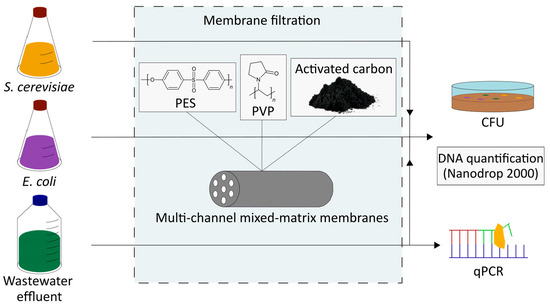
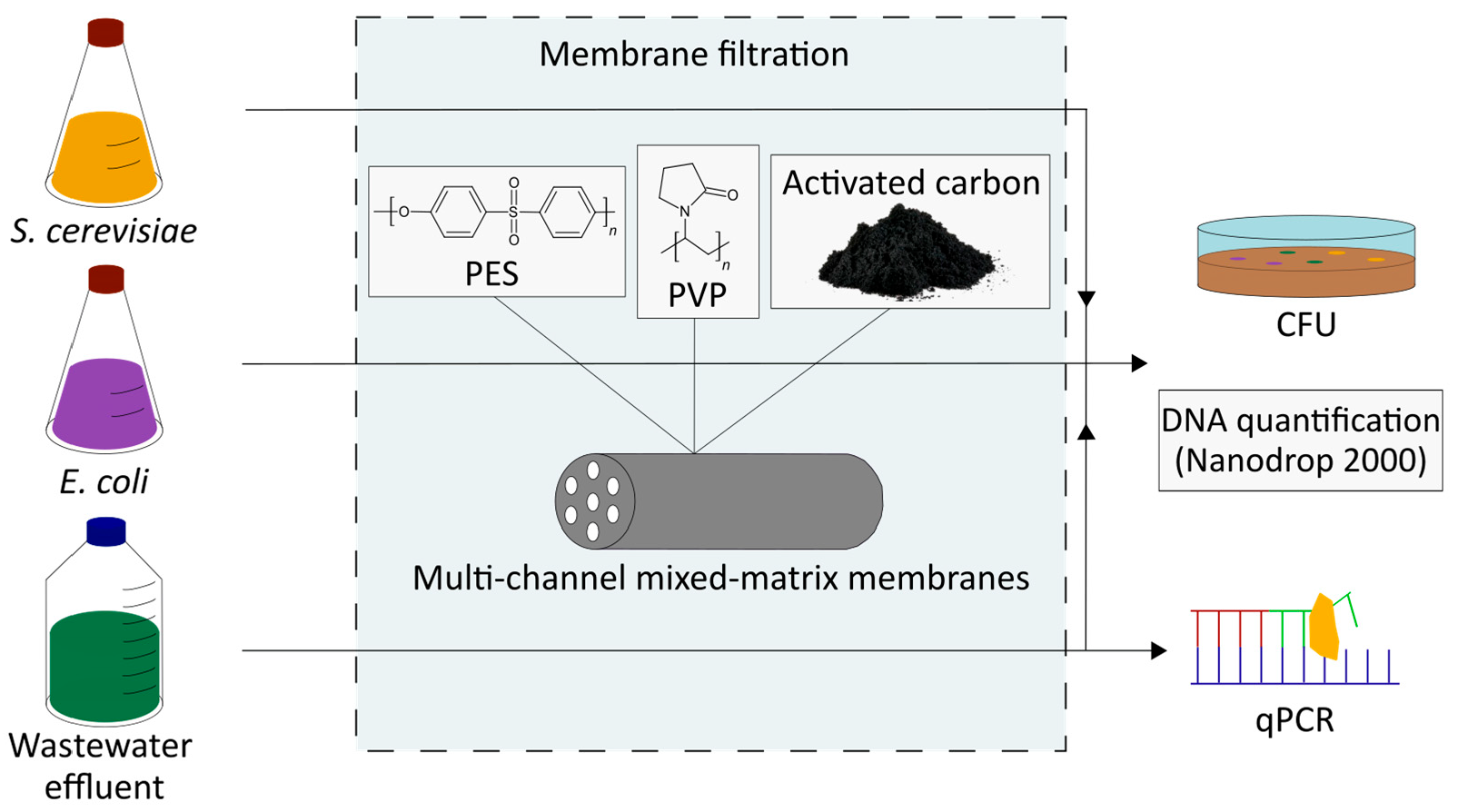
The concept of MCMMMs has been established and characterized in detail in previous studies [32,33]. In short, MCMMMs are a combined filtration and adsorption process, in which PAC (Carbopal; AP supra, Donau Carbon, Frankfurt am Main, Germany; d10 = 6.85 µm, d50 = 24.09 µm, d90 = 71.69 µm) is embedded into a polyethersulfone (PES)/polyvinylpyrrolidone (PVP) matrix of a multi-channel membrane with seven feed-channels fabricated in a steam–dry–wet spinning process. Membranes are stored in the non-solvent (water) over 7 days after spinning to prevent PVP leaching during filtration. The multi-channel geometry resulted in an outer diameter of 5 mm and an inner channel diameter of 1 mm. A single-fiber membrane with a length of 30 cm possesses an active filtration area of 66 cm2. Embedding of PAC particles enhanced the BET surface area of MCM from 13.1 m2 g−1 to 145.2 m2 g−1 for MCMMMs by simultaneously increasing the surface roughness [33]. The MCMMMs applied in this study have a solid mass share of 24.0 wt% PAC. Macromolecular retention using 500 kDa dextran (75.8 ± 1.7%) indicated a pore size range of open ultrafiltration/tight microfiltration. MCMMMs are stable up to a burst pressure of 2.78 ± 0.51 bar and withstood a tensile strength of 31.58 ± 0.94 N mm−2 [32]. PAC incorporated well into the membrane matrix, with no PAC leaching observed during filtration. Pure PES/PVP multi-channel membranes (MCMs; without embedded PAC) and MCMMMs (with embedded PAC) are compared regarding their removal of MOs and of extracted DNA from aqueous solutions. An overview of the experimental setup is given in Figure 1.

2.1. Cell Cultivation

Wastewater exhibits a variable and complex composition, encompassing not only a diverse range of pollutants but also a highly heterogeneous microbial community [36]. To elucidate the removal mechanisms involved in filtration and adsorption processes using MCM and MCMMM, initial filtration experiments were conducted with defined cell cultures. For this purpose, one eukaryotic and one prokaryotic microorganism, which are well-studied and easy to cultivate, were selected as model organisms: Saccharomyces cerevisiae (S. cerevisiae) and E. coli. These model organisms were chosen to evaluate the filtration performance of MCMs and MCMMMs for different sizes of MOs, elucidating the extent of disinfection. However, as the two MOs are not fully representative of microbial diversity in real wastewater, filtration of WWTP effluent was additionally applied.
S. cerevisiae was cultivated for 24 h at 30 °C on a suitable growth agar (Carl Roth, Karlsruhe, Germany) composed of 10 g glucose, 3 g yeast extract, 15 g Kobe agar, 3 g malt extract, and 5 g soy peptone per liter of deionized water. E. coli was grown for 24 h at 37 °C on a selective nutrient agar (Carl Roth, Karlsruhe, Germany) containing 3 g meat extract, 15 g Kobe agar, and 5 g soy peptone per liter of deionized water. Subsequently, 3–5 colonies were used to inoculate 250 mL of growth medium for each culture. The liquid growth media had the same composition as the corresponding agars, excluding Kobe agar, and were incubated by shaking for 5 days at 30 °C and 37 °C for S. cerevisiae and E. coli, respectively.
The optical density at 660 nm (OD660) was monitored to confirm mid-logarithmic growth phase. After 5 days, the cells were centrifuged three times at 3500 rpm for 5 min, with intermediate washing steps using a 0.9% sodium chloride (NaCl) solution. The resulting cell pellets were finally resuspended in 2 L of 0.9% NaCl solution, which served as the feed solution for the filtration experiments.
In addition, WWTP effluent samples were collected after treatment using the sampling unit of the municipal wastewater treatment plant in Zirl, Tyrol, Austria. The effluent was characterized by measuring pH (7.6 ± 0.4), conductivity (815.9 ± 37.7 µS cm−1), chemical oxygen demand (COD = 115.4 ± 64.9 mg L−1), and biological oxygen demand (BOD = 6.9 ± 0.1 mg L−1). Samples were stored at 4 °C and processed within a maximum of 48 h prior to filtration. Rapid handling of samples was prioritized to minimize interactions between MOs and diluted organic matter and to ensure representative results.
Scanning electron microscopy (SEM, JSM-IT200, JEOL, Tokyo, Japan) was applied on the inner channel surface of MCMs and MCMMMs after sputtering with a gold coating (Sputtercoater 180auto, Cressington, Watford, UK) pre- and post-filtration with S. cerevisiae and E. coli to evaluate surface changes, and biofouling caused by cell adhesion.

2.2. Extraction of Genetic Material

In the present study, it is assumed that DNA extracted from the selected model organisms shows widely similar behavior as extracellular DNA (eDNA) and non-cell-associated ARGs during filtration, even though fragmentation of DNA during extraction must be considered. ARGs are generally categorized as either cell-associated or non-cell-associated. Cell-associated ARGs are primarily reduced through biomass removal, whereas non-cell-associated ARGs are mainly eliminated via adsorption, degradation, or uptake by bacterial cells [21]. It was assumed that non-cell-associated ARGs exhibit filtration behavior comparable to DNA obtained from cell extracts, as eDNA often harbors an important fraction of high-risk ARGs [37,38]. This assumption is supported by findings that free extracellular DNA detected in WWTP effluent closely resembles the intracellular bacterial composition observed after secondary treatment, as well as by the co-localization of ARGs with mobile genetic elements, indicating ARG release during chlorination, as reported by Tamai et al. [39].
Genetic material from S. cerevisiae was extracted following cell cultivation as described above. DNA isolation was performed using a protocol adapted from Looke et al., employing lithium acetate–SDS solution for cell lysis and ethanol for DNA precipitation [40]. DNA from E. coli was extracted directly from liquid cultures using a combined phenol–chloroform method for cell lysis and subsequent DNA isolation [41].
For the filtration experiments targeting genetic material from wastewater, DNA was extracted from various colonies cultivated on R2A agar (Carl Roth, Karlsruhe, Germany) using the same protocol applied for E. coli DNA extraction [42]. Total nucleic acid concentrations were measured using the NanoDrop representing only the fraction of DNA derived from cultivated cells present in the wastewater. DNA concentrations may be overestimated due to RNA presence. Extracellular DNA and MOs not recoverable on R2A agar were excluded from this analysis. Nevertheless, this approach was necessary to investigate DNA removal mechanisms, as the concentration of free extracellular DNA in WWTP effluent is typically very low [41,43].

2.3. Membrane Filtration

Cross-flow filtration experiments with cell cultures were performed separately and in triplicate using both MCM and MCMMM modules with a length of 30 cm and an effective filtration area of 66 cm2. Filtration was carried out at room temperature for 1 h, at a constant transmembrane pressure (TMP) of 1 bar and a feed flow rate of approximately 40 L h−1. Samples were collected at representative time intervals throughout the filtration process.
The primary focus of the analysis was the reduction of colony-forming units (CFUs), expressed as log10 reduction, defined as the common logarithm of the ratio between CFU concentrations before and after treatment. Each log10 reduction corresponds to a tenfold decrease in CFU concentration. In addition, CFU concentrations in the feed were determined before and after filtration to assess CFU reduction attributable to shear forces acting on the inner surfaces of the membrane channels. CFU enumeration was conducted using appropriate nutrient agar plates. For S. cerevisiae and E. coli, the same nutrient agars used for cell cultivation were applied, whereas WWTP effluent samples were analyzed using a universal wastewater R2A agar plate (Carl Roth, Karlsruhe, Germany), which is selective for a broad range of heterotrophic MOs commonly present in wastewater.
For filtration experiments involving feed solutions containing extracted genetic material, the feed flow rate was reduced to 120 mL h−1 due to the limited feed volume of 250 mL. DNA concentrations were quantified using a NanoDrop 2000 spectrophotometer (Thermo Fisher, Waltham, MA, USA), with a lower limit of quantification of 2 ng μL−1 and absorbance measured at 260 nm. Following extraction and resuspension in 250 mL of 0.9% NaCl solution, feed DNA concentrations ranged from 21.0 to 27.6 ng μL−1 for S. cerevisiae and from 17.8 to 28.3 ng μL−1 for E. coli. DNA isolated from WWTP effluent colonies resulted in feed concentrations between 46.7 and 48.3 ng μL−1.

2.4. Amplicon Sequencing

Microbial communities present in WWTP effluent were investigated using amplicon sequencing to obtain a more detailed understanding of the microbial environment within the treatment plant. Prior to sequencing, WWTP effluent was subjected to cross-flow filtration in triplicate using single-fiber MCM and MCMMM modules with a length of 30 cm and an active filtration area of 66 cm2. Genetic material was extracted from samples collected before and after filtration using the ExtractNow Sewage Water DNA/RNA kit (Minerva Biolabs, Berlin, Germany). Following centrifugation, DNA was isolated from both the supernatant and the sediment and subsequently analyzed by amplicon sequencing, as described below.
The extracted DNA from WWTP effluent of feed as well as permeate of the MCMs and MCMMMs were each sequenced in triplicate. Therefore, the V4 region [44] was targeted by applying the small subunit rRNA gene primers 515f and 806r, following the Earth Microbiome Project [45]. The NGS library was prepared according to ref. [46] and modifications applied by Wunderer et al. [47]. The combined sample pool was quality-checked and sequenced using a MiSeq System (Illumina, San Diego, CA, USA) externally (Microsynth, Balgach, Switzerland). Mothur version 1.45.2 was used to process the raw data [48]. Raw sequences were assembled into contigs and quality-filtered (removing sequences with ambiguous bases, lengths outside 290–311 bp, or homopolymers >10 bp), resulting in 212,399 sequences in total and 23,600 ± 9959 sequences per sample, and then aligned to the SILVA v138.2 database [47]. After removing redundant sequences, pre-clustering, and chimera removal using VSEARCH, taxonomic classification was performed using the Wang classifier. Non-target sequences were excluded, and OTUs were clustered at 97% similarity. Alpha diversity (Shannon index, species richness, and Pielou’s evenness) was calculated from absolute OTU abundances using the vegan package in R 4.4.1 [49,50]. Beta diversity was assessed via Bray–Curtis dissimilarity. Feed-based core microbiome analysis identified OTUs present across all sample groups with a relative abundance ≥1%, which were retained in permeate samples to monitor feed reduction efficiency.

2.5. Statistical Evaluation

All experiments were performed in triplicate (sample size n = 3 per group). Plots were created using the ggplot2 package in R 4.4.1 [51]. ANOVA was applied to test for significant differences (p < 0.05) in the removal efficiencies for cells and genetic material between feed and permeate and between MCMs and MCMMMs. For the core biome of the feed, statistical analysis was conducted using all feed and permeate samples. Shapiro–Wilk tests for normality and Levene’s tests for homogeneity of variance were performed (α < 0.05). Kruskal–Wallis test followed by Dunn’s post hoc test for groupwise comparison were applied alternatively to ANOVA. For calculations of overall reduction, alpha diversity, and richness, the whole sample pool was used.

3. Results and Discussion

3.1. Filtration of MOs

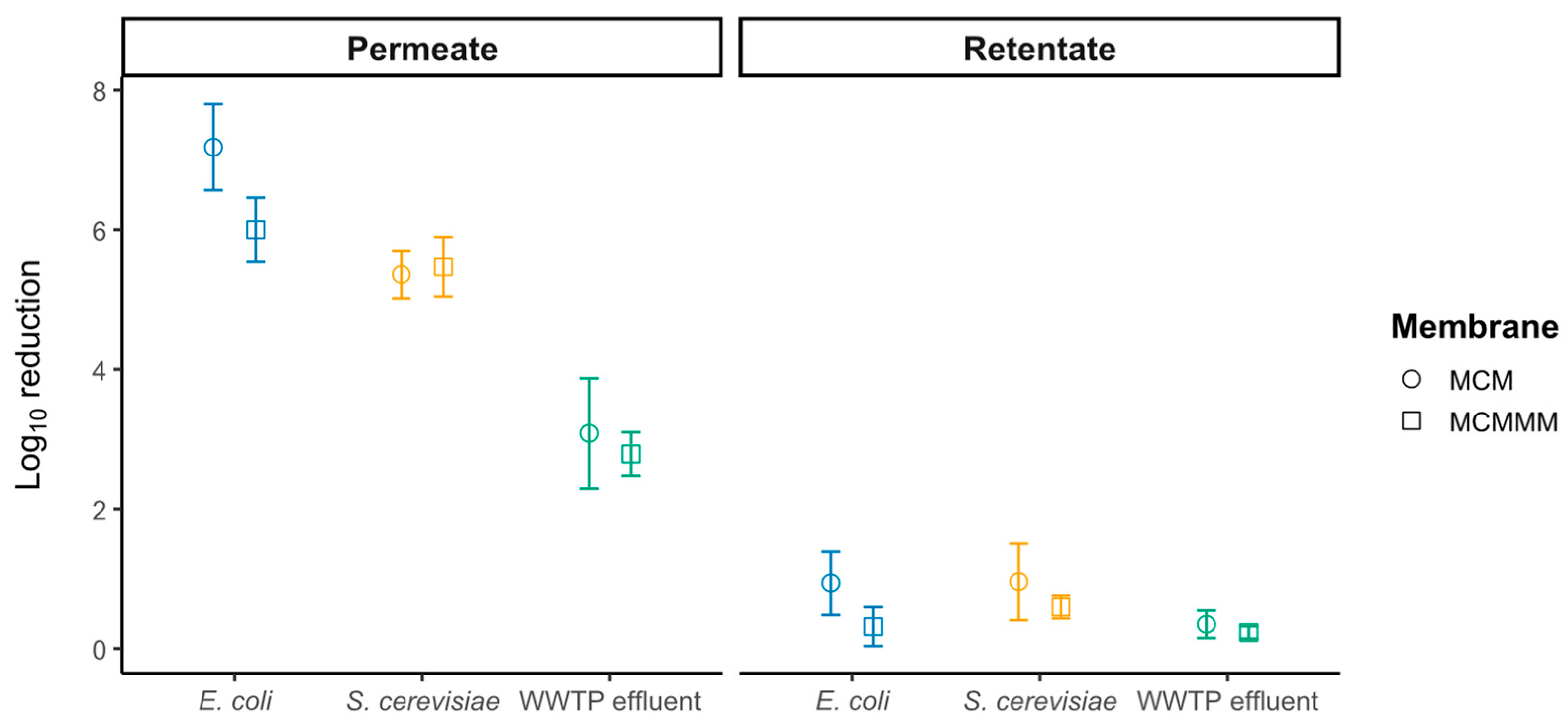
Cross-flow filtration of both S. cerevisiae and E. coli cells appeared to be successful for removal by MCMs and MCMMMs (Figure 2). The CFU of S. cerevisiae could be reduced with MCMs and MCMMMs by log10 5.36 ± 0.34 and log10 5.47 ± 0.43, respectively. Size exclusion is considered the main removal mechanism in this case. In comparison, E. coli showed an even higher retention of living cells, reaching up to log10 7.18 ± 0.62 and log10 5.99 ± 0.46 reduction for MCMs and MCMMMs, respectively. This could be related to the rod shape of E. coli, with mostly a length of 2.0–4.0 µm and a width of 0.50–1.25 µm [52]. This makes the size exclusion more variable depending on the position of the E. coli during filtration. Still, S. cerevisiae cells are on average significantly larger, with a critical diameter of around 8 µm [53]. Higher retention for E. coli could also be attributed to the higher permeability of MCM during E. coli filtration than during S. cerevisiae filtration. WWTP effluent filtration reached a log10 3.08 ± 0.79 and a log10 2.79 ± 0.31 reduction for MCM and MCMMM, respectively.
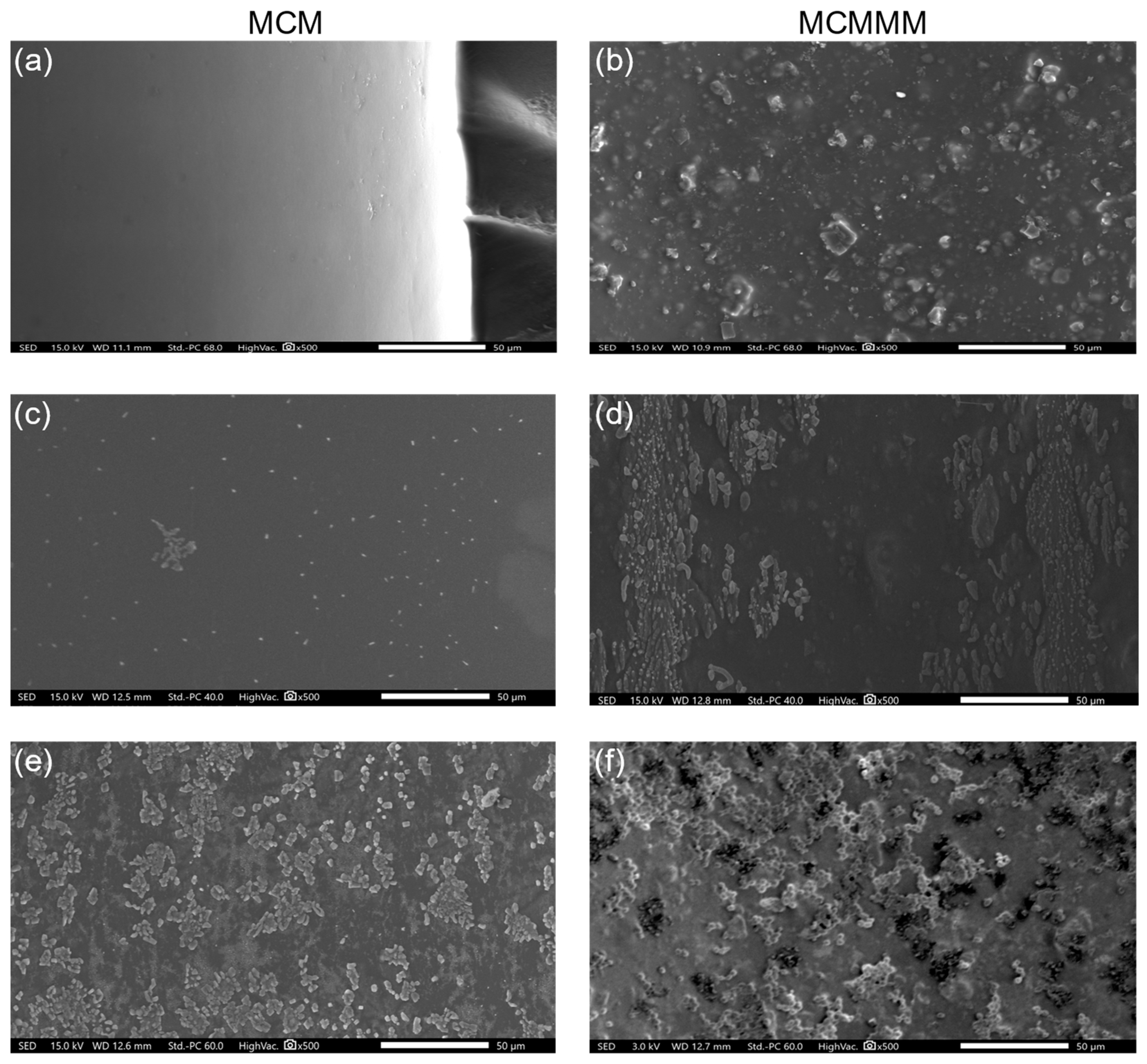
No measurable fouling was observed over 60 min of filtration. Scanning electron microscope (SEM) imaging before and after filtration revealed cell adhesion on the inner channel surface (Figure 3). Nonetheless, the shear forces during cross-flow filtration likely inhibit cell growth overall.
The broad range of organism sizes present in WWTP effluent may reduce removal efficiency compared to that observed for the model organisms. Some MOs may be smaller than the membrane cut-off and therefore pass into the permeate. In addition, the presence of spores may contribute to reduced retention. Bacterial spores, in particular, are relatively small, typically ranging from 0.5 to 2.0 μm in size [54]. Spore formation in bacteria, such as Clostridium spp., is often induced by environmental stress conditions, including nutrient limitation or exposure to toxic substances [55]. Similar stress conditions may arise from shear forces during filtration, potentially promoting spore formation.
Spores exhibit high resistance to elevated temperatures and shear stress and may therefore traverse the membrane without being damaged. Under favorable growth conditions, such as those provided on agar plates, spores can become activated, germinate into vegetative cells, and subsequently form colonies. In WWTPs, spore-forming pathogens such as clostridia can survive treatment processes and disseminate into the environment, posing potential risks to human and animal health [56]. As CFU enumeration was used as the sole quantification method in this study, it was not possible to distinguish between spores and vegetative cells contributing to the observed CFU counts.
Nevertheless, the disinfection performance of MCMs and MCMMMs is comparable to that of established technologies such as UV irradiation and chlorination, which typically achieve reductions in log10 2–4 [57]. As previously reported, a hybrid pilot-scale system combining PAC adsorption and ultrafiltration achieved reductions in log10 < 3 [31], which is within the same range as those observed for MCMMM. In contrast to conventional treatment processes, genetic material is not released through cell lysis in this case, thereby minimizing the dissemination of genomic material.
Although chlorination remains the preferred disinfection method due to its cost-effectiveness, it does not affect DNA released during cell lysis. This is evidenced by the occurrence of dissolved extracellular ARGs (eARGs) and eARGs adsorbed to particulate matter following treatment with both high and low chlorine doses [58]. In comparison, ozone treatment and TiO2-based photocatalysis are capable of damaging released DNA and thus reducing the spread of ARGs [59]. We compared feed CFU pre- and post-filtration to estimate shear-induced lysis (Figure 2). The observed reduction in CFUs in the retentate attributable to shear forces was log10 0.23 ± 0.09 and log10 0.96 ± 0.55 for MCMMMs and MCMs, respectively, indicating that cell lysis contributes only marginally to the overall CFU reduction during filtration. MCM revealed higher log10 reductions in the retentate compared to MCMMM, which could be caused by the lower permeability of MCMMM, causing smaller reduction in permeate flux along the membrane and therefore less change in the cross-flow velocity downstream of the membrane [60,61]. Nonetheless, the release of intracellular DNA during filtration cannot be completely excluded.

3.2. Filtration of Genomic Material

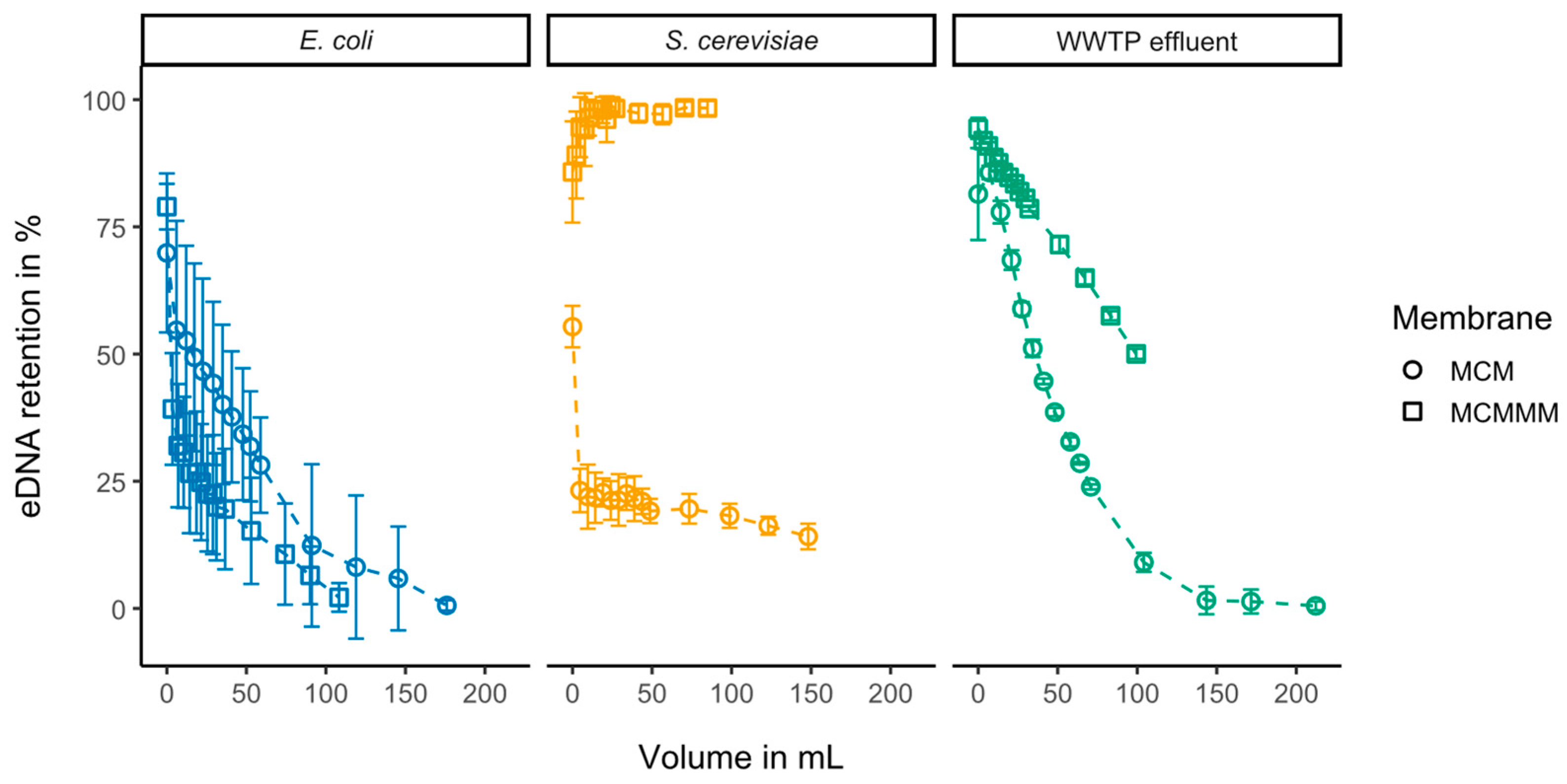
Filtration of extracellular DNA (eDNA) from the two model organisms S. cerevisiae and E. coli demonstrated pronounced differences in the removal of eukaryotic versus prokaryotic genetic material (Figure 4). Eukaryotic DNA exhibited high adsorption to embedded PAC in MCMMMs with retentions of 98.33 ± 1.39% after 1 h, whereas removal with MCM, relying mainly on size exclusion, had little effect on the removal of S. cerevisiae DNA, resulting in retentions of 14.14 ± 2.5% after 1 h. Prokaryotic DNA from E. coli exhibited negligible retention in both MCMs and MCMMMs after 1 h, with removal efficiencies of 0.59 ± 1.02% and 2.17 ± 2.81%, respectively, as well as differences between feed and permeate concentrations close to the method measurement deviation. After filtering a permeate volume of 80 to 210 mL, reached over 1 h with MCMs and MCMMMs respectively, a reduction in removal efficiency is seen for E. coli eDNA, as well as for eDNA extracted from microorganisms found in WWTP effluent. The decline in retention is attributed to diffusion into the membrane pores at the start of filtration. Also, hydrophobic interactions with the membrane matrix could be responsible for slight removal at the start of the filtration. However, PAC adsorption is not observed for E. coli DNA. In WWTP effluent, adsorption exhibits sufficient reductions in DNA concentrations, due to the broad spectrum of organisms found in WWTP effluent. Inhomogeneous adsorption and reduction is seen with a downward trend throughout the filtration duration.
Adsorption and size exclusion mechanisms appear to be largely ineffective for the removal of E. coli genetic material. Compared to the high retentions observed for S. cerevisiae DNA, prokaryotic genomes are smaller and lack histone packaging. In contrast, eukaryotic DNA is primarily confined to the cell nucleus, contains a larger number of genes, and is packaged with histones [62]. Such differences in size and organization may influence removal efficiency, as molecular weight cut-off plays a role, particularly in filtration using MCM.
In addition to molecular weight cut-off, membrane surface charge significantly affects eDNA removal. MCM exhibits an acidic surface character, whereas the incorporation of PAC shifts the surface properties of MCMMMs toward an amphoteric profile, as previously described by Marx et al. [33]. Although negatively charged membranes are commonly used in wastewater treatment to minimize adsorption of natural organic matter, DNA adsorption is reduced on negatively charged surfaces compared to neutral ones [63]. Accordingly, the presence of embedded PAC in MCMMMs can be assumed to enhance DNA adsorption at the membrane surface.
Structural differences in the genetic material of the two model organisms further contribute to the observed removal behavior. E. coli DNA is predominantly present in circular conformations [64], whereas larger and more complex DNA structures are more readily retained during filtration due to entrapment within the porous membrane matrix. However, the substantial difference between MCMs and MCMMMs in the removal of eukaryotic DNA indicates strong adsorptive interactions between the DNA and the embedded PAC. Adsorption of DNA to PAC has already been applied with sufficient yields for DNA purification proving DNA adsorption [65]. Although both DNA and PAC are generally negatively charged and positively charged species are typically more readily adsorbed, hydrophobic interactions also play an important role in adsorption processes [66]. According to Du et al. adsorption of DNA on biochar can reach adsorption capacities of up to 296 mg g−1 and removal efficiencies of up to 92.7%, validating the removal through adsorption observed during MCMMM filtration [67]. Moreover, the conformational flexibility of double-stranded DNA may allow molecules to deform and pass through membrane pores [68]. Taken together, the combined effects of filtration and adsorption provide plausible explanations for the differing removal efficiencies observed for eukaryotic and prokaryotic DNA beyond size exclusion alone. This distinction is particularly important when interpreting the retention behavior of mixed DNA extracted from cultivated MOs in WWTP effluent.
Similarly to E. coli, extracted DNA from MOs cultivated from WWTP effluent exhibited higher removal efficiencies with MCMMMs compared to MCMs (Figure 4). When filtering WWTP effluent, competitive adsorption with dissolved organic matter (DOM) and micropollutants must be taken into account. In addition, other constituents present in wastewater can influence eDNA removal through adsorption processes. Heavy metals, for example, have been shown to enhance eDNA adsorption by inducing DNA strand unwinding and strengthening hydrogen bonding interactions with biochar [69]. Such effects may also occur in wastewater effluent, where heavy metals are typically present at low concentrations [70], potentially promoting eDNA removal via adsorption.
Conversely, membrane-based removal efficiencies of eDNA can be increased in wastewater compared to buffer solutions due to the formation of complexes between eDNA and wastewater colloids [71]. Dissolved organic matter, while acting as a major competitor for eDNA during adsorption, also contributes to colloid formation. As a result, DOM may simultaneously play a beneficial role in enhancing eDNA removal from wastewater during filtration processes [72,73]. According to Merkler et al., eDNA concentrations were higher in the effluent from the secondary clarifier compared to the influent of the WWTP, suggesting that cell lysis takes place during the treatment process [31].
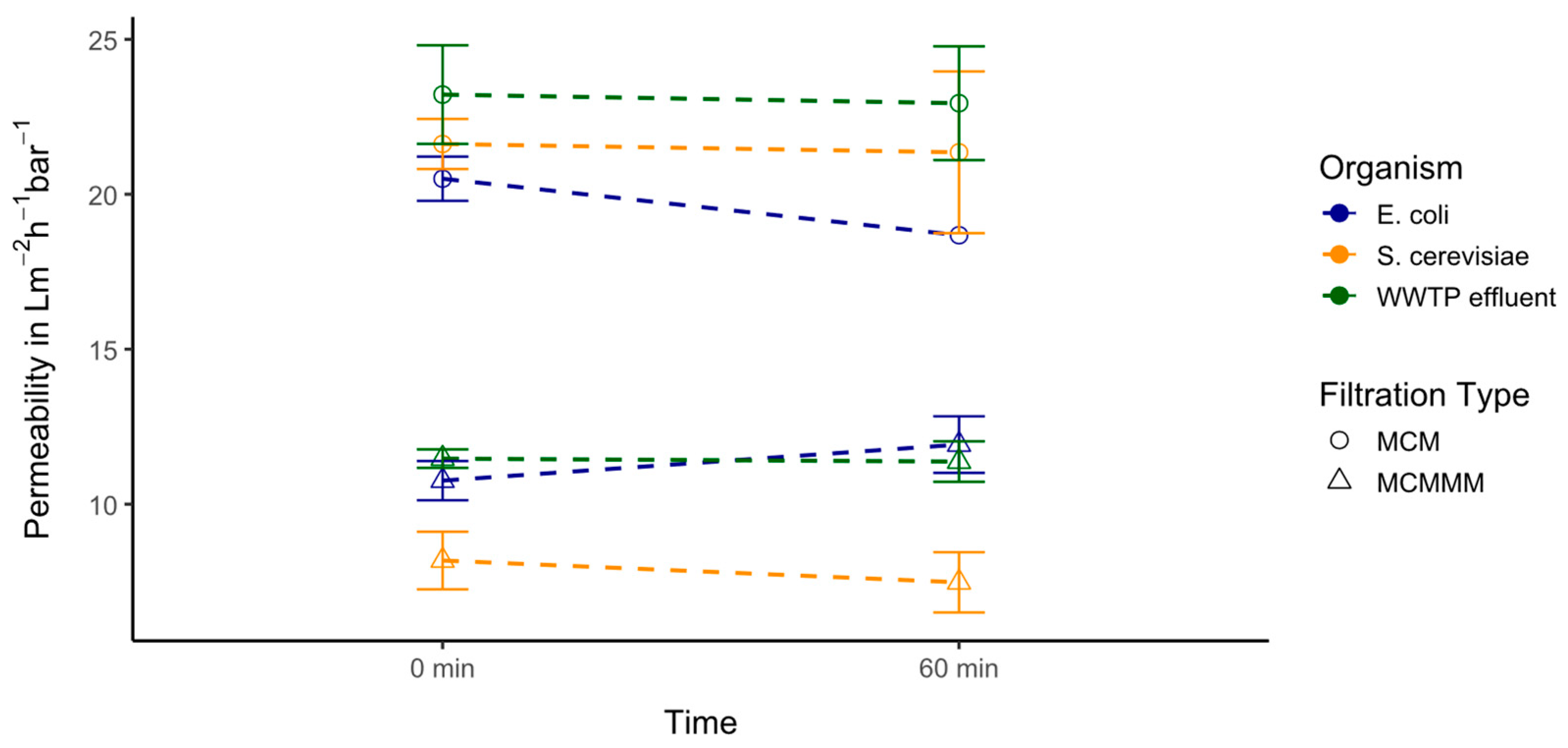
MCMMM permeabilities are generally lower than those of MCM (Figure 5). Most likely this is attributed to pore blocking through the embedded PAC particles [32]. Permeabilities of MCMs and MCMMMs did not significantly decline over a filtration time of 60 min, even at high MO concentrations (p = 0.776). Differences mainly occur due to the embedded PAC in the MCMMMs, lowering the permeate flux significantly (p = 1.36 × 10⁻¹⁵). This suggests that over the filtration time of 60 min, no visible fouling is taking place.
Still, fouling has to be considered in the context of biomass filtration. In particular, biofouling through growth of MOs in the form of biofilms on the surface of the membrane has a high potential for negative effects on the filtration performance. Biofilms can act as reservoirs for ARGs by protecting the cells from environmental stresses [74]. High cell density and close proximity of cells can enhance also the exchange of ARGs through HGT. However, transmission of DNA, especially plasmids, increases with higher permeate flux due to flow induced plasmid elongation [75], which is mainly relevant for the high permeability seen in MCM compared to MCMMM. In general, cross-flow filtration should reduce fouling due to shear forces occurring on the channel surface. Still, actual effects of biofouling on the MCMMM filtration have to be evaluated, but based on results for the regeneration and backwashing of MCMs and MCMMMs after micropollutant filtration, the recovery of the filtration performance and the adsorption capacity appear promising [32]. Filtration of WWTP effluent with MCMMM modules over a total of 144 h have previously shown limited effects of fouling. Chemical regeneration using an aqueous ethanol solution restored the cumulative removal of pharmaceuticals to 76.3%, suggesting sufficient desorption from PAC. However, an increase in permeate flux was observed after regeneration suggesting a change in the membrane composition through partial PVP leaching [34]. This low fouling susceptibility is attributed to the combination of chemical regeneration and shear forces occurring during cross-flow filtration and the antifouling properties observed, for example, for embedded graphene nanoplatelets in composite membranes [76].

3.3. Microbial Diversity Based on Amplicon Sequencing

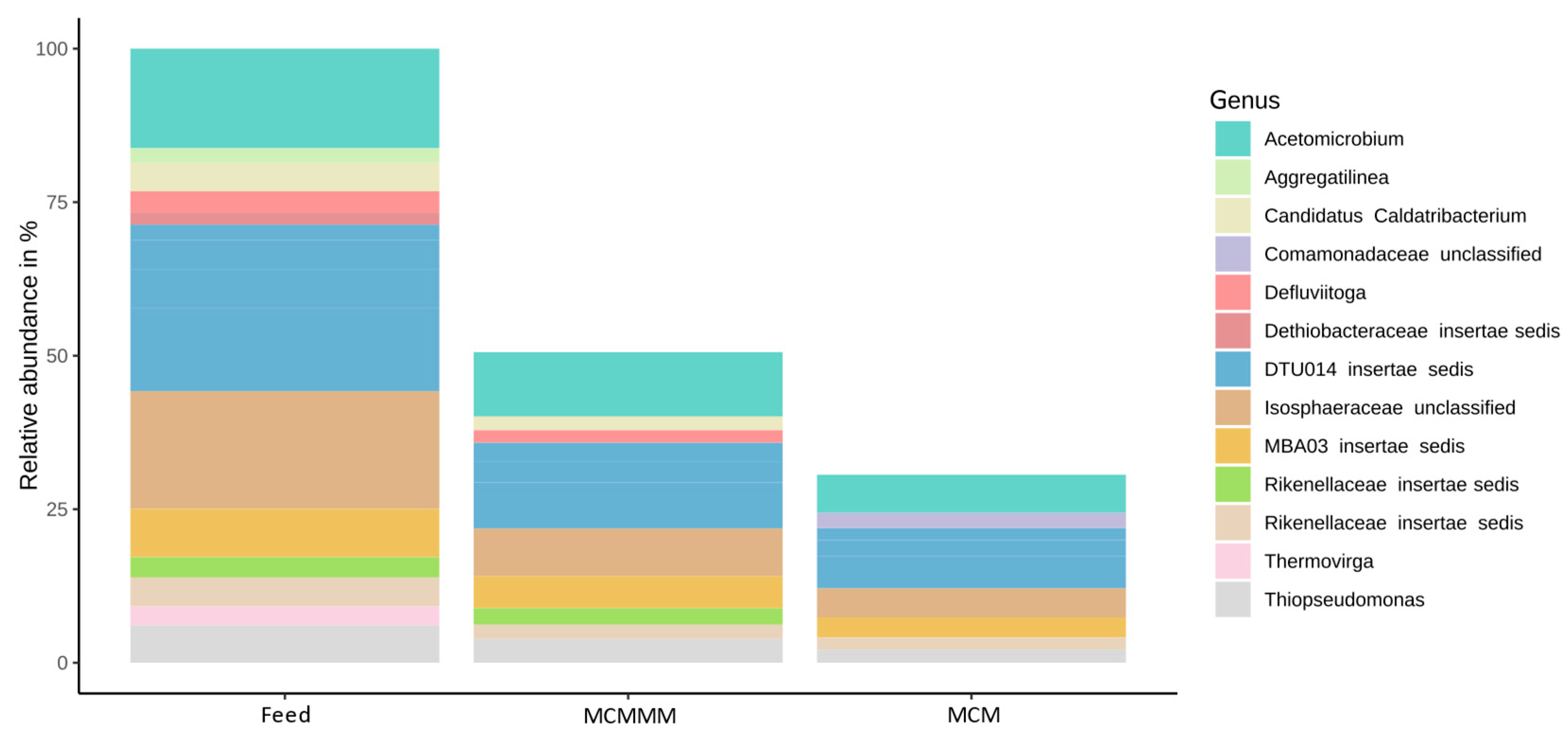
Membrane filtration altered the composition of the feed core biome significantly (Figure 6). In case of pure PES MCM filtration, the relative abundance of the feed core biome decreased to 30. 62% (p < 0.001), whereas the reduction through MCMMMs amounted to 50.58% (p = 0.010). Alpha diversity (α-D) and richness (R) appeared similar between feed (α-D = 4.58 ± 0.07, R = 534.0 ± 26.3) and permeate samples, as well as between the permeate of the MCM (α-D = 2.89 ± 1.06, R = 580.0 ± 43.6) and the MCMMMs (α-D = 3.65 ± 1.12, R = 593.0 ± 126.0), with no significant differences (p > 0.05). Conventional and advanced wastewater treatment steps should preferably reduce wastewater biodiversity, especially when considering ARG and antimicrobial-resistant organisms as part of the biodiversity and the species richness [77]. A similar alpha diversity and richness among all samples suggested a more or less similar reduction of all species simultaneously. However, Dethiobacteraceae incertae sedis, Aggregatilinea sp. and Thermovirga sp. were completely removed from the core biome with both MCM and MCMMM filtration, and Defluvitoga sp., Rikenellaceae insertae sedis sp. and Candidatus caldatribacterium sp. were only eliminated through MCM filtration. This difference in removal might result from the rougher surface of MCMMMs compared to MCMs due to the PAC particles found on the inner channel of the membrane, which has been previously observed by scanning electron microscopy and atomic force microscopy [33]. Rapid cell adhesion and biofilm formation are promoted by rougher surfaces of membranes [78].
In this study, ARGs were not determined, as no ARGs from the analyzed spectrum of ARGs were found in the conducted target ARG analysis from the wastewater effluent samples. Antimicrobial-resistant organisms are generally found in wastewater effluent; although a reduction is usually already seen during the conventional treatment process, the relevance of the release of pathogens and antimicrobial-resistant organisms from WWTPs is high considering the One Health approach and the potential reuse of wastewater effluent in water scarcity scenarios [79]. Influents and effluents monitored over one year in WWTPs in Italy showed reduction in the total abundance of ARGs and antimicrobial-resistant bacteria but an increase in the diversity during conventional wastewater treatment [80]. Still, it can be stated that ARGs found in municipal WWTPs highly depend on the composition of the influent of the WWTP. This composition could potentially be influenced by the discharge of wastewater from the hospital near the considered WWTP. However, according to Muoghalu et al., domestic wastewater shows highest relative ARG abundance compared to hospital wastewater, although greater ARG diversity was found in the latter [81]. Depending on pre-treatments and variation in contamination through excretion of the patients, the diversity and abundance of the determined antimicrobial-resistant organisms and ARGs might differ significantly [43]. Pathogens are in many cases already reduced during conventional wastewater treatment and MOs, which are characteristic of activated sludge, are found in larger abundance in WWTP effluent [77]. In this study, only the treatment of the effluent by advanced purification processes is considered, and no conclusion about the reduction in microorganisms during previous treatment steps can be drawn. However, the method is limited by the genera detected in WWTP effluent, and resistances appearing in single species were not determined. Some genera found in the core biome are characteristic MOs for activated sludge treatment, like Acetomicrobium sp. and Comamonadaceae unclassified sp. [82,83]. In general, membrane filtration can reduce ARGs by up to ~90% in WWTP effluent, depending on the pore size [81]. Removal of ARGs and pathogens by MCMMM filtration has to be evaluated in future work by experimental validation. Still, the presented results suggest large potential for the reduction for a wide range of microorganisms and their genetic material from wastewater effluent by filtration.

4. Conclusions

In the post-pandemic decade, amidst the complex interaction of humans, animals, and the environment, One Health has gained renewed importance. Building on prior pharmaceutical removal with MCMMMs (up to 76.29 ± 4.99%), this study shows that MCMMMs—PES/PVP micro-/ultrafiltration multi-channel membranes with embedded PAC—can concurrently reduce microorganisms and extracellular DNA (eDNA) from WWTP effluent. Over 60 min of cross-flow filtration, MCMMMs achieved log10 reductions of 5.99 ± 0.46 for E. coli, 5.47 ± 0.42 for S. cerevisiae, and 2.79 ± 0.31 for WWTP effluent CFUs. Eukaryotic DNA was strongly retained (up to 98.33%), whereas prokaryotic DNA showed limited removal under the tested conditions, indicating a major role of PAC-driven adsorption in eDNA elimination. Amplicon sequencing revealed a 50.58% reduction of the feed core biome after MCMMM filtration, with no detectable loss of hydraulic performance over 60 min.
The short filtration window limited evaluation of biofouling and performance decline during biomass filtration. S. cerevisiae and E. coli were only partially representative for the broader WWTP effluent microbiome resolved by amplicon sequencing. ARGs were not quantified, constraining conclusions to eDNA from cultivated organisms in wastewater effluent. Therefore, long-term fouling, regeneration, and retentate management as well as performance and economics at pilot/full scale should be assessed in future studies, aligned with existing pilot-scale MCMMM work on pharmaceutical removal.
These findings position MCMMMs as a single-unit operation that combines size exclusion and embedded-PAC adsorption for quaternary effluent treatment. Based on the demonstrated microorganism and eDNA removal, future work should aim to limit the spread of pathogens and resistances in the environment. Horizontal gene transfer, which mainly occurs in bacterial cells, could be reduced by optimizing the process toward prokaryotic DNA removal. Although this study did not quantify ARGs, resolving ARG dynamics remains essential. Future work should (i) quantify ARGs across seasons and operating conditions via extended qPCR/dPCR and metagenomics and (ii) elucidate adsorption mechanisms for DNA of different sizes and conformations. The successful disinfection and promising eDNA removal shown here support integrating MCMMM filtration into quaternary treatment to help mitigate pathogen dissemination and ARG propagation in WWTP effluents.

Author Contributions

Conceptualization, J.M. and C.M.; methodology, J.M., C.M. and A.O.W.; validation, J.M., V.H., C.U. and C.M.; formal analysis, J.M., C.M., V.H. and C.U.; investigation, V.H., C.U., C.M., E.M.P. and J.M.; resources, M.S., J.B. and A.O.W.; data curation, J.M. and C.M.; writing—original draft preparation, J.M.; writing—review and editing, C.M., A.O.W., T.P., J.B. and M.S.; visualization, J.M. and C.M.; supervision, T.P., M.S., J.B. and A.O.W.; project administration, J.B. and J.M.; funding acquisition, J.B., M.S., A.O.W. and J.M. All authors have read and agreed to the published version of the manuscript.

Funding

The study was co-financed by the Tiroler Wissenschaftsfonds (F.45092/8-2022). This work was co-funded by the European Union through the Interreg VI-A Austria–Germany/Bavaria 2021–2027 Programme (ERDF), project PFASelect (Grant No. BA0100270).

Institutional Review Board Statement

Not applicable.

Informed Consent Statement

Not applicable.

Data Availability Statement

The original contributions presented in this study are included in the article. Further inquiries can be directed to the corresponding author.

Acknowledgments

The support of Nataly Knöpfle during conceptualization and conduction of experiments is highly appreciated.

Conflicts of Interest

The authors declare no conflicts of interest. The funders had no role in the design of the study; in the collection, analyses, or interpretation of data; in the writing of the manuscript; or in the decision to publish the results.

Abbreviations

The following abbreviations are used in this manuscript:
AAsAntimicrobial agents
ACActivated carbon
ARGs Antimicrobial resistance genes
BODBiological oxygen demand
CFUColony-forming units
CODChemical oxygen demand
DOMDissolved organic matter
E. coliEscherichia coli
eARGsExtracellular ARGs
eDNAExtracellular DNA
HGT Horizontal gene transfer
MCMMulti-channel membrane
MCMMMMulti-channel mixed-matrix membrane
MICMinimum inhibitory concentration
MOMicroorganism
MWCOMolecular weight cut-off
NaClSodium chloride
PACPowdered activated carbon
PESPolyethersulfone
PVPPolyvinylpyrrolidone
RRichness
S. cerevisiaeSaccharomyces cerevisiae
TMPTransmembrane pressure
WHOWorld Health Organization
WWTP Wastewater treatment plant
α-DAlpha diversity

References

  1. Huerta, B.; Marti, E.; Gros, M.; López, P.; Pompêo, M.; Armengol, J.; Barceló, D.; Balcázar, J.L.; Rodríguez-Mozaz, S.; Marcé, R. Exploring the links between antibiotic occurrence, antibiotic resistance, and bacterial communities in water supply reservoirs. Sci. Total Environ. 2013, 456–457, 161–170. [Google Scholar] [CrossRef]
  2. Yadav, B.; Karad, D.D.; Kharat, K.R.; Makwana, N.; Jaiswal, A.; Chawla, R.; Mani, M.; Boro, H.H.; Joshi, P.R.; Kamble, D.P. Environmental and clinical impacts of antibiotics’ sub-minimum inhibitory concentrations on the development of resistance in acinetobacter baumannii. Sci. Total Environ. 2025, 979, 179521. [Google Scholar] [CrossRef]
  3. Eltai, N.O.; Yassine, H.M.; Al Thani, A.A.; Abu Madi, M.A.; Ismail, A.; Ibrahim, E.; Alali, W.Q. Prevalence of antibiotic resistant Escherichia coli isolates from fecal samples of food handlers in Qatar. Antimicrob. Resist. Infect. Control 2018, 7, 78. [Google Scholar] [CrossRef]
  4. Bijlsma, L.; Pitarch, E.; Fonseca, E.; Ibáñez, M.; Botero, A.M.; Claros, J.; Pastor, L.; Hernández, F. Investigation of pharmaceuticals in a conventional wastewater treatment plant: Removal efficiency, seasonal variation and impact of a nearby hospital. J. Environ. Chem. Eng. 2021, 9, 105548. [Google Scholar] [CrossRef]
  5. Mishra, P.; Tripathi, G.; Mishra, V.; Ilyas, T.; Irum; Firdaus, S.; Ahmad, S.; Farooqui, A.; Yadav, N.; Rustagi, S.; et al. Antibiotic contamination in wastewater treatment plant effluents: Current research and future perspectives. Environ. Nanotechnol. Monit. Manag. 2025, 23, 101047. [Google Scholar] [CrossRef]
  6. Gros, M.; Rodríguez-Mozaz, S.; Barceló, D. Fast and comprehensive multi-residue analysis of a broad range of human and veterinary pharmaceuticals and some of their metabolites in surface and treated waters by ultra-high-performance liquid chromatography coupled to quadrupole-linear ion trap tandem mass spectrometry. J. Chromatogr. A 2012, 1248, 104–121. [Google Scholar] [CrossRef]
  7. Aslan, A.; Cole, Z.; Bhattacharya, A.; Oyibo, O. Presence of Antibiotic-Resistant Escherichia coli in Wastewater Treatment Plant Effluents Utilized as Water Reuse for Irrigation. Water 2018, 10, 805. [Google Scholar] [CrossRef]
  8. Verburg, I.; García-Cobos, S.; Hernández Leal, L.; Waar, K.; Friedrich, A.W.; Schmitt, H. Abundance and Antimicrobial Resistance of Three Bacterial Species along a Complete Wastewater Pathway. Microorganisms 2019, 7, 312. [Google Scholar] [CrossRef] [PubMed]
  9. von Wintersdorff, C.J.H.; Penders, J.; van Niekerk, J.M.; Mills, N.D.; Majumder, S.; van Alphen, L.B.; Savelkoul, P.H.M.; Wolffs, P.F.G. Dissemination of Antimicrobial Resistance in Microbial Ecosystems through Horizontal Gene Transfer. Front. Microbiol. 2016, 7, 173. [Google Scholar] [CrossRef]
  10. Berendonk, T.U.; Manaia, C.M.; Merlin, C.; Fatta-Kassinos, D.; Cytryn, E.; Walsh, F.; Bürgmann, H.; Sørum, H.; Norström, M.; Pons, M.-N.; et al. Tackling antibiotic resistance: The environmental framework. Nat. Rev. Microbiol. 2015, 13, 310–317. [Google Scholar] [CrossRef] [PubMed]
  11. Li, N.; Li, M.; Chen, P.; Wood, A.; Hilton, J.; Zhou, Q.; Limayan, A. Mapping bacterial diversity and antibiotic resistance across wastewater treatment plant stages: Insights from high-resolution 16S rRNA sequencing of the V3-V4 regions to detection of multi-drug resistant bacteria. J. Water Process Eng. 2025, 71, 107143. [Google Scholar] [CrossRef]
  12. Cabral, J.P.S. Water microbiology. Bacterial pathogens and water. Int. J. Environ. Res. Public Health 2010, 7, 3657–3703. [Google Scholar] [CrossRef] [PubMed]
  13. Yao, B.; Luo, Z.; Xiong, W.; Song, B.; Zeng, Z.; Zhou, Y. Disinfection techniques of human norovirus in municipal wastewater: Challenges and future perspectives. Curr. Opin. Environ. Sci. Health 2020, 17, 29–34. [Google Scholar] [CrossRef]
  14. Bączkowska, E.; Pierpaoli, M.; Gamoń, F.; Luczkiewicz, A.; Fudala-Ksiazek, S.; Bray, R.; Szopińska, M. On-site medical wastewater treatment enabling sustainable water reclamation: Merged advanced oxidation process for disinfection, toxicity, and contaminants removal. J. Water Process Eng. 2025, 72, 107562. [Google Scholar] [CrossRef]
  15. Castañeda-Retavizca, K.J.; O’Dowd, K.; Jambrina-Hernández, E.; Nahim-Granados, S.; Plaza-Bolaños, P.; Malato, S.; Polo-López, M.I.; Pillai, S.C.; Oller, I. Urban wastewater treatment by ozonation: Disinfection by-products and toxicity assessment. J. Environ. Chem. Eng. 2025, 13, 115970. [Google Scholar] [CrossRef]
  16. Zhou, C.-S.; Wu, J.-W.; Dong, L.-L.; Liu, B.-F.; Xing, D.-F.; Yang, S.-S.; Wu, X.-K.; Wang, Q.; Fan, J.-N.; Feng, L.-P.; et al. Removal of antibiotic resistant bacteria and antibiotic resistance genes in wastewater effluent by UV-activated persulfate. J. Hazard. Mater. 2020, 388, 122070. [Google Scholar] [CrossRef]
  17. Li, W.; Ding, C.; Korshin, G.; Li, J.; Cheng, H. Effect of chlorination on the characteristics of effluent organic matter and the phototransformation of sulfamethoxazole in secondary wastewater. Chemosphere 2022, 295, 133193. [Google Scholar] [CrossRef]
  18. Liang, Y.-B.; Li, H.-B.; Chen, Z.-S.; Yang, Y.; Shi, D.-Y.; Chen, T.-J.; Yang, D.; Yin, J.; Zhou, S.-Q.; Cheng, C.-Y.; et al. Spatial behavior and source tracking of extracellular antibiotic resistance genes in a chlorinated drinking water distribution system. J. Hazard. Mater. 2022, 425, 127942. [Google Scholar] [CrossRef]
  19. Liu, S.-S.; Qu, H.-M.; Yang, D.; Hu, H.; Liu, W.-L.; Qiu, Z.-G.; Hou, A.-M.; Guo, J.; Li, J.-W.; Shen, Z.-Q.; et al. Chlorine disinfection increases both intracellular and extracellular antibiotic resistance genes in a full-scale wastewater treatment plant. Water Res. 2018, 136, 131–136. [Google Scholar] [CrossRef]
  20. Krzeminski, P.; Feys, E.; Anglès d’Auriac, M.; Wennberg, A.C.; Umar, M.; Schwermer, C.U.; Uhl, W. Combined membrane filtration and 265 nm UV irradiation for effective removal of cell free antibiotic resistance genes from feed water and concentrate. J. Membr. Sci. 2020, 598, 117676. [Google Scholar] [CrossRef]
  21. Liu, H.; Li, Z.; Qiang, Z.; Karanfil, T.; Yang, M.; Liu, C. The elimination of cell-associated and non-cell-associated antibiotic resistance genes during membrane filtration processes: A review. Sci. Total Environ. 2022, 833, 155250. [Google Scholar] [CrossRef]
  22. Pandey, R.P.; Yousef, A.F.; Alsafar, H.; Hasan, S.W. Surveillance, distribution, and treatment methods of antimicrobial resistance in water: A review. Sci. Total Environ. 2023, 890, 164360. [Google Scholar] [CrossRef]
  23. Ahmed, M.J. Adsorption of non-steroidal anti-inflammatory drugs from aqueous solution using activated carbons: Review. J. Environ. Manag. 2017, 190, 274–282. [Google Scholar] [CrossRef]
  24. de Franco, M.A.E.; de Carvalho, C.B.; Bonetto, M.M.; de Pelegrini Soares, R.; Féris, L.A. Diclofenac removal from water by adsorption using activated carbon in batch mode and fixed-bed column: Isotherms, thermodynamic study and breakthrough curves modeling. J. Clean. Prod. 2018, 181, 145–154. [Google Scholar] [CrossRef]
  25. Parniske, J.; Atallah Al-Asad, H.; Qian, J.; Morck, T. Modelling competitive adsorption of organic micropollutants onto powdered activated carbon in continuous stirred tank reactors for advanced wastewater treatment. Water Res. 2024, 258, 121806. [Google Scholar] [CrossRef] [PubMed]
  26. Kovalova, L.; Knappe, D.R.U.; Lehnberg, K.; Kazner, C.; Hollender, J. Removal of highly polar micropollutants from wastewater by powdered activated carbon. Environ. Sci. Pollut. Res. 2013, 20, 3607–3615. [Google Scholar] [CrossRef]
  27. Mailler, R.; Danel, O.; Esperanza, M.; Courtois, S.; Gonzalez Ospina, A. Mastering granular activated carbon filtration to remove organic micropollutants, antibiotic resistance and metals for municipal wastewater reuse. Sci. Total Environ. 2024, 952, 175918. [Google Scholar] [CrossRef] [PubMed]
  28. Krahnstöver, T.; Wintgens, T. Separating powdered activated carbon (PAC) from wastewater–Technical process options and assessment of removal efficiency. J. Environ. Chem. Eng. 2018, 6, 5744–5762. [Google Scholar] [CrossRef]
  29. Löwenberg, J.; Wintgens, T. PAC/UF processes: Current application, potentials, bottlenecks and fundamentals: A Review. Crit. Rev. Environ. Sci. Technol. 2017, 47, 1783–1835. [Google Scholar] [CrossRef]
  30. Ejraei, A.; Aroon, M.A.; Ziarati Saravani, A. Wastewater treatment using a hybrid system combining adsorption, photocatalytic degradation and membrane filtration processes. J. Water Process Eng. 2019, 28, 45–53. [Google Scholar] [CrossRef]
  31. Merkler, K.; Leverenz, D.; Dobslaw, D.; Locher, C.; Launay, M.; Kohlgrüber, V.; Braeutigam, P. Improved removal of micropollutants and pathogens from municipal wastewater using a pilot-scale hybrid system combining powdered activated carbon and ultrafiltration. J. Environ. Chem. Eng. 2025, 13, 118642. [Google Scholar] [CrossRef]
  32. Marx, J.; Back, J.; Hoiss, L.; Hofer, M.; Pham, T.; Spruck, M. Chemical Regeneration of Mixed-Matrix Membranes for Micropollutant Removal from Wastewater. Chem. Ing. Tech. 2023, 95, 1416–1427. [Google Scholar] [CrossRef]
  33. Marx, J.; Back, J.; Netzer, F.; Pham, T.; Penner, S.; Bakry, R.; Spruck, M. Comprehensive characterisation of multi-channel mixed-matrix membranes and impact of water matrix variability on micropollutant removal. Case Stud. Chem. Environ. Eng. 2024, 10, 100930. [Google Scholar] [CrossRef]
  34. Marx, J.; Otaiza Gonzalez, S.N.; Rodriguez Mozaz, S.; Alonso, L.L.; Back, J.; Schobel, J.; Marktl, W.; Rattinger, D.; Pham, T.; Spruck, M. Pilot-scale multi-channel mixed-matrix membranes for pharmaceutical removal in advanced municipal wastewater treatment. Sep. Purif. Technol. 2026, 398, 138238. [Google Scholar] [CrossRef]
  35. Werkneh, A.A.; Islam, M.A. Post-treatment disinfection technologies for sustainable removal of antibiotic residues and antimicrobial resistance bacteria from hospital wastewater. Heliyon 2023, 9, e15360. [Google Scholar] [CrossRef]
  36. Johnson, D.R.; Helbling, D.E.; Lee, T.K.; Park, J.; Fenner, K.; Kohler, H.-P.E.; Ackermann, M. Association of biodiversity with the rates of micropollutant biotransformations among full-scale wastewater treatment plant communities. Appl. Environ. Microbiol. 2015, 81, 666–675. [Google Scholar] [CrossRef]
  37. Calderón-Franco, D.; van Loosdrecht, M.C.M.; Abeel, T.; Weissbrodt, D.G. Free-floating extracellular DNA: Systematic profiling of mobile genetic elements and antibiotic resistance from wastewater. Water Res. 2021, 189, 116592. [Google Scholar] [CrossRef] [PubMed]
  38. Sivalingam, P.; Sabatino, R.; Sbaffi, T.; Fontaneto, D.; Corno, G.; Di Cesare, A. Extracellular DNA includes an important fraction of high-risk antibiotic resistance genes in treated wastewaters. Environ. Pollut. 2023, 323, 121325. [Google Scholar] [CrossRef]
  39. Tamai, S.; Okuno, M.; Ogura, Y.; Suzuki, Y. Genetic diversity of dissolved free extracellular DNA compared to intracellular DNA in wastewater treatment plants. Sci. Total Environ. 2025, 970, 178989. [Google Scholar] [CrossRef]
  40. Lõoke, M.; Kristjuhan, K.; Kristjuhan, A. Extraction of genomic DNA from yeasts for PCR-based applications. Biotechniques 2011, 50, 325–328. [Google Scholar] [CrossRef]
  41. Li, X.; Lin, L.; Liu, Q.; Wei, L.; Li, L.; Liao, J.; Huang, H. Fate of extracellular antibiotic resistant genes in wastewater treatment plants: Characteristics, persistence, transformation, removal and potential risk. Energy Environ. Sustain. 2025, 1, 100022. [Google Scholar] [CrossRef]
  42. He, F. E. coli Genomic DNA Extraction. bio-protocol 2011, 1, e97. [Google Scholar] [CrossRef]
  43. Li, J.; Cheng, W.; Xu, L.; Strong, P.J.; Chen, H. Antibiotic-resistant genes and antibiotic-resistant bacteria in the effluent of urban residential areas, hospitals, and a municipal wastewater treatment plant system. Environ. Sci. Pollut. Res. Int. 2015, 22, 4587–4596. [Google Scholar] [CrossRef]
  44. Apprill, A.; McNally, S.; Parsons, R.; Weber, L. Minor revision to V4 region SSU rRNA 806R gene primer greatly increases detection of SAR11 bacterioplankton. Aquat. Microb. Ecol. 2015, 75, 129–137. [Google Scholar] [CrossRef]
  45. Gilbert, J.A.; Jansson, J.K.; Knight, R. The Earth Microbiome project: Successes and aspirations. BMC Biol. 2014, 12, 69. [Google Scholar] [CrossRef]
  46. Prem, E.M.; Markt, R.; Lackner, N.; Illmer, P.; Wagner, A.O. Microbial and Phenyl Acid Dynamics during the Start-up Phase of Anaerobic Straw Degradation in Meso- and Thermophilic Batch Reactors. Microorganisms 2019, 7, 657. [Google Scholar] [CrossRef]
  47. Wunderer, M.; Markt, R.; Prem, E.M.; Peer, N.; Mullaymeri, A.; Wagner, A.O. Cofactor F420 tail length distribution in different environmental samples. Heliyon 2024, 10, e39127. [Google Scholar] [CrossRef] [PubMed]
  48. Schloss, P.D.; Westcott, S.L.; Ryabin, T.; Hall, J.R.; Hartmann, M.; Hollister, E.B.; Lesniewski, R.A.; Oakley, B.B.; Parks, D.H.; Robinson, C.J.; et al. Introducing mothur: Open-source, platform-independent, community-supported software for describing and comparing microbial communities. Appl. Environ. Microbiol. 2009, 75, 7537–7541. [Google Scholar] [CrossRef] [PubMed]
  49. Oksanen, J.; Simpson, G.L.; Blanchet, F.G.; Kindt, R.; Legendre, P.; Minchin, P.R.; O’Hara, R.B.; Solymos, P.; Stevens, M.H.H.; Szoecs, E.; et al. vegan: Community Ecology Package, 2025. Available online: https://CRAN.R-project.org/package=vegan (accessed on 10 May 2026).
  50. R Core Team. R: A Language and Environment for Statistical Computing. Vienna, Austria, 2024. Available online: https://www.R-project.org/ (accessed on 10 May 2026).
  51. Wickham, H. ggplot2: Elegant Graphics for Data Analysis; Springer: New York, NY, USA, 2016; ISBN 978-3-319-24277-4. [Google Scholar]
  52. Liu, P.Y.; Chin, L.K.; Ser, W.; Ayi, T.C.; Yap, P.H.; Bourouina, T.; Leprince-Wang, Y. Real-time Measurement of Single Bacterium’s Refractive Index Using Optofluidic Immersion Refractometry. Procedia Eng. 2014, 87, 356–359. [Google Scholar] [CrossRef]
  53. Zakhartsev, M.; Reuss, M. Cell size and morphological properties of yeast Saccharomyces cerevisiae in relation to growth temperature. FEMS Yeast Res. 2018, 18, foy052. [Google Scholar] [CrossRef]
  54. Ugwuodo, C.J.; Nwagu, T.N. Stabilizing enzymes by immobilization on bacterial spores: A review of literature. Int. J. Biol. Macromol. 2021, 166, 238–250. [Google Scholar] [CrossRef]
  55. Talukdar, P.K.; Olguín-Araneda, V.; Alnoman, M.; Paredes-Sabja, D.; Sarker, M.R. Updates on the sporulation process in Clostridium species. Res. Microbiol. 2015, 166, 225–235. [Google Scholar] [CrossRef]
  56. Chisholm, J.M.; Putsathit, P.; Riley, T.V.; Lim, S.-C. Spore-Forming Clostridium (Clostridioides) difficile in Wastewater Treatment Plants in Western Australia. Microbiol. Spectr. 2023, 11, e0358222. [Google Scholar] [CrossRef]
  57. Khan, J.A.; Ogunniyi, A.D.; Brunetti, G.; Drigo, B.; Shah, N.S.; Al-Anazi, A.; Donner, E. Effective disinfection of antibiotic resistant bacteria and antibiotic resistance genes from water using chlorination, UV and UV/H2O2. Process Saf. Environ. Prot. 2025, 202, 107589. [Google Scholar] [CrossRef]
  58. Liu, M.; Kasuga, I. Impact of chlorine disinfection on intracellular and extracellular antimicrobial resistance genes in wastewater treatment and water reclamation. Sci. Total Environ. 2024, 949, 175046. [Google Scholar] [CrossRef]
  59. Öncü, N.B.; Menceloğlu, Y.Z.; Akmehmet Balcıoğlu, I. Comparison of the Effectiveness of Chlorine, Ozone, and Photocatalytic Disinfection in Reducing the Risk of Antibiotic Resistance Pollution. J. Adv. Oxid. Technol. 2011, 14, 196–203. [Google Scholar] [CrossRef]
  60. Koo, C.H.; Mohammad, A.W.; Suja’, F. Effect of cross-flow velocity on membrane filtration performance in relation to membrane properties. Desalin. Water Treat. 2015, 55, 678–692. [Google Scholar] [CrossRef]
  61. SONG, L.; TAY, K. Performance prediction of a long crossflow reverse osmosis membrane channel. J. Membr. Sci. 2006, 281, 163–169. [Google Scholar] [CrossRef]
  62. Alberts, B.; Johnson, A.; Lewis, J.; Raff, M.; Roberts, K.; Walter, P. Molecular Biology of the Cell, 4th ed.; Garland Science Taylor & Francis Group: New York, NY, USA, 2002; ISBN 0-8153-3218-1. [Google Scholar]
  63. Slipko, K.; Reif, D.; Wögerbauer, M.; Hufnagl, P.; Krampe, J.; Kreuzinger, N. Removal of extracellular free DNA and antibiotic resistance genes from water and wastewater by membranes ranging from microfiltration to reverse osmosis. Water Res. 2019, 164, 114916. [Google Scholar] [CrossRef]
  64. Bendich, A.J.; Drlica, K. Prokaryotic and eukaryotic chromosomes: What’s the difference? Bioessays 2000, 22, 481–486. [Google Scholar] [CrossRef]
  65. Barbarić, L.; Bačić, I.; Grubić, Z. Powdered Activated Carbon: An Alternative Approach to Genomic DNA Purification. J. Forensic Sci. 2015, 60, 1012–1015. [Google Scholar] [CrossRef] [PubMed]
  66. Nam, S.-W.; Choi, D.-J.; Kim, S.-K.; Her, N.; Zoh, K.-D. Adsorption characteristics of selected hydrophilic and hydrophobic micropollutants in water using activated carbon. J. Hazard. Mater. 2014, 270, 144–152. [Google Scholar] [CrossRef]
  67. Du, L.; Ahmad, S.; Liu, L.; Wang, L.; Tang, J. A review of antibiotics and antibiotic resistance genes (ARGs) adsorption by biochar and modified biochar in water. Sci. Total Environ. 2023, 858, 159815. [Google Scholar] [CrossRef]
  68. Marko, A.; Denysenkov, V.; Margraf, D.; Cekan, P.; Schiemann, O.; Sigurdsson, S.T.; Prisner, T.F. Conformational flexibility of DNA. J. Am. Chem. Soc. 2011, 133, 13375–13379. [Google Scholar] [CrossRef]
  69. Sun, X.; Shi, L.; He, Z.; Zhang, H.; Li, F.; Zhang, D. Divalent metal ions facilitate environmental DNA adsorption on biochar by inducing new hydrogen bonds. Int. J. Biol. Macromol. 2025, 319, 145619. [Google Scholar] [CrossRef] [PubMed]
  70. Abu Kassim, N.A.; Ghazali, A.I.S.M.; Bohari, F.L.; Abidin, N.A.Z. Assessment of heavy metals in wastewater plant effluent and lake water by using atomic absorption spectrophotometry. Mater. Today Proc. 2022, 66, 3961–3964. [Google Scholar] [CrossRef]
  71. Breazeal, M.V.R.; Novak, J.T.; Vikesland, P.J.; Pruden, A. Effect of wastewater colloids on membrane removal of antibiotic resistance genes. Water Res. 2013, 47, 130–140. [Google Scholar] [CrossRef]
  72. Zietzschmann, F.; Worch, E.; Altmann, J.; Ruhl, A.S.; Sperlich, A.; Meinel, F.; Jekel, M. Impact of EfOM size on competition in activated carbon adsorption of organic micro-pollutants from treated wastewater. Water Res. 2014, 65, 297–306. [Google Scholar] [CrossRef]
  73. Matsui, Y.; Yoshida, T.; Nakao, S.; Knappe, D.R.U.; Matsushita, T. Characteristics of competitive adsorption between 2-methylisoborneol and natural organic matter on superfine and conventionally sized powdered activated carbons. Water Res. 2012, 46, 4741–4749. [Google Scholar] [CrossRef] [PubMed]
  74. Guo, X.-P.; Yang, Y.; Lu, D.-P.; Niu, Z.-S.; Feng, J.-N.; Chen, Y.-R.; Tou, F.-Y.; Garner, E.; Xu, J.; Liu, M.; et al. Biofilms as a sink for antibiotic resistance genes (ARGs) in the Yangtze Estuary. Water Res. 2018, 129, 277–286. [Google Scholar] [CrossRef]
  75. Ager, K.; Latulippe, D.R.; Zydney, A.L. Plasmid DNA transmission through charged ultrafiltration membranes. J. Membr. Sci. 2009, 344, 123–128. [Google Scholar] [CrossRef]
  76. Lee, J.; Chae, H.-R.; Won, Y.J.; Lee, K.; Lee, C.-H.; Lee, H.H.; Kim, I.-C.; Lee, J. Graphene oxide nanoplatelets composite membrane with hydrophilic and antifouling properties for wastewater treatment. J. Membr. Sci. 2013, 448, 223–230. [Google Scholar] [CrossRef]
  77. Wardi, M.; Slimani, N.; Alla, A.A.; Belmouden, A. First study of the effect of wastewater treatment on microbial biodiversity at three wastewater treatment plants in Agadir, Morocco, using 16S rRNA sequencing. Environ. Pollut. 2023, 337, 122528. [Google Scholar] [CrossRef]
  78. Tong, C.Y.; Derek, C.J.C. Membrane surface roughness promotes rapid initial cell adhesion and long term microalgal biofilm stability. Environ. Res. 2022, 206, 112602. [Google Scholar] [CrossRef]
  79. Macrì, M.; Bonetta, S.; Di Cesare, A.; Sabatino, R.; Corno, G.; Catozzo, M.; Pignata, C.; Mecarelli, E.; Medana, C.; Carraro, E.; et al. Antibiotic resistance and pathogen spreading in a wastewater treatment plant designed for wastewater reuse. Environ. Pollut. 2024, 363, 125051. [Google Scholar] [CrossRef]
  80. Bonanno Ferraro, G.; Bonomo, C.; Brandtner, D.; Mancini, P.; Veneri, C.; Briancesco, R.; Coccia, A.M.; Lucentini, L.; Suffredini, E.; Bongiorno, D.; et al. Characterisation of microbial communities and quantification of antibiotic resistance genes in Italian wastewater treatment plants using 16S rRNA sequencing and digital PCR. Sci. Total Environ. 2024, 933, 173217. [Google Scholar] [CrossRef]
  81. Muoghalu, C.; Kaboggoza, H.C.; Semiyaga, S.; Lebu, S.; Liu, C.; Niwagaba, C.; Nansubuga, F.; Manga, M. Antibiotic resistant bacteria (ARB) and genes (ARGs) in urban wastewater treatment plants: Influencing factors, mechanisms, and removal efficiency. Environ. Pollut. 2025, 383, 126851. [Google Scholar] [CrossRef]
  82. Saunders, A.M.; Albertsen, M.; Vollertsen, J.; Nielsen, P.H. The activated sludge ecosystem contains a core community of abundant organisms. ISME J. 2016, 10, 11–20. [Google Scholar] [CrossRef]
  83. Winter, J.; Braun, E.; Zabel, H.-P. Acetomicrobium faecalis spec, nov., a strictly anaerobic bacterium from sewage sludge, producing ethanol from pentoses. Syst. Appl. Microbiol. 1987, 9, 71–76. [Google Scholar] [CrossRef]
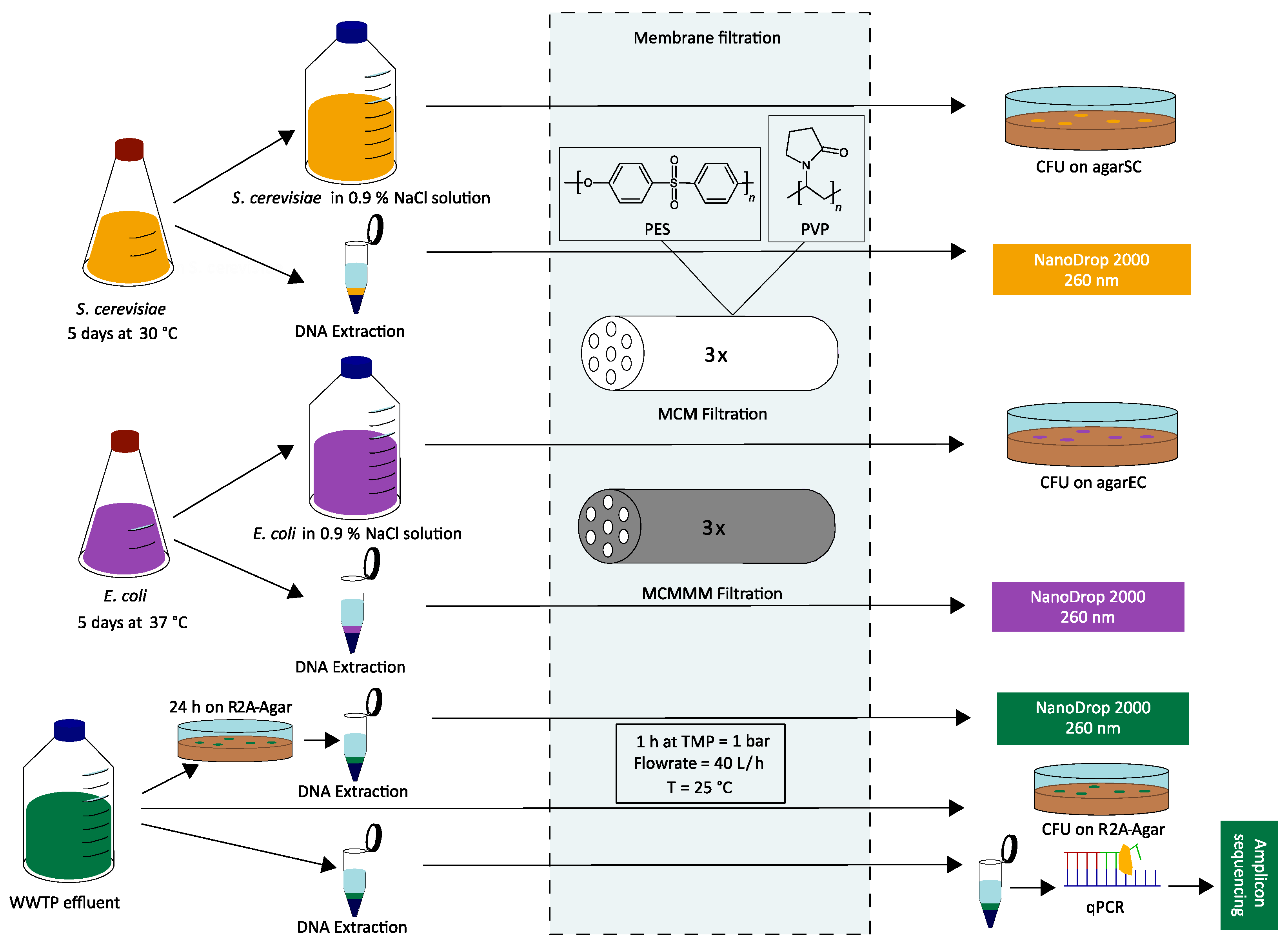
Figure 1. Experimental overview of the filtration of the model organisms S. cerevisiae and E. coli, as well as their genetic material after extraction. MOs were found in WWTP effluent and the extracted DNA, and the DNA extracted from cultivated organisms found on nutrient R2 agar were filtered. All filtrations were performed in triplicate both through MCMs and MCMMMs based on polyethersulfone (PES)/polyvinylpyrrolidone (PVP). Quantification of colony-forming units on nutrient agar and photometric DNA quantification via NanoDrop 2000 post-filtration were conducted. Genetic material extracted from WWTP effluent pre- and post-filtration was analyzed by applying amplicon sequencing.
Polymers 18 01219 g001
Figure 2. Average log10 reduction of E. coli or S. cerevisiae in NaCl solution, as well as from MOs in WWTP effluent in the permeate and the retentate after 60 min of cross-flow filtration with MCMs and MCMMMs (n = 3). Significant differences (p < 0.05) are seen between retentate and permeate, between MCMs and MCMMMs in permeate and retentate separately, and between E. coli, S. cerevisiae and WWTP effluent in permeate and retentate. MCMs and MCMMMs do not significantly influence the log10 reduction when considering permeate and retentate simultaneously (p > 0.05).
Polymers 18 01219 g002
Figure 3. SEM images of MCM (a,c,e) and MCMMM (b,d,f) inner channel surfaces pre- (a,b) and post-filtration with E. coli (c,d) and S. cerevisiae (e,f) suspension in NaCl solution. Images are shown with a 500-fold magnification and a scale bar of 50 µm after sputtering with a gold coating.
Polymers 18 01219 g003
Figure 4. Retention of extracellular DNA (eDNA) extracted from cultivated S. cerevisiae cells, E. coli and extracted DNA of MOs cultivated from WWTP effluent after filtration with MCMs and MCMMMs over 60 min (n = 3). Filtered volumes are calculated based on average permeate fluxes.
Polymers 18 01219 g004
Figure 5. Permeability of MCMs and MCMMMs before (0 min) and after (60 min) cross-flow filtration with E. coli, S. cerevisiae and WWTP effluent. Average and standard deviation of gravimetrically determined permeate flow are shown (n = 3).
Polymers 18 01219 g005
Figure 6. Relative abundance of the core biome in feed and permeate samples of MCM and MCMMM. Filtrations were performed in triplicate and the core biome represents all genera occurring with relative abundances ≥5% in the feed samples.
Polymers 18 01219 g006
Disclaimer/Publisher’s Note: The statements, opinions and data contained in all publications are solely those of the individual author(s) and contributor(s) and not of MDPI and/or the editor(s). MDPI and/or the editor(s) disclaim responsibility for any injury to people or property resulting from any ideas, methods, instructions or products referred to in the content.