Sustainability-Driven Evaluation of Circular Plastic and Bioplastic Waste Reused as Building Materials Using MCDA and SWOT Analysis

Abstract
1. Introduction
1.1. Circular Economy and Plastics
1.2. Scope and Material Classification
1.3. Decision-Support Focus: MCDA and SWOT
2. Methodology
2.1. Systematic Review Framework and Purpose
2.2. Literature Search Strategy and Database Selection
2.3. Inclusion and Exclusion Criteria
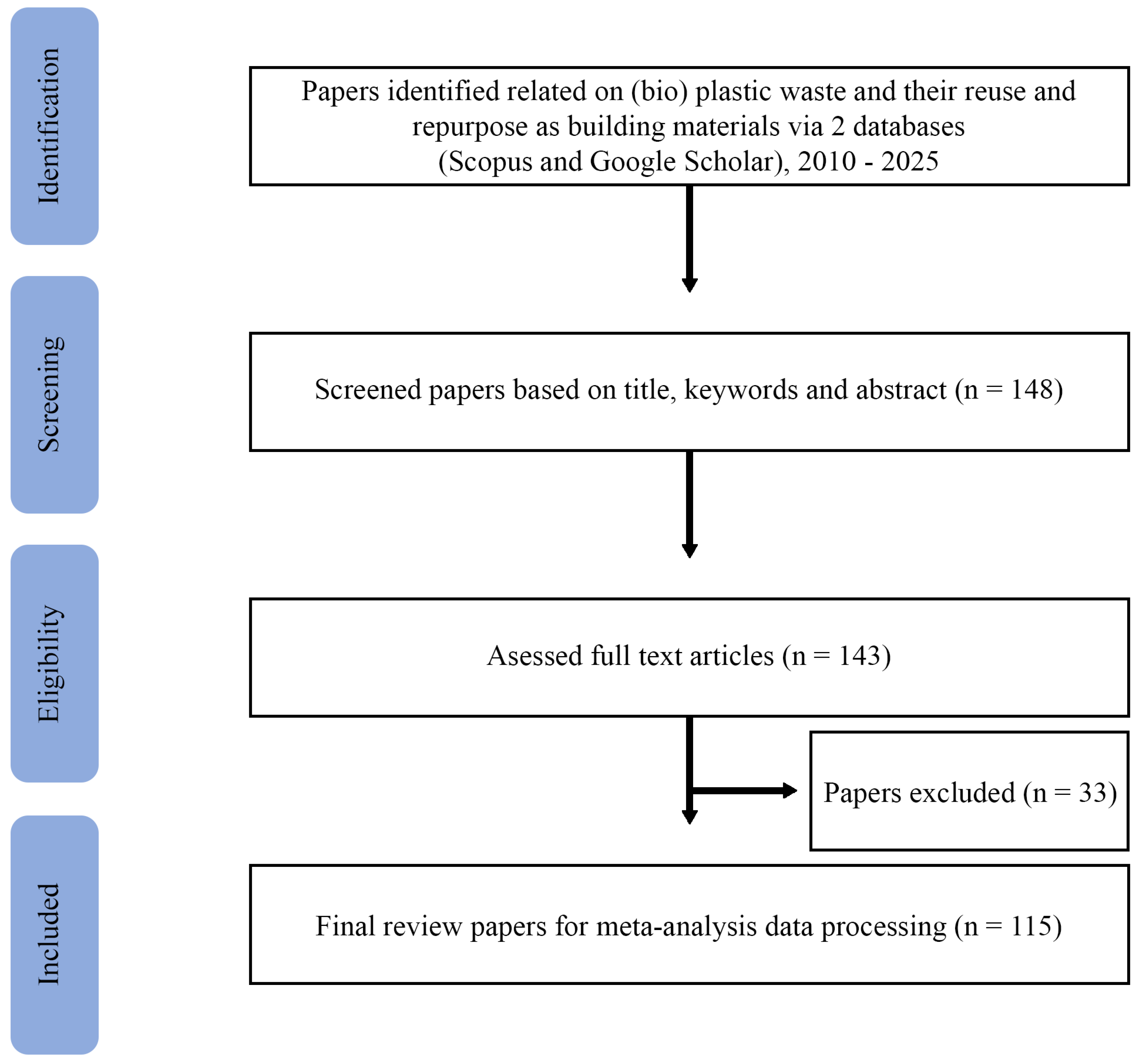
2.4. Study Selection and Data Extraction
3. Results and Discussion
3.1. Application Scope: Plastic and Bioplastic Waste in Construction
3.1.1. Fossil-Based Plastic Waste
3.1.2. Bioplastic Waste
3.1.3. Construction Application Types
3.1.4. Practical Applications and Real-World Examples
3.2. Sustainability Dimensions and Evaluation Criteria
3.2.1. Environmental Dimension
3.2.2. Economic Dimension
3.2.3. Technical Dimension
3.2.4. Social and Regulatory Dimension
3.2.5. Linking Application Types to Sustainability Criteria
3.3. Material Properties, Performance Challenges, and Reintroduction Barriers
3.4. Applications of Multi-Criteria Decision Analysis in Evaluating Plastic-Based Building Materials
3.4.1. Common MCDA Methods
3.4.2. Application Contexts
3.4.3. Synthesis of Key Findings
3.4.4. Summary Table of MCDA Applications in Reviewed Studies

| Material/Application | MCDA Method | Main Criteria | Main Outcome | Source |
|---|---|---|---|---|
| Plastic waste management | AHP/TOPSIS | Environmental, economic, social, technical | Highlights method diversity and need for transparent weighting across studies | [12,97,99,109] |
| End-of-life alternatives for waste plastics | Modified MAVT | Environmental, economic, social impacts | Decision outcome depends on multi-dimensional trade-offs across sustainability pillars | [12,97,104,106,107] |
| Recycled-plastic paver blocks | TOPSIS | Mechanical strength, water absorption, thermal resistance, cost | Identifies most suitable recycled-plastic composition based on performance trade-offs | [48,99,103,110] |
| Waste plastics + agro-waste composites | AHP/TOPSIS/VIKOR | Environmental benefit, technical performance, economic feasibility, end-of-life | Selects most suitable waste plastic type for agro-waste composites under integrated MCDM | [34,48,99,106] |
| Insulation materials in buildings | AHP/TOPSIS/VIKOR | Environmental (LCA), economic(LCC), technical, social/health | Highlights lack of standardization in criteria/weights and importance of LCA/LCC integration | [48,99,105,107] |
| Sustainable concrete with waste PET bottle-cap aggregates | AHP | Concrete performance, durability, sustainability, feasibility | PET cap aggregates can support sustainable concrete; MCDM used to select best alternative | [97,105,107,109] |
| Building parts selection LCA + MCDM | AHP | Environmental (LCA), technical, economic, social | Demonstrates how combining LCA with MCDM supports sustainable building-part selection | [48,106,109,111] |
| Ecological paving stones from plastic + glass waste | AHP | Mechanical strength, water absorption, material contribution | Identifies favorable constituent combinations; notes some pavers may not meet high-traffic standards | [103,104,105,107,109] |
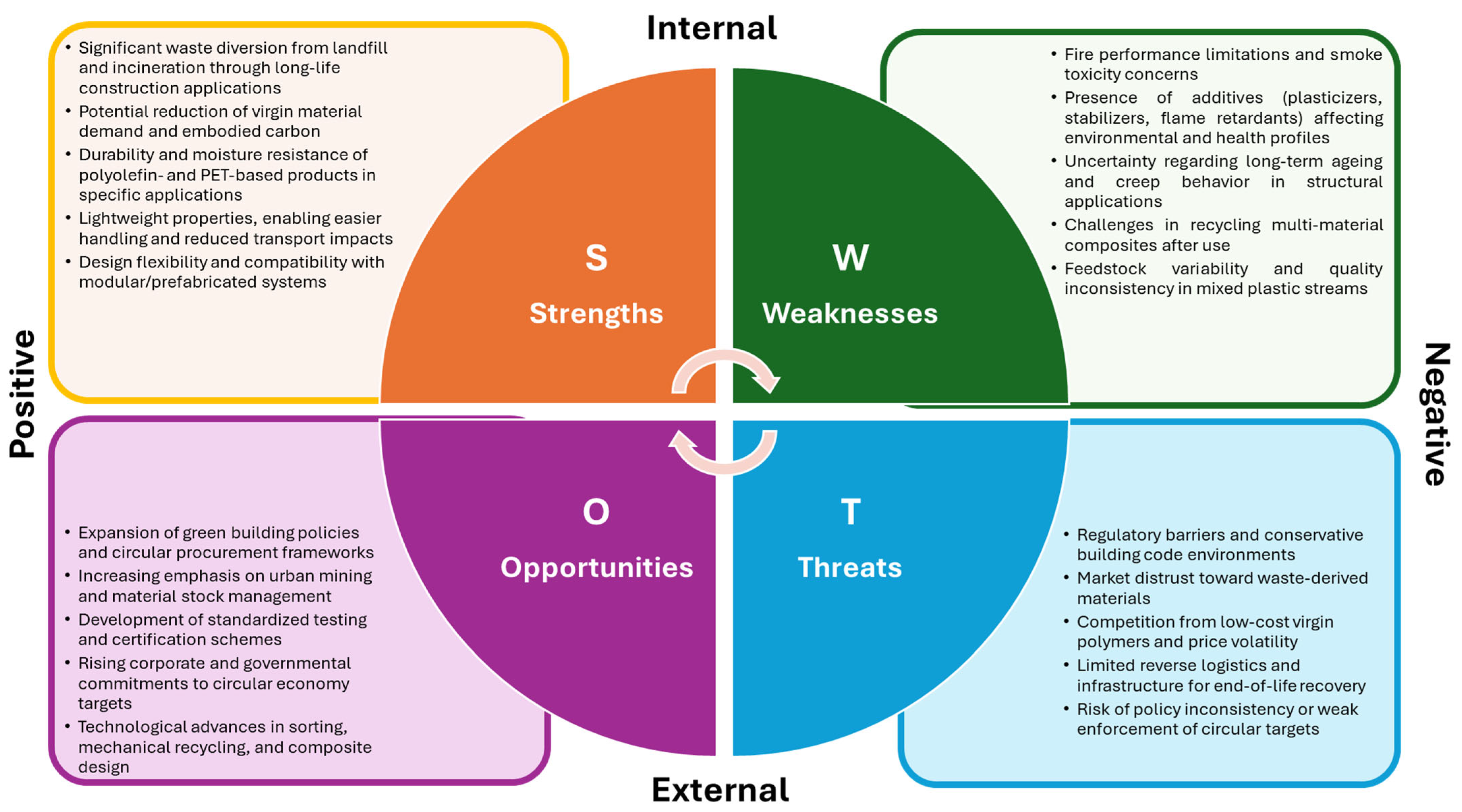
3.5. SWOT Analysis of Circular Plastic and Bioplastic-Based Building Materials
3.5.1. Strengths
3.5.2. Weaknesses
3.5.3. Opportunities
3.5.4. Threats
3.5.5. Why SWOT Complements but Does Not Replace MCDA
3.6. Integrated MCDA-SWOT Framework for Decision-Oriented Circular Construction
3.6.1. Complementary Roles of MCDA and SWOT
3.6.2. How SWOT Can Inform MCDA Weighting
- Constraint-driven weighting: When SWOT highlights dominant threats such as fire safety concerns or regulatory barriers, critical criteria can be treated as non-compensatory threshold constraints, with alternatives required to meet predefined minimum standards before being included in the ranking.
- Opportunity-aligned weighting: When SWOT identifies strong enabling conditions such as green procurement policies or recycled-content incentives, MCDA weights can be aligned with these priorities by increasing emphasis on waste diversion, recycled content, and GHG reduction.
- Risk-adjusted weighting: If SWOT reveals supply-chain vulnerabilities, MCDA models can incorporate risk-adjusted weighting by assigning greater weight to feedstock quality stability, process robustness, and scalability.
- Stakeholder-specific weighting profiles: SWOT often reveals divergent stakeholder priorities, which MCDA can translate into multiple weighting profiles (regulatory, manufacturer, municipal, and client/market profiles).
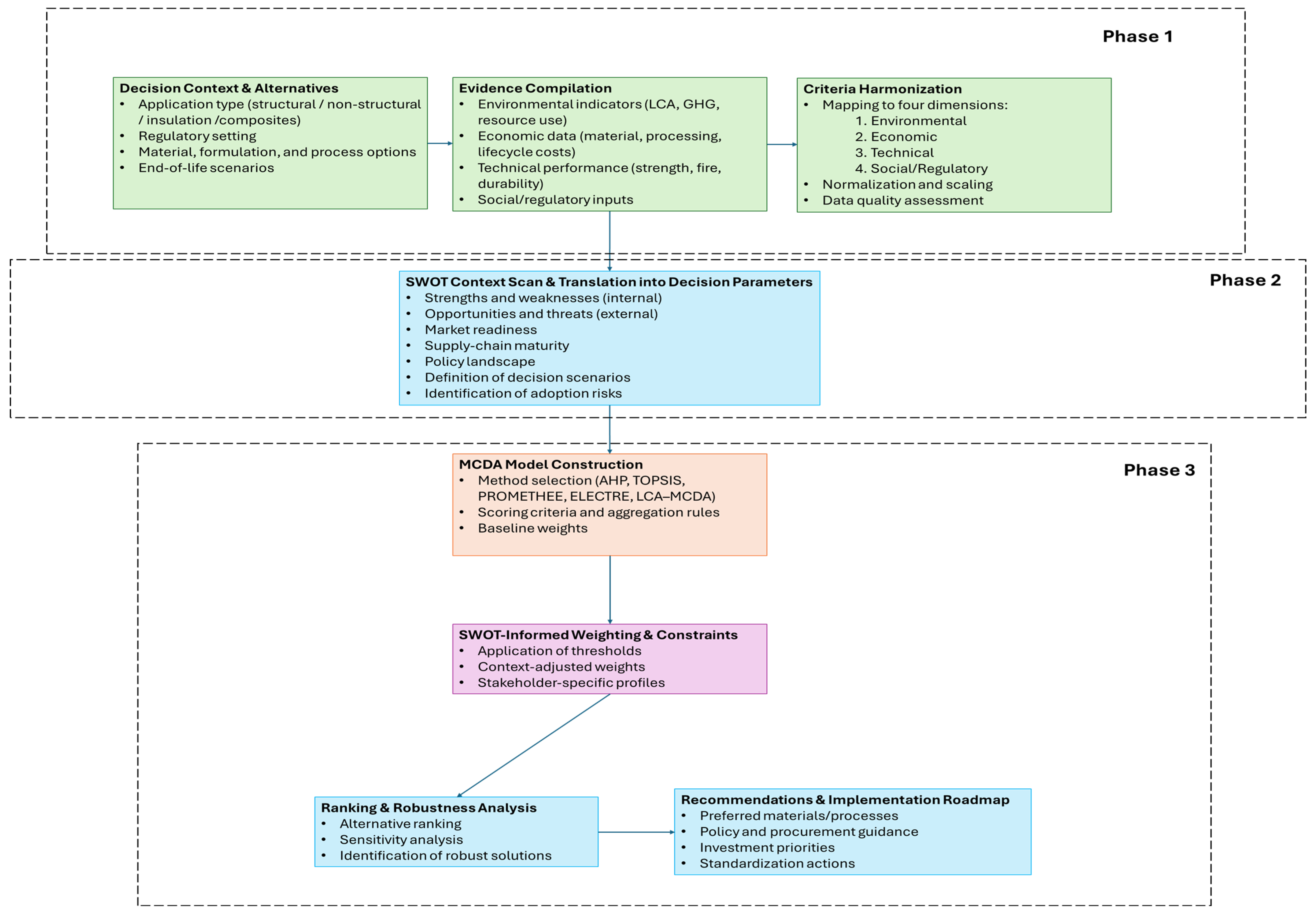
3.6.3. Proposed Conceptual Framework: Seven-Step Workflow
- Step 1—Define decision context and alternatives: Specify application type, geographic and regulatory context, and alternatives under evaluation (polymer types, material formulations, processing routes, end-of-life strategies).
- Step 2—Evidence compilation and criteria harmonization: Map all performance indicators onto the four sustainability dimensions, ensure comparability through consistent normalization, and identify data gaps.
- Step 3—SWOT-driven context scan: Assess internal factors (strengths and weaknesses of each material) and external factors (opportunities and threats specific to the region, market, and regulatory environment).
- Step 4—MCDA model construction: Select the appropriate MCDA method (AHP, TOPSIS, PROMETHEE, VIKOR, MAVT, ELECTRE, or hybrid LCA–MCDA), define scoring rules and normalization procedures, and assign baseline weights.
- Step 5—SWOT-informed weighting and constraints: Introduce gating constraints, adjust weights to reflect dominant SWOT signals, and develop scenario-based weighting sets.
- Step 6—Ranking, sensitivity, and robustness analysis: Compute rankings under multiple weighting scenarios, conduct sensitivity analysis to identify potential ranking reversals, and identify robust alternatives.
- Step 7—Decision outputs and implementation roadmap: Translate results into final recommendations, implementation measures (standardization, certification, supply-chain improvements), and policy/investment guidance.
3.6.4. Summary of Framework Insights: Key Decision Variables by Application Type
3.7. Research Gaps and Future Directions
3.7.1. Lack of Standardized Sustainability Criteria and Reporting Practices
3.7.2. Underrepresentation of Bioplastic Waste in Construction Evaluations
3.7.3. Limited Integration of Social Lifecycle Assessment
3.7.4. Uncertainty in End-of-Life Management
3.7.5. Regional and Geographic Bias
3.7.6. Methodological Advancements for Integrated Decision-Support Frameworks
4. Conclusions
- Plastic and bioplastic waste reuse in construction can meaningfully contribute to circular economy objectives by diverting waste from disposal pathways and embedding secondary materials in long-life applications. However, sustainability performance varies significantly across polymer types, construction applications, and regional contexts, and thus, it cannot be inferred from feedstock origin alone.
- MCDA provides valuable, quantitative decision support for managing sustainability trade-offs in material selection. Outcomes are, however, sensitive to criteria weighting, and greater standardization in criteria selection, reporting, and stakeholder engagement is needed to improve cross-study comparability.
- SWOT analysis offers a complementary strategic perspective that explains implementation feasibility. Regulatory frameworks, market acceptance, supply-chain maturity, and policy incentives are often as decisive as technical and environmental performance.
- The proposed integrated MCDA–SWOT framework addresses the gap between quantitative performance ranking and real-world implementation barriers. By linking structured ranking with strategic feasibility assessment, it enables more robust, context-sensitive, and actionable sustainability evaluations.
- Key priorities for future research include methodological harmonization, expanded assessment of bioplastics, integration of social lifecycle assessment, improved modeling of end-of-life scenarios, and geographically diverse empirical studies.
Funding
Institutional Review Board Statement
Informed Consent Statement
Data Availability Statement
Conflicts of Interest
References
- OECD. Global Plastics Outlook: Economic Drivers, Environmental Impacts and Policy Options; OECD Publishing: Paris, France, 2022. [Google Scholar]
- Turk, K.; Kalčikova, G.; Kokalj, A.J.; Mušič, B. From plastic use in the construction and built environment to state-of-the-art circular economy solutions to combat microplastic pollution. Environ. Sci. Eur. 2025, 37, 185. [Google Scholar] [CrossRef]
- da Silva, T.R.; de Azevedo, A.R.G.; Cecchin, D.; Marvila, M.T.; Amran, M.; Fediuk, R.; Vatin, N.; Karelina, M.; Klyuev, S.; Szelag, M. Application of plastic wastes in construction materials: A review using the concept of life-cycle assessment in the context of recent research for future perspectives. Materials 2021, 14, 3549. [Google Scholar] [CrossRef]
- Jan, K.; Deka, D.J.; Yu, E.; Lu, T.; Li, K.; Jiang, H.; Nawaz, K.; Webb, E.G.; Ozcan, S.; Zou, R.; et al. Recent Advances in Chemical Recycling and Upcycling of Plastic Waste into Valuable Materials, Chemicals, and Energy: A Comprehensive Review. RSC Sustain. 2026, 4, 1667–1702. [Google Scholar] [CrossRef]
- Lamba, P.; Kaur, D.P.; Raj, S.; Sorout, J. Recycling/reuse of plastic waste as construction material for sustainable development: A review. Environ. Sci. Pollut. Res. 2022, 29, 86156–86179. [Google Scholar] [CrossRef]
- Krajewska, A.; Siewczyńska, M. Circular Economy in the Construction Sector in Materials, Processes, and Case Studies: Research Review. Sustainability 2025, 17, 7029. [Google Scholar] [CrossRef]
- Jawaid, M.; Singh, B.; Kian, L.K.; Zaki, S.A.; Radzi, A. Processing techniques on plastic waste materials for construction and building applications. Curr. Opin. Green Sustain. Chem. 2023, 40, 100761. [Google Scholar] [CrossRef]
- Haigh, R. A decade review of research trends using waste materials in the building and construction industry: A pathway towards a circular economy. Waste 2023, 1, 935–959. [Google Scholar] [CrossRef]
- Cudzik, J.; Kropisz, K. Assessment of utilizing hard-to-recycle plastic waste from the packaging sector in architectural design—Case study for experimental building material. Sustainability 2024, 16, 6133. [Google Scholar] [CrossRef]
- Jalaluddin, M. Use of plastic waste in civil constructions and innovative decorative material (eco-friendly). MOJ Civ. Eng. 2017, 3, 359–368. [Google Scholar] [CrossRef]
- Santos, M.R.; Dias, L.C.; Cunha, M.C.; Marques, J.R. Multicriteria decision analysis addressing marine and terrestrial plastic waste management: A review. Front. Mar. Sci. 2022, 8, 747712. [Google Scholar] [CrossRef]
- Deshpande, P.C.; Skaar, C.; Brattebø, H.; Fet, A.M. Multi-criteria decision analysis (MCDA) method for assessing the sustainability of end-of-life alternatives for waste plastics: A case study of Norway. Sci. Total Environ. 2020, 719, 137353. [Google Scholar] [CrossRef]
- Seghiri, M.; Boutoutaou, D.; Kriker, A.; Hachani, M.I. The possibility of making a composite material from waste plastic. Energy Procedia 2017, 119, 163–169. [Google Scholar] [CrossRef]
- Schützenhofer, S.; Kovacic, I.; Rechberger, H.; Mack, S. Improvement of environmental sustainability and circular economy through construction waste management for material reuse. Sustainability 2022, 14, 11087. [Google Scholar] [CrossRef]
- Ulewicz, M.; Brycht, N. SWOT analysis about the possibilities of using construction waste in Polish road infrastructure. Econ. Environ. 2025, 92, 796. [Google Scholar] [CrossRef]
- Soni, A.; Das, P.K.; Kumar, S. Selection of waste plastics for incorporation in agro-waste as sustainable building construction materials concerning circular economy: An integrated MCDM approach. Clean Technol. Environ. Policy 2023, 25, 2929–2949. [Google Scholar] [CrossRef]
- Bendix, P.; Achenbach, H.; Weißhaupt, P.; Eckert, D.; Oehme, I.; Berg, H. Circular economy for durable products and materials: The recycling of plastic building products in Germany—Status quo, potentials and recommendations. J. Mater. Cycles Waste Manag. 2022, 24, 1432–1443. [Google Scholar] [CrossRef]
- Adiyanto, O.; Mohamad, E.; Razak, J.A. Systematic review of plastic waste as eco-friendly aggregate for sustainable construction. Int. J. Sustain. Constr. Eng. Technol. 2022, 13, 243–257. [Google Scholar] [CrossRef]
- Plesa, L.; Manea, L.; Istoan, R. Recycling plastic wastes in order to obtain new building materials. In IOP Conference Series: Materials Science and Engineering; IOP Publishing: Bristol, UK, 2022. [Google Scholar]
- Awoyera, P.O.; Adesina, A. Plastic wastes to construction products: Status, limitations and future perspective. Case Stud. Constr. Mater. 2020, 12, e00330. [Google Scholar] [CrossRef]
- Kumar, R.; Kumar, M.; Kumar, I.; Srivastava, D. A review on utilization of plastic waste materials in bricks manufacturing process. Mater. Today Proc. 2021, 46, 6775–6780. [Google Scholar] [CrossRef]
- Appiah, J.K.; Berko-Boateng, V.N.; Tagbor, T.A. Use of waste plastic materials for road construction in Ghana. Case Stud. Constr. Mater. 2017, 6, 1–7. [Google Scholar] [CrossRef]
- Bansal, S.; Kushwah, S.S.; Garg, A.; Sharma, K. Utilization of plastic waste in construction industry in India–A review. Mater. Today Proc. 2023. [Google Scholar] [CrossRef]
- Al Kindi, I.J.I.; Devi, M.G.; Al Abri, M.; Al Hasan, S.; Al Hatali, E.M.A.M. Production of Plastic Cement Concrete from PVC Waste. Fine Chem. Eng. 2021, 2, 63–79. [Google Scholar]
- Intan, S.K.; Santosa, S. Utilization of PTE and LDPE plastic waste and building material waste as bricks. Korean J. Mater. Res. 2019, 29, 603–608. [Google Scholar] [CrossRef]
- Ogundairo, T.O.; Olukanni, D.O.; Akinwumi, I.I.; Adegoke, D.D. A review on plastic waste as sustainable resource in civil engineering applications. In IOP Conference Series: Materials Science and Engineering; IOP Publishing: Bristol, UK, 2021. [Google Scholar]
- Moher, D.; Shamseer, L.; Clarke, M.; Ghersi, D.; Liberati, A.; Petticrew, M.; Shekelle, P.; Stewart, L.A. Preferred reporting items for systematic review and meta-analysis protocols (PRISMA-P) 2015 statement. Syst. Rev. 2015, 4, 148. [Google Scholar] [CrossRef]
- Oberti, I.; Paciello, A. Bioplastic as a substitute for plastic in construction industry. Encyclopedia 2022, 2, 1408–1420. [Google Scholar] [CrossRef]
- Lin, Y.H.; Yuan, W.; Wang, T. A Review of Construction and Demolition Waste Management: Resource Coordination and Multidimensional Interaction. Buildings 2026, 16, 1437. [Google Scholar] [CrossRef]
- Chanhoun, M.; Padonou, S.; Adjovi, E.C.; Olodo, E.; Doko, V. Study of the implementation of waste wood, plastics and polystyrenes for various applications in the building industry. Constr. Build. Mater. 2018, 167, 936–941. [Google Scholar] [CrossRef]
- Dadzie, D.K.; Kaliluthin, A.K.; Kumar, D.R. Exploration of waste plastic bottles use in construction. Civ. Eng. J. 2020, 6, 2262–2272. [Google Scholar] [CrossRef]
- Minde, P.; Kulkarni, M.; Patil, J.; Shelake, A. Comprehensive review on the use of plastic waste in sustainable concrete construction. Discov. Mater. 2024, 4, 58. [Google Scholar] [CrossRef]
- Haba, B.; Djellali, S.; Abdelouahed, Y.; Boudjelida, S.; Faleschini, F.; Carraro, M. Transforming plastic waste into value: A review of management strategies and innovative applications in sustainable construction. Polymers 2025, 17, 881. [Google Scholar] [CrossRef] [PubMed]
- Awad, H.H.; Desouki, M. Multifunctional performance assessment of waste-based bioplastic wall panels for acoustic thermal and structural efficiency in interior architecture. Sci. Rep. 2025, 15, 15708. [Google Scholar] [CrossRef]
- Kalali, E.N.; Lotfian, S.; Shabestari, M.E.; Khayatzadeh, S.; Zhao, C.; Nezhad, H.Y. A critical review of the current progress of plastic waste recycling technology in structural materials. Curr. Opin. Green Sustain. Chem. 2023, 40, 100763. [Google Scholar] [CrossRef]
- Yadav, K.; Singh, A.; Bhat, O.N.; Sharma, R.L. Transforming waste into innovation: A review of plastic bricks as sustainable construction materials. Discov. Civ. Eng. 2024, 1, 38. [Google Scholar] [CrossRef]
- Papamichael, I.; Voukkali, I.; Loizia, P.; Zorpas, A.A. Construction and demolition waste framework of circular economy: A mini review. Waste Manag. Res. 2023, 41, 1728–1740. [Google Scholar] [CrossRef]
- Ginga, C.P.; Ongpeng, J.M.C.; Daly, M.K.M. Circular economy on construction and demolition waste: A literature review on material recovery and production. Materials 2020, 13, 2970. [Google Scholar] [CrossRef]
- Abdel Tawab, O.F.; Amin, M.R.; Ibrahim, M.M.; Abdel Wahab, M.; Abd El Rahman, E.N.; Hassanien, R.H.; Hatem, M.H.; Ghaly, A.E. Recycling waste plastic bags as a replacement for cement in production of building bricks and concrete blocks. J. Waste Resour. Recycl. 2020, 1, 202. [Google Scholar]
- Obiadi, B.N. The positive impact of plastic recycling in the built environment, architecture and the waters of the world. Int. J. Trend Sci. Res. Dev. 2020, 4, 1427–1435. [Google Scholar]
- Tulashie, S.K.; Boadu, E.K.; Kotoka, F.; Mensah, D. Plastic wastes to pavement blocks: A significant alternative way to reducing plastic wastes generation and accumulation in Ghana. Constr. Build. Mater. 2020, 241, 118044. [Google Scholar] [CrossRef]
- Hernandez, G.; Low, J.; Nand, A.; Bu, A.; Wallis, S.L.; Kestle, L.; Berry, T.-A. Quantifying and managing plastic waste generated from building construction in Auckland, New Zealand. Waste Manag. Res. 2023, 41, 205–213. [Google Scholar] [CrossRef] [PubMed]
- Shoubi, M.V.; Shoubi, M.V.; Barough, A.S. Investigating the application of plastic bottle as a sustainable material in the building construction. Int. J. Sci. Eng. Technol. Res. 2013, 2, 28–34. [Google Scholar]
- Raut, A.; Patel, M.S.; Jadhwar, N.B.; Khan, U.; Dhengare, S.W. Investigating the application of waste plastic bottle as a construction material-a review. J. Int. Assoc. Adv. Technol. Sci. 2015, 16, 12. [Google Scholar] [CrossRef]
- Halimi, Y.; Inchaouh, M.; Zyade, S.; Tahiri, M. Development and characterization of a composite material reinforced by plastic waste: Application in the construction sector. GEOMATE J. 2017, 13, 172–178. [Google Scholar] [CrossRef]
- Mokhtar, M.; Sahat, S.; Hamid, B.; Kaamin, M.; Kesot, M.J.; Wen, L.C.; Xin, L.Y.; Ling, N.P.; Lei, V.S.J. Application of plastic bottle as a wall structure for green house. ARPN J. Eng. Appl. Sci. 2016, 11, 7617–7621. [Google Scholar]
- Mansour, A.M.H.; Ali, S.A. Reusing waste plastic bottles as an alternative sustainable building material. Energy Sustain. Dev. 2015, 24, 79–85. [Google Scholar] [CrossRef]
- Theilig, K.; Lourenço, B.; Reitberger, R.; Lang, W. Life cycle assessment and multi-criteria decision-making for sustainable building parts: Criteria, methods, and application. Int. J. Life Cycle Assess. 2024, 29, 1965–1991. [Google Scholar] [CrossRef]
- Chaturvedi, R.; Singh, P.K. A practicable learning under conversion of plastic waste and building material waste keen on concrete tiles. Mater. Today Proc. 2021, 45, 2938–2942. [Google Scholar] [CrossRef]
- Timm, J.F.G.; Maciel, V.G.; Passuello, A. Towards sustainable construction: A systematic review of circular economy strategies and ecodesign in the built environment. Buildings 2023, 13, 2059. [Google Scholar] [CrossRef]
- Hamada, H.M.; Al-Attar, A.; Abed, F.; Beddu, S.; Humada, A.M.; Majdi, A.; Yousif, S.T.; Thomas, B.S. Enhancing sustainability in concrete construction: A comprehensive review of plastic waste as an aggregate material. Sustain. Mater. Technol. 2024, 40, e00877. [Google Scholar] [CrossRef]
- Ikechukwu, A.F.; Naghizadeh, A. Utilization of plastic waste material in masonry bricks production towards strength, durability and environmental sustainability. J. Sustain. Archit. Civ. Eng. 2022, 30, 121–141. [Google Scholar] [CrossRef]
- Jain, D.; Bhadauria, S.; Kushwah, S. An experimental study of utilization of plastic waste for manufacturing of composite construction material. Int. J. Environ. Sci. Technol. 2023, 20, 8829–8838. [Google Scholar] [CrossRef]
- Jain, D.; Bhadauria, S.S.; Kushwah, S.S. Analysis and prediction of plastic waste composite construction material properties using machine learning techniques. Environ. Prog. Sustain. Energy 2023, 42, e14094. [Google Scholar] [CrossRef]
- Pradha, S.S.; Saranya, K. Recycling plastic waste into construction materials for sustainability. In IOP Conference Series: Earth and Environmental Science; IOP Publishing: Bristol, UK, 2023. [Google Scholar]
- Chatziparaskeva, G.; Papamichael, I.; Voukkali, I.; Loizia, P.; Sourkouni, G.; Argirusis, C.; Zorpas, A.A. End-of-life of composite materials in the framework of the circular economy. Microplastics 2022, 1, 377–392. [Google Scholar] [CrossRef]
- Athithan, V.; Natarajan, L.T. Reuse of plastic waste as building materials to enhance sustainability in construction: A review. Infrastruct. Solut. 2023, 8, 204. [Google Scholar] [CrossRef]
- Briassoulis, D.; Pikasi, A.; Hiskakis, M. End-of-waste life: Inventory of alternative end-of-use recirculation routes of bio-based plastics in the European Union context. Crit. Rev. Environ. Sci. Technol. 2019, 49, 1835–1892. [Google Scholar] [CrossRef]
- Belioka, M.P.; Achilias, D. Sustainable management and valorization of microplastics. In From Waste to Wealth; Springer: Berlin/Heidelberg, Germany, 2024; pp. 1285–1312. [Google Scholar]
- Minunno, R.; O’GRady, T.; Morrison, G.M.; Gruner, R.L. Exploring environmental benefits of reuse and recycle practices: A circular economy case study of a modular building. Resour. Conserv. Recycl. 2020, 160, 104855. [Google Scholar] [CrossRef]
- Bucknall, D.G. Plastics as a materials system in a circular economy. Philos. Trans. R. Soc. A 2020, 378, 20190268. [Google Scholar] [CrossRef]
- Hahladakis, J.N.; Iacovidou, E.; Gerassimidou, S. Plastic waste in a circular economy. In Environmental Materials and Waste; Elsevier: Amsterdam, The Netherlands, 2024; pp. 99–134. [Google Scholar]
- Kamal, M.A.; Moussa, R.R.; Guirguis, M.N. Recycled plastic as an aggregate in concrete. Civ. Eng. Archit. 2021, 9, 1289–1294. [Google Scholar] [CrossRef]
- Del Rey Castillo, E.; Almesfer, N.; Saggi, O.; Ingham, J.M. Light-weight concrete with artificial aggregate manufactured from plastic waste. Constr. Build. Mater. 2020, 265, 120199. [Google Scholar] [CrossRef]
- Ahmed, N. Utilizing plastic waste in the building and construction industry: A pathway towards the circular economy. Constr. Build. Mater. 2023, 383, 131311. [Google Scholar] [CrossRef]
- Mahrous, R.; Giancola, E.; Osman, A.; Asawa, T.; Mahmoud, H. Alternative to PCM: Recycling Plastic Waste for Affordable Thermal Insulation in Building Envelopes: An Experimental Analysis. Future Cities Environ. 2024, 10, 15. [Google Scholar] [CrossRef]
- Tul Muntaha, S.; Keitsch, M. A pathway for plastic waste in construction materials. Sustain. Dev. 2025, 33, 19–29. [Google Scholar] [CrossRef]
- Sangal, G.S. Study the effect of plastic waste on strength of concrete. Int. J. Adv. Res. Dev. 2018, 3, 36–39. [Google Scholar]
- Thiam, M.; Fall, M. Engineering properties of a building material with melted plastic waste as the only binder. J. Build. Eng. 2021, 44, 102684. [Google Scholar] [CrossRef]
- Cirino, E.; Curtis, S.; Wallis, J.; Thys, T.; Brown, J.; Rolsky, C.; Erdle, L.M. Assessing benefits and risks of incorporating plastic waste in construction materials. Front. Built Environ. 2023, 9, 1206474. [Google Scholar] [CrossRef]
- Sultana, N.; Bari, F.S.; Asaduzzaman, M.; Anand, J.C. Strategic policy implications for plastic pollution and the circular economy for developed and developing countries: Insights from a SWOT analysis. In Circular Plastics Economy; Elsevier: Amsterdam, The Netherlands, 2026; pp. 367–391. [Google Scholar]
- Payne, J.; McKeown, P.; Jones, M.D. A circular economy approach to plastic waste. Polym. Degrad. Stab. 2019, 165, 170–181. [Google Scholar] [CrossRef]
- Almohana, A.I.; Abdulwahid, M.Y.; Galobardes, I.; Mushtaq, J.; Almojil, S.F. Producing sustainable concrete with plastic waste: A review. Environ. Chall. 2022, 9, 100626. [Google Scholar] [CrossRef]
- Kamaruddin, M.A.; Abdullah, M.M.A.; Zawawi, M.H.; Zainol, M.R.R.A. Potential use of plastic waste as construction materials: Recent progress and future prospect. In IOP Conference Series: Materials Science and Engineering; IOP Publishing: Bristol, UK, 2017. [Google Scholar]
- Saikia, N.; De Brito, J. Use of plastic waste as aggregate in cement mortar and concrete preparation: A review. Constr. Build. Mater. 2012, 34, 385–401. [Google Scholar] [CrossRef]
- Belmokaddem, M.; Mahi, A.; Senhadji, Y.; Pekmezci, B.Y. Mechanical and physical properties and morphology of concrete containing plastic waste as aggregate. Constr. Build. Mater. 2020, 257, 119559. [Google Scholar] [CrossRef]
- Acuña-Pizano, H.; González-Trevizo, M.; Luna-León, A.; Martínez-Torres, K.; Fernández-Melchor, F. Plastic composites as sustainable building materials: A thermal and mechanical exploration. Constr. Build. Mater. 2022, 344, 128083. [Google Scholar] [CrossRef]
- Haq, M.Z.U.; Sharma, V.; Sood, H.; Kumar, R.; Joshi, K.; Manisha, K.; Lakhanpal, S.; Chary, M.R.; Kumar, K. Geopolymerization of Plastic Waste for Sustainable Construction: Unveiling Novel Opportunities in Building Materials. In E3S Web of Conferences; EDP Sciences: Les Ulis, France, 2023. [Google Scholar]
- Rahat, M.H.H.; Massarra, D.C.; Wang, D. Using plastic wastes in construction: Opportunities and challenges. EPiC Ser. Built Environ. 2022, 3, 785–794. [Google Scholar]
- Bahij, S.; Omary, S.; Feugeas, F.; Faqiri, A. Fresh and hardened properties of concrete containing different forms of plastic waste–A review. Waste Manag. 2020, 113, 157–175. [Google Scholar] [CrossRef] [PubMed]
- Aciu, C.; Ilutiu-Varvara, D.-A.; Manea, D.-L.; Orban, Y.-A.; Babota, F. Recycling of plastic waste materials in the composition of ecological mortars. Procedia Manuf. 2018, 22, 274–279. [Google Scholar] [CrossRef]
- Yadav, A.; Chandra, A.; Singh, S. Study on application of waste plastic in the construction industry. Mater. Today Proc. 2022, 64, 1455–1458. [Google Scholar] [CrossRef]
- Poonyakan, A.; Rachakornkij, M.; Wecharatana, M.; Smittakorn, W. Potential use of plastic wastes for low thermal conductivity concrete. Materials 2018, 11, 1938. [Google Scholar] [CrossRef]
- Haque, M.S.; Islam, S. Effectiveness of waste plastic bottles as construction material in Rohingya displacement camps. Clean. Eng. Technol. 2021, 3, 100110. [Google Scholar] [CrossRef]
- Haque, M.S. Sustainable use of plastic brick from waste PET plastic bottle as building block in Rohingya refugee camp: A review. Environ. Sci. Pollut. Res. 2019, 26, 36163–36183. [Google Scholar] [CrossRef]
- Ruiz-Herrero, J.L.; Nieto, D.V.; López-Gil, A.; Arranz, A.; Fernández, A.; Lorenzana, A.; Merino, S.; De Saja, J.A.; Rodríguez-Pérez, M.Á. Mechanical and thermal performance of concrete and mortar cellular materials containing plastic waste. Constr. Build. Mater. 2016, 104, 298–310. [Google Scholar] [CrossRef]
- Daftardar, A.; Shah, R.; Gandhi, P.; Garg, H. Use of waste plastic as a construction material. Int. J. Eng. Appl. Sci. 2017, 4, 257322. [Google Scholar]
- Mak, S.-L.; Wu, T.M.Y.; Tang, F.W.F.; Li, J.C.H.; Lai, C.W. A review on utilization of plastic wastes in making construction bricks. In IOP Conference Series: Earth and Environmental Science; IOP Publishing: Bristol, UK, 2021. [Google Scholar]
- Islam, A.B.M.S.; Kutti, W.A.; Nasir, M.; Kazmi, Z.A.; Sodangi, M. Potential use of local waste scoria as an aggregate and SWOT analysis for constructing structural lightweight concrete. Adv. Mater. Res. Int. J. 2022, 11, 147–164. [Google Scholar]
- Goli, V.S.N.S.; Mohammad, A.; Singh, D.N. Application of municipal plastic waste as a manmade neo-construction material: Issues & wayforward. Resour. Conserv. Recycl. 2020, 161, 105008. [Google Scholar] [CrossRef]
- Anum, I.; Job, O. Waste to wealth in building materials development: A review of plastic waste in concrete. Arid Zone J. Eng. Technol. Environ. 2021, 17, 173–184. [Google Scholar]
- Haq, M.Z.U.; Sood, H.; Kumar, R.; Sharma, V.; Kumar, A.; Srinivas, T.; Gulati, M.; Bindu, K.H.; Kumar, K. Eco-Friendly Building Material Innovation: Geopolymer Bricks from Repurposed Plastic Waste. In E3S Web of Conferences; EDP Sciences: Les Ulis, France, 2023. [Google Scholar]
- Tang, K.H.D. Valorization of plastic waste through incorporation into construction materials. Civ. Sustain. Urban Eng. 2022, 2, 96–109. [Google Scholar] [CrossRef]
- Corinaldesi, V.; Donnini, J.; Nardinocchi, A. Lightweight plasters containing plastic waste for sustainable and energy-efficient building. Constr. Build. Mater. 2015, 94, 337–345. [Google Scholar] [CrossRef]
- Kortsen, K.; Kilbride, S.; Lowe, S.R.; Peirce, A.; Shaver, M.P. A plastics hierarchy of fates: Sustainable choices for a circular future. arXiv 2023, arXiv:2303.14664. [Google Scholar] [CrossRef]
- Chowdhury, S.; Maniar, A.T.; Suganya, O. Polyethylene terephthalate (PET) waste as building solution. Int. J. Chem. Environ. Biol. Sci. 2013, 1, 308–312. [Google Scholar]
- Gayake, S.B.; Desai, A.K. Multi-criteria decision making tool for sustainable concrete production using waste polyethylene terephthalate bottle cap aggregates. Smart Constr. Sustain. Cities 2024, 2, 7. [Google Scholar] [CrossRef]
- Zulkernain, N.H.; Gani, P.; Chuan, N.C.; Uvarajan, T. Utilisation of plastic waste as aggregate in construction materials: A review. Constr. Build. Mater. 2021, 296, 123669. [Google Scholar] [CrossRef]
- Gholap, A.B.; Shah, S.; Deshpande, R.S.; Yadav, R.S. Multi-criteria decision making using TOPSIS for sustainable paver block selection: A case study of recycled plastic compositions. Innov. Infrastruct. Solut. 2025, 10, 438. [Google Scholar] [CrossRef]
- Almeshal, I.; Tayeh, B.A.; Alyousef, R.; Alabduljabbar, H.; Mohamed, A.M. Eco-friendly concrete containing recycled plastic as partial replacement for sand. J. Mater. Res. Technol. 2020, 9, 4631–4643. [Google Scholar] [CrossRef]
- Agyeman, S.; Obeng-Ahenkora, N.; Assiamah, S.; Twumasi, G. Exploiting recycled plastic waste as an alternative binder for paving blocks production. Case Stud. Constr. Mater. 2019, 11, e00246. [Google Scholar] [CrossRef]
- Yue, S.; Wang, P.; Yu, B.; Zhang, T.; Zhao, Z.; Li, Y.; Zhan, S. From plastic waste to treasure: Selective upcycling through catalytic technologies. Adv. Energy Mater. 2023, 13, 2302008. [Google Scholar] [CrossRef]
- Siksnelyte-Butkiene, I.; Streimikiene, D.; Balezentis, T.; Skulskis, V. A systematic literature review of multi-criteria decision-making methods for sustainable selection of insulation materials in buildings. Sustainability 2021, 13, 737. [Google Scholar] [CrossRef]
- Malbila, E.; Koungwe, A.G.L.; Toguyeni, D.Y. Multicriteria analysis of the components of ecological paving stones made from plastic and glass waste, and granular reinforcements. Open Ceram. 2024, 18, 100604. [Google Scholar] [CrossRef]
- Sindhwani, K.; Gupta, P.; Kumar, A.; Srivastava, R. Evaluation of Plastic Waste Management Methods Using Multi Criteria Decision Making Tool–AHP. Adv. Prod. Ind. Eng. 2022, 27, 453–461. [Google Scholar]
- Alam Bhuiyan, M.M.; Hammad, A. A hybrid multi-criteria decision support system for selecting the most sustainable structural material for a multistory building construction. Sustainability 2023, 15, 3128. [Google Scholar] [CrossRef]
- Goulart Coelho, L.M.; Lange, L.C.; Coelho, H.M. Multi-criteria decision making to support waste management: A critical review of current practices and methods. Waste Manag. Res. 2017, 35, 3–28. [Google Scholar] [CrossRef]
- Spandonidis, C.; Belioka, M.P.; Eriksson, O. Multi-criteria-based evaluation of digital carbon footprint tools from a household user perspective. J. Clean. Prod. 2024, 481, 144151. [Google Scholar] [CrossRef]
- Kangas, J.; Pesonen, M.; Kurttila, M.; Kajanus, M. A’WOT: Integrating the AHP with SWOT analysis. In Proceedings of the Sixth International Symposium on the Analytic Hierarchy Process ISAHP; ISAHP: Bern, Switzerland, 2001. [Google Scholar]
- Shiri, N.D.; Kajava, P.V.; Ranjan, H.V.; Pais, N.L.; Naik, V.M. Processing of waste plastics into building materials using a plastic extruder and compression testing of plastic bricks. J. Mech. Eng. Autom. 2015, 5, 39–42. [Google Scholar]
- Ben Ali, M.; Rauch, E. Sustainable Mobility Transition: A SWOT-AHP Analysis of the Case Study of Italy. Sustainability 2024, 16, 4861. [Google Scholar] [CrossRef]
- Helms, M.M.; Nixon, J. Exploring SWOT analysis—Where are we now?: A review of academic research from the last decade. J. Strategy Manag. 2010, 3, 215–251. [Google Scholar] [CrossRef]
- Gürel, E.; Tat, M. SWOT analysis: A theoretical review. J. Int. Soc. Res. 2017, 10, 994–1006. [Google Scholar] [CrossRef]
- Schettini, E.; Vox, G.; Blanco, I. SWOT analysis and land management of plastic wastes in agriculture. In Proceedings of the 43rd International Symposium on Agricultural Mechanization, Opatija, Croatia, 24–27 February 2015. [Google Scholar]
- Thuyen, T.T.N. AHP-SWOT analysis of strengths, weaknesses, opportunities, and threats of implementing green innovation. Thail. World Econ. 2023, 41, 66–87. [Google Scholar]
- Ławińska, O.; Korombel, A.; Zajemska, M. Pyrolysis-based municipal solid waste management in Poland—SWOT analysis. Energies 2022, 15, 510. [Google Scholar] [CrossRef]
- Kajanus, M.; Leskinen, P.; Kurttila, M.; Kangas, J. Making use of MCDS methods in SWOT analysis—Lessons learnt in strategic natural resources management. For. Policy Econ. 2012, 20, 1–9. [Google Scholar] [CrossRef]
- Cappiello, G.; Aversa, C.; Genovesi, A.; Barletta, M. Life cycle assessment (LCA) of bio-based packaging solutions for extended shelf-life (ESL) milk. Environ. Sci. Pollut. Res. 2022, 29, 18617–18628. [Google Scholar] [CrossRef]

| Application Type | Environmental Criteria | Economic Criteria | Technical Criteria | Social/Regulatory | Sources |
|---|---|---|---|---|---|
| Structural Applications | GHG emissions, embodied energy, resource efficiency | Lifecycle cost, maintenance cost | Mechanical strength, durability, creep, fire resistance | Code compliance, safety, liability | [3,8,22,30,38,74,75,76,77,78] |
| Non-Structural Elements | Waste diversion, material circularity, emissions | Material cost, manufacturing cost | Adequate strength, dimensional stability | Market acceptance, aesthetics | [8,14,28,30,36,52,79,80,81] |
| Insulation and Lightweight | Thermal performance, operational energy savings | Installation cost, energy cost savings | Thermal conductivity, moisture resistance | Fire safety, indoor air quality | [8,20,32,56,77,82,83,84,85,86,87] |
| Composite and Hybrid Systems | Multi-material impacts, recyclability | Processing complexity, scalability | Interfacial bonding, durability | Standardization, end-of-life management | [5,7,8,14,23,88,89,90,91,92] |
| Material | Key Properties in Construction | Performance Limitations | Barriers to Reintroduction | Sources |
|---|---|---|---|---|
| Recycled PET | High tensile strength, chemical stability, good fiber-forming ability | Moisture absorption, limited thermal resistance | Contamination in post-consumer streams; quality variability; additive uncertainty | [84,85,96,97,98] |
| Recycled HDPE/PP | Moisture resistance, durability, lightweight, processable | Creep under sustained load, poor fire performance | Limited structural application range; mixed waste streams reduce quality; fire code compliance challenges | [63,99,100,101,102] |
| Recycled PVC | Durability, weather resistance, wide availability | Additive complexity (plasticizers, stabilizers), chlorine content | Regulatory restrictions on certain additives; recycling process complexity; health concerns over VOC emissions | [24,63,99,100,101] |
| Recycled EPS/PS | Excellent thermal insulation, very low density | Flammability, poor structural contribution [63,99,100,101,102] | Strict fire safety regulations; low bulk density creates logistics challenges; styrene monomer concerns | [63,99,100,101,102] |
| PLA | Renewable origin, processable at low temperatures, good compatibility with natural fibers | Low thermal stability, brittleness, limited long-term durability outdoors | Competing end-of-life pathways (composting vs. recycling); limited industrial-scale construction applications; uncertain regulatory status | [28,34,58] |
| PHA/Starch-based | Fully bio-based, biodegradable, flexible formulations possible | High production cost, limited mechanical strength, moisture sensitivity | Very limited construction-scale evidence; high cost vs. conventional alternatives; supply chain immaturity | [28,34,58] |
| Application Type | Priority MCDA Criteria | Key SWOT Signals | Recommended MCDA Method | Implementation Considerations | Sources |
|---|---|---|---|---|---|
| Structural | Fire resistance, mechanical strength, regulatory compliance, lifecycle cost | Weakness:fire codes; threat: liability and certification gaps | AHP + TOPSIS with threshold constraints on fire/safety | Mandate fire and structural testing before ranking; engage certification bodies early | [105,109,111,115,117] |
| Non-Structural Elements | Waste diversion, cost-effectiveness, market acceptance, aesthetics | Strength: flexibility in design; Opportunity: green procurement | AHP or TOPSIS with economic and environmental criteria balanced | Prioritize low-cost, high-recycled-content formulations; engage architects and contractors | [99,105,111,115] |
| Insulation and Lightweight | Thermal conductivity, GHG savings, installation cost, fire behavior | Weakness: flammability; opportunity: energy efficiency regulations | LCA–MCDA hybrid to capture operational energy savings over full lifecycle | Balance thermal performance gains against fire safety compliance; target energy-efficiency schemes | [48,58] |
| Composite and Hybrid Systems | Recyclability, processing scalability, interfacial performance, end-of-life | Weakness: recyclability challenges; threat: market skepticism on multi-materials | PROMETHEE or ELECTRE for complex multi-attribute scenarios with qualitative criteria | Emphasize design-for-disassembly; develop clear end-of-life pathways before scaling up | [12,97,107,118] |
Disclaimer/Publisher’s Note: The statements, opinions and data contained in all publications are solely those of the individual author(s) and contributor(s) and not of MDPI and/or the editor(s). MDPI and/or the editor(s) disclaim responsibility for any injury to people or property resulting from any ideas, methods, instructions or products referred to in the content. |
© 2026 by the author. Licensee MDPI, Basel, Switzerland. This article is an open access article distributed under the terms and conditions of the Creative Commons Attribution (CC BY) license.
Share and Cite
Belioka, M.-P. Sustainability-Driven Evaluation of Circular Plastic and Bioplastic Waste Reused as Building Materials Using MCDA and SWOT Analysis. Polymers 2026, 18, 1176. https://doi.org/10.3390/polym18101176
Belioka M-P. Sustainability-Driven Evaluation of Circular Plastic and Bioplastic Waste Reused as Building Materials Using MCDA and SWOT Analysis. Polymers. 2026; 18(10):1176. https://doi.org/10.3390/polym18101176
Chicago/Turabian StyleBelioka, Maria-Paraskevi. 2026. "Sustainability-Driven Evaluation of Circular Plastic and Bioplastic Waste Reused as Building Materials Using MCDA and SWOT Analysis" Polymers 18, no. 10: 1176. https://doi.org/10.3390/polym18101176
APA StyleBelioka, M.-P. (2026). Sustainability-Driven Evaluation of Circular Plastic and Bioplastic Waste Reused as Building Materials Using MCDA and SWOT Analysis. Polymers, 18(10), 1176. https://doi.org/10.3390/polym18101176