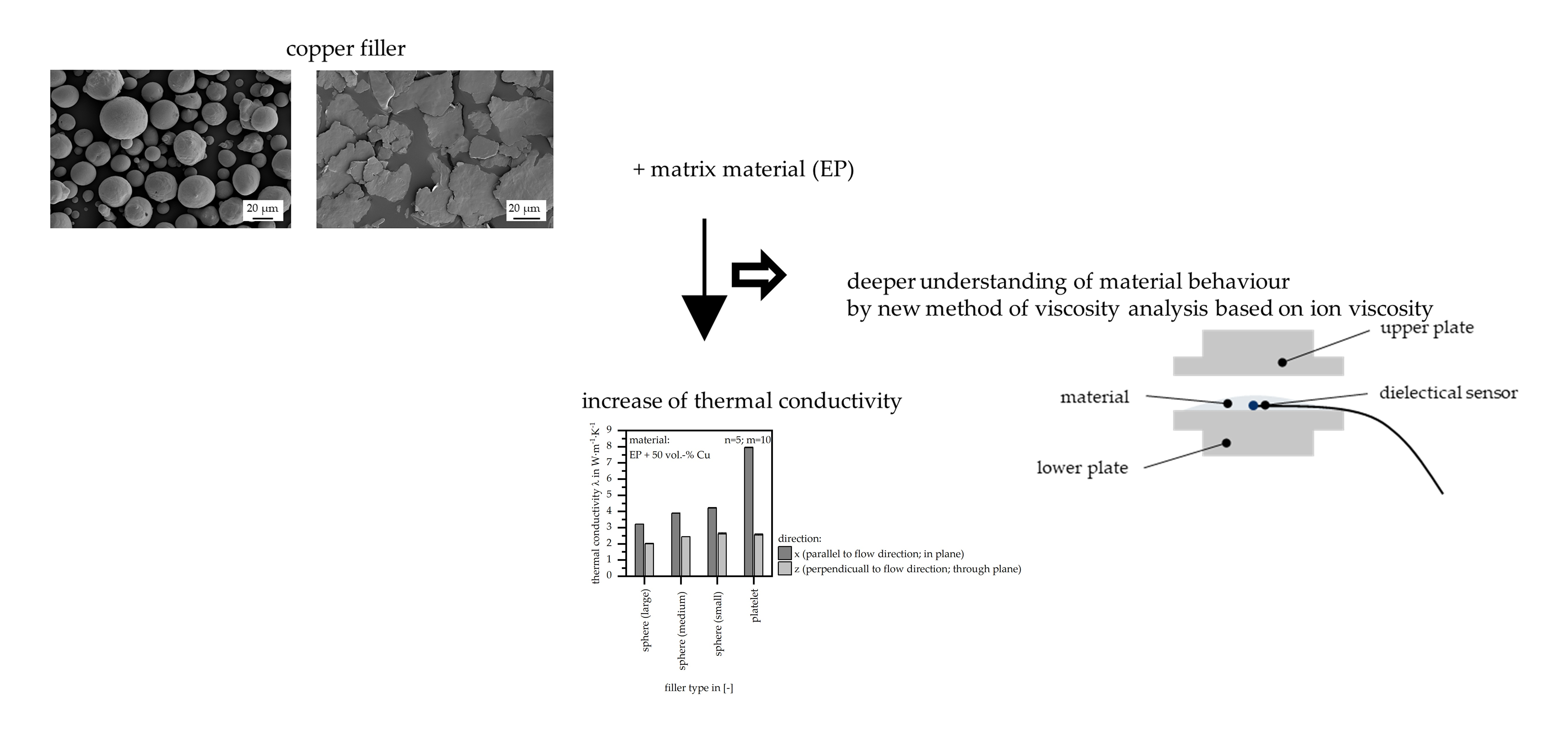
Improving the Thermal Conductivity by Varying the Filler Geometry of Copper in Thermosets


Abstract
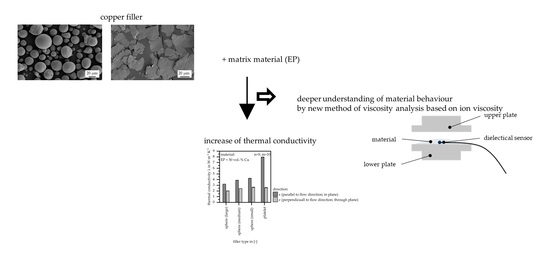
1. Introduction
1.1. Application Fields and Possible Extensions
1.2. Mechanisms of Thermal Conductivity of Thermoset-Based Compounds
1.3. Influencing Factors on the Thermal Conductivity of Filled Thermosets
1.4. Aim of the Paper
2. Materials and Methods
2.1. Materials
2.2. Fabrication of the Test Specimens
2.3. Characterization
2.3.1. Particle Size Distribution
2.3.2. Differential Scanning Calorimetry (DSC) According to DIN EN ISO 11357
2.3.3. Viscosity Behavior Determined Using a Rotational Viscometer According to DIN EN 53019
2.3.4. Density (ρ)
2.3.5. Specific Heat Capacity (c)
2.3.6. Thermal Diffusivity (α) According to DIN EN ISO 22007
2.3.7. Thermal Conductivity (λ) According to DIN EN ISO 22007
2.3.8. Filler Distribution
3. Results and Discussion
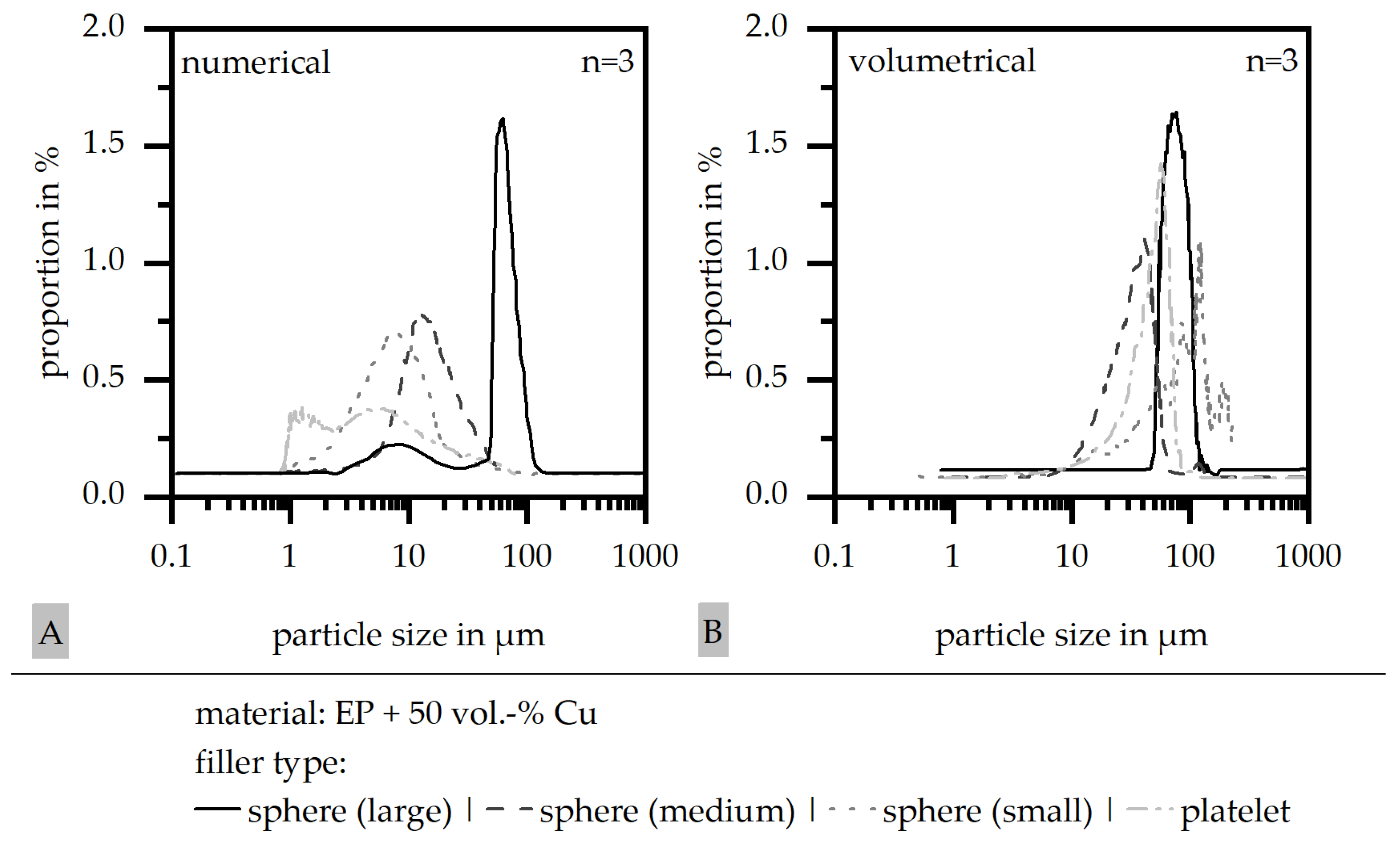
3.1. Particle Size Distribution
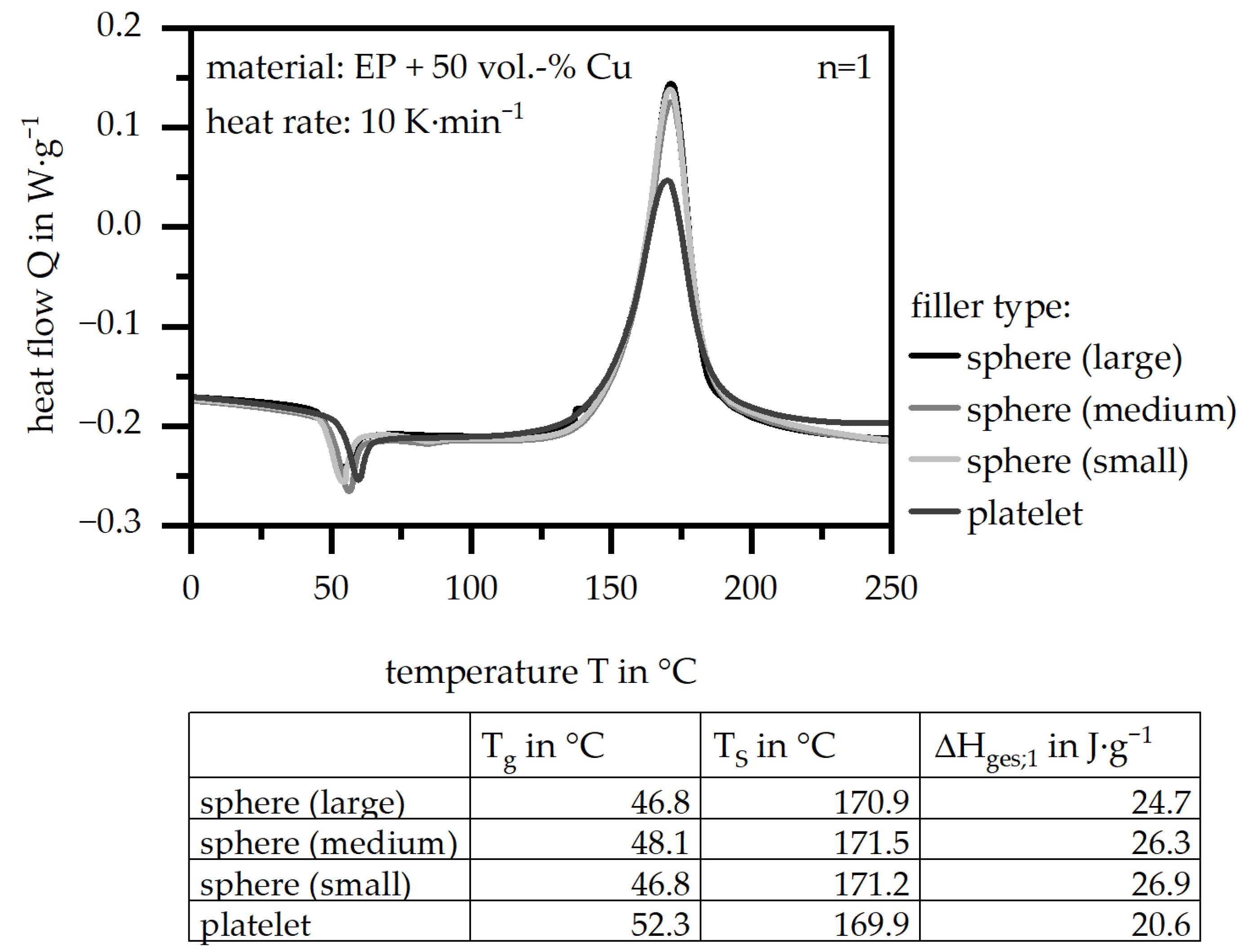
3.2. Temperature-Dependent Reaction Kinetics Based on Differential Scanning Calorimetry (DSC) According to DIN EN ISO 11357
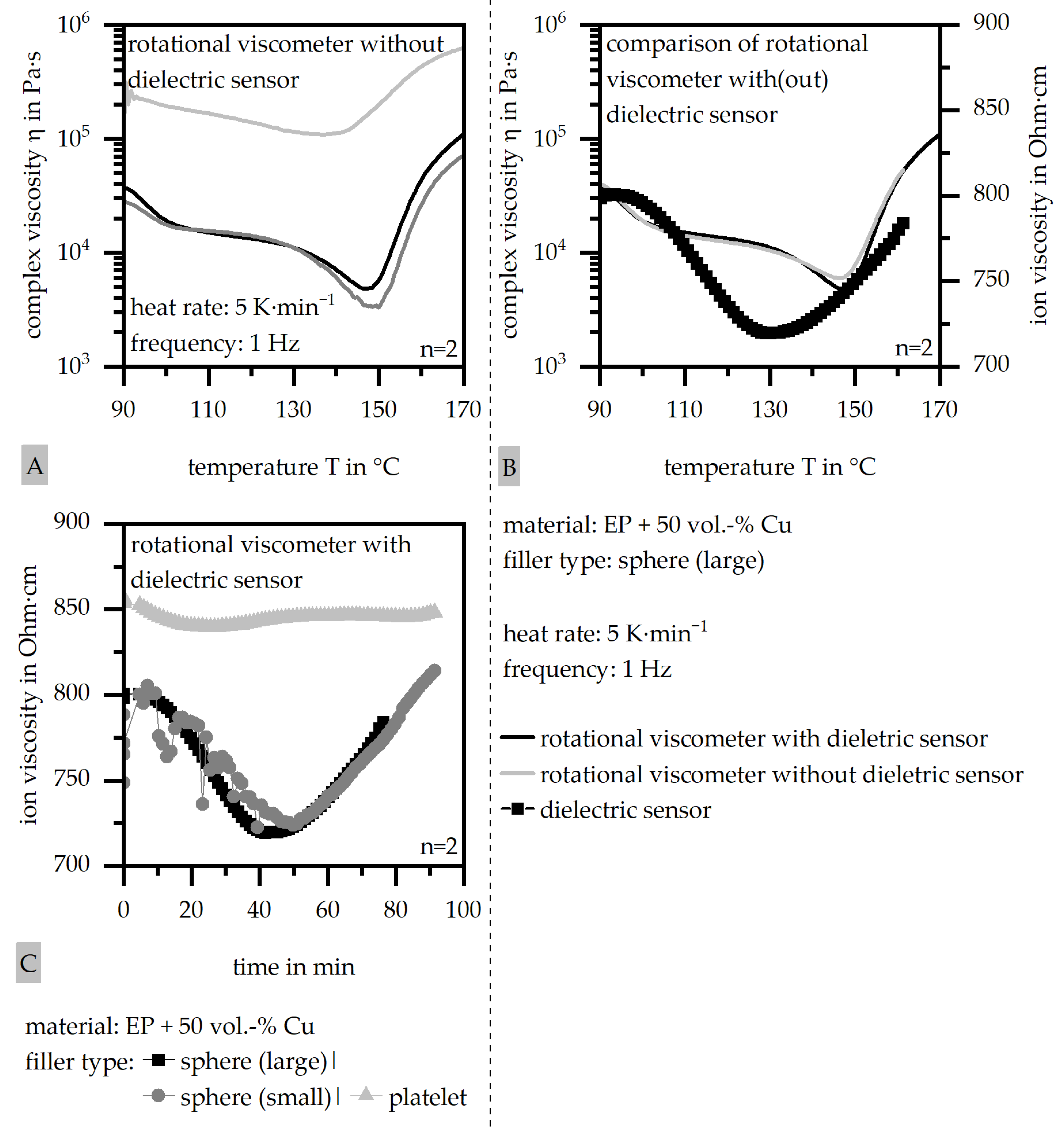
3.3. Viscosity Behavior
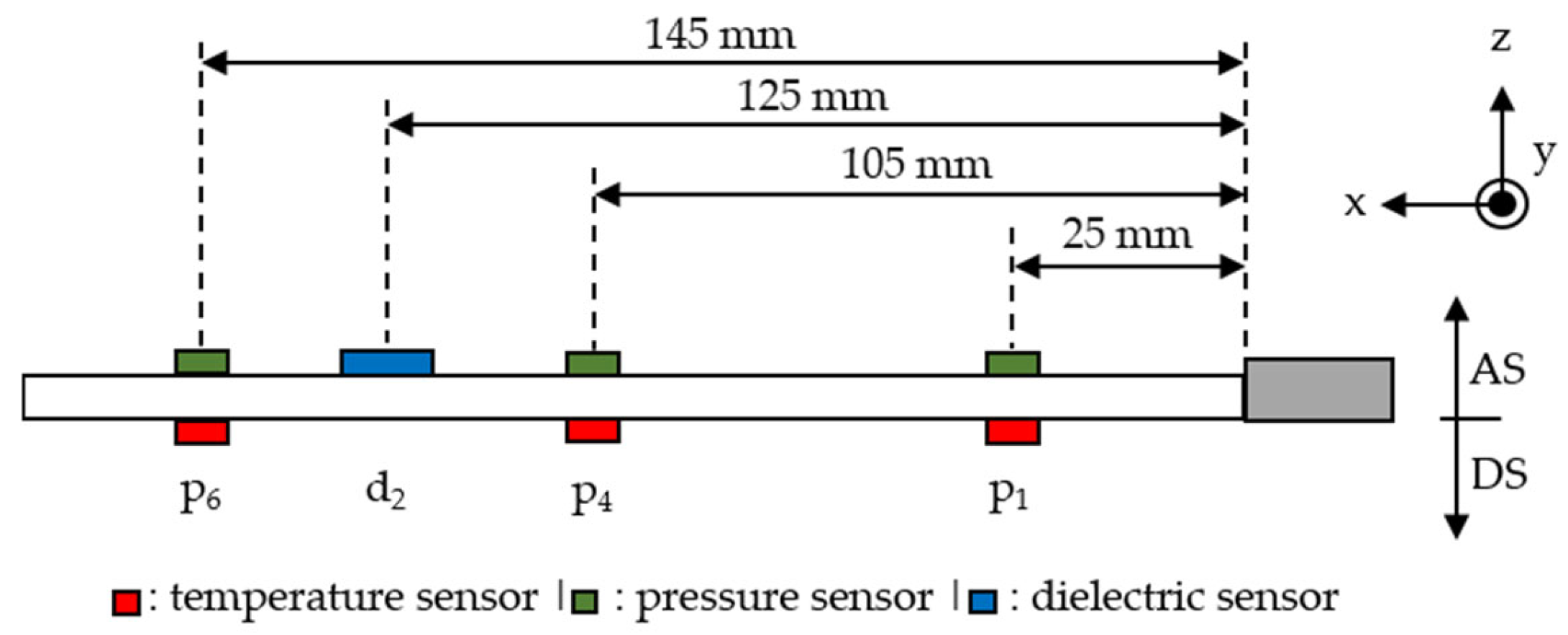
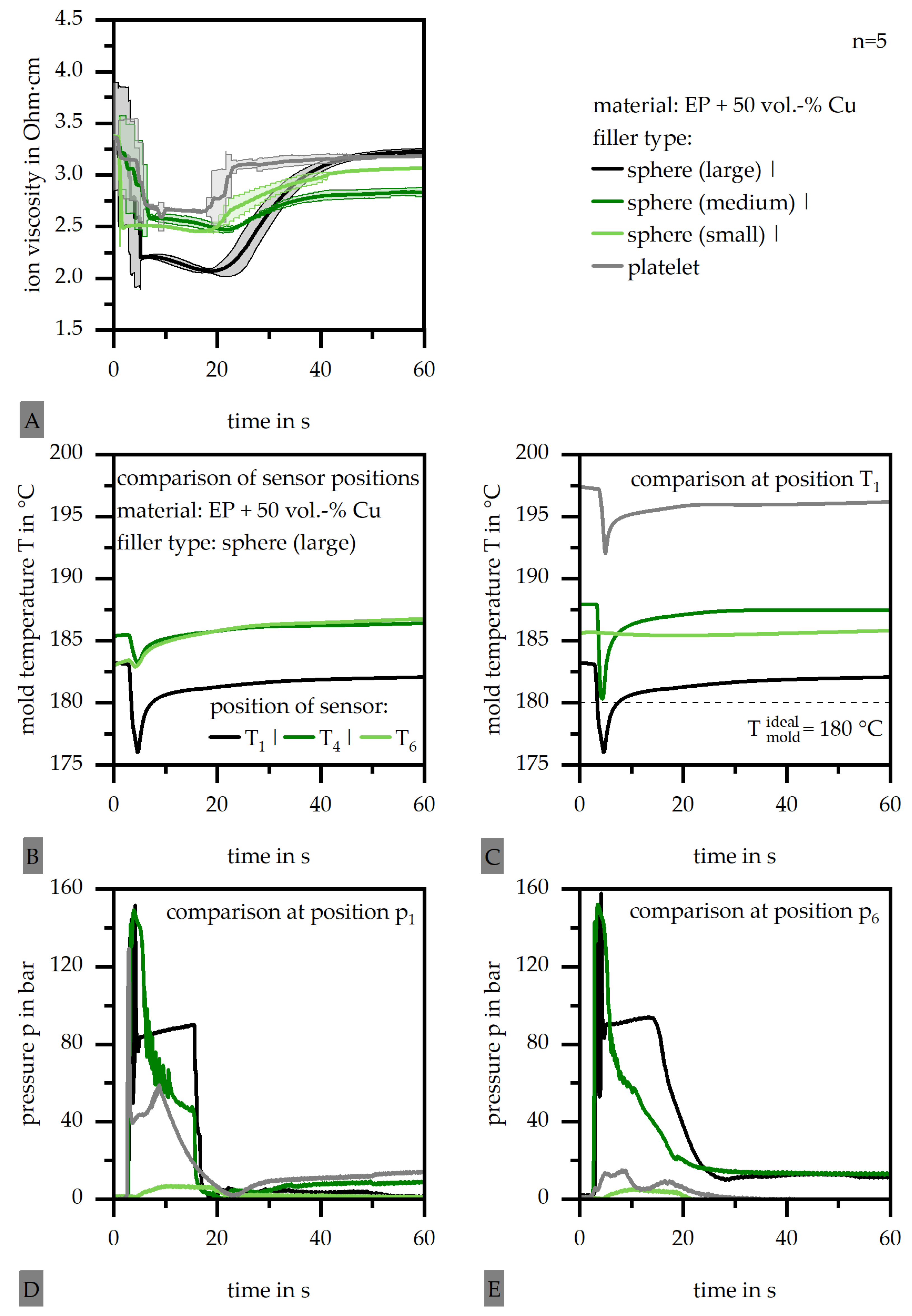
3.4. Monitoring of the Process Conditions
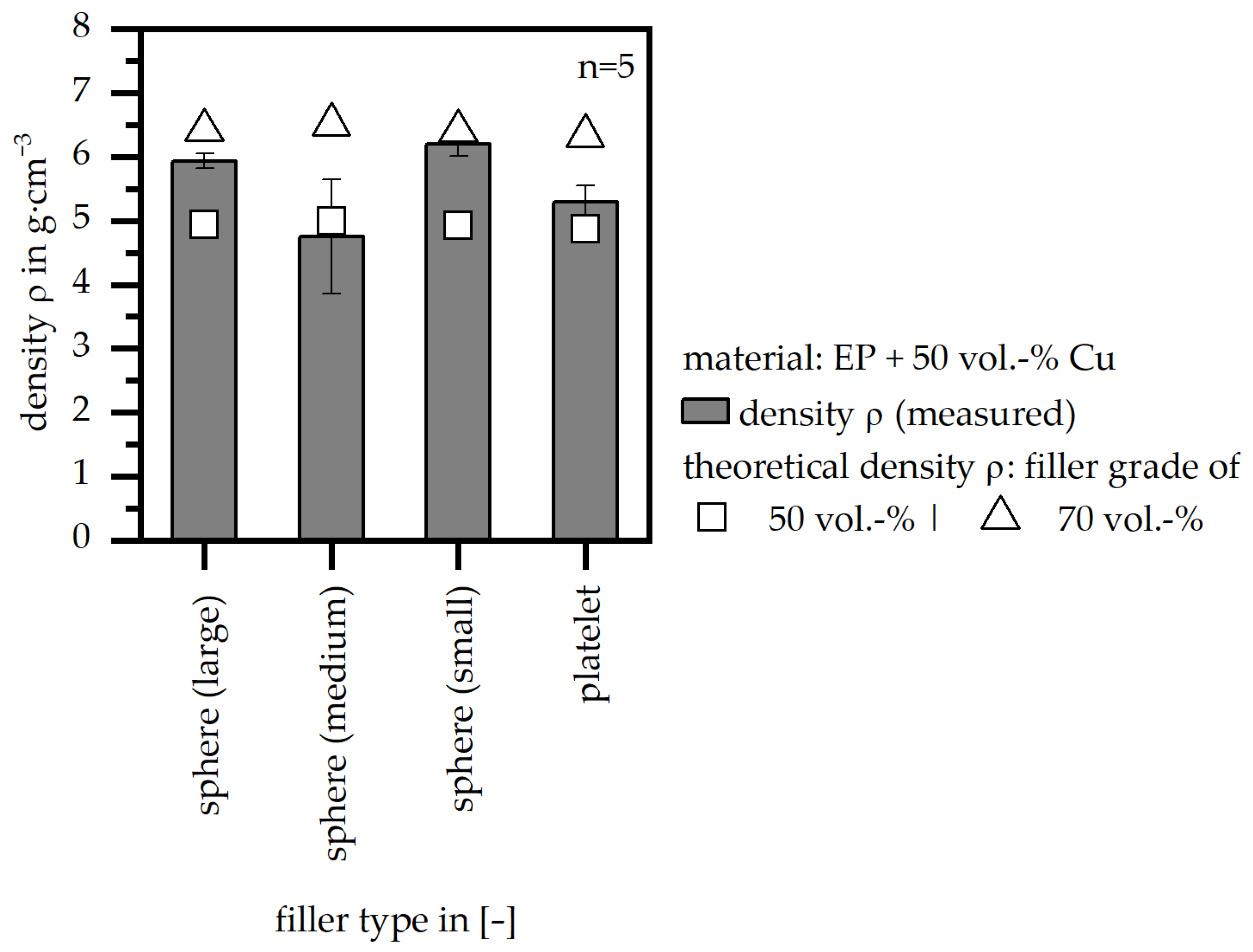
3.5. Density (ρ)
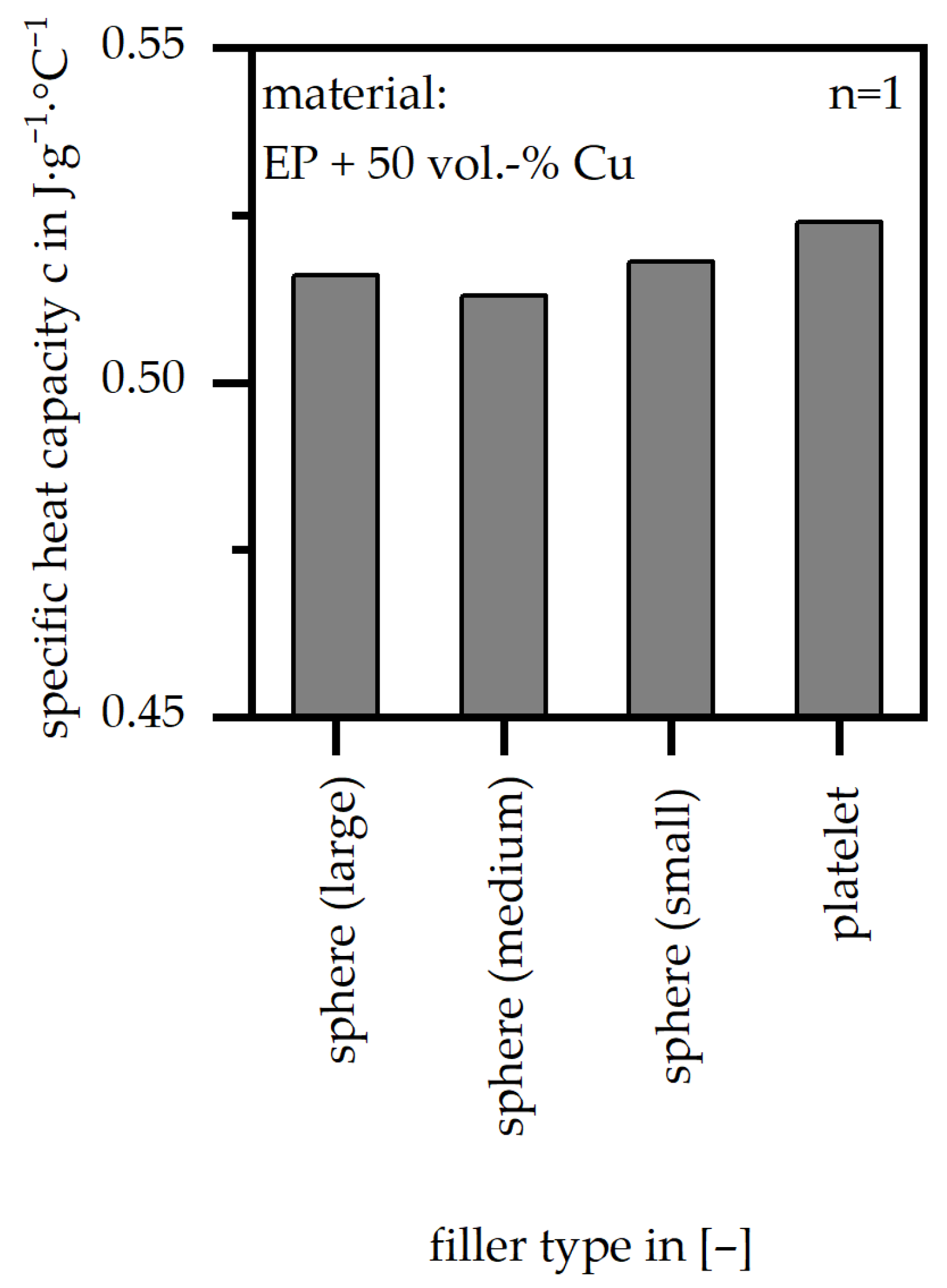
3.6. Specific Heat Capacity (c)
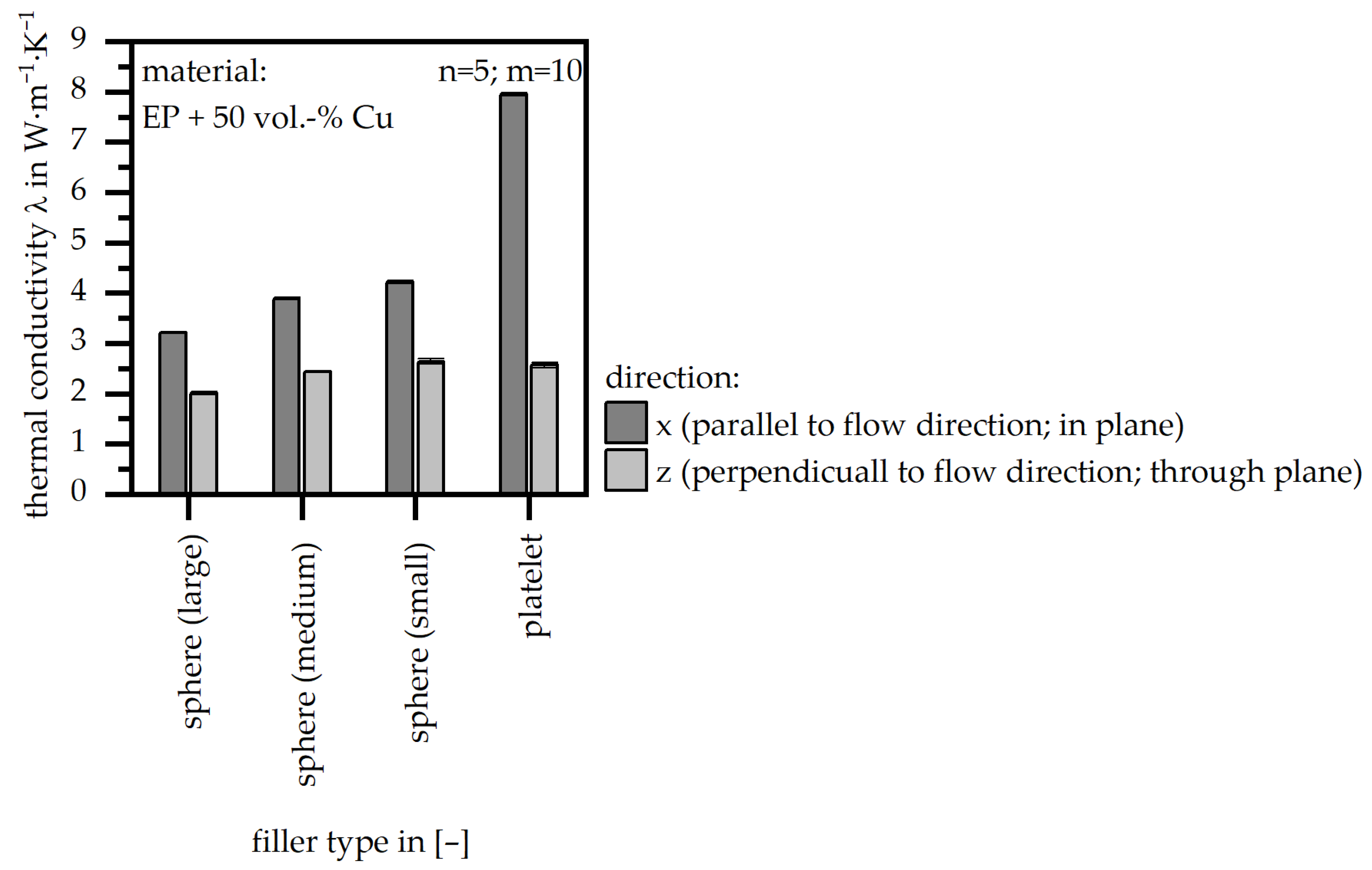
3.7. Thermal Conductivity (λ) According to DIN EN ISO 22007
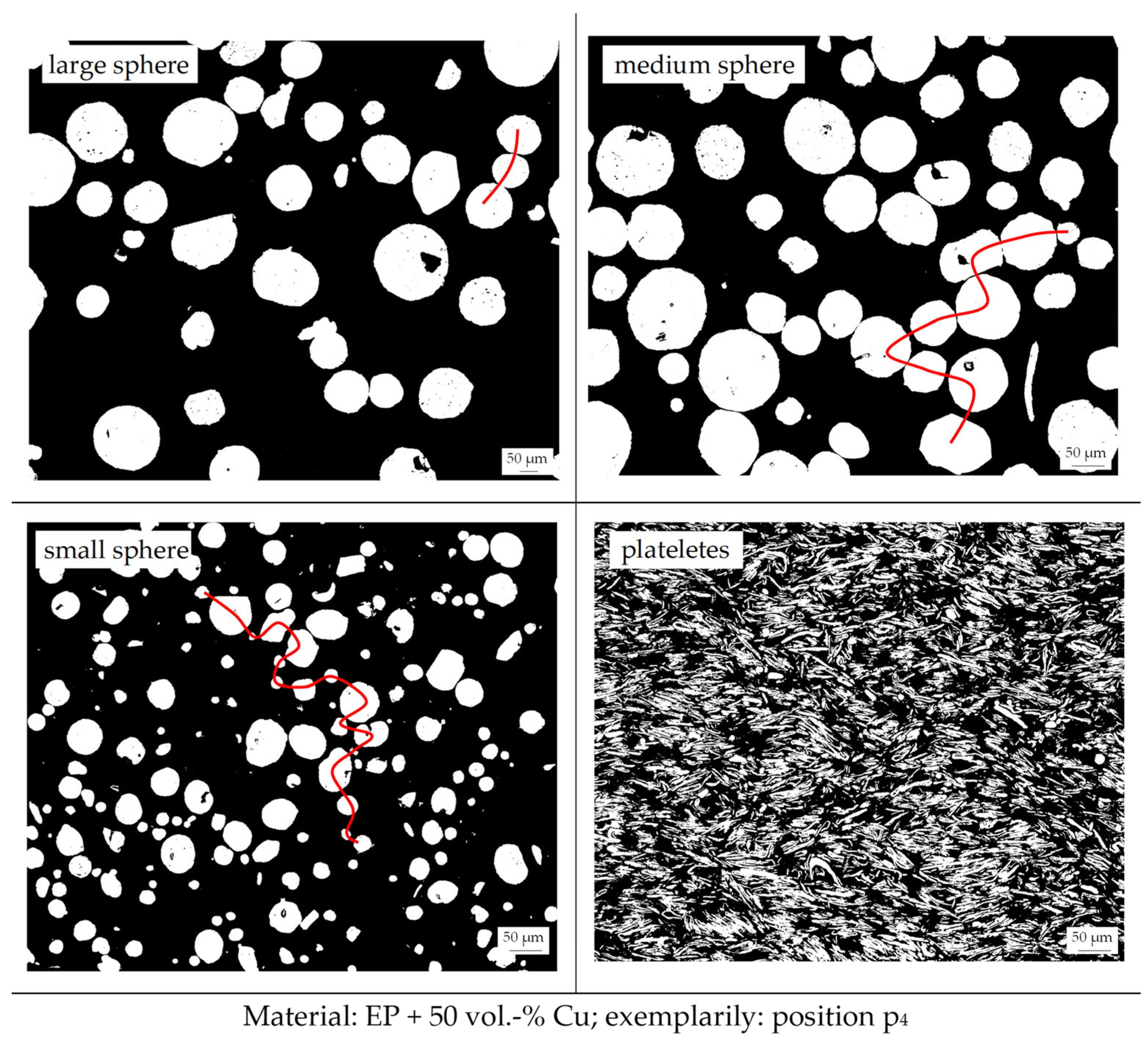
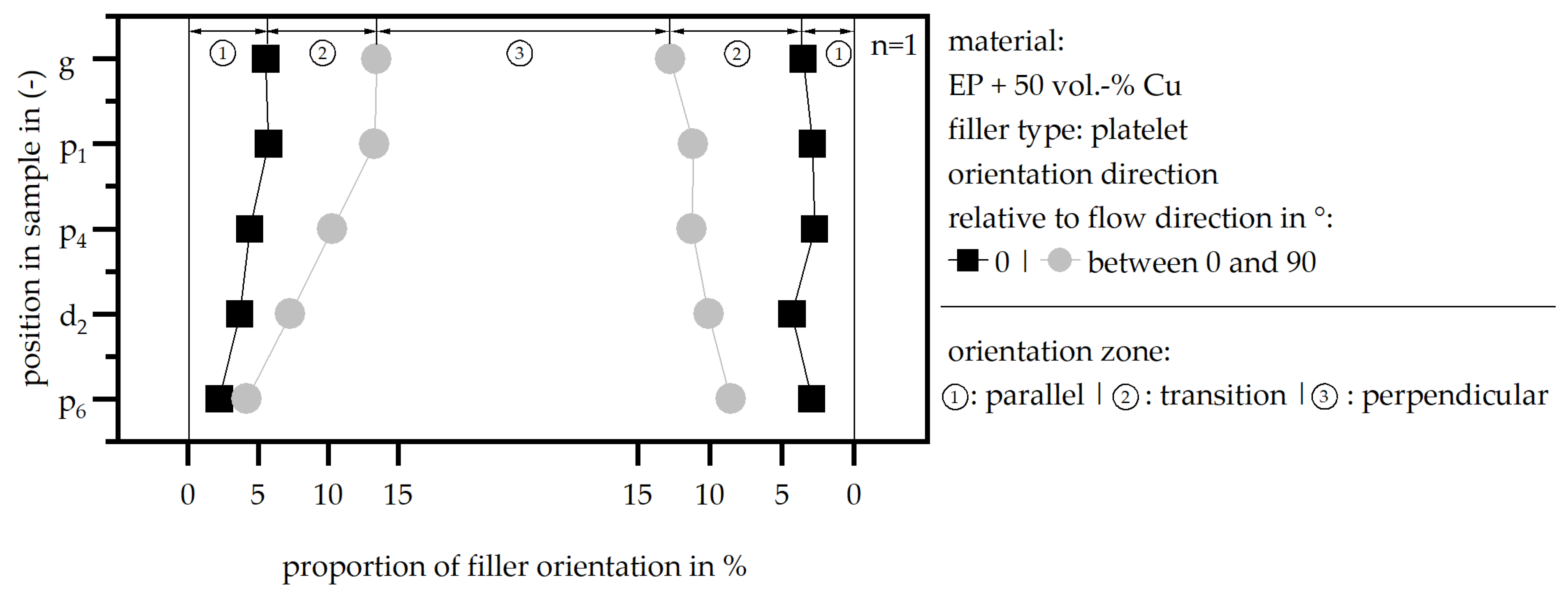
3.8. Filler Distribution
4. Conclusions
Author Contributions
Funding
Data Availability Statement
Conflicts of Interest
References
- Koch, I. Vergleich Si und SiC Halbleiter; Jahresbericht: Brauchschweig, Germany, 2007. [Google Scholar]
- SiC-Halbleiter: Schlüsseltechnologie zur effizienten und Nachhaltigen Elektronik. Available online: https://www.siconnex.com/?page_id=6360 (accessed on 10 September 2025).
- Baur, E.; Drummer, D.; Osswald, T.; Rudolph, N. Saechtling: Kunststoff-Handbuch, 32nd ed.; Verlag, C.H.: München, Germany, 2022. [Google Scholar]
- Ehrenstein, G.W.; Drummer, D. Hochgefüllte Kunststoffe mit Definierten Magnetischen, Thermischen und Elektrischen Eigenschaften; Springer: Düsseldorf, Germany, 2002. [Google Scholar]
- Übler, W. Erhöhung der Thermischen Leitfähigkeit Elektrisch Isolierender Polymerwerkstoffe. Ph.D. Thesis, Universität Erlangen-Nürnberg, Erlangen, Germany, 2004. [Google Scholar]
- Cai, Z. Simulation of the Manufacture of Closed Shape Composite Structures. Ph.D. Thesis, Massachusetts Institute of Technology, Cambridge, MA, USA, 1990. [Google Scholar]
- Xu, Y.; Chung, D.; Mroz, C. Thermally conducting aluminum nitride polymer-matrix composites. Compos. Part A Appl. Sci. Manuf. 2001, 32, 1749–1757. [Google Scholar] [CrossRef]
- Yung, K.C.; Liem, H. Enhanced thermal conductiity of boron nitride epoxy-matrix composite through multi-modal particle size mixing. J. Appl. Polym. Sci. 2007, 106, 3587–3591. [Google Scholar] [CrossRef]
- Sun, Z.; Li, J.; Yu, M.; Kathaperumal, M.; Wong, C. A review of the thermal conductivity of silver-epoxy nanocomposites as encapsulation material for packaging applications. Chem. Eng. J. 2022, 446, 137319. [Google Scholar] [CrossRef]
- Fan, J.; Zhang, S.; Zhao, G.; Fu, Q. Constructing fibrillated skeleton with highly aligned boron nirtide nanosheets confined in alumina fiber via electroispinning an dsintering for thermally conductive composite. Compos. Part A Appl. Sci. Manuf. 2021, 143, 106282. [Google Scholar] [CrossRef]
- Shen, X.; Wang, Z.; Wu, Y.; Liu, X.; Kim, J. Effect of functionalization on thermal conductivies of graphene/epoxy composites. Carbon 2016, 108, 412–422. [Google Scholar] [CrossRef]
- Pan, D.A.; Yang, G.; Abo-Dief, H.M.; Dong, J.; Su, F.; Liu, C.; Li, Y.; Xu, B.B.; Murugadoss, V.; Naik, N.; et al. Vertically aligned silicon carbide nanowires/boron nitride cellulose aerogel networks enhanced thermal conductivity and electromagnetic absorbing of epoxy composites. Nano-Micro Lett. 2022, 14, 118. [Google Scholar] [CrossRef] [PubMed]
- Feng, Y.; Han, G.; Wang, B.; Zhou, X.; Ma, J.; Ye, Y.; Liu, C.; Xie, X. Multiple synergistic effects of graphene-based hybrid and hexagonal boron nitride in enhancing thermal cundzuctivity and flame retardancy of epoxy. Chem. Eng. J. 2020, 379, 122402. [Google Scholar] [CrossRef]
- Zhou, M.-H.; Yin, G.-Z.; Prolongo, S.G. Review of thermal conductivity on epoxy thermosets and composites: Mechanism, parameters, and filler influences. Adv. Ind. Eng. Polym. Res. 2024, 7, 295–308. [Google Scholar] [CrossRef]
- Yang, X.; Zhu, J.; Yang, D.; Yang, J.; Guo, Y.; Zhong, J.; Kong, J.; Gu, J. High-effeciency improvement of thermal conductivity for epoxy omposites from synthesized liquid crystal epoxy followed by doping BN fillers. Compos. B Eng. 2020, 185, 107784. [Google Scholar] [CrossRef]
- Beyer, M. Epoxidharze in der Elektrotechnik: Grundlagen, Verabeitunsganlagen Anwendungen und neue Erkenntnisse; Expert: Grafenau/Württ, Germany, 1983. [Google Scholar]
- Johannaber, F.; Michaeli, W. Handbuch Spritzgießen, 2nd ed.; Verlag, C.H.: München, Germany, 2004. [Google Scholar]
- Bard, S. Kohlenstoffaser-Epoxydharz-Verbund mit Erhöhter Wärmeleitfähigkeit: Struktur und Eigenschaften. Ph.D. Thesis, Universität Bayreuth, Bayreuth, Germany, 2021. [Google Scholar]
- Zhao, Y.; Zhai, Z.; Drummer, D. Thermal conductivity of Aluminosilicate- and Aluminum Oxide-filled thermosets for injection molding: Effect of filler content, filler size and filer geometry. Polymers 2018, 10, 457. [Google Scholar] [CrossRef] [PubMed]
- Jasmee, S.; Omar, G.; Othaman, S.S.C.; Masripan, N.A.; Hamid, H.A. Interface thermal resistance and thermal conductivity of polymer composites at different types, shapes, and sizes of fillers: A review. Polym. Compos. 2021, 42, 2629–2652. [Google Scholar] [CrossRef]
- Liu, C.; Chen, M.; Zhou, D.; Wu, D.; Yu, W. Effect of filler shape on the thermal conductivity of thermal functional composites. J. Nanomater. 2017, 1, 6375135. [Google Scholar] [CrossRef]
- Mahanta, N.K.; Loos, M.R.; Zlocozower, I.M.; Abramson, A.R. Graphite–graphene hybrid filler system for high thermal conductivity of epoxy composites. J. Mater. Res. 2015, 30, 959–966. [Google Scholar] [CrossRef]
- Cassing, W.; Kuntze, K.; Ross, G. Dauermagnete: Mess- und Magnetisierungstechnik, 3rd ed.; Expert: Renningen, Germany, 2018. [Google Scholar]
- Netzsch-Gerätebau GmbH. Dielektrische Analyse. 2025. Available online: https://analyzing-testing.netzsch.com/de/produkte/dielektrische-analyse-dea (accessed on 15 September 2025).
- DIN EN ISO 11357-1; Kunststoffe—Dynamische Differenz Thermoanalyse (DSC): Teil 1: Allgemeine Grundlagen. Deutsches Institut für Normung: Berlin, Germany, 2017.
- DIN 53019-1; Viskosimetrie—Messung von Viskositäten und Fließkurven mit Rotationsviskosimetern—Teil 1: Grundlagen und Messgeometrie. Deutsches Institut für Normung: Berlin, Germany, 2008.
- DIN EN ISO 22007-1; Kunststoffe—Bestimmung der Wärmeleitfähigkeit und der Temperaturleitfähigkeit: Teil 1: Allgemeine Grundlagen. Deutsches Institut für Normung: Berlin, Germany, 2024.
- DIN EN ISO 11358-1; Kunststoffe—Thermogravimetrie (TG) von Polymeren—Teil 1: Allgemeine Grundsätze. Deutsches Institut für Normung: Berlin, Germany, 2022.
- Schramm, G. Einführung in Rheologie und Rheometrie; Gebrüder Haake GmbH: Karlsruhe, Germany, 1995. [Google Scholar]
- Thienel, P.; Hoster, B.; Schröder, K.; Kretschmer, J.; Ludwig, R. Duroplast-Spritzgießen mit Gasinnendruck. Kunststoffe 1993, 83, 91–95. [Google Scholar]
- Englich, S. Strukturbildung bei der Verarbeitung von Glasfasergefüllten Phenolformaldehydharzformmassen. Ph.D. Thesis, Technische Universität Chemnitz, Chemnitz, Germany, 2015. [Google Scholar]



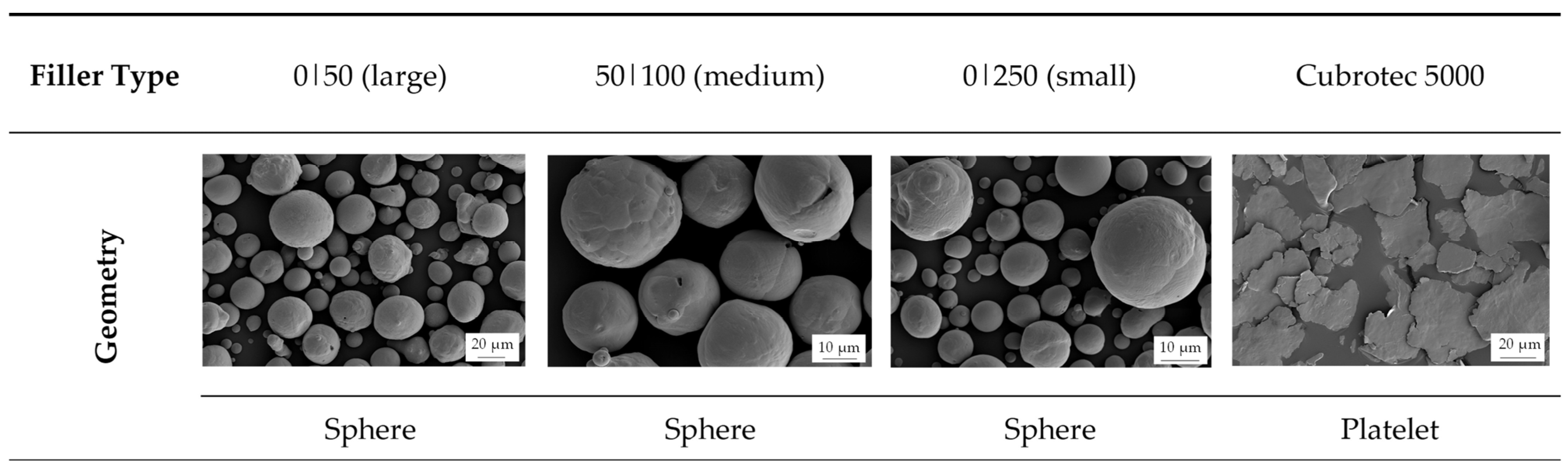
| Material System | Geometry | Density (ρ) in g∙cm−3 | Particle Size [n|v] in µm | Heat Capacity (c) in J∙g−1∙°C−1 | Thermal Conductivity (λ) in W∙m−1∙K−1 | |
|---|---|---|---|---|---|---|
| Epoxy resin (EP) | - | 1.2250 | - | 1.616 | 0.4–0.6 | |
| Copper (Cu) | 0|50 (large) | Sphere | 8.65 | 60.77|76.82 | 0.351 | 400 |
| 50|100 (medium) | Sphere | 8.77 | 13.42|33.89 | 0.360 | ||
| 0|250 (small) | Sphere | 8.63 | 6.42|73.31 | 0.362 | ||
| Cubrotec 5000 | Platelet | 8.52 | 5.64|47.38 | 0.366 | ||
| Mass Temperature (Tm) in °C [Feeding|Noozle] | Mold Temperature (TWZ) in °C | Heating Time (th) in s | Injection Speed (vin) in mm∙s−1 |
|---|---|---|---|
| 65|85 | 180 | 75 | 15 |
Disclaimer/Publisher’s Note: The statements, opinions and data contained in all publications are solely those of the individual author(s) and contributor(s) and not of MDPI and/or the editor(s). MDPI and/or the editor(s) disclaim responsibility for any injury to people or property resulting from any ideas, methods, instructions or products referred to in the content. |
© 2025 by the authors. Licensee MDPI, Basel, Switzerland. This article is an open access article distributed under the terms and conditions of the Creative Commons Attribution (CC BY) license.
Share and Cite
Rösel, U.; Drummer, D. Improving the Thermal Conductivity by Varying the Filler Geometry of Copper in Thermosets. Polymers 2026, 18, 75. https://doi.org/10.3390/polym18010075
Rösel U, Drummer D. Improving the Thermal Conductivity by Varying the Filler Geometry of Copper in Thermosets. Polymers. 2026; 18(1):75. https://doi.org/10.3390/polym18010075
Chicago/Turabian StyleRösel, Uta, and Dietmar Drummer. 2026. "Improving the Thermal Conductivity by Varying the Filler Geometry of Copper in Thermosets" Polymers 18, no. 1: 75. https://doi.org/10.3390/polym18010075
APA StyleRösel, U., & Drummer, D. (2026). Improving the Thermal Conductivity by Varying the Filler Geometry of Copper in Thermosets. Polymers, 18(1), 75. https://doi.org/10.3390/polym18010075