Article

Study on Viscoelastic Characteristics of Polymer Solution Formation and Their Effect on Oil Displacement Efficiency

1
College of Petroleum and Natural Gas Engineering, Chongqing University of Science and Technology, Chongqing 401331, China
2
Joint Logistics Support Force Engineering University, Chongqing 401331, China
3
Sinopec Zhongyuan Petrochemical Co., Ltd., Puyang 457000, China
4
Binzhou Inspection and Testing Center, Dongying 257000, China
*
Author to whom correspondence should be addressed.
Polymers 2026, 18(1), 2; https://doi.org/10.3390/polym18010002
Submission received: 28 November 2025 / Revised: 17 December 2025 / Accepted: 18 December 2025 / Published: 19 December 2025
(This article belongs to the Special Issue Application of Polymers in Enhanced Oil Recovery)

Abstract

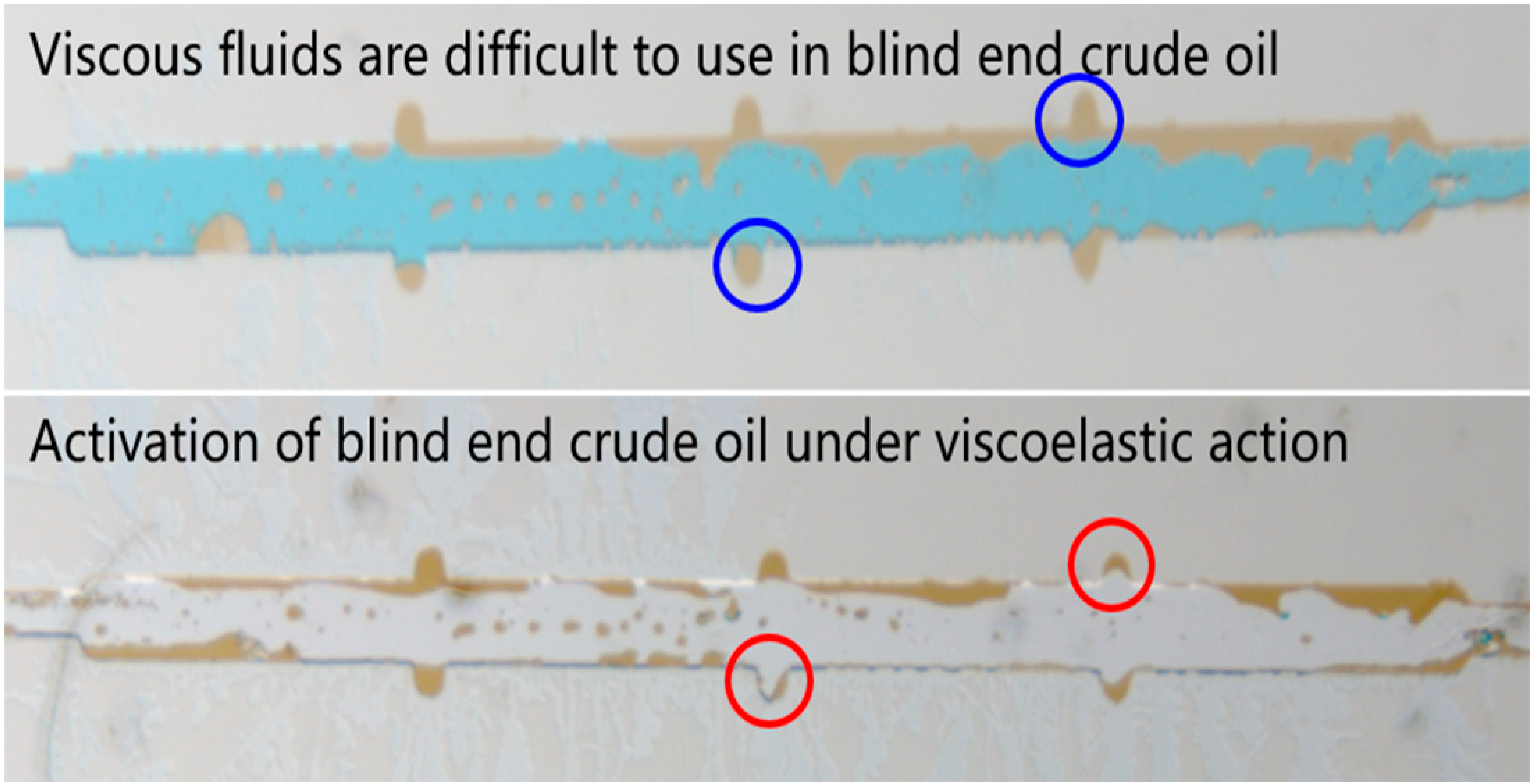
Polymer solutions exhibit radial flow characteristics upon injection into a formation via the wellbore. Accurately characterizing their viscoelastic properties at varying seepage velocities and quantifying their impact on displacement efficiency are crucial for advancing polymer flooding technology. This study simulated shear rate variations during polymer injection and integrated laboratory-measured viscoelastic properties with permeability characteristics in porous media. An analysis of the oil displacement performance between viscoelastic polymer solutions and a purely viscous fluid, glycerol, was conducted. The key findings are as follows: (1) Polymer elasticity, characterized by the first normal stress difference, diminishes with decreasing injection time/solution concentration. Significant viscoelasticity is observed near the wellbore, weakening in deeper reservoir regions. (2) The polymer type and injection conditions govern the development of solution “effective viscosity” during porous medium flow. A fundamental trend under elevated flow velocities is an increase in effective viscosity with shear rate. (3) Comparison with glycerol demonstrates that the viscoelastic effect of polymer solutions enhances heavy-oil displacement efficiency. The magnitude of this viscoelastic effect within the porous medium directly correlates with its contribution to improved displacement efficiency.

Graphical Abstract

1. Introduction

Polymer solutions employed for enhanced oil recovery are quintessential viscoelastic fluids [1]. These materials exhibit intermediate behavior between purely viscous Newtonian fluids and elastic solids, simultaneously manifesting both viscous dissipation and elastic energy storage. During porous medium flow below the yield stress, viscoelastic fluids experience viscous flow resistance; upon removal of shear stress, a portion of the deformation energy is recoverable due to elasticity. Research and development of polymer solutions focus on elucidating their characteristic properties and influencing factors, refining synthesis and formulation techniques, and ultimately enhancing their performance to meet specific oilfield development requirements [2]. The viscoelastic nature of these solutions fundamentally distinguishes their behavior from that of purely viscous fluids. Flow through porous media induces elastic deformation due to pore-throat constraints, generating an elastic viscosity component [3,4,5,6]. Consequently, the effective viscosity (μeff = μviscous + μelastic) expressed during flow significantly exceeds that of equivalent viscous fluids. This enhanced effective viscosity translates to superior flow control capability, making viscoelastic polymers more effective for improving oil recovery [7,8,9,10,11,12]. Characterizing polymer viscoelasticity typically involves oscillatory rheometry, measuring storage modulus (G′) and loss modulus (G″) under small-amplitude oscillatory shear. However, data acquired at controlled oscillation frequencies often poorly represent the viscoelastic performance observed under actual reservoir flow conditions [13,14]. This discrepancy limits the practical applicability of laboratory-derived viscoelastic understanding. Bridging this gap between laboratory measurements and field performance, effectively translating fundamental viscoelastic insights to reservoir conditions, remains a significant research challenge. Accurately characterizing the viscoelastic behavior of polymer solutions during flow in porous media is thus a critical issue in polymer flooding technology. Establishing reliable characterization methods under porous medium conditions is essential to determine whether enhanced oil recovery stems from the viscoelastic properties themselves or merely from increased viscous forces. Two primary approaches exist: (1) Shear Rate Equivalence—This involves analyzing the linear velocity during injection to calculate an equivalent shear rate or oscillation frequency. Correlating this with laboratory rheological data provides an estimated viscoelastic response under reservoir conditions. While theoretically grounded, this method exhibits significant deviations from actual behavior but offers a preliminary assessment of whether a given polymer solution concentration exhibits viscoelasticity under target conditions. (2) Porous Medium Flow Experiments—This entails directly measuring flow properties, e.g., resistance factor and residual resistance factor, in core samples. Analysis yields an effective viscosity reflecting the combined viscous and elastic effects, thereby demonstrating the viscoelastic characteristics within porous media [15,16,17].
Therefore, utilizing a polymer-flooded reservoir in an offshore oilfield as a case study, the following experimental sequence was implemented: (1) Comprehensive rheological characteristics, including viscosity modulus and energy dissipation modulus, of polymer solutions at varying concentrations were initially evaluated [18]. (2) The viscoelastic behavior of polymer solutions under reservoir conditions was subsequently analyzed by employing equivalent conversion between shear rate and linear velocity. (3) Resistance coefficient and residual resistance coefficient measurements were then conducted to validate the manifestation of viscoelasticity within porous media. (4) Conclusively, comparative core flooding experiments employing viscoelastic polymer solutions and viscous glycerol solution were performed on heavy-oil systems. This elucidated the viscoelastic effect on heavy-oil displacement dynamics, thereby providing foundational insights to underpin the advancement of polymer flooding technology for heavy-oil reservoirs.

2. Viscoelastic Characteristics of Polymers Under Reservoir Conditions

This section employs numerical simulation to analyze shear rate variations in porous medium flow. By integrating laboratory-derived viscoelastic properties at different shear rates, we systematically characterize the viscoelastic behavior of polymers across reservoir locations and injection concentrations.

2.1. Characteristics of Changes in Polymer Solution Concentration and Shear Rate Under Injection Conditions

The viscoelastic properties of the SNF3640C polymer solution under reservoir conditions constitute the prerequisite for conducting displacement experiments. Accordingly, a geological reservoir model was developed using Tinavigator 20 numerical simulation software, reflecting the target reservoir’s characteristics, shown in Figure 1.
The simulation parameters utilized are shown in Table 1 [18,19].
The expression of viscoelasticity in polymer solutions is mainly influenced by two aspects. One is the shear rate during the polymer injection process, and the other is the effective solution concentration after diffusion, dilution, adsorption, and retention of the polymer solution after injection into the formation. The linear velocity characteristics and effective solution concentration changes during the injection of polymer solution with a concentration of 1750 mg/L into the reservoir were studied using mathematical models. The variation in linear velocity during polymer solution injection was analyzed based on reservoir numerical simulation, and the shear rate was converted using Formula (1) [20]. The results are shown in Table 2.
γ = 3 n + 1 4 n v k 2 ϕ 1 2
In the formula, n is obtained based on the power law coefficient of the target polymer under different concentration conditions; K is permeability, mD; v is linear velocity, m/s; and φ is porosity, %.
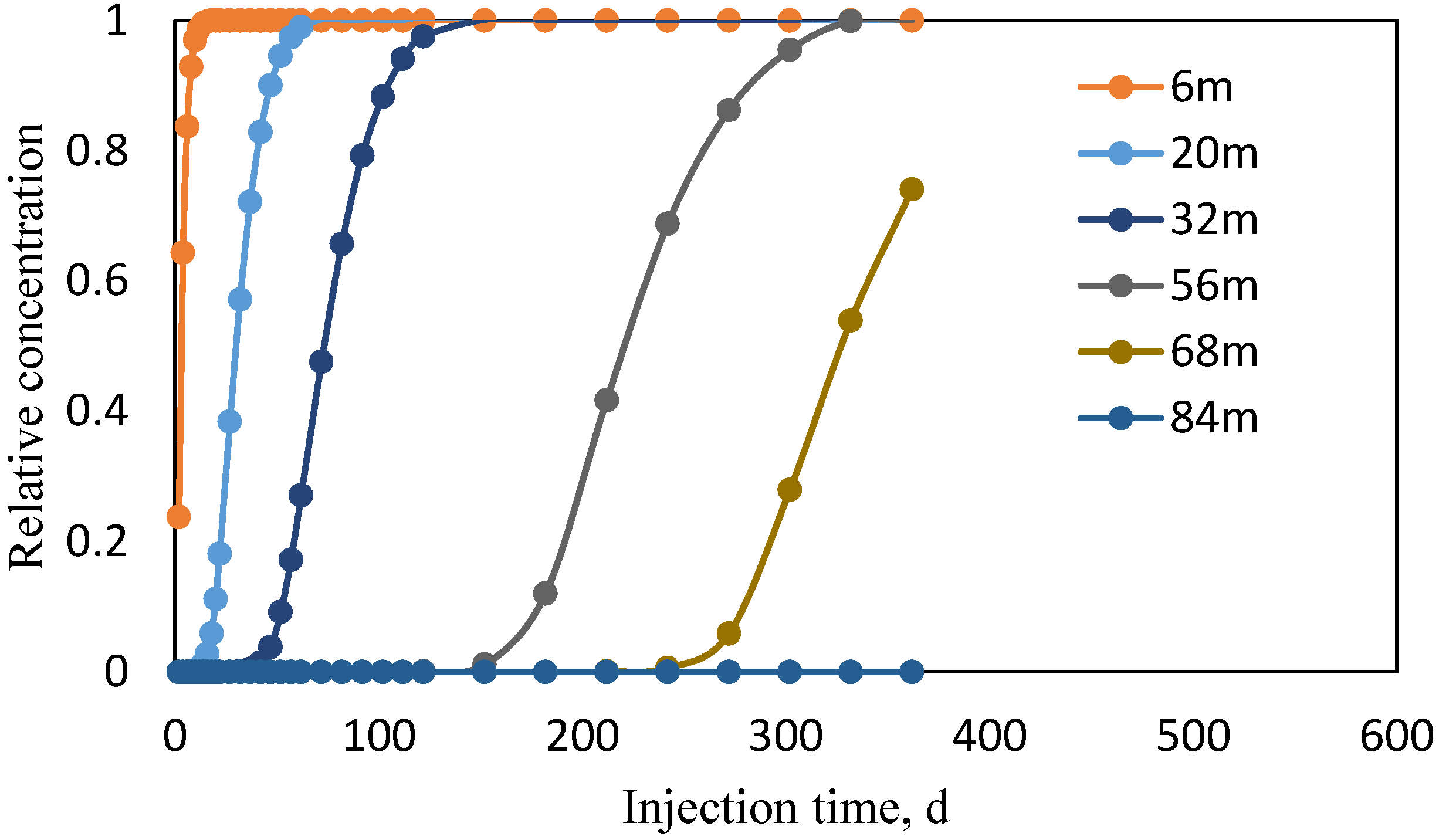
Reservoir simulation results, shown in Table 2, indicate that polymer solutions experience predominantly low shear rates < 0.6 s−1 following injection, with elevated shear rates confined to the near-wellbore region and perforations. Beyond the near-wellbore zone, shear rates throughout the reservoir remain within this lower range. This distribution demonstrates that polymer solutions primarily encounter low-shear conditions under reservoir-scale flow. Further analysis of polymer propagation behavior was conducted through reservoir simulation, as shown in Figure 2, revealing the spatial evolution of solution concentration after injection.
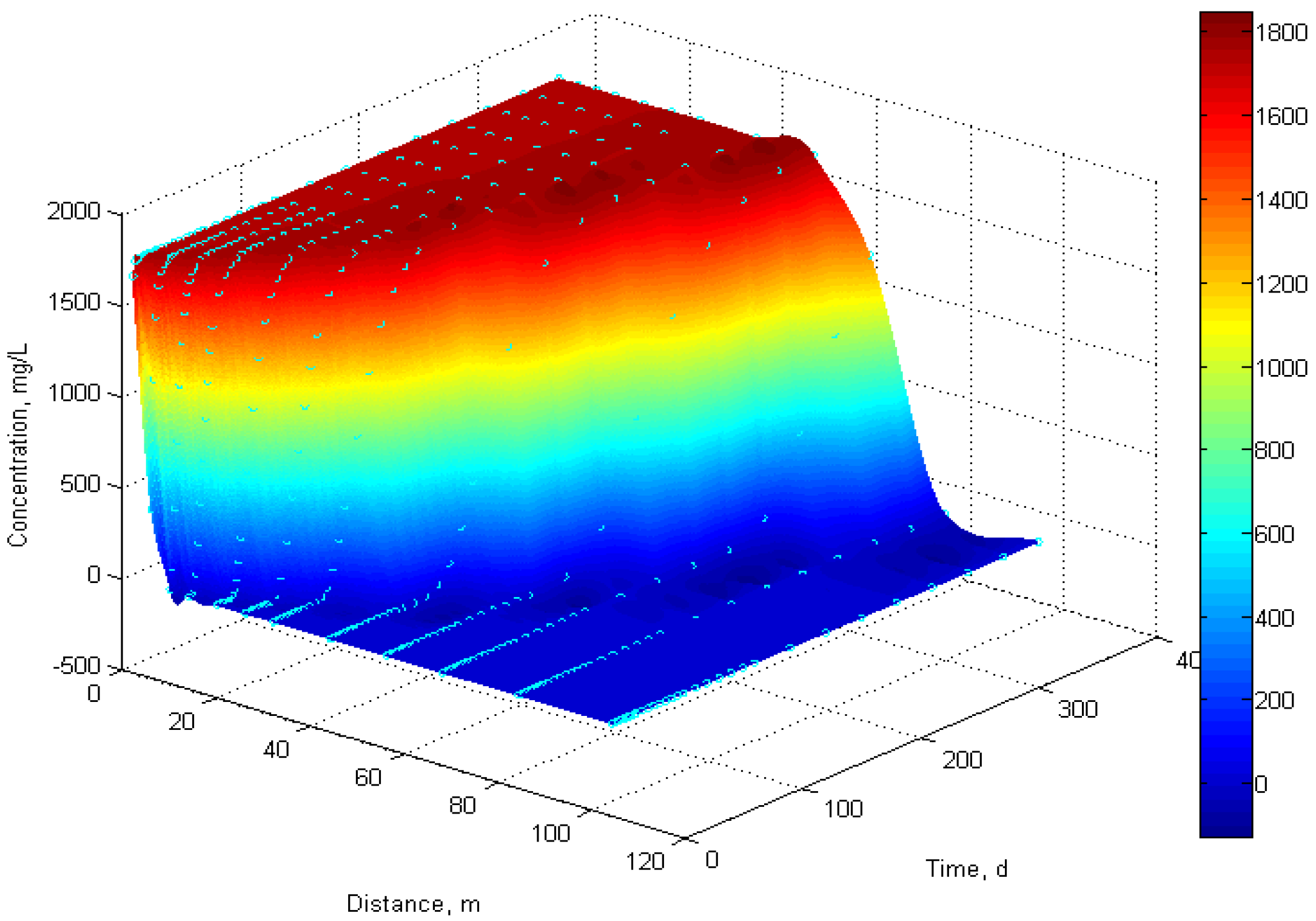
Following injection, polymer solution concentration exhibits spatial attenuation due to adsorption/retention and dispersion effects, resulting in progressive dilution with propagation distance. Propagation velocity decreases radially from the wellbore, yielding shorter concentration stabilization times near the injection point and extended equilibration periods in distal regions. Consequently, the leading edge maintains prolonged low-concentration conditions, where viscoelastic properties become strongly concentration-dependent.
Spatial analysis of velocity and concentration fields via MATLAB 2010a, shown in Figure 3, reveals distinct flow regimes: (1) near-wellbore zone—elevated concentrations > 1750 mg/L and shear rates; (2) far-field regions—diluted concentrations < 500 mg/L and low shear rates < 0.6 s−1.

2.2. Viscoelastic Characteristics of Polymer Solutions

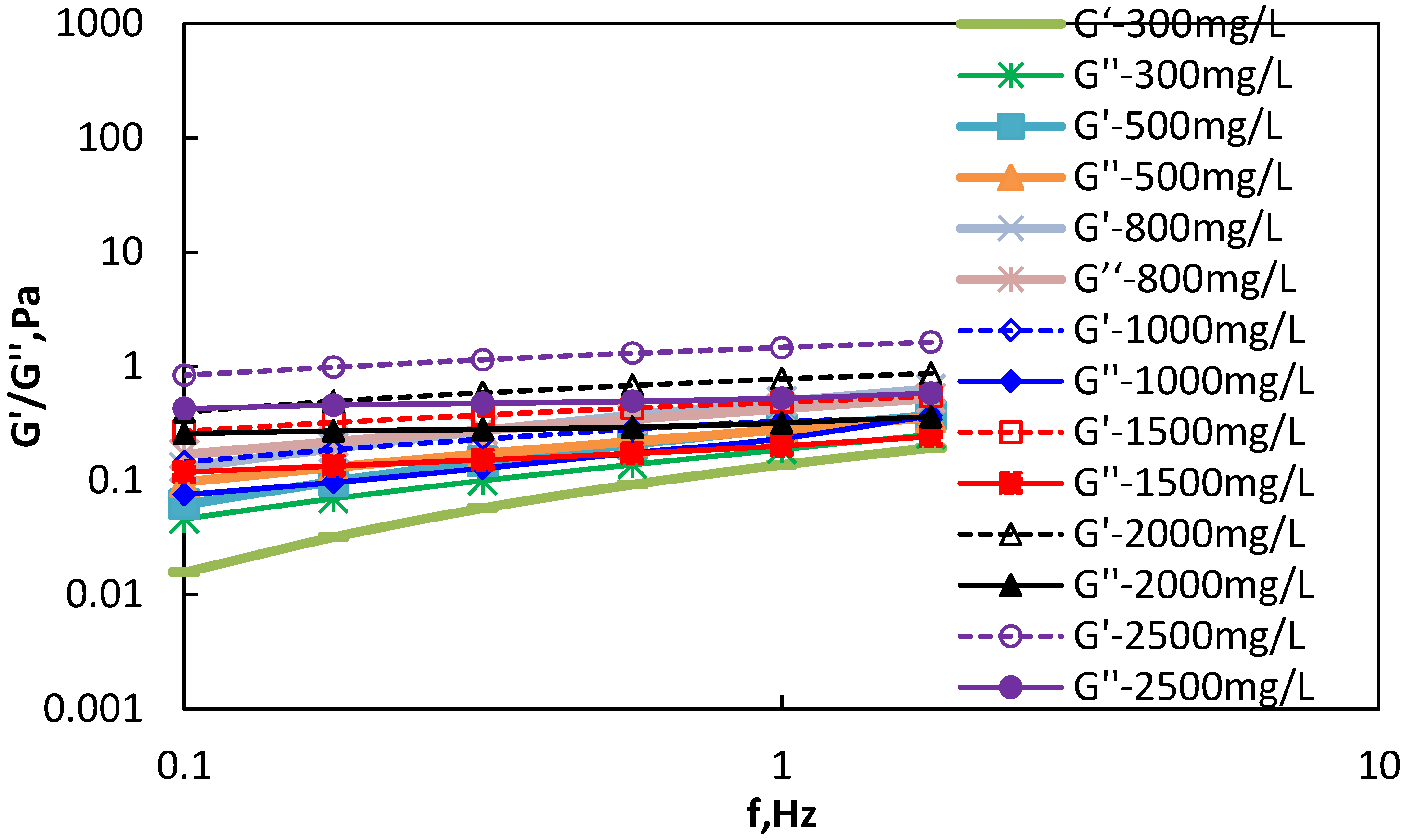
The hydrophobically associating polymer SNF3640C (Aisen Flocculant Co., Ltd., Jiangsu, Taizhou, China) was selected for rheological characterization [21,22]. Solutions were prepared at concentrations of 300, 500, 800, 1000, 1400, 2000, and 2500 mg/L. Oscillatory rheometry was performed using an RS600 rheometer with frequency sweeps from 0.1 to 1.77 Hz. The resulting loss modulus (G″) and storage modulus (G′) measurements for SNF3640C solutions are presented in Figure 4.
For the hydrophobically associating polymer SNF3640C, viscoelastic behavior below the critical concentration (C) exhibits crossover points between loss modulus (G″) and storage modulus (G′). At concentrations exceeding C, all three tested solutions demonstrate consistently greater storage modulus (G′) than loss modulus (G″). This indicates that within the studied oscillatory frequency range, SNF3640C’s viscoelastic response is primarily elastic-dominated. At low concentrations, SNF3640C maintains elastic dominance, with its strong intermolecular associations significantly enhancing resistance to deformation.

2.3. Characterization of Viscoelasticity of Polymer Solutions at Different Locations and Injection Concentrations

The first normal stress difference (N1) constitutes the primary metric for characterizing elastic behavior in viscoelastic fluids [21,22]. In porous medium flows, N1 quantitatively describes polymer solution elasticity. Complementary viscoelastic metrics can be derived by correlating shear-dependent viscosity profiles with shear rate and linear velocity relationships. The viscoelastic properties of polymer solutions were evaluated through comparative analysis using the empirical N1 calculation formula for polymers, Formula (2).
N 1 = 2 G 1 + G G 2 0.7
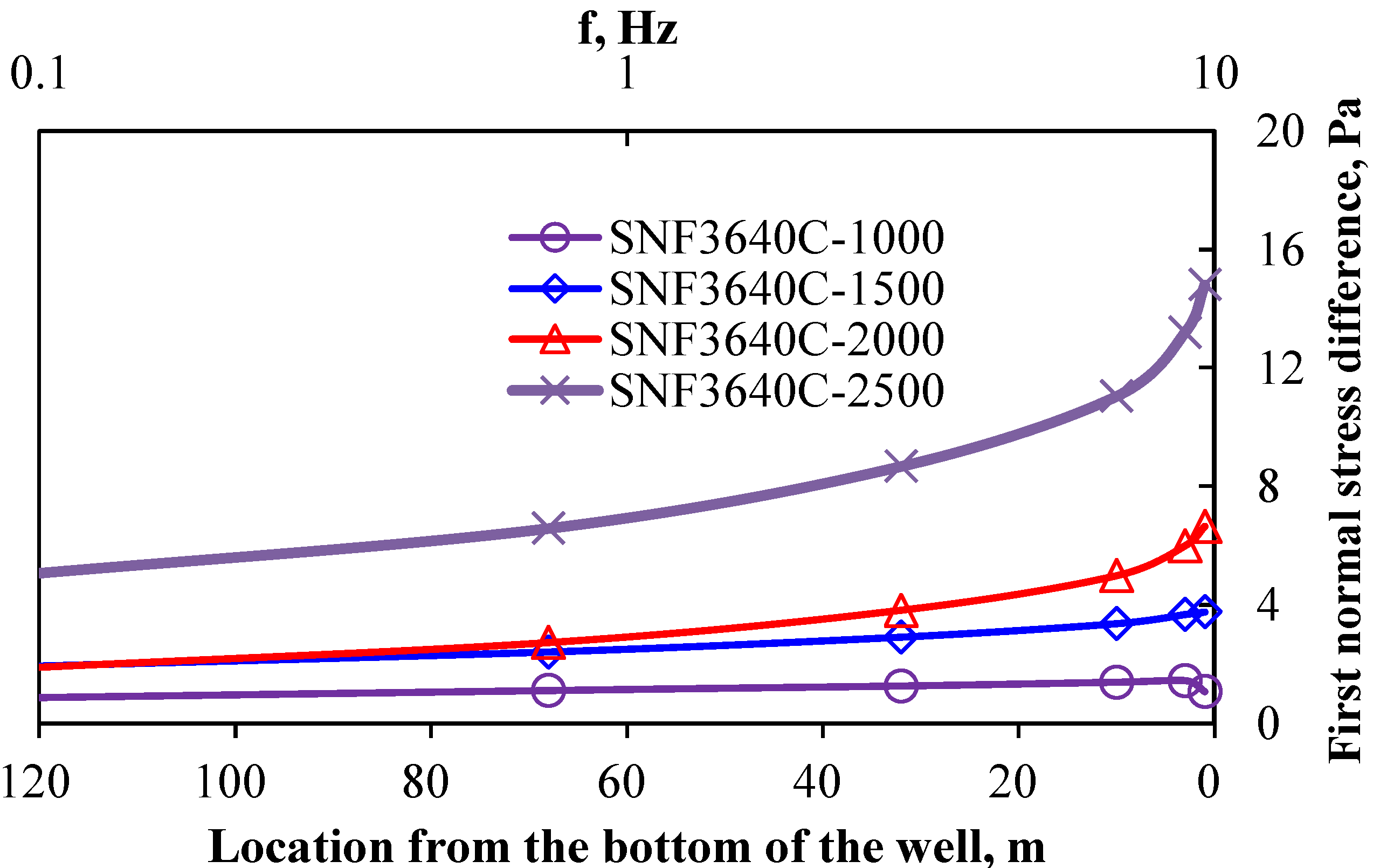
The first normal stress variation relationship after injecting polymer solution into the formation is shown in Figure 5.
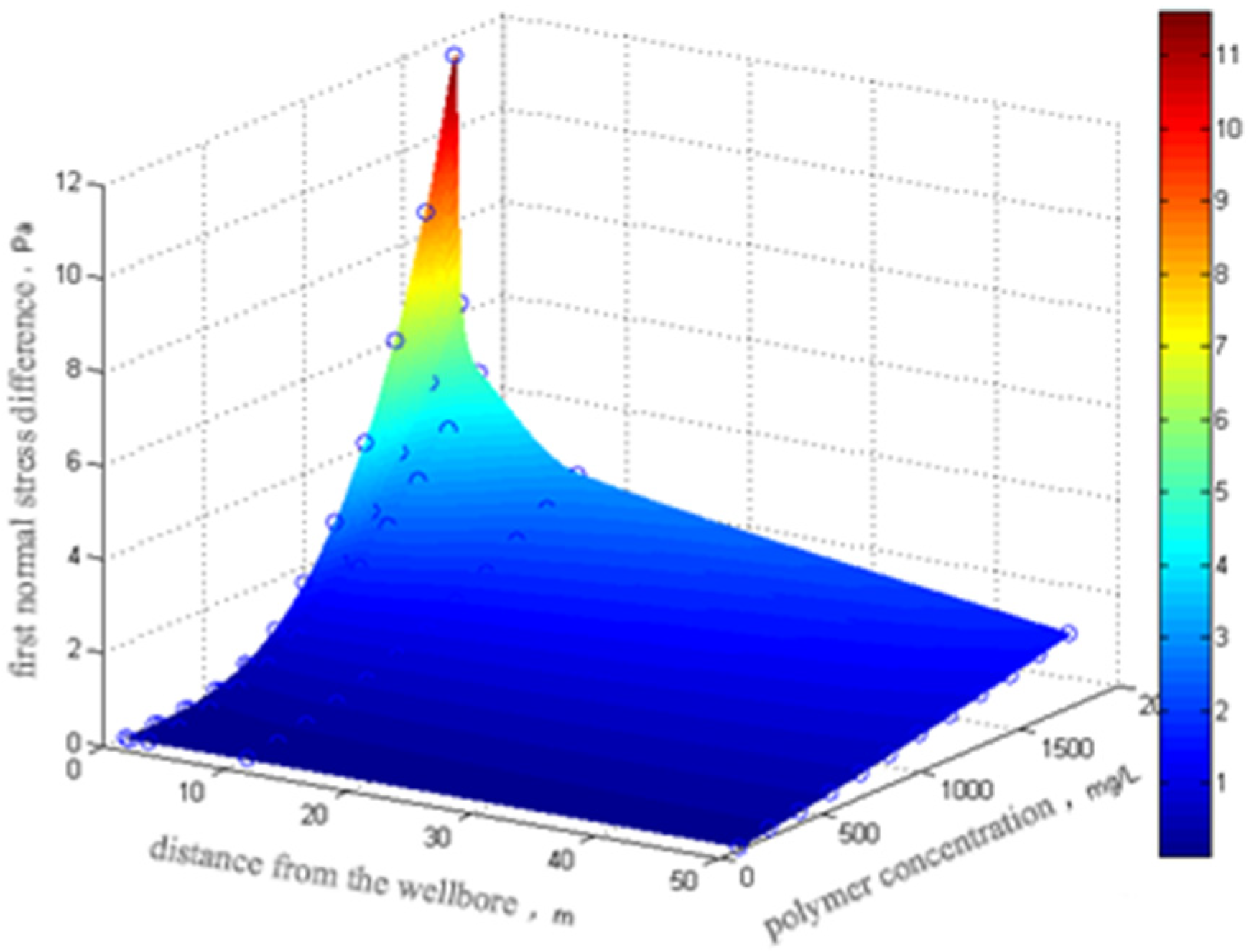
Analysis of the first normal stress difference (N1) for polymer SNF3640C (produced by Aisen Company in France, Product Code) indicates the following: At low concentrations, 1000 and 1500 mg/L, N1 exhibits limited enhancement with increasing oscillation frequency. Under high-concentration conditions, 2000 and 2500 mg/L, N1 demonstrates substantial amplification, conferring pronounced elastic characteristics. Near the wellbore, SNF3640C maintains significant N1 values despite continuous polymer concentration fluctuations during injection/production cycles. Based on the established concentration profile of the injected polymer system’s previous sequence, N1 was analyzed as a function of both concentration and radial distance from the wellbore, as shown in Figure 6 [22,23].
As depicted in Figure 6, increasing injection duration correlates with progressive elevation of polymer concentration and concomitant enhancement of the first normal stress difference (N1). This trend signifies intensified viscoelastic effects within the porous medium. With increasing propagation distance, the superficial flow velocity diminishes, resulting in gradual reduction in N1. Consequently, the primary function of the polymer system in subsurface formations remains viscoelastic flow control in high-concentration, high-shear-rate regions—specifically the near-wellbore zone. Figure 6 further demonstrates that despite propagation to 50 m reservoir depth, the polymer maintains sufficient concentration to exhibit discernible viscoelastic response.

3. Viscoelastic Characteristics of Polymers Under Infiltration Experiments

To investigate viscoelastic flow behavior in porous media, SNF3640C—a polymer exhibiting enhanced viscoelastic properties—was selected as the representative viscoelastic fluid. The solution concentration was 1500 mg/L, yielding an apparent viscosity of 64 mPa·s. For comparative analysis, 70% glycerol, with an apparent viscosity of 65 mPa⋅s, served as the viscous Newtonian control fluid. This experimental design maintains near-identical apparent viscosities across displacement systems, enabling isolation of elasticity effects during oil displacement efficiency studies.

3.1. Pressure Characteristics of Viscoelastic Polymers in Porous Media

Permeation characteristics of polymer solutions in porous media were evaluated using conventional experimental methods [24,25]. Injection pressure profiles were quantified at flow rates of 0.1, 1, and 10 mL/min. The classical Darcy’s law was employed to calculate displacement pressures for a pure viscous glycerol system under identical injection conditions. Comparative analysis of pressure differentials between the glycerol control and polymer systems enables assessment of elastic flow resistance development across injection velocities. Results are presented in Table 3.
Table 3 demonstrates that 65 mPa⋅s glycerol injected at 0.1 mL/min yields an injection pressure of 0.0087 MPa when calculated via Darcy’s law for the target core medium. Under identical conditions, the polymer system exhibits significantly elevated injection pressure relative to the glycerol system. This differential confirms viscoelastic response during polymer permeation through porous media, establishing greater flow resistance than purely viscous fluids. The resultant pressure differential manifests this phenomenon. During viscoelastic fluid transport in porous media, pore-throat geometries induce extensional deformation—distinct from viscous fluid behavior. This generates elastic stresses and enhanced flow resistance, thereby enhancing displacement-front control.

3.2. Seepage Characteristics of Polymer Solutions Under Variable Velocity Conditions

Permeation behavior of viscoelastic polymer solutions was characterized across incremental flow rates using the following experimental protocol [26,27]: (1) Polymer solution was injected into crude oil-saturated cores (K = 2000 mD) at an initial rate of 0.1 mL/min until pressure stabilization. (2) Flow rates were sequentially increased to 0.2, 0.5, 1, 2, 5, and 10 mL/min following pressure equilibration at each preceding rate. (3) Injection pressures were recorded throughout all stages. Subsequent water flooding commenced at 0.1 mL/min, with stepwise rate increases at 0.2–10 mL/min implemented after each pressure stabilization. Corresponding injection pressures were documented. Resistance and residual resistance coefficients, RF and RRF, were calculated from pressure data using Equations (3) and (4). Effective viscosity (μeff = μviscous + μelastic) was then determined via Formula (5), serving as the metric for quantifying polymer viscoelasticity within porous media [28,29].
RF = Pp/Pw
RRF = Kwb/Kwa
μ = RF/RRF
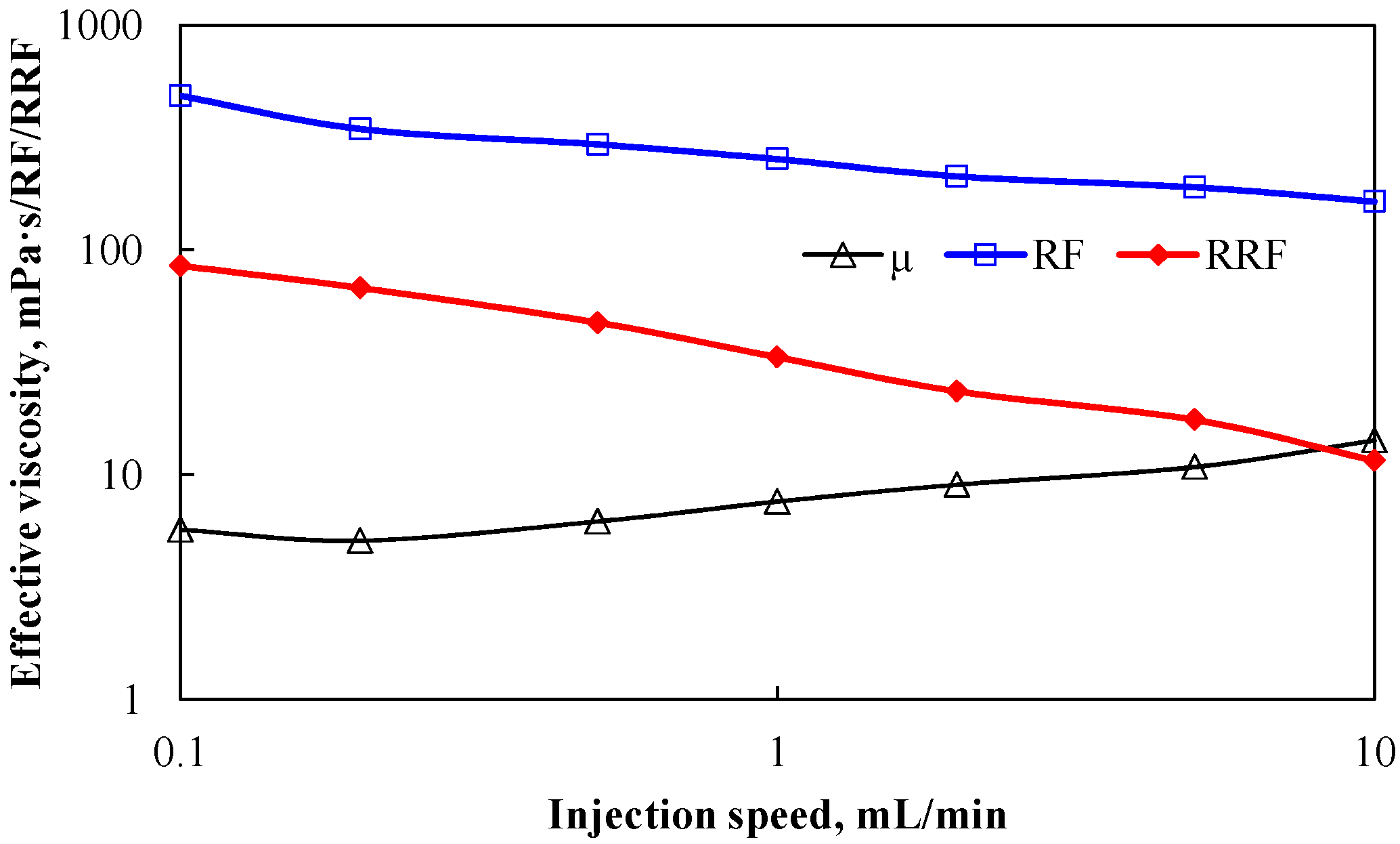
Based on the experimental data and the summary calculation of Formulas (3)–(5), the experimental results in Figure 7 were obtained, which shows the effective viscosity of the polymer solution in porous media.
As injection rate increases, both RF and RRF for polymer solutions in porous media demonstrate decreasing trends. Analysis indicates viscosity-dominated flow behavior at low rates, where shear thinning reduces RF. The RRF decline is attributed to attenuated polymer adsorption retention at elevated velocities. The calculated effective viscosity (μeff) exhibits a gradual increase, primarily resulting from RF’s slower decline relative to RRF. Alternatively, this progression is attributable to enhanced elastic contributions (μelastic) at higher injection rates, driving μeff elevation. This methodology resolves experimental challenges in quantifying effective viscosity and provides a quantitative metric for polymer permeation characteristics. Results further confirm that polymer flow behavior in porous media is governed by interdependent factors—including media properties, injection parameters, and solution rheology—requiring comprehensive consideration when evaluating viscoelastic effects under specified conditions.

4. Study on Influence of Viscoelasticity on Oil Displacement Effect

4.1. Oil Displacement Experiment Design

To mitigate diffusion and dilution artifacts during glycerol displacement, cores measuring 25 × 800 mm were selected, with average porosity of 29–32 [30,31,32]. The displacement protocol excluded initial water flooding to prevent leading-edge dilution and omitted post-displacement water flooding to avoid concentration degradation behind the displacement front. Displacement agent was continuously injected into oil-saturated cores until effluent production ceased (the crude oil has a viscosity of 70 mPa·s after degassing and dehydration under ground conditions; by saturating crude oil with variable flow rates, saturation experiments were completed, specifically by saturating it with 0.1 mL/min, 0.2 mL/min, 0.5 mL/min, 1 mL/min, 2 mL/min, and 5 mL/min for 4 h, 2 h, 1 h, 0.5 h, 0.2 h, and 0.1 h, respectively). Based on established effective viscosity characteristics of polymer solutions in porous media, five injection rates were selected to simulate reservoir positions: wellbore-proximal region (5 mL/min); near-wellbore zone (1 mL/min); 2 m radial distance (0.5 mL/min); 10 m radial distance (0.1 mL/min); and 100 m radial distance (0.01 mL/min). The experimental core data statistics are shown in Table 4.

4.2. The Influence of Viscoelasticity on Oil Displacement Effect

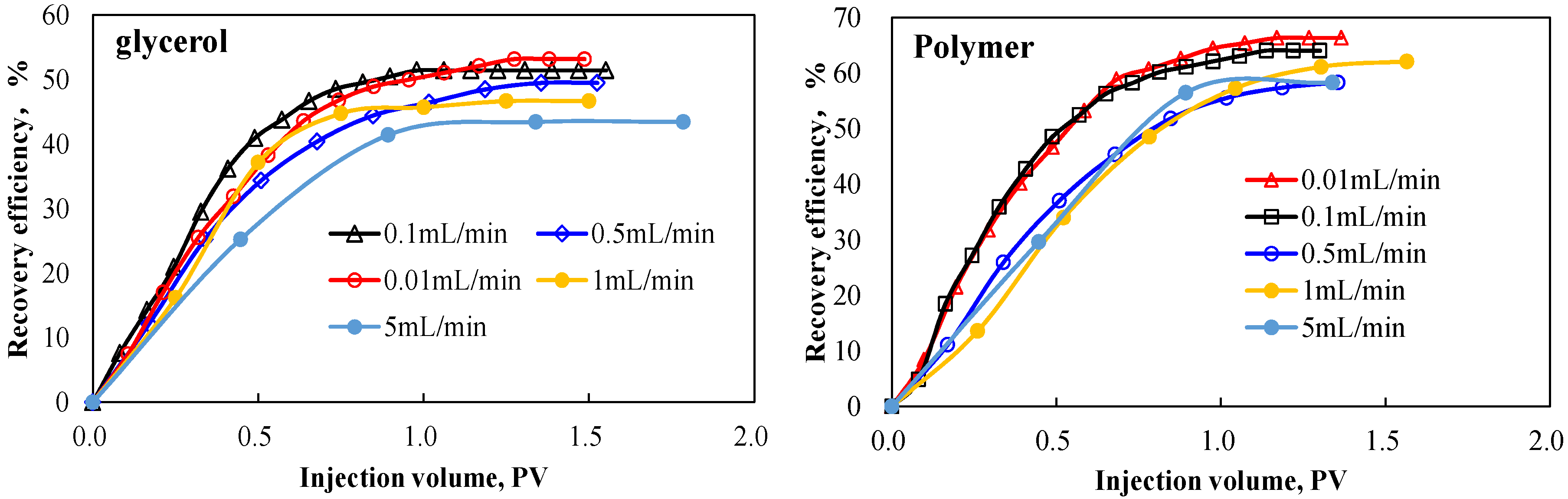
Comparison of oil displacement efficiency between glycerol and polymer solutions at different displacement rates is shown in Figure 8 and Table 5.
Polymer SNF3640C demonstrates significantly higher oil displacement efficiency than the glycerol system at elevated injection rates, with minimal efficiency disparity observed at 0.5 mL/min. Displacement efficiency for glycerol progressively decreases with increasing injection rate, exhibiting the most pronounced decline at higher velocities. The polymer system attained peak efficiency 62.14 at 1 mL/min, surpassed only by performance at 0.1 mL/min and 0.01 mL/min. This demonstrates that injection rate critically governs the activation and manifestation of polymer viscoelasticity in porous media, confirming that viscoelastic properties significantly enhance heavy-oil recovery efficiency.

5. Conclusions

(1) Following the injection of polymer solution into the reservoir, the solution encounters varying shear rates during radial flow, leading to distinct viscoelastic characteristics at different spatial positions. As propagation continues outward, the effective concentration of the solution progressively diminishes, resulting in a corresponding reduction in its elastic properties. Consequently, polymer solutions demonstrate superior viscoelastic characteristics within the near-wellbore region, whereas their capacity to provide the strong viscoelasticity essential for effective flow control in deeper reservoir regions diminishes significantly.
(2) The viscosity evolution of polymer solutions during seepage through porous media deviates from conventional shear-thinning rheological behavior observed in laboratory settings. The solution’s viscosity is influenced by its elastic properties, with the fundamental trend under elevated flow velocities being an increase in effective viscosity with increasing shear rate.
(3) Viscoelastic polymer solutions exhibit enhanced flow control capabilities within porous media through elastic effects, which further improves heavy-oil recovery efficiency compared to viscosity control alone. Moreover, the efficacy of the viscoelastic effect in porous media is directly proportional to its contribution to enhanced oil recovery efficiency.

Author Contributions

Conceptualization, S.Z. and X.J.; methodology, Y.C.; formal analysis, Y.Z. and L.C.; resources, J.Z.; data curation, X.D.; writing—original draft preparation, S.Z., Y.Z., and J.Z.; writing—review and editing, Y.C. and X.J.; project administration, J.Z.; funding acquisition, S.Z. All authors have read and agreed to the published version of the manuscript.

Funding

This project was funded by the China Postdoctoral Science Foundation (2023M744278) and Science and Technology Research Project of Chongqing Education Commission (KJQN202301518).

Institutional Review Board Statement

Not applicable.

Data Availability Statement

The original contributions presented in this study are included in the article. Further inquiries can be directed to the corresponding author.

Conflicts of Interest

Authors Lijun Chen and Jie Zhang were employed by the company Sinopec Zhongyuan Petrochemical Co., Ltd. Author Xueli Duan was employed by the company Binzhou Inspection and Testing Center. The remaining authors declare that the research was conducted in the absence of any commercial or financial relationships that could be construed as potential conflicts of interest. The funding sponsors had no role in the design of the study; in the collection, analyses, or interpretation of data; in the writing of the manuscript; and in the decision to publish the results.

References

  1. Levitt, D.; Jouenne, S.; Bondino, I.; Santanach-Carreras, E.; Bourrel, M. Polymer Flooding of Heavy Oil Under Adverse Mobility Conditions. In Proceedings of the SPE Enhanced Oil Recovery Conference, Kuala Lumpur, Malaysia, 2–4 July 2013; Society of Petroleum Engineers: Richardson, TX, USA, 2013; p. SPE165267. [Google Scholar]
  2. Wang, S.; Shi, L.; Ye, Z.; Wang, Y.; Liu, C.; Xue, X. Microscopic experimental study on the sweep and displacement efficiencies in heterogeneous heavy oil reservoirs. Energy Rep. 2021, 7, 1627–1635. [Google Scholar] [CrossRef]
  3. Guo, M.; Yu, H.; Zhou, C.; Jia, Z.; Huang, W.; Guo, S.; Zhang, P.; Pan, B.; Wang, Y. Seepage flow characteristics and ability for enhanced oil recovery based on ultra high molecular weight partially hydrolysed polyacrylamide. Int. J. Oil Gas Coal Technol. 2017, 14, 216–231. [Google Scholar] [CrossRef]
  4. Malkin, A.Y.; Subbotin, A.V.; Kulichikhin, V.G. Stability of polymer jets in extension: Physicochemical and rheological mechanisms. Russ. Chem. Rev. 2020, 89, 811–823. [Google Scholar] [CrossRef]
  5. Baumgaertel, M.; Schausberger, A.; Winter, H.H. The relaxation of polymers with linear flexible chains of uniform length. Rheol. Acta 1990, 29, 400–408. [Google Scholar] [CrossRef]
  6. Wang, J.; Liu, H. Anovel model sensitivity analysis for viscoelastic polymer flooding in offshore oilfield. J. Ind. Eng. Chem. 2014, 20, 656–667. [Google Scholar] [CrossRef]
  7. Subbotin, A.V.; Malkin, A.Y.; Kulichikhin, V.G. The Elasticity of Polymer Melts and Solutions in Shear and Extension Flows. Polymers 2023, 15, 1051. [Google Scholar] [CrossRef]
  8. Vinogradov, G.V.; Malkin, A.Y. Rheology of Polymers; Springer: Berlin/Heidelberg, Germany, 1980. [Google Scholar]
  9. Malkin, A.Y.; Petrie, C.J.S. Some conditions for rupture of polymer liquids in extension. J. Rheol. 1997, 41, 1–25. [Google Scholar] [CrossRef]
  10. Münstedt, H. Extensional Rheology and Processing of Polymeric Materials. Int. Polym. Process. 2018, 33, 594–618. [Google Scholar] [CrossRef]
  11. Malkin, A.; Arinstein, A.; Kulichikhin, V. Polymer extension flows and instabilities. Prog. Polym. Sci. 2014, 39, 959–978. [Google Scholar] [CrossRef]
  12. Kulichikhin, V.G.; Malkin, A.Y. The Role of Structure in Polymer Rheology: Review. Polymers 2022, 14, 1262. [Google Scholar] [CrossRef]
  13. Anurag, P.; Qamar, S.F.; Das, S.; Basu, S.; Kesarwani, H.; Saxena, A.; Sharma, S.; Sarkar, J. Advanced multi-wall carbon nanotube-optimized surfactant-polymer flooding for enhanced oil recovery. Fuel 2024, 355, 129463. [Google Scholar]
  14. Cheng, Y.; Chang, H.; Du, Z.; Yuan, B.; Dandekar, A.; Zhang, Y. A laboratory investigation of CO2 influence on solvent-assisted polymer flooding for improving viscous oil recovery on Alaska North Slope. Geoenergy Sci. Eng. 2023, 229, 212053. [Google Scholar] [CrossRef]
  15. Cao, J.; Hu, M.; Cheng, Y.; Wang, Z.; Zhang, H.; Chen, R.; Guo, J. Design of high-temperature salt-responsive hydrogel based on W/O/W double emulsion. Colloids Surf. A Physicochem. Eng. Asp. 2025, 717, 136852. [Google Scholar] [CrossRef]
  16. Mohsen, M.Y.; Pouyan, E.B.; Pacelli, Z. Fundamentals and Recent Progress in the Flow of Water-Soluble Polymers in Porous Media for Enhanced Oil Recovery. Energies 2022, 15, 8575. [Google Scholar] [CrossRef]
  17. Siegbert, R.; Behr, M.; Elgeti, S. Die swell as an objective in the design of polymer extrusion dies. In AIP Conference Proceedings; AIP Publishing: Melville, NY, USA, 2016; Volume 1769, p. 140003. [Google Scholar] [CrossRef]
  18. Zhang, J.; Dan, L.; Wang, L. Application of horizontal well discontinuous chemical flooding technology in Bohai Oilfield. Front. Energy Res. 2023, 10, 1036835. [Google Scholar] [CrossRef]
  19. Hao, H.; Tan, L. The Characteristic of Oil and Gas Accumulation and Main Factors of Reservoir Enrichment in SZ36-1 Region. Appl. Mech. Mater. 2015, 737, 859–862. [Google Scholar]
  20. Liu, Y.; Meng, X.; Zhang, Y.; Xia, H.; Cao, B.; Luo, Y. Numerical simulation of separate-layer injection-production effect and its influencing factors in offshore oilfield -by taking SZ36-1 oilfield in Bohai sea as an example. Pet. Geol. Eng. 2020, 34, 95–101. [Google Scholar]
  21. Xue, X.; Zhu, S.; Ma, X.; Zhang, S.; Yang, S.; Huang, Z.; Xu, M.; Huang, H. Enhancing heavy-oil displacement efficiency through viscoelasticity of polymer solution by investigating the viscosity limit of crude oil: An experimental study. Energy Sci. Eng. 2024, 12, 2493–2504. [Google Scholar] [CrossRef]
  22. Xue, X. Study on the Influence of Rheological Properties of Polymer Solutions on Enhanced Oil Recovery. Doctoral Thesis, Southwest Petroleum University, Chengdu, China, 2009. [Google Scholar]
  23. Tedde, G.M.; Santo, L.; Bellisarbo, D.; Quandini, F. Frozen Stresses in Shape Memory Polymer Composites. Mater. Plast. 2022, 55, 2018494. [Google Scholar] [CrossRef]
  24. Zhang, X.; Sun, F.; Xie, X.; Kang, X.D.; Li, B.Z. Reservoir technical-economic limit of polymer flooding and classification in Bohai Sea. China Offshore Oil Gas 2014, 26, 51–54. [Google Scholar]
  25. Zhu, S.; Xu, M.; Yang, S.; Huang, Z.; Wang, Y.; Zhu, Y. Evaluation of shear resistance of dendritic hydrophobic association polymers. J. Polym. Res. 2024, 31, 318. [Google Scholar] [CrossRef]
  26. Jiao, G.; Zhu, S.; Wang, J.; Huang, Z.; Xu, M. Feasibility of Oil Mud Reinjection from Offshore Platforms in Bohai Oilfield. J. Basic Appl. Sci. 2023, 19, 68–76. [Google Scholar] [CrossRef]
  27. Alves, M.; Oliveira, P.; Pinho, F. Numerical Methods for Viscoelastic Fluid Flows. Annu. Rev. Fluid Mech. 2021, 53, 509–541. [Google Scholar] [CrossRef]
  28. Wang, S.; Shi, L.; Ye, Z.; Zhang, X.; Zhang, L.; Li, X. Experimental study on improving oil recovery in fluvial reservoir with polymer solutions. AIP Adv. 2021, 11, 055121. [Google Scholar] [CrossRef]
  29. Browne, C.A.; Datta, S.S. Elastic turbulence generates anomalous flow resistance in porous media. Sci. Adv. 2021, 7, eabj2619. [Google Scholar] [CrossRef]
  30. Zhu, S.; Zhang, S.; Xue, X.; Zhang, J.; Xu, J.; Liu, Z. Influencing factors for effective establishment of residual resistance factor of polymer solution in porous media. J. Polym. Res. 2022, 29, 210. [Google Scholar] [CrossRef]
  31. Shi, L.; Zhu, S.; Zou, J.; Xue, X.; Zhao, W.; Ye, Z. Research on the Time Range and Influencing Factors of Effective Flow Control in Polymer Flooding. Pet. Reserv. Eval. Dev. 2019, 9, 31–35. [Google Scholar]
  32. Zang, L.; Hu, M.; Cao, J.; Cheng, Y.; Li, P.; Guo, J.; Zhang, H. Design of Janus Nanoparticles for Mobility Control in Heterogeneous Reservoirs. ACS Omega 2024, 9, 16536–16546. [Google Scholar] [CrossRef] [PubMed]
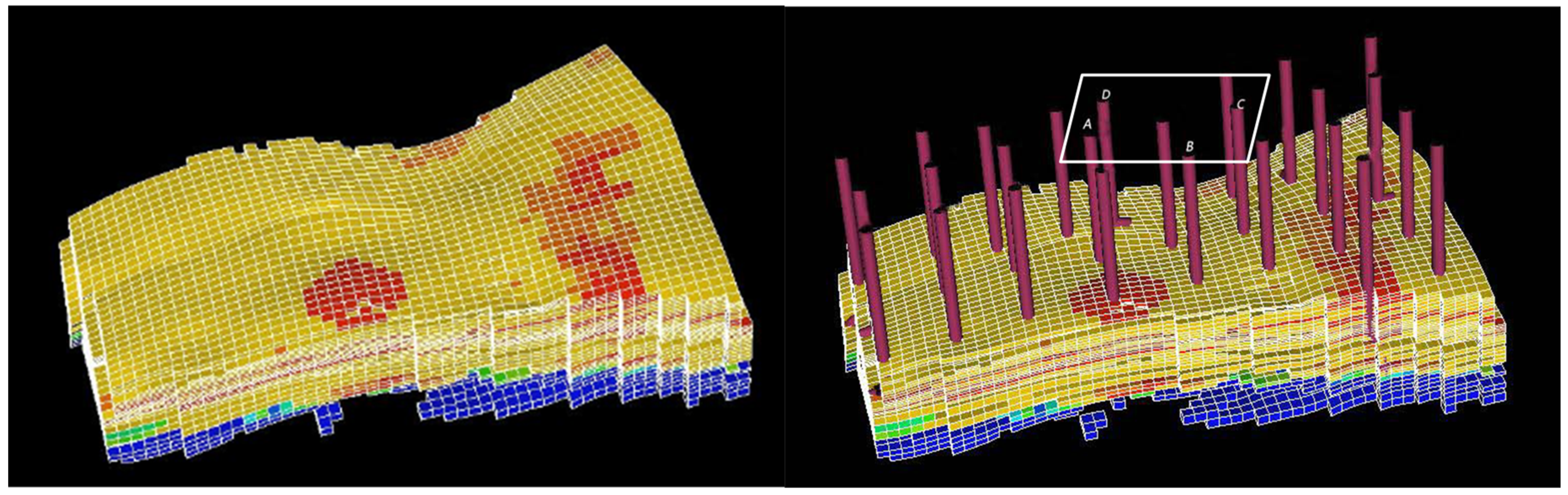
Figure 1. Geological model of the target block.
Polymers 18 00002 g001
Figure 2. Relative concentration changes in polymer solution at different positions and times.
Polymers 18 00002 g002
Figure 3. Concentration changes during polymer injection process.
Polymers 18 00002 g003
Figure 4. Viscoelasticity of polymer SNF3640C.
Polymers 18 00002 g004
Figure 5. First normal stress difference of polymer SNF3640C.
Polymers 18 00002 g005
Figure 6. First normal stress difference after polymer injection.
Polymers 18 00002 g006
Figure 7. Effective viscosity of polymer solution in porous media.
Polymers 18 00002 g007
Figure 8. Oil displacement effect of glycerol and polymer.
Polymers 18 00002 g008
Table 1. Simulation parameters utilized.
TypeParameters
Injection Schemes1. Waterflood baseline: 0.06 PV·a−1 injection rate. 2. Polymer flood: 0.3 PV slug size at 1750 mg/L concentration, 0.06 PV·a−1 injection rate
Reservoir Properties1. Thickness: 200–400 m. 2. Initial pressure: 14.2 MPa. 3. Permeability: 2500 mD, coefficient of variation VK = 0.6. 4. Porosity: 32% average. 5. Initial oil saturation: 56%.
Fluid Properties1. Crude oil viscosity: 65 mPa·s. 2. Oil formation volume factor: 1.11. 3. Injection water salinity: 9374 mg/L. 4. Temperature: 65 °C.
Table 2. Linear velocities and corresponding shear rates at different positions from the bottom of the well.
SegmentationPerforated IntervalNear-Well ZoneExceeding 6 m
Distance from the bottom of the well0.01 m0.3 m0.5 m0.8 m1 m2 m6 m20 m56 m104 m
Linear velocity318.47110.6166.3693.9813.1852.5881.1270.7580.3770.242
shear rate171.5025.7173.4302.1441.7151.3940.6070.4080.2030.13
Table 3. Stable pressure of the system at different injection rates.
Differential Pressure, MPaInjection Rate, mL/min
0.1110
Glycerol0.00870.0870.87
SNF3640C0.42.1611.5
Table 4. Analysis of the oil displacement efficiency of polymer/glycerol at different speeds.
Core
Number
Pore
Volume
Saturated Oil QuantityDisplacing Velocity,
mL/min
PorosityOil
Saturation
Displacement Fluid System
2#12.24610.5 mL0.132.20%0.86glycerol
13#11.89.9 mL0.530.00%0.84glycerol
15#11.39.4 mL0.0128.80%0.83glycerol
21#1210.1 mL132.20%0.84glycerol
22#11.29.4 mL528.50%0.84glycerol
14#12.210.8 mL0.531.08%0.89SNF3640C
16#12.310.7 mL0.0131.30%0.87SNF3640C
27#11.29 mL531.08%0.8SNF3640C
25#11.59.8 mL131.30%0.85SNF3640C
16#12.310.7 mL0.0131.30%0.87SNF3640C
Table 5. Difference in displacement efficiency between glycerol and polymer.
Displacing
Velocity,
mL/min
Oil Displacement Efficiency of GlycerolOil Displacement Efficiency of PolymerDifference
0.0153.19%66.36%13.17%
0.151.43%64.08%12.65%
0.549.49%58.33%8.84%
146.67%62.14%15.47%
543.43%58.33%14.90%
Disclaimer/Publisher’s Note: The statements, opinions and data contained in all publications are solely those of the individual author(s) and contributor(s) and not of MDPI and/or the editor(s). MDPI and/or the editor(s) disclaim responsibility for any injury to people or property resulting from any ideas, methods, instructions or products referred to in the content.