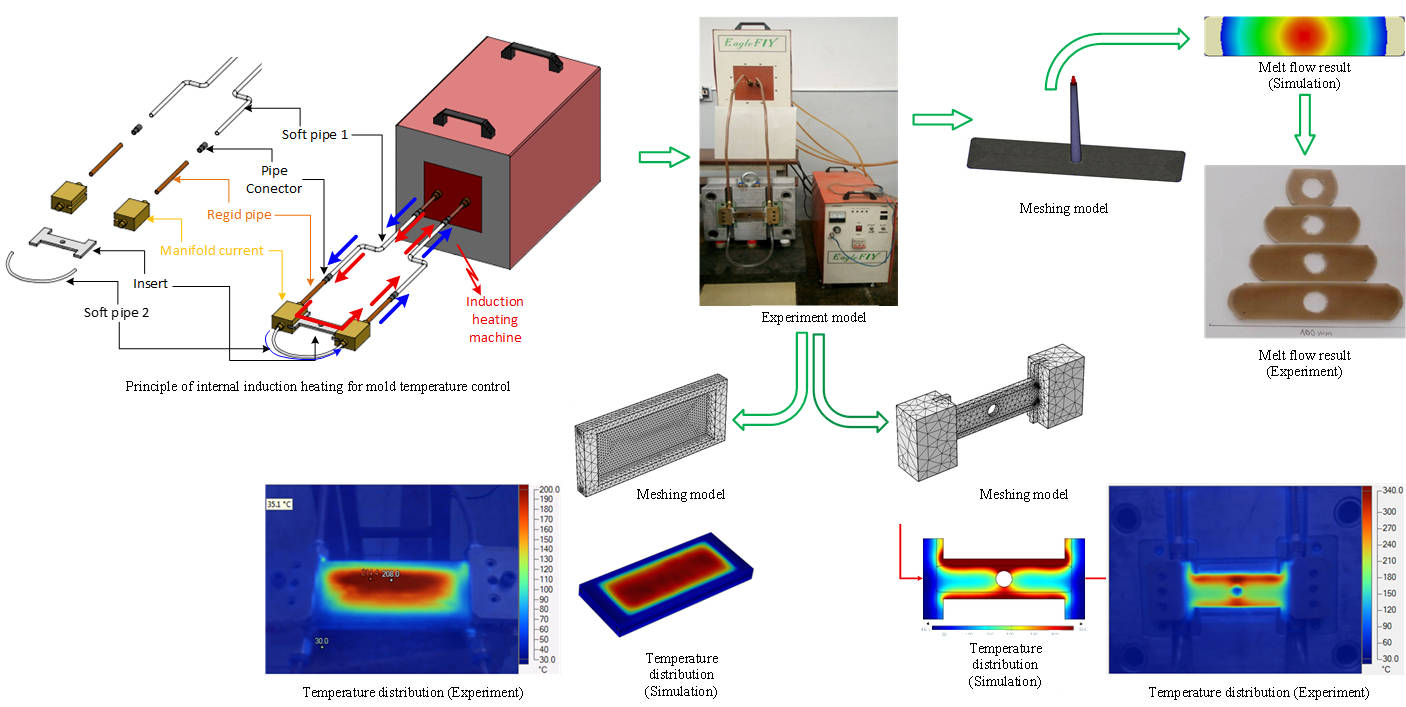
Internal Induction Heating for Local Heating in Injection Molding

 ,
,  , and
, and
Abstract
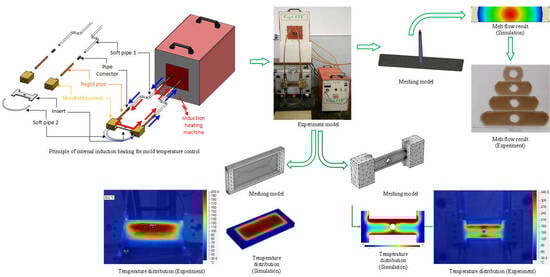
1. Introduction
2. Internal Induction Heating for Injection Mold
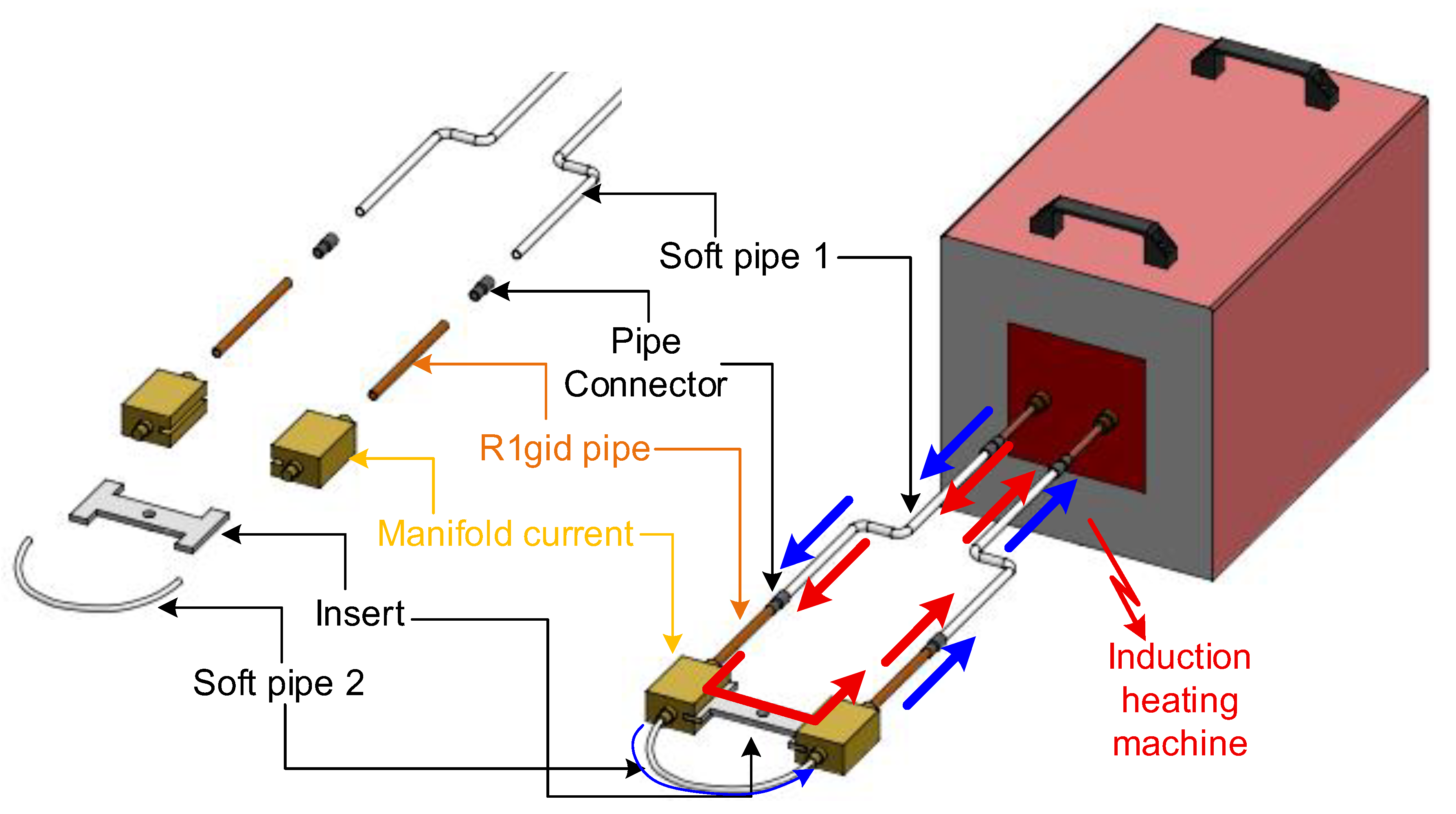
2.1. Internal Induction Heating Method
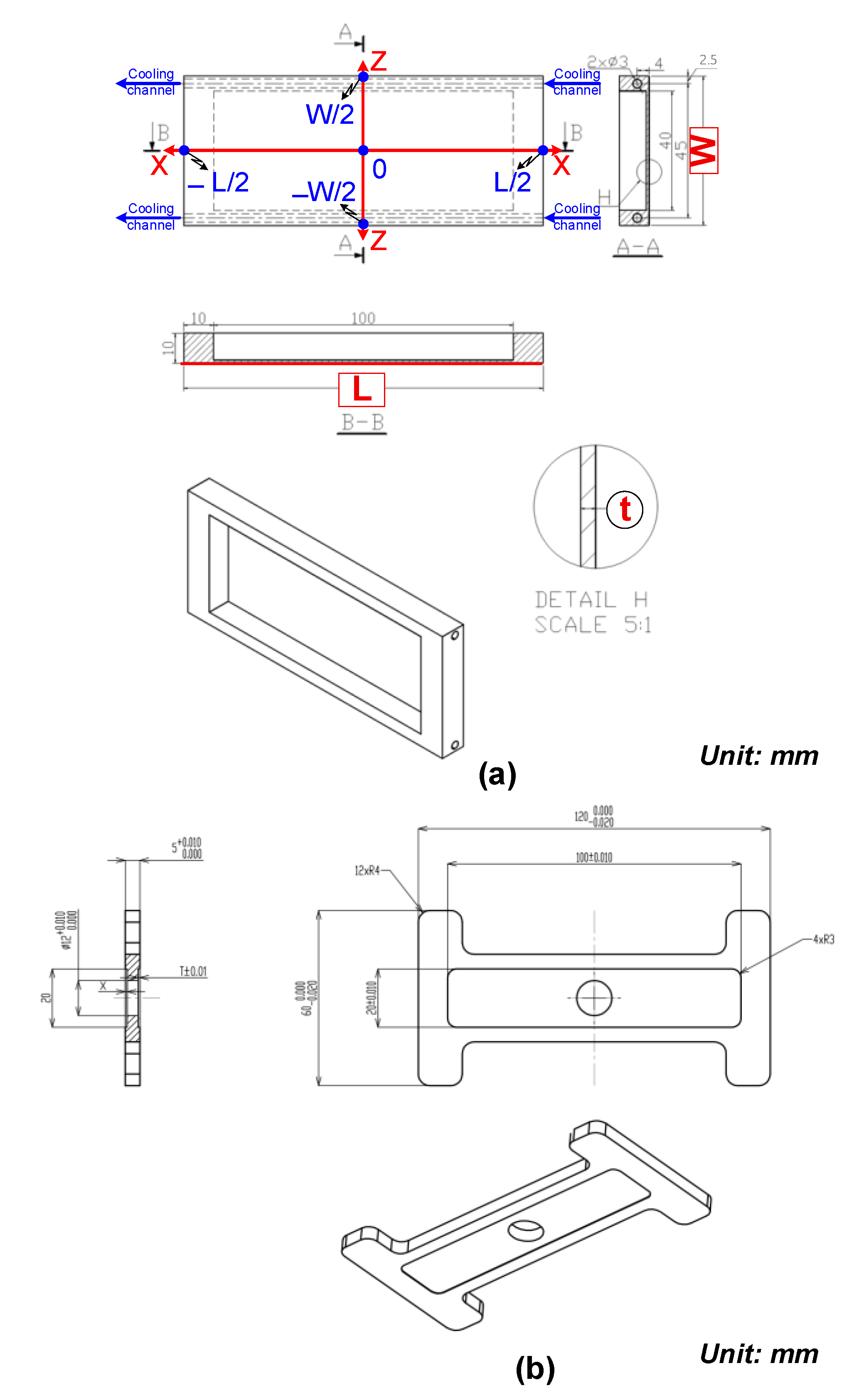
2.2. Simulation Method
2.2.1. Simulation Model of Heating Process
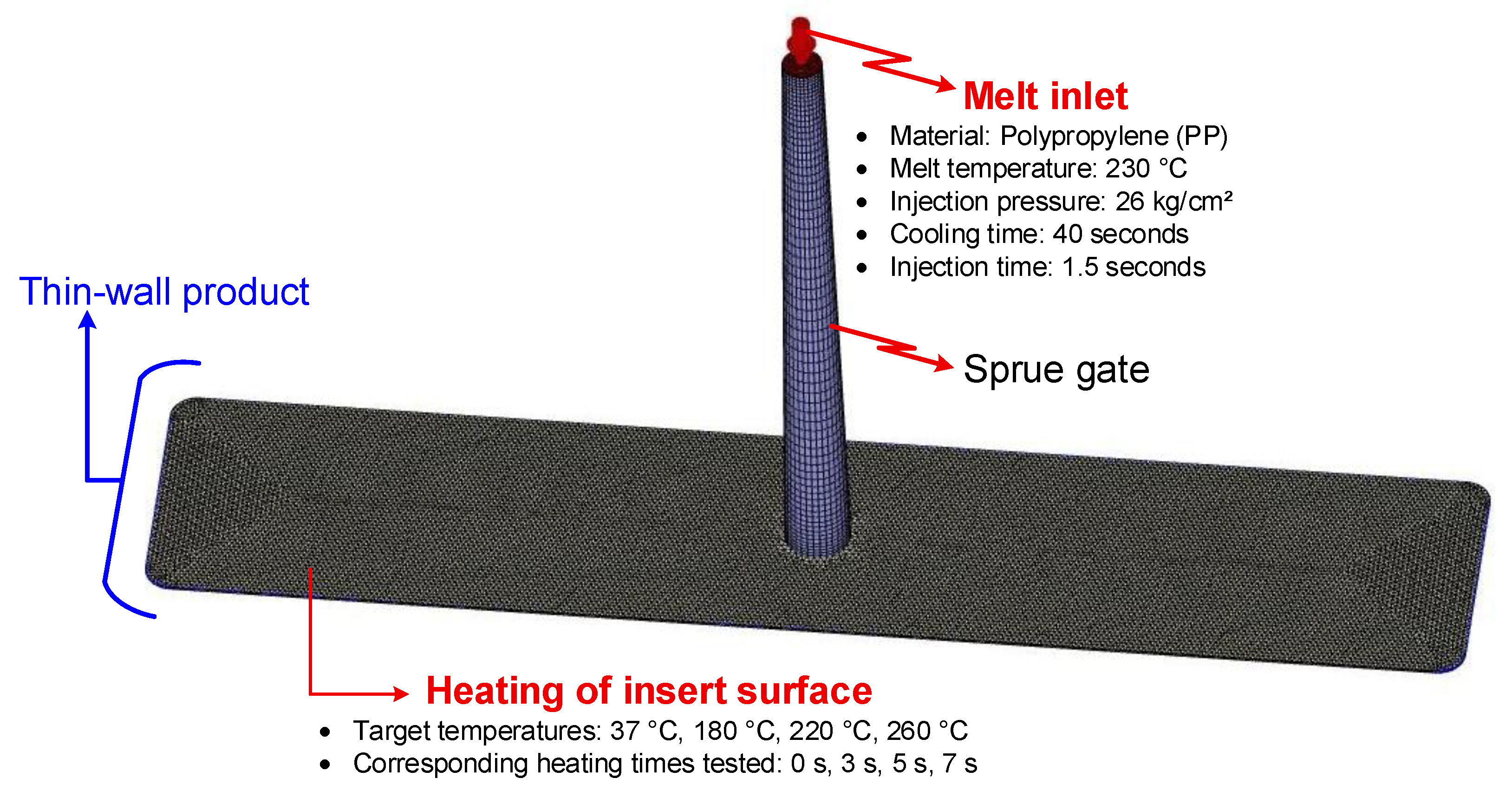
2.2.2. Simulation Model of Molding Process for Thin-Walled Products
2.3. Experimental Method
2.3.1. Heating Process via Internal Induction Heating with the Evaluation Model
2.3.2. Molding Process
3. Results and Discussion
3.1. Local Heating Capability of the Insert Using the Evaluation Model
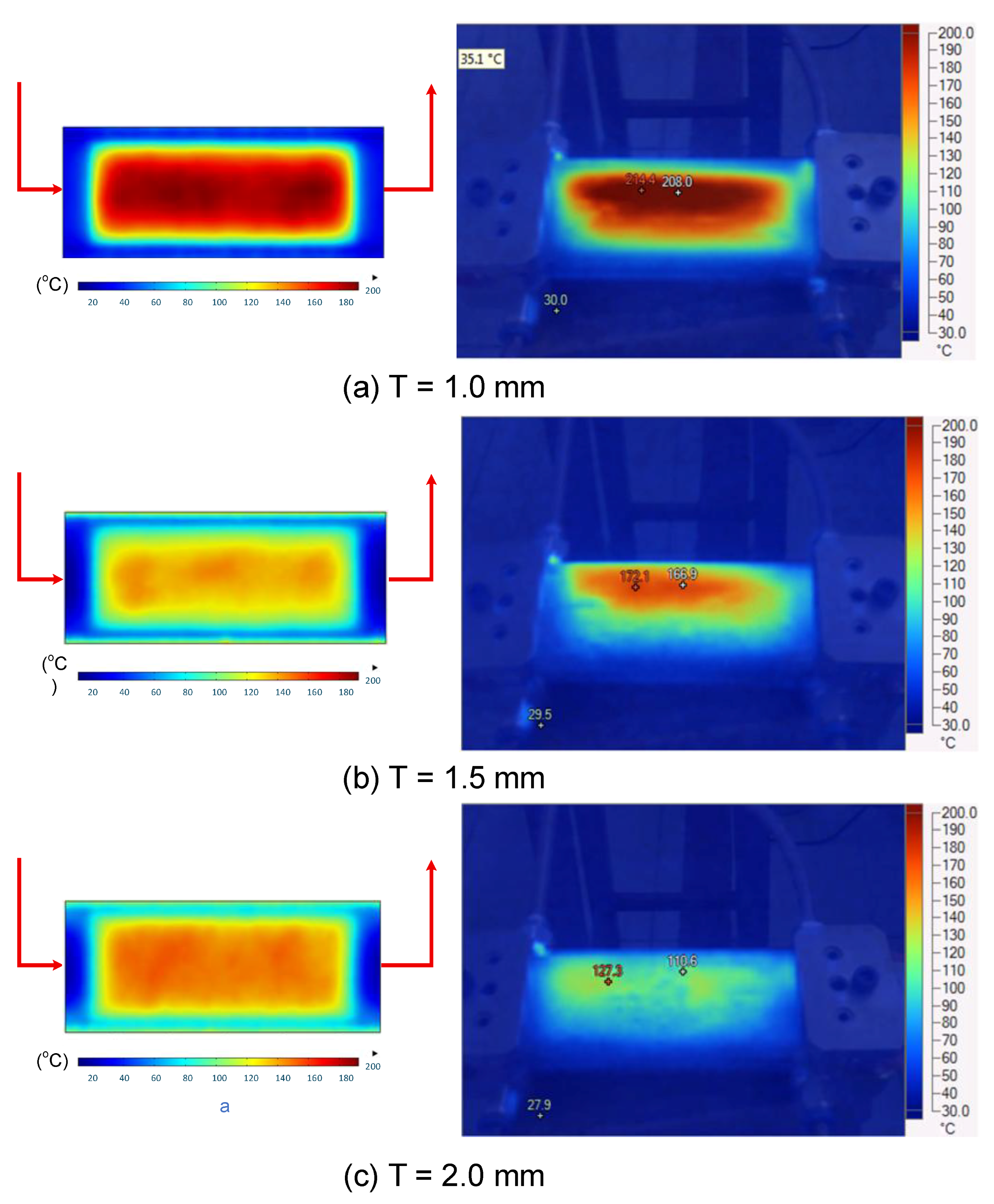
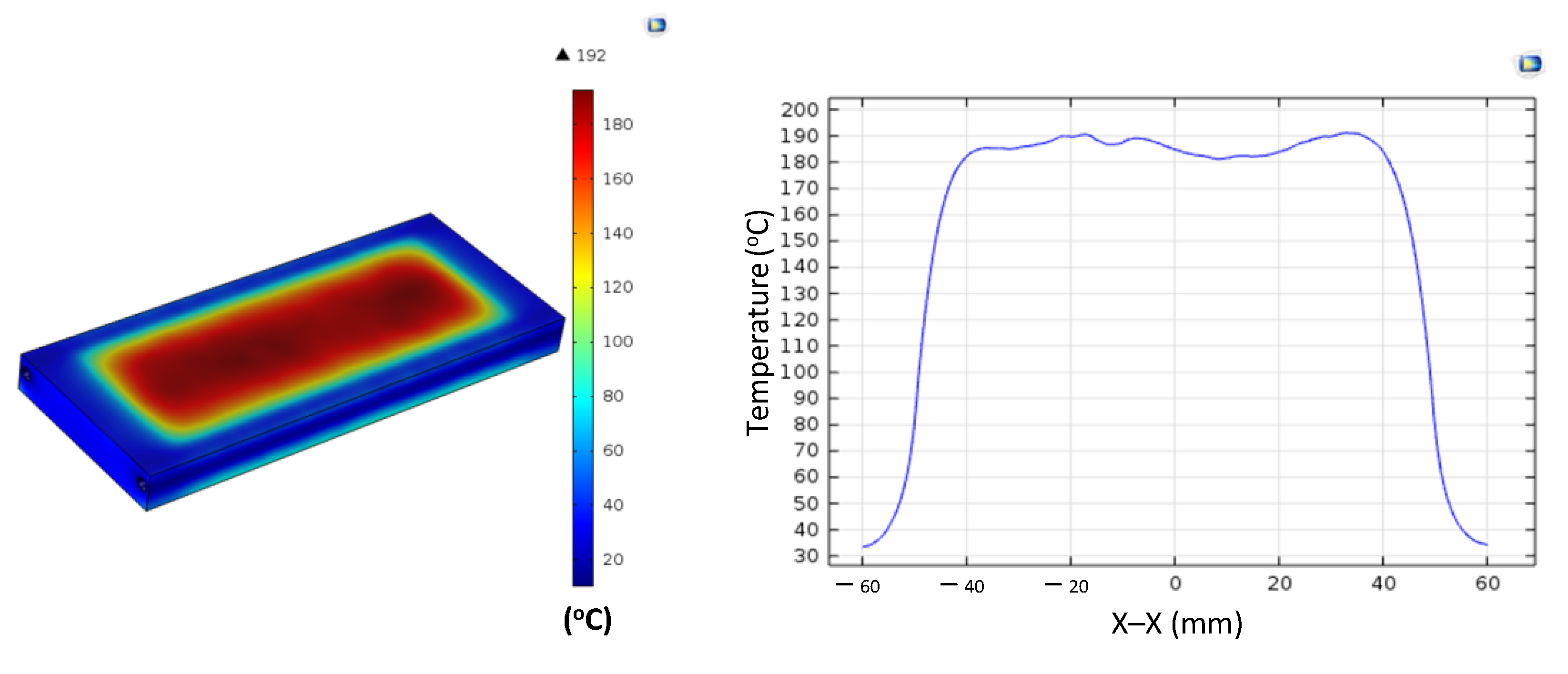
3.1.1. Effect of Insert Thickness (t)
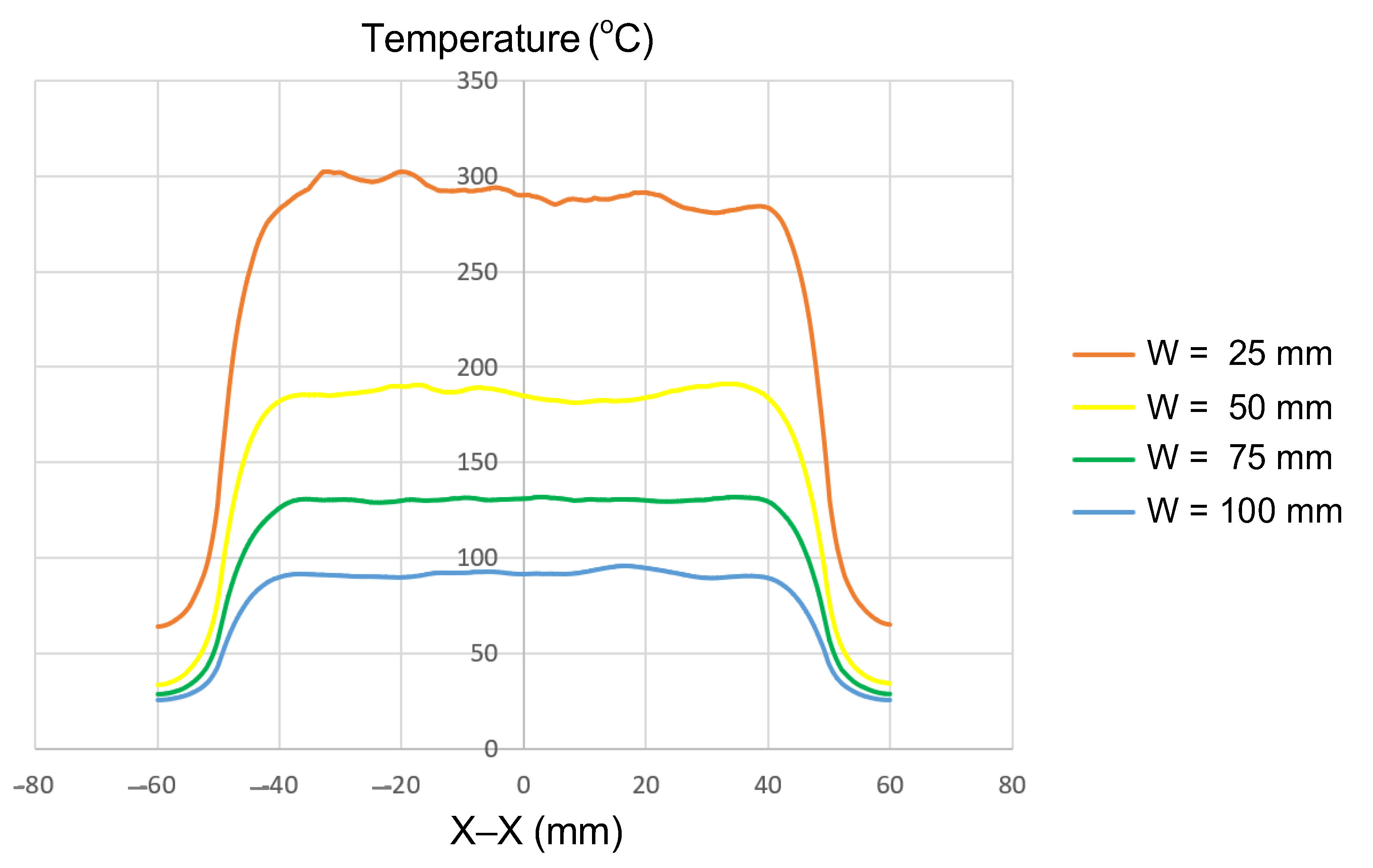
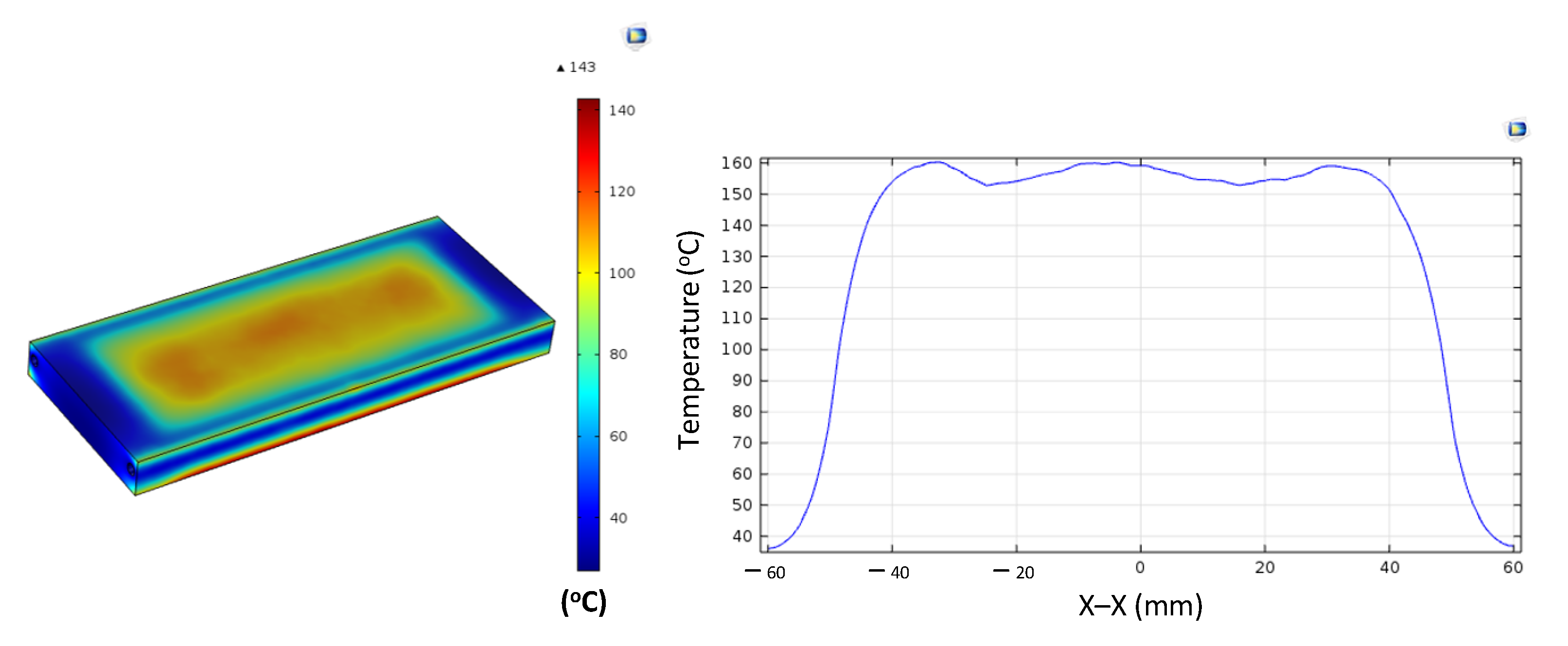
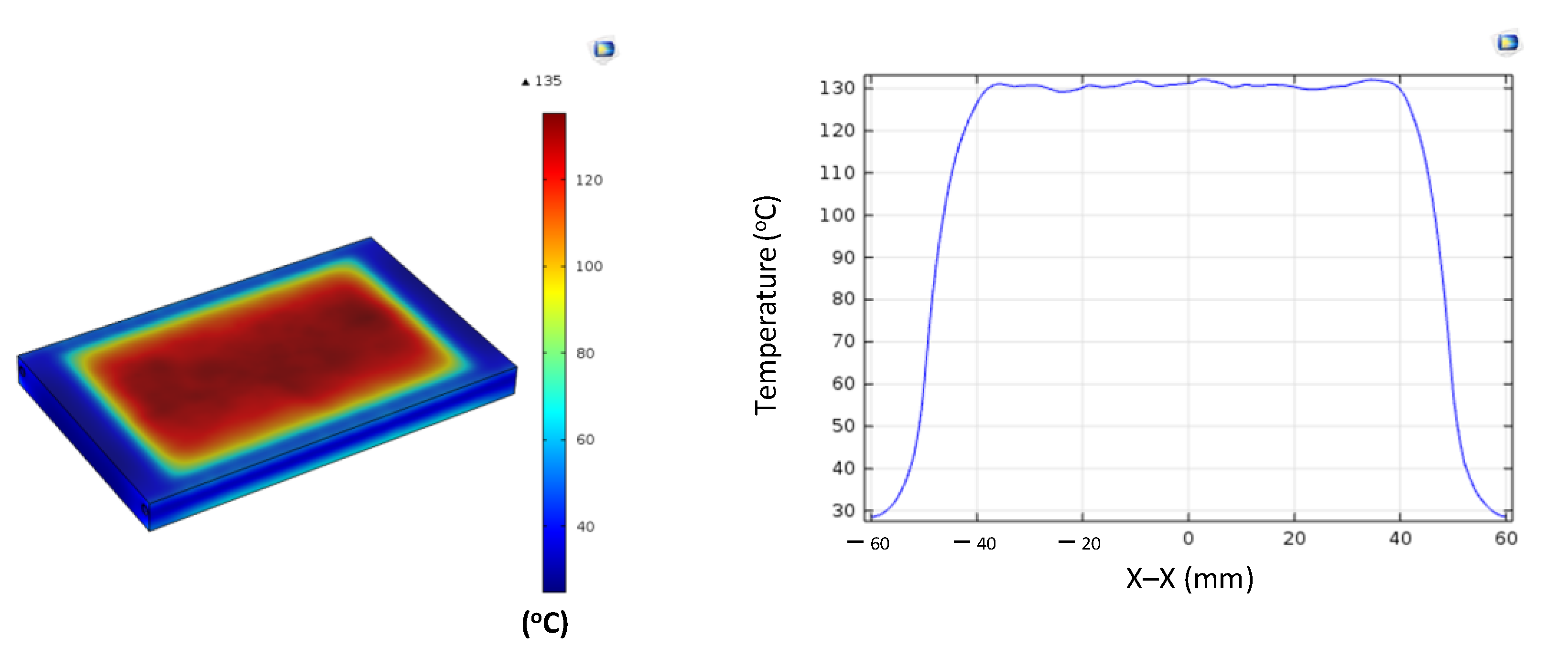
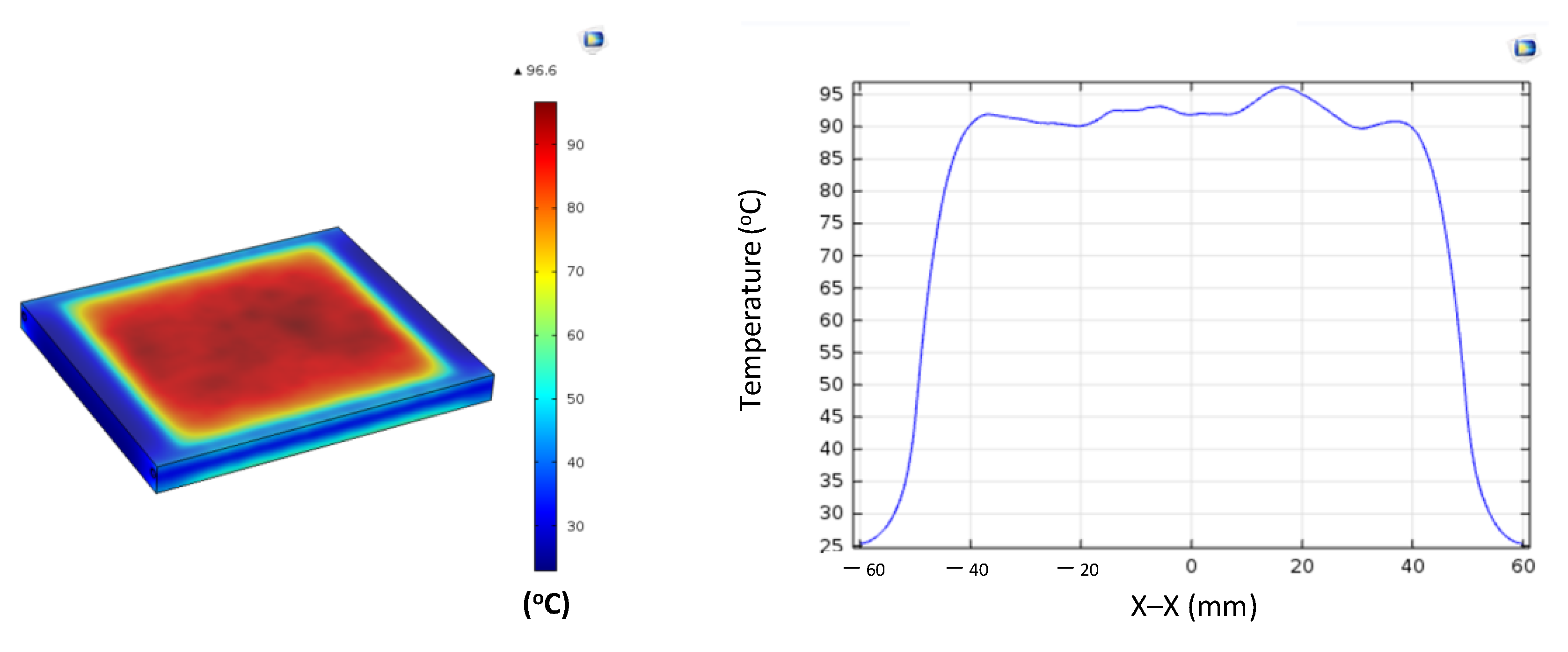
3.1.2. Effect of Insert Width (W)
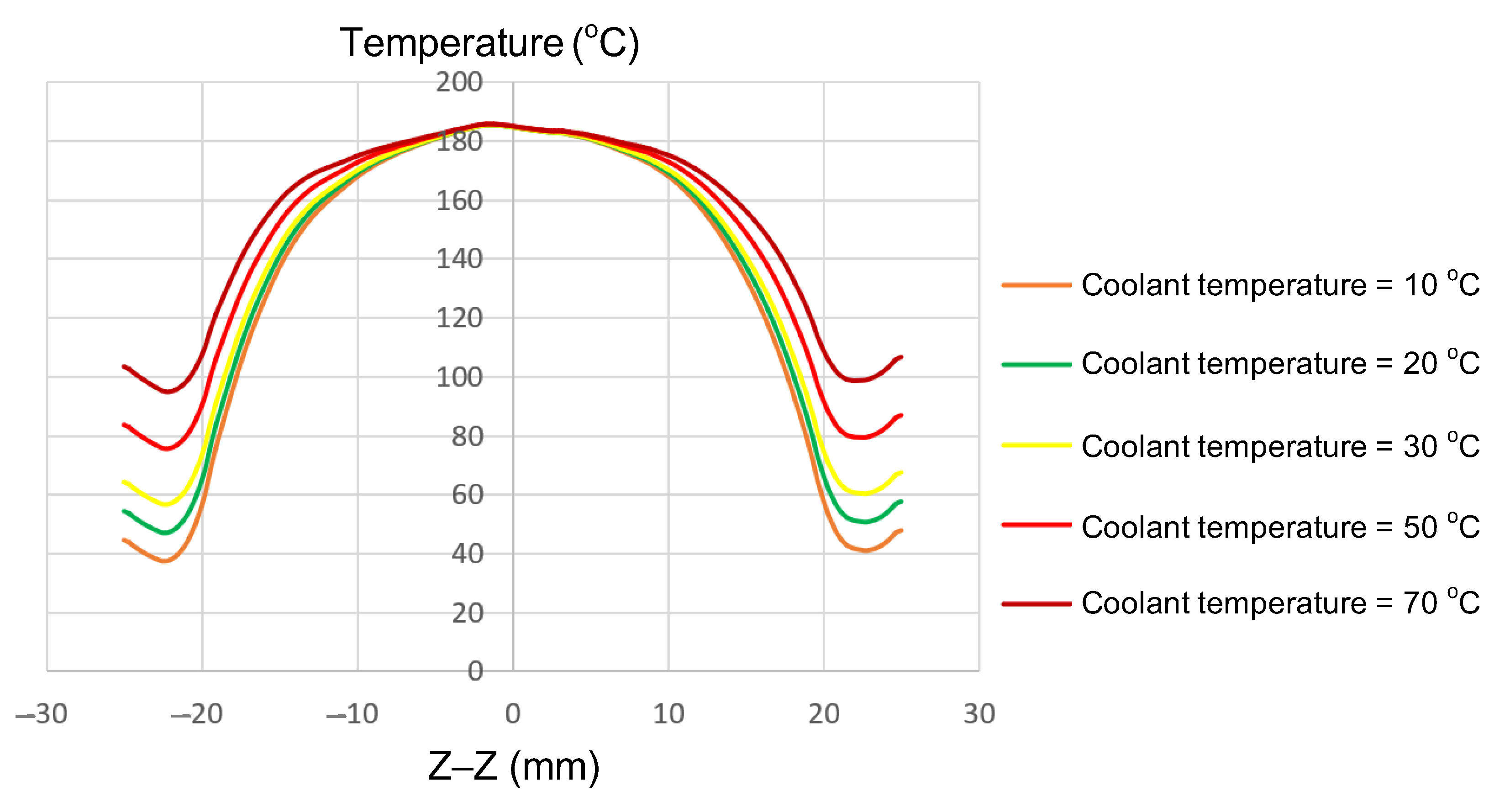
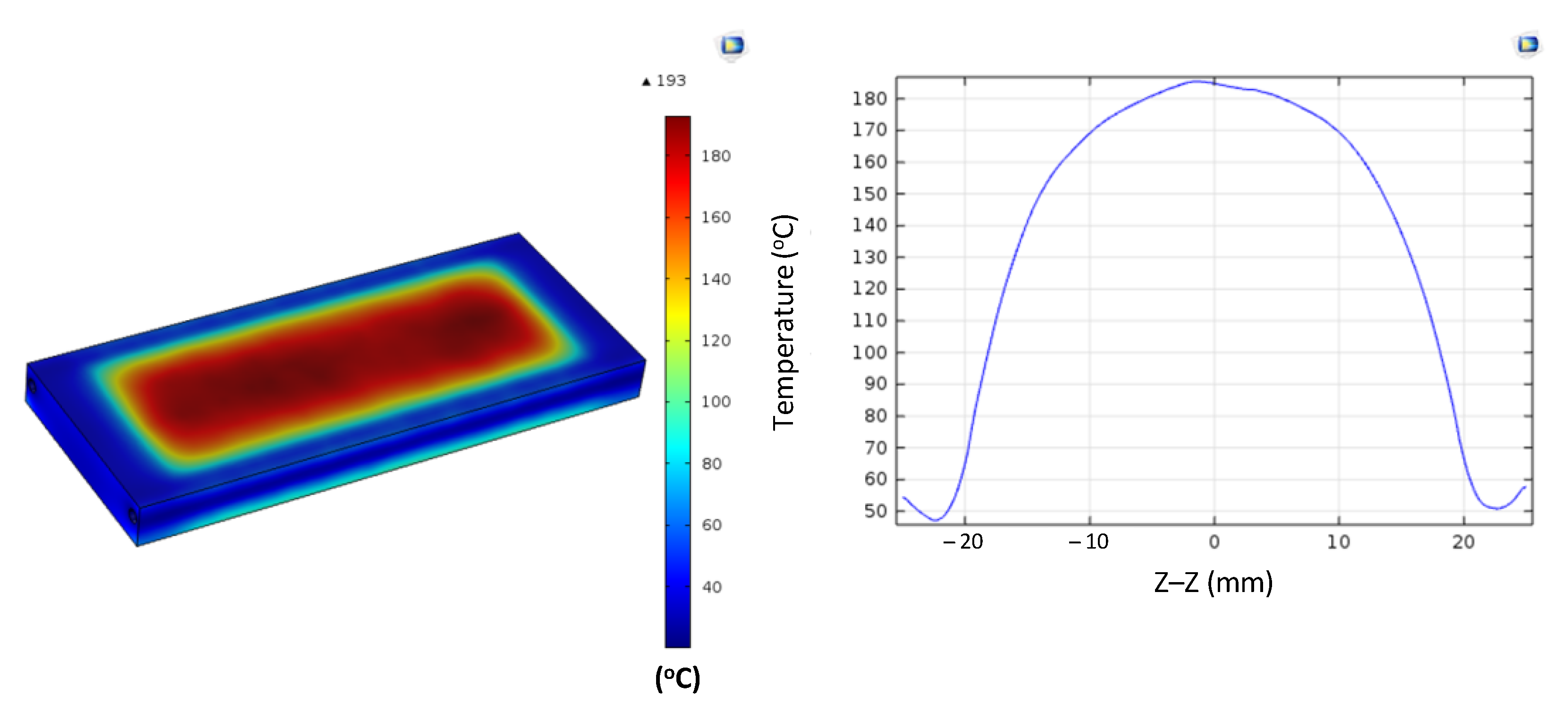
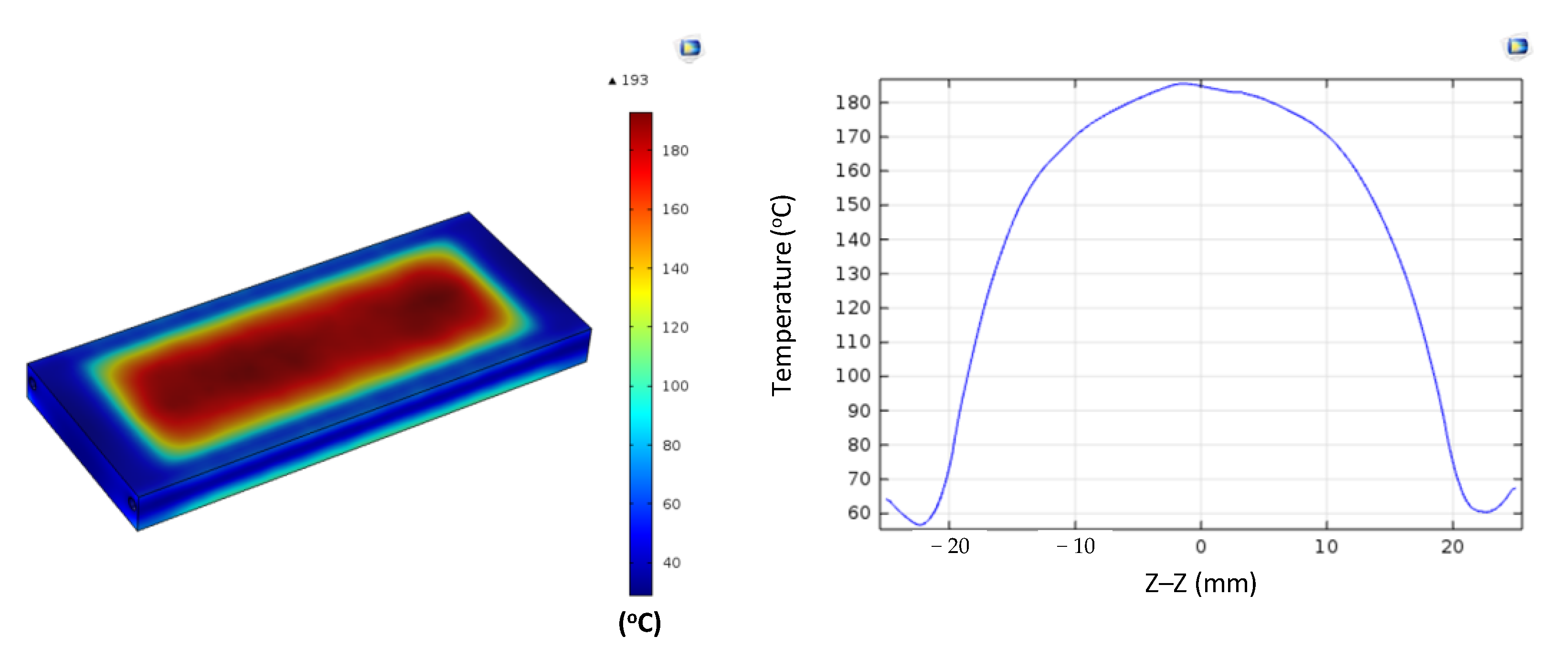
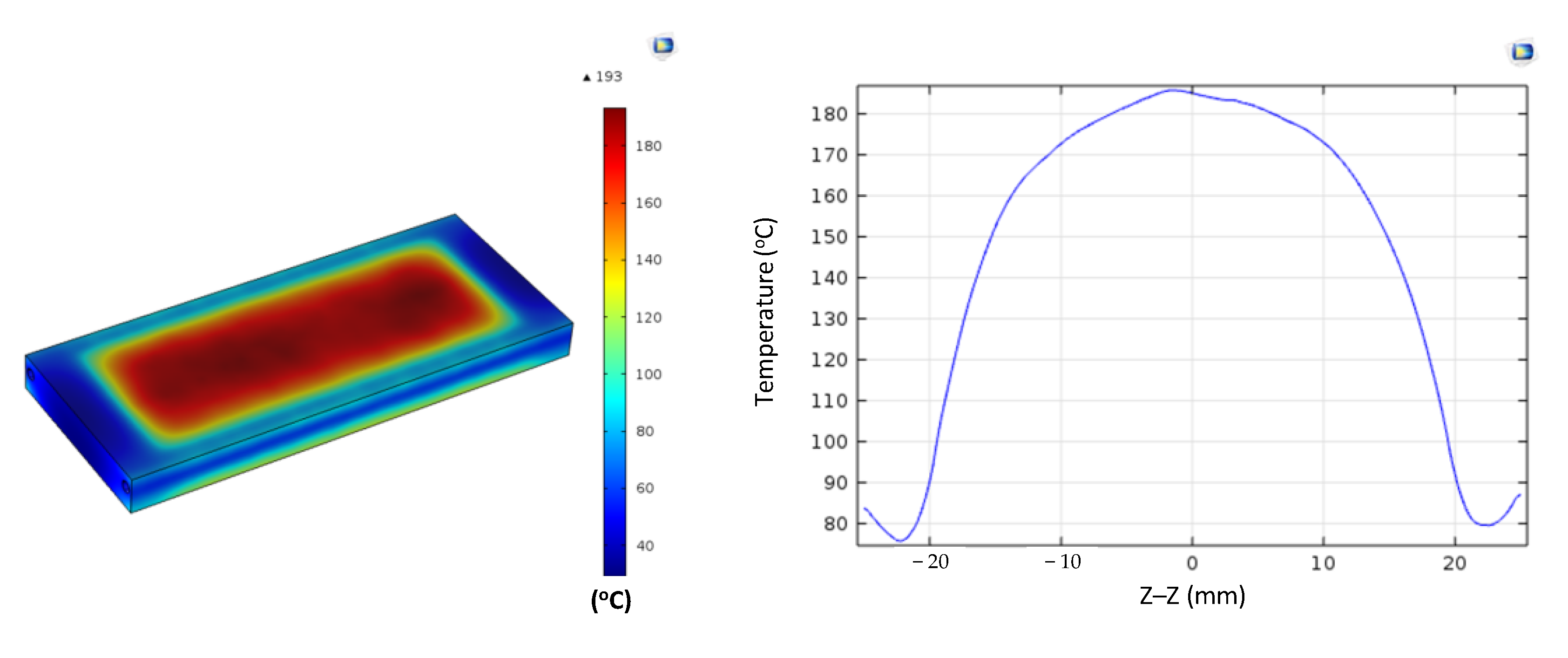
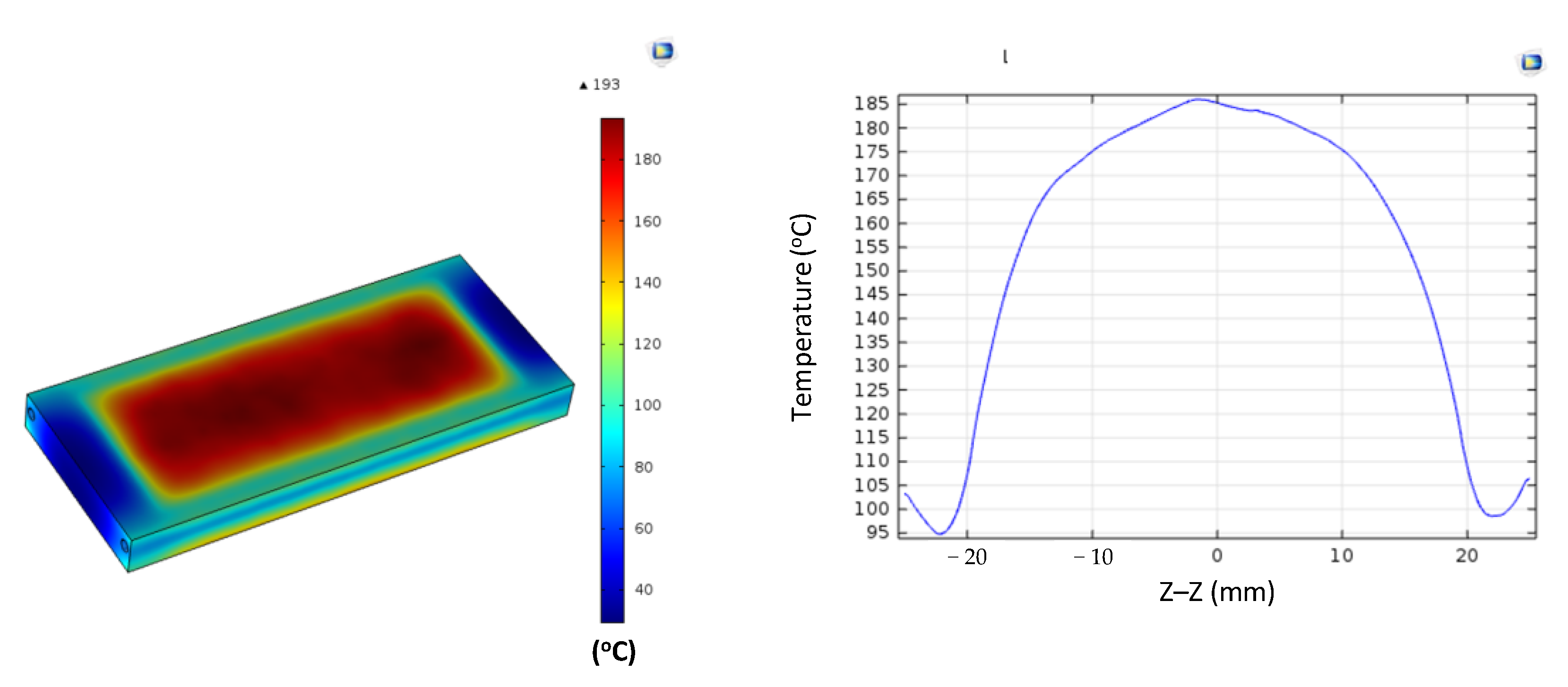
3.1.3. Effect of Coolant Temperature
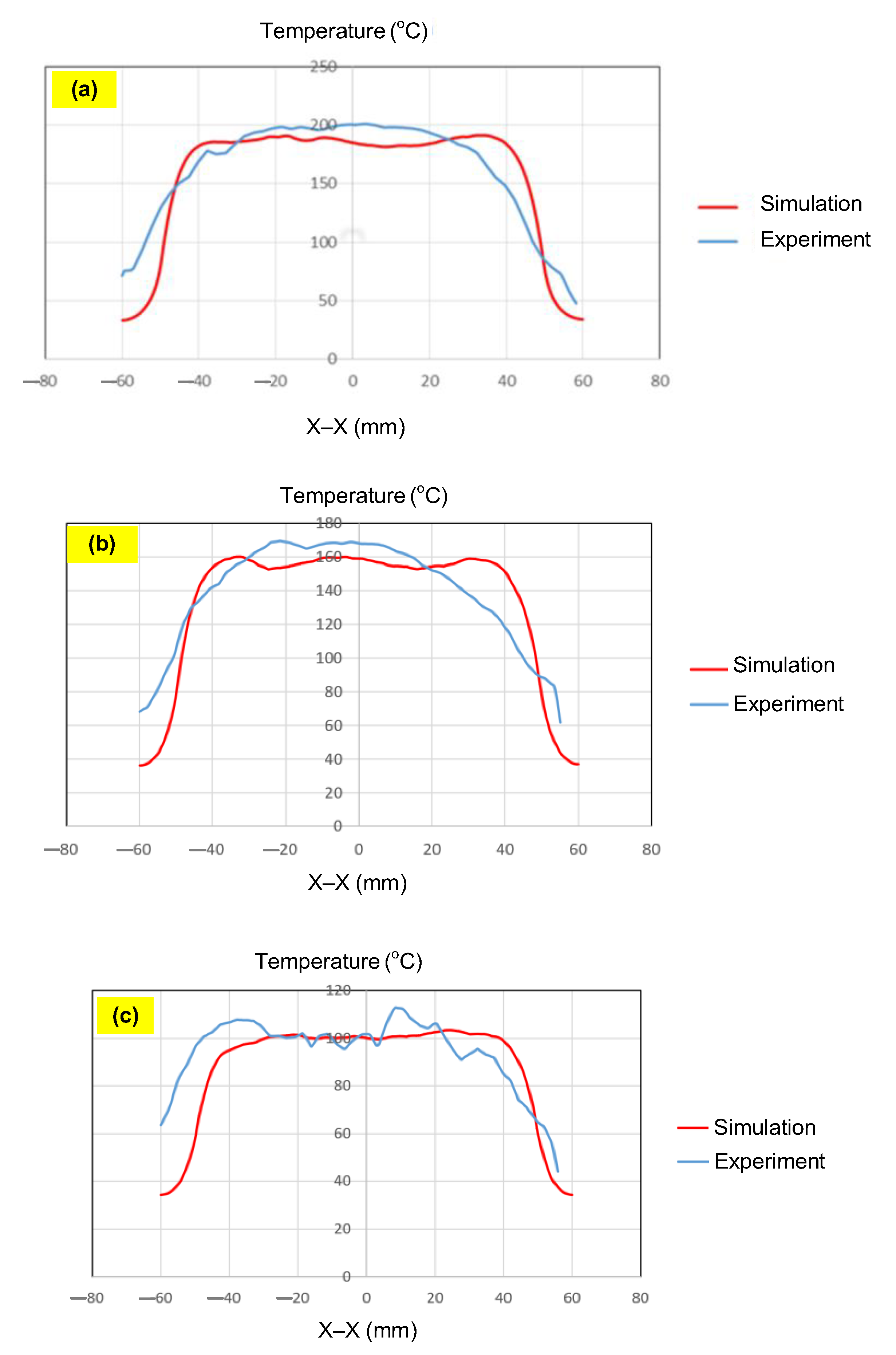
3.1.4. Experimental Verification
3.2. Application of Localized Induction Heating to Enhance Mold Filling in Thin-Walled Injection Molding
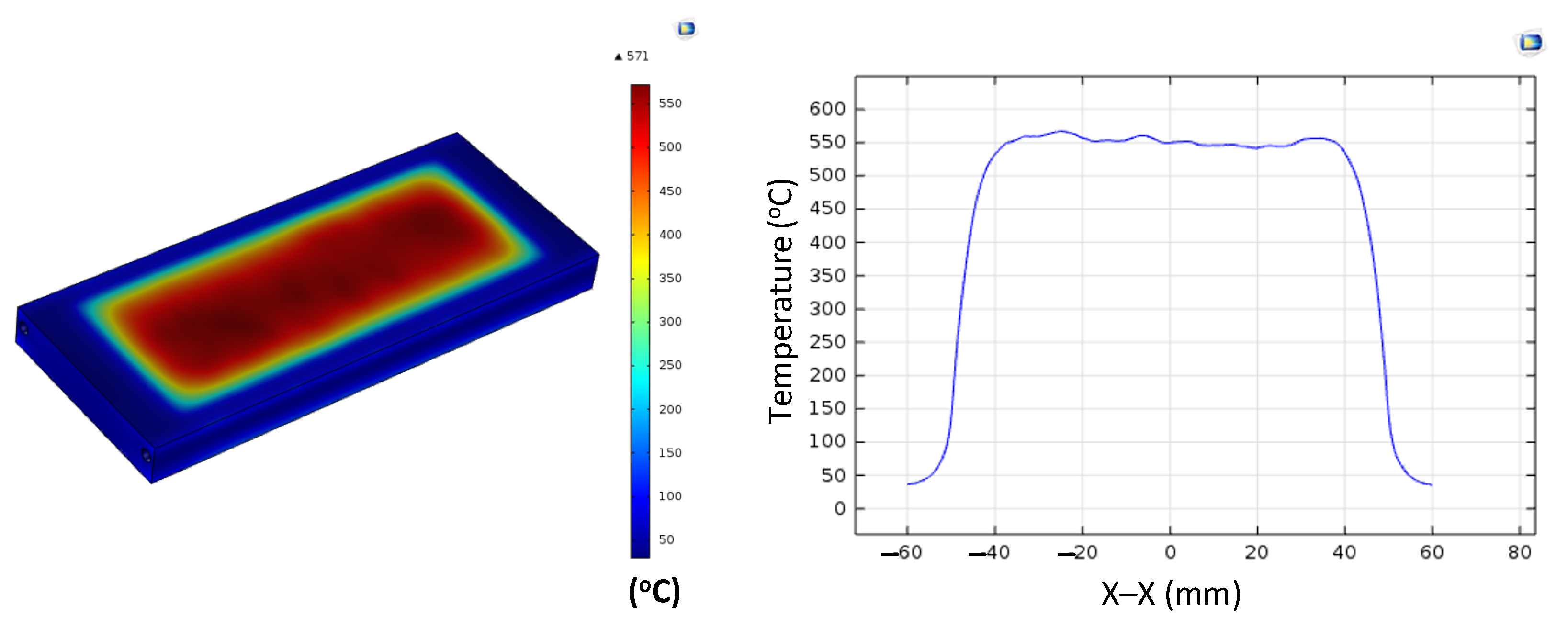
3.2.1. Internal Induction Heating for Mold Cavity Applications
3.2.2. Improving Filling Ability in Thin-Walled Injection Molding
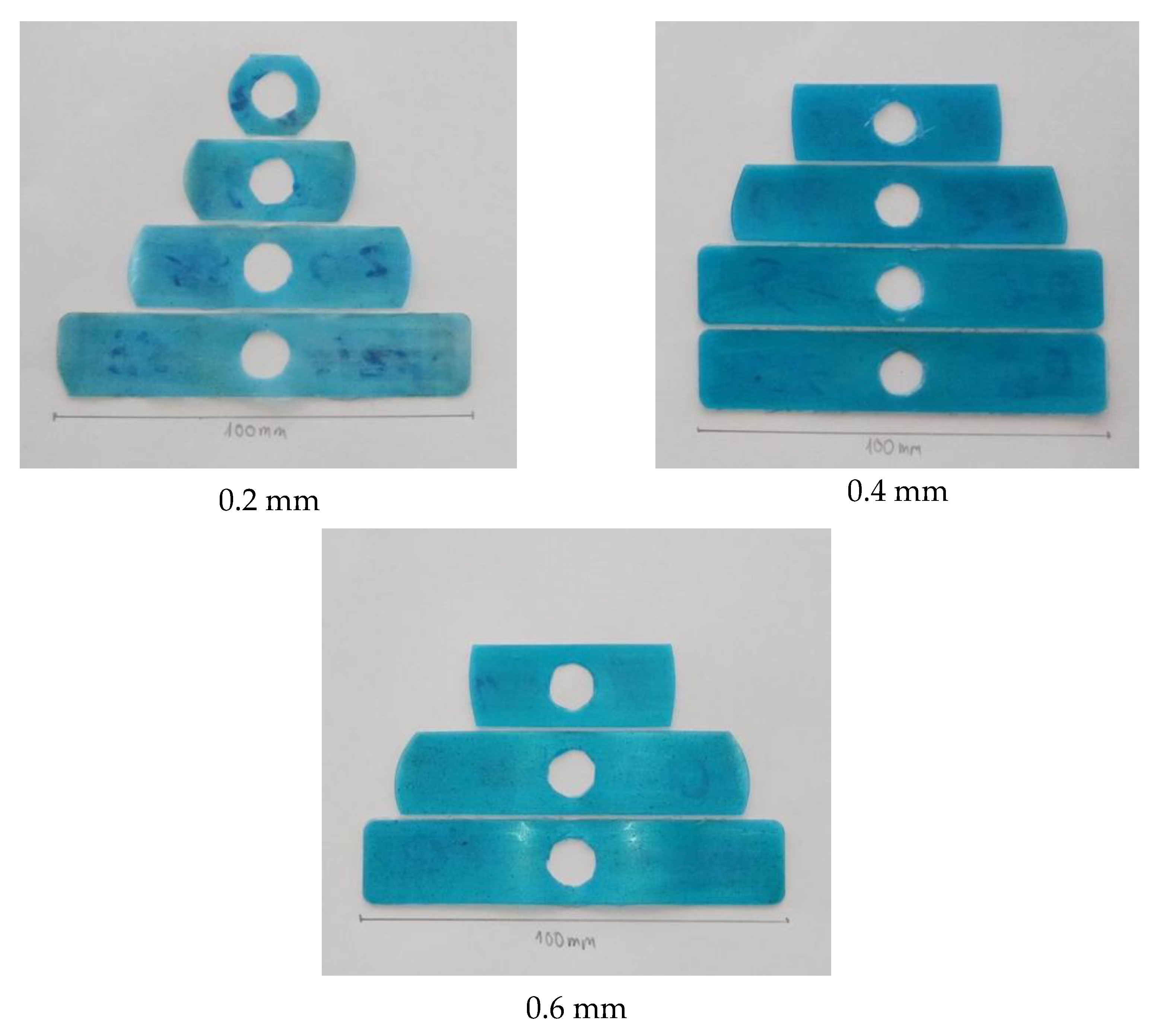
3.2.3. Experimental Validation of Filling Ability with Internal Induction Heating
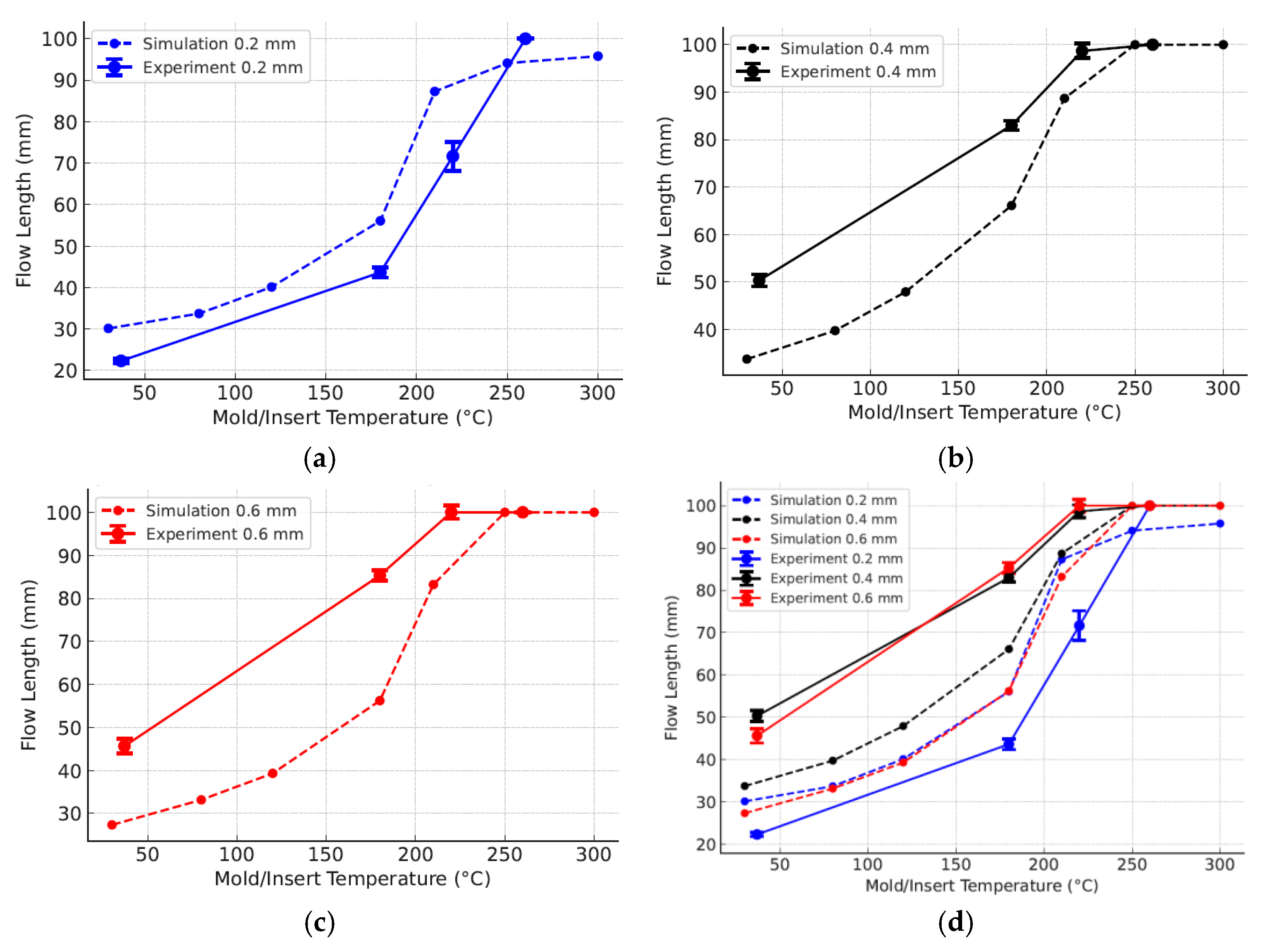
3.2.4. Comparison of Simulation and Experimental Filling Performance
4. Conclusions
Author Contributions
Funding
Institutional Review Board Statement
Data Availability Statement
Acknowledgments
Conflicts of Interest
Appendix A


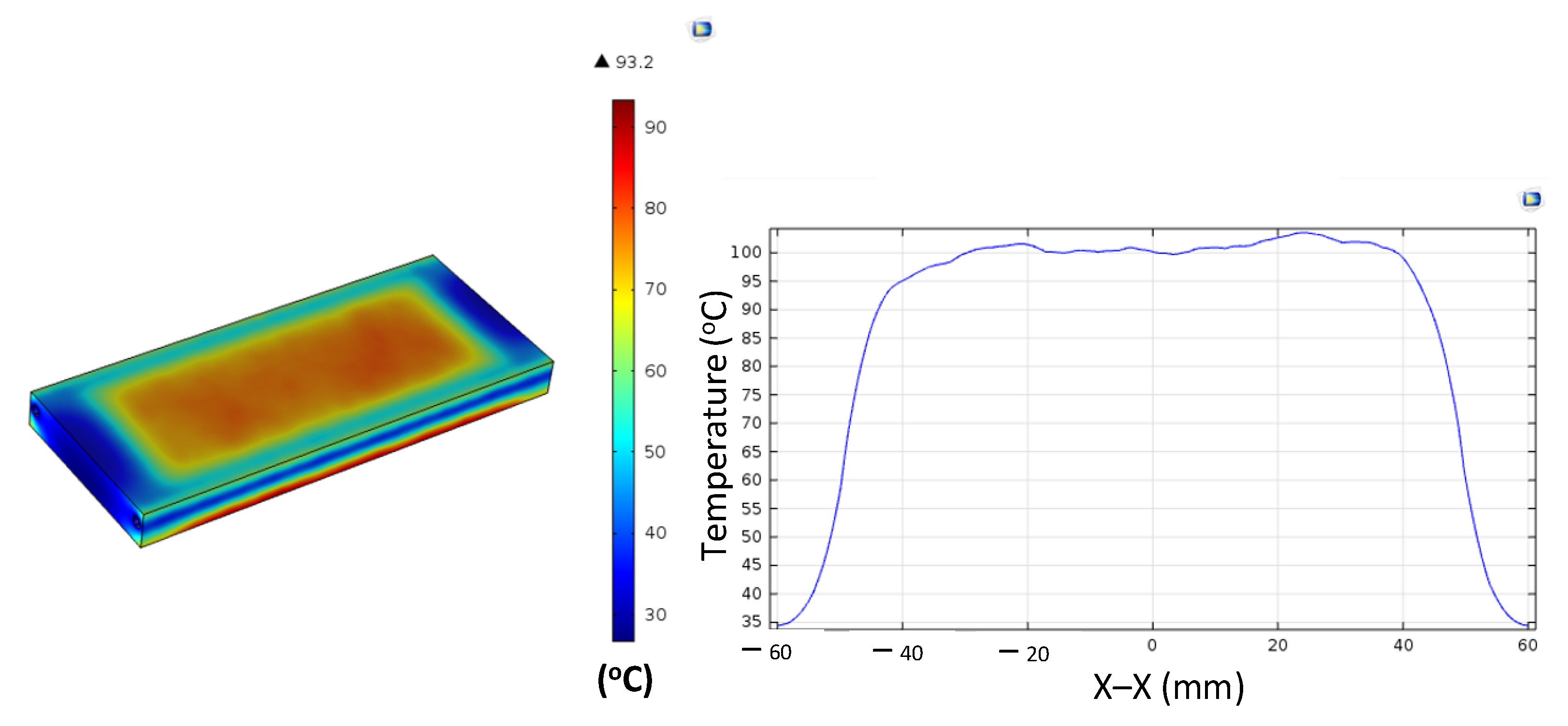
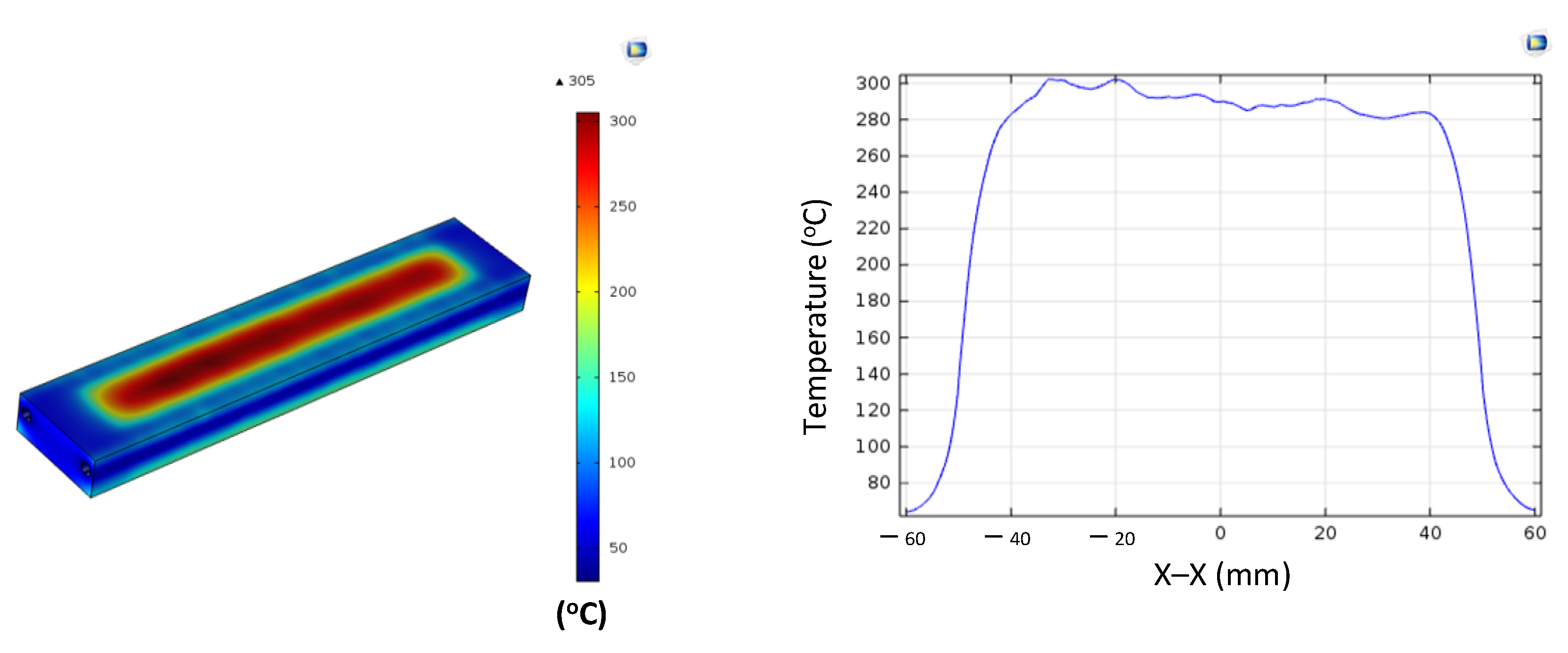


References
- Nian, S.-C.; Huang, M.-S.; Tsai, T.-H. Enhancement of induction heating efficiency on injection mold surface using a novel magnetic shielding method. Int. Commun. Heat Mass Transf. 2014, 50, 52–56. [Google Scholar] [CrossRef]
- Li, J.; Zhang, P.; Hu, J.; Zhang, Y. Study of the Synergistic Effect of Induction Heating Parameters on Heating Efficiency Using Taguchi Method and Response Surface Method. Appl. Sci. 2023, 13, 555. [Google Scholar] [CrossRef]
- Muszyński, P.; Poszwa, P.; Mrozek, K.; Zielinski, M.; Dalewski, P.; Kowal, M. Design and Simulation Study of the Induction Heated Injection Mold with Sliders. Materials 2021, 14, 7476. [Google Scholar] [CrossRef]
- Mrozek, K.; Muszyński, P.; Poszwa, P. Application of Magnetic Concentrator for Improvement in Rapid Temperature Cycling Technology. Polymers 2021, 13, 91. [Google Scholar] [CrossRef] [PubMed]
- Poszwa, P.; Muszyński, P.; Mrozek, K.; Zielinski, M.; Gessner, A.; Kowal, M. Investigation of the Strength of Plastic Parts Improved with Selective Induction Heating. Polymers 2021, 13, 4293. [Google Scholar] [CrossRef] [PubMed]
- Chen, S.-C.; Jong, W.-R.; Chang, J.-A. Dynamic mold surface temperature control using induction heating and its effects on the surface appearance of weld line. J. Appl. Polym. Sci. 2006, 101, 1174–1180. [Google Scholar] [CrossRef]
- Guo, Z.; Xie, J.; Yang, J.; Fu, J.; Zhao, P. Rapid mold temperature rising method for PEEK microcellular injection molding based on induction heating. J. Mater. Res. Technol. 2023, 26, 3285–3300. [Google Scholar] [CrossRef]
- Speranza, V.; Liparoti, S.; Calaon, M.; Tosello, G.; Pantani, R.; Titomanlio, G. Replication of micro and nano-features on iPP by injection molding with fast cavity surface temperature evolution. Mater. Des. 2017, 133, 559–569. [Google Scholar] [CrossRef]
- Simões, R.; Macedo, C.; Laranjeira, J.; Brito, A.M.; Simões, C.L.; Faria, L. Development of a Rapid Heat Cycle Injection Molding System Using Infrared Radiation and Convection Heating and Influence on Morphology and Mechanical Properties. Int. J. Adv. Manuf. Technol. 2024, 130, 283–295. [Google Scholar] [CrossRef]
- Chen, S.-C.; Minh, P.S.; Chang, J.-A.; Huang, S.W.; Huang, C.H. Mold temperature control using high-frequency proximity effect induced heating. Int. Commun. Heat Mass Transf. 2012, 39, 216–223. [Google Scholar] [CrossRef]
- Lin, H.-L.; Chen, S.-C.; Jeng, M.-C.; Minh, P.S.; Chang, J.A.; Hwang, J.R. Induction heating with the ring effect for injection molding plates. Int. Commun. Heat Mass Transf. 2012, 39, 514–522. [Google Scholar] [CrossRef]
- Chen, S.-C.; Chang, J.-A.; Jong, W.-R.; Yang, S.Y. Efficiencies of Various Mold Surface Temperature Controls and Part Quality. Solid State Phenom. 2006, 116–117, 481–484. [Google Scholar]
- Chen, S.-C.; Chien, R.-D.; Lin, S.-H.; Lin, M.C.; Chang, J.A. Feasibility evaluation of gas-assisted heating for mold surface temperature control during injection molding process. Int. Commun. Heat Mass Transf. 2009, 36, 806–812. [Google Scholar] [CrossRef]
- Yao, D.; Kimerling, T.E.; Kim, B. High-frequency proximity heating for injection molding applications. Polym. Eng. Sci. 2006, 46, 938–945. [Google Scholar] [CrossRef]
- Chen, S.C.; Chang, J.A.; Hsu, W.Y.; Huang, S.W. Improvement of replication accuracy of micro-featured molding using gas-assisted heating for mold surface. Microelectron. Eng. 2011, 88, 1594–1600. [Google Scholar] [CrossRef]
- Chang, P.-C.; Hwang, S.-J. Simulation of infrared rapid surface heating for injection molding. Int. J. Heat Mass Transf. 2006, 49, 3846–3854. [Google Scholar] [CrossRef]
- Wang, G.; Zhao, G.; Wang, X. Effects of cavity surface temperature on mechanical properties of specimens with and without a weld line in rapid heat cycle molding. Mater. Des. 2013, 46, 457–472. [Google Scholar] [CrossRef]
- Huang, M.-S.; Yu, J.-C.; Lin, Y.-Z. Effect of rapid mold surface inducting heating on the replication ability of microinjection molding light-guided plates with V-grooved microfeatures. J. Appl. Polym. Sci. 2010, 118, 3058–3065. [Google Scholar] [CrossRef]
- Sung, Y.-T.; Hwang, S.-J.; Lee, H.-H.; Huang, D.Y. Study on Induction Heating Coil for Uniform Mold Cavity Surface Heating. Adv. Mech. Eng. 2014, 6, 349078. [Google Scholar] [CrossRef]
- Kranjc, M.; Zupanic, A.; Miklavcic, D.; Jarm, T. Numerical analysis and thermographic investigation of induction heating. Int. J. Heat Mass Transf. 2010, 53, 17–18. [Google Scholar] [CrossRef]
- Chang, J.A.; Chen, S.C.; Cin, J.C. Rapid Mold Temperature Control on Micro Injection Molded Parts with High Aspect Ratio Micro-Features. SPE ANTEC 2006, 52, 1275–1279. [Google Scholar]
- The Uyen, T.M.; Truong Giang, N.; Do, T.T.; Anh Son, T.; Son Minh, P. External Gas-Assisted Mold Temperature Control Improves Weld Line Quality in the Injection Molding Process. Materials 2020, 13, 2855. [Google Scholar] [CrossRef]
- Shokouhmand, H.; Ghaffari, S. Thermal analysis of moving induction heating of a hollow cylinder with subsequent spray cooling: Effect of velocity, initial position of coil, and geometry. Appl. Math. Model. 2012, 36, 4304–4323. [Google Scholar] [CrossRef]
- Schulze, M.; Baake, E. Tailored heating of forging billets using induction and conduction heating approaches. COMPEL-Int. J. Comput. Math. Electr. Electron. Eng. 2020, 39, 100–107. [Google Scholar] [CrossRef]
- Istardi, D.; Triwinarko, A. Induction Heating Process Design Using COMSOL® Multiphysics Software. TELKOMNIKA (Telecommun. Comput. Electron. Control) 2011, 9, 327–334. [Google Scholar] [CrossRef]
- Almind, M.R. Induction-Heated Catalytic Hydrogen Production: A Magnetic Investigation. Ph.D. Thesis, Technical University of Denmark, Lyngby, Denmark, 2020. [Google Scholar]
- Martin, R.G.; Johansson, C.; Tavares, J.R.; Dubé, M. CF/PEEK Skins Assembly by Induction Welding for Thermoplastic Composite Sandwich Panels. Compos. Part B Eng. 2024, 284, 111676. [Google Scholar] [CrossRef]
- Tavakoli, M.H.; Karbaschi, H.; Samavat, F. Influence of workpiece height on the induction heating process. Math. Comput. Model. 2011, 54, 50–58. [Google Scholar] [CrossRef]
- Guerrier, P.; Hattel, J.H. Numerical modeling of magnetic induction and heating in injection molding tools. In Proceedings of the NEWTECH 2013 International Conference on Advanced Manufacturing Engineering and Technologies, Stockholm, Sweden, 27–30 October 2013. [Google Scholar]
- Phan, T.N.; Trung, D.T.; Minh, P.S. Numerical Study on the Melt Flow Length of the Composite Materials in the Injection Molding Process. Mater. Sci. Forum 2019, 971, 15–20. [Google Scholar] [CrossRef]
- Uyen, T.M.T.; Do, T.T.; Minh, P.S. Internal Gas-Assisted Mold Temperature Control for Improving the Filling Ability of Polyamide 6 + 30% Glass Fiber in the Micro-Injection Molding Process. Polymers 2022, 14, 2218. [Google Scholar] [CrossRef] [PubMed]
- Minh, P.S.; Le, M.-T. Improving the Melt Flow Length of Acrylonitrile Butadiene Styrene in Thin-Wall Injection Molding by External Induction Heating with the Assistance of a Rotation Device. Polymers 2021, 13, 2288. [Google Scholar] [CrossRef]
- Minh, P.S.; Uyen, T.M.T.; Do, T.T.; Nguyen, V.-T.; Nguyen, V.T.T. Enhancing the Fatigue Strength of the Weld Line in Advanced Polymer Injection Molding: Gas-Assisted Mold Temperature Control for Thermoplastic Polyurethane (TPU) Composites. Polymers 2023, 15, 2440. [Google Scholar] [CrossRef] [PubMed]
- Mrzljak, S.; Delp, A.; Schlink, A.; Zarges, J.C.; Hülsbusch, D.; Heim, H.P.; Walther, F. Constant Temperature Approach for the Assessment of Injection Molding Parameter Influence on the Fatigue Behavior of Short Glass Fiber Reinforced Polyamide 6. Polymers 2021, 13, 1569. [Google Scholar] [CrossRef] [PubMed]
- Murata, Y.; Kanno, R. Effects of Heating and Cooling of Injection Mold Cavity Surface and Melt Flow Control on Properties of Carbon Fiber Reinforced Semi-Aromatic Polyamide Molded Products. Polymers 2021, 13, 587. [Google Scholar] [CrossRef] [PubMed]


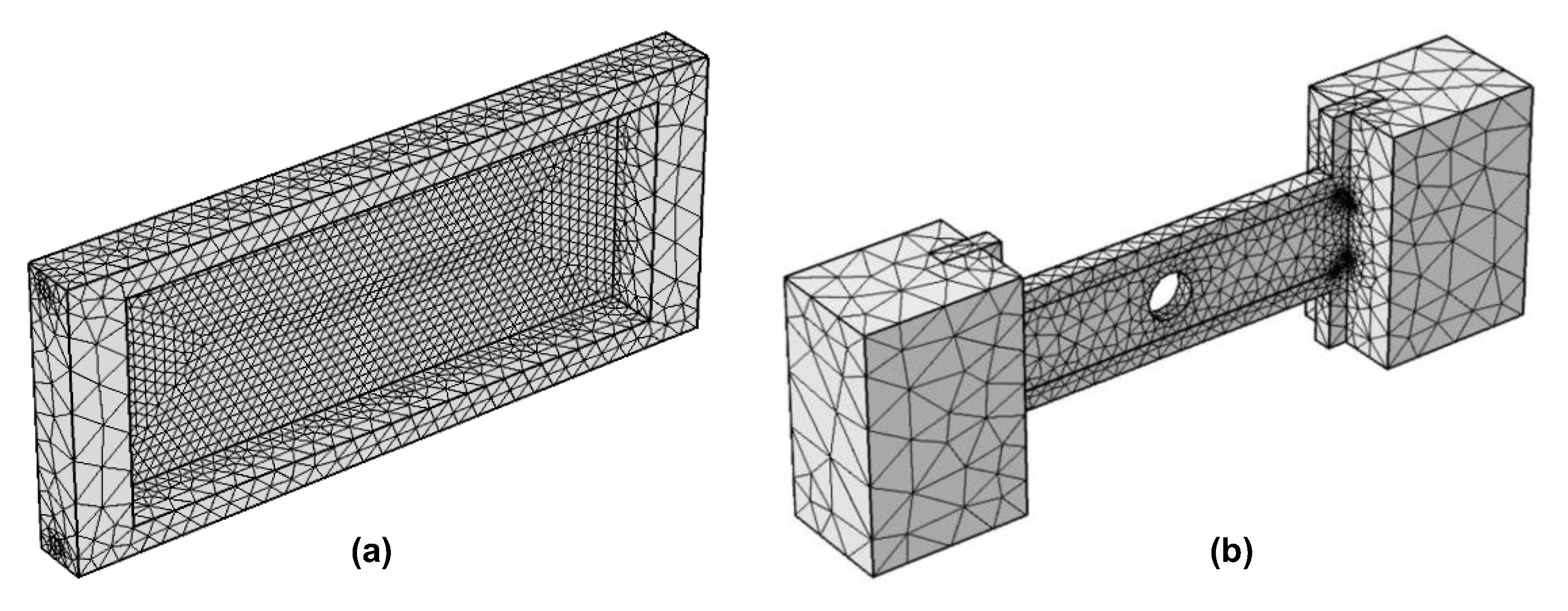



| Physical Property | Density | Electrical Resistivity | Relative Permeability | Specific | Thermal Conductivity |
|---|---|---|---|---|---|
| Unit | Kg/m3 | Ωm | µ | J/kg·K | W/m·K |
| Air at 25 °C | 1.18 | - | 1 | 1000 | 0.0256 |
| Steel | 7800 | 5.5 × 10⁻⁷ | 100 | 420 | 20 |
| Copper | 8940 | 1.71 × 10⁻⁷ | 0.99 | 392 | 400 |
| Physical Property | Electrical Conductivity | Boundary Feed 1 | Frequency | Simulation Time |
|---|---|---|---|---|
| Unit | S/m | A | Hz | s |
| Value | 1 × 10⁷ | 20 | 20,000 | (0, 0.5, 5) |
| Parameter Simulation | |
|---|---|
| Assigned material | Copper, steel |
| Setting coil intensity: I | A |
| Initial texture temperature | 30 °C |
| Type of thermal analysis | Heat transfer in solids |
| Time-series analysis | 0 s to 9 s (step 0.5 s) |
| Minimum step for analytical time scale | 0.01 s |
| Initial time | 0 s |
| STT | Insert Thickness t (mm) | Insert Width W (mm) | Insert Length L (mm) | Coolant Temperature (°C) |
|---|---|---|---|---|
| 1 | 0.5 | 50 | 100 | 30 |
| 2 | 1.0 | |||
| 3 | 1.5 | |||
| 4 | 2.0 | |||
| 5 | 1.0 | 25 | ||
| 6 | 50 | |||
| 7 | 75 | |||
| 8 | 100 | |||
| 9 | 50 | 50 | ||
| 10 | 100 | |||
| 11 | 150 | |||
| 12 | 200 | |||
| 13 | 1.0 | 50 | 100 | 10 |
| 14 | 20 | |||
| 15 | 30 | |||
| 16 | 50 | |||
| 17 | 70 |
| Parameter | Value |
|---|---|
| Controller | Programmable Logic Controller (PLC) |
| Max. power | 30 (kW) |
| Voltage | 380 (V) |
| Current | 150 (A) |
| Cooling method | Water |
| Thermal sensor | Thermal couple (K-type) |
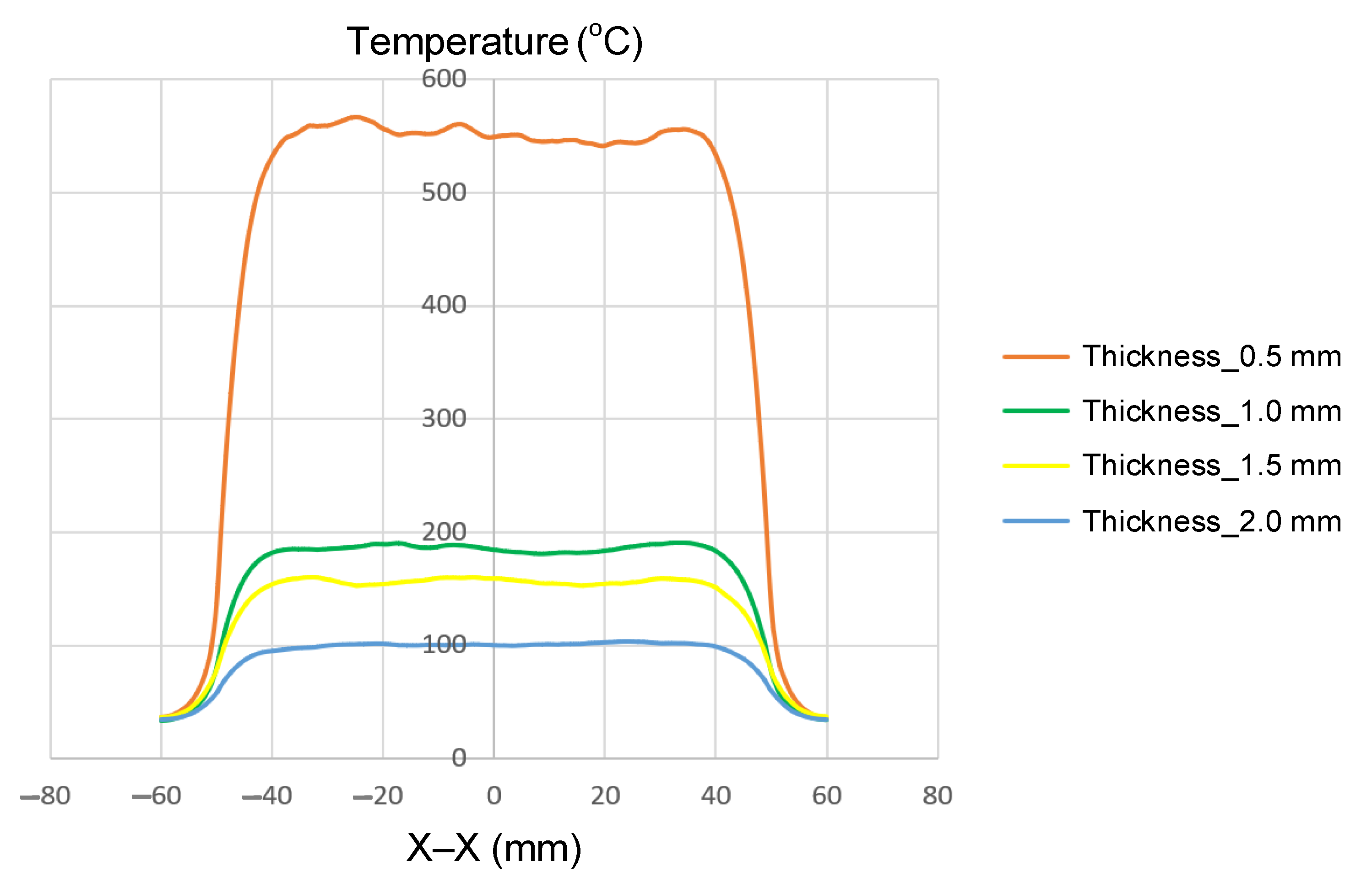
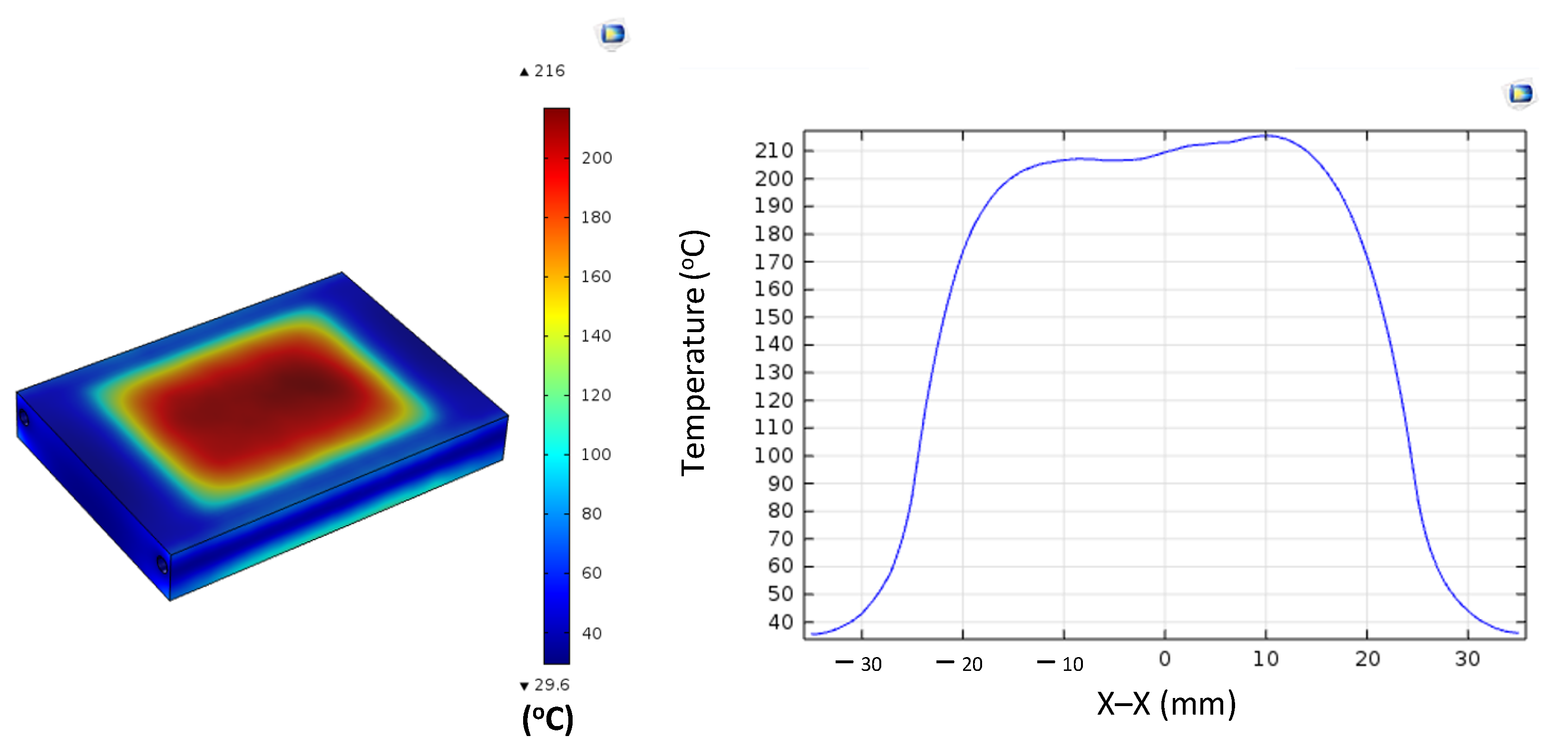
| Thickness (t) | Max. Temperature |
|---|---|
| 0.5 mm | ≈550 °C |
| 1.0 mm | ≈200 °C |
| 1.5 mm | ≈160 °C |
| 2.0 mm | ≈100 °C |
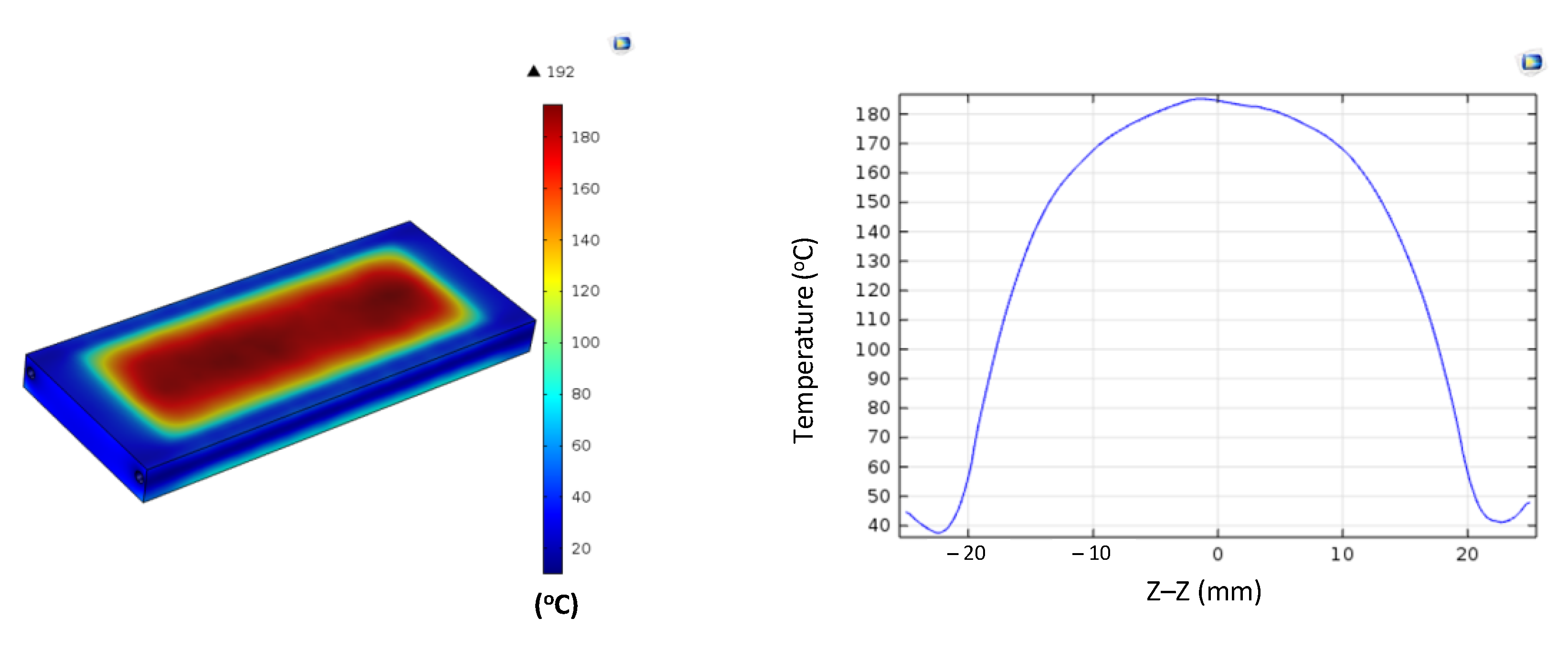
| Width (W) | Max. Temperature |
|---|---|
| 25 mm | ≈300 °C |
| 50 mm | ≈200 °C |
| 75 mm | ≈120 °C |
| 100 mm | ≈100 °C |
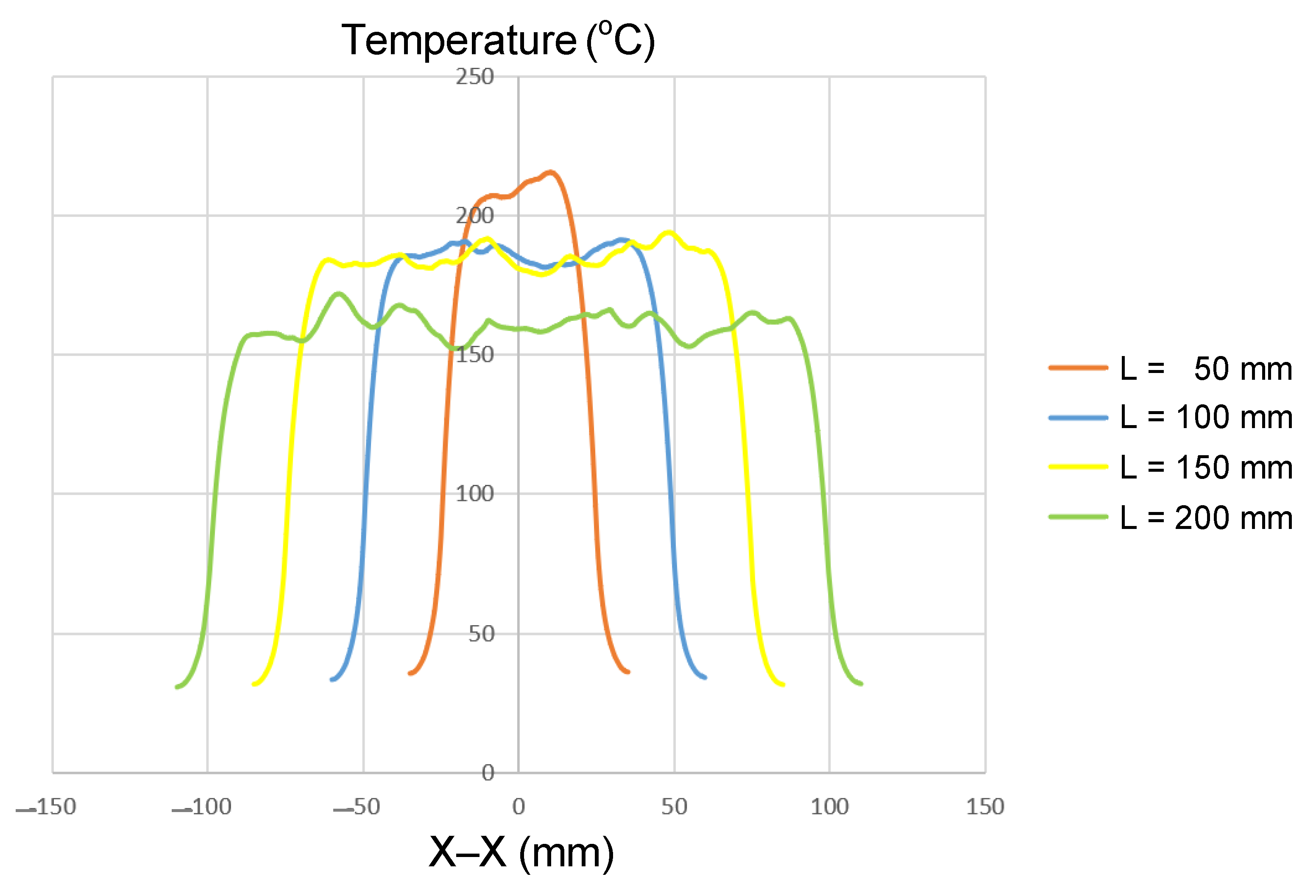
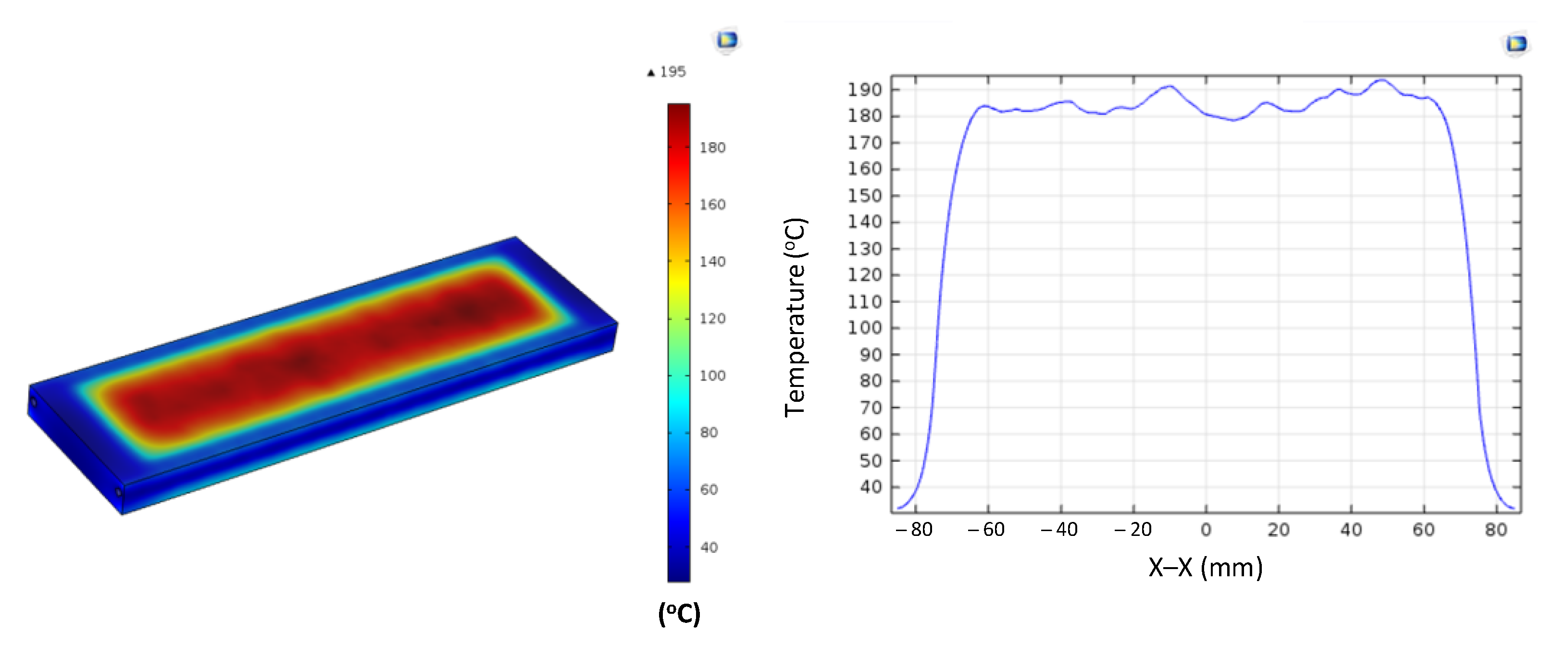
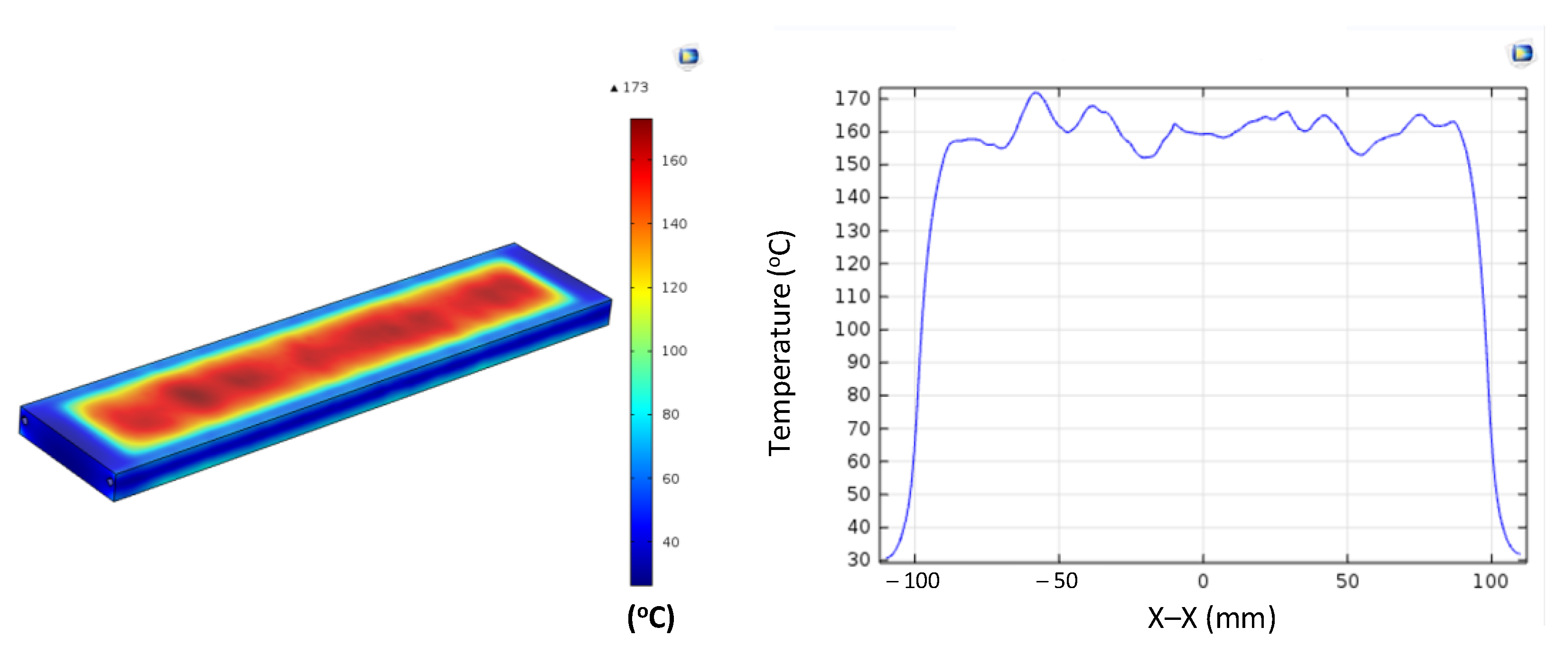
| Length (L) | Max. Temperature |
|---|---|
| 50 mm | ≈220 °C |
| 100 mm | ≈180 °C |
| 150 mm | ≈170 °C |
| 200 mm | ≈160 °C |
| Coolant Temperature | T Heating Temperature (Line X–X) |
|---|---|
| 10 °C | ≈40 °C |
| 20 °C | ≈50 °C |
| 30 °C | ≈60 °C |
| 50 °C | ≈80 °C |
| 70 °C | ≈100 °C |
| Heating Time | Temperature Distribution (°C) |
|---|---|
| 1 s |  |
| 2 s |  |
| 3 s |  |
| 5 s |  |
| 7 s |  |
| 9 s |  |
| Induction Heating Time | End of Heating Step | 2 s After End of Heating Step | 5 s After End of Heating Step |
|---|---|---|---|
| 1 s |  = 140 °C |  = 125 °C |  = 107 °C |
| 2 s |  = 239 °C |  = 213 °C |  = 195 °C |
| 3 s |  = 340 °C |  = 315 °C |  = 250 °C |
| Heating Time | Simulation | Experiment |
|---|---|---|
| 1 s |  Max: 170 °C | 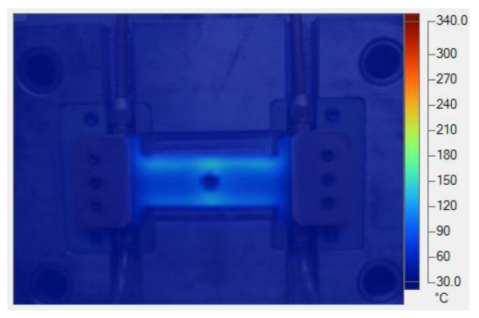 Max: 140 °C |
| 2 s |  Max: 262 °C |  Max: 240 °C |
| 3 s |  Max: 355 °C |  Max: 340 °C |
| Heating Time | 0 s | 3 s | 5 s | 7 s | 9 s |
| Insert Surface Temperature | 37 °C | 180 °C | 220 °C | 260 °C | 300 °C |
| Old Cavity Temperature | 0.2 mm Mold Cavity | 0.4 mm Mold Cavity | 0.6 mm Mold Cavity |
|---|---|---|---|
| 30 °C |  L = 30.16 mm |  L = 33.77 mm |  L = 27.35 mm |
| 80 °C |  L = 33.73 mm |  L = 39.77 mm |  L = 33.17 mm |
| 120 °C |  L = 40.14 mm |  L = 47.94 mm |  L = 39.33 mm |
| 180 °C |  L = 56.09 mm |  L = 66.12 mm |  L = 56.23 mm |
| 210 °C |  L = 87.29 mm |  L = 88.69 mm |  L = 83.21 mm |
| 250 °C |  L = 94.11 mm |  L = 100 mm |  L = 100 mm |
| 300 °C |  L = 95.79 mm |  L = 100 mm |  L = 100 mm |
| Length (mm) (Experiment 1) | Length (mm) (Experiment 2) | Length (mm) (Experiment 3) | Length (mm) (Average Value) | ||
|---|---|---|---|---|---|
| Ex.PP_0.2 mm | 0 s | 22 | 23 | 22 | 22.33 |
| 3 s | 45 | 42 | 44 | 43.66 | |
| 5 s | 71 | 68 | 76 | 71.66 | |
| 7 s | 100 | 100 | 100 | 100 | |
| Ex.PP_0.4 mm | 0 s | 52 | 49 | 50 | 50.33 |
| 3 s | 84 | 82 | 83 | 83 | |
| 5 s | 99 | 100 | 97 | 98.67 | |
| 7 s | 100 | 100 | 100 | 100 | |
| Ex.PP_0.6 mm | 0 s | 44 | 45 | 48 | 45.66 |
| 3 s | 87 | 84 | 85 | 85.33 | |
| 5 s | 100 | 100 | 100 | 100 | |
| 7 s | - | - | - | - | |
| Stamp Temperature | |||||||
|---|---|---|---|---|---|---|---|
| 30 °C | 80 °C | 120 °C | 180 °C | 210 °C | 250 °C | 300 °C | |
| Si.PP_0.2 mm | 30.16 mm | 33.73 mm | 40.14 mm | 56.09 mm | 87.29 mm | 94.11 mm | 95.79 mm |
| Si.PP_0.4 mm | 33.77 mm | 39.77 mm | 47.94 mm | 66.12 mm | 88.69 mm | 100 mm | 100 mm |
| Si.PP_0.6 mm | 27.35 mm | 33.17 mm | 39.33 mm | 56.23 mm | 83.21 mm | 100 mm | 100 mm |
| Insert Temperature (°C) | |||||||
| 37 °C | 180 °C | 220 °C | 260 °C | ||||
| Ex.PP_0.2 mm | 22.33 mm | 43.66 mm | 71.66 mm | 100 mm | |||
| Ex.PP_0.4 mm | 50.33 mm | 83.0 mm | 98.67 mm | 100 mm | |||
| Ex.PP_0.6 mm | 45.66 mm | 85.33 mm | 100 mm | 100 mm | |||
Disclaimer/Publisher’s Note: The statements, opinions and data contained in all publications are solely those of the individual author(s) and contributor(s) and not of MDPI and/or the editor(s). MDPI and/or the editor(s) disclaim responsibility for any injury to people or property resulting from any ideas, methods, instructions or products referred to in the content. |
© 2025 by the authors. Licensee MDPI, Basel, Switzerland. This article is an open access article distributed under the terms and conditions of the Creative Commons Attribution (CC BY) license (https://creativecommons.org/licenses/by/4.0/).
Share and Cite
Do, T.T.; Thuan, H.D.; Uyen, T.M.T.; Hon, N.T.; Minh, P.S.; Anh Son, T. Internal Induction Heating for Local Heating in Injection Molding. Polymers 2025, 17, 2906. https://doi.org/10.3390/polym17212906
Do TT, Thuan HD, Uyen TMT, Hon NT, Minh PS, Anh Son T. Internal Induction Heating for Local Heating in Injection Molding. Polymers. 2025; 17(21):2906. https://doi.org/10.3390/polym17212906
Chicago/Turabian StyleDo, Thanh Trung, Huynh Duc Thuan, Tran Minh The Uyen, Nguyen Thanh Hon, Pham Son Minh, and Tran Anh Son. 2025. "Internal Induction Heating for Local Heating in Injection Molding" Polymers 17, no. 21: 2906. https://doi.org/10.3390/polym17212906
APA StyleDo, T. T., Thuan, H. D., Uyen, T. M. T., Hon, N. T., Minh, P. S., & Anh Son, T. (2025). Internal Induction Heating for Local Heating in Injection Molding. Polymers, 17(21), 2906. https://doi.org/10.3390/polym17212906