Article

Conductive Chitosan–Graphene Oxide Scaffold with Applications in Peripheral Nerve Tissue Engineering


by
Andreea-Isabela Lazăr
1,2,3,
Aida Șelaru
4,
Alexa-Maria Croitoru
1,2,
Ludmila Motelica
2,3,5,6,7,
Ovidiu-Cristian Oprea
2,3,5,6,
Roxana-Doina Trușcă
1,2,3,
Denisa Ficai
2,3,5,6,
Dănuț-Ionel Văireanu
5,8,
Anton Ficai
1,2,3,6,* and
Sorina Dinescu
4,9
1
Department of Science and Engineering of Oxide Materials and Nanomaterials, Faculty of Chemical Engineering and Biotechnologies, National University of Science and Technology Politehnica Bucharest, 1-7 Gh. Polizu St., 011061 Bucharest, Romania
2
National Centre for Micro- and Nanomaterials, National University of Science and Technology Politehnica Bucharest, 313 Independence Boulevard, 060042 Bucharest, Romania
3
National Centre for Food Safety, National University of Science and Technology Politehnica Bucharest, 313 Independence Boulevard, 060042 Bucharest, Romania
4
Department of Biochemistry and Molecular Biology, Faculty of Biology, University of Bucharest, 91-95 Independence Boulevard, 050095 Bucharest, Romania
5
Department of Inorganic Chemistry, Physical Chemistry and Electrochemistry, Faculty of Chemical Engineering and Biotechnologies, National University of Science and Technology Politehnica of Bucharest, 1-7 Gh. Polizu St., 011061 Bucharest, Romania
6
Academy of Romanian Scientists, 3 Ilfov St., 050045 Bucharest, Romania
7
Research Center for Advanced Materials, Products and Processes, National University of Science and Technology Politehnica Bucharest, 060042 Bucharest, Romania
8
Technical Sciences Academy of Romania, 26 Dacia Boulevard, 030167 Bucharest, Romania
9
Research Institute of the University of Bucharest (ICUB), 90 Panduri Road, 050663 Bucharest, Romania
*
Author to whom correspondence should be addressed.
Polymers 2025, 17(17), 2398; https://doi.org/10.3390/polym17172398
Submission received: 12 July 2025 / Revised: 26 August 2025 / Accepted: 28 August 2025 / Published: 2 September 2025

Abstract

This study aimed to develop a novel biomaterial for neural tissue regeneration by combining chitosan (CS), a natural polymer, with graphene oxide (GO) at concentrations of 3%, 6%, and 9%. The homogeneity, conductivity, three-dimensional characteristics, and ability to support cell viability of the composite materials were systematically evaluated. Fourier-Transform Infrared (FTIR) spectroscopy confirmed the successful incorporation of GO into the CS matrix, while UV-Vis and photoluminescence (PL) spectrometry revealed modifications in the optical properties with increasing GO content. Thermogravimetric analysis (TG-DSC) demonstrated improved thermal stability of the composites, and swelling tests indicated enhanced water absorption capacity. Although some agglomerates were observed, the homogeneity was reasonable at both macroscopic and microscopic level (optical visualization–FTIR and electron microscopy). The composite films exhibited promising physical and electrochemical properties, highlighting their potential for neural tissue engineering applications. Their biological activity was assessed by culturing neuronal cells on the CS-GO scaffolds. Results from MTT, LDH, and LIVE/DEAD assays demonstrated excellent cell viability, moderate-to-good cell attachment, and the promotion of intercellular network formation. Among the tested formulations, the CS-GO 6% scaffold showed the most favorable biological response, with a significant increase in SH-SY5Y cell viability after 7 days (p < 0.05) compared to the CS control. LIVE/DEAD imaging confirmed enhanced cell attachment and elongated morphology, while the LDH assay indicated minimal cytotoxicity. Notably, a critical threshold was identified between 6% and 9% GO, where conductivity increased by approximately 52-fold. Future studies should focus on optimizing the composite parameters, loading them with specific biologically active agents and thus targeting specific neuronal applications.

1. Introduction

Neuronal tissue regeneration is particularly challenging, and the development of innovative scaffolds aims to facilitate the repair of damaged or injured neural tissues. Treating nerve injuries often involves using an autologous nerve graft to bridge the gap. However, nerve autografts have several drawbacks, including the necessity of impairing a healthy, functional nerve as well as an additional intervention to harvest it [1]. With the rapid progress in regenerative medicine, engineered nerve guidance conduits (NGCs) show the potential to address these limitations and enhance neural recovery. However, developing nerve grafts that fully meet clinical demands remains a significant challenge [2].
Despite their limited electrical conductivity, various materials are being explored as scaffolds for nerve regeneration. Preclinical studies frequently employ natural biopolymers due to their biocompatibility and support for cell attachment and growth. These include structural proteins such as collagen, gelatin, silk, and glycosaminoglycans or polysaccharides like hyaluronic acid, alginate, and CS [3]. Natural polymers, in particular, are utilized due to their excellent biocompatibility, adjustable biodegradability, and specific bioactive properties. The majority of synthetic materials researched for nerve scaffolds are polyester-based; however, other polymers, such as polyethylene glycol (PEG), are being investigated for their regenerative properties. However, its regenerative effects are not intrinsic; they are typically observed when PEG is functionalized with bioactive moieties such as peptides, growth factors, or adhesion molecules that can actively guide axonal regeneration [4].
CS is often used on its own or combined with other materials and is a widely recognized polymer in tissue engineering and regenerative medicine, valued for its biocompatibility, biodegradability, non-toxic nature, and beneficial antibacterial properties [5]. It is often cited in the literature as a primary component in novel tissue-engineered nerve conduits designed to bridge peripheral nerve gaps [6,7,8]. By attaching various functional groups, the hydrophilic–hydrophobic ratio as well as the electric charge of CS support can be controlled. These modifications contribute to CS’s status as a relatively unique, highly tunable biopolymer [9]. Due to these beneficial properties, a CS tube received FDA approval in 2015 for peripheral nerve repairs up to 1 cm. Additionally, Gu et al. successfully used CS-based scaffolds to repair a 30 mm long defect in the human median nerve [10]. Ongoing intensive preclinical research is focused on developing more advanced designs and functionalities to extend the gap that can be effectively supported for regeneration [11]. Due to its tunable mechanical properties, the degradation rate of CS-based materials can be customized to match the pace of nerve healing. Furthermore, it can serve as a drug delivery system, releasing therapeutic agents at the injury site to enhance regeneration [12].
The methods for modifying the polymer include chemical crosslinking, the addition of plasticizers [13], the creation of new polymer networks, and the incorporation of organic and inorganic nanoparticles such as carbon [14], silver [15,16], or gold [15,17] nanoparticles, bioglass [18], etc. Among these approaches, the combination with GO is one of the most widely researched areas [19,20,21]. Recent research demonstrates that the synergistic interaction between CS and GO exhibits excellent biocompatibility in both in vitro and in vivo settings [22,23,24], along with angiogenic and cell growth-promoting effects [25,26], antimicrobial activity [27,28], electrical conductivity [29], and superior adsorption capabilities [30,31], among other properties. Although GO is frequently employed in neural tissue engineering, it is not inherently highly conductive. Its oxygen-containing functional groups disrupt the π-conjugated network, significantly reducing electrical conductivity [32]. In contrast, conductive polymers such as polypyrrole (PPy) or polyaniline (PANI), and their composites with GO or rGO, can enhance conductivity by several orders of magnitude. For instance, GO/PPy composites may achieve conductivities on the order of ~6 S/cm that remain stable in physiological conditions over weeks, while yielding strong mechanical performance suitable for nerve repair scaffolds [33]. Similarly, biodegradable polymer composites containing ~20% PPy have shown conductivity increases of nearly 300% compared to the base polymer alone [34].
Despite this, GO-based scaffolds offer unique advantages, including good hydrophilicity, abundant reactive sites for functionalization, and excellent biocompatibility when combined with natural polymers like CS. Moreover, moderate conductivity levels (as demonstrated in CS-GO scaffolds with conductivities of ~2.8 mS/cm) have been sufficient to support neural cell adhesion, neurite outgrowth, and functional recovery in vivo [35]. Therefore, while GO alone may not match the conductivity of conductive polymer-enhanced composites, it provides a balanced platform for scaffold design with appropriate electrical, biological, and processing features.
In addition, it is worth noting that previous studies have shown that CS materials used in nerve repair are often modified with different degrees of acetylation to regulate their biodegradation rate [36,37,38]. CS is also frequently combined with other materials, such as polyglycolic acid (PGA) [39,40,41], polylactic acid (PLA) [42,43], or other commonly used polymers [44]. Some formulations use blends of CS with multiple polymers, such as a combination of PGA and PLA. By attaching various functional groups, the hydrophobic, cationic, and anionic properties of CS can be controlled [45]. CS-based materials can also be enhanced by modifying their surfaces to interact with regenerating neural tissues. For instance, extracellular matrix glycoproteins like laminin [7] or laminin-derived peptides [6,46], as well as collagen [47], can be applied to the surface of CS-based materials to enhance their compatibility with neural tissues. Moreover, neurotrophic factors such as NGF, GDNF, CNTF, NT-3, or NT-4/5 can be integrated [48,49,50,51,52,53]. The interior surfaces of these guidance channels can be designed to support the seeding of cells that aid in regeneration, such as aligned Schwann cells [54] or various types of stem cells [55]. Lastly, electrospinning technology is employed to add structured nano- or microfibers to the surface of the CS-based materials for additional functionality [56].
This study explores the potential of CS-based scaffolds incorporated with GO for peripheral nerve regeneration, focusing on their biocompatibility, electrical conductivity, and cell viability. Most prior works have focused on either morphological or biological characterization, without systematically correlating GO concentration with both electrical and biological performance in a controlled gradient. Moreover, the identification of a critical GO concentration that optimizes both conductivity and neural cell compatibility remains underexplored. While increased GO loading can improve conductivity, it may also introduce cytotoxicity or structural instability, which limits its therapeutic application.
To address this gap, the present study investigates the effect of varying GO concentrations (3%, 6%, and 9%) within CS-based scaffolds, aiming to identify the optimal formulation that balances electrical properties, structural integrity, and neuronal biocompatibility. Through a combination of physicochemical characterization (FTIR, SEM, swelling, thermal stability, and conductivity) and in vitro biological assays (MTT, LDH, and LIVE/DEAD using SH-SY5Y cells), this work aims to provide a quantitative threshold for GO concentration that enhances scaffold performance without compromising safety (a critical step for advancing CS-GO scaffolds toward neuroregenerative applications). Furthermore, the study aims to improve nerve repair outcomes and address the limitations of traditional autografts in clinical applications.

2. Materials and Methods

2.1. Materials

GO was synthesized using Hummer’s method [57]. The CS used in this study was purchased from Sigma-Aldrich with a medium molecular weight (190,000–310,000 Da), a viscosity ranging from 200 to 800 cP, and a degree of deacetylation between 75% and 85%. Glutaraldehyde (GA; OHC(CH2)3CHO) was also obtained from Sigma-Aldrich (Merck, Burlington, MA, USA) as a 25% aqueous solution (w/w). Distilled water was used throughout the study. Glycerol (99.0–101.0% purity, alkalimetric) was supplied by Honeywell, while glacial acetic acid (CH3COOH) was sourced from Chimreactiv S.R.L., with a stated purity of 99.84%. Sodium hydrogen phosphate (Na2HPO4, min. 99% purity) and sodium phosphate (Na3PO4, min. 99% purity) were acquired from Reactivul București. Tween 80 (polyoxyethylene sorbitan monooleate) was purchased from Sigma-Aldrich. The human neuroblastoma cell line SH-SY5Y (CRL-2266, ATCC) was used as an in vitro model for evaluating the biocompatibility of CS-GO scaffolds. All reagents utilized in this study were used without further purification.

2.2. Synthesis of CS-GO Scaffolds

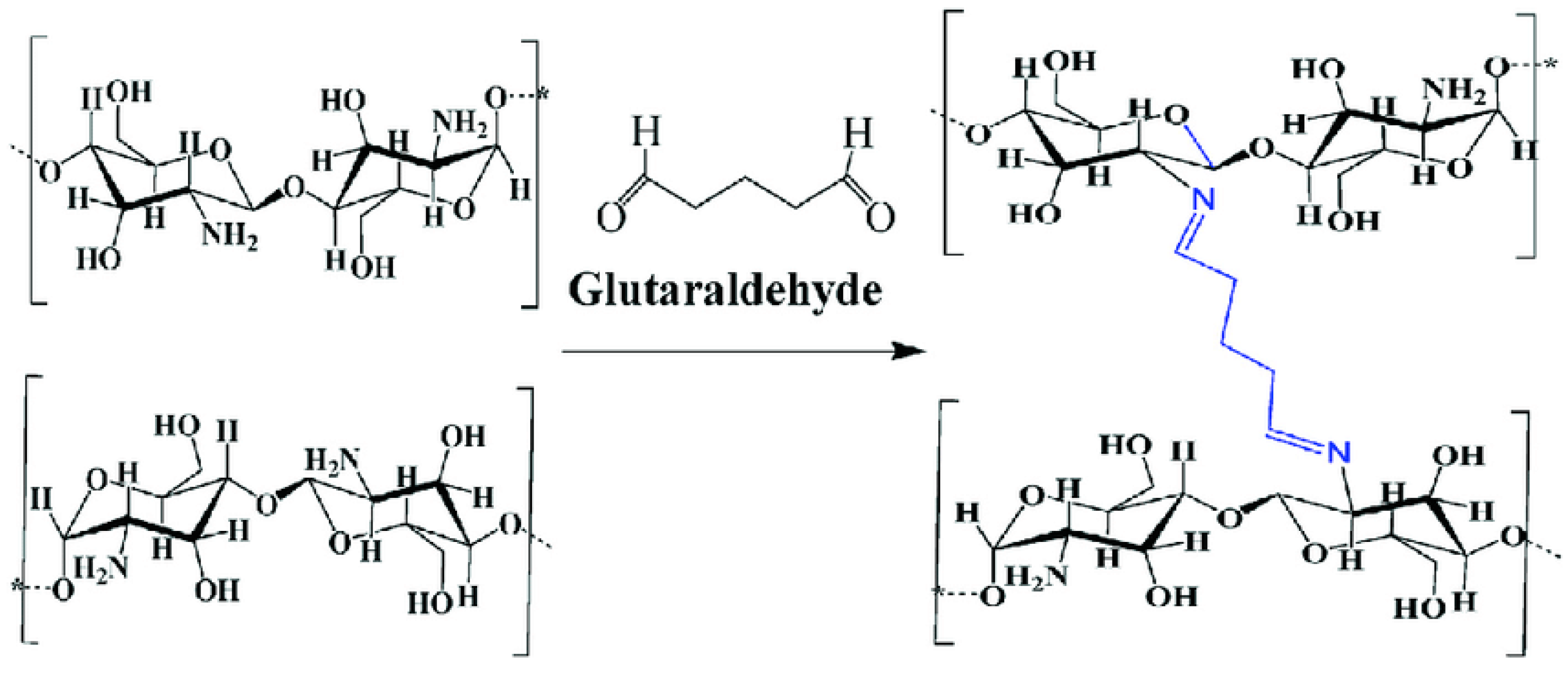
CS was activated prior to crosslinking by treating it with an acid solution, a critical step for exposing reactive sites on the CS molecules and enhancing their crosslinking potential [58]. A 30 mg/mL CS solution was prepared in 6.0% acetic acid, followed by the addition of 1.0 mL glycerin to increase the viscosity. The mixture was stirred continuously using a magnetic stirrer at room temperature for 24 h to ensure homogeneity The CS solution was combined with varying amounts of GO (3%, 6%, and 9%). The required amount of GO was first mixed with 10 mL of CS solution by manual grinding to form a uniform paste, followed by sonication to ensure additional disaggregation of the GO clusters. Subsequently, 0.1% (w/v) Tween 80 was added to the CS-GO mixture to further enhance dispersion. To the homogenized mixture, 0.15% glutaraldehyde (GA) was added to induce crosslinking. GA is a bifunctional crosslinking agent, meaning that it has two reactive groups that can form covalent bonds with amino groups present in CS [59]. The reaction was carried out in an aqueous solution, where GA reacted with CS to form covalent bonds between the CS molecules. This led to the formation of a cross-linked network (Figure 1), which significantly enhances the mechanical strength, stability, and biocompatibility of CS, thereby making it suitable for various biomedical applications [60].
-NH2 (CS) + CHO-CHO (glutaraldehyde) → -NH-CH2-CHOH-CH2-NH- (cross-linked CS)
Figure 1. Adding GA facilitates the formation of bonds between CS molecules, resulting in a cross-linked network structure [61]. Adapted from Elsevier, 2020. The asterisk (*) denotes the continuation of the CS polymer chain.
Polymers 17 02398 g001
A 10 mL aliquot of each mixture was cast into transparent glass Petri dishes and immersed in 10 mL Na2HPO4/Na3PO4 buffer. The solutions were left undisturbed at room temperature for 48 h to allow solvent evaporation and the formation of smooth, thin films. Pure CS scaffolds were prepared under identical conditions to serve as controls. The resulting films were thoroughly washed three times with distilled water to remove any unreacted GA and other by-products, then carefully dried, and peeled from the Petri dishes for further characterization (Table 1).

2.3. Fourier-Transform Infrared Spectroscopy

The presence of functional groups and interactions between various components of the composite films were investigated using FTIR in the wavenumber range 4000–400 cm−1. The spectra were recorded with a Nicolet iS50 FTIR spectrometer (Nicolet City, MA, USA), equipped with a DTGS detector, at a resolution of 4 cm−1, by averaging 32 scans. All spectra were registered in attenuated total reflectance (ATR) mode using a diamond crystal.
To obtain information about the spatial distribution of the components, FTIR 2D maps were recorded with an FTIR microscope Nicolet iS50R (Nicolet City, MA, USA), with DTGS detector, in the wavenumber range 4000–500 cm−1.

2.4. UV-Vis Spectroscopy

A JASCO V560 spectrophotometer (JASCO Inc., Easton, PA, USA) was used to measure the UV-Vis spectra. The device was equipped with a 60 mm integrating sphere (ISV-469) and a film holder for the samples. The spectra were recorded with a speed of 200 nm min−1, in the range of 200–900 nm.
The opacity values were calculated as A600/x = −logT600/x, where A600 is the absorbance at 600 nm, T600 is the fractional transmittance at 600 nm, and x is the film thickness in mm. A higher opacity value indicated that the film was less transparent [62].

2.5. PL Spectrometry

A Perkin Elmer (Waltham, MA, USA) LS55 spectrometer was used to measure the photoluminescence spectrum (PL). A Xe lamp served as a UV light source at ambient temperature. Fluorescence was measured in the range 350–600 nm. The spectra were recorded with a scan speed of 200 nm min−1, excitation and emission slits of 10 nm, and a 350 nm cut-off filter. An excitation wavelength of 320 nm was used.

2.6. Thermal Analysis

For thermal analysis, TG-DSC, approximately 10 mg from each sample was placed in an open alumina crucible in a Netzsch (Selb, Germany) STA 449C Jupiter apparatus. It was then heated from room temperature up to 900 °C, with 10 K∙min−1, under a flow of 50 mL∙min−1 dried air. An empty alumina crucible was used as a reference.

2.7. Swelling Capacity, pH, and Conductivity Variation

The samples were weighed (W0) and then were immersed in 200 mL phosphate-buffered saline (PBS) (pH = 7.4) to facilitate swelling. For each film, three successive measurements were taken, and their average value was used as a reference. The samples were weighted at specific intervals: 5 min, 10 min, 30 min, 60 min, 4 h, 6 h, 18 h, 24 h, and 48 h. The swelling degree (D) was calculated using Equation (1):
D = (Wt − W0)/W0
For each sample, the swelling, pH, and conductivity were measured at the predetermined time intervals. All experiments were carried out in triplicate (n = 3). Data are presented as mean ± standard deviation (SD). At each time point, the experimental groups (CS–3% GO, CS–6% GO, and CS–9% GO) were compared with the CS control group using two-sample t-tests. Statistical significance was defined as p < 0.05 (*), p < 0.01 (**), and p < 0.001 (***). Data were analyzed under the assumption of approximate normal distribution, in line with common practice in biomaterials studies.

2.8. Electrochemical Conductivity Measurements of CS-GO

CS-GO films (3%, 6%, and 9%) were deposited onto stainless steel plates, to provide a conductive support. To ensure accurate electrical resistance measurements, the four-electrode method was employed, suitable for low-resistance materials. A RC3563 four-electrode instrument (Changzhou Chuangkai Electronic Co., Ltd., Changzhou, Jiangsu, China) adapted for this purpose was used, with two of the electrodes in contact with the stainless-steel plate and the other two attached directly to the deposited CS-GO film. The resulting assembly was placed between the jaws of a digital micrometer (Mitutoyo Corporation, Kawasaki, Japan) capable of measuring layer thickness with micrometer resolution. The micrometer’s dynamometric screw applies constant pressure on the deposited layer, regardless of the nature of the deposit, ensuring identical conditions for all evaluations. In this configuration, one electrode pair applies a current through the deposited material, while the other measures the resulting voltage. The electrical resistance (R) of the materials can be expressed in terms of conductivity (λ), layer thickness (d), and cross-sectional area (S) using Equation (2):
R = 1 λ d S
The initial thickness of the steel plates, L0, was measured before the deposition of the materials using the same digital micrometer. This allowed us to calculate the conductivity of the evaluated sample based on the total thickness of the array, L1, and the thickness of the steel plates, L0.
The thickness of the deposited layer was determined using Equation (3):
d deposited layer = L1 − L0

2.9. SEM Analysis

The investigation of the samples was carried out using the scanning electron microscope QUANTA INSPECT F50, equipped with a field emission electron gun—FEG (field emission gun)—with a resolution of 1.2 nm and an energy dispersive X-ray spectrometer (EDS) with a resolution of MnK of 133 eV. The surface and cross-sections of the CS samples were coated with a thin layer of gold prior to the examination.
To investigate the surface samples for good electrical conductance, the samples were metallized for 60 s with gold.

2.10. Biocompatibility Assessment of SH-SY5Y Cell Culture in Contact with CS-GO Scaffolds

A cell–scaffold system was obtained by seeding an initial density of 4.5 × 10⁴ cells/cm2 on the materials’ surface. These systems were maintained in specific culture media, a mixture of 1:1 minimum essential medium eagle (MEM) and F12 medium supplemented with 10% fetal bovine serum (FBS) and 1% antibiotic. The CS-GO/SH-SY5Y systems were then incubated for one week under standard culture conditions (37 °C, 5% CO2, and 95% humidity). Biocompatibility assays were performed at 3 and 7 days post-seeding. A plain CS scaffold served as a control for these assays.
The quantitative assessment of cell viability and proliferation was evaluated using the 3-(4,5-dimethylthiazol-2-yl)-2,5-diphenyltetrazolium bromide (MTT) spectrophotometric assay. Cells cultured on CS-GO scaffolds were treated with a 1 mg/mL−1 solution of MTT for 4 h under standard culture conditions. The resulting formazan crystals were dissolved in isopropanol, and the final solution was measured at 550 nm using a FlexStation3 spectrophotometer (Molecular Devices, San Jose, CA, USA).
The cytotoxic effect of the composites upon SH-SY5Y cultures was assessed by spectrophotometrically determining the lactate dehydrogenase (LDH) levels in the culture media using an “In vitro toxicology assay kit lactate dehydrogenase-based” TOX7 Kit (Sigma-Aldrich Co., Steinheim, Germany). The assay was carried out following the manufacturer’s instructions, and the final solution was measured at 490 nm using a FlexStation3 spectrophotometer (Molecular Devices, San Jose, CA, USA).
To qualitatively assess the cellular behavior of SH-SY5Y cultures in contact with CS-GO scaffolds, a Live/Dead Kit (Invitrogen, Life Technologies, Foster City, CA, USA, L3224) and fluorescence microscopy were used. The method enabled the simultaneous visualization of live cells, dyed green with calcein AM, and the nuclei of dead cells, stained red with ethidium bromide. The examination of the samples was performed using a laser-scanning confocal microscope (Nikon A1/A1R Confocal Laser Microscope System, Tokyo, Japan), and images were analyzed with the corresponding software.

3. Results and Discussion

3.1. FTIR Spectroscopy

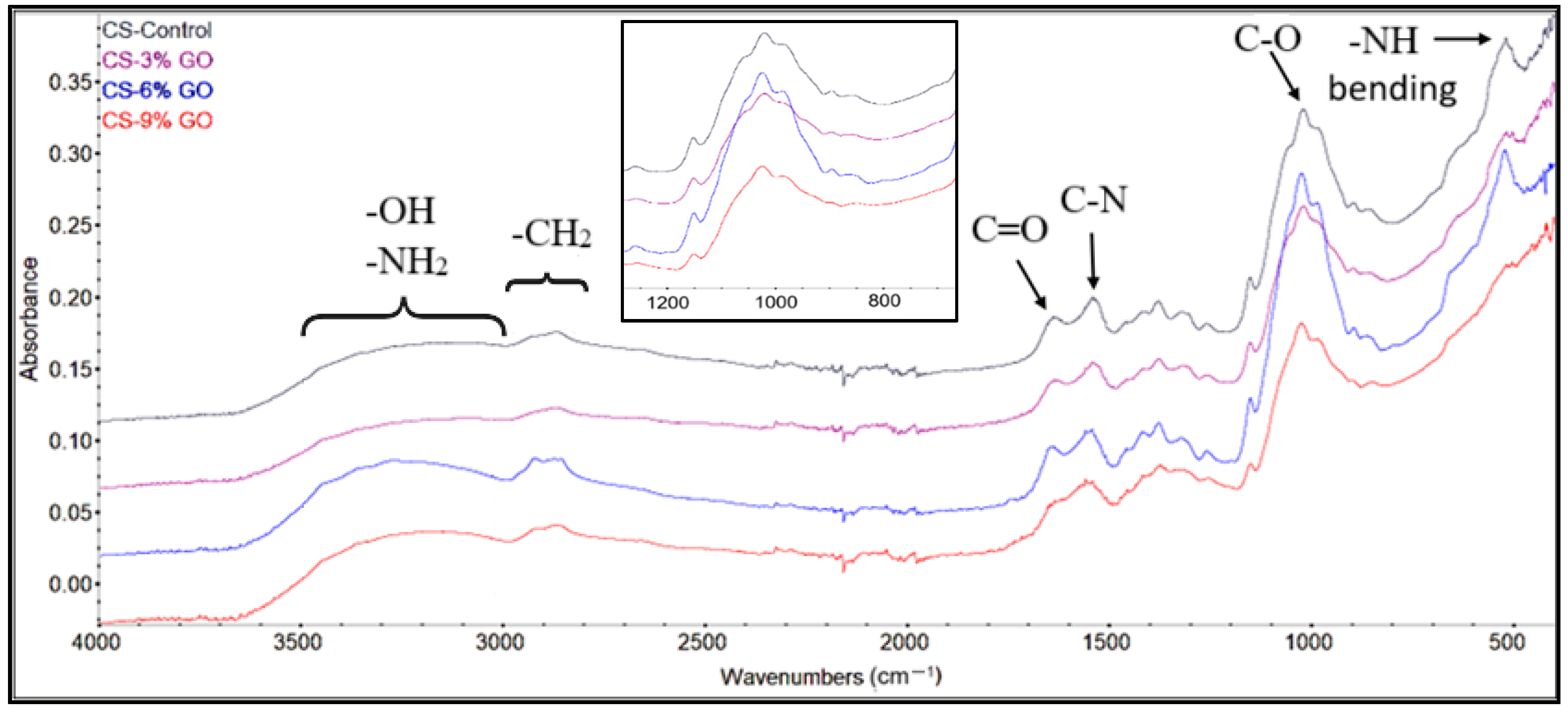
FTIR spectroscopy analysis provided detailed insights into the functional groups present in the CS and CS-GO materials by measuring their infrared (IR) radiation absorption. Based on the IR spectrum of CS (Figure 2), the main characteristic peaks were clearly identified and found to be consistent with those reported in previous studies [63,64,65]. The broad band in the region of 3500–3000 cm−1 corresponded to –OH and –NH2 stretching, while the band between 2800 and 3000 cm−1 was attributed to CH2 stretching modes. The presence of the C=O stretching vibration of amide I was confirmed by the peak at 1635 cm−1, and the band at 1541 cm−1 was assigned to the C–N stretching vibrations of amide III. Additionally, the band observed at 1019 cm−1 corresponded to C–O stretching vibrations, while the peak at 518 cm−1 was associated with out-of-plane NH bending, as also observed in the CS FTIR spectra.
The FTIR spectra for GO, as detailed in our previous study [66], provided further context for the interaction of GO with CS. A combination of both CS and GO characteristic peaks was observed in the FTIR spectra of CS-GO materials. Moreover, a strong shift in the peak from 1541 cm−1 of CS to 1577 cm−1 (observed for CS-9% GO) was observed, due to the interaction between the amino groups from CS surface with the hydroxy groups on the GO surface. Similarly, a visible shift of 3 to 7 cm−1 of the bands between 1000 and 1050 cm−1 was observed, highlighting the interaction between GO and CS. These interactions were important, as the potential toxicity of GO could thus be reduced by coating the GO. As the GO concentration increased further, the peak from 1019 cm−1 (observed for CS-3% GO) shifted to 1026 cm−1 (observed for CS-9% GO). This modification was attributed to the saturation of oxygen-containing groups on GO, which limited their interaction with the CS surface. Furthermore, the absence of the peak around 1700 cm−1, typically associated with C=O stretching vibrations in the carbonyl and carboxyl groups of GO, was attributed to the GO/CS mass ratio, which rendered the peak too weak to detect. The entrapment of the GO sheets within the CS matrix, as well as the strong interactions between CS and GO [67,68], played an essential role in limiting the development of the “foreign body effect”, with GO being mostly covered by CS.

3.2. FTIR Microscopy

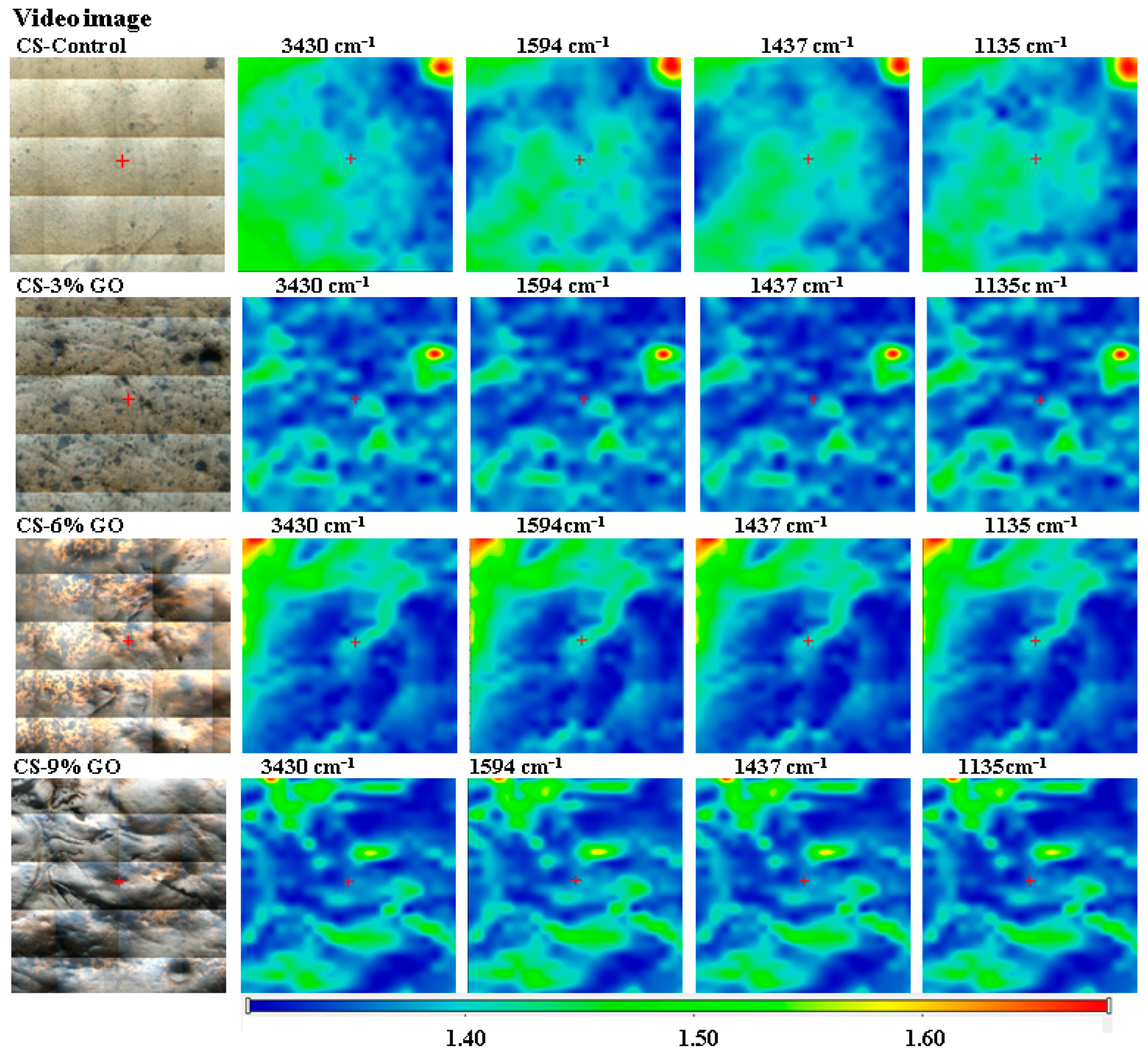
The video and FTIR maps in Figure 3 were recorded at the characteristic peaks for CS and CS-GO films with 3%, 6%, and 9% GO concentrations. The incorporation of GO resulted in changes in peak intensity and slight shifts, particularly at 3430 cm−1, indicating enhanced hydrogen bonding between GO’s oxygen-containing groups and CS’s hydroxyl and amine functionalities. Additionally, the increase in intensity and the shift in the main band associated with the COH bands of the CS (from ~1019 to over 1025 cm−1) in the presence of higher GO content reflected the interactions between the GO and CS matrix. These spectral modifications confirmed the successful integration and the interaction of GO with the CS structure.
FTIR microscopy was a suitable technique to evaluate the microstructure of the composite at a level between visual/optical and electron microscopy levels. Based on the images recorded at the four wavelengths, no considerable differences were observed, indicating that GO did not form agglomerates of tens of hundreds of µm in diameter, which would have been clearly observed in FTIR microscopy.

3.3. UV-Vis Spectroscopy

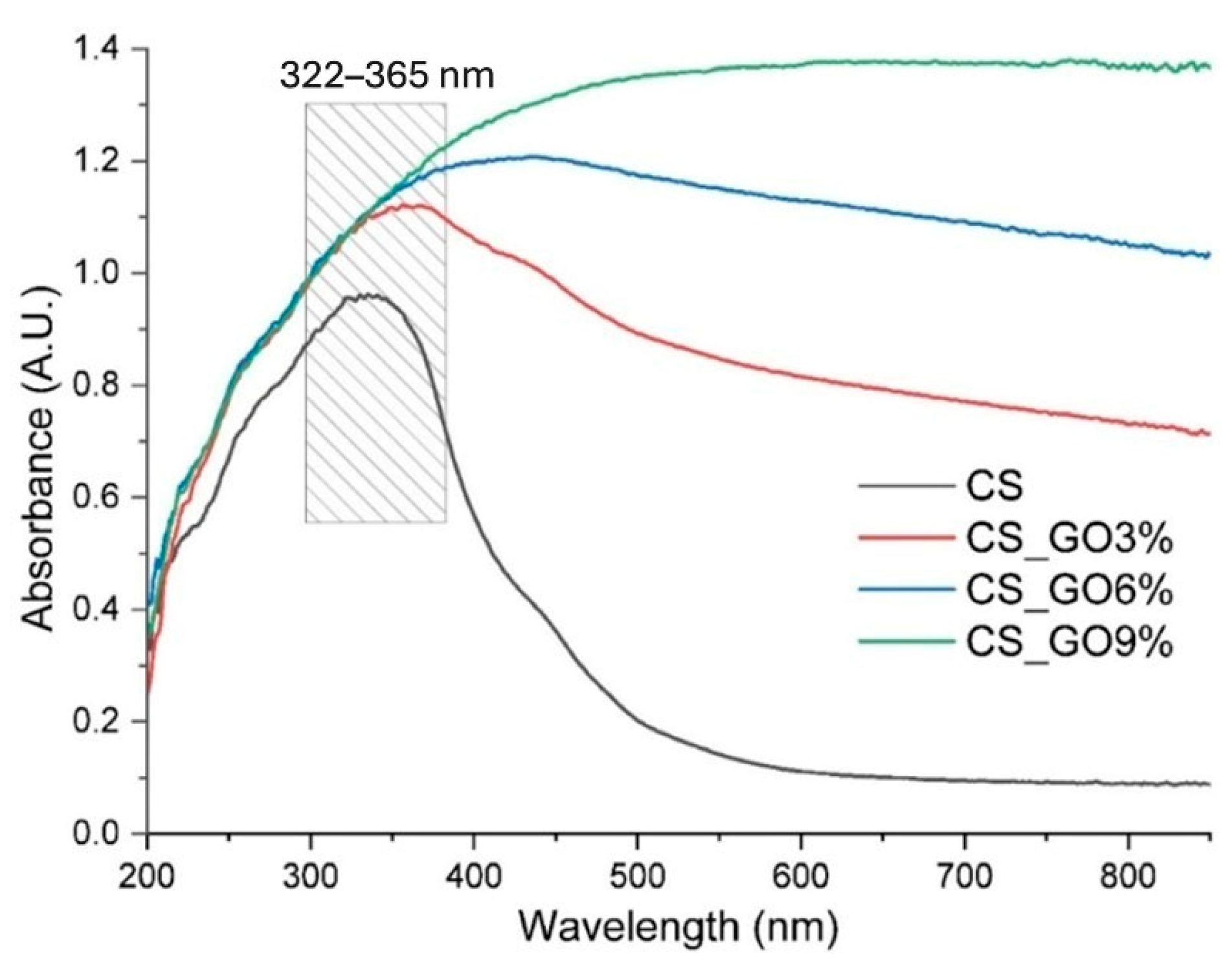
The yellowish-tinted CS transparent films presented an absorption maximum around 350 nm. The asymmetric absorption band presented a long tail in the visible domain, in the violet–blue region, which was responsible for the yellowish appearance. This color was specific for the CS-based films [69].
The addition of GO to the polymer matrix changed the color to black, and as a consequence, the films strongly absorbed light on the entire visible domain. The films became darker as the GO quantity increased from 3% to 9%, which was also indicated by the increasing absorbance for the CS-GO 9% film (Figure 4).
The film thickness and opacity values are given in Table 2. It was observed that while the thickness marginally increased with GO incorporation, the opacity increased by an order of magnitude starting from the addition of 3% GO. Increasing the GO content to 6% significantly enhanced the opacity, while further increase to 9% had a smaller influence on an already opaque composite film.

3.4. PL Spectrometry

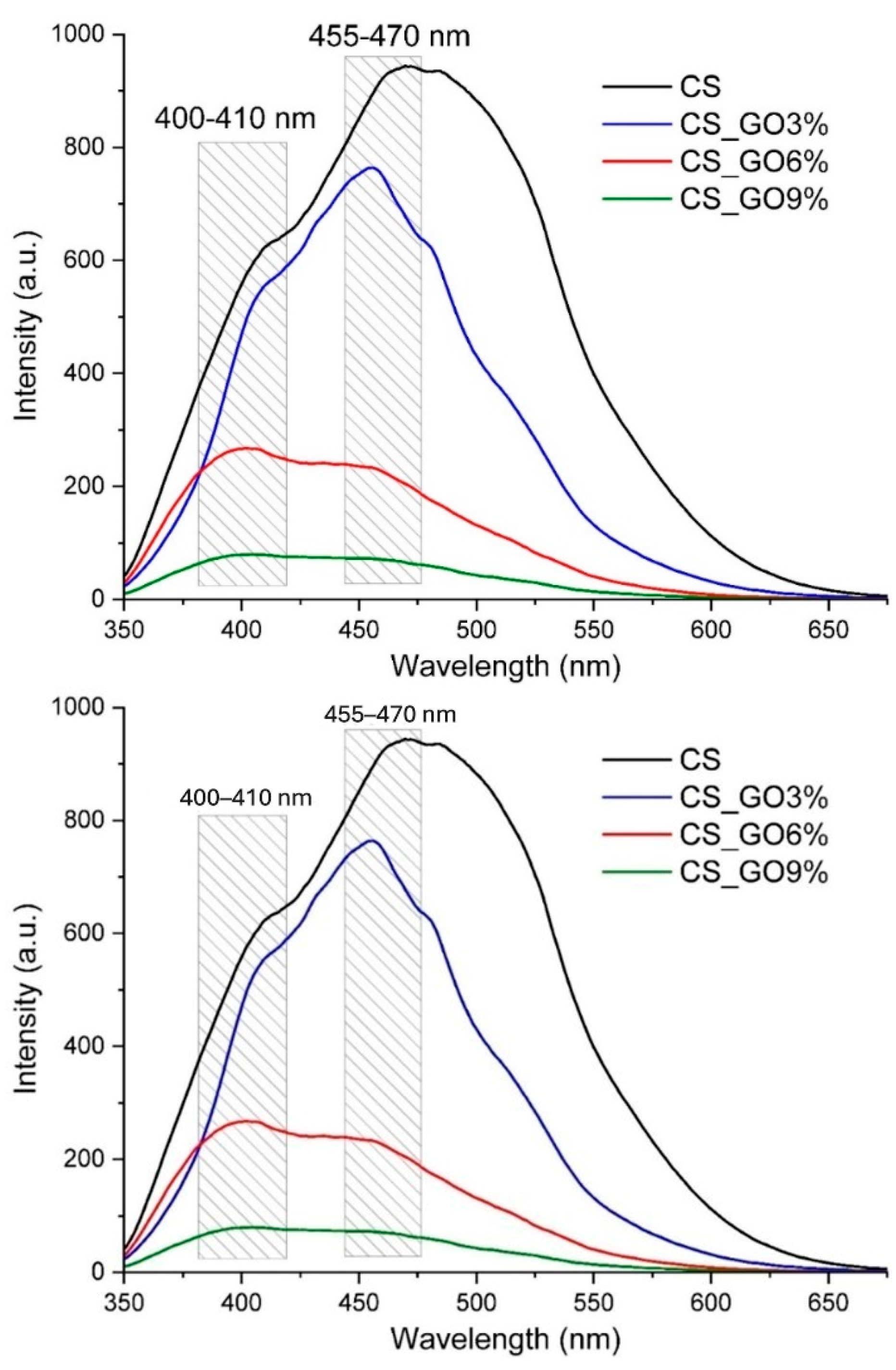
The CS film exhibited a strong blue emission fluorescence (Figure 5) as all polysaccharides, like alginate or cellulose [62,69,70]. The emission band, with multiple peaks and a tail towards longer wavelengths, covered the violet–green region of the spectrum and indicated the possible multiple origins of the emitted photons. By adding GO to the CS-based films, the intensity of the fluorescent emission decreased drastically. The band from the blue–green region diminished more than the violet emission, indicating possible covalent interactions between GO and CS polymer chains. This quenching effect may be attributed to the introduction of non-radiative pathways by GO, likely through surface conduction mechanisms that facilitate the recombination of excited electrons and corresponding holes.

3.5. Thermal Analysis

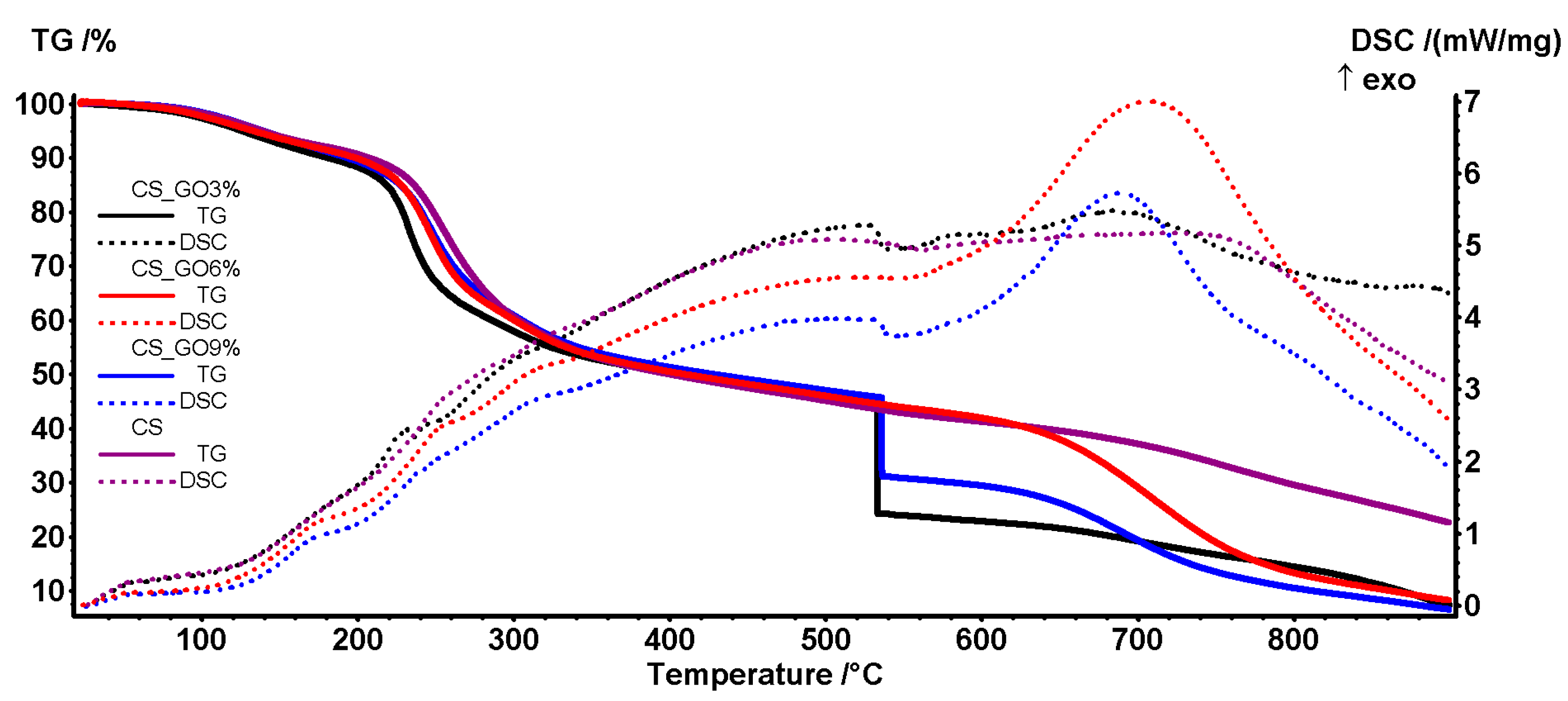
The thermal behavior of all films up to 200 °C was similar, with a mass loss of ~10% representing the elimination of water molecules (Figure 6). The residual moisture was eliminated during the first stage, as indicated by an endothermic effect on the DSC curve. Above 100 °C, the samples began to degrade due to the loss of water by polymer chain dehydration.
Fragmentation of the polymer backbone occurred above 200 °C, along with partial oxidation. Between 400 °C and 600 °C, GO also underwent oxidation reactions, explosively, as reported in [71]. In the CS-GO 6% sample, the oxidation reaction occurred more gradually, suggesting an optimized bonding between the polymer chains and GO, which led to a better stabilization of the GO structure. After 600 °C, the combustion of the carbonaceous residual mass took place, accompanied by a strong exothermic effect on the DSC curve. Additional details are provided in Supplementary Materials.
Table 3 presents the main numeric data from the thermal analysis, including the temperatures corresponding to mass losses of 5%, 10%, or 15% for each sample.

3.6. Swelling Behavior

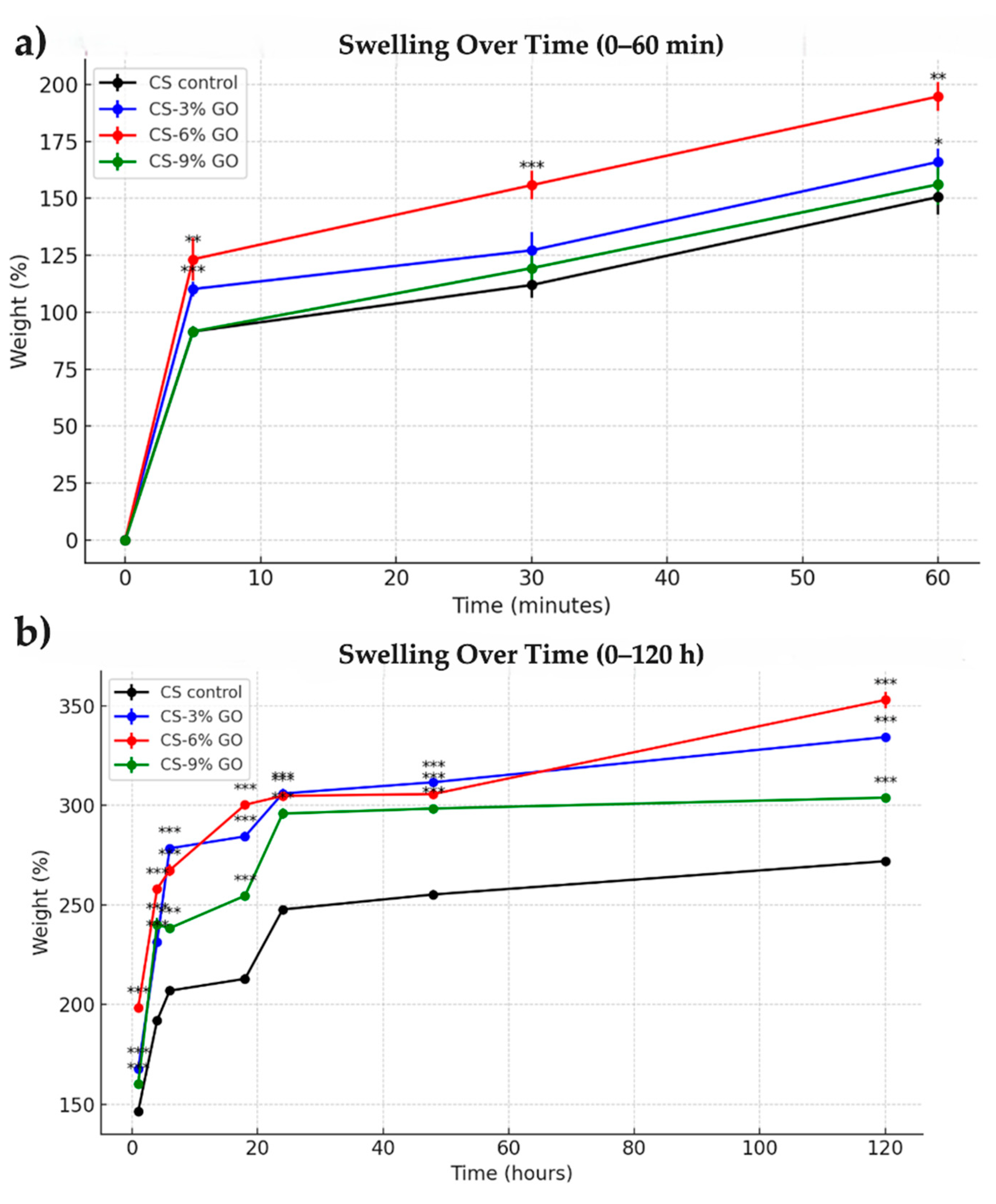
For all swelling evaluations, we considered samples of 0.46–0.65 g. Within the first 5 min, all samples showed a noticeable increase in swelling, with weights rising up to 125% w/w (Figure 7).
As shown in Figure 7a, all samples exhibited a rapid increase in swelling within the first 5 min, followed by a slower, more gradual increase over the remaining duration. The control CS control demonstrated the lowest swelling capacity, reaching 146% at 60 min. In contrast, scaffolds containing GO exhibited enhanced swelling behavior, with the 9% GO sample showing the highest swelling ratio (160%). The addition of GO appears to improve water uptake, likely due to the hydrophilic nature and high surface area of GO, which enhanced fluid absorption.
As illustrated in Figure 7b, swelling continued to increase over time for all formulations, but the rate of increase diminished significantly after the first 24 h, indicating stabilization. The CS–9% GO scaffold consistently exhibited the highest swelling capacity, reaching 304.62% at 120 h. The CS-6% GO scaffold followed closely with 352.73%, while the CS–3% GO and control scaffolds reached lower plateau values of 332.61% and 272%, respectively.
These results confirm that higher GO content promoted sustained water uptake, likely due to improved scaffold porosity and hydrophilicity.

3.7. In Vitro Evaluation of the Grafting Materials

This experiment aimed to evaluate the impact of introducing CS and CS-GO scaffolds into a PBS solution, focusing on the pH and conductivity variations over time. This was intended to simulate the interaction between the materials and a physiological solution, particularly in terms of their potential to alter the PBS environment, which is critical for various biological processes, including neuroregeneration.

3.7.1. pH Variation

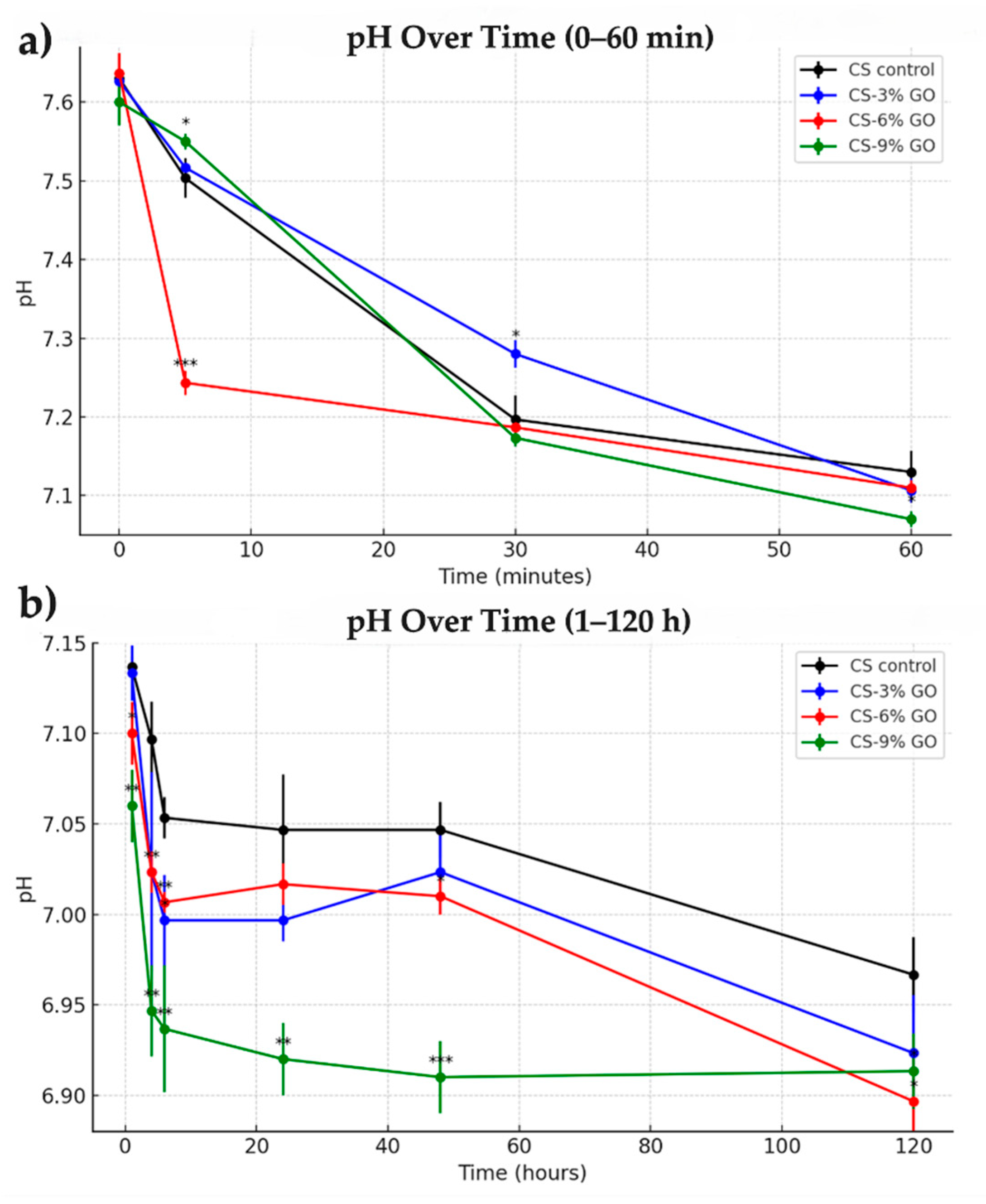
All samples were introduced into a pure PBS solution with an initial pH of 7.62. As shown in Figure 8a, within the first 5 min, a rapid decline in pH was observed across all groups, most notably in the CS–6% GO scaffold, which dropped to 7.24. At 30 min, pH values converged, ranging from 7.19 (CS-6% GO) to 7.26 (CS-3% GO). By 60 min, pH had slightly decreased further for all groups, reaching 7.13 for CS control, 7.12 for CS-3% GO, 7.10 for CS-6% GO, and 7.06 for CS-9% GO. This trend suggested an initial equilibration phase, where GO incorporation, especially at higher concentrations, subtly lowered pH, likely due to the release of functional groups (e.g., –COOH) or ionic interactions within the scaffold matrix.
Over the long term (Figure 8b), all scaffolds exhibited a gradual decline in pH during the first 6 h, with the effect being more pronounced in those containing higher concentrations of GO, likely as a result of acidic functional groups released from the graphene oxide surface. From 6 to 48 h, the pH remained stable across all samples, indicating a period of equilibrium. After 48 h, a gradual decrease in pH was observed, with final values ranging between 6.89 (CS–6% GO) and 6.95 (CS control) at 120 h.
The stability of pH is crucial for neuroregeneration, as neural cells are sensitive to pH fluctuations [72]. The observed pH stabilization indicated that, after the initial interaction, these scaffolds might provide a favorable environment for neural cell growth and regeneration.

3.7.2. Conductivity Variation in Solution

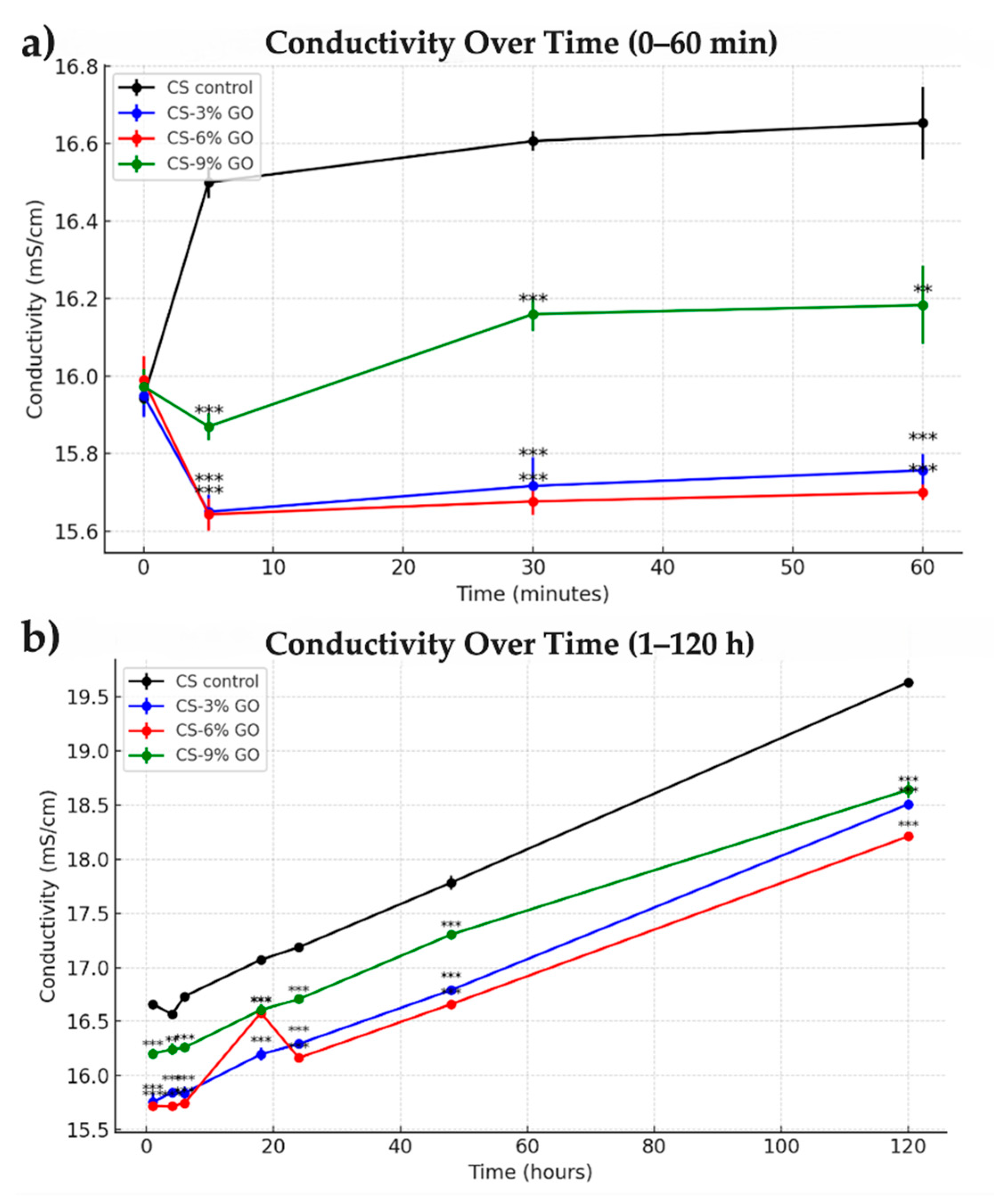
This experiment evaluated changes in ionic conductivity of CS and CS-GO scaffolds when immersed in PBS at neutral pH. The initial conductivity of the pure PBS solution was 15.97 mS/cm. The setup simulated the interaction of materials with a physiological solution, offering insights into their effects on the ionic environment for biomedical applications such as neuroregeneration.
As presented in Figure 9a, within the first 5 min, a sharp divergence in conductivity values was observed. The CS control scaffold demonstrated a marked increase to 16.47 mS/cm, while the GO-containing scaffolds showed a slight decrease, particularly CS–6% GO (15.59 mS/cm). This initial drop may have been attributed to the structural rearrangement or slight swelling delay caused by GO incorporation, which affected ion mobility. Over the next 30–60 min, a gradual increase in conductivity was observed across all samples. By 60 min, the conductivity values were as follows: CS control—16.66 mS/cm; CS-9% GO—16.20 mS/cm; CS-3% GO—15.73 mS/cm; CS-6% GO—15.71 mS/cm.
Extended conductivity measurements (Figure 9b) revealed progressive in ionic conductivity for all scaffolds over time, reflecting increased scaffold hydration and ion diffusion within the porous matrix. The CS control scaffold continued to exhibit superior conductivity throughout the observation period, increasing steadily from 16.66 mS/cm at 1 h to 19.64 mS/cm at 120 h. Among the GO-incorporated samples, CS-3% GO showed the most significant long-term increase, reaching 18.50 mS/cm, followed by CS-9% GO (18.58 mS/cm) and CS-6% GO (18.15 mS/cm).
In conclusion, both CS and GO-enhanced scaffolds interacted with the PBS solution, increasing conductivity over time. The lower conductivity in GO-enhanced scaffolds highlighted improved stability and controlled ion release, supporting their potential in neuroregeneration.

3.8. Electrochemical Conductivity Measurements of CS-GO

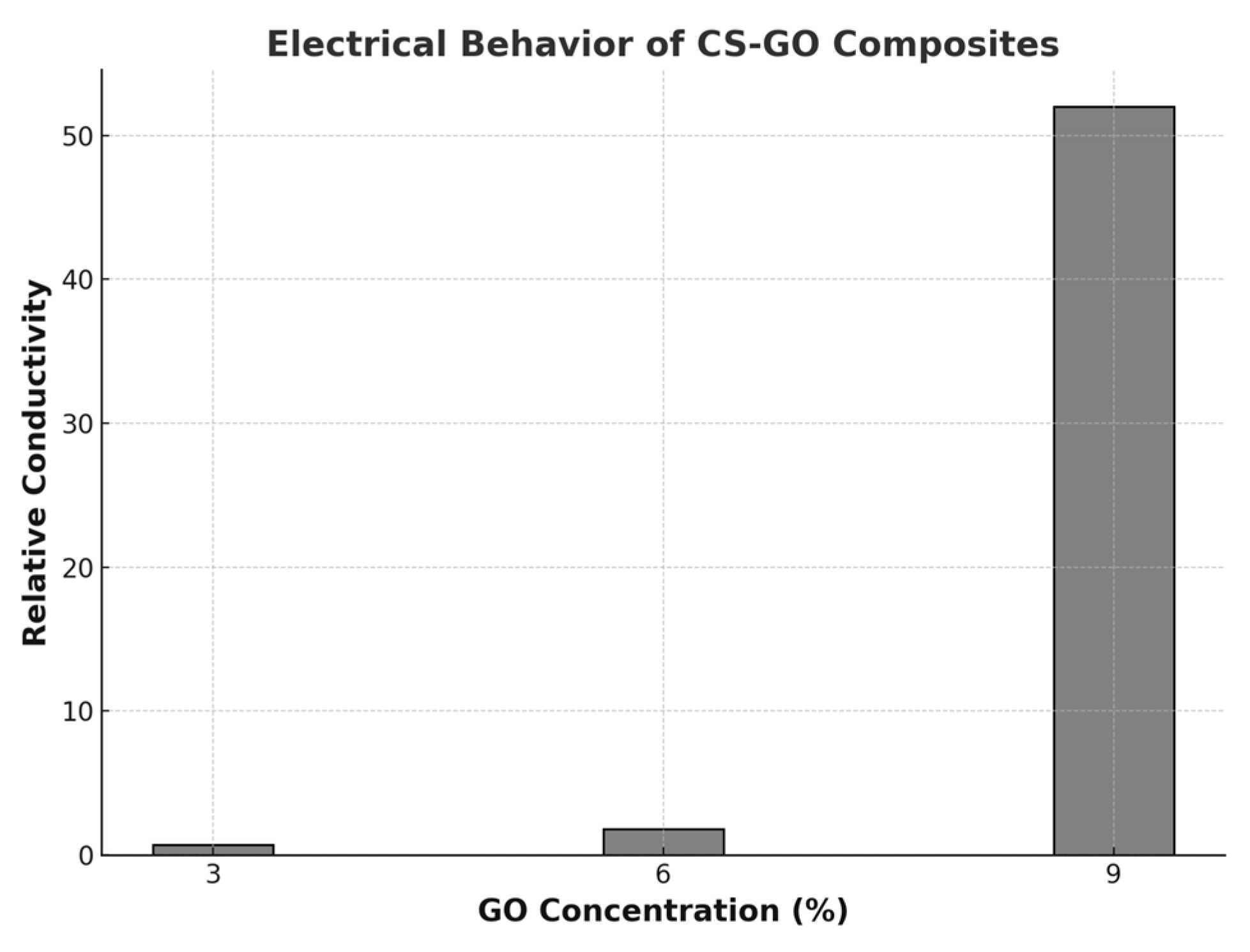
In the case of 3% and 6% CS-GO films, the relative conductivity values (dimensionless), calculated as the ratio of the considered conductivity over the lowest average conductivity value, increased marginally. This indicated a relative constancy of conductivity within the measurement errors for small concentration values of GO. This behavior was explained by the fact that, at low concentrations, small GO particles were completely surrounded by CS, having no physical contact points between them, thus limiting the formation of conductive pathways (Table 4).
A critical concentration of GO was identified between 6% and 9%, where relative conductivity increased significantly, by approximately 52-fold compared to the minimum value, as shown in Figure 10. However, further studies are needed to optimize the concentration to ensure effective electrical stimulation and controlled release of biologically active agents under an applied electric field. Certainly, the conductivity of the native neural tissues can be considered golden standard, and according to the literature, values ranged from µS/cm to mS/cm [73].

3.9. SEM Analysis

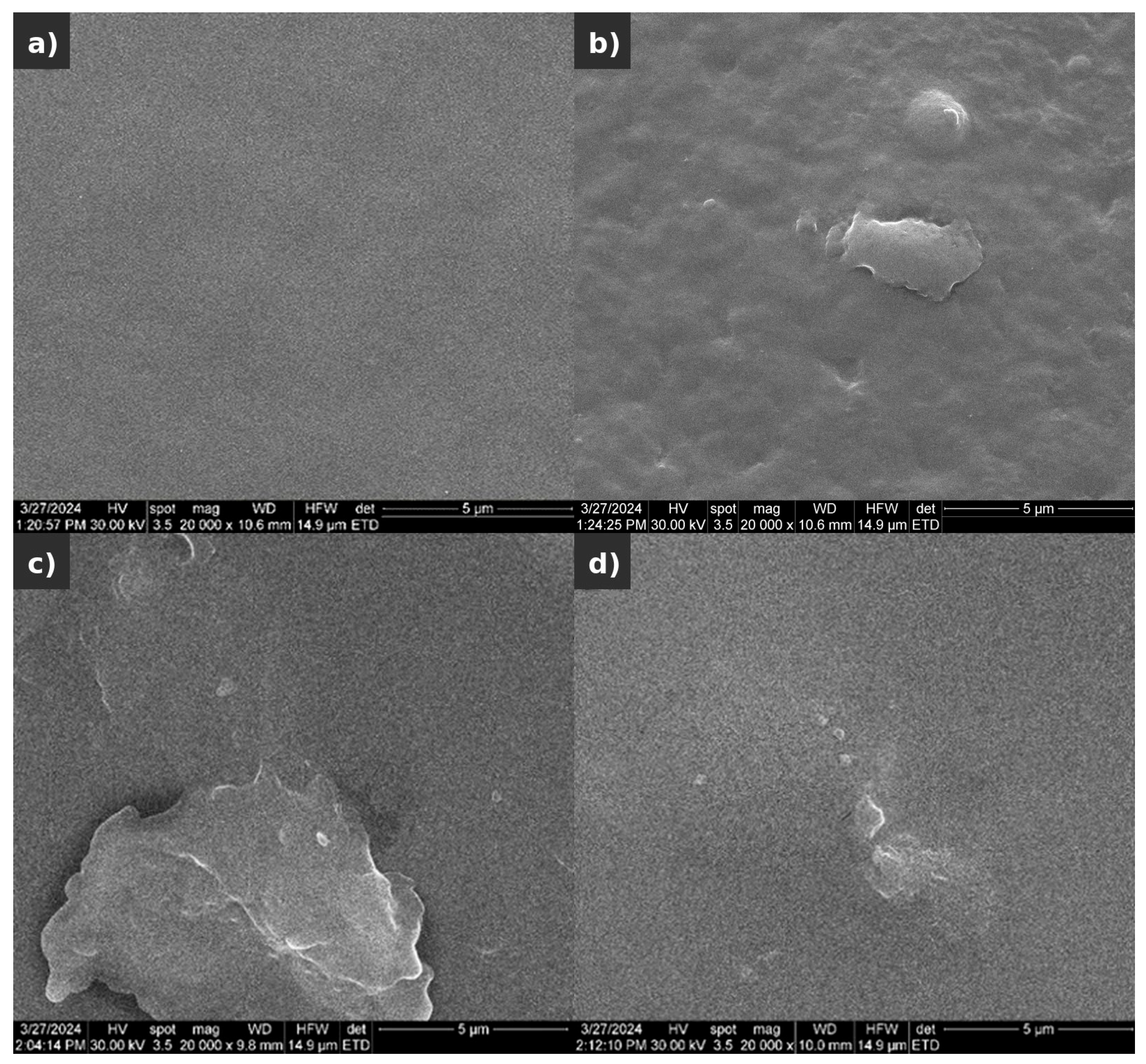
In general, as observed in the visual examination, the surfaces of the samples were smooth with limited hill–valley structures (Figure 11). These distinctive features reflected a non-smooth morphology at the submicron level and were associated with the GO-derived heterogeneity at that scale [72]. These agglomerates varied in size and shape, reflecting the complex associations between the components, without being necessarily associated with large agglomerates of GO [74]. The pure CS scaffold (Figure 11a) displayed a smooth and uniform surface with minimal irregularities or protrusions, showing only a minor hill–valley aspect as observed from the variation in the color (black intensity). This smoother surface morphology of pure CS might not have been optimal for cell adhesion and proliferation compared to more textured surfaces. However, CS’s natural biocompatibility still supported cellular attachment [75]. Modifications or the incorporation of additional materials, such as GO, was considered necessary to enhance cell adhesion and interaction for better neuroregenerative outcomes.
Most probably, the jagged edges of GO sheets and agglomerates formed during oxidation process had a strong influence on the surface defects (Figure 11b–d). Agglomerates and clusters of GO stacked on top of each other, especially at higher concentrations. The CS-3% GO (Figure 11b) scaffold showed a more textured surface with visible inclusions of GO compared to the pure CS scaffold. While the overall distribution of GO remained generally uniform, localized agglomerates were observed, indicating areas of higher concentration. The CS-6% GO scaffold displayed an even more pronounced textured surface. The increased presence of GO led to a noticeable increase in surface roughness compared to the pure CS scaffold. The scaffold maintained its structural integrity and exhibited enhanced mechanical properties. The CS-9% GO scaffold exhibited a smoother surface with less pronounced texturing than the lower GO concentration samples. Although some GO agglomerates remained visible, the overall surface appeared more compact and homogeneous. The scaffold’s porosity decreased with higher GO content, potentially affecting its overall performance in tissue engineering applications.

3.10. Biocompatibility Assessment of SH-SY5Y Cell Culture in Contact with CS-GO Scaffolds

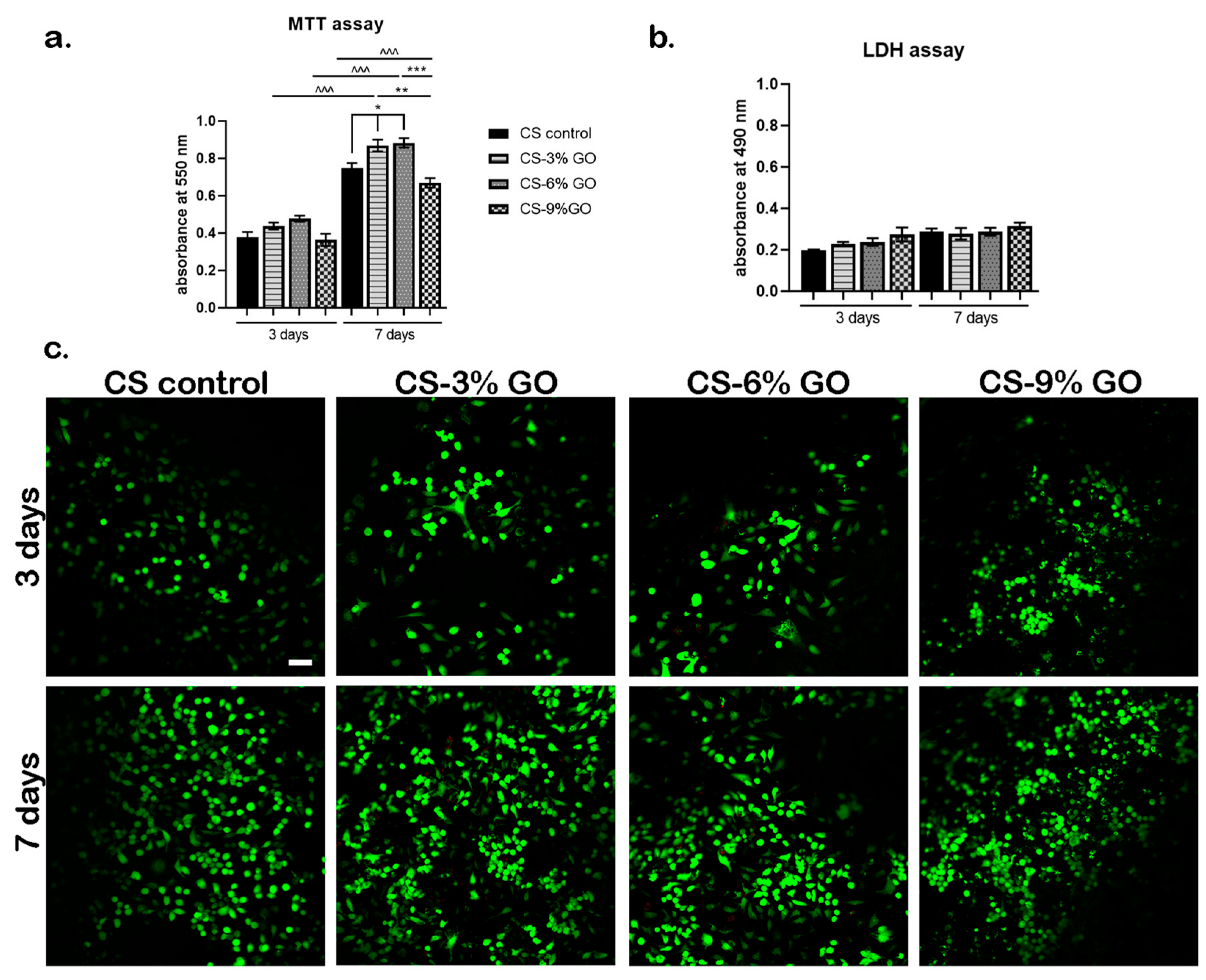
The biological analyses of CS-GO scaffolds are presented in Figure 12.
The cell viability and proliferation profile, as it resulted after performing the MTT assay (Figure 12a), revealed an overall good interaction between the SH-SY5Y cell culture and the tested CS-GO composites. After 3 days of culture under standard culture conditions, cell viability was slightly different between the materials, but with no significant difference. After 7 days of in vitro cell culture, a significantly higher (p < 0.05) viability rate was registered on CS-GO 3% and 6% compared to plain CS control. Furthermore, viability on CS-GO 9% scaffold cells was significantly lower compared to CS-GO 3% and CS-GO 6% (p < 0.01 and p < 0.001, respectively). From 3 to 7 days of culture, SH-SY5Y proliferated significantly (p < 0.001) on all tested materials, indicating that the scaffolds provided an optimal environment for proper cell growth.
The LDH assay assessed the cytotoxic potential of CS-GO enriched materials in contact with SH-SY5Y cells (Figure 12b). The results revealed relative low levels of LDH present in the culture media after 3 days, with no significant differences between the composites. The levels remained constant during one week of in vitro cell culture, without causing significant toxicity upon SH-SY5Y cells. A slightly higher level of LDH was obtained in the presence of the CS-GO 9% scaffold, but not at a statistically significant level.
Live/Dead fluorescence microscopy (Figure 12c) corroborated the MTT and LDH assays results. At 3 days post-seeding, cells were observed to adhere on the surface of the materials. Moreover, on CS-GO 3% and CS-GO 6%, cell shape was elongated, whereas on CS control, there was little-to-no cell elongation on the surface. On the CS-CO 9% composite, cells were labeled in green, but at the same time, they did not present a characteristic shape, revealing that the culture is under stress. After 7 days of in vitro cell culture, images revealed a significant increase in cell density, confirming that cells proliferated in the presence of CS-GO materials. Cells formed clusters, indicating positive cellular interaction with the surface of the materials, which in turn supported viability and growth. On CS control, SH-SY5Y cells presented an elongated phenotype, a behavior also noticed in the presence of CS-GO 3% and CS-GO 6%. In contrast, on CS-CO 9%, cells were not encouraged to elongate and displayed a rounded shape.
GO is a widely studied carbon-based nanomaterial for various applications in tissue regeneration. Due to its tunability and electro-conductivity properties, it is considered as a major candidate for nerve regeneration [76,77,78]. Our results highlight a good biological interaction between SHSY-5Y cell cultures and CS-GO enriched scaffolds, with an emphasis on CS-GO 3% and CS-GO 6%, which demonstrated the best outcomes. The presence of more GO (9%) did not necessarily increase the biological response in this experimental setup. Therefore, for SH-SY5Y cells, the optimal concentration of GO is up to 6%. Similar results were obtained in another study [79], where the same cells were tested for their biocompatibility and differentiation potential in the presence of a GO and silver nanoparticle composite. Thus, the newly developed CS-GO scaffolds are biocompatible with SH-SY5Y cells and can be validated as candidates for nerve regeneration purposes. At 3 and 6% GO, the biocompatibility significantly increased compared to pure CS, but at 9% GO, the viability slightly decreased (but not statistically significantly, as seen in Figure 12a).

4. Conclusions

This study reported the development of CS-GO composite films with enhanced physicochemical and biological performance. FTIR analysis confirmed strong chemical interactions between CS and GO, supporting successful integration into the polymer matrix. Electrical conductivity remained stable up to 6% GO, after which a sharp increase was observed, indicating a critical concentration for tuning electrical properties. Morphological characterization showed well-distributed, textured surfaces at 6% GO, favorable for cell attachment. Biological assays demonstrated that CS-GO films with 6% GO supported optimal cell viability and proliferation without inducing cytotoxic effects. The high loading of GO and the high viability can be explained considering the strong interaction between the phases and the fact that no free GO particles are released and induce toxicity. This composition emerged as the most effective in balancing structural, electrical, and biological properties. Thermal analysis revealed improved stability, with higher degradation temperatures in GO-containing films, while swelling tests showed increased fluid uptake with GO concentration—an essential feature for tissue engineering.
Overall, the incorporation of GO significantly improved CS film performance, with 6% GO identified as the optimal formulation for neuroregenerative applications. Further studies should explore the mechanical properties, electric stimulation capability, loading and release of neuroregenerative agents, and in vivo behavior on small animals, following the imposed ethical procedures.

Supplementary Materials

The following supporting information can be downloaded at: https://www.mdpi.com/article/10.3390/polym17172398/s1, Detailed data on the DSC curve in Figure 6 are provided in Supplementary Materials.

Author Contributions

Conceptualization, A.-I.L. and A.F.; methodology, A.Ș., L.M., O.-C.O., and S.D.; software, L.M. and O.-C.O.; validation, A.F., A.-M.C., and D.F.; formal analysis, A.-I.L., L.M., O.-C.O., R.-D.T., D.-I.V. and A.Ș.; investigation, A.-I.L., A.Ș., D.F. and S.D.; resources, A.F., D.F., L.M., O.-C.O., and S.D.; data curation, A.-I.L.; A.-M.C., L.M. and O.-C.O.; writing—original draft preparation, A.-I.L., A.-M.C., A.Ș., L.M., O.-C.O.; writing—review and editing, A.F., D.F., D.-I.V. and S.D.; visualization, D.F., L.M. and S.D.; supervision, A.F., D.F., D.-I.V. and S.D.; project administration, A.F.; funding acquisition, A.F. and S.D. All authors have read and agreed to the published version of the manuscript.

Funding

The authors acknowledge the financial support of the Smart2Graph—Smart nerve grafts based on graphene-related composite materials with electric-triggering capability for central and peripheral nervous system regeneration, funded within the Flag Era Call. The APC was funded by the National University of Science and Technology Politehnica Bucharest.

Data Availability Statement

The original contributions presented in this study are included in the article/Supplementary Materials. Further inquiries can be directed to the corresponding author.

Acknowledgments

The authors are grateful to the Romanian Government for providing access to the research infrastructure of the National Center for Micro and Nanomaterials through the National Program titled “Installations and Strategic Objectives of National Interest”.

Conflicts of Interest

The authors declare no conflicts of interest.

Abbreviations

The following abbreviations are used in this manuscript:
ATRAttenuated Total Reflectance
CO2Carbon Dioxide
CSChitosan
dThickness of the Deposited Layer
DSCDifferential Scanning Calorimetry
EDSEnergy Dispersive X-ray Spectroscopy
FBSFetal Bovine Serum
FEGField Emission Gun
FTIRFourier-Transform Infrared Spectroscopy
GOGraphene Oxide
λ Electrical Conductivity
LDHLactate Dehydrogenase
LIVE/DEADLive/Dead Cell Viability Assay
MEMMinimum Essential Medium (Eagle)
MTT3-(4,5-dimethylthiazol-2-yl)-2,5-diphenyltetrazolium bromide
NGCsNerve Guidance Conduits
PBSPhosphate-Buffered Saline
PLPhotoluminescence
RElectrical Resistance (Ohm)
SEMScanning Electron Microscopy
SH-SY5YHuman Neuroblastoma Cell Line
SCross-sectional Area
TGThermogravimetry
TG-DSCThermogravimetric Analysis–Differential Scanning Calorimetry
UV-VisUltraviolet–Visible Spectroscopy

References

  1. Ruijs, A.C.J.; Jaquet, J.B.; Kalmijn, S.; Giele, H.; Hovius, S.E.R. Median and ulnar nerve injuries: A meta-analysis of predictors of motor and sensory recovery after modern microsurgical nerve repair. Plast. Reconstr. Surg. 2005, 116, 484–494. [Google Scholar] [CrossRef]
  2. Kornfeld, T.; Vogt, P.M.; Radtke, C. Nerve grafting for peripheral nerve injuries with extended defect sizes. Wien Med. Wochenschr. 2019, 169, 240–251. [Google Scholar] [CrossRef]
  3. Fornasari, B.E.; Carta, G.; Gambarotta, G.; Raimondo, S. Natural-based biomaterials for peripheral nerve injury repair. Front. Bioeng. Biotechnol. 2020, 8, 554257. [Google Scholar] [CrossRef] [PubMed]
  4. Paskal, A.M.; Paskal, W.; Pietruski, P.; Wlodarski, P.K. Polyethylene glycol: The future of posttraumatic nerve repair? systemic review. Int. J. Mol. Sci. 2019, 20, 1478. [Google Scholar] [CrossRef] [PubMed]
  5. Woźniak, A.; Biernat, M. Methods for crosslinking and stabilization of graph structures for potential medical applications. J. Bioact. Compat. Polym. 2022, 37, 151–167. [Google Scholar] [CrossRef]
  6. Wang, W.; Itoh, S.; Matsuda, A.; Ichinose, S.; Shinomiya, K.; Hata, Y.; Tanaka, J. Influences of mechanical properties and permeability on chitosan nano/microfiber mesh tubes as a scaffold for nerve regeneration. J. Biomed. Mater. Res. Part A 2008, 84, 557–566. [Google Scholar]
  7. Huang, Y.C.; Hsu, S.H.; Kuo, W.C.; Chang-Chien, C.L.; Cheng, H.; Huang, Y.Y. Effects of laminin-coated carbon nanotube/chitosan fibers on guided neurite growth. J. Biomed. Mater. Res. Part A 2011, 99, 86–93. [Google Scholar] [CrossRef]
  8. Guo, X.; Zahir, T.; Mothe, A.; Shoichet, M.S.; Morshead, C.M.; Katayama, Y.; Tator, C.H. The effect of growth factors and soluble Nogo-66 receptor protein on transplanted neural stem/progenitor survival and axonal regeneration after complete transection of rat spinal cord. Cell Transplant. 2012, 21, 1177–1197. [Google Scholar] [CrossRef]
  9. Shukla, S.K.; Mishra, A.K.; Arotiba, O.A.; Mamba, B.B. Chitosan-based nanomaterials: A state-of-the-art review. Int. J. Biol. Macromol. 2013, 59, 46–58. [Google Scholar] [CrossRef]
  10. Gu, J.H.; Hu, W.; Deng, A.D.; Zhao, Q.; Lu, S.B.; Gu, X.S. Surgical repair of a 30 mm long human median nerve defect in the distal forearm by implantation of a chitosan-PGA nerve guidance conduit. J. Tissue Eng. Regen. Med. 2012, 6, 163–168. [Google Scholar] [CrossRef]
  11. Gregory, H.; Phillips, J.B. Materials for peripheral nerve repair constructs: Natural proteins or synthetic polymers? Neurochem. Int. 2021, 143, 104953. [Google Scholar] [CrossRef] [PubMed]
  12. Boecker, A.; Daeschler, S.C.; Kneser, U.; Harhaus, L. Relevance and Recent Developments of Chitosan in Peripheral Nerve Surgery. Front. Cell. Neurosci. 2019, 13, 104. [Google Scholar] [CrossRef]
  13. Janik, W.; Ledniowska, K.; Nowotarski, M.; Kudła, S.; Knapczyk-Korczak, J.; Stachewicz, U.; Nowakowska-Bogdan, E.; Sabura, E.; Nosal-Kovalenko, H.; Turczyn, R.; et al. Chitosan-Based Films with Alternative Eco-Friendly Plasticizers: Preparation, Physicochemical Properties and Stability. Carbohydr. Polym. 2023, 301, 120277. [Google Scholar] [CrossRef]
  14. Zahra, K.; Borjian-Boroujeni, M.; Yekani, R.; Varma, R.S. Carbon Nanomaterials with Chitosan: A Winning Combination for Drug Delivery Systems. J. Drug Deliv. Sci. Technol. 2021, 66, 102847. [Google Scholar] [CrossRef]
  15. Li, M.; Wang, Y.; Zhang, Y.; Yu, J.; Ge, S.; Yan, M. Graphene Functionalized Porous Au-Paper Based Electrochemiluminescence Device for Detection of DNA Using Luminescent Silver Nanoparticles Coated Calcium Carbonate/Carboxymethyl Chitosan Hybrid Microspheres as Labels. Biosens. Bioelectron. 2014, 59, 307–313. [Google Scholar] [CrossRef]
  16. Potara, M.; Jakab, E.; Damert, A.; Popescu, O.; Canpean, V.; Astilean, S. Synergistic Antibacterial Activity of Chitosan–Silver Nanocomposites on Staphylococcus aureus. Nanotechnology 2011, 22, 135101. [Google Scholar] [CrossRef]
  17. Du, Y.; Luo, X.-L.; Xu, J.-J.; Chen, H.-Y. A Simple Method to Fabricate a Chitosan-Gold Nanoparticles Film and Its Application in Glucose Biosensor. Bioelectrochemistry 2007, 70, 342–347. [Google Scholar] [CrossRef] [PubMed]
  18. Caridade, S.G.; Merino, E.G.; Alves, N.M.; Mano, J.F. Bioactivity and Viscoelastic Characterization of Chitosan/Bioglass® Composite Membranes. Macromol. Biosci. 2012, 12, 1106–1113. [Google Scholar] [CrossRef]
  19. Chen, S.; Wang, H.; Jian, Z.; Fei, G.; Qian, W.; Luo, G.; Wang, Z.; Xia, H. Novel poly (vinyl alcohol)/chitosan/modified graphene oxide biocomposite for wound dressing application. Macromol. Biosci. 2020, 20, 1900385. [Google Scholar] [CrossRef]
  20. Liu, X.; Wu, Y.; Zhao, X.; Wang, Z. Fabrication and applications of bioactive chitosan-based organic-inorganic hybrid materials: A review. Carbohydr. Polym. 2021, 267, 118179. [Google Scholar] [CrossRef] [PubMed]
  21. Wahid, F.; Zhao, X.-J.; Jia, S.-R.; Bai, H.; Zhong, C. Nanocomposite hydrogels as multifunctional systems for biomedical applications: Current state and perspectives. Compos. Part B Eng. 2020, 200, 108208. [Google Scholar] [CrossRef]
  22. Lo’pez Tenorio, D.; Valencia, C.; Valencia, C.; Zuluaga, F.; Valencia, M.; Mina, J.; Grande Tovar, C. Evaluation of the biocompatibility of CS-graphene oxide compounds in vivo. Int. J. Mol. Sci. 2019, 20, 1572. [Google Scholar] [CrossRef]
  23. Valencia, A.M.; Valencia, C.H.; Zuluaga, F.; Grande-Tovar, C.D. Dataset on in-vitro study of chitosan-graphene oxide films for regenerative medicine. Data Brief. 2021, 39, 107472. [Google Scholar] [CrossRef]
  24. Zhang, L.; Li, X.; Shi, C.; Ran, G.; Peng, Y.; Zeng, S.; He, Y. Biocompatibility and angiogenic effect of chitosan/graphene oxide hydrogel scaffolds on EPCs. Stem Cells Int. 2021, 2021, 5594370. [Google Scholar] [CrossRef]
  25. Zhang, S.; Ma, B.; Wang, S.; Duan, J.; Qiu, J.; Li, D.; Sang, Y.; Ge, S.; Liu, H. Mass production of fluorescent chitosan/graphene oxide hybrid microspheres for in vitro 3D expansion of human umbilical cord mesenchymal stem cells. Chem. Eng. J. 2018, 331, 675–684. [Google Scholar] [CrossRef]
  26. Zhang, X. Implantable glucose biosensor with enhancing electron transfer nanocomposite functional layers. Int. J. Electrochem. Sci. 2021, 16, 151061. [Google Scholar] [CrossRef]
  27. Grande, C.D.; Mangadlao, J.; Fan, J.; DeLeon, A.; Delgado-Ospina, J.; Rojas, J.G.; Rodrigues, D.F.; Advincula, R. Chitosan cross-linked graphene oxide nanocomposite films with antimicrobial activity for application in food industry. Macromol. Symp. 2017, 374, 1600114. [Google Scholar] [CrossRef]
  28. Khalil, W.F.; El-Sayyad, G.S.; El Rouby, W.M.A.; Sadek, M.A.; Farghali, A.A.; El-Batal, A.I. Graphene oxide-based nanocomposites (GO-chitosan and GO-EDTA) for outstanding antimicrobial potential against some Candida species and pathogenic bacteria. Int. J. Biol. Macromol. 2020, 164, 1370–1383. [Google Scholar] [CrossRef]
  29. Jiang, L.; Chen, D.; Wang, Z.; Zhang, Z.; Xia, Y.; Xue, H.; Liu, Y. Preparation of an electrically conductive graphene oxide/chitosan scaffold for cardiac tissue engineering. Appl. Biochem. Biotechnol. 2019, 188, 952–964. [Google Scholar] [CrossRef]
  30. Wu, K.; Liu, X.; Li, Z.; Jiao, Y.; Zhou, C. Fabrication of chitosan/graphene oxide composite aerogel microspheres with high bilirubin removal performance. Mater. Sci. Eng. C 2020, 106, 110162. [Google Scholar] [CrossRef]
  31. Yu, R.; Shi, Y.; Yang, D.; Liu, Y.; Qu, J.; Yu, Z.-Z. Graphene oxide/chitosan aerogel microspheres with honeycomb-cobweb and radially oriented microchannel structures for broad-spectrum and rapid adsorption of water contaminants. ACS Appl. Mater. Interface 2017, 9, 21809–21819. [Google Scholar] [CrossRef]
  32. Huang, X.-M.; Liu, L.-Z.; Zhou, S.; Zhao, J.-J. Physical Properties and Device Applications of Graphene Oxide. Front. Phys. 2020, 15, 33301. [Google Scholar] [CrossRef]
  33. Liu, C.; Huang, Z.; Pu, X.; Shang, L.; Yin, G.; Chen, X.; Cheng, S. Fabrication of Carboxylic Graphene Oxide-Composited Polypyrrole Film for Neurite Growth under Electrical Stimulation. Front. Mater. Sci. 2019, 13, 258–267. [Google Scholar] [CrossRef]
  34. Gayathri, V.; Khan, T.; Gowtham, M.; Balan, R.; Sebaey, T.A. Functionalized Conductive Polymer Composites for Tissue Engineering and Biomedical Applications—A Mini Review. Front. Bioeng. Biotechnol. 2025, 13, 1533944. [Google Scholar] [CrossRef]
  35. Yang, B.; Wang, P.-B.; Mu, N.; Ma, K.; Wang, S.; Yang, C.-Y.; Huang, Z.-B.; Lai, Y.; Feng, H.; Yin, G.-F.; et al. Graphene Oxide-Composited Chitosan Scaffold Contributes to Functional Recovery of Injured Spinal Cord in Rats. Neural Regen. Res. 2021, 16, 1829–1835. [Google Scholar] [CrossRef]
  36. Aranaz, I.; Mengíbar, M.; Harris, R.; Paños, I.; Miralles, B.; Acosta, N.; Galed, G.; Heras, Á. Functional characterization of chitin and chitosan. Curr. Chem. Biol. 2009, 3, 203–230. [Google Scholar]
  37. Freier, T.; Koh, H.S.; Kazazian, K.; Shoichet, M.S. Controlling cell adhesion and degradation of chitosan films by N-acetylation. Biomaterials 2005, 26, 5872–5878. [Google Scholar] [CrossRef] [PubMed]
  38. Wenling, C.; Duohui, J.; Jiamou, L.; Yandao, G.; Nanming, Z.; Xiufang, Z. Effects of the degree of deacetylation on the physicochemical properties and Schwann cell affinity of chitosan films. J. Biomater. Appl. 2005, 20, 157–177. [Google Scholar] [CrossRef] [PubMed]
  39. Jiao, H.; Yao, J.; Yang, Y.; Chen, X.; Lin, W.; Li, Y.; Gu, X.; Wang, X. Chitosan/polyglycolic acid nerve grafts for axon regeneration from prolonged axotomized neurons to chronically denervated segments. Biomaterials 2009, 30, 5004–5018. [Google Scholar] [CrossRef] [PubMed]
  40. Wang, X.; Hu, W.; Cao, Y.; Yao, J.; Wu, J.; Gu, X. Dog sciatic nerve regeneration across a 30-mm defect bridged by a chitosan/PGA artificial nerve graft. Brain 2005, 128, 1897–1910. [Google Scholar] [CrossRef]
  41. Fan, W.; Gu, J.; Hu, W.; Deng, A.; Ma, Y.; Liu, J.; Ding, F.; Gu, X. Repairing a 35-mm-long median nerve defect with a chitosan/PGA artificial nerve graft in the human: A case study. Microsurgery 2008, 28, 238–242. [Google Scholar] [CrossRef]
  42. Xie, F.; Li, Q.F.; Gu, B.; Liu, K.; Shen, G.X. In vitro and in vivo evaluation of a biodegradable chitosan-PLA composite peripheral nerve guide conduit material. Microsurgery 2008, 28, 471–479. [Google Scholar] [CrossRef]
  43. Xie, F.; Li, Q.F.; Zhao, L.S. Study on using a new biodegradable conduit to repairing rat’s peripheral nerve defect. Zhonghua Zheng Xing Wai Ke Za Zhi 2005, 21, 295–298. [Google Scholar] [PubMed]
  44. Soria, J.M.; Ramos, C.M.; Sánchez, M.S.; Benavent, V.; Fernández, A.C.; Ribelles, J.L.G.; Verdugo, J.M.G.; Pradas, M.M.; Barcia, J.A. Survival and differentiation of embryonic neural explants on different biomaterials. J. Biomed. Mater. Res. Part A 2006, 79, 495–502. [Google Scholar] [CrossRef]
  45. Ravikumar, M.N.V.; Muzzarelli, R.A.A.; Muzzarelli, C.; Sashiwa, H.; Domb, A.J. Chitosan and its derivatives: Versatile biomaterials for drug delivery, tissue engineering, and gene therapy. Chem. Rev. 2004, 104, 6017–6084. [Google Scholar]
  46. Itoh, S.; Matsuda, A.; Kobayashi, H.; Ichinose, S.; Shinomiya, K.; Tanaka, J. Effects of a laminin peptide (YIGSR) immobilized on crab-tendon chitosan tubes on 55 Chitosan for Neural Regeneration nerve regeneration. J. Biomed. Mater. Res. Part B Appl. Biomater. 2005, 73, 375–382. [Google Scholar] [CrossRef]
  47. Li, X.; Yang, Z.; Zhang, A.; Wang, T.; Chen, W. Repair of thoracic spinal cord injury by chitosan tube implantation in adult rats. Biomaterials 2009, 30, 1121–1132. [Google Scholar] [CrossRef] [PubMed]
  48. Wang, H.; Zhao, Q.; Zhao, W.; Liu, Q.; Gu, X.; Yang, Y. Repairing rat sciatic nerve injury by a nerve-growth-factor-loaded, chitosan-based nerve conduit. Biotechnol. Appl. Biochem. 2012, 59, 388–394. [Google Scholar] [CrossRef]
  49. Xu, H.; Yan, Y.; Li, S. PDLLA/chondroitin sulfate/chitosan/NGF conduits for peripheral nerve regeneration. Biomaterials 2011, 32, 4506–4516. [Google Scholar] [CrossRef] [PubMed]
  50. Patel, M.; Mao, L.; Wu, B.; VandeVord, P. GDNFblendedchitosan nerve guides: An in vivo study. J. Biomed. Mater. Res. Part A 2009, 90, 154–165. [Google Scholar] [CrossRef]
  51. Shen, H.; Shen, Z.; Zhang, P.; Chen, N.; Wang, Y.; Zhang, Z.; Jin, Y. Ciliary neurotrophic factor-coated polylactic-polyglycolic acid chitosan nerve conduit promotes peripheral nerve regeneration in canine tibial nerve defect repair. J. Biomed. Mater. Res. Part B Appl. Biomater. 2010, 95, 161–170. [Google Scholar] [CrossRef]
  52. Yang, Z.; Duan, H.; Mo, L.; Qiao, H.; Li, X. The effect of the dosage of NT-3/chitosan carriers on the proliferation and differentiation of neural stem cells. Biomaterials 2010, 31, 4846–4854. [Google Scholar] [CrossRef] [PubMed]
  53. Stucky, C.L.; Shin, J.B.; Lewin, G.R. Neurotrophin-4: A survival factor for adult sensory neurons. Curr. Biol. 2002, 12, 1401. [Google Scholar] [CrossRef] [PubMed][Green Version]
  54. Ao, Q.; Fung, C.-K.; Tsui, A.Y.-P.; Cai, S.; Zuo, H.-C.; Chan, Y.-S.; Shum, D.K.-Y. The regeneration of transected sciatic nerves of adult rats using chitosan nerve conduits seeded with bone marrow stromal cell-derived Schwann cells. Biomaterials 2011, 32, 787–796. [Google Scholar] [CrossRef]
  55. Bozkurt, G.; Mothe, A.J.; Zahir, T.; Kim, H.; Shoichet, M.S.; Tator, C.H. Chitosan channels containing spinal cord-derived stem/progenitor cells for repair of subacute spinal cord injury in the rat. Neurosurgery 2010, 67, 1733–1744. [Google Scholar] [CrossRef]
  56. Wang, W.; Itoh, S.; Konno, K.; Kikkawa, T.; Ichinose, S.; Sakai, K.; Ohkuma, T.; Watabe, K. Effects of Schwann cell alignment along the oriented electrospun chitosan nanofibers on nerve regeneration. J. Biomed. Mater. Res. Part A 2009, 91, 994–1005. [Google Scholar] [CrossRef]
  57. Hummers, W.S.; Offeman, R.E. Preparation of Graphitic Oxide. J. Am. Chem. Soc. 1958, 80, 1339. [Google Scholar] [CrossRef]
  58. Monteiro, O.A., Jr.; Airoldi, C. Some Studies of Crosslinking Chitosan-Glutaraldehyde Interaction in a Homogeneous System. Int. J. Biol. Macromol. 1999, 26, 119–128. [Google Scholar] [CrossRef]
  59. Migneault, I.; Dartiguenave, C.; Bertrand, M.; Waldron, K. Glutaraldehyde: Behavior in aqueous solution, reaction with proteins, and application to enzyme crosslinking. BioTechniques. 2004, 37, 790–802. [Google Scholar] [CrossRef]
  60. Ahmadi, F.; Oveisi, Z.; Samani, S.M.; Amoozgar, Z. Chitosan Based Hydrogels: Characteristics and Pharmaceutical Applications. Res. Pharm. Sci. 2015, 10, 1–16. [Google Scholar] [PubMed]
  61. Islam, N.; Dmour, I.; Taha, M.O. Degradability of Chitosan Micro/Nanoparticles for Pulmonary Drug Delivery. Heliyon 2019, 5, e01684. [Google Scholar] [CrossRef]
  62. Motelica, L.; Ficai, D.; Oprea, O.; Ficai, A.; Truşcă, R.; Andronescu, E.; Holban, A.M. Biodegradable alginate films with ZnO nanoparticles and citronella essential oil—a novel antimicrobial structure. Pharmaceutics 2021, 13, 1020. [Google Scholar] [CrossRef]
  63. Varma, R.; Vasudevan, S. Extraction, Characterization, and Antimicrobial Activity of Chitosan from Horse Mussel Modiolus modiolus. ACS Omega 2020, 6, 20224–20230. [Google Scholar] [CrossRef]
  64. Fernandes, Q.M.; Melo, K.R.T.; Sabry, D.A.; Sassaki, G.L.; Rocha, H.A.O. Does the Use of Chitosan Contribute to Oxalate Kidney Stone Formation? Mar. Drugs 2015, 13, 141–158. [Google Scholar] [CrossRef]
  65. Croitoru, A.-M.; Ficai, A.; Ficai, D.; Trușcă, R.; Dolete, G.; Andronescu, E.; Turculet, S.C. Chitosan/Graphene Oxide Nanocomposite Membranes as Adsorbents with Applications in Water Purification. Materials 2020, 13, 1687. [Google Scholar] [CrossRef] [PubMed]
  66. Croitoru, A.-M.; Moroșan, A.; Tihăuan, B.; Oprea, O.; Motelică, L.; Trușcă, R.; Nicoară, A.I.; Popescu, R.-C.; Savu, D.; Mihăiescu, D.E.; et al. Novel Graphene Oxide/Quercetin and Graphene Oxide/Juglone Nanostructured Platforms as Effective Drug Delivery Systems with Biomedical Applications. Nanomaterials 2022, 12, 1943. [Google Scholar] [CrossRef] [PubMed]
  67. El Rouby, W.M.A.; Farghali, A.A.; Sadek, M.A.; Khalil, W.F. Fast Removal of Sr (II) from Water by Graphene Oxide and Chitosan-Modified Graphene Oxide. J. Inorg. Organomet. Polym. Mater. 2018, 28, 2336–2349. [Google Scholar] [CrossRef]
  68. Zuo, P.P.; Feng, H.F.; Xu, Z.Z.; Zhang, L.F.; Zhang, Y.L.; Xia, W.; Zhang, W.Q. Fabrication of Biocompatible and Mechanically Reinforced Graphene Oxide–Chitosan Nanocomposite Films. Chem. Cent. J. 2013, 25, 39. [Google Scholar] [CrossRef] [PubMed]
  69. Motelica, L.; Ficai, D.; Ficai, A.; Truşcă, R.-D.; Ilie, C.-I.; Oprea, O.-C.; Andronescu, E. Innovative antimicrobial chitosan/ZnO/AG NPS/citronella essential oil nanocomposite—Potential coating for grapes. Foods 2020, 9, 1801. [Google Scholar] [CrossRef]
  70. Motelica, L.; Ficai, D.; Petrisor, G.; Oprea, O.-C.; Trușcǎ, R.-D.; Ficai, A.; Andronescu, E.; Hudita, A.; Holban, A.M. Antimicrobial Hydroxyethyl-Cellulose-Based Composite Films with Zinc Oxide and Mesoporous Silica Loaded with Cinnamon Essential Oil. Pharmaceutics 2024, 16, 122558. [Google Scholar] [CrossRef]
  71. Constantinescu, S.; Niculescu, A.-G.; Hudiță, A.; Grumezescu, V.; Rădulescu, D.; Bîrcă, A.C.; Irimiciuc, S.A.; Gherasim, O.; Holban, A.M.; Gălățeanu, B.; et al. Silver/Graphene Oxide Nanostructured Coatings for Modulating the Microbial Susceptibility of Fixation Devices Used in Knee Surgery. Int. J. Mol. Sci. 2024, 25, 246. [Google Scholar] [CrossRef]
  72. Obara-Michlewska, M.; Szeliga, M.; Albrecht, J. Regulation of pH in the mammalian central nervous system under normal and pathological conditions: Facts and hypotheses. Neurochem. Int. 2008, 52, 905–919. [Google Scholar] [CrossRef]
  73. Wang, S.; Guan, S.; Li, W.; Ge, D.; Xu, J.; Sun, C.; Liu, T.; Ma, X. 3D culture of neural stem cells within conductive PEDOT layer-assembled chitosan/gelatin scaffolds for neural tissue engineering. Mater. Sci. Eng. C 2018, 93, 890–901. [Google Scholar] [CrossRef]
  74. Souza, A.; Parnell, M.; Rodriguez, B.J.; Reynaud, E.G. Role of pH and Crosslinking Ions on Cell Viability and Metabolic Activity in Alginate–Gelatin 3D Prints. Gels 2023, 9, 853. [Google Scholar] [CrossRef] [PubMed]
  75. Kumar, P. Nano-TiO2 Doped Chitosan Scaffold for the Bone Tissue Engineering Applications. Int. J. Biomater. 2018, 2018, 6576157. [Google Scholar] [CrossRef]
  76. Rodrigues, A.F.; Tavares, A.P.; Simões, S.; Silva, R.P.; Sobrino, T.; Figueiredo, B.R.; Sales, M.G.F.; Ferreira, L. Engineering graphene-based electrodes for optical neural stimulation. Nanoscale 2023, 15, 687–706. [Google Scholar] [CrossRef]
  77. Convertino, D.; Trincavelli, M.L.; Giacomelli, C.; Marchetti, L.; Coletti, C. Graphene-based nanomaterials for peripheral nerve regeneration. Front. Bioeng. Biotechnol. 2023, 11, 1306184. [Google Scholar] [CrossRef] [PubMed]
  78. Zhao, Y.; Liu, Y.; Kang, S.; Sun, D.; Liu, Y.; Wang, X.; Lu, L. Peripheral nerve injury repair by electrical stimulation combined with graphene-based scaffolds. Front. Bioeng. Biotechnol. 2024, 12, 1345163. [Google Scholar] [CrossRef]
  79. Gurunathan, S.; Kim, J.H. Graphene oxide–silver nanoparticles nanocomposite stimulates differentiation in human neuroblastoma cancer cells (SH-SY5Y). Int. J. Mol. Sci. 2017, 18, 2549. [Google Scholar] [CrossRef] [PubMed]
Figure 2. FTIR spectra for CS, CS-3% GO, CS-6% GO, and CS-9% GO.
Polymers 17 02398 g002
Figure 3. Hyperspectral FTIR imaging of CS and CS-GO films with different GO concentrations: distribution of key functional groups at 3430 cm−1 (O–H/N–H), 1594 cm−1 (C=C), 1437 cm−1 (C–N), and 1135 cm−1 (C–O). The intensity scale represents absorbance levels.
Polymers 17 02398 g003
Figure 4. UV-Vis spectra of CS-based films.
Polymers 17 02398 g004
Figure 5. The fluorescence (PL) spectra of CS-based films.
Polymers 17 02398 g005
Figure 6. The thermal analysis (TG and DSC curves) for CS and CS-GO samples.
Polymers 17 02398 g006
Figure 7. Swelling behavior of CS-based films over short- (a) and long- (b) term periods. Mean and standard deviation (SD) were calculated for each group at each time point. Statistical analysis was performed using one-way ANOVA, followed by Tukey’s post hoc test to compare groups. Statistical significance was denoted as follows: p < 0.05 (*); p < 0.01 (**); p < 0.001 (***). All experiments were performed in triplicate (n = 3).
Polymers 17 02398 g007
Figure 8. The pH behavior of CS-based films. (a) pH variation of CS and CS-GO scaffolds during the first 60 min of immersion in PBS; (b) pH variation of the same samples over extended immersion periods (1 to 120 h). Mean and standard deviation (SD) were calculated for each group at each time point. Statistical analysis was performed using one-way ANOVA, followed by Tukey’s post hoc test to compare groups. Statistical significance was denoted as follows: p < 0.05 (*); p < 0.01 (**); p < 0.001 (***). All experiments were performed in triplicate (n = 3).
Polymers 17 02398 g008
Figure 9. Ionic conductivity of CS and CS-GO scaffolds in PBS over short-term (a) and long-term (b) periods. Mean and standard deviation (SD) were calculated for each group at each time point. Statistical analysis was performed using one-way ANOVA, followed by Tukey’s post hoc test to compare groups. Statistical significance was denoted as follows: p < 0.01 (**); p < 0.001 (***). All experiments were performed in triplicate (n = 3).
Polymers 17 02398 g009
Figure 10. The relative conductivity values increased slightly for low GO concentrations (3% to 6%), while a sharp increase was observed above 6%. CS-GO scaffolds exhibit enhanced electrical conductivity with increasing GO concentration.
Polymers 17 02398 g010
Figure 11. SEM analysis: (a) CS control, (b) CS-3% GO, (c) CS-6% GO, and (d) CS-9% GO.
Polymers 17 02398 g011
Figure 12. In vitro biocompatibility investigations of CS-GO scaffolds in contact with SH-SY5Y cells during one week of culture. (a) Cell viability and proliferation profiles as revealed by the MTT assay. Statistical significance: * p < 0.05; ** p < 0.01; ^^^ and *** p < 0.001; (*) was used to compare different composites during the same time point of testing and (^) was used to compare the same material at different time points during the experiment. (b) CS-GO-enriched scaffold toxicity evaluated by the LDH assay. (c) Fluorescence microscopy assessment of live (green-labeled) and dead (red-labeled) SH-SY5Y cells in contact with CS-GO-enriched materials. Scale bar: 50 µm.
Polymers 17 02398 g012
Table 1. Sample codes, descriptions, and the mass of GO added for each sample. In all cases, a 30 mg/mL CS solution was used.
Sample CodeDescriptionGO (mg/mL)
Polymers 17 02398 i001
CS control
The first image (a) shows a plain CS scaffold without any enhancements. It appears translucent and flexible, exhibiting the typical characteristics of a pure CS-based material.0.0
Polymers 17 02398 i002
CS + 3%GO
The second image (b) displays a CS scaffold enhanced with 3% GO. The scaffold appears slightly darker and less translucent than the simple CS scaffold, indicating the incorporation of the enhancing agent.0.92
Polymers 17 02398 i003
CS + 6%GO
The third image (c) features a CS scaffold enhanced with 6% GO. This scaffold is noticeably darker and more opaque, suggesting a higher additive concentration.1.91
Polymers 17 02398 i004
CS + 9%GO
The last image (d) presents a CS scaffold enhanced with 9% GO. The scaffold is the darkest and opaquest, reflecting the highest enhancement level.2.96
Table 2. Measured thickness and calculated film opacity.
Sample CodeCSCS_GO3%CS_GO6%CS_GO9%
Thickness (mm)0.42 ± 0.020.45 ± 0.010.44 ± 0.020.49 ± 0.03
Opacity0.265 ± 0.012 a1.812 ± 0.040 b2.563 ± 0.111 c2.799 ± 0.172 c
Different superscript letters indicate statistically significant differences between films (p < 0.05). All experiments were performed in triplicate (n = 3).
Table 3. Principal data from thermal analysis.
SampleMass Loss (%)
RT-200 °C
Endothermic Effect (oC)Mass Loss (%)
200–400 °C
Residual Mass (%)T5%T10%T15%
CS9.41%125.0 °C40.75%22.57%138 °C207 °C236 °C
CS_GO3%11.73%112.1 °C38.10%7.33%125 °C181 °C218.5 °C
CS_GO6%10.10%116.0 °C39.44%8.16%133 °C199 °C228 °C
CS_GO9%10.70%117.0 °C38.14%6.48%139 °C193 °C227.5 °C
Table 4. Calculation of the relative conductivity for the three concentrations (3%, 6%, and 9%) of GO. At all concentrations, the relative conductivity values increased marginally. All experiments were performed in triplicate (n = 3).
GO Concentration (%)Average Conductivity
−1.cm−1
Relative Standard DeviationRelative Conductivity *
35.07 × 10−113.12 × 1001.00 × 100
61.03 × 10−106.80 × 1002.03 × 100
92.64 × 10−95.39 × 1005.20 × 101
Disclaimer/Publisher’s Note: The statements, opinions and data contained in all publications are solely those of the individual author(s) and contributor(s) and not of MDPI and/or the editor(s). MDPI and/or the editor(s) disclaim responsibility for any injury to people or property resulting from any ideas, methods, instructions or products referred to in the content.