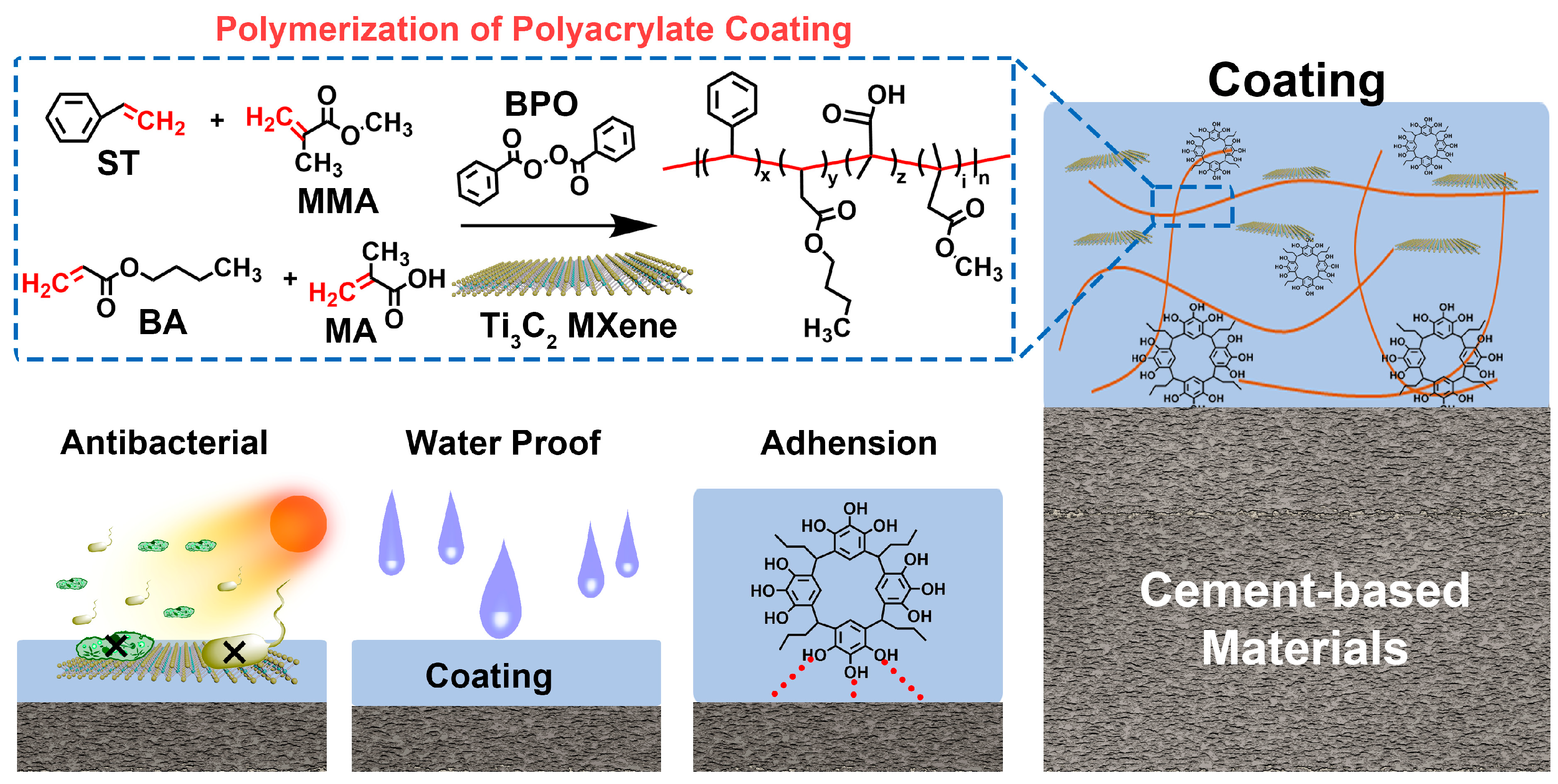
MXene-Functionalized Light-Induced Antimicrobial and Waterproof Polyacrylate Coating for Cementitious Materials Protection




Abstract
Share and Cite
Zhang, H.; Tang, P.; Tang, Y.; Yang, K.; Wang, Q. MXene-Functionalized Light-Induced Antimicrobial and Waterproof Polyacrylate Coating for Cementitious Materials Protection. Polymers 2023, 15, 2076. https://doi.org/10.3390/polym15092076
Zhang H, Tang P, Tang Y, Yang K, Wang Q. MXene-Functionalized Light-Induced Antimicrobial and Waterproof Polyacrylate Coating for Cementitious Materials Protection. Polymers. 2023; 15(9):2076. https://doi.org/10.3390/polym15092076
Chicago/Turabian StyleZhang, Hongping, Pengfei Tang, Youhong Tang, Kun Yang, and Qingyuan Wang. 2023. "MXene-Functionalized Light-Induced Antimicrobial and Waterproof Polyacrylate Coating for Cementitious Materials Protection" Polymers 15, no. 9: 2076. https://doi.org/10.3390/polym15092076
APA StyleZhang, H., Tang, P., Tang, Y., Yang, K., & Wang, Q. (2023). MXene-Functionalized Light-Induced Antimicrobial and Waterproof Polyacrylate Coating for Cementitious Materials Protection. Polymers, 15(9), 2076. https://doi.org/10.3390/polym15092076