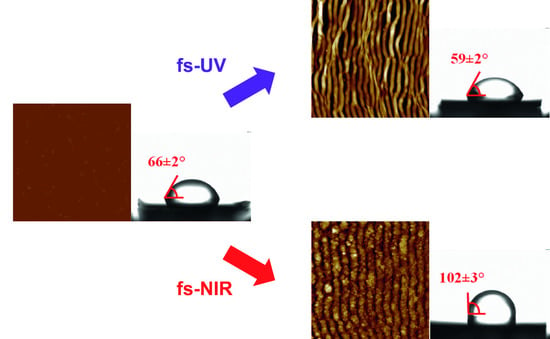
Physicochemical Modifications on Thin Films of Poly(Ethylene Terephthalate) and Its Nanocomposite with Expanded Graphite Nanostructured by Ultraviolet and Infrared Femtosecond Laser Irradiation

 , , ,
, , , 
Abstract
Share and Cite
Rodríguez-Beltrán, R.I.; Prada-Rodrigo, J.; Crespo, A.; Ezquerra, T.A.; Moreno, P.; Rebollar, E. Physicochemical Modifications on Thin Films of Poly(Ethylene Terephthalate) and Its Nanocomposite with Expanded Graphite Nanostructured by Ultraviolet and Infrared Femtosecond Laser Irradiation. Polymers 2022, 14, 5243. https://doi.org/10.3390/polym14235243
Rodríguez-Beltrán RI, Prada-Rodrigo J, Crespo A, Ezquerra TA, Moreno P, Rebollar E. Physicochemical Modifications on Thin Films of Poly(Ethylene Terephthalate) and Its Nanocomposite with Expanded Graphite Nanostructured by Ultraviolet and Infrared Femtosecond Laser Irradiation. Polymers. 2022; 14(23):5243. https://doi.org/10.3390/polym14235243
Chicago/Turabian StyleRodríguez-Beltrán, René I., Javier Prada-Rodrigo, Ana Crespo, Tiberio A. Ezquerra, Pablo Moreno, and Esther Rebollar. 2022. "Physicochemical Modifications on Thin Films of Poly(Ethylene Terephthalate) and Its Nanocomposite with Expanded Graphite Nanostructured by Ultraviolet and Infrared Femtosecond Laser Irradiation" Polymers 14, no. 23: 5243. https://doi.org/10.3390/polym14235243
APA StyleRodríguez-Beltrán, R. I., Prada-Rodrigo, J., Crespo, A., Ezquerra, T. A., Moreno, P., & Rebollar, E. (2022). Physicochemical Modifications on Thin Films of Poly(Ethylene Terephthalate) and Its Nanocomposite with Expanded Graphite Nanostructured by Ultraviolet and Infrared Femtosecond Laser Irradiation. Polymers, 14(23), 5243. https://doi.org/10.3390/polym14235243