Review

Gellan Gum in Wound Dressing Scaffolds

by
Zizo Feketshane
,
Sibusiso Alven
and
Blessing Atim Aderibigbe
*
Department of Chemistry, University of Fort Hare, Alice Campus, Alice 5700, Eastern Cape, South Africa
*
Author to whom correspondence should be addressed.
Polymers 2022, 14(19), 4098; https://doi.org/10.3390/polym14194098
Submission received: 10 August 2022 / Revised: 23 September 2022 / Accepted: 26 September 2022 / Published: 30 September 2022
(This article belongs to the Special Issue Polymers for Wound Dressings)

Abstract

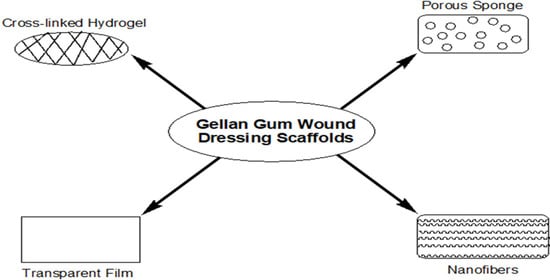
Several factors, such as bacterial infections, underlying conditions, malnutrition, obesity, ageing, and smoking are the most common issues that cause a delayed process of wound healing. Developing wound dressings that promote an accelerated wound healing process and skin regeneration is crucial. The properties of wound dressings that make them suitable for the acceleration of the wound healing process include good antibacterial efficacy, excellent biocompatibility, and non-toxicity, the ability to provide a moist environment, stimulating cell migration and adhesion, and providing gaseous permeation. Biopolymers have demonstrated features appropriate for the development of effective wound dressing scaffolds. Gellan gum is one of the biopolymers that has attracted great attention in biomedical applications. The wound dressing materials fabricated from gellan gum possess outstanding properties when compared to traditional dressings, such as good biocompatibility, biodegradability, non-toxicity, renewability, and stable nature. This biopolymer has been broadly employed for the development of wound dressing scaffolds in different forms. This review discusses the physicochemical and biological properties of gellan gum-based scaffolds in the management of wounds.
Keywords: biopolymers; gellan gum; wound healing; hydrogels; films; nanofibers biopolymers; gellan gum; wound healing; hydrogels; films; nanofibers
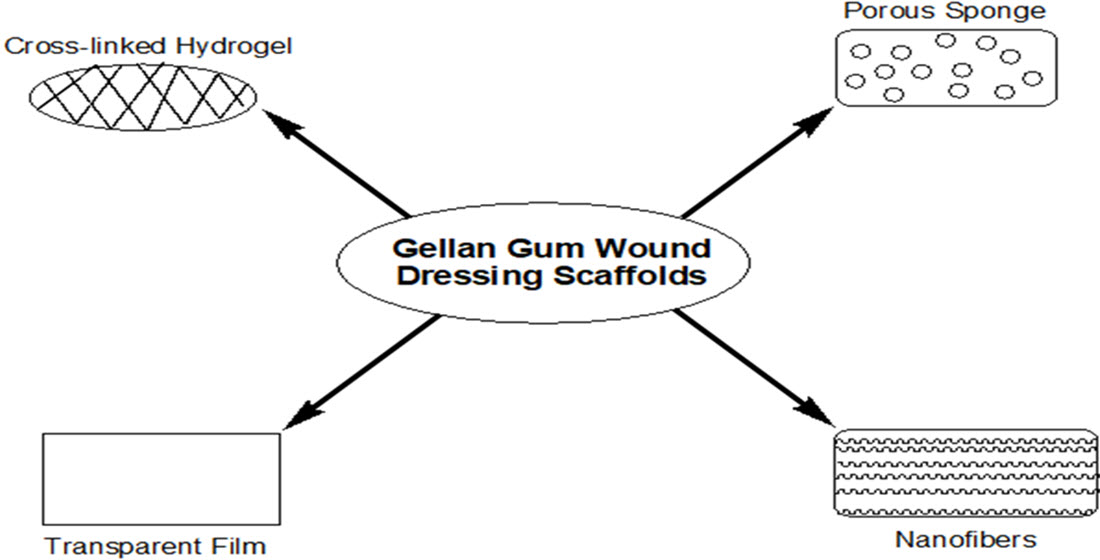
Graphical Abstract