Effects of Hydrothermal Aging of Carbon Fiber Reinforced Polycarbonate Composites on Mechanical Performance and Sand Erosion Resistance


 ,
,  ,
, 
Abstract
1. Introduction
2. Experimental
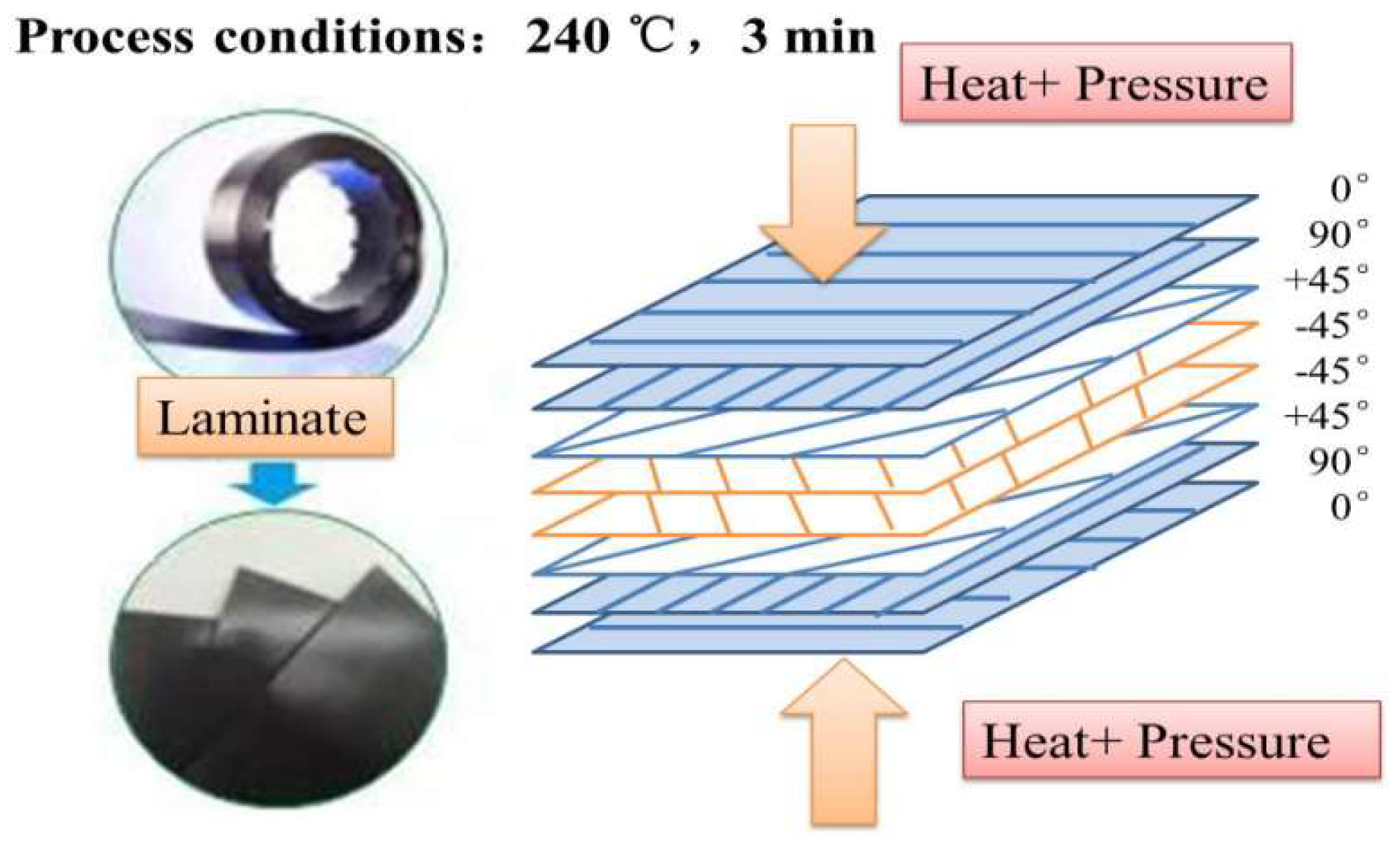
2.1. CF/PC Composites
2.2. Hydrothermal Aging
2.3. Moisture Absorption Test
2.4. Mechanical Performance Testing
2.5. Dynamic Mechanical Analysis (DMA)
2.6. Solid Particle Erosion
2.7. Scanning Electron Microscope (SEM)
3. Results and Discussion
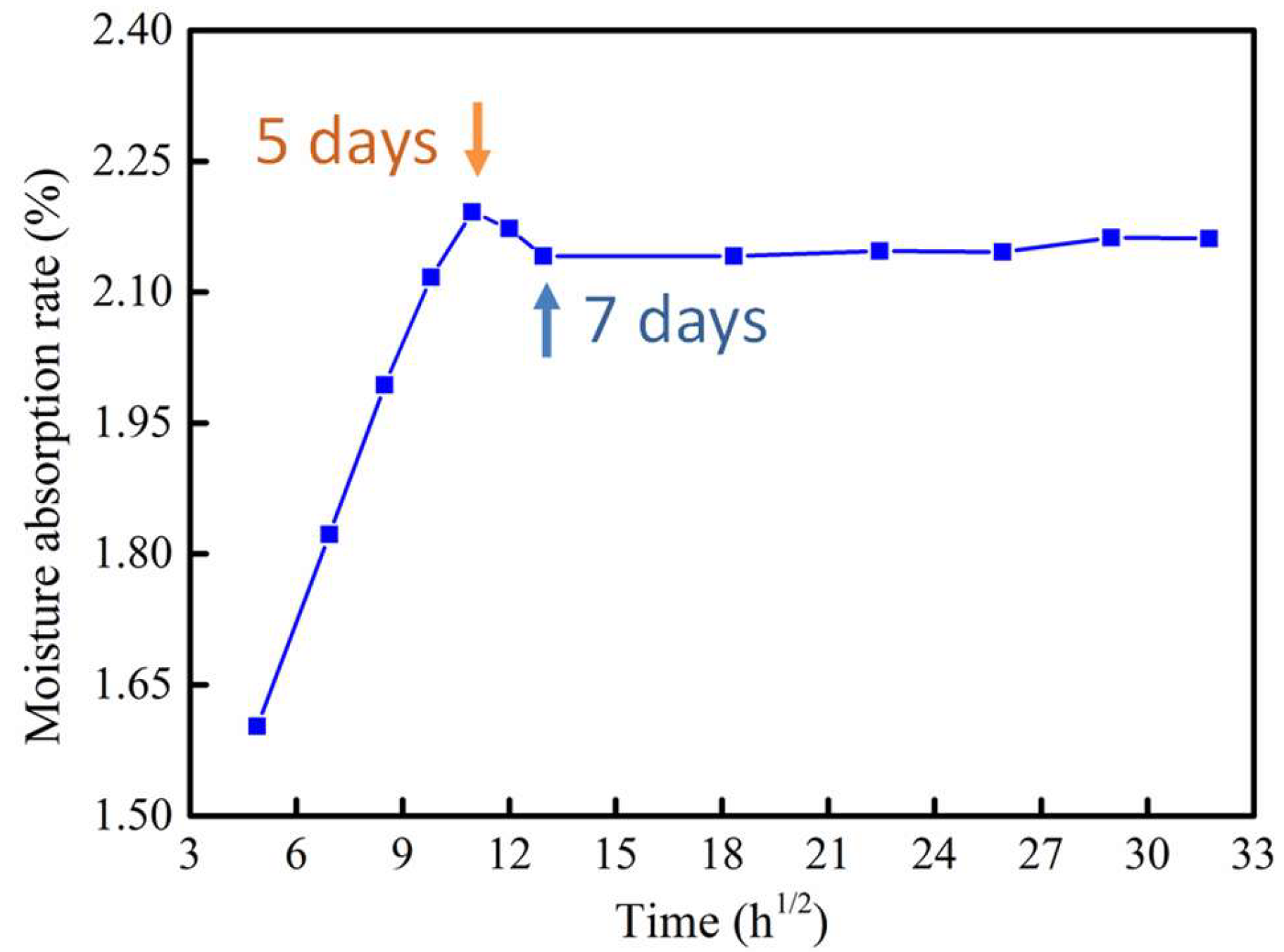
3.1. Moisture Absorption Analysis
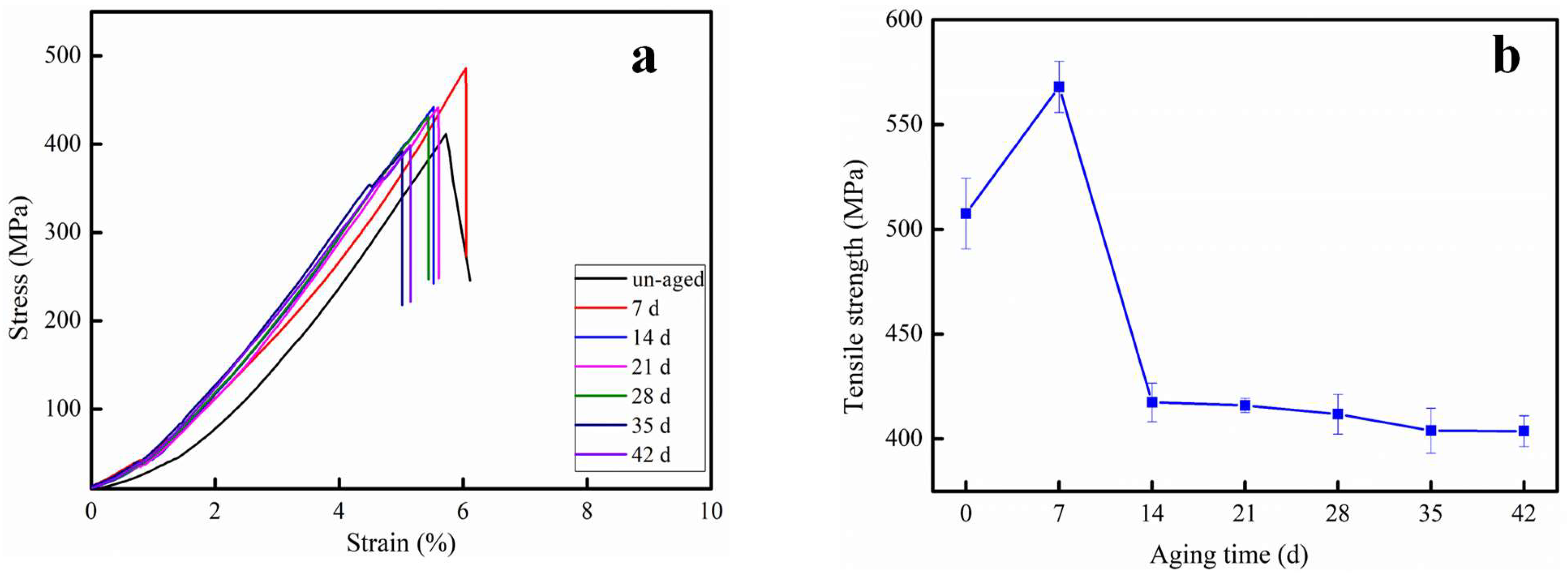
3.2. Tensile Property Analysis
3.3. Three-Point Bending Analysis
3.4. Dynamic Thermal Mechanical Analysis
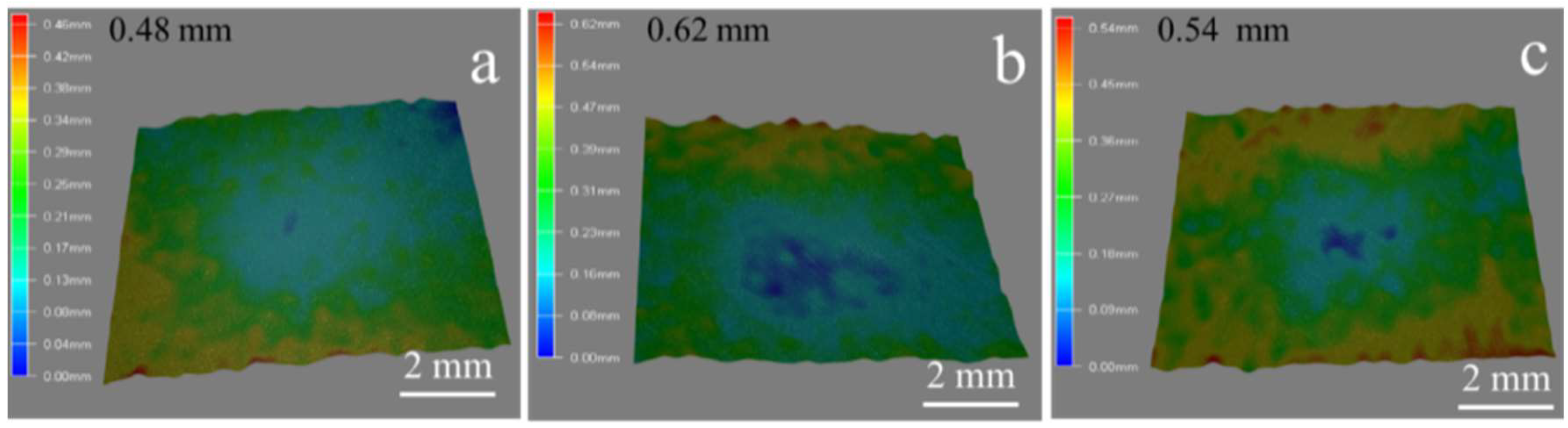
3.5. Solid Particle Erosion Performance
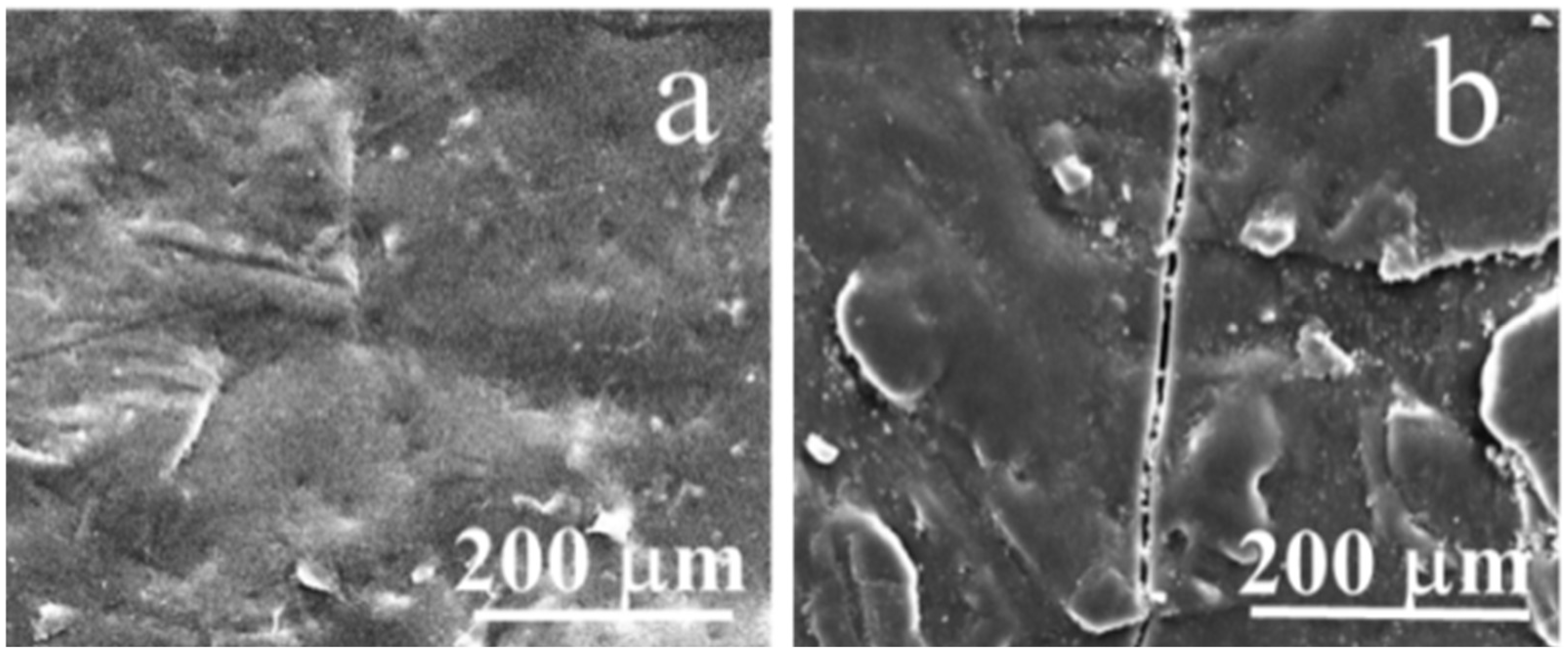
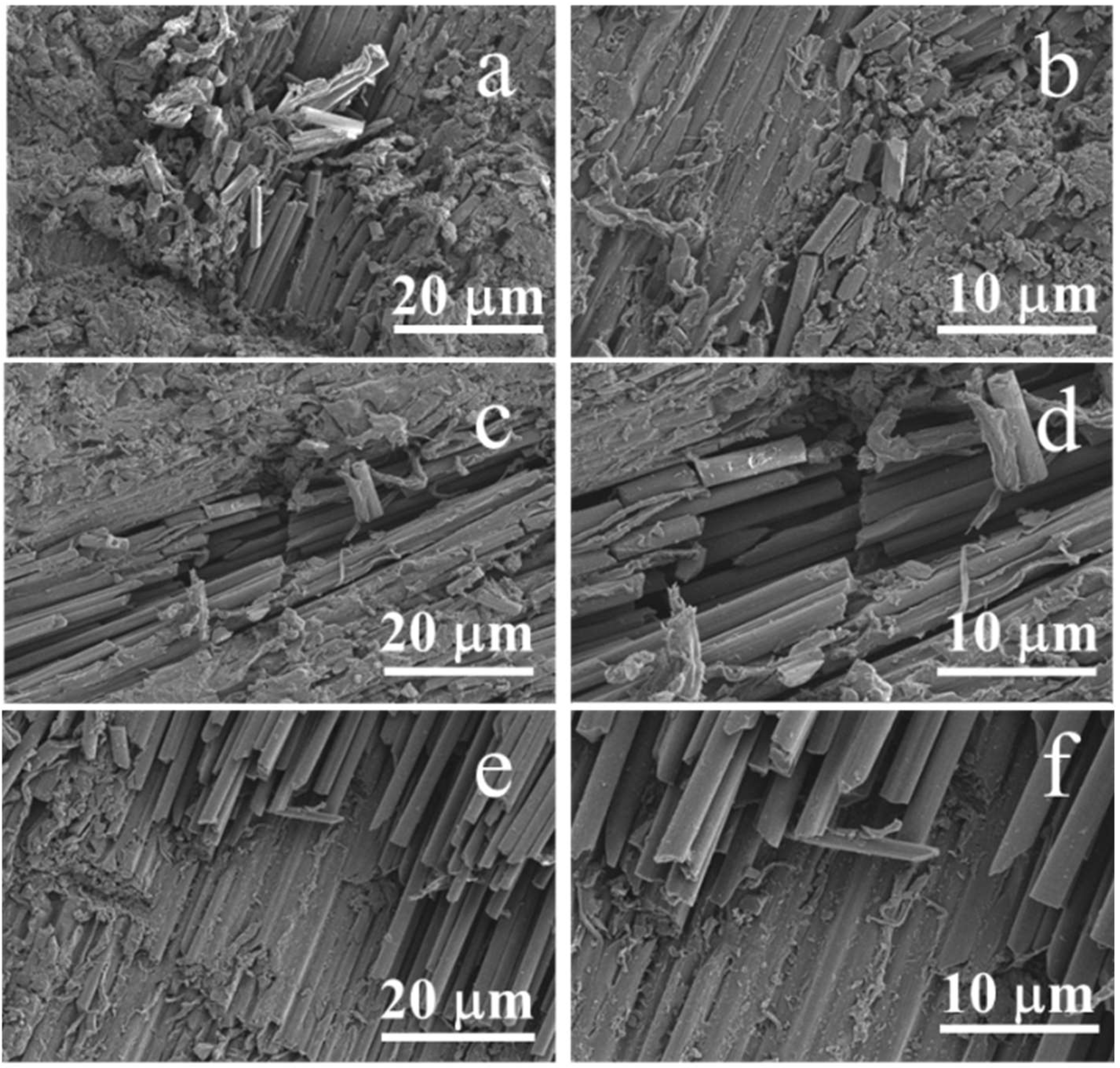
3.6. Surface Morphology Analysis
4. Conclusions
Author Contributions
Funding
Conflicts of Interest
References
- Xian, G.; Karbhari, V.M. DMTA based investigation of hygrothermal ageing of an epoxy system used in rehabilitation. J. Appl. Polym. Sci. 2007, 104, 1084–1094. [Google Scholar] [CrossRef]
- Karbhari, V.M.; Xian, G. Hygrothermal effects on high VF pultruded unidirectional carbon/epoxy composites: Moisture uptake. Compos. Part B Eng. 2009, 40, 41–49. [Google Scholar] [CrossRef]
- He, J.; Xian, G. Bond-slip behavior of fiber reinforced polymer strips-steel interface. Constr. Build. Mater. 2017, 155, 250–258. [Google Scholar] [CrossRef]
- Jawali, N.D.; Siddaramaiah; Siddeshwarappa, B.; Lee, J.H. Polycarbonate/Short Glass Fiber Reinforced Composites—Physico-mechanical, Morphological and FEM Analysis. J. Reinf. Plast. Compos. 2007, 27, 313–319. [Google Scholar] [CrossRef]
- Song, J.H.; Lim, J.K. Fatigue crack growth behavior and fiber orientation of glass fiber reinforced polycarbonate polymer composites. Met. Mater. Int. 2007, 13, 371–377. [Google Scholar] [CrossRef]
- Zhang, J.; Chaisombat, K.; He, S.; Wang, C.H. Hybrid composite laminates reinforced with glass/carbon woven fabrics for lightweight load bearing structures. Mater. Des. 2012, 36, 75–80. [Google Scholar] [CrossRef]
- Batuwitage, C.; Fawzia, S.; Thambiratnam, D.; Liu, X.; Al-Mahaidi, R.; Elchalakani, M. Impact behaviour of carbon fibre reinforced polymer (CFRP) strengthened square hollow steel tubes: A numerical simulation. Thin-Walled Struct. 2018, 131, 245–257. [Google Scholar] [CrossRef]
- Alessi, S.; Pitarresi, G.; Spadaro, G. Effect of hydrothermal ageing on the thermal and delamination fracture behaviour of CFRP composites. Compos. Part B Eng. 2014, 67, 145–153. [Google Scholar] [CrossRef]
- Marom, G. Environmental effects on fracture mechanical properties of polymer composites. In Composite Materials Series; Elsevier: Amsterdam, The Netherlands, 1988; Volume 6, pp. 397–424. [Google Scholar]
- Shen, C.H.; Springer, G.S. Environmental effects on the elastic moduli of composite CF/PC composites. J. Compos. Mater. 1977, 11, 250–264. [Google Scholar] [CrossRef]
- Tsai, Y.; Bosze, E.; Barjasteh, E.; Nutt, S. Influence of hygrothermal environment on thermal and mechanical properties of carbon fiber/fiberglass hybrid composites. Compos. Sci. Technol. 2009, 69, 432–437. [Google Scholar] [CrossRef]
- Jefferson, G.D.; Farah, B.; Hempowicz, M.L.; Hsiao, K.T. Influence of hygrothermal aging on carbon nanofiber enhanced polyester CF/PC composites systems. Compos. B Eng. 2015, 78, 319–323. [Google Scholar] [CrossRef]
- Bian, L.; Xiao, J.; Zeng, J.; Xing, S. Effects of seawater immersion on water absorption and mechanical properties of GFRP composites. J. Compos. Mater. 2012, 46, 3151–3162. [Google Scholar] [CrossRef]
- Alomayri, T.; Assaedi, H.; Shaikh, F.U.A.; Low, I.M. Effect of water absorption on the mechanical properties of cotton fabric-reinforced geo-polymer composites. J. Asian Ceram. Soc. 2014, 2, 223–230. [Google Scholar] [CrossRef]
- Li, Y.; Li, R.; Huang, L.; Wang, K.; Huang, X. Effect of hygrothermal aging on the damage characteristics of carbon woven fabric/epoxy laminates subjected to simulated lightning strike. Mater. Des. 2016, 99, 477–489. [Google Scholar] [CrossRef]
- Meng, M.; Rizvi, J.; Grove, S.; Le, H. Effects of hygrothermal stress on the failure of CFRP composites. Compos. Struct. 2015, 133, 1024–1035. [Google Scholar] [CrossRef]
- Grammatikos, S.; Evernden, M.C.; Mitchels, J.; Zafari, B.; Mottram, J.T.; Papanicolaou, G.C. On the response to hygrothermal aging of pultruded FRPs used in the civil engineering sector. Mater. Des. 2016, 96, 283–295. [Google Scholar] [CrossRef]
- Ellyin, F.; Maser, R. Environmental effects on the mechanical properties of glass-fiber epoxy composite tubular specimens. Compos. Sci. Technol. 2004, 64, 1863–1874. [Google Scholar] [CrossRef]
- Visco, A.; Campo, N.; Cianciafara, P. Comparison of seawater absorption properties of thermoset resins based composites. Compos. Part A Appl. Sci. Manuf. 2011, 42, 123–130. [Google Scholar] [CrossRef]
- Harsha, A.; Jha, S.K. Erosive wear studies of epoxy-based composites at normal incidence. Wear 2008, 265, 1129–1135. [Google Scholar] [CrossRef]
- Lu, X.J.; Zhang, Q. Effect of Water Absorption on the Impact Properties of Carbon Fiber/Epoxy Composites. Chin. J. Aeronau. 2016, 19, 14–18. [Google Scholar]
- Ahmad, F.; Hong, J.W.; Choi, H.S.; Park, M.K. Hygro effects on the low-velocity impact behavior of unidirectional CFRP composite plates for aircraft applications. Compos. Struct. 2016, 135, 276–285. [Google Scholar] [CrossRef]
- Mokhtar, H.; Sicot, O.; Rousseau, J.; Aminanda, Y.; Aivazzadeh, S. The Influence of Ageing on the Impact Damage of Carbon Epoxy Composites. Procedia Eng. 2011, 7, 2615–2620. [Google Scholar] [CrossRef]
- Joseph, E.A.; Paul, D.R.; Barlow, J.W. Boiling water aging of a miscible blend of polycarbonate and a copolyester. J. Appl. Polym. Sci. 1982, 27, 4807–4819. [Google Scholar] [CrossRef]
- Narkis, M.; Nicolais, L.; Apicella, A.; Bell, J.P. Hot water aging of polycarbonate. Polym. Eng. Sci. 1984, 24, 211–217. [Google Scholar] [CrossRef]
- Ito, E.; Kobayashi, Y. Changes in physical properties of polycarbonate by absorbed water. J. Appl. Polym. Sci. 1978, 22, 1143–1149. [Google Scholar] [CrossRef]
- Barkoula, N.M.; Karger, K. Processes and influencing parameters of the solid particle erosion of polymers and their composites. Chemin. Form. 2003, 37, 3807–3820. [Google Scholar] [CrossRef]
- Schilling, F.C.; Ringo, W.M.; Sloane, N.J.A.; Bovey, F.A. Carbon-13 nuclear magnetic resonance study of the hydrolysis of bisphenol a polycarbonate. Macromolecules 1981, 14, 532–537. [Google Scholar] [CrossRef]
- Fang, M.; Ma, Y.; Zhang, N.; Huang, M.; Lu, B.; Tan, K.; Liu, C.; Shen, C. Solid particle erosion resistance and electromagnetic shielding performance of carbon fiber reinforced polycarbonate composites. Mater. Res. Express 2020, 7, 045305. [Google Scholar] [CrossRef]
- Chen, J.; Hutchings, I.M.; Deng, T.; Bradley, M.S.; Koziol, K. The effect of carbon nanotube orientation on erosive wear resistance of CNT-epoxy based composites. Carbon 2014, 73, 421–431. [Google Scholar] [CrossRef]


Publisher’s Note: MDPI stays neutral with regard to jurisdictional claims in published maps and institutional affiliations. |
© 2020 by the authors. Licensee MDPI, Basel, Switzerland. This article is an open access article distributed under the terms and conditions of the Creative Commons Attribution (CC BY) license (http://creativecommons.org/licenses/by/4.0/).
Share and Cite
Fang, M.; Zhang, N.; Huang, M.; Lu, B.; Lamnawar, K.; Liu, C.; Shen, C. Effects of Hydrothermal Aging of Carbon Fiber Reinforced Polycarbonate Composites on Mechanical Performance and Sand Erosion Resistance. Polymers 2020, 12, 2453. https://doi.org/10.3390/polym12112453
Fang M, Zhang N, Huang M, Lu B, Lamnawar K, Liu C, Shen C. Effects of Hydrothermal Aging of Carbon Fiber Reinforced Polycarbonate Composites on Mechanical Performance and Sand Erosion Resistance. Polymers. 2020; 12(11):2453. https://doi.org/10.3390/polym12112453
Chicago/Turabian StyleFang, Mei, Na Zhang, Ming Huang, Bo Lu, Khalid Lamnawar, Chuntai Liu, and Changyu Shen. 2020. "Effects of Hydrothermal Aging of Carbon Fiber Reinforced Polycarbonate Composites on Mechanical Performance and Sand Erosion Resistance" Polymers 12, no. 11: 2453. https://doi.org/10.3390/polym12112453
APA StyleFang, M., Zhang, N., Huang, M., Lu, B., Lamnawar, K., Liu, C., & Shen, C. (2020). Effects of Hydrothermal Aging of Carbon Fiber Reinforced Polycarbonate Composites on Mechanical Performance and Sand Erosion Resistance. Polymers, 12(11), 2453. https://doi.org/10.3390/polym12112453