Preparation and Characterization of Self-Colored Waterborne Polyurethane and Its Application in Eco-Friendly Manufacturing of Microfiber Synthetic Leather Base

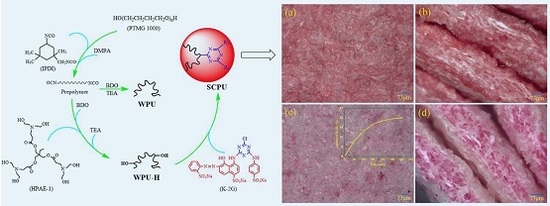
Abstract
Share and Cite
Wang, Y.; Jin, L. Preparation and Characterization of Self-Colored Waterborne Polyurethane and Its Application in Eco-Friendly Manufacturing of Microfiber Synthetic Leather Base. Polymers 2018, 10, 289. https://doi.org/10.3390/polym10030289
Wang Y, Jin L. Preparation and Characterization of Self-Colored Waterborne Polyurethane and Its Application in Eco-Friendly Manufacturing of Microfiber Synthetic Leather Base. Polymers. 2018; 10(3):289. https://doi.org/10.3390/polym10030289
Chicago/Turabian StyleWang, Yulu, and Liqiang Jin. 2018. "Preparation and Characterization of Self-Colored Waterborne Polyurethane and Its Application in Eco-Friendly Manufacturing of Microfiber Synthetic Leather Base" Polymers 10, no. 3: 289. https://doi.org/10.3390/polym10030289
APA StyleWang, Y., & Jin, L. (2018). Preparation and Characterization of Self-Colored Waterborne Polyurethane and Its Application in Eco-Friendly Manufacturing of Microfiber Synthetic Leather Base. Polymers, 10(3), 289. https://doi.org/10.3390/polym10030289