Article

First-Principles Study of O2 Dissociative Adsorption on Cu-, Pt-, and Pd-Doped Ag(111) Surfaces


Key Laboratory of Advanced Functional Materials, School of Science, Kaili University, Kaili 556011, China
*
Author to whom correspondence should be addressed.
Crystals 2026, 16(8), 544; https://doi.org/10.3390/cryst16080544
Submission received: 17 July 2026 / Revised: 12 August 2026 / Accepted: 18 August 2026 / Published: 20 August 2026
(This article belongs to the Section Crystalline Metals and Alloys)

Abstract

The dissociative adsorption of O2 strongly depends on the activity of CO oxidation electrocatalysts. Using first-principles calculations, we investigated O2 dissociative adsorption on Cu-, Pt-, and Pd-doped Ag(111) surfaces. Our results show that the adsorption configuration designated t-b-t1 is the most energetically favorable adsorption state, with the O2 binding strength following the order AgCu(111) > AgPt(111) > AgPd(111) > Ag(111). By analyzing the factors that influence the d-band center, we infer that the ligand effect constitutes the dominant determinant of adsorption behaviour. For the subsequent dissociation of O2, our calculations identify a viable reaction pathway that begins with the t-b-t1 configuration and evolves into two oxygen adatoms adsorbed at adjacent hollow fcc sites. The computed energy barriers for this pathway follow the order Ag(111) > AgPt(111) > AgPd(111) > AgCu(111). These theoretical findings provide crucial guidance for the practical implementation of Ag-based bimetallic alloys as efficient CO oxidation electrocatalysts.

1. Introduction

Transition metals are considered ideal candidates for enhancing catalyst activity in heterogeneous catalytic processes, as their atomic surface composition and electronic structure determine the ease of catalytic reaction steps and dictate subsequent reaction pathways [1,2,3]. The dissociative adsorption of oxygen molecules, as a key initial step in many heterogeneous catalytic processes, imposes further constraints on the formation and transformation of subsequent intermediates through its activation energy barrier and adsorption configuration, thereby directly influencing the overall activity, selectivity and stability of the catalytic reaction [4,5,6,7,8,9,10,11,12]. For example, for the oxygen reduction reaction (ORR), Guo et al. [4] demonstrated that Ru–Fe bimetallic sites enable a Pt-like adsorption mode that cleaves the O–O bond directly, bypassing the *OOH intermediate and thereby markedly accelerating the ORR. Li et al. [5] investigated the catalytic performance of plasma-treated Ru/TiO2 for the selective oxidation of primary C–H bonds, and found that the energy barrier of the O2 dissociation step and its compatibility with the reaction pathway not only influence catalytic activity and selectivity but also directly affect the long-term operational stability of the catalyst by inhibiting or mitigating surface poisoning caused by oxygen adsorption. For both ORR and CO oxidation, Zhang et al. [6] investigated the O2 adsorption and dissociation behaviour on Pt/ZrC alloy surfaces, and observed that Pt modification of ZrC(100) surfaces strengthens substrate–adsorbate interactions, reducing the dissociation barrier and simultaneously improving performance in both reactions. Similarly, Liu et al. [12] systematically examined the catalytic behavior for the CO oxidation reaction over Au–Cu alloy nanoparticle surfaces, and revealed that the overall oxidation rate is critically governed by the dissociative adsorption step of oxygen molecules. Consequently, a nuanced understanding of the dissociative adsorption of oxygen molecules on transition metal surfaces is indispensable for the rational design of efficient catalysts.
The CO oxidation reaction plays a vital role in the treatment of industrial flue gases and the purification of motor vehicle exhaust gases [13,14]. Although Pt and its alloys are regarded as premier catalysts for this process, their widespread application is severely constrained by elevated costs and the limited availability of Pt within the Earth’s crust [15,16]. Enhancing the economic viability of CO oxidation reaction systems therefore necessitates overcoming several key challenges, most critically, the discovery of a cost-effective yet sufficiently active substitute for Pt. A promising class of low-cost alternatives are alloys composed of silver, which fulfill these criteria by offering reasonable catalytic activity, robust stability, and economic advantages. In particular, introducing transition metals (e.g., Pd, Pt, or Cu) into silver has proven to be a powerful route for fine-tuning the electronic configuration and, consequently, optimizing the CO oxidation reaction kinetics of these bimetallic systems. This alloying strategy has received substantial experimental validation [17,18,19]. For instance, Panafidin et al. [17] observed that CO2 production on Ag-Pd catalysts initiates above 150 °C, accompanied by surface composition changes and sintering stability below 300 °C. Hwang et al. [18] reported that Ag-Pt alloys exhibit significantly enhanced room-temperature activity and reduced activation barriers compared to pure Pt and Ag, along with good thermal stability. Murtazalieva et al. [19] further demonstrated that Ag-Cu catalysts maintain high activity in both CO oxidation and soot combustion, with thermal stability confirmed even after 10 h of ageing at 650 °C. Notably, the superior performance of these Ag-based systems is intimately correlated with the dissociative adsorption of O2, given that this initial step dictates the subsequent formation of key reaction intermediates. However, previous DFT investigations have extensively studied O2 adsorption and dissociation on pristine Ag(111) [20] and Ag-Au alloy surfaces [11,21], the influence of 3d (Cu), 5d (Pt), and 4d (Pd) single-atom doping on the dissociative adsorption of O2 on Ag(111) remains largely unexplored. Existing theoretical studies on doped Ag systems have primarily focused on CO oxidation [22,23] or molecular O2 adsorption [24], rather than the kinetics of O–O bond scission. Furthermore, although recent works have identified Cu-doped Ag(111) as active for O2 dissociation [25], a systematic comparative study across different dopants (Cu, Pt, Pd) is still missing.
In this work, we differ from the prior studies by: (i) systematically calculating the O2 dissociation energy barriers and pathways on Cu-, Pt-, and Pd-doped Ag(111) surfaces; (ii) identifying the doping-induced changes in adsorption configurations and transition states; and (iii) revealing the electronic origins that govern the dopant-dependent reactivity trends. The calculated results show that the t-b-t1 configuration, which denotes adsorption at the top-bridge-top site, represents the most energetically favorable adsorption state, with the O2 binding strength following the order AgCu(111) > AgPt(111) > AgPd(111) > Ag(111). By analyzing the factors that influence the d-band center, we infer that the ligand effect constitutes the dominant determinant of adsorption behaviour. For the subsequent dissociation of O2, our calculations identify a viable reaction pathway that begins with the t-b-t1 configuration and evolves into two oxygen adatoms adsorbed at adjacent hollow fcc sites. The computed energy barriers for this pathway follow the order Ag(111) > AgPt(111) > AgPd(111) > AgCu(111). The remainder of the present paper is organized as follows: the computational details are outlined in Section 2. The calculated results and discussion are then presented in Section 3, while a concise summary is provided in Section 4.

2. Computational Details

The spin-polarized DFT calculations were performed by using the Vienna ab initio simulation package (VASP) [26,27,28]. The projector augmented wave method [29,30] was used to describe the interactions between the ionic core. The wave functions were expanded in the plane-wave basis up to a kinetic energy of 400 eV. A convergence test showed that increasing the cutoff by 50 eV altered the total energy by less than 2 meV per atom. The Perdew-Burke-Ernzerhof (PBE) [31] functional was used as the basic exchange-correlation functional in all the structure calculations, and the electric dipole was neglected. The Brillouin zone was sampled using a Monkhorst-Pack grid [32]. For the 2 × 2 surface unit cell, a 5 × 5 × 1 k-point mesh was used. We verified that a denser 7 × 7 × 1 mesh changed the adsorption energy by less than 0.01 eV. The convergence criteria for ionic relaxations were set to 0.02 eV/Å.
Our computed lattice parameter for Ag is 4.14 Å, closely matching the previously reported theoretical value of 4.153 Å [23] and the experimental result of 4.086 Å [33]. Starting from these optimized bulk structures, we constructed the AgPd(111), AgPt(111), and AgCu(111) slabs, and the models were constructed by changing one Ag atom with a dopant atom in the topmost atomic layer of the slab. Consequently, the uppermost layer is composed of 75% Ag and 25% dopant atom, whereas the remaining atomic layers consist exclusively of Ag. We tested slabs consisting of 3, 4, and 5 atomic layers. The surface energy and the adsorption energy of O2 converged to within 0.02 eV when increasing the slab from 4 to 5 layers. To balance accuracy and computational cost, a 4-layer p(2 × 2) slab was adopted, with the bottom two layers fixed at their respective bulk positions and the top two layers fully relaxed. A vacuum layer of 15 Å was inserted between periodically repeated slabs. We confirmed that increasing the vacuum to 20 Å changed the total energy by less than 1 meV, effectively eliminating spurious interlayer interactions.
The adsorption energies ( E a d s , O 2 ) were calculated from the following expression:
E a d s , O 2 = E O 2 s l a b E s l a b E O 2 ,
where E O 2 s l a b , E s l a b and E O 2 represent the slab covered with the oxygen molecule, the relaxed clean slab and the total energy of the oxygen molecule, respectively.
The climbing image nudged elastic band (CI-NEB) method [34,35] was utilized to map the minimum-energy pathway and pinpoint the transition state along the reaction coordinate. The activation energy ( E a ) was subsequently derived from the energy difference between the transition state and the precursor state, evaluated from the following expression:
E a = E b T S E b P S .
In this expression, E b P S and E b T S denote the total energies of the initial adsorbed precursor and the transition-state configuration, respectively.
The d-state change of the alloy component was quantified by calculating the d-band center, and its definition is as follows:
ε d = + E ρ E d E + ρ E d E
where E and ρ(E) are the given energy and the density of electronic states, respectively.
Bader charge analysis was performed to quantify the charge transfer between the adsorbed O2 molecule and the substrate. The charge on the O2 molecule was determined by integrating the electron density within the Bader volumes of each oxygen atom, using the Bader code developed by the Henkelman group [36]. To define the atomic basins, the charge density was partitioned based on the zero-flux surfaces of the electron density. The amount of charge transferred was calculated as the difference between the total Bader charge of the adsorbed O2 and that of a gas-phase O2 molecule calculated under identical computational conditions. This approach provides a well-defined and systematically consistent measure of charge redistribution upon adsorption.

3. Results

3.1. The Adsorption of O2

Unless otherwise specified, all calculations and discussions in this section refer to the (111) surface facet of the respective Ag-based alloys. Previous investigations on the pristine Ag surface identified three distinct adsorption sites for O2 molecules—namely, top-hcp hollow-bridge (t-h-b), top-bridge-top (t-b-t), and top-fcc hollow-bridge (t-f-b) [11,20]. Geometrically, at the t-b-t adsorption site, the O–O bond axis lies parallel to the bridge site between two neighboring metal atoms, with two O atoms vertically aligned above neighboring metal atoms (top site). In contrast, for the t-f-b and t-h-b sites, the second O atom shifts from the top to the bridge, and the O–O bond axis lies the three-fold fcc or hcp hollow sites, respectively.
In the present alloy systems, because the dopant atoms (Cu, Pt, or Pd) are situated at the center of the top layer, each of these sites gives rise to two distinct adsorption configurations: one where an O atom is directly coordinated to the dopant atom, and another where both O atoms are coordinated solely to Ag atoms. To distinguish these variants, we adopt the notation shown in Figure 1 and Table 1. Here, ‘t’, ‘b’, ‘f’, and ‘h’ represent the top, bridge, fcc hollow, and hcp hollow sites, respectively. The subscript ‘1’ indicates that the O atom at the top site is positioned directly atop the dopant atom, while the subscript ‘2’ refers to the analogous configuration where the top-site O atom resides above a Ag atom. For example, ‘t-b-t1’ denotes the top-bridge configuration with one O atom atop the dopant, whereas ‘t-b-t2’ denotes the same geometry but with the top-site O atom above a Ag atom. The optimized geometries of these configurations are displayed in Figure 1, and their corresponding structural and energetic parameters—including adsorption energies, O–O bond lengths, and Bader charge transfers—are compiled in Table 1. Among all configurations, those with an O atom adsorbed directly atop a dopant atom—specifically, t-b-t1, t-f-b1, and t-h-b1—exhibit favorable stability, with the t-b-t1 configuration being the most energetically preferred across all three alloys. Notably, compared to Ag surface, the O–O bond lengths on AgPd, AgPt, and AgCu surfaces become progressively longer, suggesting an enhanced capability for O2 activation [7,37]. This interpretation is corroborated by charge distribution analyses, which show increased electron transfer from the alloy surfaces to O2 relative to pure Ag. Such an increase implies that the introduction of alloying elements modifies the local electronic structure, thereby facilitating charge donation into the anti-π orbitals of O2 and strengthening the adsorbate–substrate interaction. This electronic effect is further reflected in the adsorption energetics. Specifically, the binding strength of O2 on all three alloy surfaces is higher than that on Ag surface. Taking the t-b-t1 site as an example, the computed adsorption energies are −0.592 eV (AgCu), −0.386 eV (AgPt), −0.295 eV (AgPd), and −0.243 eV (Ag), and the same trend is observed at other adsorption sites. Therefore, the overall O2 binding strength follows the order AgCu > AgPt > AgPd > Ag.
According to the volcano-curve relationship for CO oxidation [38], pure silver inherently exhibits a relatively weak adsorption capacity for O2, positioning it on the left branch of the curve. Consequently, the O–O bond is difficult to break, making the activation of O2 the rate-determining step of the overall reaction. Upon introducing Cu, Pd, or Pt into Ag, these transition metals enhance the electron back-donation to the anti-bonding orbitals of O2 by modulating the d-band center of alloy surface. This modification increases the O2 adsorption energy in absolute value, shifting it from the initially too-low level toward the optimal region near the volcano peak. As a result, the activation energy barrier for O2 dissociation is substantially reduced, and the coverage of reactive oxygen species on the surface is significantly increased, thereby providing an ample supply of reactants for subsequent CO oxidation. More importantly, this enhancement does not create a product-desorption bottleneck because the reaction pathways achieve an effective division of labor between sites: O2 is preferentially activated and dissociated at the highly oxophilic Cu/Pd/Pt sites, whereas CO primarily reacts at Ag sites or at the interfacial regions to form weakly adsorbed CO2, which desorbs readily and does not block the active centers. Consequently, the increased adsorption energy precisely overcomes the core deficiency of pure silver—namely, insufficient oxygen activation—while simultaneously avoiding the side effect of excessive-adsorption poisoning through bifunctional synergy, ultimately leading to a substantial improvement in the overall catalytic turnover rate.

3.2. The Electronic Structure of Ag-Based Alloy Surfaces

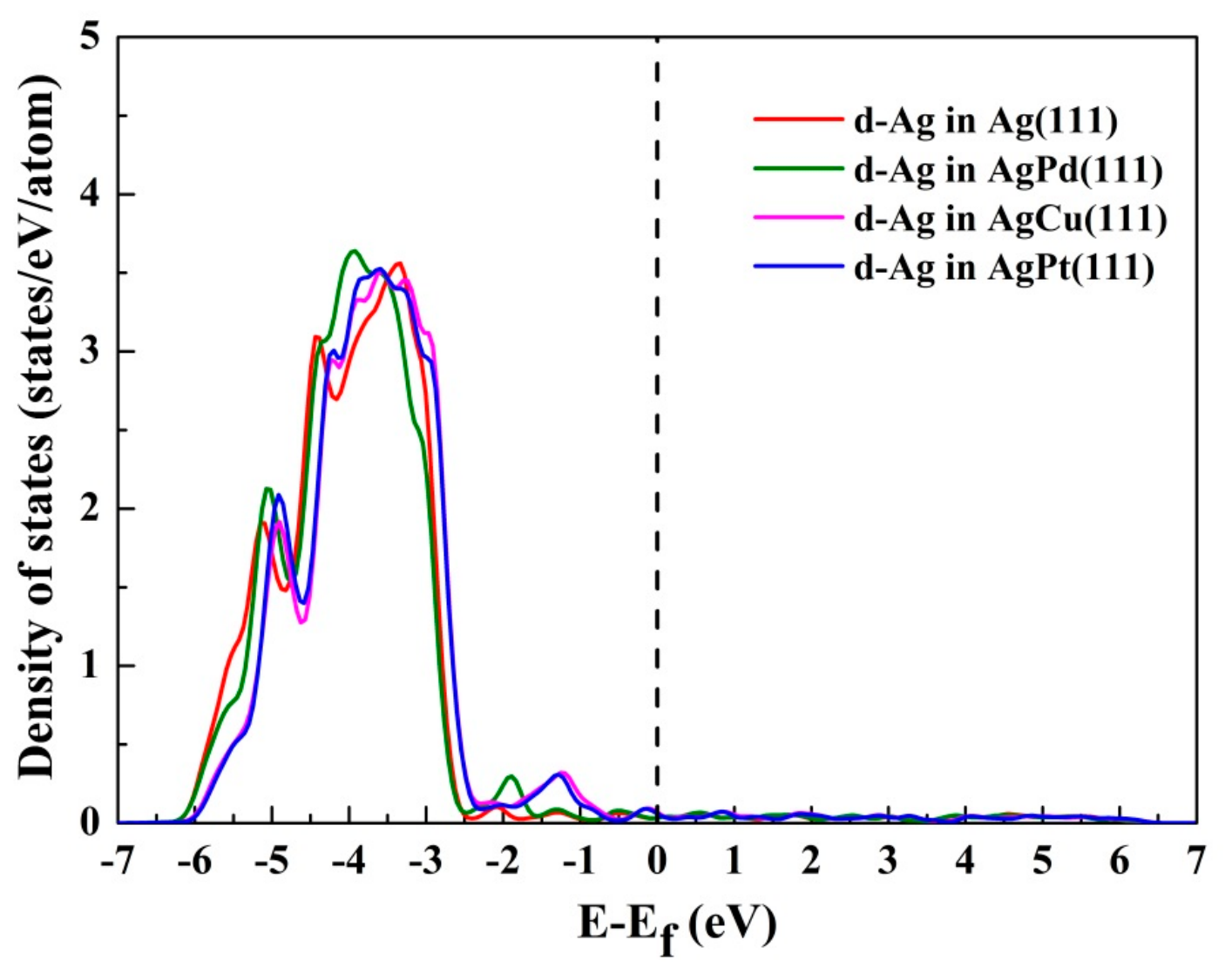
Density functional theory (DFT) provides a robust framework for investigating metal-adsorbate interactions, wherein d-band density-of-states (DOS) analysis proves especially informative. At the heart of the d-band model lies the concept that adsorbate binding strength is predominantly governed by the position of the metal d-band centre relative to the Fermi level [39,40]. Upon adsorbate approach, its valence orbitals interact with metal d-states to generate bonding and anti-bonding counterparts. The d-band centre’s shift directly reflects variations in anti-bonding state occupancy. A downward displacement of this centre, moving further from the Fermi level, elevates the energy of the anti-bonding states, which consequently attenuates the adsorbate-surface bond. Conversely, an upward shift towards the Fermi level enhances this bond and elevates the adsorption energy. To computationally probe this electronic coupling for O2 on the catalyst surfaces, we computed the projected d-band DOS for the outermost Ag atoms on AgCu(111), AgPt(111), AgPd(111), and bare Ag(111), with the results shown in Figure 2. According to Equation (3), the d-band centre for Ag, AgPd, AgPt, and AgCu surfaces are −3.80, −3.78, −3.56, and −3.52 eV, respectively. Interpreting this ordering via the d-band model leads to a clear prediction: O2 binding should follow the trend AgCu(111) > AgPt(111) > AgPd(111) > Ag(111). This theoretical prediction is entirely consistent with the adsorption energy sequence obtained from our calculations.
In the Ag-based alloy system, the d-band centre of the surface Ag atoms is not an intrinsic property, but rather emerges from the coupled interplay between strain effects and ligand effects. The relative contributions of these two mechanisms dictate the ultimate direction and magnitude of the d-band centre shift, thereby governing O2 adsorption and activation. Since Cu, Pt, and Pd each possess smaller atomic radii than Ag [41], their incorporation introduces in-plane compressive strain within the surface Ag–Ag lattice. Under such compression, the reduced Ag–Ag spacing broadens the d-band, which in turn forces the band centre to shift downward, away from the Fermi level. This downward movement elevates the energy of the anti-bonding states with the adsorbate, thus weakening the adsorption strength. This strain-driven mechanism therefore appears to be not the primary factor modulating the adsorption behaviour. To discern whether ligand effects, which are intimately tied to the electronegativity differences among surface atoms, also play a significant role, we performed a charge distribution analysis on the alloy surfaces. Bader charge analysis reveals that Ag atoms gain 0.064 e, 0.542 e, and 0.748 e on AgCu(111), AgPt(111), and AgPd(111), respectively. The electron transfer to Ag increases the occupation of Ag’s d-electrons, and this ligand effect drives the Ag d-band centre substantially upward, closer to the Fermi level—an influence that partially counteracts the downward shift imposed by strain. Synthesising these observations, we can infer that the ligand effect constitutes the dominant determinant of adsorption behaviour.
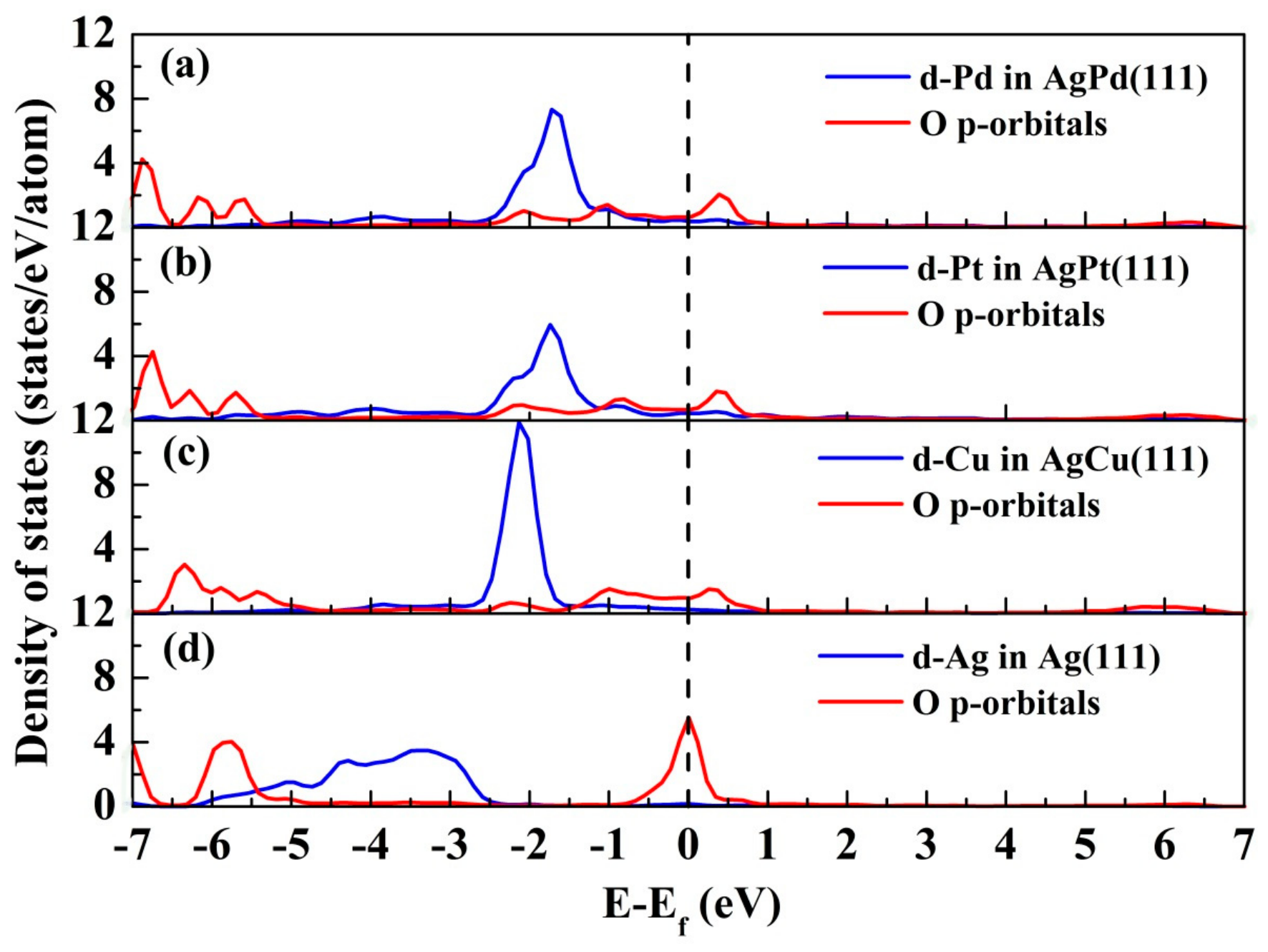
To gain deeper insight into the role of different dopants, we performed projected density of states (PDOS) analyses focusing on the orbital hybridization between the surface dopants and the adsorbed O2 species (Figure 3). For the pristine Ag surface, the Ag-d bands lie far below the Fermi level, resulting in weak hybridization with the O-2π orbitals. However, in the Pd-doped system, a pronounced resonance peak appears at approximately 0 to 1 eV, indicating strong covalent interactions. Similar results can also be observed in the Pt-doped system. Interestingly, we found that, above the Fermi level, the overlap between the Cu’s d-states and the O-p states is very small. This indicates that the hybridization is significantly weaker for the Cu-doped system. However, in the Cu-doped system, the d-band centre of surface Ag is closest to the Fermi level; consequently, O2 exhibits the strongest adsorption energy in the Cu-doped system. In addition, the PDOS, in conjunction with Bader charge analysis, reveals that the dopant atoms act as electron donors, facilitating greater charge transfer into the O2 2π antibonding orbitals. For instance, the Cu dopant transfers approximately 0.31 e to the adsorbed O2 compared to only 0.21 e transferred by the pristine Ag surface. This increased occupation of the antibonding states directly weakens the O-O bond, consistent with the reduced dissociation barriers we reported.

3.3. The Dissociation of O2

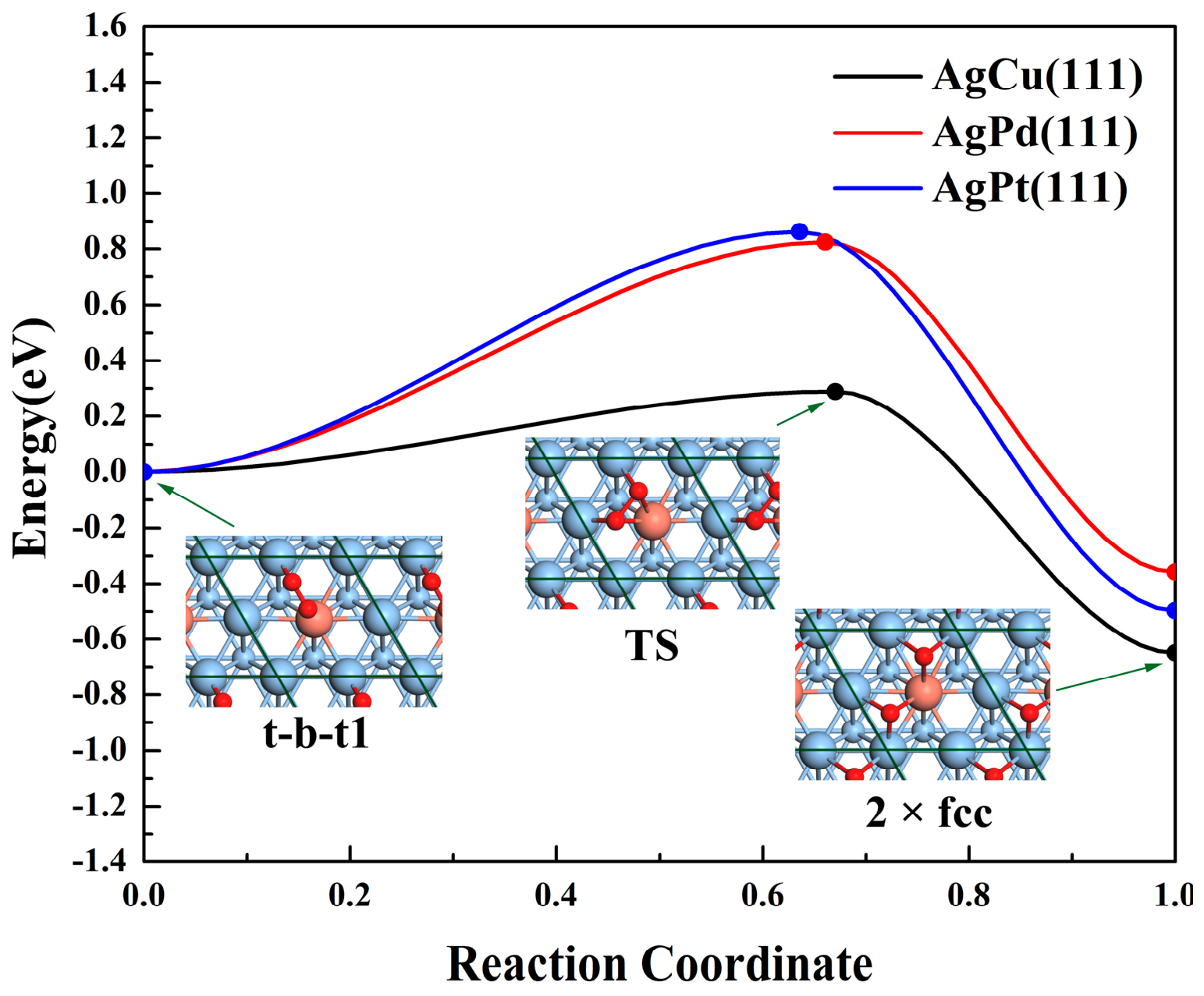
In DFT calculations of multiphase catalytic reactions, understanding the initial and final states is crucial as the proper determination of these states is both a prerequisite for the CI-NEB workflow and a core condition for ensuring the physical validity and numerical convergence of the transition state search. Based on our selection criteria, we chose the most stable t-b-t1 adsorption configuration, obtained via DFT optimization, as the initial state for O2 dissociation on the alloy surface. Upon adsorption-dissociation, the two oxygen atoms preferentially occupy two adjacent stable fcc sites closest to the dopant atom, defining the final state as the 2 × fcc configuration. The dissociation pathway of O2 molecule is shown in Figure 4. The O2 molecule adsorbed at the t-b-t1 site rotates, with the two O atoms temporarily occupying bridge sites to form the transition state (TS). As the O–O bond subsequently stretches, the oxygen atoms migrate to the adjacent fcc sites, completing the dissociation process. The calculated energy barriers for this pathway on the AgCu(111), AgPd(111), AgPt(111), and Ag(111) surfaces are 0.289, 0.824, 0.862, and 1.05 eV, respectively. According to the Arrhenius equation [42], the reaction rate constant is inversely proportional to the energy barrier at a constant temperature. Consequently, in the Ag-based alloy system, O2 exhibits the highest intrinsic dissociation rate constant on the AgCu(111) surface, indicating optimal kinetic catalytic activity for O–O bond cleavage on this surface. In contrast, the AgPt(111) surface, with the highest barrier of 0.862 eV, presents the greatest kinetic hindrance to oxygen activation and thus the slowest reaction rate.
It is important to note that while the O2 dissociation barrier is a critical descriptor for CO oxidation activity, it represents only the initial activation step in the multi-step catalytic cycle. A complete CO oxidation pathway on Ag-based catalysts typically involves the following elementary steps: (i) CO adsorption, (ii) O2 dissociation (or O atom formation), (iii) CO + O coupling to form CO2, and (iv) CO2 desorption [43,44,45]. In this work, we focused primarily on step (ii), as it is often considered the rate-determining step on noble metal surfaces like Ag(111) under oxygen-rich conditions [43]. However, we acknowledge that the overall turnover frequency may also be significantly influenced by the CO adsorption strength and the CO + O reaction barrier, particularly under CO-rich or low-temperature conditions. For instance, excessively strong O2 binding (as seen in some doped systems) could lead to oxygen poisoning, blocking active sites for CO adsorption and ultimately suppressing the overall reaction rate [46]. Therefore, while our calculated O2 dissociation barrier provides a valuable screening descriptor for O2 activation ability, it should be interpreted as a necessary prerequisite, rather than a sole guarantee, for superior catalytic performance. Future microkinetic modeling incorporating all elementary steps is required to quantitatively predict the overall CO oxidation activity for these doped Ag surfaces.

4. Conclusions

In this work, first-principles calculations reveal that alloying Ag with Cu, Pt, or Pd significantly enhances O2 dissociation. The t-b-t1 configuration is the universal active site on all doped surfaces. Mechanistically, the ligand effect dominates the electronic modulation. It shifts the d-band center upward toward the Fermi level. This shift promotes greater charge back-donation into the O2 anti-π orbitals. Consequently, the O–O bond weakens and the adsorbate–substrate interaction strengthens. Kinetically, the dopants substantially lower the dissociation barriers. We identify a clear reaction pathway from the t-b-t1 state to adjacent fcc hollow sites. These findings translate into three practical design rules for Ag-based bimetallic catalysts. First, the ligand effect, rather than geometric strain, is the primary lever for tuning reactivity. Second, the activity trend (Cu > Pd > Pt) suggests that early-to-mid transition metals provide an optimal balance between O2 activation and surface stability. Third, the tunable electronic structure allows for precise control to avoid the strong binding that poisons pure transition metals while overcoming the inertness of pure Ag. Notably, AgCu(111) stands out as a promising candidate for low-temperature CO oxidation. Its moderate barrier and enhanced charge transfer are ideal for controlling the rate-determining O2 dissociation step. Finally, given the absence of prior experimental kinetic data for these specific Ag-based alloy surfaces, we emphasize the urgent need for systematic experimental validation to corroborate our theoretical predictions. We propose three complementary experimental strategies. First, ultrahigh vacuum (UHV) surface science experiments—specifically temperature-programmed desorption (TPD) combined with scanning tunneling microscopy (STM) on well-defined AgCu, AgPt, and AgPd single crystals—are indispensable for directly measuring O2 adsorption enthalpies and visualizing the dissociation intermediates. Such experiments would provide the most rigorous test of our calculated energy trends (Cu > Pt > Pd). Second, for electrocatalytic applications, electrochemical CO oxidation measurements using rotating disk electrode (RDE) setups on shape-controlled alloy nanocatalysts could reveal whether the O2 dissociation barriers we calculated (0.289–0.862 eV) translate into distinct overpotential differences. Third, in-situ ambient-pressure X-ray photoelectron spectroscopy (AP-XPS) could be employed to track the evolution of adsorbed O-species under realistic reaction conditions, potentially confirming our proposed reaction pathway from the molecular t-b-t1 configuration to atomic fcc-adsorbed O species. Such combined theoretical–experimental investigations would not only validate our current findings but also accelerate the data-driven design of next-generation Ag-based bimetallic electrocatalysts.

Author Contributions

Conceptualization, H.Y.; methodology, H.G.; software, Y.L.; validation, R.Z.; formal analysis, H.G.; investigation, H.G.; resources, H.Y.; data curation, W.Y.; writing—original draft preparation, H.G.; writing—review and editing, H.Y.; visualization, H.G.; supervision, H.Y.; project administration, R.F.; funding acquisition, H.Y. All authors have read and agreed to the published version of the manuscript.

Funding

This research was funded by the Specialized Fund for the Doctoral of Kaili University (grant number: BS20230102) and Guizhou Provincial Science and Technology Project (Qian Ke He Ji Chu MS [2026]725). The APC was funded by the Specialized Fund for the Doctoral of Kaili University.

Data Availability Statement

The authors confirm that the data supporting the findings of this study are available within the article.

Acknowledgments

The authors would like to acknowledge the support of the Specialized Fund for the Doctoral of Kaili University (BS20230102) and Guizhou Provincial Science and Technology Project (Qian Ke He Ji Chu MS [2026]725).

Conflicts of Interest

The authors declare no conflicts of interest.

References

  1. Gumuslu, G.; Kondratyuk, P.; Boes, J.R.; Morreale, B.; Miller, J.B.; Kitchin, J.R.; Gellman, A.J. Correlation of Electronic Structure with Catalytic Activity: H2–D2 Exchange across CuxPd1–x Composition Space. ACS Catal. 2015, 5, 3137–3147. [Google Scholar] [CrossRef] [Scilit]
  2. Yu, Y.; Liu, Z.; Huang, W.; Zhou, S.; Hu, Z.; Wang, L. Ab Initio Investigation of the Adsorption and Dissociation of O2 on Cu-Skin Cu3Au (111) Surface. Catalysts 2022, 12, 1407. [Google Scholar] [CrossRef] [Scilit]
  3. Yu, Y.; Xiao, W.; Wang, J.; Wang, L. First-Principles Study of Mo Segregation in MoNi(111): Effects of Chemisorbed Atomic Oxygen. Materials 2016, 9, 5. [Google Scholar] [CrossRef] [Scilit] [PubMed]
  4. Guo, P.; Liu, B.; Tu, F.; Dai, Y.; Zhang, Z.; Xia, Y.; Ma, M.; Zhang, Y.; Zhao, L.; Wang, Z. Breaking Sabatier’s vertex via switching the oxygen adsorption configuration and reaction pathway on dual active sites for acidic oxygen reduction. Energy Environ. Sci. 2024, 17, 3077–3087. [Google Scholar] [CrossRef] [Scilit]
  5. Li, H.; Shang, H.; Jiang, F.; Zhu, X.; Ruan, Q.; Zhang, L.; Wang, J. Plasmonic O2 dissociation and spillover expedite selective oxidation of primary C–H bonds. Chem. Sci. 2021, 12, 15308–15317. [Google Scholar] [CrossRef] [Scilit] [PubMed]
  6. Zhang, X.; Lu, Z.; Yang, Z. A first principles study of O2 dissociation on Pt modified ZrC (100) surface. Chem. Phys. Lett. 2016, 649, 141–147. [Google Scholar] [CrossRef] [Scilit]
  7. Yang, Z.; Wang, J.; Yu, X. The adsorption, diffusion and dissociation of O2 on Pt-skin Pt3Ni (111): A density functional theory study. Chem. Phys. Lett. 2010, 499, 83–88. [Google Scholar] [CrossRef] [Scilit]
  8. Qiao, Y.; Xu, L.; Zhang, H.; Luo, H. O2 dissociative adsorption on the Cu-, Ag-, and W-doped Al (111) surfaces from DFT computation. Surf. Interface Anal. 2021, 53, 46–52. [Google Scholar] [CrossRef] [Scilit]
  9. Yu, Y.; Gu, H.; Wu, G.; Liu, X. Density functional theory study of dissociative adsorption of O2 on Pd-skin Pd3Cu (111) surface. Comput. Mater. Sci. 2024, 237, 112876. [Google Scholar] [CrossRef] [Scilit]
  10. Liu, J.; Fan, X.; Sun, C.Q.; Zhu, W. DFT study on intermetallic Pd–Cu alloy with cover layer Pd as efficient catalyst for oxygen reduction reaction. Materials 2017, 11, 33. [Google Scholar] [CrossRef] [Scilit] [PubMed]
  11. Yu, Y.; Fu, M.; Gu, H.; Wang, L.; Liu, W.; Xie, Q.; Wu, G. Dissociative Adsorption of O2 on Ag3Au (111) Surface: A Density Functional Theory Study. Crystals 2024, 14, 504. [Google Scholar] [CrossRef] [Scilit]
  12. Liu, X.; Wang, A.; Wang, X.; Mou, C.-Y.; Zhang, T. Au–Cu alloy nanoparticles confined in SBA-15 as a highly efficient catalyst for CO oxidation. Chem. Commun. 2008, 27, 3187–3189. [Google Scholar] [CrossRef] [Scilit] [PubMed]
  13. Zhao, N.; Dong, F.; Kang, Y.-H.; Wu, L.; Tang, Z. Research progress and future challenges of CO catalytic oxidation catalysts: Preparation, catalytic performance, reaction mechanism and anti-poisoning strategies. J. Mater. Chem. A 2026, 14, 11083–11117. [Google Scholar] [CrossRef] [Scilit]
  14. Shen, Z.; Xing, X.; Wang, S.; Ren, S.; Lv, M.; Zheng, Z.; Jiang, X. Removal of CO in flue gas by catalytic oxidation: A review. Z. Phys. Chem. 2024, 238, 1207–1265. [Google Scholar] [CrossRef] [Scilit]
  15. Wang, D.; Xin, H.L.; Yu, Y.; Wang, H.; Rus, E.; Muller, D.A.; Abruña, H.D. Pt-decorated PdCo@ Pd/C core− shell nanoparticles with enhanced stability and electrocatalytic activity for the oxygen reduction reaction. J. Am. Chem. Soc. 2010, 132, 17664–17666. [Google Scholar] [CrossRef] [Scilit] [PubMed]
  16. Mao, L.; Zhang, D.; Sotomura, T.; Nakatsu, K.; Koshiba, N.; Ohsaka, T. Mechanistic study of the reduction of oxygen in air electrode with manganese oxides as electrocatalysts. Electrochim. Acta 2003, 48, 1015–1021. [Google Scholar] [CrossRef] [Scilit]
  17. Panafidin, M.; Bukhtiyarov, A.; Prosvirin, I.; Zubavichus, Y.; Bukhtiyarov, V. Adaptivity of depth distribution of two metals in Pd-Ag/HOPG catalyst to external conditions in the course of mild CO oxidation. Surf. Interfaces 2023, 41, 103255. [Google Scholar] [CrossRef] [Scilit]
  18. Hwang, S.Y.; Zhang, C.; Yurchekfrodl, E.; Peng, Z. Property of Pt–Ag alloy nanoparticle catalysts in carbon monoxide oxidation. J. Phys. Chem. C 2014, 118, 28739–28745. [Google Scholar] [CrossRef] [Scilit]
  19. Murtazalieva, A.M.; Grabchenko, M.V.; Stonkus, O.A.; Salaev, M.A. Structure–Performance Relationships in Ag–Cu/CeO2–SnO2–ZrO2 Bimetallic Catalysts for Soot Combustion and CO Oxidation. Ind. Eng. Chem. Res. 2025, 64, 17311–17327. [Google Scholar] [CrossRef] [Scilit]
  20. Xu, Y.; Greeley, J.; Mavrikakis, M. Effect of subsurface oxygen on the reactivity of the Ag (111) surface. J. Am. Chem. Soc. 2005, 127, 12823–12827. [Google Scholar] [CrossRef] [Scilit] [PubMed]
  21. García-Cruz, R.; Poulain, E.; Hernández-Pérez, I.; Reyes-Nava, J.A.; González-Torres, J.C.; Rubio-Ponce, A.; Olvera-Neria, O. Effect of spin multiplicity in O2 adsorption and dissociation on small bimetallic AuAg clusters. J. Phys. Chem. A 2017, 121, 6079–6089. [Google Scholar] [CrossRef] [Scilit] [PubMed]
  22. Ma, W.; Chen, F. CO oxidation on Cu-doped Ag clusters. Theor. Chem. Acc. 2013, 132, 1322. [Google Scholar] [CrossRef] [Scilit]
  23. Han, B.; Ling, L.; Zhang, R.; Liu, P.; Fan, M.; Wang, B. Dimethyl oxalate synthesis via CO oxidation on Pd-doped Ag (111) surface: A theoretic study. Mol. Catal. 2020, 484, 110731. [Google Scholar] [CrossRef] [Scilit]
  24. Jaatinen, S.; Salo, P.; Alatalo, M.; Kulmala, V.; Kokko, K. Structure and reactivity of Pd doped Ag surfaces. Surf. Sci. 2003, 529, 403–409. [Google Scholar] [CrossRef] [Scilit]
  25. Cramer, L.A.; Liu, Y.; Deshlahra, P.; Sykes, E.C.H. Dynamic restructuring induced oxygen activation on AgCu near-surface alloys. J. Phys. Chem. Lett. 2020, 11, 5844–5848. [Google Scholar] [CrossRef] [Scilit] [PubMed]
  26. Kresse, G.; Furthmüller, J. Efficiency of ab-initio total energy calculations for metals and semiconductors using a plane-wave basis set. Comput. Mater. Sci. 1996, 6, 15–50. [Google Scholar] [CrossRef] [Scilit]
  27. Kresse, G.; Furthmüller, J. Efficient iterative schemes for ab initio total-energy calculations using a plane-wave basis set. Phys. Rev. B Condens. Matter 1996, 54, 11169–11186. [Google Scholar] [CrossRef] [Scilit] [PubMed]
  28. Kresse, G.; Hafner, J. Ab initio molecular-dynamics simulation of the liquid-metal-amorphous-semiconductor transition in germanium. Phys. Rev. B 1993, 49, 14251–14269. [Google Scholar] [CrossRef] [Scilit] [PubMed]
  29. Blöchl, P.E. Projector augmented-wave method. Phys. Rev. B Condens. Matter 1994, 50, 2665–2668. [Google Scholar] [CrossRef] [Scilit] [PubMed]
  30. Kresse, G.; Joubert, D. From ultrasoft pseudopotentials to the projector augmented-wave method. Phys. Rev. B 1999, 59, 1758–1775. [Google Scholar] [CrossRef] [Scilit]
  31. Perdew, J.P.; Burke, K.; Ernzerhof, M. Generalized Gradient Approximation Made Simple. Phys. Rev. Lett. 1996, 77, 3865–3868. [Google Scholar] [CrossRef] [Scilit] [PubMed]
  32. Monkhorst, H.J.; Hendrik, J.; James, D. Special points for Brillouin-zone integrations. Phys. Rev. B 1976, 13, 5188–5192. [Google Scholar] [CrossRef] [Scilit]
  33. Suh, I.-K.; Ohta, H.; Waseda, Y. High-temperature thermal expansion of six metallic elements measured by dilatation method and X-ray diffraction. J. Mater. Sci. 1988, 23, 757–760. [Google Scholar] [CrossRef] [Scilit]
  34. Henkelman, G.; Jónsson, H. Improved tangent estimate in the nudged elastic band method for finding minimum energy paths and saddle points. J. Chem. Phys. 2000, 113, 9978–9985. [Google Scholar] [CrossRef] [Scilit]
  35. Henkelman, G.; Uberuaga, B.P.; Jónsson, H. A climbing image nudged elastic band method for finding saddle points and minimum energy paths. J. Chem. Phys. 2000, 113, 9901–9904. [Google Scholar] [CrossRef] [Scilit]
  36. Henkelman, G.; Arnaldsson, A.; Jónsson, H. A fast and robust algorithm for Bader decomposition of charge density. Comput. Mater. Sci. 2006, 36, 354–360. [Google Scholar] [CrossRef] [Scilit]
  37. Dhouib, A.; Guesmi, H. DFT study of the M segregation on MAu alloys (M=Ni, Pd, Pt) in presence of adsorbed oxygen O and O2. Chem. Phys. Lett. 2012, 521, 98–103. [Google Scholar] [CrossRef] [Scilit]
  38. Grabow, L.C.; Hvolbæk, B.; Nørskov, J.K. Understanding trends in catalytic activity: The effect of adsorbate–adsorbate interactions for CO oxidation over transition metals. Top. Catal. 2010, 53, 298–310. [Google Scholar] [CrossRef] [Scilit]
  39. Hammer, B.; Nørskov, J.K. Why gold is the noblest of all the metals. Nature 1995, 376, 238–240. [Google Scholar] [CrossRef] [Scilit]
  40. Hammer, B.; Nørskov, J.K. Electronic factors determining the reactivity of metal surfaces. Surf. Sci. 1995, 343, 211–220. [Google Scholar] [CrossRef] [Scilit]
  41. Allinger, N.L.; Zhou, X.; Bergsma, J. Molecular mechanics parameters. J. Mol. Struct. THEOCHEM 1994, 312, 69–83. [Google Scholar] [CrossRef] [Scilit]
  42. Kohout, J. Modified Arrhenius equation in materials science, chemistry and biology. Molecules 2021, 26, 7162. [Google Scholar] [CrossRef] [Scilit] [PubMed]
  43. Wei, Z.Z.; Li, D.C.; Pang, X.Y.; Lv, C.Q.; Wang, G.C. The Mechanism of Low-Temperature CO Oxidation on IB Group Metals and Metal Oxides. ChemCatChem 2012, 4, 100–111. [Google Scholar] [CrossRef] [Scilit]
  44. Poldorn, P.; Wongnongwa, Y.; Namuangruk, S.; Kungwan, N.; Golovko, V.B.; Inceesungvorn, B.; Jungsuttiwong, S. Theoretical mechanistic study of CO catalytic oxidation by O2 on an ultra-small 13-atom bimetallic Ag7Au6 cluster. Appl. Catal. A 2020, 595, 117505. [Google Scholar] [CrossRef] [Scilit]
  45. Tezsevin, I.; van de Sanden, M.C.; Er, S. Surface charging activated mechanism change: A computational study of O, CO, and CO2 interactions on Ag electrodes. J. Energy Chem. 2020, 50, 307–313. [Google Scholar] [CrossRef] [Scilit]
  46. Su, H.-Y.; Zeng, Z.; Bao, X.-H.; Li, W.-X. First-principles study of carbon monoxide oxidation on Ag (111) in presence of subsurface oxygen and stepped Ag (221). J. Phys. Chem. C 2009, 113, 8266–8272. [Google Scholar] [CrossRef] [Scilit]
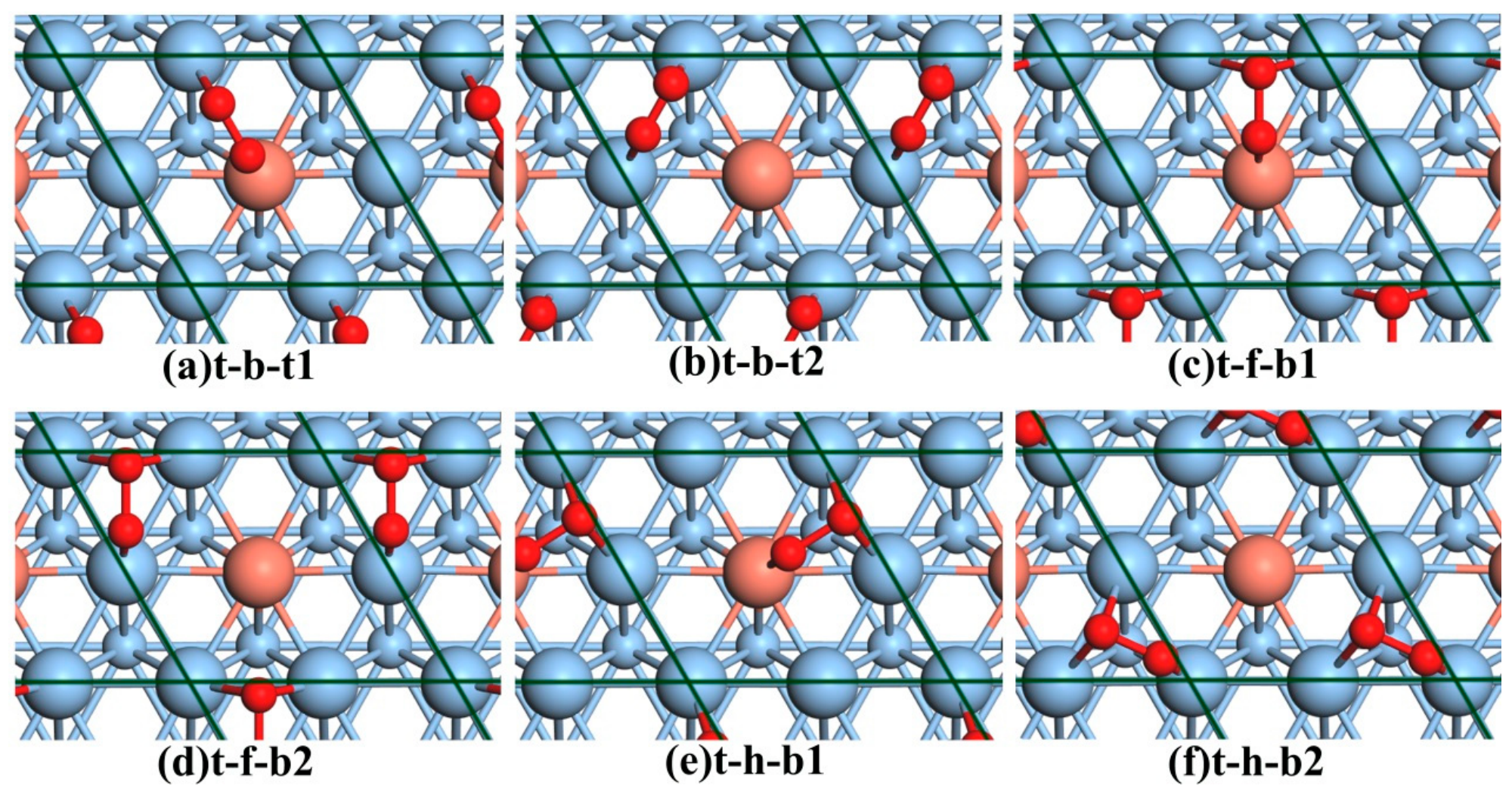
Figure 1. Top view of the stable adsorption configurations of O2 on Cu-, Pt-, and Pd-doped Ag(111) surfaces. The size of the atoms in the second layer is smaller than those in the first layer in the top view to show the adsorption sites clearly. The red, brick-red and silver balls represent O, dopant and Ag atoms, respectively.
Crystals 16 00544 g001
Figure 2. Projected d-band DOS for Ag atoms on the first layers of pristine/doped Ag(111) surfaces without O2 adsorption.
Crystals 16 00544 g002
Figure 3. Projected density of states (PDOS) for dopant atoms on the doped Ag(111) surfaces with O2 adsorption. (a), (b), (c) and (d) present the results for the AgPd(111), AgPt(111), AgCu(111), and Ag(111) surfaces, respectively. The PDOS of surface Ag atoms on Ag(111) is presented for comparison.
Crystals 16 00544 g003
Figure 4. The O2 dissociation pathway on the Cu-, Pt-, and Pd-doped Ag(111) surfaces.
Crystals 16 00544 g004
Table 1. DFT-calculated adsorption energy values of O2 (Eads, in eV), the corresponding O–O bond lengths (dO–O, in Å) for the considered configurations, and the number of electrons gained by O2 (Nchg) from the alloy surfaces.
AgCuAgPdAgPtAg
SiteEadsdO–ONchgEadsdO–ONchgEadsdO–ONchgSiteEadsdO–ONchg
t-b-t1−0.5921.3390.645−0.2951.3080.498−0.3861.3170.504t-b-t−0.2431.3070.496
t-b-t2−0.2711.3080.499//////t-f-b−0.1961.3160.544
t-f-b1−0.5891.3870.786−0.2631.3190.558−0.3501.3230.554t-h-b−0.1891.3170.545
t-f-b2−0.2181.3170.550//////
t-h-b1−0.5861.3850.773−0.2621.3030.557−0.3521.3270.547
t-h-b2−0.2151.3170.547//////
All adsorption energies and structural parameters reported in this table correspond to the (111) surface orientation of each alloy composition.
Disclaimer/Publisher’s Note: The statements, opinions and data contained in all publications are solely those of the individual author(s) and contributor(s) and not of MDPI and/or the editor(s). MDPI and/or the editor(s) disclaim responsibility for any injury to people or property resulting from any ideas, methods, instructions or products referred to in the content.