
Article

Nonlinear Lattice Dynamics and Discrete Breathers in B2 Crystals: A Comparative Study of CsCl, LiPb, and NiTi


by
Dina U. Abdullina
1,
Arseny M. Kazakov
2,
Alexander S. Semenov
1,3,* and
Sergey V. Dmitriev
1,4
1
Institute of Molecule and Crystal Physics, Ufa Federal Research Center of Russian Academy of Sciences, Oktyabrya Ave., 71, 450075 Ufa, Russia
2
Laboratory for Metals and Alloys Under Extreme Impacts, Ufa University of Science and Technology, Zaki Validi Str., 32, 450076 Ufa, Russia
3
Polytechnic Institute (Branch) in Mirny, Ammosov North-Eastern Federal University, Tikhonova Str. 5/1, 678170 Mirny, Russia
4
Institute of Mathematics with Computer Center, Ufa Federal Research Center of Russian Academy of Sciences, Chernyshevsky Str., 112, 450008 Ufa, Russia
*
Author to whom correspondence should be addressed.
Crystals 2026, 16(7), 425; https://doi.org/10.3390/cryst16070425
Submission received: 16 May 2026 / Revised: 28 June 2026 / Accepted: 28 June 2026 / Published: 30 June 2026
(This article belongs to the Section Inorganic Crystalline Materials)

Abstract

Discrete breathers (DBs) are nonlinear vibrational excitations localized on small groups of atoms in perfect crystal lattices. While theoretically proven, a systematic understanding of DB formation in binary crystals with the B2 structure remains limited. We employ molecular dynamics simulations using the LAMMPS package to investigate the nonlinear dynamics of three representative B2 crystals: ionic CsCl, and intermetallic LiPb and NiTi. We calculate the amplitude-frequency dependencies of delocalized nonlinear vibrational modes (DNVMs) and analyze DB existence conditions based on phonon spectrum features and anharmonicity type. Our analysis reveals that a significant atomic mass difference creates a phonon band gap, enabling gap DBs in CsCl and LiPb, whereas NiTi, with similar atomic masses, exhibits no gap. A simplified model assuming identical bond stiffnesses accurately predicts frequency ratios in CsCl and LiPb but fails for NiTi due to strong bond stiffness asymmetry. We demonstrate the successful excitation of long-lived gap DBs in LiPb by initializing atomic displacements based on the G1 DNVM pattern on heavy Pb atoms. These gap DBs remain stable for over 20 ps with negligible energy dissipation. In contrast, DBs with frequencies above the phonon spectrum (excited on light Li atoms) exhibit shorter lifetimes (~2 ps). The study establishes that both atomic mass ratio and interatomic bond stiffness asymmetry are critical parameters governing nonlinear dynamics in B2 crystals. The predicted long-lived gap DBs in LiPb provide a target for future experimental detection via inelastic neutron or X-ray scattering, offering new insights into energy localization and transport in biatomic alloys.

1. Introduction

The linear theory of lattice dynamics, developed by Born and Huang, provides a comprehensive description of crystal vibrations at low temperatures [1]. However, as the amplitude of atomic oscillations increases, nonlinear effects become significant, leading to phenomena that cannot be explained within the harmonic approximation. One of the most intriguing nonlinear phenomena is the existence of discrete breathers (DBs). These are large-amplitude vibrational modes localized on small groups of atoms that can exist in perfect, defect-free crystals due to the interplay of nonlinearity and discreteness [2,3,4,5,6,7]. Since their theoretical prediction by Dolgov [2] and independently by Sievers and Takeno [3], DBs have been extensively studied in various model systems, including one-dimensional chains, two-dimensional lattices, and three-dimensional crystals [6,7].
Indirect evidence of the existence of DBs in crystals has been obtained through inelastic neutron and X-ray scattering for NaI [8] and α-uranium [9]. DBs are believed to play a crucial role in various physical processes, including heat transport, thermal expansion, plastic deformation, and defect migration [10,11,12,13,14,15,16,17,18,19,20,21,22,23,24,25,26]. In particular, DBs can concentrate energy locally, facilitating bond breaking or defect motion, and can act as carriers of vibrational energy over long distances with a weak dispersion [12,13,14,15].
A powerful method for constructing DBs in crystals with high symmetry is based on delocalized nonlinear vibrational modes (DNVMs), also known as bushes of nonlinear normal modes [27,28,29,30,31,32]. DNVMs are exact solutions to the nonlinear equations of motion, determined solely by the symmetry of the crystal lattice. They represent periodic orbits in the phase space that do not excite other modes, even at large amplitudes. By applying a localization function to a DNVM whose frequency is outside the phonon spectrum (either above the upper limit or inside the band gap), one can attempt to obtain a localized DB [33,34]. In this work, we use the terms ‘hard-type’ and ‘soft-type’ anharmonicity (or nonlinearity) to describe the amplitude-frequency dependence of vibrational modes. Hard-type anharmonicity implies that the mode frequency increases with increasing oscillation amplitude, whereas soft-type anharmonicity corresponds to a decrease in frequency as the amplitude grows.
Crystals with the B2 (CsCl-type) structure constitute an important class of materials widely used in aerospace, automotive, and biomedical industries due to their high strength, corrosion resistance, and shape memory effects [35,36,37,38,39,40,41,42,43,44,45,46,47,48] (e.g., NiTi alloys [49]). In particular, the vibrational properties of the crystals have been analyzed in [36,37,40], the mechanical properties in [41], and the structure in [38,39]. The LiPb system is complex and widely studied, particularly in nuclear engineering for its applications in fusion reactors, where liquid Li-Pb eutectic is used as a tritium breeder and neutron multiplier [50]. Despite their practical importance, the nonlinear dynamics of B2 crystals, particularly the properties of DNVMs and DBs, have not been systematically investigated. Previous studies have mostly focused on monoatomic lattices or simplified models with nearest-neighbor interactions [51,52,53,54]. However, B2 crystals are binary systems with atoms of different masses and complex interatomic potentials that often include long-range interactions (up to the fourth coordination sphere) [55]. The presence of two sublattices with different atomic masses can lead to the formation of a band gap in the phonon spectrum, which allows for the existence of gap DBs—a type of localized mode that has received less attention than DBs with frequencies above the spectrum.
The existence and stability of DBs depend critically on two factors: the mass ratio of the constituent atoms and the stiffness of interatomic bonds. In simplified models with identical bond stiffnesses for all atom pairs, the frequencies of DNVMs excited on light and heavy sublattices are related by a simple scaling law [56]. However, in real crystals, bond stiffnesses differ depending on the atom types, which may significantly alter the amplitude-frequency dependencies of DNVMs and the conditions for DB existence. Understanding DBs is not only of fundamental interest but also has practical implications. Localized energy concentrations can facilitate diffusion processes, influence thermal conductivity in nanomaterials, and potentially trigger phase transformations or defect nucleation in structural alloys like NiTi. Thus, controlling DB formation could offer new pathways for managing material properties under extreme conditions.
In this work, we perform a comparative molecular dynamics study of the nonlinear dynamics of three B2 crystals with different chemical bonding and mass ratios: CsCl (ionic), LiPb (metallic with a large mass difference), and NiTi (intermetallic with a small mass difference). We calculate the amplitude-frequency dependencies of DNVMs for all symmetry-allowed groups (G1–G7) and analyze the deviations from the simplified scaling law to assess the role of bond stiffness asymmetry. Furthermore, we demonstrate the existence of long-lived gap discrete breathers in the LiPb crystal, excited on the heavy Pb sublattice, and discuss their stability and potential for energy transport. This study provides a comprehensive understanding of the conditions for DB formation in B2 crystals and lays the groundwork for interpreting experimental data on nonlinear vibrational properties of these technologically important materials.

2. Materials and Methods

Molecular dynamics simulations were performed using the Large-scale Atomic/Molecular Massively Parallel Simulator (LAMMPS) package (version 29 Aug 2024) [57], which includes a library of interatomic potentials for various substances and compounds. For the CsCl crystal, the potential developed in [58] was employed; for LiPb, the potential described in [59] was used; and for NiTi, the potential presented in [60] was applied. The selected potentials have been validated previously to reproduce lattice parameters, elastic constants, and phonon spectra of the respective B2 phases with good accuracy [61,62,63]. In our simulations, the linear phonon spectra derived from these potentials match well with available experimental and DFT data, ensuring the reliability of the harmonic baseline for our nonlinear analysis.
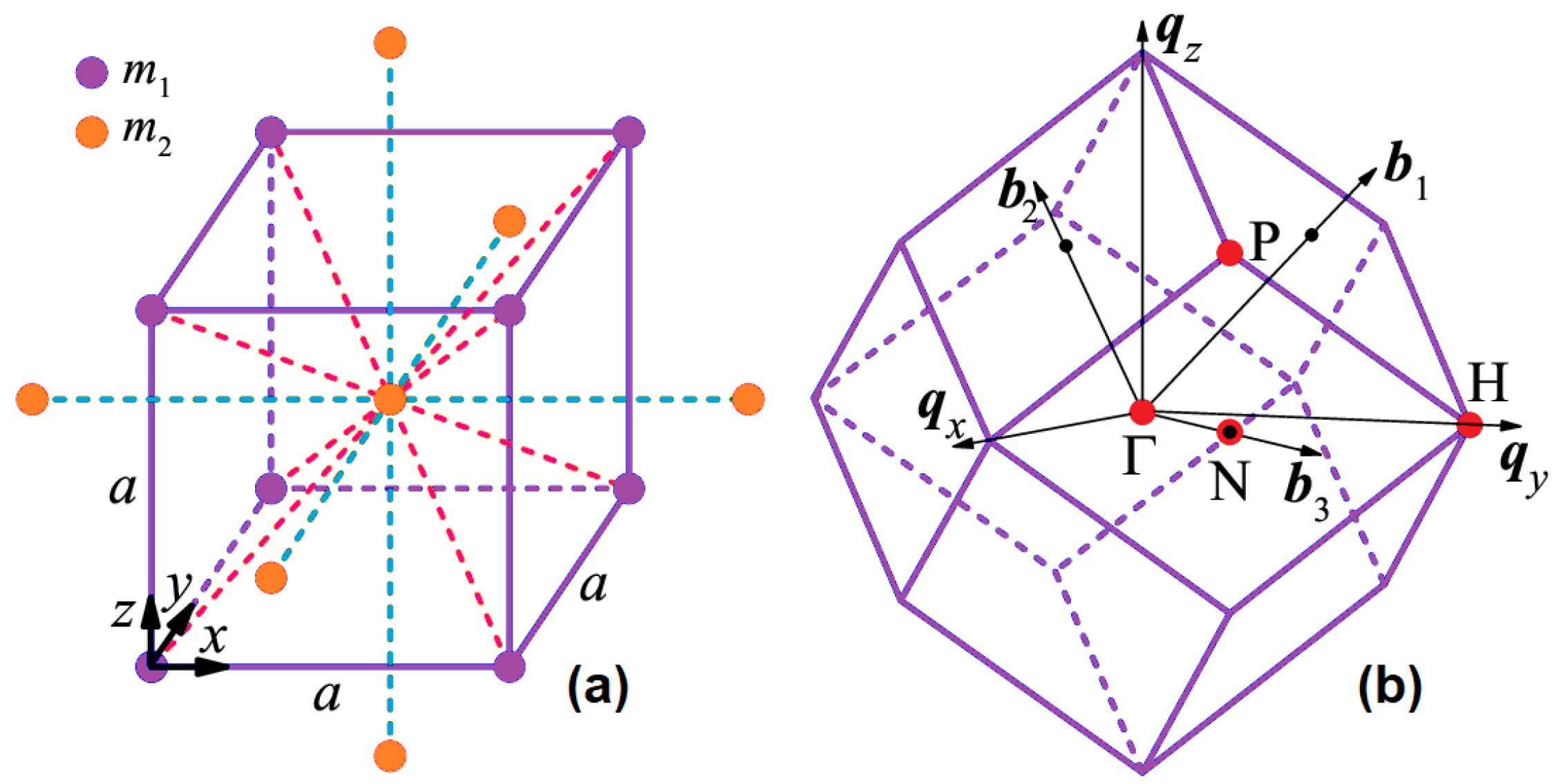
The computational cell adopts the B2 structure, as shown in Figure 1a. The B2 structure is based on a body-centered cubic (BCC) lattice and consists of two simple cubic sublattices with a lattice parameter a. Atoms of one type (mass m1) are located at the cube vertices, while atoms of the other type (mass m2) occupy the cube center.
Simulations of delocalized nonlinear vibrational modes (DNVMs) were carried out in a computational cell consisting of 2 × 2 × 2 primitive translation cells of size 2a × 2a × 2a, where a is the lattice parameter. Such a cell contains 8 atoms of each component. Discrete breathers (DBs) were studied in a computational cell comprising 20 × 20 × 20 primitive translation cells of size 20a × 20a × 20a, with a total of 16,000 atoms.
The phonon dispersion curves of the studied crystals were calculated using the standard LAMMPS–Phonopy workflow. The calculations were performed for the relaxed structures, and the results are presented as phonon frequencies along the high-symmetry directions of the first Brillouin zone. In general, the dispersion relations exhibit six branches.
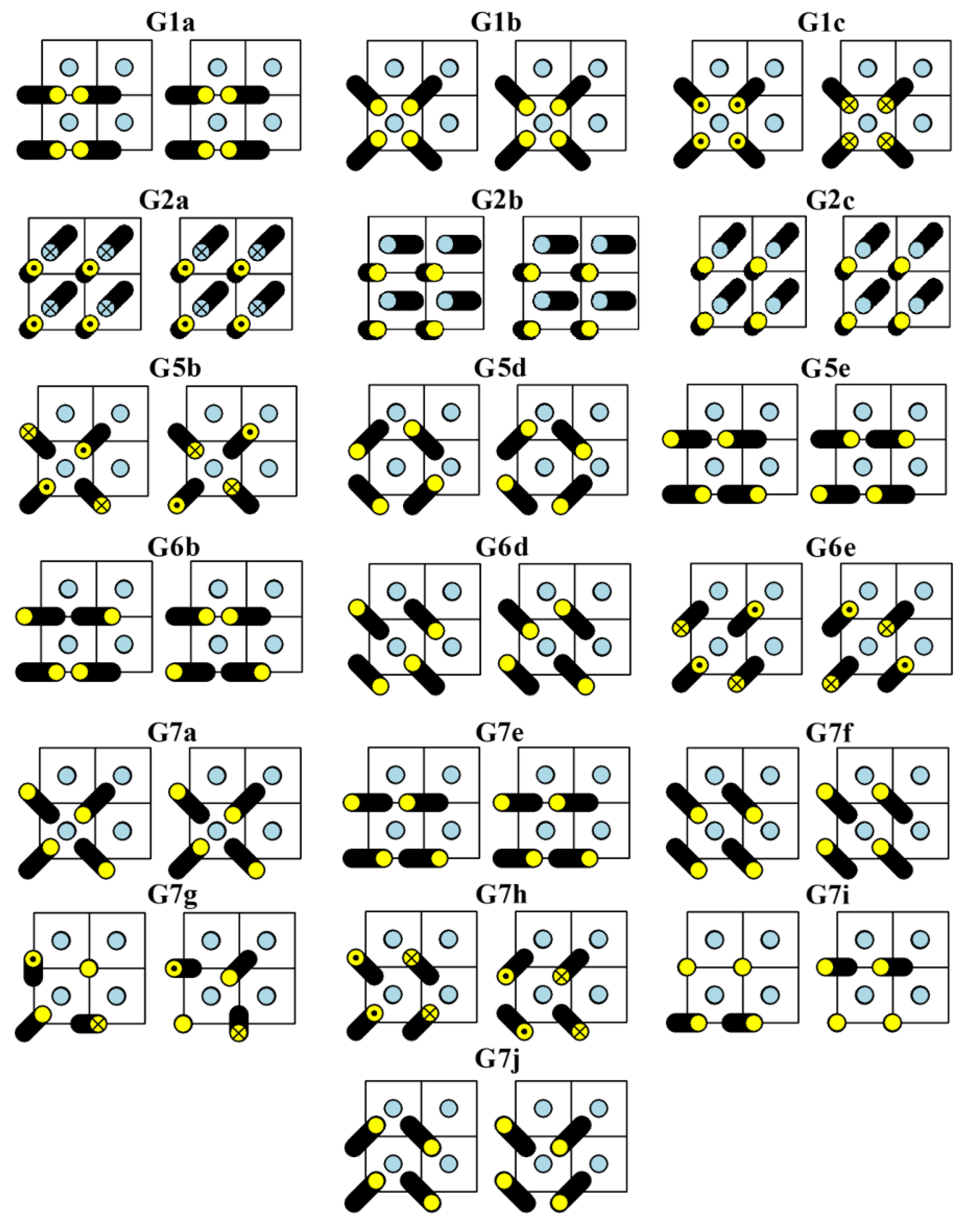
The B2 structure supports exact nonlinear vibrational solutions with one degree of freedom (DNVMs). These modes were described in [56] and can be determined based solely on the symmetry of the BCC lattice. DNVMs are classified into groups G1 through G7. The atomic displacement patterns for these modes are shown in Figure 2. In these figures, the trajectories of oscillating atoms are depicted in black. Atoms with a positive (negative) z-component of displacement are marked with a dot (cross).
DNVMs of groups G3 and G4 exist as exact solutions only in a monoatomic BCC lattice, not in the B2 structure; therefore, they are not considered in this work. It is important to note that DNVMs of group G2 differ qualitatively from those of all other groups. In G2 DNVMs, both cubic sublattices oscillate relative to each other as rigid bodies, whereas in other DNVMs, atoms of only one sublattice oscillate while atoms of the other sublattice remain at rest.
Thus, all DNVMs of groups G1, G5, G6, and G7 have two frequencies corresponding to the oscillations of cubic lattices with atoms of mass m1 and m2. Denoting these frequencies as ω1 and ω2, they are related by the following equation:
ω 2 = m 1 m 2 ω 1 .
This relation holds strictly for a model with identical bond stiffnesses for all atom pairs. Deviations from this ratio in real crystals (CsCl, LiPb, NiTi) indicate differences in interatomic bond stiffnesses between different components. All frequencies are given in THz. We use the symbol ω to denote the vibration frequency in THz for consistency with common literature in this field.
Periodic boundary conditions and the NVE thermodynamic ensemble (microcanonical ensemble) were used. The equations of atomic motion were integrated numerically using the fourth-order Verlet method with a time step of 0.5 fs. This time step ensured high calculation accuracy, as further reduction in the step did not affect the results.

3. Results and Discussion

3.1. Phonon Dispersion Curves for the Studied Crystals

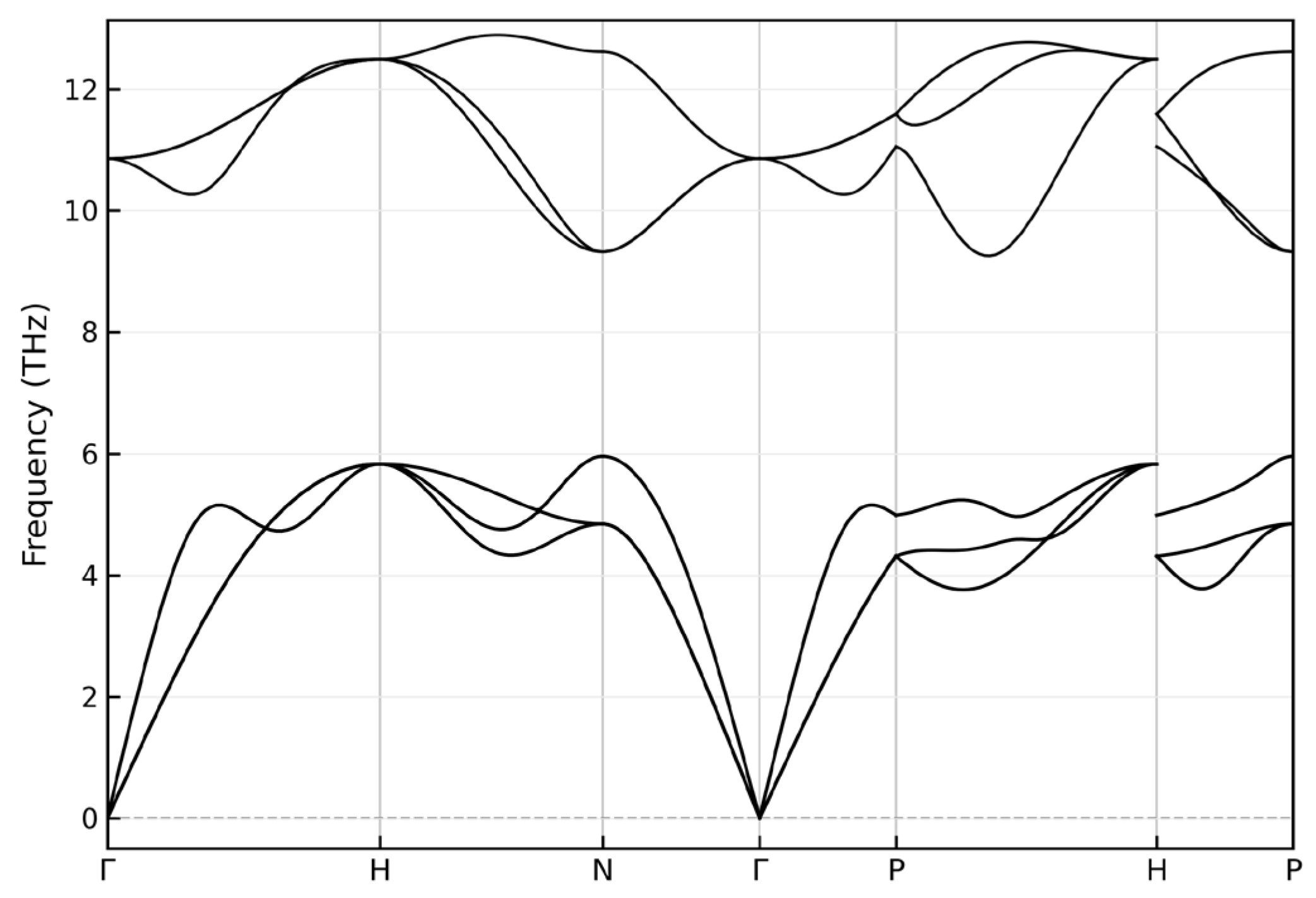
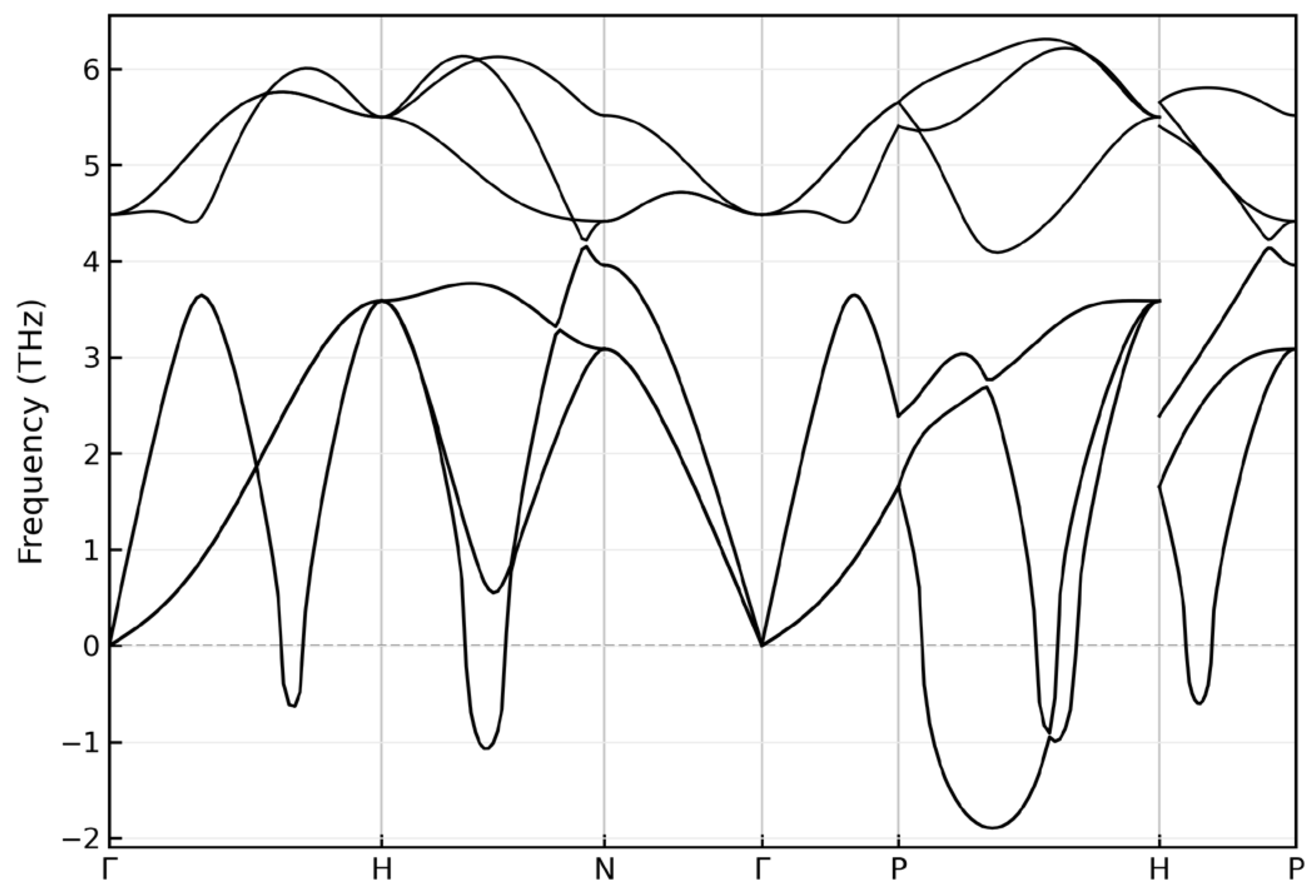
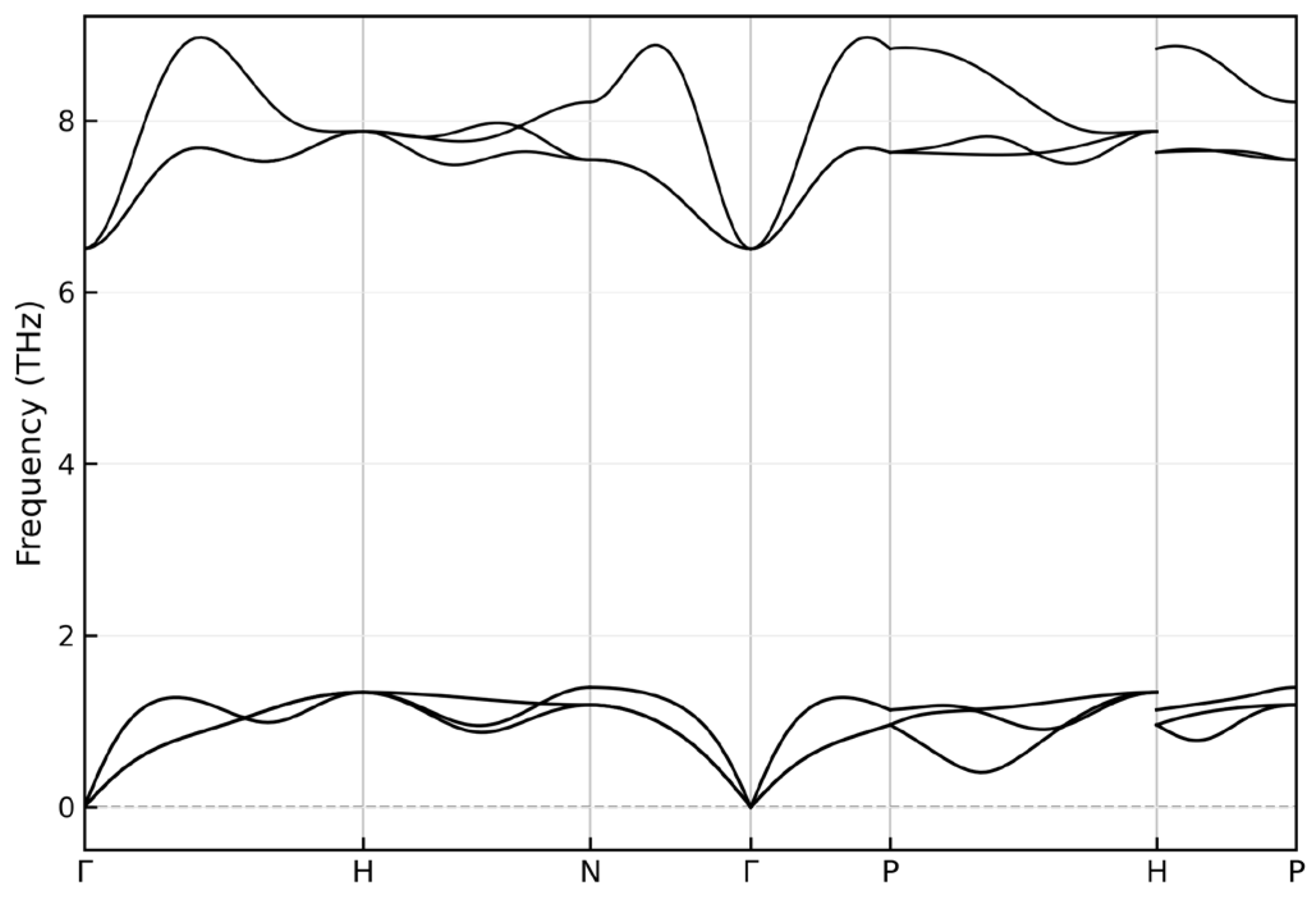
In Figure 3, Figure 4 and Figure 5, the phonon dispersion curves are presented for the three B2 crystals considered in this work, namely for CsCl, NiTi, and LiPb, respectively.
Figure 3 shows that the CsCl crystal exhibits a phonon band gap in the frequency range of 6 to 9.4 THz, while the upper edge of the phonon spectrum is located at 12.8 THz. The maximum phonon frequency is attained not at the Brillouin zone boundary but along the path between the H and N high-symmetry points. This implies that the crystal cannot support DBs with frequencies above the phonon spectrum; however, gap DBs associated with either soft or hard anharmonicity may exist.
Figure 4 indicates the dynamical instability of the B2 NiTi crystal at 0 K, as evidenced by the presence of imaginary phonon frequencies (plotted as negative values ω 2 ). It is well known that the thermodynamically stable low-temperature phase is the B19′, which transforms into the high-temperature B2 phase at approximately room temperature. In the present simulations, this instability is not manifested due to the limited size of the computational cell (2 × 2 × 2 primitive unit cells), which restricts the development of unstable modes. The B2 NiTi crystal does not exhibit a phonon band gap because the atomic masses of Ni and Ti are relatively close. The maximum phonon frequency occurs not at the Brillouin zone boundary but along the path between the P and H high-symmetry points. Consequently, DBs with frequencies above the phonon spectrum cannot exist in this system.
The phonon dispersion curves of the LiPb crystal shown in Figure 5 reveal a wide band gap, which arises from the large difference in the atomic masses of its constituent elements. This feature enables the existence of gap DBs, whereas DBs with frequencies above the phonon spectrum are not possible. This is because the maximum phonon frequency is attained not at the boundary of the first Brillouin zone but along the path between the Γ and H high-symmetry points.

3.2. Amplitude-Frequency Dependencies of DNVMs in the CsCl Crystal

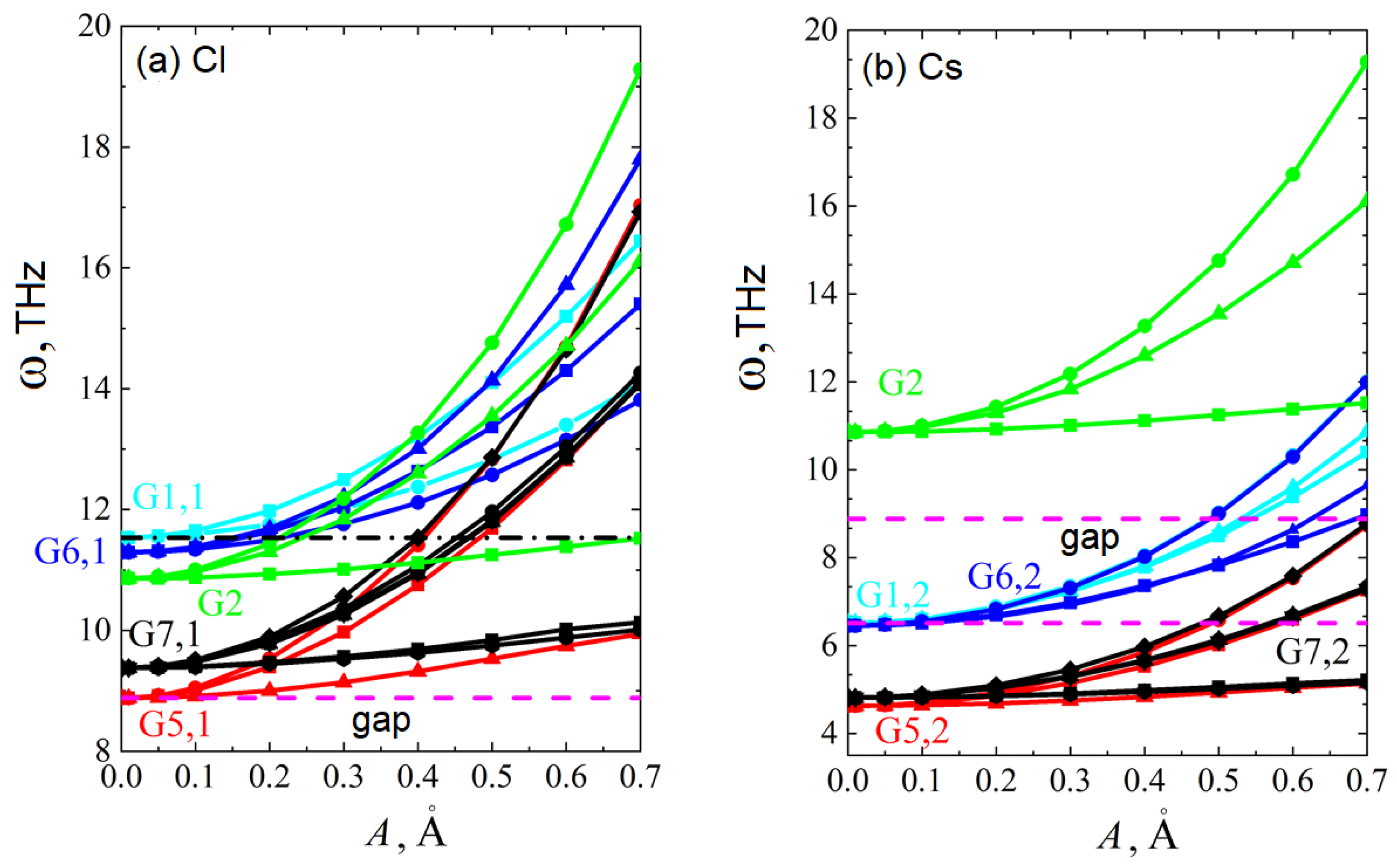
We consider the frequency dependence on amplitude for all studied delocalized nonlinear vibrational modes (DNVMs) in the ionic CsCl crystal with a lattice parameter a = 3.984 Å. The results of molecular dynamics simulations are presented in Figure 6. The chlorine atom has a mass m1 = 35.45 u, while the cesium atom mass is m2 = 132.91 u. The significant difference in the masses of the constituent atoms is a fundamental factor determining the phonon spectrum of this crystal, leading to the formation of a band gap. While phonon propagation at frequencies within the band gap is impossible, this condition allows for the existence of gap discrete breathers (DBs).
The horizontal pink dashed lines in Figure 6 indicate the boundaries of the phonon band gap, which lies in the frequency range from Ω = 6.51 THz to Ω = 8.88 THz. The black dash-dotted line in panel (a) shows the upper boundary of the spectrum at a frequency of Ω = 11.53 THz. The obtained results demonstrate that all five groups of DNVMs in the CsCl crystal exhibit hard-type nonlinearity, with mode frequencies increasing as the amplitude grows. Hard anharmonicity is a key factor necessary for the formation of DBs with frequencies either above the phonon spectrum or within the band gap.
At small amplitudes, DNVMs of group G2 have a single oscillation frequency. This is because, in these modes, both monoatomic sublattices oscillate in antiphase relative to each other. At moderate amplitudes, the frequencies of G2 DNVMs lie within the optical part of the phonon spectrum, but at significant amplitudes, they exceed the upper spectrum boundary. For the G5 DNVM group excited on Cl atoms (see Figure 6a), the frequencies branch off from the upper boundary of the band gap and increase within the optical band of the phonon spectrum. The G7 DNVMs excited on light Cl atoms (see black curves Figure 6a) have frequencies in the optical band; however, at large oscillation amplitudes, the frequencies of some of these modes rise above the phonon spectrum. The G5 and G7 DNVMs for Cs (see Figure 6b) lie in the acoustic band of the spectrum. At large oscillation amplitudes, the frequencies of some of these modes enter the phonon band gap.
The G6 DNVMs excited on chlorine atoms have frequencies slightly lower than those of the G1 DNVMs. At amplitudes less than 0.17 Å they lie in the optical part of the spectrum, while at larger amplitudes, they exceed the spectrum boundary. The G6 DNVMs on Cs atoms also have frequencies slightly lower than the corresponding G1 DNVM frequencies. At small amplitudes, they lie in the acoustic region of the spectrum, but as the amplitude increases, they enter the optical band and subsequently exceed the spectrum boundary.
Thus, only the G1 DNVMs are the primary candidates for generating DBs with frequencies above the spectrum (when excited on light chlorine atoms) or gap DBs (when excited on heavy cesium atoms). Given that the oscillation frequencies of G6 DNVMs are only slightly lower than those of G1 DNVMs, it can be assumed that gap DBs based on G6 DNVMs may exist, provided that the DB amplitudes are sufficiently large for their frequencies to exit the phonon spectrum.
For the crystals considered in this Section, atoms of different components interact differently; therefore, it is expected that Equation (1) will not hold strictly. The deviation of the frequency ratio ω2/ω1 from this equation characterizes the ratio of bond stiffnesses between atoms of different types. Therefore, it is important to discuss the magnitude of this deviation for various DNVMs. Table 1 presents the ω2/ω1 ratios for the CsCl crystal, along with the values calculated using Equation (1) for comparison. It is evident that for the CsCl crystal, the bond stiffnesses between different components differ insignificantly. Consequently, Equation (1), derived under the assumption of identical stiffnesses for all bonds, provides a good estimate of the frequency ratio.

3.3. Amplitude-Frequency Dependencies of DNVMs in the LiPb Crystal

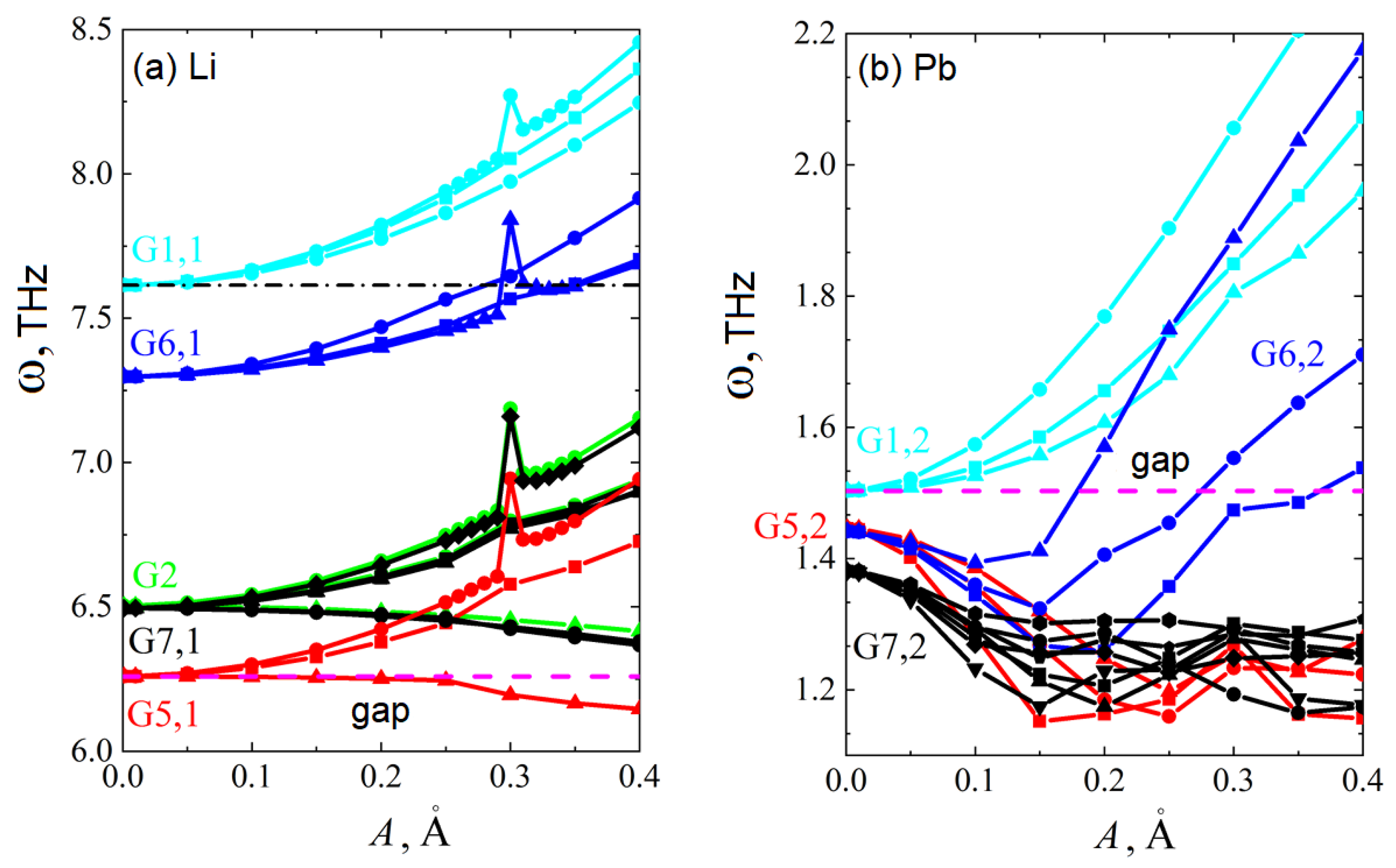
Further, we consider the obtained amplitude-frequency dependencies for the LiPb crystal with metallic bonding, as shown in Figure 7. The mass of the lithium atom is m1 = 6.941 u, and the mass of the lead atom is m2 = 207.2 u. The lattice parameter is a = 3.568 Å. As can be seen, this crystal exhibits a significant difference in component masses, which leads to a strong separation of oscillation frequencies between heavy and light atoms and, consequently, to the formation of a wide band gap in the phonon spectrum. In Figure 7, the boundaries of the phonon band gap are marked by horizontal pink dashed lines: (a) the upper boundary at a frequency of Ω = 6.26 THz, and (b) the lower boundary at a frequency of Ω = 1.503 THz. The black dash-dotted line in panel (a) indicates the upper boundary of the phonon spectrum at a frequency of Ω = 7.61 THz.
In Figure 7a, upon excitation of light Li atoms, DNVMs of groups G1 and G6 exhibit hard-type anharmonicity. Meanwhile, for some DNVMs of groups G2, G5, and G7, hard-type anharmonicity is observed, but there are also DNVMs with soft-type anharmonicity. At small amplitudes, the frequencies of G1 DNVMs lie at the upper edge of the phonon spectrum, but at large amplitudes, the frequencies exceed the spectrum boundary. For G6 DNVMs, the oscillation frequencies lie within the optical band of the spectrum at small amplitudes, but as the amplitude increases, the frequencies rise above the phonon spectrum. The oscillation frequencies of G2 and G7 DNVMs lie within the optical band of the phonon spectrum. For two DNVMs of group G5, the oscillation frequencies branch off from the upper edge of the band gap and increase within the optical band. The third DNVM of this group branches downward from the band gap boundary at large amplitudes and enters the gap. In panel Figure 7a, a sharp frequency jump is observed simultaneously for DNVMs of different groups at an amplitude of A = 0.3 Å. Such behavior of the amplitude-frequency dependencies of DNVMs lacks physical justification. There are several possible explanations for this observation. First, the interatomic potential used may possess a singularity (such as a kink or a discontinuity in the derivative) at A = 0.3 Å, which could lead to numerical instability. Second, at such large oscillation amplitudes, the system may probe regions of the interatomic potential that are less accurately parameterized, or numerical errors may accumulate due to the steepness of the potential walls, leading to the observed instability. It should be noted that while this anomaly suggests a limitation of the empirical potential in this extreme regime, the discrete breathers discussed in Section 3.5 are excited at amplitudes well below this threshold (with individual atomic displacements A1 ≤ 0.60 Å, but effective local strain distributed over several atoms is lower), where the potential behaves physically and provides reliable results.
In Figure 7b, upon excitation of DNVMs on heavy Pb atoms, all G1 DNVMs exhibit hard-type anharmonicity. For G1 DNVMs, the oscillation frequencies are located at the lower boundary of the phonon band gap at small amplitudes, and as the amplitude increases, the frequencies enter the gap. Soft-type anharmonicity predominates for DNVMs of groups G5 and G7. G6 DNVMs exhibit soft-type anharmonicity up to an amplitude of approximately A = 0.15 Å; however, at larger amplitudes, the character of the anharmonicity changes to hard-type, and the mode frequencies enter the phonon band gap. Therefore, they are not considered as candidates for gap DB excitation. While some G2 DNVMs exhibit hard-type anharmonicity, their frequencies remain within the phonon spectrum for most amplitudes, making them less favorable candidates for DB formation compared to G1 or G6 modes. The oscillation frequencies of G6 DNVMs lie in the acoustic band of the phonon spectrum at small amplitudes but move into the band gap as the amplitude increases.
Thus, potential candidates for DB excitation are G1 DNVMs with frequencies above the spectrum (when excited on light lithium atoms) or gap DBs (when excited on heavy lead atoms). G5 DNVMs may also be potential candidates for exciting gap DBs, provided that the DB amplitude is sufficient for the frequency to remain within the band gap.
Table 2 presents the frequency ratios for the LiPb crystal, along with values calculated using Equation (1) for comparison. As shown in Table 2, for the LiPb crystal, the deviation from the simplified model varies across different mode groups, reaching up to ~20% for G5 modes. While this indicates some asymmetry in bond stiffnesses, the overall agreement is significantly better than in systems with strong chemical ordering, allowing Equation (1) to serve as a reasonable first-order approximation for most modes.

3.4. Amplitude-Frequency Dependencies of DNVMs in the NiTi Crystal

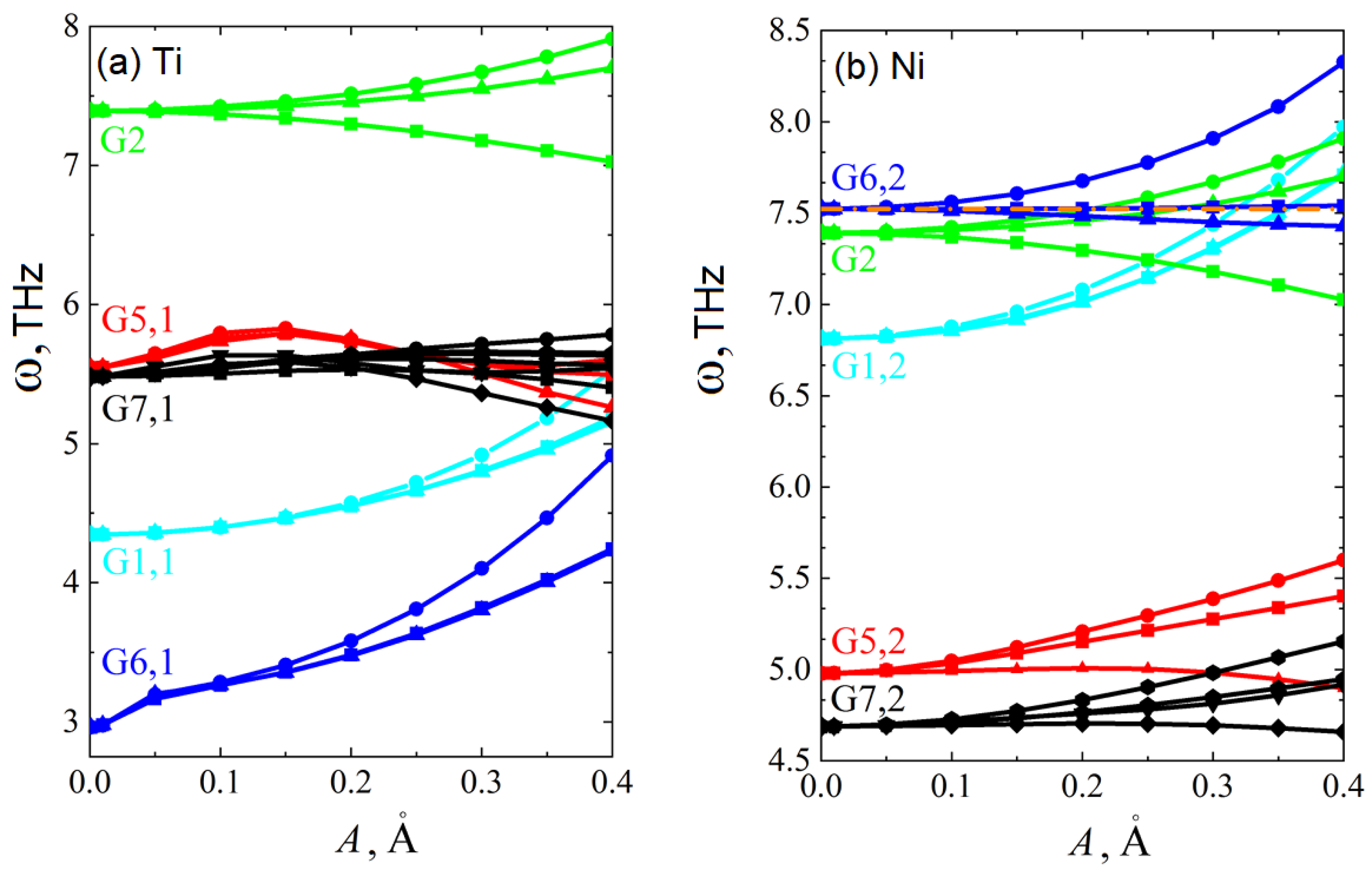
Figure 8 presents the amplitude-frequency dependencies for the NiTi crystal. The mass of the nickel atom is m1 = 58.693 u, the mass of the titanium atom is m2 = 47.867 u, and the equilibrium lattice parameter is a = 2.999 Å. Like the LiPb crystal, NiTi exhibits metallic bonding. However, unlike LiPb, which has a significant difference in atomic masses, the mass difference in NiTi is negligible. This substantial distinction leads to a fundamentally different picture in DNVM dynamics. The phonon spectrum of NiTi lacks a band gap, in contrast to LiPb, where the gap is quite wide. The acoustic and optical branches in the NiTi spectrum are located close to each other, likely resulting in strong mixing.
In Figure 8a, for the Ti sublattice, two DNVMs of group G2 exhibit hard-type anharmonicity, while the third DNVM of this group shows soft-type anharmonicity. The oscillation frequency of this mode group changes insignificantly with increasing amplitude, remaining within the phonon spectrum up to significant amplitudes; only at very large amplitudes do the frequencies of the two DNVMs with hard-type nonlinearity exceed the spectrum boundary. DNVMs of groups G5 and G7 show a complex frequency dependence on amplitude: at small amplitudes, they exhibit a slight frequency increase, while at large amplitudes, a slight decrease is observed. DNVMs of groups G1 and G6 display hard-type anharmonicity, with their oscillation frequencies increasing as the amplitude grows.
In Figure 8b, for the Ni sublattice, the orange dash-dotted line indicates the upper boundary of the phonon spectrum at a frequency of Ω = 7.52 THz. One DNVM of group G6 exhibits hard-type anharmonicity. At small amplitudes, its oscillation frequencies lie at the upper edge of the phonon spectrum and extend beyond it. This is the only DNVM in the NiTi alloy that can be considered a candidate for DB search. The other two DNVMs of group G6 have soft-type anharmonicity and branch downward from the upper boundary of the phonon spectrum. The G1 DNVM has hard-type anharmonicity and lies within the phonon spectrum; at very large amplitudes, its oscillation frequencies rise above the spectrum. Two DNVMs of group G5 exhibit hard-type anharmonicity, while the third has soft-type anharmonicity; the frequencies of this group remain within the spectrum. With the exception of one, all G7 DNVMs exhibit hard-type anharmonicity, and their frequencies lie within the spectrum.
As noted in Section 3.1 and Section 3.2, in the model with identical bond types between different components, DNVM frequencies satisfy Equation (1). However, this Section investigates crystals with interactions that depend on the atom type, which presumably renders Equation (1) invalid. A quantitative assessment of this discrepancy for various DNVMs in the NiTi crystal is provided in Table 3. The results indicate that the significant difference in interatomic bond stiffnesses in NiTi makes the use of the simplified model impossible, and Equation (1) does not hold. Consequently, the discrepancy between the measured frequencies ω1 and ω2 and the values predicted by Equation (1) points to differences in the stiffness of interatomic bonds between atoms of different types.

3.5. Comparative Analysis of Amplitude-Frequency Dependencies for CsCl, LiPb, and NiTi Crystals

In this section, we analyze the amplitude-frequency dependencies of DNVMs obtained in Section 3.1, Section 3.2 and Section 3.3 for three binary crystals that differ in the atomic mass ratios of their constituent elements and the nature of their chemical bonding.
In the alkali-halide CsCl crystal, there is a significant difference in the masses of chlorine and cesium atoms. This difference leads to the formation of a wide band gap in the phonon spectrum, in the frequency range from Ω = 6.51 THz to Ω = 8.88 THz. This crystal exhibits very strong hard-type nonlinearity: as the oscillation amplitude increases, the frequencies of all DNVM groups increase. The most promising candidates for DB excitation are the G1 DNVMs. When excited on light chlorine atoms, they can generate DBs with hard-type nonlinearity and frequencies above the phonon spectrum; when excited on heavy cesium atoms, they generate gap DBs with hard-type nonlinearity. It should be noted that for CsCl, the simplified model given by Equation (1) well describes the frequency ratio of DNVMs excited on light and heavy atoms, indicating a negligible difference in bond stiffnesses between chlorine and cesium atoms (see Table 1).
The LiPb crystal has a very significant mass difference between lithium and lead, resulting in a particularly wide band gap in the frequency range of 1.503–6.26 THz. Unlike CsCl, a mixed type of nonlinearity is observed for various DNVMs in LiPb: hard-type nonlinearity manifests when DNVMs are excited on light lithium atoms, whereas excitation of modes on heavy lead atoms shows soft-type nonlinearity at small amplitudes and hard-type at large amplitudes. Despite the complex behavior of DNVM frequencies of different groups in LiPb, G1 modes can serve as candidates for exciting DBs with hard-type nonlinearity, both gap DBs and those with frequencies above the phonon spectrum. An anomaly was recorded in the calculations—a sharp jump in the amplitude-frequency dependencies at an amplitude of A = 0.3 Å—which may be associated with inaccuracies in the interatomic potentials. The simplified model linking the frequencies of DNVMs excited on light and heavy atoms remains acceptable for LiPb, and Equation (1) predicts the frequency ratio sufficiently well, as shown in Table 2.
The fundamental difference between the NiTi crystal and the previous two crystals lies in the minimal difference in the masses of nickel and titanium atoms. This gives rise to completely different physics: the phonon spectrum has no band gap, and the acoustic and optical branches of the spectrum are closely intertwined. The amplitude-frequency dependencies of DNVMs in NiTi are characterized by mixed nonlinearity manifesting in both sublattices. There is only one DNVM of group G6, excited on nickel, which can be used to excite DBs with frequencies above the spectrum. A key point is the failure of the simplified model linking the frequencies of DNVMs excited on light and heavy atoms for NiTi, since Equation (1) is violated due to the significant difference in the stiffness of interatomic bonds (see Table 3).
The analysis revealed that the nonlinear dynamics of crystals are determined by two main parameters: the difference in atomic masses and the nature of interatomic interactions. In CsCl and LiPb crystals, the simplified model linking the frequencies of DNVMs excited on light and heavy atoms works well. However, for the NiTi intermetallic compound, accounting for different bond stiffnesses between different components becomes critically important for accurate modeling of DNVM oscillations. In light of the obtained data, it can be stated that the crystal model with identical bond stiffnesses between different components yields good results for certain crystals but must be applied with caution, as the error can be substantial for some crystals (e.g., NiTi).

3.6. Discrete Breathers in the LiPb Crystal

By analyzing the obtained amplitude-frequency dependencies of DNVMs for the LiPb crystal (Figure 7), we can identify mode groups that can be used to excite discrete DBs.
The phonon dispersion curves and phonon DOS for B2 LiPb have been calculated using a DFT approach and are reported in Figure 7 in the work by Durukan and Ciftci [64]. According to these simulation results, the gap in the phonon spectrum spans from 1.8 to 7.1 THz, while the upper edge of the spectrum is at 7.8 THz. Our MD results, shown in Figure 7, give an upper edge of the phonon spectrum of 7.6 THz, which is the frequency of DNVM G1,1 in the small-amplitude limit. The gap boundaries are determined by the small amplitude DNVM G1,2 at 1.51 THz and G5,1 at 6.26 THz. Thus, the interatomic potentials used in this work for LiPb provide reasonably good agreement with the DFT data for the boundaries of the phonon spectrum.
When light Li atoms oscillate (Figure 7a), the G1,1 mode group has frequencies above the phonon spectrum. It is also evident that for one of the DNVMs of the G5,1 group, the frequency lies below the upper boundary of the band gap. This mode is likely unsuitable for DB excitation, as its frequency deviates only slightly from the gap boundary with increasing amplitude. For Pb atom oscillations (Figure 7b), gap DBs can be excited on the G1,2 modes, since the frequencies of these modes lie within the gap. This mode group is suitable for finding long-lived DBs because propagating phonons do not exist at frequencies within the gap; thus, the DB has no mechanism to excite propagating waves and dissipate its energy. Furthermore, it should be noted that both the second and third harmonics of the G1,2 DNVM have frequencies within the phonon band gap.
To obtain DBs in the LiPb crystal, we utilized the G1 DNVM. Excitation of this mode on light Li atoms yields frequencies above the phonon spectrum, whereas excitation on heavy Pb atoms results in frequencies within the spectral gap. Since the frequency of this mode group lies outside the spectrum, there is a high probability of obtaining long-lived DBs with frequencies either above the spectrum or within the gap.
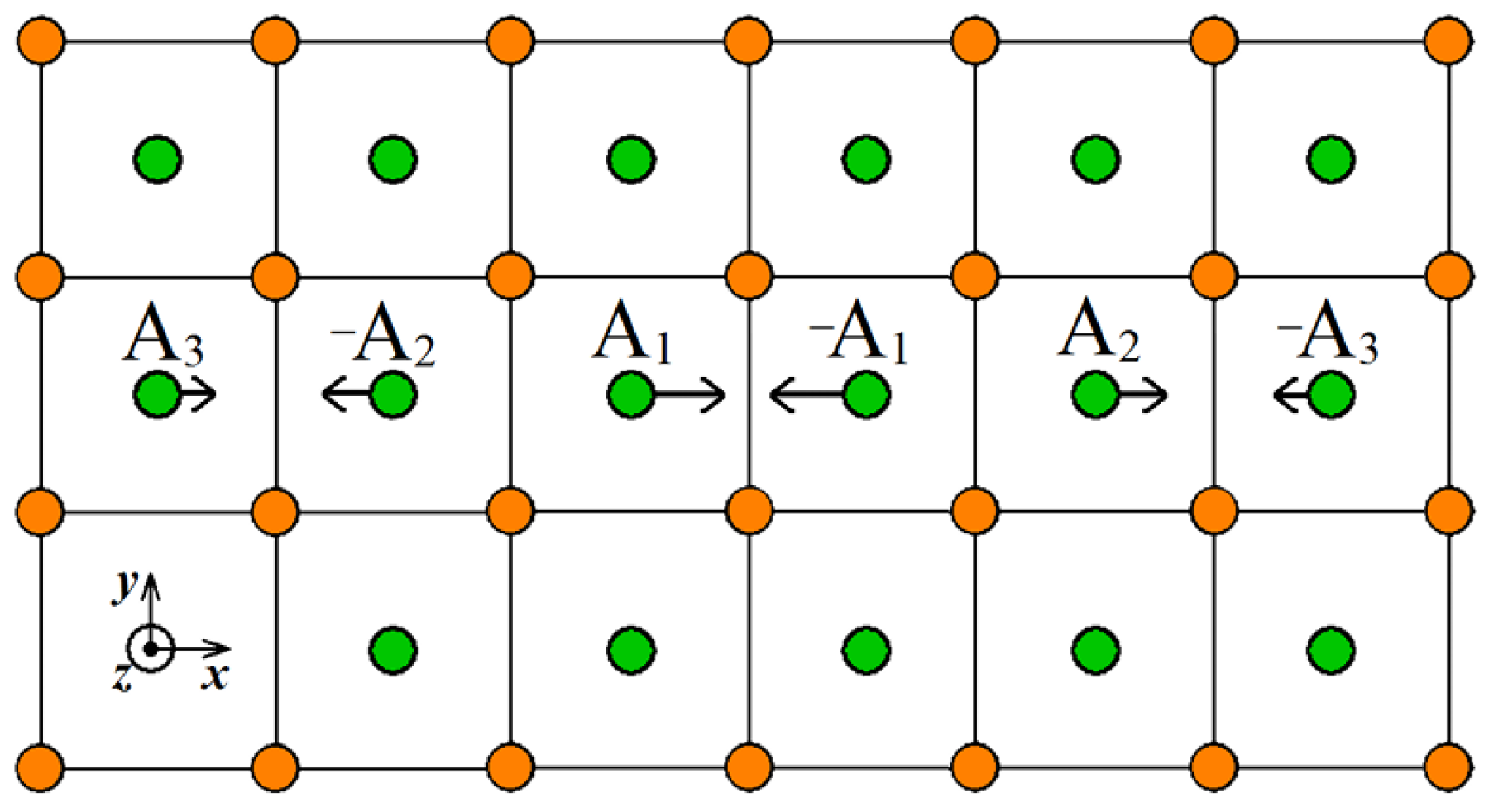
When exciting DBs, atomic displacements were assigned based on the G1a DNVM pattern; the schematic atomic displacement is shown in Figure 9. As can be seen in this figure, initial displacements are applied to heavy atoms (shown in green), while light atoms remain in their equilibrium lattice positions (shown in orange). This applies to the excitation of gap DBs. In the case of exciting DBs with frequencies above the spectrum, light atoms are displaced according to the same scheme, while heavy atoms receive no initial displacements. In all cases, the initial velocities of all atoms are zero. The parameters A1, A2 and A3 describe the deviations of atoms from their equilibrium positions, with arrows indicating the direction of deviation along the x-axis. Such parameters were determined by the spatial profile of the G1 DNVM eigenvector, modulated by an exponential localization function. The ratios between them preserve the symmetry of the mode while ensuring rapid decay of amplitude away from the breather center.
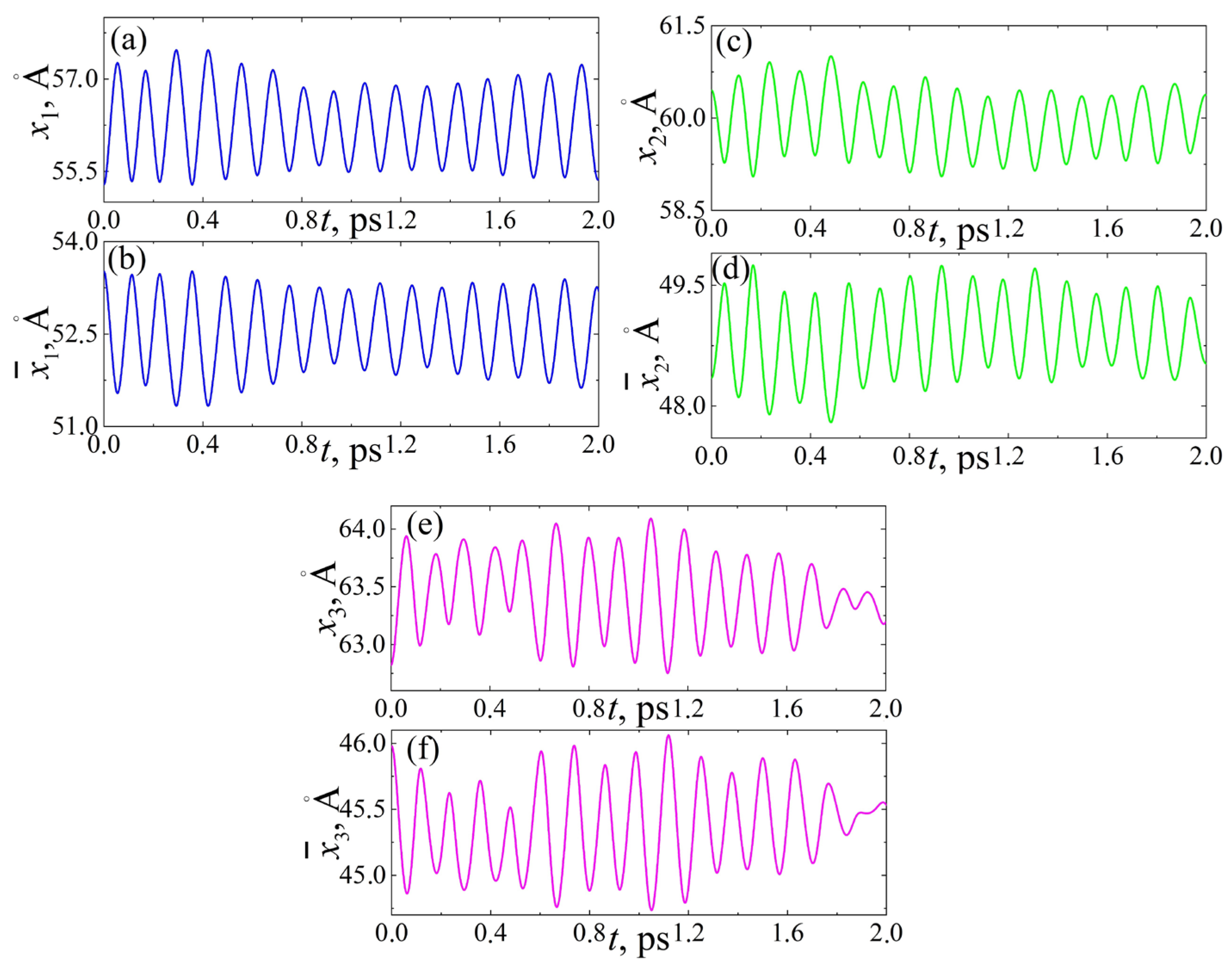
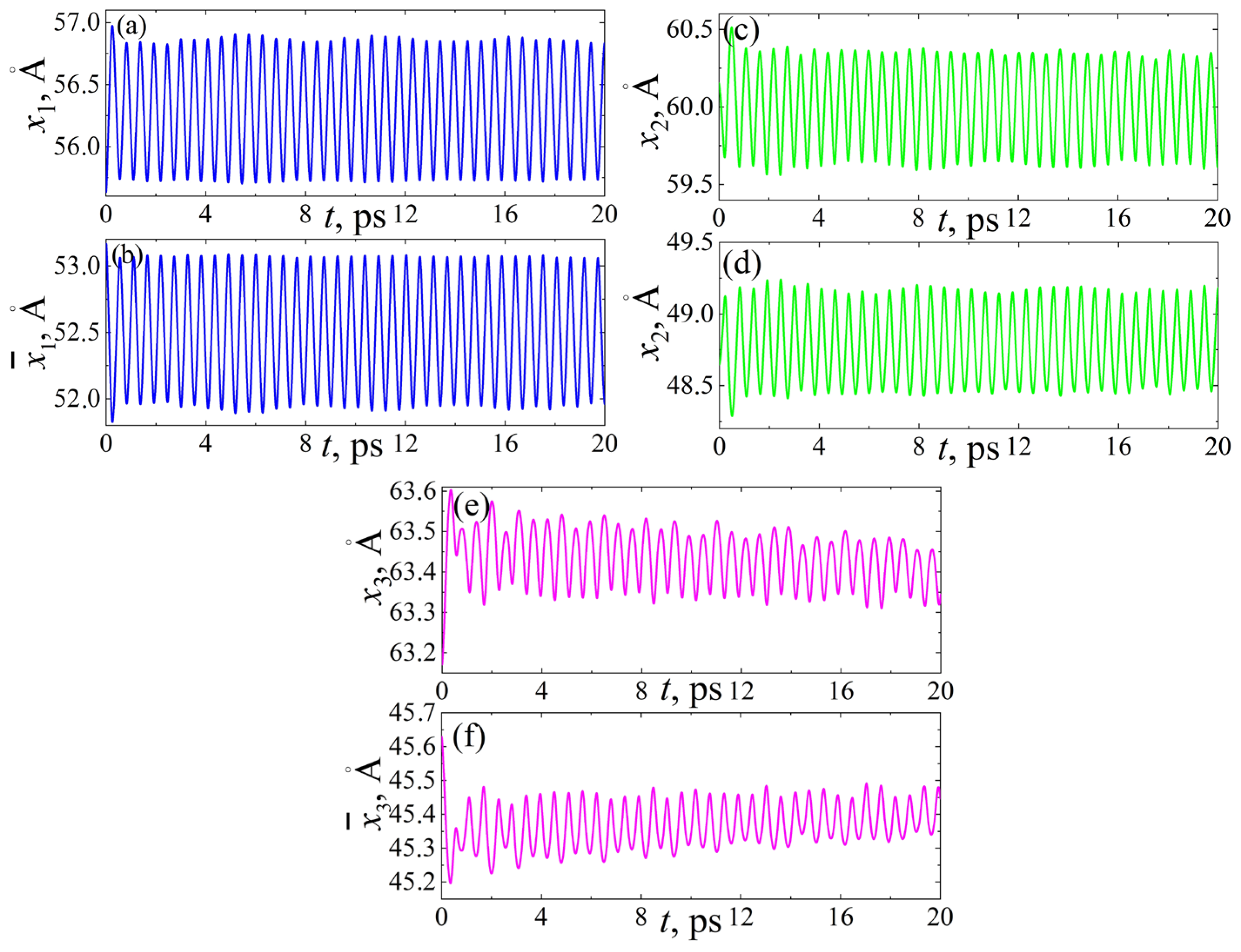
Figure 10 presents a DB excited on light lithium atoms, while Figure 11, Figure 12 and Figure 13 show DBs excited on heavy lead atoms. Figure 10 shows a DB obtained in the Li sublattice with parameters A1 = 0.90 Å, A2 = 0.70 Å, and A3 = 0.50 Å. The oscillation frequency of this DB was found to be Ω = 8.57 THz. It can be noted that this frequency lies above the upper edge of the phonon spectrum (see Figure 7a). The DB exists for approximately 2 ps. As seen in Figure 10, the oscillation amplitude of the outer atom (x3) decays rapidly, followed by a loss of coherence in the central atoms, indicating the dissipation of the localized mode into the lattice. The DB exhibits hard-type nonlinearity, consistent with the hard-type nonlinearity of the G1,1 DNVM. Subsequently, DBs were excited on the Pb sublattice using various initial atomic displacements. For instance, a DB obtained with initial displacement parameters A1 = 0.50 Å, A2 = 0.38 Å, and A3 = 0.15 Å is shown in Figure 11. As can be seen in the figure, the obtained DB is stable and does not decay throughout the entire simulation interval. No energy loss of the DB is observed during the simulation. The energy initially concentrated in the DB is practically not dissipated into the lattice, indicating high stability of the DB.
To quantify the stability, we monitored the total energy of the system, which was conserved within 10−5 eV/atom, indicating negligible numerical dissipation. Furthermore, the participation ratio remained constant, confirming that the energy remains localized on the initial group of atoms without spreading into the lattice over the 20 ps simulation time.
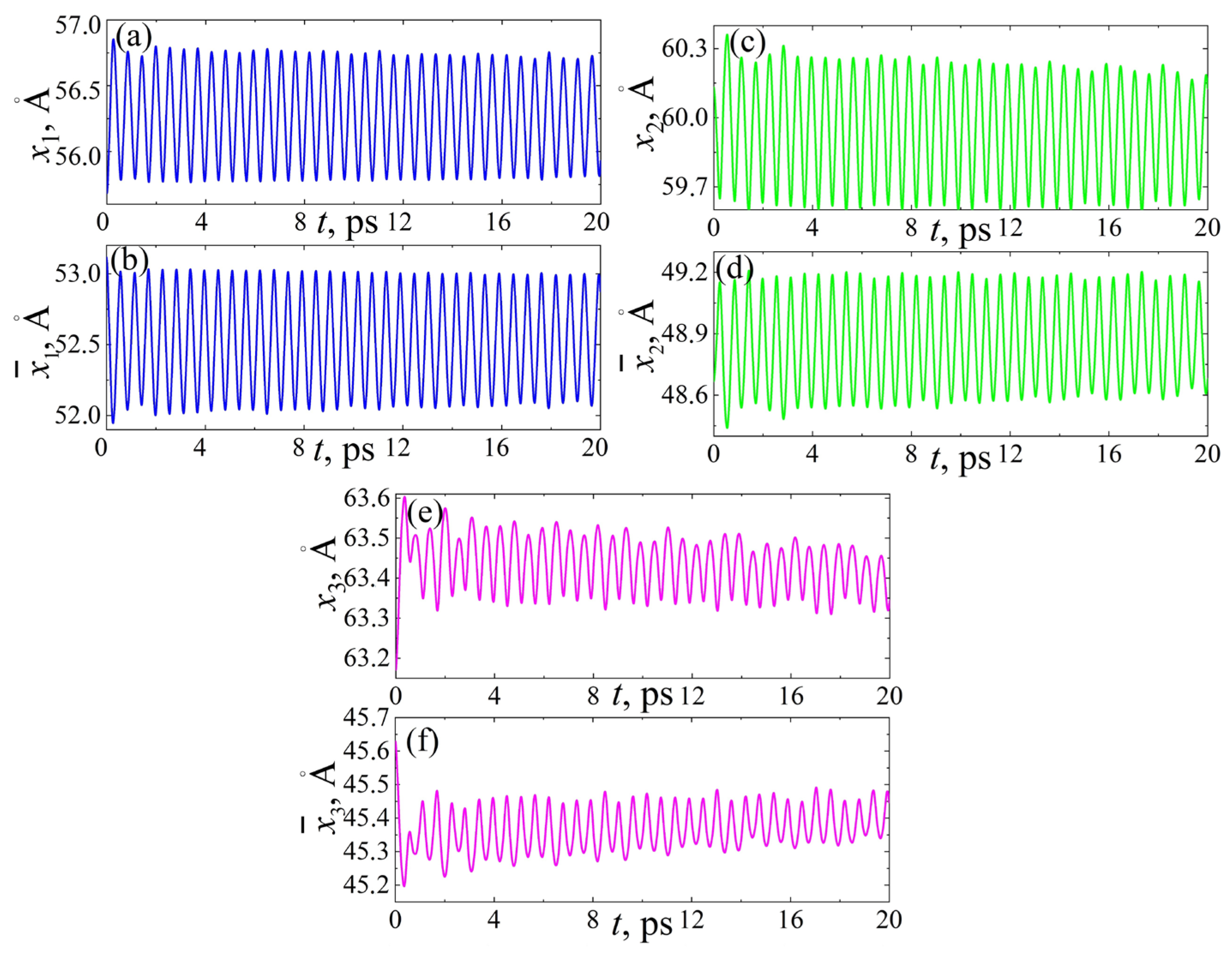
Figure 12 shows a DB excited with parameters A1 = 0.55 Å, A2 = 0.40, and A3 = 0.15 Å. It can be noted that periodic oscillations with constant amplitude are observed in all graphs throughout the entire simulation interval. The lifetime of the obtained DB is large and significantly exceeds the simulation time (20 ps). Oscillations in the Li sublattice (see Figure 10) and oscillations in the Pb sublattice (see Figure 12) are stable and synchronous. This leads to the formation of a DB that encompasses both sublattices of the crystal, but lead atoms in this gap DB oscillate with significantly larger amplitudes than lithium atoms. This result indicates that the selected set of initial displacements for lead atoms (A1 = 0.55 Å, A2 = 0.40 Å, and A3 = 0.15 Å) is optimal for exciting a long-lived gap DB.
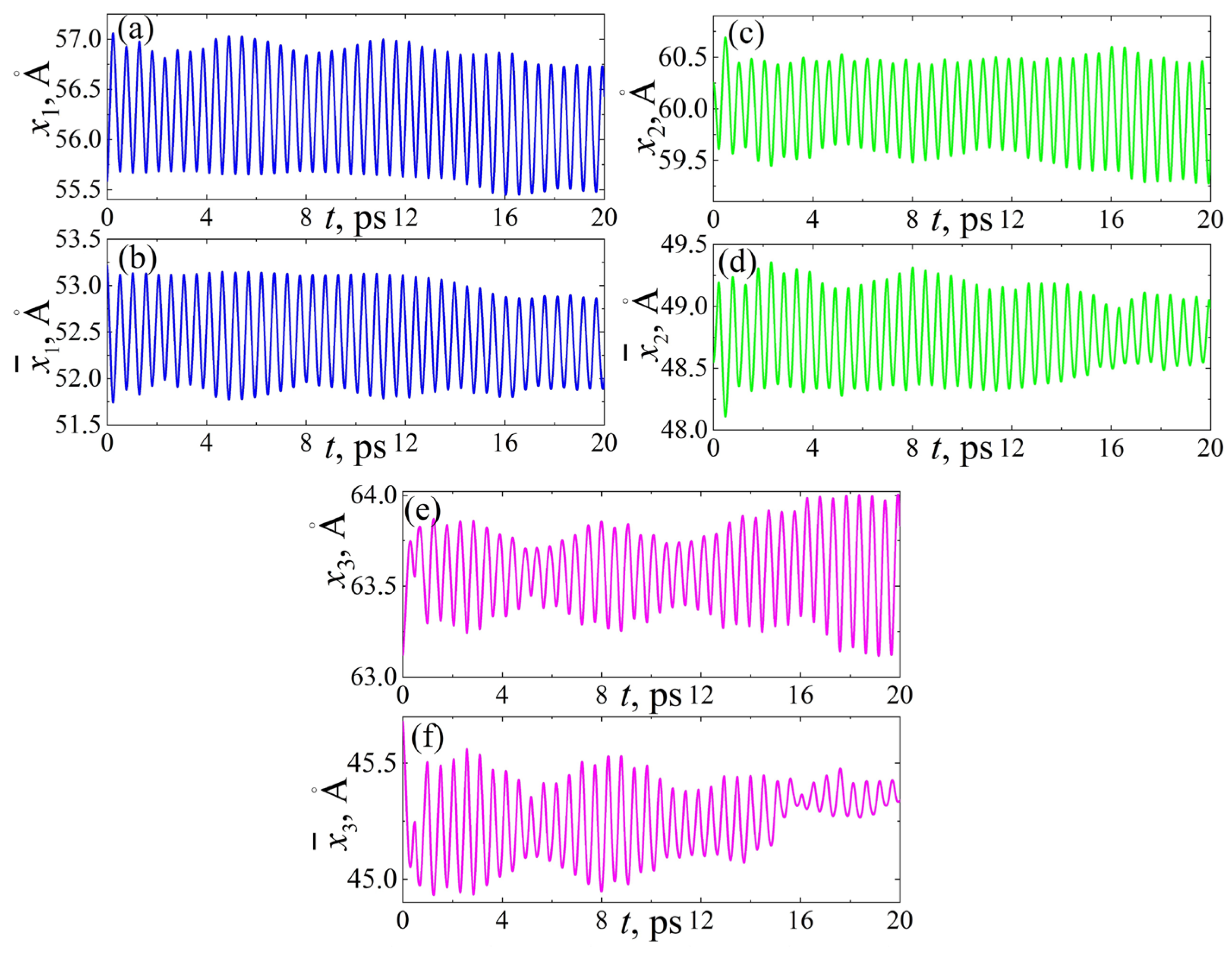
Figure 13 shows a DB excited with parameters A1 = 0.60 Å, A2 = 0.50 Å, and A3 = 0.20 Å. As seen in panels (a,b), the oscillations are stable, but an oscillation of the oscillation amplitude is observed. This occurs because, with the chosen parameter A1 = 0.60 Å, more pronounced oscillations of the light sublattice atoms are observed in the obtained DB compared to the previous case. The excitation of lithium atoms can be explained by the fact that the DB frequency is Ω = 1.98 THz, and its third harmonic approaches the optical band of the spectrum. With further increase in amplitude, the obtained DB will likely become unstable and decay. In panels (c,d) for A2 = 0.50 Å and (e,f) for A3 = 0.20 Å, it is evident that the DB exhibits a tendency to move to the left, as the oscillation amplitude increases for some atoms and decreases for others. Taking into account the DB motion, it can be stated that the oscillations remain periodic throughout the entire simulation time (20 ps).

4. Conclusions

In this work, we performed a comprehensive comparative study of the linear and nonlinear dynamics of three binary crystals with the B2 structure: CsCl, LiPb, and NiTi. Using molecular dynamics simulations, we analyzed the amplitude-frequency dependencies of delocalized nonlinear vibrational modes (DNVMs) and investigated the conditions for the existence and stability of discrete breathers (DBs).
The primary findings of this study are as follows:
  • The presence of a band gap in the phonon spectrum, which is a prerequisite for gap DBs, is determined by the ratio of atomic masses of the constituent elements. Crystals with a significant mass difference, such as CsCl and LiPb, exhibit wide band gaps, allowing for the existence of both gap DBs and DBs with frequencies above the phonon spectrum. In contrast, NiTi, characterized by similar atomic masses of Ni and Ti, possesses a continuous phonon spectrum without a gap, restricting DB existence to frequencies above the spectrum only.
  • We tested the applicability of a simplified analytical model [56,65], which assumes identical interatomic bond stiffnesses for all atom pairs and relates the frequencies of DNVMs excited on light and heavy sublattices via Equation (1). This model provides accurate predictions for CsCl and LiPb, where bond stiffness asymmetry is low. However, for NiTi, significant deviations from Equation (1) were observed (up to 129% for certain modes), indicating that bond stiffness asymmetry plays a dominant role in its nonlinear dynamics. Thus, realistic interatomic potentials are essential for accurate modeling of intermetallics like NiTi.
  • All DNVM groups in CsCl exhibit hard-type anharmonicity. In LiPb and NiTi, mixed anharmonicity is observed, depending on the specific mode and the excited sublattice. The G1 DNVM group was identified as the most promising candidate for DB excitation in all three crystals. In CsCl and LiPb, G1 modes excited on light atoms yield frequencies above the spectrum, while excitation on heavy atoms yields frequencies within the band gap.
  • We successfully demonstrated the excitation of DBs in the LiPb crystal. DBs excited on light Li atoms (frequencies above the spectrum) exhibited hard-type nonlinearity but had a relatively short lifetime (~2 ps) due to energy radiation. In contrast, gap DBs excited on heavy Pb atoms based on the G1 DNVM pattern showed exceptional stability. With optimal initial displacement parameters (A1 = 0.55 Å, A2 = 0.40 Å, A3 = 0.15 Å), the gap DB remained localized and stable throughout the 20 ps simulation interval, with negligible energy loss. This stability is attributed to the fact that both the fundamental frequency and higher harmonics of the DB lie within the phonon band gap, preventing resonant energy transfer to propagating phonons.
These results highlight the critical influence of both mass disparity and chemical bonding nature on the nonlinear vibrational properties of B2 crystals. The prediction of long-lived gap DBs in LiPb provides a concrete theoretical basis for experimental efforts to detect these localized modes using inelastic scattering techniques. Furthermore, the established criteria for DB existence can be extended to other B2-structured materials, aiding in the understanding of energy transport, thermal conductivity, and defect formation in advanced alloys.

Author Contributions

Conceptualization, S.V.D. and A.S.S.; methodology, S.V.D. and A.S.S.; software, D.U.A.; visualization, A.M.K.; investigation, D.U.A.; writing—original draft preparation, A.M.K. and S.V.D. All authors have read and agreed to the published version of the manuscript.

Funding

This work was supported by the Russian Science Foundation (Grant No. 24-11-00139), the Ministry of Science and Higher Education of the Russian Federation within the framework of the state task of the Ufa University of Science and Technology (No. 075-03-2024-123/1) of the youth research laboratory and “Metals and Alloys under Extreme Impacts”, and state assignment of the Institute of Mathematics with Computer Center, Ufa Federal Research Center of Russian Academy of Sciences.

Data Availability Statement

The original contributions presented in this study are included in the article material. Further inquiries can be directed to the corresponding author.

Conflicts of Interest

The authors declare no conflicts of interest.

References

  1. Born, M.; Huang, K. Dynamical Theory of Crystal Lattices; Foreign Languages Publishing House: Moscow, Russia, 1958; p. 488. [Google Scholar]
  2. Dolgov, A.S. On localization of oscillations in nonlinear crystal structure. Sov. Phys. Solid State 1986, 28, 907. [Google Scholar]
  3. Sievers, A.J.; Takeno, S. Intrinsic Localized Modes in Anharmonic Crystals. Phys. Rev. Lett. 1988, 61, 970–973. [Google Scholar] [CrossRef] [PubMed]
  4. Page, J.B. Asymptotic solutions for localized vibrational modes in strongly anharmonic periodic systems. Phys. Rev. B 1990, 41, 7835–7838. [Google Scholar] [CrossRef] [PubMed]
  5. Kistanov, A.A.; Murzaev, R.T.; Dmitriev, S.V.; Dubinko, V.V.; Hizhnyakov, V.V. Moving discrete breathers in a monoatomic two-dimensional crystal. JETP Lett. 2014, 99, 353–357. [Google Scholar] [CrossRef]
  6. Flach, S.; Willis, C.R. Discrete breathers. Phys. Rep. 1998, 295, 181–264. [Google Scholar] [CrossRef]
  7. Flach, S.; Gorbach, A.V. Discrete breathers—Advances in theory and applications. Phys. Rep. 2008, 467, 1–116. [Google Scholar] [CrossRef]
  8. Manley, M.E.; Sievers, A.J.; Lynn, J.W.; Kiselev, S.A.; Agladze, N.I.; Chen, Y.; Llobet, A.; Alatas, A. Intrinsic localized modes observed in the high-temperature vibrational spectrum of NaI. Phys. Rev. B 2009, 79, 134304. [Google Scholar] [CrossRef]
  9. Manley, M.E.; Lynn, J.W.; Chen, Y.; Lander, G.H. Intrinsically localized mode in α−U as a precursor to a solid-state phase transition. Phys. Rev. B 2008, 77, 052301. [Google Scholar] [CrossRef]
  10. Manley, M.E. Impact of intrinsic localized modes of atomic motion on materials properties. Acta Mater. 2010, 58, 2926–2935. [Google Scholar] [CrossRef]
  11. Dubinko, V.I.; Selyshchev, P.A.; Archilla, J.F.R. Reaction-rate theory with account of the crystal anharmonicity. Phys. Rev. E 2011, 83, 041124. [Google Scholar] [CrossRef] [PubMed]
  12. Murzaev, R.T.; Kistanov, A.A.; Dubinko, V.I.; Terentyev, D.A.; Dmitriev, S.V. Moving discrete breathers in bcc metals V, Fe and W. Comput. Mater. Sci. 2015, 98, 88. [Google Scholar] [CrossRef]
  13. Kistanov, A.A.; Semenov, A.S.; Dmitriev, S.V. Properties of moving discrete breathers in a monoatomic two-dimensional crystal. J. Exp. Theor. Phys. 2014, 119, 766–771. [Google Scholar] [CrossRef]
  14. Marin, J.L.; Eilbeck, J.C.; Russell, F.M. Localized moving breathers in a 2D hexagonal lattice. Phys. Lett. A 1998, 248, 225–229. [Google Scholar] [CrossRef]
  15. Bachurina, O.V.; Murzaev, R.T.; Semenov, A.S.; Korznikova, E.A.; Dmitriev, S.V. Properties of moving discrete breathers in beryllium. Phys. Solid State 2018, 60, 989. [Google Scholar] [CrossRef]
  16. Archilla, J.F.R.; Coelho, S.M.M.; Auret, F.D.; Dubinko, V.I.; Hizhnyakov, V. Long range annealing of defects in germanium by low energy plasma ions. Phys. D 2015, 297, 56. [Google Scholar] [CrossRef]
  17. Kistanov, A.A.; Dmitriev, S.V.; Semenov, A.S.; Dubinko, V.I.; Terent’ev, D.A. Interaction of propagating discrete breathers with a vacancy in a two-dimensional crystal. Tech. Phys. Lett. 2014, 40, 657–661. [Google Scholar] [CrossRef]
  18. Terentyev, D.A.; Dubinko, A.V.; Dubinko, V.I.; Dmitriev, S.V.; Zhurkin, E.E.; Sorokin, M.V. Interaction of discrete breathers with primary lattice defects in bcc Fe. Model. Simul. Mater. Sci. Eng. 2015, 23, 085007. [Google Scholar] [CrossRef]
  19. Zakharov, P.V.; Korznikova, E.A.; Dmitriev, S.V.; Ekomasov, E.G.; Zhou, K. Surface discrete breathers in Pt3Al intermetallic alloy. Surf. Sci. 2019, 679, 1–5. [Google Scholar] [CrossRef]
  20. Chetverikov, A.P.; Ebeling, W.; Lakhno, V.D.; Velarde, M.G. Discrete-breather-assisted charge transport along DNA-like molecular wires. Phys. Rev. E 2019, 100, 052203. [Google Scholar] [CrossRef] [PubMed]
  21. Velarde, M.G.; Ebeling, W.; Chetverikov, A.P. Thermal solitons and solectrons in 1D anharmonic lattices up to physiological temperature. Int. J. Bifurc. Chaos 2008, 18, 3815. [Google Scholar] [CrossRef]
  22. Chetverikov, A.P.; Ebeling, W.; Velarde, M.G. Nonlinear soliton-like excitations in two-dimensional lattices and charge transport. Eur. Phys. J. Spec. Top. 2013, 222, 2531. [Google Scholar] [CrossRef]
  23. Velarde, M.G. From polaron to solectron: The addition of nonlinear elasticity to quantum mechanics and its possible effect upon electric transport. J. Comput. Appl. Math. 2010, 233, 1432. [Google Scholar] [CrossRef]
  24. Wang, J.; Dmitriev, S.V.; Xiong, D. Thermal transport in long-range interacting Fermi-Pasta-Ulam chains. Phys. Rev. Res. 2020, 2, 013179. [Google Scholar] [CrossRef]
  25. Xiong, D.; Saadatmand, D.; Dmitriev, S.V. Crossover from ballistic to normal heat transport in the phi4 lattice: If nonconservation of momentum is the reason what is the mechanism? Phys. Rev. E 2017, 96, 042109. [Google Scholar] [CrossRef] [PubMed]
  26. Singh, M.; Morkina, A.Y.; Korznikova, E.A.; Dubinko, V.I.; Terentiev, D.A.; Xiong, D.; Naimark, O.B.; Gani, V.A. Effect of discrete breathers on the specific heat of a nonlinear chain. J. Nonlinear Sci. 2021, 31, 12. [Google Scholar] [CrossRef]
  27. Chechin, G.M.; Sakhnenko, V.P. Interactions between normal modes in nonlinear dynamical systems with discrete symmetry. Exact results. Phys. D 1998, 117, 43–76. [Google Scholar] [CrossRef]
  28. Sakhnenko, V.; Chechin, G.M.; Amoretty, S.J. Symmetrical selection rules in nonlinear dynamics of atomic systems. Dokl. Phys. 1993, 38, 219–221. [Google Scholar]
  29. Sakhnenko, V.; Chechin, G.M. Bushes of modes and normal modes for nonlinear dynamical systems with discrete symmetry. Dokl. Phys. 1994, 39, 625–628. [Google Scholar]
  30. Dmitriev, S.V.; Korznikova, E.A.; Baimova, J.A.; Velarde, M.G. Discrete breathers in crystals. Phys.-Usp. 2016, 59, 446–461. [Google Scholar] [CrossRef]
  31. Shcherbinin, S.A.; Semenova, M.N.; Semenov, A.S.; Korznikova, E.A.; Chechin, G.M.; Dmitriev, S.V. Dynamics of a three-component delocalized nonlinear vibrational mode in graphene. Phys. Solid State 2019, 61, 2139–2144. [Google Scholar] [CrossRef]
  32. Shcherbinin, S.A.; Krylova, K.A.; Chechin, G.M.; Soboleva, E.G.; Dmitriev, S.V. Delocalized nonlinear vibrational modes in fcc metals. Commun. Nonlinear Sci. Numer. Simul. 2022, 104, 106039. [Google Scholar] [CrossRef]
  33. Ryabov, D.S.; Chechin, G.M.; Naumov, E.K.; Bebikhov, Y.V.; Korznikova, E.A.; Dmitriev, S.V. One-component delocalized nonlinear vibrational modes of square lattices. Nonlinear Dyn. 2023, 111, 8135–8153. [Google Scholar] [CrossRef]
  34. Chechin, G.M.; Dzhelauhova, G.S.; Mehonoshina, E.A. Quasibreathers as a generalization of the concept of discrete breathers. Phys. Rev. E 2006, 74, 036608. [Google Scholar] [CrossRef] [PubMed]
  35. Nwobu, A.I.P.; Rawlings, R.D.; West, D.R.F. Nitride formation in titanium based substrates during laser surface melting in nitrogen–argon atmospheres. Acta Mater. 1999, 47, 631–643. [Google Scholar] [CrossRef]
  36. Ishii, Y.; Mori, A.; Onodera, A.; Kawano, S.; Morii, Y. Phonon measurement of RbCl at 4.9 kbar. Phys. B 1997, 241, 409–411. [Google Scholar] [CrossRef]
  37. Abdullina, D.U.; Kosarev, I.V.; Evarestov, R.A.; Kudreyko, A.A.; Dmitriev, S.V. Phonon spectrum and gap quasi-breathers in B2 (CsCl) structure. Chaos Solitons Fractals 2025, 199, 116724. [Google Scholar] [CrossRef]
  38. Lipson, H.; Taylor, W.H. The structure of beta-brass. Proc. R. Soc. Lond. A 1939, 173, 232–238. [Google Scholar]
  39. Bradley, A.J.; Jay, A.H. The crystal structure of the superlattice CuZn. Proc. R. Soc. Lond. A 1932, 136, 210–232. [Google Scholar]
  40. Brewe, D.; Pease, D.M.; Budnick, J.I.; Law, C.C. Temperature-dependent vibrational properties of NiAl, CoAl, and FeAl β-phase alloys. Phys. Rev. B 1997, 56, 11449. [Google Scholar] [CrossRef]
  41. Fleischer, R.L.; Zabala, R.J. Mechanical properties of B2 compounds. Metall. Trans. A 1990, 21, 2709–2717. [Google Scholar] [CrossRef]
  42. Darolia, R. NiAl alloys for high-temperature structural applications. JOM 1991, 43, 44–49. [Google Scholar] [CrossRef]
  43. Ryabov, D.S.; Kosarev, I.V.; Xiong, D.; Kudreyko, A.A.; Dmitriev, S.V. Delocalized nonlinear vibrational modes in bcc lattice for testing and improving interatomic potentials. Comput. Mater. Contin. 2025, 82, 3797–3820. [Google Scholar] [CrossRef]
  44. Wang, L.; Gabrisch, H.; Lorenz, U.; Schimansky, F.-P.; Schreyer, A.; Stark, A.; Pyczak, F. Nucleation and thermal stability of carbide precipitates in high Nb containing TiAl alloys. Intermetallics 2015, 66, 111–119. [Google Scholar] [CrossRef]
  45. Ball, A.; Smallman, R.E. The deformation properties and electron microscopy studies of the intermetallic compound NiAl. Acta Metall. 1966, 14, 1349–1355. [Google Scholar] [CrossRef]
  46. Fu, C.L. Electronic, elastic, and fracture properties of trialuminide alloys: Al3Sc and Al3Ti. J. Mater. Res. 1990, 5, 971–979. [Google Scholar] [CrossRef]
  47. Miracle, D.B.; Senkov, O.N. A critical review of high entropy alloys and related concepts. Acta Mater. 2017, 122, 448–511. [Google Scholar] [CrossRef]
  48. Curtarolo, S.; Hart, G.L.; Nardelli, M.B.; Mingo, N.; Sanvito, S.; Levy, O. The high-throughput highway to computational materials design. Nat. Mater. 2013, 12, 191–201. [Google Scholar] [CrossRef] [PubMed]
  49. Otsuka, K.; Ren, X. Physical metallurgy of Ti–Ni-based shape memory alloys. Prog. Mater. Sci. 2005, 50, 511–678. [Google Scholar] [CrossRef]
  50. Hadi, M.R.; Ahmed, M.T.; Rahman, M.; Antor, A.R. Comparative analysis of tritium breeding ratio of a tokamak reactor using different blanket materials. Ann. Nucl. Energy 2026, 236, 112386. [Google Scholar] [CrossRef]
  51. Chechin, G.; Ryabov, D.; Shcherbinin, S. Large-amplitude periodic atomic vibrations in diamond. J. Micromech. Mol. Phys. 2018, 3, 1850002. [Google Scholar] [CrossRef]
  52. Kistanov, A.A.; Kosarev, I.V.; Shcherbinin, S.A.; Shapeev, A.V.; Korznikova, E.A.; Dmitriev, S.V. Unified approach to generating a training set for machine learning interatomic potentials: The case of bcc tungsten. Mater. Today Commun. 2025, 42, 111437. [Google Scholar] [CrossRef]
  53. Bachurina, O.V.; Kudreyko, A.A.; Dmitriev, S.V.; Bachurin, D.V. Impact of delocalized nonlinear vibrational modes on the properties of NiTi. Phys. Lett. A 2025, 555, 130769. [Google Scholar] [CrossRef]
  54. Krylova, K.A.; Lobzenko, I.; Semenov, A.S.; Kudreyko, A.A.; Dmitriev, S.V. Spherically localized discrete breathers in bcc metals V and Nb. Comput. Mater. Sci. 2020, 180, 109695. [Google Scholar] [CrossRef]
  55. Ono, S.; Kobayashi, D. Role of the M point phonons for the dynamical stability of B2 compounds. Sci. Rep. 2022, 12, 7258. [Google Scholar] [CrossRef] [PubMed]
  56. Ryabov, D.S.; Bezuglova, G.S.; Korznikova, E.A.; Dmitriev, S.V. Testing interatomic potentials for binary alloys using exact solutions to the equations of motion. Procedia Struct. Integr. 2014, 65, 209–214. [Google Scholar] [CrossRef]
  57. Plimpton, S. Fast parallel algorithms for short-range molecular dynamics. J. Comput. Phys. 1995, 117, 1–19. [Google Scholar] [CrossRef]
  58. Zhou, X.W.; Doty, F.P.; Yang, P. Atomistic simulation study of atomic size effects on B1 (NaCl), B2 (CsCl), and B3 (zinc-blende) crystal stability of binary ionic compounds. Comput. Mater. Sci. 2011, 50, 2470–2481. [Google Scholar] [CrossRef]
  59. Al-Awad, A.S.; Batet, L.; Sedano, L. Parametrization of embedded-atom method potential for liquid lithium and lead-lithium eutectic alloy. J. Nucl. Mater. 2023, 587, 154735. [Google Scholar] [CrossRef]
  60. Sharifi, H.; Wick, C.D. Developing interatomic potentials for complex concentrated alloys of Cu, Ti, Ni, Cr, Co, Al, Fe, and Mn. Comput. Mater. Sci. 2025, 248, 113595. [Google Scholar] [CrossRef]
  61. Su, M.; Liu, L.; Hu, W.; Deng, Q. Size- and Interface-Constrained Tensile Behavior of Ti/Ni Polycrystalline Nanolaminates: Insight from Molecular Dynamics. Nanomaterials 2026, 16, 588. [Google Scholar] [CrossRef] [PubMed]
  62. Wu, Z.; Dong, B.; Luo, W.; Jie, J.; Li, T. Unravelling tribology of Cu-Pb alloys with distinct secondary phase morphologies: Molecular dynamics and experimental investigation. J. Alloys Compd. 2025, 1011, 178402. [Google Scholar] [CrossRef]
  63. Lanjan, A.; Moradi, Z.; Srinivasan, S. Multiscale Investigation of the Diffusion Mechanism within the Solid-Electrolyte Interface Layer: Coupling Quantum Mechanics, Molecular Dynamics, and Macroscale Mathematical Modeling. ACS Appl. Mater. Interfaces 2021, 13, 41899–41910. [Google Scholar] [CrossRef] [PubMed]
  64. Durukan, I.K.; Ciftci, Y.O. Ab-initio Study on Physical Properties of Intermetallic LiPb Compound. J. Comput. Sci. 2021, 54, 101428. [Google Scholar] [CrossRef]
  65. Babicheva, R.I.; Shepelev, I.A.; Naumov, E.K.; Xiong, D.; Kudreyko, A.A.; Dmitriev, S.V. Quasi-breathers in square lattice with long-range interactions. Phys. D 2025, 484, 135011. [Google Scholar] [CrossRef]
Figure 1. (a) The B2 structure based on a BCC lattice consists of two simple cubic sublattices with lattice parameter a. The sublattices are filled with atoms of mass m1 (purple) and m2 (orange). Bonds between first and second neighbors are shown in magenta and blue, respectively. Bonds between third and fourth neighbors are also accounted for but not shown. (b) Coordinate axes and high-symmetry points (shown in red) in the first Brillouin zone of the BCC lattice.
Crystals 16 00425 g001
Figure 2. DNVMs of groups G1–G7. The two panels correspond to two different z-slices of the supercell.
Crystals 16 00425 g002
Figure 3. Phonon dispersion curves of CsCl crystal.
Crystals 16 00425 g003
Figure 4. Phonon dispersion curves of NiTi crystal.
Crystals 16 00425 g004
Figure 5. Phonon dispersion curves of LiPb crystal.
Crystals 16 00425 g005
Figure 6. Amplitude-frequency dependencies of DNVMs in the CsCl crystal. In panel (a), DNVMs are excited on light Cl atoms, while in panel (b), they are excited on heavy Cs atoms. Consequently, for all modes except those of group G2, the oscillation frequencies in panel (b) are lower than those in panel (a). DNVMs of group G2 represent oscillations of both monoatomic sublattices in antiphase; therefore, they are characterized by a single oscillation frequency. The horizontal pink dashed lines denote the boundaries of the phonon band gap. The upper edge of the spectrum is marked by the horizontal black dash-dotted line in panel (a). The upper edge of the spectrum is marked only in panel (a) because it represents the limit for modes excited on light atoms. Modes in panel (b) are excited on heavy atoms and lie significantly below this boundary.
Crystals 16 00425 g006
Figure 7. Amplitude-frequency dependencies of DNVMs in the LiPb crystal. In panel (a), DNVMs are excited on light Li atoms; in panel (b), they are excited on heavy Pb atoms. The horizontal pink dashed lines denote the boundaries of the phonon band gap. The upper edge of the spectrum is marked by the horizontal black dash-dotted line in panel (a).
Crystals 16 00425 g007
Figure 8. Amplitude-frequency dependencies of DNVMs in the NiTi crystal. In panel (a), DNVMs are excited on light Ti atoms; in panel (b), they are excited on heavy Ni atoms. Due to the small difference in atomic masses, there is no band gap in the phonon spectrum. The orange dash-dotted line in panel (b) indicates the boundary of the phonon spectrum at a frequency of Ω = 7.52 THz.
Crystals 16 00425 g008
Figure 9. Initial atomic displacements for exciting DBs based on the G1a DNVM, where heavy atoms oscillate (shown in green), while light atoms (shown in orange) remain at rest. Excitation of atoms in a single row occurs along the x-axis, with the amplitude of initial displacements decreasing with distance from the DB center.
Crystals 16 00425 g009
Figure 10. A DB in the LiPb crystal obtained by displacing six Li atoms in an atomic row along the x-axis; the atomic displacement is schematically shown in Figure 9. The DB frequency is above the phonon spectrum. Panels (a,c,e) show the instantaneous displacements x1(t), x2(t), and x3(t), respectively, while panels (b,d,f) display the corresponding time-averaged displacements x ¯ 1(t), x ¯ 2(t), and x ¯ 3(t). The parameters used for DB excitation are: (a,b) A1 = 0.90 Å, (c,d) A2 = 0.70 Å, and (e,f) A3 = 0.50 Å. The DB oscillation frequency ω = 8.57 THz (above the phonon spectrum).
Crystals 16 00425 g010
Figure 11. A DB in the LiPb crystal obtained by displacing six Pb atoms in an atomic row along the x-axis; the atomic displacement is schematically shown in Figure 9. The DB frequency is above the phonon spectrum. The parameters used for DB excitation are: (a,b) A1 = 0.50 Å, (c,d) A2 = 0.38 Å, and (e,f) A3 = 0.15 Å. The DB oscillation frequency ω = 1.81 THz (in the spectrum gap).
Crystals 16 00425 g011
Figure 12. A DB in the LiPb crystal obtained by displacing Pb atoms in an atomic row along the x-axis; the atomic displacement is schematically shown in Figure 9. The DB frequency is above the phonon spectrum. The parameters used for DB excitation are: (a,b) A1 = 0.55 Å, (c,d) A2 = 0.40 Å, and (e,f) A3 = 0.15 Å. The DB oscillation frequency ω = 1.88 THz (in the spectrum gap).
Crystals 16 00425 g012
Figure 13. Same as in Figure 12, but for the following parameters used for DB excitation: (a,b) A1 = 0.60 Å, (c,d) A2 = 0.50 Å, and (e,f) A3 = 0.20 Å. The DB frequency is ω = 1.98 THz.
Crystals 16 00425 g013
Table 1. Ratios of frequencies of DNVMs excited on heavy and light atoms in the CsCl crystal, compared with values calculated from Equation (1), which is valid for a crystal with interatomic interactions independent of atom type.
Groupω2/ω1ω2/ω1 (Equation (1))Difference, %
G10.5650.5168.7
G50.5210.5160.96
G60.5710.5169.6
G70.5130.516−0.6
Table 2. Ratios of frequencies of DNVMs excited on heavy and light atoms in the LiPb crystal, compared with values calculated from Equation (1).
Groupω2/ω1ω2/ω1 (Equation (1))Difference, %
G10.1970.1837.1
G50.2310.18320.8
G60.1980.1837.6
G70.2130.18314.1
Table 3. Ratios of frequencies of DNVMs excited on heavy and light atoms in the NiTi crystal, compared with values calculated from Equation (1).
Groupω2/ω1ω2/ω1 (Equation (1))Difference, %
G11.5670.90342.4
G51.1140.90318.9
G60.3940.903−129.2
G71.1690.90322.8
Disclaimer/Publisher’s Note: The statements, opinions and data contained in all publications are solely those of the individual author(s) and contributor(s) and not of MDPI and/or the editor(s). MDPI and/or the editor(s) disclaim responsibility for any injury to people or property resulting from any ideas, methods, instructions or products referred to in the content.