Article

Hydrogen-Rich Mixed Anionic Halides with a Strong Response to UV–Vis Radiations for Photonic and Energy Storage Applications

1
Department of Physics, The University of Lahore, Sargodha Campus, Sargodha 40100, Pakistan
2
National Key Laboratory of Tunable Laser Technology, Institute of Optoelectronics, Department of Electronics Science and Technology, Harbin Institute of Technology, Harbin 150080, China
3
Department of Physics, Fatima Jinnah Women University, Rawalpindi 46000, Pakistan
4
Department of Industrial and Systems Engineering, College of Engineering, Princess Nourah bint Abdulrahman University, P.O. Box 84428, Riyadh 11671, Saudi Arabia
5
Department of Physics, Qilu Institute of Technology, Jinan 250200, China
6
Department of Electrical Engineering, College of Engineering, Northern Border University, Arar 73213, Saudi Arabia
*
Authors to whom correspondence should be addressed.
Crystals 2026, 16(5), 344; https://doi.org/10.3390/cryst16050344
Submission received: 3 April 2026 / Revised: 8 May 2026 / Accepted: 13 May 2026 / Published: 18 May 2026

Abstract

In this study, density functional theory (DFT)-based investigations are carried out using the CASTEP code. The plane-wave pseudopotential method is used to explore the multifunctional properties, including the structural, electronic spectra, thermo-mechanical and hydrogen storage properties, of hydrogen-rich mixed-anionic (Li3H4N2X, where X = F, Cl, Br, and I) halides. The exchange–correlation interactions are treated within the generalized gradient approximation (GGA) using the Perdew–Burke–Ernzerhof (PBE) functional, while the hybrid HSE06 function is used for accurate band gap predictions. Moreover, the optical properties of the halides are analyzed under the influence of UV–Vis radiation instances. The band gap values of these orthorhombic-structured halides lie in the visible-to-UV regions of radiation, with values of 2.97 eV, 3.12 eV, 3.06 eV and 3.28 eV, respectively. Such band gap values allow these materials to absorb nearly 75% to 90% of incoming radiation, with absorption values around (105 cm−1). These favorable opto-electronic responses make these halides suitable for solar radiation energy conversion applications. Stable thermodynamic responses and the mechanical nature of the mixes (brittle for Li3H4N2Br and ductile for the rest) reveal their practical applicability for flexible photonics. Moreover, due to the presence of rich hydrogen atoms, the Li3H4N2F halide exhibits a gravimetric ratio of around 6.0 wt%, which is higher than the standard (5.5 wt%) value defined by the US DOE. Similarly, GHSC values of 2.5 wt% for Li3H4N2I, 3.5 wt% for Li3H4N2Br, and 5.0 wt% for Li3H4N2Cl are reported; these values indicate that these compounds possess strong potential for use in the hydrogen fuel cells required in light-duty vehicles.

1. Introduction

Radiation from the sun is a clean and abundant source of energy that reaches Earth in the form of electromagnetic waves, i.e., infrared (IR), visible and ultraviolet (UV). The way it interacts with materials governs their optoelectronic responses, a factor which is essential for understanding any material’s applicability [1]. One of the best applications is the solar cell, which converts incoming solar radiation into a useful form of electricity [2], which is a requirement for a sustainable future. The use of classical fuels has caused sufficient damage to the environment, and also to human beings, to limit the utilization of these fuels in a sustainable future. Moreover, due to their limited quantities and rapid depletion from the Earth, fossil fuels cannot meet immense future energy demands. So, with respect to this issue, a transition towards utilizing other energy resources, like solar energy-based devices, as a useful form of energy is beneficial in ensuring a sustainable future [3]. Hydrogen is another energy source, and is considered the cleanest and safest source among all three types of storage, i.e., solid, liquid, and gas storage methods. Solid-state hydrogen storage utilizing hydrogen-containing materials is considered the best [4]. For multifunctional purposes (radiation conversion and hydrogen storage), the choice of materials is considered a main topic of concern; such materials should control not only the conversion efficiency but also the storage percentage. Given their utilization as the active layer in solar radiation conversion devices, semiconductors are considered the backbone of the technology. For these materials, the existence of band gap values in the visible region of the spectra can limit their energy conversion ranges, while a band gap lying at the visible edge or in near-UV regions can provide a wide range for energy conversion [5]. For hydrogen storage-related studies, researchers require materials with gravimetric ratios exceeding the target limit set by the United States Department of Energy (US DOE) [6], to ensure the materials are suitable for such applications.
For this purpose, the simulation of new types of materials that commonly contain hydrogen has come into widespread consideration, and if there exists a mixed anionic elemental nature in such materials, it will definitely allow for enhanced chemical flexibility, enabling systematic tuning of structural stability and bonding characteristics, along with strong optoelectronic properties and high energy storage potential, due to the hydrogen-rich environment [7]. Recent DFT-based studies have shown gravimetric ratios of around 2.20 wt% and 3.14 wt% for stable hydrogen-rich CaH6X10 (X = Se, Te) compounds, respectively, with band gap values appearing in the semiconducting range (around 2 eV), indicating that these hydrogen-rich compounds possess potential for hydrogen storage, optoelectronic, and radiation conversion applications [8]. Conversely, complex MgX3H8 (X = Sc, Ti, Zr) hydrides have shown hydrogen storage potentials of around 4.60 wt%, 4.38 wt%, and 2.56 wt%, respectively, which are less than the US DOE targets, and they have demonstrated a metallic nature, limiting their radiation conversion applicability [9]. Although these materials have lower gravimetric ratios, they still show desorption temperatures of 239.54 K, 241.76 K, and 303.87 K, respectively, which highlights their potential for solid-state hydrogen storage applications. There are also some complex hydrides that have presented exceptional storage capacities exceeding the US DOE target. Materials like CaBH5 (9.01 wt%) and CaAlH5 (6.9 wt%) have gravimetric ratios with band gap values of around 4 eV, which allows them to convert a wide radiation spectrum, making them applicable for multifunctional purposes [10]. In another study, hydrogen-containing Na2CaCdH6 alloy was reported, which is characterized by cubic symmetry and a band gap value in the semiconducting region, making it effective for radiation conversion applications. Being a hydride alloy in nature, it shows a gravimetric ratio of 2.956 wt%. It was also reported that the compound is mechanically and thermodynamically stable, making its practical utilization possible in lightweight vehicles [11]. Some double-perovskite Cs2XLuH6 (X = Ca, Sr, Ba) hydrides have been explored using HSE06, presenting a metallic nature and gravimetric hydrogen storage capacities (GHSCs) of 4.07 wt% for Cs2BaLuH6, highlighting their potential for multifunctional purposes [12]. Complex hydrogen-rich A2RuH6 (A = Mg, Ca, Sr, Ba) hydrides are reported to have a semiconducting nature, with band gap values of 3.53, 3.11, 2.99, and 2.68 eV, respectively. They have presented GHSCs suitable for solid-state hydrogen fuel cell utilization, revealing their potential for multifunctional applications, i.e., hydrogen storage and radiation conversion devices [13].
Similarly, materials like KCaH3 and KSrH3 have shown structural stability, promising hydrogen capacities (3.55 wt% and 2.28 wt%) and desorption temperatures of around 449 K and 394 K. They have also presented a brittle nature, proving their promising potential for hydrogen storage applications [14]. Another study on MgFeH3 hydride has indicated suitable hydrogen storage performance (GHSC of 3.64 wt%), pressure-dependent improved formation energy and desorption temperature and optical properties indicating a strong response in the visible–UV region [15]. Materials like Li2MgH4 and K2CaH4 have also proven to be promisingly performing candidates for hydrogen storage, based on their gravimetric storage ratios [15,16]. MGaH4 (M = Li, Na, K, Rb, Cs) hydrides have also been examined by DFT, and have presented mechanical stability and a soft but brittle nature, with wide band gap values of 4.57–5.00 eV, indicating good optical response in the UV region. These hydrides have shown gravimetric ratios up to 5.00 wt% (LiGaH4), along with low desorption temperatures (113.70–183.01 K). Such outcomes highlight that LiGaH4 hydride is a promising candidate among all the examined options [17]. There are some other reported materials having very high gravimetric ratios of around 16.95 wt% and 10.98 wt%, with desorption temperatures of 456 K and 194 K for Li2BH5 and Li2AlH5, respectively, making them promising candidates for solid-state hydrogen storage [18]. In another study, Mg7XH16 (X = Ti, Mn, Fe) hydrides have shown good hydrogen storage gravimetric ratios (up to 6.88 wt% for Mg7TiH16) with metallic behavior, which allows favorable hydrogen diffusion kinetics, making them promising candidates for solid-state hydrogen storage applications [19].
All these studies have presented hydrogen-containing compounds and have demonstrated their potential for hydrogen energy storage and radiation conversion devices (photovoltaic, visible-light conversion, tandem cells, and UV-light conversion). Based on these observations, this study aims to explore hydrogen-rich mixed-anionic (Li3H4N2X where X = F, Cl, Br, and I) halides. The choice of double anions can greatly influence the optoelectronic and radiation conversion properties of these halides. This study has also investigated some basic physical properties, like structural, electronic, thermo-mechanical, and optical properties, alongside the hydrogen storage potential. On this basis, their potential for multifunctional purposes is explored with respect to optoelectronic devices and hydrogen storage fuel cells.

2. Methodology

By using the plane-wave ultrasoft pseudopotentials (PW-USPP) [20], this study has explored the hydrogen-rich lithium-based mixed-anionic (Li3H4N2X where X = F, Cl, Br, and I) halides for their structural, optoelectronic, thermodynamic, and mechanical, as well as hydrogen storage-related, properties, to estimate the possibility of their application for multifunctional purposes. These hydrogen-rich halides were fully geometrically optimized in order to obtain their equilibrium parameters with the help of the Cambridge serial total energy package (CASTEP) [21] code and by considering the Broyden–Fletcher–Goldfarb–Shanno (BFGS) algorithm technique [22]. For this purpose, the total energy was fixed at 2.0 × 10⁻⁵ eV/atom, the self-consistent field (SCF) was adjusted to 1.0 × 10⁻⁶ Å, maximum force was set at 0.05 eV/Å, maximum stress applied was 0.1 GPa, and a maximum displacement of 0.002 Å was utilized. All these parameters ensure accurate investigations by considering the necessity of convergence criteria. Implementation of the generalized gradient approximation (GGA) alongside Perdew–Burke–Ernzerhof (PBE) as the exchange-correlation functional (XC) [23] helps to reduce computational costs without compromising the accuracy. The energy cut-off was set at 400 eV, with a 3 × 2 × 2 set of k-points which were obtained after satisfying complete convergence criteria. Similar studies have demonstrated that an advanced time-dependent density functional theory (TD-DFT) approach can provide improved descriptions of optical characteristics and electronic transition phenomena in complex systems involving (Li3H4N2X where X = F, Cl, Br, and I) halides [24]. In determining thermodynamic properties, density functional perturbation theory (DFPT) [25] was used within this code, which helps to calculate several properties, i.e., zero-point energy, enthalpy, entropy, free energy, phonon (vibrational) densities, etc. In this study, the Forcite module within the BIOVIA materials studio 2024 [26] was used to estimate elastic constants, using a universal force field with fine-quality charges, and also taking into account the electrostatic interactions via the “Ewald summation” method.

3. Results and Discussion

3.1. Structural Properties

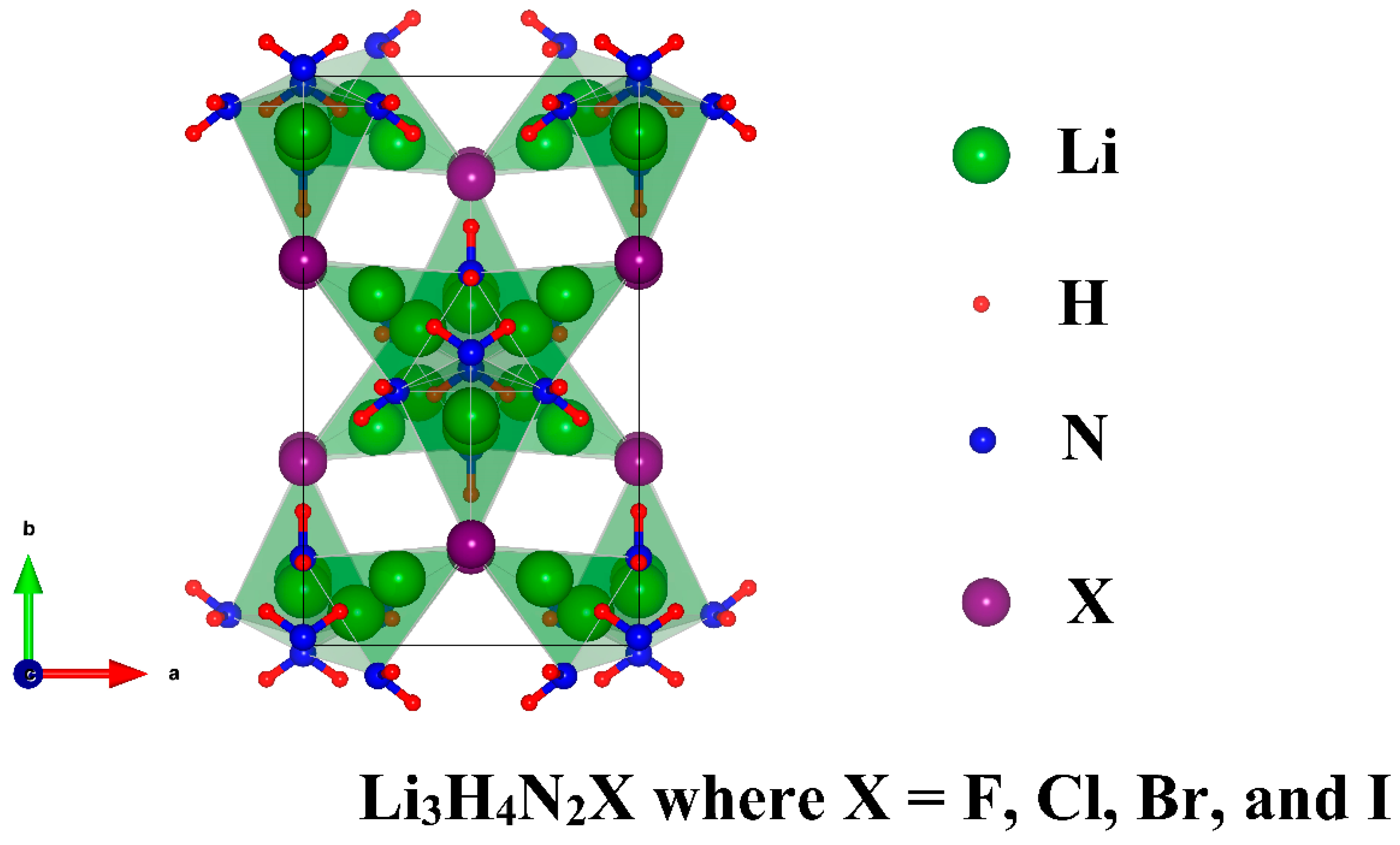
The hydrogen-rich mixed-anionic (Li3H4N2X where X = F, Cl, Br, and I) halides crystallize in an orthorhombic geometry (point group = Cmc21) [27]. After the optimization of their unit cells, the determined lattice parameters are as provided in Table 1. As the lattice parameters are entirely dependent upon the atomic radii of the substituted halide elements (F, Cl, Br, and I), the most compact lattice parameters are shown by the Li3H4N2F halide, due to the presence of the F−1 having the smallest ionic radius compared to the other halide elements. All the obtained lattice parameters are in the order of Li3H4N2F < Li3H4N2Cl < Li3H4N2Br < Li3H4N2I, which is consistent with the atomic radii, as F < Cl < Br < I. For each of these structures there exist two Wyckoff sites, i.e., 4a and 8b, which are each occupied by 14 equivalent atoms, out of which there are two lithium atoms present at 4a, and also two lithium atoms are present at 8b, with coordinates of (0 0.12 0.17), (0 0.09 0.37), and (0.34 0.44 0.13), (0.22 0.38 0.29), respectively. Hydrogen is also present at both Wyckoff sites, as there are two equivalent H-atoms at 4a, and four equivalent H-atoms at 8b, with coordinates of (0 0.77 0.22) and (0 0.85 0.32) at 4a, and (0.17 0.60 0.23), (0.24 0.55 0.34), (0.39 0.55 0.98), and (0.72 0.55 0.26) at 8b, respectively. The two distinct nitrogen atoms are present only at the 4a site, with coordinates of (0 0.85 0.23) and (0 0.01 0.01), respectively. The remaining two atoms are of the halide (X) substituent, and are located at the 4a site, with coordinates of (0 0.67 0.59) and (0 0.68 0.96), respectively. All taken together, they form a unit cell of orthorhombic geometry (Figure 1).
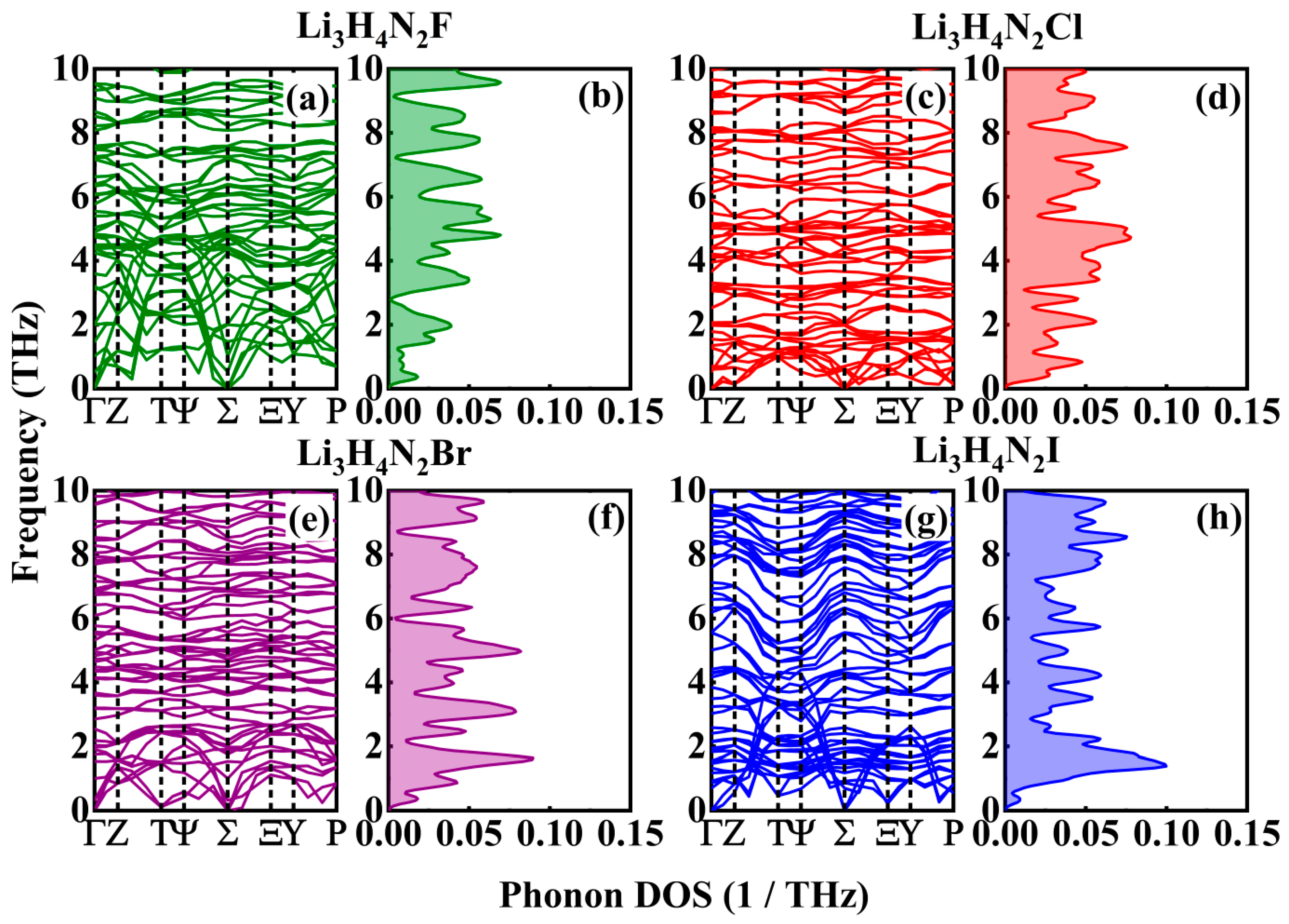
The stability of the Li3H4N2X (X = F, Cl, Br, and I) halides is predicted by analyzing the phonon dispersion curves and corresponding phonon density of states (DOS); the results are presented in Figure 2. Such stability is directly analyzed by gaining knowledge of the real (positive) and imaginary (negative) phonon modes appearing throughout the Brillouin zone; the existence of imaginary modes symbolizes the instability [28] of the compounds. For all these hydrogen-rich halides, the phonon dispersion curves indicate dynamical stability, and there is an absence of imaginary curves, confirming that these materials are applicable in the context of different applications and suitable for practical synthesis.
For CASTEP, thermodynamic properties are measured under harmonic approximation, in which atomic vibrations are considered as minor displacements around their mean equilibrium positions. These outcomes correspond to a 0 K temperature as well as 0 GPa external pressure, as they can directly be obtained from the ground-state electronic structures. The obtained phonon curves are divided into acoustic and optical modes, in which the acoustic modes lie close to the Γ-point, indicating stable long-wavelength lattice vibrations, whereas the optical modes are diverse over wider frequency ranges due to the presence of a larger mass contrast between the Li and H atoms and the heavier halide atoms. For a crystalline system containing N atoms (which is 10 in this study), the total number of phonon vibrational modes will be 3N. Following this, in this study, the total phonon vibrational modes are 30, out of which three correspond to acoustic modes and the remaining 27 correspond to optical branches. Such multiple optical branches have been observed at high frequencies for Li3H4N2X (where X = F, Cl, Br, and I) systems. Also, it is clearly depicted by the phonon density of states that some higher modes slightly shift towards lower frequencies with the substitution of heavier halogens (Br, and I), indicating the tendency of halogens towards increased rigidity.
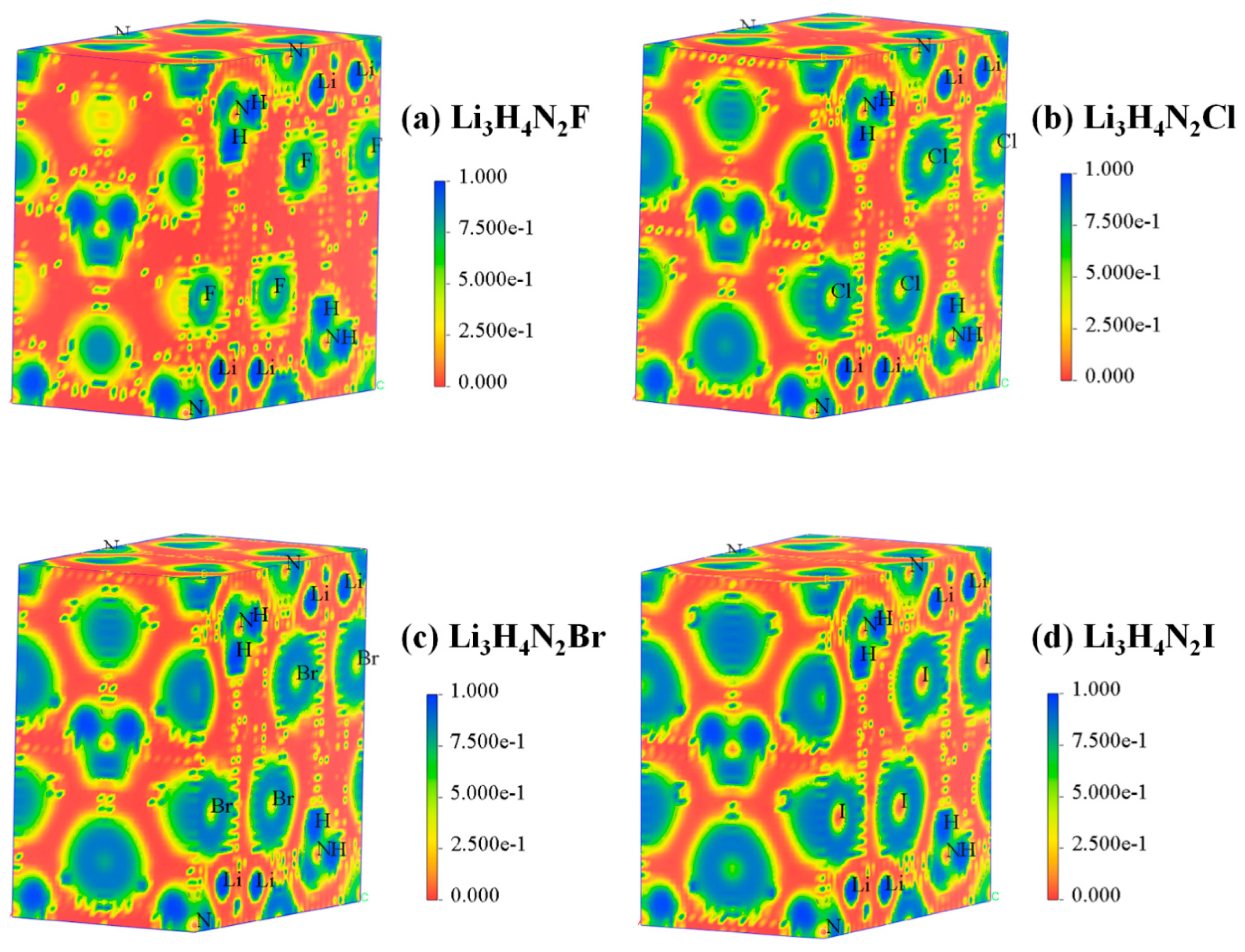
In order to understand the charge transfer behaviors and bonding natures of these Li3H4N2X (X = Cl, Br, F, and I) halides, Mulliken population analysis/charge analysis and Hirshfeld charge analysis [29] were performed (Table 2). For these halides, the Li-atom consistently shows a positive nature, as predicted by Mulliken charges (0.37–0.756) and Hirshfeld charges (0.06–0.20), confirming its electropositive nature and its role as an electron donor. The lowest Li1+ electronic charge transfer can be seen in Li3H4N2I, due to the lower electronegative nature of I1− as compared to other halides, and also due to its higher halide-ionic nature, which can attract less electron density towards itself. In comparisons with the others, the population in the s- and p-orbitals of Li1+ is higher for Li3H4N2I as compared to others, which is obvious, as its atomic radius is larger than those of the others. This behavior is further highlighted by the electronic localization plot, Figure 3d, where the localization value for Li1+ lies between (0.5 to 0.75) and is distributed over a larger region of space, confirming the larger population and less charge transfer by the Li-atom in Li3H4N2I. Compared to this, the Li3H4N2Br and Li3H4N2Cl halides have demonstrated lower Li1+ charge transfer, with Li3H4N2Br showing a value of around 0.08, which is relatively moderate in electronegative character among the halide series. For the Li3H4N2Cl halide, the high electronegativity of halogen (Cl) is observed, in which it attracts a higher amount of charge from neighboring Li1+ towards itself, and this behavior varies in the case of Li3H4N2F, which shows the highest value of charge transfer from Li1+ towards the surrounding halogen (F1−), due to its higher electronegativity among the series. This behavior is further elaborated by ELF plots (Figure 3a,b,d) for the Li3H4N2F, Li3H4N2Cl, and Li3H4N2Br halides, which show that the densities around Li3H4N2F are comparatively less than those of the others, due to its lower ionic radius, with a moderate localization value indicating a covalent bond. The Li3H4N2Cl, and Li3H4N2Br halides have shown nearly the same value of localization, which indicates their mixed bonding characteristics. This clear decreasing trend in the effective positive charge on Li1+ is observed when moving from F1− to I1− (Mulliken charge ≈ 0.75 → 0.37; Hirshfeld charge ≈ 0.20 → 0.06), which arises due to the decreasing electronegativity of the halogen series in the same order. As a result, it weakens the Li–X ionic interactions, as indicated by less charge being transferred from Li1+ to the surrounding anions in heavier halide systems. Li1+ shows a dominant s-orbital population with smaller p-orbital contributions for all compounds (s ≈ 2.10 → 2.05; p ≈ 0.56 → 0.18), and shows a slight decrement when moving towards the I1−-based system, due to reduced p-state involvement (Total ≈ 2.63 → 2.24), confirming the weak interaction between the Li and the heavier halides.
As to the nitrogen atoms in the compounds, they consistently show similar charge distributions because of their stronger influence on neighboring hydrogen atoms, and less interaction with the substituted halogen series. This lessened interaction is also due to the reason that both the halogen series atoms and nitrogen atoms have negative charges, as both attract electron densities (halogens with lithium and hydrogen with nitrogen), as is clear from Figure 1. Nitrogen atoms consistently carry the largest negative charges among all species for all compounds (Mulliken charge ≈ −1.13 to −1.02; Hirshfeld charge ≈ −0.33 to −0.35). These negative charge values are nearly similar for all compounds, confirming the electronegative nature of nitrogen atoms and also indicating that nitrogen is primarily an electron acceptor in the lattice and it plays a dominant role in charge localization. This behavior is further confirmed by the ELF plots for N-atoms, where the value of localization lies around 0.7, which indicates higher localization. Nitrogen displays small variations among the s- and p-orbital populations across all the compounds (s ≈ 1.70 → 1.68, p ≈ 4.44 → 4.34), which confirms nitrogen as the main electron-acceptor and bonding center.
Hydrogen atoms exhibit small positive Mulliken charges in all compounds, indicating partial electron donation towards the more electronegative N3− atoms. Although the charge on H1+ remains positive throughout the series, its magnitude slightly decreases when moving from Li3H4N2F to Li3H4N2I (Mulliken charge ≈ 0.27 → 0.16; Hirshfeld charge ≈ 0.10 → 0.06). This behavior reflects the gradual weakening of H-related polarization effects, as the halogen size increases and the local bonding environment becomes less ionic. While the increase in halogen atomic size across the series contributes to changes in the atomic bonding environment through reduced orbital overlap and enhanced bond length effects, despite this contribution, the electronegativity differences between the constituent atomic species also play crucial and complementary roles. As a result, the bonding character is determined by both atomic size and the relative electronegativity effects of the interacting species; this provides a more accurate and physically complete explanation of the observed trends in bonding nature.
The relatively low Hirshfeld charges on H1+ further suggest that hydrogen participates mainly in weakly polar covalent interactions rather than in fully ionic bonding. H1+ mainly contributes only due to the presence of the s-orbital within all compounds, showing a s-orbital population around (s ≈ 0.87 → 0.73) with only minor variations from F1− to I1− substitution. This also indicates that the local bonding environment of H1+ is weakly affected by the halogen substitution.
A pronounced trend is observed for the halogen atoms, as fluorine exhibits the most negative Mulliken and Hirshfeld charges, reflecting its highest electronegativity and strongest electron-withdrawing capability (Mulliken charge ≈ −0.66; Hirshfeld charge ≈ −0.43). As X changes from F1− to Cl1−, Br1−, and I1−, the magnitude of the negative charge on the halogen decreases steadily (Mulliken charge ≈ −0.66 → −0.53 → −0.21 → −0.05; Hirshfeld charge ≈ −0.43 → −0.20 → −0.11 → +0.02). Halogens (F1−, Cl1−, Br1−, I1−), also show a strong p-orbital population, which systematically decreases from F1− to I1− (p ≈ 5.68 → 5.34), with fluorine exhibiting the highest p- orbital population (≈5.69), while iodine shows the lowest (≈5.34). This reduction reflects increasing atomic size and reduced electronegativity. As a result, electron localization weakens along the halogen series. These charge population and ELF plot analyses reveal that Li3H4N2F is the most ionic compound, while Li3H4N2I exhibits the weakest charge localization among the series. This systematic evolution in charge distribution confirms that halogen substitution provides an effective route to tune the bonding nature and electronic polarization in Li3H4N2X compounds. Not only this, but such a hydrogen-rich environment with direct linkage to the central atom can be proven beneficial for hydrogen storage mechanisms, with simpler attachment to surrounding species within these hydrogen-rich halide materials.

3.2. Electronic Properties

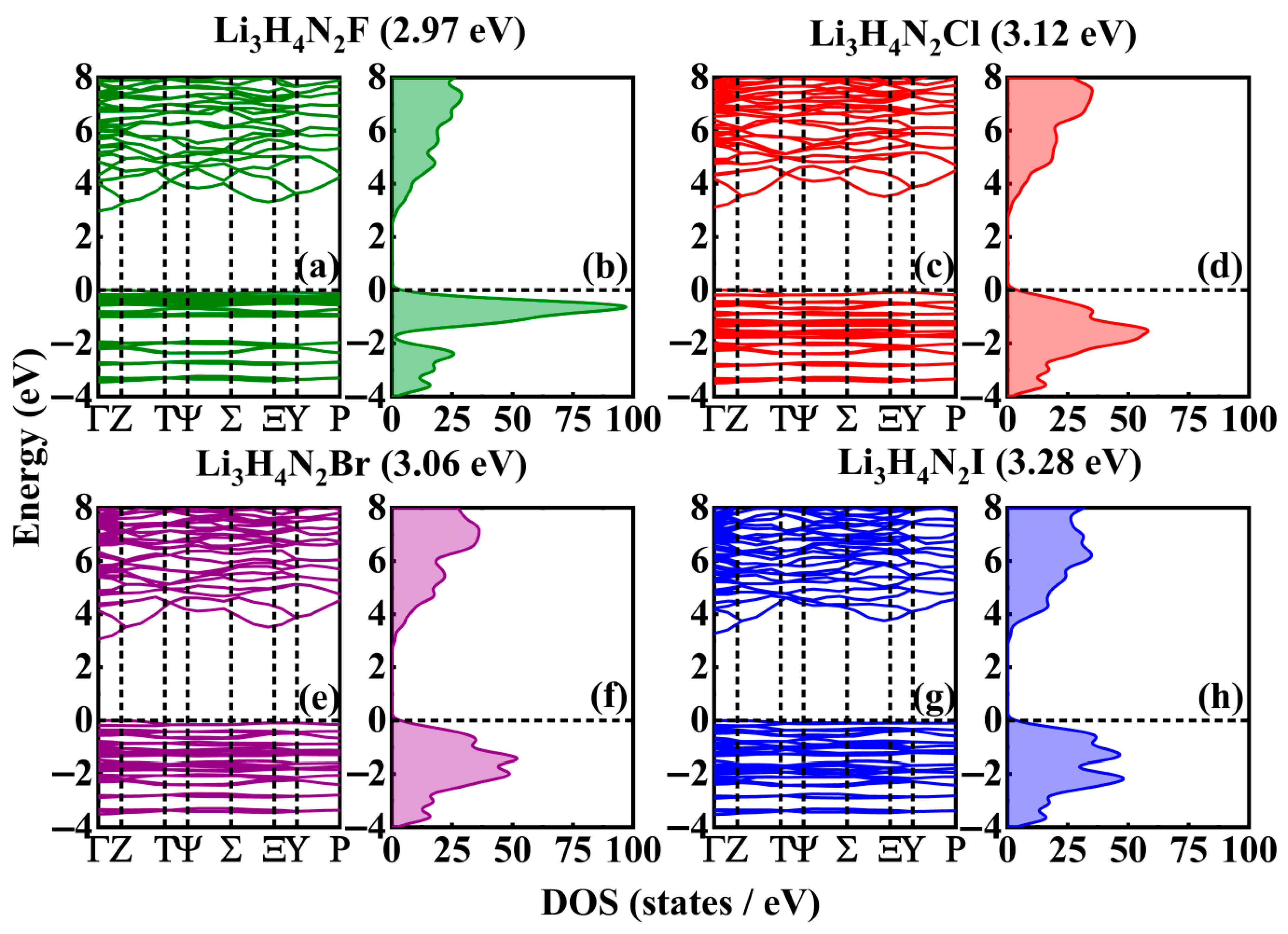
The electronic behavior of any material is used to identify its potential for different applications; therefore, for this purpose, the band structure and density of states (DOS) analyses of Li3H4N2X (X = F, Cl, Br, and I) halides are presented in Figure 4a–h. These properties reveal that these halides are classified as direct band gap semiconductors (with the band gap located at Γ-point) with values of 2.97 eV for Li3H4N2F, 3.12 eV for Li3H4N2Cl, 3.06 eV for Li3H4N2Br, and 3.28 eV for Li3H4N2I; these values are measured by the GGA-PBE approach. These band gap values for the halides indicate their suitability for optoelectronic and radiation energy conversion applications. These obtained band gap values do not vary monotonically with halogen substitution; this reflects the significant influence of the other anionic species (N3−). The presence of (N3−) in these halides not only confirms the narrow band gap range of about 2.9 eV to 3.3 eV, but also highlights its influence on the optical properties as well. Furthermore, the DOS analyses also confirm the semiconducting behaviors of these halides; there exists a zero-DOS region, which is called the Fermi level (0 eV). Such consistency between the band structure and DOS of the halides validates the reliability of the electronic structure calculations, while also predicting their suitability for optoelectronic and UV–Vis radiation energy conversion applications.
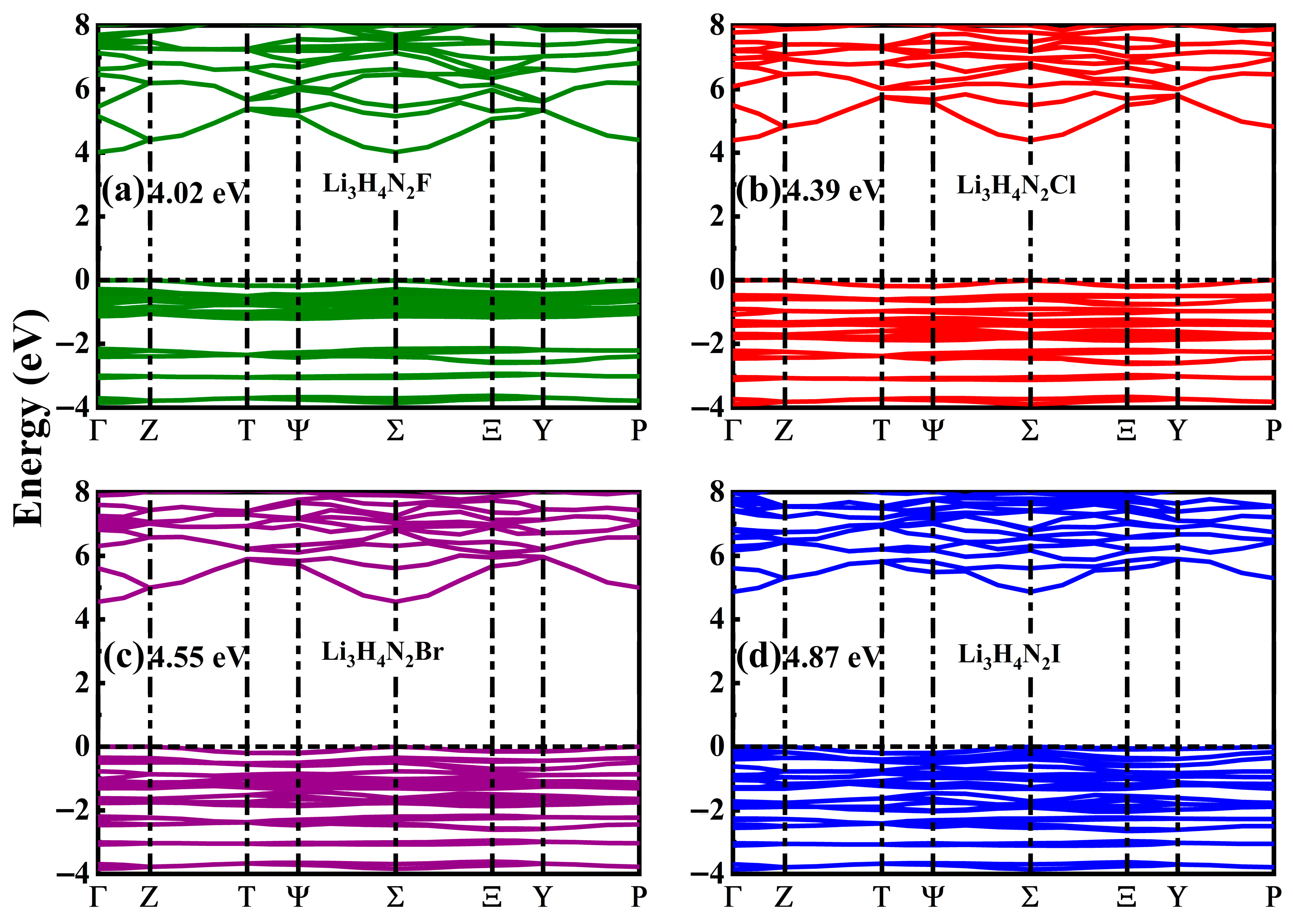
As it is a well-established fact that choosing the GGA-PBE method often results in an underestimation of the band gap values, in order to overcome this, in this study, a hybrid HSE06 functional is also employed for the calculations of band structures of halides (Figure 5a–d). The band gap values, measured by this approach, are 4.02, 4.39, 4.55 and 4.87 eV respectively, and are increasing monotonically with the increase in the atomic size of substituted species. The obtained band gap values further confirm that these materials are suitable for UV–Vis light conversion devices.
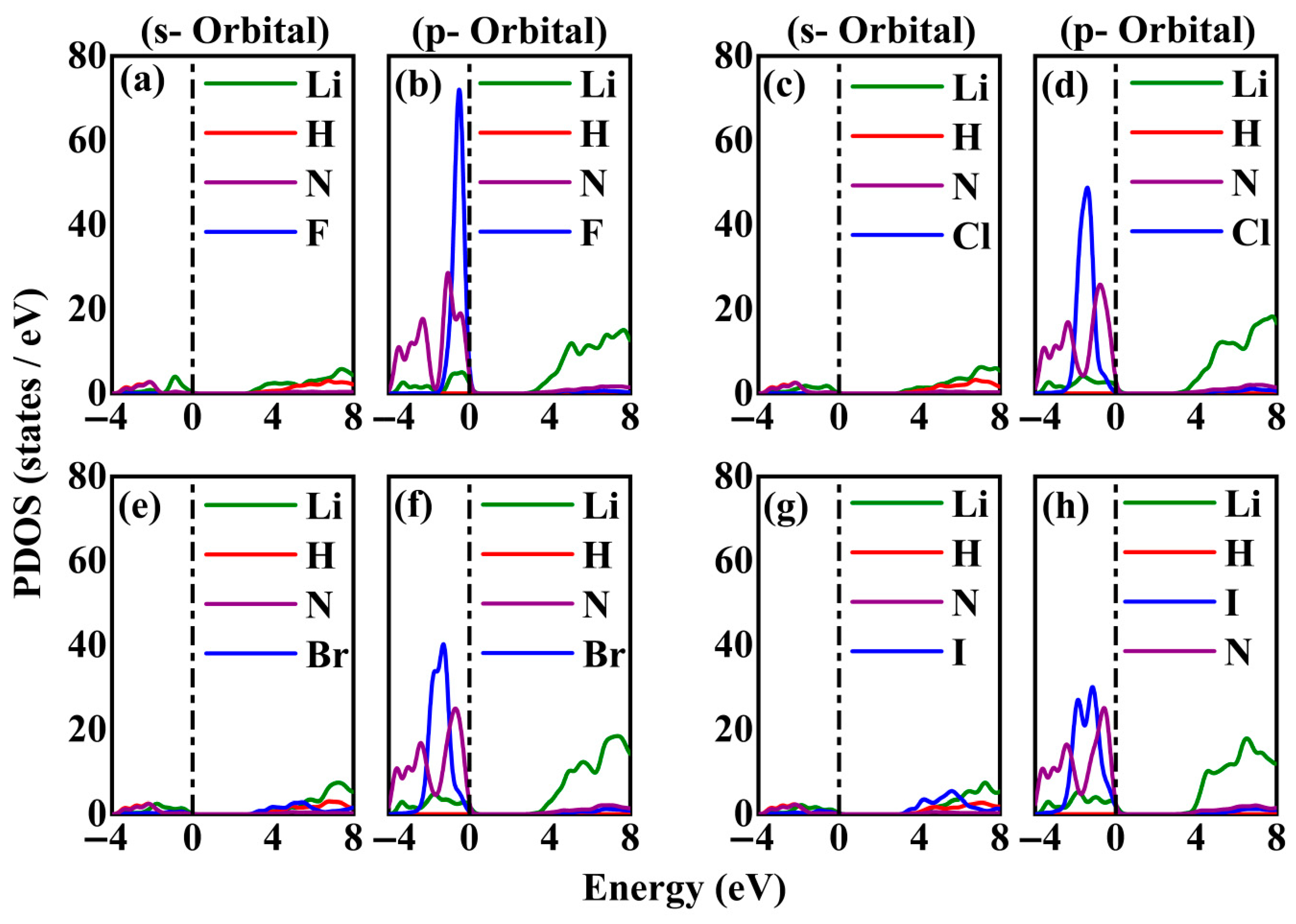
The partial density of states (PDOS) plots for these compounds provide the information about the specific orbital contributions for construction of the electronic structures (Figure 6), with the Fermi level (0 eV) separating the valance band (VB) (−4 eV to 0 eV) from the conduction band (CB) (0 eV to 8 eV). For all these halides, there exist only s- and p-orbital contributions for the formation of electronic structures, as this outcome is consistent with previously discussed population analysis, which shows no population for d and f orbitals. Figure 6a,b shows the s and p orbitals of Li3H4N2F, where VB is preponderantly made up of p-orbital contributions by substituent atoms. Specifically, there exist stronger contributions of both electronegative species (F-2p5 and N-2p3) relative to the electropositive specie (Li-2p1). In VB, the Li-2p1 contribution is less, compared to its contribution in CB.
The contribution of the s-orbital towards the electronic structure (for VB and CB) is significantly less relative to all constituents (Li-1s2, H-1s1, and N-2s2). As they are semiconducting compounds, there exists a band gap between VB and CB. PDOS plots of Li3H4N2Cl are presented in Figure 6c,d for the s and p orbitals, respectively. It is observed with respect to the compound that VB is primarily composed of anionic species’ (Cl-3p5 and N-2p3) contributions. For CB, there exist the contributions by the Li-2p1 and Li-2p1 orbitals. Herein, s-orbital contribution is minimal by all constituents (Li-1s2, H-1s1, and N-2s2), because s-orbitals hold a smaller population, as compared to other orbitals. PDOS plots for Li3H4N2Br for the s and p orbitals are presented in Figure 6e,f, respectively. It is observed that VB is preponderantly made up of anionic species’ contributions (Br-4p5 and N-2p3). In VB, the Li-2p1 contribution is low, as compared to its contribution in CB. Moreover, little contribution is observed by the Li-1s2 and H-1s1 orbitals in the CB. PDOS plots of Li3H4N2I with s- and p-orbital contributions are presented in Figure 6g,h. Here, anionic species (I-5p5 and N-2p3) have shown strong contributions in the VB. In VB, the contribution of I-5p5 in Li3H4N2I is much less than the contribution of F-2p5 in Li3H4N2F; this has occurred due to the lower electronegativity of I1−. In CB of Li3H4N2I, Li-2p1 is contributing preponderantly, while little contribution is observed from the Li-1s2, H-1s1, and I-5s2 orbitals. Altogether, PDOS analysis is important for understanding the construction of the band structures of materials.
This PDOS analysis further provides information regarding the non-monotonic band structure behaviors when moving from F1− to I1−. From the analysis it is evident that VBs of halides are mainly composed of N-p and X-p states, which highlights the clear evidence of hybridization among these states, while CBs are mainly dominated by Li-related states. Following the F → Cl → Br → I trend, p-orbital contributions by halogens change non-uniformly, showing more peaks when the heavier halogen ions are introduced into the main structure. For the F-based system, higher localization can be seen in the F-2p state, which lies deeper in energy, resulting in stronger N–F hybridization, and a relatively stabilized VBM. For Cl- and Br-based systems, p-states become more delocalized, and hybridization strength varies non-linearly due to differences in orbital overlap and energy alignment, which leads to a slight reduction in band gap for Li3H4N2Br compared to Li3H4N2Cl. Lastly, for Li3H4N2I, the hybridization becomes weaker and more dispersed due to the presence of relativistic effects associated with its heavier nature; hence, a non-monotonic band gap trend is observed rather than a linear variation.

3.3. Optical Properties

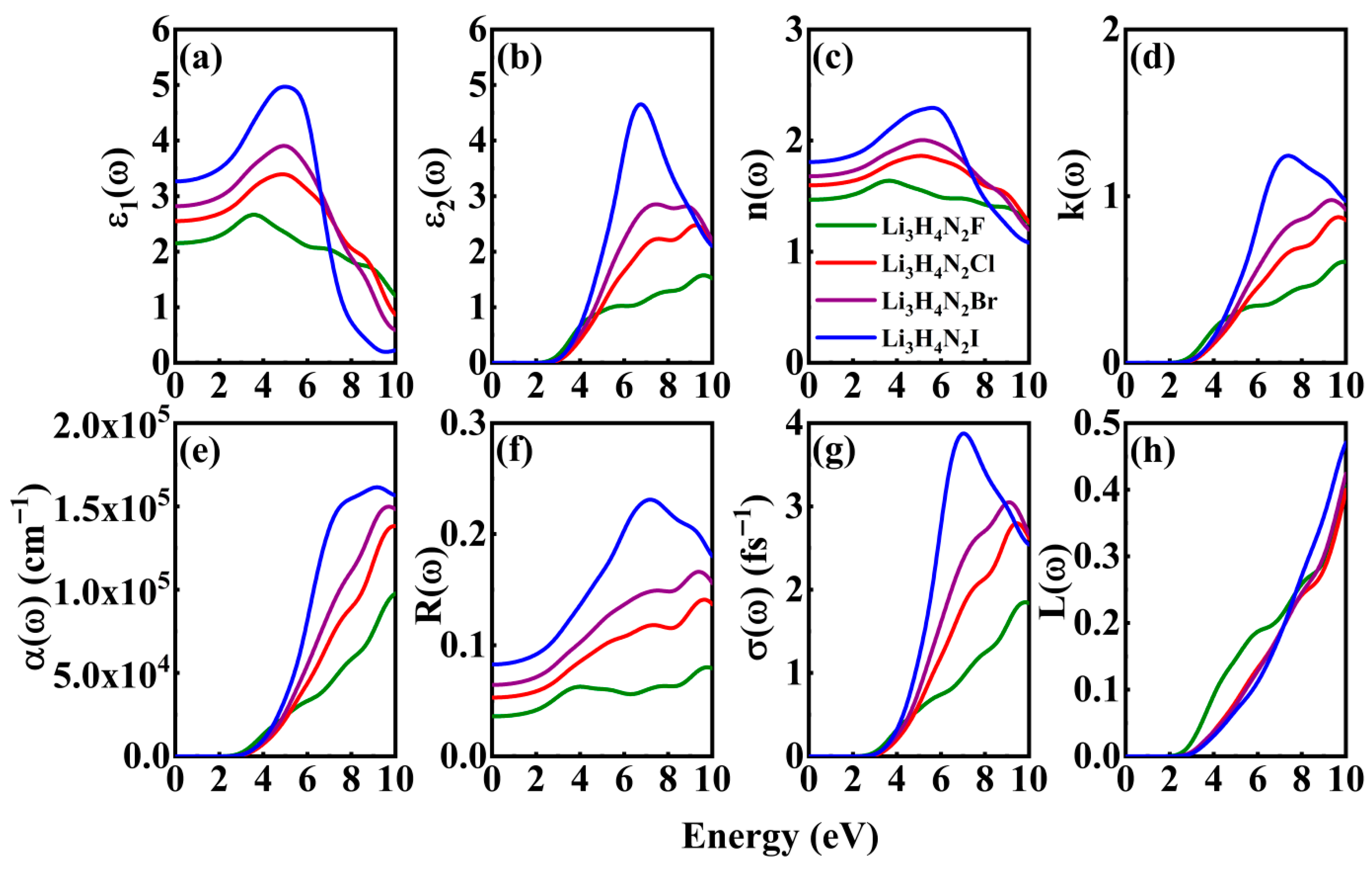
Studying and understanding the optical properties of the compounds that are the subjects of the present study are of foremost importance in view of their foreseen applications, i.e., solar energy conversion and photonic uses. So, the optical properties of hydrogen-rich lithium-based mixed-anionic Li3H4N2X (X = Cl, Br, F, and I) halide systems have been computed and are presented in Figure 6a–h. The dielectric function ε(ω) is the combination of real ε1(ω) and imaginary ε2(ω) parts (Equation (1)) [30]. The determined values of ε1(ω) and ε2(ω) are further utilized to define the material’s degree of polarization under the influence of incoming radiation. In the complex dielectric function, the imaginary dielectric function ε2(ω) is of great importance; this is computed by using Equation (2) [31], and is described by the absorption of incident photon of specific frequency ‘ω’, due to electronic transitions among the occupied VB states to un-occupied CB states. The momentum matrix element is defined as ⟨ψₖᵛ | p | ψₖᶜ⟩, and provides information about the probability of a transition, whereas the delta function δ(Eₖᶜ − Eₖᵛ − ℏω) ensures energy conservation. The ε2(ω) values are further used for the calculation of ε1(ω) by Equation (3) [32]. Afterwards, having determined ε1(ω) and ε2(ω), other optical properties can be computed by using Equations (4)–(9) [33,34,35].
ε ( ω ) = ε 1 ( ω ) + i ε 2 ( ω )
ε 2 ( ω ) = 4 π 2 e 2 m 2 ω 2 V v , c B Z ψ k v p ψ k c 2   δ ( E k c E k v ω )   d 3 k
ε 1 ( ω ) = 1 + 2 π   P 0 ω   ε 2 ( ω ) ω 2 ω 2   d ω
n ( ω ) = ε 1 ( ω ) 2 + ε 1 2 ( ω ) + ε 2 2 ( ω ) 2
k ( ω ) = ε 1 ( ω ) 2 + ε 1 2 ( ω ) + ε 2 2 ( ω ) 2
α ( ω ) = 2 ω   k ( ω ) = 2 ω   ε 1 2 ( ω ) + ε 2 2 ( ω )     ε 1 ( ω ) 2
L ( ω ) = ε 2 ( ω ) ε 1 2 ( ω ) + ε 2 2 ( ω )
R ( ω ) = ( 1 n ( ω ) ) 2 + k 2 ( ω ) ( 1 + n ( ω ) ) 2 + k 2 ( ω )
σ ( ω ) = i ω 4 π   ε ( ω )
Figure 7a presents the plots of ε1(ω) for halides, which demonstrate the presence of strong electrostatic transmission within the materials under the influence of radiation; as a result, they weaken the Coulomb interactions among the electron–hole pairs [36]. The static values of (2.15, 2.55, 2.82, 3.26) for halides are found to be less, as compared to their peak values (2.66, 3.39, 3.90, 4.97), respectively, confirming that these Li3H4N2X (X = F, Cl, Br and I) halides exhibit a semiconducting nature. These values also demonstrate that the ionic radii of substituted halogens increase the static ε1(0) as well as peak ε1(ω) values of the halides, hence showing the dependency of optical properties on halogen substitutions. For these materials, peak values appear in the visible-to-UV regions of incident radiation, which indicates that these materials not only have the tendency to convert visible light but are also capable of converting incoming UV radiation as well. Such values of ε1(ω) over a vast region of ω indicate a reduction in exciton binding energy, which allows electron–hole pairs to separate more easily into free charge carriers, making them good options for visible-to-UV radiation energy conversion applications, as this is the necessary requirement for photovoltaic cells and tandem cells.
The outcomes of ε2(ω) for Li3H4N2X (X = F, Cl, Br and I) halides are presented in Figure 7b. The threshold ε2(ω) values of these halides correspond to their band gap values, which confirms their semiconducting nature and shows consistency with the electronic band structure values and electronic DOS. For all these materials, ε2(ω) values rise from the visible region until they attain their peak values of 1.57, 2.50, 2.85, and 4.65, respectively, in the UV region. The same trend is observed here; the increases in the ionic radii of substituted halogen atoms have caused increases in the corresponding ε2(ω) peak values. Such high peak values provide evidence that the absorption, for these materials, can start from the visible region, and become maximum in the UV region, indicating that these materials have potential for radiation conversion applications.
Any material for which the refractive index n(ω) value lies between 1.5 and 3 is considered good for solar cell applications [37]. For Li3H4N2X (X = F, Cl, Br and I) halides (Figure 7c), the static n(0) values are 1.47, 1.60, 1.67, and 1.80, respectively. These materials have presented n(ω) values in the visible region, which confirms that these materials have potential for radiation conversion applications. Figure 7d presents the plots for the extinction coefficient k(ω), which emerge after adding the band gap values of the compounds. This signifies how strongly the materials can absorb incident photons. Moreover, the peak k(ω) values for the compounds are 0.60, 0.87, 0.97, and 1.25, respectively. The k(ω) values for compounds appear within the visible and UV regions of incident radiation, indicating higher optical activities within these regions, making these materials efficient in radiation conversion applications.
The absorption coefficient α(ω) determines the amount of absorption of incident radiation per cm (Figure 7e). For Li3H4N2X (X = F, Cl, Br and I) halides, α(ω) values emerge after adding the band gap values of the halides; below their band gap energies, the incident photons cannot be absorbed by the materials. So, the material’s band gap greatly influences the α(ω) of incident radiation. For hydrogen-rich Li3H4N2X (X = F, Cl, Br and I) halides, the α(ω) values are significantly high (104 to 105 cm−1), and are incident in the visible-to-UV regions, hence indicating that these materials can absorb the significant amounts of radiation required for electron–hole pairs generation. Not only this, at the edge of the visible region, all materials show nearly similar behaviors, and show nearly the same values, hence indicating that they have potential for energy conversion applications. For halides, R(ω) values remain significantly low (around 20%) (Figure 7f) throughout the considered energy region (0 to 10 eV). Low reflectivity indicates that the materials absorb most of the incident radiation, confirming their potential for efficient radiation absorption in photovoltaic applications.
Figure 7g presents the plots of optical conductivity σ(ω) for the compounds; σ(ω) describes the ability of materials to generate free charge carriers under the influence of incoming radiation; it directly depends upon the absorption coefficient [38]. For all of these materials, σ(ω) values start to rise from their band gap values and then attain their peak values of 1.84 fs−1, 2.79 fs−1, 3.12 fs−1, and 3.85 fs−1, respectively. As for σ(ω), the rising trend is similar to that of the previous characteristics, in that the compound with the larger ionic radius of the substituent halogen attains the maximum peak value. This trend observed in the outcomes of the optical properties indicates that the Li3H4N2I halide has higher potential for radiation conversion devices, as compared to other materials. The energy loss function L(ω) outcomes for the halides are presented in Figure 7h, where the peak values correspond to plasmonic excitations, which occur due to the loss of energy by fast-moving electrons inside the materials [39]. For these materials, peak L(ω) values appear in the UV region, while low losses appear in the visible region, indicating that these halides are strong candidates for visible radiation energy conversion devices.

3.4. Thermodynamic Properties

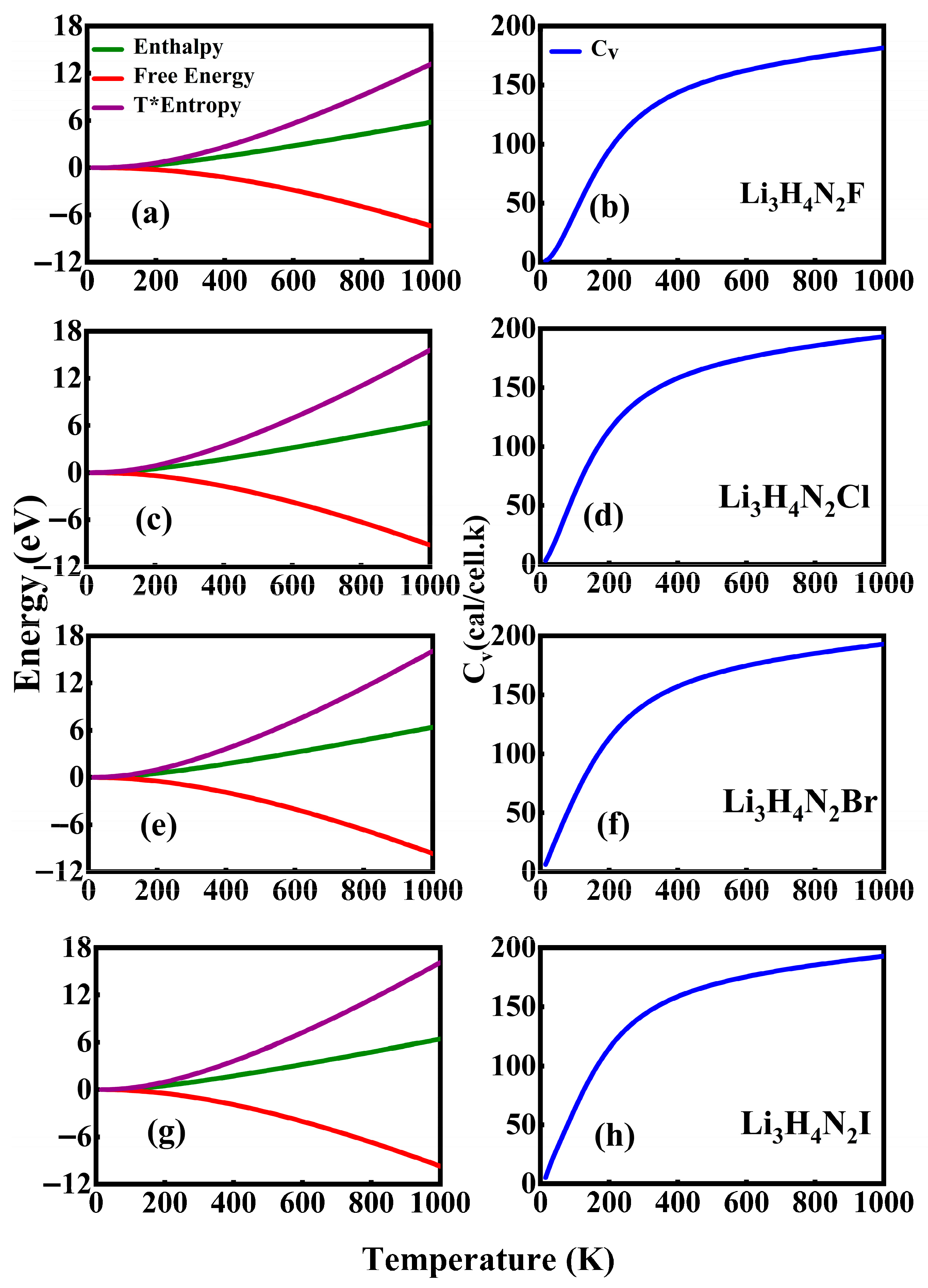
Thermodynamic properties, including enthalpy (H), temperature × entropy (T × S), Gibbs free energy (G), heat capacity at constant volume (Cv), and Debye temperature, are calculated in order to predict the stability, feasibility, and behavior of Li3H4N2X (X = F, Cl, Br and I) halides under different temperatures (0 K to 1000 K). These characteristics also provide insight into whether these materials are experimentally stable, and whether their synthesis is possible under a wide range of temperatures. Thermodynamic parameters have a direct link with the phonon density of states N(ω), which can also be determined from Equations (10)–(13) [40,41], where ℏ is the reduced Planck’s constant, Ezp is known as the zero-point energy, and kB is the Boltzmann’s constant. H(T) is enthalpy, TS(T) is temperature × entropy, F(T) free energy, and CV(T) is heat capacity at constant volume, all as a function of temperature; these are presented in the following:
H T = E t o t + E Z P + ω exp ω k B T 1 N ω d ω
T S T = k B T ω k B T exp ω k B T 1 N ω d ω N ω l n 1 e x p ω k B T d ω
F T = E t o t + E Z P + k B T N ω l n 1 e x p ω k B T d ω
C v T = k B ω k T 2 e x p ω k T e x p ω k T 1 2 N ω d ω
In Figure 8a,c,e,f, corresponding enthalpy (H), temperature × entropy (T × S), and free energy (F) outcomes are presented that demonstrate smoothly increasing or decreasing trends. Generally, these trends are more important for describing the specific natures of compounds, rather than their specific values. For all halides, the enthalpy (which reflects the internal energy and bonding strength of a material) increases monotonically with the rise in temperature. This behavior is normal for stable materials, as internal energy increases regularly with an increase in temperature. Hence, a smooth increment occurs in lattice vibrations, resulting in smoothly increasing curves of enthalpy. The enthalpy value at 1000 K is highest for the I-based system (~6.41 eV) and lower for the F-based system (~5.78 eV), indicating that enthalpy becomes more prominent with an increasing ionic radius of the substituted species. The temperature × entropy trends for materials also show smooth increments, but their values are double those of the enthalpy trends. These higher values are due to the reason that at higher temperatures, entropy becomes more prominent, and as this term varies directly with temperature, an increase in one term causes an increase in the other, and their product further increases those values. Therefore, higher TS(T) curves are achieved. The smoothly rising curves indicate that all these halides are stable, and are consistent with the trends of the enthalpy results. The lowest TS(T) value was observed for the F-based system, with a value of ~ 13.18 eV at 1000 K, while the highest value was observed for the I-based system, with a value of ~ 16.13 eV, confirming the influence of the heavier substituted halogen ion in these lithium-based hydrogen-rich halides. Free energy (F) is the most important stability criterion, as it explains whether a material is thermodynamically favorable; mostly, this trend decreases with an increase in temperature. The free energy values for halides are −7.04, −9.23, −9.70, and −9.72 eV, respectively, at a temperature of 1000 K, highlighting the consistency with previous outcomes. This decreasing trend is due to the reason that free energy has a direct link with enthalpy (Equation (14)) [42]. These decreasing curves show that these materials are structurally stable, as this is a normal behavior for stable materials.
F = H − TS
CV is a characteristic fundamental for understanding the thermal behavior, lattice vibrations at elevated temperatures, and radiation conversion capacity of materials. In Figure 8b,d,f,g, the plots of heat capacity at constant volume for Li3H4N2X (X = F, Cl, Br and I) halides are presented, respectively. These outcomes also confirm that these hydrogen-rich materials are stable, due to the presence of smooth and monotonically increasing curves, which indicate that the lattice vibrations increase gradually without any abrupt structural changes. At low temperature values, CV trends for all compounds rise sharply, reflecting the dominance of low-energy phonon modes, while at higher temperature values these CV trends approach saturation points, close to the Dulong–Petit limit (200 cal/cell·K) [43], showing that all vibrational modes are fully excited. These trends confirm that these hydrogen-rich halides are thermally stable over wide temperature ranges and can act as favorable materials for different applications.
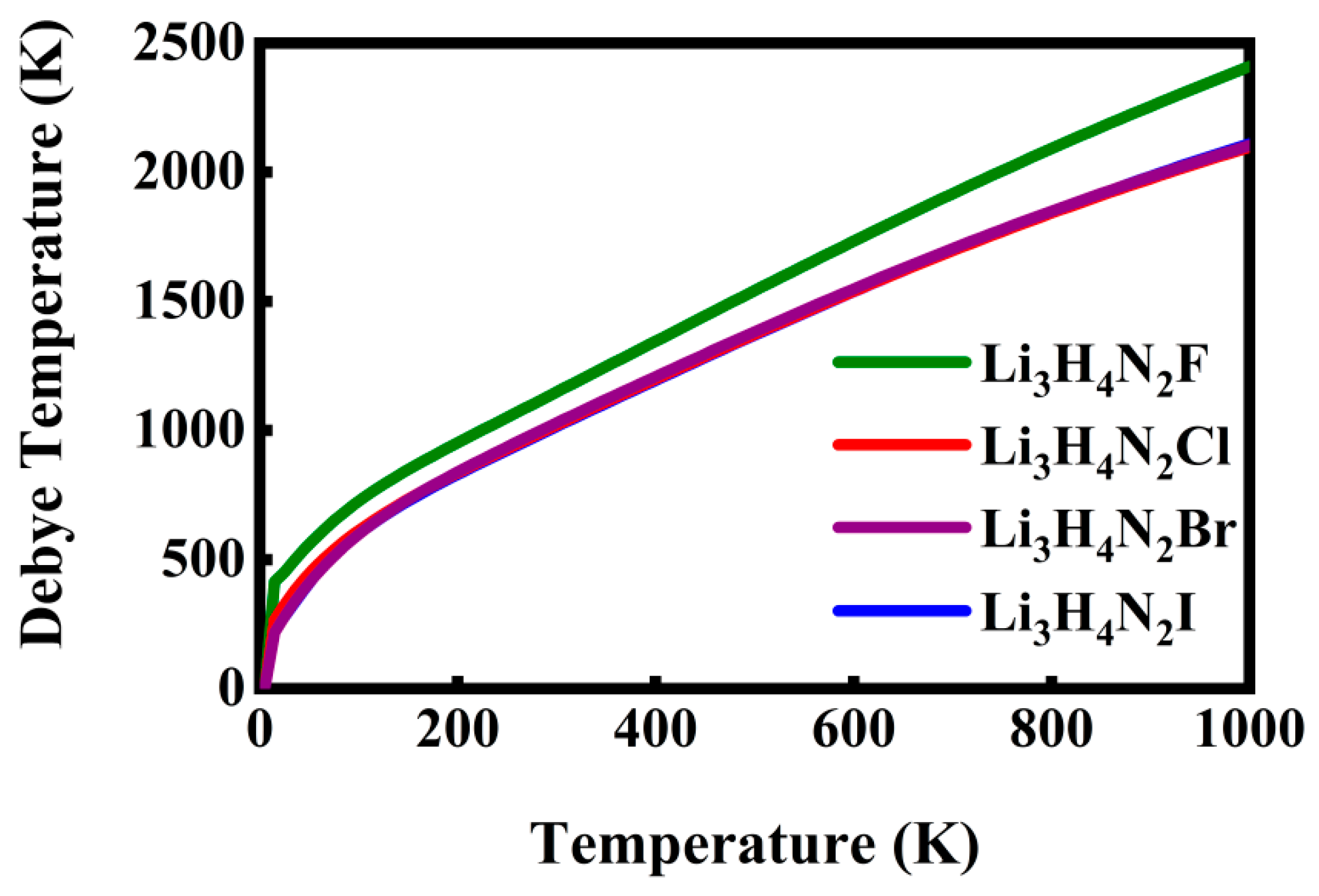
The outcomes for the Debye temperature for all halides are presented in Figure 9 over a temperature range of 0 K to 1000 K. Debye temperature gives the information related to the stiffness and vibrational behavior of the materials. A relatively high value for Debye temperature indicates a rigid lattice with strong atomic bonds. In Figure 9 it is clear that the Li3H4N2F halide is more rigid, as compared to other halides, showing a high Debye temperature value of ~2409 K at 1000 K. This can be attributed to the high electronegativity of F1− compared to other halogens. This analysis also reveals that these materials show a nearly smooth increase with rising temperature, indicating their structural stability along with their rigidity, which make them applicable in multifunctional applications.

3.5. Mechanical Properties

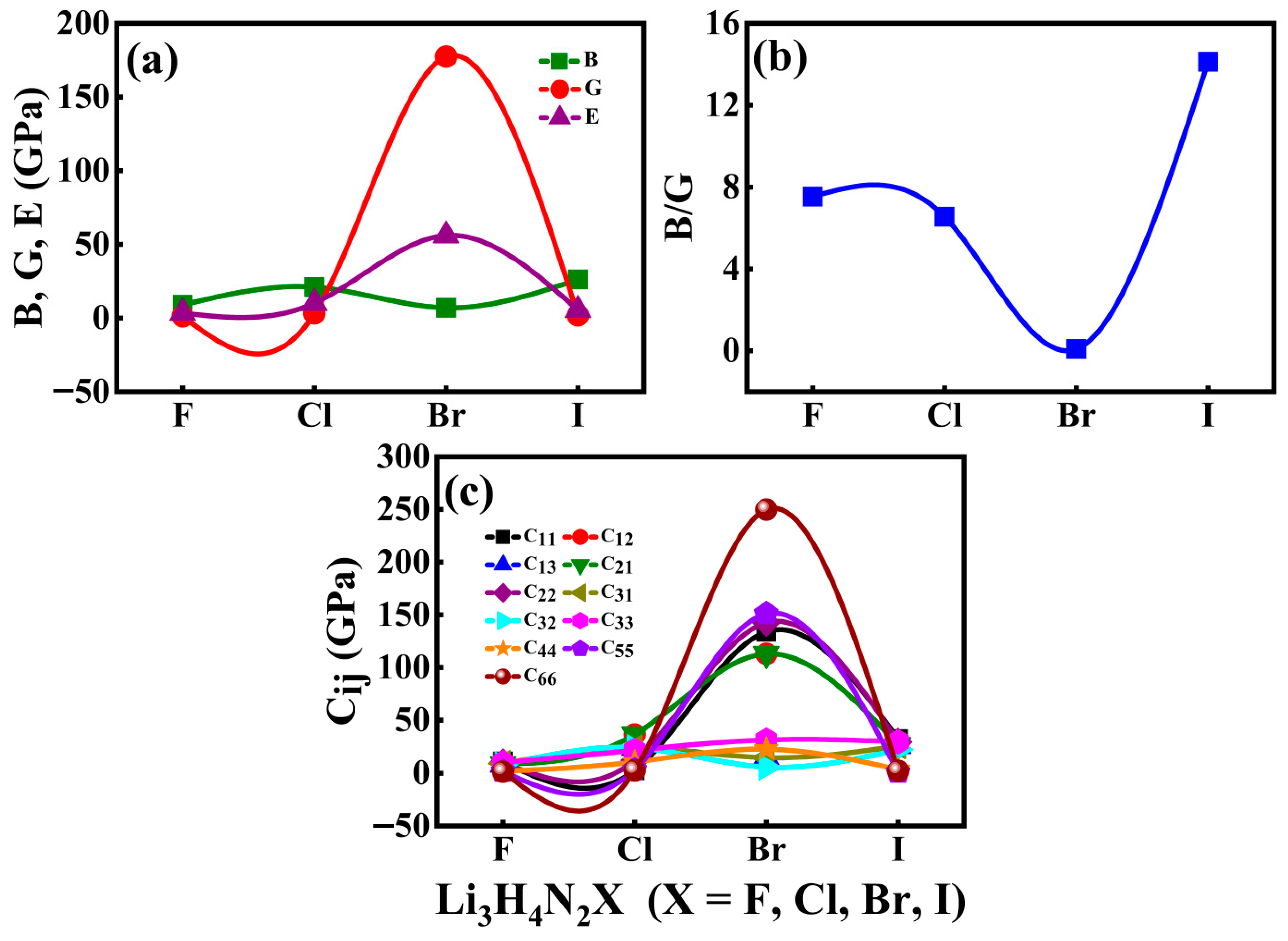
As all Li3H4N2X (X = F, Cl, Br and I) halides contain orthorhombic geometries, there are a total of nine [44] independent elastic constants for them, used in order to determine whether they are mechanically stable. The values of these independent elastic constants (C11, C22, C33, C12, C13, C23, C44, C55, and C66) are provided in Table 3, and are also presented in Figure 10 for comparison. These elastic constants must satisfy the Born–Hung stability criterion (Equations (15)–(19)) [45] to confirm the stability of compounds. These obtained elastic constants satisfy the stability criterion; therefore, these materials are mechanically stable.
C11 > 0, C22 > 0, C33 > 0, C44 > 0, C55 > 0, C66 > 0
C11 + C22 − 2C12 > 0
C11 + C33 − 2C13 > 0
C22 + C33 − 2C23 > 0
C11 + C22 + C33 + 2C12 + 2C13 + 2C23 > 0
Furthermore, in order to estimate structural robustness and the ductile/brittle nature, these elastic constants are used to estimate other mechanical parameters, including elastic modulus and Pugh’s ratio (Equations (20)–(23)) [45]. Among all these materials, a higher value of shear modulus of elasticity (G) is reported for Li3H4N2Br halide, which is due to the fact that Br offers an optimal balance between bond strength and lattice compactness as compared to other halogens in the compounds. In this case, the halide is exhibiting low bulk modulus, which indicates that it can be compressed relatively easily under applied hydrostatic stress, while the high shear modulus reflects strong resistance to shape deformation due to directional and rigid interatomic bonding within specific crystallographic directions. This behavior mainly originates from the existence of anisotropic bond distribution and non-uniform structural rigidity in the crystal framework.
The obtained values for elastic modulus (bulk modulus, shear modulus and Young’s modulus), along with Pugh’s ratio, are presented in Figure 10. The critical value for Pugh’s ratio is 1.75 [45]; this value distinguishes between the ductile and brittle natures of the materials, since values lower than this critical value indicate brittle behavior and the values higher than this critical value confirm their ductility. For Li3H4N2X (X = F, Cl, Br and I) halides, Li3H4N2Br exhibits a brittle nature, showing less resistance to transformation, as compared to other materials (Li3H4N2X, where X = F, Cl, I), which show ductile behavior, and are characterized as being more suitable for applications. From these outcomes, it is clear that these hydrogen-rich halides can be used for multifunctional applications like hydrogen storage, flexible optoelectronics and photovoltaic solar radiation conversion devices.
B H = 1 2 B v + B R
G H = 1 2 G v + G R
E = 9 B H G H 3 B H + G H

3.6. Hydrogen Gravimetric Ratio

As Li3H4N2X (X = F, Cl, Br, and I) halides contain a high content of hydrogen atoms, they can be used as solid-state hydrogen storage devices. The GHSCs of these hydrogen-rich alkali-metal mixed-anionic Li3H4N2X, (X = F, Cl, Br, and I) halides have been calculated by using Equation (23) [46].
wt %   of   H 2 = M a s s   o f   H y d r g e n T o t a l   M o l a r   M a s s   o f   c o m p o u n d   × 100
The GHSCs for Li3H4N2X halides are 2.5 wt% for Li3H4N2I, 3.5 wt% for Li3H4N2Br, 5.0 wt% for Li3H4N2Cl, and 6.0 wt% for Li3H4N2F. The highest value is reported for Li3H4N2F halide (up to 6.0 wt%), while the halides with heavier substituted halogen ions show lower GHSCs, which is due to the fact that the storage potential entirely depends on atomic mass. So, for Li3H4NlF, the theoretically estimated GHSC value has exceeded the US DOE target (5.5 wt%). Hence, Li3H4NlF halide possesses the possibility to be utilized for lightweight hydrogen storage vehicles. Other materials have also presented suitable GHSCs, and are applicable in the context of applications like submarine propulsion [47], hydrogen-powered forklifts, etc. Moreover, the obtained gravimetric ratios of the studied compounds are compared (Table 4) with some other related materials [48,49,50,51,52,53,54,55], based on values in the literature, in order to validate these outcomes.

4. Conclusions

In this study, plane-wave ultrasoft pseudopotential (PW-USPP) is used to investigate, simultaneously, the multifunctional properties of hydrogen-rich lithium-based mixed-anionic Li3H4N2X, (X = F, Cl, Br, and I) halides. The physical optical properties’ dependence on UV–Vis radiation is analyzed. These halides contain orthorhombic stable structures and present indirect band gap values of 2.97 eV, 3.12 eV, 3.06 eV and 3.28 eV, respectively. These halides can reflect up to 25% of radiation, with a maximum absorption coefficient of 75%, revealing their strong potential for radiation-to-energy conversion applications. The compounds have presented a high radiation absorption, around 105 cm−1, and a dielectric function from 2 to 4, making them applicable for a wide range of radiation-to-energy conversion applications. The thermodynamic properties presented smooth behaviors for these halides, hence predicting their structural practicability with mixed mechanical behavior (as, brittle for Li3H4N2Br and ductile for the remaining halides), which makes them efficient in flexible solar radiation conversion devices. The highest GHSC value was measured for the Li3H4N2F halide, proving its applicability for lightweight heavy-duty hydrogen storage vehicles. Moreover, the GHSCs for the other halides are also suitable for submarine propulsion, hydrogen-powered forklifts, etc. Overall, these comprehensive analyses of the diverse range of properties in this study can serve as a gateway for such complex compounds as they are used in multifunctional applications.

Author Contributions

Conceptualization, N.J.; Methodology, A.Y., M.U.K., G.A.A. and M.A.Q.; Software, S.A., M.U.K. and A.H.; Validation, S.A., G.A.A. and H.M.Z.; Formal analysis, G.A.A.; Investigation, M.A.Q. and A.H.; Resources, A.Y., M.U.K., G.A.A. and H.M.Z.; Data curation, S.A., M.A.Q. and H.M.Z.; Writing—original draft, A.Y. and N.J.; Visualization, M.U.K., M.A.Q. and A.H.; Supervision, N.J. and H.M.Z.; Project administration, N.J. and A.H. All authors have read and agreed to the published version of the manuscript.

Funding

Authors extend their appreciation to the Deanship of Scientific Research at Northern Border University, Arar, KSA, for funding this research work through project number NBU-FFR-2026-1563-03. Princess Nourah bint Abdulrahman University Researchers Supporting Project number (PNURSP2026R820), Princess Nourah bint Abdulrahman University, Riyadh, Saudi Arabia.

Data Availability Statement

The original contributions presented in this study are included in the article. Further inquiries can be directed to the corresponding authors.

Acknowledgments

The authors extend their appreciation to the Deanship of Scientific Research at Northern Border University, Arar, KSA, for funding this research work through project number NBU-FFR-2026-1563-03. Princess Nourah bint Abdulrahman University Researchers Supporting Project number (PNURSP2026R820), Princess Nourah bint Abdulrahman University, Riyadh, Saudi Arabia.

Conflicts of Interest

The authors declare no conflicts of interest.

References

  1. Spiridonov, V.; Ćurić, M.; Novkovski, N. Solar Radiation: Driving Atmospheric Change. In Atmospheric Perspectives: Unveiling Earth’s Environmental Challenges; Springer Nature: Cham, Switzerland, 2025; pp. 137–170. [Google Scholar]
  2. Rathore, N.; Panwar, N.L.; Yettou, F.; Gama, A. A comprehensive review of different types of solar photovoltaic cells and their applications. Int. J. Ambient Energy 2021, 42, 1200–1217. [Google Scholar] [CrossRef]
  3. Jabeen, N.; Hussain, A.; Khan, I.A.; Smerat, A.; Ghodhbani, R. Revealing the structure-property relationship in CaXH5 (X = Ga, In, Tl) hydrides: DFT study for high-performance energy storage applications. Inorganica Chim. Acta 2026, 598, 123185. [Google Scholar] [CrossRef]
  4. Kalibek, M.R.; Ospanova, A.D.; Suleimenova, B.; Soltan, R.; Orazbek, T.; Makhmet, A.M.; Rafikova, K.S.; Nuraje, N. Solid-state hydrogen storage materials. Discov. Nano 2024, 19, 195. [Google Scholar] [CrossRef]
  5. Jabeen, N.; Zafar, S.; Hussain, A.; Haider, I.; Thabet, H.K.; Smerat, A. Theoretical Multifunctional Investigations for CsXNb2O7 (X = La, Lu, In and Ga) for Next-generation Optical Devices under Visible and UV radiations. Radiat. Phys. Chem. 2026, 242, 113596. [Google Scholar] [CrossRef]
  6. Boateng, E.; Chen, A. Recent advances in nanomaterial-based solid-state hydrogen storage. Mater. Today Adv. 2020, 6, 100022. [Google Scholar] [CrossRef]
  7. Dematteis, E.M.; Amdisen, M.B.; Autrey, T.; Barale, J.; Bowden, M.E.; Buckley, C.E.; Cho, Y.W.; Deledda, S.; Dornheim, M.; de Jongh, P.; et al. Hydrogen storage in complex hydrides: Past activities and new trends. Prog. Energy 2022, 4, 032009. [Google Scholar] [CrossRef]
  8. Irfan, M.; Ibrahim, F.A.; Hamdy, M.S.; Issa, S.A.; Zakaly, H.M. Insights into energy and environmental sustainability through photoactive Ca-based hydrides CaH6X10 (X = Se, Te) for hydrogen storage: Perspectives and promises. J. Energy Storage 2025, 132, 117822. [Google Scholar] [CrossRef]
  9. Al, S.; Cavdar, N.; Arikan, N. Computational evaluation of comprehensive properties of MgX3H8 (X = Sc, Ti and Zr) as effective solid state hydrogen storage materials. J. Energy Storage 2024, 80, 110402. [Google Scholar] [CrossRef]
  10. Khan, I.A.; Yaqoob, A.; Jabeen, N.; Hussain, A.; Smerat, A.; Thabet, H.K. First-Principles Insight of CaXH5 (X = Al, Ga, B) Hydrides for Possible Potentials in UV-harvesting and Hydrogen Storage Applications. J. Phys. Chem. Solids 2025, 211, 113421. [Google Scholar] [CrossRef]
  11. Shahzad, M.K.; Hussain, S.; Khan, M.N.; Aslam, M.J.; Mohammed, R.M.; Tirth, V.; Alqahtani, H.; Algahtani, A.; Al-Mughanam, T.; Azeem, W. Computational insights of double perovskite Na2CaCdH6 hydride alloy for hydrogen storage applications: A DFT investigation. Sci. Rep. 2024, 14, 25102. [Google Scholar] [CrossRef]
  12. Hayat, M.S.; Khalil, R.A. Ab-initio exploration of unique and substantial computational properties of double hydrides Cs2CaTlH6, Cs2SrTlH6, & Cs2BaTlH6, for the computational manufacturing of hydrogen fuel cell: A DFT study. J. Mol. Graph. Model. 2023, 125, 108600. [Google Scholar]
  13. Boudrifa, O.; Bouhemadou, A.; Uğur, Ş.; Khenata, R.; Bin-Omran, S.; Al-Douri, Y. Structural, electronic, optical and elastic properties of the complex K2PtCl6-structure hydrides A RuH6 (A = Mg, Ca, Sr and Ba): First-principles study. Philos. Mag. 2016, 96, 2328–2361. [Google Scholar] [CrossRef]
  14. Kurkcu, C.; Al, S.; Yamcicier, C. Investigation of mechanical properties of KCaH3 and KSrH3 orthorhombic perovskite hydrides under high pressure for hydrogen storage applications. Eur. Phys. J. B 2022, 95, 180. [Google Scholar] [CrossRef]
  15. Arharbi, A.; El Bahri, A.; Ez-Zahraouy, H. Unveiling hydrogen storage potential: In-depth DFT and AIMD study of strain engineering and diffusion mechanisms in Li2MgH4. J. Energy Storage 2025, 138, 118730. [Google Scholar] [CrossRef]
  16. Yamçıçıer, Ç.; Kürkçü, C.; Yamçıçıer, S. Investigation on structural, mechanical, electronic, vibrational, thermophysical, optic, and hydrogen storage properties of K2CaH4 under pressures from 0 to 15 GPa. Chem. Phys. 2025, 603, 113039. [Google Scholar] [CrossRef]
  17. Kürkçü, C.; Yamçıçıer, Ç. Theoretical investigations on structural, electronic, mechanical, optical, dynamic, thermal, and hydrogen storage properties of MGaH4 (M = Li, Na, K, Rb, Cs). Indian J. Phys. 2025, 100, 1505–1528. [Google Scholar] [CrossRef]
  18. Yamçıçıer, S.; Yamçıçıer, Ç. Structural validation, electronic bonding, and realistic hydrogen storage properties of novel Li2BH5 and Li2AlH5 complex hydrides. Int. J. Hydrogen Energy 2026, 205, 153358. [Google Scholar] [CrossRef]
  19. Berri, S.; Yamçıçıer, Ç. First-principles analysis to evaluate the crystal stability, hydrogen storage, mechanical behavior and electronic structure of Mg7XH16 (X = Ti, Mn, Fe). Int. J. Hydrogen Energy 2025, 177, 151559. [Google Scholar] [CrossRef]
  20. Shi, B.X.; Nicholls, R.J.; Yates, J.R. Accurate and efficient structure factors in ultrasoft pseudopotential and projector augmented wave DFT. Phys. Rev. B 2023, 108, 115112. [Google Scholar] [CrossRef]
  21. Wang, X. The Electronic Structure and Catalytic Performance of New Environmentally Friendly Catalyst Materials Based on CASTEP Algorithm. In International Conference on Cognitive Based Information Processing and Applications; Springer Nature: Singapore, 2024; pp. 47–59. [Google Scholar]
  22. Egidio, L.N.; Hansson, A.; Wahlberg, B. Learning the step-size policy for the limited-memory Broyden-Fletcher-Goldfarb-Shanno algorithm. In 2021 International Joint Conference on Neural Networks (IJCNN); IEEE: Piscataway, NJ, USA, 2021; pp. 1–8. [Google Scholar]
  23. Perdew, J.P. SCAN meta-GGA, strong correlation, symmetry breaking, self-interaction correction, and semi-classical limit in density functional theory: Hidden connections and beneficial synergies? APL. Comput. Phys. 2025, 1, 010903. [Google Scholar] [CrossRef]
  24. Oliveira, M.J.; Medeiros, P.V.; Sousa, J.R.; Nogueira, F.; Gueorguiev, G.K. Optical and magnetic excitations of metal-encapsulating Si cages: A systematic study by time-dependent density functional theory. J. Phys. Chem. C 2014, 118, 11377–11384. [Google Scholar] [CrossRef]
  25. Weck, P.F.; Jové-Colón, C.F.; Kim, E. Thermodynamic properties of metaschoepite predicted from density functional perturbation theory. Chem. Phys. Lett. 2020, 757, 137878. [Google Scholar] [CrossRef]
  26. Shankar, U.; Gogoi, R.; Sethi, S.K.; Verma, A. Introduction to materials studio software for the atomistic-scale simulations. In Forcefields for Atomistic-Scale Simulations: Materials and Applications; Springer Nature: Singapore, 2022; pp. 299–313. [Google Scholar]
  27. Orimo, S.I.; Nakamori, Y.; Eliseo, J.R.; Züttel, A.; Jensen, C.M. Complex hydrides for hydrogen storage. Chem. Rev. 2007, 107, 4111–4132. [Google Scholar] [CrossRef]
  28. Li, Z.; Carbotte, J.P. Phonon structure in dispersion curves and density of states of massive Dirac fermions. Phys. Rev. B—Condens. Matter Mater. Phys. 2013, 88, 045417. [Google Scholar] [CrossRef]
  29. Saha, S.; Roy, R.K.; Ayers, P.W. Are the Hirshfeld and Mulliken population analysis schemes consistent with chemical intuition? Int. J. Quantum Chem. 2009, 109, 1790–1806. [Google Scholar] [CrossRef]
  30. Boudiaf, K.; Bouhemadou, A.; Boudrifa, O.; Haddadi, K.; Saoud, F.S.; Khenata, R.; Al-Douri, Y.; Bin-Omran, S.; Ghebouli, M.A. Structural, elastic, electronic and optical properties of LaOAgS-type silver fluoride chalcogenides: First-principles study. J. Electron. Mater. 2017, 46, 4539–4556. [Google Scholar] [CrossRef]
  31. Xue, S.; Ning, J.; Zhang, B.; Wu, Q.; Zhang, F.; Zhang, W. The Electronic Structure and Optical Properties of CdGeAs2 Crystal: A DFT and HSE06 Study. Coatings 2022, 12, 1778. [Google Scholar] [CrossRef]
  32. Hussain, A.; Jabeen, N.; Yaqoob, A.; Smerat, A.; Qaiser, M.A.; Aldawsari, N.A. Hydrogen Storage Capacity and Optoelectronic Response of Mechanically and Thermally Stable Lithium-Based Tetrahydrates (LiXH4, X = B, Al, Mn), a DFT Approach. Crystals 2025, 15, 990. [Google Scholar] [CrossRef]
  33. Dabhi, V.A.; Patel, H.S.; Vora, A.M. First principles investigation of the structural, anisotropic mechanical, optical, thermodynamic, and thermoelectric properties of MF2 (M = Ca, Sr, Ba, Pb) fluorite minerals using density functional theory. Next Mater. 2025, 8, 100893. [Google Scholar] [CrossRef]
  34. Hussain, A.; Jabeen, N.; Yaqoob, A.; Smerat, A. Theoretical Investigation of the Static Behavior of Various Compositions of Layered Quaternary Oxysulfide Compounds, A New Possibility for Next-Generation Supercapacitive Energy Devices. Nano 2025, 21, 2550122. [Google Scholar] [CrossRef]
  35. Ferjani, H.; Ben Smida, Y.; Onwudiwe, D.C.; Elamin, N.Y.; Ezzine, S.; Almotlaq, N.S. An Experimental and Theoretical Study of the Optical Properties of (C2H7N4O)2BiCl5 for an Optoelectronic Application. Inorganics 2022, 10, 48. [Google Scholar] [CrossRef]
  36. Ding, Z.J.; Li, C.; Da, B.; Liu, J. Charging effect induced by electron beam irradiation: A review. Sci. Technol. Adv. Mater. 2021, 22, 932–971. [Google Scholar] [CrossRef]
  37. Hou, G.; García, I.; Rey-Stolle, I. High-low refractive index stacks for broadband antireflection coatings for multijunction solar cells. Sol. Energy 2021, 217, 29–39. [Google Scholar] [CrossRef]
  38. Rao, P.; Mook, A.; Knolle, J. Tunable band topology and optical conductivity in altermagnets. Phys. Rev. B 2024, 110, 024425. [Google Scholar] [CrossRef]
  39. Yang, F.; Huidobro, P.A.; Pendry, J.B. Electron Energy Loss Spectroscopy of Singular Plasmonic Metasurfaces. Laser Photonics Rev. 2020, 14, 2000055. [Google Scholar] [CrossRef]
  40. Abdel-Wahab, H.; Bozzelli, J. Gaussian M-062x/6-31+ g (d, p) Calculation of Standard Enthalpy, Entropy and Heat Capacity of Some Fluorinated Alcohol’s and Its Radicals at Different Temperatures. Am. J. Phys. Chem. 2020, 9, 101–111. [Google Scholar] [CrossRef]
  41. Hussain, A.; Yaqoob, A.; Jabeen, N.; Smerat, A.; Thabet, H.K. Exploring the hydrogen energy storage potential of alkali metal tetrahydrometallates through first-principles analysis. Mod. Phys. Lett. B 2026, 40, 2550281. [Google Scholar] [CrossRef]
  42. Du, M.; Yu, F.; Gong, S.; Liu, F. Design of electrocatalysts with high performance based on thermodynamics and kinetics: Progress and prospects. Adv. Funct. Mater. 2025, 35, 2413826. [Google Scholar] [CrossRef]
  43. Rosa, P.; Souza, A. Dulong-Petit’s law and Boltzmann’s theoretical proof from the Kinetic Theory of Gases. J. Phys. Conf. Ser. 2024, 2727, 012009. [Google Scholar] [CrossRef]
  44. Mouhat, F.; Coudert, F.X. Necessary and sufficient elastic stability conditions in various crystal systems. Phys. Rev. B 2014, 90, 224104. [Google Scholar] [CrossRef]
  45. Ding, Y. Theoretical study on stability, mechanical properties and thermodynamic parameters of the orthorhombic-A2N2O (A = C, Si and Ge). Phys. B Condens. Matter 2012, 407, 2190–2200. [Google Scholar] [CrossRef]
  46. Yaqoob, A.; Hussain, A.; Jabeen, N.; Fallatah, A.M. DFT Study of Physical Properties for A2H3X (A = Sr, Ba; X = Cl, Br) Compounds: Their Possible Applications for Hydrogen Storage and Optoelectronic Devices. ChemistrySelect 2025, 10, e03422. [Google Scholar] [CrossRef]
  47. Gunathilake, C.; Soliman, I.; Panthi, D.; Tandler, P.; Fatani, O.; Ghulamullah, N.A.; Marasinghe, D.; Farhath, M.; Madhujith, T.; Conrad, K.; et al. A comprehensive review on hydrogen production, storage, and applications. Chem. Soc. Rev. 2024, 53, 10900–10969. [Google Scholar] [CrossRef] [PubMed]
  48. Yamçıçıer, Ç. Exploring the structural, elastic, phonon, optoelectronics, and thermoelectric properties of tetragonal complex metal hydride X2MgH4 (X = K, Rb, and Cs) compounds for hydrogen storage applications. Int. J. Hydrogen Energy 2023, 48, 39930–39943. [Google Scholar] [CrossRef]
  49. Yamçıçıer, Ç.; Al, S.; Kürkçü, C. Theoretical investigations on structural, electronic, elastic, thermal, optic and hydrogen storage properties of XAlH6 (X = La, Ce, Pr) aluminium hydrides. Phys. B Condens. Matter 2025, 716, 417713. [Google Scholar] [CrossRef]
  50. Yiğit, T.; Öztürk, H.; Yamçıçıer, Ç. X2AlH7 (X: Ca, Sr, Ba) hydrides as next-generation hydrogen storage materials: A comprehensive first principles study on structural, mechanical, optical, electronic and thermophysical properties. J. Energy Storage 2025, 129, 117400. [Google Scholar] [CrossRef]
  51. Yamçıçıer, Ç.; Yamçıçıer, S.; Kürkçü, C. AI-driven discovery of high-performance LiMHx (M = Sc, Ti; x = 3, 4, 5) hydrides: A first-principles investigation structural, mechanical, electronic, thermophysical, optical and hydrogen storage properties. Int. J. Hydrogen Energy 2025, 187, 152097. [Google Scholar] [CrossRef]
  52. Yamçıçıer, Ç.; Kürkçü, C. Ab initio study of the structural, mechanical, optoelectronic and thermo-physical properties of XGaH5 (X = Ba, Ca, and Mg) compounds for hydrogen storage applications. Int. J. Hydrogen Energy 2024, 81, 391–404. [Google Scholar] [CrossRef]
  53. Yamçıçıer, Ç.; Kürkçü, C. Investigation of structural, electronic, elastic, vibrational, thermodynamic, and optical properties of Mg2NiH4 and Mg2RuH4 compounds used in hydrogen storage. J. Energy Storage 2024, 84, 110883. [Google Scholar] [CrossRef]
  54. Al, S.; Yamçıçıer, Ç. Computational exploration of hexahydride materials (K2SiH6 and Rb2SiH6); structural, mechanical, thermodynamic, optic, electronic and dynamic properties. J. Energy Storage 2024, 91, 112033. [Google Scholar] [CrossRef]
  55. Yamçıçıer, Ç.; Kürkçü, C. Structural, elastic, optic, electronic, phonon, thermodynamic, and hydrogen storage properties of bialkali alanates M2LiAlH6 (M = Na, K). Int. J. Hydrogen Energy 2025, 135, 440–456. [Google Scholar] [CrossRef]
Figure 1. Structural illustration of hydrogen-rich lithium-based mixed-anionic halides Li3H4N2X (X = F, Cl, Br, and I).
Crystals 16 00344 g001
Figure 2. Phonon dispersion curves and their corresponding densities: (a,b) Li3H4N2F, (c,d) Li3H4N2Cl, (e,f) Li3H4N2Br, and (g,h) Li3H4N2I halides.
Crystals 16 00344 g002
Figure 3. Electron localization function (ELF) plots of (a) Li3H4N2F, (b) Li3H4N2Cl, (c) Li3H4N2Br, and (d) Li3H4N2I.
Crystals 16 00344 g003
Figure 4. Comparative analyses of band structures and corresponding density of states of (a,b) Li3H4N2F, (c,d) Li3H4N2Cl, (e,f) Li3H4N2Br, and (g,h) Li3H4N2I.
Crystals 16 00344 g004
Figure 5. HSE06-based band structures of (a) Li3H4N2F, (b) Li3H4N2Cl, (c) Li3H4N2Br, and (d) Li3H4N2I.
Crystals 16 00344 g005
Figure 6. (ah): The s- and p-orbital contributions of elements in the partial density of states (PDOS) plots of (a,b) Li3H4N2F, (c,d) Li3H4N2Cl, (e,f) Li3H4N2Br, and (g,h) Li3H4N2I.
Crystals 16 00344 g006
Figure 7. A comparative analysis of computed optical behaviors: (a) real dielectric function, ε1(ω); (b) imaginary dielectric function, ε2(ω); (c) refractive index, n(ω); (d) extinction coefficient, k(ω); (e) optical absorption coefficient, α(ω); (f) reflectivity, R(ω); (g) optical conductivity, σ(ω); and (h) energy loss function, L(ω) of hydrogen-rich lithium-based mixed-anionic halide Li3H4N2X (X = Cl, Br, F, and I) systems.
Crystals 16 00344 g007
Figure 8. Thermodynamic parameters, including enthalpy (green line), temperature × entropy (purple), free energy (red), and heat capacity (Cv) at constant volume; (a,b) Li3H4N2F, (c,d) Li3H4N2Cl, (e,f) Li3H4N2Br, and (g,h) Li3H4N2I.
Crystals 16 00344 g008
Figure 9. Comparative analysis of Debye temperature for Li3H4N2X (X = F, Cl, Br and I) halides.
Crystals 16 00344 g009
Figure 10. Comparisons of the mechanical properties of Li3H4N2X, (X = F, Cl, Br and I), as (a) shear modulus of elasticity (G), bulk modulus of elasticity (B), and Young’s modulus of elasticity (E), (b) Pugh’s ratio (B/G), and (c) elastic stiffness constants (Cij).
Crystals 16 00344 g010
Table 1. Optimized lattice parameters alongside volumes of hydrogen-rich lithium-based mixed-anionic Li3H4N2X (X = Cl, Br, F, and I) halides.
Compounda (Å)b (Å)c (Å)α = β = γ Volume Å3
Li3H4N2F5.849.539.1790°510.36
Li3H4N2Cl6.0710.239.7690°602.06
Li3H4N2Br6.5311.0910.5790°765.45
Li3H4N2I7.3412.4411.8690°1081.45
Table 2. Detailed comparison of atomic population for the Li3H4N2X (X = Cl, Br, F, and I) halides, along with Mulliken and Hirshfeld charge analyses.
SpeciesIon (s)spdfTotalMulliken Charge (e)Hirshfeld Charge (e)
Li3H4N2FH1, 4, 7, 10, 13, 16, 19, 220.7960000.7960.2040.1
H2, 5, 8, 11, 14, 17, 20, 230.7310000.7310.2690.09
H3, 6, 9, 12, 15, 18, 21, 240.8250000.8250.1750.08
H25, 27, 29, 310.8620000.8620.1380.07
H26, 28, 30, 320.7360000.7360.2640.09
Li1, 3, 5, 7, 9, 11, 13, 152.0620.366002.4280.5720.15
Li2, 4, 6, 8, 10, 12, 14, 162.0610.182002.2440.7560.2
Li17, 19, 21, 232.0790.19002.2690.7310.19
Li18, 20, 22, 242.0860.222002.3080.6920.17
N1–81.7034.427006.129−1.129−0.33
N9, 11, 13, 151.6794.437006.114−1.114−0.34
N10, 12, 14, 161.6954.377006.071−1.071−0.34
F1, 3, 5, 71.9785.685007.663−0.663−0.43
F2, 4, 6, 81.9795.663007.642−0.642−0.40
Li3H4N2ClH1, 4, 7, 10, 13, 16, 19, 220.80000.80.20.09
H2, 5, 8, 11, 14, 17, 20, 230.7360000.7360.2640.09
H3, 6, 9, 12, 15, 18, 21, 240.8290000.8290.1710.07
H25, 27, 29, 310.8640000.8640.1360.07
H26, 28, 30, 320.7420000.7420.2580.08
Li1, 3, 5, 7, 9, 11, 13, 152.0590.418002.4770.5230.1
Li2, 4, 6, 8, 10, 12, 14, 162.0520.258002.3090.6910.13
Li17, 19, 21, 232.0770.22002.2980.7020.15
Li18, 20, 22, 242.0860.26002.3470.6530.12
N1–81.74.415006.116−1.116−0.34
N9, 11, 13, 151.6774.437006.114−1.114−0.35
N10, 12, 14, 161.6954.377006.071−1.071−0.35
Cl1, 3, 5, 71.9535.579007.532−0.532−0.20
Cl2, 4, 6, 81.9545.543007.497−0.497−0.15
Li3H4N2BrH1, 4, 7, 10, 13, 16, 19, 220.8040000.8040.1960.09
H2, 5, 8, 11, 14, 17, 20, 230.7480000.7480.2520.08
H3, 6, 9, 12, 15, 18, 21, 240.8360000.8360.1640.07
H25, 27, 29, 310.8660000.8660.1340.07
H26, 28, 30, 320.7580000.7580.2420.08
Li1, 3, 5, 7, 9, 11, 13, 152.0620.507002.5690.4310.08
Li2, 4, 6, 8, 10, 12, 14, 162.0910.341002.4310.5690.1
Li17, 19, 21, 232.0950.265002.360.640.13
Li18, 20, 22, 242.0880.335002.4230.5770.11
N1–81.694.397006.087−1.087−0.34
N9, 11, 13, 151.6754.423006.098−1.098−0.35
N10, 12, 14, 161.6834.357006.041−1.041−0.35
Br1, 3, 5, 71.7355.475007.209−0.209−0.11
Br2, 4, 6, 81.8465.449007.296−0.296−0.06
Li3H4N2IH1, 4, 7, 10, 13, 16, 19, 220.8070000.8070.1930.08
H2, 5, 8, 11, 14, 17, 20, 230.7560000.7560.2440.08
H3, 6, 9, 12, 15, 18, 21, 240.8390000.8390.1610.06
H25, 27, 29, 310.8670000.8670.1330.06
H26, 28, 30, 320.7630000.7630.2370.07
Li1, 3, 5, 7, 9, 11, 13, 152.0660.564002.630.370.06
Li2, 4, 6, 8, 10, 12, 14, 162.10.423002.5230.4770.07
Li17, 19, 21, 232.1030.303002.4060.5940.11
Li18, 20, 22, 242.0920.391002.4830.5170.08
N1–81.6864.383006.069−1.069−0.34
N9, 11, 13, 151.6734.409006.082−1.082−0.35
N10, 12, 14, 161.684.344006.024−1.024−0.35
I1, 3, 5, 71.6685.38007.048−0.0480.02
I2, 4, 6, 81.7395.341007.08−0.0800.06
Table 3. Calculated values for elastic constants (Cij), bulk modulus (B), shear modulus (G), Young’s modulus (E), and Pugh’s ratio (B/G), for Li3H4N2X, (X = F, Cl, Br, and I) halides.
NameLi3H4N2FLi3H4N2ClLi3H4N2BrLi3H4N2I
C1111.032.71133.8231.95
C128.6236.45112.9426.41
C138.2014.7724.1125.71
C2210.0912.21142.5329.40
C237.935.9224.1322.42
C3310.1721.7131.2129.71
C441.8610.7922.843.72
C551.883.26151.110.87
C661.482.65249.782.20
B8.9420.996.9726.26
G1.193.20177.551.86
E3.4110.1256.105.45
B/G7.546.550.0414.13
Table 4. Comparison of gravimetric ratios of Li3H4N2X, (X = F, Cl, Br, and I) halides with some similar compounds found in the literature.
NameGravimetric Ratio (wt%)Reference
Li3H4N2F6.0This work
Li3H4N2Cl5.0This work
Li3H4N2Br3.5This work
Li3H4N2I2.5This work
K2MgH43.8[48]
Rb2MgH42.02[48]
Cs2MgH41.37[48]
LaAlH63.52[49]
CeAlH63.5[49]
PrAlH63.48[49]
Ca2AlH76.18[50]
Sr2AlH73.37[50]
Ba2AlH72.29[50]
LiScH35.51[51]
LiScH47.21[51]
LiScH58.85[51]
MgGaH55.1[52]
CaGaH54.4[52]
BaGaH52.38[52]
Mg2NiH43.62[53]
Mg2RuH42.62[53]
K2SiH65.2[54]
Rb2SiH62.86[54]
Na2LiAlH63.42[55]
K2LiAlH65.12[55]
Disclaimer/Publisher’s Note: The statements, opinions and data contained in all publications are solely those of the individual author(s) and contributor(s) and not of MDPI and/or the editor(s). MDPI and/or the editor(s) disclaim responsibility for any injury to people or property resulting from any ideas, methods, instructions or products referred to in the content.