1. Introduction
Lithium, often referred to as “white gold” during the global energy transition, plays a vital role in advancing new-energy vehicle development and the large-scale energy storage system, establishing itself as a critical element for these emerging high-tech industries [
1,
2]. Although China holds substantial lithium resources, a significant portion is locked in high-altitude salt-lake brine characterized by a high Mg/Li ratio and a complex matrix of impurities, a combination that renders the extraction process both technically challenging and economically costly. Currently, China’s domestic lithium supply chain relies heavily on conventional ore-processing routes, which are often energy-intensive and limited in throughput. In contrast, recovering lithium from spent lithium-ion batteries (LIBs) presents a compelling alternative. End-of-life LIBs contain lithium concentrations several times higher than those found in natural ores, effectively constituting a rich “urban mine.” Amidst the rapid growth of the electric vehicle (EV) market and stationary energy storage applications, lithium demand is surging at a rate that far exceeds the supply capacity of primary extraction [
3,
4]. Therefore, establishing a closed-loop and efficient recycling system for spent LIBs has become an economic imperative and is crucial for securing resources, mitigating environmental impact, and fostering the sustainable development of the battery industry [
5,
6,
7].
Based on their chemical composition, cathode materials for lithium-ion batteries can be broadly classified into several types, including LCO (LiCoO
2), LFP (LiFePO
4), LMO (LiMn
2O
4), NCA (LiNixCoyAl1-x-yO
2), and NCM (LiNixCoyMn1-x-yO
2) [
8,
9]. Correspondingly, recycling methods for spent LIBs primarily fall into three categories: pyrometallurgy, hydrometallurgy, and direct regeneration [
10,
11,
12]. The traditional pyrometallurgical process is robust and offers high throughput, but it suffers from poor lithium recovery as lithium tends to partition into the slag phase. Hydrometallurgy, in contrast, can achieve high leaching efficiencies. However, it often involves complex flowsheets and generates large volumes of wastewater and chemical reagents [
13,
14]. A significant drawback of these conventional approaches is that lithium recovery is often treated as an afterthought. Consequently, the lithium products obtained are frequently of low purity, and substantial lithium losses occur during the subsequent multi-step purification and precipitation processes. Direct regeneration is a promising alternative that can produce low-impurity, structurally intact cathode materials. However, its application is currently limited by poor feedstock flexibility and requires further development for large-scale industrial implementation [
15,
16]. A critical challenge, particularly for complex NCM cathodes, is the difficulty in achieving selective lithium extraction at the outset of the recycling process. The lack of such selectivity leads to the contamination of lithium in the subsequent recovery streams for nickel, cobalt, and manganese, resulting in lithium loss and representing a major technological bottleneck for high-value recycling [
17,
18].
Among these approaches, thermal treatment via phase transition has emerged as an innovative and effective strategy for lithium extraction [
19,
20,
21,
22]. Representative methods include salt-assisted roasting (e.g., sulfation and chlorination) and carbothermal reduction roasting [
23,
24,
25,
26]. Salt-assisted roasting enables the selective conversion of lithium into water-soluble salts such as Li
2SO
4 and LiCl, while transition metals are transformed into insoluble oxides [
27,
28]. However, this method generates hazardous gases including Cl
2 and SO
2, posing environmental concerns [
29,
30,
31]. In contrast, carbothermal reduction leverages the difference in metallicity between lithium and transition metals [
32]. This process employs carbon-based reducing agents—such as coal, coke, or biomass—to decompose the cathode structure at elevated temperatures, yielding leachable lithium compounds (e.g., Li
2CO
3 or Li
2O). Simultaneously, Ni, Co, and Mn are reduced to their metallic or lower-valence oxide states, which remain within the solid matrix [
33,
34,
35]. It is better at lithium than normal smelting and uses less energy. In existing studies, Yuan et al. [
36] used the inherent graphite anode from spent batteries as a reductant and employed an in situ carbothermal reduction (ICTR) roasting-water leaching process to selectively extract lithium from spent NCM cathode powder. The optimal roasting conditions were as follows: graphite addition of 10 wt.%, roasting temperature of 700 °C, and roasting time of 90 min, achieving a lithium leaching efficiency of 84.11%, while the leaching efficiencies of nickel, cobalt, and manganese were all below 0.001%. Lu et al. [
37] utilized Bidens pilosa as a carbothermal reductant and achieved selective lithium recovery under optimal conditions (temperature of 700 °C, Bidens pilosa addition of 20 wt.%, roasting time of 30 min), with a lithium leaching efficiency of 94.18%. Zhang et al. [
38] employed glucose as a carbothermal reductant and achieved a lithium leaching efficiency of 98.1% under optimal conditions (glucose/NCM mass ratio of 25%, roasting temperature of 750 °C, roasting time of 1 h). Based on the above comparisons, the optimal conditions determined in this work are a sucrose content of 15 wt.%, a roasting temperature of 650 °C, and a roasting time of 30 min, achieving a lithium leaching efficiency of 97.1%. Compared with the aforementioned studies, this work achieves a high lithium leaching efficiency while exhibiting lower energy consumption and a shorter roasting time, demonstrating superior overall performance. And notable among the biomass-derived reductants is sucrose as a greener option [
39,
40]. During pyrolysis, sucrose decomposes to produce reactive gases such as CO and H
2, which enhance reduction kinetics. Concurrently, its carbonization yields a porous, foam-like carbon matrix with excellent dispersion properties within the cathode powder. This nanostructured architecture maximizes solid–gas–solid contact area, mitigates particle aggregation, and promotes complete reduction. Consequently, the pyrolysis of sucrose and the reduction in cathode materials become synergistically coupled, reinforcing one another throughout the process [
36,
41,
42].
This study investigates the use of sucrose as a biomass-derived reducing agent for the carbothermal reduction in spent ternary cathode materials, aiming to achieve high-value recovery of valuable metals. Through a single-step thermal process integrating sucrose-assisted carbothermal reduction at elevated temperatures, lithium from spent cathodes is selectively converted into water-leachable Li2CO3, while the transition metals (Ni, Co, and Mn) are reduced to metallic Ni, Co, and MnO, respectively. Effects of carbothermal reduction temperature, sucrose ratio and calcining time on spent cathode powders were found out. Furthermore, the influence of water leaching conditions on lithium recovery efficiency was examined. A stepwise optimization of the integrated process enabled the identification of ideal operating variables. This approach offers a promising route for the efficient and sustainable recycling of spent ternary cathode batteries, characterized by its rapid processing, operational simplicity, and process stability.
3. Results and Discussion
3.1. Pyrolysis Thermodynamic Analysis
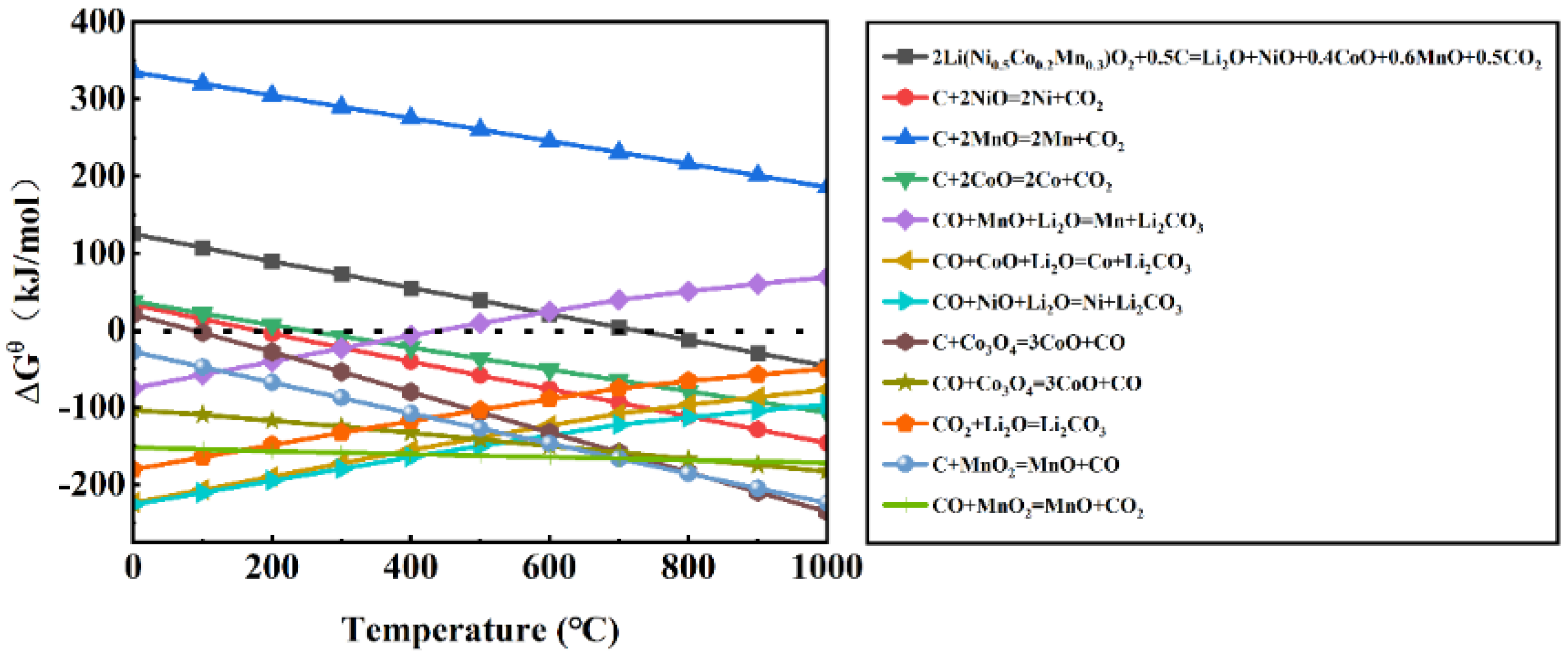
To investigate the reaction mechanism from a thermodynamic perspective, the standard Gibbs free energy changes (ΔG
θ) of relevant reactions were calculated using the HSC Chemistry 9.0 software over a temperature range of 0–1000 °C. This thermodynamic analysis determined the direction and spontaneity of the involved reactions, with the results presented in
Figure 1. As shown in
Figure 1, during high-temperature carbothermal reduction, the ternary cathode material Li(Ni
0.5Co
0.2Mn
0.3)O
2 decomposes into Li
2O, NiO, CoO, MnO, and CO
2. This decomposition reaction reaches thermodynamic equilibrium at 731 °C, where ΔG
θ = 0. When the temperature exceeds 731 °C, ΔG
θ becomes negative and continues to decrease with increasing temperature, indicating that the reaction proceeds spontaneously under these conditions. Therefore, in the temperature range of 731–1000 °C, the carbothermal reduction in Li(Ni
0.5Co
0.2Mn
0.3)O
2 proceeds spontaneously, yielding the corresponding oxides of lithium, cobalt, nickel, and manganese. Furthermore, the residual carbon in the system, along with the carbon monoxide generated during the reaction, may further reduce these freshly formed metal oxides through secondary reduction reactions [
38,
44,
45].
As shown in
Figure 1: within the temperature range of 300–1000 °C, the transition metal oxides exhibit increased reactivity with both carbon and the CO generated from the carbothermal reduction. Specifically, NiO and CoO can be reduced to their respective metallic forms by either carbon or CO [
46,
47]. For all these reactions, the ΔG
θ values remain negative throughout the entire temperature range, indicating that the reductions are thermodynamically spontaneous, with spontaneity increasing at elevated temperatures. It is also well established that Co
3O
4 can be reduced to CoO by carbon at around 200 °C, and subsequently to metallic Co at higher temperatures. However, within the experimental temperature range, the ΔG
θ values for the reduction in MnO remain consistently greater than zero, reflecting its high thermodynamic stability and resistance to further reduction by carbon or CO under the current reaction system. Consequently, MnO persists as a stable oxide phase in the final reduction products. Meanwhile, the Li
2O generated from the decomposition reacts with CO
2 in the system to form stable Li
2CO
3. Although the ΔG
θ of this reaction is negative, its absolute value decreases with increasing temperature, indicating that the spontaneity of this reaction tends to weaken at higher temperatures. Based on the above thermodynamic analysis, the mixed pyrolysis of Li(Ni
0.5Co
0.2Mn
0.3)O
2 with carbon in the temperature range of 731–1000 °C can theoretically yield the corresponding metal oxides as described [
38]. Nickel and cobalt oxides can be further reduced by carbon or CO to their metallic states. In contrast, manganese oxide (MnO) remains stable under these conditions and undergoes no further reduction, thus persisting as the final manganese-containing phase.
3.2. Effect of Pyrolysis Conditions on the Reduction in High-Value Metals
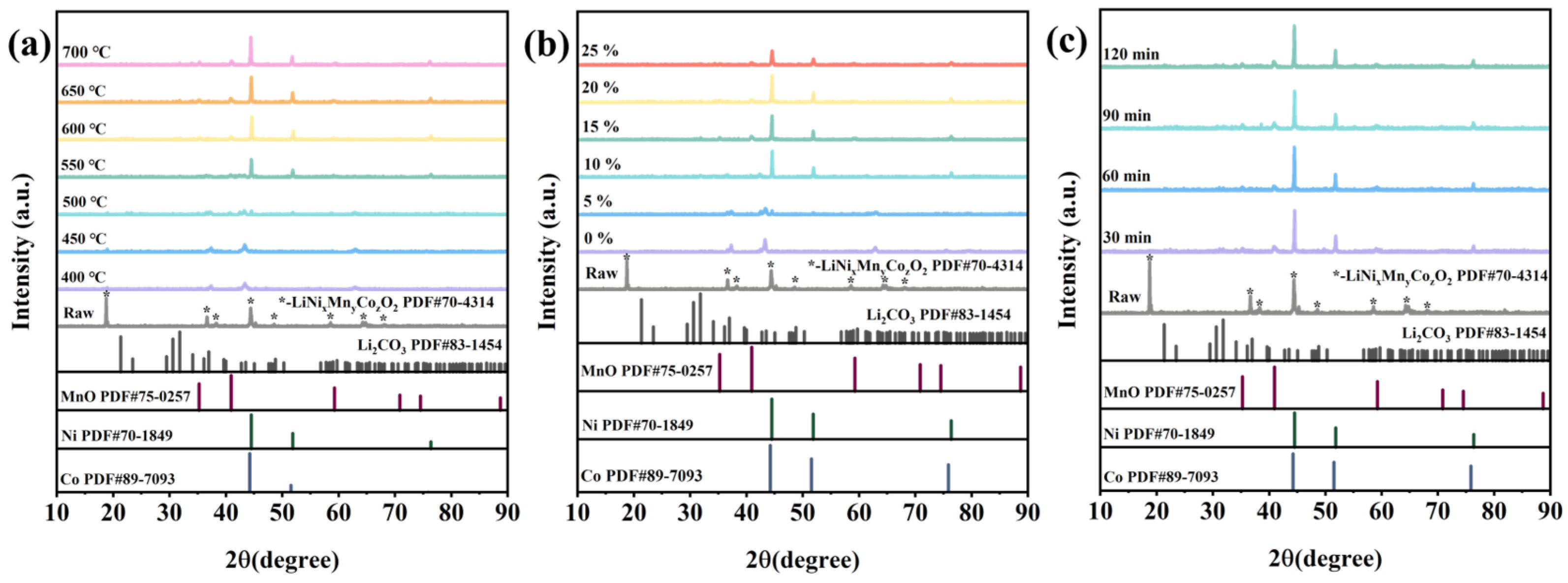
To determine the optimal process parameters for carbothermal reduction, the influences of calcination temperature (400–700 °C), sucrose addition (0–25 wt.%), and carbothermal reduction time (30–120 min) on the phase composition of the reduction products. The crystalline phases of the reduced samples were characterized by X-ray diffraction (XRD), as shown in
Figure 2. The spent cathode material was subjected to pretreatment before being used in the roasting reduction study in order to prevent the residual PVDF binder and carbon black from influencing the reduction efficiency.
As shown in
Figure 2a, at a roasting temperature of 400 °C, the XRD patterns show characteristic peaks of NiO, Li
0.21Co
0.79O, and Ni
6MnO
8, while the peaks corresponding to the original cathode material disappear. This result indicates that although the structure of the high-valence oxides in the cathode material has been disrupted, the valuable metals have not been effectively reduced, and a large amount of intermediate-valence metal oxides remain in the system, suggesting that the roasting temperature is insufficient to provide the energy required for the reduction in all metals. When the roasting temperature is increased to 650 °C, the reduction effect reaches its optimum, as evidenced by the complete disappearance of the NiO and Co
3O
4 peaks and the emergence of well-defined peaks corresponding to metallic Ni, Co, MnO, and Li
2CO
3. Further increasing the temperature does not significantly improve the reduction effect but would increase energy consumption and may lead to the decomposition or melting of Li
2CO
3. Zha et al. [
33] reported that when using graphite as the reductant, a roasting temperature of 750 °C for 4 h was required to achieve a lithium leaching efficiency of 98.86%. In contrast, the sucrose-assisted reduction system employed in this study can efficiently complete the reduction process at a lower temperature (650 °C), demonstrating a significant energy-saving advantage. Considering all factors, 650 °C is selected as the optimal roasting temperature.
As shown in
Figure 2b, by comparing the XRD results of the roasting products with sucrose contents of 10 wt.% and 15 wt.%, it can be seen that at a sucrose content of 10 wt.%, a small number of characteristic peaks corresponding to NiO and Co
3O
4 are still present in the XRD patterns, indicating that the reduction roasting was insufficient. When the sucrose content is increased to 15 wt.%, the diffraction peaks of NiO and Co
3O
4 disappear completely, and well-defined diffraction peaks corresponding to metallic Ni, Co, MnO, and Li
2CO
3 emerge, indicating that the optimal reduction effect has been achieved. Therefore, a sucrose content of 15 wt.% is determined as the optimal condition.
As shown in
Figure 2c, the effect of carbothermal reduction time was investigated under the conditions of a roasting temperature of 650 °C and a sucrose content of 15 wt.%. The results indicate that at a roasting time of 30 min, distinct diffraction peaks of metallic Ni, Co, and MnO already appear. Compared with the study by Wang et al. [
48], who used sulfur powder as a reductant and sulfidizing agent to achieve a lithium leaching efficiency of 97.0% at 600 °C for 30 min, their method, although efficient, suffers from the volatilization of sulfur oxides and associated environmental pollution. In contrast, under similar process conditions, the use of sucrose as a reductant not only effectively promotes the rapid progress of the carbothermal reduction reaction but also avoids the generation of hazardous gases, demonstrating better environmental friendliness. In summary, when sucrose is used as the reductant, a reduction effect comparable to that achieved after 120 min of roasting can be attained in just 30 min, while further extending the roasting time would only increase energy and time consumption.
As summarized, the optimal carbothermal reduction conditions identified via XRD analysis were a temperature of 650 °C, a sucrose dosage of 15 wt.%, and a pyrolysis duration of 30 min. Under these conditions, the carbonization and pyrolysis of sucrose effectively disrupt the layered structure of the ternary cathode material. As a result, the high-valence oxides of nickel and cobalt are reduced to their respective metallic forms. In contrast, manganese oxide (MnO) exhibits high thermodynamic stability within this temperature range and is not further reduced, thus persisting as MnO in the final product. Meanwhile, lithium remains in the form of lithium carbonate (Li2CO3).
3.3. Sample Morphology Analysis
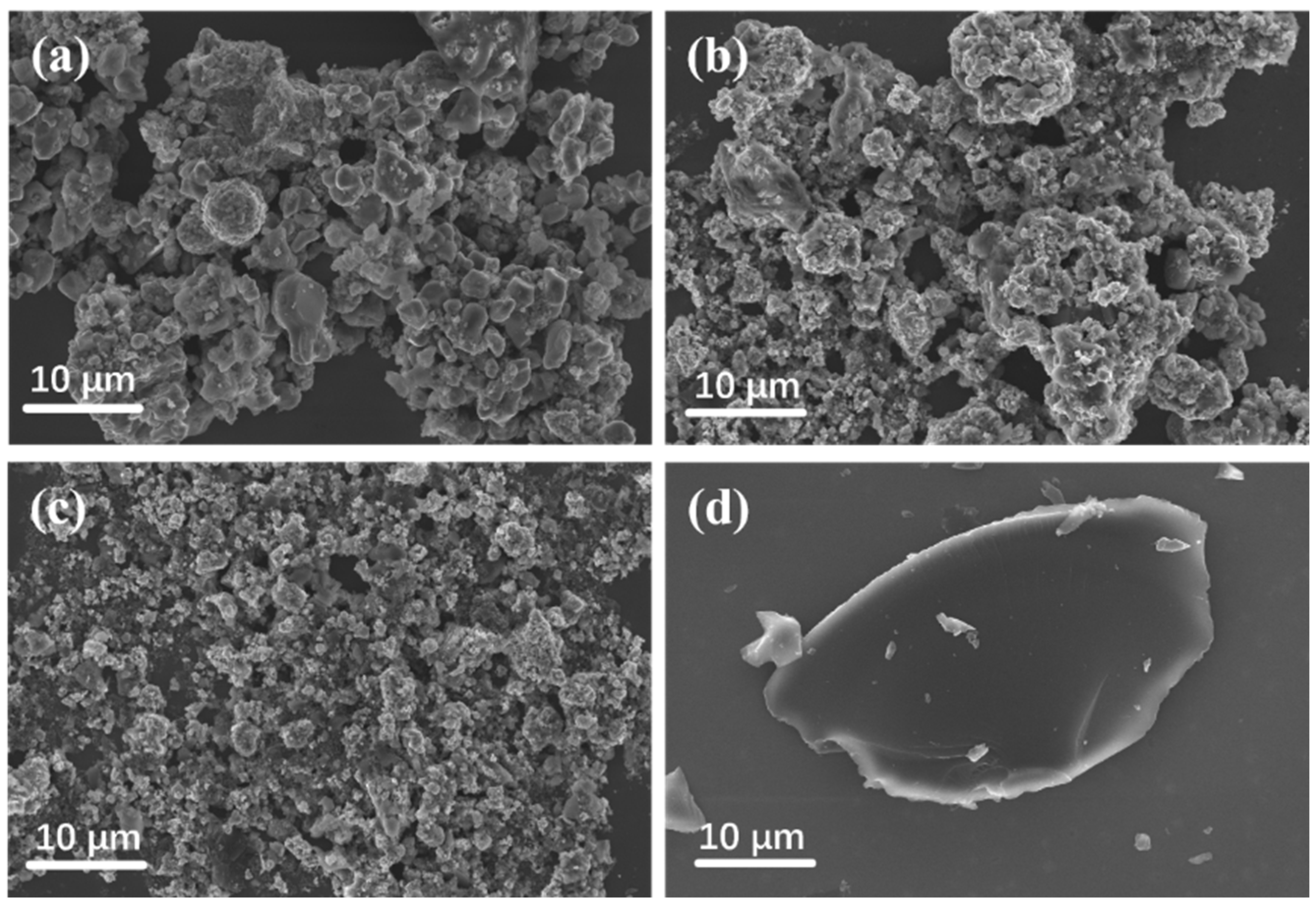
The morphological evolution of the spent cathode powder during carbothermal reduction was examined by scanning electron microscopy, as shown in
Figure 3. As shown in
Figure 3a, the spent cathode powder prior to roasting exhibits particles with uniformly smooth surfaces, along with some fine particles aggregated into clusters.
In contrast, the morphologies depicted in
Figure 3b,c reveal that the originally spherical particles have undergone extensive fragmentation, resulting in irregular shapes, broader particle size distributions, and the formation of newly agglomerated blocky structures. These morphological transformations are primarily attributed to the phase restructuring induced by carbothermic reduction, which is consistent with the XRD analysis. During the reduction process, the high-valence transition metal oxides (Ni, Co, and Mn) are reduced to their respective metallic or lower-valence oxide states—namely Ni, Co, and MnO—while lithium is converted into Li
2CO
3. The aggregation of these newly formed phases, coupled with particle fragmentation caused by the release of reducing gases, collectively contributes to the breakdown of the original spherical structure and subsequent re-agglomeration.
Figure 3d shows the morphology of the sample after sucrose carbonization, characterized by a relatively smooth surface but with irregular particle shapes and non-uniform sizes. Additional morphological and microstructural changes observed under different roasting conditions are presented in the
Supplementary Information (Figures S1 and S2). As shown in
Figure 3a and
Figure S1, the spent cathode powder before roasting has spherical particles ranging from 5 to 18 µm. Some particles exhibit fractures and incomplete structures, primarily attributed to the structural degradation of the cathode material during prolonged battery cycling. Within the roasting temperature range of 400–550 °C (
Figure S1), the reduction products largely retain their spherical morphology. At 600 °C, the spherical particles begin to fracture, and by 650 °C, significant particle fragmentation accompanied by re-agglomeration is observed. With the roasting temperature set to 650 °C, the effect on samples with different sucrose additions in terms of their microstructures is given in
Figure S2. In the absence of sucrose, the roasted material maintains a spherical morphology with smooth particle surfaces. As the sucrose dosage increases from 5 to 10 wt.%, the particle surfaces become increasingly rougher and cracks develop. With further increases in reducing agent content, more extensive particle fragmentation occurs, driven by the enhanced reduction in metal oxides and the intensified release of gaseous products during the reaction.
Figures S3 and S4 present the EDS analysis of the spent cathode powder before roasting and after roasting respectively. Following reduction roasting, significant structural transformations were observed in the sample. Prior to roasting, nickel was uniformly distributed across the particle surfaces and constituted the dominant element, with an atomic percentage of 29.59%. After roasting, both the distribution and content of nickel remained largely unchanged. The contents of cobalt and manganese were considerably lower than those of nickel, and their relative ratios were generally consistent with the stoichiometric characteristics of the NCM523 cathode material. During the carbothermic reduction process, selective transformation of the metal elements occurs based on differences in their thermodynamic stability.
Specifically, nickel and cobalt are reduced to their metallic forms and undergo agglomeration growth, while manganese remains as stable oxides, and lithium is converted into lithium carbonate. This phase restructuring, accompanied by the release of gaseous products, promotes particle fragmentation and recrystallization, ultimately resulting in a multiphase structure composed of Ni–Co metallic phases, MnO oxide, and Li2CO3 carbonate. Thermodynamic calculation provides theoretical insights into the feasibility and direction of each reaction step, while characterization data from SEM, EDS, and XRD collectively offer experimental evidence regarding morphological evolution, elemental distribution, and phase transformation. Together, these analyses comprehensively elucidate the structural changes occurring in the cathode material during reduction roasting.
3.4. Effect of Different Carbon Sources on the Reduction in Valuable Metals
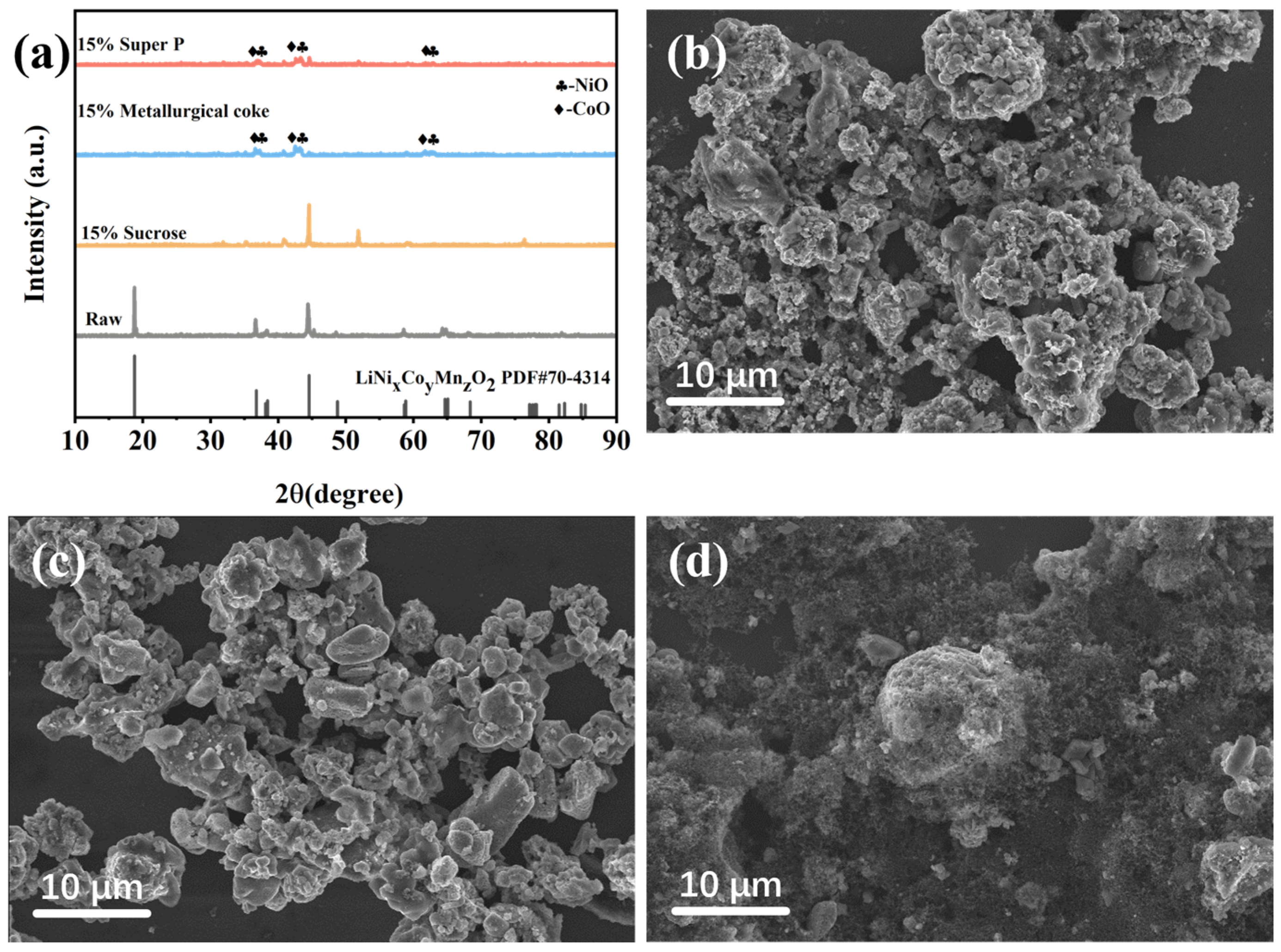
To investigate the effect of different carbon sources on the carbothermal reduction process, spent cathode materials were treated under identical reduction conditions using sucrose, coke, and conductive carbon as reducing agents, respectively. The results are presented in
Figure 4. Under the same temperature, duration, and carbon powder ratio conditions, the sucrose group achieved nearly complete reduction of nickel and cobalt to their metallic states. In contrast, the coke and conductive carbon groups still contained substantial amounts of nickel oxide and cobalt oxide, indicating that sucrose exhibits superior reduction performance compared to the other two carbon sources. Morphological observations revealed that particles reduced with sucrose exhibited irregular shapes and a broad size distribution. In the coke group, although the particles also tended toward irregularity, distinct agglomerates of originally spherical particles remained discernible. The conductive carbon group, however, displayed a large amount of flocculent structure, along with a mixture of fine particles and agglomerated spherical particles. The enhanced reduction efficiency of sucrose is primarily attributed to the formation of a porous “foam-like” carbon structure during its pyrolysis (as shown in
Figure S8) [
49,
50,
51], which facilitates intimate contact between the reducing gases and the cathode material. Additionally, the oxygen-containing functional groups present in sucrose-derived carbon readily bind with oxygen from the cathode material, thereby promoting the carbothermal reduction more effectively. XPS analysis of the spent cathode powders treated with different reducing agents is presented in
Figures S5–S7. Under identical calcination conditions, no significant changes were observed in the main peak positions of the Mn 2p and Co 2p core-level spectra. However, noticeable shifts were detected in the survey spectra and the main peak position of the Ni 2p spectrum, which can be attributed to the high content of nickel and its susceptibility to reduction. Among the transition metals, nickel oxide exhibits the lowest stability and is most readily reduced, while cobalt and manganese components undergo only partial reduction under the same conditions.
Experimental results demonstrate that under identical carbothermal reduction conditions, sucrose exhibits significantly superior reduction performance compared to coke and conductive carbon when applied to spent cathode materials. XRD and XPS analyses confirmed that nickel and cobalt in the sucrose-treated group were almost completely converted to their metallic states, whereas substantial amounts of nickel oxide and cobalt oxide phases remained in the coke and conductive carbon groups. Further comparative XPS analysis revealed that nickel exhibits greater chemical sensitivity to different carbon sources, resulting in the most pronounced spectral variations among the transition metals. In contrast, only less pronounced changes were observed for cobalt and manganese. This phenomenon can be attributed to two main factors. First, nickel constitutes the highest proportion among the transition metals in the NCM523 cathode material, making its spectral signals the most susceptible to detectable changes upon reduction. Second, nickel oxide possesses the lowest thermodynamic stability among the three transition metal oxides, rendering it the most readily reducible and, under the current conditions, the only component to undergo complete reduction. For carbon sources with lower reduction capacity, nickel oxide remains the most prominently affected phase due to its inherent instability.
These findings indicate that, under identical process conditions, the use of sucrose as a carbon source for the carbothermal reduction in spent cathode materials offers a distinct advantage over conventional coke and the conductive carbon typically present within batteries.
3.5. XPS Analysis Under Different Pyrolysis Conditions and Infrared Analysis of Pyrolysis Products
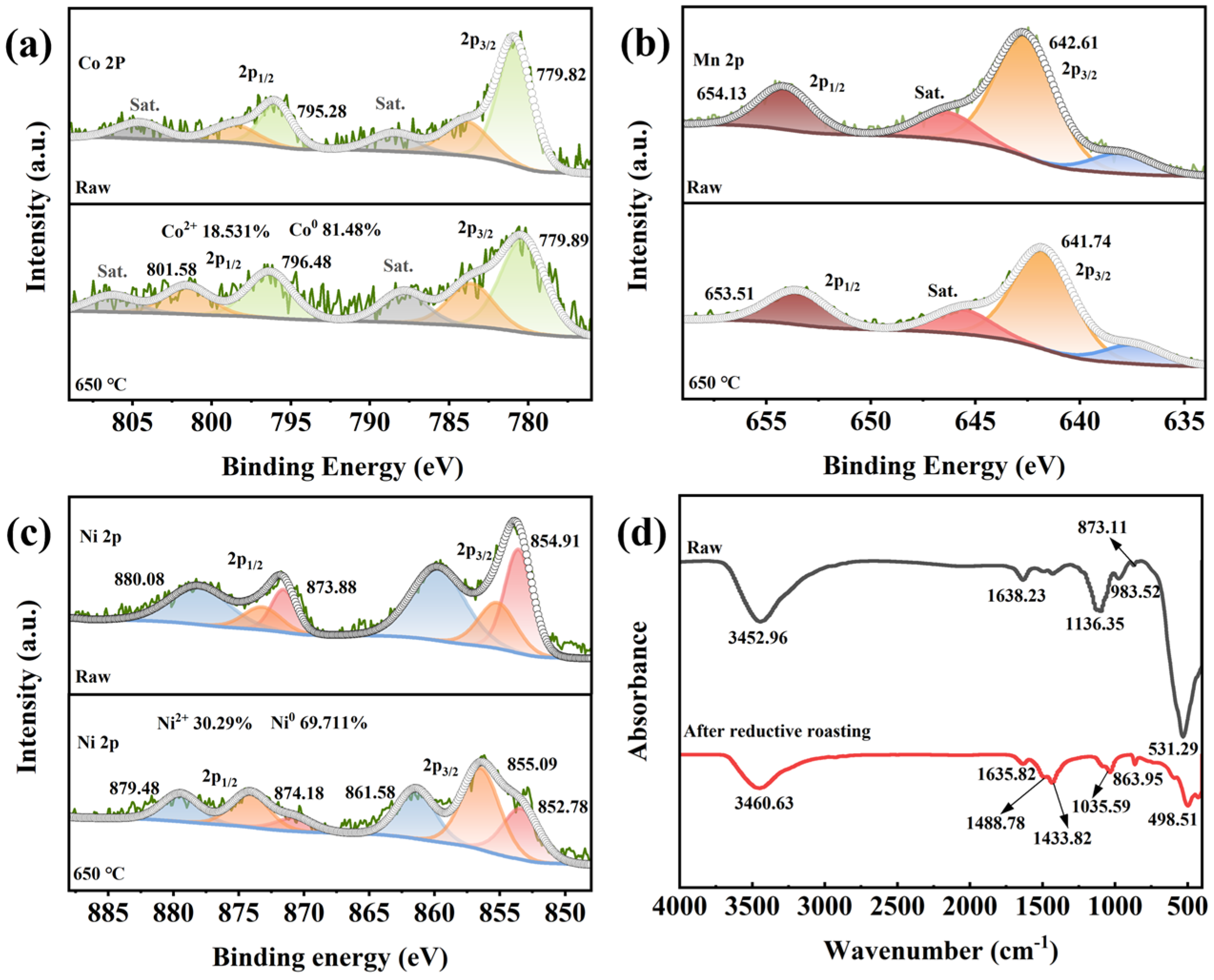
XPS analysis was conducted to investigate the oxidation states of nickel, cobalt, and manganese in the spent cathode material before and after carbothermal reduction, with the results presented in
Figure 5. The XPS spectrum of Co 2p is shown in
Figure 5a. Prior to reduction, the peaks observed at 779.82 eV (Co 2p3/2) and 795.28 eV (Co 2p1/2) correspond to Co
3+. After carbothermal reduction at 650 °C, Co
3+ was reduced to metallic cobalt (Co
0), with Co
0 accounting for 81.48% and Co
2+ for 18.53% of the cobalt species. As shown in
Figure 5b, the main peaks of Mn 2p at 642.61 eV and 654.13 eV indicate the presence of Mn
4+. Following reduction at 650 °C, new peaks corresponding to MnO appeared at 641.74 eV and 653.51 eV, indicating the reduction in Mn
4+ to Mn
2+. As shown in
Figure 5c, before reduction, the main peaks at 854.91 eV (Ni 2p3/2) and 873.88 eV (Ni 2p1/2), along with their associated satellite peaks, confirm the presence of Ni
2+. After carbothermal reduction at 650 °C, peaks emerged at 852.78 eV, 855.09 eV, and 874.18 eV, indicating that 69.71% of Ni
2+ was reduced to metallic nickel. These results confirm that the carbothermal reduction effectively disrupted the original structure of the cathode material and successfully reduced the high-valence transition metals to low-valence metallic elements and oxides [
37,
52].
FTIR analysis further confirmed the structural transformation of the cathode material, as shown in
Figure 5d. Following carbothermal reduction, a weak absorption peak emerged at 863.95 cm
−1, corresponding to the formation of Li
2CO
3. Concurrently, the intensity of the peak at approximately 498.51 cm
−1 decreased, indicating the cleavage of original metal–oxygen (M-O) bonds due to high-temperature reduction and the subsequent formation of new metal oxides. Additionally, the peaks at 1635.82 cm
−1 and 3460.63 cm
−1 exhibited reduced intensities compared to those before roasting, suggesting that a certain amount of adsorbed water was removed during the thermal treatment. Combined with the XPS results, the FTIR analysis confirms that during the carbothermal reduction process using sucrose, the layered structure of the ternary cathode material is disrupted. This leads to the reduction of high-valence transition metals to their metallic states (Ni and Co) and lower-valence oxide (MnO), consistent with the phase transformations observed in the XRD and XPS analyses.
3.6. Lithium Extraction Through Water-Selective Leaching
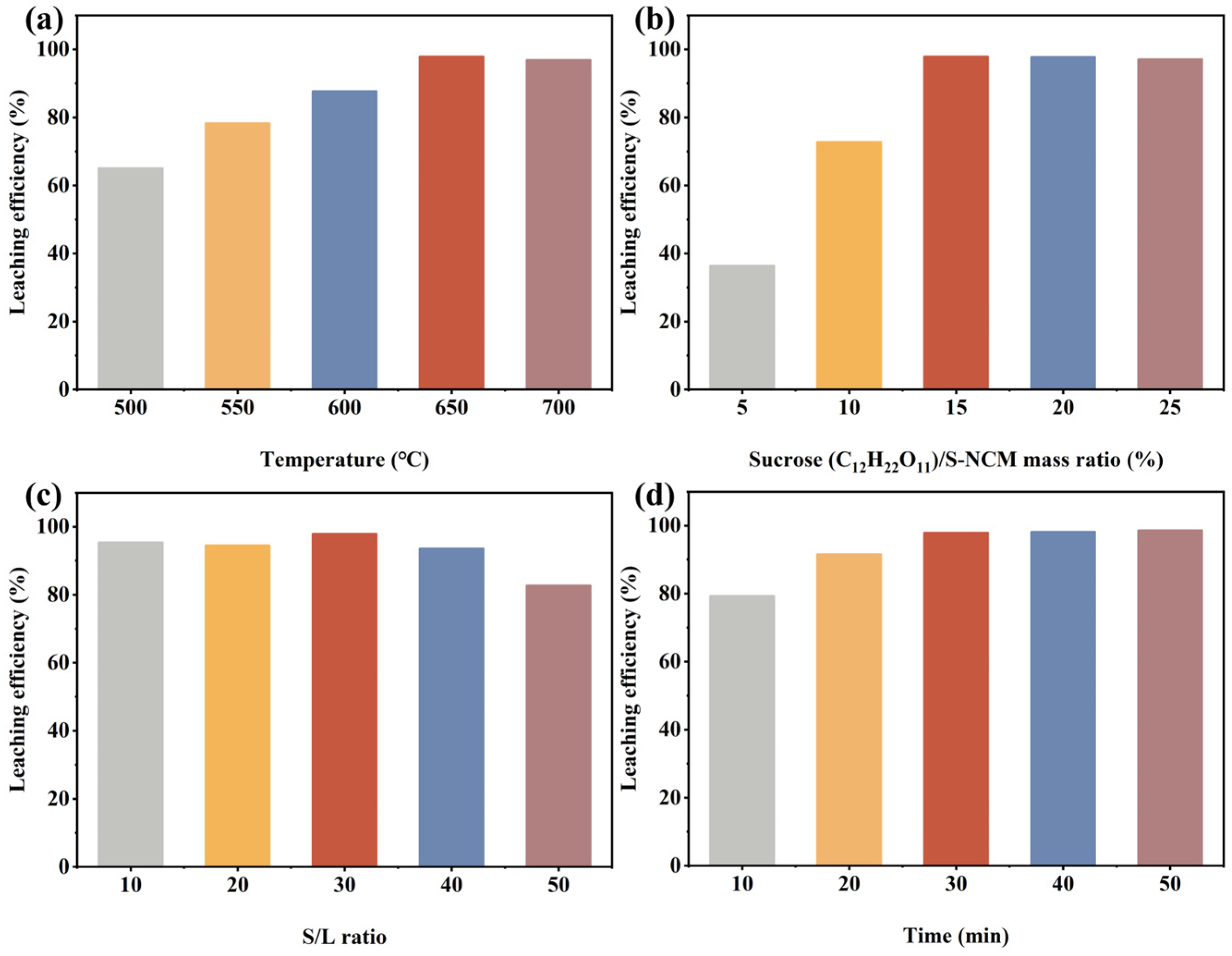
Based on the above analysis, carbothermal reduction can convert spent cathode material into water-soluble lithium salts and insoluble metals or metal oxides. This enables the selective recovery of lithium through aqueous leaching, while other metals and metal oxides remain intact in the solid residue. The effects of temperature (500–700 °C), reducing agent dosage (5–25 wt.%), solid-to-liquid ratio (10–50 g/L), and leaching time (10–50 min) on lithium leaching efficiency were systematically investigated, and the corresponding results are presented in
Figure 6. Under carbothermal reduction at 650 °C with 15 wt.% sucrose, the highest lithium leaching efficiency of 97.9% was achieved. At lower temperatures, the reduction in the cathode powder was insufficient, yielding only 65.1% leaching efficiency. A further increase in temperature did not enhance leaching performance, indicating that 650 °C is sufficient for the complete reduction in the spent material. As illustrated in
Figure 6b, a sucrose dosage of 5 wt.% resulted in a lithium leaching rate of only 36.5% due to inadequate reduction. Increasing the dosage to 15 wt.% raised the leaching rate to 97.9%; beyond this point, no further improvement was observed.
Under a nitrogen atmosphere, the carbothermal reduction process using sucrose at elevated temperatures disrupts the crystal structure of Li-O bonds. Oxygen atoms react with CO, CO
2, and C derived from the reducing agent to form Li
2CO
3, while high-valent nickel, cobalt, and manganese are converted into more stable metallic elements and metal oxides. This process is essentially a carbothermal reduction rather than traditional calcination in an oxidizing atmosphere. Therefore, a sufficient amount of reductant is required to convert the lithium component in the material into a water-soluble form while simultaneously facilitating the reduction of high-valence metal oxides [
53].
Under the optimal roasting conditions (15% sucrose content, 650 °C, roasting time of 90 min), this study further investigated the effects of solid-to-liquid ratio and leaching time on lithium leaching efficiency during the water leaching process. The results are shown in
Figure 6c and
Figure 6d, respectively. The leaching experiments were conducted at room temperature with a stirring speed of 400 rpm, and the leaching time was set to 50 min to ensure sufficient reaction. As shown in the figures, when the solid-to-liquid ratio was 10 g/L, the lithium leaching efficiency reached 88.4%. As the solid-to-liquid ratio increased to 30 g/L, the leaching efficiency further improved to 97.1%, which is attributed to the optimization of the solid-to-liquid ratio that promoted the dissolution and mass transfer of lithium salts. However, when the solid-to-liquid ratio was too high (e.g., 50 g/L), the dissolution capacity of the solution approached saturation, resulting in incomplete dissolution of some lithium salts and a decrease in leaching efficiency to below 82.7%. This indicates that an appropriate solid-to-liquid ratio is crucial for improving lithium recovery efficiency.
The effect of leaching time on lithium leaching efficiency is shown in
Figure 6b. In the initial stage of leaching, the lithium leaching efficiency showed a significant positive correlation with time. Within the first 30 min, the leaching efficiency increased rapidly and reached a peak of 97.1%. Extending the leaching time to 50 min resulted in only a slight increase in leaching efficiency, indicating that the leaching reaction was essentially complete within 30 min. Therefore, considering both energy consumption and efficiency, 30 min was determined as the optimal leaching time. Accordingly, the optimal solid-to-liquid ratio for water leaching is 30 g/L, and the optimal leaching time is 30 min. In addition, analysis of impurity elements in the leachate showed that the concentrations of Ni, Co, and Mn were all below 0.001 g/L, far lower than the detection limit.
Overall, during the water leaching process, transition metals such as nickel, cobalt, and manganese, as well as their oxides, were not dissolved, indicating that the leaching system exhibits excellent selectivity for lithium. This further verifies the feasibility and superiority of the carbothermal reduction-water leaching process in the resource recovery of spent cathode materials. Compared with the study by Zhang et al. [
38], which used glucose as a reducing agent, the sucrose employed in this experiment achieved a lithium leaching efficiency of 97.1% under a lower roasting temperature and within a shorter time.
3.7. XRD and SEM Analysis of Leaching Residue
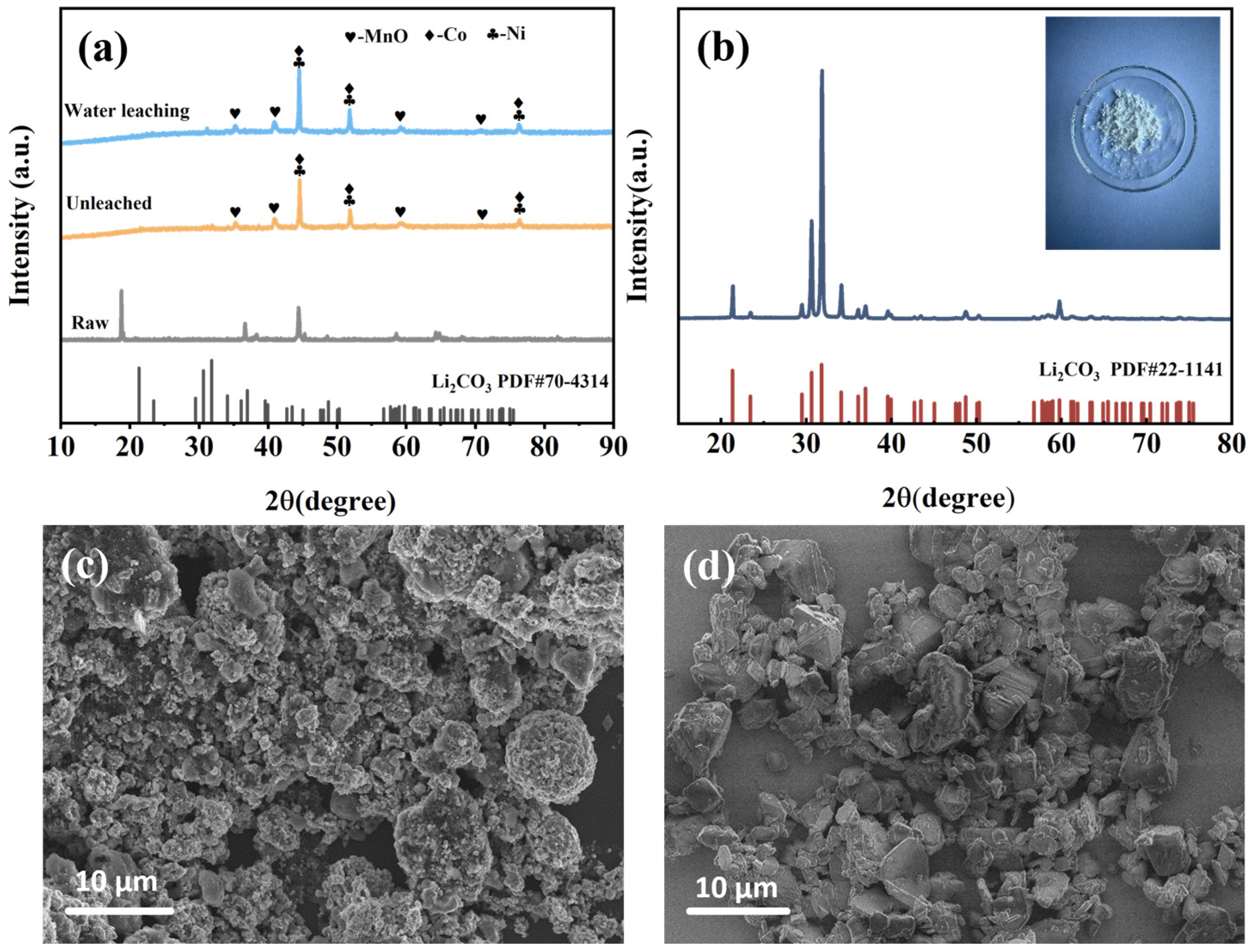
In
Figure 7, the XRD and SEM results collectively demonstrate the successful selective recovery of lithium via this process. As shown in
Figure 7a, no distinct diffraction peaks corresponding to lithium carbonate were observed in the roasted samples prior to leaching. This absence is primarily attributed to the relatively low content of generated lithium carbonate—which constitutes only a small fraction of the cathode material and thus falls below the detection limit of XRD—and the possible overlap of its main peaks with the broad reflections of transition metal oxides or carbonaceous materials. This interpretation was consistent with the compositional data in
Table 1, which indicated that the lithium content in the spent cathode material before roasting was only 4.9 wt.%.
Following water leaching, XRD analysis of the leaching residue revealed the complete disappearance of the characteristic peaks for Li
2CO
3, leaving only diffraction peaks attributable to Ni, Co, and Mn oxides. This confirms that lithium was selectively transferred into the leachate. The recovered lithium carbonate product appeared as a white powder, and its XRD pattern was in excellent agreement with the standard reference for Li
2CO
3. ICP-OES analysis further confirmed the high purity of the product, with a measured lithium content of 18.49%, closely matching the theoretical value for pure Li
2CO
3(18.79%). AAS analysis determined the purity of the recovered Li
2CO
3 to be 98.74%. SEM observations revealed that the leaching residue consisted of fine, aggregated particles, whereas the recovered Li
2CO
3 exhibited a relatively uniform morphology with smooth surfaces. The recovered Li
2CO
3 may be subject to contamination by fluoride ions derived from the decomposition of the PVDF binder; therefore, the reported purity of the product warrants further scrutiny. Collectively, these results demonstrate that the combined carbothermal reduction and water leaching process enables the efficient and selective extraction of lithium from spent cathode materials [
54].
4. Conclusions
In this work, an efficient sucrose-based carbothermal reduction method was developed for the recovery of spent cathode materials, enabling the highly selective extraction of lithium. During calcination, the high-valence metal elements (Ni, Co, and Mn) present in the cathode materials are reduced to their metallic or lower-valence oxide states, while lithium is simultaneously converted into water-soluble lithium carbonate. The converted lithium can subsequently be efficiently separated via water leaching. Through systematic optimization of the carbothermal reduction and leaching parameters (calcination temperature: 650 °C; sucrose dosage: 15 wt.%; roasting time: 30 min; solid-to-liquid ratio: 30 g/L; leaching time: 30 min), a lithium leaching efficiency of 97.9% was achieved. Notably, the reducing atmosphere formed by sucrose pyrolysis provides a stable reducing environment for the reaction system, significantly reducing energy consumption while maintaining excellent reduction efficiency. It should be noted that the cathode material used in this study was pretreated to remove binder and carbon impurities, enabling an independent investigation of the reducing effect of sucrose. However, in an actual spent battery treatment process without such pretreatment, the decomposition of residual PVDF binder and carbon black during thermal treatment would also increase material porosity and expose active surfaces. This would create a synergistic effect with the carbothermal reduction in sucrose, potentially further enhancing lithium leaching efficiency. In summary, this carbothermal reduction route avoids the substantial lithium loss associated with conventional hydrometallurgical processes while offering additional advantages including a simple process flow, environmental friendliness, and ease of scale-up. It therefore provides a more efficient and commercially viable technical solution for the recovery of spent cathode materials.