Article

Confinement Reweights Protein Orientational Phase Space in Crystallization: A PDB-Anchored Hamiltonian Comparison of Hanging-Drop and Langmuir–Blodgett Nanotemplates

1
Proteomics and Mass Spectrometry Unit, IRCCS AOM (Azienda Ospedaliera Metropolitana), 16132 Genoa, Italy
2
Laboratories of Biophysics and Nanotechnology, Department of Experimental Medicine (DIMES), University of Genova Medical School, Via A. Pastore, 3, 16132 Genoa, Italy
3
Independent Researcher, 16147 Genoa, Italy
4
Department of Surgical Sciences and Integrated Diagnostics (DISC), Genova University, Corso Europa 30, 16132 Genoa, Italy
5
Istituto Zooprofilattico Sperimentale del Lazio e della Toscana “M. Aleandri”, 00178 Rome, Italy
*
Author to whom correspondence should be addressed.
Crystals 2026, 16(4), 269; https://doi.org/10.3390/cryst16040269
Submission received: 5 March 2026 / Revised: 24 March 2026 / Accepted: 26 March 2026 / Published: 16 April 2026
(This article belongs to the Section Biomolecular Crystals)

Abstract

This study quantifies how confinement changes the orientational phase space of proteins by comparing hanging-drop (HD) with Langmuir–Blodgett (LB) conditions within a unified probabilistic framework grounded in structural data from the Protein Data Bank (PDB). For each protein, principal moments of inertia are computed from atomic coordinates, trace-normalized, and used to define a geometry-based benchmark for the probability of occupying a predefined productive-orientation set. In parallel, a Hamiltonian-weighted probability is obtained within a classical statistical–mechanical treatment by reconstructing the orientational distribution over the polar–azimuthal domain under a fixed global confinement protocol. The analysis is carried out on a ten-protein panel spanning diverse sizes and anisotropies, and the HD→LB contrast is characterized through probability gains, distributional distances, and an energy-basin decomposition that distinguishes basin depth from basin measure. Under identical parameterization, LB globally produces higher productive-orientation probabilities than HD across all proteins, establishing a uniform direction of the confinement effect while preserving protein-dependent magnitudes. The inertia-based benchmark exhibits broader dispersion in LB/HD amplification, whereas the Hamiltonian construction yields a more regular cross-protein gain, consistent with LB acting as a global reweighting of orientational phase space rather than a protein-specific re-tuning. By integrating PDB-derived structural descriptors with a statistical–mechanical operator, the framework provides a transparent bridge between molecular geometry and confinement-driven ordering and offers a compact basis for comparing crystallization-relevant confinement protocols across structurally heterogeneous proteins.

1. Introduction

This study develops a structure-driven Hamiltonian framework, embedded in statistical mechanics, to quantify how confinement and interfacial templating reshape the orientational probability distribution of proteins during crystallization, comparing conventional hanging-drop (HD) vapor diffusion with Langmuir–Blodgett (LB) nanotemplates. Here, “Hamiltonian” is used in the statistical–mechanical sense of an effective orientational energy function defined on the sphere of rigid-body directions; the resulting observables are classical orientational probabilities obtained from the corresponding partition function. Protein crystallization remains a practical gatekeeper for high-resolution structural biology, yet nucleation often stays unpredictable and difficult to anticipate from first principles [1,2].
The methodological ideal is a strategy that increases nucleation probability while preserving lattice selectivity, crystal quality, and experimental simplicity. Many interventions pursue this ideal by using heterogeneous nucleants, porous media, additives, gels, or external fields to lower barriers and expand the window of successful conditions [3,4]. Porous substrates, for instance, can concentrate macromolecules via coupled diffusion–adsorption and enable nucleation even at metastable bulk conditions [5]. Gels further promote a reproducible diffusive regime by suppressing convection and sedimentation, which can influence early nucleation pathways [6]. These advances rarely provide a transferable, structure-resolved predictor of when a specific protein will benefit from a specific template, because the redistribution of orientational microstates—the core entropic lever—remains largely implicit.
LB nanotemplates occupy a distinctive position because they introduce a reproducible quasi-2D protein interface within an otherwise standard HD workflow. They consist of ordered protein monolayers formed at the air–water interface and transferred to a solid support, where they can trigger 3D crystal formation [7]. The physical expectation is that a 2D template constrains rotational degrees of freedom, enriches productive encounter geometries, and accelerates the approach to a nucleation-competent state; the unresolved issue is how to quantify that bias in a way that generalizes across proteins. This motivation is consistent with recent evidence that interfacial adsorption stages can precede and promote protein crystallization [8].
The present work addresses this gap by linking experimentally determined structures to a structure-resolved description of encounter orientations and to quantify how confinement redistributes orientational microstates relevant to early association steps [9,10]. Rather than treating templating effects as protein-specific or ad hoc, the approach isolates a single physical difference between the two experimental settings: in the LB method, the presence of a planar nanotemplate interface creates an interfacial environment that can bias rotational freedom, enriching alignments compatible with templated encounters, whereas standard HD conditions do not impose the same interfacial constraint.
The main outcome is a direct, paired comparison between HD and LB conditions in terms of the enrichment of productive encounter orientations, enabling cross-protein comparisons under the same experimental protocol aside from the presence of the nanotemplate interface. To connect orientational enrichment to kinetic intuition without overclaiming experimental timescales, we additionally summarize the ordering effect through a minimal coarse-grained two-state description, reporting model-derived indicators that support comparative ranking and internal consistency. Across the studied proteins, the confinement effect is consistently positive, supporting the view that interfacial templating systematically enriches productive encounter orientations relative to standard HD conditions.
The objectives of this study are therefore: (i) to formalize confinement-induced orientational ordering as a quantitative, structure-resolved descriptor; (ii) to test its consistency across structurally diverse proteins; and (iii) to connect this descriptor to coarse-grained kinetic proxies that enable paired comparisons between HD and LB conditions.

2. Materials and Methods

2.1. Protein Structural Dataset (PDB-Based Parameters)

This section defines the Protein Data Bank (PDB)-resolved structural dataset used to parameterize the Hamiltonian orientational framework (embedded in statistical mechanics) for HD versus LB crystallization [1,3,7]. The protein panel was selected as a deliberately heterogeneous but tractable benchmark set for a protocol-level comparison. The aim was not to maximize biological coverage, but to span a broad range of molecular sizes, inertia-derived anisotropies, and fold classes while retaining well-resolved PDB entries representative of canonical soluble states. This choice enables cross-protein testing of transferability under a single global HD/LB parameterization, while avoiding protein-specific refitting and limiting confounding factors associated with poorly resolved or strongly heterogeneous assemblies.
The dataset comprises α-lactalbumin (PDB 1A4V), concanavalin A (1CVN), human serum albumin (HSA; 1AO6), insulin (4INS), lysozyme (1HEW), phycocyanin (1GH0), proteinase K (2PRK), ribonuclease A (7RSA), thaumatin (1RQW), and trypsin (2PTN) Sigma Aldrich (Merck KGaA Frankfurter Straße 250 64293 Darmstadt Germany). For each entry, the biological unit corresponding to the predominant soluble form was retained, coordinates were recentred at the molecular centroid, and the backbone Cα trace was treated as a rigid point cloud, providing a reproducible, fold-level representation that is robust to side-chain disorder and local conformational noise. This preprocessing establishes a consistent geometric input across proteins. The HD–LB contrast is introduced only through the explicit interfacial confinement (surface field) channel defined in Section 2.3 and Section 2.4, while the structural input and the geometric tensor descriptors are kept fixed across ensembles.
PDB-derived properties were incorporated at multiple levels, combining geometric invariants with hydrodynamic and energetic normalizers. The inertia tensor of the Cα distribution yields the principal moments ( I 1 I 3 ), the radius of gyration ( R g ), and the relative shape and planar anisotropies ( κ 2 and Π ), reported in the next Section, which jointly define the shape tensor that governs the angular dependence of the model framework. The solvent-accessible surface area (SASA) was computed from the PDB coordinates; SASA further defines a spherical-equivalent area radius R e f f via R e f f = S A S A / ( 4 π ) . The translational diffusion coefficient D t provides an independent size cross-check through the Stokes–Einstein relation, such that R h and D t are linked for a stated solvent viscosity and temperature. In the Supplementary Section S1, further details of the kinetic reduction are reported: (i) the characteristic orientational relaxation time is defined as τ N ( k + + k ) 1 ; (ii) its Hamiltonian-conditioned component is expressed as the dimensionless mixing time τ ~ N τ N D r ; (iii) and its dependence rests on the rotational diffusion coefficient D r . Table 1 summarizes the protein-resolved structural and physical descriptors used throughout the benchmark, including the PDB entry, Cα count, translational diffusion coefficient, solvent-accessible surface area, and effective radius; this protein–interface benchmark framing is consistent with recent discussions of interface-induced protein crystallization [11].
The dataset in Table 1 should be interpreted as a deliberately restricted benchmark domain rather than as an exhaustive survey of crystallization targets. It samples soluble, structurally well-resolved proteins spanning different sizes and anisotropies, for which a consistent rigid-body, PDB-anchored orientational description can be applied across the full panel. As such, the present benchmark is intended to probe transferability within this class of systems rather than to capture the full complexity of membrane proteins, highly flexible conformational ensembles, or large multicomponent assemblies.

2.2. Computational Extraction of Geometric Tensors

All geometric parameters were computed using the backbone Cα atomic coordinates, which define the three-dimensional trace of each amino acid residue. The Cα atom, corresponding to the central carbon of the peptide backbone (N–Cα–C=O), provides a robust structural marker insensitive to side-chain flexibility or solvent exposure. This coarse-grained representation captures the intrinsic topology of the protein scaffold while retaining the geometrical resolution needed for orientational analysis [12]. Thus, for each PDB entry, the molecular geometry was treated as a rigid distribution of Cα coordinates r i , referred to the centroid (equivalently, the center of mass under the equal-mass Cα approximation). The inertia tensor (I) was computed as the sum over atoms [13]:
I = m i r i 2 E r i r i  
where mi denotes the atomic mass (approximated as constant for Cα atoms), and E is the identity matrix. Under this choice, the absolute scale of the inertia is not used; only ratios/invariants (e.g., κ2 and Π) enter the orientational model. Diagonalization of the inertia tensor I yields the principal moments of inertia I1I2I3, from which we can define [14,15,16]:
R g = I 1 + I 2 + I 3 M ,   i.e. ,   the   radius   of   gyration   Rg ,   where M   is   the   total mass   ( with m i   related   to   C α atoms ) ,
κ = 1 3 I 1 I 2 + I 2 I 3 + I 3 I 1 ( I 1 + I 2 + I 3 ) 2 , i.e. , the   shape   anisotropy   κ , Π = I 3 I 2 I 3 + I 2   i.e. , the   planar   anisotropy   Π
The planar anisotropy Π is a complementary descriptor explaining the relative contribution of biaxiality to the inertia-derived anisotropy.
These quantities—reported in Table 2—provide a compact geometric fingerprint of each protein, reflecting its intrinsic orientational constraints.
Further, we define the following arrangements:
I a v g = I 1 + I 2 + I 3 3 ,     u = I 3 1 2 I 1 + I 2 I a v g ,     v Π = I 2 I 1 I a v g .  
in which the invariant u quantifies a uniaxial departure from spherical symmetry along the dominant principal axis, and v quantifies biaxial splitting in the orthogonal plane. The practical reason for introducing u and v is that they enter directly into a closed-form second-rank angular basis in θ ,   ϕ , entering Equation (5) below. Table 2 provides the protein-specific geometric invariants used by the model. This anchors cross-protein variability to structural anisotropy alone, preventing a free-parameter per-protein interpretation and making the HD/LB contrast attributable to the protocol-level framework.

2.3. Explicit Orientational Hamiltonian Driven by PDB-Derived Tensors and Interfacial Confinement

This section defines an effective orientational Hamiltonian that converts the protein-resolved inertia spectrum reported in Table 2 into a free-energy function and introduces an explicit confinement channel that distinguishes LB from HD in a controlled and testable way. Protein structure enters the Hamiltonian only through second-rank invariants derived from the principal moments of inertia (I1, I2, I3), which are computed from the PDB C α point cloud in Section 2.2. The PDB, therefore, provides the experimentally resolved structural input that anchors the theory to a reproducible dataset rather than to adjustable geometric parameters. Thus, higher-order rank terms could capture finer angular features, but are not introduced here to preserve identifiability and to avoid such protein-specific interaction modeling [17].
The reduced Hamiltonian is written as:
ε θ , ϕ H θ , ϕ k B T = ε s h a p e θ , ϕ ; u , v + ε s u r f θ ; η ,
where θ and ϕ are the polar and azimuthal angles of the body principal axis system with respect to the laboratory frame. A common laboratory frame was used for both ensembles. In LB, the laboratory z -axis coincides with the air–water interface normal, and θ denotes the tilt relative to this normal (easy-plane anchoring implies a minimum near θ = π / 2 ). In HD, the same z -axis is retained as a reference; isotropy of the bulk ensemble ensures that Z H D and the derived probabilities are independent of this choice. The decomposition in Equation (5) mirrors a standard separation used in orientational statistical mechanics: a bulk/shape contribution was expressed as a low-rank angular potential (often termed as a potential of mean torque), and a surface contribution was expressed as an explicit anchoring or confinement field. The specific choice of a second rank (quadrupolar) shape term is consistent with modern treatments of biaxial orientational order, where the dominant angular structure is captured at l = 2 while preserving interpretability and avoiding protein-specific interaction modeling.
The shape term is defined as:
ε s h a p e θ , ϕ ; u , v = ξ u P 2 c o s θ + v s i n 2 θ c o s 2 ϕ ,
where P 2 x = 1 2 3 x 2 1 , and ξ is a global dimensionless scale factor that is shared by all proteins. Equation (6) is the explicit ( θ , ϕ ) representation of the quadrupolar structure that is commonly used for uniaxial/biaxial potentials of mean torque; in particular, it is aligned with the general quadrupolar viewpoint in which biaxial contributions appear naturally at the same rank as the uniaxial P 2 c o s θ component [18].
The interfacial confinement term is chosen as the minimal even-tilt potential with an easy-plane minimum:
ε s u r f θ , η = η c o s 2 θ ,                               η 0 ,  
which penalizes alignment along the interface normal and favors orientations with θ π / 2 . This quadratic anchoring form belongs to the Rapini–Papoular-type class that is widely used as a baseline model for surface anchoring, while recent studies continue to treat the quadratic form as a valid small-deviation limit and develop modified potentials when large deviations or additional symmetries become relevant [19].

2.4. HD Versus LB Specialization and Dimensional Reduction

This section expresses the HD/LB difference directly at the level of the Hamiltonian, so that the HD–LB comparison is paired and not handled asymmetrically in later results.
The HD ensemble is defined by the absence of the surface field [20]:
ε H D θ , ϕ = ε s h a p e θ , ϕ ; u , v                                 η = 0 ,
while the LB ensemble is defined by the same shape term plus the anchoring field:
ε L B θ , ϕ = ε s h a p e θ , ϕ ; u , v + ε s u r f θ     ε s u r f θ =   ε s u r f ( θ ) = η c o s 2 θ                   η > 0
Equations (8) and (9) enforce the conceptual core of the manuscript: the shape-driven reduced Hamiltonian is identical in HD and LB, and confinement enters only through the interfacial anchoring term quantified by η. Importantly, both ensembles are defined on the same full orientational domain; the HD→LB contrast arises from a reweighting of orientational microstates through the LB Boltzmann factor, not from imposing a protein-specific restriction of admissible orientations. This paired formulation enables a direct assessment of the confinement contribution at the level of the ODF, which can then be propagated consistently into the derived ordering and kinetic proxies.
A mechanistic motivation for representing the LB environment as an external alignment field is supported by protein–interface literature, where adsorption to the air–water interface is repeatedly reported to bias accessible orientations and to select subsets of angular states. Within a coarse-grained model, such observations justify encoding the LB setting as a planar anchoring channel acting on rotational degrees of freedom while leaving protein-specific chemistry to future interface-resolved extensions [21,22].

2.5. Orientational Partition Functions, ODF, and Theoretical Productive Probability

This section defines the angular statistical–mechanical layer that is used to quantify (for each ensemble) the probability mass associated with productive directions. The angular partition function Z X is introduced in Equation (10) as the normalizing factor of the Boltzmann weight that is built from the ensemble-specific reduced Hamiltonian ε X θ , ϕ in the standard statistical–mechanical sense of a configurational partition function [23]. We describe orientations through the solid angle ( θ , ϕ ) of a unit-vector direction on the unit sphere ( S 2 ). While the full configuration space of a rigid body is S O ( 3 ) , the present coarse-grained model focuses on the degrees of freedom that couple to confinement (tilt θ and in-plane azimuth ϕ ); any residual rotation around the selected body axis is assumed to be either weakly coupled or effectively averaged out at this level of description.
The angular partition function for a given reduced Hamiltonian is:
Z = 0 2 π 0 π e x p ε θ , ϕ s i n θ d θ d ϕ ,
and the corresponding orientation distribution function (ODF) is:
f θ , ϕ = 1 Z e x p ε θ , ϕ .          
Here, the solid-angle weight s i n θ d θ d ϕ ensures normalization on the unit sphere, i.e., 0 2 π 0 π f X ( θ , ϕ ) s i n θ d θ d ϕ = 1 , and the azimuthal domain is taken as [ 0,2 π ) to avoid double-counting the periodic endpoint [24,25].
In this construction, the orientational domain is the full unit sphere Ω (with the same solid-angle measure) and is shared by both ensembles X { H D , L B } . Productive alignment is expressed as a reproducible angular probability by selecting, within the common domain Ω , a productive subset Ω p . Two operational definitions are considered: (12a) defines an ensemble-specific energy-basin subset (because it is defined from H X ), whereas (12b) defines a geometric acceptance patch that is held fixed for a given protein and used unchanged for both HD and LB. Thus, the HD–LB contrast under (12b) isolates confinement through probability reweighting [26] is:
Ω p r o d , X E = θ , ϕ Ω : ε X θ , ϕ ε X , m i n + Δ ,     Δ > 0     ,     Ω p r o d , X G δ , ϕ = { θ , φ Ω X :   θ π / 2 δ ,
sgn v i cos 2 φ cos 2 ϕ ,   δ > 0 ,   ϕ > 0 } .
Here, θ is measured with respect to the interface normal. Productive states are evaluated in two operationally distinct ways. The energy-basin definition in Equation (12a) selects a near-minimum sublevel set that is controlled by energetic tolerance Δ ; because it is defined from H X , the basin location may differ between HD and LB. In contrast, the geometric definition in Equation (12b) selects an acceptance patch on the unit sphere that is controlled by the polar half-width and the azimuthal half-width; this patch is defined once per protein and then applied identically to HD and LB so that the HD–LB comparison uses the same geometric criterion. In the Results section, we compute p X t h using Equation (13) with Equation (12b), while Equation (12a) is retained as the energetic counterpart for conceptual comparison. The sensitivity of the geometric acceptance parameters is documented in Supplementary Materials S4. The productive angular probability is defined as the canonical Boltzmann measure of the productive subsets in Equation (12a,b) under the orientation-dependent Hamiltonian, which is normalized by the full orientational partition function on the unit sphere [26]. The resulting probability is invariant under additive energy shifts ε X ε X + c o n s t and, therefore, depends only on relative energetic weights. Accordingly, under the distribution f X in Equation (11), the following relation holds:
p X t h = Ω p r o d , X e x p ε X θ , ϕ s i n θ d θ d ϕ 0 2 π 0 π e x p ε X θ , ϕ s i n θ d θ d ϕ .
This definition is invariant under additive energy shifts and therefore depends only on relative energetic weights. When Equation (12a) is used, the productive set is defined directly from the energy-based interpretation, and no external geometric acceptance cone is introduced. When Equation (12b) is used, the acceptance patch is explicitly specified by the chosen half-width parameters, and its probability is still evaluated under the same Hamiltonian-weighted measure in Equation (13). Definition (12a) yields a near-minimum (energy-basin) probability that is controlled by Δ , whereas definition (12b) yields a geometric acceptance probability that is controlled by δ ; both are evaluated under the same Hamiltonian-weighted measure in Equation (13). Applying Equation (13) to ε H D and ε L B yields p H D t h and p L B t h for each protein, with protein specificity entering through ( u , v ), computed from Table 2 via Equation (4).

2.6. Linking Hamiltonian-Based p X t h to the Table-Based Proxy p X r e f

The reference quantities p H D r e f and p L B r e f obtained from the inertia-spectrum pipeline are used as a geometry-only baseline in comparison with the Hamiltonian-based probabilities p H D and p L B that are computed from the ODF. Table 2 reports the protein-resolved inertia-derived inputs (including κ 2 , Π , and the planar anisotropy) that parameterize this mapping so that any dispersion in the proxy gain reflects structural anisotropy alone.
The comparison is methodological in a specific sense: it checks whether the explicit Hamiltonian weighting produces, across proteins, the same sign and ranking trend in the HD→LB gain that is suggested by the compact inertia-based proxy while additionally providing a consistent energetic framework that is required by the angular–kinetic cascade that is introduced in the Results section.
To make the proxy construction explicit, we define the trace-normalized inertia spectrum:
I ~ i = I i I 1 + I 2 + I 3 , i 1 , 2 , 3 ,
where I 1 , i I 2 , i I 3 , i are the ordered principal moments of inertia of protein i . We then assign the lowest and highest normalized components to the HD and LB proxy weights:
p H D , i r e f I ~ 1 , i ,   p L B , i r e f I ~ 3 , i ,
so that p H D , L B r e f 0 , 1 . This provides a simple size-independent geometric allocation and allows the ordered inertia spectrum to be used in a probability-like way within the proxy HD/LB mapping. In this sense, Equation (14b) is introduced as an operational benchmark convention based on the normalized inertia spectrum rather than as a direct physical identification between a protocol and a single inertia mode. Their ratio p L B , i r e f / p H D , i r e f therefore serves as a dimensionless proxy for confinement-induced angular gain, and it is used alongside Δ p and λ in the subsequent sections.
The “productivity” is reframed in Results Section as a near-minimum energetic neighborhood, defined by the energy-basin productive operator (Equation (12a)) or the geometric operator (Equation (12b)). The energy-basin probability is the Boltzmann-weighted probability mass of the sublevel set under the same reconstructed distribution ρ X used in Equation (13).

2.7. Numerical Quadrature, Derived Metrics, and Output Generation

This section specifies the computational evaluation and the reporting outputs that make the Hamiltonian–proxy link transparent to the reader.
Angular integrals in Equations (10)–(13) were evaluated numerically by discretizing θ and ϕ on a uniform grid. The continuous surface element on the unit sphere is s i n θ d θ d ϕ ; accordingly, each grid point ( θ i , ϕ j ) carries the corresponding solid-angle weight. Partition functions and probabilities were obtained by replacing the integrals in Equation (10) with weighted Riemann sums, i.e.,:
Z = i = 0 N θ j = 0 N ϕ 1 e ε θ i ,     ϕ j s i n θ i Δ θ Δ ϕ
Using the same angular grid and quadrature weights for HD and LB ensures that any HD–LB differences originate only from the ensemble-specific reduced Hamiltonian ε X entering the Boltzmann factor and the resulting redistribution of probability mass on the unit sphere, while the numerical quadrature is held invariant. For diagnostics that require identifying local-minimum attraction regions (energy-basin operator), the same grid and the same well-identification rule are applied in both ensembles, with basins defined on the corresponding energy surface. Agreement between p t h and p r e f is reported using parity plots for HD and LB separately, together with protein-labeled residual diagnostics, and the HD–LB increment Δ p is compared in the same manner. This validation set is then propagated into λ and subsequent kinetic quantities in the Results Section, with the explicit interpretive advantage that increases in p L B t h can be traced directly to a confinement-induced redistribution of probability mass in angular space that is induced by the interfacial field. This is consistent with broader observations that adsorption at the air–water interface biases the accessible set of directional states in protein systems [27].

2.8. Numerical Evaluation of the Angular Ensemble for HD and LB

The numerical evaluation of the orientational partition functions Z X and the associated distribution functions for the two ensembles X ∈ {HD, LB} are calculated as reported in this section. For each protein listed in Section 2.1 and characterized geometrically in Section 2.2 (Table 2), Z X is computed from the orientational partition function introduced in Equation (10) by inserting the ensemble-specific reduced Hamiltonian ε X θ , ϕ that is defined previously in Equations (6) and (7). The integral in Equation (10) is evaluated by the discrete quadrature, as already reported, i.e., by a Riemann-sum approximation on a fixed θ , ϕ grid with the same angular weights and step sizes that are used consistently across all proteins and both ensembles. Under this construction, HD–LB differences originate from the Hamiltonian term used inside the Boltzmann factor, whereas the numerical scheme itself is held invariant.
The reduced Hamiltonian-weighted distribution function (ODF) is then defined from Equation (11) as f X θ , ϕ = 1 Z X [28]. In practice, Equation (10) is evaluated through discretization by a weighted Riemann sum on a fixed ( θ , ϕ ) grid Equation (15):
Z = i = 0 N θ j = 0 N φ 1   e ε θ i , ϕ j   sin θ i Δ θ Δ ϕ
with θ i = i Δ θ over [0, π] and ϕ j = j Δ ϕ over [ 0 , 2 π ) , with weights s i n θ Δ θ Δ ϕ as in Equation (15), and with Z X obtained from Equation (10). All orientational integrals (sums) are evaluated by tensor-product quadrature on a ( θ , φ ) grid with N θ = 721 points on [ 0 , π ] and N φ = 720 points on [ 0 ,   2 π ] (endpoint excluded) by using the spherical measure d Ω = s i n θ d θ d φ . The ODF in Equation (11) constitutes the common computational object from which the productive orientational probabilities p H D and p o r i e n t , L B are obtained (and hence Δ p and λ ), and it is also the starting point for the Hamiltonian-forward diagnostics that are introduced in Section 2.9, Section 2.10 and Section 2.11 and reported in Section 3.

2.9. Hamiltonian-Based Derived Observables: Angular–Kinetic Cascade

The sequence of quantities forming the central LB–HD mechanism is defined in this subsection. Productive probabilities p H D r e f and p L B r e f are computed from Equation (13) as reference benchmarks derived from protein structural geometry (PDB-based invariants) and the adopted productive-set definition; they are therefore not treated as experimental observables, but as a reproducible geometry-driven baseline for the expected HD→LB contrast. The comparison p L B r e f versus p H D r e f provides a direct visual benchmark of the productive-orientation gain implied by geometry alone across the selected protein panel. This reference increment Δ p r e f = p L B r e f p H D r e f is then compared protein-by-protein with the Hamiltonian-weighted prediction Δ p t h from the present model. The comparison is formulated at the level of the HD→LB probability increment, thereby treating both constructions as model-derived quantities and avoiding any implication that either constitutes an experimental ground validation. An effective coupling parameter λ is introduced as a dimensionless energetic regularization of Δ p , thereby mapping the confinement-induced probability gain into a coupling scale that can be propagated into the two-state kinetic readout. Specifically, λ is defined by energetic normalization with an effective bond free-energy scale E b d and thermal scaling by k B T , according to λ = ( Δ p ) 2 E b d k B T . Here, E b d represents the stabilization of free energy associated with one productive contact, whereas k B T sets the thermal fluctuation scale.
The HD–LB distinction is implemented at the level of angular configuration space through the ensemble-specific reduced Hamiltonian entering the Boltzmann factor, while the underlying orientational domain and solid-angle measure are held fixed. Under bulk HD conditions, the angular integrals are taken over the full solid angle Ω , with θ [ 0 , π ] and ϕ [ 0 , 2 π . Under LB confinement, the angular integrals are still taken over the same full domain Ω ; the difference is that the interfacial confinement channel, introduced in Section 2.4 and Section 2.10, reweights the same angular microstates so that the probability mass concentrates near the easy-plane minimum (around θ π / 2 ). For interpretive purposes, this localisation can be associated with an effective high-probability support Ω L B Ω (used later for phase-space contraction diagnostics), but no hard domain restriction is imposed: HD and LB differ by the Boltzmann reweighting induced by ε X , not by changing admissible orientations.
This subsection defines the two-state master-equation reduction used to interpret the kinetic readouts ( P N , τ N ) as a coarse-grained projection of the orientational dynamics generated by the reduced Hamiltonian. The pre-nucleation ordering stage is represented by two macrostates: an unproductive state U (angular states outside the productive subset in Equation (12a,b)) and a productive state O (angular states within Ω p r o d ), with Ω p r o d taken from the productive-set operator defined in Section 2.5 (Equation (12b)) in the Results Section, unless stated otherwise. Transitions between U and O are modeled as a continuous-time Markov process,
U k k + O
where k + denotes the rate of entering the productive manifold and k denotes the rate of leaving it. P t is defined as the probability of systems being in state O at time t , and its corresponding master equation is:
d P d t = k + + 1 P k P
Its solution has the standard form [29]:
P t = P N 1 e t / τ N ,     P N = k + k + + k ,     τ N = 1 k + + k .
When time-resolved trajectories P ( t ) are available, P N and τ N may be obtained by nonlinear fitting, from which the effective rates follow as
k + = P N τ N , k = 1 P N τ N .
In the present work, the two-state layer is introduced as a coarse-grained representation of the continuous orientational dynamics generated by the reduced Hamiltonian in Section 2.3. Specifically, the steady occupation P N e q is determined independently from the Hamiltonian-weighted orientational distribution function reconstructed from the partition function (Equations (10)–(13)), while the relaxation time τ N reflects the dominant slow mode of the corresponding overdamped orientational-diffusion (Smoluchowski) operator. Under this interpretation, the equilibrium odds are:
λ e q = P N e q 1   P N e q
This represents a thermodynamic bias between productive and unproductive orientational basins, whereas the relaxation time τ N is controlled by barrier geometry and orientational mobility. The identification λ = k + / k therefore holds only at stationarity as a consequence of detailed balance in the coarse-grained description and is not imposed a priori as a defining relation.
Within this construction, τ N is intended as a comparative protocol-level proxy that preserves the direction and relative magnitude of confinement-induced changes within the model; it is not intended as a direct experimental observable, nor as a surrogate for measured crystallization induction times.
Equation (20) can be rewritten in log-odds form,
l n P N e q 1 P N e q = l n   λ e q  
which provides a compact representation of the equilibrium orientational bias across proteins.
This separation ensures that steady occupation and relaxation time originate from distinct physical objects: (i) the stationary Hamiltonian-weighted ODF and (ii) the spectral relaxation of the overdamped orientational dynamics.

2.10. Reduced Angular Hamiltonian with Protocol-Level Couplings

The global reduced Hamiltonian is parameterized by two protocol-level dimensionless couplings, ξ and η , which are shared across the full protein set. The parameter ξ weights the quadrupolar shape term and therefore controls how strongly the PDB-derived inertia anisotropy contributes to the orientational energy landscape. The parameter η weights the easy-plane anchoring term and therefore controls the strength of the LB-specific interfacial confinement that disfavors alignment with the normal interface. In this sense, ξ regulates the geometry-driven component of the orientational bias, whereas η regulates the confinement-driven component.
Parameter η is treated as a protocol-level parameter that is shared across the protein set, whereas protein-to-protein variability enters only through the PDB-derived shape coefficients (Table 2). This modeling choice encodes structural dependence strictly through geometry, and encodes the HD/LB contrast through a single explicit interfacial confinement field that controls the strength of easy-plane anchoring. No protein-wise coupling adjustment is permitted, so cross-protein differences in predicted ordering arise only from the structural invariants. In this framework, ξ sets the reduced energetic weight of the quadrupolar shape term ε s h a p e , and η controls the strength of easy-plane anchoring through Equation (9), a quadratic Rapini–Papoular-type baseline that is widely used in the small-deviation limit and can be generalized when additional symmetries or large deviations become relevant [21,30].
A surface-only calibration mapping η to c o s 2 θ and p p l a n e ( 10 ) is reported in Supplementary Section S3, Table S3 and Figure S2. In this global-coupling identification, ( ξ , η ) are treated as protocol-level parameters shared across the dataset so that all cross-protein differences in predicted ordering arise from the structural invariants ( u i , v i ). The default choice ξ = 1 fixes the reduced-energy gauge, and η = 3 represents a strong but finite planar-confinement regime; for the quadratic anchoring term alone, η = 3 implies c o s 2 θ   0.15 . Protocol-level sensitivity diagnostics over η [ 2 , 5 ] and ξ [ 0.5 , 1 ] show that increasing η strengthens planar confinement monotonically, while moderate departures from the baseline ( ξ , η ) = ( 1 , 3 ) do not overturn the cross-protein gain hierarchy.
Orientational ordering is defined through confinement-linked, directly computable observables; planar ordering is quantified by the probability mass within an equatorial belt around θ = π / 2 θ = π / 2 , p p l a n e δ = θ π / 2 δ f X θ , ϕ d Ω (with δ = 10 ), and by the polar order parameter c o s 2 θ X . All ordering observables are computed from the same normalized ODF on the full sphere; the equatorial belt is a diagnostic region used to quantify planarity, not a restriction of the orientational integration domain. These observables provide a direct measure of confinement-induced planarity and are used as the primary ordering readouts in the Results Section. Protein-resolved baseline values at ( ξ , η ) = (1,3), together with the gains derived, are reported in Supplementary Table S3a.
In summary, the global reduced-coupling identification is implemented as a dataset-level protocol constraint: the pair ( ξ , η ) is declared a priori and applied uniformly to every protein so that no protein-wise coupling adjustment is permitted, and all cross-protein differences in f X ( θ , ϕ ) arise only through the PDB-derived shape invariants ( u i , v i ). This choice is operationally equivalent to fixing the model’s degrees of freedom at the protocol level and testing whether the resulting HD–LB ordering signature is transferable across proteins rather than refitting couplings to reproduce protein-specific outcomes. Under this convention, ξ functions as a reduced-energy gauge, setting the weight of ε s h a p e , whereas η is the single confinement-control parameter that distinguishes LB from HD through the explicit easy-plane field. Sensitivity sweeps over η [ 2 , 5 ] and ξ [ 0.5 , 1 ] are therefore interpreted as protocol-robustness diagnostics rather than optimisation and are reported in Supplementary Section S2/Table S2 to document the stability of gain metrics.

2.11. Ensemble-Level Diagnostics from the Orientational Distribution Function

The information-theoretic and distributional diagnostics introduced in this subsection are computed from the Hamiltonian-derived orientation distribution function defined in Equation (11), with the aim of quantifying confinement-induced reweighting of angular space beyond the scalar increment. The central object is the orientational probability density on ( θ , ϕ ) generated by the Boltzmann weight of the reduced Hamiltonian. All diagnostics below are computed using the same angular grid, quadrature weights, and normalization conventions so that the HD–LB differences reflect ensemble physics rather than numerical choices.

2.11.1. Shannon Entropy

A first diagnostic test concerns the Shannon entropy of the distribution. From Shannon’s theory, entropy can be related to angular statistics in a formalism providing a quantitative measure of how strongly the ensemble localizes in θ , ϕ -space:
S X = k B Ω f X θ , ϕ l n f X θ , ϕ d Ω ,                               Δ S = S H D S L B ,          
where k B converts the dimensionless information measure into thermodynamic units. The integral in Equation (23) is evaluated numerically within the discretization scheme illustrated above, ensuring that S H D and S L B are computed under identical quadrature settings [31].
The same diagnostic is further resolved into polar and azimuthal contributions by applying the Shannon chain rule to the joint distribution on ( θ , ϕ ). This decomposition is introduced because confinement can concentrate probability mass either by suppressing interface-normal excursions (polar localisation in θ ) or by selecting preferred in-plane symmetry directions (azimuthal structuring in ϕ at fixed θ ); these mechanisms are not distinguishable from S X alone. Defining the polar marginal
f X ( θ ) = 0 2 π f X ( θ , ϕ ) d ϕ
and the conditional azimuthal distribution
f X ( ϕ θ ) = f X ( θ , ϕ ) f X ( θ ) ,
the marginal and conditional entropies are computed as
S θ , X = k B 0 π f X ( θ ) l n f X ( θ ) s i n θ d θ ,
S ϕ θ X = k B 0 π f X ( θ ) 0 2 π f X ( ϕ θ ) l n f X ( ϕ θ ) d ϕ s i n θ d θ ,
so that the total entropy admits the exact decomposition
S X = S θ , X + S ϕ θ X .
In this representation, a reduction in S θ , X   indicates confinement-driven polar localisation (the depletion of interface-normal alignment in favor of directions parallel to the interface), whereas a reduction in S ϕ θ X   indicates additional azimuthal selection among in-plane symmetry directions. All terms are evaluated under the same ( θ , ϕ ) quadrature scheme used for f X , preserving numerical comparability between HD and LB.
Since, as defined above, the confinement-induced entropy change is defined as Δ S = S H D S L B ,   under this convention, a resulting Δ S > 0 would correspond to a lower entropy under LB rather than under HD conditions.

2.11.2. Spherical Harmonic Decomposition

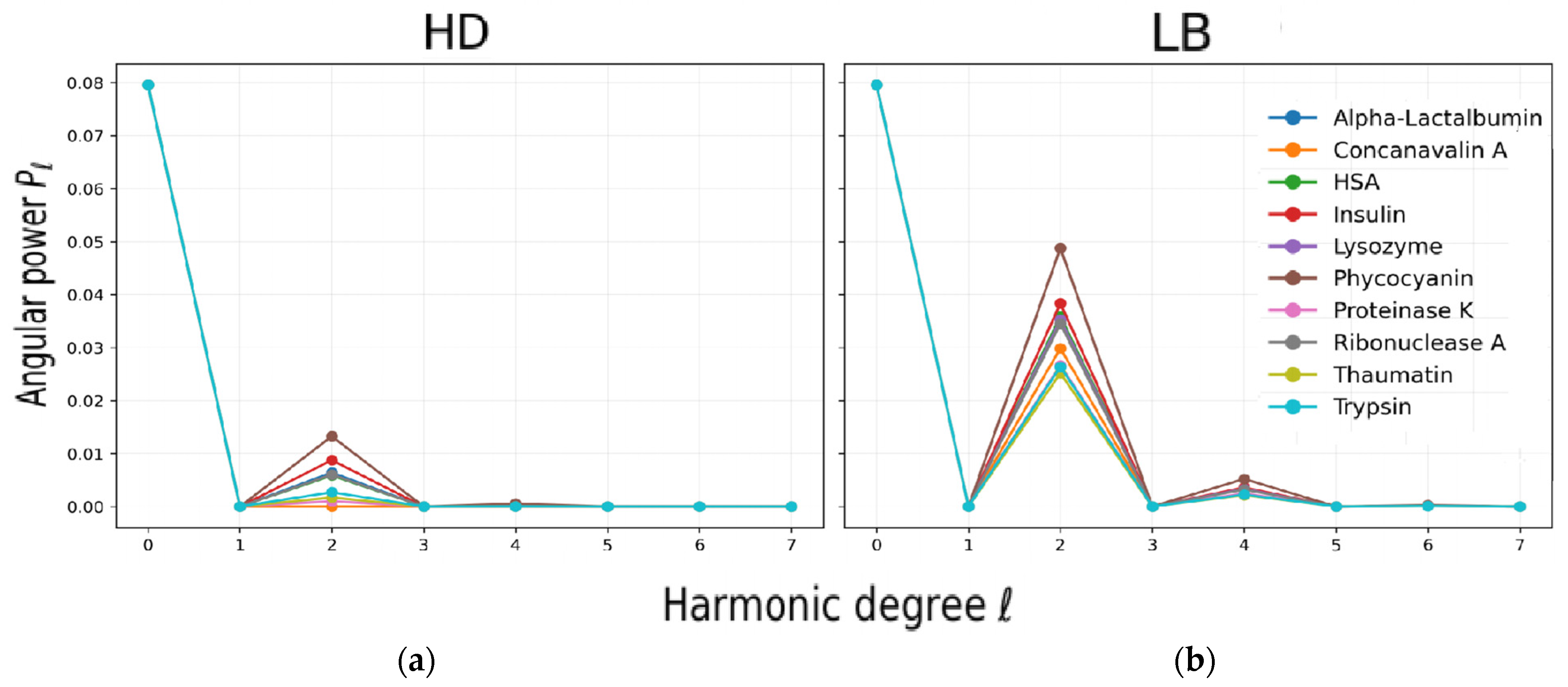
A second diagnostic calculation, explored in the Results Section, resolves the angular structure of f X θ , ϕ by spherical harmonic decomposition. Spherical harmonics Y l m θ , ϕ form a complete orthonormal basis for square-integrable functions on the unit sphere; therefore, any orientational distribution can be represented as a superposition of these modes. The degree l indexes the angular resolution of a mode (low l : broad angular anisotropy; high l : sharper localisation), while m enumerates the 2 l + 1 independent components at fixed l . The expansion coefficients are obtained by the projection of f X on the following basis:
a l m X = Ω f X θ , ϕ Y l m θ , ϕ d Ω ,    
and the corresponding angular power spectrum is defined as:
P l X = m = l l a l m X 2 .
The quantity P l X measures the total contribution of the angular degree l to the structure of f X , independently of the azimuthal phase of the pattern, because the sum over m removes dependence on a specific coordinate choice. In particular, P 0 X captures the isotropic component, whereas l 1   quantifies deviations from isotropy. For distributions that are symmetric under inversion, even degrees l = 2 , 4 , provide the leading contributions.
All projections are evaluated numerically using the same discretisation and weights illustrated above, and the spectrum is truncated at l m a x , chosen consistently with the angular-grid resolution.
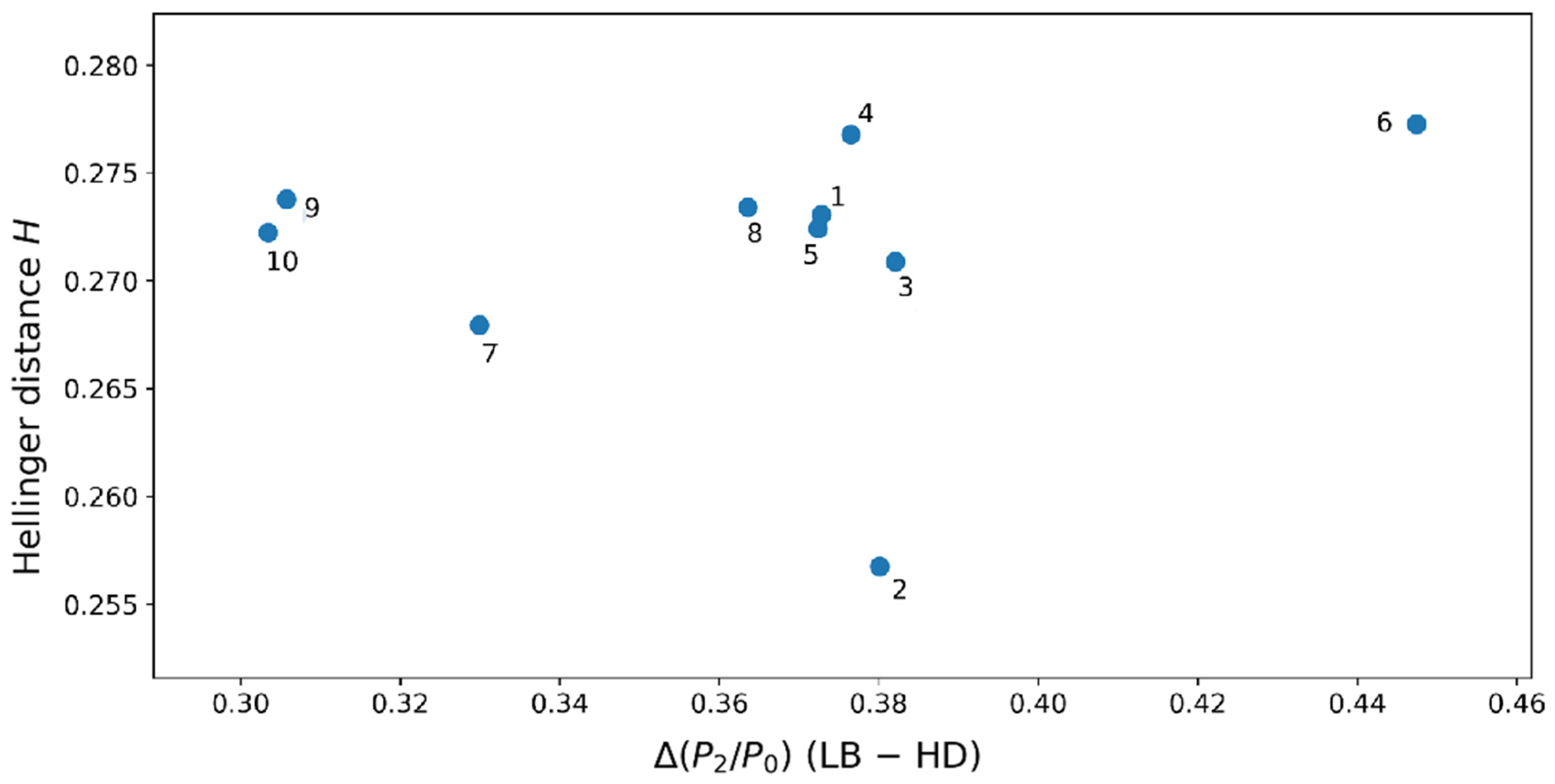
Section 3 presents Δ P l = P l L B P l H D to identify which angular modes are preferentially amplified under LB confinement with respect to the HD conditions.
Under this construction, the varied parameters that generated the figures reported in the Results Section (obtained by these formulations) are the ensemble conditions, HD versus LB, the protein index, the diagnostic window Δ E (for compression/competition, fixed by a convention), and the harmonic degree l (up to a fixed l m a x ). The parameters that are held fixed across proteins are the quadrature resolution ( N θ , N ϕ ), the well-identification rule on the grid, and the reporting conventions for ΔE and l m a x so that the differences in Section 3 arise from the Hamiltonian and the HD–LB ensemble change rather than from numerical choices.

2.11.3. Real-Space Tensor and Coupling Diagnostics from the Reconstructed Orientation Distribution

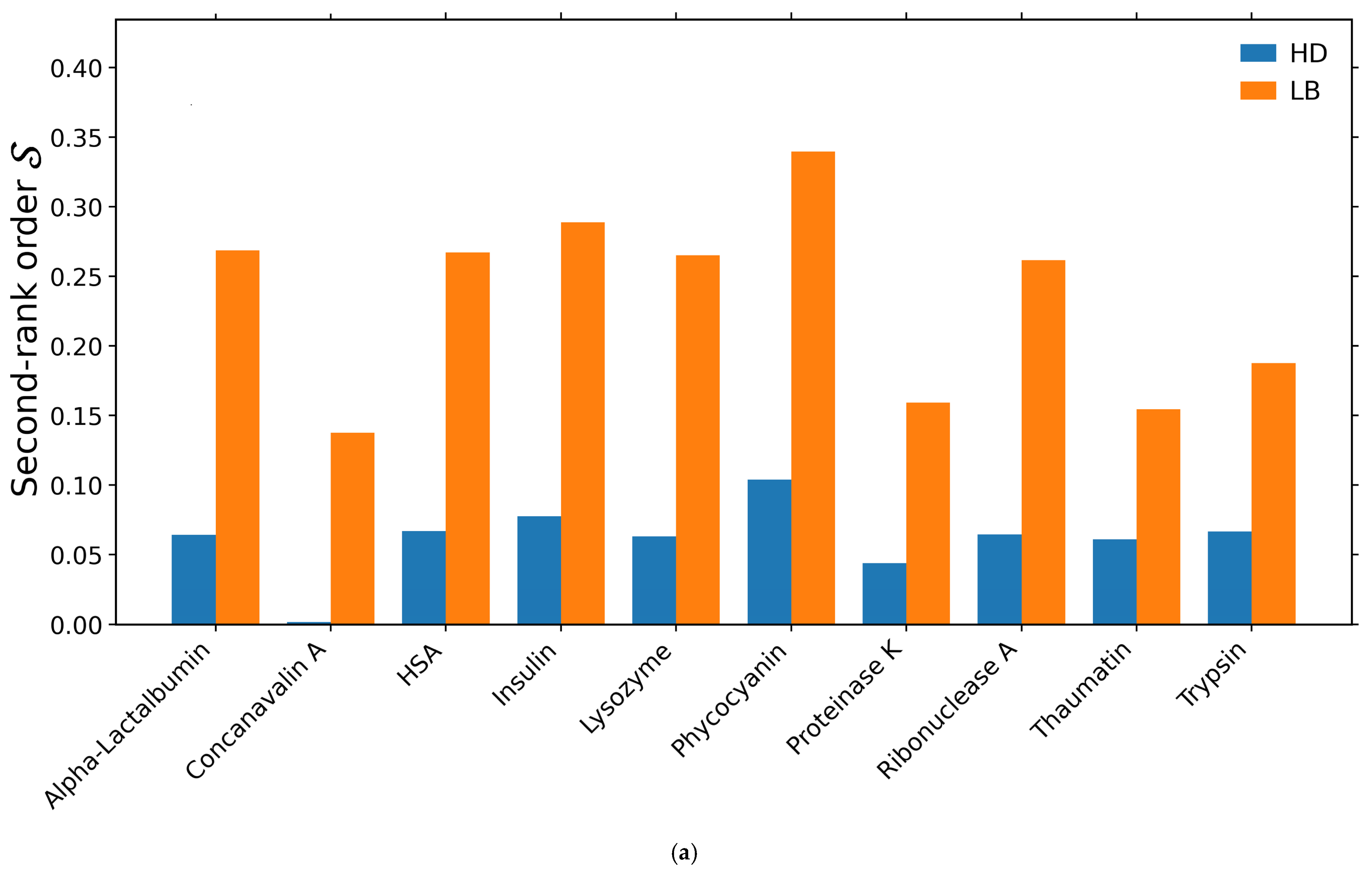
A third diagnostic calculation introduces real-space structural observables that are derived directly from the Hamiltonian-reconstructed orientational distribution function that is defined in Equation (11), with the aim of characterizing ensemble geometry beyond scalar entropy and harmonic power spectra. The diagnostics defined here quantify alignment strength, symmetry class, local confinement stiffness, and nonlinear angular coupling in a manner that is independent of spherical harmonic decomposition.
The unit vector u θ , φ defines the second-rank orientation tensor:
M X = u u T X ,
which is computed numerically using the same quadrature and grid resolution adopted above. From M X , the alignment tensor is constructed as
Q X = 3 M X I 2 .
Let q 1 , X q 2 , X q 3 , X denote the eigenvalues of Q X . The second-rank alignment strength is then defined as:
S X = q 1 , X .
where I is the identity tensor. Let q 1 , X q 2 , X q 3 , X denote the eigenvalues of Q X . This scalar provides a rotationally invariant measure of global alignment and is selectively sensitive to the second-rank structure of the distribution.
To characterize the symmetry class, a scalar biaxiality index is computed from the invariants of Q X [32]:
β X = 1 6 t r Q X 3 2 t r Q X 2 3 .
Values β X 0 correspond to an approximately uniaxial order, whereas larger values indicate increasing biaxiality. Interpretation is considered jointly with S X because β X is ratio-based and may be ill-conditioned in weakly ordered regimes.
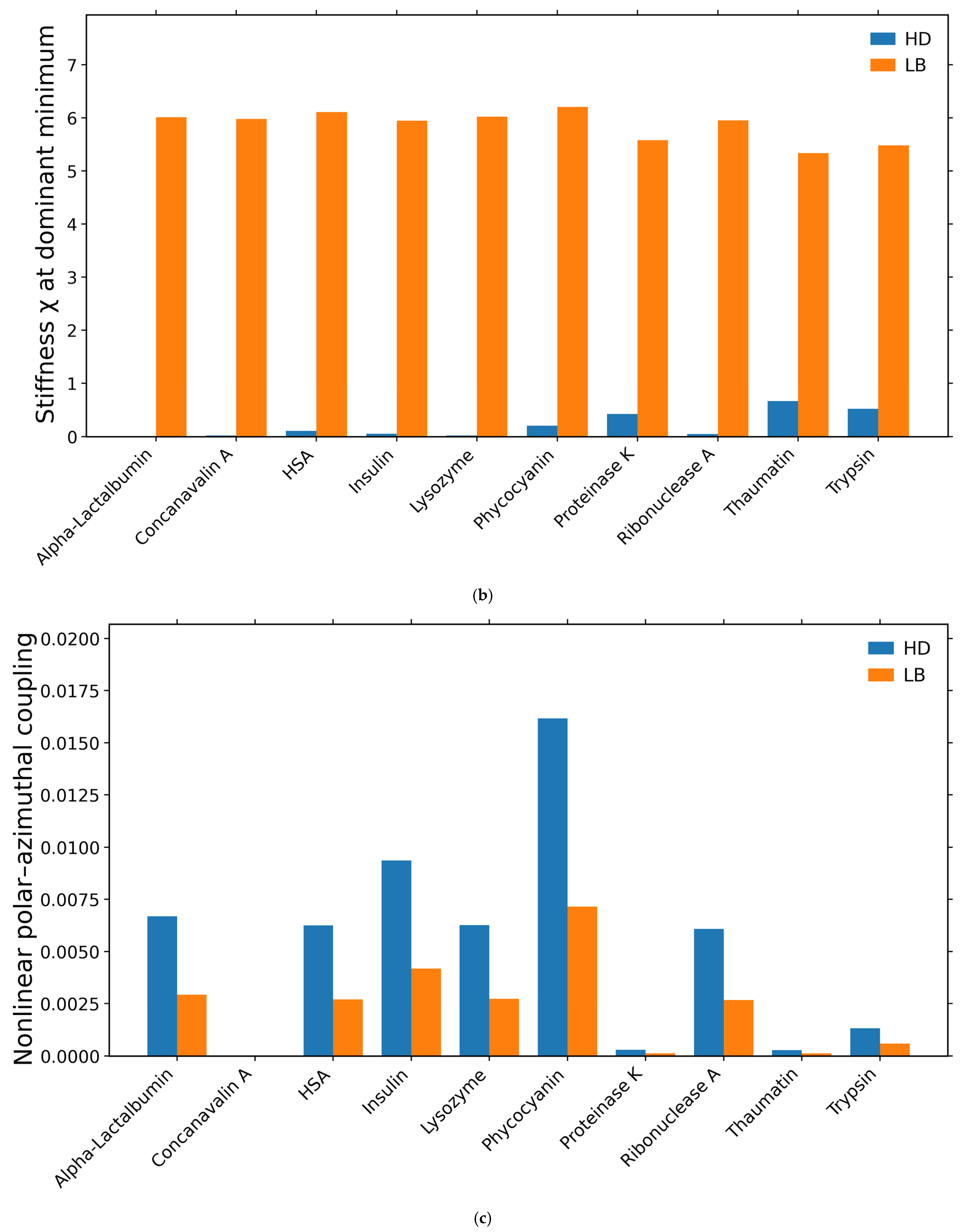
The dominant minimum of the reduced-energy surface is identified on the discretised grid used above. Local confinement stiffness is quantified via numerical second derivatives evaluated at the minimum:
χ θ , X   2 ε ~ X θ 2 m i n ,                 χ φ , X 1 s i n 2 θ 2 ε ~ X φ 2 .
These curvatures provide a harmonic approximation of the trapping strength around the most probable angular state. They quantify local rigidity rather than global symmetry.
Non-separability between polar and azimuthal fluctuations is quantified through the mutual information between θ and φ . Using the discretised joint distribution induced by f X θ , φ , the mutual information is computed as:
I X θ ; φ = p X θ , φ l n p X θ , φ p X θ p X φ d θ d φ .
This quantity vanishes only if the distribution factorizes into independent polar and azimuthal components. It therefore captures the nonlinear angular coupling that is not accessible through second-rank tensor moments or harmonic power amplitudes.
All diagnostics in this subsection are computed using the identical grid resolution and normalization conventions described in the present chapter.

2.12. Methodological Limitations

The present framework is designed to quantify how confinement reweights the orientational phase space of a rigid protein model under two idealized protocols (HD vs. LB). Accordingly, several simplifying assumptions delimit the scope of the results. First, the model focuses on rigid-body orientation on S 2 and does not explicitly represent surface chemistry, heterogeneous adsorption sites, or protein-specific interfacial interactions beyond the effective anchoring term.
Second, the solution conditions (e.g., pH, ionic strength, additives, concentrations) and translational degrees of freedom are not modeled. The reported quantities should therefore be interpreted as orientation-centric descriptors rather than a complete theory of crystallization. In particular, the framework isolates the orientational contribution to early ordering under confinement, while leaving aside effects associated with supersaturation control, diffusive transport, and detailed growth kinetics.
Third, the comparison between HD and LB is performed at fixed global control. While this enables consistent cross-protein comparisons and avoids protein-specific refitting, it does not constitute a calibration to any single experimental system. The conclusions should therefore be read at the level of comparative confinement signatures within the adopted protocol class.
Fourth, productive orientations are operationalized using two complementary criteria: a geometric set Ω G and an energetic set Ω E . These sets are not equivalent (see Section 2.5 and Supplementary S4) and are intended to probe different aspects of orientational selectivity; consequently, absolute values and even some trend amplitudes may differ depending on the criterion used.
A further limitation concerns the rigid-body representation of each protein through a single PDB-derived Cα point cloud. This approximation suppresses conformational heterogeneity and local shape fluctuations and therefore may underestimate the breadth of the orientational ensemble that would be sampled by a flexible molecule in solution or near an interface. In practical terms, neglecting internal flexibility can lead to an underestimation of orientational entropy and to a sharper reconstructed contrast between HD and LB than would be obtained from a fully conformationally averaged description. For this reason, the absolute amplitudes of the reported ordering, gain, and entropy-compression metrics should be interpreted with caution. At the same time, we expect the sign of the global confinement effect to be more robust than its exact magnitude, because in the present framework, the HD/LB contrast is driven primarily by the shared interfacial anchoring term applied on top of protein-specific but fixed structural anisotropy descriptors. A dedicated sensitivity analysis with conformational ensembles, multiple structural states, or molecular-dynamics-derived shape distributions would be required to quantify this effect explicitly and is left for future work.
An additional limitation is the use of a single PDB-derived rigid-body representation for each protein. This approximation neglects conformational heterogeneity and local shape fluctuations, and may therefore underestimate the breadth of the accessible orientational ensemble. As a consequence, orientational entropy may be underestimated, and the HD/LB contrast may appear sharper than in a fully conformationally averaged description. We therefore interpret the absolute magnitude of the ordering and entropy-related metrics with caution, while expecting the overall direction of the confinement effect to be more robust than its exact amplitude.
Finally, the kinetic quantities derived from probability changes (e.g., λ , τ ) are reported as internal proxies that summarize the model’s reweighting effect; they are not meant to provide absolute nucleation times without external calibration. A dedicated sensitivity analysis based on conformational ensembles or molecular-dynamics-derived structures would be required to quantify this effect explicitly; also, this issue is left for future work.
Numerical results are obtained by discretizing the angular domain; while high-resolution grids are used, residual discretization effects may persist and can be assessed via standard resolution checks.

2.13. Disclosures

This work relies on custom Python (v3.x) workflows developed and executed by the authors, built on standard open-source scientific libraries (e.g., NumPy, SciPy, and Matplotlib), to perform all numerical analyses and to generate all numerical datasets, plots, and figures reported in the manuscript directly from the computed outputs. In selected stages, GPT (via ChatGPT 5.4) was used as an implementation aid, including translation of analytical expressions into executable code, debugging, and prompting manual consistency checks. These interactions supported implementation and verification workflows; they did not replace author-defined modeling choices, production runs, or author-led validation. All modeling assumptions, parameter choices, numerical settings, validation steps, and interpretation of outputs were defined and verified by the authors.
For literature screening and synthesis, the authors used a combination of conventional academic search engines (e.g., Google Scholar) and GPT-5 to help expand keyword queries, identify potentially relevant publications, and summarize background concepts for internal triage. All cited sources were ultimately selected, read, and interpreted by the authors. AI tools were also used during early drafting and language revision to improve clarity and readability.
All scientific interpretations and the final manuscript content are the sole responsibility of the authors. The manuscript was carefully reviewed and finalized to ensure scientific accuracy, originality, and compliance with journal policies regarding the transparent use of AI-assisted tools.

3. Results

3.1. Confinement-Induced Planar Ordering Under Global ( ξ , η )

Confinement-induced planar ordering is evaluated from the reduced Hamiltonian on the same full orientational domain Ω 3 D for both HD and LB, with protein dependence entering only through the PDB-derived ( u i , v i ) coefficients and with a single global pair ( ξ , η ) applied to all proteins. Under LB, the additional anchoring contribution redistributes statistical weight so that the distribution becomes effectively concentrated in an equatorial, quasi-2D high-probability region (denoted Ω 2 D in what follows), without imposing a hard restriction on admissible orientations. The global setting ξ , η ) = ( 1 , 3 yields a systematic redistribution of angular statistical weight under LB across the dataset. The polar order diagnostic captures the same confinement signature for every protein, with c o s 2 θ decreasing from 0.335–0.385 (HD) to 0.151–0.171 (LB), indicating depletion of interface-normal alignment in favor of directions parallel to the interface plane.
The distributional nature of this confinement signature is quantified by the Kullback–Leibler divergence between the LB and HD ensembles [33]. Defining the discretised Hamiltonian-weighted probability mass on the ( θ , ϕ ) quadrature grid by the normalized Boltzmann weights with the spherical measure
P X ( θ i , ϕ j ) = e ε X ( θ i , ϕ j )   s i n θ i m , n   e ε X ( θ m , ϕ n )   s i n θ m
(where the denominator is the discrete partition sum, consistent with the quadrature scheme used for Z X and ensuring i , j P X ( θ i , ϕ j ) = 1 ), the divergence is computed as:
D K L L B H D = i , j P L B θ i , ϕ j ln P L B θ i , ϕ j P H D θ i , ϕ j
This quantity is non-negative and equals zero when the two ensembles coincide; it therefore provides a single-number measure of the extent to which LB confinement reweights angular probability mass relative to HD on the same full orientational domain Ω 3 D under the same geometric descriptors ( u i , v i ) and the same global coupling ξ η . In the present dataset, D K L ( L B H D ) falls in a narrow range (0.235–0.279), consistent with a uniform confinement-driven shift applied across proteins rather than protein-specific retuning. The full 10-protein set is reported in Table 3 under the global setting ξ , η ) = ( 1 , 3 . These values support the interpretation that the confinement term (Equation (9b)) imposes a consistent planar bias at the ensemble level, driving an effective localization of probability mass toward an equatorial, quasi-2D high-probability region (denoted Ω 2 D for diagnostic purposes), while cross-protein differences remain encoded in the structural anisotropy descriptors ( u i , v i ) inherited from the PDB-derived inertia tensor.
Sensitivity analysis confirms that the adopted baseline ξ , η ) = ( 1 , 3 lies in a robust protocol-level regime rather than at an isolated tuned point. Over the explored range η [ 2 , 5 ] at fixed ξ = 1 , increasing η monotonically strengthens planar confinement, as reflected by lower c o s 2 θ and higher equatorial-belt mass under LB. Over the same range, the planar and productive gain metrics vary smoothly, and moderate perturbations around the baseline do not overturn the cross-protein gain hierarchy. We therefore interpret the observed HD→LB contrast as a stable confinement signature rather than an artefact of fine tuning (Supplementary Section S3, Tables S3 and S4).The limited dispersion of D K L across proteins supports the interpretation that the confinement contribution is predominantly global, whereas cross-protein differences enter through the PDB-derived anisotropy descriptors ( u i , v i ) rather than being absorbed into protein-specific coupling parameters.
In the following Section 3.2 and Section 3.3, we formalize two complementary definitions of productive orientation (geometric vs. energetic/basin) to interpret confinement-induced reweighting.

3.2. Confinement-Induced Angular Ordering Across the Protein Set

In this section, productive probabilities are computed from Equation (13) using the geometric productive subset in Equation (12b) with fixed ( δ , ϕ ) across the protein set with δ , ϕ ) = ( 35 , 50 (Supplementary Figure S4; Supplementary Table S4). The confinement-induced ordering is quantified by comparing, for each protein, a proxy benchmark ( p H D r e f , p L B r e f ) derived from inertia-based shape invariants and a Hamiltonian evaluation ( p H D t h ( G ) ,   p L B t h ( G ) ) obtained from the orientational Hamiltonian on the HD/LB manifolds defined in Equation (12a,b). The p L B t h   are evaluated using the geometric definition of Ω in Equation (12b) so that the HD/LB comparison is performed on the same geometric acceptance criterion under Hamiltonian reweighting [34]. Importantly, for a given protein, the geometric productive subset in Equation (12b) is held fixed and applied identically to HD and LB. Hence, the contrast isolates confinement through Boltzmann reweighting rather than a change of admissible orientations. The partition function Z X and the normalized distribution defined in Equation (11) enter the Hamiltonian computation, whereas the proxy probabilities p X r e f are constructed from the same PDB-derived geometric inputs (κ2 and Π) discussed in Section 2.5 and Section 2.6. The dataset-wide comparison in Table 4 shows that confinement induces a systematic LB enhancement under both constructions, while the magnitude and dispersion of the gain depend on whether the mapping is purely geometric ( p r e f ( G ) ) or Hamiltonian-weighted ( p t h (G)). As reported in Table 4, the proxy pipeline, p H D r e f ( G ) spans 0.136–0.332 and p L B r e f ( G ) spans 0.335–0.445, yielding p L B r e f / p H D r e f ( G ) = 1.010 –3.280. In the Hamiltonian pipeline, p H D t h spans 0.286–0.339 and p L B t h spans 0.381–0.526, yielding a tighter gain range p L B t h / p H D t h ( G ) = 1.554 –1.683.
Because Equation (12b) is held fixed across HD and LB for each protein, the gain reported in Table 3 reflects a redistribution of angular statistical weight under confinement rather than a change of the geometric acceptance criterion. The contrast between these two gain envelopes is expected: the proxy ratio reflects a geometry-only mapping from inertia invariants, whereas the Hamiltonian ratio reflects the global confinement bias applied uniformly across proteins under the same ( ξ , η ), with protein specificity entering only through ( u i , v i ).
Figure 1 provides the direct HD–LB comparison in the ( p H D , p L B ) plane. In each panel, every marker represents a pair of probabilities for the same protein, with the x-coordinate corresponding to p H D and the y-coordinate to p L B . The left panel reports the inertia-spectrum reference construction ( p H D r e f , p L B r e f ) obtained by trace-normalization of the principal moments of inertia (Equation (12a,b)), whereas the right panel reports the Hamiltonian-weighted probabilities ( p H D t h , p L B t h ) computed from the distribution under the fixed global protocol.
In both constructions, the systematic displacement of the points above the identity line p L B = p H D indicates that the LB condition increases the productive-orientation probability relative to HD. The sign of the contrast is uniform across the ten-protein panel. The magnitude of the displacement, however, depends on the construction: the inertia-based reference exhibits a broader dispersion of LB/HD amplification, reflecting the raw anisotropy encoded in the inertia spectrum, whereas the Hamiltonian-weighted probabilities display a comparatively compressed spread under the shared global coupling. This difference in dispersion is consistent with Table 4, where proteins with strong intrinsic anisotropy (e.g., Phycocyanin, Insulin) occupy the upper tail of the gain distribution, while nearly isotropic cases (e.g., Concanavalin A) remain close to unity.
Figure 1 and Table 3 quantify the HD→LB contrast in productive probability using two constructions that share identical protein-specific geometric inputs ( u , v ) but differ in the probabilistic operator applied to the orientation space. The reference construction maps the inertia spectrum directly onto probability weights through spectral normalization (Equation (12a,b)), thereby serving as a geometry-only benchmark. The Hamiltonian construction, in contrast, evaluates the productive subset by Equation (12b) under a Boltzmann-weighted distribution function (Equation (11)) so that the HD–LB contrast is generated by the confinement-induced reweighting of angular microstates rather than by changing the productive-set geometry. The uniform inequality p L B > p H D across all proteins in both constructions establishes that confinement systematically increases the probability mass assigned to the productive set independently of molecular identity. The protein dependence of the magnitude reflects how each inertia-derived anisotropy projects onto the confinement potential. In the reference construction, amplification scales directly with spectral asymmetry and therefore exhibits pronounced dispersion. In the Hamiltonian construction, the global-coupling parameter η acts as a shared modulation of angular weight, reducing protein-to-protein variability while preserving the sign of the contrast.
This interpretation is consistent with published model-system evidence from the LB crystallization literature. In chicken egg-white lysozyme, crystal size was reported to depend critically on the surface pressure of the protein monolayer during LB deposition. As shown in Figure 2 reported by Ref. [35], larger single crystals and faster growth were obtained only within an optimal pressure window of 20–25 mN/m, corresponding to the most closely packed monolayer. At 30 mN/m, by contrast, film collapse was associated with a marked decrease in crystal size. Earlier Brewster microscopy and nanogravimetry data were consistent with this interpretation [35].

3.3. Energy-Basin Productive Probability and Basin Decomposition (ΩE)

This subsection quantifies confinement effects by evaluating the energy-basin productive subset Ω p r o d , X E , defined as a near-minimum sublevel set of the reduced orientational Hamiltonian. Here, the focus is on Ω E -based energetic descriptors (Table 5; Figure 2a,b), whereas the previous Section exploited the Ω G -based geometric productive set. We next quantify productive orientations by using the energetic/basin operator (E), defined by the probability mass that is captured within a fixed reduced-energy neighborhood Δ around local minima of ε ~ X ( θ , φ ) . The corresponding probabilities are denoted p H D t h ( E ) and p L B t h ( E ) , with gain Δ p E = p L B t h ( E ) p H D t h ( E ) . Table 5 reports p t h ( E ) , along with basin multiplicity and confinement-induced redistribution metrics.
Because the energy-basin subset is defined directly from the ensemble-specific reduced Hamiltonian (Equation (12a)), its boundary and measure can differ between HD and LB at fixed tolerance, allowing the HD→LB contrast to be decomposed into basin contraction versus in-basin densification.
In each ensemble X [ H D , L B ] , the productive basin is defined by Equation (12a) as Ω p r o d , X E Δ = θ , φ 0 Ω : ε X θ , φ ε X , m i n + Δ , and the corresponding theoretical probability p X t h E is computed from Equation (13) on the same full orientational domain Ω 3 D as the Boltzmann-weighted probability mass of this sublevel set under the ODF f X θ , φ . Computations use the global Hamiltonian protocol with ξ , η H D , η L B ) = ( 1 , 0 , 3 and discrete quadrature on a tensor grid with N θ = 721 ,   N φ = 720 points over θ 0 , π and φ [ 0 , 2 π (endpoint excluded).
The present analysis uses the fixed tolerance Δ = 0.25 k B T for all proteins and both ensembles to provide a protocol-level energetic threshold that is directly comparable across the dataset.
Further, a mechanistic decomposition that separates basin geometry from in-basin probability concentration at fixed Δ is reported. The energy-basin probability is written as p X t h E = m X C X , where m X is the normalized basin measure m X = 1 4 π Ω p r o d , X E Δ d Ω computed under the unweighted spherical measure d Ω = s i n θ d θ d φ , and C X = p X t h E / m X is the corresponding concentration factor that quantifies how strongly the Boltzmann measure enriches probability mass within the basin relative to its geometric size. The numerical evaluation of all angular integrals is performed by discretized quadrature on a fixed ( θ , φ ) grid (denoted by N θ and N φ sampling points), which implements Equation (15)-type weighted Riemann sums for the full-sphere integrals in Equation (13) and is required for reproducibility, even when the productive definition is purely energy-based.
This subsection reports, alongside the Hamiltonian-based energy-basin probabilities, the inertia-spectrum reference probabilities p H D r e f and p L B r e f , which are computed directly from the principal moments of inertia I 1 I 2 I 3 according to the reference mapping defined in Equation (12a,b), and serve as a geometry-only benchmark for the HD/LB pairing. These reference quantities are reported to preserve the paired HD/LB comparison logic and to separate geometry-only leverage from Hamiltonian reweighting, not as experimental validation.
Table 5 presents the resulting dataset-wide values for p H D t h E and p L B t h E , together with the increment Δ p t h E = p L B t h E p H D t h E , and it reports the decomposition terms m H D , m L B , C H D , C L B for each protein.
Theoretical energy-basin probabilities p H D t h E and p L B t h E are obtained from Equation (13) using the energy-defined productive subset Ω E , X Δ (Equation (12a)) with Δ = 0.25 k B T ; the increment is Δ p t h E = p L B t h E p H D t h E . Each probability is decomposed as p X t h E = m X C X , with m X = ( 4 π ) 1 Ω E , X d Ω and C X = p E , X t h / m X , where d Ω = s i n θ d θ d φ .
Table 5 additionally reports the inertia-spectrum reference probabilities p H D r e f and p L B r e f , constructed directly from the principal moments of inertia ( I 1 ,   I 2 ,   I 3 ) via trace-normalization I ~ i = I i / I 1 + I 2 + I 3 and the spectral-weight assignment p H D r e f I ~ 1 , p L B r e f I ~ 3 (Equation (14)).
These reference quantities serve as a geometry-only benchmark derived from inertia moments, and they are reported side-by-side with the Hamiltonian-derived energy-basin probabilities p H D t h E and p L B t h E to preserve a direct comparison across proteins under the same HD/LB pairing logic.
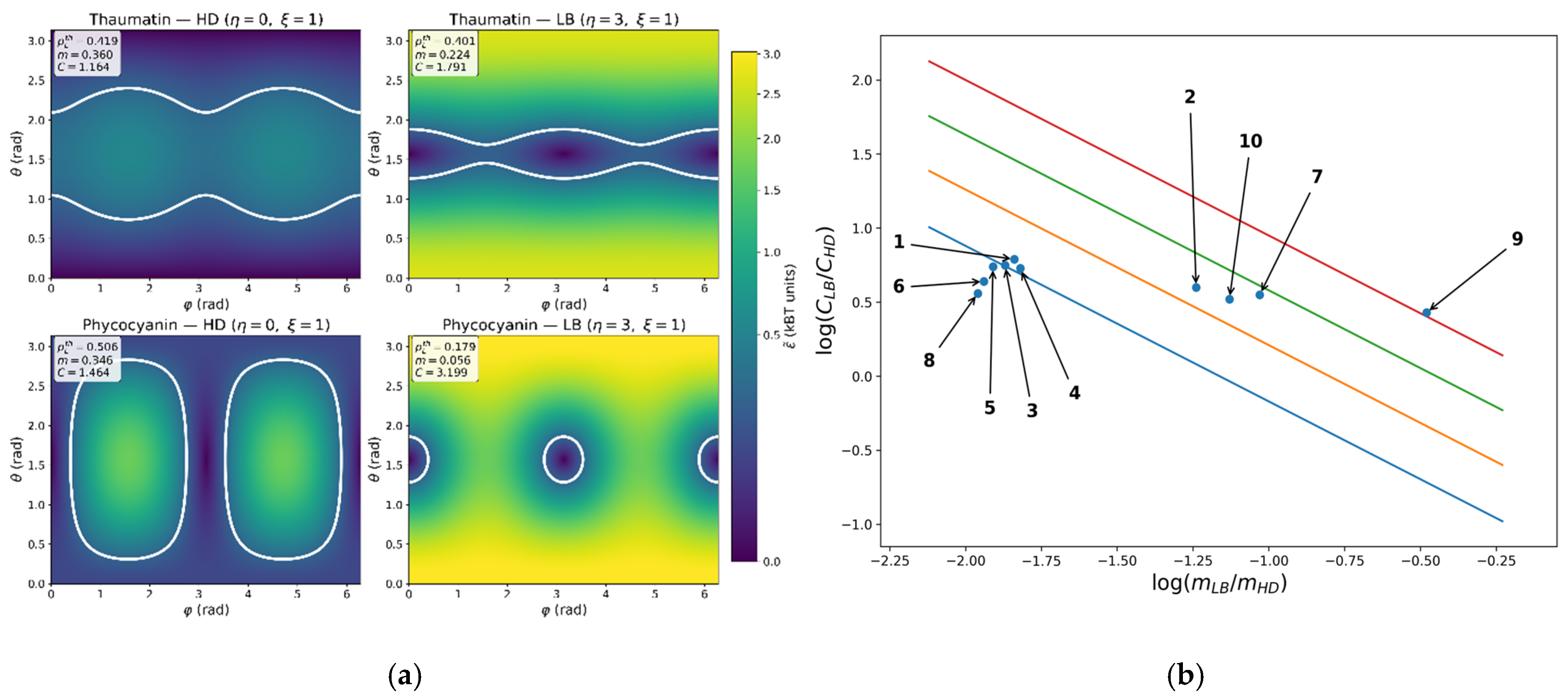
Across the panel of ten proteins at Δ = 0.25 k B T , the reported Hamiltonian values span p H D t h E 0.419 , 1.000 and p L B t h E 0.179 , 0.526 , with the corresponding protein-resolved m X C X decomposition values listed in Table 5 for each ensemble. Figure 2 provides the operational visualization required to interpret this Table at the level of definitions and reported observables. Figure 2a displays representative shifted energy surfaces ε ~ X θ , φ = ε X θ , φ ε X , m i n in HD and LB, and overlays the contour ε ~ X = Δ , which delineates the energy-basin productive subset Ω p r o d , X E Δ directly in ( θ , φ )-space. Figure 2b maps each protein into the decomposition plane l o g m L B / m H D versus l o g C L B / C H D , where the identity l o g p L B t h ( E ) / p H D t h ( E ) = l o g m L B / m H D + l o g C L B / C H D follows from p X t h E = m X C X and is visualized through diagonal constant-gain guidelines.
The paired Figure 2a,b provides a direct, operational reading of the energy-basin definition Ω E , X Δ and of its dataset-level consequences under the same fixed protocol. Figure 2a (left) shows ε ~ X θ , φ for two representative proteins—Thaumatin (top row) and Phycocyanin (bottom row)—arranged so that HD is the left column and LB is the right column for each protein. The contour ε ~ X = Δ (with Δ = 0.25 k B T ) delineates the productive energy basin Ω E , X Δ in ( θ , φ )-space. The representation compares, within each row, how the enclosed region changes from HD to LB and how the reported triplet ( p E , X t h , m X , C X ) changes accordingly. In this construction, m X quantifies the geometric fraction of the solid angle captured by the basin, C X = p E , X t h / m X quantifies the Boltzmann densification of probability within the basin, and p E , X   t h is the resulting Hamiltonian-weighted basin probability.
Figure 2. Energy-basin definition and decomposition at fixed Δ . (a) Shifted reduced Hamiltonian ε ~ X θ , φ = ε X θ , φ ε X , m i n for representative proteins in HD and LB under ξ , η H D , η L B ) = ( 1,0 , 3 ; the contour ε ~ X = Δ with Δ = 0.25 k B T delineates Ω E , X Δ . In-panel values report p E , X t h , m X , and C X = p E , X t h / m X . (b) Decomposition plane with x = l o g m L B / m H D and y = l o g C L B / C H D , where m X is the normalized measure of Ω E , X Δ and C X is the corresponding concentration factor; diagonal guidelines indicate constant l o g p E , L B t h / p E , H D t h = x + y stacked at p E , L B t h / p E , H D t h approximately equal to 0.30 ( b l u e )   0.45 ( o r a n g e ) , 0.67 ( g r e e n )   a n d   1.0 ( r e d ) . Protein numbering as in Figure 1.
Crystals 16 00269 g002
Figure 2b (right) extends the same Ω E Δ construction to the full protein set by plotting each protein at x = l o g m L B / m H D and y = l o g C L B / C H D . The diagonal guidelines represent constant l o g p E , L B t h / p E , H D t h because the factorization p E , X t h = m X C X implies l o g p E , L B t h / p E , H D t h = x + y . Taken together, Figure 2a and Figure 2b link a representative visualization of the energy-basin boundary in ( θ , φ )-space to a dataset-level map that separates basin-measure changes from in-basin concentration changes under the same fixed Δ .

3.4. Coupling-Controlled Nucleation and Relaxation: Size Control, Kinetic Scaling, and Integrated HD vs. LB Coupling–Relaxation Diagram

The increment Δ p t h = p L B t h p H D   t h is computed from Equation (13) on the geometric productive subset of Equation (12b) and is therefore distinct from the energy-basin probabilities p E , X t h E defined in (Equation (12a). For a given protein, the geometric productive subset in Equation (12b) is held fixed and applied identically to HD and LB, so this increment isolates confinement through Hamiltonian reweighting rather than a change of admissible orientations. The geometric productive subset in Equation (12b) is adopted as the domain for p X t h because it operationalizes directional accessibility in a protocol-invariant manner and isolates the confinement-driven reorganization of the angular density of states from the energetic tolerance used in the basin analysis. Under this choice, Δ p t h = p L B t h p H D t h measures how LB confinement reweights occupancy within a fixed geometric target region, so the subsequent mapping λ ( Δ p t h ) 2 ( E b d / k B T ) introduces the energetic scale only at the regularization stage. The energy-basin subset (Equation (12a)) is treated separately in Section 3.3 because it defines a different observable—probability mass in a near-minimum sublevel set—whose HD–LB contrast is explicitly controlled by the choice of Δ and decomposes into basin contraction versus in-basin densification.
Here, we evaluate whether the nucleation tendency proxy and the associated microscopic relaxation dynamics proxy are organized primarily by hydrodynamic size or by the confinement-induced coupling parameter derived from the angular–kinetic cascade. Productive probabilities are defined and computed as p X t h from the Hamiltonian-weighted construction in Equation (13) for X H D , L B , and the confinement increment is therefore written as Δ p t h = p L B t h p H D t h (Section 2.9). The effective coupling is obtained by energetic regularization of this increment, λ ( Δ p o r i e n t t h ) 2 ( E b d / k B T ) , which defines the dimensionless control variable propagated into the two-state kinetic readout.
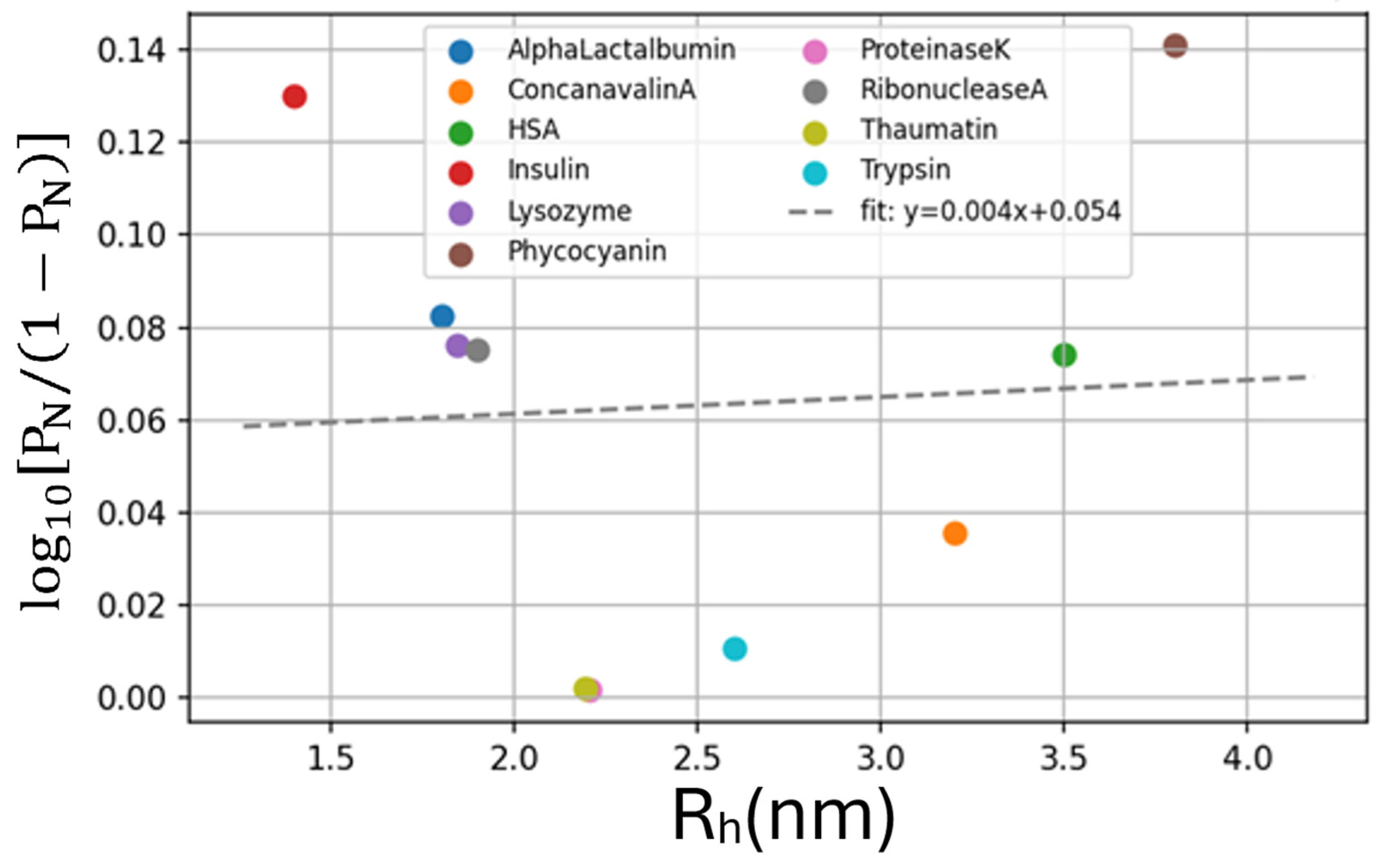
The steady-state probability P N is treated as a normalized two-state occupation that is monotonic in λ . Under the two-state mapping adopted here, l o g i t ( P N ) = λ , so the logit transform equals λ . In Figure 3, we report the base-10 log-odds, l o g 10 [ P N / ( 1 P N ) ] , which is proportional to λ through l o g 10 [ P N / ( 1 P N ) ] = λ / l n 10 . Thus, in Figure 3, the ordinate used is an explicit representation of the coupling strength through l o g 10 P N / 1 P N versus the hydrodynamic radius R h reported on the x-axis. The figure shows that the inferred coupling scale is size-organized across proteins. The fitted trend is shallow, and the correlation is weak, indicating that hydrodynamic size does not provide the dominant organizing axis for the coupling-controlled ordering propensity proxy in this dataset under the present normalization.
The same two-state reduction provides a kinetic readout through the characteristic relaxation time τ N extracted from fitting P ( t ) from Equation (18). This timescale is interpreted here as a mobility- and landscape-controlled orientational relaxation time for the coarse-grained ordering coordinate rather than as an experimental deposition induction time.
In the present framework, the steady productive occupation is determined independently from the Hamiltonian-weighted orientational distribution reconstructed from Equations (10)–(13): the productive probability mass P N e q (and its associated odds parameter λ e q P N e q / ( 1 P N e q ) ) quantifies how confinement reweights orientational phase space toward Ω p r o d . In contrast, τ N encodes the slowest redistribution mode of probability mass under overdamped orientational mixing within the same reduced Hamiltonian landscape ε ( θ , ϕ ) , and therefore depends on rotational mobility and on barrier and curvature features of the landscape rather than solely on the stationary bias. In this sense, λ e q characterizes stationary orientational reweighting, whereas τ N reflects the dominant mixing timescale set by landscape geometry and mobility.
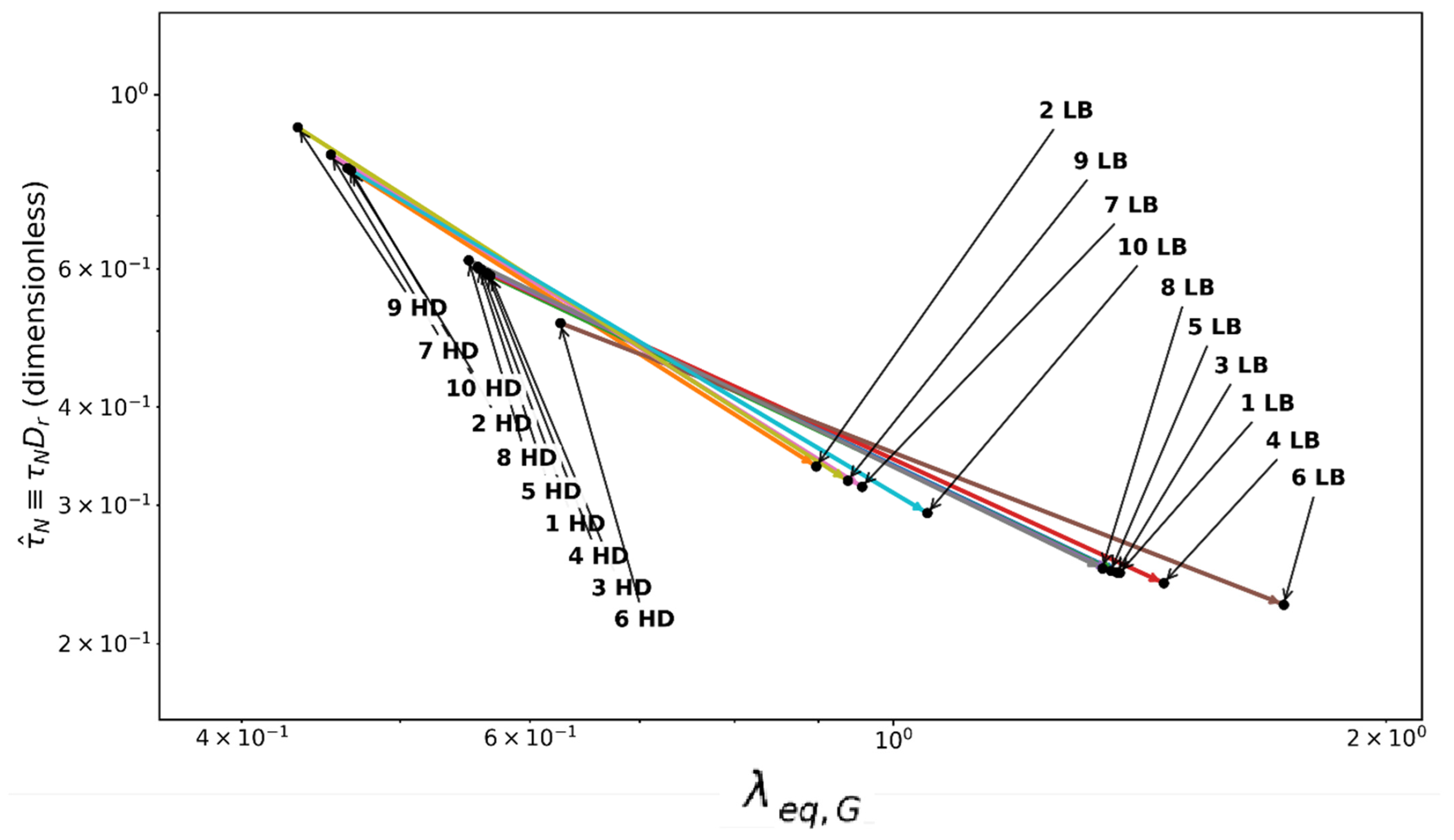
Figure 4 plots τ N versus λ e q on log–log axes and shows a consistent cross-protein HD→LB displacement toward higher effective coupling and lower reduced relaxation time. Across the dataset, the points follow an approximately inverse trend, with a descriptive slope close to 3 / 2 , i.e., τ ^ N λ e q , G 1.50 . Within an overdamped orientational-diffusion picture, increasing confinement-induced bias not only raises the stationary weight of productive orientations (increasing λ e q , G ), but also steepens the localized basin and reduces the effective angular exploration length of the reweighted distribution, thereby accelerating the dominant relaxation mode. The resulting τ ^ N ( λ e q , G ) relation is therefore interpreted as a regime-level trend, reflecting coordinated changes in basin depth, curvature, and effective exploration volume under confinement rather than as a strict identity implied by the two-state parametrization.
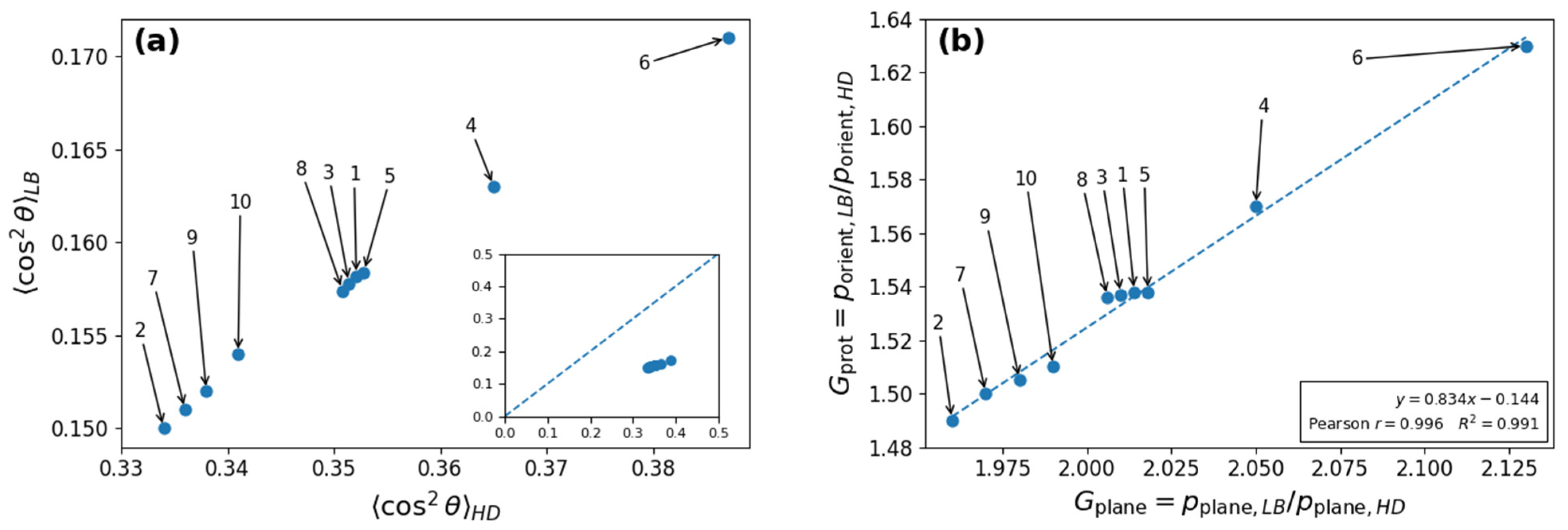
Figure 5 provides two upstream observables that interpret the coupling cascade in terms of confinement-induced planarization and productive probability gains. Figure 5a plots the polar order parameter c o s 2 θ L B against c o s 2 θ H D across proteins planar-ordering diagnostics), showing a systematic shift below the identity line that is consistent with depletion of interface-normal alignment under LB confinement (Supplementary Section S3 and Table S3a). Figure 5b relates the productive gain from Equation (12b): G p r o d = p p r o d , L B / p p r o d , H D to the planar gain: G p l a n e = p p l a n e , L B ( 10 ) / p p l a n e , H D ( 10 ) , indicating that proteins with stronger planarization also exhibit larger productive enhancement under the same global protocol.

3.5. HD–LB Cascade Synthesis and State-Space Summary

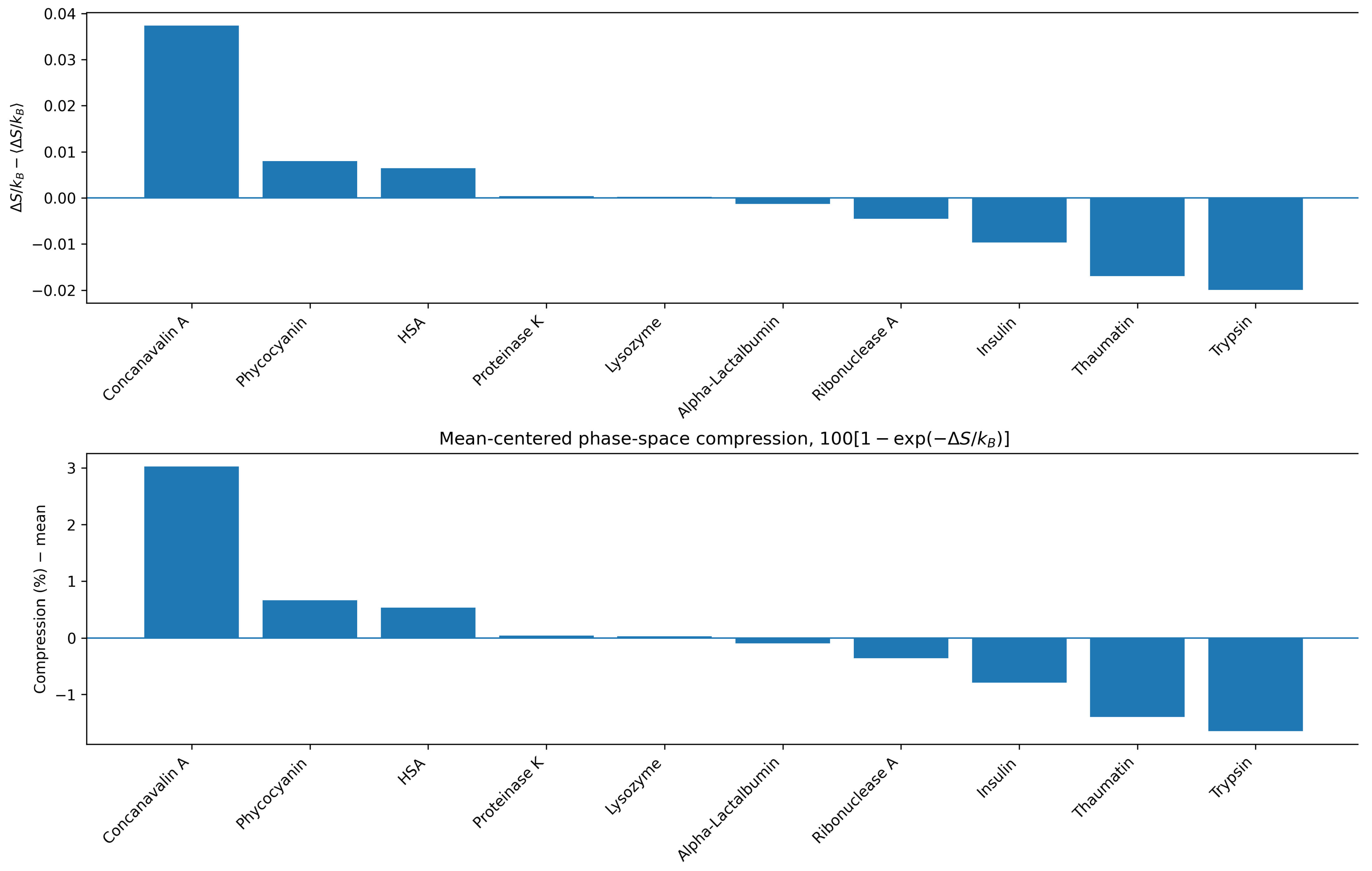
An ensemble-level localization diagnostic is computed from the discretised Hamiltonian-weighted probability mass on the fixed ( θ , φ ) grid. Specifically, the Shannon entropy functional S X (Equation (23)) is evaluated on the normalized grid distribution P X ( θ i , φ j ) obtained from the Boltzmann weights and the solid-angle quadrature factors under the same protocol settings (Equation (28)). The primary HD–LB contrast is expressed as Δ S = S H D S L B . To translate this entropy change into an interpretable measure of phase-space contraction, we report the effective angular phase-space volume Ω e f f , X = e x p S X k B , and the corresponding LB/HD compression ratio:
Ω e f f , L B Ω e f f , H D =   e x p   Δ S k B .
Table 6 lists S H D / k B , S L B / k B , Δ S / k B , and the associated compression metrics for each protein under identical quadrature settings, ensuring that differences arise from the HD versus LB ensembles rather than from numerical resolution. Figure 6 summarizes the same information in two complementary representations.
Panel (a) reports the absolute entropy shift Δ S / k B , which directly quantifies confinement-induced localization of the full ODF. Panel (b) adopts a mean-centered view Δ S ~ i / k B = Δ S i / k B Δ S / k B to visualize protein-to-protein ranking within the dataset. This centered representation necessarily exhibits a sign inversion across proteins: values Δ S ~ i > 0 identify proteins that undergo an above-average entropy reduction under LB, whereas Δ S ~ i < 0 identify proteins whose entropy reduction is below the dataset mean. The presence of both positive and negative centered values, therefore, reflects relative positioning within the ensemble and does not imply a reversal of the physical LB vs. HD trend for S X . The paired reporting of Δ S / k B and Ω e f f , L B / Ω e f f , H D provides a compact, distributional control that complements threshold-based probabilities: it quantifies confinement-induced reweighting of phase space at the level of the full distribution f X θ , φ rather than through a single scalar increment defined on a restricted subset.
The Shannon entropy S X   , computed from the full orientational distribution f X θ , φ (Equation (11)) using Equation (23), shows a protein-dependent sign of Δ S = S H D S L B . Positive values ( Δ S > 0 ) indicate a net localization of the full ODF under LB confinement, whereas negative values ( Δ S < 0 ) indicate a net increase of global dispersion despite polar bias. This sign inversion is physically consistent with the two-degree-of-freedom structure of the ODF: LB confinement can compress the polar coordinate (captured by a decrease in the marginal contribution S θ ) while simultaneously broadening or fragmenting azimuthal probability mass (captured by an increase in the conditional contribution S φ θ ). The decomposition S = S θ + S φ θ therefore identifies whether the HD–LB entropy contrast is dominated by polar localization or by azimuthal redistribution at fixed quadrature settings. Table 7 reports the chain-rule decomposition S = S θ + S φ θ under HD and LB for each protein, together with the corresponding HD–LB component differences. The polar marginal entropy S θ , X / k B and the conditional azimuthal contribution S φ θ X / k B are reported for each ensemble X { H D , L B } , together with their HD–LB differences Δ S θ / k B = S θ , H D / k B S θ , L B / k B and Δ S φ θ / k B = S φ θ H D / k B S φ θ L B / k B . The total entropy shift satisfies Δ S / k B = Δ S θ / k B + Δ S φ θ / k B , enabling attribution of confinement-induced localization to polar narrowing versus azimuthal redistribution.

3.6. Spherical Harmonic Power Spectrum of the Orientational ODF and Mode-Selective LB Amplification

The angular structure of the Hamiltonian-derived distribution f X θ , φ (Equation (11)) is explored in terms of its spherical harmonic decomposition. The expansion coefficients a l m X and the rotationally invariant power spectrum P l X are computed by projection onto the basis Y l m θ , φ and by summation over m as defined in Equation (29–30), using the same ( θ , φ ) discretisation and quadrature weights applied throughout the present Results Section [36]. The analysis is truncated at a fixed l m a x compatible with the angular-grid resolution, and confinement effects are reported as Δ P l = P l L B P l H D . Because P l is invariant under global rotations, Δ P l identifies which angular degrees are preferentially strengthened under LB confinement without dependence on a specific coordinate choice.
Figure 7 reports representative spectra P l H D and P l L B for selected proteins, displayed as the anisotropic component P l for l 1 normalized by P 0 to remove the trivial isotropic baseline set by normalization of f X . Table 8 reports compact spectral summaries per protein, including the total anisotropic power l = 1 l m a x P l and a spectral centroid l = l 1 l P l / l 1 P l , for both HD and LB together with their HD–LB differences. The spherical harmonic decomposition of the reconstructed orientational distribution shows that the HD→LB redistribution is dominated by the quadrupolar sector, with the leading amplitude concentrated at l = 2 . This empirical dominance is not unexpected because the angular Hamiltonian is formulated at quadrupolar order and therefore channels the HD→LB redistribution primarily through second-order angular symmetry. The trend is nevertheless informative because it shows that the experimentally relevant confinement contrast is captured by a low-dimensional mode that is stable across proteins, while the residual higher- l content quantifies protein-specific fine structure beyond the leading mechanism.
Figure 7 resolves the orientational distribution function f X θ , ϕ into spherical harmonics and reports the normalized angular power spectrum P l X / P 0 , where X H D , L B . The degree l indexes angular resolution, with l = 0 representing the isotropic component and l 1 encoding deviations from isotropy. The upper panel shows representative spectra for two proteins under HD (Figure 7a) and LB (Figure 7b) conditions. Several structural features are evident: (i) beyond the l = 0 mode used to normalize, a most pronounced confinement-induced amplification occurs for the quadrupolar mode at l = 2 . Under LB conditions, P 2 / P 0 increases substantially relative to HD, whereas higher-order modes remain small. This identifies the LB-induced anisotropy as primarily quadrupolar, consistent with polar confinement symmetry. (ii) The same panel also shows a negligible high- l amplification mode with l 6 that remains near zero in both ensembles, indicating that LB does not introduce fine angular localization but rather reorganizes the large-scale angular structure. In contrast, the Hellinger distance metric [37] (Figure 8) collapses the full spectral information into a scalar measure of ensemble separation. The two representations are therefore complementary: the former is mechanism-resolved, the latter is globally integrated.

3.7. Tensor Order, Local Stiffness, and Nonlinear Coupling in HD and LB Ensembles

The impact of LB confinement on the phase space reconstructed by the reduced Hamiltonian is quantified using the real-space diagnostics defined in Equations (31)–(36). The three orthogonal outcomes presented in the main text are summarized in Figure 9a–c, and the full per-protein values required for reproducibility are provided in Table 9 and Table 10. This dataset shows a consistent confinement signature at the level of second-rank order. Figure 9a reports the Equation (33) second-rank order metric obtained from Q X (Equations (31)–(33)); higher values in LB indicate that f L B θ , φ is more anisotropic than f H D θ , φ , consistent with an interfacial constraint that preferentially weights a restricted range of orientations.
Figure 9b reports the stiffness diagnostic χ (Equation (35)) and shows that LB simultaneously increases the curvature of the dominant angular well, which is the mechanical signature of tighter trapping around the most probable directional state; Table 9 reports both stiffness components ( χ θ , X and χ φ , X ) to document whether confinement is isotropic in angular coordinates or preferentially stiffens one direction. Figure S1 reports the biaxiality index (Equation (34)) together with the corresponding second-rank orientational order metric from Equation (33), so that symmetry classification is conditioned on the magnitude of ordering. Under HD conditions, several proteins can display extreme biaxiality indices while remaining weakly ordered, a regime in which invariant-based biaxiality ratios are not robust because the tensor invariants entering Equation (34) become small as expected. Under LB conditions, the biaxiality response becomes protein dependent in a physically interpretable manner, with sustained biaxiality emerging primarily in proteins that retain non-negligible second-rank order and strong azimuthal anisotropy content; Table 9 provides the full joint reporting of Equations (33) and (34) required for this classification.
This dataset reveals a distinct and non-redundant confinement effect in the nonlinear coupling structure of the ODF. Figure 9c reports the mutual information I X θ ; φ (Equation (36)) and shows a systematic decrease under LB for all proteins, with a near protein-invariant contraction factor I L B / I H D 0.43 documented numerically in Table 10. This result indicates that LB confinement increases global order (Figure 9a) while reducing polar–azimuthal non-separability of the reconstructed distribution, consistent with a restriction of the effective θ -support that suppresses θ -dependent modulation of the azimuthal structure in p X θ , φ . The protein ranking of I H D further supports the physical content of Equation (36), since coupling is strongest for high- v proteins and negligible already in HD for low- v proteins, indicating that mutual information acts as a direct nonlinear readout of the azimuthal anisotropy embedded in the model rather than a reformulation of second-rank order.
This combined evidence supports a coherent mechanistic statement: LB confinement drives the angular ensemble toward a state that is simultaneously more aligned and more locally trapped (Figure 9a,b, Equations (31)–(35)), while exhibiting reduced nonlinear coupling between polar and azimuthal degrees of freedom (Figure 9c, Equation (36)); the symmetry class of the ordered state is protein dependent and must be interpreted with explicit conditioning on the magnitude of second-rank order (Figure S1, Equation (34)).

4. Discussion

4.1. Productive-Orientation Probabilities and Protein Ordering Under HD and LB Conditions

The uniform inequality p L B > p H D across all proteins establishes that confinement systematically enhances access to the productive-orientation set, independently of molecular identity. The protein dependence of the magnitude reflects how each inertia-derived anisotropy projects onto the confinement potential. In the reference construction, amplification scales directly with spectral asymmetry and therefore exhibits pronounced dispersion [38,39,40,41].
In the Hamiltonian construction, the global-coupling parameter η acts as a shared modulation of phase space, smoothing protein-to-protein variability while preserving the sign of the contrast.
Physically, this indicates that confinement does not introduce protein-specific retuning of geometry; rather, it reshapes the accessible phase space through a common energetic bias. The inertia spectrum determines how strongly a given protein responds to that bias, but the operator itself is uniform [40]. The comparison therefore separates two effects: intrinsic geometric anisotropy (reference spread) and confinement-induced probabilistic reweighting (Hamiltonian smoothing). Together, they demonstrate that the observed LB amplification arises from a systematic redistribution of probability mass rather than from an ad hoc adjustment of individual molecular parameters.
Table 4 makes this dependence explicit. The proxy gain p L B r e f / p H D r e f spans ≈ 1.01–3.28 and separates proteins into a high-response regime (Phycocyanin 3.280; Insulin 2.426; α-lactalbumin 2.018), an intermediate regime (Ribonuclease A 1.981; Lysozyme 1.961; HSA 1.902; Trypsin 1.579), and a low-response regime (Thaumatin 1.412; Proteinase K 1.310), with Concanavalin A defining the near-unity baseline (1.010). The Hamiltonian-weighted gain p L B t h / p H D t h is markedly narrower (≈1.49–1.65) and the absolute probabilities populate tighter intervals ( p H D t h ≈ 0.286–0.339; p L B t h ≈ 0.381–0.526), indicating that energetic reweighting compresses inter-protein dispersion while preserving the ranking implied by the proxy. This proxy–Hamiltonian contrast is mechanistically informative rather than merely methodological: the proxy expresses the leverage available from inertia-tensor invariants (κ2 and Π in Table 4), whereas the Hamiltonian probability integrates those invariants into a single ensemble weight e ε X ( θ , φ ) applied on the same angular grid and under the same global confinement parameters. Cross-protein interpretation should therefore be framed at two levels. A broad dispersion in proxy gain identifies proteins for which geometry alone provides a strong confinement handle, whereas the narrower Hamiltonian gain isolates a dataset-level confinement reweighting of the orientational distribution function that is robust to protein identity under the selected protocol. The analysis reports protein-resolved contrasts within a defined probabilistic model, whereas it uses Table 1, Table 2 and Table 3 to keep protein specificity anchored to PDB-derived invariants rather than to protein-specific tuning.

4.2. Interpretive Framework for Basin Contraction and Probability Densification

Figure 2 and Table 5 quantify productive configurations through a near-minimum energetic neighborhood. The energy-basin probability p E , X t h is then defined as the Boltzmann-weighted probability mass assigned t h r o u g h   E q u a t i o n ( 12 b ) under the same normalized distribution f X ( θ , ϕ ) reconstructed from the reduced Hamiltonian. Table 5 reports p X t h (E) under HD and LB at fixed Δ = 0.25 kBT, and provides the mechanistic factorisation p X t h (E) = m X C X , where this factorization is central because it separates two non-equivalent confinement effects: geometric contraction of the near-minimum admissible set and densification of probability within that set. The results show C L B > C H D for all proteins, while m L B < m H D for all proteins, and the net increment p t h (E) is negative across the panel. The protein-to-protein contrasts locate where each system sits in the contraction–densification trade-off.
Concanavalin A exhibits strong basin contraction ( m H D = 1.000 m L B = 0.288 ) with moderate densification ( C H D = 1.000 C L B = 1.827 ), yielding a large negative energy-basin contrast Δ p t h = p L B t h p H D t h 0.474 . Thaumatin shows a comparatively small contrast ( Δ p t h 0.018 ) because the measure loss ( 0.360 0.224 ) is limited and the densification ( 1.164 1.791 ) nearly compensates. Phycocyanin and Insulin show strong densification (e.g., Phycocyanin 1.464 to 3.199) but even stronger measure loss (0.346 to 0.056), explaining why Δ p t h (E) remains strongly negative despite their large proxy gains in Table 3 and Table 4. Figure 2b consolidates these statements by plotting l o g ( m L B / m H D ) against l o g ( C L B / C H D ) , where diagonal guidelines correspond to constant p L B t h / p H D t h via p L B t h / p H D t h =   m L B / m H D ( C L B / C H D ). The energy-basin analysis, therefore, provides a topology-sensitive constraint that complements the geometric productive set: confinement can increase geometric productive probability while decreasing the probability captured within a fixed-Δ energetic neighborhood because the two operators probe different, explicitly defined aspects of the same energy function ε X ( θ , φ ) .

4.3. Coupling-Controlled Kinetic Proxy: Mapping from Δp to λ and τ N Across Proteins

This propagation from confinement-induced orientational reweighting to a kinetic proxy is studied through a parameterized mapping. The modeling chain first defines the confinement increment Δ p = p L B t h p H D   t h (Equation (13)), evaluated with the geometric productive set Ω G (Equation (12b)), then converts Δ p into an effective dimensionless coupling parameter λ through energetic regularization, and finally maps λ onto a steady-state productive occupation P N and a characteristic relaxation time τ N under a two-state closure (Equations (17)–(21)).
In Figure 4, the cross-protein comparison is presented in absolute reduced coordinates rather than in paired gain space: the coupling response is represented by λ e q , G , and the kinetic response is represented by the reduced relaxation proxy τ ^ N τ N D r . This representation is therefore dimensionless and does not require explicit hydrodynamic-radius scaling, while still allowing the HD LB displacement to be read within each protein pair. The mapping is exercised over a non-trivial dynamic interval at the level of the operative confinement input Δ p , which spans approximately 0.155 0.249 across the ten proteins (geometric productive set). Across the same dataset, λ H D lies in the range 0.43 0.63 , whereas λ L B lies in the range 0.90 1.73 . The corresponding reduced kinetic response shifts systematically toward lower τ ^ N under LB, indicating faster orientational relaxation under stronger confinement. Figure 4, therefore, provides a protocol-level picture in which LB confinement consistently moves the system toward higher effective coupling and lower reduced relaxation time within the same protein.
The magnitude of τ N is discussed at the correct interpretive level by construction: τ N is a microscopic relaxation time of the reduced ordering coordinate under overdamped mixing in the reconstructed landscape, and the HD/LB ratio is therefore a proxy for orientational readiness rather than a substitute for experimental induction times. This interpretation should be kept strictly at the level of the reduced model: the reported τ N values and ratios quantify relative changes in orientational relaxation propensity under HD and LB, not experimentally measured nucleation timescales. Molecular-dynamics-based validation or time-resolved experimental calibration would be valuable future extensions, but they are outside the scope of the present theoretical comparison.

4.4. Distribution Reweighting: Polar Localization, Entropy Compression, and Spectral Content

The cross-protein contrast is informative when read jointly with Table 4. Concanavalin A combines minimal proxy gain with one of the strongest entropy compressions, indicating that confinement can localize the ensemble globally, even when a specific geometry-defined productive patch captures limited additional probability mass. Table 7 further resolves entropy into polar and azimuthal contributions (S = Sθ + ⟨Sφ|θ⟩), enabling attribution of ΔS to polar localization versus azimuthal redistribution in a protein-resolved manner under identical quadrature settings [42]. The spherical harmonic analysis (Equations (29) and (30)) adds a symmetry-resolved view. Figure 7 identifies the quadrupolar mode = 2 as the dominant channel of confinement-amplified anisotropy, while higher- contributions remain small, indicating broad, low-rank redistribution rather than sharp localization into fine angular structures. Figure 8 complements this with a bounded global separability measure H f H D , f L B (Hellinger distance) [43] and relates separability to quadrupolar amplification, thereby connecting mode selectivity to overall ensemble displacement. Together, these controls establish that confinement effects are expressed at the level of the full distribution and provide a consistent, protein-resolved basis for interpreting differences in magnitude across the panel.

4.5. Order, Stiffness, and θ–φ Dependence: Complementary Constraints on Confinement-Induced Structure

Figure 8 and Table 8 and Table 9 constrain the confinement effect using three complementary diagnostics that probe distinct aspects of the reconstructed ensemble: second-rank order (Equation (31)), local stiffness at the dominant minimum (Equation (33)), and nonlinear θ φ dependence quantified by mutual information (Equation (34)). The Q-tensor order metric provides a rotationally invariant measure of departure from isotropy computed directly from the orientational distribution function, and Figure 9a shows a systematic increase from HD to LB across proteins, with Table 9 providing the per-protein values required for quantitative comparison. The magnitude is protein dependent, consistent with the gain ordering in Table 4, and it supplies an independent validation of confinement-induced ordering because it is not defined by thresholding into a productive set. The stiffness diagnostic complements this global view by probing curvature near the dominant minimum of the reduced energy. Figure 9b reports increased stiffness under LB, and Table 9 details stiffness components, enabling an assessment of whether confinement preferentially stiffens polar versus azimuthal directions; the absence of an azimuthal curvature entry for polar minima follows the methodological statement that φ-curvature is ill defined at θ = 0 or π. Mutual information adds a non-redundant constraint on joint angular structure. Figure 9c and Table 10 show that I ( θ ,   φ ) decreases under LB for every protein, and that the contraction factor I L B / I H D is narrowly distributed (≈ 0.407–0.446) despite large protein-to-protein differences in absolute I H D . This near multiplicative invariance implies that confinement-induced ordering and stiffening are accompanied by a systematic simplification of the joint angular dependence rather than by increased nonlinear coupling between θ and φ. The combined interpretation is therefore multi-dimensional and protein resolved: LB confinement increases second-rank order and local trapping while reducing θφ interdependence, and the extent of these effects varies across the panel in a manner that is consistent with the structural dispersion captured by κ2 and Π in Table 4 and with the whole-distribution localization captured by the spectral and orientational diagnostics summarized in Table 6, Table 7, Table 8, Table 9 and Table 10 and Figure 6, Figure 7, Figure 8 and Figure 9.
Although the present framework is not calibrated to absolute crystallization rates, the predicted orientational reweighting has clear qualitative experimental implications. A systematic LB-induced increase in productive-orientation probability, together with stronger planar ordering and entropy compression, would be expected to favor earlier access to nucleation-competent encounter geometries at the interface. In experimental terms, this could translate into a higher fraction of successful crystallization trials, shorter induction windows, larger crystal counts, or improved reproducibility under LB-templated conditions relative to HD controls, provided that solution chemistry and supersaturation are kept comparable. We stress, however, that the present results support these observables at the level of directional readiness and interfacial ordering, not as direct predictions of absolute growth rates or diffraction resolution.

5. Conclusions

This study provides a PDB-driven framework to investigate orientational-ordering mechanisms in LB films vs. HD processes. The main result from the framework is the presentation of a coherent amplification chain from molecular-shape tensors to confinement-induced ordering increments and coupling-controlled kinetics, enclosing LB enhancement as a boundary-condition effect rather than an empirical artefact. LB conditions are shown to produce orientationally ordered protein configurations in most cases reported.
The system is formulated through a reduced angular Hamiltonian that enables a consistent evaluation of productive-orientation probability, energy-basin topology, and whole-distribution diagnostics within a single probabilistic framework. Across a ten-protein panel, the HD→LB contrast exhibits a uniform direction for Hamiltonian-weighted productive probability while preserving a protein-dependent magnitude that is expressed most strongly in geometry-only benchmarks. The energy-basin operator further resolves confinement effects into basin-measure contraction versus in-basin densification, clarifying how localization around the dominant minimum can coexist with reduced probability mass within a fixed- Δ neighborhood.
The coupling-controlled kinetic proxy provides a compact cross-protein organization: confinement-induced Δ p propagates to λ and to τ N , yielding a coherent cross-protein trend and suggesting that the inferred amplification is not reducible to a hydrodynamic size over this dataset. Whole-distribution controls strengthen this interpretation by showing polar localization, entropy-based phase-space compression, and quadrupolar mode selectivity, while orientational diagnostics indicate increased second-rank order and stiffness, accompanied by a systematic reduction in θ φ mutual information.
Collectively, these results suggest a mechanistic picture in which confinement reshapes orientational phase space in a protein-specific but model-consistent manner, and they support the use of a Hamiltonian-based statistical–mechanical framework as a coherent link between protein geometry and the inferred nucleation tendency.

Supplementary Materials

The following supporting information can be downloaded at: https://www.mdpi.com/article/10.3390/cryst16040269/s1. The material in the Supplementary Materials file is as follows: S1. PDB-derived descriptors and size normalizers; S1.1 Translational diffusion and hydrodynamic cross-checks; S1.2. Rotational diffusion coefficient used for mobility calibration; Table S1. Expanded PDB-derived structural descriptors and orientational kinetic normalizers for the studied proteins; S2. Protocol-level coupling sensitivity and operational definition of planar ordering; Figure S1. Sensitivity of confinement-driven ordering and gain metrics to η at fixed ξ = 1 ; Table S2. Magnitude sensitivity of confinement gains and planarization readouts across the protocol grid, relative to the baseline ξ , η ) = ( 1,3 ; S3. Orientational partition function and distribution; Table S3a. Baseline ODF-derived ordering observables per protein at ξ , η ) = ( 1,3 ; Table S3b. Surface-only calibration of the confinement parameter η for ε s u r f ( θ ) = η c o s 2 θ ; Figure S2. Surface-only calibration of the confinement parameter η for ε s u r f ( θ ) = η c o s 2 θ ; S4. Sensitivity and identifiability of the geometric acceptance parameters δ and φ ; Figure S3. Sensitivity of the geometric productive subset parameters ( δ , φ ) in Equation (12b) under fixed ξ , η ) = ( 1,3 ; Table S4. ( δ , ϕ ) sensitivity sweep underlying Figure S3.

Author Contributions

Conceptualization: E.P. and R.E.; methodology, E.P., P.G., C.R., K.B. and G.C.; software: F.M.S. and R.E.; validation: E.P., P.G., C.R., S.O. and R.E.; formal analysis: E.P., F.M.S. and R.E.; investigation: K.B. and R.E.; resources: R.E.; data curation: E.P., F.M.S., P.G. and C.R.; writing—original draft preparation, E.P., F.M.S., P.G., C.R., K.B., G.C., S.O. and R.E.; writing—review and editing, E.P., F.M.S., P.G., C.R., K.B., G.C., S.O. and R.E.; visualization: K.B.; supervision, E.P. and R.E. project administration: E.P. All authors have read and agreed to the published version of the manuscript.

Funding

This work was supported by the Italian Ministry of University and Research, PRIN. 2022D53C24004370006.

Data Availability Statement

The datasets presented in this article are not readily available because of technical limitations. Requests to access the datasets should be directed to Roberto Eggenhöffner, roberto.eggenhoffner@unige.it.

Acknowledgments

In selected stages, GPT5 (via ChatGPT 5.4) was used as an implementation aid, including translation of analytical expressions into executable code, debugging, and prompting manual consistency checks. These interactions supported implementation and verification workflows; they did not replace author-defined modelling choices, production runs, or author-led validation. All modelling assumptions, parameter choices, numerical settings, validation steps, and interpretation of outputs were defined and verified by the authors. All cited sources were ultimately selected, read, and interpreted by the authors. AI tools were also used during early drafting and language revision to improve clarity and readability. All scientific interpretations and the final manuscript content are the sole responsibility of the authors. The manuscript was carefully reviewed and finalized to ensure scientific accuracy, originality, and compliance with journal policies regarding the transparent use of AI-assisted tools.

Conflicts of Interest

The authors declare no conflicts of interest.

Abbreviations

The following abbreviations are used in this manuscript:
Alpha-carbon atoms of the protein backbone (Cα trace used as a rigid point cloud)
HDHanging-drop crystallization condition (vapour-diffusion)
HSAHuman serum albumin
kBBoltzmann constant (used for entropy normalisation, e.g., S/kB)
LBLangmuir–Blodgett condition (nanotemplating/interfacial confinement)
ODFOrientation distribution function
PDBProtein Data Bank
RgRadius of gyration
RhHydrodynamic radius
SASASolvent-accessible surface area

References

  1. Holcomb, J.; Spellmon, N.; Zhang, Y.; Doughan, M.; Li, C.; Yang, Z. Protein crystallization: Eluding the bottleneck of X-ray crystallography. AIMS Biophys. 2017, 4, 557–575. [Google Scholar] [CrossRef]
  2. Chayen, N.E. Turning protein crystallisation from an art into a science. Curr. Opin. Struct. Biol. 2004, 14, 577–583. [Google Scholar] [CrossRef]
  3. Moreno, A. Advanced methods of protein crystallization. Methods Mol. Biol. 2017, 1607, 51–76. [Google Scholar] [CrossRef]
  4. Zhou, R.; Cao, H.; Zhang, C.; Yin, D. A review on recent advances for nucleants and nucleation in protein crystallization. CrystEngComm 2017, 19, 1143–1155. [Google Scholar] [CrossRef]
  5. Nanev, C.N.; Saridakis, E.; Chayen, N.E. Protein crystal nucleation in pores. Sci. Rep. 2017, 7, 35821. [Google Scholar] [CrossRef] [PubMed]
  6. García-Ruiz, J.M.; Otálora, F. Macromolecular Crystals—Growth and Characterization. In Crystal Growth-From Fundamentals to Technology; Elsevier: Amsterdam, The Netherlands, 2004; pp. 369–390. [Google Scholar]
  7. Pechkova, E.; Nicolini, C. Langmuir–Blodgett nanotemplates for protein crystallography. Nat. Protoc. 2017, 12, 2570–2589. [Google Scholar] [CrossRef] [PubMed]
  8. Banks, H.; Surfaro, F.; Pastryk, K.-F.; Buchholz, C.; Zaluzhnyy, I.A.; Gerlach, A.; Schreiber, F. From adsorption to crystallization of proteins: Evidence for interface-assisted nucleation. Colloids Surf. B Biointerfaces 2024, 241, 114063. [Google Scholar] [CrossRef]
  9. wwPDB Consortium. Protein Data Bank: The single global archive for 3D macromolecular structure data. Nucleic Acids Res. 2019, 47, D520–D528. [Google Scholar] [CrossRef] [PubMed]
  10. Berman, H.M.; Westbrook, J.; Feng, Z.; Gilliland, G.; Bhat, T.N.; Weissig, H.; Shindyalov, I.N.; Bourne, P.E. The Protein Data Bank. Nucleic Acids Res. 2000, 28, 235–242. [Google Scholar] [CrossRef] [PubMed]
  11. Acharya, B.S.; Abdul Salam, A.A. Solid/liquid interface induced protein crystallization. Prog. Cryst. Growth Charact. Mater. 2025, 71, 100676. [Google Scholar] [CrossRef]
  12. Adawy, A. A tutorial review on the methodologies and theories utilized to handle proteins toward obtaining single protein crystals. Cryst. Growth Des. 2024, 24, 6865–6887. [Google Scholar] [CrossRef]
  13. Artusio, F. Mastering interfaces: Advances and challenges in controlling protein nucleation. CrystEngComm 2025, 27, 6106–6121. [Google Scholar] [CrossRef]
  14. Yaws, C.L.; Leh, A.S. Radius of gyration—Organic compounds. In Thermophysical Properties of Chemicals and Hydrocarbons; William Andrew Publishing: Norwich, NY, USA, 2009; pp. 661–668. [Google Scholar]
  15. Pitulice, L.; Isvoran, A.; Craescu, C.T.; Chiriac, A. Scaling properties of the radius of gyration and surface area for EF-hand calcium binding proteins. Chaos Solitons Fractals 2009, 40, 684–690. [Google Scholar] [CrossRef]
  16. Suematsu, K. Radius of Gyration of Randomly Branched Molecules. arXiv 2014, arXiv:1402.6408. [Google Scholar] [CrossRef]
  17. Li, W. Protein Structure Description with ρ, θ and ϕ: A Case Study with Caenopore-5. bioRxiv 2025, 1–14. [Google Scholar] [CrossRef]
  18. Bisi, F.; Luckhurst, G.R.; Virga, E.G. Dominant biaxial quadrupolar contribution to the nematic potential of mean torque. Phys. Rev. E 2008, 78, 021710. [Google Scholar] [CrossRef]
  19. Puech, N.; Grelet, E.; Poulin, P.; Blanc, C.; van Der Schoot, P. Nematic droplets in aqueous dispersions of carbon nanotubes. Phys. Rev. E 2010, 82, 020702. [Google Scholar] [CrossRef] [PubMed]
  20. Muravsky, A.; Murauski, A. Q&A of liquid crystal alignment: Theory and practice. Front. Soft Matter 2024, 4, 1382925. [Google Scholar] [CrossRef]
  21. Alamdari, S.; Roeters, S.J.; Golbek, T.W.; Schmuser, L.; Weidner, T.; Pfaendtner, J. Orientation and conformation of proteins at the air–water interface determined from integrative molecular dynamics simulations and sum frequency generation spectroscopy. Langmuir 2020, 36, 11855–11865. [Google Scholar] [CrossRef] [PubMed]
  22. Kanthe, A.; Ilott, A.; Krause, M.; Zheng, S.; Li, J.; Bu, W.; Bera, M.K.; Lin, B.; Maldarelli, C.; Tu, R.S. No ordinary proteins: Adsorption and molecular orientation of monoclonal antibodies. Sci. Adv. 2021, 7, eabg2873. [Google Scholar] [CrossRef] [PubMed]
  23. Huang, K. Introduction to Statistical Physics; John Wiley & Sons: Hoboken, NJ, USA, 2008. [Google Scholar]
  24. Borgmans, S.; Rogge, S.M.J.; Vanduyfhuys, L.; Van Speybroeck, V. OGRe: Optimal Grid Refinement 263 Protocol for Accurate Free Energy Surfaces and Its Application to Proton Hopping in Zeolites and 264 2D COF Stacking. J. Chem. Theory Comput. 2023, 19, 9032–9048. [Google Scholar] [CrossRef] [PubMed]
  25. Schön, J.C. Energy Landscapes-Past, Present, and Future: A Perspective. J. Chem. Phys. 2024, 161, 050901. [Google Scholar] [CrossRef]
  26. Schaeben, H. Parameterizations and probability distributions of orientations. Texture Stress. Microstruct. 1990, 13, 51–54. [Google Scholar] [CrossRef]
  27. Liu, N.; Wang, H.-W. Better Cryo-EM Specimen Preparation: How to Deal with the Air–Water Interface? J. Mol. Biol. 2023, 435, 167926. [Google Scholar] [CrossRef]
  28. Pathria, R.K.; Beale, P.D. The statistical basis of thermodynamics. In Statistical Mechanics; Elsevier: Amsterdam, The Netherlands, 2011; pp. 1–23. [Google Scholar]
  29. Talkner, P.; Hänggi, P. Colloquium: Statistical mechanics and thermodynamics at strong coupling: Quantum and classical. Rev. Mod. Phys. 2020, 92, 041002. [Google Scholar] [CrossRef]
  30. Zhao, W.; Wu, C.X.; Iwamoto, M. Analysis of weak-anchoring effect in nematic liquid crystals. Phys. Rev. E 2000, 62, R1481. [Google Scholar] [CrossRef]
  31. Wang, Q.A. Extensive generalization of statistical mechanics based on incomplete information theory. Entropy 2003, 5, 220–232. [Google Scholar] [CrossRef]
  32. Turzi, S.S.; Bisi, F. Determination of the symmetry classes of orientational ordering tensors. arXiv 2016, arXiv:1602.06413. [Google Scholar] [CrossRef]
  33. Nielsen, F. An elementary introduction to information geometry. Entropy 2020, 22, 1100. [Google Scholar] [CrossRef]
  34. Frenkel, D.; Smit, B. Understanding Molecular Simulation: From Algorithms to Applications; Elsevier: Amsterdam, The Netherlands, 2023. [Google Scholar]
  35. Pechkova, E.; Nicolini, C. From art to science in protein crystallization by means of thin-film nanotechnology. Nanotechnology 2002, 13, 460–464. [Google Scholar] [CrossRef]
  36. Varshalovich, D.A.; Moskalev, A.N.; Khersonskiĭ, V.K. Quantum Theory of Angular Momentum: Irreducible Tensors, Spherical Harmonics, Vector Coupling Coefficients, 3nj Symbols; World Scientific Pub: Singapore, 1989. Available online: https://lccn.loc.gov/86009279 (accessed on 24 March 2026).
  37. Nikulin, M.S. Hellinger distance. In Encyclopedia of Mathematics; Kluwer Academic Publishers: Dordrecht, The Netherlands, 2001; p. 78. [Google Scholar]
  38. Pechkova, E.; Speranza, F.M.; Ghisellini, P.; Rando, C.; Barbaro, K.; Eggenhöffner, R. Hybrid Kinetic Modelling of Protein Crystallization: Hanging Drop and Langmuir–Blodgett Conditions. Crystals 2025, 15, 857. [Google Scholar] [CrossRef]
  39. Zhang, N.; Guan, W.; Cui, S.; Ai, N. Crowded environments tune the fold-switching in metamorphic proteins. Commun. Chem. 2023, 6, 117. [Google Scholar] [CrossRef]
  40. Klyshko, E.; Kim, J.S.-H.; McGough, L.; Valeeva, V.; Lee, E.; Ranganathan, R.; Rauscher, S. Functional protein dynamics in a crystal. Nat. Commun. 2024, 15, 3244. [Google Scholar] [CrossRef] [PubMed]
  41. Tian, W.; Rielly, C.; Yang, H. Protein crystallisation with air bubble templates: Case of gas–liquid–solid interfaces. CrystEngComm 2021, 23, 8159–8168. [Google Scholar] [CrossRef]
  42. Blech, A.; Ebeling, R.M.; Heger, M.; Koch, C.P.; Reich, D.M. Numerical evaluation of orientation averages and its application to molecular physics. J. Chem. Phys. 2024, 161, 131501. [Google Scholar] [CrossRef]
  43. Dwivedi, A.; Wang, S.; Tajer, A. Discriminant analysis under f-divergence measures. Entropy 2022, 24, 188. [Google Scholar] [CrossRef] [PubMed]
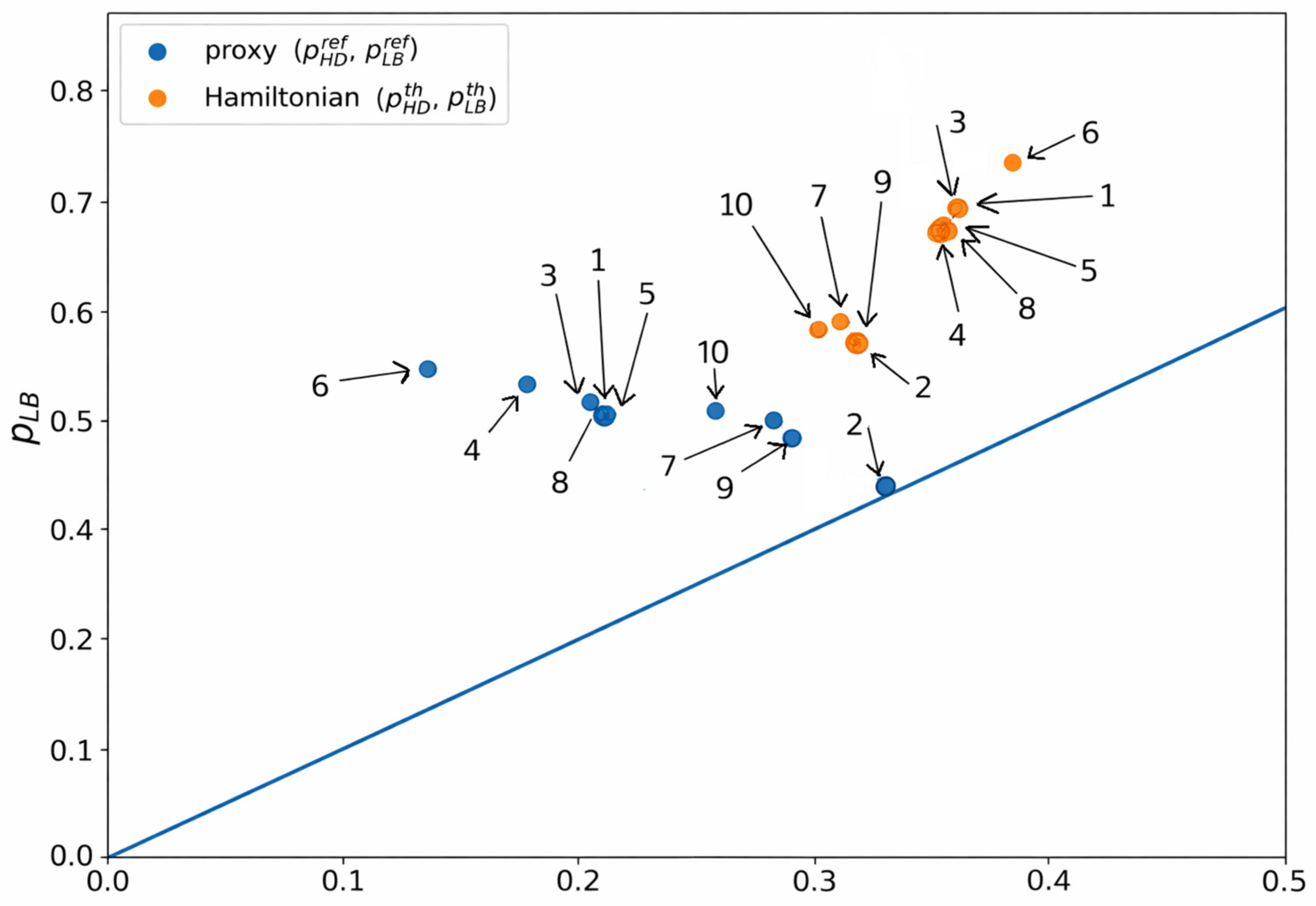
Figure 1. Paired comparison of probabilities under LB confinement versus HD conditions. The plot reports p L B versus p H D for both the proxy construction p H D r e f p L B r e f and the Hamiltonian construction p H D t h p L B t h . Each marker corresponds to one protein and represents an HD–LB pair evaluated under the same geometric productive criterion. The identity line indicates equal probability; systematic displacement above the line indicates confinement-induced ordering. Numbering key: 1 = Alpha-Lactalbumin; 2 = Concanavalin A; 3 = HSA; 4 = Insulin; 5 = Lysozyme; 6 = Phycocyanin; 7 = Proteinase K; 8 = Ribonuclease A; 9 = Thaumatin; 10 = Trypsin.
Crystals 16 00269 g001
Figure 3. Nucleation probability proxy versus hydrodynamic radiu. The ordinate is l o g 10 P N / 1 P N , which equals l o g 10 λ under the two-state mapping P N = λ / 1 + λ . The fitted trend is shallow, indicating weak size organization of the inferred coupling scale across proteins.
Crystals 16 00269 g003
Figure 4. Log–log representation of the reduced kinetic proxy τ ^ N τ N D r versus the effective coupling λ e q , G for the ten proteins under HD and LB conditions. For each protein, the two labeled points (HD and LB) are connected to visualize the confinement-induced shift from the HD state to the LB state. The figure shows that LB systematically moves the system toward higher λ e q , G and lower τ ^ N , consistent with stronger coupling and faster reduced orientational relaxation under confinement.
Crystals 16 00269 g004
Figure 5. Planarization and gain concordance across proteins under the global protocol. (a) Paired comparison of the polar order parameter c o s 2 θ : c o s 2 θ L B versus c o s 2 θ H D for the 10-protein set (values from Supplementary S3 and Table S3a, planar-ordering diagnostics). The identity line marks equality; systematic displacement below the line indicates confinement-induced depletion of interface-normal alignment (enhanced planarity) under LB. (b) Productive gain versus planar gain: G p r o d = p p r o d , L B / p p r o d , H D plotted against G p l a n e = p p l a n e , L B ( 10 ) / p p l a n e , H D ( 10 ) , where p p l a n e , X ( 10 ) is the equatorial-belt mass defined in Methods (Section 2.10) and p p r o d , X is the geometric productive probability defined in Equation (12b) and evaluated via Equation (13). Protein numbering as in Figure 1.
Crystals 16 00269 g005
Figure 6. Entropy shift and effective phase-space compression under LB confinement. Bars show Δ S / k B and Ω e f f , L B / Ω e f f , H D = e x p Δ S / k B computed from Equation (23).
Crystals 16 00269 g006
Figure 7. Spherical harmonic signature of the orientational ODF and global HD–LB reweighting. (a) Representative normalized spectra P l X / P 0 LB (Equations (29) and (30)) under HD (a) and LB (b).
Crystals 16 00269 g007
Figure 8. Global orientational reweighting versus quadrupolar amplification. Hellinger distance H f H D , f L B plotted against Δ P 2 / P 0 . All proteins exhibit moderate but systematic ensemble separation, with larger quadrupolar amplification associated with increased global distributional distance. Protein numbering as in Figure 1.
Crystals 16 00269 g008
Figure 9. (a) Second-rank orientational order from the Q-tensor (Equation (33)). Second-rank order metric S X computed from the alignment tensor Q X (Equations (31)–(33)) for each protein under HD and LB conditions. Higher values indicate a stronger departure from isotropy of the reconstructed distribution f X ( θ , φ ) , consistent with confinement-driven redistribution of probability mass over the angular domain. (b) Local confinement stiffness χ at the dominant minimum. Local stiffness parameters χ X evaluated at the dominant minimum of the reduced orientational energy (Equation (35)), reported for each protein under HD and LB conditions. Larger stiffness corresponds to a tighter orientational well and therefore to stronger harmonic confinement of fluctuations around the most probable orientation. (c) Nonlinear polar–azimuthal coupling quantified by mutual information (Equation (36)). Mutual information I X θ ; φ computed from the reconstructed joint angular distribution (Equation (36)), reported for each protein under HD and LB conditions. Lower values indicate reduced non-separability between polar and azimuthal degrees of freedom, i.e., a joint distribution closer to a factorisable structure under confinement.
Crystals 16 00269 g009aCrystals 16 00269 g009b
Table 1. Structural and physical descriptors of the studied proteins derived from PDB coordinates. Cα denotes the number of Cα atoms in the model. D t is the translational diffusion coefficient; SASA is the solvent-accessible surface area (reported in n m 2 ); R e f f is an effective radius.
ProteinPDB D t
(m2/s)
SASA (nm2) R e f f
(nm)
Alpha-Lactalbumin1A4V1251.35−10722.39
Concanavalin A1CVN2388.90−111072.92
HSA1AO611568.00−115786.78
Insulin4INS1021.50−10622.22
Lysozyme1HEW1291.33−10682.32
Phycocyanin1GH06929.00−113124.98
Proteinase K2PRK2811.11−101193.08
Ribonuclease A7RSA1241.29−1065.82.29
Thaumatin1RQW2071.12−101112.97
Trypsin2PTN2241.05−101153.03
Table 2. Principal moments of inertia and shape descriptors computed from Cα coordinates after centring at the molecular centroid. I1–I3 are the principal moments; Rg and Rh are the radius of gyration and hydrodynamic radius, respectively; κ2 is the relative shape anisotropy; Π is the planar anisotropy.
ProteinPDBI12)I22)I32)Rg
(nm)
Rh
(nm)
Anisotropy
2)
Planar Anisotropy
Alpha-Lactalbumin1A4V996018,70020,1001.401.800.1520.057
Concanavalin A1CVN519,000520,000524,0002.873.200.0000.005
HSA1AO6615,0001,120,0001,170,0003.553.500.1340.033
Insulin4INS643014,10015,6001.331.400.2210.084
Lysozyme1HEW10,20018,70020,0001.381.850.1420.053
Phycocyanin1GH0175,000542,000574,0003.063.800.3540.050
Proteinase K2PRK43,90049,50057,5001.642.200.0250.106
Ribonuclease A7RSA10,50019,10020,8001.431.900.1450.067
Thaumatin1RQW29,60033,40041,8001.592.190.0430.160
Trypsin2PTN29,20038,10046,1001.592.600.0660.141
Table 3. Planar-ordering diagnostics under global ξ = 1 , η = 3 : the polar order metric c o s 2 θ ; the divergence D K L ( L B H D ) evaluated from the Hamiltonian-weighted distribution over the HD domain Ω 3 D and the LB domain Ω 2 D .
ProteinPDBuv c o s 2 θ H D c o s 2 θ L B D K L
Alpha-Lactalbumin1A4V0.3550.5380.3750.1670.27
Concanavalin A1CVN0.0090.0020.3350.1510.235
HSA1AO60.3120.5220.370.1650.265
Insulin4INS0.4430.6370.3850.1710.278
Lysozyme1HEW0.340.5210.3740.1670.268
Phycocyanin1GH00.5010.8530.3850.1710.279
Proteinase K2PRK0.2150.1110.3630.1620.258
Ribonuclease A7RSA0.3570.5120.3760.1680.27
Thaumatin1RQW0.2950.1090.3740.1670.268
Trypsin2PTN0.3290.2350.3780.1690.271
Table 4. PDB-derived geometric and angular descriptors under HD and LB ensembles. κ2 and Π are shape invariants from the inertia tensor; p H D r e f , p L B r e f are proxy probabilities from the inertia spectrum; p H D t h , p L B t h are Hamiltonian-weighted productive probabilities that are computed from Equation (13) using Equation (12b) with fixed acceptance parameters δ , ϕ ) = ( 35 , 50 ; HD and LB are evaluated on the same full orientational domain, and reported ratios quantify the LB/HD gain produced by confinement-induced probability reweighting.
Proteinκ2Π p H D r e f p L B r e f p L B r e f / p H D r e f p H D t h (G) p L B t h (G) p L B t h ( G ) / p H D t h ( G )
Alpha-Lactalbumin0.1520.0570.2040.4122.0180.3590.5791.613
Concanavalin A0.0000.0050.3320.3351.0100.3180.4731.489
HSA0.1340.0330.2120.4031.9020.3620.5781.596
Insulin0.2210.0840.1780.4322.4260.3610.5941.644
Lysozyme0.1420.0530.2090.4091.9610.3580.5761.608
Phycocyanin0.3540.0500.1360.4453.2800.3850.6341.646
Proteinase K0.0250.1060.2910.3811.3100.3120.4891.568
Ribonuclease A0.1450.0670.2080.4131.9810.3550.5731.616
Thaumatin0.0430.1600.2820.3991.4120.3020.4841.602
Trypsin0.0660.1410.2570.4071.5790.3170.5121.616
Table 5. Energy-basin productive probability and basin decomposition at fixed Δ = 0.25 k B T .
ProteinPDB p H D r e f p L B r e f p H D t h ( E ) p L B t h E Δp (E) m H D m L B C H D C L B
Alpha-Lactalbumin1A4V0.2040.4120.6050.189−0.4150.4800.0731.2592.613
Concanavalin A1CVN0.3320.3351.0000.526−0.4741.0000.2881.0001.827
HSA1AO60.2120.4030.5860.191−0.3950.4680.0731.2512.606
Insulin4INS0.1780.4320.5700.184−0.3850.4280.0671.3312.764
Lysozyme1HEW0.2090.4090.6060.190−0.4160.4850.0741.2492.588
Phycocyanin1GH00.1360.4450.5060.179−0.3270.3460.0561.4643.199
Proteinase K2PRK0.2910.3810.6730.394−0.2780.6290.2151.0691.831
Ribonuclease A7RSA0.2080.4130.6000.192−0.4080.4790.0751.2512.557
Thaumatin1RQW0.2820.3990.4190.401−0.0180.3600.2241.1641.791
Trypsin2PTN0.2570.4070.4520.245−0.2070.3790.1211.1912.022
Table 6. Shannon entropy shift and effective phase-space compression under LB confinement. Values report S X / k B , Δ S / k B = S H D / k B S L B / k B , Ω e f f , L B / Ω e f f , H D = e x p Δ S / k B , percent compression, and mean-centered rankings across proteins. Centered quantities are computed as Δ S ~ = Δ S Δ S and Compression ~ = Compression Compression , where denotes the mean across proteins.
ProteinSHD/kB S L B / k B S L B / k B ΔS/kBΩLBHDCompression (%) Δ S ~ / k B Compression (%)
Alpha-Lactalbumin2.4882.2940.1940.82417.611−0.001−0.096−0.096
Concanavalin A2.5312.2990.2320.79320.7360.0373.0283.028
HSA2.4912.2900.2010.81818.2430.0060.5350.535
Insulin2.4712.2850.1850.83116.915−0.010−0.793−0.793
Lysozyme2.4902.2950.1950.82317.7350.0000.0280.028
Phycocyanin2.4382.2350.2030.81618.3700.0080.6630.663
Proteinase K2.5252.3290.1950.82317.7480.0000.0410.041
Ribonuclease A2.4902.3000.1910.82717.346−0.004−0.362−0.362
Thaumatin2.5212.3420.1780.83716.311−0.017−1.396−1.396
Trypsin2.5142.3390.1750.83916.059−0.020−1.648−1.648
Table 7. Polar and conditional azimuthal contributions to the HD–LB Shannon entropy contrast. Values report S θ and S φ θ for HD and LB, and their HD–LB differences.
Protein S θ , H D S θ , L B Δ S θ S φ θ H D S φ θ L B S φ θ L B
Alpha-Lactalbumin1.0450.6280.4171.8041.7870.017
Concanavalin A1.0010.5660.4351.8381.8380.000
HSA1.0400.6200.4201.8061.7900.016
Insulin1.0530.6430.4101.7921.7680.024
Lysozyme1.0430.6260.4181.8061.7900.016
Phycocyanin1.0540.6420.4131.7591.7180.041
Proteinase K1.0320.6100.4221.8361.8360.001
Ribonuclease A1.0460.6300.4161.8071.7920.016
Thaumatin1.0430.6280.4151.8361.8360.001
Trypsin1.0460.6340.4131.8311.8280.003
Table 8. Spherical harmonic summaries of the reconstructed orientational distribution under HD and LB. For each protein, the Hamiltonian-derived ODF f X ( θ , φ ) ( X { H D , L B } ) is expanded in spherical harmonics Y l m , and the rotationally invariant power spectrum P l X = m a l m X 2 is computed on the common θ φ discretisation. Reported metrics are the total anisotropic power (HD and LB) and the spectral centroid l X (HD and LB), together with the respective HD–LB differences.
Protein l = 1 l m a x P l (HD) l = 1 l m a x P l (LB)Δ (HD–LB) Spectral   centroid   l (HD) Spectral   centroid   l (LB) Δ l (HD–LB)
Alpha-Lactalbumin0.0070.0390.0332.0352.1900.155
Concanavalin A0.0000.0330.0332.0002.2210.220
HSA0.0060.0400.0342.0322.1950.164
Insulin0.0090.0420.0332.0492.1880.139
Lysozyme0.0060.0390.0332.0332.1900.158
Phycocyanin0.0140.0540.0402.0792.2130.134
Proteinase K0.0010.0290.0282.0052.1850.180
Ribonuclease A0.0060.0380.0322.0332.1870.154
Thaumatin0.0020.0270.0262.0082.1710.164
Trypsin0.0030.0290.0262.0132.1700.157
Table 9. Second-rank order and local stiffness in HD and LB (Equations (31)–(35)). The table reports the Equation (33) second-rank order metric and the Equation (35) stiffness component χ θ , X for each protein under HD and LB. The results depend on the data on protein anisotropy coefficients u and v and are reported in Table 2. Blank entries for χ φ , H D indicate polar minima where the azimuthal curvature is not well-defined ( s i n θ 0 ). Equalities between χ φ , H D and χ φ , L B arise when both ensembles share an equatorial minimum; since the confinement term is φ -independent, χ φ is then governed by the azimuthal anisotropy term and reduces to 4 ξ v (with ξ = 1 in the present protocol).
ProteinOrder
HD
Order
LB (Equation (31))
βHDβLB
(Equation (34))
χ θ , H D χ θ , L B
(Equation (35))
χ φ , H D χ φ , L B
(Equation (35))
Alpha-Lactalbumin0.0640.2690.0000.9620.0116.0112.1522.152
Concanavalin A0.0020.1380.4660.0000.0235.977 0.008
HSA0.0670.2670.0330.9800.1086.1082.0882.088
Insulin0.0780.2890.0060.8130.0555.945 2.548
Lysozyme0.0630.2650.0010.9770.0226.0222.0842.084
Phycocyanin0.1040.3390.0590.4520.2036.2033.4123.412
Proteinase K0.0440.1590.9960.1620.4235.577 0.444
Ribonuclease A0.0640.2610.0060.9820.0475.953 2.048
Thaumatin0.0610.1550.7810.1630.6675.333 0.436
Trypsin0.0660.1880.8930.5910.5175.483 0.940
Table 10. Nonlinear polar–azimuthal coupling quantified by mutual information (Equation (36)). Mutual information values I H D θ , φ and I L B θ , φ are reported for each protein, together with the LB–HD difference Δ I = I L B I H D and the contraction factor I L B / I H D . Protein anisotropy coefficients u and v , which enter the reduced Hamiltonian used to reconstruct the underlying orientational distribution, are reported in Table 2. Mutual information is reported in natural units.
ProteinIHD (θ;φ)ILB (θ;φ)ILB − IHDContraction Factor ILB/IHD
Alpha-Lactalbumin0.0070.003−0.0040.438
Concanavalin A0.0000.0000.0000.407
HSA0.0060.003−0.0040.433
Insulin0.0090.004−0.0050.446
Lysozyme0.0060.003−0.0040.437
Phycocyanin0.0160.007−0.0090.443
Proteinase K0.0000.0000.0000.430
Ribonuclease A0.0060.003−0.0030.439
Thaumatin0.0000.0000.0000.441
Trypsin0.0010.001−0.0010.444
Disclaimer/Publisher’s Note: The statements, opinions and data contained in all publications are solely those of the individual author(s) and contributor(s) and not of MDPI and/or the editor(s). MDPI and/or the editor(s) disclaim responsibility for any injury to people or property resulting from any ideas, methods, instructions or products referred to in the content.